






中国农业科学 ›› 2026, Vol. 59 ›› Issue (10): 2123-2137.doi: 10.3864/j.issn.0578-1752.2026.10.005
王媛媛1( ), 王琦1, 母俊毅1, 米东明1, 谢晓婷1, 哈琦琦1, 周鹏1, 任爱霞1, 孙敏2, 高志强1,2()
收稿日期:2025-10-16
接受日期:2026-04-17
出版日期:2026-05-16
发布日期:2026-05-20
通信作者:
联系方式:
王媛媛,E-mail:18303500427@163.com。
基金资助:
WANG YuanYuan1(), WANG Qi1, MU JunYi1, MI DongMing1, XIE XiaoTing1, HA QiQi1, ZHOU Peng1, REN AiXia1, SUN Min2, GAO ZhiQiang1,2()
Received:2025-10-16
Accepted:2026-04-17
Published:2026-05-16
Online:2026-05-20
摘要:
【目的】明确春季因苗水肥精准管理措施,揭示优化产量构成的光能高效利用机制,助力冬小麦单产提升。【方法】于2021—2023年在山西晋中太谷小麦基地,以90 kg·hm-2(N90)、120 kg·hm-2(N120)2个春季追氮量为主区、以返青后10、20、30、40 d 4个追氮时间为副区开展大田试验,通过定期调查群体分蘖动态、测定冠层光合有效辐射(PAR)截获率、并利用Richards模型拟合籽粒灌浆过程,系统分析不同追氮处理对冬小麦群体结构、冠层光分布及籽粒灌浆特性的影响。采用相关分析明确了群体光合性能、分蘖动态与产量构成因素间的内在联系。【结果】返青后30 d追氮120 kg·hm-2较其他处理降低分蘖高峰,推迟分蘖高峰出现时间,降低分蘖消亡速率28%—43%,减少返青后50—70 d的无效分蘖15%—30%,显著提升分蘖成穗率10%—23%;显著提高开花期和灌浆中期冠层PAR截获率和消光系数,显著降低开花-灌浆阶段冠层下层PAR截获率降幅;显著提高理论最高千粒重、灌浆起始势、平均和最大灌浆速率、达到最大灌浆速率的时间、灌浆渐增期持续时间和灌浆快增期、缓增期阶段灌浆速率,显著提高穗长3%—10%、单穗重8%—14%、结实率2%—12%;显著提高穗数4%—10%、穗粒数3%—10%、千粒重5%—10%,增产达7%—20%。孕穗-开花群体光合势与返青后45—70 d群体分蘖数呈显著正相关关系,返青后45—70 d群体分蘖数与成熟期穗数呈显著正相关关系;灌浆中期冠层下层辐射截获率与返青后50—55 d群体分蘖数呈显著正相关关系,返青后50—55 d群体分蘖数与穗粒数呈显著正相关关系;开花和灌浆中期冠层PAR截获率与返青后50—55 d群体分蘖数呈正相关关系,孕穗-开花群体光合势与返青后50—55 d群体分蘖数呈显著正相关关系,返青后50—55 d群体分蘖数与千粒重呈显著正相关关系。【结论】返青后30 d追氮120 kg·hm-2可通过抑制并推迟分蘖高峰、优化花后冠层光分布和强化籽粒灌浆进程,协同提升冬小麦的有效穗数、穗粒数与粒重,实现籽粒产量的显著提高;且相关分析进一步证实,花前群体光合势与花后冠层光合性能通过影响分蘖成穗与籽粒建成,共同决定了最终产量。本研究可为黄土高原灌溉区冬小麦通过水肥管理以提升群体光能利用效率、达到高产高效栽培提供关键氮肥管理策略。
王媛媛, 王琦, 母俊毅, 米东明, 谢晓婷, 哈琦琦, 周鹏, 任爱霞, 孙敏, 高志强. 春季追氮对冬小麦产量构成及光合资源利用的调控机制[J]. 中国农业科学, 2026, 59(10): 2123-2137.
WANG YuanYuan, WANG Qi, MU JunYi, MI DongMing, XIE XiaoTing, HA QiQi, ZHOU Peng, REN AiXia, SUN Min, GAO ZhiQiang. Regulatory Mechanisms of Spring Nitrogen Topdressing on Yield Components and Photosynthetic Resource Utilization in Winter Wheat[J]. Scientia Agricultura Sinica, 2026, 59(10): 2123-2137.
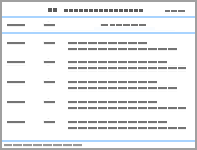
表1
试验点播种前土壤基本特性(0—20 cm)"
| 年份 Year | 有机质 Organic matter (g·kg-1) | 碱解氮 Alkaline hydrolyzable nitrogen (mg·kg-1) | 有效磷 Available phosphorus (mg·kg-1) | 速效钾 Available potassium (mg·kg-1) |
|---|---|---|---|---|
| 2021—2022 | 12.55 | 41.67 | 13.64 | 201.35 |
| 2022—2023 | 12.76 | 42.25 | 14.46 | 205.70 |
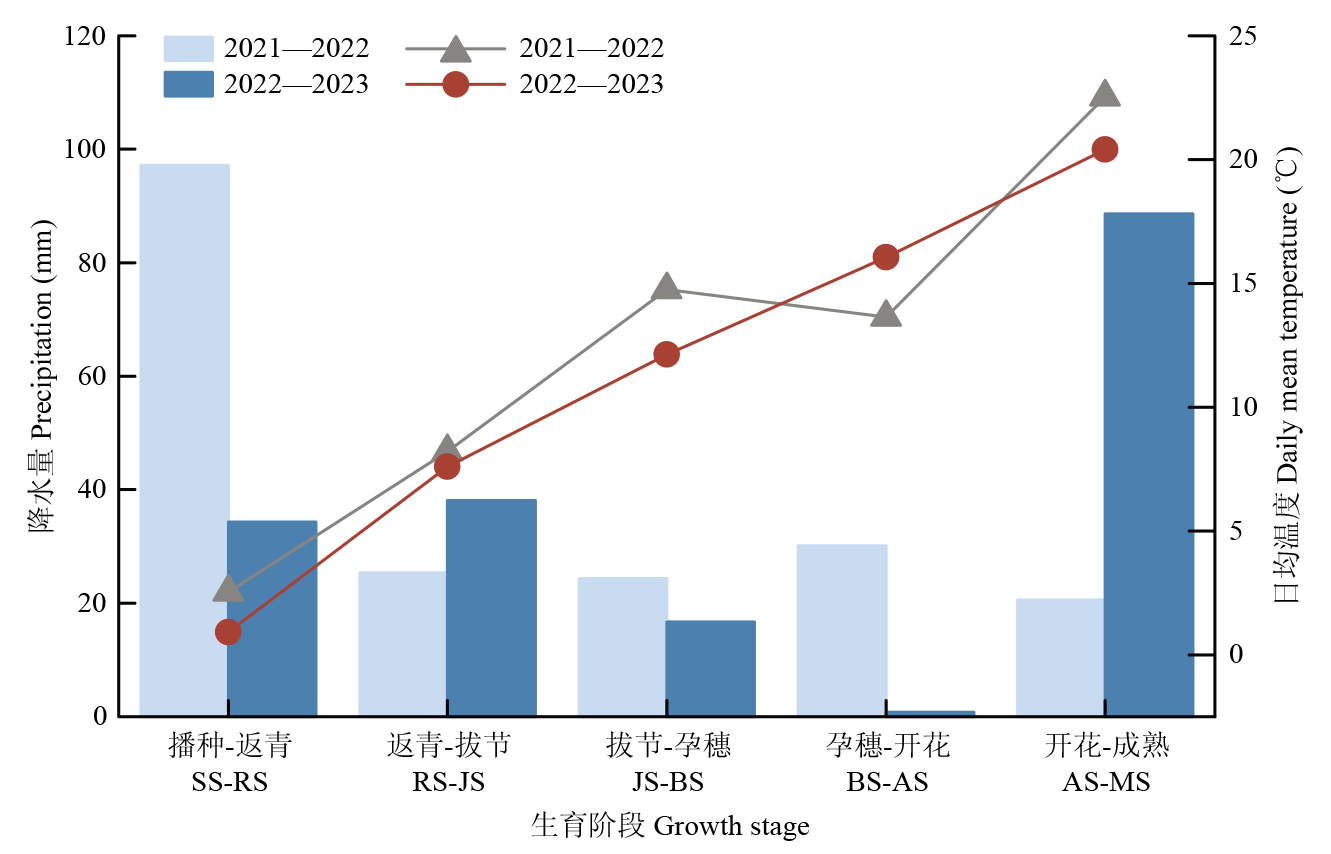
图1
冬小麦各生育阶段降水量与日均温度(2021—2023) 2021-2022年冬小麦返青、拔节、孕穗、开花和成熟日期依次为3月8日、4月1日、5月5日、5月18日与6月18日;2022-2023年分别为3月1日、3月25日、5月1日、5月15日及6月22日"
表2
试验点春季追肥时间"
| 年份 Year | 返青期(月-日) Regreening (Month-Day) | 拔节期(月-日) Jointing (Month-Day) | 追肥时间Topdressing date | |||
|---|---|---|---|---|---|---|
| D10(月-日) (Month-Day) | D20(月-日) (Month-Day) | D30(月-日) (Month-Day) | D40(月-日) (Month-Day) | |||
| 2021—2022 | 03-08 | 04-01 | 03-18 | 03-28 | 04-07 | 04-17 |
| 2022—2023 | 03-01 | 03-25 | 03-11 | 03-21 | 03-31 | 04-10 |
表3
追氮时期处理对应的叶龄与主要生育时期范围"
| 处理 Treatment | 返青后天数 Days after regreening | 对应主茎叶龄范围 Corresponding main stem leaf age range | 对应生育时期范围 Corresponding growth stage |
|---|---|---|---|
| D10 | 10 | 春生第1—2叶展开 Elongation of the 1st to 2nd spring leaves | 返青期-起身初期 Regreening to early erecting stage |
| D20 | 20 | 春生第3—4叶展开 Elongation of the 3rd to 4th spring leaves | 起身后期-拔节初期 Late erecting to early jointing stage |
| D30 | 30 | 春生第5—6叶展开 Elongation of the 5th to 6th spring leaves | 拔节中期-孕穗初期 Mid jointing to early booting stage |
| D40 | 40 | 旗叶展开前后Around flag leaf elongation | 孕穗期Booting stage |
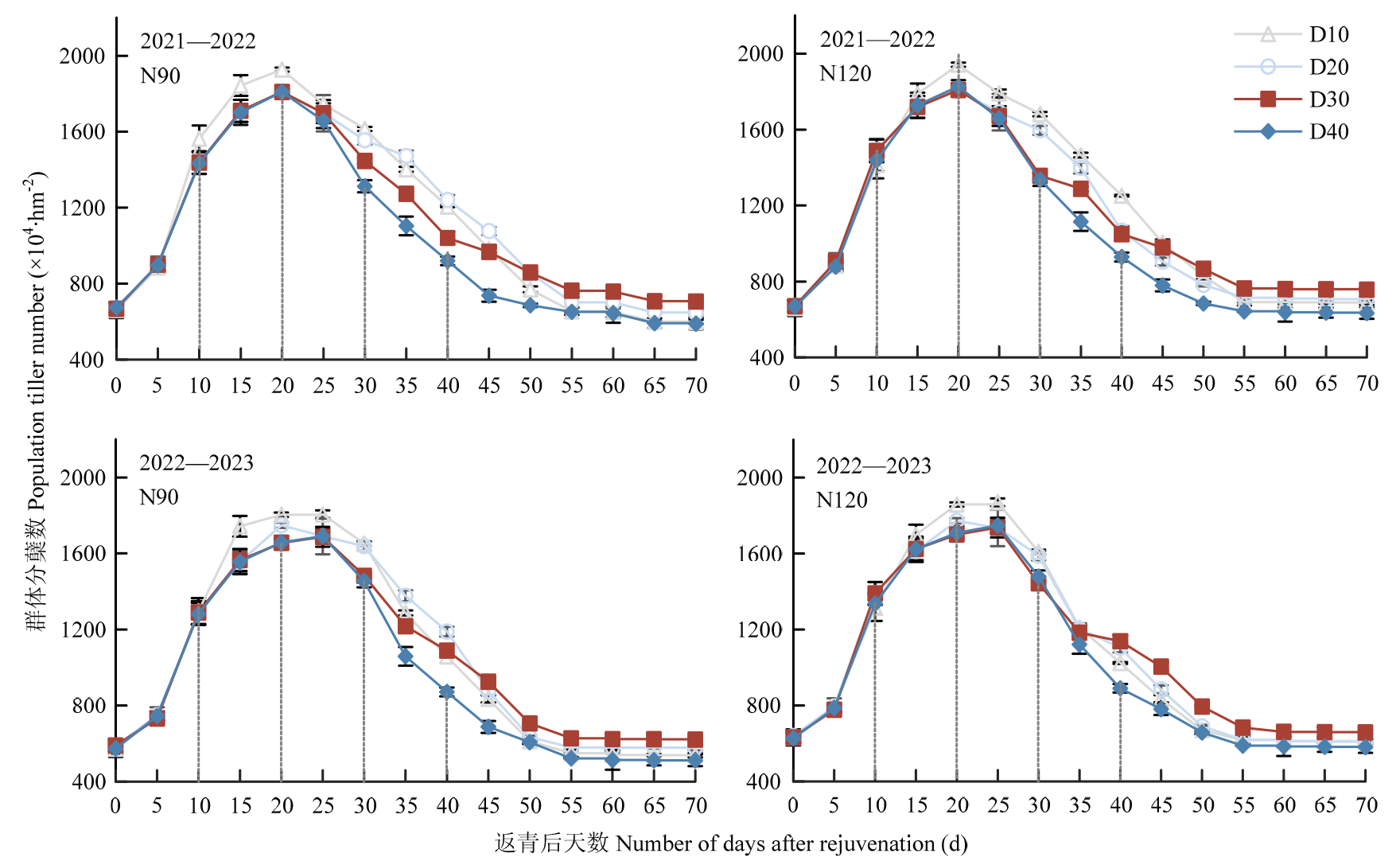
图2
春季追氮对冬小麦群体分蘖数动态的影响(2021—2023) 虚线与横坐标的交点表示追氮的实际时间点。在2021—2022年度,小麦返青后23、57和69 d分别对应拔节期、孕穗期和开花期;2022—2023年度,返青后24、56和70 d依次为拔节期、孕穗期和开花期;D10、D20、D30、D40分别代表本试验处理返青后10、20、30和40 d追氮。下同"
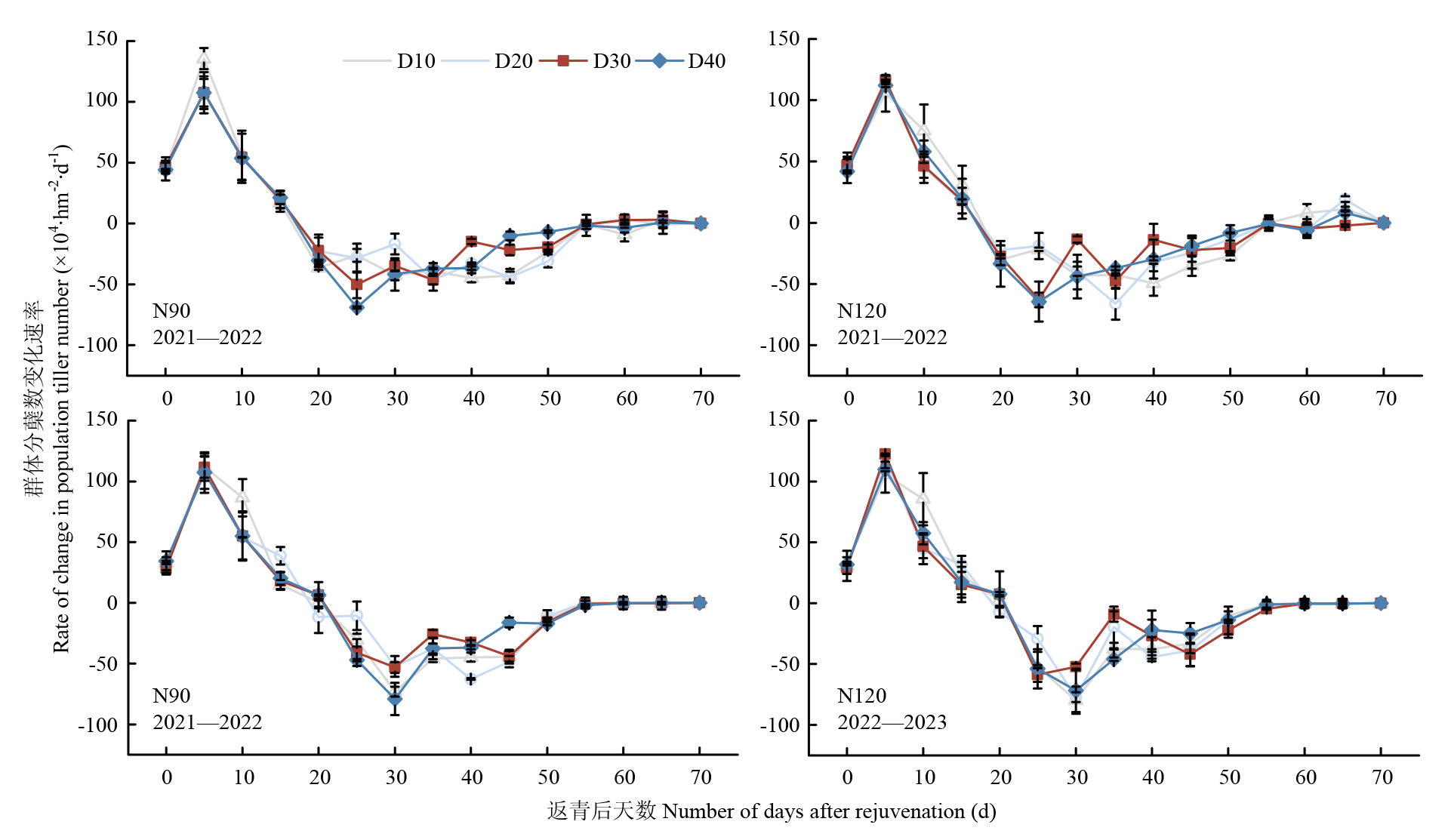
图3
春季追氮对冬小麦群体分蘖变化速率的影响(2021—2023)"
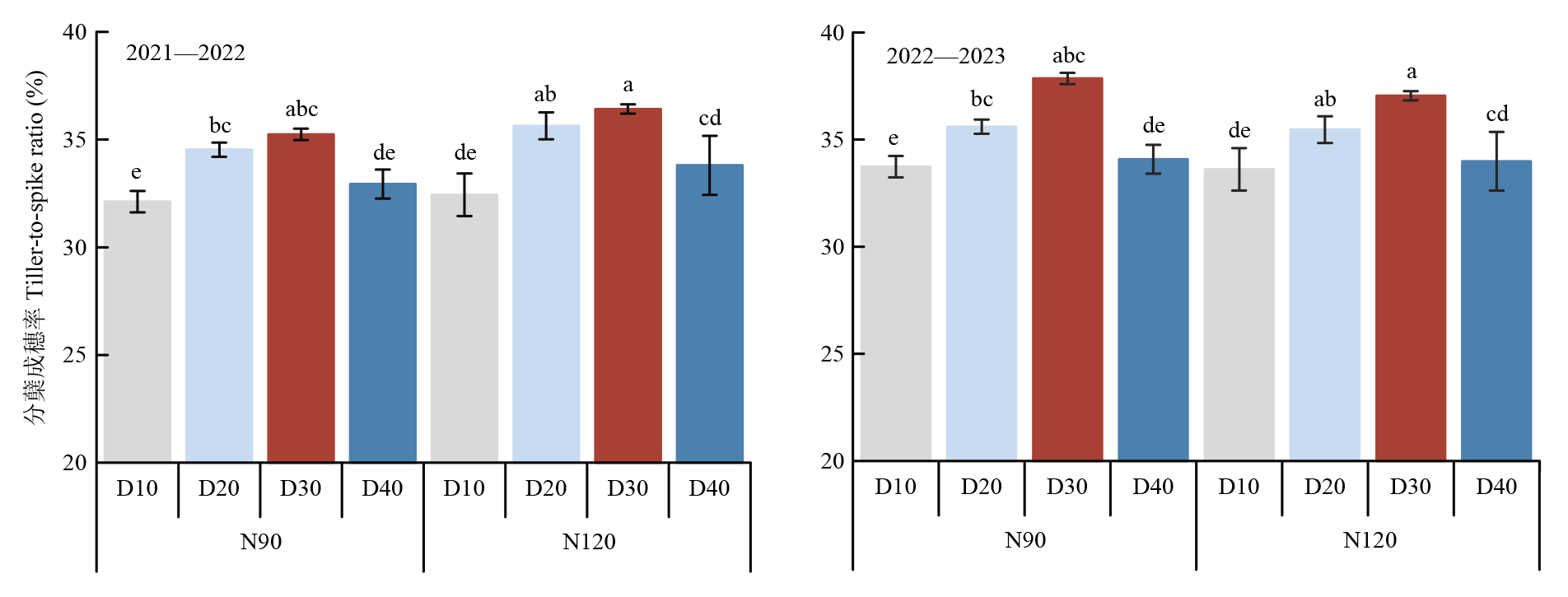
图4
春季追氮对冬小麦分蘖成穗率的影响(2021—2023) 不同小写字母表示处理间差异显著(P<0.05)。下同"
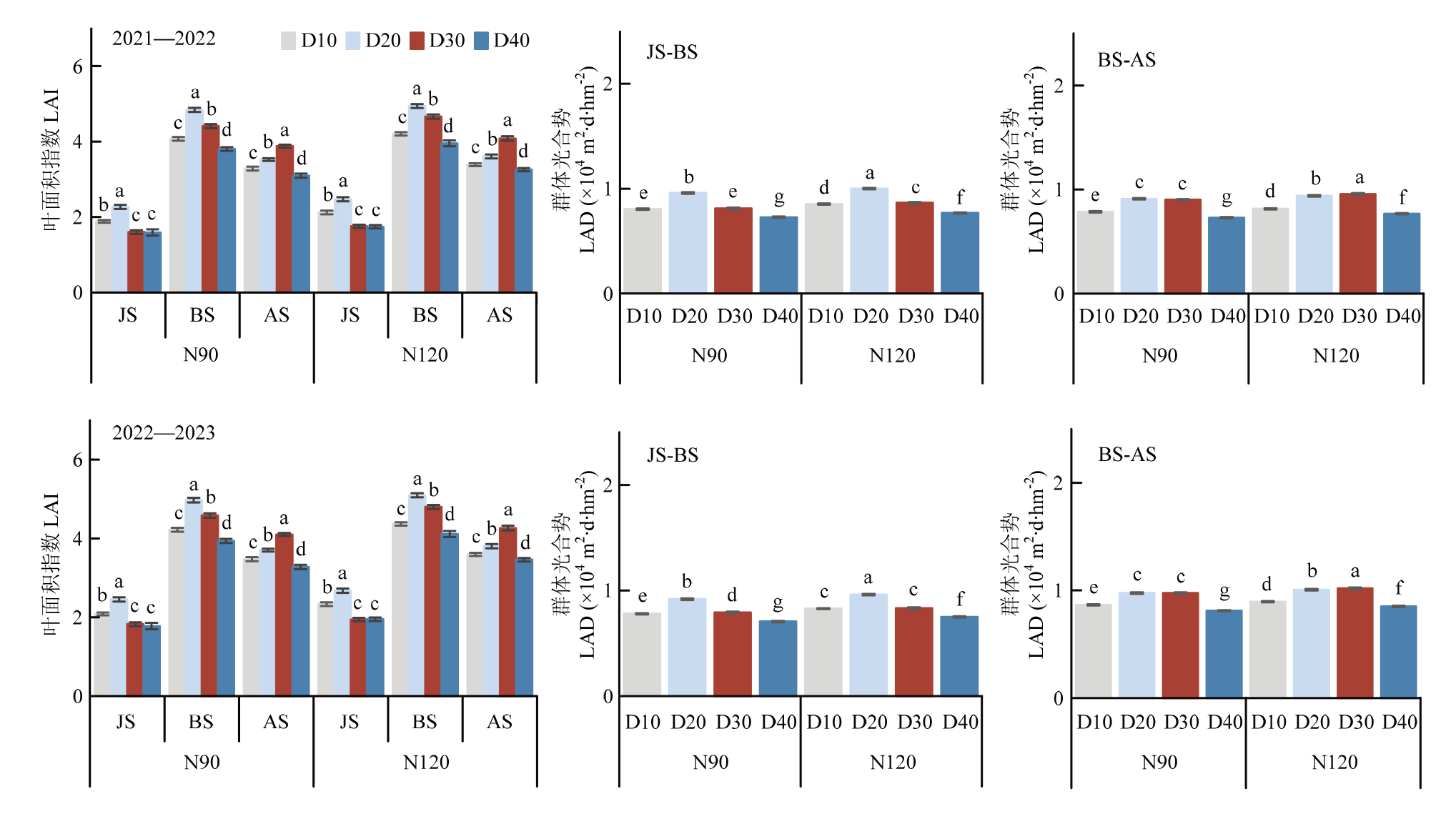
图5
春季追氮对冬小麦花前叶面积指数与群体光合势的影响(2021—2023) JS、BS、AS分别代表拔节期、孕穗期和开花期"
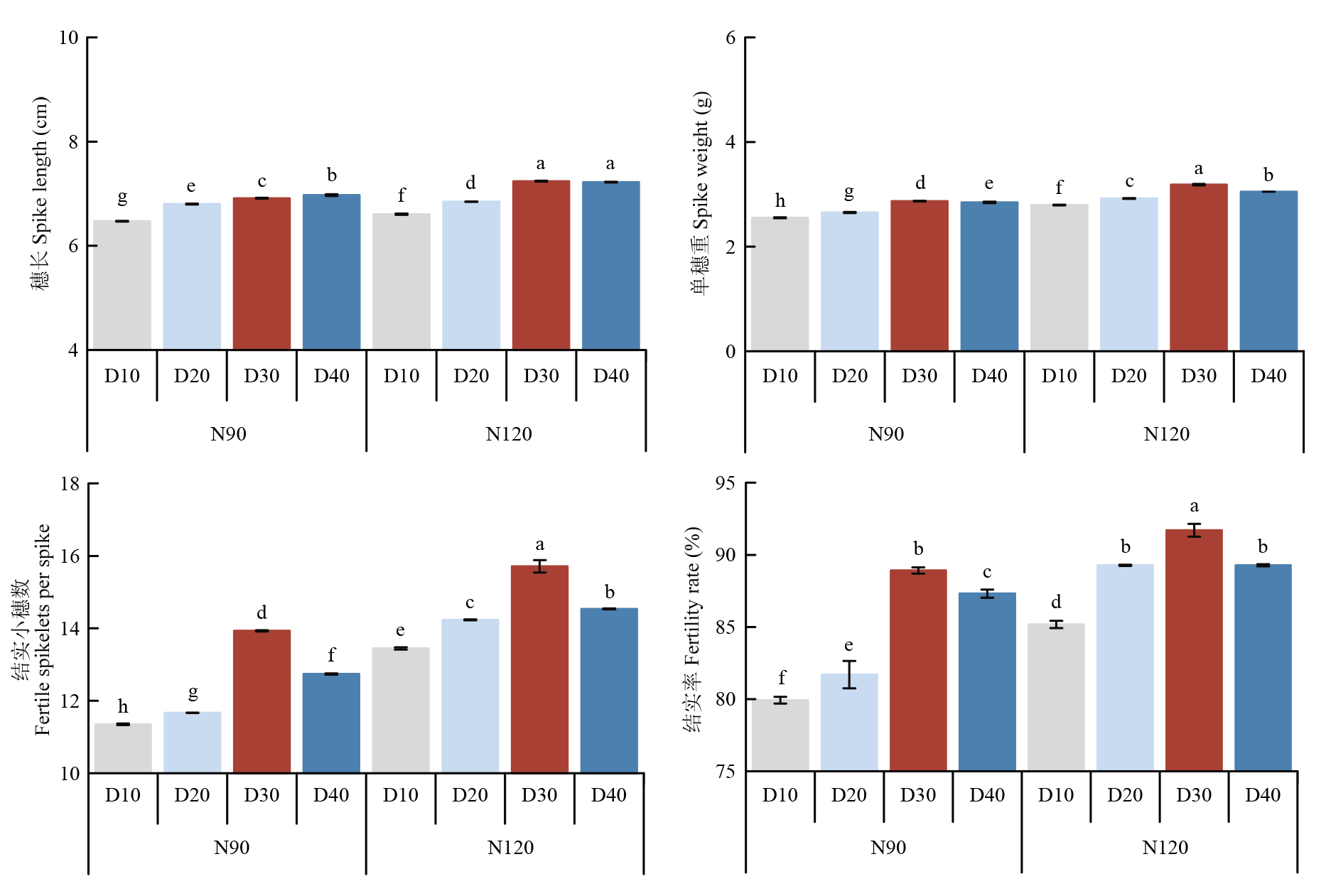
图6
春季追氮对冬小麦成熟期穗部性状的影响(2021—2022)"
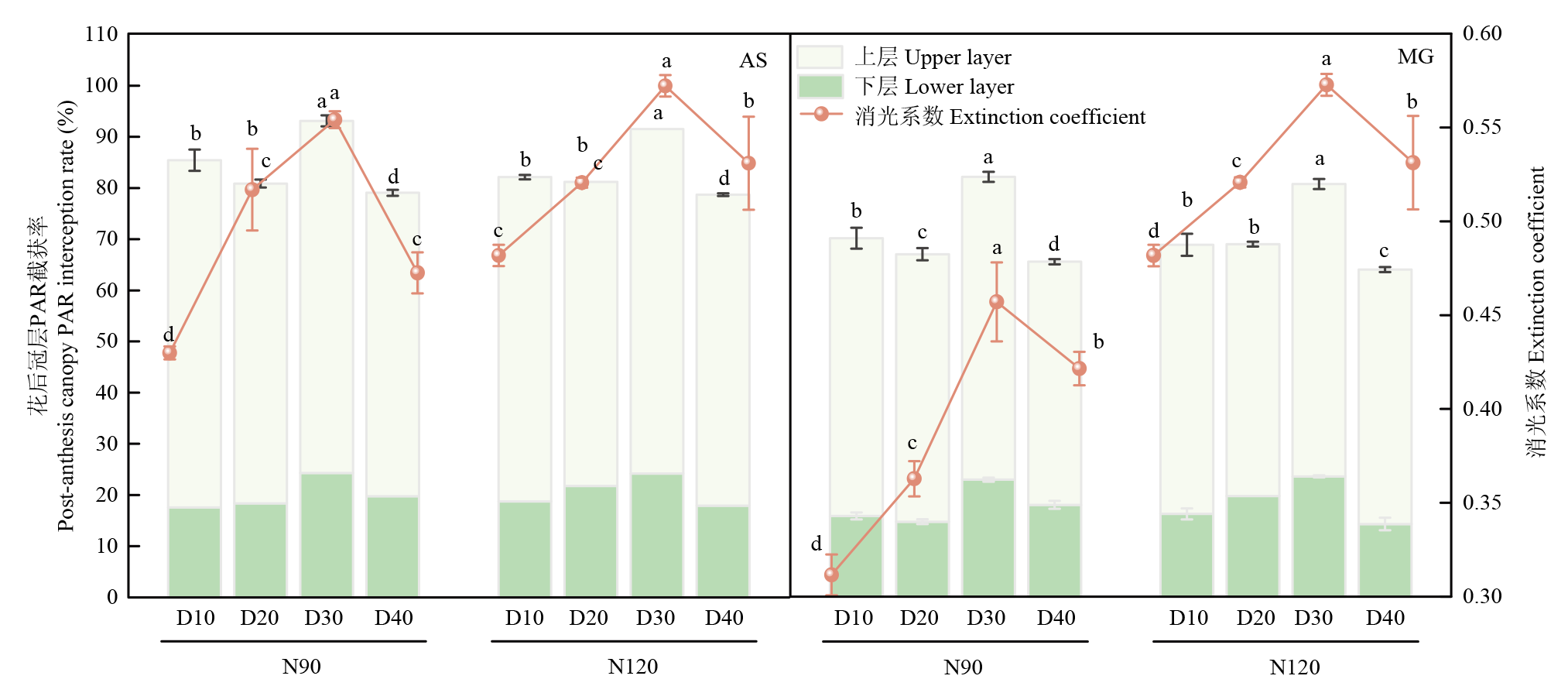
图7
春季追氮对冬小麦花后冠层有效辐射截获的影响(2022—2023)"
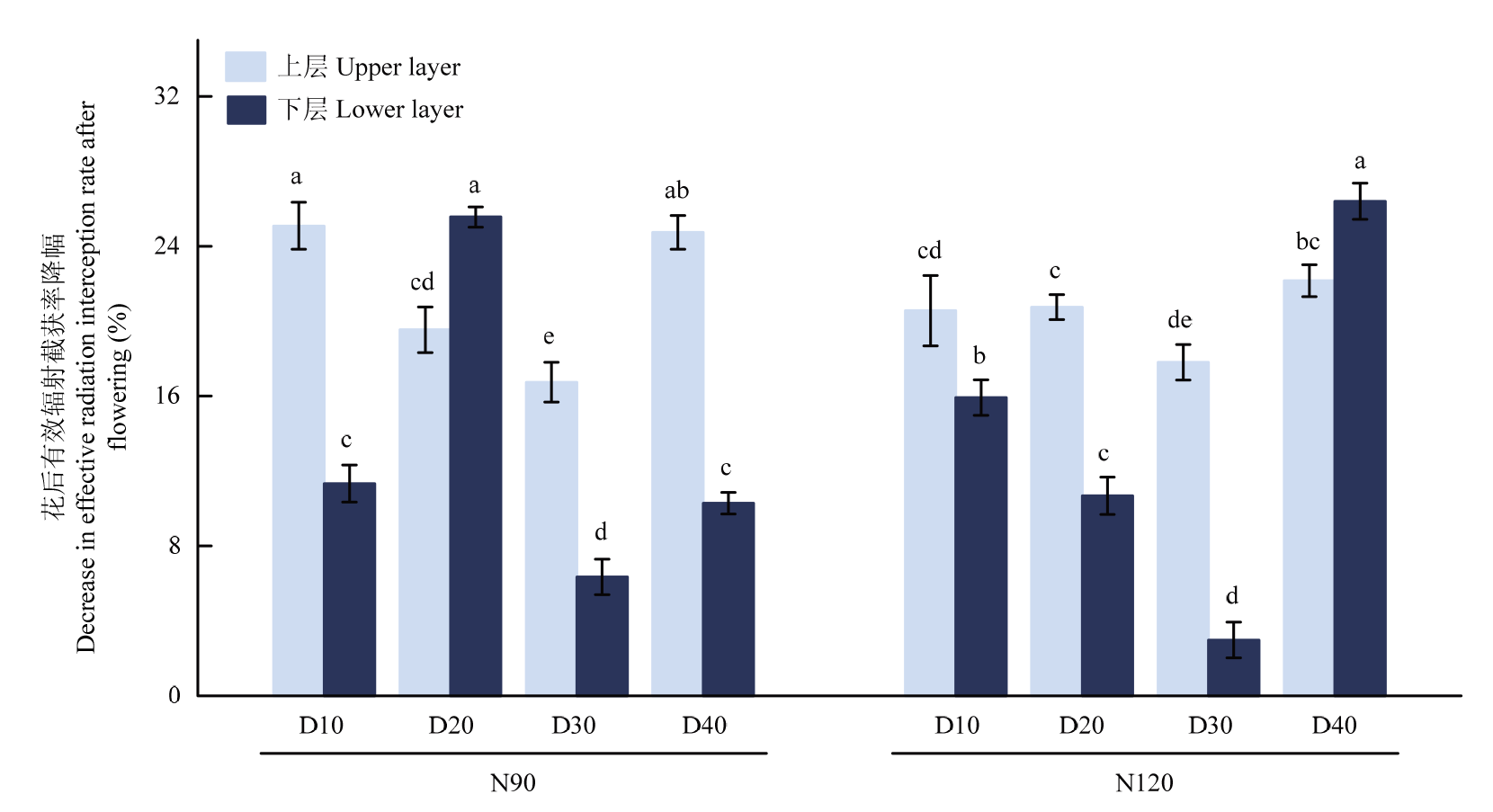
图8
春季追氮对冬小麦花后冠层有效辐射截获降幅的影响(2022—2023) AS:开花期;MG:灌浆中期"
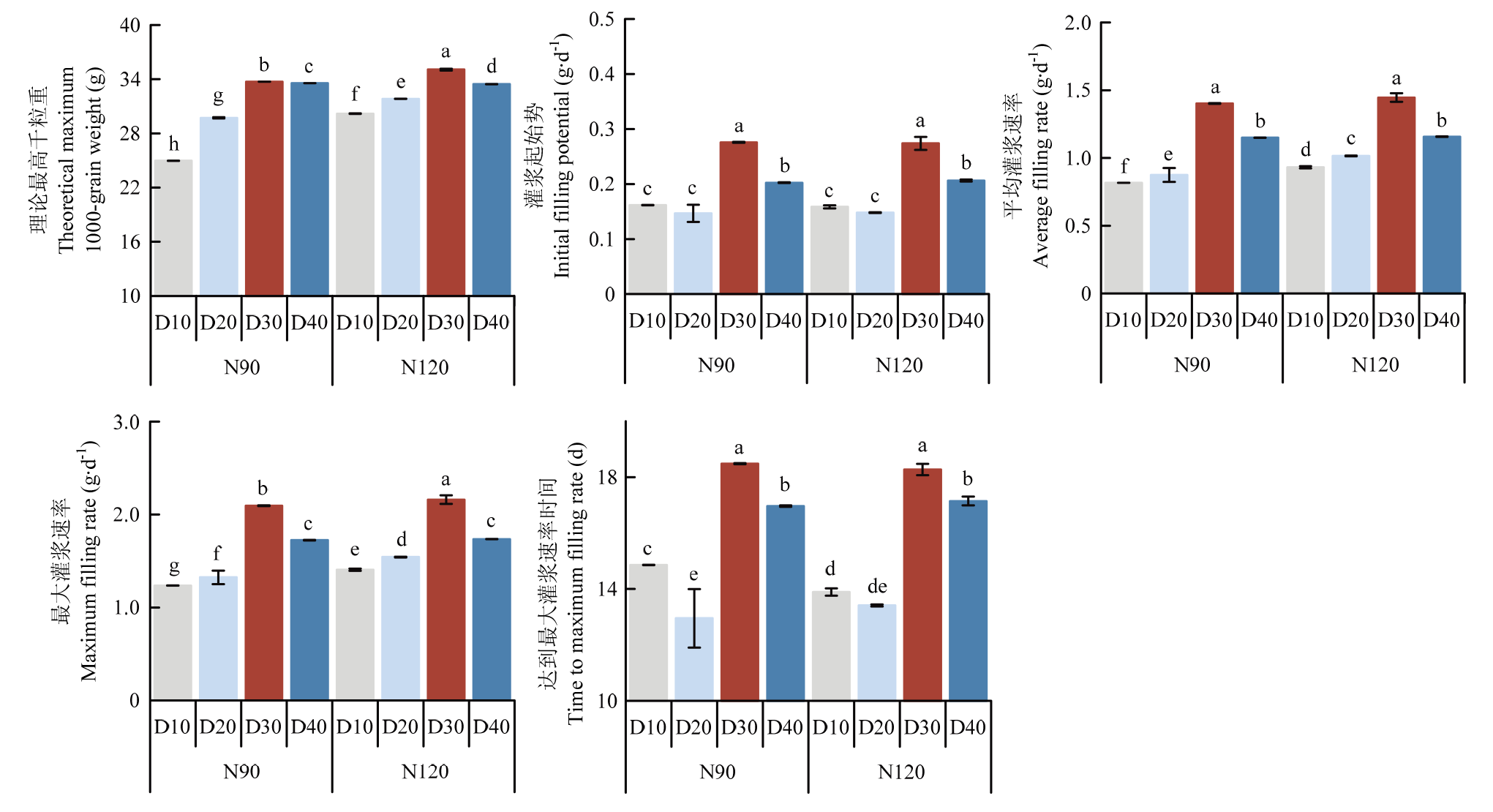
图9
春季追氮对冬小麦籽粒灌浆参数的影响(2022—2023)"
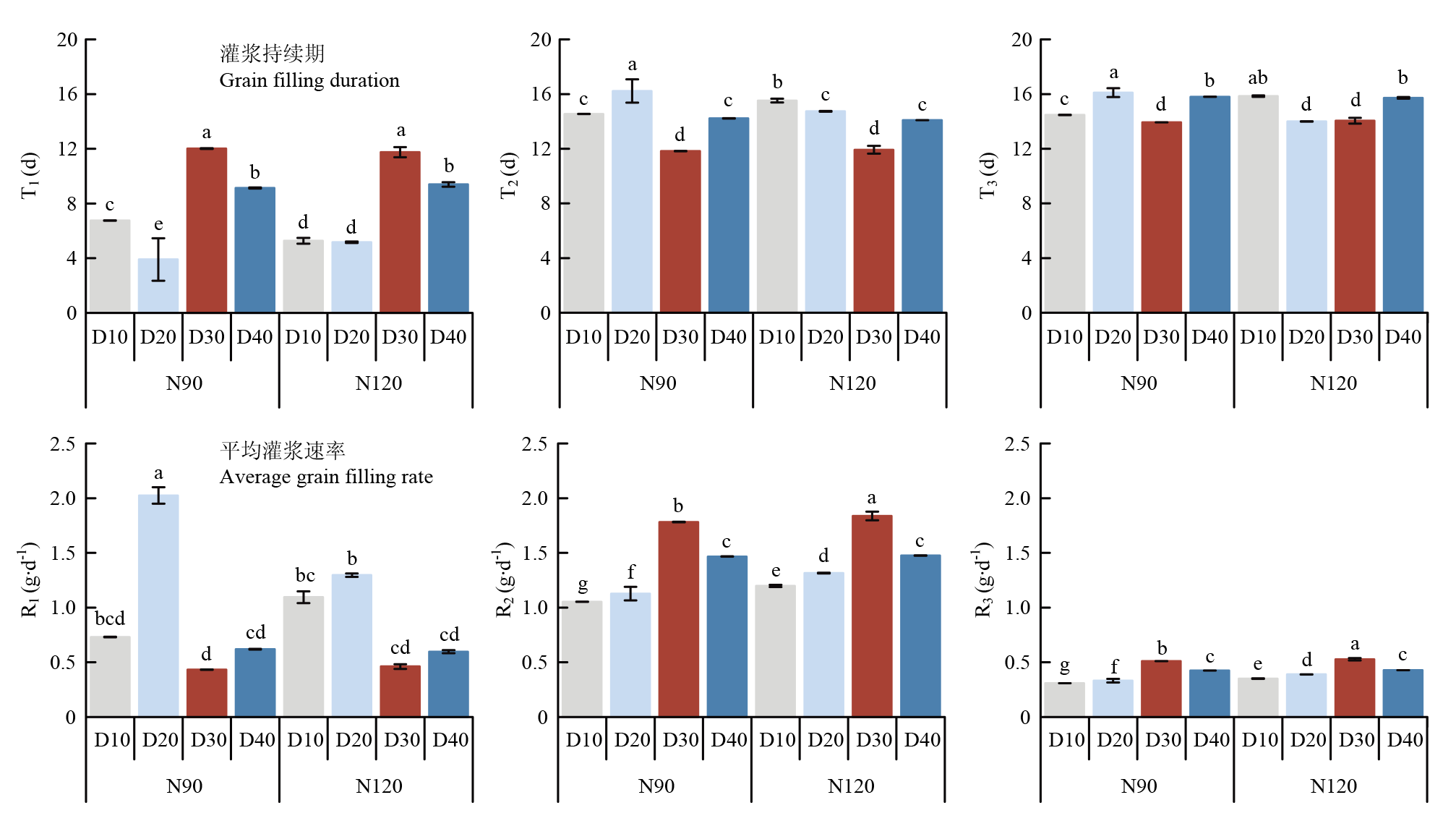
图10
春季追氮对冬小麦籽粒灌浆特性的影响(2022—2023) T1、T2、T3表示灌浆渐增期、快增期和缓增期的持续时间,R1、R2、R3是以上时期对应阶段灌浆速率"
表4
春季追氮对冬小麦产量及其构成因素的影响(2021—2023)"
| 年份 Year | 追氮量 Nitrogen application (kg·hm-2) | 追氮时间 Time of application | 穗数 Spikes (×104·hm-2) | 穗粒数 Grain number per spike | 千粒重 1000-grain weight (g) | 产量 Yield (kg·hm-2) |
|---|---|---|---|---|---|---|
| 2021—2022 | N90 | D10 | 618.76±3.25f | 41.61±1.10cd | 30.80±0.02c | 7155.39±59.88g |
| D20 | 624.76±4.00e | 42.50±0.50bcd | 31.18±0.92c | 7417.15±8.11e | ||
| D30 | 637.51±2.25c | 43.50±0.90abc | 32.99±0.22abc | 7622.16±13.10d | ||
| D40 | 595.51±0.75g | 40.76±0.20d | 31.98±0.65bc | 6377.21±22.01h | ||
| N120 | D10 | 629.26±1.25d | 43.02±0.35abcd | 32.35±0.78bc | 7671.57±3.69c | |
| D20 | 642.51±2.75b | 44.77±0.43ab | 33.24±1.10abc | 8399.89±15.48b | ||
| D30 | 658.76±0.50a | 45.42±2.84a | 35.03±0.99a | 8927.93±21.66a | ||
| D40 | 616.26±2.25f | 42.68±0.84bcd | 33.93±0.01ab | 7236.95±8.58f | ||
| 2022—2023 | N90 | D10 | 609.01±1.50d | 38.98±0.63e | 31.04±0.40e | 6939.93±19.74g |
| D20 | 622.36±1.35c | 39.02±0.67e | 32.09±0.45e | 7507.37±80.28e | ||
| D30 | 638.51±2.00ab | 43.51±0.52bc | 34.64±0.35bc | 7957.89±46.99c | ||
| D40 | 575.51±1.15f | 41.69±0.71d | 33.03±0.46d | 6778.27±34.14h | ||
| N120 | D10 | 628.51±1.00bc | 43.07±0.39c | 32.29±0.55c | 7770.68±47.35d | |
| D20 | 616.51±4.50cd | 44.10±0.34b | 33.04±0.55b | 8216.44±36.68h | ||
| D30 | 643.51±2.00a | 46.62±0.12a | 34.89±0.60a | 8897.26±74.13a | ||
| D40 | 593.76±2.75e | 45.98±0.52a | 33.52±0.32a | 7313.08±72.50f |
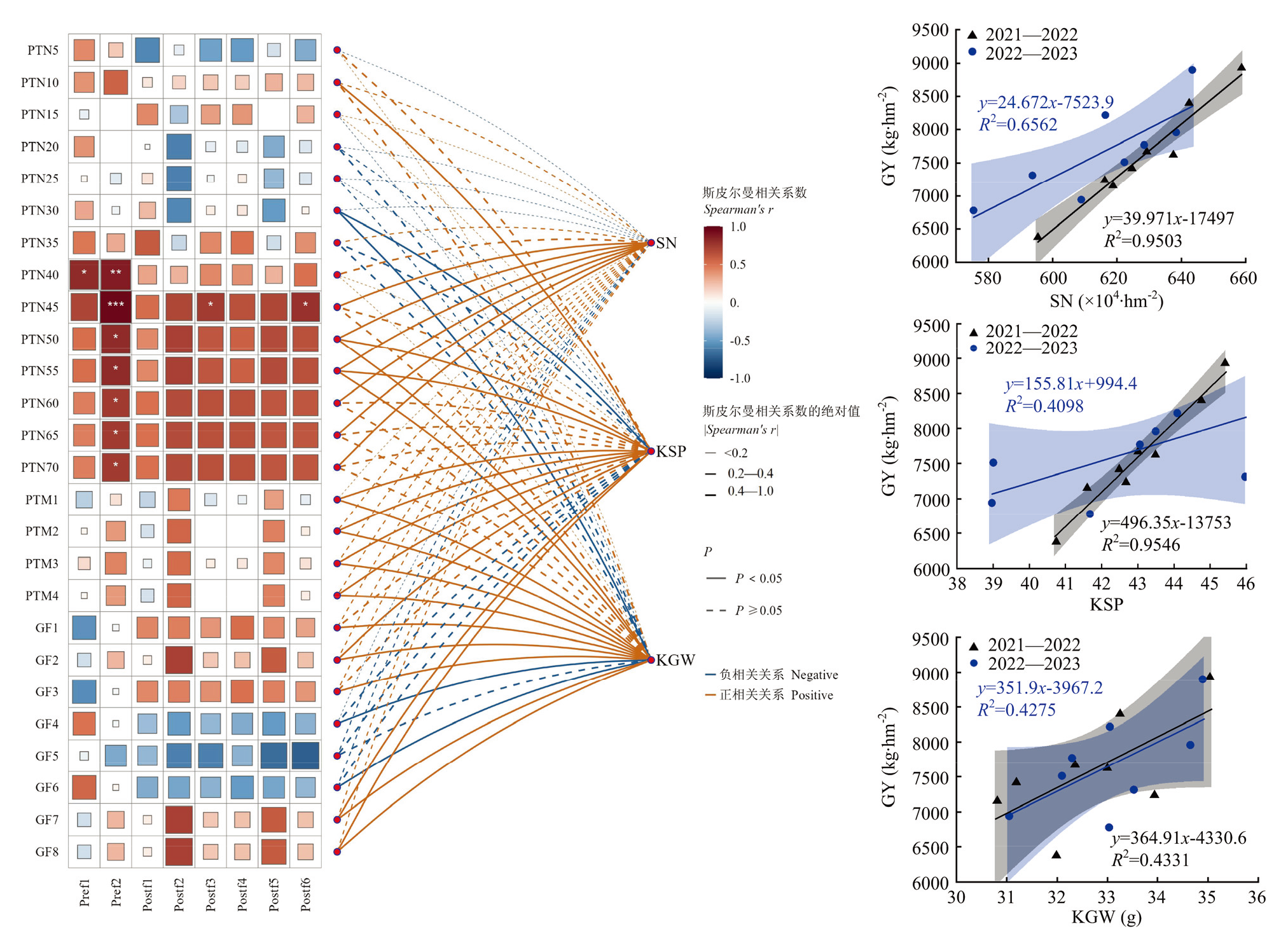
图11
调控产量构成因素的驱动因子分析 PTN代表群体分蘖数,其后数字代表返青后天数;PTM代表成熟期穗部性状,分别为穗长、单穗重量、结实小穗数、结实率;GF代表籽粒灌浆参数,分别为灌浆起始势、平均灌浆速率,灌浆渐增期、快增期和缓增期的持续时间以及对应时期的阶段灌浆速率;Pref1、Pref2分别为拔节-孕穗、孕穗-开花群体光合势,Postf1—6代表花后群体有效辐射截获参数,分别为开花期与灌浆中期上层、下层及总冠层群体有效辐射截获率;SN、KSP、KGW分别为穗数、穗粒数、千粒重;GY代表产量"
| [1] |
代新俊, 夏清, 杨珍平, 高志强. 氮肥后移对强筋小麦氮素积累转运及籽粒产量与品质的影响. 水土保持学报, 2018, 32(3): 289-294.
|
|
|
|
| [2] |
王婷, 常旭虹, 王艳杰, 刘希伟, 杨玉双, 王德梅, 石书兵, 赵广才. 冬小麦群体结构及产量对播期和追氮时期的响应. 麦类作物学报, 2025, 45(3): 395-403.
|
|
|
|
| [3] |
闫锦涛, 冯利平, 李扬, 陈先冠, 余卫东. 播期和播深对冬小麦越冬前生长性状的影响. 农业机械学报, 2022, 53(2): 327-335.
|
|
|
|
| [4] |
赵庆玲, 林文, 任爱霞, 张蓉蓉, 李蕾, 孙敏, 高志强. 春季追肥对冬小麦群体构建和籽粒灌浆进程的影响. 作物杂志, 2021(3): 99-105.
|
|
|
|
| [5] |
张军, 胡川, 周起晖, 任开明, 董誓言, 刘傲寒, 吴金芝, 黄明, 李友军. 减氮及有机肥替代对旱地冬小麦干物质积累、转运、分配和产量的影响. 作物学报, 2025, 51(1): 207-220.
|
|
doi: 10.3724/SP.J.1006.2025.41025 |
|
| [6] |
张永强, 陈传信, 徐其江, 聂石辉, 雷钧杰, 刘昌文. 氮肥增效剂与氮肥减量配施对冬小麦叶片生理及产量的影响. 新疆农业科学, 2023, 60(6): 1319-1325.
doi: 10.6048/j.issn.1001-4330.2023.06.003 |
|
doi: 10.6048/j.issn.1001-4330.2023.06.003 |
|
| [7] |
肖强, 刘东生, 刘建斌, 武凤霞, 衣文平. 减氮条件下配施控释尿素对冬小麦-夏玉米氮素利用及产量的影响. 华北农学报, 2023, 38(2): 160-169.
doi: 10.7668/hbnxb.20193572 |
|
doi: 10.7668/hbnxb.20193572 |
|
| [8] |
杨晓梅, 尹昌斌, 李贵春, 南云不二男. 氮肥减量及秸秆替代过量氮肥下冬小麦/夏玉米轮作体系氮素淋失风险研究. 中国农业资源与区划, 2016, 37(7): 116-122.
|
|
|
|
| [9] |
丛鑫, 庞桂斌, 张立志, 徐征和, 杨金梁, 牟晓宇. 减氮适水对冬小麦光合特性与土壤水氮分布的影响. 农业机械学报, 2021, 52(6): 324-332.
|
|
|
|
| [10] |
卢殿君, 陈新平, 张福锁, 崔振岭, 贺明荣, 王振林. 花后营养调控对冬小麦灌浆期物质生产、氮素吸收及再运移的影响. 中国农学通报, 2013, 29(9): 57-60.
|
|
doi: 10.11924/j.issn.1000-6850.2012-1595 |
|
| [11] |
doi: 10.3390/agriculture12020311 |
| [12] |
邓丽娟, 焦小强. 氮管理对冬小麦产量和品质影响的整合分析. 中国农业科学, 2021, 54(11): 2355-2365. doi:10.3864/j.issn.0578-1752.2021.11.009.
|
|
|
|
| [13] |
doi: 10.3390/plants13121714 |
| [14] |
doi: 10.1038/srep42247 pmid: 28176865 |
| [15] |
谢迎新, 刘宇娟, 张伟纳, 董成, 赵旭, 贺德先, 王晨阳, 郭天财, 王慎强. 潮土长期施用生物炭提高小麦产量及氮素利用率. 农业工程学报, 2018, 34(14): 115-123.
|
|
|
|
| [16] |
姜丽娜, 张凯, 宋飞, 张新敏, 蒿宝珍, 李春喜. 拔节期追氮对冬小麦产量、效益及氮素吸收和利用的影响. 麦类作物学报, 2013, 33(4): 716-721.
|
|
|
|
| [17] |
彭科研, 赵凯男, 周发宝, 刁延宾, 陈广周, 李升东. 氮肥减量后移对冬小麦-夏玉米两熟体系籽粒产量和氮素吸收利用的影响. 华北农学报, 2025, 40(1): 133-145.
doi: 10.7668/hbnxb.20194705 |
|
doi: 10.7668/hbnxb.20194705 |
|
| [18] |
翟苗苗. 基于地面激光雷达的小麦生物量和分蘖数估算研究[D]. 南京: 南京农业大学, 2018.
|
|
|
|
| [19] |
杜蒙蒙, 李民赞, 姬江涛,
|
|
|
|
| [20] |
李晓州, 郝明德, 赵晶, 王哲, 付威, 刘增照. 不同降水年型下长期施肥的小麦产量效应. 应用生态学报, 2018, 29(10): 3237-3244.
doi: 10.13287/j.1001-9332.201810.025 |
|
doi: 10.13287/j.1001-9332.201810.025 |
|
| [21] |
陈怡平, 陈东, 刘强, 毋俊华, 郭家宏, 张静, 闽东红, 张安静, 李瑞国, 郑颖娟, 等. 冬小麦突变新品系'白鹿181'的遗传构成、品质分析及栽培技术. 中国生态农业学报(中英文), 2024, 32(10): 1679-1688.
|
|
|
|
| [22] |
马瑞琦, 王德梅, 陶志强, 王艳杰, 杨玉双, 赵广才, 常旭虹. 追氮量对不同筋型小麦品种产量及农艺性状的调控效应. 作物杂志, 2023(2): 131-137.
|
|
|
|
| [23] |
裴自友, 温辉芹, 张立生, 程天灵, 李雪, 卢成达, 朱玫. 大赖草染色体对小麦光合特性和产量性状的效应研究. 农学学报, 2014, 4(7): 8-12.
|
|
|
|
| [24] |
郑梦瑶, 欧行奇, 尹宇龙, 李豪杰, 郑会芳, 崔振岭. 不同施氮处理对百农207光合特性及氮肥利用效率的影响. 环境工程技术学报, 2024, 14(5): 1459-1466.
|
|
|
|
| [25] |
刘哲文, 郭丹丹, 常旭虹, 王德梅, 杨玉双, 刘希伟, 王玉娇, 石书兵, 王艳杰, 赵广才. 氮肥追施时期和比例对强筋小麦籽粒灌浆及其生理机制的影响. 作物杂志, 2024(1): 174-179.
|
|
|
|
| [26] |
赵长星, 马东辉, 王月福, 林琪. 施氮量和花后土壤含水量对小麦旗叶衰老及粒重的影响. 应用生态学报, 2008, 19(11): 2388-2393.
|
|
|
|
| [27] |
郭天财, 岳艳军, 马冬云, 查菲娜, 宋晓, 朱云集, 王晨阳, 王永华, 韩巧霞. 追氮时期对冬小麦籽粒灌浆及淀粉特性的影响. 麦类作物学报, 2007, 27(5): 836-840.
|
|
|
|
| [28] |
曹彩云, 党红凯, 郑春莲, 郭丽, 李科江, 马俊永. 灌浆期高温胁迫对小麦灌浆的影响及叶面喷剂的缓解作用. 中国生态农业学报, 2016, 24(8): 1103-1113.
|
|
|
|
| [29] |
李世清, 邵明安, 李紫燕, 伍维模, 张兴昌. 小麦籽粒灌浆特征及影响因素的研究进展. 西北植物学报, 2003, 23(11): 2030-2038.
|
|
|
|
| [30] |
doi: 10.9755/ejfa. |
| [1] | 王彩玉, 刘小丽, 李文广, 杨文平, 杨珍平, 高志强. 有机肥不同替代比例对土壤多功能性的影响及微生物驱动机制[J]. 中国农业科学, 2026, 59(8): 1712-1726. |
| [2] | 朱琦, 贾振鹏, Tahir SHAH, 徐晨晟, 李芷琦, 吕会帅, 朱鹏超, 韦小敏, 黄冬琳, 孙艳妮, 曹卫东, 高亚军, 王朝辉, 张达斌. 绿肥配施增效产品降低旱地麦田温室气体排放及碳足迹[J]. 中国农业科学, 2026, 59(7): 1507-1522. |
| [3] | 钱瑾, 李映雪, 吴芳, 邹晓晨. 集成光谱降维的冬小麦叶片磷含量估算[J]. 中国农业科学, 2026, 59(4): 781-792. |
| [4] | 孔媛, 崔沙沙, 李美, 李健, 杨思雨, 房锋, 刘帅帅, 刘明平, 曾艳, 高兴祥, 柏连阳. 黄淮海冬小麦田多花黑麦草等5种禾本科杂草时空分布变化规律[J]. 中国农业科学, 2026, 59(4): 807-823. |
| [5] | 咸青林, 肖鉴珂, 高阿庆, 郜利闯, 刘杨. 种植方式结合测墒补灌下冬小麦产量及水分利用效率[J]. 中国农业科学, 2026, 59(3): 589-601. |
| [6] | 吕旭东, 孙世媛, 李亚楠, 刘玉龙, 王艳群, 付鑫, 张佳英, 宁鹏, 彭正萍. 智能机械化分层施肥对麦田根-土养分分布和小麦产量的影响[J]. 中国农业科学, 2026, 59(1): 129-146. |
| [7] | 蒲丽霞, 张佳芮, 叶建萍, 黄秀兰, 樊高琼, 杨洪坤. 二氢赤霉素与秸秆覆盖对旱地小麦分蘖成穗与产量的影响[J]. 中国农业科学, 2025, 58(9): 1735-1748. |
| [8] | 史帆, 李文广, 易树生, 杨娜, 陈玉萌, 郑伟, 张雪辰, 李紫燕, 翟丙年. 有机无机肥配施下旱地麦田土壤有机碳组分含量的变化特征[J]. 中国农业科学, 2025, 58(4): 719-732. |
| [9] | 房康睿, 丁世杰, 陈雨珊, 杨秉庚, 郭腾飞, 徐新朋, 赵士诚, 王秀斌, 黄绍敏, 仇少君, 何萍, 周卫. 有机无机肥配施下典型潮土小麦季有机肥氮磷的当季释放率[J]. 中国农业科学, 2025, 58(24): 5234-5246. |
| [10] | 佘映军, 周子哲, 伍明, 郭魏, 师昌健, 胡超, 李平. 地下水埋深和施氮对土壤水盐分布及冬小麦养分吸收利用的影响[J]. 中国农业科学, 2025, 58(20): 4285-4304. |
| [11] | 王荣荣, 徐宁璐, 黄修利, 赵凯男, 黄明, 王贺正, 付国占, 吴金芝, 李友军. 一次灌溉和氮肥运筹对旱地小麦籽粒产量和品质的影响[J]. 中国农业科学, 2025, 58(1): 43-57. |
| [12] | 高兴祥, 孔媛, 张耀中, 李美, 李健, 金岩, 张国福, 刘帅帅, 刘明平, 曾艳, 柏连阳. 河南省冬小麦田杂草群落分布现状及其变化原因分析[J]. 中国农业科学, 2025, 58(1): 91-100. |
| [13] | 臧少龙, 刘淋茹, 高越之, 吴珂, 贺利, 段剑钊, 宋晓, 冯伟. 基于无人机影像多时相的小麦品种氮效率分类识别[J]. 中国农业科学, 2024, 57(9): 1687-1708. |
| [14] | 高晨凯, 刘水苗, 李煜铭, 赵志恒, 邵京, 于昊琳, 吴鹏年, 王艳丽, 关小康, 王同朝, 温鹏飞. 冬小麦水分利用效率相关驱动因子及其预测模型构建[J]. 中国农业科学, 2024, 57(7): 1281-1294. |
| [15] | 高尚洁, 刘杏认, 李迎春, 柳晓婉. 施用生物炭和秸秆还田对农田温室气体排放及增温潜势的影响[J]. 中国农业科学, 2024, 57(5): 935-949. |
|
||
