






中国农业科学 ›› 2026, Vol. 59 ›› Issue (19): 4263-4276.doi: 10.3864/j.issn.0578-1752.2026.19.006
段旭坤1( ), 魏禾雅1, 李建政2(), 田峪萍1, 王立刚1()
收稿日期:2025-11-20
接受日期:2026-01-18
出版日期:2026-10-01
发布日期:2026-10-10
通信作者:
联系方式:
段旭坤,E-mail:2524822438@qq.com。
基金资助:
DUAN XuKun1(), WEI HeYa1, LI JianZheng2(), TIAN YuPing1, WANG LiGang1()
Received:2025-11-20
Accepted:2026-01-18
Published:2026-10-01
Online:2026-10-10
摘要:
【目的】瘠薄旱地农田中长期施用生物炭的效应尚不明确,本研究旨在通过长期定位试验定量分析氮肥减施条件下生物炭施用对黄淮海区域瘠薄农田固碳减排和作物生产的影响,为该区域同类型中低产田生物炭施用提供优化方案与科学依据。【方法】依托于农业农村部燕山生态环境重点野外科学观测试验站,在瘠薄农田开展了10年长期定位试验,设置农民常规施氮(N)、减施40%氮肥(RN)、减氮+每年施用低量生物炭(RNC1)及减氮+每5年施用高量生物炭(RNC5)4个处理,测定土壤有机碳含量及N2O排放通量,并结合土壤理化性状及作物产量等指标综合评价不同生物炭施用处理对瘠薄旱地固碳减排效应及作物生产的影响。【结果】与RN处理相比,RNC1处理显著提高土壤的速效养分水平,有效磷和速效钾分别提高28.5%和7.9%;而RNC5处理更侧重于土壤氮素固持,表层和深层土壤的全氮含量分别显著提高7.4%和13.5%,深层土壤的碱解氮含量显著提高10.3%。施用生物炭显著增加了土壤有机碳储量并改善了土壤碳组分,与N处理相比,RNC1与RNC5处理土壤有机碳储量分别提高了34.8%与38.6%,其中颗粒态有机碳含量分别提高了19.5%和20.5%,矿物结合态有机碳含量分别提高了78.3%和88.9%。减氮配施生物炭还减少了N2O排放,与RNC1处理相比,RNC5处理N2O累计排放量减少了13.0%,表明每隔数年施用一次生物炭能够有效发挥其土壤改良的特性并更有利于农业生态系统固碳减排。【结论】施用生物炭能够大幅提高土壤碳储量、减少温室气体排放、并改善土壤养分环境,其中每5年施用3.85 t生物炭还能够兼顾瘠薄农田固碳与作物产量的稳定性,可作为黄淮海区域瘠薄农田绿色低碳发展策略。
段旭坤, 魏禾雅, 李建政, 田峪萍, 王立刚. 长期施用生物炭对瘠薄旱地农田固碳减排及作物生产的影响[J]. 中国农业科学, 2026, 59(19): 4263-4276.
DUAN XuKun, WEI HeYa, LI JianZheng, TIAN YuPing, WANG LiGang. Effects of Long-term Biochar Application on Carbon Sequestration, Emission Reduction and Crop Production in Barren Rainfed Farmland[J]. Scientia Agricultura Sinica, 2026, 59(19): 4263-4276.
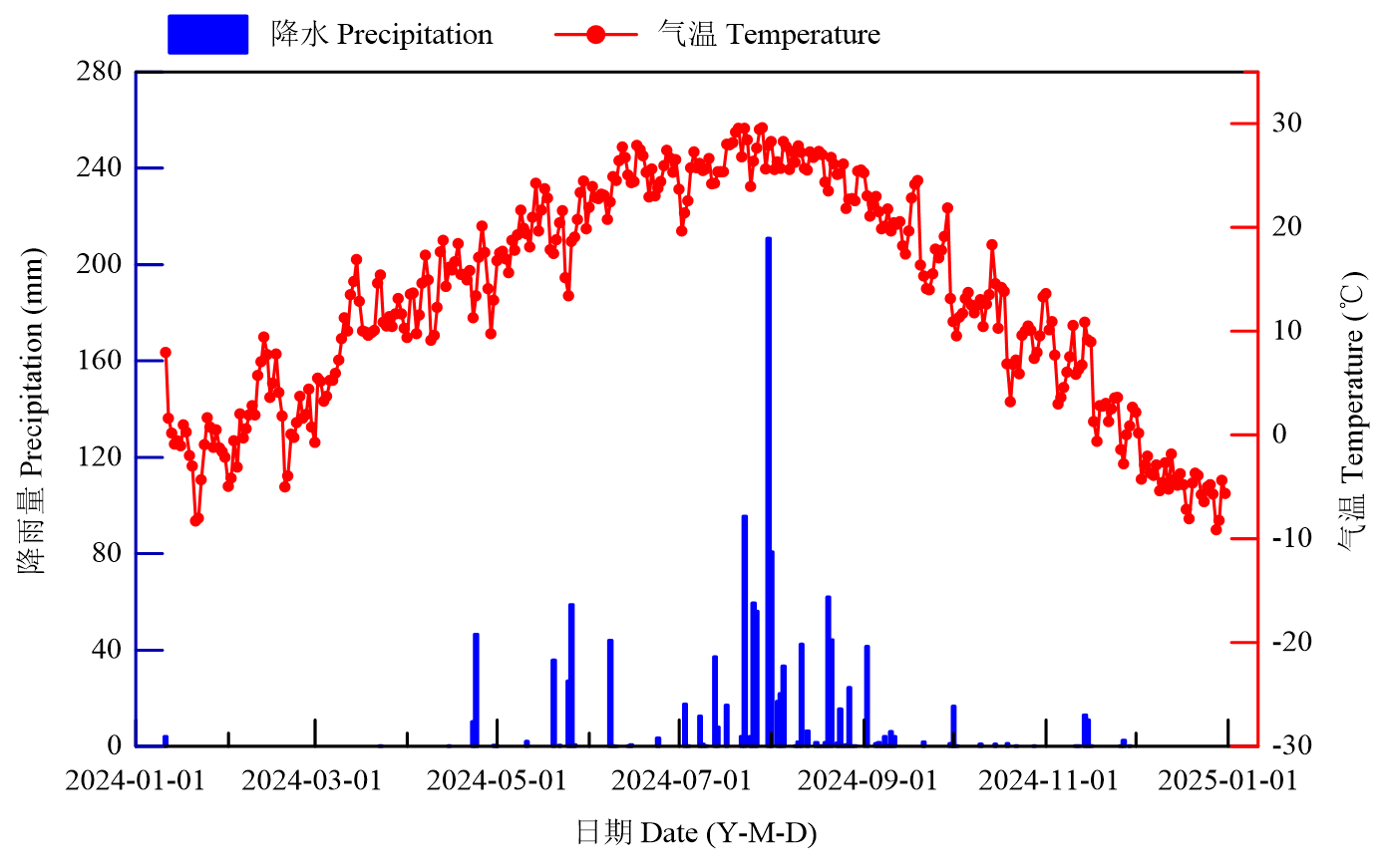
图1
试验期间降雨与气温"

表1
各试验处理化肥和生物炭施用量"
| 处理 Treatment | 氮肥 N (kg·hm-2) | 磷肥 P2O5 (kg·hm-2) | 钾肥 KCl (kg·hm-2) | 生物炭 Biochar |
|---|---|---|---|---|
| N | 180 | 75 | 75 | 0 |
| RN | 108 | 75 | 75 | 0 |
| RNC1 | 108 | 75 | 75 | 0.77 t·hm-2 per year |
| RNC5 | 108 | 75 | 75 | 3.85 t·hm-2 in 5 years |
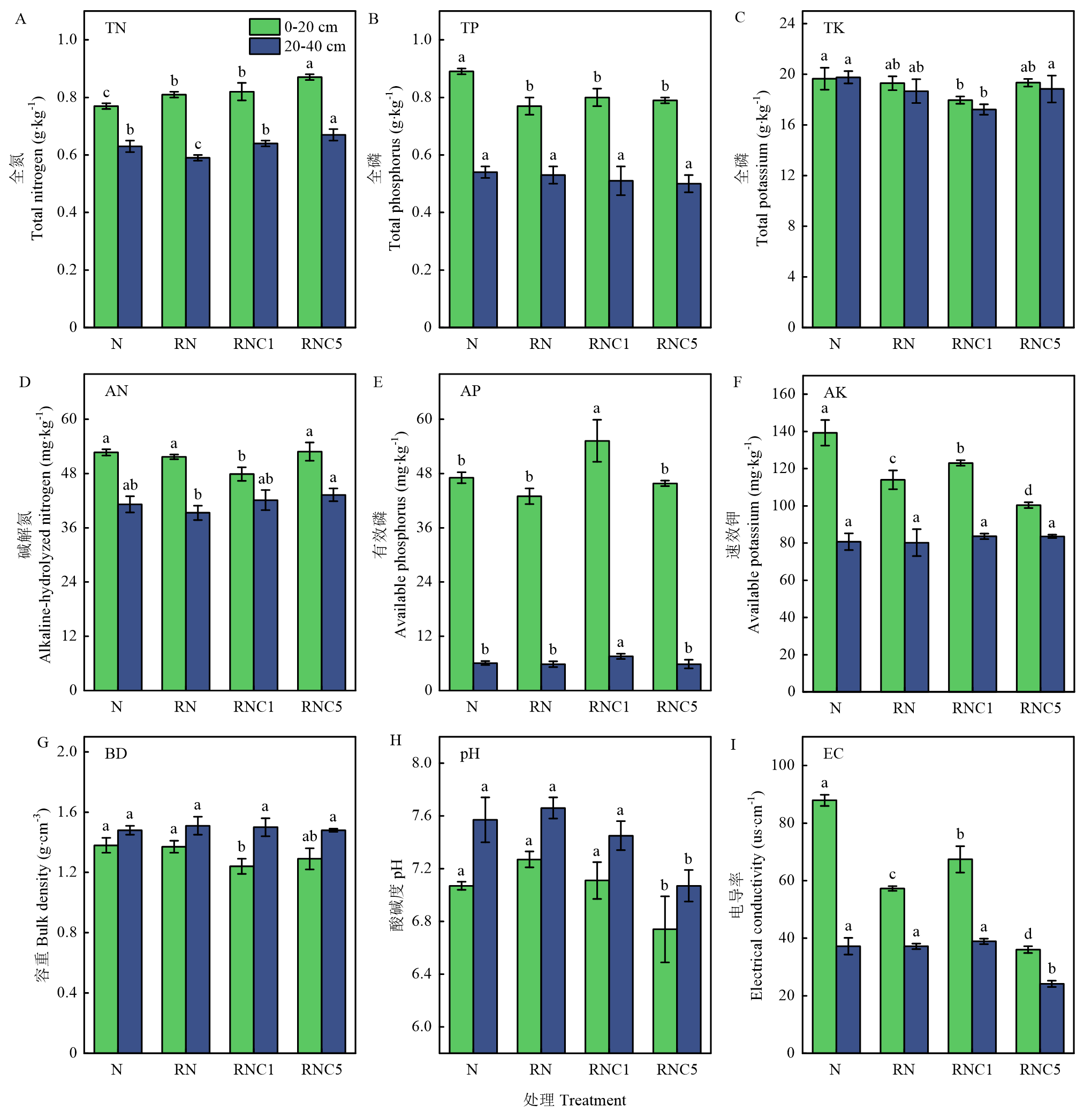
图2
不同处理对土壤理化性状的影响 图柱上不同小写字母表示不同处理间差异显著(P<0.05)。下同"
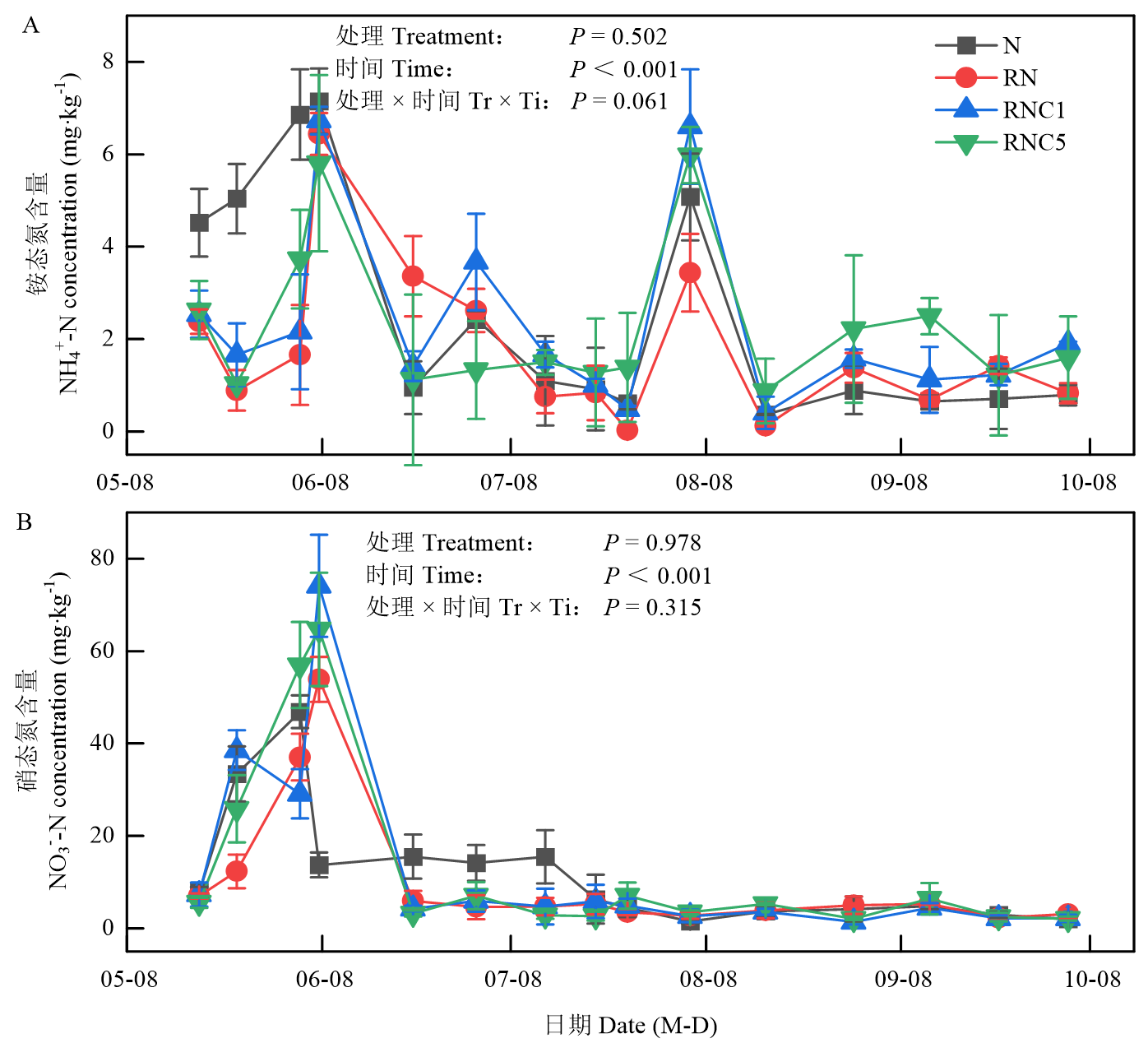
图3
玉米生长季土壤铵态氮(A)与硝态氮(B)的含量变化"
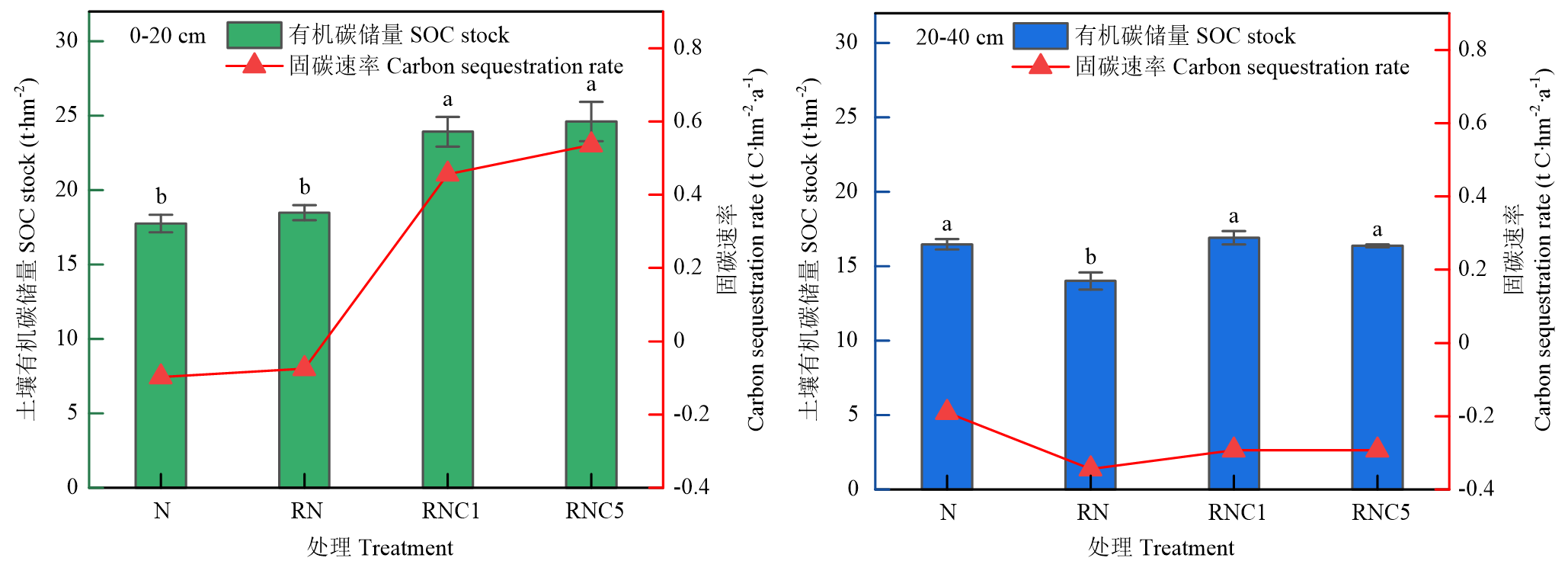
图4
不同处理对土壤有机碳储量的影响"
表2
不同处理对土壤碳组分的影响"
| 处理 Treatment | 可溶性有机碳 Dissolved organic carbon (mg·kg-1) | 微生物量碳 Microbial biomass carbon (g·kg-1) | 颗粒有机碳 Particulate organic carbon (g·kg-1) | 矿物结合态有机碳 Mineral-associated organic carbon (g·kg-1) |
|---|---|---|---|---|
| N | 57.86±3.21b | 66.67±0.86b | 3.47±0.26b | 3.10±0.03c |
| RN | 46.56±0.76c | 78.18±2.81a | 2.65±0.26c | 4.10±0.12b |
| RNC1 | 62.77±2.02a | 65.25±4.24b | 4.15±0.16a | 5.52±0.46a |
| RNC5 | 56.78±2.62b | 63.73±4.00b | 4.19±0.47a | 5.85±0.66a |
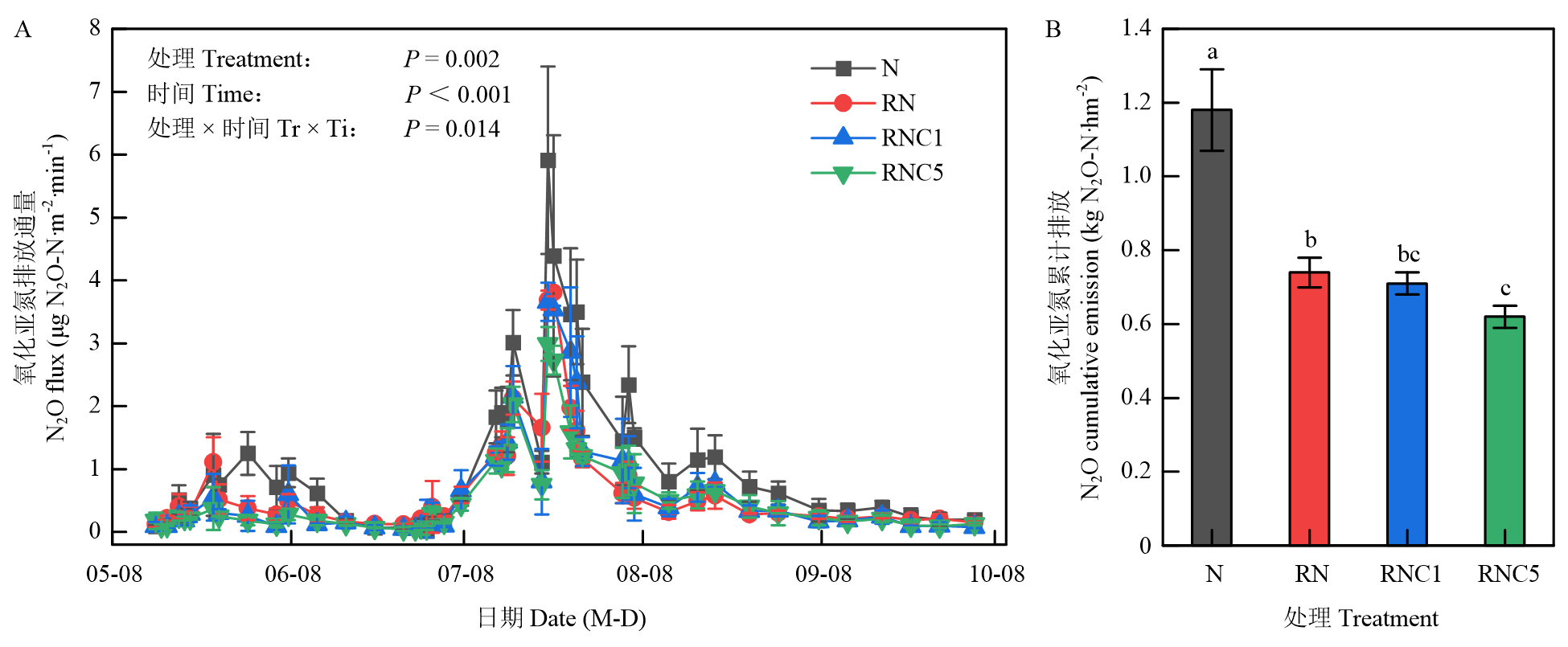
图5
不同处理对N2O排放的影响"
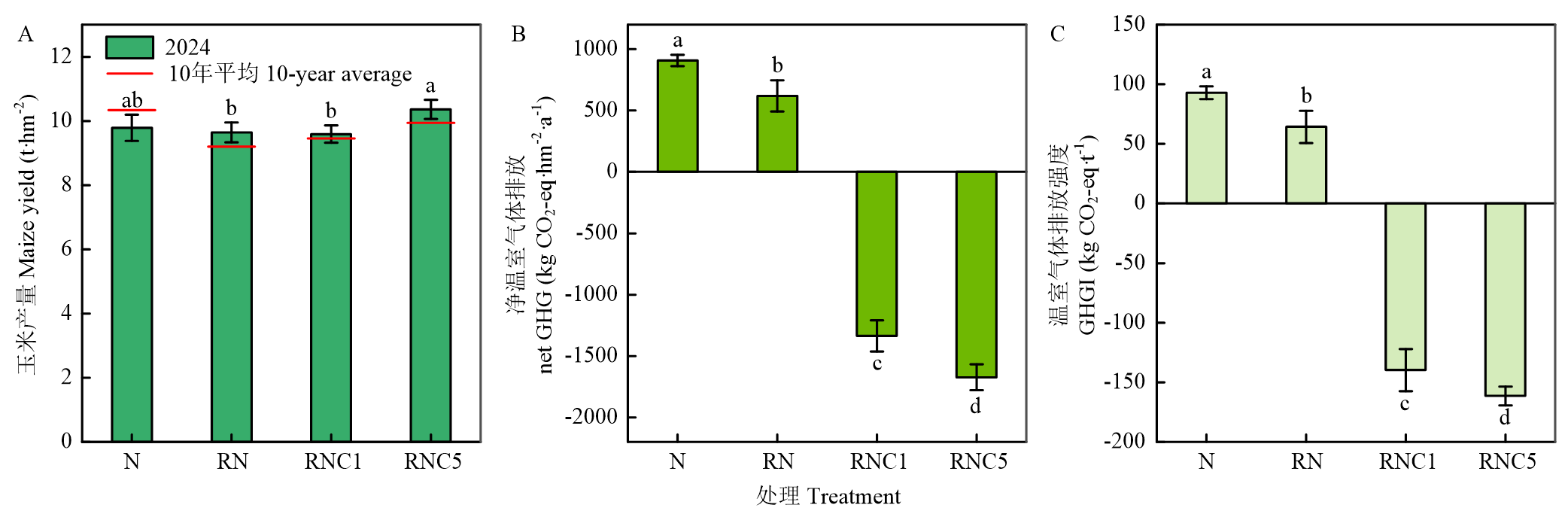
图6
不同处理对玉米产量、净温室气体排放和温室气体排放强度的影响"

图7
温室气体排放、作物产量、土壤有机碳、各理化性状间的相关关系 *:P<0.05;**:P<0.01;***:P<0.001. 下同 The same as below TN:全氮Total nitrogen; TP:全磷 Total phosphorus; TK:全钾 Total potassium; AN:碱解氮 Alkaline-hydrolyzed nitrogen; AP:有效磷 Available phosphorus; AK:速效钾 Available potassium; BD:容重 Bulk density; EC:电导率 Electrical conductivity; DOC:可溶性有机碳 Dissolved organic carbon; MBC:微生物量碳 Microbial biomass carbon; POC:颗粒态有机碳 Particulate organic carbon; MAOC:矿物结合态有机碳 Mineral-associated organic carbon; SOC:土壤有机碳 Soil organic carbon; N2O:氧化亚氮Nitrous oxide; CO2:二氧化碳Carbon dioxide; Yield:产量"

图8
施肥对瘠薄农田固碳减排和作物生产的影响路径 A:偏最小二乘结构方程模型;B:作物产量效应分解;C:氧化亚氮效应分解;D:土壤碳效应分解;GFI = 0.70:拟合优度指数"
| [1] |
2019年全国耕地质量等级情况公报(农业农村部公报[2020]1号)[Z]. 中华人民共和国农业农村部公报, 2020(4): 113-121.
|
|
Announcement of national arable land quality grading in 2019[Z]. Gazette of the Ministry of Agriculture and Rural Affairs of the People’s Republic of China, 2020(4): 113-121. (in Chinese)
|
|
| [2] |
doi: 10.1016/j.soilbio.2011.04.022 |
| [3] |
doi: 10.1021/acs.est.3c02620 |
| [4] |
doi: 10.1016/j.fcr.2024.109517 |
| [5] |
doi: 10.1016/j.still.2022.105337 |
| [6] |
高尚洁, 刘杏认, 李迎春, 柳晓婉. 施用生物炭和秸秆还田对农田温室气体排放及增温潜势的影响[J]. 中国农业科学, 2024, 57(5): 935-949. DOI: 10.3864/j.issn.0578-1752.2024.05.009.
|
|
|
|
| [7] |
doi: 10.1016/j.scitotenv.2023.166171 |
| [8] |
doi: 10.1111/gcbb.2016.8.issue-2 |
| [9] |
doi: 10.1016/j.soilbio.2014.04.029 |
| [10] |
doi: 10.1016/j.still.2025.106713 |
| [11] |
doi: 10.1016/j.still.2025.106723 |
| [12] |
doi: 10.1016/j.jafr.2025.102211 |
| [13] |
doi: 10.1016/j.jclepro.2023.138425 |
| [14] |
doi: 10.1007/s42773-021-00090-6 |
| [15] |
doi: 10.1016/j.eja.2025.127516 |
| [16] |
|
| [17] |
doi: 10.1021/acs.est.0c04033 |
| [18] |
doi: 10.2136/sssaj1992.03615995005600030017x |
| [19] |
doi: 10.1016/S0016-7061(00)00077-X |
| [20] |
doi: 10.1016/0038-0717(90)90046-3 |
| [21] |
doi: 10.1111/gcb.2011.17.issue-4 |
| [22] |
杨建君, 盖浩, 孙振兴, 王卿梅, 陈柏旭, 文昊, 焦玉昌, 王立刚. 一种用于高秆作物的便携式农田温室气体采集装置[P]. 中国: CN216484204U, 2022-05-10.
|
|
|
|
| [23] |
IPCC. 2019 Refinement to the 2006 IPCC Guidelines for National Greenhouse Gas Inventories: Volume 4-Agriculture, Forestry and Other Land Use[M]. Hayama, Japan: Institute for Global Environmental Strategies (IGES), 2019.
|
| [24] |
蒋志敏, 王威, 储成才. 植物氮高效利用研究进展和展望[J]. 生命科学, 2018, 30(10): 1060-1071.
|
|
|
|
| [25] |
doi: 10.1016/j.fuel.2021.120128 |
| [26] |
doi: 10.1038/s41467-024-50674-6 |
| [27] |
史广宇, 吴贝贝, 胡嘉源, 施维林. 施加生物炭缓解土壤氮流失机理的研究进展[J]. 环境化学, 2025, 44(1): 149-163.
|
|
|
|
| [28] |
doi: 10.1007/s42773-020-00065-z |
| [29] |
doi: 10.1016/j.chemosphere.2019.125471 |
| [30] |
doi: 10.1080/00103624.2016.1225081 |
| [31] |
doi: 10.1016/j.jenvman.2024.121653 |
| [32] |
doi: 10.1007/s42773-022-00138-1 |
| [33] |
doi: 10.3390/agriculture15050561 |
| [34] |
doi: 10.1016/j.fuel.2025.135745 |
| [35] |
doi: 10.1080/10643389.2016.1239975 |
| [36] |
|
| [37] |
黄家威, 白嘉骏, 关松, 窦森, 张家麟, 王曦若. 田间老化生物质炭结构表征及吸附铵态氮效应[J]. 土壤学报, 2023, 60(5): 1468-1479.
|
|
|
|
| [38] |
doi: 10.1016/j.biortech.2015.05.054 pmid: 26022969 |
| [39] |
doi: 10.1016/j.geoderma.2020.114184 |
| [40] |
doi: 10.1016/j.scitotenv.2022.158876 |
| [41] |
doi: 10.1016/j.scitotenv.2023.163968 |
| [42] |
doi: 10.1007/s11368-023-03546-3 |
| [43] |
doi: 10.1111/gcbb.v14.10 |
| [44] |
doi: 10.1038/s43016-025-01124-z pmid: 40074921 |
| [45] |
|
| [46] |
doi: 10.1016/j.catena.2014.10.026 |
| [1] | 李星宇, 黄容, 鲜一鸣, 田娇娇, 马晓瑾, 杨乔茜, 李冰, 王昌全. 稻田土壤不同粒级团聚体有机碳组分及CO2排放对长期施肥的响应[J]. 中国农业科学, 2026, 59(6): 1255-1271. |
| [2] | 李永娟, 张悦彤, 王艺博, 赵长江, 宋洁, 陈雪丽, 姚钦. 生物炭施用对大豆轮连作系统土壤固氮微生物nifH基因丰度及群落组成的影响[J]. 中国农业科学, 2026, 59(6): 1272-1285. |
| [3] | 韩小雨, 朱玉萍, 刘红芳, 孙志梅, 张秀芝, 高洪军, 彭畅, 张淑香. 长期施肥措施下黑土活性碳组分和碳水解酶的动态变化[J]. 中国农业科学, 2026, 59(18): 4092-4104. |
| [4] | 吴佳佳, 刘蕊, 李鑫艳, 张久东, 常单娜, 曹卫东. 间作绿肥下减氮并配施生物炭降低玉米生产氮足迹[J]. 中国农业科学, 2026, 59(16): 3605-3620. |
| [5] | 李津津, 赵宇晴, 刘芮怡, 吉艳芝, 谢建治, 郭艳杰, 张丽娟. 减氮控水配施生物炭与硝化抑制剂对设施土壤-番茄体系氮素损失的影响[J]. 中国农业科学, 2026, 59(16): 3621-3639. |
| [6] | 王晓丽, 樊志龙, 南运有, 陈桂平, 江龙秀, 殷文, 胡发龙, 柴强. 减氮下间作玉米干物质积累及产量稳定性对施用生物炭的响应[J]. 中国农业科学, 2026, 59(15): 3302-3314. |
| [7] | 王珅, 李盼, 梁淼, 王丽萍, 张殿凯, 赵连豪, 樊志龙, 胡发龙, 南运有, 殷文, 柴强. 生物炭配施缓释肥对绿洲灌区土壤水分利用的调控效应[J]. 中国农业科学, 2026, 59(15): 3374-3386. |
| [8] | 周胜一, 李超, 于鑫冉, 吴凤芝, 潘凯. 菊芋秸秆生物炭对连作西瓜生长、枯萎病及土壤细菌群落的影响[J]. 中国农业科学, 2026, 59(14): 3132-3146. |
| [9] | 黄一文, 隋世江, 何志刚, 叶鑫, 徐嘉翼, 邹晓锦, 宫亮. 秸秆还田对草甸土壤团聚结构和固碳效应的影响[J]. 中国农业科学, 2026, 59(13): 2867-2877. |
| [10] | 叶梦雪, 王宜伦, 张倩, 曾冲, 武雪萍, 吴会军, 田文仲, 吕军杰, 李俊红, 苗玉红, 郑凤君. 长期保护性耕作土壤有机碳矿化特征及其影响因子[J]. 中国农业科学, 2026, 59(10): 2181-2193. |
| [11] | 赵耀, 程前, 徐田军, 刘正, 王荣焕, 赵久然, 陆大雷, 李从锋. 高密度条件下株型改良对春玉米根-冠特征及籽粒产量的影响[J]. 中国农业科学, 2025, 58(7): 1296-1310. |
| [12] | 史帆, 李文广, 易树生, 杨娜, 陈玉萌, 郑伟, 张雪辰, 李紫燕, 翟丙年. 有机无机肥配施下旱地麦田土壤有机碳组分含量的变化特征[J]. 中国农业科学, 2025, 58(4): 719-732. |
| [13] | 张方方, 宋启龙, 高娜, 白炬, 李阳, 岳善超, 李世清. 长期覆盖对黄土高原春玉米产量、土壤碳氮组分和碳氮库相关指数的影响[J]. 中国农业科学, 2025, 58(3): 507-519. |
| [14] | 田磊, 邵鑫, 周一民, 苗秀珍, 纪楠, 王浩, 石明帅, 张悦忠. 多因素管理下大兴安岭南麓玉米种植密度及耐密抗倒品种选择[J]. 中国农业科学, 2025, 58(24): 5143-5155. |
| [15] | 张海睿, 贾昂元, 高奇奇, 韩哲群, 南珊珊, 段碧华, 武雪萍. 生物炭配施黄腐酸对滨海盐碱地土壤理化性质、酶活性和多功能性的影响[J]. 中国农业科学, 2025, 58(20): 4178-4188. |
|
||
