






中国农业科学 ›› 2026, Vol. 59 ›› Issue (15): 3352-3373.doi: 10.3864/j.issn.0578-1752.2026.15.009
王玉霞1( ), 罗楚欣2, 李子双1, 杜梦扬1, 李洪杰1, 周晓琳1, 刘佰霖1, 曹卫东3, 李子忠2()
收稿日期:2025-10-15
接受日期:2026-01-05
出版日期:2026-08-01
发布日期:2026-08-03
通信作者:
联系方式:
王玉霞,E-mail:yibaoyujing@163.com。
基金资助:
WANG YuXia1(), LUO ChuXin2, LI ZiShuang1, DU MengYang1, LI HongJie1, ZHOU XiaoLin1, LIU BaiLin1, CAO WeiDong3, LI ZiZhong2()
Received:2025-10-15
Accepted:2026-01-05
Published:2026-08-01
Online:2026-08-03
摘要:
【目的】针对鲁西北棉田长期连作导致的土壤退化(有机质含量低、养分失衡、次生盐渍化)问题,本研究旨在明确适宜该区域盐渍化棉田的填闲作物种类及最优翻压比例,为棉田生态修复与绿色生产提供技术支撑。【方法】于2022—2023年在山东省德州市武城县试验示范基地开展试验。采用裂区设计,主区设二月兰(Orychophragmus violaceus)、毛叶苕子(Vicia villosa Roth)、黑麦草(Lolium perenne L.)3种填闲作物,副区设100%、70%、30%、0等4个翻压还田比例,以冬闲裸地为对照(CK)。系统测定填闲作物翻压前的生物量与养分累积量,并在棉花苗期、开花期、收获期动态监测土壤理化性质(速效磷、速效钾、碱解氮、有机质、pH、电导率)、微生物量碳氮、关键土壤酶(脲酶、蔗糖酶、过氧化氢酶)活性。采用模糊数学隶属度函数结合主成分分析法计算土壤肥力综合指数(IFI),并结合棉花产量与周年经济效益进行综合评价。【结果】(1)不同填闲作物改良功能差异显著(P<0.05):毛叶苕子全氮累积量达70.4 kg·hm-2,在提升土壤氮素供应与综合肥力方面表现最优;黑麦草鲜重和干重分别为31 951.4和6 058.0 kg·hm-2,总碳累积量3 129.9 kg·hm-2,在碳输入与生物量积累方面优势显著;二月兰养分释放平稳,综合表现均衡。(2)翻压比例对土壤指标具有显著调控作用(P<0.05),100%翻压处理表现最佳,较 CK 平均降低土壤电导率32.7%,有机质含量提高15.9%,脲酶、蔗糖酶、过氧化氢酶活性分别提高142.3%、46.4%、54.6%。(3)土壤理化性质与生物活性存在生育时期差异:棉花苗期有机质为核心驱动因子(与微生物量碳氮、酶活性呈显著正相关,P<0.05);收获期电导率的抑制作用显著增强(相关系数-0.5—-0.9)。(4)毛叶苕子 100%翻压处理的IFI最高(0.76),棉花产量达5 263.6 kg·hm-2,净收益21 477.0 元/hm2,较CK增加50.0%;黑麦草100%翻压虽提高了土壤碳库,但显著抑制棉花生长,净收益较CK降低24.0%。【结论】毛叶苕子100%翻压为鲁西北轻盐渍化棉田的最优改良模式,可实现生态效益与经济效益协同提升,该模式下填闲作物功能特性与翻压比例的匹配机制可为同类盐渍化农田改良提供参考。
王玉霞, 罗楚欣, 李子双, 杜梦扬, 李洪杰, 周晓琳, 刘佰霖, 曹卫东, 李子忠. 填闲作物种类及翻压比例对盐渍化棉田土壤肥力及经济效益的影响[J]. 中国农业科学, 2026, 59(15): 3352-3373.
WANG YuXia, LUO ChuXin, LI ZiShuang, DU MengYang, LI HongJie, ZHOU XiaoLin, LIU BaiLin, CAO WeiDong, LI ZiZhong. Effects of Cover Crop Species and Incorporation Ratios on Soil Fertility and Economic Returns in Salinized Cotton Fields[J]. Scientia Agricultura Sinica, 2026, 59(15): 3352-3373.
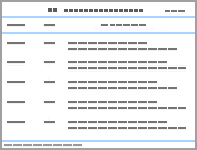
表1
不同填闲作物翻压前地上部分生物量及养分累积量"
| 填闲作物 种类 Cover crop specie | 鲜重 Fresh weight (kg·hm-2) | 含水量 Moisture content (%) | 干重 Dry weight (kg·hm-2) | 养分含量Nutrient content (%) | 养分累积量Nutrient accumulation (kg·hm-2) | C/N | ||||||
|---|---|---|---|---|---|---|---|---|---|---|---|---|
| 氮干基 N dry-mass basis | 磷干基 P dry-mass basis | 钾干基 K dry-mass basis | 碳干基 C dry-mass basis | TN | TP | TK | TC | |||||
| Ory | 20431.1c | 81.5b | 3768.1c | 1.5b | 0.5a | 1.8a | 47.6b | 57.0b | 19.3a | 69.4c | 1794.6b | 31.5b |
| Vic | 26068.7b | 84.0a | 4181.4b | 1.7a | 0.4a | 1.9a | 45.4b | 70.4a | 18.6a | 78.5b | 1898.9b | 27.0c |
| Lol | 31951.4a | 81.0b | 6058.0a | 1.1c | 0.4a | 1.7b | 51.7a | 68.1a | 25.3a | 105.7a | 3129.9a | 46.0a |
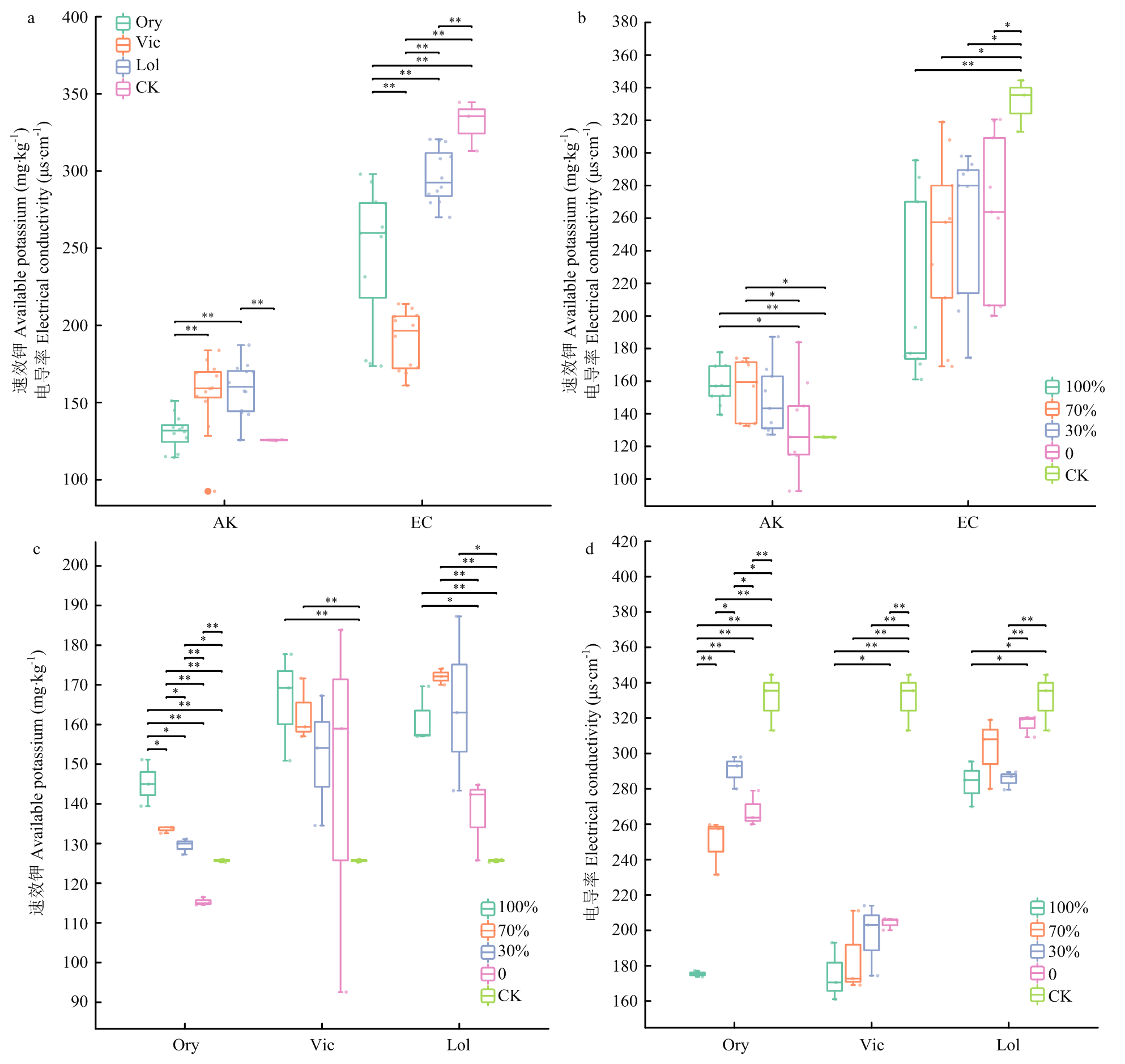
图1
棉花苗期填闲作物、还田比例和二者交互作用对土壤速效钾、电导率的影响 (a)不同填闲作物对AK、EC 的影响;(b)不同翻压比例处理对AK、EC的影响;(c)填闲作物和翻压比例交互作用对AK的影响;(d)填闲作物和翻压比例交互作用对EC的影响。图2同。CK:裸地休闲对照;误差棒表示标准误差,*表示处理间差异显著(P<0.05,LSD检验),**表示处理间差异极显著(P<0.01,LSD检验)。下同"
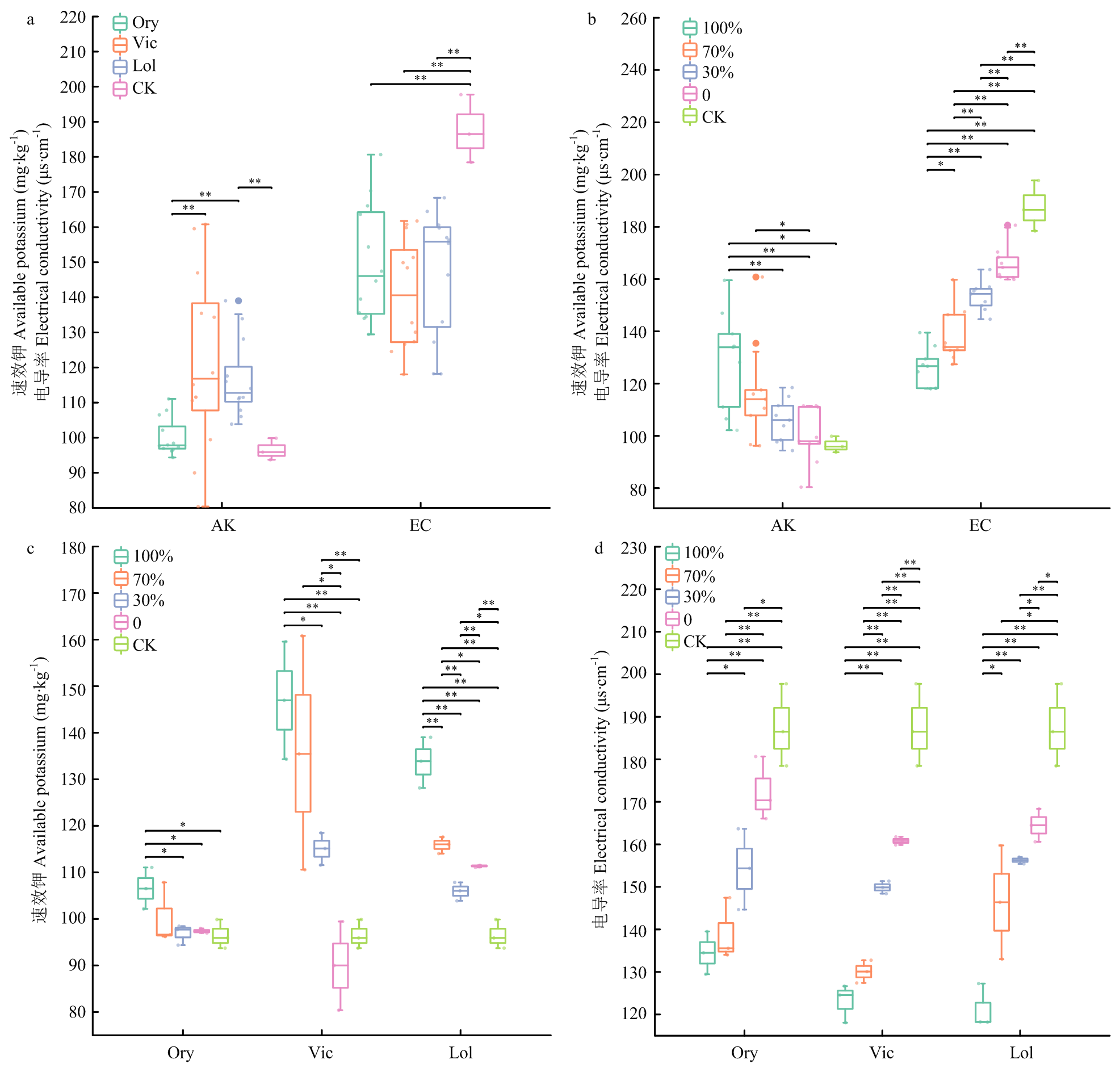
图2
棉花收获期填闲作物、还田比例和二者交互作用对土壤速效钾、电导率的影响"
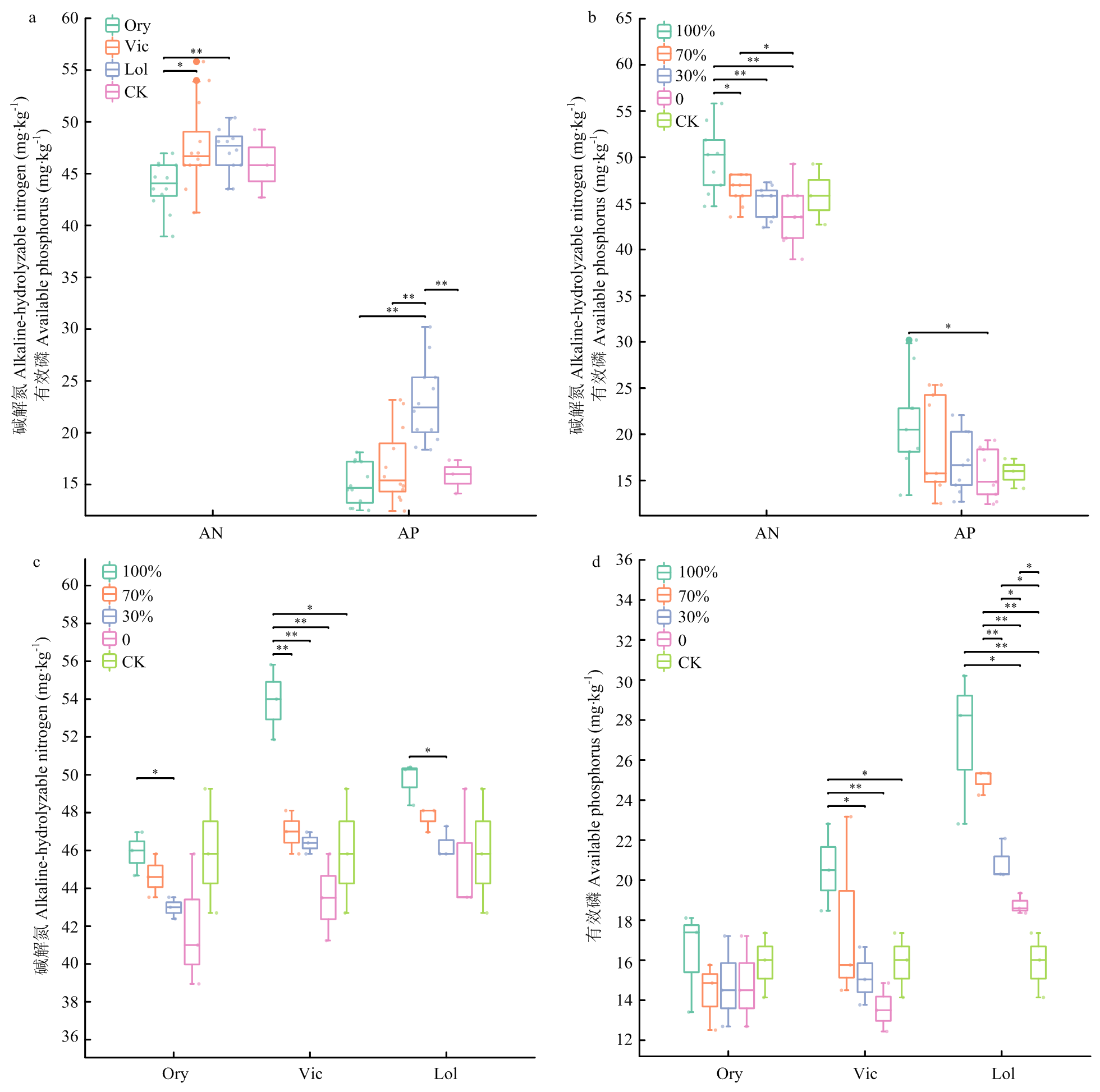
图3
棉花苗期填闲作物、还田比例和二者交互作用对土壤碱解氮、有效磷的影响 (a)不同填闲作物对AN、AP的影响;(b)不同翻压比例处理对AN、AP的影响;(c)填闲作物和翻压比例交互作用对AN的影响;(d)填闲作物和翻压比例交互作用对AP的影响。图4同"
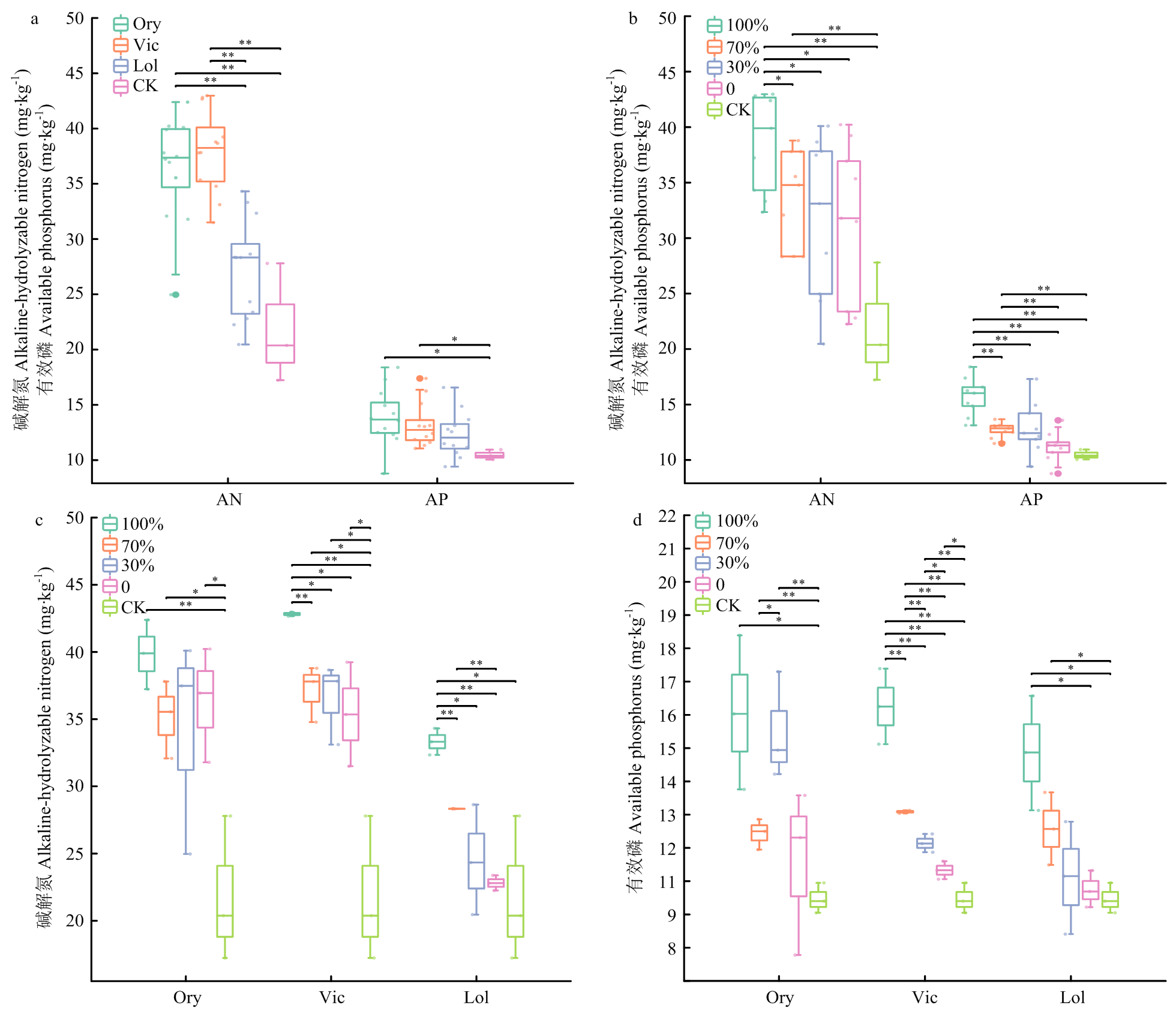
图4
棉花收获期填闲作物、还田比例和二者交互作用对土壤碱解氮、有效磷的影响"
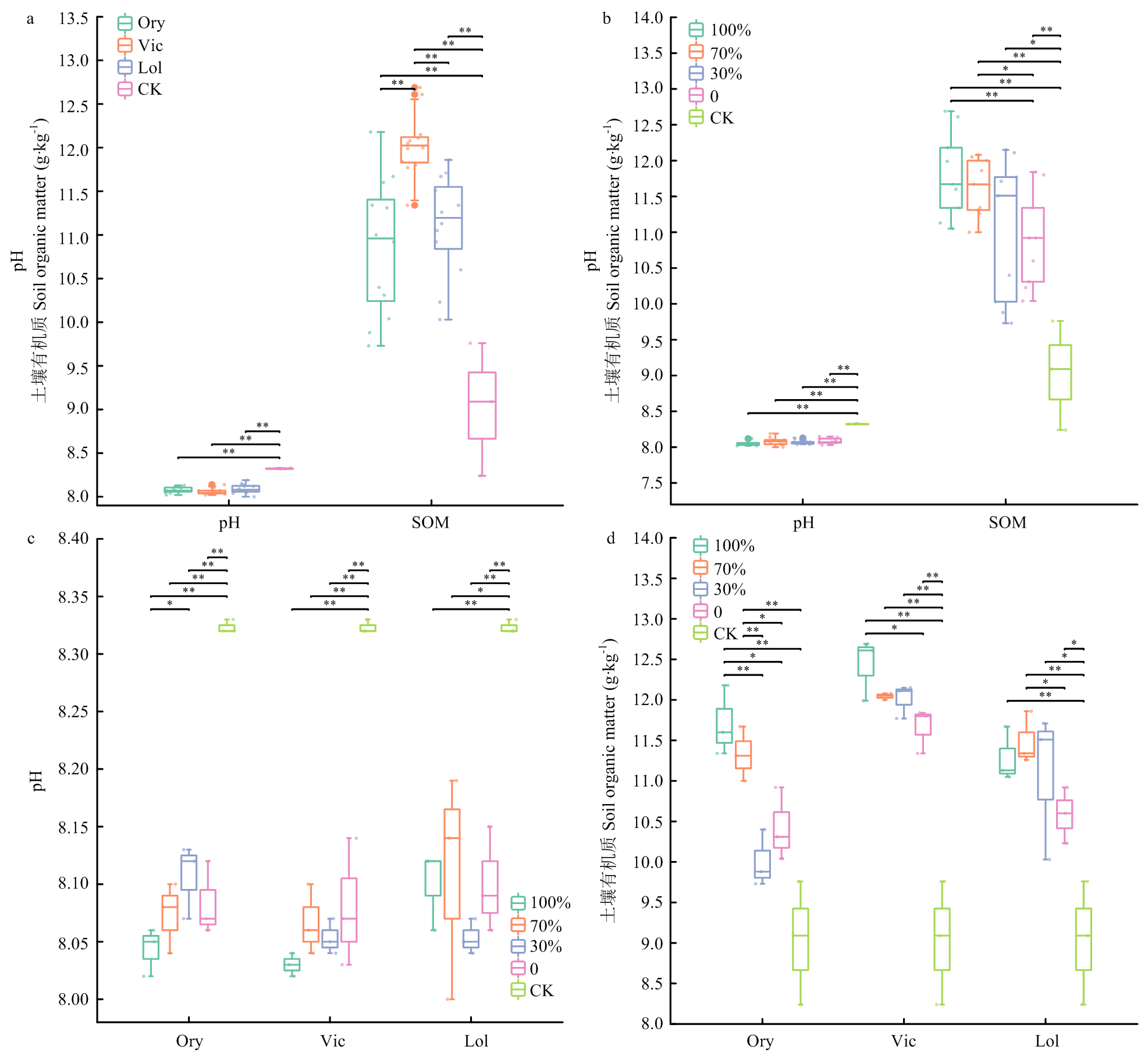
图5
棉花苗期填闲作物、还田比例和二者交互作用对土壤pH、有机质的影响 (a)不同填闲作物对pH、SOM的影响;(b)不同翻压比例处理对pH、SOM的影响;(c)填闲作物和翻压比例交互作用对pH的影响;(d)填闲作物和翻压比例交互作用对SOM的影响。图6同"
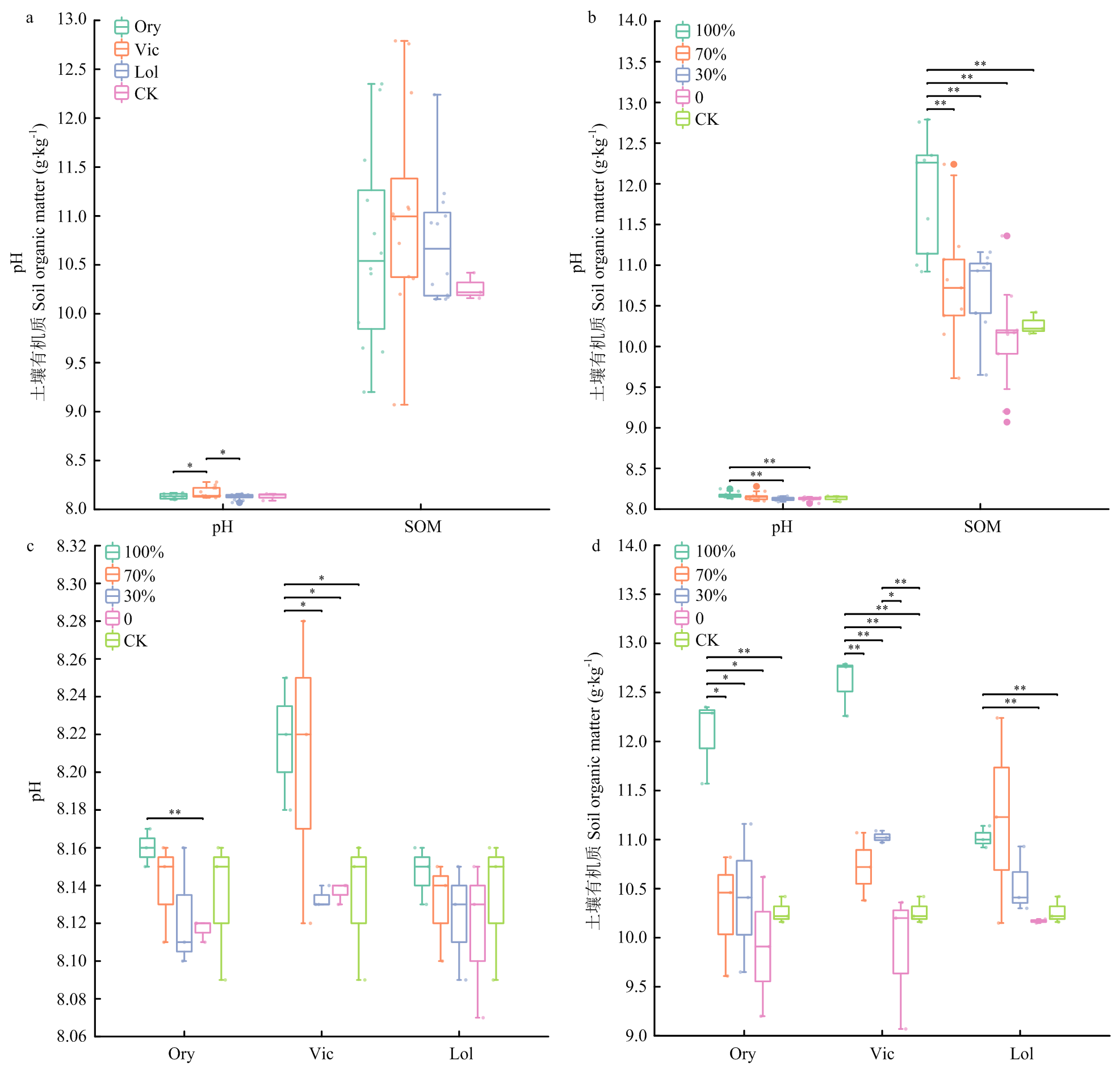
图6
棉花收获期填闲作物、还田比例和二者交互作用对土壤pH、有机质的影响"
表2
填闲作物与翻压比例对土壤基础理化性质影响的方差分析"
| 棉花生育时期 Cotton growth period | 方差来源 Source of variation | df | AP | AK | AN | SOM | EC | pH | ||||||
|---|---|---|---|---|---|---|---|---|---|---|---|---|---|---|
| F | P | F | P | F | P | F | P | F | P | F | P | |||
| 苗期 Seedling stage | 填闲作物Cover crop | 3 | 47.85 | 0.00 | 9.89 | 0.00 | 12.04 | 0.00 | 24.55 | 0.00 | 14.85 | 0.00 | 1.06 | 0.36 |
| 翻压比例Incorporation ratio | 4 | 15.37 | 0.00 | 3.98 | 0.02 | 13.17 | 0.00 | 7.85 | 0.00 | 1.71 | 0.19 | 0.62 | 0.61 | |
| 填闲作物×翻压比例Cover crop×Incorporation ratio | 12 | 2.72 | 0.04 | 0.35 | 0.90 | 1.10 | 0.39 | 2.61 | 0.04 | 1.48 | 0.23 | 0.73 | 0.63 | |
| 收获期 Harvest stage | 填闲作物Cover crop | 3 | 3.82 | 0.04 | 18.40 | 0.00 | 38.39 | 0.00 | 3.07 | 0.07 | 6.35 | 0.01 | 3.74 | 0.04 |
| 翻压比例Incorporation ratio | 4 | 16.59 | 0.00 | 18.27 | 0.00 | 8.54 | 0.00 | 14.00 | 0.00 | 70.10 | 0.00 | 3.52 | 0.03 | |
| 填闲作物×翻压比例Cover crop×Incorporation ratio | 12 | 1.89 | 0.12 | 5.16 | 0.00 | 0.83 | 0.56 | 3.42 | 0.01 | 2.37 | 0.06 | 0.55 | 0.77 | |
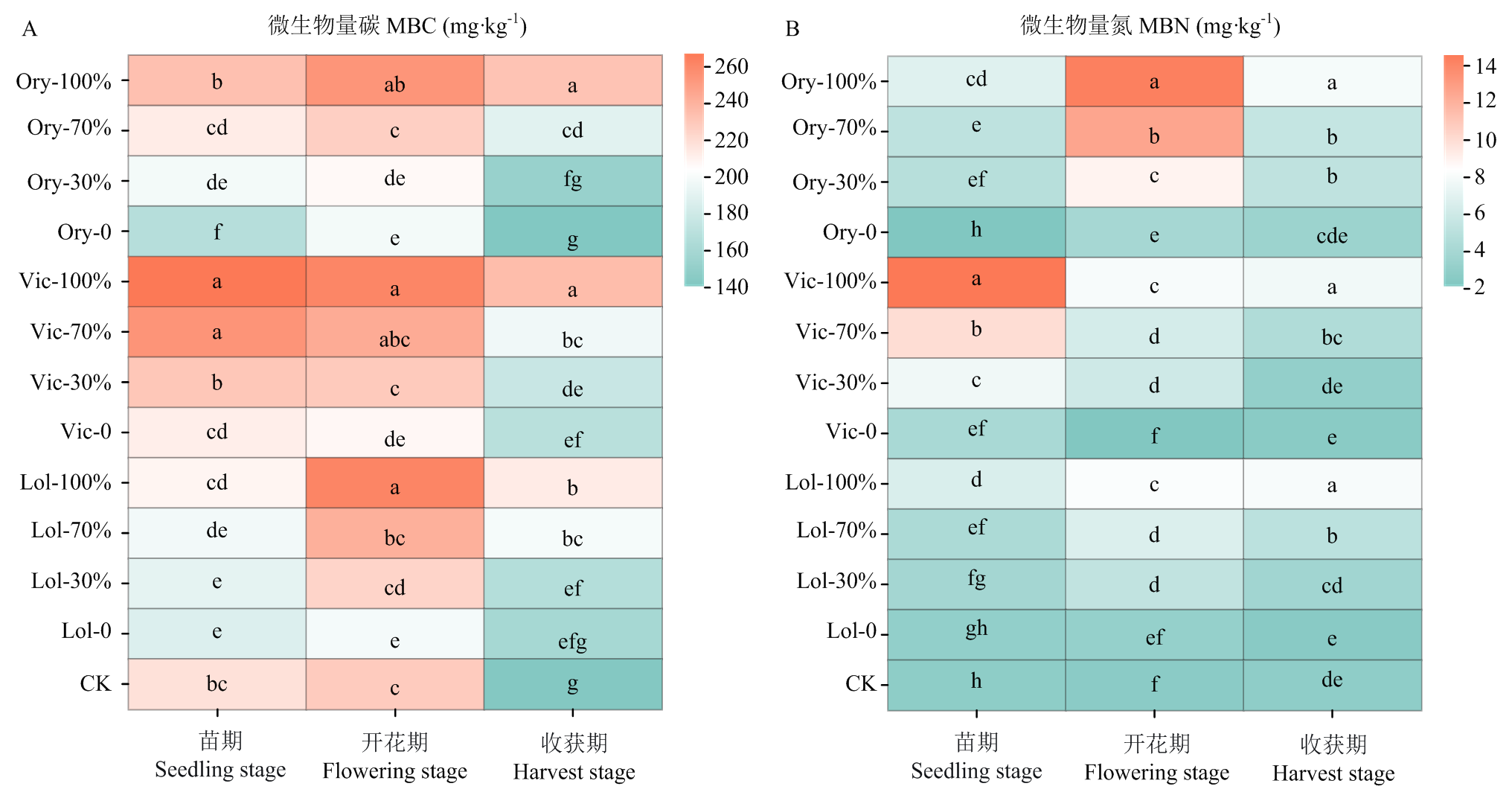
图7
棉花生育期各处理对微生物量碳、氮的影响 不同小写字母表示相同生育时期处理间差异显著(P<0.05)。下同"
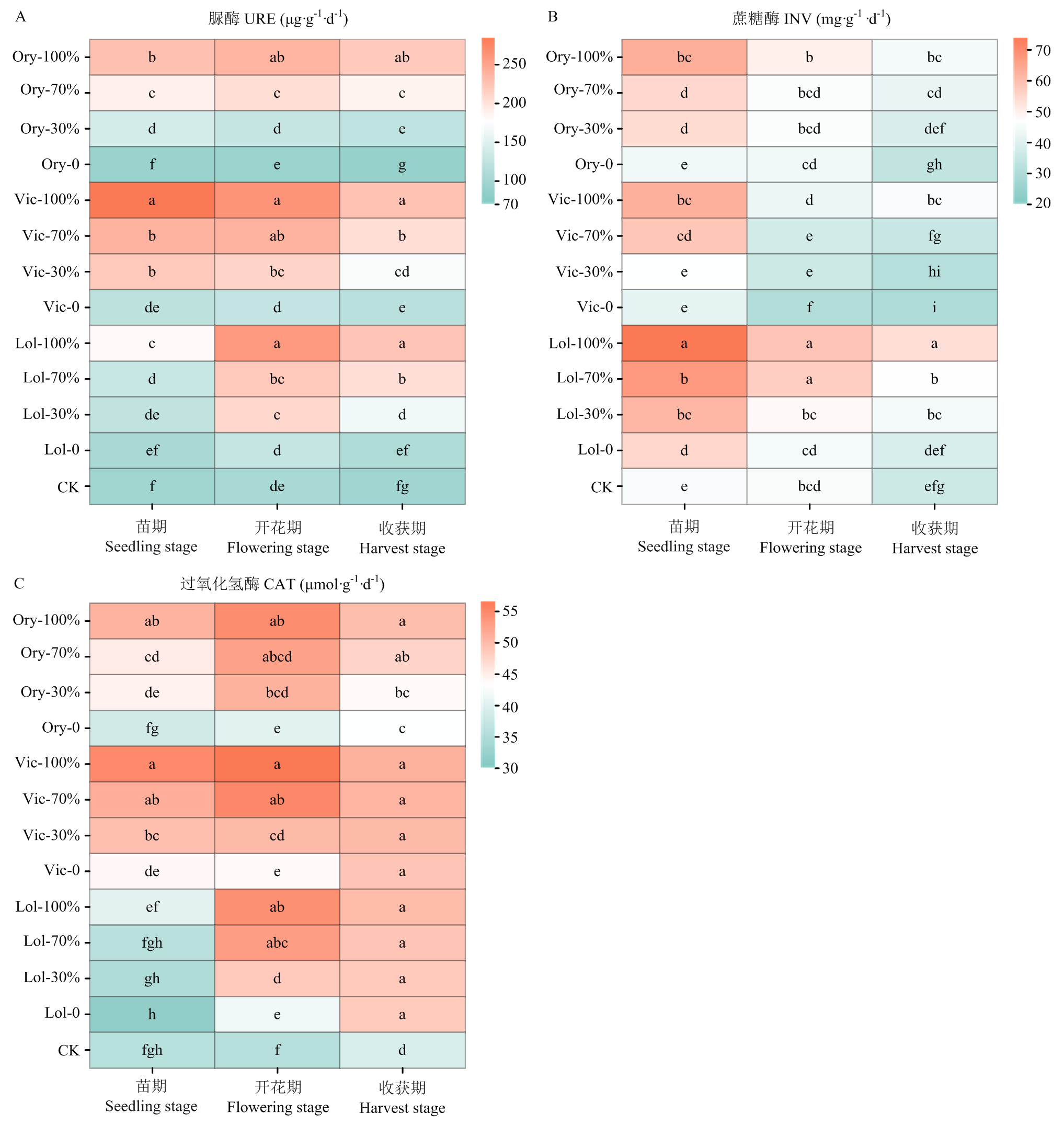
图8
棉花生育期各处理对土壤脲酶、蔗糖酶、过氧化氢酶的影响"
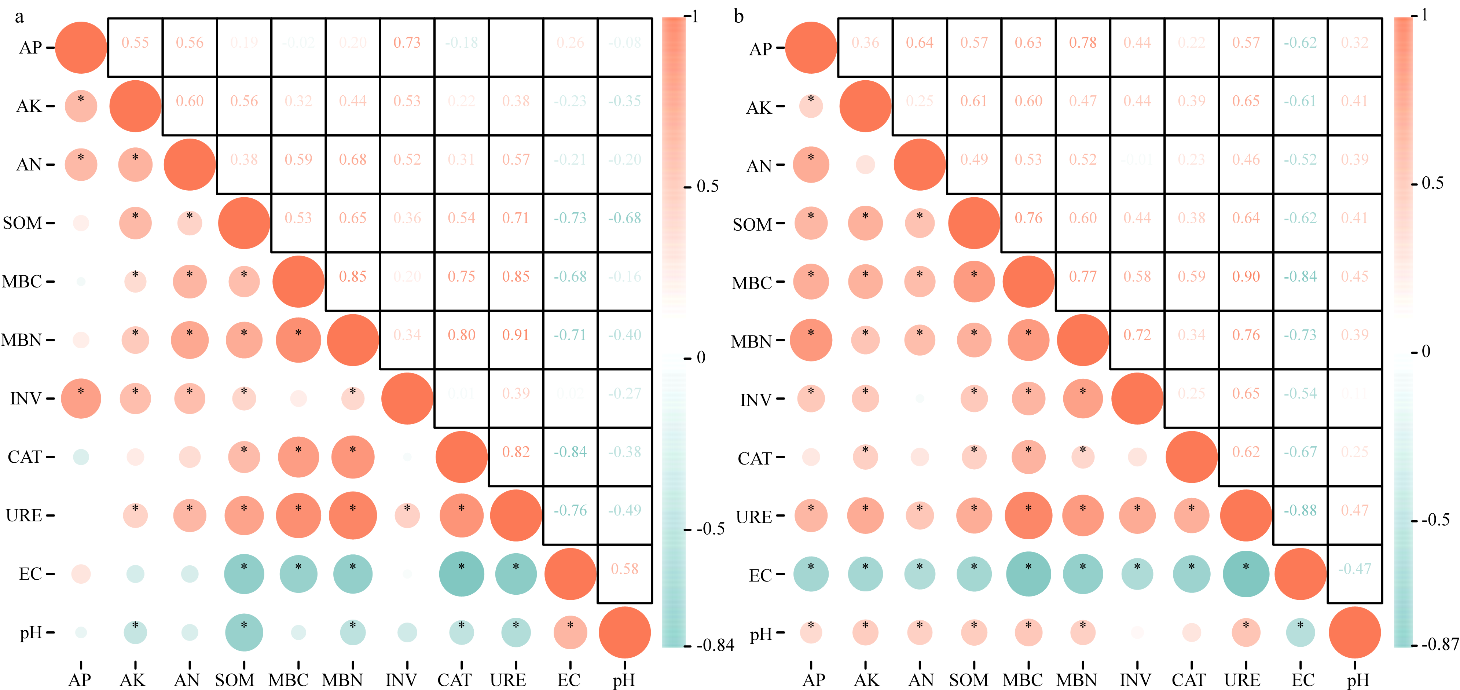
图9
土壤理化性质与微生物量碳氮、酶活性的相关性 (a)棉花苗期;(b)棉花收获期。MBC:微生物量碳,MBN:微生物量氮,INV:蔗糖酶,CAT:过氧化氢酶,URE:脲酶。下同"
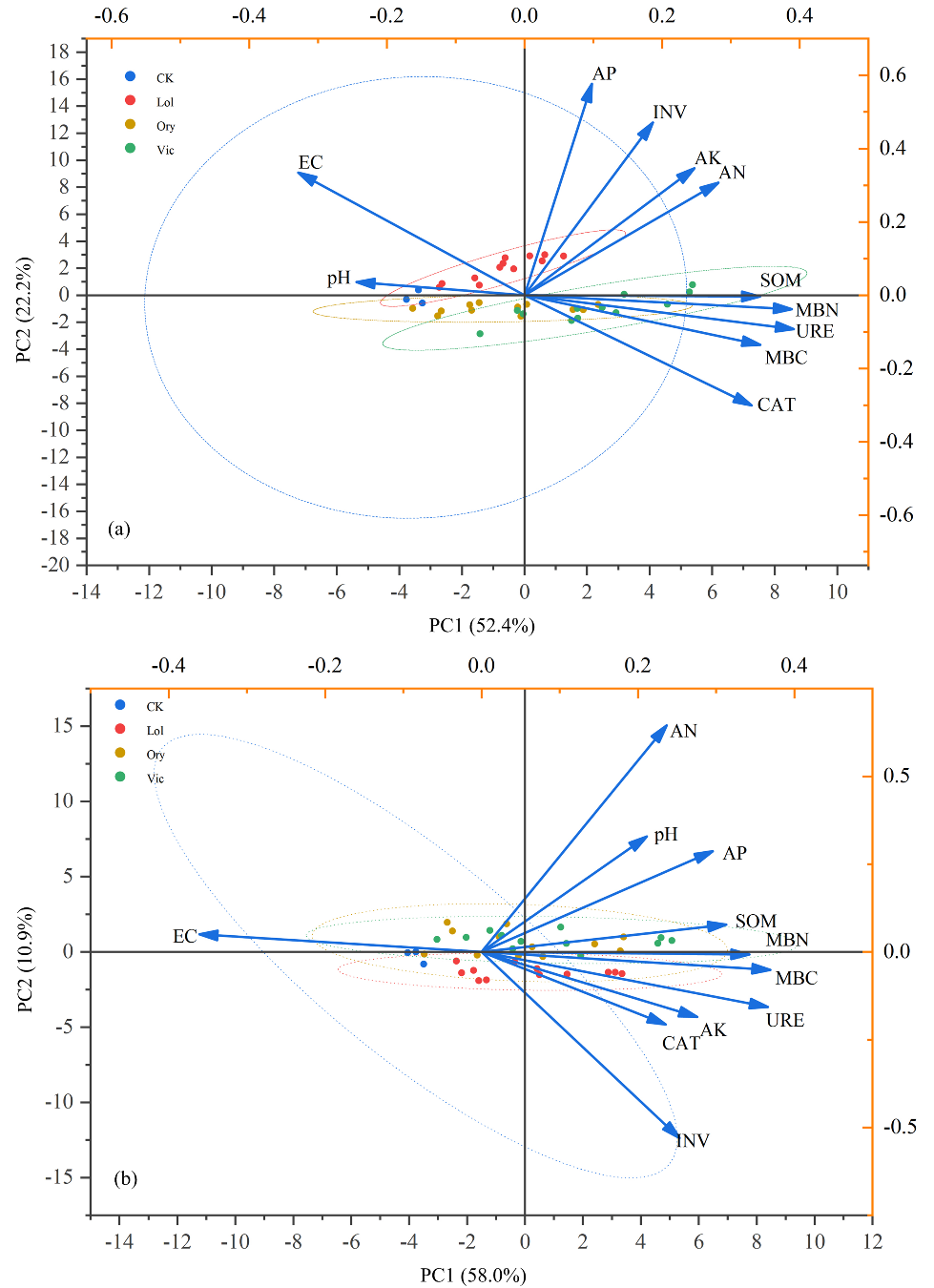
图10
土壤理化性质与微生物量碳氮、酶活性的主成分分析"
表3
收获期各处理土壤肥力综合指数(IFI)比较"
| 处理Treatment | IFI |
|---|---|
| Ory100% | 0.71b |
| Ory70% | 0.59c |
| Ory30% | 0.51d |
| Ory0 | 0.43ef |
| Vic100% | 0.76a |
| Vic70% | 0.61c |
| Vic30% | 0.53d |
| Vic0 | 0.45ef |
| Lol100% | 0.73ab |
| Lol70% | 0.62c |
| Lol30% | 0.53d |
| Lol0 | 0.46e |
| CK | 0.41f |
表4
不同填闲作物及利用方式对棉田经济效益的影响"
| 处理 Treatment | 牧草年收入 Annual forage revenue (yuan/hm2) | 棉花产量 Cotton yield(kg·hm-2) | 棉花年收入 Annual cotton revenue (yuan/hm2) | 周年总收入 Annual gross income (yuan/hm2) | 周年总投入 Annual total cost (yuan/hm2) | 周年净收益 Annual net benefit (¥/hm2) |
|---|---|---|---|---|---|---|
| Ory100% | 0.00 | 5063.67ab | 37977.50ab | 37977.50cd | 18000 | 19977.50cd |
| Ory70% | 1838.80 | 4923.40bc | 36925.50bc | 38764.30bc | 17700 | 21064.30bc |
| Ory30% | 4290.53 | 4511.18de | 33833.88de | 38124.41bcd | 17400 | 20724.41c |
| Ory0 | 6129.33 | 4297.07ef | 32228.00ef | 38357.33bc | 17100 | 21257.33bc |
| Vic100% | 0.00 | 5263.60a | 39477.00a | 39477.00bc | 18000 | 21477.00bc |
| Vic70% | 2346.19 | 4677.50cd | 35081.25cd | 37427.44cd | 17700 | 19727.44cd |
| Vic30% | 5474.43 | 4491.55de | 33686.63de | 39161.06bc | 17400 | 21761.06bc |
| Vic0 | 7820.62 | 4511.75de | 33838.13de | 41658.74a | 17100 | 24558.74a |
| Lol100% | 0.00 | 3849.90g | 28874.25g | 28874.25f | 18000 | 10874.25f |
| Lol70% | 2875.62 | 4406.05def | 33045.38def | 35921.00d | 17700 | 18221.00d |
| Lol30% | 6709.78 | 4123.25fg | 30924.38fg | 37634.16cd | 17400 | 20234.16cd |
| Lol0 | 9585.41 | 4102.85fg | 30771.38fg | 40356.78ab | 17100 | 23256.78ab |
| CK | 0.00 | 4188.50f | 31413.75f | 31413.75e | 17100 | 14313.75e |
| [1] |
于谦林, 钟振江, 刘海霞. 鲁西北植棉区棉花产业现状及新旧动能转换对策[J]. 中国棉花, 2019, 46(3): 7-10.
|
|
|
|
| [2] |
|
| [3] |
|
| [4] |
张明龙, 柴强, 韩梅, 樊志龙, 殷文, 范虹, 何蔚, 孙亚丽, 胡发龙, 谈燕. 氮肥减施及绿肥混作对土壤质量和小麦产量的影响[J]. 中国农业科学, 2025, 58(22): 4718-4731. DOI: 10.3864/j.issn.0578-1752.2025.22.012.
|
|
|
|
| [5] |
李银平, 徐文修, 陈冰, 候松山, 韩晶磊, 侯猛, 陈雅欢. 绿肥种植模式对连作棉田土壤肥力及棉花产量的影响[J]. 西北农业学报, 2010, 19(9): 149-153.
|
|
|
|
| [6] |
余梦梦, 何浩, 程李洋, 李帅, 万婷婷, 丁娅萍, 李俊华. 连续施用生物有机肥对连作棉花生长、养分吸收及产量的影响[J]. 农业资源与环境学报, 2026, 43(3): 696-706.
|
|
|
|
| [7] |
|
| [8] |
|
| [9] |
程文龙, 卜容燕, 王慧, 胡润, 李敏, 韩上, 朱勤, 唐杉, 武际. 不同紫云英翻压量和施氮水平对皖南稻区土壤肥力和水稻养分吸收及产量的影响[J]. 土壤通报, 2024, 55(3): 669-676.
|
|
|
|
| [10] |
孙国荣, 彭永臻, 岳中辉, 陈刚, 阎秀峰, 倪红伟. 星星草的生长对盐碱土壤氮素营养的影响[J]. 草业学报, 2008, 17(1): 1-7.
|
|
|
|
| [11] |
黄依妮. 十字花科绿肥生物熏蒸防控番茄病害及对土壤性质的影响[D]. 太谷: 山西农业大学, 2024.
|
|
|
|
| [12] |
谢晓丽, 孙振宇, 郭建国, 岳德成, 金社林. 苹果园间作不同绿肥对害虫- 天敌关系的影响及其生态调控技术[J]. 中国植保导刊, 2024, 44(4): 50-55.
|
|
|
|
| [13] |
张磊, 徐昌旭, 刘佳, 李顺, 高嵩涓, 曹卫东. 减施20%化肥下绿肥翻压量对江西双季稻产量及氮素利用的影响[J]. 植物营养与肥料学报, 2022, 28(5): 845-856.
|
|
|
|
| [14] |
王赟, 徐昌旭, 周国朋, 常单娜, 高嵩涓, 曹卫东. 连续种植翻压紫云英减施化肥对江西早稻产量、品质及土壤肥力的影响[J]. 植物营养与肥料学报, 2021, 27(10): 1735-1745.
|
|
|
|
| [15] |
孙文彦, 尹红娟, 许建新, 李志杰, 田昌玉, 唐继伟. 棉田套作冬绿肥促进棉花增产的机理研究[J]. 华北农学报, 2015(增刊1): 129-132.
|
|
|
|
| [16] |
赵秋, 高贤彪, 宁晓光, 曹卫东. 华北地区几种冬闲覆盖作物碳氮蓄积及其对土壤理化性质的影响[J]. 生态环境学报, 2011, 20(4): 750-753.
|
|
|
|
| [17] |
赵秋, 高贤彪, 宁晓光, 吴迪, 曹卫东. 华北地区春玉米-冬绿肥轮作对碳、氮蓄积和土壤养分以及微生物的影响[J]. 植物营养与肥料学报, 2013, 19(4): 1005-1011.
|
|
|
|
| [18] |
|
| [19] |
|
| [20] |
|
| [21] |
|
| [22] |
鲍士旦. 土壤农化分析3版[M]. 北京: 中国农业出版社, 2000.
|
|
|
|
| [23] |
徐建明, 张甘霖, 谢正苗, 吕晓男. 土壤质量指标与评价[M]. 北京: 科学出版社, 2010.
|
|
|
|
| [24] |
孙波, 张桃林, 赵其国. 我国东南丘陵山区土壤肥力的综合评价[J]. 土壤学报, 1995, 32(4): 362-369.
|
|
|
|
| [25] |
|
| [26] |
张一帆, 徐昊文, 吴洋洋, 孙岩颖, 黄亚浩, 贾振江, 李王成. 绿肥驱动中国西北旱区土壤改良的作用效果及多维机制进展与展望[J]. 水土保持学报, 2025, 39(6): 27-40, 48.
|
|
|
|
| [27] |
张璐, 黄晶, 高菊生, 曹卫东, 高鹏, 杨志长. 长期绿肥与氮肥减量配施对水稻产量和土壤养分含量的影响[J]. 农业工程学报, 2020, 36(5): 106-112.
|
|
|
|
| [28] |
|
| [29] |
|
| [30] |
|
| [31] |
何蒙晰. 毛叶苕子与胡麻混播对作物产量和品质及土壤性状的影响[D]. 呼和浩特: 内蒙古农业大学, 2024.
|
|
|
|
| [32] |
司伟. 绿肥还田对盐碱土冬小麦产量及土壤理化性质的影响[D]. 兰州: 兰州理工大学, 2024.
|
|
|
|
| [33] |
|
| [34] |
魏可嘉. 不同功能型绿肥混作对土壤碳组分和养分的影响[D]. 上海: 华东师范大学, 2024.
|
|
|
|
| [35] |
|
| [36] |
赵炯平, 邓小华, 江智敏, 郑宏斌, 张仲文, 覃勇, 田峰, 张明发. 不同绿肥翻压还土后植烟土壤主要养分动态变化[J]. 作物研究, 2015, 29(2): 161-165.
|
|
|
|
| [37] |
|
| [38] |
|
| [39] |
常芳娟, 张贵云, 张丽萍, 吕贝贝, 刘珍, 范巧兰, 姚众. 生物熏蒸配施微生物菌剂对西瓜连作土壤真菌群落结构的影响[J]. 中国生态农业学报(中英文), 2022, 30(2): 248-257.
|
|
|
|
| [40] |
郭小琰. 氮肥减量下棉花/二月兰对棉花生长及土壤养分的影响[D]. 保定: 河北农业大学, 2021.
|
|
|
|
| [41] |
刘慧, 李子玉, 白志贵, 刘建国. 油菜绿肥翻压还田对新疆盐碱土壤的改良效果研究[J]. 农业资源与环境学报, 2020, 37(6): 914-923.
|
|
|
|
| [42] |
郭耀东, 程曼, 赵秀峰, 郝保平, 张延芳, 曹卫东, 郑普山. 轮作绿肥对盐碱地土壤性质、后作青贮玉米产量及品质的影响[J]. 中国生态农业学报, 2018, 26(6): 856-864.
|
|
|
|
| [43] |
刘晗, 王萍, 孙鲁沅, 秦文婧, 陈晓芬, 陈金, 周国朋, 梁婷, 刘佳, 李燕丽. 种植冬绿肥对红壤幼龄橘园土壤微生物量碳、氮和酶活的影响[J]. 生态环境学报, 2023, 32(9): 1623-1631.
|
|
|
|
| [44] |
王敬宽. 禾本科绿肥还田对盐碱地棉田土壤碳氮及微生物量碳氮的影响[J]. 中国生态农业学报(中英文), 2023, 31(3): 396-404.
|
|
|
|
| [45] |
|
| [46] |
池静波, 黄子蔚, 黄玉萍, 何江勇, 杨国江, 樊庆鲁. 滴灌条件下不同产量水平棉花各生育期需肥规律的研究[J]. 新疆农业科学, 2009, 46(2): 327-331.
|
|
|
|
| [47] |
|
| [48] |
廖明季, 刘宝勇, 何星星, 王东丽, 全美丽, 万勇. 不同改良剂对黄河泥沙理化性质及酶活性的影响[J]. 生态学杂志, 2025, 44(10): 3316-3329.
|
|
|
|
| [49] |
蒋宇航, 林生, 林伟伟, 陈婷,
|
|
|
|
| [50] |
周国朋, 谢志坚, 曹卫东, 徐昌旭, 白金顺, 曾闹华, 高嵩涓, 杨璐. 稻草高茬-紫云英联合还田改善土壤肥力提高作物产量[J]. 农业工程学报, 2017, 33(23): 157-163.
|
|
|
|
| [51] |
苟志文, 殷文, 柴强, 樊志龙, 胡发龙, 赵财, 于爱忠, 范虹. 干旱灌区小麦间作玉米麦后复种绿肥的可持续性分析[J]. 中国农业科学, 2022, 55(7): 1319-1331. DOI: 10.3864/j.issn.0578-1752.2022.07.005.
|
|
|
|
| [52] |
张正贵. 冬种绿肥配合氮肥减施的棉田生产和生态效应研究[D]. 北京: 中国农业科学院, 2023.
|
|
|
|
| [53] |
|
| [54] |
|
| [1] | 袁浩亮, 聂军, 黎鹏, 鲁艳红, 廖育林, 徐昌旭, 李忠义, 曹卫东, 张江林. 紫云英与稻草联合利用对南方稻区土壤磷库组成及磷素活化的影响[J]. 中国农业科学, 2026, 59(7): 1480-1491. |
| [2] | 王佳诺, 陈桂平, 李盼, 王丽萍, 南运有, 何蔚, 樊志龙, 胡发龙, 柴强, 殷文, 赵连豪. 免耕地膜两年覆盖提高绿洲灌区玉米产量的灌浆期光合生理机制[J]. 中国农业科学, 2026, 59(6): 1189-1202. |
| [3] | 严艳鸽, 张水勤, 许猛, 徐久凯, 李燕婷, 赵秉强, 袁亮. 葡聚糖改性尿素在潮土中的转化特征[J]. 中国农业科学, 2026, 59(5): 1048-1059. |
| [4] | 咸青林, 肖鉴珂, 高阿庆, 郜利闯, 刘杨. 种植方式结合测墒补灌下冬小麦产量及水分利用效率[J]. 中国农业科学, 2026, 59(3): 589-601. |
| [5] | 叶嘉怡, 邬奇峰, 王嘉林, 周燕, 马晓敏, 梁辰飞, 秦华, 陈俊辉. 调理剂与有机肥配施对酸性稻田土壤性质及水稻产量的影响[J]. 中国农业科学, 2026, 59(14): 3121-3131. |
| [6] | 马鹏龙, 王美文, 李星竺, 尚婉婷, 刘丹, 马新柔, 王婧, 蒋春姬, 赵新华, 王晓光. 磷酸二氢钾对玉米花生间作模式下花生膜系统损伤与防御及产量的影响[J]. 中国农业科学, 2026, 59(13): 2802-2814. |
| [7] | 李畅, 任凤玲, 张路平, 王树会, 乔磊, 孙楠, 徐明岗. 化肥有机肥配施提升东北黑土区土壤肥力水平并促进玉米高产的效应与主控因素[J]. 中国农业科学, 2026, 59(11): 2405-2419. |
| [8] | 林娇, 牟廷森, 陈俊, 李想, 袁思雨, 刘乐, 张振华, 夏银行. 湖南省典型红壤区不同土地利用方式农田土壤碳氮磷化学计量比特征[J]. 中国农业科学, 2026, 59(11): 2434-2446. |
| [9] | 吕旭东, 孙世媛, 李亚楠, 刘玉龙, 王艳群, 付鑫, 张佳英, 宁鹏, 彭正萍. 智能机械化分层施肥对麦田根-土养分分布和小麦产量的影响[J]. 中国农业科学, 2026, 59(1): 129-146. |
| [10] | 李绍兴, 宋稳锋, 魏泽煜, 周玉玲, 宋李霞, 任可, 马群, 王龙昌. 秸秆与紫云英覆盖对土壤肥力及甘薯产量的影响[J]. 中国农业科学, 2025, 58(8): 1591-1603. |
| [11] | 陈桂平, 李盼, 邵冠贵, 吴霞玉, 殷文, 赵连豪, 樊志龙, 胡发龙. 减量灌水与有机无机肥配施对青贮玉米吐丝期后叶片持绿特性的调控作用[J]. 中国农业科学, 2025, 58(7): 1381-1396. |
| [12] | 黄少辉, 杨慧敏, 杨军芳, 杨文方, 聂浩亮, 张静, 邢素丽, 王敬霞, 杨云马, 贾良良. 磷肥长期施用对石灰性褐土团聚体中磷形态及磷酸酶活性的影响[J]. 中国农业科学, 2025, 58(5): 943-955. |
| [13] | 郑煜, 陈颐, 遆晋松, 史龙飞, 许校博, 李昱霖, 郭瑞. 烟草不同轮作模式碳足迹及经济效益评价[J]. 中国农业科学, 2025, 58(4): 733-747. |
| [14] | 李建昆, 彭超, 张子扬, 梁茜, 魏鸣康, 杨强, 李斌奇, Muhammad Moaaz Ali, Viola Kayima, 陈发兴, 邓红红. ‘皇冠’李果实空腔褐变与木质素积累的关系及其4CL基因家族鉴定[J]. 中国农业科学, 2025, 58(4): 759-778. |
| [15] | 房健, 秦召纪, 于园园, 于宁宁, 赵斌, 刘鹏, 任佰朝, 张吉旺. 大豆玉米带状间作下不同行比配置对作物个体和群体产量及效益的影响[J]. 中国农业科学, 2025, 58(23): 4841-4857. |
|
||
