






中国农业科学 ›› 2026, Vol. 59 ›› Issue (15): 3374-3386.doi: 10.3864/j.issn.0578-1752.2026.15.010
王珅( ), 李盼, 梁淼, 王丽萍, 张殿凯, 赵连豪, 樊志龙, 胡发龙, 南运有, 殷文(), 柴强()
收稿日期:2025-09-16
接受日期:2025-12-29
出版日期:2026-08-01
发布日期:2026-08-03
通信作者:
联系方式:
王珅,E-mail:wangshen0612@163.com。
基金资助:
WANG Shen(), LI Pan, LIANG Miao, WANG LiPing, ZHANG DianKai, ZHAO LianHao, FAN ZhiLong, HU FaLong, NAN YunYou, YIN Wen(), CHAI Qiang()
Received:2025-09-16
Accepted:2025-12-29
Published:2026-08-01
Online:2026-08-03
摘要:
【目的】针对绿洲灌区水资源短缺及玉米生产中氮肥施用过量、水分利用效率低等问题,探讨生物炭配施缓释肥在减量施氮条件下对玉米田土壤水分利用特征的影响,旨在为玉米高产与水资源高效利用提供实践依据。【方法】试验采用裂区设计,主区为土壤调理剂:生物炭(B)、无调理剂(C),裂区为2种氮肥类型:传统化学氮肥(T)、缓释肥(S),裂裂区为2个施氮水平:传统施氮量(N2:360 kg·hm-2)、传统施氮减量30%(N1:252 kg·hm-2),于2023—2024年研究生物炭配施缓释肥结合减氮对玉米产量、耗水量和水分利用效率的影响。【结果】生物炭配施缓释肥结合减氮(BSN1)可提高玉米播前土壤贮水量,降低玉米全生育期耗水量。就播前土壤贮水量而言,施生物炭较无调理剂提高5.3%—6.5%;缓释肥与传统化肥之间、以及减量施氮与常规施氮量之间,无显著差异(P>0.05)。BSN1较CTN2处理提高玉米播前土壤贮水量11.1%—12.5%。生物炭降低玉米播种期—拔节期与大喇叭口期—开花期的耗水量分别为6.4%—6.7%与4.6%—5.5%,但耗水模系数无显著差异;缓释肥降低玉米播种期—成熟期的耗水量8.1%—10.0%,但仅降低玉米播种期—开花期的耗水模系数;减量施氮使玉米大喇叭口期—开花期的耗水量降低6.3%—7.5%,耗水模系数无显著差异。综合土壤调理剂、氮肥类型和施氮水平,BSN1较CTN2处理在玉米播种期—开花期耗水量降低21.4%—29.5%,耗水模系数降低6.3%—7.6%;开花期—成熟期耗水量降低8.0%—9.9%,耗水模系数呈升高趋势。生物炭配施缓释肥有效协调减氮玉米不同生育时期水分供需关系。因此,BSN1较CTN2处理玉米总耗水量降低13.6%—14.8%,籽粒产量和水分利用效率提高8.6%—9.1%和24.1%—24.7%。【结论】生物炭配施缓释肥结合减量施氮较无调理剂、传统化学氮肥、传统施氮量组合处理(CTN2)显著提高玉米籽粒产量和水分利用效率,可作为河西绿洲灌区玉米节氮增产及高效用水的可行技术。
王珅, 李盼, 梁淼, 王丽萍, 张殿凯, 赵连豪, 樊志龙, 胡发龙, 南运有, 殷文, 柴强. 生物炭配施缓释肥对绿洲灌区土壤水分利用的调控效应[J]. 中国农业科学, 2026, 59(15): 3374-3386.
WANG Shen, LI Pan, LIANG Miao, WANG LiPing, ZHANG DianKai, ZHAO LianHao, FAN ZhiLong, HU FaLong, NAN YunYou, YIN Wen, CHAI Qiang. Regulation Effect of Biochar Combined with Slow-Release Fertilizer on Soil Water Use in Oasis Irrigation Area[J]. Scientia Agricultura Sinica, 2026, 59(15): 3374-3386.

表1
各处理耕层土壤容重"
| 处理Treatment | ||||||||
|---|---|---|---|---|---|---|---|---|
| BTN1 | BTN2 | BSN1 | BSN2 | CTN1 | CTN2 | CSN1 | CSN2 | |
| 容重 Bulk density (g·cm-3) | 1.46 | 1.47 | 1.43 | 1.43 | 1.56 | 1.59 | 1.52 | 1.53 |
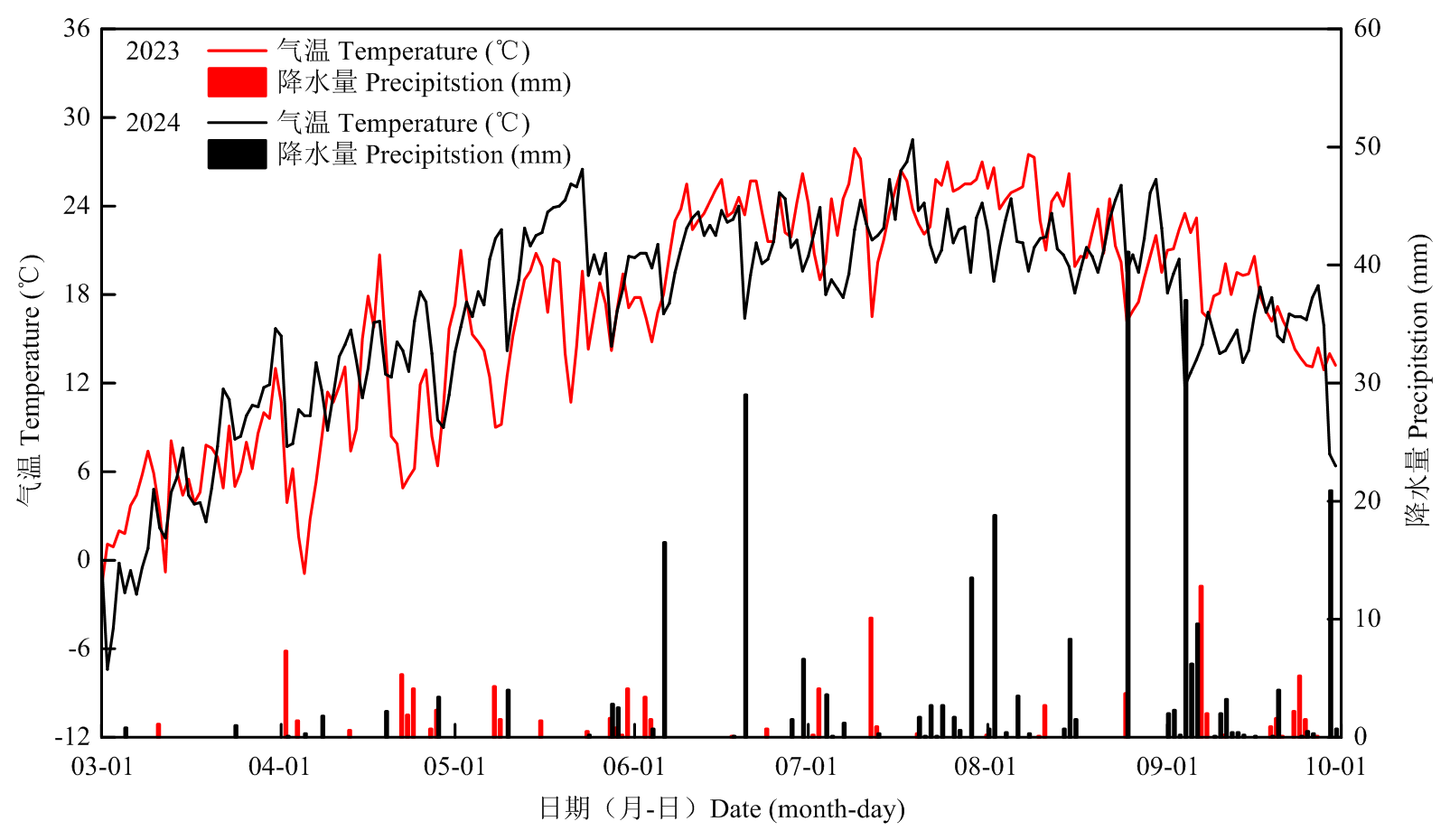
图1
2023、2024年试验区内气温及降水量变化"
表2
生物炭的理化性质"
| pH | 裂解温度 Cracking temperature (℃) | 有机碳含量 Organic carbon content (%) | 全氮含量 Total nitrogen content (%) | 全磷含量 Total phosphorus content (%) | 全钾含量 Total potassium content (%) | 灰分 Ash (%) |
|---|---|---|---|---|---|---|
| 9.21 | 500 | 53.28 | 1.04 | 0.26 | 0.51 | 35.64 |
表3
不同试验设计的处理代码"
| 土壤调理剂 Soil conditioner | 氮肥类型 Nitrogen type | 施氮水平 Nitrogen level | 处理代码 Treatment code |
|---|---|---|---|
| 生物炭 Biochar (B) | 传统化学氮肥 Traditional chemical nitrogen fertilizer (T) | 传统施氮量 Traditional nitrogen application rate (N2) | BTN2 |
| 传统施氮减量30% Reduction of 30% in N2 (N1) | BTN1 | ||
| 缓释肥 Slow-release nitrogen fertilizer (S) | 传统施氮量 Traditional nitrogen application rate (N2) | BSN2 | |
| 传统施氮减量30% (N1) Reduction of 30% in N2 (N1) | BSN1 | ||
| 无调理剂 No conditioner (C) | 传统化学氮肥 Traditional chemical nitrogen fertilizer (T) | 传统施氮量 Traditional nitrogen application rate (N2) | CTN2 |
| 传统施氮减量30% Reduction of 30% in N2 (N1) | CTN1 | ||
| 缓释肥 Slow-release nitrogen fertilizer (S) | 传统施氮量 Traditional nitrogen application rate (N2) | CSN2 | |
| 传统施氮减量30% Reduction of 30% in N2 (N1) | CSN1 |
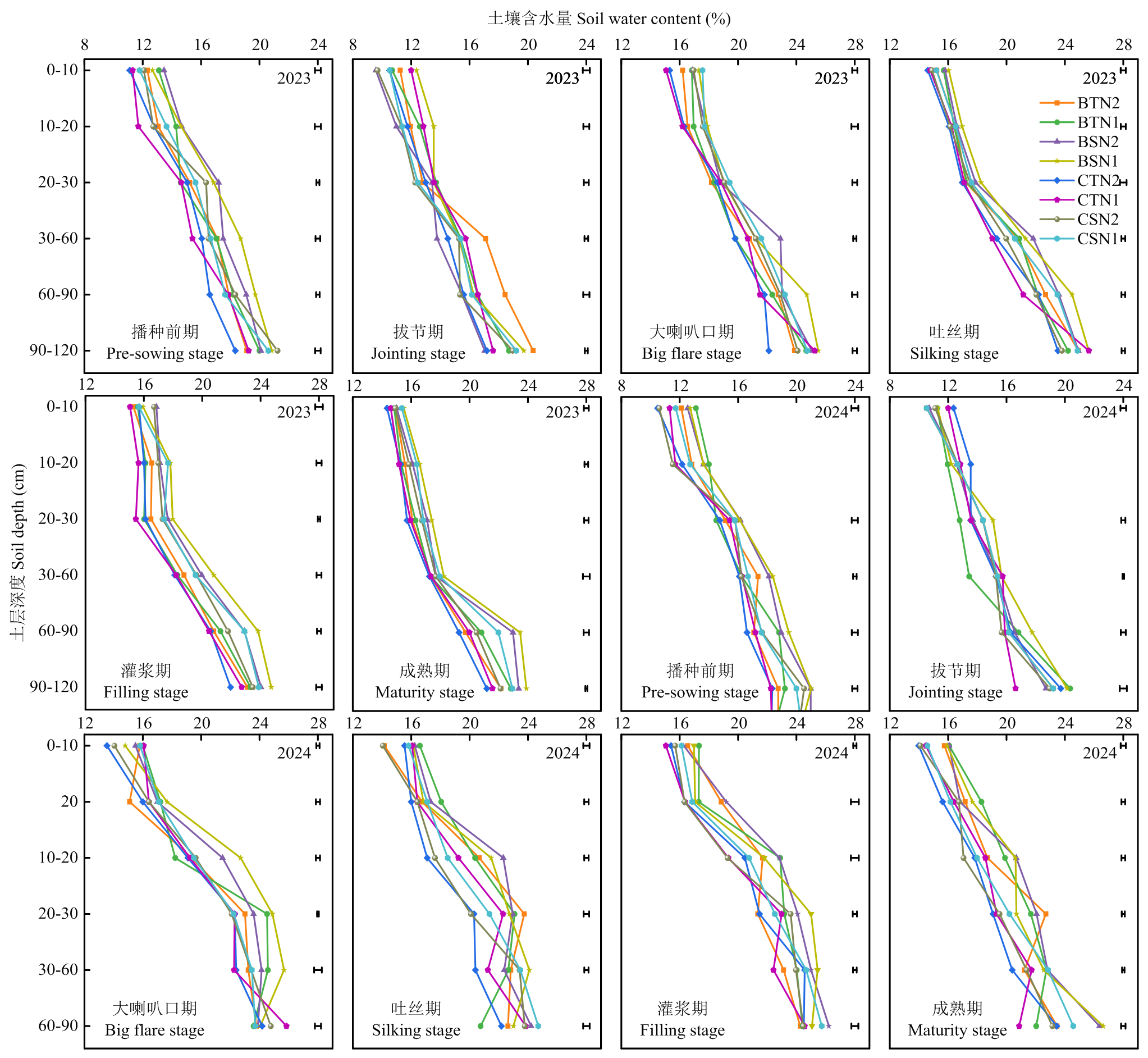
图2
生物炭配施缓释肥在减量施氮下玉米不同生育时期0—120 cm土层土壤含水量的垂直变化 B和C代表生物炭和无调理剂;S和T代表缓释肥和传统化学氮肥;N1和N2代表减氮30%和传统施氮量。下同。图上方的误差线表示LSD值"
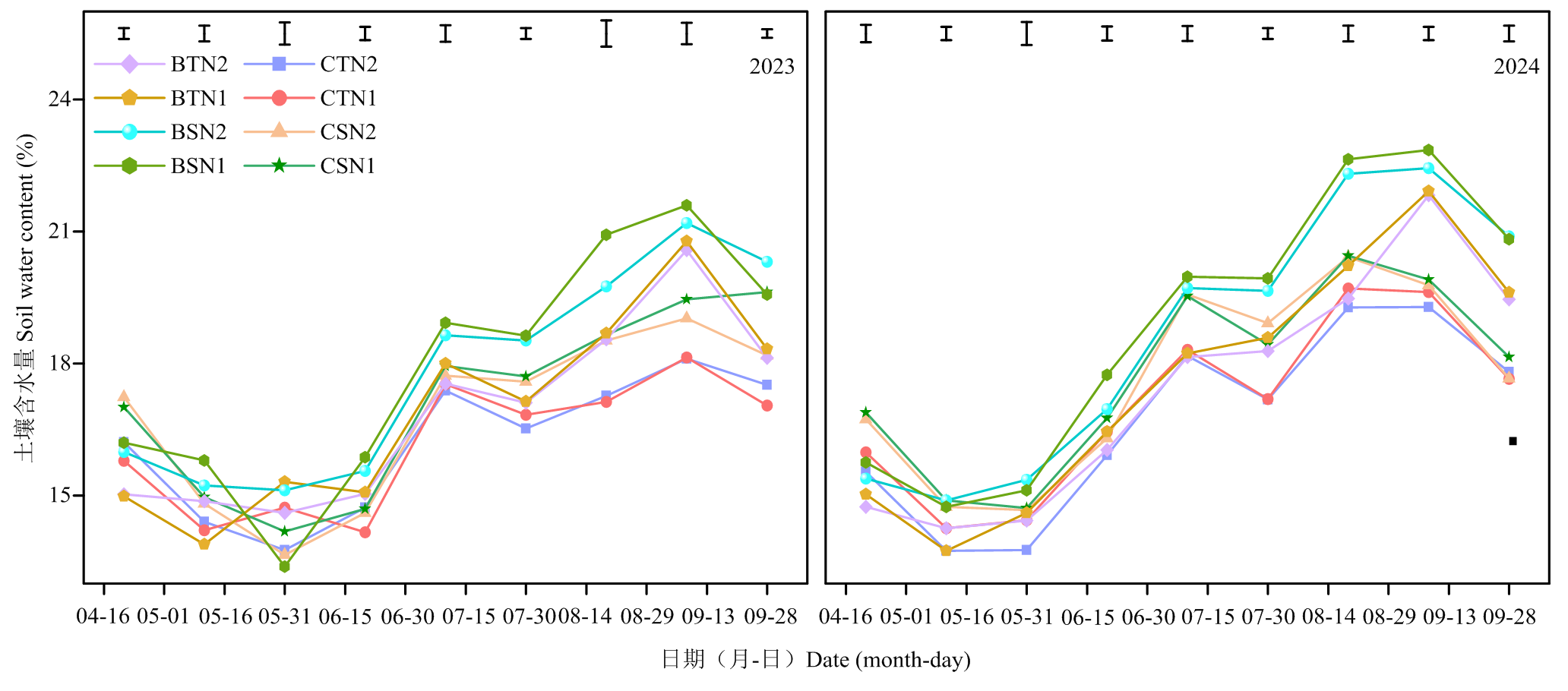
图3
生物炭配施缓释肥在减量施氮下玉米全生育期0—120 cm土层土壤平均含水量动态"
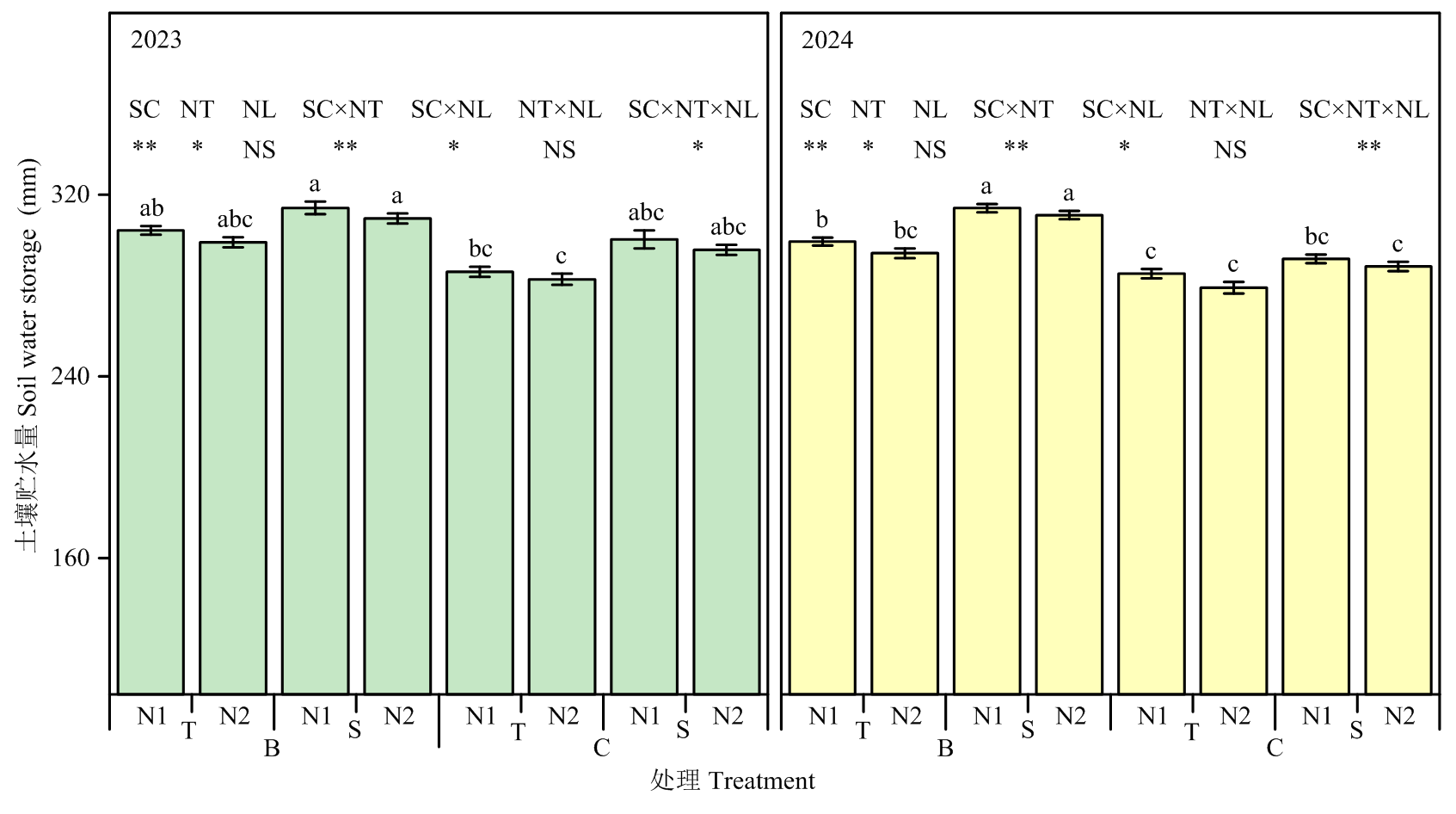
图4
生物炭配施缓释肥在减量施氮下的玉米播前土壤贮水量 SC:土壤调理剂;NT:氮肥类型;NL:施氮水平。不同字母表示处理间在0.05水平上差异显著(Duncan)。**:P<0.01;*:P<0.05;NS:无显著差异。下同"
表4
生物炭配施缓释肥在减量施氮条件下的玉米耗水量及耗水模系数"
| 年份 Year | 土壤调理剂 Soil conditioner | 氮肥类型 Nitrogen type | 施氮 水平 Nitrogen level | 播种期—拔节期 Sowing-jointing | 拔节期— 大喇叭口期 Jointing-big flare | 大喇叭口期— 开花期 Big flare-flowering | 开花期—灌浆期 Flowering-filling | 灌浆期—成熟期 Filling-maturating | 总耗水量 Total evapotran- spiration (mm) | |||||
|---|---|---|---|---|---|---|---|---|---|---|---|---|---|---|
| ET (mm) | CP (%) | ET (mm) | CP (%) | ET (mm) | CP (%) | ET (mm) | CP (%) | ET (mm) | CP (%) | |||||
| 2023 | B | S | N1 | 45.1c | 8.3bc | 106.9d | 19.8d | 92.7f | 17.1d | 126.4c | 23.4a | 169.8b | 31.4b | 540.9g |
| N2 | 46.5bc | 8.3c | 109.7d | 19.6d | 96.2e | 17.2d | 127.8c | 22.9ab | 179.1ab | 32.0a | 559.3fg | |||
| T | N1 | 48.6abc | 8.3c | 129.8ab | 22.1a | 100.6d | 17.1d | 129.8abc | 22.1bc | 177.8ab | 30.3cd | 586.6cd | ||
| N2 | 51.3abc | 8.3bc | 135.9a | 22.5a | 113.3b | 18.4b | 134.1ab | 21.7c | 182.0a | 29.5e | 616.6ab | |||
| C | S | N1 | 48.2abc | 8.5bc | 118.6c | 20.9c | 98.1e | 17.3cd | 125.9c | 22.2bc | 176.1ab | 31.1bc | 566.9ef | |
| N2 | 48.5abc | 8.4bc | 125.7b | 21.7ab | 101.0d | 17.4cd | 128.8bc | 22.2bc | 176.4ab | 30.4cd | 580.5cde | |||
| T | N1 | 52.4ab | 8.7a | 126.6b | 21.1bc | 107.4c | 17.9bc | 129.8abc | 21.6c | 184.2a | 30.7bcd | 600.4bc | ||
| N2 | 54.6a | 8.8a | 127.0b | 20.5c | 118.3a | 19.0a | 135.4a | 21.8c | 185.7a | 29.9de | 621.1a | |||
| 2024 | B | S | N1 | 17.2c | 2.8b | 123.6f | 20.3ab | 87.6f | 14.4b | 137.1e | 22.5a | 243.5d | 40.0a | 609.0f |
| N2 | 17.5bc | 2.8b | 127.8e | 20.5ab | 92.1e | 14.8ab | 140.0d | 22.4a | 246.6d | 39.5ab | 623.9e | |||
| T | N1 | 18.5ab | 2.9b | 135.7c | 20.9ab | 98.5c | 15.2ab | 144.5c | 22.3a | 251.5c | 38.8bc | 648.7c | ||
| N2 | 21.3a | 3.2a | 135.7c | 20.2ab | 110.6a | 16.4a | 148.1b | 22.0a | 257.6b | 38.3c | 673.2b | |||
| C | S | N1 | 18.5ab | 3.0ab | 125.0f | 20.1b | 94.9d | 15.2ab | 140.4d | 22.5a | 243.9e | 39.2abc | 622.7e | |
| N2 | 19.1b | 3.0ab | 132.8d | 20.8ab | 97.9c | 15.3ab | 144.4c | 22.6a | 245.4de | 38.4c | 639.6d | |||
| T | N1 | 20.8a | 3.1a | 139.4b | 20.8ab | 104.6b | 15.6ab | 147.4b | 22.0a | 258.4b | 38.5c | 670.7b | ||
| N2 | 21.1a | 3.0a | 146.0a | 21.1a | 109.3a | 15.8ab | 151.4a | 21.9a | 264.9a | 38.2c | 692.8a | |||
| 显著性Significance | ||||||||||||||
| 土壤调理剂Soil conditioner (SC) | * | NS | NS | NS | * | * | NS | NS | NS | NS | NS | |||
| 氮肥类型Nitrogen type (NT) | * | NS | ** | * | ** | * | * | * | * | * | ** | |||
| 施氮水平Nitrogen level (NL) | NS | NS | NS | NS | * | NS | NS | NS | NS | NS | NS | |||
| 土壤调理剂×氮肥类型SC×NT | * | * | ** | * | ** | * | * | NS | * | * | ** | |||
| 土壤调理剂×施氮水平SC×NL | * | * | NS | NS | * | NS | NS | NS | NS | NS | NS | |||
| 氮肥类型×施氮水平NT×NL | NS | NS | ** | NS | * | * | ** | NS | * | * | ** | |||
| 土壤调理剂×氮肥类型×施氮水平 SC×NT×NL | ** | * | ** | * | ** | * | * | NS | * | * | * | |||
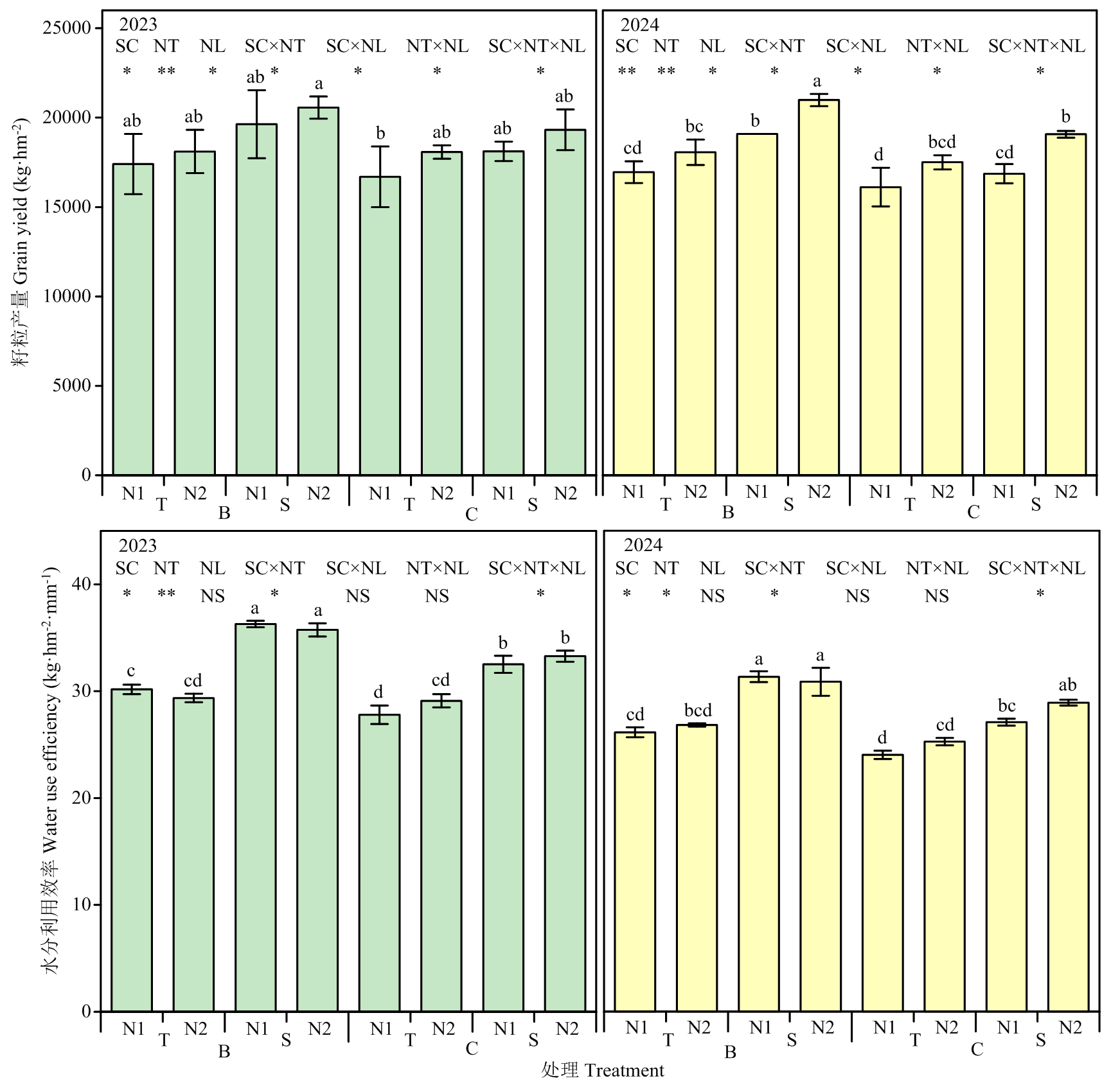
图5
生物炭配施缓释肥及减氮玉米的籽粒产量和水分利用效率"
| [1] |
王浩, 汪林, 杨贵羽, 贾玲, 姚懿真, 张瑀桐. 我国农业水资源形势与高效利用战略举措[J]. 中国工程科学, 2018, 20(5): 9-15.
|
|
|
|
| [2] |
李斌, 宿顺顺, 冯浩, 吴淑芳, 胡亚瑾, 王建平. 灌溉与有机肥处理对冬小麦水分利用效率的影响[J]. 中国土壤与肥料, 2024(3): 144-152.
|
|
|
|
| [3] |
张建军, 樊廷录, 党翼, 赵刚, 王磊, 李尚中, 王淑英, 王勇. 黄土旱塬耕作方式和施肥对冬小麦产量和水分利用特性的影响[J]. 中国农业科学, 2017, 50(6):1016-1030. DOI: 10.3864/j.issn.0578-1752.2017.06.004.
|
|
|
|
| [4] |
李含婷, 柴强, 王琦明, 胡发龙, 于爱忠, 赵财, 殷文, 樊志龙, 范虹. 绿洲灌区不同施氮水平下玉米绿肥间作模式的水分利用特征[J]. 中国农业科学, 2021, 54(12): 2608-2618. DOI: 10.3864/j.issn.0578-1752.2021.12.011.
|
|
|
|
| [5] |
张金鑫, 葛均筑, 马玮, 丁在松, 王新兵, 李从锋, 周宝元, 赵明. 华北平原冬小麦-夏玉米种植体系周年水分高效利用研究进展[J]. 作物学报, 2023, 49(4): 879-892.
|
|
|
|
| [6] |
|
| [7] |
阚正荣, 刘鹏, 李超, 祁剑英, 马守田, 濮超, 赵鑫, 张海林. 施用生物炭对华北平原土壤水分和夏玉米生长发育的影响[J]. 玉米科学, 2019, 27(1): 142-150.
|
|
|
|
| [8] |
梁凯, 王祚, 郝顺. 生物炭配施条件下减氮对春玉米产量及土壤氨挥发的影响[J]. 内蒙古水利, 2023(9): 6-7.
|
|
|
|
| [9] |
贾咏霖, 屈忠义, 丁艳宏, 杨威, 马贵仁, 李争争. 不同灌溉方式下施用生物炭对土壤水盐运移规律及玉米水分利用效率的影响[J]. 灌溉排水学报, 2020, 39(8): 44-51.
|
|
|
|
| [10] |
|
| [11] |
焦智辉, 陈桂平, 范虹, 张金丹, 殷文, 李含婷, 王琦明, 胡发龙, 柴强. 绿洲灌区密植减量施氮玉米的水分利用特征[J]. 中国农业科学, 2023, 56(16): 3088-3099. DOI: 10.3864/j.issn.0578-1752.2023.16.004.
|
|
|
|
| [12] |
蔡晓, 王东, 吴祥运, 吴雨晴, 林祥, 张俊鹏. 氮肥减施对夏玉米生长及水氮利用效率的影响[J]. 玉米科学, 2022, 30(1): 158-165.
|
|
|
|
| [13] |
蒋伟勤, 马中涛, 胡群, 马会珍, 任高磊, 朱盈, 刘国栋, 张洪程, 魏海燕. 缓控释氮肥对水稻生长发育及氮素利用的影响[J]. 江苏农业学报, 2020, 36(3): 777-784.
|
|
|
|
| [14] |
吴得峰, 崔全红, 王军尚. 黄土旱塬施氮模式对春玉米产量和水肥利用效率的影响[J]. 土地开发工程研究, 2017, 2(11): 47-54.
|
|
|
|
| [15] |
樊小林, 刘芳, 廖照源, 郑祥洲, 喻建刚. 我国控释肥料研究的现状和展望[J]. 植物营养与肥料学报, 2009, 15(2): 463-473.
|
|
|
|
| [16] |
魏海燕, 李宏亮, 程金秋, 张洪程, 戴其根, 霍中洋, 许轲, 郭保卫, 胡雅杰, 崔培媛. 缓释肥类型与运筹对不同穗型水稻产量的影响[J]. 作物学报, 2017, 43(5): 730-740.
|
|
|
|
| [17] |
|
| [18] |
|
| [19] |
于玲玲, 赵贵元, 崔婧婧, 郭强. 施用生物炭对玉米田土壤呼吸及水分利用效率的影响[J]. 江苏农业科学, 2022, 50(3): 209-213.
|
|
|
|
| [20] |
刘小月, 高日平, 韩云飞, 高宇, 高宏艳, 张鹏, 赵沛义, 任永峰. 生物炭配施有机肥对阴山北麓旱作燕麦生长及水分利用的影响[J]. 中国土壤与肥料, 2023(3): 46-54.
|
|
|
|
| [21] |
赵文举, 徐浩, 吴克倩, 曹伟. 生物炭与凹凸棒对土壤水力特性的影响[J]. 节水灌溉, 2023(1): 64-70.
|
|
|
|
| [22] |
樊叶, 莫姣娇, 张丽丽, 薛兵东, 张嫣然, 刘懿萱, 赵新宇, 丰光. 缓释肥减施对辽东地区玉米产量及氮肥利用效率的影响[J]. 玉米科学, 2024, 32(6): 86-94.
|
|
|
|
| [23] |
邓振镛, 张强, 王强, 张谋草, 王润元, 倾继祖, 王鹤龄, 徐金芳. 黄土高原旱塬区土壤贮水量对冬小麦产量的影响[J]. 生态学报, 2011, 31(18): 5281-5290.
|
|
|
|
| [24] |
|
| [25] |
|
| [26] |
李丰琇, 马英杰. 不同氮肥处理夏玉米生理生态因子对光合-蒸腾作用的调控[J]. 干旱地区农业研究, 2018, 36(5): 102-109.
|
|
|
|
| [27] |
殷文, 柴强, 胡发龙, 樊志龙, 范虹, 于爱忠, 赵财. 干旱内陆灌区不同秸秆还田方式下春小麦田土壤水分利用特征[J]. 中国农业科学, 2019, 52(7): 1247-1259. DOI: 10.3864/j.issn.0578-1752.2019.07.012.
|
|
|
|
| [28] |
王鹏飞, 于爱忠, 王玉珑, 苏向向, 李悦, 吕汉强, 柴健, 杨宏伟. 绿肥还田结合减量施氮对玉米干物质积累分配及产量的影响[J]. 中国农业科学, 2023, 56(7): 1283-1294. DOI: 10.3864/j.issn.0578-1752.2023.07.007.
|
|
|
|
| [29] |
梁淼, 李盼, 赵连豪, 樊志龙, 胡发龙, 范虹, 何蔚, 柴强, 殷文. 土壤调理剂与缓释氮肥对小麦干物质积累及产量的影响[J]. 作物学报, 2025, 51(2): 470-484.
|
|
|
|
| [30] |
|
| [31] |
|
| [32] |
孙云保, 张民, 郑文魁, 耿计彪, 杨力, 李家康. 控释氮肥对小麦-玉米轮作产量和土壤养分状况的影响[J]. 水土保持学报, 2014, 28(4): 115-121.
|
|
|
|
| [33] |
张殿凯, 李盼, 范虹, 何蔚, 樊志龙, 胡发龙, 孙亚丽, 谭向念, 殷文, 陈桂平. 西北灌区复种绿肥及减氮条件下春小麦产量及水分利用特征[J]. 中国农业科学, 2024, 57(11): 2189-2201. DOI:10.3864/j.issn.0578-1752.2024.11.011.
|
|
|
| [1] | 白晶晶, 章宇辰, 倪子捷, 高佳勇, 刘伟洋, 盖东升, 王雨行, 何佳庆, 张强, 邵玺文, 吴莹, 耿艳秋, 郭丽颖. 不同灌溉量对东北地区水稻抗倒伏特性及产量的影响[J]. 中国农业科学, 2026, 59(9): 1848-1868. |
| [2] | 蔡巧红, 周甜, 苏明, 洪自强, 李翻过, 李彤, 汪华, 康建宏, 吴宏亮. 宁夏引黄灌区减氮增钾施肥模式对玉米光合荧光特性及光合产物积累的影响[J]. 中国农业科学, 2026, 59(9): 1869-1886. |
| [3] | 祝培, 赵耀, 白岩, 张金盔, 李莓, 龙金佳, 杨龙, 罗丽娅, 许本波, 徐劲松, 张学昆. 氟唑菌酰羟胺对油菜的生理调控作用及其与咪鲜胺的复配效应[J]. 中国农业科学, 2026, 59(9): 1903-1915. |
| [4] | 王志高, 李刘滨, 许颖, 鞠澄辉, 何荣. 基于图像处理的玉米破损比例检测方法及其品质变化同步分析[J]. 中国农业科学, 2026, 59(9): 1987-2001. |
| [5] | 陈宣伊, 郭星星, 张向前, 路战远, 刘凌悦, 罗方, 李金龙, 张传玲, 张志青, 车曼青. 间作行比对玉米冠层光环境异质性和光合物质生产的影响[J]. 中国农业科学, 2026, 59(8): 1653-1671. |
| [6] | 侯慧芝, 尹嘉德, 马明生, 刘晓伟, 柳燕兰, 雷康宁. 耕作与增施有机肥对陇东马铃薯-玉米一年两熟制作物产量和水分利用的影响[J]. 中国农业科学, 2026, 59(8): 1672-1685. |
| [7] | 赵思捷, 任家欣, 南江磊, 王兴云, 成卫宁. 玉米叶片次生物质含量及相关基因表达与其对草地贪夜蛾抗性的关系[J]. 中国农业科学, 2026, 59(8): 1686-1696. |
| [8] | 彭廷燊, 陆久焱, 吴美林, 严雨欣, 刘宏周, 南文斌, 秦小健, 李明, 龚俊义, 梁永书. 多年生水稻黄糯2号和长白7号产量相关性状的QTL分析[J]. 中国农业科学, 2026, 59(7): 1361-1379. |
| [9] | 王亚菲, 闫鹏, 薛金涛, 董学瑞, 孟凡琦, 郭丽娜, 罗艺, 张娟, 董志强, 卢霖. 乙烯利-甜菜碱-水杨酸合剂对高温胁迫下玉米根系建构、生理功能和产量的影响[J]. 中国农业科学, 2026, 59(7): 1439-1455. |
| [10] | 王玉萍, 符质, 孙佳莹, 穆晓萌, 刘慧淋, 郭进云, 宋文菁, 侯雷平, 赵海亮. 苗期施用褪黑素对番茄短期低温胁迫的缓解作用与应用效果评价[J]. 中国农业科学, 2026, 59(7): 1523-1535. |
| [11] | 王佳诺, 陈桂平, 李盼, 王丽萍, 南运有, 何蔚, 樊志龙, 胡发龙, 柴强, 殷文, 赵连豪. 免耕地膜两年覆盖提高绿洲灌区玉米产量的灌浆期光合生理机制[J]. 中国农业科学, 2026, 59(6): 1189-1202. |
| [12] | 周新杰, 任昊, 陈应龙, 张吉旺, 赵斌, 任佰朝, 刘鹏, 王洪章. 过氧化钙对渍涝农田夏玉米根系形态及产量形成的影响[J]. 中国农业科学, 2026, 59(6): 1203-1216. |
| [13] | 何继航, 张擎, 吕相月, 薛吉全, 徐淑兔, 刘建超. 不同保绿型玉米杂交种氮效率评价[J]. 中国农业科学, 2026, 59(6): 1217-1230. |
| [14] | 李永娟, 张悦彤, 王艺博, 赵长江, 宋洁, 陈雪丽, 姚钦. 生物炭施用对大豆轮连作系统土壤固氮微生物nifH基因丰度及群落组成的影响[J]. 中国农业科学, 2026, 59(6): 1272-1285. |
| [15] | 李思源, 李鸿萍, 常洪庆, 张森焱, 栗思佳, 崔欣飞, 乔泼, 曾波, 刘桂珍, 刘天学, 汤继华, 李潮海. 增密对不同株高玉米品种产量和农艺性状动态变化的影响[J]. 中国农业科学, 2026, 59(5): 967-984. |
|
||
