






中国农业科学 ›› 2026, Vol. 59 ›› Issue (11): 2358-2373.doi: 10.3864/j.issn.0578-1752.2026.11.005
杨林1,2( ), 段普舜1,2, 王凤梧3, 王千军3, 郑成忠3, 梅雪3, 王希全1,2(), 赵宝平1,2()
收稿日期:2025-11-19
接受日期:2026-04-02
出版日期:2026-06-01
发布日期:2026-06-03
通信作者:
联系方式:
杨林,E-mail:yanglin18872154738@163.com。
基金资助:
YANG Lin1,2(), DUAN PuShun1,2, WANG FengWu3, WANG QianJun3, ZHENG ChengZhong3, MEI Xue3, WANG XiQuan1,2(), ZHAO BaoPing1,2()
Received:2025-11-19
Accepted:2026-04-02
Published:2026-06-01
Online:2026-06-03
摘要:
【目的】内蒙古自治区作为我国燕麦主产区,地处干旱半干旱区域,水分匮乏是制约燕麦高产与稳产的关键因素。通过探究不同减灌条件下燕麦籽粒产量形成的生理机制,以期为该地区燕麦节水高产栽培模式的构建提供理论依据和实践指导。【方法】于2022—2023年在内蒙古自治区乌兰察布市开展田间定位试验。选用穗粒数差异显著的坝莜1号和定莜8号为试验材料,在防雨棚条件下设置3种灌溉模式,即常规灌溉(CK)、分蘖期减灌(reduced irrigation at tillering,RIt)和拔节期减灌(reduced irrigation at jointing,RIj),并于孕穗期撤除防雨棚。通过系统分析不同灌溉处理下燕麦小穗的发育、内源激素变化及源库流特征与籽粒产量的相互关系,阐明减少灌溉对燕麦生理机制的影响过程。【结果】燕麦籽粒产量受年份、品种及减灌模式的显著影响。与常规灌溉相比,两燕麦品种在分蘖期减灌下两年平均减产7.8%—8.9%,而拔节期减灌则减产17.9%—20.0%。拔节期减灌显著降低穗中部结实小穗数并增加穗下部不孕小穗数,导致坝莜1号的穗粒数、结实率两年平均降低28.2%、11.3%,定莜8号则分别降低25.8%、15.6%。Mantel检验和随机森林模型分析表明,籽粒产量与各部位内源激素密切相关,拔节期减灌使两燕麦品种穗部、叶部、根部的(生长素+赤霉素+玉米素核苷)/脱落酸含量比值两年平均下降16.4%—32.2%、22.2%—54.4%、21.9%—50.6%,分蘖期减灌各部位则分别提高42.2%—54.8%、10.3%—55.5%、18.4%—94.8%。此外,拔节期减灌还打破了燕麦源库流关系,降低光合特性致使代谢源不足,限制维管束发育导致流不畅,阻碍燕麦各部位干物质量的积累,从而导致燕麦籽粒产量降低,而分蘖期减灌对上述生理过程的影响较小。【结论】拔节期减灌通过打破燕麦各部位内源激素平衡和源流库关系,影响小穗发育,降低穗粒数和结实率,最终导致籽粒产量显著下降。因此,在内蒙古干旱缺水地区,为缓解水分胁迫对燕麦籽粒产量的负面影响,采取分蘖期适度控水结合拔节期灌溉,并选用穗粒数较多的品种,可有效减少水资源浪费和籽粒产量的损失。
杨林, 段普舜, 王凤梧, 王千军, 郑成忠, 梅雪, 王希全, 赵宝平. 减灌条件下燕麦内源激素与源库流关系对籽粒产量的影响[J]. 中国农业科学, 2026, 59(11): 2358-2373.
YANG Lin, DUAN PuShun, WANG FengWu, WANG QianJun, ZHENG ChengZhong, MEI Xue, WANG XiQuan, ZHAO BaoPing. Effects of Endogenous Hormones and Source-Sink-Flow Relationships on Grain Yield in Oat Under Reduced Irrigation Conditions[J]. Scientia Agricultura Sinica, 2026, 59(11): 2358-2373.

表1
试验地0—20 cm土层基础理化特性"
| 年份 Year | 土壤有机质 Soil organic matter (g·kg-1) | 全氮 Total nitrogen (g·kg-1) | 全磷 Total phosphorus (g·kg-1) | 全钾 Total potassium (g·kg-1) | 碱解氮 Alkali hydrolyzed nitrogen (mg·kg-1) | 有效磷 Available phosphorus (mg·kg-1) | 有效钾 Available potassium (mg·kg-1) | pH |
|---|---|---|---|---|---|---|---|---|
| 2022 | 23.93 | 2.14 | 0.52 | 18.32 | 111.50 | 6.73 | 238.67 | 8.16 |
| 2023 | 23.77 | 2.16 | 0.54 | 16.83 | 109.67 | 7.10 | 242.33 | 8.14 |
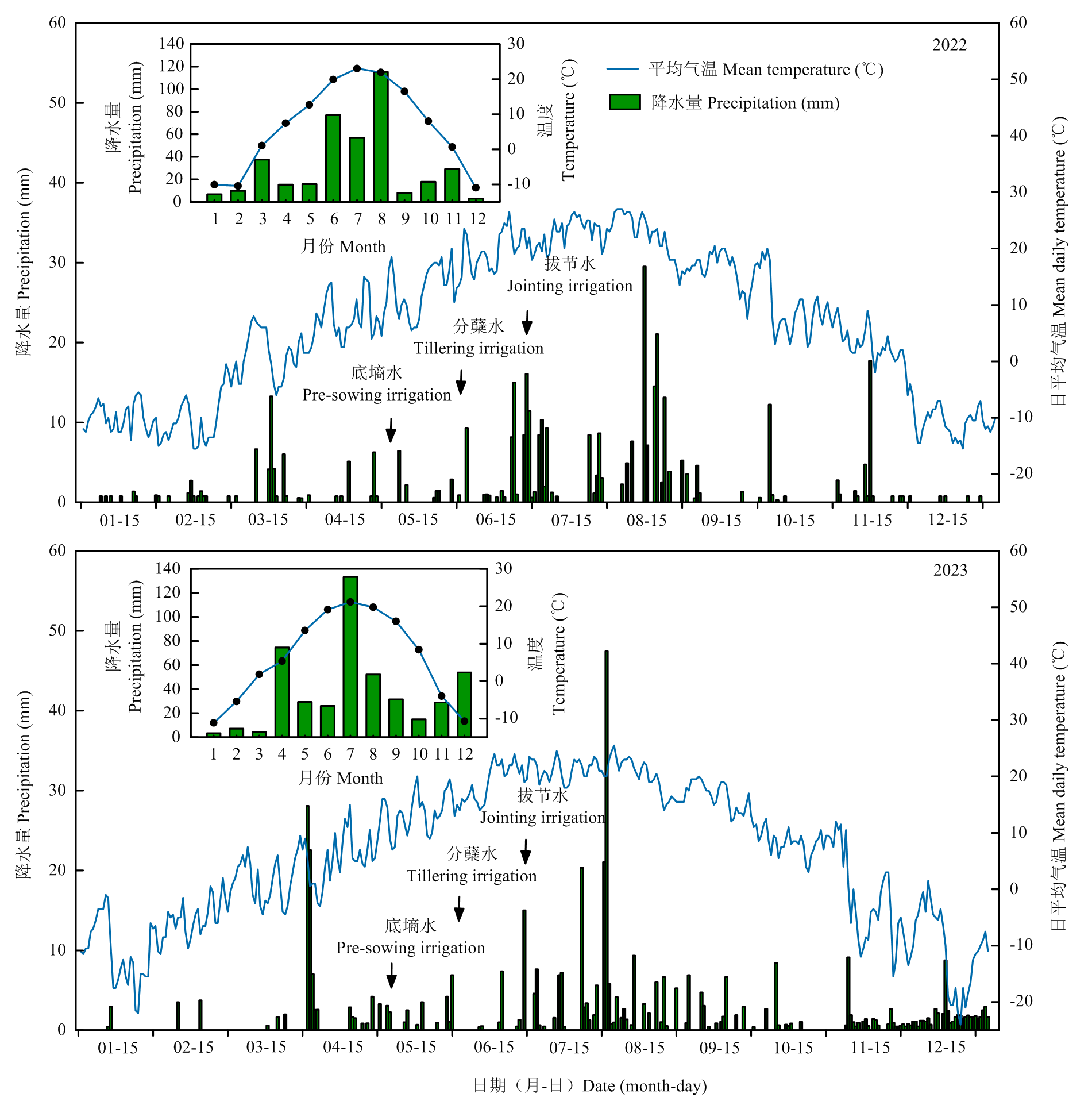
图1
试验地2022—2023年降水量及平均气温情况"
表2
灌溉处理时期及灌水量"
| 灌溉处理 Irrigation treatment | 底墒水 Pre-sowing irrigation (mm) | 分蘖水 Irrigation at tillering (mm) | 拔节水 Irrigation at jointing (mm) | 灌水总量 Total irrigation amount (mm) |
|---|---|---|---|---|
| 常规灌溉 CK | 60 | 60 | 60 | 180 |
| 分蘖期减灌 RIt | 60 | 0 | 60 | 120 |
| 拔节期减灌 RIj | 60 | 60 | 0 | 120 |
表3
减灌模式对燕麦籽粒产量及产量构成因素的影响"
| 年份 Year | 品种 Variety | 减灌模式Reduced irrigation | 穗长 Panicle length (cm) | 穗粒数 Kernel number per panicle | 千粒重 1000-grain weight (g) | 有效穗数 Productive panicle number (m2) | 结实率 Seed setting rate (%) | 籽粒产量 Grain yield (kg·hm-2) |
|---|---|---|---|---|---|---|---|---|
| 2022 | 坝莜1号 Bayou 1 | CK | 15.75±0.63a | 114.75±16.75a | 23.90±1.98b | 206.91±20.58a | 94.93±2.15a | 2421.34±233.42a |
| RIt | 16.09±1.09a | 102.91±11.72a | 25.88±1.59a | 166.84±16.09b | 94.31±2.53a | 2167.36±303.64a | ||
| RIj | 14.10±0.46b | 85.82±5.91b | 26.44±1.21a | 224.79±11.64a | 84.12±1.21b | 1971.84±169.95b | ||
| 定莜8号 Dingyou 8 | CK | 21.82±5.52a | 116.40±8.89a | 21.97±1.36a | 219.89±45.07a | 82.09±1.75b | 1784.10±226.01a | |
| RIt | 23.88±2.70a | 108.28±17.44b | 22.98±1.85a | 187.31±9.22b | 90.11±2.13a | 1743.50±201.27a | ||
| RIj | 17.74±1.40b | 94.68±12.01b | 21.37±0.87a | 213.27±13.16a | 71.96±4.61c | 1537.51±108.43b | ||
| 2023 | 坝莜1号 Bayou 1 | CK | 20.71±0.41a | 127.91±5.15a | 23.88±0.82c | 229.79±19.61a | 91.15±3.37a | 2520.05±327.07a |
| RIt | 21.23±2.32a | 115.51±4.43b | 26.67±0.96a | 172.31±17.79b | 92.92±3.14a | 2337.25±202.43b | ||
| RIj | 17.16±0.58b | 87.85±3.47c | 24.98±0.91b | 221.06±11.14a | 80.86±2.00b | 1980.95±146.78c | ||
| 定莜8号 Dingyou 8 | CK | 21.12±3.64b | 117.67±7.74a | 21.00±1.56c | 209.26±19.29b | 83.57±3.20a | 2011.99±277.23a | |
| RIt | 24.70±0.66a | 94.31±6.81b | 23.84±1.34a | 181.78±8.98c | 89.79±4.12a | 1758.57±78.85b | ||
| RIj | 18.96±0.87c | 78.99±8.36c | 22.14±1.06b | 226.33±13.51a | 67.77±5.34b | 1580.94±291.19c | ||
| 年份 Year (Y) | *** | ns | *** | ns | *** | *** | ||
| 品种 Variety (V) | *** | ** | *** | ns | *** | *** | ||
| 减灌模式 Reduced irrigation (R) | *** | *** | *** | *** | *** | *** | ||
| Y×V | *** | *** | * | ns | ns | *** | ||
| Y×R | ns | ** | ** | ns | ** | *** | ||
| V×R | ** | ** | * | * | *** | ns | ||
| Y×V×R | * | ns | *** | * | * | ns | ||
| 籽粒产量 Grain yield | -0.16* | 0.45*** | 0.37*** | -0.08 | 0.54*** | 1 | ||
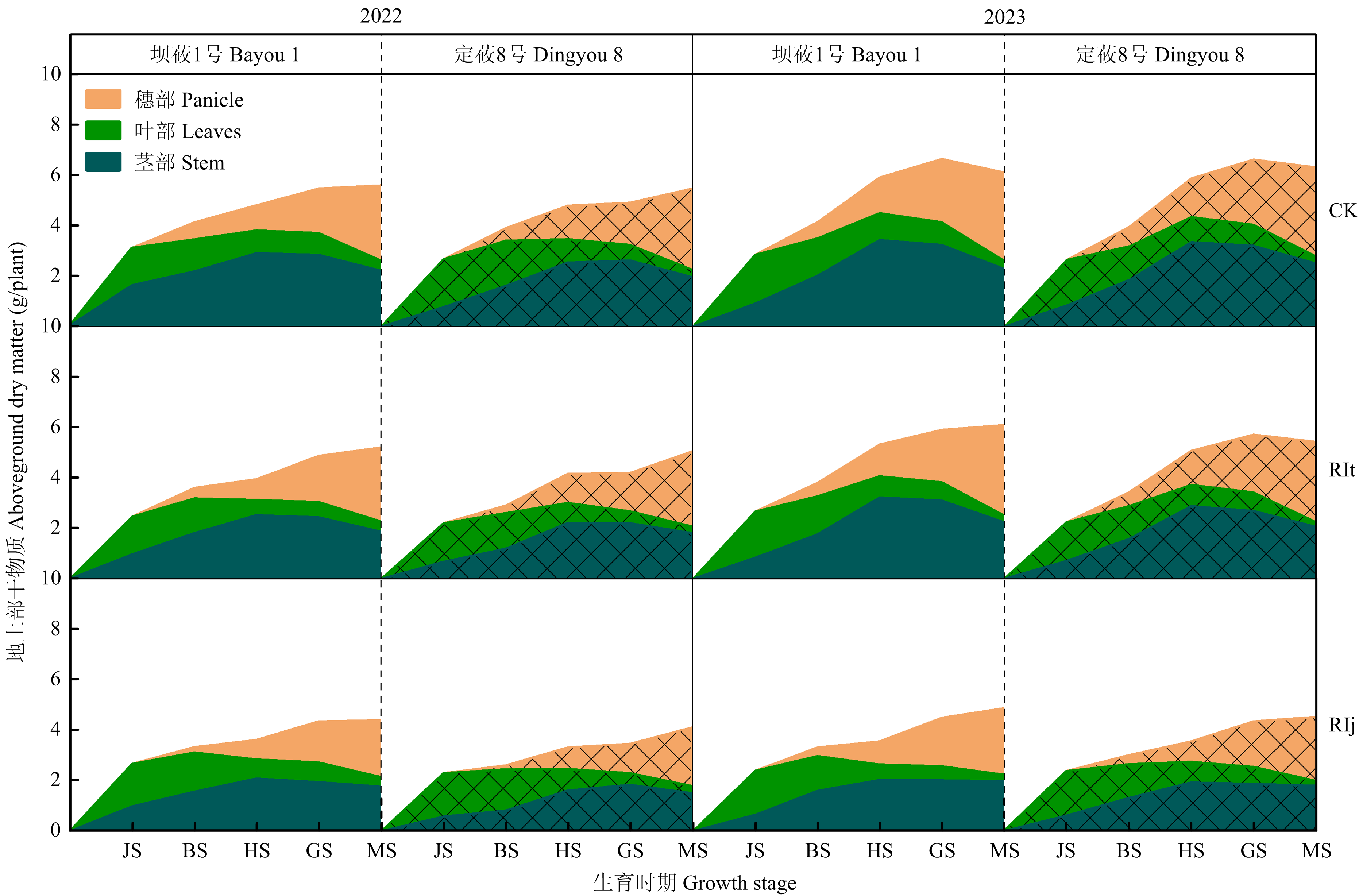
图2
减灌模式对燕麦地上部干物质量的影响 JS:拔节期,BS:孕穗期,HS:抽穗期,GS:灌浆期,MS:成熟期"
表4
减灌模式对燕麦小穗数的影响"
| 年份 Year | 品种 Variety | 减灌模式 Reduced irrigation | 结实小穗数 Number of fertile spikelets | 不孕小穗数 Number of sterile spikelets | ||||
|---|---|---|---|---|---|---|---|---|
| 穗上部 Upper spikelet | 穗中部 Middle spikelet | 穗下部 Lower spikelet | 穗上部 Upper spikelet | 穗中部 Middle spikelet | 穗下部 Lower spikelet | |||
| 2022 | 坝莜1号 Bayou 1 | CK | 9.08±0.94a | 16.91±1.72b | 25.39±2.25b | 0.00±0.00a | 0.00±0.00c | 3.62±0.49b |
| RIt | 5.84±0.38b | 19.47±1.34a | 23.20±3.29c | 0.00±0.00a | 0.44±0.19a | 2.24±0.60c | ||
| RIj | 6.11±0.60b | 13.70±3.44c | 27.86±3.02a | 0.00±0.00a | 0.21±0.09b | 8.78±0.07a | ||
| 定莜8号 Dingyou 8 | CK | 6.49±0.10a | 13.22±1.63b | 16.90±1.83a | 0.00±0.00a | 0.20±0.09b | 8.27±0.69b | |
| RIt | 5.18±0.22b | 16.10±2.29a | 16.80±1.31a | 0.00±0.00a | 0.32±0.12a | 4.33±0.20c | ||
| RIj | 5.17±0.19b | 10.15±0.55c | 16.87±1.28a | 0.00±0.00a | 0.00±0.00c | 13.37±1.34a | ||
| 2023 | 坝莜1号 Bayou 1 | CK | 4.57±0.51a | 16.58±0.91b | 36.94±3.31a | 0.00±0.00a | 0.32±0.09b | 5.46±0.57b |
| RIt | 2.92±0.87b | 19.13±1.65a | 30.94±3.22c | 0.00±0.00a | 0.00±0.00c | 2.12±0.61c | ||
| RIj | 2.59±0.45b | 12.55±1.46c | 33.60±2.68b | 0.00±0.00a | 1.05±0.23a | 10.61±1.92a | ||
| 定莜8号 Dingyou 8 | CK | 4.26±1.30a | 15.52±1.33b | 17.36±1.48a | 0.00±0.00a | 0.30±0.10b | 6.28±1.58b | |
| RIt | 3.44±0.59b | 17.95±1.83a | 16.50±1.52a | 0.00±0.00a | 0.00±0.00c | 4.06±1.95c | ||
| RIj | 2.80±1.39b | 9.22±1.36c | 14.93±1.76b | 0.00±0.00a | 1.26±0.08a | 16.02±1.02a | ||
| 年份 Year (Y) | *** | ns | *** | — | *** | *** | ||
| 品种 Variety (V) | *** | *** | *** | — | ns | *** | ||
| 减灌模式 Reduced irrigation (R) | *** | *** | *** | — | *** | *** | ||
| Y×V | *** | *** | *** | — | *** | *** | ||
| Y×R | *** | *** | *** | — | *** | *** | ||
| V×R | *** | ns | *** | — | *** | *** | ||
| Y×V×R | * | ns | * | — | *** | *** | ||
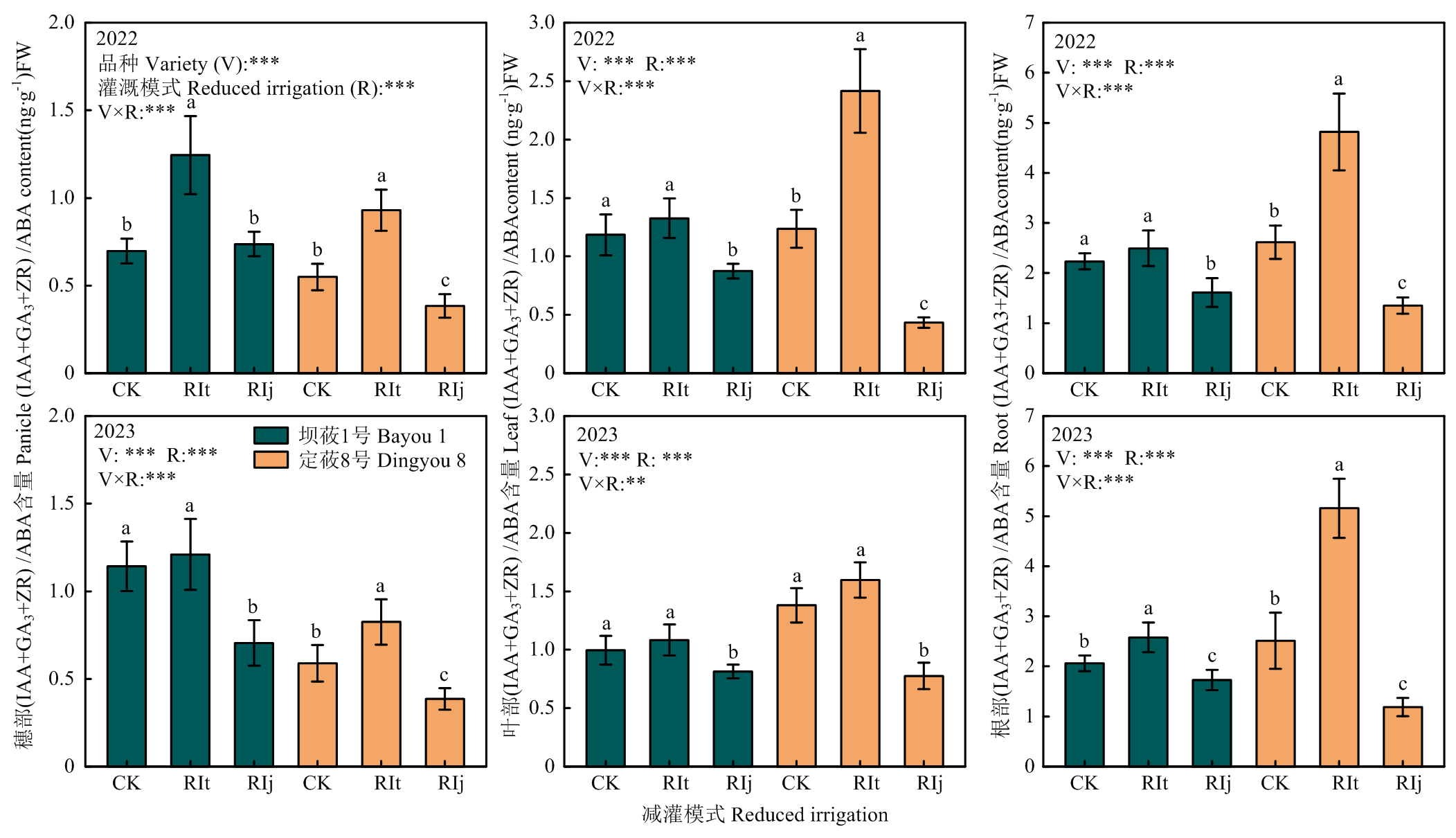
图3
减灌模式对孕穗期燕麦穗、叶和根部内源激素含量的影响"
表5
减灌模式对燕麦旗叶光合特性的影响"
| 年份 Year | 品种 Variety | 减灌模式 Reduced irrigation | 孕穗期 Booting stage | 抽穗期 Heading stage | ||||||
|---|---|---|---|---|---|---|---|---|---|---|
| 净光合速率 Pn (µmol·m-2·s-1) | 蒸腾速率 Tr (mmol·m-2·s-1) | 气孔导度 Gs (mmol·m-2·s-1) | 胞间CO2浓度 Ci (µmol·mol-1) | 净光合速率 Pn (µmol·m-2·s-1) | 蒸腾速率 Tr (mmol·m-2·s-1) | 气孔导度 Gs (mmol·m-2·s-1) | 胞间CO2浓度 Ci (µmol·mol-1) | |||
| 2022 | 坝莜1号 Bayou 1 | CK | 19.67±2.51a | 8.67±0.49b | 437.58±28.28a | 287.33±16.31b | 17.22±2.82a | 7.90±0.98a | 405.66±54.99a | 292.91±30.45a |
| RIt | 16.16±1.24b | 9.56±0.41a | 369.60±20.71b | 304.02±26.04a | 14.58±2.67b | 7.26±0.66b | 373.36±33.46b | 266.84±23.98b | ||
| RIj | 15.60±2.90b | 6.68 ±0.76c | 353.70±51.08b | 275.70±21.63b | 13.06±1.50c | 5.63±0.90c | 308.85±26.15c | 238.29±23.38c | ||
| 定莜8号 Dingyou 8 | CK | 21.35±2.20a | 7.91±0.98b | 534.99±64.57a | 330.13±45.87a | 17.13±1.66a | 7.00±0.50b | 446.01±51.79b | 280.94±18.83b | |
| RIt | 15.34±3.09b | 9.94±1.07a | 487.59±33.13b | 276.88±42.51b | 13.24±1.66b | 11.70±0.85a | 613.74±78.91a | 327.53±38.29a | ||
| RIj | 12.95±1.49c | 5.49±0.59c | 305.00±18.10c | 255.82±20.34b | 11.69±3.42b | 4.10±0.97c | 287.15±20.09c | 239.86±28.00c | ||
| 2023 | 坝莜1号 Bayou 1 | CK | 20.94±2.50a | 7.43 ±0.76b | 467.39±48.59b | 274.71±18.60b | 18.07±1.28a | 4.18±0.67b | 265.28±16.55b | 225.03±17.51b |
| RIt | 17.43±2.20b | 10.72 ±0.74a | 708.92±112.42a | 346.70±10.86a | 16.10±0.87b | 5.81±0.70a | 283.54±20.04a | 274.30±20.89a | ||
| RIj | 9.39±1.01c | 5.41±0.24c | 172.33±26.63c | 208.86±14.42c | 11.53±0.94c | 2.16 ±0.16c | 82.93±7.45c | 197.64±24.18c | ||
| 定莜8号 Dingyou 8 | CK | 19.92±1.81a | 8.25±0.82b | 667.19±80.97a | 288.00±19.07a | 15.99±1.09a | 3.00 ±0.66b | 289.15±33.79a | 219.87±19.27a | |
| RIt | 16.29±0.71b | 10.46±1.02a | 600.51±72.82b | 288.86±5.72a | 9.60±0.93b | 3.81±0.53a | 234.33±20.10b | 223.41±13.53a | ||
| RIj | 9.21±4.07c | 4.16 ±0.31c | 120.22±20.00c | 212.44±32.12b | 5.52±0.23c | 2.08±0.85c | 85.50±5.67c | 182.99±13.77b | ||
| 年份 Year (Y) | *** | ** | *** | *** | *** | *** | *** | *** | ||
| 品种 Variety (V) | * | *** | *** | * | *** | * | *** | ns | ||
| 减灌模式 Reduced irrigation (R) | *** | *** | *** | *** | *** | *** | *** | *** | ||
| Y×V | ns | ns | ** | ns | *** | *** | *** | *** | ||
| Y×R | *** | *** | *** | *** | *** | *** | *** | ns | ||
| V×R | * | *** | *** | *** | *** | *** | *** | ns | ||
| Y×V×R | ** | *** | *** | ** | ** | *** | *** | *** | ||
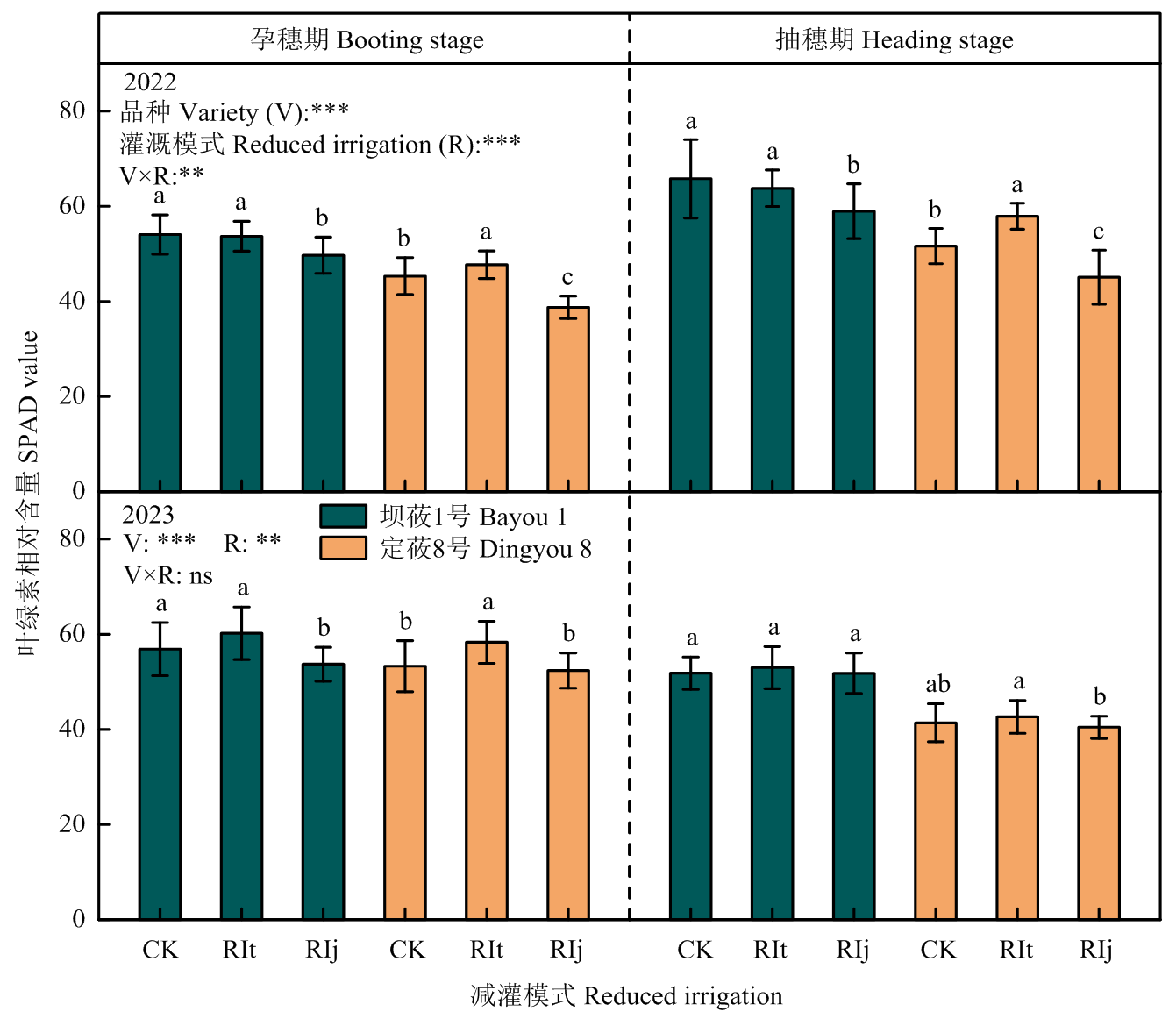
图4
减灌模式对燕麦旗叶SPAD值的影响"
表6
减灌模式对燕麦穗轴部维管束结构的影响"
| 年份 Year | 品种 Variety | 减灌模式Reduced irrigation | 大维管束横截面积 Large vascular bundle area (×102 μm2) | 大维管束韧皮部面积 Large vascular bundle phloem area (×102 μm2) | 大维管束数目 Number of large vascular bundles | 大维管束导管直径 Large vascular bundle vessel diameter (μm) |
|---|---|---|---|---|---|---|
| 2022 | 坝莜1号 Bayou 1 | CK | 184.61±6.82a | 54.27±5.32a | 15.55±0.75a | 42.79±3.27a |
| RIt | 162.71±6.89b | 54.62±3.55a | 14.20±1.72b | 42.58±2.33a | ||
| RIj | 147.32±3.40c | 41.39±4.45b | 15.46±1.64a | 35.97±3.12b | ||
| 定莜8号 Dingyou 8 | CK | 269.88±8.67b | 80.15±2.21b | 18.42±2.81a | 45.57±4.66a | |
| RIt | 292.13±9.62a | 84.23±5.24a | 14.60±0.74b | 47.26±2.45a | ||
| RIj | 184.76±7.78c | 56.76±2.25c | 17.25±2.36a | 38.69±2.42b | ||
| 2023 | 坝莜1号 Bayou 1 | CK | 201.63±8.71b | 57.44±3.50a | 16.54±1.37a | 43.89±3.30b |
| RIt | 206.50±3.64a | 56.53±4.84a | 13.95±1.62b | 46.19±4.03a | ||
| RIj | 178.40±8.03c | 42.71±4.25b | 16.55±1.02a | 39.38±3.14c | ||
| 定莜8号 Dingyou 8 | CK | 287.72±8.61a | 80.07±3.75a | 18.95±2.87a | 50.67±5.40a | |
| RIt | 287.86±8.93a | 81.93±7.50a | 16.50±1.21b | 49.23±3.91b | ||
| RIj | 173.34±7.03b | 53.31±7.29b | 18.25±1.33a | 38.32±2.54c | ||
| 年份 Year (Y) | *** | ns | *** | *** | ||
| 品种 Variety (V) | *** | *** | *** | *** | ||
| 减灌模式 Reduced irrigation (R) | *** | *** | *** | *** | ||
| Y×V | *** | ** | ns | ns | ||
| Y×R | *** | ns | ns | ns | ||
| V×R | *** | *** | ns | ** | ||
| Y×V×R | *** | ns | * | ** | ||

图5
减灌模式下影响燕麦籽粒产量的关键因素 A—C分别表示常规灌溉、分蘖期减灌和拔节期减灌条件下燕麦籽粒产量的影响因素及相关性分析,D表示基于随机森林模型下燕麦籽粒形成的主要影响因子。PL:穗长;KNP:穗粒数;TKW:千粒重;PNVA:单位面积穗数;SSR:结实率;LHB:叶部(IAA+GA3+ZR)/ABA比值;PHB:穗部(IAA+GA3+ZR)/ABA比值;RHB:根部(IAA+GA3+ZR)/ABA比值;Pn:净光合速率;Tr:蒸腾速率;Gs:气孔导度;Ci:胞间CO2浓度;SPAD:叶绿素相对含量;LVBA:大维管束横截面积;NLVB:大维管束数目;LVBD:大维管束直径;PDW:穗部干物质量;LDW:叶部干物质量;SDW:茎部干物质量"
| [1] |
doi: 10.1016/j.agwat.2019.105778 |
| [2] |
任家辉, 孙娟娟, 郝莹璐, 王凤梧, 王靖宇, 张明伟, 李宝涵, 郑成忠, 何竹青, 王照兰. 内蒙古中部地区饲用燕麦品种筛选及青贮品质评价. 中国农业科学, 2025, 58(19): 4026-4038. doi:10.3864/j.issn.0578-1752.2025.19.017.
|
|
|
|
| [3] |
任长忠, 胡跃高. 中国燕麦学. 北京: 中国农业出版社, 2013: 1-23.
|
|
|
|
| [4] |
doi: 10.1038/s41598-022-15418-w |
| [5] |
王俊江, 尹媛红, 陆楚盛, 陆展华, 蔡昊炀, 叶群欢, 廖嘉晖, 卢钰升, 梁开明, 傅友强. 水稻关键生育期灌溉对干旱胁迫下稻谷产量和水分利用效率的影响. 中国农学通报, 2025, 41(8): 1-10.
doi: 10.11924/j.issn.1000-6850.casb2024-0540 |
|
doi: 10.11924/j.issn.1000-6850.casb2024-0540 |
|
| [6] |
李前, 秦裕波, 尹彩侠, 孔丽丽, 王蒙, 侯云鹏, 孙博, 赵胤凯, 徐晨, 刘志全. 滴灌施肥模式对玉米产量、养分吸收及经济效益的影响. 中国农业科学, 2022, 55(8): 1604-1616. doi:10.3864/j.issn.0578-1752.2022.08.011.
|
|
|
|
| [7] |
doi: 10.1111/jac.v209.1 |
| [8] |
于肖, 牛佳红, 陈二影, 秦岭, 杨延兵, 黎飞飞, 刘振宇, 管延安. 水氮处理对谷子内源激素脱落酸和光合作用特性的影响. 中国土壤与肥料, 2024(4): 190-198.
|
|
|
|
| [9] |
段素梅, 杨安中, 黄义德. 分蘖期干旱处理时间对水稻产量和生理指标的影响. 中国稻米, 2017, 23(1): 36-42.
doi: 10.3969/j.issn.1006-8082.2017.01.007 |
|
doi: 10.3969/j.issn.1006-8082.2017.01.007 |
|
| [10] |
姚林, 郑华斌, 刘建霞, 贺慧, 黄璜. 分蘖期水分胁迫对不同栽培方式水稻生长发育及产量的影响. 作物研究, 2014, 28(5): 455-460.
|
|
|
|
| [11] |
赵方洋, 曹红霞, 马丽娜, 党小文, 万宇, 彭美龄, 李志军. 补充灌溉对黄土高原谷子生长、产量及水分利用效率的影响. 干旱地区农业研究, 2024, 42(5): 44-53, 84.
|
|
|
|
| [12] |
李萍, 尚云秋, 林祥, 刘帅康, 王森, 胡鑫慧, 王东. 拔节期阶段性干旱对小麦茎蘖成穗与结实的影响. 中国农业科学, 2020, 53(20): 4137-4151. doi:10.3864/j.issn.0578-1752.2020.20.004.
|
|
|
|
| [13] |
邵靖宜, 李小凡, 于维祯, 刘鹏, 赵斌, 张吉旺, 任佰朝. 高温干旱复合胁迫对夏玉米产量和茎秆显微结构的影响. 中国农业科学, 2021, 54(17): 3623-3631. doi:10.3864/j.issn.0578-1752.2021.17.006.
|
|
|
|
| [14] |
于治广, 赵宝平, 闫洁, 米俊珍, 吕品, 张茹, 武俊英, 刘景辉. 不同水分条件下燕麦穗颈维管束结构与穗部性状的关系. 麦类作物学报, 2022, 42(3): 342-351.
|
|
|
|
| [15] |
陆红飞, 郭相平, 甄博, 乔冬梅, 周新国, 王振昌, 刘春成, 杨泊. 旱涝交替胁迫对粳稻分蘖期叶片解剖结构的影响. 农业工程学报, 2017, 33(7): 116-122.
|
|
|
|
| [16] |
张志芬, 付晓峰, 赵宝平, 刘俊青, 刘景辉. 腐植酸对重度干旱胁迫下燕麦叶片可溶性糖组分和内源激素的影响. 中国农业大学学报, 2018, 23(9): 11-20.
|
|
|
|
| [17] |
程艳双, 胡美艳, 杜志敏, 闫秉春, 李丽, 王祎玮, 鞠晓堂, 孙丽丽, 徐海. 减氮对辽粳5号/秋田小町RIL群体茎秆维管束、穗部和产量性状的影响及其相互关系. 作物学报, 2021, 47(5): 964-973.
doi: 10.3724/SP.J.1006.2021.02040 |
|
doi: 10.3724/SP.J.1006.2021.02040 |
|
| [18] |
doi: 10.1016/j.agwat.2025.109322 |
| [19] |
石作雄, 师伟杰, 邓浩亮, 魏建龙, 郭世乾, 葛承暄. 河西绿洲不同节水灌溉方式和灌溉定额对制种玉米光合特性和产量的影响. 玉米科学, 2025, 33(9): 77-87.
|
|
|
|
| [20] |
doi: 10.1016/j.agee.2022.107954 |
| [21] |
白海波, 吕学莲, 惠建, 董建力, 朱永兴, 李树华. 灌水量对宁夏春小麦光合特性及产量构成因素的影响. 中国农学通报, 2017, 33(34): 9-14.
doi: 10.11924/j.issn.1000-6850.casb17080005 |
|
doi: 10.11924/j.issn.1000-6850.casb17080005 |
|
| [22] |
doi: 10.3389/fpls.2024.1509325 |
| [23] |
doi: 10.1007/s40003-020-00485-0 |
| [24] |
周广生, 徐才国, 靳德明, 崔克辉, 曹凑贵, 蔡明历, 骆炳山. 分蘖期节水处理对水稻生物学特性的影响. 中国农业科学, 2005, 38(9): 1767-1773.
|
|
|
|
| [25] |
宋兆云, 赵阳, 王东, 谷淑波. 拔节期补灌对两种土壤质地上冬小麦旗叶衰老特性和籽粒产量的影响. 作物学报, 2016, 42(12): 1834-1843.
doi: 10.3724/SP.J.1006.2016.01834 |
|
doi: 10.3724/SP.J.1006.2016.01834 |
|
| [26] |
张笑培, 周新国, 王和洲, 杨慎骄, 陈金平, 刘安能. 拔节期水氮处理对冬小麦植株生长及氮肥吸收利用的影响. 灌溉排水学报, 2021, 40(10): 64-70.
|
|
|
|
| [27] |
孙涛, 曹红霞, 万宇, 马丽娜, 艾玉玉, 李志军. 关键生育期补灌对陕北旱作区大豆产量与水分生产力的影响. 干旱地区农业研究, 2024, 42(6): 161-171.
|
|
|
|
| [28] |
杨晓慧, 王碧胜, 孙筱璐, 侯靳锦, 徐梦杰, 王志军, 房全孝. 冬小麦对水分胁迫响应的模型模拟与节水滴灌制度优化. 作物学报, 2023, 49(8): 2196-2209.
doi: 10.3724/SP.J.1006.2023.21054 |
|
doi: 10.3724/SP.J.1006.2023.21054 |
|
| [29] |
姚宁, 宋利兵, 刘健, 冯浩, 吴淑芳, 何建强. 不同生长阶段水分胁迫对旱区冬小麦生长发育和产量的影响. 中国农业科学, 2015, 48(12): 2379-2389. doi:10.3864/j.issn.0578-1752.2015.12.011.
|
|
|
|
| [30] |
赵连佳, 薛丽华, 孙乾坤, 章建新. 不同水氮处理对滴灌冬小麦田耗水特性及水氮利用效率的影响. 麦类作物学报, 2016, 36(8): 1050-1059.
|
|
|
|
| [31] |
doi: 10.1093/jxb/eraa380 pmid: 32822501 |
| [32] |
赵艺婷, 谢可冉, 高逖, 崔克辉. 水稻分蘖期干旱锻炼对幼穗分化期高温下穗发育和产量形成的影响. 中国水稻科学, 2024, 38(3): 277-289.
doi: 10.16819/j.1001-7216.2024.231110 |
|
doi: 10.16819/j.1001-7216.2024.231110 |
|
| [33] |
doi: 10.1016/j.plaphy.2025.110698 |
| [34] |
寸玉洁. 氮素对拔节期受旱玉米根系形态及生理特性的调控[D]. 杨凌: 西北农林科技大学, 2024.
|
|
|
|
| [35] |
doi: 10.3390/plants12030418 |
| [36] |
doi: 10.1016/j.agwat.2015.12.007 |
| [37] |
doi: 10.3389/fpls.2025.1598652 |
| [38] |
王国栋, 曾胜和, 周建伟, 陈云, 梁飞, 张磊. 基于控墒补灌的春小麦滴灌制度研究. 干旱地区农业研究, 2014, 32(6): 19-25.
|
|
|
|
| [39] |
田旭浪, 王振华, 李文昊, 王东旺, 刘茹华. 覆土浅埋滴灌对春小麦耗水特性及水分利用效率的影响. 土壤通报, 2022, 53(2): 315-323.
|
|
|
|
| [40] |
陆红飞, 郭相平, 甄博, 王振昌, 周新国, 李小朴. 旱涝交替胁迫条件下粳稻叶片光合特性. 农业工程学报, 2016, 32(8): 105-112.
|
|
|
|
| [41] |
徐强, 马晓鹏, 吕廷波, 王东旺, 白蒙, 王泽林, 牛靖冉. 分蘖期干旱胁迫对水稻光合特性及产量的影响. 干旱地区农业研究, 2020, 38(1): 133-139.
|
|
|
|
| [42] |
doi: 10.1080/1343943X.2017.1302307 |
| [43] |
肖婷婷, 吕金印. 水分亏缺对小麦穗部维管束系统发育的影响. 中国生态农业学报, 2010, 18(5): 977-981.
|
|
doi: 10.3724/SP.J.1011.2010.00977 |
|
| [44] |
doi: 10.1111/pce.v48.10 |
| [45] |
doi: 10.3390/ijms231911157 |
| [1] | 管书萍, 李可, 解凯东, 段耀园, 王婷婷, 周志虎, 伍小萌, 郭文武. ‘温州蜜柑+桃叶橙’胞质杂种果实增大的生理基础及相关基因发掘[J]. 中国农业科学, 2026, 59(8): 1748-1759. |
| [2] | 王佳诺, 陈桂平, 李盼, 王丽萍, 南运有, 何蔚, 樊志龙, 胡发龙, 柴强, 殷文, 赵连豪. 免耕地膜两年覆盖提高绿洲灌区玉米产量的灌浆期光合生理机制[J]. 中国农业科学, 2026, 59(6): 1189-1202. |
| [3] | 申丽琼, 何林丽, 刘倪, 陆俊杏, 朱波, 张涛. 钾营养水平对油菜苗期抗湿害能力及内源激素平衡的影响[J]. 中国农业科学, 2026, 59(3): 528-542. |
| [4] | 侯晨梓, 李小平, 王晓龙, 郭来春, 任长忠, 胡新中. 燕麦和面阶段面絮图像及理化特性分析与深度学习识别模型构建[J]. 中国农业科学, 2026, 59(11): 2484-2498. |
| [5] | 吕旭东, 孙世媛, 李亚楠, 刘玉龙, 王艳群, 付鑫, 张佳英, 宁鹏, 彭正萍. 智能机械化分层施肥对麦田根-土养分分布和小麦产量的影响[J]. 中国农业科学, 2026, 59(1): 129-146. |
| [6] | 赵宇萱, 苗纪元, 胡伟, 周治国. 苗期低温对棉花花芽分化和棉株产量的影响[J]. 中国农业科学, 2025, 58(7): 1311-1320. |
| [7] | 陈彩锦, 马琳, 蒋庆雪, 刘金晖, 苗童, 张志鹏, 孟翔, 马晓冉, 周昕越, 张建, 刘文辉, 王学敏. 244份饲用燕麦种质资源表型性状遗传多样性分析[J]. 中国农业科学, 2025, 58(23): 4825-4836. |
| [8] | 徐修远, 张洪志, 徐丽君, 薛玮, 聂莹莹, 郭明英, 李金霞, 赵雅茹, 史明江. 基于13C脉冲标记揭示施氮对牧草光合碳分配的影响[J]. 中国农业科学, 2025, 58(21): 4346-4356. |
| [9] | 任家辉, 孙娟娟, 郝莹璐, 王凤梧, 王靖宇, 张明伟, 李宝涵, 郑成忠, 何竹青, 王照兰. 内蒙古中部地区饲用燕麦品种筛选及青贮品质评价[J]. 中国农业科学, 2025, 58(19): 4026-4038. |
| [10] | 赵凯男, 丁豪, 刘阿康, 姜宗昊, 陈广周, 冯波, 王宗帅, 李华伟, 司纪升, 张宾, 毕香君, 李勇, 李升东, 王法宏. 氮肥减量后移改善植株光合特性提高麦-玉周年产量及经济效益[J]. 中国农业科学, 2024, 57(5): 868-884. |
| [11] | 郭娅, 任昊, 王洪章, 张吉旺, 赵斌, 任佰朝, 刘鹏. 高温干旱复合胁迫抑制夏玉米光系统Ⅱ性能降低籽粒产量[J]. 中国农业科学, 2024, 57(21): 4205-4220. |
| [12] | 张建龙, 邢文文, 叶绍波, 张超, 郑德聪. 基于双输出回归卷积神经网络的燕麦株高估测研究[J]. 中国农业科学, 2024, 57(20): 3974-3985. |
| [13] | 王小军, 王金兰, 琚泽亮, 梁国玲, 贾志锋, 刘文辉, 马祥, 马金秀, 李文. 环青海湖地区不同饲用燕麦品种生产性能和营养品质综合评价[J]. 中国农业科学, 2024, 57(19): 3730-3742. |
| [14] | 张巫军, 段秀建, 李茂瑜, 罗夏, 刘强明, 唐永群, 李经勇, 姚雄. 弱光下烯效唑对杂交籼稻茎秆形态、解剖特征和抗倒伏性的影响[J]. 中国农业科学, 2024, 57(15): 2946-2963. |
| [15] | 张振, 石玉, 于振文, 张永丽. 不同产量水平麦田植株氮素转运和籽粒氮素积累的差异[J]. 中国农业科学, 2024, 57(13): 2539-2548. |
|
||
