






中国农业科学 ›› 2026, Vol. 59 ›› Issue (11): 2325-2339.doi: 10.3864/j.issn.0578-1752.2026.11.003
谢永祥1,2( ), 潘怡敏1,2, 黄蕊2, 秦慧彬2, 侯森2, 贺强3, 凌亮4,5(), 穆志新2(), 王海岗2()
收稿日期:2025-10-31
接受日期:2025-12-15
出版日期:2026-06-01
发布日期:2026-06-03
通信作者:
联系方式:
谢永祥,E-mail:2874911460@qq.com。
基金资助:
XIE YongXiang1,2(), PAN YiMin1,2, HUANG Rui2, QIN HuiBin2, HOU Sen2, HE Qiang3, LING Liang4,5(), MU ZhiXin2(), WANG HaiGang2()
Received:2025-10-31
Accepted:2025-12-15
Published:2026-06-01
Online:2026-06-03
摘要:
【目的】通过对山西谷子种质资源进行系统耐瘠性鉴定与综合评价,筛选优异耐瘠种质,建立评价模型,筛选鉴定指标,为谷子耐瘠品种的高效选育提供理论依据与方法支撑。【方法】以617份山西谷子地方品种为试验材料,于2023—2024年分别在太原(23TY,24TY,瘠薄胁迫)和东阳(23DY,24DY,正常肥力)种植,测定节数、茎粗、穗粗、株高、颈长、穗长、叶长、叶宽、穗重、穗粒重、千粒重11个指标,通过正态分布检验、耐瘠薄系数差异分析、相关性分析、聚类分析和回归分析等方法,对谷子种质资源的耐瘠性进行综合评价鉴定。【结果】各农艺性状的变异幅度存在差异,变异系数为9.23%—48.05%,其中,23TY叶宽的变异系数最小,为9.23%;24TY穗粒重的变异系数最大,为48.05%。K-S检验结果表明,除了节数、穗长、叶宽和穗重之外,其他性状在不同环境中均存在不同程度的正态性分布(P>0.05)。通过对两年两点4个环境中测量的表型值进行相关性分析,穗重和穗粒重呈显著正相关,且相关系数最大,其次是节数与株高、穗长与叶长。此外,颈长与节数在23TY、23DY呈显著负相关;叶长与株高、节数在23TY呈显著负相关;颈长与穗粗在23TY呈显著负相关;颈长与株高在23DY呈显著负相关。主成分分析结果表明,将11个表型性状转化为2个综合指标,累积解释率达到59.68%。利用隶属函数法计算综合耐瘠薄评价值(D值),进行聚类分析,按照耐瘠薄强弱分为3种类型,第Ⅰ类不耐瘠品种有13个,D值为0.09—0.28;第Ⅱ类中度耐瘠品种包括595个,D值为0.40—0.81;第Ⅲ类耐瘠品种有9个,D值为0.84—0.93,其中,来源于阳泉市的毛软谷为耐瘠性最强的品种。采用多元回归分析方法,建立耐瘠薄预测评价模型Y=-0.031+0.129X9+0.167X10+0.141X6+0.233X8+0.205X4(R2=0.951,P<0.001)。【结论】采用多元统计分析方法可有效评价与预测谷子种质的耐瘠薄性,筛选出株高、穗长、叶宽、穗重、穗粒重5个表型性状作为耐瘠薄鉴定评价指标,鉴定到阳泉市的毛软谷为耐瘠性最强的种质。
谢永祥, 潘怡敏, 黄蕊, 秦慧彬, 侯森, 贺强, 凌亮, 穆志新, 王海岗. 山西谷子种质资源耐瘠性鉴定及综合评价[J]. 中国农业科学, 2026, 59(11): 2325-2339.
XIE YongXiang, PAN YiMin, HUANG Rui, QIN HuiBin, HOU Sen, HE Qiang, LING Liang, MU ZhiXin, WANG HaiGang. Identification and Comprehensive Evaluation of the Barren-Tolerant Germplasm Resources of Foxtail Millet in Shanxi[J]. Scientia Agricultura Sinica, 2026, 59(11): 2325-2339.
表 1
试验地土壤养分含量"
| 地点 Location | 全氮 Total nitrogen (g·kg-1) | 有效磷 Available phosphorus (mg·kg-1) | 速效钾 Available potassium (mg·kg-1) | 有机质 Organic matter (g·kg-1) | 酸碱度 pH |
|---|---|---|---|---|---|
| 太原TY | 0.58 | 5.67 | 116.90 | 9.45 | 8.51 |
| 东阳DY | 0.80 | 5.30 | 118.05 | 13.95 | 8.65 |
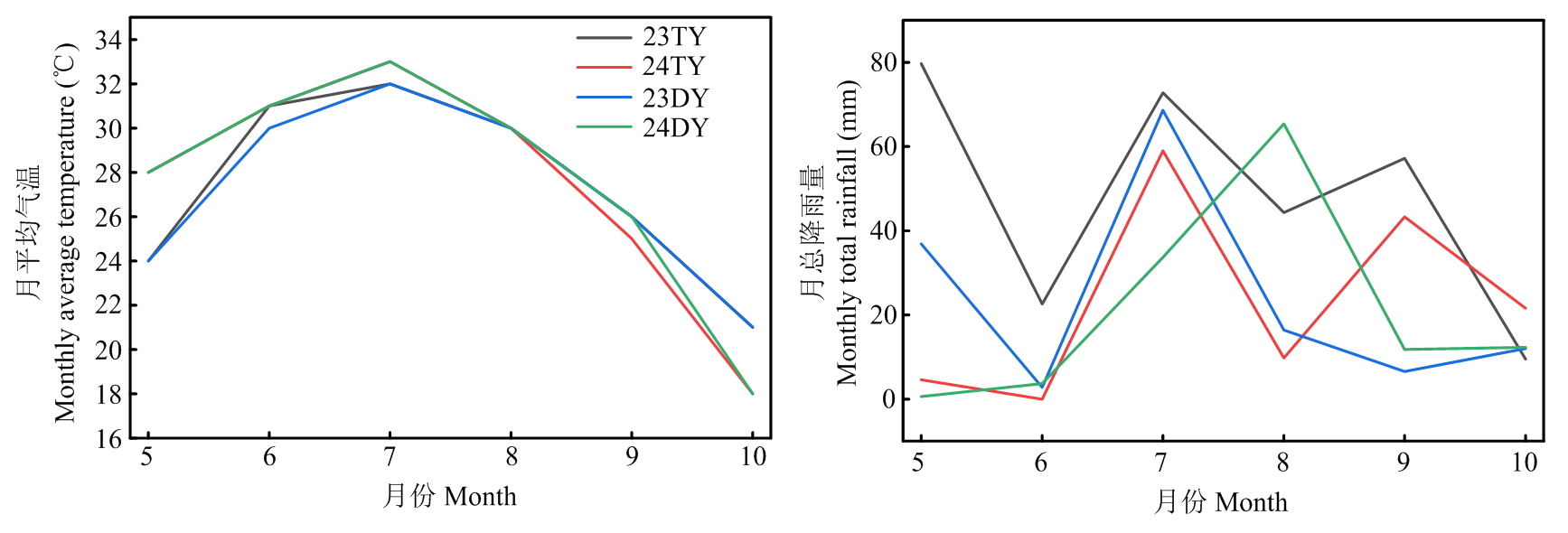
图1
4个环境5—10月的月平均气温和总降雨量 23TY:2023年太原;24TY:2024年太原;23DY:2023年东阳;24DY:2024年东阳。下同"
表2
617份谷子种质资源的农艺性状的统计分析"
| 性状Trait | 环境Environment | 平均值Mean | 变异系数Coefficient variation (%) | 偏度Skewness | 峰度Kurtosis | P值P value |
|---|---|---|---|---|---|---|
| 节数 SNN | 23TY | 11.75±1.43 | 12.24 | -0.01 | 1.03 | 0.000 |
| 24TY | 11.20±1.60 | 14.36 | -0.26 | 0.05 | 0.000 | |
| 23DY | 10.79±1.81 | 16.75 | -0.05 | 0.00 | 0.000 | |
| 24DY | 11.43±1.68 | 14.71 | -0.07 | -0.30 | 0.000 | |
| 茎粗 SD | 23TY | 4.03±0.76 | 18.77 | 0.62 | 1.21 | 0.001 |
| 24TY | 5.44±1.12 | 20.63 | 0.64 | 1.28 | 0.000 | |
| 23DY | 7.29±0.99 | 13.63 | 0.46 | 2.63 | 0.200* | |
| 24DY | 5.88±1.02 | 17.30 | 0.18 | 0.03 | 0.200* | |
| 穗粗 PD | 23TY | 15.51±2.72 | 17.52 | 1.19 | 5.46 | 0.000 |
| 24TY | 19.08±3.97 | 20.83 | 0.88 | 1.14 | 0.000 | |
| 23DY | 23.94±4.60 | 19.29 | 0.28 | 0.02 | 0.200* | |
| 24DY | 24.29±4.78 | 19.73 | 0.62 | 1.59 | 0.000 | |
| 株高 PH | 23TY | 80.91±13.37 | 16.55 | -0.15 | 0.13 | 0.200* |
| 24TY | 89.82±16.67 | 18.57 | -0.09 | -0.37 | 0.011 | |
| 23DY | 106.17±16.41 | 15.42 | -0.26 | 0.13 | 0.060* | |
| 24DY | 104.14±16.84 | 16.18 | -0.32 | -0.02 | 0.000 | |
| 颈长 PeL | 23TY | 38.41±5.01 | 13.04 | 0.07 | 1.20 | 0.001 |
| 24TY | 36.97±5.83 | 15.84 | 0.34 | 0.43 | 0.009 | |
| 23DY | 33.93±6.81 | 20.05 | 0.24 | 0.03 | 0.077* | |
| 24DY | 33.98±5.69 | 16.77 | 0.35 | 0.45 | 0.000 | |
| 穗长 PaL | 23TY | 18.75±3.85 | 20.53 | 0.46 | 0.43 | 0.001 |
| 24TY | 18.41±4.87 | 26.47 | 0.51 | -0.14 | 0.001 | |
| 23DY | 25.58±4.80 | 18.86 | 0.21 | 0.21 | 0.004 | |
| 24DY | 26.61±5.49 | 20.71 | 0.48 | 0.23 | 0.001 | |
| 叶长 LL | 23TY | 34.28±5.14 | 15.06 | 0.28 | 0.14 | 0.171* |
| 24TY | 33.45±6.78 | 20.33 | 0.21 | -0.48 | 0.077* | |
| 23DY | 39.94±4.98 | 12.54 | 0.11 | 0.59 | 0.009 | |
| 24DY | 41.07±6.26 | 15.32 | 0.12 | 0.53 | 0.184* | |
| 叶宽 LW | 23TY | 2.17±0.20 | 9.23 | 1.51 | 7.42 | 0.000 |
| 24TY | 2.34±0.44 | 18.93 | 0.36 | 0.26 | 0.003 | |
| 23DY | 2.90±0.41 | 14.24 | 0.07 | 1.09 | 0.000 | |
| 24DY | 2.72±0.30 | 10.99 | 1.08 | 3.29 | 0.000 | |
| 穗重 SWP | 23TY | 11.85±4.61 | 38.81 | 0.50 | 1.47 | 0.000 |
| 24TY | 12.20±5.46 | 45.08 | 0.66 | 0.20 | 0.000 | |
| 23DY | 21.19±5.67 | 26.80 | 0.52 | 0.52 | 0.003 | |
| 24DY | 17.87±4.61 | 26.01 | 0.37 | 0.06 | 0.022 | |
| 穗粒重 GWP | 23TY | 8.67±3.87 | 44.52 | 0.52 | 1.65 | 0.006 |
| 24TY | 6.57±3.15 | 48.05 | 0.60 | -0.15 | 0.000 | |
| 23DY | 16.91±4.78 | 28.41 | 0.51 | 0.49 | 0.029 | |
| 24DY | 13.58±4.00 | 29.74 | 0.39 | 0.20 | 0.200* | |
| 千粒重 TGW | 23TY | 2.88±0.34 | 11.84 | -0.72 | 4.23 | 0.000 |
| 24TY | 3.04±0.39 | 12.83 | -0.73 | 3.07 | 0.004 | |
| 23DY | 3.43±0.39 | 11.50 | -0.08 | 0.04 | 0.200* | |
| 24DY | 3.40±0.39 | 11.69 | -0.13 | 0.40 | 0.200* |

图2
4个环境下11个表型性状的boxplot图 **和***表示在0.01和0.001水平差异显著。下同"

图3
谷子各个性状表型值的相关性 A:23TY;B:23DY;C:24TY;D:24DY"
表3
各主成分载荷系数及贡献率"
| 指标 Index | 主成分1 Principal component 1 | 主成分2 Principal component 2 |
|---|---|---|
| 节数SNN | 0.689 | -0.271 |
| 茎粗SD | 0.668 | -0.242 |
| 穗粗PD | 0.703 | -0.057 |
| 株高PH | 0.748 | -0.210 |
| 颈长PeL | 0.470 | 0.071 |
| 穗长PaL | 0.764 | -0.148 |
| 叶长LL | 0.751 | -0.334 |
| 叶宽LW | 0.772 | -0.238 |
| 穗重SWP | 0.664 | 0.687 |
| 穗粒重GWP | 0.646 | 0.715 |
| 千粒重TGW | 0.592 | 0.239 |
| 特征值Eigenvalue | 5.150 | 1.41 |
| 贡献率Contributive rate (%) | 46.82 | 12.86 |
| 累积贡献率 Cumulative contributive rate (%) | 46.82 | 59.68 |

图4
617份谷子品种耐瘠系数聚类图 图中为品种编号,同附表1"
表4
各性状与综合评价值(D)的相关性"
| 指标Index | 相关系数Correlation coefficient |
|---|---|
| 节数SNN | 0.579** |
| 茎粗SD | 0.567** |
| 穗粗PD | 0.654** |
| 株高PH | 0.653** |
| 颈长PeL | 0.471** |
| 穗长PaL | 0.687** |
| 叶长LL | 0.619** |
| 叶宽LW | 0.668** |
| 穗重SWP | 0.837** |
| 穗粒重GWP | 0.828** |
| 千粒重TGW | 0.637** |
表5
谷子品种耐瘠薄特性预测模型"
| 多元回归方程 Multiple regression equation | 相关系数 r | 判定系数 R2 | F值 F value | P值 P value |
|---|---|---|---|---|
| Y=0.354+0.227X9+0.182X10 | 0.847 | 0.718 | 779.906 | ≤0.001 |
| Y=0.174+0.159X9+0.172X10+0.319X6 | 0.925 | 0.856 | 1217.475 | ≤0.001 |
| Y=0.048+0.14X9+0.174X10+0.189X6+0.286X8 | 0.958 | 0.917 | 1699.921 | ≤0.001 |
| Y=0.027+0.138X9+0.161X10+0.154X6+0.244X8+0.121X3 | 0.966 | 0.932 | 1681.664 | ≤0.001 |
| Y=-0.031+0.129X9+0.167X10+0.141X6+0.233X8+0.205X4 | 0.975 | 0.951 | 2386.573 | ≤0.001 |
| Y=-0.039+0.128X9+0.158X10+0.12X6+0.207X8+0.186X4+0.089X3 | 0.979 | 0.959 | 2381.147 | ≤0.001 |
| Y=-0.133+0.124X9+0.134X10+0.117X6+0.162X8+0.161X4+0.098X3+0.188X11 | 0.992 | 0.983 | 5131.342 | ≤0.001 |
| Y=-0.138+0.122X9+0.139X10+0.082X6+0.128X8+0.143X4+0.102X3+0.186X11+0.082X7 | 0.994 | 0.988 | 6237.503 | ≤0.001 |
表6
9个谷子耐瘠品种的农艺性状2年平均表现"
| 材料 Materials | 地点 Location | 节数 SNN | 茎粗 SD | 穗粗 PD | 株高 PH | 颈长 PeL | 穗长 PaL | 叶长 LL | 叶宽 LW | 穗重 SWP | 穗粒重 GWP | 千粒重 TGW |
|---|---|---|---|---|---|---|---|---|---|---|---|---|
| 竹叶青 Zhuyeqing | TY | 11.33 | 5.48 | 17.88 | 69.48 | 38.98 | 24.28 | 36.37 | 2.34 | 14.51 | 9.85 | 3.10 |
| DY | 9.50 | 5.91 | 21.82 | 91.83 | 38.83 | 25.17 | 38.67 | 2.62 | 13.03 | 9.50 | 2.86 | |
| 称锤白谷 Chengchuibaigu | TY | 10.17 | 4.55 | 15.95 | 78.83 | 42.18 | 18.14 | 40.77 | 2.08 | 11.90 | 7.81 | 3.02 |
| DY | 8.50 | 3.67 | 15.28 | 93.33 | 31.33 | 17.50 | 36.67 | 2.10 | 11.94 | 8.96 | 3.45 | |
| 羊毛糙 Yangmaocao | TY | 13.63 | 4.06 | 16.81 | 111.30 | 38.73 | 22.66 | 39.60 | 2.23 | 19.00 | 11.43 | 2.74 |
| DY | 12.83 | 6.91 | 32.19 | 118.00 | 25.33 | 19.50 | 35.67 | 2.85 | 15.03 | 11.95 | 2.85 | |
| 青达谷 Qingdagu | TY | 12.17 | 4.37 | 16.14 | 84.78 | 34.58 | 21.25 | 34.52 | 2.38 | 17.18 | 11.15 | 3.05 |
| DY | 11.50 | 6.17 | 16.06 | 106.67 | 27.33 | 19.00 | 39.33 | 2.72 | 13.68 | 10.42 | 3.40 | |
| 刘沟谷 Liugougu | TY | 13.23 | 6.90 | 12.40 | 76.93 | 22.33 | 20.66 | 34.73 | 3.98 | 20.50 | 12.31 | 2.88 |
| DY | 11.83 | 9.54 | 28.91 | 83.67 | 18.00 | 20.83 | 35.17 | 4.36 | 15.54 | 10.73 | 2.96 | |
| 一层黄 Yicenghuang | TY | 14.37 | 6.02 | 28.15 | 113.23 | 32.60 | 25.58 | 45.67 | 2.55 | 21.05 | 13.82 | 2.57 |
| DY | 13.50 | 6.57 | 29.34 | 127.67 | 28.00 | 29.33 | 46.17 | 2.53 | 17.32 | 13.12 | 2.89 | |
| 红石榴 Hongshiliu | TY | 12.03 | 5.85 | 19.31 | 97.47 | 37.30 | 23.05 | 39.43 | 2.74 | 20.55 | 15.91 | 3.39 |
| DY | 10.83 | 7.11 | 22.99 | 108.83 | 33.17 | 31.50 | 43.17 | 2.83 | 14.90 | 11.16 | 3.22 | |
| 黄熟谷 Huangshugu | TY | 10.10 | 4.37 | 17.62 | 81.83 | 48.22 | 20.59 | 45.35 | 2.49 | 13.62 | 6.96 | 3.01 |
| DY | 8.50 | 5.73 | 18.62 | 90.83 | 45.50 | 28.33 | 45.17 | 2.92 | 7.70 | 5.40 | 3.22 | |
| 毛软谷 Maoruangu | TY | 12.67 | 5.20 | 23.49 | 93.00 | 35.88 | 25.30 | 36.62 | 2.23 | 14.30 | 10.33 | 2.71 |
| DY | 10.50 | 5.99 | 22.22 | 103.00 | 33.33 | 20.67 | 32.17 | 2.20 | 11.69 | 8.04 | 2.68 |
| [1] |
吕厚远. 中国史前农业起源演化研究新方法与新进展. 中国科学: 地球科学, 2018, 48(2): 181-199.
|
|
|
|
| [2] |
刁现民. 禾谷类杂粮作物耐逆和栽培技术研究新进展. 中国农业科学, 2019, 52(22): 3943-3949. doi: 10.3864/j.issn.0578-1752.2019.22.001.
|
|
|
|
| [3] |
doi: 10.1080/87559129.2017.1290103 |
| [4] |
吕建珍, 王宏勇, 任莹, 马建萍, 赵凯. 不同生态区谷子品种表型鉴定及SSR遗传多样性分析. 核农学报, 2023, 37(3): 471-482.
doi: 10.11869/j.issn.1000-8551.2023.03.0471 |
|
doi: 10.11869/j.issn.1000-8551.2023.03.0471 |
|
| [5] |
doi: 10.1007/s00425-024-04446-7 pmid: 38796805 |
| [6] |
曹春霞, 朱升海, 颜越, 龙武赐, 黎淳, 谢冰一, 刘云慧, 段美春. 有机管理对不同土地利用方式下土壤质量的影响. 中国生态农业学报(中英文), 2021, 29(3): 474-482.
|
|
|
|
| [7] |
doi: 10.1002/jsfa.v103.15 |
| [8] |
钱晓刚, 腾应, 吴敏, 陈海燕. 玉米耐瘠种质资源的研究: Ⅰ玉米耐瘠种质资源鉴定技术体系的研究. 种子, 2002, 21(6): 22-25.
|
|
|
|
| [9] |
doi: 10.1016/j.micres.2022.127294 |
| [10] |
doi: 10.1007/s00425-023-04129-9 pmid: 37036535 |
| [11] |
王劲松, 焦晓燕, 丁玉川, 董二伟, 白文斌, 王立革, 武爱莲. 粒用高粱养分吸收、产量及品质对氮磷钾营养的响应. 作物学报, 2015, 41(8): 1269-1278.
|
|
doi: 10.3724/SP.J.1006.2015.01269 |
|
| [12] |
张桂香, 王呈祥, 高儒萍, 张秋萍. 高粱主要性状与耐瘠性的相关分析. 山西农业科学, 1998, 26(4): 24-26.
|
|
|
|
| [13] |
陈志德, 刘瑞显, 沈一, 刘永惠, 沈悦, 王晓军. 不同施肥水平下花生品种的耐瘠性及光合特性研究. 花生学报, 2018, 47(3): 47-51, 31.
|
|
|
|
| [14] |
潘中涛, 张秀伟, 蔡甫格. 安单系列玉米自交系耐瘠性鉴定指标筛选及耐瘠性评价. 中国种业, 2017(9): 54-58.
|
|
|
|
| [15] |
李长青, 宋亚茹, 肖凡, 缪春语, 孙梦宇, 纪萌, 孙志梅. 耐瘠高产型玉米品种主要农艺性状特征分析. 草业学报, 2025, 34(9): 97-110.
doi: 10.11686/cyxb2024374 |
|
|
|
| [16] |
张彦, 王劲松, 董二伟, 武爱莲, 王媛, 焦晓燕. 中晚熟区主要高粱品种耐瘠性综合评价. 中国农业科学, 2021, 54(23): 4954-4968. doi: 10.3864/j.issn.0578-1752.2021.23.003.
|
|
|
|
| [17] |
吴秀红, 郭泰, 王志新, 郑伟, 李灿东, 张振宇, 潘相文, 王洪武, 刘忠堂. 耐瘠薄大豆新品种合农62的选育与栽培技术. 黑龙江农业科学, 2011(12): 4-6.
|
|
|
|
| [18] |
连盈, 卢娟, 胡成梅, 牛胤全, 史雨刚, 杨进文, 王曙光, 张文俊, 孙黛珍. 低氮胁迫对谷子苗期性状的影响和耐低氮品种的筛选. 中国生态农业学报(中英文), 2020, 28(4): 523-534.
|
|
|
|
| [19] |
商春悦, 兰倩, 邓玉峰, 朱峰, 赵美丞, 王海岗. 不同驯化阶段谷子对氮胁迫的生理响应及耐低氮综合评价. 中国生态农业学报(中英文), 2024, 32(10): 1650-1658.
|
|
|
|
| [20] |
doi: 10.1016/j.plaphy.2020.03.027 |
| [21] |
张楚, 张永清, 路之娟, 刘丽琴, 杨春婷. 低氮胁迫对不同苦荞品种苗期生长和根系生理特征的影响. 西北植物学报, 2017, 37(7): 1331-1339.
|
|
|
|
| [22] |
梁颖颖, 周俊江, 卿桂霞, 张富厚, 孟超敏. 低磷对不同基因型谷子生长、磷素积累及根际微生物的影响. 山东农业科学, 2024, 56(3): 92-98.
|
|
|
|
| [23] |
李振姣, 井苗, 强羽竹, 王彩兰, 付治忠, 薛志和. 榆林市谷子新品系抗旱耐瘠性评价及资源筛选. 陕西农业科学, 2020, 66(5): 5-8.
|
|
|
|
| [24] |
王海岗, 温琪汾, 乔治军, 穆志新. 山西谷子地方品种初选核心种质构建. 农学学报, 2019, 9(4): 26-31.
doi: 10.11923/j.issn.2095-4050.cjas18060022 |
|
doi: 10.11923/j.issn.2095-4050.cjas18060022 |
|
| [25] |
陆平. 谷子种质资源描述规范和数据标准. 北京: 中国农业出版社, 2006.
|
|
LU P. Descriptors and Data Standard for Foxtail Millet [Setaria italica (L.) beauv.]. Beijing: China Agriculture Press, 2006. (in Chinese)
|
|
| [26] |
|
| [27] |
doi: 10.1002/jsfa.v101.3 |
| [28] |
郭帅, 夏雪岩, 崔纪菡, 刘猛, 校诺娅, 鲁一薇, 刘寒双, 赵文庆, 李顺国. 不同品种夏播饲用谷子生产性能与营养品质的关联分析及评价. 中国草地学报, 2021, 43(9): 60-70.
|
|
|
|
| [29] | |
|
|
|
| [30] |
doi: 10.1038/s41477-020-0747-7 |
| [31] |
王劲松, 董二伟, 武爱莲, 白文斌, 王媛, 焦晓燕. 不同肥力条件下施肥对粒用高粱产量、品质及养分吸收利用的影响. 中国农业科学, 2019, 52(22): 4166-4176. doi: 10.3864/j.issn.0578-1752.2019.22.020.
|
|
|
|
| [32] |
陈昊翔, 万鑫杰, 陈青, 王劲松, 董二伟, 王媛, 黄晓磊, 刘秋霞, 焦晓燕. 石灰性褐土条件下高粱与玉米耐瘠薄特性及对土壤肥力响应的比较. 作物学报, 2025, 51(10): 2775-2787.
doi: 10.3724/SP.J.1006.2025.54006 |
|
doi: 10.3724/SP.J.1006.2025.54006 |
|
| [33] |
doi: 10.1186/s12870-022-03823-2 pmid: 36076172 |
| [34] |
doi: 10.1146/annurev-arplant-042811-105532 pmid: 22224450 |
| [35] |
doi: 10.1007/s00425-024-04385-3 pmid: 38554244 |
| [36] |
董二伟, 王媛, 王劲松, 刘秋霞, 黄晓磊, 焦晓燕. 施氮量对谷子产量、氮素利用及小米品质的影响. 中国农业科学, 2024, 57(2): 306-318. doi: 10.3864/j.issn.0578-1752.2024.02.007.
|
|
|
|
| [37] |
doi: 10.1016/j.foodhyd.2016.09.042 |
| [38] |
陈二影, 杨延兵, 秦岭, 张华文, 刘宾, 王海莲, 陈桂玲, 于淑婷, 管延安. 谷子苗期氮高效品种筛选及相关特性分析. 中国农业科学, 2016, 49(17): 3287-3297. doi: 10.3864/j.issn.0578-1752.2016.17.004.
|
|
|
|
| [39] |
陈凌, 王君杰, 王海岗, 曹晓宁, 刘思辰, 田翔, 秦慧彬, 乔治军. 耐低氮糜子品种的筛选及农艺性状的综合评价. 中国农业科学, 2020, 53(16): 3214-3225. doi: 10.3864/j.issn.0578-1752.2020.16.002.
|
|
|
|
| [40] |
梁颖颖, 周俊江, 周佳敏, 张富厚, 孟超敏. 不同磷处理对谷子磷素积累与分配的影响. 西南农业学报, 2023, 36(12): 2662-2669.
|
|
|
|
| [41] |
王磊, 张浩, 宋炜, 赵昕, 吴子龙. 不同供磷水平对谷子光合性能及磷吸收利用效率的影响. 饲料研究, 2023, 46(23): 79-83.
|
|
|
|
| [42] |
王晓军, 孙玉琴, 杨军学, 王勇, 张晓娟, 张尚沛, 罗世武, 李凯, 程炳文. 长期施肥对旱地谷子产量和养分利用效率的影响. 江苏农业科学, 2019, 47(21): 133-137.
|
|
|
|
| [43] |
徐田军, 吕天放, 赵久然, 王荣焕, 张勇, 蔡万涛, 刘月娥, 刘秀芝, 陈传永, 邢锦丰, 等. 不同播期条件下黄淮海区主推夏播玉米品种籽粒灌浆特性. 作物学报, 2021, 47(3): 566-574.
doi: 10.3724/SP.J.1006.2021.03023 |
|
doi: 10.3724/SP.J.1006.2021.03023 |
|
| [44] |
doi: 10.1016/j.cub.2023.09.055 |
| [45] |
doi: 10.3390/plants14162502 |
| [46] |
王海岗, 秦慧彬, 温琪汾, 乔治军, 穆志新. 山西谷子地方品种表型鉴定与应用分析. 山西农业科学, 2021, 49(12): 1467-1473.
|
|
|
|
| [47] |
王颖, 李会霞, 田岗, 刘鑫, 刘红, 王振华. 山西谷子生产问题及改进措施. 中国种业, 2024(12): 46-48, 55.
|
|
|
|
| [48] |
王瑞, 平俊爱, 张福耀, 詹鹏杰, 楚建强. 高粱育种资源耐瘠性鉴定及评价. 作物杂志, 2020(6): 30-37.
|
|
|
|
| [49] |
赵冬兰, 周志林, 唐君, 曹清河, 张安, 戴习彬. 不同基因型甘薯的耐瘠性研究. 江苏农业科学, 2019, 47(3): 74-78.
|
|
|
|
| [50] |
高雪, 朱林, 苏莹. 基于隶属函数法的甜高粱孕穗期耐盐性综合评价. 南方农业学报, 2018, 49(9): 1736-1744.
|
|
|
|
| [51] |
doi: 10.1016/S0169-5347(03)00061-2 |
| [52] |
夏军, 时晓娟, 郝先哲, 李楠楠, 田雨, 李军宏, 罗宏海. 低温对不同基因型棉种萌发过程中酶活性及激素含量的影响. 植物生理学报, 2019, 55(9): 1291-1305.
|
|
|
|
| [53] |
徐立明, 徐小兵, 杜理, 冷益丰. 玉米自交系耐瘠性综合评价. 江苏农业科学, 2025, 53(15): 137-142.
|
|
|
|
| [54] |
郑兰阳, 董颖苹, 曹贝尔, 吴茅, 黄莉傈, 罗充. 重金属镉-铅地质高背景区不同基因型马铃薯的耐瘠性评价. 分子植物育种, 2023, 21(3): 1034-1044.
|
|
|
| [1] | 王小玮, 杜佛力, 闫红财, 郎正东, 党志娟, 李葆春, 汪军成, 马小乐, 王化俊, 张宏, 姚立蓉. 396份春小麦灌浆期和成熟期抗旱性评价[J]. 中国农业科学, 2026, 59(8): 1608-1621. |
| [2] | 崔节浩, 张萌, 王沁, 于佳妍, 林琨, 李尚泽, 兰恒, 耿艳秋, 张强, 郭丽颖, 邵玺文. 粳稻资源抗倒伏性评价与生理机制[J]. 中国农业科学, 2026, 59(7): 1420-1438. |
| [3] | 陈敏氡, 裘波音, 黄昊, 李永平, 温庆放. 松花菜种质花球质地品质的评价[J]. 中国农业科学, 2026, 59(6): 1302-1316. |
| [4] | 陈敏, 焦紫岚, 乔承彬, 许昊, 张碧, 马东花, 孔维儒, 王敬文, 宋佳伟, 罗成科, 李培富, 田蕾. 不同亚种水稻种质资源对盐胁迫的形态生理响应及适应策略[J]. 中国农业科学, 2026, 59(4): 705-722. |
| [5] | 郝琨, 陈洪德, 张威, 钟韵, 党美荣, 朱士江, 黄志坤, 金英. 基于柑橘产量、品质及水氮利用的涌泉根灌水氮综合评价[J]. 中国农业科学, 2026, 59(4): 862-873. |
| [6] | 何治霖, 孙翠霞, 岳红丽, 谈月霞, 张耀海, 王福生, 刘思涛, 江东. 基于重测序枸橼、柠檬类种质资源的遗传多样性分析和别罗勒烯的全基因组关联分析[J]. 中国农业科学, 2026, 59(2): 386-401. |
| [7] | 高亚峰, 杨嘉宁, 孙雪迪, 陈佳佳, 党志娟, 汪军成, 张宏, 马小乐, 姚立蓉, 孟亚雄, 司二静, 李葆春, 王化俊. 春小麦耐低氮种质资源的筛选与综合评价[J]. 中国农业科学, 2026, 59(11): 2299-2313. |
| [8] | 张悦青, 张玉亭, 薛晨飞, 韩秦宇, 贺一容, 徐紫娟, 范秀梅, 王军娥, 罗丹, 冯雪, 孙胜. 364份樱桃番茄种质资源表型性状的遗传多样性分析及综合评价[J]. 中国农业科学, 2026, 59(11): 2468-2483. |
| [9] | 吕涛, 孙国清, 郭栋材, 陈全家, 蔡永生, 樊标星, 曲延英, 郑凯. 海岛棉纤维强度QTL紧密连锁InDel分子标记开发及效应评价[J]. 中国农业科学, 2025, 58(9): 1684-1701. |
| [10] | 张义茹, 韩雪, 姚鑫杰, 冯军, 魏爱丽, 李文超, 张彬, 韩渊怀, 李红英. 基于多组学解析谷子后熟米色变化的分子机制[J]. 中国农业科学, 2025, 58(9): 1702-1718. |
| [11] | 陈彩锦, 马琳, 蒋庆雪, 刘金晖, 苗童, 张志鹏, 孟翔, 马晓冉, 周昕越, 张建, 刘文辉, 王学敏. 244份饲用燕麦种质资源表型性状遗传多样性分析[J]. 中国农业科学, 2025, 58(23): 4825-4836. |
| [12] | 陈天晓, 曹榕, 宋倩楠, 胡亮亮, 王素华, 王丽侠, 程须珍, 陈红霖. 小豆种质资源苗期耐盐性综合评价及耐盐种质筛选[J]. 中国农业科学, 2025, 58(21): 4317-4332. |
| [13] | 张帆, 杨青川. 紫花苜蓿育种历史、现状与展望[J]. 中国农业科学, 2025, 58(21): 4471-4481. |
| [14] | 陈永先, 陈瑞江, 都艺芝, 术钧捷, 陈晚霞, 赵梓含, 王季春, 杜康, 张凯. 耐旱甘薯种质资源的筛选与鉴定[J]. 中国农业科学, 2025, 58(2): 214-237. |
| [15] | 唐桂梅, 李卫东, 周宇霞, 孔佑涵, 肖晓玲, 彭颖姝, 张力, 符红艳, 刘洋, 黄国林. 基于表型性状分析蕙兰种质资源遗传多样性[J]. 中国农业科学, 2025, 58(2): 339-354. |
|
||
