






中国农业科学 ›› 2026, Vol. 59 ›› Issue (10): 2109-2122.doi: 10.3864/j.issn.0578-1752.2026.10.004
曾昭海1,2( ), 周文彬3, 柴强4, 孙占祥5, 张吉旺6
收稿日期:2025-10-10
接受日期:2026-03-31
出版日期:2026-05-16
发布日期:2026-05-20
联系方式:
曾昭海,E-mail:zengzhaohai@cau.edu.cn
基金资助:
ZENG ZhaoHai1,2(), ZHOU WenBin3, CHAI Qiang4, SUN ZhanXiang5, ZHANG JiWang6
Received:2025-10-10
Accepted:2026-03-31
Published:2026-05-16
Online:2026-05-20
摘要:
在人口持续增长和收入水平稳步提高的驱动下,粮食需求呈刚性增长态势,而气候变化与资源环境约束对粮食产能提升构成严峻挑战。作物栽培学与耕作学是农业科学的核心骨干学科,其构建的理论、研发的技术与模式不仅能显著提升粮食产能,还能有效提高资源利用效率、推动实现农业可持续发展,在粮食安全与生态安全协同发展方面发挥着不可替代的作用。本文系统归纳了作物栽培学与耕作学学科内涵与理论支撑,梳理了作物栽培学与耕作学学科技术体系演变特征,明确了该学科在保障国家粮食安全、提升作物单产、改善农产品品质与营养、驱动品种改良创新及推动农业绿色发展等方面的重要作用,深入剖析了制约学科发展的关键因素,包括长期稳定支持不足、现行评价体系削弱学科影响力、人才队伍短缺、学科特色优势发掘不足、技术进展显示度偏低以及学科研究体系与前沿技术融合不够等问题。在全球气候变化背景下,国家新增千亿斤粮食产能战略的实施、农业社会化服务体系的完善和多学科交叉融合带来的技术创新,为本学科发展提供了重大机遇。本文创新性提出“五位一体”的学科建设路径:(1)强化基础研究——依托平台建设设置长期定位联网观测试验,夯实学科基础研究;(2)融合理论技术——深度融合前沿理论与新技术,丰富学科内涵;(3)攻坚关键技术——面向国家战略需求研发与集成核心技术,提升学科贡献;(4)加速成果转化——推进技术产品化进程,扩大学科影响力;(5)构建人才体系——构建可持续发展的人才培养机制,厚植学科发展根基。本文为作物栽培与耕作学科的转型发展提供了理论框架和实现路径。
曾昭海, 周文彬, 柴强, 孙占祥, 张吉旺. 我国作物栽培学与耕作学研究的进展与展望[J]. 中国农业科学, 2026, 59(10): 2109-2122.
ZENG ZhaoHai, ZHOU WenBin, CHAI Qiang, SUN ZhanXiang, ZHANG JiWang. Progress and Prospects of Crop Cultivation and Farming System in China[J]. Scientia Agricultura Sinica, 2026, 59(10): 2109-2122.
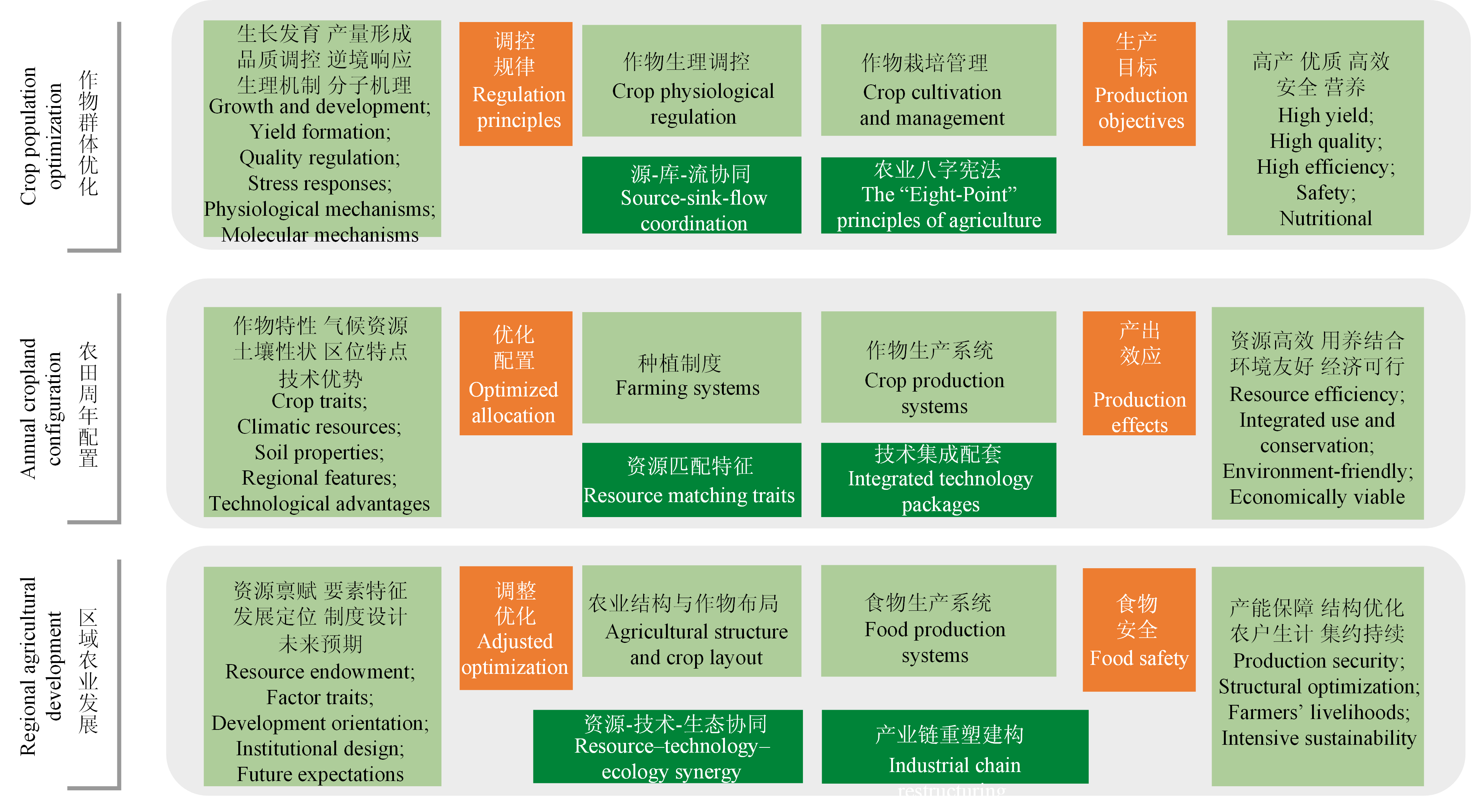
图1
作物栽培学与耕作学学科的核心研究内容框架图"
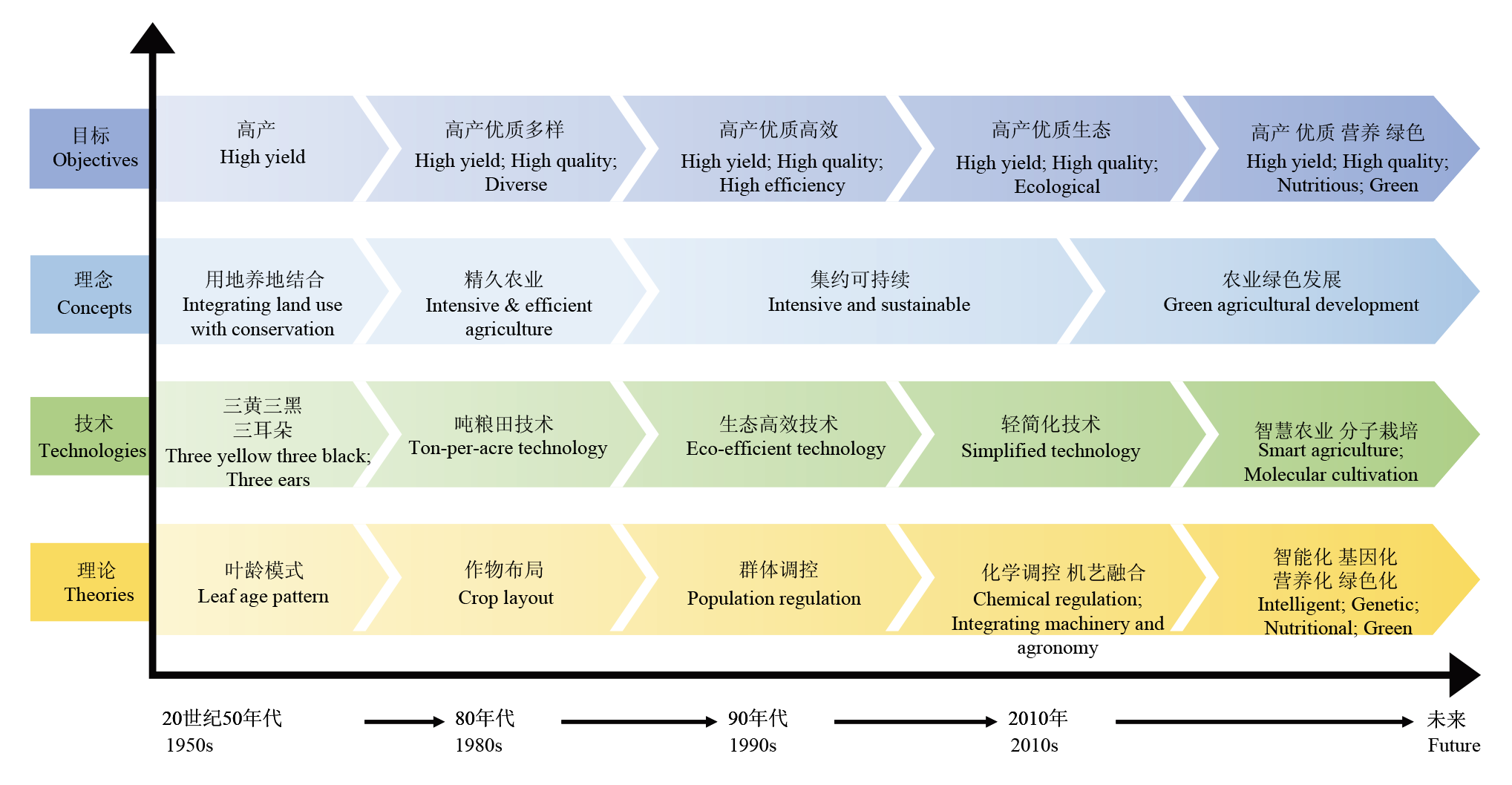
图2
作物栽培与耕作学科的技术演变特征与趋势"
| [1] |
doi: 10.1038/s43016-021-00322-9 |
| [2] |
|
| [3] |
doi: 10.1038/s41467-024-44947-3 pmid: 38321008 |
| [4] |
doi: 10.1038/528032a |
| [5] |
|
| [6] |
doi: 10.1146/annurev-environ-020411-130608 |
| [7] |
doi: 10.1371/journal.pone.0066428 |
| [8] |
文姝蓉, 王怡婷, 钟钰, 王榕. 新一轮千亿斤粮食产能提升行动的路径研究. 科技导报, 2025, 43(10): 23-30.
doi: 10.3981/j.issn.1000-7857.2024.11.01614 |
|
|
|
| [9] |
刘巽浩, 胡跃高, 陈阜. 粮食: 中国农业的永恒难题与主题. 农业现代化研究, 2010, 31(4): 385-391.
|
|
|
|
| [10] |
doi: 10.1038/nature10452 |
| [11] |
doi: 10.1038/nature11420 |
| [12] |
王志敏, 方保停. 论作物生产系统产量分析的理论模式及其发展. 中国农业大学学报, 2009, 14(1): 1-7.
|
|
|
|
| [13] |
doi: 10.1038/s41561-017-0004-5 |
| [14] |
doi: 10.1088/1748-9326/8/4/044041 |
| [15] |
pmid: 12078005 |
| [16] |
doi: 10.1016/j.oneear.2024.07.008 |
| [17] |
陈阜, 赵明. 作物栽培与耕作学科发展. 农学学报, 2018, 8(1): 50-54.
|
|
|
|
| [18] |
曹卫星. 作物栽培学总论. 3版. 北京: 科学出版社, 2017.
|
|
|
|
| [19] |
陈阜, 张海林. 耕作学. 北京: 中国农业出版社, 2021.
|
|
|
|
| [20] |
凌启鸿. 论中国特色作物栽培科学的成就与振兴. 作物杂志, 2003(1): 1-7.
|
|
|
|
| [21] |
杨立炯, 汤玉庚, 王嘉训, 黄祥熙. 陈永康晚粳稻“三黑三黄”高产栽培经验的初步分析. 作物学报, 1964(2): 113-136.
|
|
|
|
| [22] |
凌启鸿. 中国特色水稻栽培理论和技术体系的形成与发展: 纪念陈永康诞辰一百周年. 江苏农业学报, 2008, 24(2): 101-113.
|
|
|
|
| [23] |
邓建平, 葛自强, 顾万荣. 中国作物栽培科学发展的回顾与展望. 中国农学通报, 2005, 21(12): 179-183.
|
|
doi: 10.11924/j.issn.1000-6850.0512179 |
|
| [24] |
余松烈. 冬小麦精播高产栽培. 山东农学院学报, 1980, 11(2): 1-13.
|
|
|
|
| [25] |
凌启鸿, 蔡建中, 苏祖芳. 叶龄余数在稻穗分化进程鉴定中的应用价值. 中国农业科学, 1980, 13(4): 1-11.
|
|
|
|
| [26] |
刘巽浩. 论我国耕作制度的发展. 耕作与栽培, 1983, 3(5): 7-13.
|
|
|
|
| [27] |
胡恒觉, 高炳生, 李雪屏, 蔺海明. 提高我省旱地农业水资源利用效率的探讨. 甘肃农业科技, 1983, 14(7): 2-7.
|
|
|
|
| [28] |
王树安, 兰林旺. 小麦: 夏玉米平播亩产吨粮的理论与实践: 沧州吨粮田的技术特点. 作物杂志, 1990(4): 17-18.
|
|
|
|
| [29] |
李丕明, 奚惠达, 何钟佩, 韩碧文. 农作物化控栽培工程技术的发展与中国农业现代化前景. 北京农业大学学报, 1991(S1): 1-5.
|
|
|
|
| [30] |
杨建昌, 杜永, 刘辉. 长江下游稻麦周年超高产栽培途径与技术. 中国农业科学, 2008, 41(6): 1611-1621. doi:10.3864/j.issn.0578-1752.2008.06.006.
|
|
|
|
| [31] |
于振文, 田奇卓, 潘庆民, 岳寿松, 王东, 段藏禄, 段玲玲, 王志军, 牛运生. 黄淮麦区冬小麦超高产栽培的理论与实践. 作物学报, 2002, 28(5): 577-585.
|
|
|
|
| [32] |
张海林, 高旺盛, 陈阜, 朱文珊. 保护性耕作研究现状、发展趋势及对策. 中国农业大学学报, 2005, 10(1): 16-20.
|
|
|
|
| [33] |
王树安, 兰林旺, 周殿玺, 王志敏, 王璞. 冬小麦节水高产技术体系研究. 中国农业大学学报, 2007, 12(6): 44.
|
|
|
|
| [34] |
彭少兵. 对转型时期水稻生产的战略思考. 中国科学(生命科学), 2014, 44(8): 845-850.
|
|
|
|
| [35] |
高旺盛, 陈源泉, 梁龙. 论发展循环农业的基本原理与技术体系. 农业现代化研究, 2007, 28(6): 731-734.
|
|
|
|
| [36] |
刘巽浩, 陈阜, 吴尧. 多熟种植: 中国农业的中流砥柱. 作物杂志, 2015(6): 1-9.
|
|
|
|
| [37] |
彭少兵. 论新时期作物栽培管理在全球水稻增产中的作用. 作物研究, 2008, 22(4): 207-208.
|
|
|
|
| [38] |
doi: 10.1016/j.scitotenv.2022.159456 |
| [39] |
|
| [40] |
|
| [41] |
doi: 10.1002/agj2.v117.1 |
| [42] |
doi: 10.1038/s41467-023-38355-2 |
| [43] |
李少昆, 王克如, 杨小霞, 韩冬生, 王玉华, 谢瑞芝, 侯鹏, 明博. 玉米高产纪录田块技术与效益分析. 作物杂志, 2017(6): 1-6.
|
|
|
|
| [44] |
莫钊文, 潘圣刚, 王在满, 段美洋, 唐湘如. 科技成果转化农学创新综合实验的探索与实践. 实验室研究与探索, 2024, 43(5): 220-224.
|
|
|
|
| [45] |
凌启鸿. 论中国特色作物栽培科学的不可替代性. 中国农学通报, 2003, 19(4): 1-6.
|
|
|
|
| [46] |
doi: 10.1126/science.aaa5766 |
| [47] |
doi: 10.1038/35093585 pmid: 11584298 |
| [48] |
doi: 10.1126/science.1185383 pmid: 20110467 |
| [49] |
doi: 10.1016/j.tibtech.2025.04.002 |
| [50] |
韩美坤, 黄琴, 李金鹏, 王云奇, 徐学欣, 王志敏. 贮墒旱作冬小麦耗水特征与水分利用效率. 中国农业大学学报, 2018, 23(2): 11-19.
|
|
|
|
| [51] |
谢立勇, 许婧, 郭李萍, 徐玉秀, 孙雪, 赵洪亮, 郭飞, 赵迅. 水肥管理对稻田CH4排放及其全球增温潜势影响的评估. 中国生态农业学报, 2017, 25(7): 958-967.
|
|
|
|
| [52] |
赵凯男, 丁豪, 刘阿康, 姜宗昊, 陈广周, 冯波, 王宗帅, 李华伟, 司纪升, 张宾, 等. 氮肥减量后移改善植株光合特性提高麦-玉周年产量及经济效益. 中国农业科学, 2024, 57(5): 868-884. doi:10.3864/j.issn.0578-1752.2024.05.004.
|
|
|
|
| [53] |
doi: 10.3389/fpls.2021.700331 |
| [54] |
江瑜, 朱相成, 钱浩宇, 张楠, 丁艳锋. 水稻丰产与稻田甲烷减排协同的研究展望. 南京农业大学学报, 2022, 45(5): 839-847.
|
|
|
|
| [55] |
|
| [56] |
刘珍环, 陆晓君. 农作物景观生态研究: 概念框架与研究方向. 生态学报, 2021, 41(24): 9953-9962.
|
|
|
|
| [57] |
王小慧, 陈阜. 华北平原作物面积比例对农田景观异质性特征的影响. 中国农业大学学报, 2022, 27(7): 73-83.
|
|
|
|
| [58] |
矫江. 适应科技体制改革促进栽培专业发展. 农业科技管理, 1996, 15(1): 6-7.
|
|
|
|
| [59] |
刘正辉, 杨建昌, 王大刚, 杨新泉. 从国家自然科学基金资助情况分析作物栽培学基础研究状况. 中国基础科学, 2015, 17(2): 56-62.
|
|
|
|
| [60] |
龚放, 曲铭峰. 南京大学个案: SCI引入评价体系对中国大陆大学基础研究的影响. 高等理科教育, 2010(3): 4-17.
|
|
|
|
| [61] |
王连敏. 关于作物栽培学科面临的危机与发展的思考. 黑龙江农业科学, 2004(5): 23-24.
|
|
|
|
| [62] |
黄开红. 关于作物栽培研究之管见. 江苏农业科学, 1999, 27(2): 7-8.
|
|
|
|
| [63] |
佟屏亚. 试论耕作栽培学科的发展趋势和研究重点. 耕作与栽培, 1993, 13(4): 1-7.
|
|
|
|
| [64] |
王宏广. 中国农业科技的现状、问题、潜力与对策. 中国农业科技导报, 1999, 1(3): 34-41.
|
|
|
|
| [65] |
钟大森, 赵明, 张昭. “粮食丰产增效科技创新”重点专项组织实施进展情况. 作物杂志, 2019(3): 1-9.
|
|
|
|
| [66] |
赵明. 三大粮食主产区作物丰产增效“三适三调”技术体系创建与应用, 2021.
|
|
|
|
| [67] |
张国强, 李少昆, 谢瑞芝, 王克如. 玉米密植精准调控高产技术的原理、应用与思考. 中国农民合作社, 2025(5): 17-20.
|
|
|
|
| [68] |
doi: 10.1038/s43016-023-00915-6 |
| [69] |
doi: 10.1016/j.tplants.2023.01.005 |
| [70] |
doi: 10.1073/pnas.1701762114 pmid: 28811375 |
| [71] |
doi: 10.1038/nclimate2468 |
| [72] |
doi: 10.1088/1748-9326/abf004 |
| [73] |
李腾飞, 曾伟. 农业强国背景下新一轮粮食产能提升潜力与实施路径研究. 经济纵横, 2023(9): 48-55.
|
|
|
|
| [74] |
黎莉莉, 胡晓群, 陈松柏. 新世纪中国粮食生产特征及粮食安全政策取向. 宏观经济研究, 2023(1): 70-83.
|
|
|
|
| [75] |
郑风田, 普蓂喆. 量质兼顾下新一轮千亿斤粮食产能提升: 思路与举措. 中州学刊, 2023(4): 46-53.
|
|
|
|
| [76] |
陈锡文. 当前农业农村的若干重要问题. 中国农村经济, 2023(8): 2-17.
|
|
|
|
| [77] |
崔永福, 王树强. 保障粮食安全: 全球挑战与中国路径. 改革与战略, 2025, 41(3): 74-81.
|
|
|
|
| [78] |
张玉成, 张晓博, 高树琴, 郑聪聪, 张景尧, 文亚, 李禄军, 王卓, 李铁, 赵洪龙. “伏羲农场”: 智慧农业技术集成创新的实践探索与思考. 中国科学院院刊, 2025, 40(2): 301-309.
|
|
|
|
| [79] |
doi: 10.1038/s41586-024-07669-6 |
| [80] |
doi: 10.1016/j.molp.2025.01.004 |
| [81] |
doi: 10.1016/j.molp.2025.01.005 |
| [82] |
doi: 10.1016/j.molp.2025.01.012 |
| [83] |
doi: 10.1038/s41586-025-09251-0 |
| [84] |
|
| [85] |
doi: 10.2136/sssaj2006.0181 |
| [86] |
doi: 10.1016/j.oneear.2020.02.007 |
| [87] |
doi: 10.1017/S0021859620000301 |
| [88] |
|
| [89] |
李少昆, 赵久然, 董树亭, 赵明, 李潮海, 崔彦宏, 刘永红, 高聚林, 薛吉全, 王立春, 等. 中国玉米栽培研究进展与展望. 中国农业科学, 2017, 50(11): 1941-1959. doi:10.3864/j.issn.0578-1752.2017.11.001.
|
|
|
|
| [90] |
doi: 10.1038/s41467-019-09447-9 pmid: 30979872 |
| [91] |
周上游, 邹应斌. 作物栽培产品研究的展望. 作物杂志, 1999(4): 4-7.
|
|
|
|
| [92] |
唐启源, 周上游, 邹应斌. 作物栽培科学的新发展: 从作物化控到物化栽培工程. 中国农业科技导报, 2002, 4(4): 27-32.
|
|
|
| [1] | 黄国勤. 中国南方粮食产能提升的战略路径[J]. 中国农业科学, 2026, 59(9): 2029-2041. |
| [2] | 廖萍, 翁文安, 高辉, 张洪程. 我国直播稻栽培技术应用现状与发展建议[J]. 中国农业科学, 2024, 57(24): 4854-4870. |
| [3] | 张卫建, 尚子吟, 张俊, 严圣吉, 邓艾兴, 张鑫, 郑成岩, 宋振伟. 农业温室气体排放统计核算体系的规范化建设[J]. 中国农业科学, 2023, 56(22): 4467-4477. |
| [4] | 杨世琦. 基于国家粮食安全下的农业面源污染综合防治体系思考[J]. 中国农业科学, 2022, 55(17): 3380-3394. |
| [5] | 陈印军,易小燕,方琳娜,杨瑞珍. 中国耕地资源与粮食增产潜力分析[J]. 中国农业科学, 2016, 49(6): 1117-1131. |
| [6] | 李保国,黄峰. 蓝水和绿水视角下划定“中国农业用水红线”探索[J]. 中国农业科学, 2015, 48(17): 3493-3503. |
| [7] | 史文娇, 陶福禄. 非洲农业产量对气候变化响应与适应研究进展[J]. 中国农业科学, 2014, 47(16): 3157-3166. |
| [8] | 陈温福, 张伟明, 孟军. 农用生物炭研究进展与前景[J]. 中国农业科学, 2013, 46(16): 3324-3333. |
| [9] | 张卫建, 陈金, 徐志宇, 陈长青, 邓艾兴, 钱春荣, 董文军. 东北稻作系统对气候变暖的实际响应与适应[J]. 中国农业科学, 2012, 45(7): 1265-1273. |
| [10] | 唐华俊, 李哲敏. 基于中国居民平衡膳食模式的人均粮食需求量研究[J]. 中国农业科学, 2012, 45(11): 2315-2327. |
| [11] | 余强毅, 吴文斌, 唐华俊, 陈佑启, 杨 鹏. 基于粮食生产能力的APEC地区粮食安全评价[J]. 中国农业科学, 2011, 44(13): 2838-2848 . |
| [12] | 田云录,郑建初,张彬,陈金,董文军,杨飞,张卫建 . 麦田开放式昼夜不同增温系统的设计及增温效果[J]. 中国农业科学, 2010, 43(18): 3724-3731 . |
| [13] | . 基于EMD的中国粮食安全保障研究[J]. 中国农业科学, 2009, 42(1): 180-188 . |
| [14] | 卢良恕;许世卫. 2020年中国粮食和食物安全发展战略与展望[J]. 中国农业科学, 2007, 40(增刊): 2931-2940. |
| [15] | 王熹,陶龙兴,谈惠娟,程式华. 革新稻作技术,维护粮食安全与生态安全(征文)[J]. 中国农业科学, 2006, 39(10): 1984-1991 . |
|
||
