






中国农业科学 ›› 2019, Vol. 52 ›› Issue (9): 1488-1501.doi: 10.3864/j.issn.0578-1752.2019.09.002
曲玉杰,孙君灵,耿晓丽,王骁,ZareenSarfraz,贾银华,潘兆娥,何守朴,龚文芳,王立如,庞保印,杜雄明( )
)
收稿日期:2018-12-18
接受日期:2019-03-12
出版日期:2019-05-01
发布日期:2019-05-16
联系方式:
曲玉杰,Tel:15737227096;E-mail: quyujie305@163.com。
基金资助:
QU YuJie,SUN JunLing,GENG XiaoLi,WANG Xiao,Zareen Sarfraz,JIA YinHua,PAN ZhaoE,HE ShouPu,GONG WenFang,WANG LiRu,PANG BaoYin,DU XiongMing()
Received:2018-12-18
Accepted:2019-03-12
Published:2019-05-01
Online:2019-05-16
摘要:
【目的】通过1 500个陆地棉杂交组合分析杂种优势与其亲本间数量性状遗传距离的相关性,探讨能否利用大规模杂交组合亲本间遗传距离提高陆地棉杂种优势预测效果,以期为棉花杂交育种和杂种优势利用提供理论指导。【方法】选择来自15个国家和中国23个省(市)的305份陆地棉核心种质为亲本,采用L×T(Line×Tester)杂交设计配制1 500个杂交组合。2012—2013年,在中国南北方13个生态环境下考察其株高、单铃重、衣分、纤维长度等10个产量和纤维品质相关性状,分析F1杂种优势、亲本间遗传距离和群体结构,并采用4种方式(Cor1—Cor4)计算遗传距离与杂种优势的相关性。【结果】10个性状中亲优势(MPH)均值的变幅为1.70%—7.40%,平均为4.36%,按父本不同将F1分成5组(A,E),其MPH均值A>E>B>C>D;超亲优势(HB)均值的变幅为-4.17%—1.87%,平均为-0.17%,A、B和E组的HB均值皆为正。10个性状在5组中除D、E组的马克隆值之外,其他性状普遍具有明显的中亲优势,其中,单铃重和纤维长度的中亲优势在5组中均以正优势为主(达80%以上),最大值分别为34.01%和9.83%,对应的超亲优势分别为24.25%和5.80%。F1和亲本差异显著性分析表明单铃重、株高、纤维长度、伸长率和整齐度指数整体表现出一定的超亲优势。父本(测试种)与300个母本之间的遗传距离介于2.280—61.430,平均为21.550,5个测试种与母本间的平均遗传距离D>C>E>A>B,其中,最近值为11.721,最远值为33.271。按最小方差聚类,将305个陆地棉亲本划分为2个主群,包括5个亚群。4种遗传距离与杂种优势的相关性分析结果显示,因样本量、遗传距离变幅和父本不同其结果有所差异,相关性随样本量的增大而有所增强。其中,Cor1是Cor2结果的整体体现;Cor3与Cor1和Cor2相比,部分性状的中亲优势与遗传距离的相关性有所不同;Cor4的相关性最弱。综合来看,遗传距离与衣分、断裂比强度、整齐度指数和纺纱均匀性指数的中亲优势呈显著正相关,遗传距离与其他性状的中亲优势的相关性因采用的分析方案不同,结果有所不同;在4种方案中,除整齐度指数外,遗传距离与超亲优势的相关性整体表现负相关。其中,遗传距离与马克隆值、纤维长度和衣分的超亲优势相关性较强。【结论】陆地棉亲本间数量性状遗传距离与杂种优势有一定的线性关系,不同性状的杂种优势与遗传距离的相关性存在正负和强弱差异,且样本量越大相关性越强。说明基于大规模杂交组合研究陆地棉亲本间遗传距离与杂种优势的关系效果显著。
曲玉杰, 孙君灵, 耿晓丽, 王骁, ZareenSarfraz, 贾银华, 潘兆娥, 何守朴, 龚文芳, 王立如, 庞保印, 杜雄明. 陆地棉亲本间遗传距离与杂种优势的相关性研究[J]. 中国农业科学, 2019, 52(9): 1488-1501.
QU YuJie, SUN JunLing, GENG XiaoLi, WANG Xiao, Zareen Sarfraz, JIA YinHua, PAN ZhaoE, HE ShouPu, GONG WenFang, WANG LiRu, PANG BaoYin, DU XiongMing. Correlation Between Genetic Distance of Parents and Heterosis in Upland Cotton[J]. Scientia Agricultura Sinica, 2019, 52(9): 1488-1501.
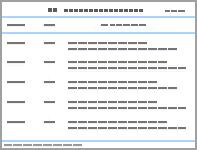
表1
数量性状遗传距离与杂种优势的相关性分析方案"
| 编号 Serial No. | 相关性分析方案 Correlation analysis schemes |
|---|---|
| Cor1 | Dtij vs Fijk |
| Cor2 | Dtij-m vs Fijk-m |
| Cor3 | DtAj vs FAjk,DtBj vs FBjk,DtCj vs FCjk,DtDj vs FDjk,DtEj vs FEjk |
| Cor4 | DtAj-m vs FAjk-m,DtBj-m vs FBjk-m,DtCj-m vs FCjk-m,DtDj-m vs FDjk-m,DtEj-m vs FEjk-m |
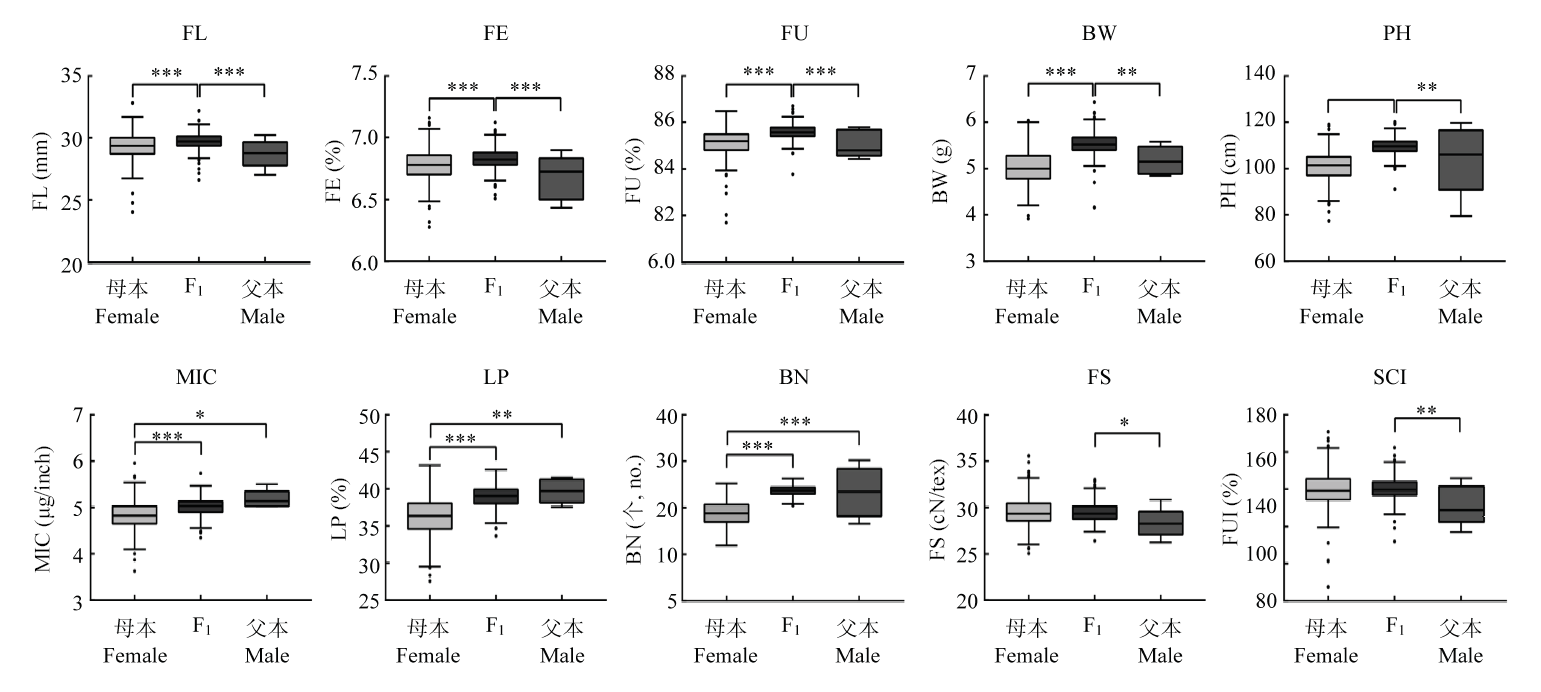
图1
F1与亲本10个性状的差异显著性分析 FL:纤维长度;FE:伸长率;FU:整齐度指数;BW:单玲重;PH:株高;MIC:马克隆值;LP:衣分;BN:单株铃数;FS:断裂比强度;SCI:纺纱均匀性指数。*:P<0.05水平差异显著;**:P<0.01水平差异显著;***:P<0.001水平差异显著"
表2
陆地棉10个数量性状杂种优势"
| 性状 Trait | 分组 Group | 中亲优势MPH | 超亲优势HB | |||||
|---|---|---|---|---|---|---|---|---|
| 变幅 Range (%) | 均值 Mean (%) | 正(负)优势组合数 No. of F1s with positive (negative) heterosis | 变幅 Range (%) | 均值 Mean (%) | 正(负)优势组合数 No. of F1s with positive (negative) heterosis | |||
| PH | A | -5.69—24.29 | 9.67 | 286(14) | -8.67—19.98 | 5.08 | 243(57) | |
| B | -7.07—16.79 | 5.08 | 267(33) | -15.81—14.16 | 1.29 | 183(117) | ||
| C | -1.93—22.05 | 10.16 | 298(2) | -8.26—15.36 | 3.87 | 242(58) | ||
| D | -7.77—13.02 | 3.45 | 254(46) | -22.39—4.34 | -6.03 | 17(283) | ||
| E | -6.25—11.99 | 2.57 | 227(72) | -16.40—6.74 | -2.28 | 76(223) | ||
| BW | A | -12.48—34.01 | 15.55 | 298(2) | -21.65—24.25 | 8.58 | 284(16) | |
| B | -19.71—26.00 | 8.29 | 291(9) | -22.75—19.28 | 2.51 | 220(80) | ||
| C | -13.87—17.57 | 5.82 | 276(24) | -19.93—12.21 | -0.15 | 149(151) | ||
| D | -13.81—24.95 | 7.16 | 285(15) | -20.97—18.79 | 2.69 | 224(76) | ||
| E | -12.72—30.82 | 9.68 | 289(10) | -20.78—20.24 | 2.08 | 195(104) | ||
| LP | A | -4.72—9.30 | 2.62 | 260(40) | -8.80—5.04 | -1.45 | 96(204) | |
| B | -3.06—11.96 | 3.38 | 275(25) | -17.14—6.68 | -1.06 | 107(193) | ||
| C | -16.00—13.33 | 3.35 | 268(32) | -25.18—3.97 | -5.32 | 22(278) | ||
| D | -0.38—13.14 | 5.07 | 297(3) | -13.54—7.80 | 0.30 | 186(114) | ||
| E | -14.04—7.54 | 0.87 | 195(104) | -20.33—4.20 | -4.42 | 51(248) | ||
| BN | A | 2.10—50.41 | 23.35 | 300(0) | -13.52—22.49 | 7.03 | 265(35) | |
| B | -3.72—67.89 | 20.77 | 295(5) | -16.86—34.80 | 7.45 | 243(57) | ||
| C | -13.03—34.73 | 4.81 | 215(85) | -27.49—10.85 | -9.91 | 18(282) | ||
| D | -18.18—39.5 | 2.36 | 169(131) | -31.41—5.50 | -13.38 | 5(295) | ||
| E | -11.18—75.92 | 26.20 | 290(9) | -22.14—47.65 | 10.61 | 245(54) | ||
| FL | A | -1.59—7.33 | 2.93 | 291(9) | -5.69—6.08 | 0.88 | 219(81) | |
| B | -3.79—5.03 | 1.45 | 255(45) | -8.61—4.09 | -0.44 | 122(178) | ||
| C | -5.62—6.79 | 1.88 | 264(36) | -12.08—4.68 | -0.17 | 147(153) | ||
| D | -3.69—6.65 | 1.93 | 269(31) | -7.61—4.26 | -1.35 | 78(222) | ||
| E | -4.13—9.83 | 2.75 | 283(16) | -10.79—5.80 | 0.79 | 205(94) | ||
| 续 | ||||||||
| 性状 Trait | 分组 Group | 中亲优势MPH | 超亲优势HB | |||||
| 变幅 Range (%) | 均值 Mean (%) | 正(负)优势组合数 No. of F1s with positive (negative) heterosis | 变幅 Range (%) | 均值 Mean (%) | 正(负)优势组合数 No. of F1s with positive (negative) heterosis | |||
| FS | A | -6.68—8.60 | 0.53 | 163(137) | -12.11—4.40 | -2.98 | 32(268) | |
| B | -5.91—10.75 | 1.02 | 201(99) | -11.47—5.43 | -1.97 | 76(224) | ||
| C | -4.99—12.19 | 3.08 | 272(28) | -11.44—9.62 | 0.38 | 177(123) | ||
| D | -7.54—12.55 | 2.03 | 228(72) | -16.52—6.33 | -2.46 | 66(234) | ||
| E | -9.01—12.78 | 1.96 | 212(87) | -15.61—10.40 | -1.04 | 124(175) | ||
| MIC | A | -6.75—11.80 | 3.95 | 262(38) | -13.06—7.12 | -1.54 | 108(192) | |
| B | -8.70—10.91 | 2.13 | 243(57) | -16.29—5.22 | -1.66 | 90(210) | ||
| C | -10.38—8.33 | 0.03 | 154(146) | -15.67—5.78 | -5.00 | 23(277) | ||
| D | -11.10—6.40 | -3.19 | 23(277) | -18.40—2.27 | -7.64 | 1(299) | ||
| E | -14.4—19.63 | -0.42 | 128(171) | -22.09—4.52 | -5.22 | 20(279) | ||
| FU | A | -0.87—2.76 | 0.78 | 277(23) | -1.31—1.64 | 0.18 | 185(115) | |
| B | -1.22—2.60 | 0.30 | 223(77) | -2.01—1.47 | -0.31 | 76(224) | ||
| C | -1.02—2.14 | 0.44 | 241(59) | -2.38—1.70 | -0.12 | 118(182) | ||
| D | -0.55—2.22 | 0.81 | 289(11) | -1.60—1.69 | 0.15 | 184(116) | ||
| E | -1.81—1.97 | 0.39 | 224(75) | -2.13—1.41 | -0.13 | 120(179) | ||
| FE | A | -3.64—3.82 | 0.36 | 181(119) | -7.25—1.36 | -2.04 | 12(288) | |
| B | -1.83—3.95 | 0.63 | 211(89) | -4.57—2.90 | -0.50 | 99(201) | ||
| C | -3.17—4.13 | 0.93 | 246(54) | -4.42—3.57 | -0.11 | 142(158) | ||
| D | -3.75—3.19 | 0.23 | 178(122) | -5.82—1.63 | -1.39 | 36(264) | ||
| E | -4.38—10.46 | 3.28 | 261(38)) | -7.21—8.96 | 0.47 | 164(135) | ||
| SCI | A | -6.77—15.10 | 2.42 | 226(74) | -13.31—9.08 | -2.42 | 78(222) | |
| B | -11.15—11.87 | 0.85 | 180(120) | -17.11—7.75 | -2.94 | 50(250) | ||
| C | -8.74—17.67 | 4.59 | 275(25) | -21.08—10.57 | 0.08 | 151(149) | ||
| D | -6.42—18.16 | 6.09 | 288(12) | -14.11—11.77 | -0.78 | 133(167) | ||
| E | -10.00—16.34 | 3.88 | 258(41) | -16.43—12.82 | -0.25 | 152(147) | ||
| 均值Mean | A | 1.59—11.71 | 6.21 | 300(0) | -3.54—4.73 | 1.13 | 236(64) | |
| B | -0.07—10.37 | 4.39 | 299(1) | -3.87—4.94 | 0.24 | 172(128) | ||
| C | -0.71—8.11 | 3.51 | 298(2) | -6.88—2.33 | -1.64 | 39(261) | ||
| D | -1.31—6.55 | 2.59 | 188(12) | -7.41—0.55 | -2.99 | 3(297) | ||
| E | 0.11—11.52 | 5.12 | 299(0) | -4.93—5.53 | 0.06 | 150(149) | ||
| 总均值Total mean | 1.70—7.40 | 4.36 | -4.17—1.87 | -0.64 | ||||
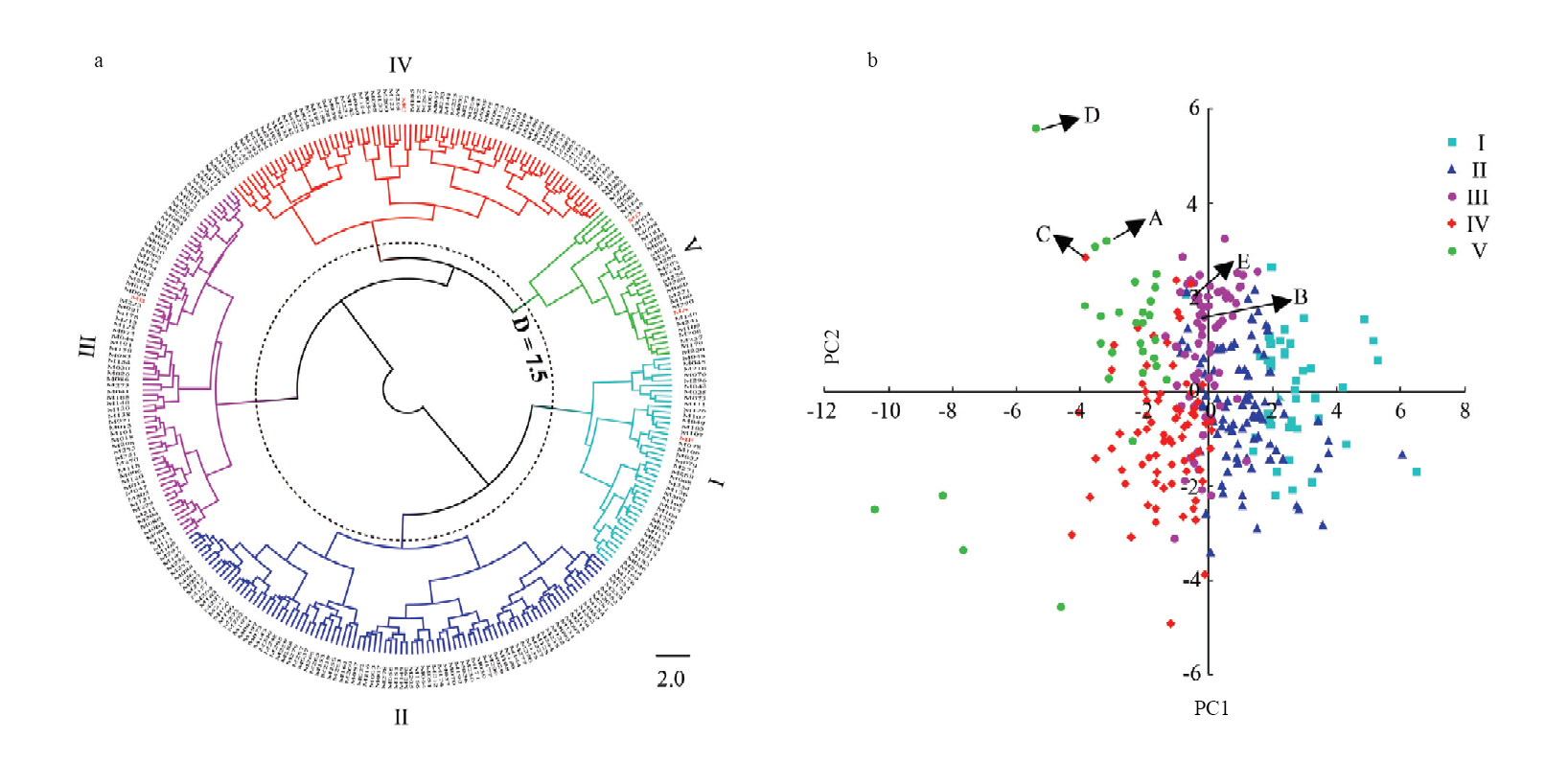
图2
305份亲本的群体结构分析"
表3
Cor1遗传距离与杂种优势的相关关系"
| 性状 Trait | 与遗传距离的相关性系数 Correlation coefficient with genetic distance | |
|---|---|---|
| 中亲优势MPH | 超亲优势HB | |
| PH | 0.0115 | -0.2798*** |
| BW | -0.1618*** | -0.1250*** |
| LP | 0.2459*** | -0.1234*** |
| BN | -0.3870*** | -0.5277*** |
| FL | 0.0109 | -0.3482*** |
| FS | 0.1890*** | -0.1055*** |
| MIC | -0.3627*** | -0.5161*** |
| FU | 0.1764*** | 0.0921*** |
| FE | -0.0495 | -0.0315 |
| SCI | 0.3530*** | -0.0634* |
表4
Cor2遗传距离与杂种优势的相关关系"
| 性状 Trait | 与遗传距离的相关性系数 Correlation coefficient with genetic distance | ||||||||||
|---|---|---|---|---|---|---|---|---|---|---|---|
| 中亲优势MPH | 超亲优势HB | ||||||||||
| Ⅰ | Ⅱ | Ⅲ | Ⅳ | Ⅴ | Ⅰ | Ⅱ | Ⅲ | Ⅳ | Ⅴ | ||
| PH | 0.2433*** | -0.0173 | 0.0870 | -0.1815*** | 0.0196 | -0.0037 | -0.3721*** | -0.1579** | -0.5368*** | -0.1613 | |
| BW | -0.1003 | -0.1486** | -0.2628*** | -0.2738*** | -0.2346** | -0.0008 | -0.0864 | -0.1819*** | -0.2451*** | -0.4287*** | |
| LP | 0.3801*** | 0.2978*** | 0.2879*** | 0.1346** | 0.2462** | -0.0562 | -0.0356 | -0.0852 | -0.0949 | -0.4010*** | |
| BN | -0.5678*** | -0.4537*** | -0.5135*** | -0.3352*** | 0.0049 | -0.6861*** | -0.6001*** | -0.6672*** | -0.4586*** | -0.0976 | |
| FL | -0.0951 | 0.0630 | -0.0964 | 0.0163 | -0.2031* | -0.4566*** | -0.3952*** | -0.2698*** | -0.0866 | -0.5788*** | |
| FS | -0.0239 | 0.1614*** | 0.2813*** | 0.1780*** | 0.2144* | -0.2216** | -0.1698*** | 0.1662** | 0.0818 | -0.0685 | |
| MIC | -0.2862*** | -0.3924*** | -0.4440*** | -0.4387*** | -0.1036 | -0.4695*** | -0.5275*** | -0.4915*** | -0.5194*** | -0.1980* | |
| FU | 0.1141 | 0.2487*** | 0.1173* | 0.1518** | 0.1791* | -0.0189 | 0.2020*** | 0.0613 | 0.1870*** | -0.2032* | |
| FE | -0.3579*** | -0.1354** | -0.1053 | 0.0999 | 0.1257 | -0.2300** | -0.1320** | 0.0370 | 0.1207* | -0.0573 | |
| SCI | 0.1834** | 0.4003*** | 0.4058*** | 0.3726*** | 0.2354** | -0.2461*** | -0.0577 | 0.2116*** | 0.2357*** | -0.2630** | |
表5
Cor3遗传距离与杂种优势的相关关系"
| 性状 Trait | 与遗传距离的相关性系数 Correlation coefficient with genetic distance | ||||||||||
|---|---|---|---|---|---|---|---|---|---|---|---|
| 中亲优势MPH | 超亲优势HB | ||||||||||
| A | B | C | D | E | A | B | C | D | E | ||
| PH | -0.11067 | 0.0312 | 0.0017 | 0.0052 | 0.1615** | -0.1641** | -0.0833 | 0.0051 | -0.3327*** | 0.0227 | |
| BW | 0.1073 | -0.0282 | 0.1353* | 0.2430*** | 0.0554 | -0.0087 | -0.0669 | 0.1034 | 0.1466* | 0.0074 | |
| LP | 0.1419* | 0.1554** | 0.0350 | 0.1358* | -0.1145* | -0.0849 | -0.3894*** | -0.1031 | -0.2701*** | -0.3032*** | |
| BN | 0.1857** | 0.1712** | 0.1544** | 0.0346 | 0.1311* | 0.0608 | 0.0268 | 0.0603 | -0.2319*** | 0.1402* | |
| FL | 0.1765** | 0.0001 | 0.1664** | 0.2205*** | -0.1417* | -0.1908*** | -0.3943*** | -0.0480 | -0.3636*** | -0.3814*** | |
| FS | 0.1470* | 0.1501** | 0.0881 | 0.0730 | -0.1812** | -0.2267*** | -0.3329*** | -0.2339*** | -0.3668*** | -0.2409*** | |
| MIC | 0.0100 | 0.0416 | -0.0033 | -0.0042 | -0.0834 | -0.2506*** | -0.3376*** | -0.2372*** | -0.4879*** | -0.1338* | |
| FU | 0.0130 | 0.1898*** | 0.0281 | 0.1364* | 0.0113 | -0.0461 | -0.0260 | -0.0401 | 0.0644 | -0.0909 | |
| FE | 0.2138*** | 0.0941 | 0.2281*** | 0.1783** | 0.0139 | 0.1112 | -0.1177* | 0.0892 | -0.0334 | -0.0138 | |
| SCI | 0.0193 | 0.1416* | 0.0804 | 0.1335* | -0.0742 | -0.3766*** | -0.3699*** | -0.2454*** | -0.4021*** | -0.2531*** | |
表6
Cor4遗传距离与杂种优势的相关关系"
| 优势 Heterosis | 性状 Trait | 与遗传距离的相关性 Correlation with genetic distance | ||||||||||||||||||||||||||||
|---|---|---|---|---|---|---|---|---|---|---|---|---|---|---|---|---|---|---|---|---|---|---|---|---|---|---|---|---|---|---|
| Ⅰ | Ⅱ | Ⅲ | Ⅳ | Ⅴ | ||||||||||||||||||||||||||
| A | B | C | D | E | A | B | C | D | E | A | B | C | D | E | A | B | C | D | E | A | B | C | D | E | ||||||
| 中亲优势 MPH | PH | P | P | P | ||||||||||||||||||||||||||
| BW | P | P | ||||||||||||||||||||||||||||
| LP | N | P | P | P | P | |||||||||||||||||||||||||
| BN | P | P | P | P | P | P | ||||||||||||||||||||||||
| FL | P | P | ||||||||||||||||||||||||||||
| FS | N | P | ||||||||||||||||||||||||||||
| MIC | P | P | P | P | P | |||||||||||||||||||||||||
| FU | N | P | P | P | P | |||||||||||||||||||||||||
| FE | N | P | P | P | ||||||||||||||||||||||||||
| SCI | P | N | ||||||||||||||||||||||||||||
| 超亲优势 HB | PH | P | N | N | P | N | N | P | N | N | ||||||||||||||||||||
| BW | N | P | N | N | ||||||||||||||||||||||||||
| LP | N | N | N | N | N | N | N | N | N | N | N | N | N | N | N | |||||||||||||||
| BN | P | P | N | P | ||||||||||||||||||||||||||
| FL | N | N | N | N | N | N | N | N | N | N | N | |||||||||||||||||||
| FS | N | N | N | N | N | N | N | N | N | |||||||||||||||||||||
| MIC | N | N | N | N | N | N | N | N | N | N | N | P | P | N | ||||||||||||||||
| FU | N | N | ||||||||||||||||||||||||||||
| FE | N | N | P | P | N | N | N | |||||||||||||||||||||||
| SCI | N | N | N | N | N | N | N | N | N | N | N | N | ||||||||||||||||||
| [1] | CHEN Z J, SCHEFFLER B E, ELIZABETH D, TRIPLETT B A, TIANZHEN Z, WANGZHEN G, XIAOYA C, STELLY D M, RABINOWICZ P D, TOWN C D . Toward sequencing cotton (Gossypium) genomes. Plant Physiology, 2007,145(4):1303-1310. |
| [2] |
ZHANG J, FANG H, ZHOU H P, SANOGO S, MA Z . Genetics, breeding, and marker-assisted selection for verticillium wilt resistance in cotton. Crop Science, 2014,54(4):1289-1303.
doi: 10.2135/cropsci2013.08.0550 |
| [3] |
FANG L, WANG Q, HU Y, JIA Y, CHEN J, LIU B, ZHANG Z, GUAN X, CHEN S, ZHOU B . Genomic analyses in cotton identify signatures of selection and loci associated with fiber quality and yield traits. Nature Genetics, 2017,49(7):1089-1098.
doi: 10.1038/ng.3887 pmid: 28581501 |
| [4] |
彭倩, 薛亚东, 张向歌, 李慧敏, 孙高阳, 李卫华, 谢慧玲, 汤继华 . 利用单片段代换系测交群体定位玉米产量相关性状的杂种优势位点. 作物学报, 2016,42(4):482-491.
doi: 10.3724/SP.J.1006.2016.00482 |
|
PENG Q, XUE Y D, ZHANG X G, LI H M, SUN G Y, LI W H, XIE H L, TANG J H . Identification of heterotic loci for yield and ear traits using CSSL test population in maize. Acta Agronomica Sinica, 2016,42(4):482-491. (in Chinese)
doi: 10.3724/SP.J.1006.2016.00482 |
|
| [5] |
LI D Y, HUANG Z Y, SONG S H, XIN Y Y, MAO D H, LV Q M, ZHOU M, TIAN D M, TANG M F, ZHUNL H . Integrated analysis of phenome, genome, and transcriptome of hybrid rice uncovered multiple heterosis-related loci for yield increase. Proceedings of the National Academy of Sciences of the United States of America, 2016,113(41):E6026-E6035.
doi: 10.1073/pnas.1610115113 pmid: 27663737 |
| [6] |
DUVICK D N . The contribution of breeding to yield advances in maize (Zea mays L.). Advances in Agronomy, 2005,86(5):83-145.
doi: 10.1016/S0065-2113(05)86002-X |
| [7] | 傅廷栋 . 油菜杂种优势研究利用的现状与思考. 中国油料作物学报, 2008: 1-5. |
| FU T D . On research and application of heterosis in rapessed. Chinese Journal of Oil Crop Sciences, 2008: 1-5. (in Chinese) | |
| [8] |
邢朝柱, 靖深蓉, 邢以华 . 中国棉花杂种优势利用研究回顾和展望. 棉花学报, 2007,19(5):337-345.
doi: 10.3969/j.issn.1002-7807.2007.05.003 |
|
XING C Z, JING S R, XING Y H . Review and prospect on cotton heterosis utilization and study in China. Cotton Science, 2007,19(5):337-345. (in Chinese)
doi: 10.3969/j.issn.1002-7807.2007.05.003 |
|
| [9] |
袁有禄, 靖深蓉 . 世界棉花杂种优势利用研究进展, 问题与前景. 中国棉花, 2000,27(8):2-5.
doi: 10.3969/j.issn.1000-632X.2000.08.001 |
|
YUAN Y L, JING S R . Advances, problems and prospects of heterosis utilization of cotton in the world. China Cotton, 2000,27(8):2-5. (in Chinese)
doi: 10.3969/j.issn.1000-632X.2000.08.001 |
|
| [10] |
WU Y T, YIN J M, GUO W Z, ZHU X F, ZHANG T Z . Heterosis performance of yield and fibre quality in F1 and F2 hybrids in upland cotton. Plant Breeding, 2010,123(3):285-289.
doi: 10.1111/j.1439-0523.2004.00990.x |
| [11] |
邢朝柱, 喻树迅 . 棉花杂种优势表达机理研究进展. 棉花学报, 2004,16(6):379-382.
doi: 10.3969/j.issn.1002-7807.2004.06.012 |
|
XING C Z, YU S X . Progress of cotton heterosis expression mechanisms. Cotton Science, 2004,16(6):379-382. (in Chinese)
doi: 10.3969/j.issn.1002-7807.2004.06.012 |
|
| [12] | NEI M. Genetic Distance and Molecular Phylogeny. University of Washington Press, Seattle, Washington, 1987, 193-223. |
| [13] | 徐静斐, 汪路应 . 水稻杂种优势和配合力的初步研究. 遗传, 1980,2(2):17-19. |
| XU J P, WANG L Y . Preliminary study on heterosis and combining ability of rice. Hereditas, 1980,2(2):17-19. (in Chinese) | |
| [14] |
MOLL R H, LONNQUIST J H, FORTUNO J V, JOHNSON E C . The relationship of heterosis and genetic divergence in maize. Genetics, 1965,52(1):139-144.
doi: 10.0000/PMID17248265 pmid: 17248265 |
| [15] |
GHADERI A, ADAMS M W, NASSIB A M . Relationship between genetic distance and heterosis for yield and morphological traits in dry edible bean and faba bean1. Crop Science, 1984,24(1):37-42.
doi: 10.2135/cropsci1984.0011183X002400010009x |
| [16] |
ALI M, COPELAND L O, ELIAS S G, KELLY J D . Relationship between genetic distance and heterosis for yield and morphological traits in winter canola (Brassica napus L.). Theoretical & Applied Genetics, 1995,91(1):118-121.
doi: 10.1007/BF00220867 pmid: 24169676 |
| [17] |
TEKLEWOLD A, BECKER H C . Comparison of phenotypic and molecular distances to predict heterosis and F1 performance in Ethiopian mustard (Brassica carinata A. Braun). Theoretical & Applied Genetics, 2006,112(4):752-759.
doi: 10.1007/s00122-005-0180-3 pmid: 16365759 |
| [18] |
王学德, 潘家驹 . 棉花亲本遗传距离与杂种优势间的相关性研究. 作物学报, 1990,16(1):32-38.
doi: 10.1007/BF02015343 |
|
WANG X D, PAN J J . Studies on the relationship between genetic distance of parents and yield heterosis in hybrid cotton. Acta Agronomica Sinica, 1990,16(1):32-38. (in Chinese)
doi: 10.1007/BF02015343 |
|
| [19] |
赵玉昌, 曹栓柱, 曹新川 . 陆地棉数量性状遗传距离与杂种优势关系的研究. 塔里木大学学报, 2008,20(1):19-22.
doi: 10.3969/j.issn.1009-0568.2008.01.006 |
|
ZHAO Y C, CAO S Z, CAO X C . Study of the relationship between genetic distance and heterosis in upland cotton. Journal of Tarim University, 2008,20(1):19-22. (in Chinese)
doi: 10.3969/j.issn.1009-0568.2008.01.006 |
|
| [20] |
郝德荣, 何林池, 刘水东, 周金凤, 邢建美, 黄昭平 . 抗虫棉数量性状遗传距离与杂种优势关系的研究. 金陵科技学院学报, 2008,24(4):50-55.
doi: 10.3969/j.issn.1672-755X.2008.04.012 |
|
HAO D R, HE L C, LIU S D, ZHOU J F, XING J M, HUANG S P . Study of the relationship between genetic distance and heterosis in insect resistant cotton. Journal of Jinling Institute of Technology, 2008,24(4):50-55. (in Chinese)
doi: 10.3969/j.issn.1672-755X.2008.04.012 |
|
| [21] |
陈强, 杨祖荣, 王谧, 范玉刚 . 几个陆地棉表型遗传距离与杂种优势之间的关系研究. 江西农业学报, 2011,23(5):25-26.
doi: 10.3969/j.issn.1001-8581.2011.05.009 |
|
CHEN Q, YANG Z R, WANG M, FAN Y G . Research on relationship between phenotypic genetic distance and heterosis of several upland cotton combinations. Acta Agriculture Jiangxi, 2011,23(5):25-26. (in Chinese)
doi: 10.3969/j.issn.1001-8581.2011.05.009 |
|
| [22] |
赵仁渠, 杨明 . 样本对小麦遗传距离与杂种优势关系的影响. 生物数学学报, 1994(1):48-53.
doi: 10.1007/BF02007173 |
|
ZHAO R Q, YANG M . Studies on the effects of sample on the relationship between genetic distance and heterosis in wheat. Journal of Biomathematics, 1994(1):48-53. (in Chinese)
doi: 10.1007/BF02007173 |
|
| [23] |
代攀虹, 孙君灵, 贾银华, 杜雄明, 王谧 . 利用表型数据构建陆地棉核心种质. 植物遗传资源学报, 2016,17(6):961-968.
doi: 10.13430/j.cnki.jpgr.2016.06.001 |
|
DAI P H, SUN J L, JIA Y H, DU X M, WANG M . Construction of core collection of upland cotton based on phenotypic data. Journal of Plant Genetic Resources, 2016,17(6):961-968. (in Chinese)
doi: 10.13430/j.cnki.jpgr.2016.06.001 |
|
| [24] |
代攀虹, 孙君灵, 何守朴, 王立如, 贾银华, 潘兆娥, 庞保印, 杜雄明, 王谧 . 陆地棉核心种质表型性状遗传多样性分析及综合评价. 中国农业科学, 2016,49(19):3694-3708.
doi: 10.3864/j.issn.0578-1752.2016.19.003 |
|
DAI P H, SUN J L, HE S P, WANG L R, JIA Y H, PAN Z E, PANG B Y, DU X M, WANG M . Comprehensive evaluation and genetic diversity analysis of phenotypic traits of core collection in upland ctton. Scientia Agricultura Sinica, 2016,49(19):3694-3708. (in Chinese)
doi: 10.3864/j.issn.0578-1752.2016.19.003 |
|
| [25] |
KEMPTHORNE O, FINNEY D J . An introduction to genetic statistics. Aibs Bulletin, 1957,39(2):69-79.
doi: 10.2307/1292411 |
| [26] | BORCARD D, GILLET F, LEGENDRE P . Numerical Ecology with R. Springer, 2011: 332-334. |
| [27] |
GB —2007《棉花细绒棉》条款解释. 中国纤检, 2007(7):6-14.
doi: 10.3969/j.issn.1671-4466.2007.07.002 |
|
GB 1103—2007《Cotton–Upland cotton》Interpretation. China Fiber Inspection, 2007(7):6-14. (in Chinese)
doi: 10.3969/j.issn.1671-4466.2007.07.002 |
|
| [28] | MILLER M, SONG Q, SHI X, JUENGER T E, CHEN Z J . Natural variation in timing of stress-responsive gene expression predicts heterosis in intraspecific hybrids of Arabidopsis. Nature Communications, 2015,6:7453-7455. |
| [29] |
张锡顺, 杨建国, 杨若菡, 徐宁生, 刘旭云, 杜刚 . 蓖麻数量性状遗传距离与杂种优势关系的研究. 中国农业科学, 2006,39(3):209-216.
doi: 10.3321/j.issn:0578-1752.2006.03.029 |
|
ZHANG X S, YANG J G, YANG R H, XU N S, LIU X Y, DU G . Study of the relationship between genetic distance and heterosis in castor. Scientia Agricultura Sinica, 2006,39(3):209-216. (in Chinese)
doi: 10.3321/j.issn:0578-1752.2006.03.029 |
|
| [30] |
武耀廷, 张天真, 朱协飞, 王广明 . 陆地棉遗传距离与杂种F1、F2产量及杂种优势的相关分析. 中国农业科学, 2002,35(1):22-28.
doi: 10.3321/j.issn:0578-1752.2002.01.005 |
|
WU Y T, ZHANG T Z, ZHU X F, WANG G M . Relationship between F1, F2 yield, heterosis and genetic distance measured by molecular markers and parent performance in cotton. Scientia Agricultura Sinica, 2002,35(1):22-28. (in Chinese)
doi: 10.3321/j.issn:0578-1752.2002.01.005 |
|
| [31] |
杨代刚, 马雄风, 周晓箭, 张先亮, 白凤虎, 王海风, 孟清芹, 裴小雨, 喻树迅 . 陆地棉配合力与杂种优势、遗传距离的相关性分析. 棉花学报, 2012,24(3):191-198.
doi: 10.3969/j.issn.1002-7807.2012.03.001 |
|
YANG D G, MA X F, ZHOU X J, ZHANG X L, BAI F H, WANG H F, MENG Q Q, PEI X Y, YU S X . Correlation among combining ability, heterosis and genetic distance in upland cotton. Cotton Science, 2012,24(3):191-198. (in Chinese)
doi: 10.3969/j.issn.1002-7807.2012.03.001 |
|
| [32] |
宿俊吉, 陈红, 余渝, 林海, 宁新柱, 李吉莲, 刘萍, 刘丽, 相吉山, 邓福军 . 陆地棉遗传距离与纤维品质性状中亲优势及F1、F2表现的相关性研究. 棉花学报, 2013,25(2):142-147.
doi: 10.3969/j.issn.1002-7807.2013.02.008 |
|
SU J J, CHEN H, YU Y, LIN H, NING X Z, LI J L, LIU P, LIU L, XIANG J S, DENG F J . The relationship of genetic distance to mid-parent heterosis and manifestations of F1&F2 of fiber quality traits in upland cotton. Cotton Science, 2013,25(2):142-147. (in Chinese)
doi: 10.3969/j.issn.1002-7807.2013.02.008 |
|
| [33] |
ZHANG J F, ABDELRAHEEM A, WU J X . Heterosis, combining ability and genetic effect, and relationship with genetic distance based on a diallel of hybrids from five diverse Gossypium barbadense cotton genotypes. Euphytica, 2017,213(9):208-222.
doi: 10.1007/s10681-017-1997-y |
| [34] | CHRISTIAN R, ANGELIKA C E, CHRISTOPH G, JAN L, FRANK T, RONAN S, THOMAS A, MARK S, LOTHAR W, MELCHINGER A E . Genomic and metabolic prediction of complex heterotic traits in hybrid maize. Nature Genetics, 2012,44(2):217-220. |
| [35] |
桑世飞, 王会, 梅德圣, 刘佳, 付丽, 王军, 汪文祥, 胡琼 . 利用全基因组SNP芯片分析油菜遗传距离与杂种优势的关系. 中国农业科学, 2015,48(12):2469-2478.
doi: 10.3864/j.issn.0578-1752.2015.12.020 |
|
SANG S F, WANG H, MEI D S, LIU J, FU L, WANG J, WANG W X, HU Q . Correlation analysis between heterosis and genetic distance evaluated by genome-wide SNP chip in Brassica napus. Scientia Agricultura Sinica, 2015,48(12):2469-2478. (in Chinese)
doi: 10.3864/j.issn.0578-1752.2015.12.020 |
|
| [36] | YANG M, WANG X, REN D, HUANG H, XU M, HE G, DENG X W . Genomic architecture of biomass heterosis in Arabidopsis. Proceedings of the National Academy of Sciences of the United States of America, 2017,114(30):8101-8106. |
| [37] |
孙正文, 匡猛, 马峙英, 王省芬 . 利用CottonSNP63K芯片构建棉花品种的指纹图谱. 中国农业科学, 2017,50(24):4692-4704.
doi: 10.3864/j.issn.0578-1752.2017.24.003 |
|
SUN Z W, KUANG M, MA Z Y, WANG S F . Using cotton SNP63K chip to construct fingerprint map of cotton varieties. Scientia Agricultura Sinica, 2017,50(24):4692-4704. (in Chinese)
doi: 10.3864/j.issn.0578-1752.2017.24.003 |
|
| [38] |
WANG M, TU L, LIN M, LIN Z, WANG P, YANG Q, YE Z, SHEN C, LI J, ZHANG L . Asymmetric subgenome selection and cis-regulatory divergence during cotton domestication. Nature Genetics, 2017,49(4):579-590.
doi: 10.1038/ng.3807 pmid: 28263319 |
| [39] |
MA Z, HE S, WANG X, SUN J, ZHANG Y, ZHANG G, WU L, LI Z, LIU Z, SUN G . Resequencing a core collection of upland cotton identifies genomic variation and loci influencing fiber quality and yield. Nature Genetics, 2018,50(6):803-813.
doi: 10.1038/s41588-018-0119-7 pmid: 29736016 |
| [1] | 吴媛媛, 吕书文, 张子君, 王涛, 张逸鸣, 卜令超, 邹庆道, 姜晶. 番茄果实果脐大小性状主基因+多基因遗传分析[J]. 中国农业科学, 2026, 59(5): 1060-1069. |
| [2] | 陈彩锦, 马琳, 蒋庆雪, 刘金晖, 苗童, 张志鹏, 孟翔, 马晓冉, 周昕越, 张建, 刘文辉, 王学敏. 244份饲用燕麦种质资源表型性状遗传多样性分析[J]. 中国农业科学, 2025, 58(23): 4825-4836. |
| [3] | 王丽媛, 王晖, 王穆穆, 王东建, 李汝玉, 郑永胜, 张晗. 陆地棉DUS测试已知品种DNA指纹数据库构建及应用[J]. 中国农业科学, 2025, 58(22): 4570-4588. |
| [4] | 刘鹏鹏, 李江博, 徐红军, 聂迎彬, 韩新年, 孔德真, 桑伟. 新疆冬小麦品种资源蛋白组分及品质的遗传多样性[J]. 中国农业科学, 2025, 58(15): 2948-2959. |
| [5] | 郑敏华, 陈洛, 邢甲乐, 谢月兰, 姜先芽, 聂帅, 蔡甫格, 巫浩翔, 陆展华, 孙伟, 霍兴, 白嵩, 赵均良, 杨武. 华南籼稻稻瘟病抗性QTL鉴定与候选基因挖掘[J]. 中国农业科学, 2025, 58(14): 2707-2719. |
| [6] | 赵真坚, 王凯, 陈栋, 申琦, 余杨, 崔晟頔, 王俊戈, 陈子旸, 禹世欣, 陈佳苗, 王翔枫, 唐国庆. 基因组和DNA甲基化组联合分析筛选猪肉质性状关键基因[J]. 中国农业科学, 2024, 57(7): 1394-1406. |
| [7] | 李凯利, 魏云晓, 种智力, 孟志刚, 王远, 梁成真, 陈全家, 张锐. 红蓝光促进陆地棉愈伤组织诱导和增殖[J]. 中国农业科学, 2024, 57(4): 638-649. |
| [8] | 杨春, 杨代星, 李燕, 梁思慧, 邓小强, 乔大河, 陈娟, 郭燕, 林开勤, 陈正武. 贵州大树茶形态学特征及生化成分综合分析[J]. 中国农业科学, 2024, 57(19): 3894-3916. |
| [9] | 李玉姗, 肖菁, 马越, 田超, 赵连佳, 王帆, 宋羽, 蒋程瑶. 169份番茄种质资源表型性状遗传多样性分析及综合评价[J]. 中国农业科学, 2024, 57(18): 3671-3683. |
| [10] | 叶雪莲, 陈靖雯, 姚祥坦, 权新华, 黄鹂. 不结球白菜叶片皱缩性状的遗传分析[J]. 中国农业科学, 2024, 57(18): 3684-3694. |
| [11] | 白冰楠, 乔丹, 葛群, 栾玉娟, 刘小芳, 卢全伟, 牛皓, 龚举武, 巩万奎, ELAMEER ELSAMMAN, 闫浩亮, 李俊文, 刘爱英, 石玉真, 王海泽, 袁有禄. 陆地棉棉籽相关性状的QTN挖掘及候选基因筛选[J]. 中国农业科学, 2024, 57(15): 2901-2913. |
| [12] | 宋想, 王钟曼, 张秋玲, 魏媛媛, 赵小刚, 刘波, 戴思兰. 早花露地小菊杂交后代株系的综合评价与筛选[J]. 中国农业科学, 2024, 57(1): 173-189. |
| [13] | 李子萌, 袁婵, 张宇庆, 任妍, 刘鹏鹏, 严珊珊, 袭梦涵, 穆培源, 兰彩霞. 普通小麦Arableu#1白粉病成株抗性遗传解析[J]. 中国农业科学, 2024, 57(1): 52-64. |
| [14] | 贾晓昀, 王士杰, 朱继杰, 赵红霞, 李妙, 王国印. 陆地棉高密度遗传图谱的构建及产量相关性状的QTL定位[J]. 中国农业科学, 2023, 56(4): 587-598. |
| [15] | 董琰钰, 徐碧玉, 董泽宇, 汪露瑶, 陈锦文, 方磊. 棉花EXO70基因家族全基因组的鉴定及种间比较[J]. 中国农业科学, 2023, 56(23): 4621-4634. |
|
||
