Scientia Agricultura Sinica ›› 2026, Vol. 59 ›› Issue (18): 4056-4075.doi: 10.3864/j.issn.0578-1752.2026.18.009

• SPECIAL FOCUS: MECHANISM ANALYSIS, TECHNOLOGY OPTIMIZATION AND DECISION-MAKING SUPPORT FOR PRECISION PREVENTION AND CONTROL OF AGRICULTURAL PESTS • Previous Articles     Next Articles

The Importance of Different Crop Types to the Hawkmoth-Host Plant Interaction Network in Beijing Area

LI HaoYuan1(), YANG CaiQing1(), CHEN Dan1, XU ZhenBang2, MEN YaHui1, GAO Fei1, ZHANG AiBing1()   

  1. 1 College of Life Sciences, Capital Normal University, Beijing 100048
    2 Institute of International Rivers and Eco-Security, Yunnan University, Kunming 650500
  • Received:2026-04-03 Accepted:2026-06-18 Online:2026-09-16 Published:2026-09-20
  • Contact: YANG CaiQing, ZHANG AiBing

Abstract:

【Objective】Hawkmoth larvae feed on the leaves of host plants, causing plant damage or even death, thereby posing a serious threat to regional agricultural and forestry development. This paper aims to reveal the potential importance of different types of economic crops to hawkmoth pests in Beijing area, identify the main hawkmoth pest species associated with each crop type, and propose prevention and control strategies.【Method】A hawkmoth-host plant interaction network in Beijing area was constructed. Network structure was analyzed using metrics such as connectance, nestedness, and modularity. The roles of individual nodes within the network’s modular structure were quantified using inter-module connectivity (c-value) and within-module degree (z-value). The impact of nodes on network robustness was assessed using secondary extinction curves. The Kruskal-Wallis test was employed to determine whether there were significant differences in the effects of different crop types on network robustness and modular structure. For hawkmoth species with high connectivity in the network, their dietary composition was analyzed, and prevention and control recommendations were proposed based on different crop types.【Result】The hawkmoth-host plant interaction network exhibited a connectance C=0.043, nestedness N=3.67, and modularity Q=0.668. The agricultural crop category contained two module hubs, the forestry crop category contained two module hubs, the medicinal crop category contained two module hubs and three connectors, the ornamental crop category contained two module hubs and two connectors, the native tree category contained three module hubs and one connector, the other crop category contained four module hubs and two connectors, and plants in the non-economic crop category were all peripheral nodes. There was no significant difference among crop categories in their impact on network robustness. However, the within-module degree of all economic crop categories was significantly higher than that of non-economic crops (agricultural crops: P=0.0015; forestry crops: P=0.0030; medicinal crops: P=0.0010; ornamental crops: P=0.0069; native trees: P=0.0006; other crops: P=0.0011).【Conclusion】The hawkmoth-host plant interaction network in Beijing area exhibits a sparse and dispersed interaction pattern. Different hawkmoth pests pose high potential risks to various economic crop types. For prevention and control efforts in Beijing area, species with high centrality in the network, such as Psilogramma increta and Agrius convolvuli, should be prioritized for control across all host plants. For all crop categories, in addition to the protection of key agricultural and forestry crops, other economic crops and native trees should also be included in the scope of protection. For individual crop types, specific control measures should target hawkmoth species that primarily feed on them. Furthermore, for hawkmoth species that have distribution records in Beijing area and potential host plants but currently have small population sizes, vigilance should be exercised regarding the risk of population outbreaks.

Key words: agricultural crop, forestry crop, Sphingidae insect, host plant, interaction network

Fig. 1

Hawkmoth-host plant interaction network of Beijing area"

Table 1

Crop categories and network roles of host plants"

科名
Family name
属名
Genus name
农业作物
Agricultural
crop
林业作物
Forestry
crop
药用作物
Medicinal
crop
观赏作物
Ornamental
crop
乡土树木
Indigenous
tree
其他作物
Other
crop
非经济作物
Non-econo-mic crop
节点属性
Network role
菊科Asteraceae 莴苣属Lactuca 边缘节点Peripheral node
五加科Araliaceae 常春藤属Hedera
忍冬科Caprifoliaceae 忍冬属Lonicera 连接者节点Connector node
败酱属Patrinia 边缘节点Peripheral node
锦带花属Weigela
荚蒾科Viburnaceae 荚蒾属Viburnum
冬青科Aquifoliaceae 冬青属Ilex
唇形科
Lamiaceae
紫珠属Callicarpa
大青属Clerodendrum 模块枢纽
Module hub
鞘蕊花属Coleus 边缘节点Peripheral node
紫苏属Perilla
牡荆属Vitex 模块枢纽Module hub
泡桐科
Paulowniaceae
泡桐属Paulownia 边缘节点Peripheral node
紫葳科Bignoniaceae 梓属Catalpa
芝麻科Pedaliaceae 芝麻属Sesamum
马鞭草科Verbenaceae 假连翘属Duranta
车前科
Plantaginaceae
金鱼草属Antirrhinum
柳穿鱼属Linaria
车前属Plantago
木樨科
Oleaceae
流苏树属Chionanthus
连翘属Forsythia
梣属Fraxinus
素馨属Jasminum
女贞属Ligustrum
木樨榄属Olea
木樨属Osmanthus
丁香属Syringa
茜草科
Rubiaceae
拉拉藤属Galium 连接者节点Connector node
栀子属Gardenia 边缘节点Peripheral node
野丁香属Leptodermis
水线草属Oldenlandia
鸡屎藤属Paederia
茜草属Rubia
白马骨属Serissa
茄科
Solanaceae
辣椒属Capsicum
烟草属Nicotiana
茄属Solanum
旋花科
Convolvulaceae
打碗花属Calystegia
旋花属Convolvulus
番薯属Ipomoea
鱼黄草属Merremia
猕猴桃科Actinidiaceae 猕猴桃属Actinidia
凤仙花科Balsaminaceae 凤仙花属Impatiens
绣球花科Hydrangeaceae 绣球属Hydrangea
山梅花属Philadelphus
马齿苋科Portulacaceae 马齿苋属Portulaca
石竹科Caryophyllaceae 繁缕属Stellaria
蓼科
Polygonaceae
萹蓄属Polygonum
酸模属Rumex
豆科
Fabaceae
落花生属Arachis
刀豆属Canavalia
大豆属Glycine
扁豆属Lablab
胡枝子属Lespedeza
菜豆属Phaseolus
豌豆属Pisum
葛属Pueraria
刺槐属Robinia
豇豆属Vigna
紫藤属Wisteria
蔷薇科
Rosaceae
山楂属Crataegus
枇杷属Eriobotrya
棣棠属Kerria
苹果属Malus
石楠属Photinia
李属Prunus
梨属Pyrus
蔷薇属Rosa
绣线菊属Spiraea
桑科
Moraceae
构属Broussonetia
榕属Ficus
橙桑属Maclura
桑属Morus
榆科
Ulmaceae
榆属Ulmus
榉属Zelkova
鼠李科
Rhamnaceae
鼠李属Rhamnus
枣属Ziziphus
胡颓子科Elaeagnaceae 胡颓子属Elaeagnus
桦木科
Betulaceae
桦木属Betula
鹅耳枥属Carpinus
榛属Corylus
胡桃科
Juglandaceae
山核桃属Carya
胡桃属Juglans 模块枢纽
Module hub
枫杨属Pterocarya 边缘节点Peripheral node
壳斗科
Fagaceae
栗属Castanea
栎属Quercus
杨柳科
Salicaceae
杨属Populus
柳属Salix
大戟科
Euphorbiaceae
铁苋菜属Acalypha
大戟属Euphorbia 连接者节点Connector node
酢浆草科Oxalidaceae 酢浆草属Oxalis 边缘节点Peripheral node
卫矛科Celastraceae 卫矛属Euonymus
锦葵科
Malvaceae
黄麻属Corchorus
梧桐属Firmiana
棉属Gossypium
锦葵属Malva
椴属Tilia
楝科Meliaceae 楝属Melia
无患子科Sapindaceae 槭属Acer
漆树科
Anacardiaceae
黄连木属Pistacia
盐麸木属Rhus
柳叶菜科
Onagraceae
柳兰属Chamerion
露珠草属Circaea
柳叶菜属Epilobium 连接者节点Connector node
倒挂金钟属Fuchsia 边缘节点Peripheral node
丁香蓼属Ludwigia
月见草属Oenothera
千屈菜科Lythraceae 千屈菜属Lythrum
牻牛儿苗科Geraniaceae 老鹳草属Geranium
葡萄科
Vitaceae
蛇葡萄属Ampelopsis
乌蔹莓属Causonis
地锦属Parthenocissus
葡萄属Vitis 模块枢纽
Module hub
虎耳草科Saxifragaceae 虎耳草属Saxifraga 边缘节点Peripheral node
悬铃木科Platanaceae 悬铃木属Platanus
小檗科Berberidaceae 小檗属Berberis
禾本科
Poaceae
白茅属Imperata
玉蜀黍属Zea
薯蓣科Dioscoreaceae 薯蓣属Dioscorea
天南星科
Araceae
魔芋属Amorphophallus
天南星属Arisaema
五彩芋属Caladium
芋属Colocasia
半夏属Pinellia
犁头尖属Typhonium
马蹄莲属Zantedeschia
松科
Pinaceae
落叶松属Larix
云杉属Picea
松属Pinus

Table 2

Degree and network roles of hawkmoths"

亚科名Subfamily name 种名Species name 度(连接数)Degree (number of links) 节点属性Network role
天蛾亚科Sphinginae 丁香天蛾Psilogramma increta 20 边缘节点
Peripheral node
长喙天蛾亚科Macroglossinae 芋双线天蛾Theretra oldenlandiae 19
天蛾亚科Sphinginae 白薯天蛾Agrius convolvuli 18
长喙天蛾亚科Macroglossinae 深色白眉天蛾Hyles gallii 17 连接者节点
Connector node
红天蛾Deilephila elpenor 16
天蛾亚科Sphinginae 芝麻鬼脸天蛾Acherontia styx 15 边缘节点
Peripheral node
长喙天蛾亚科Macroglossinae 八字白眉天蛾Hyles livornica 12
雀纹天蛾Theretra japonica 12
蒙古白肩天蛾Rhagastis mongoliana 10
目天蛾亚科Smerinthinae 红六点天蛾Marumba gaschkewitschii 9
天蛾亚科Sphinginae 红节天蛾Sphinx ligustri 9
目天蛾亚科Smerinthinae 榆绿天蛾Callambulyx tatarinovii 8
长喙天蛾亚科Macroglossinae 白环红天蛾Deilephila askoldensis 8
目天蛾亚科Smerinthinae 钩翅天蛾Mimas christophi 7
蓝目天蛾Smerinthus planus 7
豆天蛾Clanis bilineata 6
黄脉天蛾Laothoe amurensis 6
栗六点天蛾Marumba sperchius 5
锯翅天蛾亚科Langiinae 锯翅天蛾Langia zenzeroides 5
长喙天蛾亚科Macroglossinae 缺角天蛾Acosmeryx castanea 5
葡萄缺角天蛾Acosmeryx naga 5
葡萄天蛾Ampelophaga rubiginosa 5
目天蛾亚科Smerinthinae 裂斑鹰翅天蛾Ambulyx ochracea 4
核桃鹰翅天蛾Ambulyx schauffelbergeri 4
天蛾亚科Sphinginae 绒星天蛾Dolbina tancrei 4
长喙天蛾亚科Macroglossinae 条背线天蛾Cechetra lineosa 4
黑长喙天蛾Macroglossum pyrrhosticta 4
目天蛾亚科Smerinthinae 日本鹰翅天蛾Ambulyx japonica 3
构月天蛾Parum colligata 3
盾天蛾Phyllosphingia dissimilis 3
杨目天蛾Smerinthus caecus 3
天蛾亚科Sphinginae 晦暗松天蛾Hyloicus caligineus 3
绒天蛾Kentrochrysalis streckeri 3
长喙天蛾亚科Macroglossinae 纹背线天蛾Cechetra striata 3
咖啡透翅天蛾Cephonodes hylas 3
黑边天蛾Hemaris affinis 3
黄胫黑边天蛾Hemaris ottonis 3
后黄黑边天蛾Hemaris radians 3
青背长喙天蛾Macroglossum bombylans 3
小豆长喙天蛾Macroglossum stellatarum 3
葡萄昼天蛾Sphecodina caudata 3
目天蛾亚科Smerinthinae 托比鹰翅天蛾Ambulyx tobii 2
灰斑豆天蛾Clanis undulosa 2
甘蔗天蛾Leucophlebia lineata 2
黄边六点天蛾Marumba maackii 2
天蛾亚科Sphinginae 白须绒天蛾Kentrochrysalis sieversi 2
鼠天蛾Sphingulus mus 2
长喙天蛾亚科Macroglossinae 凸缘长喙天蛾Macroglossum nycteris 2
山锤天蛾Neogurelca montana 2
目天蛾亚科Smerinthinae 华南鹰翅天蛾Ambulyx kuangtungensis 1
晋陕六点天蛾Marumba fenzelii 1
小目天蛾Smerinthus minor 1
长喙天蛾亚科Macroglossinae 浅纹白眉天蛾Hyles exilis 1
长喙天蛾Macroglossum corythus 1
波斑长喙天蛾Macroglossum saga 1

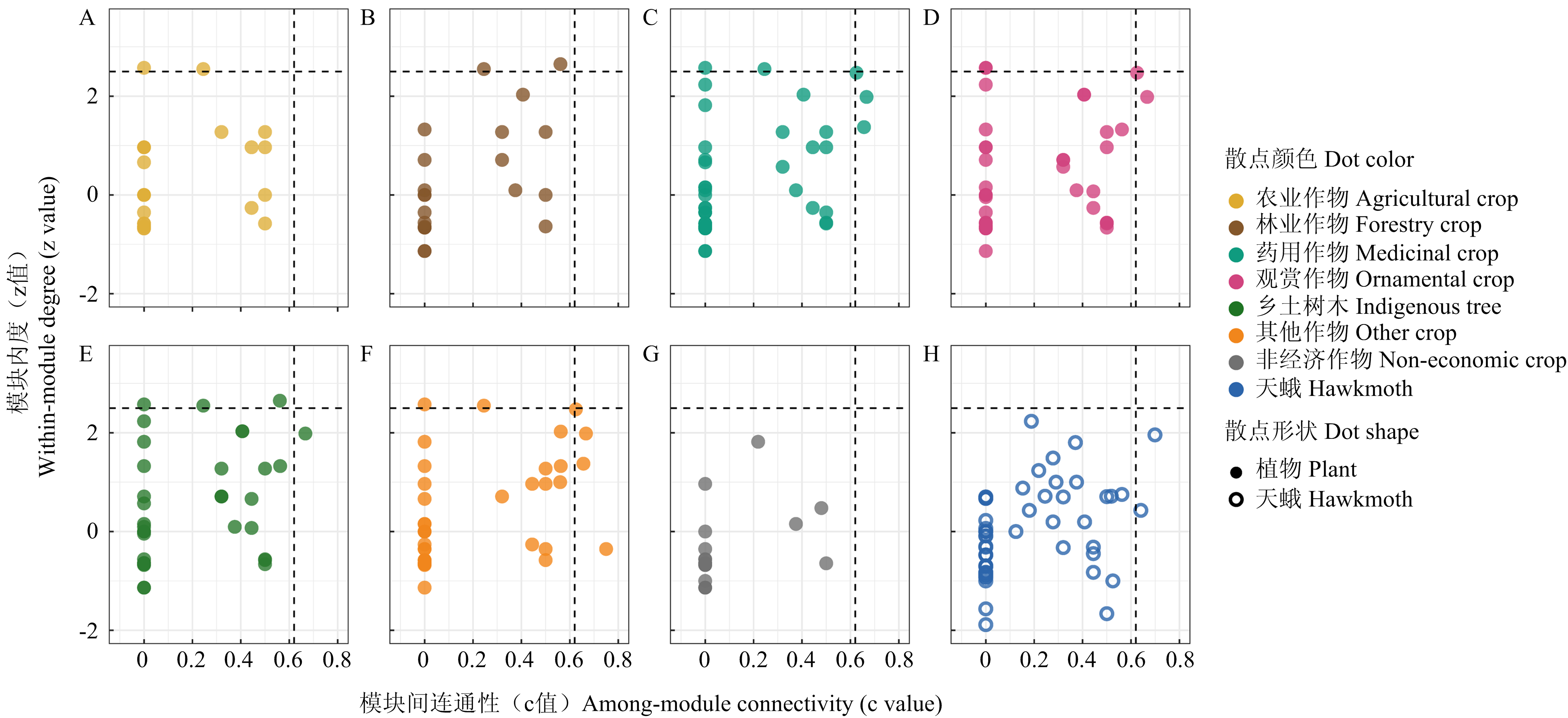
Fig. 2

c-z values of host plant and hawkmoth nodes in the interaction network"

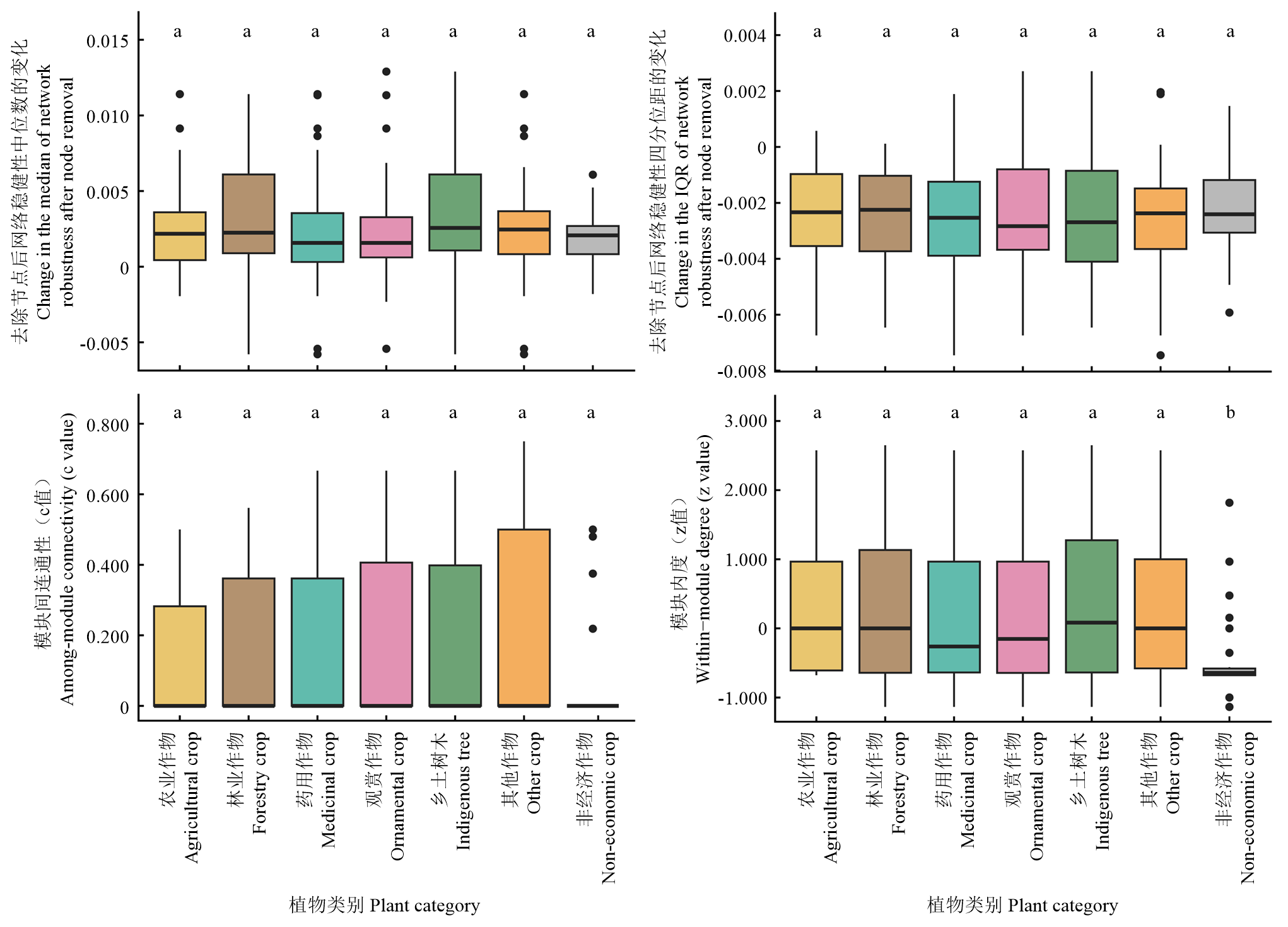
Fig. 3

Differences among crop types in their effects on network robustness, variability in robustness, and c-z values"

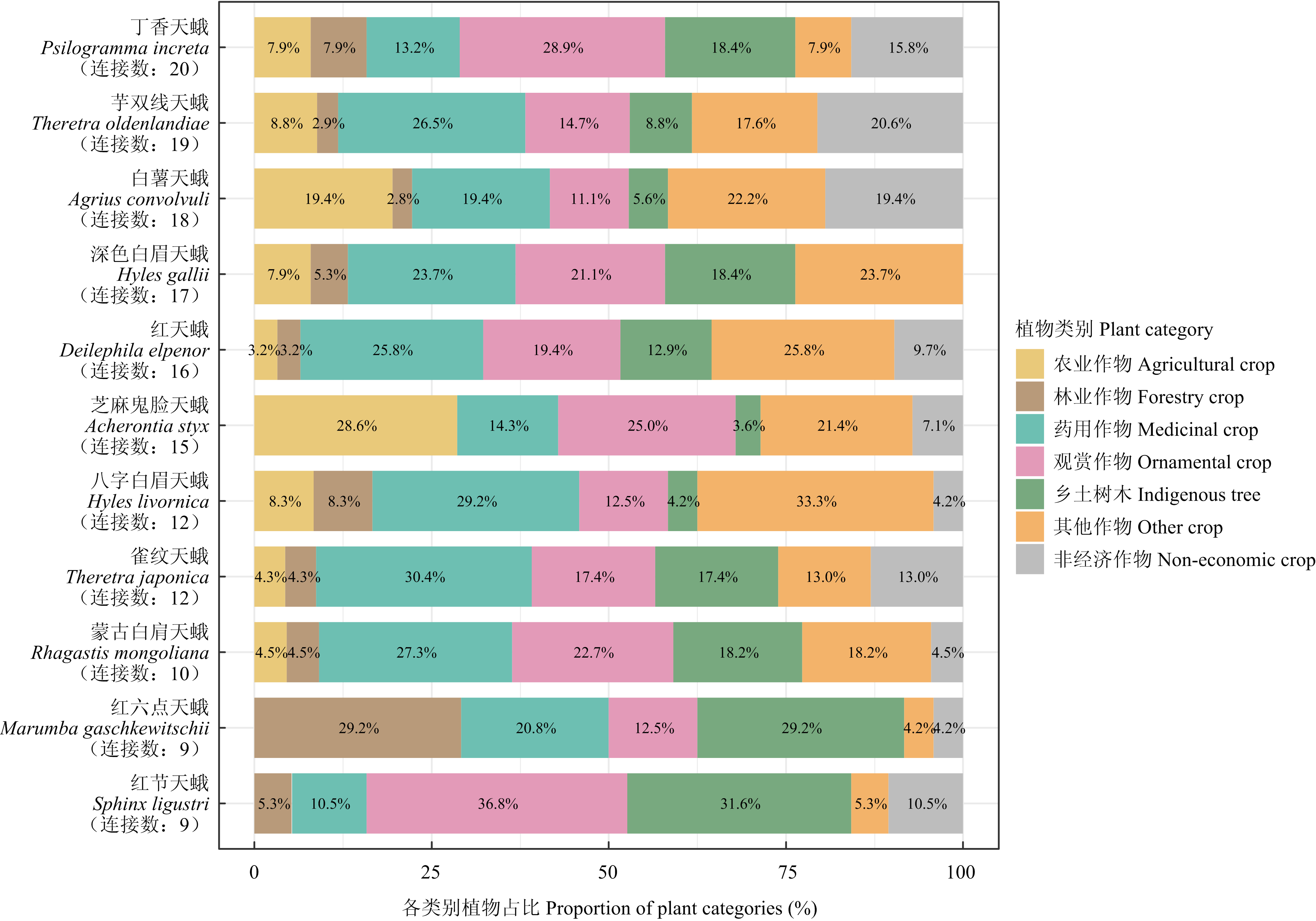
Fig. 4

Host plants consumed by the top 10 hawkmoth species ranked by the number of links"

Fig. 5

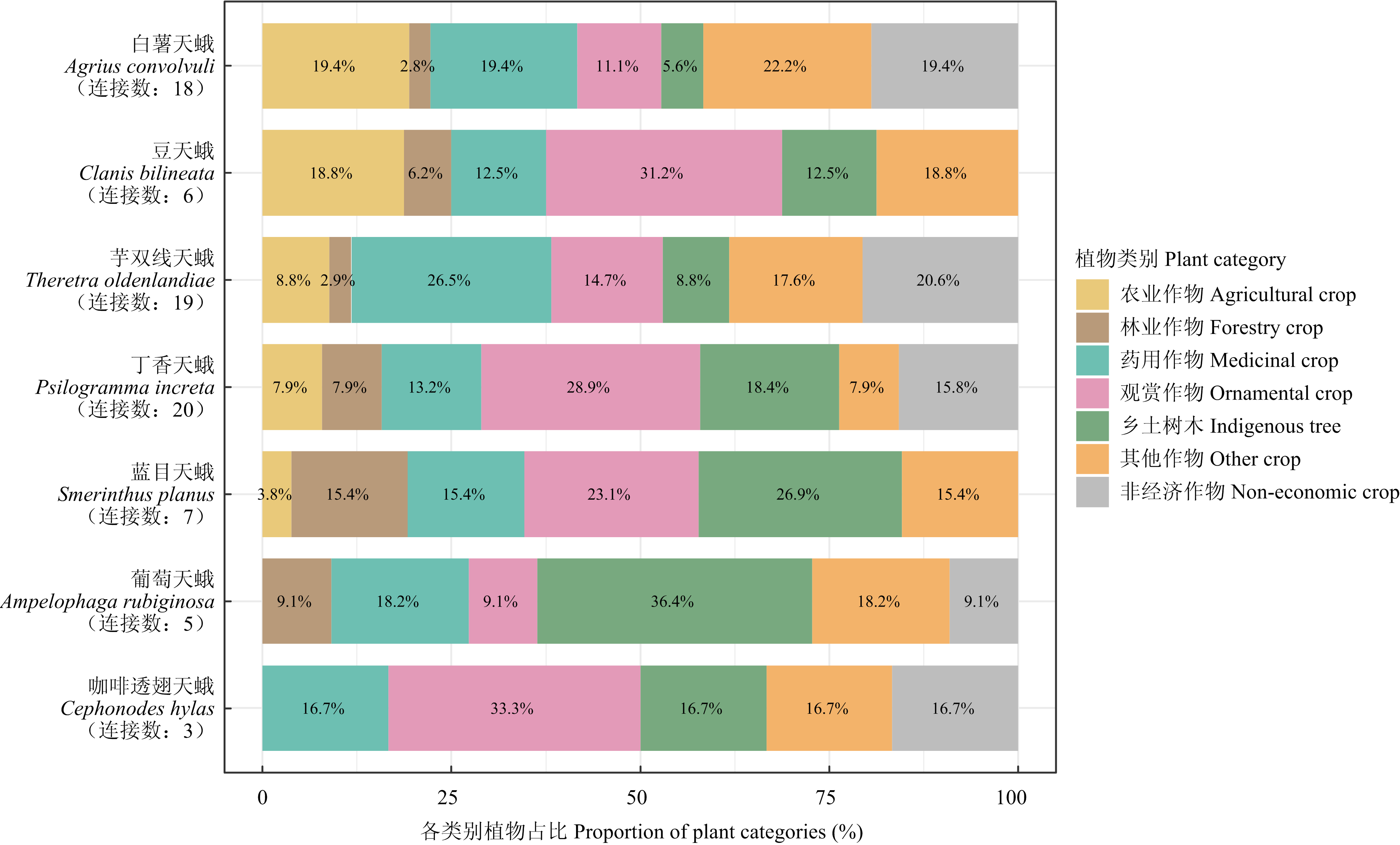
Host plants utilized by major hawkmoth pest species (ranked by the proportion of plant categories consumed)"

Table 3

Host plant preferences of hawkmoths across different plant categories"

寄主植物类别
Host plant category
类别内占比最高的天蛾
Hawkmoth species with the highest proportion
within each plant category
类别内食谱最宽的天蛾
Hawkmoth species with the broadest diet breadth
within each plant category
农业作物Agricultural crop 芝麻鬼脸天蛾Acherontia styx 芝麻鬼脸天蛾Acherontia styx
林业作物Forestry crop 红六点天蛾Marumba gaschkewitschii 红六点天蛾Marumba gaschkewitschii
药用作物Medicinal crop 雀纹天蛾Theretra japonica 深色白眉天蛾Hyles gallii
芋双线天蛾Theretra oldenlandiae
观赏作物Ornamental crop 红节天蛾Sphinx ligustri 丁香天蛾Psilogramma increta
乡土树木Indigenous tree 红节天蛾Sphinx ligustri 榆绿天蛾Callambulyx tatarinovii
红六点天蛾Marumba gaschkewitschii
钩翅天蛾Mimas christophi
蓝目天蛾Smerinthus planus
丁香天蛾Psilogramma increta
深色白眉天蛾Hyles gallii
其他作物Other crop 八字白眉天蛾Hyles livornica 深色白眉天蛾Hyles gallii
非经济作物Non-economic crop 芋双线天蛾Theretra oldenlandiae 白薯天蛾Agrius convolvuli
芋双线天蛾Theretra oldenlandiae
[1]
Strona G, Lafferty K D. Environmental change makes robust ecological networks fragile[J]. Nature Communications, 2016, 7: 12462.

doi: 10.1038/ncomms12462 pmid: 27511722
[2]
Proulx S, Promislow D, Phillips P. Network thinking in ecology and evolution[J]. Trends in Ecology & Evolution, 2005, 20(6): 345-353.

doi: 10.1016/j.tree.2005.04.004
[3]
Bascompte J, Jordano P, Melián C J, Olesen J M. The nested assembly of plant-animal mutualistic networks[J]. Proceedings of the National Academy of Sciences of the United States of America, 2003, 100(16): 9383-9387.

doi: 10.1073/pnas.1633576100 pmid: 12881488
[4]
Olesen J M, Bascompte J, Dupont Y L, Jordano P. The modularity of pollination networks[J]. Proceedings of the National Academy of Sciences of the United States of America, 2007, 104(50): 19891-19896.

doi: 10.1073/pnas.0706375104 pmid: 18056808
[5]
Thébault E, Fontaine C. Stability of ecological communities and the architecture of mutualistic and trophic networks[J]. Science, 2010, 329(5993): 853-856.

doi: 10.1126/science.1188321 pmid: 20705861
[6]
Memmott J, Waser N M, Price M V. Tolerance of pollination networks to species extinctions[J]. Proceedings of the Royal Society B-Biological Sciences, 2004, 271(1557): 2605-2611.

doi: 10.1098/rspb.2004.2909
[7]
Burgos E, Ceva H, Perazzo R P, Devoto M, Medan D, Zimmermann M, María Delbue A. Why nestedness in mutualistic networks?[J]. Journal of Theoretical Biology, 2007, 249(2): 307-313.

pmid: 17897679
[8]
Pocock M J, Evans D M, Memmott J. The robustness and restoration of a network of ecological networks[J]. Science, 2012, 335(6071): 973-977.

doi: 10.1126/science.1214915 pmid: 22363009
[9]
张梦迪, 闫俊杰, 高玉林. 马铃薯块茎蛾对不同品种马铃薯块茎的适应性分析[J]. 中国农业科学, 2021, 54(3): 536-546. DOI: 10.3864/j.issn.0578-1752.2021.03.008.
Zhang M D, Yan J J, Gao Y L. The adaptive analysis of Phthorimaea operculella to different potato tuber varieties[J]. Scientia Agricultura Sinica, 2021, 54(3): 536-546. DOI: 10.3864/j.issn.0578-1752.2021.03.008. (in Chinese)
[10]
吴明月, 甫秋梅, 黄圣琳, 罗丰, 刘勇, 史彩华, 张友军, 孔祥义, 谢文. 2020—2025年海南冬春季豇豆害虫种类调查及其发生危害规律[J]. 中国农业科学, 2025, 58(21): 4451-4466. DOI: 10.3864/j.issn.0578-1752.2025.21.014.
Wu M Y, Fu Q M, Huang S L, Luo F, Liu Y, Shi C H, Zhang Y J, Kong X Y, Xie W. Investigation on species composition and damage dynamics of cowpea pests in Hainan winter-spring cropping system (2020-2025)[J]. Scientia Agricultura Sinica, 2025, 58(21): 4451-4466. DOI: 10.3864/j.issn.0578-1752.2025.21.014. (in Chinese)
[11]
Welti E, Helzer C, Joern A. Impacts of plant diversity on arthropod communities and plant-herbivore network architecture[J]. Ecosphere, 2017, 8(10): e01983.

doi: 10.1002/ecs2.2017.8.issue-10
[12]
Neff F, Brändle M, Ambarli D, Ammer C, Bauhus J, Boch S, Hölzel N, Klaus V H, Kleinebecker T, Prati D, Schall P, Schäfer D, Schulze E D, Seibold S, Simons N K, Weisser W W, Pellissier L, Gossner M M. Changes in plant-herbivore network structure and robustness along land-use intensity gradients in grasslands and forests[J]. Science Advances, 2021, 7(20): eabf3985.
[13]
de Araujo W S, Silveira L T, Couto M, Falcão L A, Fagundes M, de Neves F S. Beta diversity of plant-herbivore interactions is unaffected by urbanization levels in Brazilian Cerrado[J]. Arthropod-Plant Interactions, 2024, 18(5): 881-889.

doi: 10.1007/s11829-024-10079-0
[14]
de Araújo W S, Bergamini L L, Almeida-Neto M. Global effects of land-use intensity and exotic plants on the structure and phylogenetic signal of plant-herbivore networks[J]. Science of the Total Environment, 2024, 944: 173949.

doi: 10.1016/j.scitotenv.2024.173949
[15]
Sazatornil F D, Moré M, Benitez-Vieyra S, Cocucci A A, Kitching I J, Schlumpberger B O, Oliveira P E, Sazima M, Amorim F W. Beyond neutral and forbidden links: Morphological matches and the assembly of mutualistic hawkmoth-plant networks[J]. Journal of Animal Ecology, 2016, 85(6): 1586-1594.

doi: 10.1111/1365-2656.12509 pmid: 26931495
[16]
Liu C Q, Sun H. Pollination in Lilium sargentiae (Liliaceae) and the first confirmation of long-tongued hawkmoths as a pollinator niche in Asia[J]. Journal of Systematics and Evolution, 2019, 57(1): 81-88.

doi: 10.1111/jse.v57.1
[17]
Liu C Q, Niu Y, Lu Q B, Chen Z, Cai B, Fang Y, Gao Y D. Papilio butterfly vs. hawkmoth pollination explains floral syndrome dichotomy in a clade of Lilium[J]. Botanical Journal of the Linnean Society, 2022, 199(3): 678-693.

doi: 10.1093/botlinnean/boab074
[18]
魏鸿钧. 黄淮地区的“三蛾”问题[J]. 植物保护, 1965(2): 64-65.
Wei H J. The ‘three moths’ problem in Huanghuai area[J]. Plant Protection, 1965(2): 64-65. (in Chinese)
[19]
王贺军. 豆天蛾在河北省发生严重[J]. 植物保护, 1988(1): 55.
Wang H J. Clanis bilineata occurs seriously in Hebei Province[J]. Plant Protection, 1988(1): 55. (in Chinese)
[20]
刘珍, 张世举. 豆天蛾1990年在新乡市暴发[J]. 植物保护, 1991(4): 53.
Liu Z, Zhang S J. Clanis bilineata broke out in Xinxiang City in 1990[J]. Plant Protection, 1991(4): 53. (in Chinese)
[21]
张广义, 王登甲, 惠祥海, 詹召芳, 孙明海. 1994年甘薯天蛾大暴发原因及防治对策[J]. 山东农业科学, 1995, 27(2): 31-32.
Zhang G Y, Wang D J, Hui X H, Zhan Z F, Sun M H. Causes and control countermeasures of the outbreak of sweet potato moth in 1994[J]. Shandong Agricultural Sciences, 1995, 27(2): 31-32. (in Chinese)
[22]
杨辉, 蔡娟, 姜道威, 吕丽萍, 孙宗明. 洛宁县2005年豆天蛾局部暴发成因及监控意见[J]. 中国植保导刊, 2006, 26(9): 18.
Yang H, Cai J, Jiang D W, L P, Sun Z M. Causes and monitoring opinions of local outbreak of Clanis bilineata in Luoning County in 2005[J]. China Plant Protection, 2006, 26(9): 18. (in Chinese)
[23]
Ho H C, Altermatt F. Associating the structure of Lepidoptera-plant interaction networks across clades and life stages to environmental gradients[J]. Journal of Biogeography, 2024, 51(4): 725-738.

doi: 10.1111/jbi.v51.4
[24]
Wang X P, Fu X, Shi M M, Xue C Q, Yang J Z, Zhao Z T, Li S J, Tu T Y. Multiple interaction networks reveal that Lepidoptera larvae and adults prefer various host plants for diet and pollination[J]. Integrative Zoology, 2024, 19(4): 763-776.

doi: 10.1111/1749-4877.12745
[25]
刘爱萍, 王建锋. 恶性杂草乳浆大戟天敌—大戟天蛾寄主专一性测定[J]. 中国草地, 1996(2): 33-34.
Liu A P, Wang J F. Host specificity tests of Celerio (Hyles) lineata (Esper)[J]. Grassland of China, 1996(2): 33-34. (in Chinese)
[26]
Mejia L B, Arnal P, Hallwachs W, Haxaire J, Janzen D, Kitching I J, Rougerie R. A global food plant dataset for wild silkmoths and hawkmoths and its use in documenting polyphagy of their caterpillars (Lepidoptera: Bombycoidea: Saturniidae, Sphingidae)[J]. Biodiversity Data Journal, 2020, 8: e60027.
[27]
虞国跃. 北京蛾类图谱[M]. 北京: 科学出版社, 2014.
Yu G Y. Moths in Beijing[M]. Beijing: Science Press, 2014. (in Chinese)
[28]
杜连海, 史宏亮, 吴记贵, 潘彥平, 田呈明, 刘博. 北京松山自然保护区昆虫图谱[M]. 杨凌: 西北农林科技大学出版社, 2015.
Du L H, Shi H L, Wu J G, Pan Y P, Tian C M, Liu B. Insects Atlas of Beijing Songshan Nature Reserve[M]. Yangling: Northwest A&F University Press, 2015. (in Chinese)
[29]
丁建云, 张建华. 北京灯下蛾类图谱[M]. 北京: 中国农业出版社, 2016.
Ding J Y, Zhang J H. Atlas of Under Lamp Moths in Beijing[M]. Beijing: China Agriculture Press, 2016. (in Chinese)
[30]
虞国跃, 王合, 冯术快. 王家园昆虫[M]. 北京: 科学出版社, 2016.
Yu G Y, Wang H, Feng S K. Insects of Wangjiayuan[M]. Beijing: Science Press, 2016. (in Chinese)
[31]
虞国跃, 王合. 北京林业昆虫图谱(I)[M]. 北京: 科学出版社, 2018.
Yu G Y, Wang H. The Beijing Forestry Insect Atlas (I)[M]. Beijing: Science Press, 2018. (in Chinese)
[32]
虞国跃. 北京访花昆虫图谱[M]. 北京: 电子工业出版社, 2019.
Yu G Y. Atlas of Beijing Flower-visiting Insects[M]. Beijing: Publishing House of Electronics Industry, 2019. (in Chinese)
[33]
蒋卓衡, 黄嘉龙. 中国天蛾科图鉴[M]. 福州: 海峡书局, 2023.
Jiang Z H, Huang J L. Hawkmoths of China[M]. Fuzhou: Straits Book Company, 2023. (in Chinese)
[34]
Melichar T, Haxaire J, Řezáč M, Manjunatha H B. A Field Guide to Hawkmoths (Lepidoptera: Sphingidae) of the State of Karnataka, India[M]. Příbram: Ekologické Centrum Orlov, 2018.
[35]
肖翠, 刘冰, 吴超然, 马金双, 叶建飞, 夏晓飞, 林秦文. 北京维管植物编目和分布数据集[J]. 生物多样性, 2022, 30(6): 22064.

doi: 10.17520/biods.2022064
Xiao C, Liu B, Wu C R, Ma J S, Ye J F, Xia X F, Lin Q W. A dataset on inventory and geographical distributions of vascular plants in Beijing, China[J]. Biodiversity Science, 2022, 30(6): 22064. (in Chinese)

doi: 10.17520/biods.2022064
[36]
Dormann C F, Gruber B, Fründ J. Introducing the bipartite package: Analysing ecological networks[J]. R News, 2008, 8: 8-11.
[37]
Zhu C, Li W D, Campos-Arceiz A, Dalsgaard B, Ren P, Wang D R, Zhang X, Sun M H, Si Q, Kang Y, Ding P, Si X F. The reliability of regional ecological knowledge to build local interaction networks: A test using seed-dispersal networks across land-bridge islands[J]. Proceedings of the Royal Society B, 2023, 290(2003): 20231221.
[38]
Jin Y, Qian H. V.PhyloMaker2: An updated and enlarged R package that can generate very large phylogenies for vascular plants[J]. Plant Diversity, 2022, 44(4): 335-339.

doi: 10.1016/j.pld.2022.05.005
[39]
Couch C D, Masonick P, Plotkin D, Li X K, Breinholt J W, Rougerie R, Barber J R, Kitching I, Kawahara A Y. The evolution of proboscis length and feeding behaviour in hawkmoths (Lepidoptera: Sphingidae)[J]. Royal Society Open Science, 2026, 13(3): 251697.

doi: 10.1098/rsos.251697
[40]
刘旭, 杨庆文. 中国作物及其野生近缘植物名录卷[M]. 北京: 中国农业出版社, 2013.
Liu X, Yang Q W. Catalogue of Chinese Crops and Their Wild Relatives[M]. Beijing: China Agriculture Press, 2013. (in Chinese)
[41]
冯志荣, 陈有城, 彭艳琼, 李莉, 王波. 生态网络分析: 从集合群落到集合网络[J]. 生物多样性, 2023, 31(8): 23171.

doi: 10.17520/biods.2023171
Feng Z R, Chen Y C, Peng Y Q, Li L, Wang B. Ecological network analysis: From metacommunity to metanetwork[J]. Biodiversity Science, 2023, 31(8): 23171. (in Chinese)

doi: 10.17520/biods.2023171
[42]
Almeida-Neto M, Guimarães P, Guimarães P R, Loyola R D, Ulrich W. A consistent metric for nestedness analysis in ecological systems: Reconciling concept and measurement[J]. Oikos, 2008, 117(8): 1227-1239.

doi: 10.1111/oik.2008.117.issue-8
[43]
Beckett S J. Improved community detection in weighted bipartite networks[J]. Royal Society Open Science, 2016, 3(1): 140536.

doi: 10.1098/rsos.140536
[44]
Ogle D H, Doll J C, Wheeler A P, Dinno A. FSA: Simple Fisheries Stock Assessment Methods[Z]. Vienna: R Foundation for Statistical Computing, 2026.
[45]
Jordán F, Benedek Z, Podani J. Quantifying positional importance in food webs: A comparison of centrality indices[J]. Ecological Modelling, 2007, 205(1/2): 270-275.

doi: 10.1016/j.ecolmodel.2007.02.032
[46]
Lai S M, Liu W C, Jordán F. On the centrality and uniqueness of species from the network perspective[J]. Biology Letters, 2012, 8(4): 570-573.

doi: 10.1098/rsbl.2011.1167
[47]
Dehling D M. The structure of ecological networks[M]//Dáttilo W, Rico-Gray V. Ecological Networks in the Tropics. Cham: Springer, 2018: 29-42.
[48]
Cagua E F, Wootton K L, Stouffer D B. Keystoneness, centrality, and the structural controllability of ecological networks[J]. Journal of Ecology, 2019, 107(4): 1779-1790.

doi: 10.1111/jec.2019.107.issue-4
[49]
李曾三, 郑新民. 消灭柳天蛾保护堤柳的几种办法[J]. 黄河建设, 1964(12): 31.
Li Z S, Zheng X M. Several methods to eliminate the willow moth and protect the dike willow[J]. Yellow River, 1964(12): 31. (in Chinese)
[50]
冯建国. 繁殖赤眼蜂的新寄主—柳天蛾的研究[J]. 山东农业科学, 1979(1): 29-31.
Feng J G. Study on the new host of Trichogramma - willow moth[J]. Shandong Agricultural Sciences, 1979(1): 29-31. (in Chinese)
[51]
陈崇祯. 襄北地区甘薯天蛾(Herse convolvuli C.)的初步观察[J]. 昆虫知识, 1964(3): 124.
Chen C Z. A preliminary observation of Herse convolvuli C. in Xiangbei Region[J]. Entomological Knowledge, 1964(3): 124. (in Chinese)
[52]
刘汉舒, 尤桂爱, 迟新之, 张广义, 孙明海, 詹召芳. 鲁西南甘薯天蛾发生规律及防治研究[J]. 华东昆虫学报, 1998(1): 42-46.
Liu H S, You G A, Chi X Z, Zhang G Y, Sun M H, Zhan Z F. Occurrence and control of Agrius convolvuli Linnaeus in southwest Shangdong[J]. Entomological Journal of East China, 1998(1): 42-46. (in Chinese)
[53]
黄广泰. 伏牛山区甘薯天蛾的发生与防治[J]. 河南农业科学, 1998(7): 25.
Huang G T. Occurrence and control of Agrius convolvuli in Funiu Mountain area[J]. Journal of Henan Agricultural Sciences, 1998(7): 25. (in Chinese)
[54]
陈森. 霜天蛾生活习性初步观察[J]. 江苏林业科技, 1982(2): 27-28.
Chen S. Preliminary observation on the living habits of Psilogramma discistriga[J]. Journal of Jiangsu Forestry Science & Technology, 1982(2): 27-28. (in Chinese)
[55]
程红, 严善春. 危害丁香属植物的昆虫种类[J]. 东北林业大学学报, 2011, 39(3): 113-116.
Cheng H, Yan S C. Insects causing damage to plants of the genus Syringa[J]. Journal of Northeast Forestry University, 2011, 39(3): 113-116. (in Chinese)
[56]
庞震, 龙淑文. 葡萄天蛾的观察简报[J]. 昆虫知识, 1975(4): 24-25.
Pang Z, Long S W. Observation report on Ampelophaga rubiginosa[J]. Entomological Knowledge, 1975(4): 24-25. (in Chinese)
[57]
张东光, 付晓颖. 葡萄天蛾在吉林松原地区的发生与防治[J]. 北方园艺, 2013(1): 200.
Zhang D G, Fu X Y. Occurrence and control of Ampelophaga rubiginosa in Jilin Songyuan area[J]. Northern Horticulture, 2013(1): 200. (in Chinese)
[58]
鄢春发, 吴文智, 唐征辉, 杨勤根, 李龙根. 咖啡透翅天蛾的初步研究[J]. 昆虫知识, 1988(2): 98-100.
Yan C F, Wu W Z, Tang Z H, Yang Q G, Li L G. Preliminary research of Cephonodes hylas[J]. Entomological Knowledge, 1988(2): 98-100. (in Chinese)
[59]
廖寿南, 谢保令. 山枝子咖啡透翅天蛾的生活习性及防治[J]. 广西农业科学, 1995(3): 128-129.
Liao S N, Xie B L. Life habit and control of Cephonodes hylas[J]. Guangxi Agricultural Sciences, 1995(3): 128-129. (in Chinese)
[60]
许思学. 黄栀子咖啡透翅天蛾发生规律及防治技术初探[J]. 植保技术与推广, 2003, 23(12): 22-23.
Xu S X. Prelininary study on occurring rules of Cephonodes hylas in yellow Gardenia and its control[J]. Plant Protection Technology and Extension, 2003, 23(12): 22-23. (in Chinese)
[61]
李国元, 邓青云, 华光安, 胡波, 雷朝亮. 红栀子主要害虫与天敌种类及田间种群动态研究[J]. 昆虫天敌, 2005, 27(1): 21-26.
Li G Y, Deng Q Y, Hua G A, Hu B, Lei C L. Species and field population dynamic of main insect pests and their natural enemies on Gardenia jasminonides Ellis[J]. Natural Enemies of Insects, 2005, 27(1): 21-26. (in Chinese)
[62]
李国元, 邓青云, 华光安, 胡波, 雷朝亮. 红栀子园两种主要害虫咖啡透翅天蛾和茶长卷叶蛾的生物学特性及防治[J]. 昆虫知识, 2005, 42(4): 400-403.
Li G Y, Deng Q Y, Hua G A, Hu B, Lei C L. Bionomics and control of two major pests Cephonodes hylas and Homona magnanima in Gardenia jasminonides field[J]. Entomological Knowledge, 2005, 42(4): 400-403. (in Chinese)
[63]
何家庆, 施忠辉. 双线雀天蛾生物学及其对磨芋为害的观察研究[J]. 武汉植物学研究, 1995, 13(4): 369-372.
He J Q, Shi Z H. The observation and study on the biology of Theretra oldenlandiae and its damage to Amorphophallus konjac[J]. Journal of Wuhan Botanical Research, 1995, 13(4): 369-372. (in Chinese)
[64]
只佳增, 钱云, 陈鸿洁, 周劲松. 芋双线天蛾的生物学特性[J]. 热带农业科学, 2018, 38(5): 66-70.
Zhi J Z, Qian Y, Chen H J, Zhou J S. Biological characteristics of Theretra oldenlandiae (Fabricius)[J]. Chinese Journal of Tropical Agriculture, 2018, 38(5): 66-70. (in Chinese)
[65]
王帅宇, 张子腾, 谢爱婷, 董杰, 杨建国, 张爱环. 我国草地贪夜蛾种群杀虫剂靶标基因突变分析[J]. 中国农业科学, 2022, 55(20): 3948-3959. DOI: 10.3864/j.issn.0578-1752.2022.20.007.
Wang S Y, Zhang Z T, Xie A T, Dong J, Yang J G, Zhang A H. Mutation analysis of insecticide target genes in populations of Spodoptera frugiperda in China[J]. Scientia Agricultura Sinica, 2022, 55(20): 3948-3959. DOI: 10.3864/j.issn.0578-1752.2022.20.007. (in Chinese)
[66]
张桂芬, 万坤, 潘梦妮, 王龙, 黄聪, 王玉生, 张毅波, 冼晓青, 杨念婉, 桂富荣, 刘万学, 万方浩. 番茄潜叶蛾种群定殖与种群重建及延续能力研究[J]. 中国农业科学, 2024, 57(3): 514-524. DOI: 10.3864/j.issn.0578-1752.2024.03.007.
Zhang G F, Wan K, Pan M N, Wang L, Huang C, Wang Y S, Zhang Y B, Xian X Q, Yang N W, Gui F R, Liu W X, Wan F H. Population colonization, re-establishment and development of the tomato leafminer (Tuta absoluta)[J]. Scientia Agricultura Sinica, 2024, 57(3): 514-524. DOI: 10.3864/j.issn.0578-1752.2024.03.007. (in Chinese)
[67]
刘浩凯, 丰友娜, 李靖, 梁倩. 八角和莪术挥发油对小菜蛾杀虫活性成分及其作用机制[J]. 中国农业科学, 2025, 58(19): 3905-3918. DOI: 10.3864/j.issn.0578-1752.2025.19.008.
Liu H K, Feng Y N, Li J, Liang Q. Insecticidal active components and mechanisms of essential oils from Illicium verum and Curcuma phaeocaulis against Plutella xylostella[J]. Scientia Agricultura Sinica, 2025, 58(19): 3905-3918. DOI: 10.3864/j.issn.0578-1752.2025.19.008. (in Chinese)
[68]
陆庆轩. 关于乡土植物定义的辨析[J]. 中国城市林业, 2016, 14(4): 12-14.
Lu Q X. Discussion on the definition of native plants[J]. Journal of Chinese Urban Forestry, 2016, 14(4): 12-14. (in Chinese)
[69]
卢成仁. 有机、生态食物与中国的第三次农业革命[J]. 原生态民族文化学刊, 2022, 14(1): 69-76, 154.
Lu C R. Organic, ecological food and the third agricultural revolution in China[J]. Journal of Original Ecological National Culture, 2022, 14(1): 69-76, 154. (in Chinese)
[70]
王琛柱, 闫凤鸣. 信息化学物质及其在害虫防治中的应用[J]. 应用昆虫学报, 2023, 60(2): 313-314.
Wang C Z, Yan F M. Information chemicals and their application in pest control[J]. Chinese Journal of Applied Entomology, 2023, 60(2): 313-314. (in Chinese)
[71]
陈学新, 杜永均, 黄健华, 李姝, 姜道宏, 莫明和, 庞虹, 孙修炼, 王琦, 王甦, 夏玉先, 徐学农, 臧连生, 张杰, 张礼生, 张文庆, 尹恒. 我国作物病虫害生物防治研究与应用最新进展[J]. 植物保护, 2023, 49(5): 340-370.
Chen X X, Du Y J, Huang J H, Li S, Jiang D H, Mo M H, Pang H, Sun X L, Wang Q, Wang S, Xia Y X, Xu X N, Zang L S, Zhang J, Zhang L S, Zhang W Q, Yin H. Recent progresses in biological control of crop pathogens and insect pests in China[J]. Plant Protection, 2023, 49(5): 340-370. (in Chinese)
[72]
向云菊, 张旺和, 徐进, 叶辉. CRISPR/Cas9基因编辑技术在害虫基因功能及害虫防治研究中的应用进展[J]. 农业生物技术学报, 2024, 32(6): 1415-1431.
Xiang Y J, Zhang W H, Xu J, Ye H. Progress in the application of CRISPR/Cas9 gene editing technology in pest gene function and pest control research[J]. Journal of Agricultural Biotechnology, 2024, 32(6): 1415-1431. (in Chinese)
[73]
海露, 张梦君, 杨斌. RNA农药: 重塑农业生态与害虫防治范式的创新蓝图[J]. 植物保护, 2025, 51(5): 178-189, 196.
Hai L, Zhang M J, Yang B. RNA-based pesticides: An innovative blueprint for reshaping agricultural ecology and pest management paradigms[J]. Plant Protection, 2025, 51(5): 178-189, 196. (in Chinese)
[74]
Yang B, Zhang Z X, Yang C Q, Wang Y, Orr M C, Wang H B, Zhang A B. Identification of species by combining molecular and morphological data using convolutional neural networks[J]. Systematic Biology, 2022, 71(3): 690-705.

doi: 10.1093/sysbio/syab076
[75]
张壮, 傅慧, 王殿轩, 荆世华, 李志信, 王泽, 刘曼. 基于AI多模型技术对储粮害虫防治应用的研究[J]. 中国粮油学报, 2024, 39(11): 17-25.
Zhang Z, Fu H, Wang D X, Jing S H, Li Z X, Wang Z, Liu M. Application of AI multi-model technology in prevention and control of stored grain pests[J]. Journal of the Chinese Cereals and Oils Association, 2024, 39(11): 17-25. (in Chinese)
[1] HUANG ShengLin, XU YiBo, KONG XiangYi, SHI CaiHua, JIAO XiaoGuo, ZHANG YouJun, WU MingYue, XIE Wen. Analysis of Annual Population Dynamics of Megalurothrips usitatus on Cowpea in Hainan [J]. Scientia Agricultura Sinica, 2025, 58(21): 4439-4450.
[2] WANG HuanTing, HUANG LiFei, CAO XueMei, GONG Rui, SU GuoLian, ZHENG XiaLin, WU MingYue, YANG Lang. Effects of Different Host Plants on Digestive Enzyme Activity and Nutrient Content in Megalurothrips usitatus [J]. Scientia Agricultura Sinica, 2025, 58(21): 4429-4438.
[3] SONG BoWen,YANG Long,PAN YunFei,LI HaiQiang,LI Hao,FENG HongZu,LU YanHui. Effects of Agricultural Landscape on the Population Dynamic of Grapholitha molesta Adults in Apple Orchards in Southern Xinjiang [J]. Scientia Agricultura Sinica, 2022, 55(1): 85-95.
[4] ZHENG XuSong, TIAN JunCe, YANG YaJun, ZHU PingYang, LI Kuan, XU HongXing, Lü ZhongXian. The feasibility of using graminaceous weeds as a functional plant for controlling rice leaffolder (Cnaphalocrocis medinalis) [J]. Scientia Agricultura Sinica, 2017, 50(21): 4129-4137.
[5] WANG Jie,TIAN Guo-zhong,XU Qi-cong,LIU Yong-guang,GAO Rui,LI Xiang-dong,ZHU Xiao-ping
. Molecular Detection of Phytoplasma Strains From Several Plants Around Diseased Paulownia Infected with Paulownia Witches’-broom Phytoplasma
[J]. Scientia Agricultura Sinica, 2010, 43(2): 304-312 .
Viewed
Full text


Abstract

Cited

  Shared   
  Discussed   
No Suggested Reading articles found!