Scientia Agricultura Sinica ›› 2026, Vol. 59 ›› Issue (7): 1576-1586.doi: 10.3864/j.issn.0578-1752.2026.07.015

• ANIMAL SCIENCE·VETERINARY SCIENCE • Previous Articles    

Genetic and Biological Characterization of Two H8N4 Subtype Avian Influenza Viruses Isolated from Duck

MIAO JiaHao(), CUI PengFei, YAN Cheng, WANG CongCong, WANG Yan, CHEN Yuan, CHEN Peng, SHI JianZhong, DENG GuoHua*(), CHEN HuaLan   

  1. Harbin Veterinary Research Institute, Chinese Academy of Agricultural Sciences/State Key Lab of Animal Disease Control and Prevention/National Poultry Laboratory Animal Resource Center, Harbin 150069
  • Received:2025-10-19 Accepted:2025-12-17 Online:2026-04-08 Published:2026-04-08
  • Contact: DENG GuoHua

Abstract:

【Objective】This study aimed to analyze the biological characteristics of the newly isolated H8N4 subtype avian influenza virus (AIV), so as to provide the basis for avian influenza surveillance and comprehensive prevention and control.【Method】The whole-genome sequencing of two strains of H8N4 subtype avian influenza virus DK/HuN/S11158/2024 (DK/S11158) and DK/HuN/S11301/2025 (DK/S11301) isolated from duck farms in Hunan Province were determined. Reference strain sequences with the highest homology to each segment were downloaded from the GISAID database. The phylogenetic trees for each gene segment of the isolated strains and reference strains were constructed using MEGA 7.0 software. The key amino acid residue variations in different encoded proteins of the two H8N4 subtype AIVs were analyzed. The differences in viral receptor-binding characteristics were assessed using bio-layer interferometry. SPF chickens and BALB/c mice were infected with a virus dose of 106 EID50 to evaluate the infection and pathogenicity of the two H8N4 subtype viruses in poultry and mammals.【Result】BLAST comparison results showed that for the DK/S11158 strain, the PB1, PA, and NA gene segments had the highest nucleotide homology with corresponding segments from AIVs of South Korean waterfowl origin; the PB2, HA, and NS gene segments had the highest homology with those from Japanese wild bird-origin AIVs; the M gene segment had the highest homology with a duck-origin AIV from Iran; the NP gene segment had the highest homology with a wild bird-origin AIV from China. For the DK/S11301 strain, the PB2, PB1, PA, NP, and NS gene segments showed the highest nucleotide homology with corresponding segments from Japanese wild bird and waterfowl-origin AIVs; the HA and NA gene segments had the highest homology with those from North American waterfowl-origin AIVs; the M gene segment had the highest homology with a South Korean wild bird-origin AIV. The amino acid sequence at the HA protein cleavage site of both H8N4 subtype AIVs was PSIEPK↓GLF, containing only a single basic amino acid, which was consistent with the molecular characteristics of low pathogenic avian influenza virus (LPAIV). Several mammalian adaptation mutation sites were identified, including 89V, 358E, 389R in the PB2 protein, 3V, 622G in the PB1 protein, 37A, 409S in the PA protein, and 42S, 106M in the NS1 protein. Assessment of viral receptor-binding characteristics using bio-layer interferometry revealed that both viruses could bind to both α-2,3-sialic acid and α-2,6-sialic acid receptors, demonstrating dual receptor-binding capability. Results from the infectivity experiment in chickens showed that no virus was detected in any organs, oropharyngeal swabs, or cloacal swabs of chickens in the DK/S11158 and DK/S11301 infection groups. No virus was detected in the oropharyngeal or cloacal swabs of chickens in the contact transmission groups either. Serological antibody level testing 14 days post-infection showed seroconversion in only one chicken from the DK/S11158 infection group. After intranasal infection of BALB/c mice with 106 EID50/50μL of virus, the viral titer in the nasal turbinates and lungs of the DK/S11158 group were 5.58 log10EID50/mL and 2.75 log10EID50/mL, respectively. The viral titers in the nasal turbinates and lungs of the DK/S11301 group were 6.25 log10EID50/mL and 4.08 log10EID50/mL, respectively, accompanied by a certain degree of weight loss.【Conclusion】The above results indicate that the two H8N4 subtype AIVs were novel recombinant viruses with significant genetic diversity and posed a potential risk of infecting mammals and humans. This study provided important data support for the surveillance and comprehensive prevention and control of avian influenza.

Key words: avian influenza virus, H8N4, infectivity, receptor-binding specificity, genetic evolution

Table 1

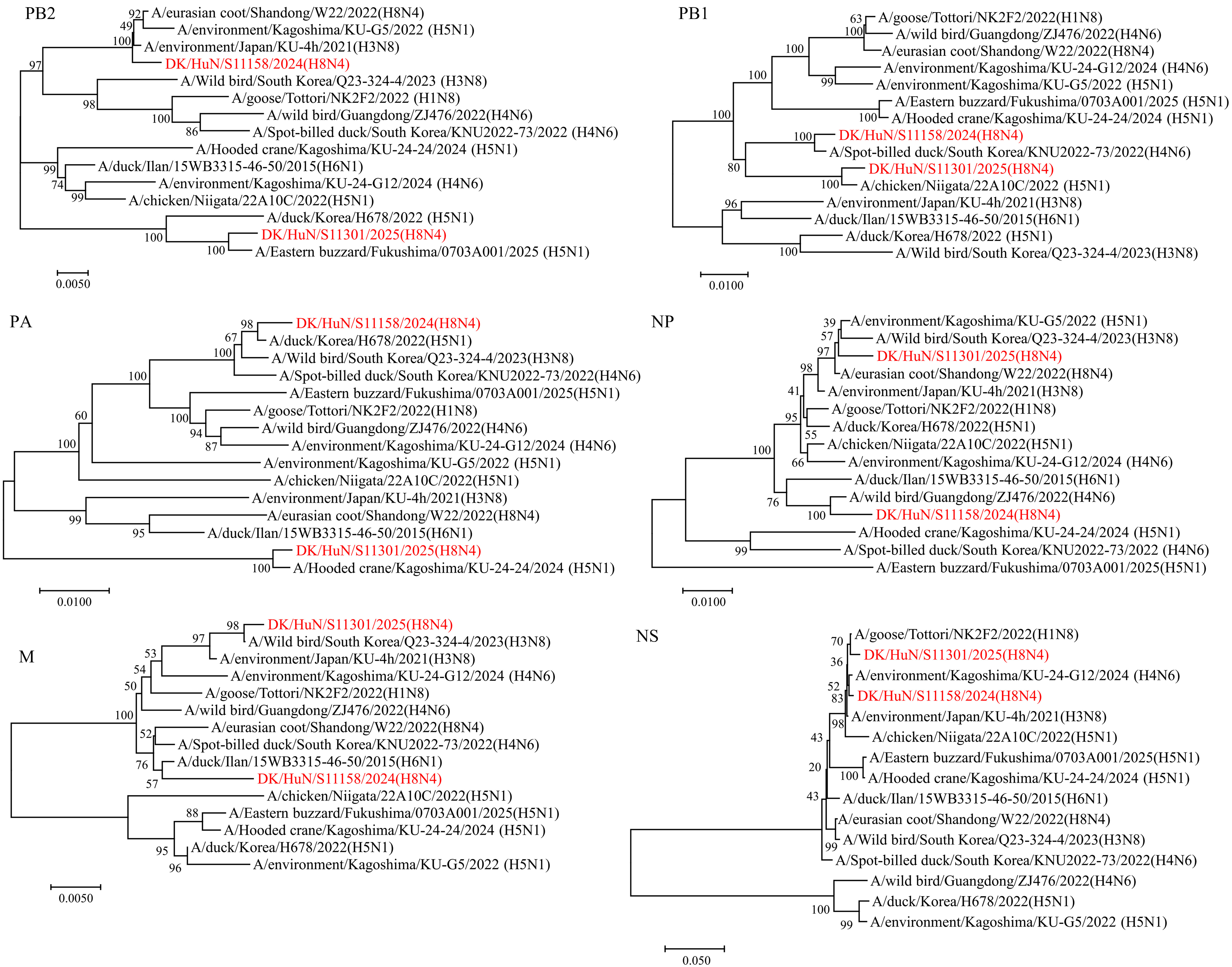
Viruses showing the highest homology to each segment of the two H8N4 subtype AIVs"

病毒
Virus
基因
Gene
与GISAID数据库中同源性最高的病毒
The highest homologous strains in the GISAID database
同源性
Identity
登录号
Segment-ID
DK/HuN/S11158/
2024(H8N4)
PB2 A/environment/Japan/KU-4h/2021(H3N8) 99.4% EPI2596070
PB1 A/Spot-billed duck/South Korea/KNU2022-73/2022(H4N6) 99.3% EPI19109827
PA A/duck/Korea/H678/2022(H5N1) 99.4% EPI19453475
HA A/bird/Japan/NIES-0000009/2022(H8N4) 98.4% EPI2628718
NP A/wild bird/Guangdong/ZJ476/2022(H4N6) 98.9% EPI4313854
NA A/mallard/Korea/KNU-8/2023(H10N4) 99.3% EPI2873264
M A/duck/Ilan/15WB3315-46-50/2015 (H6N1) 99.0% EPI3407222
NS A/environment/Kagoshima/KU-24-G12/2024(H4N6) 99.4% EPI4323141
DK/HuN/S11301/
2025(H8N4)
PB2 A/Eastern buzzard/Fukushima/0703A001/2025(H5N1) 99.1% EPI4264867
PB1 A/chicken/Niigata/22A10C/2022(H5N1) 99.2% EPI2751889
PA A/Hooded crane/Kagoshima/KU-24-24/2024(H5N1) 99.5% EPI3872674
HA A/mallard/Alaska/AH0176804/2021(H8N4) 97.3% EPI1933012
NP A/environment/Kagoshima/KU-G5/2022(H5N1) 99.1% EPI2789439
NA A/Mallard/Ohio/19OS0172/2019(H10N4) 97.5% EPI1778889
M A/A/Wild bird/South Korea/Q23-324-4/2023(H3N8) 99.8% EPI3040266
NS A/goose/Tottori/NK2F2/2022(H1N8) 99.2% EPI3327150

Fig. 1

Phylogenetic trees of the two H8N4 subtype AIVs based on HA and NA gene"

Fig. 2

Phylogenetic trees of the two H8N4 subtype AIVs based on internal genes"

Fig. 3

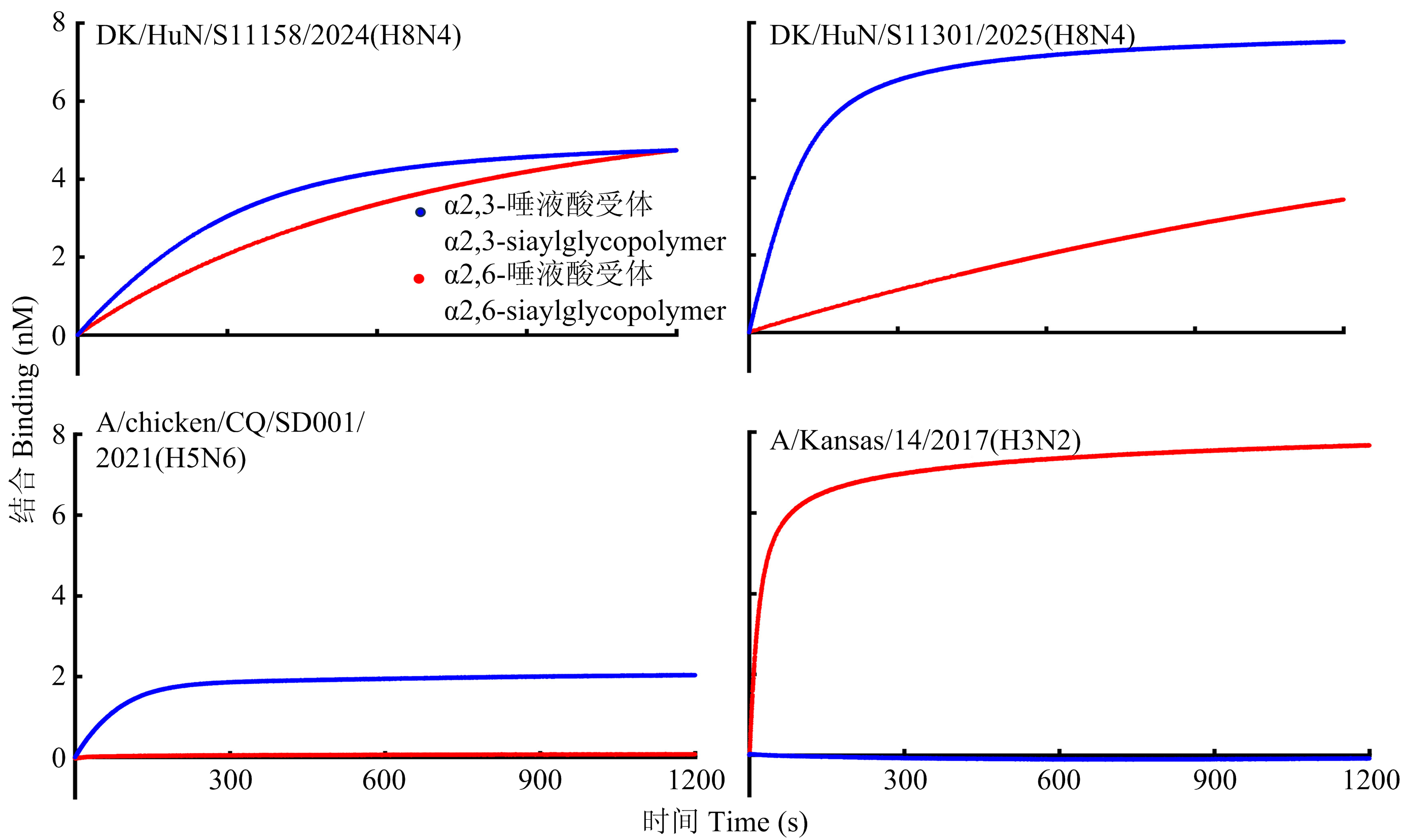
Receptor-binding properties of the two H8N4 subtype AIVs"

Table 2

The viral replication in organs of SPF chickens infected with two H8N4 subtype AIVs"

病毒名称
Virus name
病毒感染SPF鸡复制情况(阳性数/总数) Replication of viral infection in SPF chickens (positive number/total number)

Brain
气管
Trachea
胸腺
Thymus
肺脏
Lung
肾脏
Kidney
脾脏
Spleen
胰腺
Pancreas
心脏
Heart
肝脏
Liver
法氏囊
Bursa of Fabricius
盲肠
Cecum
DK/S11158 0/3 0/3 0/3 0/3 0/3 0/3 0/3 0/3 0/3 0/3 0/3
DK/S11301 0/3 0/3 0/3 0/3 0/3 0/3 0/3 0/3 0/3 0/3 0/3

Table 3

Oropharyngeal and cloacal swab viral shedding in SPF chickens at specified time points post-infection"

病毒名称
Virus name
感染组 Inoculated group 接触组 Contact group
咽喉拭子(阳性数/总数)
Oropharyngeal swab
(positive number/total number)
泄殖腔拭子
(阳性数/总数)
Cloacal swab (positive number/total number)
血清转阳
Seroconversion
咽喉拭子(阳性数/总数)
Oropharyngeal swab
(positive number/total number)
泄殖腔拭子
(阳性数/总数)
Cloacal swab (positive number/total number)
血清转阳
Seroconversion
3d 5d 7d 9d 3d 5d 7d 9d 3d 5d 7d 9d 3d 5d 7d 9d
DK/S11158 0/8 0/8 0/8 0/8 0/8 0/8 0/8 0/8 1/8 0/2 0/2 0/2 0/2 0/2 0/2 0/2 0/2 0/2
DK/S11301 0/8 0/8 0/8 0/8 0/8 0/8 0/8 0/8 0/8 0/2 0/2 0/2 0/2 0/2 0/2 0/2 0/2 0/2

Fig. 4

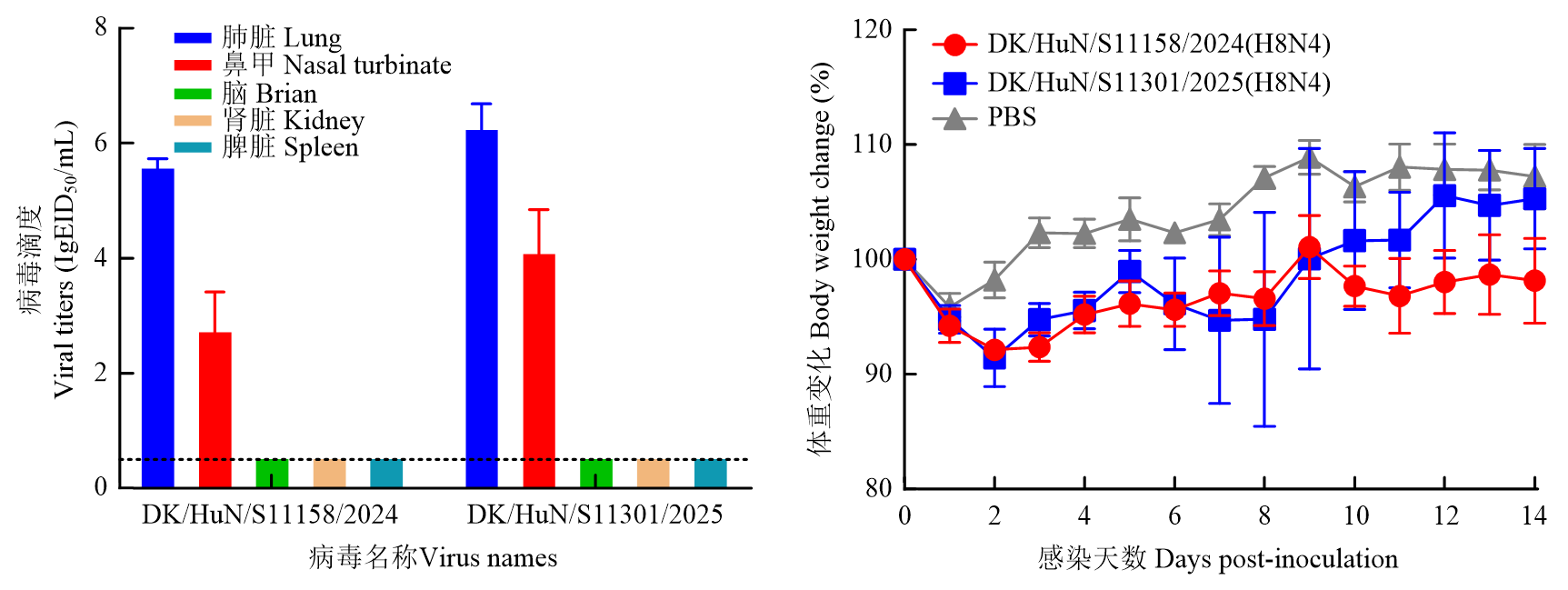
Organ viral titers and body weight changes in mice A:Titration results of mice organs in chicken embryos on the third day of infection; B: Changes in mice body weight 14 days after infection."

[1]
KARAKUS U, MENA I, KOTTUR J, EL ZAHED S S, SEOANE R, YILDIZ S, CHEN L, PLANCARTE M, LINDSAY L, HALPIN R, et al. H 19 influenza A virus exhibits species-specific MHC class II receptor usage. Cell Host & Microbe, 2024, 32(7): 1089-1102.e10.
[2]
WU Y, WU Y, TEFSEN B, SHI Y, GAO G F. Bat-derived influenza- like viruses H17N10 and H18N11. Trends in Microbiology, 2014, 22(4): 183-191.

doi: 10.1016/j.tim.2014.01.010
[3]
赵晴晴, 李群辉, 朱杰, 钟蕾, 刘晶晶, 顾敏, 王晓泉, 刘文博, 刘秀梵. 一株鸭源H4N8亚型禽流感病毒的全基因测序及遗传进化分析. 中国农业科学, 2015, 48(15): 3040-3049. doi: 10.3864/j.issn.0578-1752.2015.15.014.
ZHAO Q Q, LI Q H, ZHU J, ZHONG L, LIU J J, GU M, WANG X Q, LIU W B, LIU X F. Genome sequencing and genetic analysis of H4N8 Subtype avian influenza virus isolated from duck. Scientia Agricultura Sinica, 2015, 48(15): 3040-3049. doi: 10.3864/j.issn.0578-1752.2015.15.014. (in Chinese)
[4]
SHI J Z, ZENG X Y, CUI P F, YAN C, CHEN H L. Alarming situation of emerging H5 and H7 avian influenza and effective control strategies. Emerging Microbes & Infections, 2023, 12(1): 2155072.
[5]
CUI P F, SHI J Z, WANG C C, ZHANG Y C, XING X, KONG H H, YAN C, ZENG X Y, LIU L L, TIAN G B, et al. Global dissemination of H5N1 influenza viruses bearing the clade 2.3.4.4b HA gene and biologic analysis of the ones detected in China. Emerging Microbes & Infections, 2022, 11(1): 1693-1704.
[6]
FERRO P J, KHAN O, PETERSON M J, BATCHULUUN D, REDDY S M, LUPIANI B. Avian influenza virus surveillance in hunter-harvested waterfowl, Texas coast, September 2009-January 2010. Avian Diseases, 2012, 56(4 Suppl.): 1006-1009.

doi: 10.1637/10194-041012-ResNote.1
[7]
TONG S X, ZHU X Y, LI Y, SHI M, ZHANG J, BOURGEOIS M, YANG H, CHEN X F, RECUENCO S, GOMEZ J, et al. New world bats harbor diverse influenza A viruses. PLoS Pathogens, 2013, 9(10): e1003657.

doi: 10.1371/journal.ppat.1003657
[8]
GAO R B, CAO B, HU Y W, FENG Z J, WANG D Y, HU W F, CHEN J, JIE Z J, QIU H B, XU K, et al. Human infection with a novel avian-origin influenza A (H7N9) virus. The New England Journal of Medicine, 2013, 368(20): 1888-1897.

doi: 10.1056/NEJMoa1304459 pmid: 23577628
[9]
LI Q, ZHOU L, ZHOU M H, CHEN Z P, LI F R, WU H Y, XIANG N J, CHEN E F, TANG F Y, WANG D Y, et al. Epidemiology of human infections with avian influenza a(H7N9) virus in China. The New England Journal of Medicine, 2014, 370(6): 520-532.

doi: 10.1056/NEJMoa1304617 pmid: 23614499
[10]
CHEN H Y, YUAN H, GAO R B, ZHANG J X, WANG D Y, XIONG Y, FAN G Y, YANG F, LI X D, ZHOU J F, et al. Clinical and epidemiological characteristics of a fatal case of avian influenza A H10N8 virus infection: A descriptive study. Lancet, 2014, 383(9918): 714-721.

doi: 10.1016/S0140-6736(14)60111-2 pmid: 24507376
[11]
QI X, QIU H B, HAO S X, ZHU F C, HUANG Y Z, XU K, YU H Y, WANG D W, ZHOU L, DAI Q G, et al. Human infection with an avian-origin influenza a (H10N3) virus. The New England Journal of Medicine, 2022, 386(11): 1087-1088.

doi: 10.1056/NEJMc2112416 pmid: 35294820
[12]
BUSQUETS N, ALBA A, NAPP S, SÁNCHEZ A, SERRANO E, RIVAS R, NÚÑEZ J I, MAJÓ N. Influenza A virus subtypes in wild birds in North-Eastern Spain (Catalonia). Virus Research, 2010, 149(1): 10-18.

doi: 10.1016/j.virusres.2009.12.005 pmid: 20045439
[13]
MUZYKA D, PANTIN-JACKWOOD M, SPACKMAN E, SMITH D, RULA O, MUZYKA N, STEGNIY B. Isolation and genetic characterization of avian influenza viruses isolated from wild birds in the azov-black sea region of Ukraine (2001-2012). Avian Diseases, 2016, 60(1, Suppl.): 365-377.

doi: 10.1637/11114-050115-Reg
[14]
TANG W, LI X, HU C H, ZHU C, LI Z, WU D, WANG T, HE G. Isolation of H8N4 avian influenza virus from wild birds in Shanghai, China. Acta Virologica, 2019, 63(1): 121-125.

doi: 10.4149/av_2019_116 pmid: 30879322
[15]
ZHANG H, GUO J, PENG P, WANG M J, SHEN J Y, SUN X H, GUAN M D, CUI P F, DENG G H, CHU D, LI X Y. Evolution and biological characteristics of the circulated H8N4 avian influenza viruses. Journal of Integrative Agriculture, 2025, 24(6): 2342-2355.

doi: 10.1016/j.jia.2023.12.033
[16]
王晶, 张芳, 卢坤鹏, 关立峥, 肖丽, 彭志, 邓国华, 陈化兰. 一株鸭源H8N4亚型禽流感病毒分离株的全基因组序列分析及致病性的研究. 中国预防兽医学报, 2014(12): 922-925.
WANG J, ZHANG F, LU K P, GUAN L Z, XIAO L, PENG Z, DENG G H, CHEN H L. Sequence analysis and pathogenicity of a H8N4 subtype avian influenza virus isolated from duck. Chinese Journal of Preventive Veterinary Medicine, 2014(12): 922-925. (in Chinese)
[17]
陈源, 崔鹏飞, 施建忠, 邓国华, 陈化兰. 5株H6N3亚型禽流感病毒的分子特征及遗传演化分析. 中国家禽, 2024(11): 70-77.
CHEN Y, CUI P F, SHI J Z, DENG G H, CHEN H L. Molecular characterization and phylogenetic analysis of 5 strains of H6N3 subtype avian influenza viruse. China Poultry, 2024(11): 70-77. (in Chinese)
[18]
崔鹏飞, 颜成, 林维鹏, 王丛丛, 王燕, 陈源, 缪葭皓, 朱春成, 施建忠, 邓国华, 陈化兰. 一株鸭源H1N4亚型禽流感病毒的遗传演化分析及其对小鼠的感染性研究. 中国预防兽医学报, 2024(12): 1215-1221.
CUI P F, YAN C, LIN W P, WANG C C, WANG Y, CHEN Y, MIAO J H, ZHU C C, SHI J Z, DENG G H, CHEN H L. Phylogenetic analysis of an H1N4 subtype avian influenza virus isolated from duck and its infectivity to mice. Chinese Journal of Preventive Veterinary Medicine, 2024(12): 1215-1221. (in Chinese)
[19]
FOUCHIER R A M, MUNSTER V, WALLENSTEN A, BESTEBROER T M, HERFST S, SMITH D, RIMMELZWAAN G F, OLSEN B, OSTERHAUS A D M E. Characterization of a novel influenza A virus hemagglutinin subtype (H16) obtained from black-headed gulls. Journal of Virology, 2005, 79(5): 2814-2822.

doi: 10.1128/JVI.79.5.2814-2822.2005 pmid: 15709000
[20]
REN H G, JIN Y, HU M D, ZHOU J, SONG T, HUANG Z S, LI B P, LI K W, ZHOU W, DAI H M, SHI W F, YUE J J, LIANG L. Ecological dynamics of influenza A viruses: Cross-species transmission and global migration. Scientific Reports, 2016, 6: 36839.

doi: 10.1038/srep36839 pmid: 27827462
[21]
KIDA H, YANAGAWA R, MATSUOKA Y. Duck influenza lacking evidence of disease signs and immune response. Infection and Immunity, 1980, 30(2): 547-553.

doi: 10.1128/iai.30.2.547-553.1980 pmid: 7439994
[22]
VERHAGEN J H, HÖFLE U, VAN AMERONGEN G, VAN DE BILDT M, MAJOOR F, FOUCHIER R A M, KUIKEN T. Long-term effect of serial infections with H13 and H16 low-pathogenic avian influenza viruses in black-headed gulls. Journal of Virology, 2015, 89(22): 11507-11522.

doi: 10.1128/JVI.01765-15 pmid: 26339062
[23]
彭志. 2014-2015年环洞庭湖与鄱阳湖散养鸭群禽流感病毒感染情况调查[D]. 长沙: 湖南农业大学, 2016.
PENG Z. Investigation of infection of avian influenza in domestic duck in Dongting Lake and Pouang Lake from 2014 to 2015[D]. changsha: Hunan Agricultural University, 2016. (Chinese)
[24]
DENG G H, TAN D, SHI J Z, CUI P F, JIANG Y P, LIU L L, TIAN G B, KAWAOKA Y, LI C J, CHEN H L. Complex reassortment of multiple subtypes of avian influenza viruses in domestic ducks at the Dongting Lake Region of China. Journal of Virology, 2013, 87(17): 9452-9462.

doi: 10.1128/JVI.00776-13 pmid: 23804642
[25]
SUTTIE A, DENG Y M, GREENHILL A R, DUSSART P, HORWOOD P F, KARLSSON E A. Inventory of molecular markers affecting biological characteristics of avian influenza A viruses. Virus Genes, 2019, 55(6): 739-768.

doi: 10.1007/s11262-019-01700-z pmid: 31428925
[26]
NAUGHTIN M, DYASON J C, MARDY S, SORN S, VON ITZSTEIN M, BUCHY P. Neuraminidase inhibitor sensitivity and receptor-binding specificity of Cambodian clade 1 highly pathogenic H5N1 influenza virus. Antimicrobial Agents and Chemotherapy, 2011, 55(5): 2004-2010.

doi: 10.1128/AAC.01773-10 pmid: 21343450
[27]
WATANABE Y, IBRAHIM M S, ELLAKANY H F, KAWASHITA N, MIZUIKE R, HIRAMATSU H, SRIWILAIJAROEN N, TAKAGI T, SUZUKI Y, IKUTA K. Acquisition of human-type receptor binding specificity by new H5N1 influenza virus sublineages during their emergence in birds in Egypt. PLoS Pathogens, 2011, 7(5): e1002068.

doi: 10.1371/journal.ppat.1002068
[28]
WANG W J, LU B, ZHOU H, SUGUITAN A L Jr, CHENG X, SUBBARAO K, KEMBLE G, JIN H. Glycosylation at 158N of the hemagglutinin protein and receptor binding specificity synergistically affect the antigenicity and immunogenicity of a live attenuated H5N1 A/Vietnam/1203/2004 vaccine virus in ferrets. Journal of Virology, 2010, 84(13): 6570-6577.

doi: 10.1128/JVI.00221-10 pmid: 20427525
[29]
SHI J Z, KONG H H, CUI P F, DENG G H, ZENG X Y, JIANG Y P, HE X J, ZHANG X F, CHEN L, ZHUANG Y C, et al. H5N1 virus invades the mammary glands of dairy cattle through ‘mouth-to-teat’ transmission. National Science Review, 2025, 12(9): 1-12.
[1] LI YaYu, WANG XinLiang, ZHOU JinHuan, LI ChuXin, LI JiaXin, TIAN XuBin, SONG Zhen. Construction and Infectivity Identification of Genome-Length cDNA of Citrus Psorosis Virus [J]. Scientia Agricultura Sinica, 2025, 58(17): 3451-3460.
[2] CHEN Yuan, CUI PengFei, SHI JianZhong, ZHANG YuanCheng, YU QingQing, YAN Cheng, ZHANG YaPing, WANG CongCong, ZHANG Jie, WANG Yan, DENG GuoHua, CHEN HuaLan. Biological Characteristics of H6N1 Subtype Avian Influenza Virus from 2019 to 2022 in China [J]. Scientia Agricultura Sinica, 2024, 57(9): 1820-1832.
[3] LI BOTIAN, LI CHUNQI, LIU GUOPING, XIE JUN, ZENG PAN, ZHAO RUNZE, LI TONG, PEI JIE, GUO LIWEI, WU RUI, TAN LEI. Molecular Epidemic Characteristics and Genetic Variation Analysis of Porcine Circovirus 3 in Some Pig Farms in Central China from 2020 to 2022 [J]. Scientia Agricultura Sinica, 2024, 57(3): 613-626.
[4] LI XinLei, SUN JiuYing, YANG Cheng, CHENG Ning, WANG KaiYue, WANG HuanHuan, CHENG XueJiao, ZHAO Jian, SUN YingFeng. Isolation, Identification and Genetic Variation of a Three-Lineage Strain Recombined Porcine Reproductive and Respiratory Syndrome Virus [J]. Scientia Agricultura Sinica, 2024, 57(24): 4978-4989.
[5] LI Pei, HE ZhiLin, TAN YueXia, ZHAO WanTong, FENG JinYing, CHEN GuiHu, YAN Chi, WANG ZiHao, HUANG Ping, JIANG Dong. Genetic Diversity Analysis of Mandarin and Excellent Germplasm Screening Based on Whole-Genome Resequencing Data and Phenotypic Traits [J]. Scientia Agricultura Sinica, 2024, 57(23): 4761-4773.
[6] REN CaiXia, LIU Lin, LIU ShengXue, BU Fang DI, XIANG BenChun, ZHENG YinYing, CUI BaiMing. Complete Genome Sequence Analysis and Infectious Clone Construction of Mume Virus A Peach Isolate pp in Xinjiang [J]. Scientia Agricultura Sinica, 2024, 57(19): 3810-3822.
[7] WANG YanWen,WANG MengJing,ZHANG Hong,GAO XinXin,GUO Jing,LI XuYong. Evolution of Human H9N2 Avian Influenza Virus in China from 1998 to 2021 [J]. Scientia Agricultura Sinica, 2022, 55(20): 4075-4090.
[8] YANG Cheng,GONG GuiZhi,PENG ZhuChun,CHANG ZhenZhen,YI Xuan,HONG QiBin. Genetic Relationship Among Citrus and Its Relatives as Revealed by cpInDel and cpSSR Marker [J]. Scientia Agricultura Sinica, 2022, 55(16): 3210-3223.
[9] JING Dan, YUE XiaoFeng, BAI YiZhen, GUO Can, DING XiaoXia, LI PeiWu, ZHANG Qi. The Infectivity of Aspergillus flavus in Peanut [J]. Scientia Agricultura Sinica, 2021, 54(23): 5008-5020.
[10] LI Li, DU XIN, ZHANG LiNa, YANG Liu, GAO XiaoQing, TANG DongXue, ZHAO HaiYuan, JIANG XiaoMei, ZHANG TianShu, LI JinXiang. Optimization of Cultivation Conditions for Reassortant Avian Influenza Virus H7N9 H7-Re1 Strain [J]. Scientia Agricultura Sinica, 2018, 51(17): 3415-3426.
[11] CHEN Hong, YANG Liu, SONG HaiYan, SHI Ying, MENG LingWei, FU ChunJie, Zhang Dan, ZHAO HaiYuan, LI JinXiang, JIANG XiaoMei, ZHANG TianShu. Domestication of Suspended MDCK Cells and Cultivation of H5 Subtype Avian Influenza Virus [J]. Scientia Agricultura Sinica, 2018, 51(17): 3405-3414.
[12] WANG XiaoKe, JIANG Dong, SUN ZhenZhu. Study on Phylogeny of 240 Mandarin Accessions with Genotyping-by-Sequencing Technology [J]. Scientia Agricultura Sinica, 2017, 50(9): 1666-1673.
[13] WANG Yun-he, BAO Hong-mei, SUN Jia-shan, LI Yan-bing, XU Xiao-long, WANG Zi-long, SHI Jian-zhong, ZENG Xian-ying, WANG Xiu-rong, CHEN Hua-lan. Development of RT-PCR Technique for Detection of H7N9 Subtype Avian Influenza Virus [J]. Scientia Agricultura Sinica, 2015, 48(15): 3050-3055.
[14] ZHAO Qing-qing, LI Qun-hui, ZHU Jie, ZHONG Lei, LIU Jing-jing, GU Min, WANG Xiao-quan, LIU Wen-bo, LIU Xiu-fan. Genome Sequencing and Genetic Analysis of H4N8 Subtype Avian Influenza Virus Isolated from Duck [J]. Scientia Agricultura Sinica, 2015, 48(15): 3040-3049.
[15] REN Juan-Juan, WANG Jing-Yu, LIU Hong-Yan, LIU Wan-Hua, WU Ning, QIU Yuan-Hao, TANG Pan, JIANG Yue-De. Phylogenetic Analysis of Avain-like H1N1 Swine Influenza Virus in Shaanxi Province [J]. Scientia Agricultura Sinica, 2013, 46(18): 3901-3913.
Viewed
Full text


Abstract

Cited

  Shared   
  Discussed   
No Suggested Reading articles found!