Scientia Agricultura Sinica ›› 2026, Vol. 59 ›› Issue (9): 1916-1936.doi: 10.3864/j.issn.0578-1752.2026.09.007

• SOIL & FERTILIZER·WATER-SAVING IRRIGATION·AGROECOLOGY & ENVIRONMENT • Previous Articles     Next Articles

Spatio-Temporal Evolution and Driving Factors of Carbon Storage in Hilly Areas in Central Sichuan Based on Land Use Change in the Past 40 Years

DENG ChunXiu1(), YAO Li2, WU HongJian1, LI Jie1, SHEN Yue1, LAI Ming1, YU Long1, GUO Wei1, LI JinMeng1, LIN ChaoWen2, LI YuanHong1()   

  1. 1 Institute of Remote Sensing and Digital Agriculture, Sichuan Academy of Agricultural Sciences (Chengdu Agricultural Remote Sensing Sub-center), Chengdu 610066
    2 Agricultural Resources and Environment Institute, Sichuan Academy of Agricultural Sciences, Chengdu 610011
  • Received:2025-06-07 Accepted:2025-08-26 Online:2026-05-01 Published:2026-05-06
  • Contact: LI YuanHong

Abstract:

【Objective】This study aimed to clarify the coupling mechanism between land use change and carbon storage in Suining City, Sichuan Province, is a typical hilly region in the upper reaches of the Yangtze River. Besides, the synergistic pathways for "cropland protection-ecological conservation-carbon sequestration" from 1986 to 2035 were explored. This study could provide a theoretical basis for scientifically and rationally promoting the increase of carbon storage and maintaining the sustainable development of agriculture.【Method】Based on land use data interpreted from remote sensing imagery from 1986 to 2023, the InVEST model was employed to estimate carbon storage across multiple time periods. Geographic detectors and ridge regression were used to analyze spatial differentiation drivers. The PLUS model was used to simulate land use and carbon storage changes under four 2035 scenarios: Natural Development (NDS), Urban Development (UDS), Ecological Priority (EPS), and Cropland Protection (CPS). The changing trends and influencing factors of carbon storage in Suining City over the past 40 years were explored.【Result】(1) Land use transformation patterns. Over the past 40 years, the area of cropland, forest land, and construction land has changed significantly, and land use has undergone a three-stage transition: "cropland contraction-urban expansion-ecological restoration". The proportion of crop land decreased from 66.6% to 46.1%, whereas construction land increased from 6.0% to 13.4%. The dominant transition pathway was cropland-to-forest (56.3%). (2) Bidirectional effects on carbon storage. Regional net carbon storage increased by 28.73×10⁵ t, of which the conversion of cropland to forest land was the most important factor driving the increase of carbon storage, contributing 113.16×10⁵ t to the increase of the core carbon increment, followed by the conversion of cropland to shrub land, which increased carbon storage by 13.13×10⁵ t. In contrast, built-up land expansion resulted in a carbon loss of 14.90×10⁵ t. The carbon storage structure was dominated by soil organic carbon, which accounted for more than 84.0%. (3) Driving mechanisms. Topography-vegetation synergistic effects primarily shaped the spatial heterogeneity of carbon storage. Vegetation indices-including Soil Adjusted Vegetation Index (SAVI), Normalized Difference Vegetation Index (NDVI), and Leaf Area Index (LAI)-accounted for over 62.0% of the explanatory power. Due to limited topographic variability in hilly areas (slope coefficient of variation CV≤0.38), topographic factors exhibited a paradox of "high q-value-low contribution" (actual contribution rate <7.0%). (4) Scenario simulations. The EPS scenario was identified as the optimal carbon-maximum pathway, with a marginal increase in carbon storage (0.2%) achieved by strictly controlling construction land (increase limited to 2.2%) and enhancing coordinated restoration of forest and grassland ecosystems (grassland area increased by 69.9%). In contrast, the CPS scenario induced ecological risks: although cropland expanded by 11.6%, carbon storage declined by 0.1%, and wetland conversion exceeded 50.0%.【Conclusion】Based on an analysis of the impact of land use changes over the past 40 years on carbon storage and its driving factors, optimizing land use structure and implementing a “zonal management” policy represented the key pathway to promoting the steady increase of carbon storage in the hilly region of central Sichuan.

Key words: land use change, carbon storage, InVEST model, PLUS model, Geodetector-Ridge Regression, hilly region of central Sichuan Province

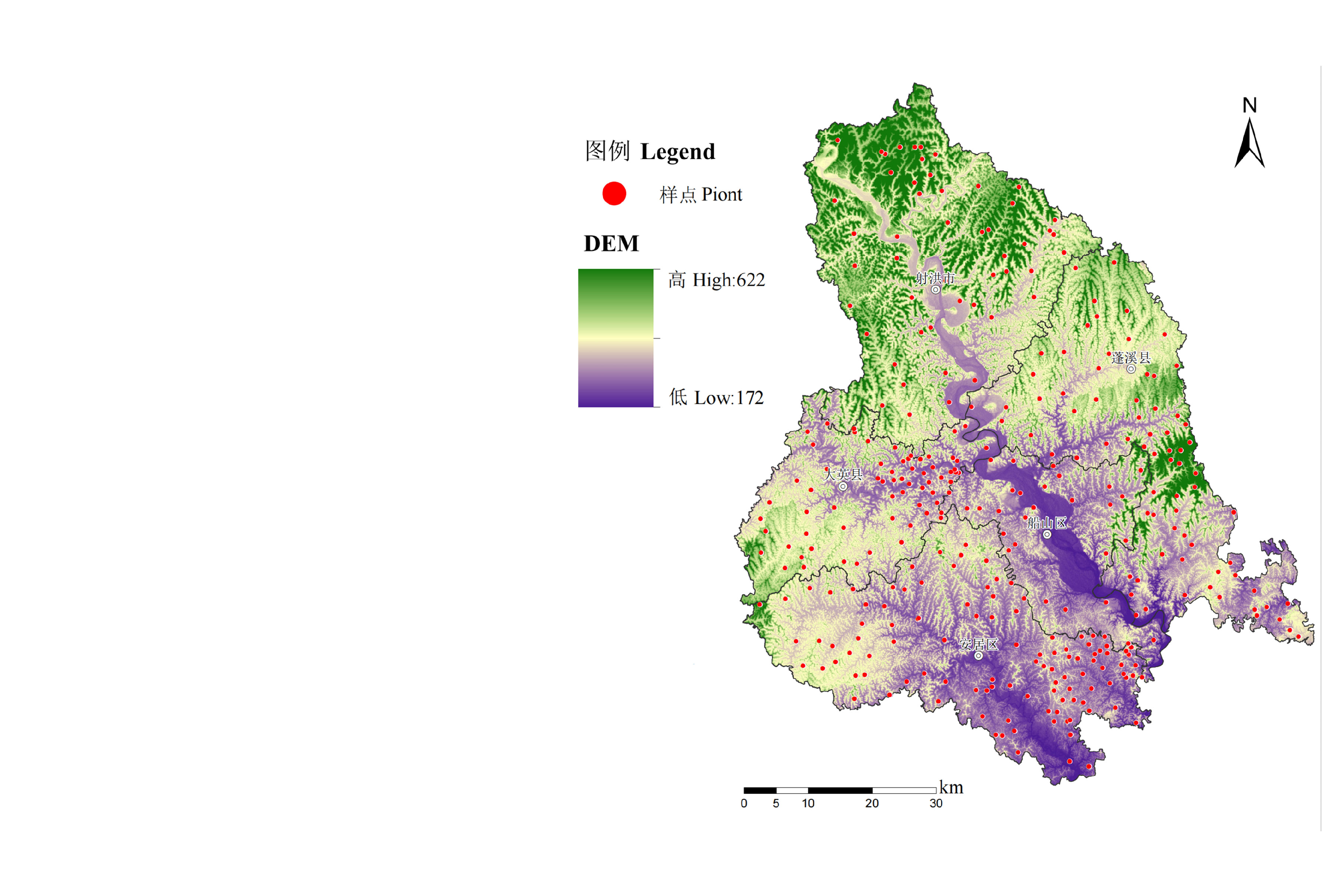
Fig. 1

Distribution of sample points in the study area"

Table 1

Data sources and descriptions of driving factors"

数据类别
Data category
数据名称
Data name
时间
Year
分辨率
Resolution (m)
数据来源
Data source
地形因子
Topographic factor
海拔高度DEM 30 OpenTopography_Copernicus GLO-30 Digital Elevation Model https://opentopography.s3.sdsc.edu/minio/raster/COP30/
坡度SLP 1986, 2009, 2019, 2023 30
山谷深度VD 30
植被指数
Vegetation index
归一化植被指数NDVI 30 中国陆地观测卫星(Landsat)(https://data.cresda.cn)计算分析得出
Calculated and analyzed by China Land Observation Satellite (Landsat) https://data.cresda.cn
叶面积指数LAI 30
增强植被指数EVI 30
土壤调解植被指数SAVI 30
地表水分指数LSWI 30
修正型归一化差异水体指数MNDWI 30
土壤增强指数SER1 30
土壤增强指数SER2 30
土壤增强指数SER3 30
气候因子
Climatic factor
年平均气温TEM 1000 中国1 km分辨率逐月平均气温数据集(1901—2023)
Monthly mean temperature dataset at 1km resolution for China (1901-2023) https://www.tpdc.ac.cn/zh-hans/data/71ab4677-b66c-4fd1-a004-b2a541c4d5bf/
年平均降水PRE 1000 中国1 km分辨率逐月降水量数据集(1901—2023)
Monthly precipitation dataset at 1 km resolution for China (1901 -2023) https://data.tpdc.ac.cn/zh-hans/data/faae7605-a0f2-4d18-b28f-5cee413766a2
社会因子
Social factor
人口数据POP 2000, 2010, 2015, 2020 1000 中国人口空间分布公里网格数据集 https://www.resdc.cn/DOI/DOI.aspx DOIID=32
China Population Spatial Distribution Kilometer Grid Dataset
距道路距离ROAD 1986, 2009, 2019, 2023 30 根据土地利用提取后,数据计算生成
After extraction based on land use, the data is computationally generated

Table 2

Carbon density of different land use types in Suining City (t·hm-2)"

土地利用类型
Land use/Land cover type
地上生物量碳密度
Aboveground biomass carbon density
地下生物量碳密度
Belowground biomass carbon density
土壤有机碳密度(校正)
Soil organic carbon
density
死亡有机质碳密度
Dead organic matter carbon density
耕地Cultivated land 4.02 0.75 91.33 2.11
林地Forest land 22.62 18.03 125.77 2.78
灌木Shrubland 8.67 4.05 84.78 0.87
草地Grassland 3.60 11.70 65.93 7.28
水域Water area 1.59 0.00 67.53 3.98
湿地Wetland 2.10 6.82 56.17 0.21
建设用地 Construction land 0.83 0.08 43.71 0.00
未利用地Unused land 0.59 0.64 28.42 0.96

Table 3

Land use transition matrix settings under different scenarios"

LUCC类型
LUCC type
自然发展情景
Natural development scenario
城市发展情景
Urban development scenario
生态优先情景
Ecological priority scenario
耕地保护情景
Farmland protection scenario
a b c d e f g h a b c d e f g h a b c d e f g h a b c d e f g h
a 1 1 1 1 1 1 1 1 1 1 1 1 1 1 1 1 1 1 1 1 1 1 1 1 1 0 0 0 0 0 0 0
b 1 1 1 1 1 1 1 1 0 1 0 0 0 0 0 0 1 1 0 1 1 1 0 0 1 1 1 1 1 1 1 1
c 1 1 1 1 1 1 1 1 0 0 1 0 0 0 0 0 0 0 1 0 0 0 0 0 1 0 1 0 0 0 1 0
d 1 1 1 1 1 1 1 1 1 1 1 1 1 1 1 0 0 0 0 1 1 1 0 1 1 1 1 1 1 1 1 1
e 1 1 1 1 1 1 1 1 1 1 1 1 1 1 1 0 0 0 0 1 1 1 0 1 1 1 1 1 1 1 1 1
f 1 1 1 1 1 1 1 1 1 1 1 1 1 1 1 0 0 0 0 1 1 1 0 1 1 1 1 1 1 1 1 1
g 1 1 1 1 1 1 1 1 1 0 1 0 0 1 1 0 1 0 1 1 1 1 1 0 1 1 1 1 1 1 1 1
h 1 1 1 1 1 1 1 1 1 1 1 1 1 1 1 1 1 1 1 1 1 1 1 1 1 1 1 1 1 1 1 1

Table 4

Land use/land cover (LUCC) area changes in Suining City from 1986 to 2023"

LUCC类型
LUCC type
1986-2009 2009-2019 2019-2023 1986-2023
面积
Area (hm2)
变幅
Variation (%)
面积
Area (hm2)
变幅
Variation (%)
面积
Area (hm2)
变幅
Variation (%)
面积
Area (hm2)
变幅
Variation (%)
草地Grassland -3575.30 -71.8 -104.82 -7.5 890.05 68.5 -2790.07 -56.0
耕地Cultivated land -27805.54 -7.9 -79926.70 -24.5 -1274.11 -0.5 -109006.34 -30.8
灌木Shrubland -5627.45 -97.3 26986.71 16949.3 -2026.81 -7.5 19332.46 334.1
建设用地Construction land 29327.39 91.9 5152.97 8.4 4728.70 7.1 39209.06 122.8
林地Forest land 21861.79 22.5 43985.20 37.0 -3479.77 -2.1 62367.22 64.2
湿地Wetlands -719.09 -16.0 -2567.37 -67.9 -337.21 -27.8 -3623.68 -80.5
水域Water area -7439.46 -27.2 6565.33 32.9 1495.62 5.6 621.49 2.3
未利用地Unused land -6022.35 -98.4 -91.32 -93.2 3.53 52.7 -6110.14 -99.8

Fig. 2

Land use maps of Suining City in 1986 (a), 2009 (b), 2019 (c), and 2023 (d)"

Fig. 3

Schematic diagram of the land use transition matrix"

Fig. 4

Spatial distribution of carbon density in Suining City in 1986, 2009, 2019, and 2023"

Table 5

Carbon storage in Suining City from 1986 to 2023"


Year
碳储量
Carbon stock
地上生物量碳
Above-ground biomass carbon
地下生物量碳
Below-ground biomass
carbon
土壤有机碳
Soil organic carbon
死亡有机质碳
Dead organic matter
carbon
含量
Quantity contained
(×105 t)
含量
Quantity contained
(×105 t)
占比
Percentage (%)
含量
Quantity contained
(×105 t)
占比
Percentage (%)
含量
Quantity contained
(×105 t)
占比
Percentage (%)
含量
Quantity contained
(×105 t)
占比
Percentage (%)
1986 561.64 37.74 6.7 21.37 3.8 490.78 87.4 11.75 2.1
2009 567.96 41.03 7.2 24.39 4.3 491.43 86.5 11.11 2.0
2019 595.73 50.19 8.4 32.63 5.5 501.78 84.2 11.13 1.9
2023 590.37 49.27 8.3 32.00 5.4 498.00 84.4 11.11 1.9

Table 6

Changes in carbon storage by land use type in Suining City from 1986 to 2023"

LUCC类型
LUCC type
1986-2009 2009-2019 2019-2023 1986-2023
变化量
Variation
(×105 t)
变幅
Variation
(%)
变化量
Variation
(×105 t)
变幅
Variation
(%)
变化量
Variation
(×105 t)
变幅
Variation
(%)
变化量
Variation
(×105 t)
变幅
Variation
(%)
草地Grassland -3.16 -71.8 -0.09 -7.5 0.79 68.5 -2.47 -56.0
耕地Cultivated land -27.31 -7.9 -78.50 -24.5 -1.25 -0.5 -107.06 -30.8
灌木Shrubland -5.54 -97.3 26.55 16949.3 -1.99 -7.5 19.02 334.1
建设用地Construction land 13.09 91.9 2.30 8.4 2.11 7.1 17.50 122.8
林地Grassland 36.99 22.5 74.42 37.0 -5.89 -2.1 105.53 64.2
湿地Wetland -0.47 -16.0 -1.68 -67.9 -0.22 -27.8 -2.37 -80.5
水域Water area -5.44 -27.2 4.80 32.9 1.09 5.6 0.45 2.3
未利用地Unused land -1.84 -98.4 -0.03 -93.2 0.00 52.7 -1.87 -99.8
合计Total 6.32 1.1 27.78 4.9 -5.36 -0.9 28.73 5.1

Table 7

Matrix of land use changes and carbon storage changes by land use type in Suining City from 1986 to 2023"

面积转移矩阵Area transfer matrix (hm2)
LUCC类型
LUCC type
草地
Grassland
耕地
Cultivated land
灌木
Shrubland
建设用地
Construction land
林地
Forest land
湿地
Wetland
水域
Water area
未利用地
Unused
land
转出
Transfer
out
草地Grassland 539.16 818.32 153.68 268.30 3121.70 7.50 71.25 0.08 4440.84
耕地Cultivated land 1020.77 226682.98 14749.15 37641.09 71907.59 34.72 2326.01 0.40 127679.73
灌木Shrubland 29.51 1398.53 2054.02 229.25 1978.68 0.00 96.67 0.00 3732.65
建设用地Construction land 39.47 4250.35 382.73 24603.99 2088.16 4.79 556.47 0.70 7322.68
林地Forest land 308.89 5028.28 7080.07 4606.49 79179.66 14.82 966.57 1.88 18007.00
湿地Wetland 41.60 1210.99 34.58 728.93 170.48 546.18 1766.84 0.03 3953.46
水域Water area 77.89 2438.18 140.71 1252.80 1038.97 267.95 22176.29 0.55 5217.04
未利用地Unused land 132.64 3528.74 524.19 1804.87 68.65 0.00 54.71 6.57 6113.79
转入Transfer in 1650.77 18673.39 23065.10 46531.74 80374.22 329.78 5838.54 3.65 /
碳储量转移矩阵 Carbon storage transfer matrix(×105 t)
LUCC类型
LUCC type
草地
Grassland
耕地
Cultivated land
灌木
Shrubland
建设用地
Construction land
林地
Forest land
湿地
Wetland
水域
Water area
未利用地
Unused
land
转出
Transfer
out
草地Grassland 0.00 -0.20 0.12 0.10 4.76 -0.02 0.00 -0.04 4.72
耕地Cultivated land 0.18 0.00 13.13 14.90 113.16 -0.77 -0.08 -1.08 139.44
灌木Shrubland -0.11 -13.11 0.00 -0.07 -8.63 -0.02 -0.03 -0.16 -22.13
建设用地Construction land -0.20 -32.79 0.15 0.00 -4.26 -0.47 -0.51 -0.55 -38.63
林地Forest land -2.49 -65.68 5.02 1.12 0.00 -0.10 -0.05 -0.02 -62.20
湿地Wetland 0.03 1.16 0.03 0.32 0.26 0.00 1.10 0.00 2.90
水域Water area 0.01 0.11 0.04 0.31 0.12 -0.98 0.00 -0.02 -0.41
未利用地Unused land 0.12 3.47 0.52 0.81 0.11 0.00 0.04 0.00 5.07
转入Transfer in -2.46 -107.04 19.01 17.49 105.52 -2.36 0.47 -1.87 /

Table 8

Detection results of driving factors for spatial variation of carbon storage in Suining City from 1986 to 2023"

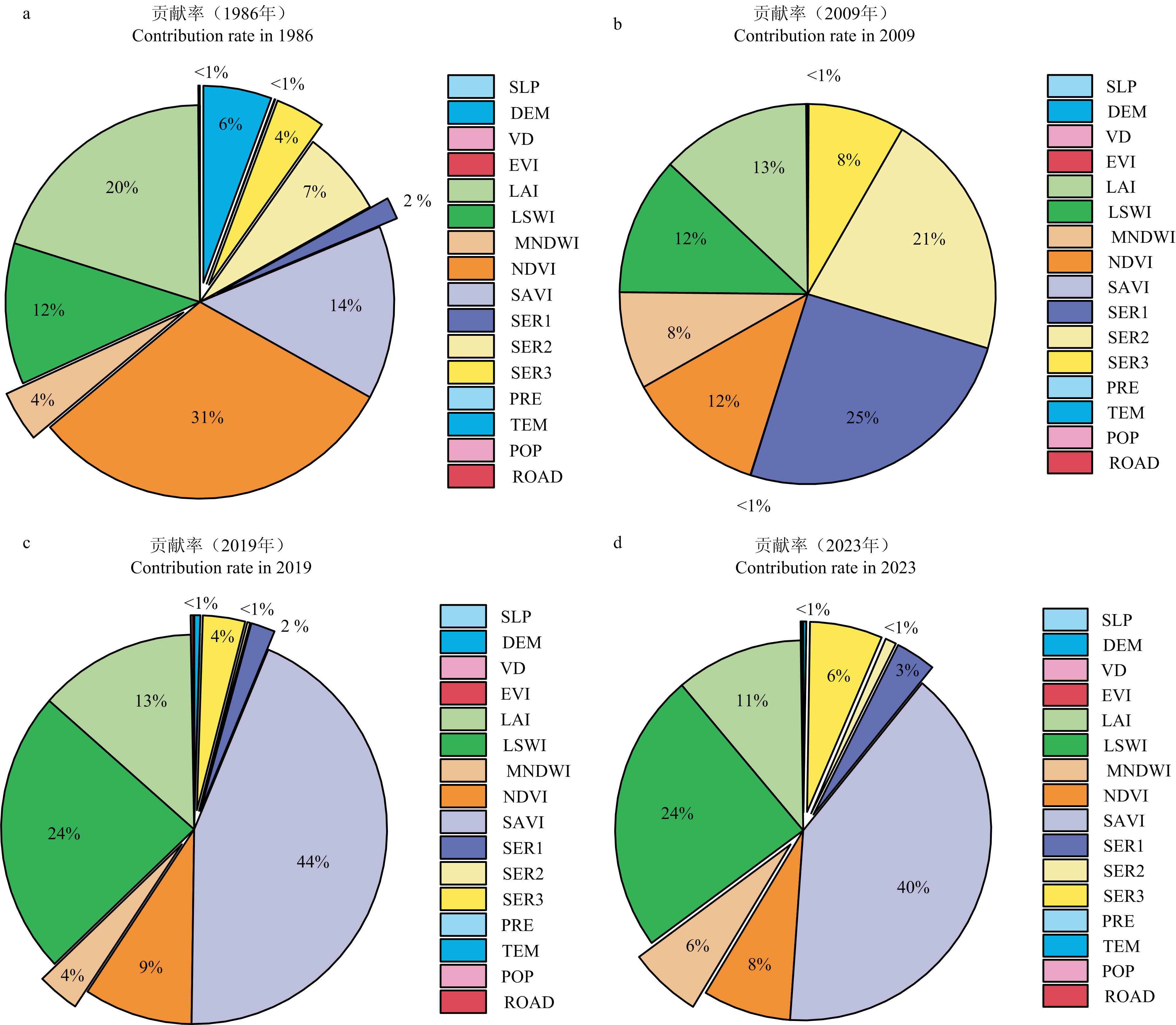
影响因素Influencing factor 驱动因子Driving factor 1986 2009 2019 2023
q β 贡献率Contribution rate (%) q β 贡献率Contribution rate (%) q β 贡献率Contribution rate (%) q β 贡献率Contribution rate (%)
气候因素Climate factors TEM 0.084 9.587 5.7 0.036 1.196 0.1 0.049 14.006 0.5 0.044 6 0.3
PRE 0.052 0.166 0.1 0.005 -0.323 0.0 0.003 -0.880 0.0 0.002 -1.898 0.0
生物因素Biological factors NDVI 0.026 -170.88 30.9 0.115 -53.449 11.9 0.291 -43.115 9.1 0.319 -24.641 7.6
LAI 0.055 51.946 20.0 0.147 45.162 12.9 0.390 46.716 13.2 0.399 28.523 11.0
EVI 0 0.002 0.0 0.064 0.025 0.0 0.120 -2.502 0.2 0.148 0.677 0.1
SAVI 0.035 57.120 14.3 0.070 0.195 0.1 0.143 -423.848 43.9 0.152 -275.299 40.2
地形因素Topographic factors DEM 0.107 0.173 0.1 0.089 0.106 0.0 0.097 0.182 0.0 0.124 0.084 0.0
SLP 0.003 0.024 0.0 0.076 0.682 0.1 0.118 0.454 0.0 0.202 0.517 0.1
VD 0.018 0.028 0.0 0.037 -0.071 0.0 0.075 0.083 0.0 0.096 -0.051 0.0
其他遥感因素Other remote sensing factors LSWI 0.015 -112.032 11.6 0.025 -245.289 11.8 0.128 253.776 23.6 0.147 168.803 23.9
MNDWI 0.02 29.83 4.2 0.030 -141.852 8.3 0.056 -86.220 3.5 0.098 -65.859 6.2
SER1 0.007 37.625 1.8 0.071 -182.486 25.3 0.241 -11.486 2.0 0.218 -16.479 3.5
SER2 0.024 -42.286 7.1 0.040 276.297 21.2 0.037 8.487 0.2 0.075 13.126 0.9
SER3 0.02 -29.83 4.1 0.030 141.852 8.3 0.056 86.220 3.5 0.098 65.859 6.2
社会经济因素Socio-economic factors POP 0.026 -0.001 0.0 0.028 -0.012 0.0 0.026 0.002 0.0 0.025 0.001 0.0
ROAD 0.034 0.002 0.0 0.011 0 0.0 0.018 -0.001 0.0 0.019 -0.001 0.0

Fig. 5

Schematic diagram of ridge regression analysis results for driving factors in 1986(a), 2009(b), 2019(c), and 2023(d)"

Fig. 6

Predicted land use types in 2035 under four scenarios: natural development, urban development, ecological priority, and farmland protection"

Table 9

Predicted land use/land cover types under four development scenarios in 2035"

LUCC类型
LUCC type
2023年基期年
The base year of 2023
2035年自然发展情景
Natural development scenario in 2035
2035年城镇发展情景
Urban development scenarios in 2035
2035年生态优先情景
Ecological priority scenario in 2035
2035年耕地保护情景
Farmland protection scenario in 2035
面积
Area
(hm2)
地类占比
Percentage of land types (%)
面积
Area
(hm2)
地类占比
Percentage of land types (%)
变幅
Amplitude variation (%)
面积
Area
(hm2)
地类占比
Percentage of land types (%)
变幅
Amplitude variation (%)
面积
Area
(hm2)
地类占比
Percentage of land types (%)
变幅
Amplitude variation (%)
面积
Area
(hm2)
地类占比
Percentage of land types (%)
变幅
Amplitude variation (%)
耕地Cultivated land 245356.37 46.1 240743.52 45.2 -1.9 239961.15 45.1 -2.2 237923.33 44.7 -3.0 273812.13 51.4 11.6
建设用地
Construction land
71135.72 13.4 84758.67 15.9 19.1 86100.21 16.2 21.0 72716.49 13.7 2.2 61056.54 11.5 -14.2
水域Water area 28014.83 5.3 29112.03 5.5 3.9 29797.83 5.6 6.4 28642.05 5.4 2.2 25280.28 4.8 -9.8
林地Forest land 159553.89 30.0 149852.79 28.2 -6.1 149553.36 28.1 -6.3 162717.52 30.6 2.0 149867.46 28.2 -6.1
灌木Shrubland 25119.12 4.7 24591.96 4.6 -2.2 23608.62 4.4 -6.1 26079.3 4.9 3.8 20949.39 3.9 -16.7
草地Grassland 2189.93 0.4 2745 0.5 25.7 2478.33 0.5 13.4 3719.61 0.7 69.9 841.23 0.2 -61.5
湿地Wetland 875.96 0.2 456.03 0.1 -48.0 760.41 0.1 -13.2 465.12 0.1 -46.9 456.48 0.1 -47.9
未利用地
Unused land
10.22 0.0 6.57 0.0 -37.6 6.66 0.0 -36.8 3.15 0.0 -69.2 3.06 0.0 -70.9

Table 10

Predicted carbon storage under four development scenarios in 2035"

LUCC类型
LUCC type
2023年基期年
The base year of 2023
2035年自然发展情景
Natural development scenario in 2035
2035年城镇发展情景
Urban development scenarios in 2035
2035年生态优先情景
Ecological priority scenario in 2035
2035年耕地保护情景
Farmland protection scenario in 2035
碳储量
Carbon stock
(×105 t)
碳储量
Carbon stock
(×105 t)
变幅
Amplitude variation (%)
碳储量
Carbon stock
(×105 t)
变幅
Amplitude variation (%)
碳储量
Carbon stock
(×105 t)
变幅
Amplitude variation (%)
碳储量
Carbon stock
(×105 t)
变幅
Amplitude variation (%)
耕地Cultivated land 240.96 236.43 -1.9 235.67 -2.2 233.66 -3.0 268.91 11.6
建设用地Construction land 31.74 37.82 19.2 38.42 21.0 32.45 2.2 27.24 -14.2
水域Water area 20.48 21.28 3.9 21.78 6.4 20.94 2.2 18.48 -9.8
林地Forest land 269.97 253.55 -6.1 253.04 -6.3 275.32 2.0 253.58 -6.1
灌木Shrubland 24.71 24.19 -2.1 23.22 -6.0 25.65 3.8 20.61 -16.6
草地Grassland 1.94 2.43 25.4 2.19 13.2 3.29 69.9 0.74 -61.6
湿地Wetland 0.57 0.30 -47.9 0.50 -13.2 0.30 -46.9 0.30 -47.9
未利用地Unused land 0.003 0.002 -35.7 0.002 -34.8 0.001 -69.2 0.001 -70.1
合计Total 590.37 576.01 -2.4 574.83 -2.6 591.62 0.2 589.86 -0.1

Fig. 7

Schematic map of carbon density distribution in Suining City under natural development, urban development, ecological priority, and farmland protection scenarios in 2035"

Table 11

Distribution of average carbon density per unit under four scenarios (t·hm-2)"

分区
Partition
2023基期年
The base year of
2023
自然发展情景
Natural development scenario
城镇发展情景
Urban development scenario
生态优先情景
Ecological priority scenario
耕地保护情景
Farmland protection scenario
北部低山带
The northern low mountain area
120.98 117.41 117.08 121.19 120.50
涪江冲积带Fujiang alluvial zone 80.75 78.99 78.67 81.80 81.15
琼江丘陵带Qiongjiang hilly belt 111.62 109.16 108.98 111.66 111.66
中心城郊带Central peri-urban belt 69.51 66.58 66.41 70.39 68.68
合计Total 110.92 108.22 108.00 111.15 110.82
[1]
FANG J Y, ZHU J L, WANG S P, YUE C, SHEN H H. Global warming, hhuman-induced carbon emissions, and their uncertainties. Science China Earth Sciences, 2011, 54(10): 1458-1468.

doi: 10.1007/s11430-011-4292-0
[2]
陈宁, 辛存林, 唐道斌, 张亮, 辛顺杰. 中国西北地区多情景土地利用优化与碳储量评估. 环境科学, 2023, 44(8): 4655-4665.
CHEN N, XIN C L, TANG D B, ZHANG L, XIN S J. Multi- scenario land use optimization and carbon storage assessment in northwest China. Environmental Science, 2023, 44(8): 4655-4665. (in Chinese)
[3]
FOLEY J A, PRENTICE I C, RAMANKUTTY N, LEVIS S, POLLARD D, SITCH S, HAXELTINE A. An integrated biosphere model of land surface processes, terrestrial carbon balance, and vegetation dynamics. Global Biogeochemical Cycles, 1996, 10(4): 603-628.

doi: 10.1029/96GB02692
[4]
司晓茜, 王小军, 林莹冰, 刘光旭. 福建省碳储量时空特征及其对土地利用变化的响应. 水土保持通报, 2023, 43(5): 355-364, 394.
SI X Q, WANG X J, LIN Y B, LIU G X. Spatiotemporal characteristics of carbon storage and its response to land use changes in Fujian Province. Bulletin of Soil and Water Conservation, 2023, 43(5): 355-364, 394. (in Chinese)
[5]
刘纪远, 于贵瑞, 王绍强, 岳天祥, 高志强. 陆地生态系统碳循环及其机理研究的地球信息科学方法初探. 地理研究, 2003, 22(4): 397-405.
LIU J Y, YU G R, WANG S Q, YUE T X, GAO Z Q. A method of geo-information science for studying carbon cycle and its mechanism of terrestrial ecosystems. Geographical Research, 2003, 22(4): 397-405. (in Chinese)
[6]
杜怀玉, 俞金凤, 张媛, 王家亮. 石羊河流域多情景土地利用优化及碳储量评估. 环境科学, 2024, 45(7): 4164-4176.
DU H Y, YU J F, ZHANG Y, WANG J L. Land use optimization and carbon reserve assessment in the Shiyang River Basin. Environmental Science, 2024, 45(7): 4164-4176. (in Chinese)
[7]
屈颂杰, 韩玲, 黄馨, 杨楠楠, 郭千慧子. 未来不同情景下陕西省碳储量的时空演变分析. 环境科学, 2024, 45(8): 4683-4695.
QU S J, HAN L, HUANG X, YANG N N, GUO Q. Analysis of the spatiotemporal evolution of carbon reserves in Shaanxi Province under different scenarios in the future. Environmental Science, 2024, 45(8): 4683-4695. (in Chinese)
[8]
YIN C B, ZENG S, LIU D. Carbon emission effects of land use structure changes and their driving factors: a case study of urban agglomeration in the middle reaches of the Yangtze River, China. Journal of Resources and Ecology, 2025, 16(1): 132-147.

doi: 10.5814/j.issn.1674-764x.2025.01.013
[9]
朴世龙, 何悦, 王旭辉, 陈发虎. 中国陆地生态系统碳汇估算: 方法、进展、展望. 中国科学: 地球科学, 2022, 52(6): 1010-1020.
PIAO S L, HE Y, WANG X H, CHEN F H. Carbon sequestration estimation of terrestrial ecosystem in China: Method, progress and prospect. Scientia Sinica (Terrae), 2022, 52(6): 1010-1020. (in Chinese)
[10]
薛玮, 徐丽君, 聂莹莹, 吴欣珈, 严翊丹, 叶立明, 柳新伟. 影响呼伦贝尔草原土壤有机碳空间变异的主导因素. 中国农业科学, 2024, 57(12): 2378-2389. doi: 10.3864/j.issn.0578-1752.2024.12.009.
XUE W, XU L J, NIE Y Y, WU X J, YAN Y D, YE L M, LIU X W. Study on dominant factors affecting spatial variation of soil organic carbon in Hulunbuir grassland. Scientia Agricultura Sinica, 2024, 57(12): 2378-2389. doi: 10.3864/j.issn.0578-1752.2024.12.009. (in Chinese)
[11]
李曼, 吴东丽, 何昊, 余慧婕, 赵琳, 刘聪, 胡正华, 李琪. 1990—2020年黄河流域碳储量时空演变及驱动因素研究. 生态环境学报, 2025, 34(3): 333-344.

doi: 10.16258/j.cnki.1674-5906.2025.03.001
LI M, WU D L, HE H, YU H J, ZHAO L, LIU C, HU Z H, LI Q. Spatio-temporal evolution and driving factors of carbon storage in the Yellow River Basin from 1990 to 2020. Ecology and Environmental Sciences, 2025, 34(3): 333-344. (in Chinese)
[12]
黄韬, 刘素红. 基于PLUS-InVEST模型的福建省土地利用变化与碳储量评估. 水土保持学报, 2024, 38(2): 246-257.
HUANG T, LIU S H. Evaluation of land use change and carbon storage in Fujian Province based on PLUS-InVEST model. Journal of Soil and Water Conservation, 2024, 38(2): 246-257. (in Chinese)

doi: 10.1080/00224561.1983.12436295
[13]
ZHU L Y, SONG R X, SUN S, LI Y, HU K. Land use/land cover change and its impact on ecosystem carbon storage in coastal areas of China from 1980 to 2050. Ecological Indicators, 2022, 142: 109178.

doi: 10.1016/j.ecolind.2022.109178
[14]
孙严超, 王伟业, 刘道垒, 蔡俊. 基于LUCC的河南省碳储量时空演变与驱动因素分析. 水土保持研究, 2025, 32(4): 266-278.
SUN Y C, WANG W Y, LIU D L, CAI J. Analysis of spatiotemporal evolution and driving factors of carbon storage in Henan Province based on LUCC. Research of Soil and Water Conservation, 2025, 32(4): 266-278. (in Chinese)
[15]
陈大蓉, 周旭, 杨胜天, 裴宇, 胡玉雪, 胡锋. 基于贵州省土地变化的碳储量演变及其脆弱性特征分析. 水土保持通报, 2023, 43(3): 301-309.
CHEN D R, ZHOU X, YANG S T, PEI Y, HU Y X, HU F. Analysis of carbon stock evolution and its vulnerability characteristics based on land use change in Guizhou Province. Bulletin of Soil and Water Conservation, 2023, 43(3): 301-309. (in Chinese)
[16]
王双, 赵晓, 周生辉. 未来多情景土地利用变化对河南省区域碳储量的影响. 环境科学, 2025, 46(6): 3830-3845.
WANG S, ZHAO X, ZHOU S H. Exploring the impact of future multi-scenario land use change on Henan Province regional carbon storage. Environmental Science, 2025, 46(6): 3830-3845. (in Chinese)
[17]
田梓祎, 高凡, 何兵, 韩方红. 1990—2020年塔里木河流域土地利用变化及其对碳储量的影响. 环境科学, 2024, 45(11): 6514-6526.
TIAN Z Y, GAO F, HE B, HAN F H. Land use change and its impact on carbon stock in the Tarim River Basin from 1990 to 2020. Environmental Science, 2024, 45(11): 6514-6526. (in Chinese)
[18]
傅楷翔, 贾国栋, 余新晓, 陈立欣. 耦合PLUS-InVEST-Geodector模型的新疆地区碳储量时空变化及驱动机制分析. 环境科学, 2024, 45(9): 5416-5430.
FU K X, JIA G D, YU X X, CHEN L X. Analysis of temporal and spatial carbon stock changes and driving mechanism in Xinjiang Region by coupled PLUS-InVEST-Geodector model. Environmental Science, 2024, 45(9): 5416-5430. (in Chinese)
[19]
XIE L, WANG H W, LIU S H. The ecosystem service values simulation and driving force analysis based on land use/land cover: A case study in inland rivers in arid areas of the Aksu River Basin, China. Ecological Indicators, 2022, 138: 108828.

doi: 10.1016/j.ecolind.2022.108828
[20]
陈红香, 辛存林, 陈宁, 马新淑, 白元, 康利刚, 辛顺杰. 基于PLUS-InVEST模型的川渝地区碳储量变化及多情景预测. 环境科学, 2026, 47(1): 360-371.
CHEN H X, XIN C L, CHEN N, MA X S, BAI Y, KANG L G, XIN S J. Carbon stock changes and multi-scenario prediction in the Sichuan-Chongqing region based on PLUS-InVEST modeling. Environmental Science, 2026, 47(1): 360-371. (in Chinese)
[21]
贾天朝, 胡西武. 基于PLUS-InVEST-Geodector模型的三江源国家公园碳储量时空变化及驱动力. 环境科学, 2024, 45(10): 5931-5942.
JIA T C, HU X W. Spatial-temporal change and driving force of carbon storage in three-river-source National Park based on PLUS- InVEST-Geodector model. Environmental Science, 2024, 45(10): 5931-5942. (in Chinese)
[22]
林彤, 杨木壮, 吴大放, 刘锋, 杨金海, 王颖佳. 基于InVEST- PLUS模型的碳储量空间关联性及预测: 以广东省为例. 中国环境科学, 2022, 42(10): 4827-4839.
LIN T, YANG M Z, WU D F, LIU F, YANG J H, WANG Y J. Spatial correlation and prediction of land use carbon storage based on the InVEST-PLUS model: A case study in Guangdong Province. China Environmental Science, 2022, 42(10): 4827-4839. (in Chinese)
[23]
蔡博峰, 朱松丽, 于胜民, 董红敏, 张称意, 王长科, 朱建华, 高庆先, 方双喜, 潘学标, 郑循华. 《IPCC 2006年国家温室气体清单指南2019修订版》解读. 环境工程, 2019, 37(8): 1-11.
CAI B F, ZHU S L, YU S M, DONG H M, ZHANG C Y, WANG C K, ZHU J H, GAO Q X, FANG S X, PAN X B, ZHENG X H. The interpretation of 2019 refinement to the 2006 IPCC guidelines for national greenhouse gas inventory. Environmental Engineering, 2019, 37(8): 1-11. (in Chinese)
[24]
DE PINTO A, LI M, HARUNA A, HYMAN G G, MARTINEZ M A L, CREAMER B, KWON H Y, GARCIA J B V, TAPASCO J, MARTINEZ J D. Low emission development strategies in agriculture. an agriculture, forestry, and other land uses (AFOLU) perspective. World Development, 2016, 87: 180-203.

doi: 10.1016/j.worlddev.2016.06.013
[25]
国务院第三次全国土壤普查领导小组办公室. 国务院第三次全国土壤普查领导小组办公室调研座谈第三次全国土壤普查技术规程规范验证情况. 中国农业综合开发, 2023(6): 62.
The Office of the Leading Group for the Third National Soil Survey in the State Council. The Office of the Leading Group for the Third National Soil Survey in the State Council conducted an investigation and discussion on the verification of the technical specifications of the third national soil survey. Agricultural Comprehensive Development in China, 2023(6): 62. (in Chinese)
[26]
于卓璇, 刘钺. 基于PLUS和InVEST模型的湘江流域碳储存时空演变及多情景预测. 农业资源与环境学报, 2026, 43(2): 355-365.
YU Z X, LIU Y. Spatial-temporal evolution and multi-scenario prediction of carbon storage in Xiangjiang river basin based on PLUS and InVEST models. Journal of Agricultural Resources and Environment, 2026, 43(2): 355-365. (in Chinese)
[27]
于晓燕, 商亚男, 魏光普, 张舒宇, 吴健. 基于PLUS-InVEST模型的国家级稀土矿区土地利用变化与碳储量预测研究. 沈阳农业大学学报, 2025, 56(6): 153-164.
YU X Y, SHANG Y N, WEI G P, ZHANG S Y, WU J. Land use change and prediction of carbon storage in national rare earth mining area based on PLUS-InVEST model. Journal of Shenyang Agricultural University, 2025, 56(6): 153-164. (in Chinese)
[28]
LIANG X, LIU X P, LI D, ZHAO H, CHEN G Z. Urban growth simulation by incorporating planning policies into a CA-based future land-use simulation model. International Journal of Geographical Information Science, 2018, 32(11): 2294-2316.

doi: 10.1080/13658816.2018.1502441
[29]
LIANG X, GUAN Q F, CLARKE K C, LIU S S, WANG B Y, YAO Y. Understanding the drivers of sustainable land expansion using a patch-generating land use simulation (PLUS) model: A case study in Wuhan, China. Computers, Environment and Urban Systems, 2021, 85: 101569.

doi: 10.1016/j.compenvurbsys.2020.101569
[30]
POURMOHAMMADI P, STRAGER M P, DOUGHERTY M J, ADJEROH D A. Analysis of land development drivers using geographically weighted ridge regression. Remote Sensing, 2021, 13(7): 1307.

doi: 10.3390/rs13071307
[31]
马玉洁, 李旭, 翟英芳, 李敬宇, 付鑫, 彭正萍. 秸秆还田方式和施氮量对土壤有机碳组分及酶活性的影响. 中国农业科学, 2025, 58(12): 2397-2410. doi: 10.3864/j.issn.0578-1752.2025.12.010.
MA Y J, LI X, ZHAI Y F, LI J Y, FU X, PENG Z P. Effects of straw returning methods and nitrogen application rates on soil organic carbon components and enzyme activity. Scientia Agricultura Sinica, 2025, 58(12): 2397-2410. doi: 10.3864/j.issn.0578-1752.2025.12.010. (in Chinese)
[1] GUO RongBo, LI GuoDong, PAN MengYu, ZHENG XianFeng, WANG ZhaoHui, HE Gang. Effects of Long-Term Straw Return and Nitrogen Application Rate on Organic Carbon Storage, Components and Aggregates in Cultivated Layers [J]. Scientia Agricultura Sinica, 2023, 56(20): 4035-4048.
[2] XIN XiaoPing,DING Lei,CHENG Wei,ZHU XiaoYu,CHEN BaoRui,LIU ZhongLing,HE GuangLi,QING GeLe,YANG GuiXia,TANG HuaJun. Biomass Carbon Storage and Its Effect Factors in Steppe and Agro-Pastoral Ecotones in Northern China [J]. Scientia Agricultura Sinica, 2020, 53(13): 2757-2768.
[3] WANG MingLei,SHI WenJiao. Spatial-Temporal Changes of Newly Cultivated Land in Northern China and Its Zoning Based on Driving Factors [J]. Scientia Agricultura Sinica, 2020, 53(12): 2435-2449.
[4] SA Ru-La-1, LI Jin-Xiang-2, HOU Xiang-Yang-1. Research on Soil Organic Carbon Storage Distribution in the Grassland Ecosystem [J]. Scientia Agricultura Sinica, 2013, 46(17): 3604-3614.
[5] . Profile Distribution and Storage of Soil Organic Carbon in an Aquic Brown Soil as Affected by Land Use [J]. Scientia Agricultura Sinica, 2005, 38(03): 544-550 .
Viewed
Full text


Abstract

Cited

  Shared   
  Discussed   
No Suggested Reading articles found!