Scientia Agricultura Sinica ›› 2026, Vol. 59 ›› Issue (5): 985-995.doi: 10.3864/j.issn.0578-1752.2026.05.005

• TILLAGE & CULTIVATION·PHYSIOLOGY & BIOCHEMISTRY·AGRICULTURE INFORMATION TECHNOLOGY • Previous Articles     Next Articles

Multi-Model Elucidating of Nutritional Quality Contributions to Maize Kernel Test Weight and Regional Heterogeneity

DONG JinLong1,2(), ZHAO Ying2, YU HaiBing1, LÜ JianYe2, QIN JiaQi2, LIANG Chen2, MING Bo2, LI ShaoKun1,2()   

  1. 1 Anhui Science and Technology University, Fengyang 233100, Anhui
    2 Institute of Crop Sciences, Chinese Academy of Agricultural Sciences/State Key Laboratory of Crop Gene Resources and Breeding, Beijing 100081
  • Received:2025-07-21 Accepted:2026-02-02 Online:2026-03-01 Published:2026-03-06
  • Contact: LI ShaoKun

Abstract:

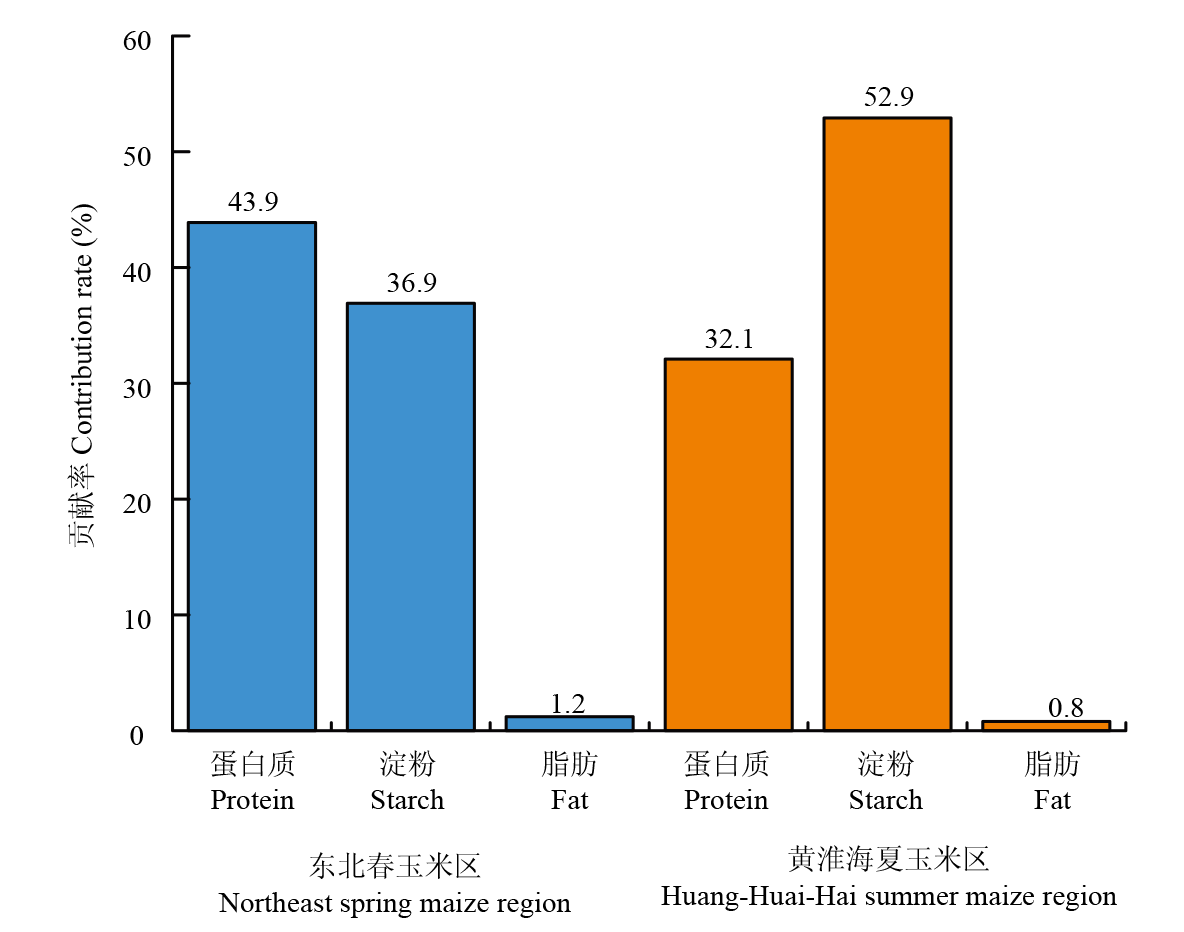
【Objective】 This study systematically quantified the contribution rates and spatial heterogeneity of protein, starch, and fat—the three major nutritional components—to maize kernel test weight formation, and elucidated how genetic background, ecological region, and cultivation density interactively modulate both nutritional quality and test weight. The findings aim to establish a science-based foundation for region-specific optimization of maize quality and to advance an integrated “high-yield-high-quality- high-efficiency” production paradigm.【Method】 A nationwide field survey was conducted across four major maize-producing regions in China, encompassing 718 representative kernel samples from 77 leading cultivars grown under 24 distinct planting density gradients (37 500-127 500 plants/hm2). All samples were naturally air-dried to standardized moisture content (14% w.b.) prior to uniform physicochemical analysis. Protein, starch, and fat contents were determined using calibrated near-infrared reflectance spectroscopy (NIRS), and test weight was measured with a certified grain test weight instrument (ISO 7971-3 compliant). To dissect the complex determinants of test weight, we implemented a hierarchical analytical framework integrating: (i) multiple linear regression to estimate independent linear effects; (ii) random forest modeling to capture nonlinear interactions and relative feature importance; and (iii) structural equation modeling (SEM) to infer directional causal pathways among traits. Three-way ANOVA was further employed to assess the main and interactive effects of cultivar, ecological region, and cultivation density on test weight and each nutritional component.【Result】 Protein (β=8.406, P<0.001) and starch (β=6.413, P<0.001) emerged as statistically robust and biologically dominant drivers of test weight, accounting for 28% and 45% of the total explained variance in the random forest model, respectively—both exhibiting high path coefficient stability in SEM (standardized coefficients ≥0.72, P<0.001). In contrast, fat showed negligible explanatory power (2%), and its effect failed to reach statistical significance (P=0.09). Three-way ANOVA confirmed highly significant (P<0.001) main effects and two- and three-way interactions among cultivar, ecological region, and density for test weight, protein, and starch—indicating strong contextual dependency. Spatially, protein contributed most strongly in the Northeast spring maize region (43.9% of model variance), whereas starch dominated in the Huang-Huai-Hai summer maize region (52.9%). Critically, the synergistic contribution of protein and starch jointly explained 81.0% and 85.0% of the total model variance in these two regions, respectively. Structural equation modeling revealed a direct positive effect of protein on test weight, but an indirect negative effect stemming from the compensatory relationship between protein and starch accumulation, which underscores the physiological trade-off in kernel sink-filling.【Conclusion】 Maize test weight formation was a biologically synergistic process driven by protein and starch, with fat playing no substantial role. Significant interactions existed among cultivar, ecological region, and density, with the same cultivar exhibiting distinct regulatory pathways under different ecological and cultivation conditions. Consequently, the Northeast region should prioritize high-protein cultivar selection and precise nitrogen management, while the Huang-Huai-Hai region should enhance carbon assimilation efficiency and regulate key starch-synthesis enzymes. All production areas should achieve a precise "cultivar-region-practice" matching strategy to synergistically improve maize yield and quality.

Key words: maize, nutritional quality, kernel test weight, regional heterogeneity, multi-model analysis

Table 1

Overview of national maize sampling sites"

玉米产区
Maize production region
省份
Province
样品数量
Number of samples
取样地区
Sampling region
播种密度
Sowing density (plants/hm2)
黄淮海夏玉米区
Huang-Huai-Hai summer maize region
安徽
Anhui
34 阜阳Fuyang(17)、宿州Suzhou(7)、淮北Huaibei(3)、亳州Bozhou(4)、蚌埠Bengbu(3) 82500、85500、90000、97500、105000
河北
Hebei
34 石家庄Shijiazhuang(25)、邯郸Handan(4)、邢台Xingtai(5) 60000、67500、75000、82500
河南
Henan
47 焦作Jiaozuo(4)、商丘Shangqiu(4)、许昌Xuchang(4)、驻马店Zhumadian(3)、开封Kaifeng(4)、新乡Xinxiang(4)、三门峡Sanmenxia(3)、安阳Anyang(3)、鹤壁Hebi(2)、平顶山Pingdingshan(5)、周口Zhoukou(8)、洛阳Luoyang(3) 66000、67500、75000、82500、90000、105000
江苏
Jiangsu
17 盐城Yancheng(5)、徐州Xuzhou(8)、连云港Lianyungang(4) 55500、64500、67500、75000、82500、90000
山东
Shandong
108 青岛Qingdao(10)、烟台Yantai(10)、潍坊Weifang(10)、济宁Jining(22)、枣庄Zaozhuang(5)、菏泽Heze(5)、聊城Liaocheng(21)、德州Dezhou(20)、淄博Zibo(5) 63000、67500、72000、75000、82500、85500、87000、90000、93000、97500
陕西
Shaanxi
50 榆林Yulin(25)、西安Xi'an(6)、渭南Weinan(6)、宝鸡Baoji(7)、咸阳Xianyang(6) 63000、67500、72000、75000、82500、87000、90000
西北春玉米区
Northwest spring maize region
甘肃Gansu 15 平凉Pingliang(10)、白银Baiyin(5) 60000、64500、67500、75000
内蒙古
Inner Mongolia
16 呼和浩特Hohhot(5)、巴彦淖尔Bayannur(5)、包头Baotou(3)、鄂尔多斯Ordos(3) 67500、75000、82500、85500
新疆Xinjiang 15 昌吉Changji(5)、博乐Bole(5)、乌鲁木齐Urumqi(5) 112500、120000、127500
山西Shanxi 22 长治Changzhi(18)、晋城Jincheng(4) 67500、75000
西南夏玉米区
Southwest summer maize region
广西
Guangxi
20 崇左Chongzuo(5)、南宁Nanning(5)、贵港Guigang(4)、河池Hechi(4)、百色Baise(2) 42000、45000、52500
湖北Hubei 16 恩施Enshi(12)、宜昌Yichang(4) 37500、40500、45000、75000
四川Sichuan 10 绵阳Mianyang(5)、德阳Deyang(5) 52500、57000、63000、90000
东北春玉米区
Northeast spring maize region
黑龙江
Heilongjiang
162 黑河Heihe(37)、齐齐哈尔Qiqihar(44)、鹤岗Hegang(2)、双鸭山Shuangyashan(6)、绥化Suihua(19)、伊春Yichun(6)、哈尔滨Harbin(8)、佳木斯Jiamusi(8)、大庆Daqing(32) 60000、67500、75000、82500、90000、97500、105000
吉林
Jilin
69 长春Changchun(4)、四平Siping(2)、白城Baicheng(8)、松原Songyuan(12)、吉林Jilin(40)、敦化Dunhua(3) 52500、55500、60000、67500、72000、75000、82500、90000
内蒙古
Inner Mongolia
29 通辽Tongliao(14)、赤峰Chifeng(15) 60000、72000、75000、82500、90000、97500、112500
辽宁
Liaoning
60 大连Dalian(5)、丹东Dandong(7)、营口Yingkou(5)、阜新Fuxin(22)、沈阳Shenyang(10)、铁岭Tieling(11) 60000、67500、75000、82500、97500

Table 2

Key indicators of the four major maize production regions"

产区
Region
蛋白质
Protein
(%)
脂肪
Fat
(%)
淀粉
Starch
(%)
容重
Test weight
(g·L-1)
平均种植密度
Average planting density (plants/hm2)
东北春玉米区 Northeast spring maize 10.08±0.83a 3.80±0.43c 74.37±1.13b 775.06±25.98a 77944
西北春玉米区 Northwest spring maize 9.17±0.84b 3.98±0.34b 74.55±0.85a 771.23±22.69a 83077
西南夏玉米区 Southwest summer maize 9.66±0.84ab 4.80±0.39a 73.68±0.78c 756.27±23.64c 54545
黄淮海夏玉米区 Huang-Huai-Hai summer maize 9.35±0.81b 3.97±0.69b 75.43±3.82a 769.42±22.36b 79382

Table 3

Multiple linear regression coefficients for national maize"

变量
Variables
非标准化回归系数
β (Coefficient)
标准化回归系数
β (Standardized)
标准误
SE
t值
t value
P
P value
95%置信区间
95% CI
蛋白质Protein 6.41 0.33 1.61 3.99 P<0.001 3.25-9.57
脂肪Fat 5.93 0.12 3.51 1.69 P =0.09 -0.95-12.81
淀粉Starch 8.41 0.31 2.22 3.78 P<0.001 4.06-12.76

Fig. 1

Path diagram of the structural equation model (SEM) A: Path diagram of structural equation model for nationwide maize; B: Path diagram of structural equation model for spring maize in northeast region; C: Path diagram of structural equation model for summer maize in Huang-Huai-Hai region"

Table 4

Statistical test results of structural equation modeling path coefficients for nationwide maize"

路径关系
Pathway relationship
非标准化系数
Unstandardized coefficient
标准化系数
Standardized coefficient
标准误
SE
t值
t value
P
P value
蛋白质→容重 Protein→test weight 8.41 0.62 1.40 6.02 P<0.001
淀粉→容重 Starch→test weigh 6.41 0.54 1.09 5.87 P<0.001
蛋白质→淀粉 Protein→starch -0.10 -0.18 0.05 -2.11 P=0.035

Table 5

Parameter optimization for the national maize test weight model"

参数组合
Parameter combination
决定系数
R2
均方根误差
RMSE (g·L-1)
平均绝对误差
MAE (g·L-1)
调整后决定系数Adjusted R2 性能变化
Performance change
ntree=500, mtry=1, max_depth=6 0.589 7.128 5.812 0.587 欠拟合Underfitting
ntree=500, mtry=1, max_depth=8 0.604 6.981 5.642 0.602 优化中Optimizing
ntree=500, mtry=1, max_depth=10 0.597 7.051 5.735 0.595 基准模型Benchmark
ntree=800, mtry=1, max_depth=6 0.633 6.712 5.423 0.631 -
ntree=800, mtry=1, max_depth=8 0.648 6.573 5.281 0.646 +8.5%▲
ntree=800, mtry=1, max_depth=10 0.642 6.650 5.432 0.640 区域最佳候选Regional best candidate
ntree=1100, mtry=1, max_depth=6 0.638 6.682 5.301 0.636 -
ntree=1100, mtry=1, max_depth=8 0.659 6.501 5.152 0.657 +10.4%▲
ntree=1100, mtry=1, max_depth=10 0.645 6.619 5.231 0.643 全国最优模型National optimal

Table 6

Comparison of standardized values for nutritional component contributions across three models"

模型类型 Model type 淀粉贡献 Starch contribution 蛋白质贡献 Protein contribution 脂肪贡献 Fat contribution
多元线性回归 Multiple linear regression 0.31 0.33 0.12
随机森林模型 Random forest model 0.45 0.28 0.02
结构方程模型 Structural equation model 0.64 0.84 0.03

Fig. 2

Comparison of variables in random forest models of corn nutritional quality for two major maize production regions"

Table 7

Multiple linear regression coefficients for two major maize production regions"

玉米产区
Maize production region
变量
Variables
非标准化回归系数
β (Coefficient)
标准化回归系数
β (Standardized)
标准误
SE
t值
t value
P
P value
95%置信区间
95% CI
黄淮海夏玉米区
Huang-Huai-Hai summer maize region
蛋白质Protein 12.67 0.19 6.41 1.98 0.05 0.11-25.23
脂肪Fat 1.60 0.02 6.52 0.25 0.81 -11.18-14.38
淀粉Starch 8.92 0.26 3.36 2.66 0.01 2.33-15.51
东北春玉米区
Northeast spring maize region
蛋白质Protein 18.85 0.44 3.21 5.87 0.00 12.56-25.14
脂肪Fat 6.31 0.08 4.95 1.27 0.20 -3.38-16.00
淀粉Starch 11.36 0.37 2.35 4.82 0.00 6.75-15.97

Table 8

Three-way ANOVA results for the effects of variety, region and planting density on kernel test weight and nutritional qualities"

分析因素
Analysis of factors
容重 Test weight 蛋白质 Protein 淀粉 Starch
F值 F value PP value F值 F value
品种 Variety 38.2 P<0.001 35.6
区域 Region 42.5 P<0.001 28.9
密度 Density 6.9 P<0.05 3.2
品种×区域 Variety×region 15.3 P<0.001 12.8
品种×密度 Variety×density 3.1 P<0.05 2.8
区域×密度 Region×density 7.2 P<0.01 5.6
品种×区域×密度 Variety×region×density 4.2 P<0.05 3.3
[1]
李少昆, 王崇桃. 中国玉米生产技术的演变与发展. 中国农业科学, 2009, 42(6): 1941-1951. doi:10.3864/j.issn.0578-1752.2009.06.009.
LI S K, WANG C T. Evolution and development of maize production techniques in China. Scientia Agricultura Sinica, 2009, 42(6): 1941-1951. doi:10.3864/j.issn.0578-1752.2009.06.009. (in Chinese)
[2]
赵久然, 王荣焕. 中国玉米生产发展历程、存在问题及对策. 中国农业科技导报, 2013, 15(3): 1-6.
ZHAO J R, WANG R H. Development process, problem and countermeasure of maize production in China. Journal of Agricultural Science and Technology, 2013, 15(3): 1-6. (in Chinese)

doi: 10.3969/j.issn.1008-0864.2013.03.01
[3]
刘劼武, 冯锡仲. 国内外玉米标准的分析探讨. 粮食储藏, 2010, 39(4): 55-56.
LIU J W, FENG X Z. Analysis and discussion on corn standards at home and abroad. Grain Storage, 2010, 39(4): 55-56. (in Chinese)
[4]
李依依, 田汉钊, 朱良佳, 刘美, 赵永锋. 玉米粒重杂交当代杂种优势分析. 种子, 2020, 39(4): 22-28.
LI Y Y, TIAN H Z, ZHU L J, LIU M, ZHAO Y F. Heterosis analysis within contemporary maize based on hybridization of grain weight. Seed, 2020, 39(4): 22-28. (in Chinese)
[5]
刘松柏, 谭会泽, 魏师, 赵江涛, 彭运智, 尹玉港, 陈永均. 玉米容重差异形成机制及其营养价值探析. 饲料工业, 2014, 35(19): 62-64.
LIU S B, TAN H Z, WEI S, ZHAO J T, PENG Y Z, YIN Y G, CHEN Y J. Discussion on the formation mechanism of corn test weight and its nutritional value. Feed Industry, 2014, 35(19): 62-64. (in Chinese)
[6]
LÓPEZ-MONTAÑEZ R, CALERO-RIOS E, QUISPE K, HUASASQUICHE L, LASTRA S, LA TORRE B, SOLÓRZANO R. Synergy between microbial inoculants and mineral fertilization to enhance the yield and nutritional quality of maize on the Peruvian coast. Applied Microbiology, 2024, 4(4): 1757-1775.

doi: 10.3390/applmicrobiol4040118
[7]
王晓燕, 高荣岐, 董树亭. 玉米胚乳发育研究进展. 中国农学通报, 2005, 21(6): 107-109.
WANG X Y, GAO R Q, DONG S T. Study progress in development of endosperm in maize. Chinese Agricultural Science Bulletin, 2005, 21(6): 107-109. (in Chinese)

doi: 10.11924/j.issn.1000-6850.0506107
[8]
BEI J L, WANG J Q, ZHANG H Y. An optimization method for corn planting parameters based on mutation breeding sea horse optimization algorithm. Computers and Electronics in Agriculture, 2025, 236: 110417.

doi: 10.1016/j.compag.2025.110417
[9]
REN R C, JIANG X, ZHENG G M, ZHAO Y J, LI J, ZHANG X S, ZHAO X Y. ZmADT2 regulates maize kernel development via the auxin signaling pathway. The Crop Journal, 2025, 13(1): 181-191.

doi: 10.1016/j.cj.2024.12.002
[10]
GLAHN R, TAKO E, GORE M A. The germ fraction inhibits iron bioavailability of maize: Identification of an approach to enhance maize nutritional quality via processing and breeding. Nutrients, 2019, 11(4): 833.
[11]
ZHANG Z Y, ZHENG X X, YANG J, MESSING J, WU Y R. Maize endosperm-specific transcription factors O2 and PBF network the regulation of protein and starch synthesis. PNAS, 2016, 113(39): 10842-10847.

doi: 10.1073/pnas.1613721113
[12]
薛民杰, 李永胜, 张乃建, 唐开梁, 白俊飞, 司武剑, 周恺琳. 水分对玉米容重的影响. 粮食储藏, 2016, 45(6): 36-38.
XUE M J, LI Y S, ZHANG N J, TANG K L, BAI J F, SI W J, ZHOU K L. The influence of moisture to the corn volume weight. Grain Storage, 2016, 45(6): 36-38. (in Chinese)
[13]
车海先, 李海玉. 玉米容重影响因素浅析. 粮食与食品工业, 2011, 18(1): 56-58, 61.
CHE H X, LI H Y. Analysis of influencing factors on maize test weight. Cereal and Food Industry, 2011, 18(1): 56-58, 61. (in Chinese)
[14]
SHAO Y, SUN J Q. Decoding the complexity of autophagy in maize endosperm development: Insights from a multi-omics approach. Plant Physiology, 2023, 193(2): 875-876.

doi: 10.1093/plphys/kiad410 pmid: 37440713
[15]
BI M W, CHEN H F, ZUO M. Comprehensive quality grading and dynamic prediction of physicochemical indicators of maize during storage based on clustering and time-series prediction models. Journal of Cereal Science, 2025, 123: 104187.

doi: 10.1016/j.jcs.2025.104187
[16]
杨张钰, 陈小央, 李燕, 李欣泽, 白康杰, 骆遥, 赵光武, 施俊生, 韩庆辉. 517份玉米种质容重与其他品质性状相关性分析及候选基因挖掘. 浙江农林大学学报, 2024, 41(4): 669-678.
YANG Z Y, CHEN X Y, LI Y, LI X Z, BAI K J, LUO Y, ZHAO G W, SHI J S, HAN Q H. Correlation analysis of test weight and other quality traits and candidate gene mining in 517 maize germplasms. Journal of Zhejiang A & F University, 2024, 41(4): 669-678. (in Chinese)
[17]
张丽, 董树亭, 刘存辉, 王空军, 张吉旺, 刘鹏. 玉米籽粒容重与产量和品质的相关分析. 中国农业科学, 2007, 40(2): 405-411.
ZHANG L, DONG S T, LIU C H, WANG K J, ZHANG J W, LIU P. Correlation analysis on maize test weight, yield and quality. Scientia Agricultura Sinica, 2007, 40(2): 405-411. (in Chinese)
[18]
张静, 王彩红, 赵永锋, 祝丽英, 黄亚群, 郭晋杰, 陈景堂. 玉米种质资源子粒容重和品质性状差异性分析. 植物遗传资源学报, 2016, 17(5): 832-839.

doi: 10.13430/j.cnki.jpgr.2016.05.006
ZHANG J, WANG C H, ZHAO Y F, ZHU L Y, HUANG Y Q, GUO J J, CHEN J T. Difference analysis of kernel test weight and nutritional quality traits in maize (Zea mays L.) germplasm resources. Journal of Plant Genetic Resources, 2016, 17(5): 832-839. (in Chinese)
[19]
郭益洋, 郭书磊, 张君, 史喜飞, 赵海军, 陈盛, 韩赞平. 429份玉米种质籽粒物理及品质性状综合评价. 干旱地区农业研究, 2024, 42(5): 25-33.
GUO Y Y, GUO S L, ZHANG J, SHI X F, ZHAO H J, CHEN S, HAN Z P. Identification and comprehensive evaluation of seed physical and quality traits of 429 maize germplasms. Agricultural Research in the Arid Areas, 2024, 42(5): 25-33. (in Chinese)
[20]
常莉, 钱承敬, 史晓梅, 张巍巍, 高曼, 吕朝政, 罗云敬, 翟晨. 基于近红外光谱技术的主产区玉米品质分析. 中国粮油学报, 2024, 39(6): 36-42.
CHANG L, QIAN C J, SHI X M, ZHANG W W, GAO M, C Z, LUO Y J, ZHAI C. Corn quality analysis based on near infrared spectroscopy in main producing areas. Journal of the Chinese Cereals and Oils Association, 2024, 39(6): 36-42. (in Chinese)
[21]
KOIMBORI J K, WANG S, PAN J, GUO L P, LI K. Yield response of spring maize under future climate and the effects of adaptation measures in Northeast China. Plants, 2022, 11(13): 1634.
[22]
杨加豹, 陈瑾. 玉米淀粉渣: 猪饲料中玉米、豆粕的优选替代原料. 四川畜牧兽医, 2024, 51(2): 2-4.
YANG J B, CHEN J. Corn starch residue: a preferred substitute for corn and soybean meal in pig feed. Sichuan Animal & Veterinary Sciences, 2024, 51(2): 2-4. (in Chinese)
[23]
赵秀兰, 吕厚荃. 近60年黄淮海夏玉米光温水资源适宜度及灾害风险演变特征. 干旱地区农业研究, 2025, 43(3): 210-219, 232.
ZHAO X L, H Q. Evolution of light, temperature, and water resource suitability and disaster risks for summer maize in the Huang-Huai-Hai region over the past 60 years. Agricultural Research in the Arid Areas, 2025, 43(3): 210-219, 232. (in Chinese)
[24]
宋洋. 玉米多元深加工关键技术创新与高附加值产品开发研究. 中外食品工业, 2025(4): 4-6.
SONG Y. Research on key technology innovation and high value- added product development of corn multi-element deep processing. Global Food Industry, 2025(4): 4-6. (in Chinese)
[25]
褚超, 雷俊, 阳仁贵, 齐月, 李强, 杨庆怡, 姚玉璧, 施磊. 西北干旱区气候变化对灌溉春玉米生产的影响. 中国农业气象, 2024, 45(7): 745-755.
CHU C, LEI J, YANG R G, QI Y, LI Q, YANG Q Y, YAO Y B, SHI L. Climate change impact on the growth period and yield of irrigation spring maize in arid region of northwest China. Chinese Journal of Agrometeorology, 2024, 45(7): 745-755. (in Chinese)

doi: 10.3969/j.issn.1000-6362.2024.07.005
[26]
MA P, ZHANG H, SHUI H X, ZHANG X C, WANG X Q, GAO S B, ZHANG H Y, NIE Z, QING C Y, LU T Q, et al. Unveiling the heterosis pattern of modern maize breeding in Southwest China through population structure and genetic diversity analysis. BMC Plant Biology, 2025, 25(1): 477.
[27]
陈传永, 赵久然, 吴珊珊, 张春原, 毛振武, 杨海涛, 李瑞媛, 王元东. 黄淮海夏玉米区南北部产量及相关性状差异分析. 耕作与栽培, 2022, 42(5): 42-46.
CHEN C Y, ZHAO J R, WU S S, ZHANG C Y, MAO Z W, YANG H T, LI R Y, WANG Y D. Analysis on yield difference between south and north of Huanghuaihai summer maize region. Tillage and Cultivation, 2022, 42(5): 42-46. (in Chinese)
[28]
高翔, 周先林, 杨惠, 周新明, 张席军, 相富超. 不同玉米品种(系)在东北早熟春播区丰产、稳产及适应性分析. 中国农学通报, 2020, 36(24): 7-13.

doi: 10.11924/j.issn.1000-6850.casb20190700478
GAO X, ZHOU X L, YANG H, ZHOU X M, ZHANG X J, XIANG F C. Spring maize varieties (strains) in early-maturing zone in Northeast China: analysis of high-yield, stability and adaptability. Chinese Agricultural Science Bulletin, 2020, 36(24): 7-13. (in Chinese)

doi: 10.11924/j.issn.1000-6850.casb20190700478
[29]
何革命. 黄淮海地区夏玉米新品种考察研究与利用. 种子科技, 2025, 43(17): 69-71.
HE G M. Investigation and utilization of new summer maize varieties in Huang-Huai-Hai Region. Seed Science & Technology, 2025, 43(17): 69-71. (in Chinese)
[30]
奉杰, 刘鹏飞, 涂亮, 高媛, 郭向阳, 王安贵, 祝云芳, 吴迅, 陈泽辉. 玉米籽粒相关性状的QTL定位与候选基因分析. 种子, 2023, 42(1): 18-24.
FENG J, LIU P F, TU L, GAO Y, GUO X Y, WANG A G, ZHU Y F, WU X, CHEN Z H. QTL mapping and candidate gene analysis of maize kernel related traits. Seed, 2023, 42(1): 18-24. (in Chinese)
[31]
MENG B, WANG S H, LI W X, GUO Z F, TANG J H. QTL mapping of Fusarium ear rot resistance using genotyping by target sequencing (GBTS) in maize. Journal of Applied Genetics, 2025, 66(4): 787-796.

doi: 10.1007/s13353-025-00944-w
[32]
张蕾, 陈学文, 梁爱珍, 黄文智, 柳亚彤, 叶雯昕, 魏步青. 基于文献计量学的黑土微生物研究现状及热点分析. 微生物学报, 2025, 65(8): 3447-3467.
ZHANG L, CHEN X W, LIANG A Z, HUANG W Z, LIU Y T, YE W X, WEI B Q. Research status and hotspots of black soil microorganisms: A bibliometric perspective. Acta Microbiologica Sinica, 2025, 65(8): 3447-3467. (in Chinese)
[33]
史良国. 不同胚乳类型玉米的转录组分析. 园艺与种苗, 2025, 45(3): 83-84, 102.
SHI L G. Transcriptome analysis of different type endosperm in maize. Horticulture & Seed, 2025, 45(3): 83-84, 102. (in Chinese)
[34]
王以胜. 现代农业技术在玉米科学种植过程中的有效应用与发展策略探讨. 种子世界, 2025(1): 90-92.
WANG Y S. Effective application and development strategy of modern agricultural technology in planting process in journal of maize sciences. Seed World, 2025(1): 90-92. (in Chinese)
[1] YUE LiXin, WANG QingHua, WANG ZhenBao, NIMAQIONGJI, LIU ZeZhou, KONG SuPing, ZHANG LiFeng, GAO LiMin. Widely Targeted Metabolomics-Based Analysis of the Differences in Tibetan Bunching Onion and Chive on Nutritional Quality and Flavonoid Metabolites [J]. Scientia Agricultura Sinica, 2026, 59(5): 1070-1086.
[2] ZHANG LiDong, GUO YiCong, HUANG HongYu, NIE Jing, WANG Bing, LI MengYu, LI JiaWang, SUI XiaoLei, LI YuHe. Correlation Analysis of Cucumber Fruit Quality Integrating Sensory Evaluation with Nutritional Traits and Flavor Compound Characteristics [J]. Scientia Agricultura Sinica, 2026, 59(5): 1087-1100.
[3] LI SiYuan, LI HongPing, CHANG HongQing, ZHANG SenYan, LI SiJia, CUI XinFei, QIAO Po, ZENG Bo, LIU GuiZhen, LIU TianXue, TANG JiHua, LI ChaoHai. Effects of Density Increase on Dynamic Change of Yield and Agronomic Traits of Maize Cultivars with Different Plant Heights [J]. Scientia Agricultura Sinica, 2026, 59(5): 967-984.
[4] CHEN GuiPing, WEI JinGui, GUO Yao, LI Pan, WANG FeiEr, QIU HaiLong, FENG FuXue, YIN Wen. Synergistic Effects of Wide-Narrow Row and Density Enhancement on the Photosynthetic Characteristics and Resource Utilization of Maize in Oasis Irrigation Areas [J]. Scientia Agricultura Sinica, 2026, 59(2): 278-291.
[5] ZHANG ZhiYong, TAN ShiChao, XIONG ShuPing, MA XinMing, WEI YiHao, WANG XiaoChun. Effects of Annual Water and Nitrogen Optimization on Yield and Nitrogen Migration of Wheat-Maize Rotation System in Irrigation Area of Northern Henan [J]. Scientia Agricultura Sinica, 2026, 59(2): 336-353.
[6] JI ShengYang, LU BaiYi, LI PeiWu. Some Reflections on Modern Science of Agricultural Product Quality [J]. Scientia Agricultura Sinica, 2025, 58(9): 1830-1844.
[7] WEI WenHua, LI Pan, SHAO GuanGui, FAN ZhiLong, HU FaLong, FAN Hong, HE Wei, CHAI Qiang, YIN Wen, ZHAO LianHao. Response of Silage Maize Yield and Quality to Reduced Irrigation and Combined Organic-Inorganic Fertilizer in Northwest Irrigation Areas [J]. Scientia Agricultura Sinica, 2025, 58(8): 1521-1534.
[8] XUE YuQi, ZHAO JiYu, SUN WangSheng, REN BaiZhao, ZHAO Bin, LIU Peng, ZHANG JiWang. Effects of Different Nitrogen Forms on Yield and Quality of Summer Maize [J]. Scientia Agricultura Sinica, 2025, 58(8): 1535-1549.
[9] CHEN GuiPing, LI Pan, SHAO GuanGui, WU XiaYu, YIN Wen, ZHAO LianHao, FAN ZhiLong, HU FaLong. The Regulatory Effect of Reduced Irrigation and Combined Organic- Inorganic Fertilizer Application on Stay-Green Characteristics in Silage Maize Leaves After Tasseling Stage [J]. Scientia Agricultura Sinica, 2025, 58(7): 1381-1396.
[10] YUE RunQing, LI WenLan, DING ZhaoHua, MENG ZhaoDong. Molecular Characteristics and Resistance Evaluation of Transgenic Maize LD05 with Stacked Insect and Herbicide Resistance Traits [J]. Scientia Agricultura Sinica, 2025, 58(7): 1269-1283.
[11] ZHAO Yao, CHENG Qian, XU TianJun, LIU Zheng, WANG RongHuan, ZHAO JiuRan, LU DaLei, LI CongFeng. Effects of Plant Type Improvement on Root-Canopy Characteristics and Grain Yield of Spring Maize Under High Density Condition [J]. Scientia Agricultura Sinica, 2025, 58(7): 1296-1310.
[12] ZOU XiaoWei, XIA Lei, ZHU XiaoMin, SUN Hui, ZHOU Qi, QI Ji, ZHANG YaFeng, ZHENG Yan, JIANG ZhaoYuan. Analysis of Disease Resistance Induced by Ustilago maydis Strain with Overexpressed UM01240 Based on Transcriptome Sequencing [J]. Scientia Agricultura Sinica, 2025, 58(6): 1116-1130.
[13] ZHOU GuangFei, MA Liang, MA Lu, ZHANG ShuYu, ZHANG HuiMin, SONG XuDong, ZHANG ZhenLiang, LU HuHua, HAO DeRong, MAO YuXiang, XUE Lin, CHEN GuoQing. Genome-Wide Association Study of Husk Traits in Maize [J]. Scientia Agricultura Sinica, 2025, 58(3): 431-442.
[14] WANG JiaXin, HU JingYi, ZHANG Wei, WEI Qian, WANG Tao, WANG XiaoLin, ZHANG Xiong, ZHANG PanPan. Effects of Different Mulching Methods on the Production of Photosynthetic Substances and Water Use Efficiency of Intercropped Maize [J]. Scientia Agricultura Sinica, 2025, 58(3): 460-477.
[15] ZHANG FangFang, SONG QiLong, GAO Na, BAI Ju, LI Yang, YUE ShanChao, LI ShiQing. Effects of Long-Term Mulching Practices on Maize Yield, Soil Organic Carbon and Nitrogen Fractions and Indexes Related to Carbon and Nitrogen Pool on the Loess Plateau [J]. Scientia Agricultura Sinica, 2025, 58(3): 507-519.
Viewed
Full text


Abstract

Cited

  Shared   
  Discussed   
No Suggested Reading articles found!