Scientia Agricultura Sinica ›› 2026, Vol. 59 ›› Issue (10): 2214-2228.doi: 10.3864/j.issn.0578-1752.2026.10.011

• HORTICULTURE • Previous Articles     Next Articles

Distribution of Glandular Trichome and Correlation with Volatile Compounds in Phalaenopsis Floral Organs

LIN ShiYun1,2(), MA Di1,3(), YE GuangYing1, CHEN HeMing1, XIAO WenFang1(), LÜ FuBing1()   

  1. 1 Environmental Horticulture Research Institute, Guangdong Academy of Agricultural Sciences/Guangdong Key Lab of Ornamental Plant Germplasm Innovation and Utilization, Guangzhou 510640
    2 Department of Horticulture and Landscape Architecture, Zhongkai University of Agriculture and Engineering, Guangzhou 510225
    3 Guizhou Technological College of Ecology and Energy, Guiyang 553199
  • Received:2025-12-29 Accepted:2026-01-29 Online:2026-05-16 Published:2026-05-20
  • Contact: XIAO WenFang, Lü FuBing

Abstract:

【Background】Phalaenopsis is the most commercialized ornamental orchid plant globally, with floral fragrance being one of its core ornamental traits. Glandular trichomes are key physiological structures for the synthesis and release of fragrant compounds. At present, the mechanism of floral fragrance synthesis in Phalaenopsis has been preliminarily explored, but the distribution of glandular trichomes and its association with volatile components are still unclear.【Objective】The objective of this study is to clarify the physiological structural basis of fragrance release in Phalaenopsis, analyze the correlation between glandular trichome distribution and volatile components, and to provide theoretical support for understanding fragrance release mechanisms and fragrant varieties breeding.【Method】The strongly fragrant ‘Frigdaas Huang Chan’, moderately fragrant ‘Brother Sara Gold’, lightly fragrant ‘Frigdaas Hongyi’, and non-fragrant ‘Frigdaas Peach’ were used as experimental materials. Neutral red staining, scanning electron microscopy, histochemical staining and headspace-solid phase microextraction-gas chromatography-mass spectrometry (HS-SPME-GC-MS) were used to systematically analyze the glandular trichome morphology, distribution, cellular reserve accumulation characteristics, and differences in volatile components. Correlation analysis was conducted to clarify the relationships between glandular trichome density and volatile content, as well as odor activity values (OAVs).【Result】Glandular trichomes in Phalaenopsis were primarily distributed on the adaxial side of sepals and petals, predominantly as capitate trichomes, with minimal distribution on the abaxial side. Higher fragrance intensity was associated with greater glandular trichome density, following the order: strongly fragrant>moderately fragrant>lightly fragrant>non-fragrant. Floral organs of fragrant varieties accumulated both starch and lipids, while the non-fragrant ‘Frigdaas Peach’ accumulated only starch. The extent of lipid accumulation was closely related to fragrance intensity. Sepals were identified as the main sites of fragrance release, with representative volatile compounds including linalool, eucalyptol, myrcene, and α-pinene. The density of glandular trichomes on the adaxial side of the dorsal and lateral sepals showed a highly significant positive correlation (P<0.01) with both total volatile compound contents and total OAVs.【Conclusion】Glandular trichomes in Phalaenopsis floral organs are predominantly located on the adaxial side of sepals and are mainly capitate in type. The distribution density is positively correlated with the content of representative volatile compounds and OAVs. Additionally, lipid accumulation in floral organ cells is a significant material characteristic of fragrant Phalaenopsis varieties. This study clarifies the structural and material basis of fragrance release in Phalaenopsis, which can provide a basis for understanding the mechanisms of floral fragrance release and the selection and breeding of fragrant varieties.

Key words: Phalaenopsis, floral organ, glandular trichome, cellular reserve, odor activity value (OAV)

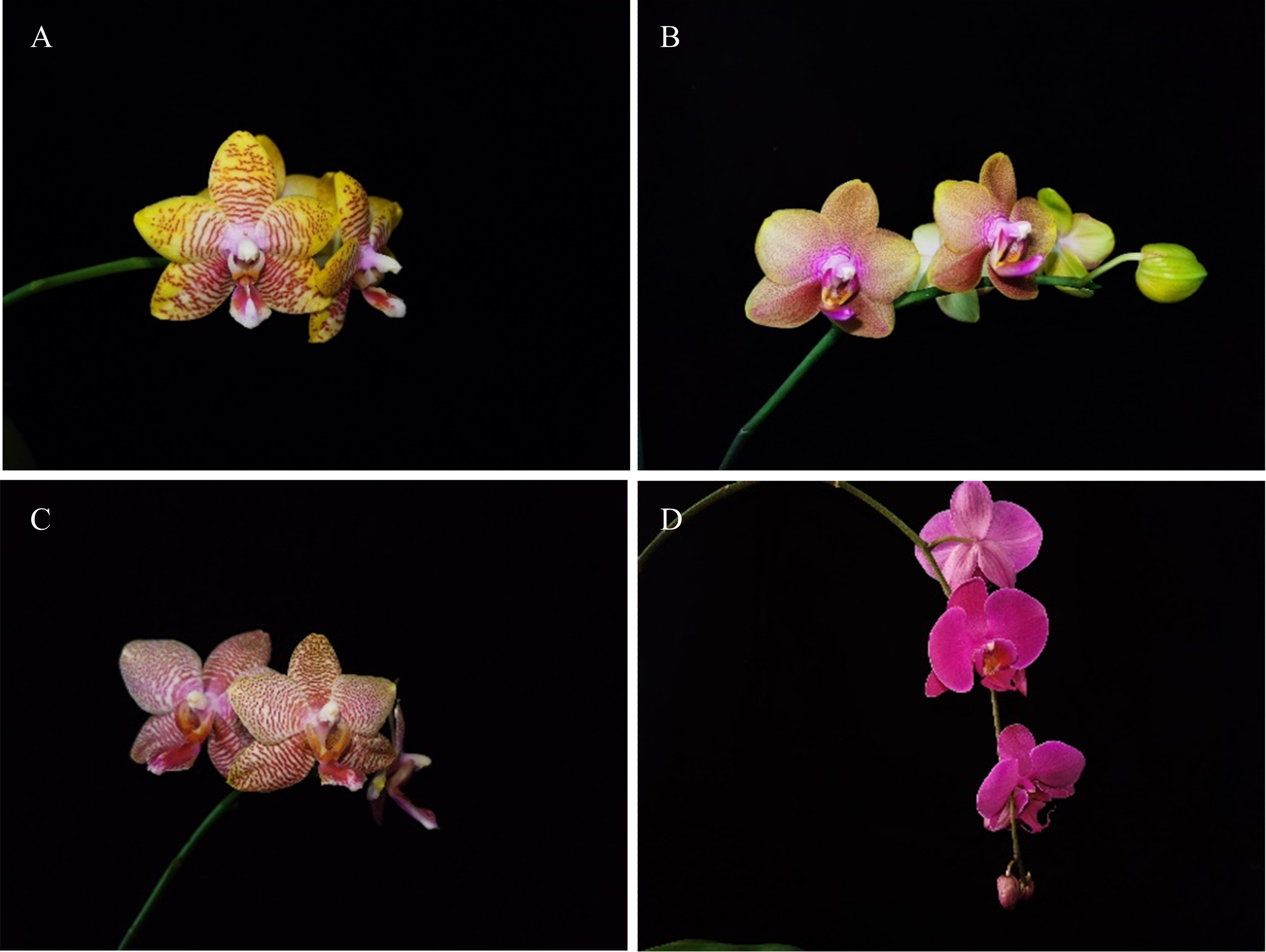
Fig. 1

Schematic diagram of the peak flowering period of four Phalaenopsis varieties"

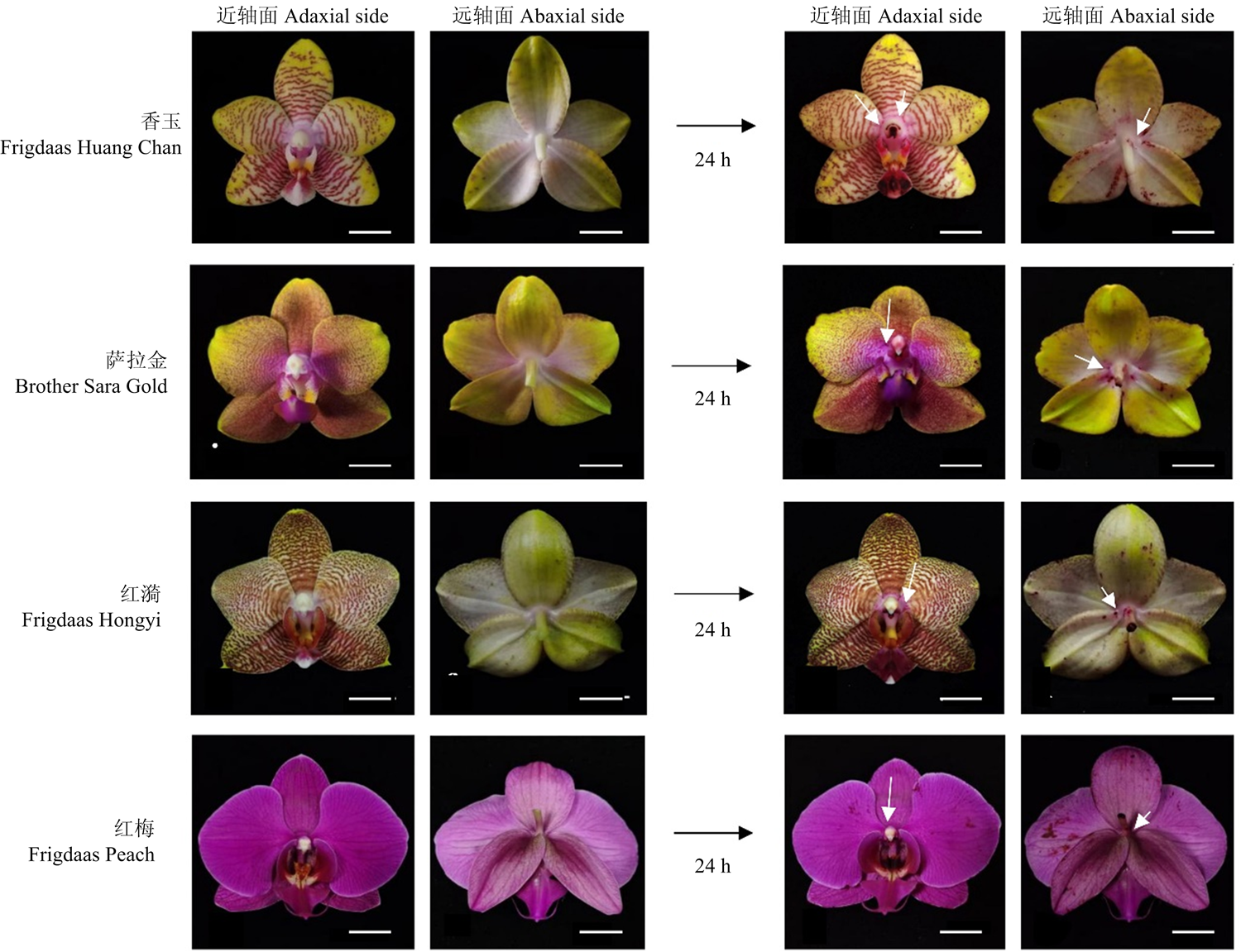
Fig. 2

Comparison of Phalaenopsis flowers before and after 24 h of neutral red immersion The area indicated by the white arrow is the near gynostemium part, scale bar is 1 cm"

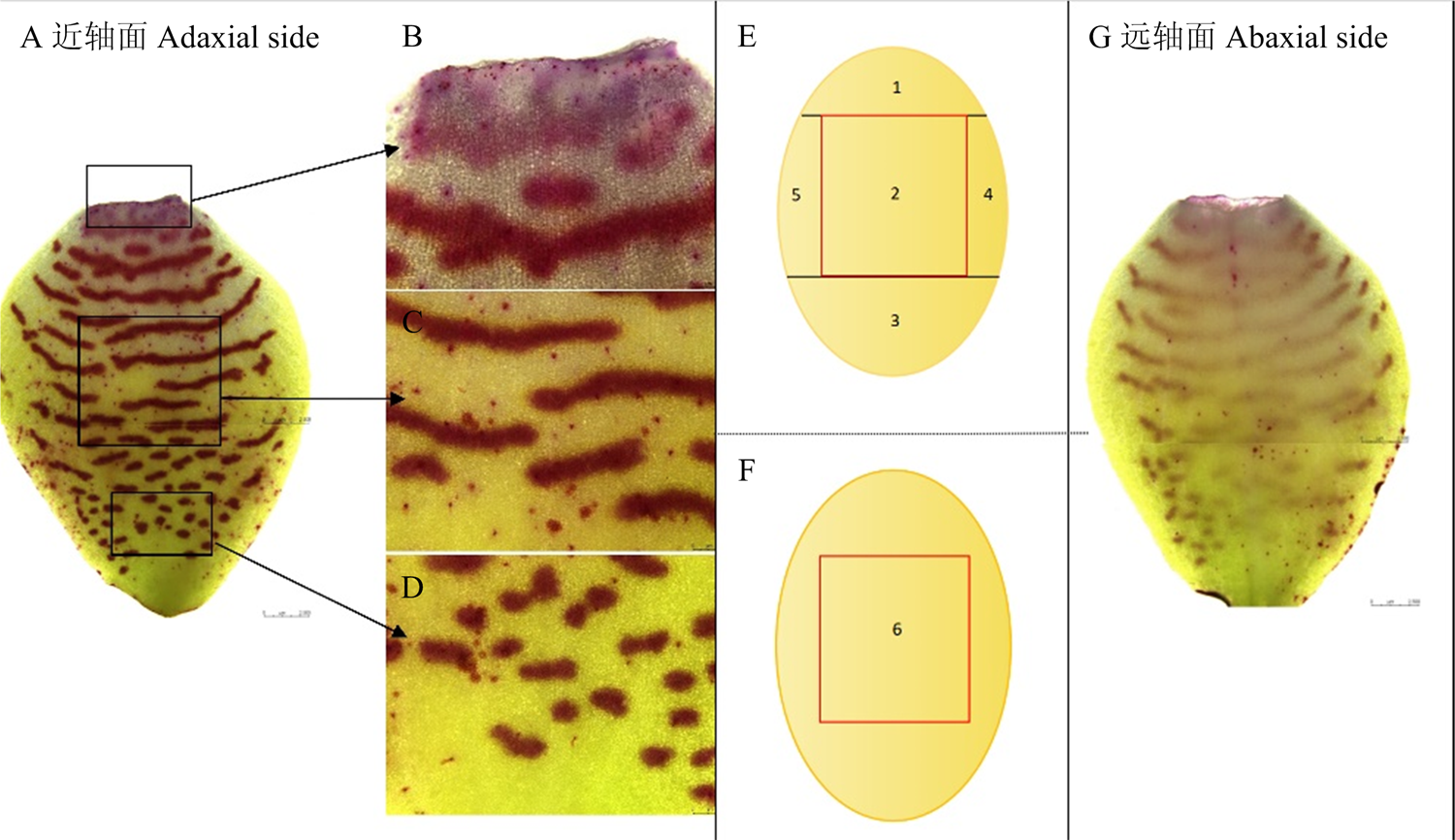
Fig. 3

Distribution characteristics of glandular trichomes in Phalaenopsis floral organs (taking the petals of ‘Frigdaas Huang Chan’ as an example)"

Fig. 4

Adaxial and abaxial sides glandular trichome structure of floral organs in four Phalaenopsis varieties"

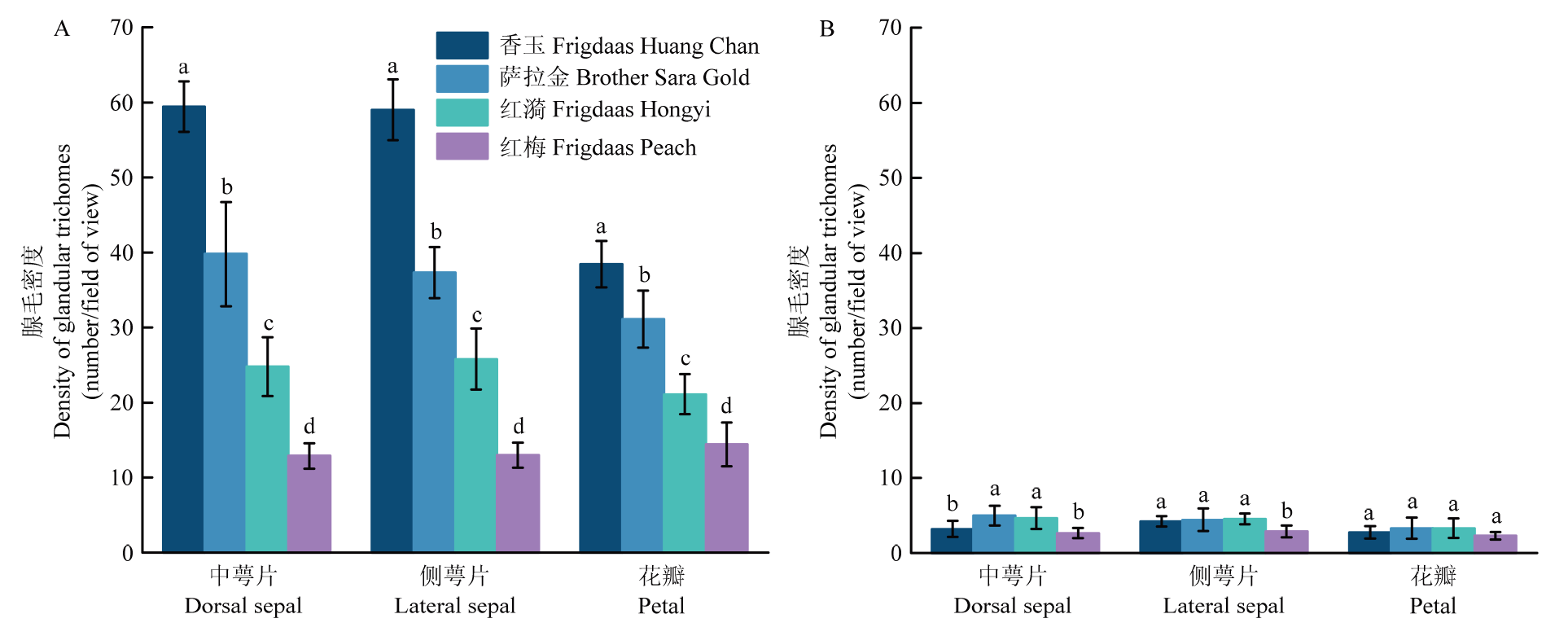
Fig. 5

Density of glandular trichomes on the adaxial (A) and abaxial (B) sides of floral organs in four Phalaenopsis varieties Different lowercase letters on the bars indicate significant difference among varieties (n=45, P<0.05); Glandular trichome density refers to the number of glandular trichomes that can be observed within each visual field under a microscope"

Fig. 6

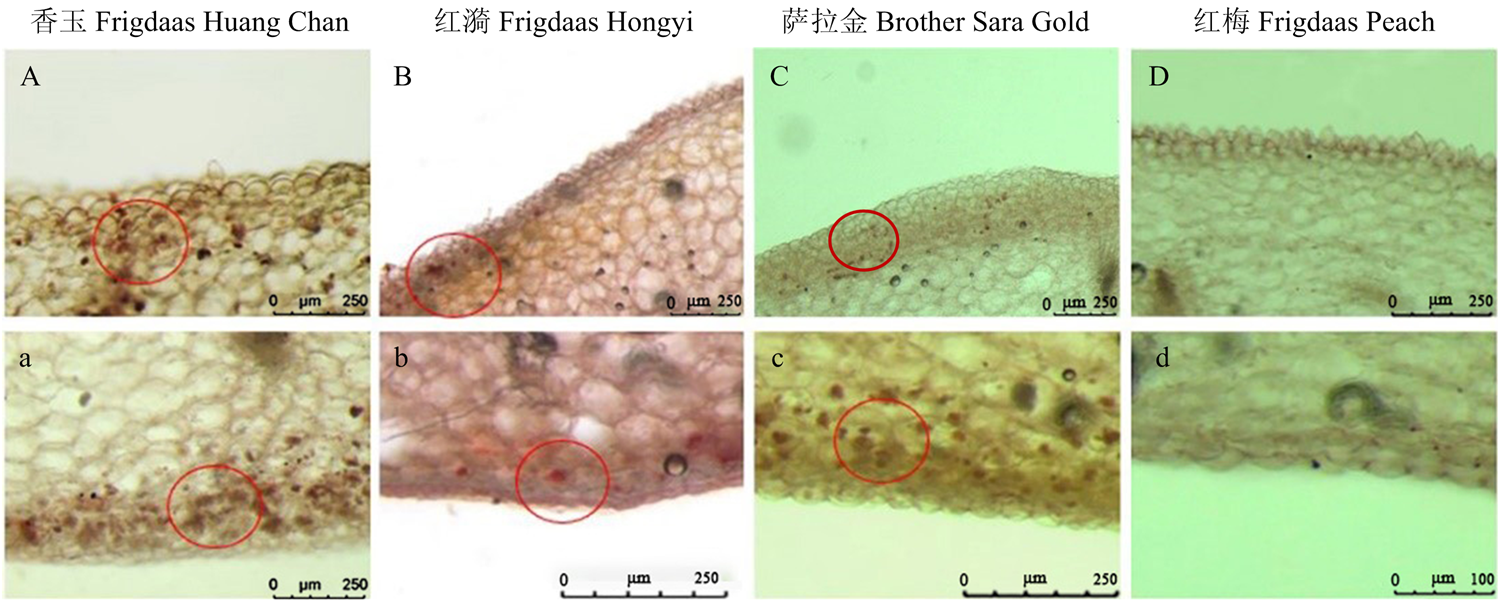
Detection of lipids in floral organs by Sudan IV (Using petals as an example)"

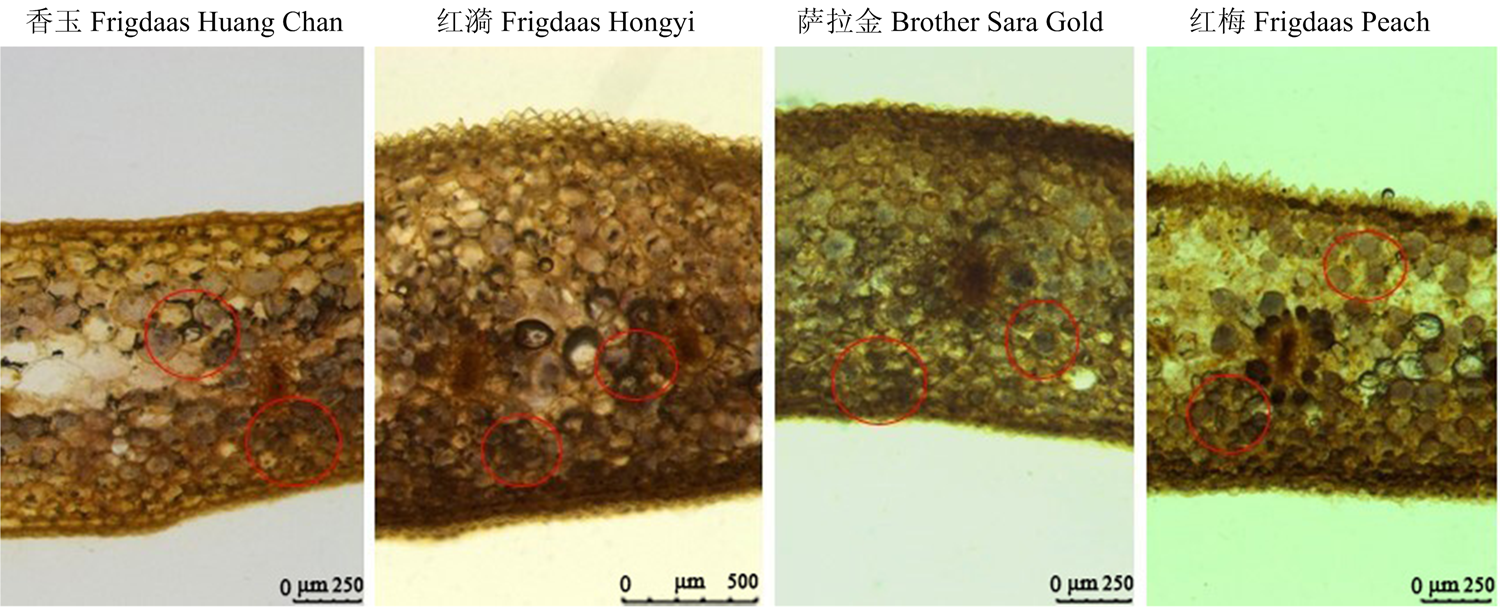
Fig. 7

Detection of starch in floral organs by Lugol’s iodine solution (Using petals as an example)"

Table 1

Histochemical reactions of floral organs in four Phalaenopsis varieties"

花器官
Floral organ
材料
Material
苏丹IV(脂质)Sudan IV (for lipids) Lugol’s碘液(淀粉)Lugol’s iodine (for starch)
反应Reaction 反应位点Reaction site 反应Reaction 反应位点Reaction site
花瓣
Petal
香玉Frigdaas Huang Chan + 角质层、表皮、皮下细胞StC, Ep, CST + 皮下细胞、薄壁细胞CST, ScC
萨拉金Brother Sara Gold + 表皮、皮下细胞Ep, CST + 皮下细胞、薄壁细胞CST, ScC
红漪Frigdaas Hongyi + 表皮、皮下细胞Ep, CST + 皮下细胞、薄壁细胞CST, ScC
红梅Frigdaas Peach - + 皮下细胞、薄壁细胞CST, ScC
中萼片
Dorsal sepal
香玉Frigdaas Huang Chan + 角质层、表皮、皮下细胞StC, Ep, CST + 皮下细胞、薄壁细胞CST, ScC
萨拉金Brother Sara Gold + 表皮、皮下细胞Ep, CST + 皮下细胞、薄壁细胞CST, ScC
红漪Frigdaas Hongyi + 表皮、皮下细胞Ep, CST + 皮下细胞、薄壁细胞CST, ScC
红梅Frigdaas Peach - + 皮下细胞、薄壁细胞CST, ScC
侧萼片
Lateral sepal
香玉Frigdaas Huang Chan + 角质层、表皮、皮下细胞StC, Ep, CST + 皮下细胞、薄壁细胞CST, ScC
萨拉金Brother Sara Gold + 表皮、皮下细胞Ep, CST + 皮下细胞、薄壁细胞CST, ScC
红漪Frigdaas Hongyi + 表皮、皮下细胞Ep, CST + 皮下细胞、薄壁细胞CST, ScC
红梅Frigdaas Peach - + 皮下细胞、薄壁细胞CST, ScC

Table 2

The 14 main volatile components in various floral organs of four Phalaenopsis varieties (μg·kg-1)"

化合物
Compound
香玉Frigdaas Huang Chan 萨拉金Brother Sara Gold
中萼片DS 侧萼片LS 花瓣Pe 唇瓣Li 合蕊柱Co 中萼片DS 侧萼片LS 花瓣Pe 唇瓣Li 合蕊柱Co
α-水芹烯α-Phellandrene 2.62±0.64a 3.10±0.29a 2.80±0.39a 0.75±0.14b 0.38±0.11b 1.14±0.42a 0.82±0.41ab 1.05±0.44a 0.17±0.07c 0.25±0.15bc
(+)-α-蒎烯(+)-α-Pinene 5.36±1.72a 6.17±0.57a 0.55±0.09b 0.11±0.02b 0.08±0.01b 2.65±0.27a 2.08±0.41a 2.46±0.38a 0.54±0.20c 1.28±0.55b
β-水芹烯β-Phellandrene 2.97±0.84a 3.73±0.29a 3.32±0.72a 0.97±0.24b 0.51±0.12b 1.47±0.70a 1.12±0.72ab 1.40±0.72a 0.31±0.02b 0.30±0.18b
β-蒎烯β-Pinene 1.42±0.43a 1.65±0.11a 1.54±0.28a 0.31±0.08b 0.26±0.06b 1.35±0.25a 1.02±0.25a 1.24±0.26a 0.20±0.06b 0.55±0.31b
月桂烯Myrcene 7.11±1.67a 8.25±1.28a 0.71±0.07b 0.23±0.05b 0.08±0.01b 1.01±0.12a 0.79±0.18a 0.87±0.18a 0.18±0.02b 0.09±0.01b
(+)-4-蒈烯(+)-4-Carene 2.23±0.53a 2.57±0.32a 2.38±0.25a 0.51±0.13b 0.23±0.07b 1.03±0.25a 0.76±0.27a 0.87±0.29a 0.13±0.02b 0.10±0.01b
间异丙基甲苯β-Cymene 1.78±0.47a 1.89±0.30a 1.77±0.20a 0.55±0.10b 0.32±0.10b 0.81±0.25a 0.67±0.23a 0.76±0.25a 0.23±0.01b 0.23±0.11b
桉叶油醇Eucalyptol 28.44±4.68a 31.04±3.33a 2.85±0.42b 0.61±0.20b 0.03±0.01b 13.37±3.44a 13.48±0.65a 8.05±2.28b 2.58±0.14c 0.53±0.10c
δ-3-蒈烯δ-3-Carene 0.11±0.05a 0.07±0.01ab 0.11±0.06a 0.04±0.02bc 0.13±0.02a 0.11±0.01ab 0.09±0.01b
γ-松油烯γ-Terpinene 2.94±0.52a 3.26±0.31a 3.00±0.09a 0.84±0.16b 0.41±0.10b 1.44±0.32a 1.12±0.34a 1.26±0.36a 0.18±0.08b 0.36±0.24b
芳樟醇Linalool 13.39±3.62b 18.95±5.14a 1.39±0.64c 0.05±0.03c 0.74±0.03c 2.83±0.28a 2.36±0.67a 2.35±0.54a 1.40±0.27b 0.22±0.10c
L-α-松油醇
L-α-Terpineol
0.40±0.33a 0.47±0.31a 0.57±0.72a 0.06±0.04a
阿司匹林甲酯
Aspirin methyl ester
0.43±0.38a 0.59±0.56a 0.16±0.11a 0.29±0.03a 0.26±0.17a 1.49±0.42a 0.99±0.76ab 1.28±0.28a 0.43±0.27bc 0.17±0.04c
(E,E)-α-法尼烯(E,E)-α-Farnesene 0.44±0.20a 0.31±0.08ab 0.35±0.14ab 0.24±0.05ab 0.08±0.01b 0.85±1.07a 0.07±0.02a
化合物
Compound
红漪Frigdaas Hongyi 红梅Frigdaas Peach
中萼片DS 侧萼片LS 花瓣Pe 唇瓣Li 合蕊柱Co 中萼片DS 侧萼片LS 花瓣Pe 唇瓣Li 合蕊柱Co
α-水芹烯α-Phellandrene 1.00±0.30a 1.04±0.16a 0.80±0.65ab 0.24±0.1bc 0.13±0.01c
(+)-α-蒎烯(+)-α-Pinene 0.20±0.06a 0.19±0.03a 0.21±0.03a 0.06±0.01b 0.16±0.13a 0.17±0.18a 0.15±0.10a 0.13±0.04a
β-水芹烯β-Phellandrene 1.37±0.41a 1.37±0.22a 1.55±0.16a 0.32±0.13b 0.17±0.01b
β-蒎烯β-Pinene 0.48±0.15a 0.48±0.08a 0.51±0.10a 0.26±0.21ab 0.12±0.02b
月桂烯Myrcene 0.37±0.11a 0.34±0.07a 0.32±0.16a 0.12±0.01b
(+)-4-蒈烯(+)-4-Carene 0.72±0.28a 0.72±0.15a 0.78±0.27a 0.17±0.02b 0.11±0.01b
间异丙基甲苯β-Cymene 0.62±0.12a 0.64±0.04a 0.46±0.37ab 0.20±0.07bc 0.12±0.01c
桉叶油醇Eucalyptol 1.16±0.49a 1.07±0.27a 0.99±0.75ab 0.23±0.01b 0.25±0.03b
δ-3-蒈烯δ-3-Carene 0.13±0.03a 0.12±0.01a 4.86±1.29a 4.93±1.91a 5.02±0.79a 4.69±0.41a 1.30±0.30b
γ-松油烯γ-Terpinene 1.09±0.37a 1.15±0.22a 0.93±0.73ab 0.29±0.11bc 0.17±0.03c
芳樟醇Linalool 0.93±0.8ab 1.13±0.61a 0.32±0.12ab 0.57±0.22ab 0.13±0.02b
L-α-松油醇
L-α-Terpineol
0.11±0.09a 0.18±0.02a 0.18±0.07a
阿司匹林甲酯
Aspirin methyl ester
0.89±0.32a 0.71±0.07a 0.70±0.31a 0.12±0.01b 0.07±0.01b 0.06±0.01b 0.09±0.01b 0.42±0.21a 0.05±0.01b
(E,E)-α-法尼烯(E,E)-α-Farnesene 0.72±0.31a 0.68±0.13a 0.90±0.49a 0.41±0.17ab 0.15±0.07a 0.19±0.12a 0.19±0.03a 0.16±0.01a

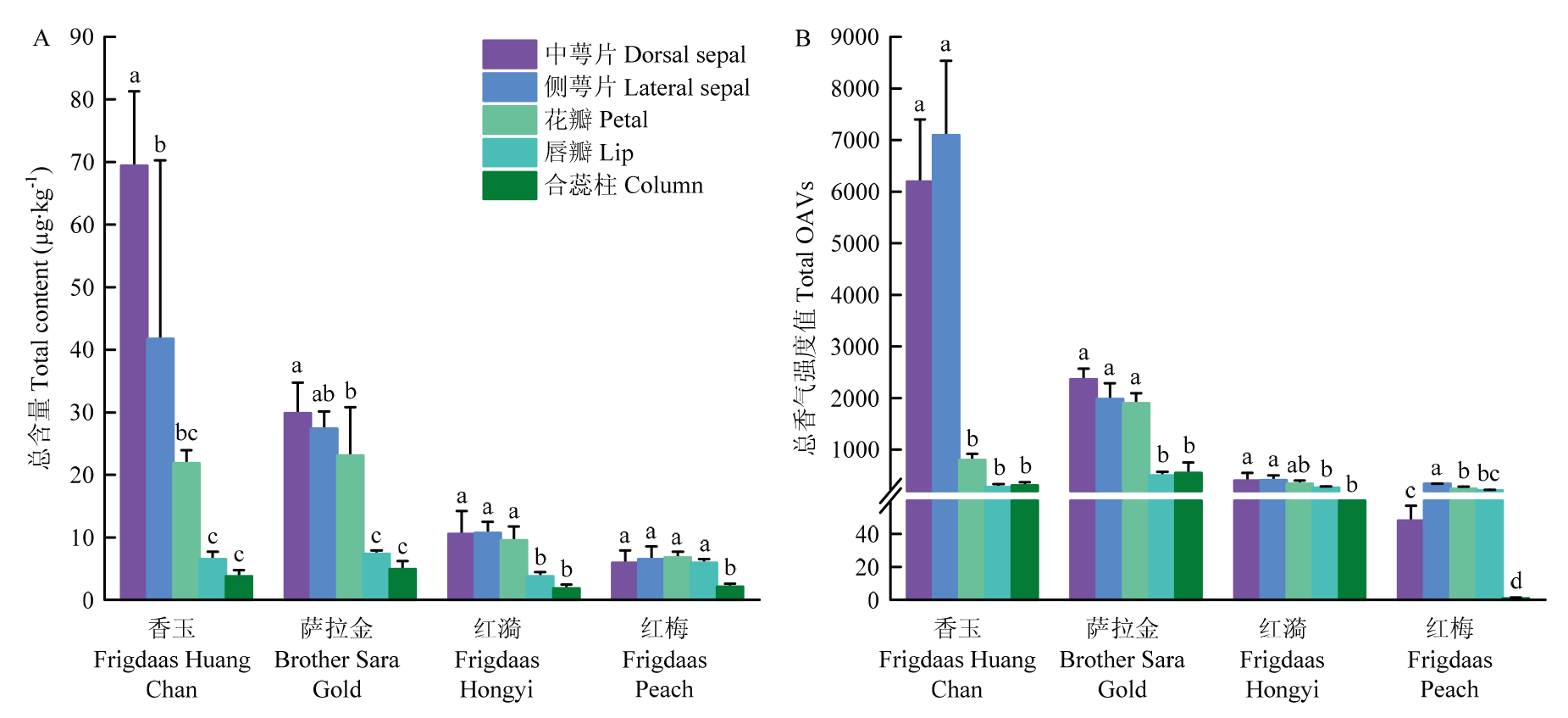
Fig. 8

Total content and total OAVs of 14 volatile components in various floral organs"

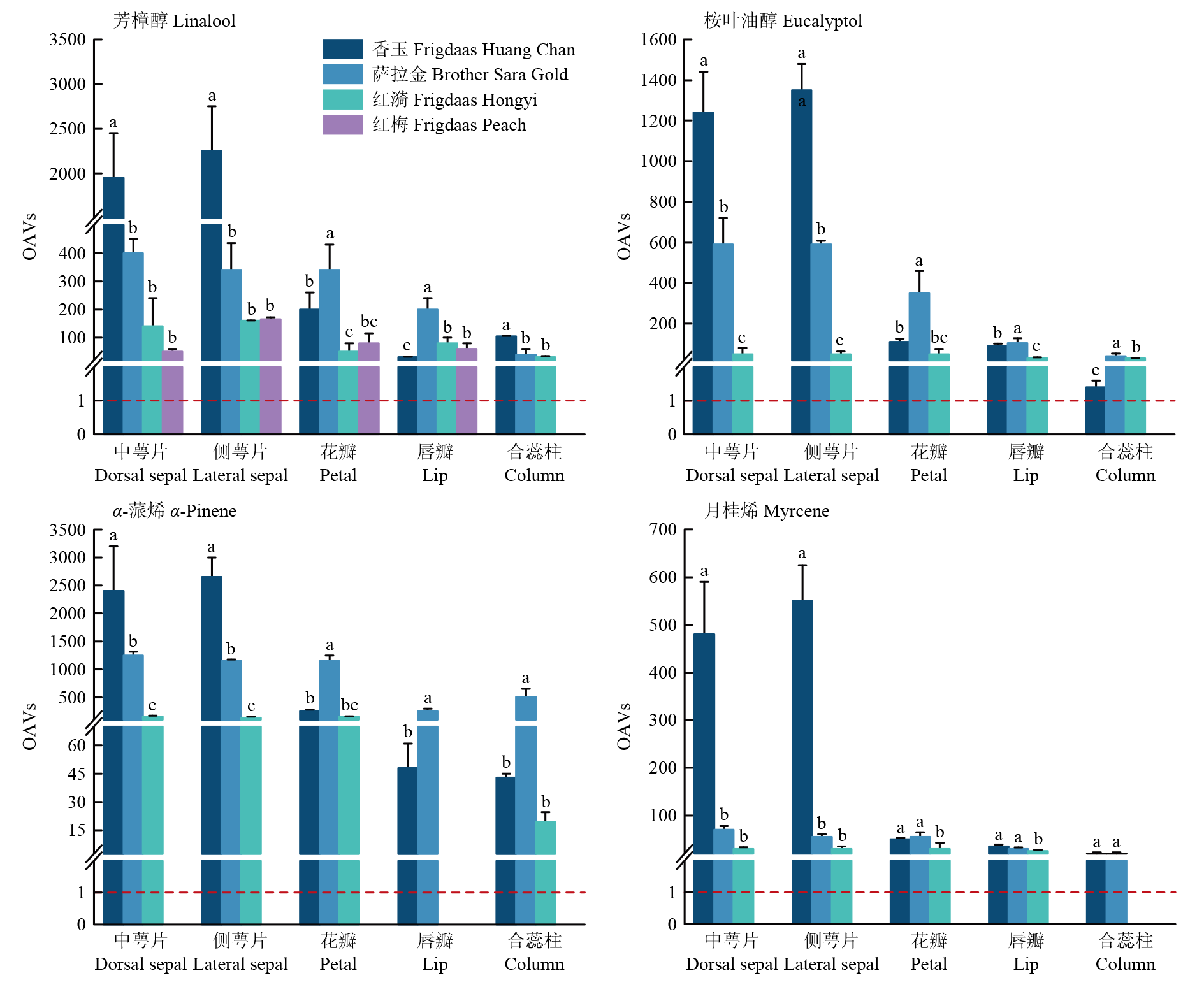
Fig. 9

OAVs of the primary odorants of four Phalaenopsis varieties"

Table 3

Correlation analysis between floral organ parts and total volatile substance content as well as corresponding total OAVs in Phalaenopsis"

部位
Organ
指标对
Indicator pair
相关系数
Correlation coefficient (r)
显著性
Significance (P)
相关性判定
Correlation judgment
中萼片
Dorsal sepal
近轴腺毛密度vs挥发物总含量
Adaxial glandular trichome density vs total volatile content
0.987 0.003 **
近轴腺毛密度vs总OAV
Adaxial glandular trichome density vs total OAVs
0.992 0.001 **
远轴腺毛密度vs挥发物总含量
Abaxial glandular trichome density vs total volatile content
0.625 0.375 ns
远轴腺毛密度vs总OAV
Abaxial glandular trichome density vs total OAVs
0.581 0.419 ns
侧萼片
Lateral sepal
近轴腺毛密度vs挥发物总含量
Adaxial glandular trichome density vs total volatile content
0.976 0.006 **
近轴腺毛密度vs总OAV
Adaxial glandular trichome density vs total OAVs
0.985 0.002 **
远轴腺毛密度vs挥发物总含量
Abaxial glandular trichome density vs total volatile content
0.702 0.298 ns
远轴腺毛密度vs总OAV
Abaxial glandular trichome density vs total OAVs
0.658 0.342 ns
花瓣
Petal
近轴腺毛密度vs挥发物总含量
Adaxial glandular trichome density vs total volatile content
0.786 0.214 ns
近轴腺毛密度vs总OAV
Adaxial glandular trichome density vs total OAVs
0.823 0.177 ns
远轴腺毛密度vs挥发物总含量
Abaxial glandular trichome density vs total volatile content
0.915 0.085 ns
远轴腺毛密度vs总OAV
Abaxial glandular trichome density vs total OAVs
0.887 0.113 ns
[1]
赵玉安, 王世尧, 张果, 王瑞华, 蒋拴丽, 杨书才. 蝴蝶兰种质资源生物学性状综合评价. 北方园艺, 2024(1): 54-59.
ZHAO Y A, WANG S Y, ZHANG G, WANG R H, JIANG S L, YANG S C. Comprehensive evaluation of biological characters of Phalaenopsis germplasm resources. Northern Horticulture, 2024(1): 54-59. (in Chinese)
[2]
王瑞华, 王俊. 中国蝴蝶兰产业现状及发展建议. 湖北农业科学, 2018, 57(3): 45-47, 50.
WANG R H, WANG J. The development status and strategies of Phalaenopsis industry in China. Hubei Agricultural Sciences, 2018, 57(3): 45-47, 50. (in Chinese)
[3]
YANG F X, GAO J, LI J, WEI Y L, XIE Q, JIN J P, LU C Q, ZHU W, WONG S M, ZHU G F. The China orchid industry: Past and future perspectives. Ornamental Plant Research, 2024, 49: e002.
[4]
童妍, 张燕萍, 胡美娟, 曹映辉, 章杨婷, 仝恩慧, 王文君, 赵凯, 彭东辉, 周育真. 蝴蝶兰新型杂交品种挥发性成分分析. 广西植物, 2023, 43(6): 1016-1026.
TONG Y, ZHANG Y P, HU M J, CAO Y H, ZHANG Y T, TONG E H, WANG W J, ZHAO K, PENG D H, ZHOU Y Z. Volatile component analysis of new hybrid varieties of Phalaenopsis. Guihaia, 2023, 43(6): 1016-1026. (in Chinese)
[5]
马迪, 肖文芳, 李佐, 张俊卫, 陈和明, 吕复兵. 兰科植物花香成分研究进展. 中国农学通报, 2023, 39(16): 52-60.

doi: 10.11924/j.issn.1000-6850.casb2022-0928
MA D, XIAO W F, LI Z, ZHANG J W, CHEN H M, F B. Research progress on floral scent components of Orchidaceae. Chinese Agricultural Science Bulletin, 2023, 39(16): 52-60. (in Chinese)

doi: 10.11924/j.issn.1000-6850.casb2022-0928
[6]
肖文芳, 李佐, 陈和明, 吕复兵. 基于HS-SPME-GC-MS的4种不同蝴蝶兰种质资源花朵挥发性成分比较分析. 中国农业大学学报, 2021, 26(3): 38-52.
XIAO W F, LI Z, CHEN H M, F B. Analysis of volatile components in flowers of four different Phalaenopsis germplasm resources by headspace solid phase microextraction coupled with gas chromatography-mass spectrometry. Journal of China Agricultural University, 2021, 26(3): 38-52. (in Chinese)
[7]
张英杰, 李奥, 吕云飞, 孙纪霞, 刘民晓, 张京伟, 刘学庆, 刘晓华, 郭文姣, 郭对田. 蝴蝶兰成花过程内源激素含量的变化和植物生长调节剂的作用. 热带亚热带植物学报, 2022, 30(1): 104-110.
ZHANG Y J, LI A, Y F, SUN J X, LIU M X, ZHANG J W, LIU X Q, LIU X H, GUO W J, GUO D T. Changes in endogenous hormones content and effect of plant growth regulators of Phalaenopsis during flowering period. Journal of Tropical and Subtropical Botany, 2022, 30(1): 104-110. (in Chinese)
[8]
章杨婷, 张燕萍, 黄静妍, 王文君, 童妍, 赵凯, 周育真. 一心维纳斯蝴蝶兰花香物质合成相关基因RT-qPCR内参基因筛选. 热带作物学报, 2023, 44(11): 2188-2195.

doi: 10.3969/j.issn.1000-2561.2023.11.006
ZHANG Y T, ZHANG Y P, HUANG J Y, WANG W J, TONG Y, ZHAO K, ZHOU Y Z. Selection of suitable RT-qPCR reference genes for floral scent biosynthesis in Phalaenopsis I-Hsin Venus. Chinese Journal of Tropical Crops, 2023, 44(11): 2188-2195. (in Chinese)
[9]
刘秀云, 孙纪霞, 董春燕, 明凤, 董文明, 郭文姣, 张京伟, 刘民晓, 张英杰. 3个黄色香花蝴蝶兰品种花香成分鉴别与调控基因初探. 种子, 2025, 44(2): 201-209.
LIU X Y, SUN J X, DONG C Y, MING F, DONG W M, GUO W J, ZHANG J W, LIU M X, ZHANG Y J. Primary study on floral components identification and regulatory genes of 3 yellow fragrant Phalaenopsis aphrodite cultivars. Seed, 2025, 44(2): 201-209. (in Chinese)
[10]
FAHN A. Secretory tissues in vascular plants. New Phytologist, 1988, 108(3): 229-257.

doi: 10.1111/j.1469-8137.1988.tb04159.x pmid: 33873942
[11]
查旻昱, 吴悠, 张梁. 茶叶中挥发性香气物质研究进展. 食品安全质量检测学报, 2020, 11(13): 4298-4303.
ZHA M Y, WU Y, ZHANG L. Research advances on volatile aroma compounds of tea. Journal of Food Safety and Quality, 2020, 11(13): 4298-4303. (in Chinese)
[12]
HSIAO Y Y, TSAI W C, CHEN W H, CHEN H H. Floral scent in Phalaenopsis//Floriculture, Ornamental and Plant Biotechnology: Advances and Topical, 2008: 408-420.
[13]
崔长杰, 邹璞, 廖景平. 长萼兰花蕉(Orchidantha chinensis var. longisepala)气味腺结构探究. 植物科学学报, 2015, 33(5): 602-607.
CUI C J, ZOU P, LIAO J P. Structural analysis of the osmophores in Orchidantha chinensis var. longisepala. Plant Science Journal, 2015, 33(5): 602-607. (in Chinese)
[14]
PŁACHNO B J, ŚWIĄTEK P, SZYMCZAK G. Can a stench be beautiful? - Osmophores in stem-succulent stapeliads (Apocynaceae- Asclepiadoideae-Ceropegieae-Stapeliinae). Flora-Morphology, Distribution, Functional Ecology of Plants, 2010, 205(2): 101-105.
[15]
PRIDGEON A M, STERN W L. Ultrastructure of osmophores in Restrepia (Orchidaceae). American Journal of Botany, 1983, 70(8): 1233-1243.

doi: 10.1002/ajb2.1983.70.issue-8
[16]
VOGEL S. LANGE O L, NOBEL P S, OSMOND C B, ZIEGLER H. Ecophysiology of zoophilic pollination//LANGE O L, NOBEL P S, OSMOND C B, ZIEGLER H. Physiological Plant Ecology III: Responses to the Chemical and Biological Environment. Berlin, Heidelberg: Springer Berlin Heidelberg, 1983, 12: 559-624.
[17]
FAHN A. Secretory Tissues in Plants. London: Academic Press, 1979.
[18]
STERN W L, CURRY K J, PRIDGEON A M. Osmophores of Stanhopea (Orchidaceae). American Journal of Botany, 1987, 74(9): 1323-1331.

doi: 10.1002/ajb2.1987.74.issue-9
[19]
WERKER E, FAHN A. Secretory hairs of Inula viscosa (L.) Ait. - development, ultrastructure, and secretion. Botanical Gazette, 1981, 142(4): 461-476.

doi: 10.1086/337247
[20]
GUTTENBERGER M. A rapid staining procedure for arbuscules of living arbuscular mycorrhizas using neutral red as acidotropic dye. Plant and Soil, 2000, 226(2): 211-218.

doi: 10.1023/A:1026568428770
[21]
FRANCISCO A, ASCENSAO L. Structure of the osmophore and labellum micromorphology in the sexually deceptive orchids Ophrys bombyliflora and Ophrys tenthredinifera (Orchidaceae). International Journal of Plant Sciences, 2013, 174(4): 619-636.

doi: 10.1086/669911
[22]
HSIAO Y Y, TSAI W C, KUOH C S, HUANG T H, WANG H C, WU T S, LEU Y L, CHEN W H, CHEN H H. Comparison of transcripts in Phalaenopsis bellina and Phalaenopsis equestris (Orchidaceae) flowers to deduce monoterpene biosynthesis pathway. BMC Plant Biology, 2006, 6(1): 14.

doi: 10.1186/1471-2229-6-14
[23]
REPOSI S D, GOTELLI M M, TORRETTA J P. Anatomy and ultrastructure floral osmophores of Catasetum fimbriatum (Orchidaceae). Protoplasma, 2021, 258(5): 1091-1102.

doi: 10.1007/s00709-021-01625-1
[24]
李晓颍, 王海静, 徐宁伟, 曹翠玲, 刘建珍, 武春成, 张立彬. 顶空固相微萃取-气相色谱-质谱联用法分析欧李果实挥发性成分. 中国农业科学, 2019, 52(19): 3448-3459. doi: 10.3864/j.issn.0578-1752.2019.19.014.
LI X Y, WANG H J, XU N W, CAO C L, LIU J Z, WU C C, ZHANG L B. Analysis of volatile components in Cerasus humilis (Bge.) Sok by headspace solid phase microextraction-gas chromatography-mass spectrometry. Scientia Agricultura Sinica, 2019, 52(19): 3448-3459. doi: 10.3864/j.issn.0578-1752.2019.19.014. (in Chinese)
[25]
孔慧娟, 赵国玲, 汪雯岚, 阎卫东. 6种水果中键合态香气成分的气相色谱-质谱法鉴定与比较. 食品科学, 2015, 36(14): 140-144.

doi: 10.7506/spkx1002-6630-201514027
KONG H J, ZHAO G L, WANG W L, YAN W D. Identification and comparison of bound aroma components in six kinds of fruits by GC-MS. Food Science, 2015, 36(14): 140-144. (in Chinese)

doi: 10.7506/spkx1002-6630-201514027
[26]
姚红, 尹小庆, 颜宇鸽, 阚建全, 武运, 戚晨晨, 王治国, SAMEH A, AMEL I, 杜木英. 鲊辣椒生香酵母的分离筛选鉴定及其应用研究. 食品与发酵工业, 2023, 49(17): 145-152.

doi: 10.13995/j.cnki.11-1802/ts.034239
YAO H, YIN X G, YAN Y G, KAN J Q, WU Y, QI C C, WANG Z G, SAMEH A, AMEL I, DU M Y. Application of an aroma-producing yeast isolated from natural fermented Zha-chili. Food and Fermentation Industries, 2023, 49(17): 145-152. (in Chinese)
[27]
ZHANG Y J, GONG Z H, ZHU Z Q, SUN J X, GUO W J, ZHANG J W, DING P S, LIU M X, GAO Z H. Identification of floral aroma components and molecular regulation mechanism of floral aroma formation in Phalaenopsis. Journal of the Science of Food and Agriculture, 2024, 104(15): 9202-9209.

doi: 10.1002/jsfa.v104.15
[28]
施婷婷, 杨秀莲, 王良桂. 3个桂花品种花香组分动态特征及花被片结构解剖学观测. 南京林业大学学报(自然科学版), 2020, 44(4): 12-20.

doi: 10.3969/j.issn.1000-2006.202003047
SHI T T, YANG X L, WANG L G. Dynamic characteristics of floral components and anatomical observation of petals in three cultivars of Osmanthus fragrans. Journal of Nanjing Forestry University (Natural Sciences Edition), 2020, 44(4): 12-20. (in Chinese)
[29]
罗乐, 杨玉勇, 张启翔. 中国蔷薇属. 北京: 中国林业出版社, 2024.
LUO L, YANG Y Y, ZHANG Q X. Genus Rosa L. in China. Beijing: China Forestry Publishing House, 2024. (in Chinese)
[30]
CHEN Y Y, JIANG Z Y, WU S H, CHENG B X, ZHOU L J, LIU T H, YU C. Structure and release function of fragrance glands. Horticulture Research, 2025, 12(5): uhaf031.
[31]
CURRY K J, MCDOWELL L M, JUDD W S, STERN W L. Osmophores, floral features, and systematics of Stanhopea (Orchidaceae). American Journal of Botany, 1991, 78(5): 610-623.

doi: 10.1002/ajb2.1991.78.issue-5
[32]
DE MELO M C, BORBA E L, PAIVA E A S. Morphological and histological characterization of the osmophores and nectaries of four species of Acianthera (Orchidaceae: Pleurothallidinae). Plant Systematics and Evolution, 2010, 286: 141-151.

doi: 10.1007/s00606-010-0294-1
[33]
KOWALKOWSKA A K, PAWLOWICZ M, GUZANEK P, KRAWCZYNSKA A T. Floral nectary and osmophore of Epipactis helleborine (L.) Crantz (Orchidaceae). Protoplasma, 2018, 255(6): 1811-1825.

doi: 10.1007/s00709-018-1274-5
[34]
TOH C, MOHD-HAIRUL A R, AIN N M, NAMASIVAYAM P, GO R, ABDULLAH N A P, ABDULLAH M O, ABDULLAH J O. Floral micromorphology and transcriptome analyses of a fragrant Vandaceous Orchid, Vanda Mimi Palmer, for its fragrance production sites. BMC Research Notes, 2017, 10: 554.

doi: 10.1186/s13104-017-2872-6
[35]
HUCHELMANN A, BOUTRY M, HACHEZ C. Plant glandular trichomes: Natural cell factories of high biotechnological interest. Plant Physiology, 2017, 175(1): 6-22.

doi: 10.1104/pp.17.00727 pmid: 28724619
[36]
屈亚芳, 许明录, 曹建敏, 孙惠青, 尤祥伟, 王国平, 蒋彩虹, 王元英, 常爱霞. 不同基因型烟草腺毛主要分泌物差异分析. 中国烟草学报, 2018, 24(1): 45-52.
QU Y F, XU M L, CAO J M, SUN H Q, YOU X W, WANG G P, JIANG C H, WANG Y Y, CHANG A X. Differential analysis of major glandular trichome secretion between different tobacco genotypes. Acta Tabacaria Sinica, 2018, 24(1): 45-52. (in Chinese)
[37]
张思琦, 何佳, 周方, 徐世晓, 王袁, 刘超, 张安乾, 陈芳, 孙志浩, 杨铁钊. 不同烤烟品种(系)叶片组织结构、腺毛及分泌物比较分析. 中国农业科技导报, 2019, 21(1): 132-140.

doi: 10.13304/j.nykjdb.2018.0025
ZHANG S Q, HE J, ZHOU F, XU S X, WANG Y, LIU C, ZHANG A Q, CHEN F, SUN Z H, YANG T Z. Comparison analysis of leaf tissue structure, trichome and exudates of different flue-cured tobacco varieties (lines). Journal of Agricultural Science and Technology, 2019, 21(1): 132-140. (in Chinese)

doi: 10.13304/j.nykjdb.2018.0025
[38]
GUAN Y Q, CHEN S M, CHEN F D, CHEN F, JIANG Y F. Exploring the relationship between trichome and terpene chemistry in Chrysanthemum. Plants, 2022, 11(11): 1410.

doi: 10.3390/plants11111410
[39]
CHALVIN C, DREVENSEK S, DRON M, BENDAHMANE A, BOUALEM A. Genetic control of glandular trichome development. Trends in Plant Science, 2020, 25(5): 477-487.

doi: S1360-1385(19)30350-4 pmid: 31983619
[40]
周秀梅, 刘会超, 李保印. 木香薷叶表皮毛的类型、分布及腺毛的分泌过程. 园艺学报, 2016, 43(8): 1555-1565.

doi: 10.16420/j.issn.0513-353x.2016-0154
ZHOU X M, LIU H C, LI B Y. Type and distribution of trichomes on the leaf epidermis of Elsholtzia stauntonii and the secreting process of the glandular trichomes. Acta Horticulturae Sinica, 2016, 43(8): 1555-1565. (in Chinese)
[1] ZHONG RongYang, WEI ShouHui, WANG XiaoShan, SHI DuiHong, MIN LeiGuo, WANG WenHua, WANG JiangBo, XIAO XueMei. Aroma Formation and Key Volatile Compounds in Coriander Leaves Across Growth Stages Based on GC-MS and E-Nose [J]. Scientia Agricultura Sinica, 2026, 59(7): 1552-1563.
[2] ZHANG DongMei, ZHOU XinXin, XIAO GuiLin, ZENG XiangGuo, WANG ChunYan, WANG ZeXian, HAN YongChao. Phenotypic Characteristics of Strawberry Floral Organs in Response to Botrytis cinerea Infection and Methods for Gray Mold Resistance Evaluation [J]. Scientia Agricultura Sinica, 2026, 59(7): 1456-1466.
[3] ZENG YueHui, ZOU WenGuang, ZHAO FuMing, XIAO ChangChun, HUANG JianHong, MA BinLin, YANG WangXing, WEI XinYu, XU XuMing. Map-Based Cloning and Functional Verification of A Novel Split Glume Gene OsSG2 in Rice (Oryza sativa L.) [J]. Scientia Agricultura Sinica, 2025, 58(11): 2062-2080.
[4] YANG ChengCong, LIANG Rong, QIN Ran, ZENG DongDong, JIN XiaoLi, SHI ChunHai. Phenotypical Analysis and Gene Mapping of Abnormal Floral Organ Number Mutant afon1 in Rice (Oryza sativa L.) [J]. Scientia Agricultura Sinica, 2017, 50(20): 3837-3847.
[5] CHEN Li-kai, HUANG Ming, LIU Yong-zhu, WANG Hui, CHEN Zhi-qiang, GUO Tao. Observation, Genetic Analysis and Gene Mapping of an Open Hull Semi-Sterility Mutant in Rice (Oryza sativa) [J]. Scientia Agricultura Sinica, 2016, 49(1): 1-13.
[6] HUANG Jun-bao, HE Yong-ming, ZENG Xiao-chun, XIANG Miao-lian, FU Yong-qi. Changes of JA Levels in Floral Organs and Expression Analysis of JA Signaling Genes in Lodicules Before Floret Opening in Rice [J]. Scientia Agricultura Sinica, 2015, 48(6): 1219-1227.
[7] ZHANG Ling, GUO Shuang, WANG Ling, ZHANG Tian-quan, ZHUANG Hui, LONG Yu-chen, HE Guang-hua, LI Yun-feng. Gene Mapping and Candidate Gene Analysis of a dwarf and deformed flower 2 (ddf2) Mutant in Rice (Oryza sativa) [J]. Scientia Agricultura Sinica, 2015, 48(10): 1873-1881.
[8] LI Hong-You, WANG Chan, LI Li-Lin, WANG Yong-Qin, ZHAO Rui. Cloning and Expression Analysis of A Putative B Class MADS-box Gene of AcPI in Onion [J]. Scientia Agricultura Sinica, 2012, 45(23): 4759-4769.
[9] . Study on the Supercooling point and Freezing point of Apricot Flower at different stage [J]. Scientia Agricultura Sinica, 2008, 41(4): 1128-1133 .
Viewed
Full text


Abstract

Cited

  Shared   
  Discussed   
No Suggested Reading articles found!