






中国农业科学 ›› 2026, Vol. 59 ›› Issue (20): 4461-4475.doi: 10.3864/j.issn.0578-1752.2026.20.003
刘丹丹( ), 丁文涛, 程起灿, 张瑜, 邢爱双, 郭祥龙, 邢邯, 郭娜(), 赵晋铭()
收稿日期:2026-02-21
接受日期:2026-04-15
出版日期:2026-10-16
发布日期:2026-10-21
通信作者:
联系方式:
刘丹丹,E-mail:2019101153@njau.edu.cn。
基金资助:
LIU DanDan(), DING WenTao, CHENG QiCan, ZHANG Yu, XING AiShuang, GUO XiangLong, XING Han, GUO Na(), ZHAO JinMing()
Received:2026-02-21
Accepted:2026-04-15
Published:2026-10-16
Online:2026-10-21
摘要:
【目的】解析大豆R6期籽粒氨基酸含量的遗传多样性,综合评价营养品质并挖掘优异育种材料;定位调控氨基酸含量的关键遗传位点与候选基因,为菜用大豆分子育种提供理论基础。【方法】采用氨基酸自动分析仪测定133份大豆种质R6期籽粒17种氨基酸含量;结合主成分分析与隶属函数法构建氨基酸品质综合评价体系,对供试材料进行系统评价,并结合聚类分析筛选优异种质。进一步整合高密度基因型数据,通过限制性两阶段多位点全基因组关联分析(RTM-GWAS)对总氨基酸含量(TAA)和综合评价值(F值)开展关联分析,鉴定显著遗传位点,并筛选候选基因。基于QTL-allele矩阵预测群体杂交组合TAA的育种潜力,并筛选最优组合。【结果】133份大豆种质具有丰富的遗传多样性,测定的17种氨基酸中,谷氨酸含量最高,甲硫氨酸和半胱氨酸含量最低。主成分分析表明,前3个主成分累计贡献率为95.92%,能够代表17种氨基酸绝大部分的遗传变异信息。基于综合评价值(F值),通过聚类分析可将供试材料分为3个类群,并筛选出9份综合表现优异的种质材料。通过RTM-GWAS,共检测到55个与氨基酸含量显著关联的位点,其中8个位点与前人已定位的区域重叠,7个位点在至少2个环境下被重复鉴定。Chr.17_3312682为F值与TAA共定位的稳定位点,进一步在该位点附近挖掘到29个候选基因。其中,Glyma.17g044500编码的蛋白具有天冬氨酸酯酶活性,且在种子中表达量较高,推测该基因为调控氨基酸含量的关键候选基因。基于QTL-allele矩阵,对群体所有可能杂交组合的TAA育种潜力进行预测,并筛选出10个最优杂交组合,其纯系后代TAA含量高达29.36%。【结论】系统解析了大豆R6期籽粒氨基酸含量的遗传多样性,构建了氨基酸品质综合评价体系,将133份材料分为3个类群,并筛选出9份优异种质资源;通过RTM-GWAS鉴定到一个稳定关联位点,最终确定Glyma.17g044500为调控大豆R6期籽粒氨基酸含量的关键候选基因。
刘丹丹, 丁文涛, 程起灿, 张瑜, 邢爱双, 郭祥龙, 邢邯, 郭娜, 赵晋铭. 大豆R6期籽粒氨基酸含量的遗传多样性与全基因组关联分析[J]. 中国农业科学, 2026, 59(20): 4461-4475.
LIU DanDan, DING WenTao, CHENG QiCan, ZHANG Yu, XING AiShuang, GUO XiangLong, XING Han, GUO Na, ZHAO JinMing. Genetic Diversity and Genome-Wide Association Study of Amino Acid Content in Soybean Seeds at the R6 Stage[J]. Scientia Agricultura Sinica, 2026, 59(20): 4461-4475.
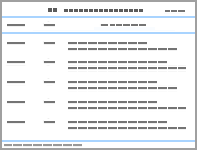
表1
氨基酸含量的描述性统计"
| 性状 Trait | 2020 | 2021 | 遗传多样 性指数 H′ | F值(基因型) FG | |||||||||
|---|---|---|---|---|---|---|---|---|---|---|---|---|---|
| 最小值 Min | 最大值 Max | 平均值 Mean | 标准差 SD | 变异系数 CV (%) | 最小值 Min | 最大值 Max | 平均值 Mean | 标准差 SD | 变异系数 CV (%) | ||||
| 天冬氨酸Asp (%) | 1.69 | 3.32 | 2.47 | 0.34 | 13.90 | 2.03 | 3.66 | 2.70 | 0.32 | 11.77 | 2.02 | 1.92** | |
| 苏氨酸Thr (%) | 0.55 | 1.10 | 0.79 | 0.12 | 14.66 | 0.51 | 1.11 | 0.83 | 0.11 | 13.22 | 2.06 | 2.02** | |
| 丝氨酸Ser (%) | 0.75 | 1.46 | 1.09 | 0.16 | 14.42 | 0.69 | 1.53 | 1.14 | 0.15 | 13.36 | 2.00 | 1.98** | |
| 谷氨酸Glu (%) | 2.61 | 4.77 | 3.68 | 0.52 | 14.25 | 2.36 | 5.39 | 3.96 | 0.56 | 14.14 | 2.08 | 2.03** | |
| 甘氨酸Gly (%) | 0.61 | 1.17 | 0.85 | 0.12 | 14.24 | 0.57 | 1.19 | 0.90 | 0.12 | 13.04 | 2.06 | 1.89** | |
| 丙氨酸Ala (%) | 0.65 | 1.37 | 0.94 | 0.13 | 14.28 | 0.78 | 1.32 | 1.04 | 0.12 | 11.45 | 2.03 | 1.60** | |
| 半胱氨酸Cys (%) | 0.20 | 0.47 | 0.29 | 0.04 | 15.03 | 0.16 | 0.40 | 0.27 | 0.04 | 15.65 | 2.08 | 2.36** | |
| 缬氨酸Val (%) | 0.66 | 1.25 | 0.92 | 0.13 | 13.88 | 0.61 | 1.26 | 0.97 | 0.12 | 12.69 | 2.03 | 1.95** | |
| 甲硫氨酸Met (%) | 0.16 | 0.49 | 0.28 | 0.05 | 18.95 | 0.18 | 0.38 | 0.28 | 0.04 | 12.68 | 2.00 | 1.73** | |
| 异亮氨酸Ile (%) | 0.63 | 1.22 | 0.90 | 0.14 | 15.08 | 0.59 | 1.25 | 0.96 | 0.12 | 12.95 | 2.02 | 1.85** | |
| 亮氨酸Leu (%) | 1.08 | 2.10 | 1.55 | 0.23 | 14.54 | 1.00 | 2.12 | 1.63 | 0.21 | 13.04 | 2.03 | 1.90** | |
| 酪氨酸Tyr (%) | 0.52 | 0.98 | 0.72 | 0.09 | 12.80 | 0.48 | 0.90 | 0.72 | 0.08 | 11.31 | 2.03 | 1.71** | |
| 苯丙氨酸Phe (%) | 0.78 | 1.57 | 1.10 | 0.16 | 14.16 | 0.71 | 1.42 | 1.11 | 0.14 | 12.73 | 2.05 | 1.71** | |
| 赖氨酸Lys (%) | 0.94 | 1.93 | 1.36 | 0.19 | 13.84 | 0.90 | 1.90 | 1.44 | 0.18 | 12.81 | 2.00 | 1.91** | |
| 组氨酸His (%) | 0.40 | 0.73 | 0.56 | 0.07 | 13.28 | 0.47 | 0.83 | 0.61 | 0.07 | 12.18 | 2.04 | 1.76** | |
| 精氨酸Arg (%) | 1.09 | 2.32 | 1.57 | 0.23 | 14.77 | 1.11 | 2.46 | 1.68 | 0.24 | 14.57 | 2.04 | 2.13** | |
| 脯氨酸Pro (%) | 0.68 | 1.35 | 0.98 | 0.15 | 14.78 | 0.61 | 1.37 | 1.01 | 0.14 | 13.87 | 2.05 | 1.97** | |
| 总氨基酸TAA (%) | 14.35 | 26.59 | 20.04 | 2.77 | 13.81 | 13.85 | 28.44 | 21.26 | 2.70 | 12.70 | 2.06 | 1.94** | |

图1
氨基酸的相关性分析 ***:P<0.001。下同"
表2
前3个主成分的特征向量"
| 指标 Indicators | 主成分 Principal component | ||
|---|---|---|---|
| PC1 | PC2 | PC3 | |
| X1 (Asp) | 0.57 | -0.63 | 0.28 |
| X2 (Thr) | -0.02 | 0.23 | -0.06 |
| X3 (Ser) | 0.03 | 0.15 | 0.16 |
| X4 (Glu) | 0.15 | 0.11 | 0.22 |
| X5 (Gly) | 0.14 | 0.10 | 0.01 |
| X6 (Ala) | 0.52 | -0.23 | -0.71 |
| X7 (Cys) | -0.27 | -0.57 | 1.49 |
| X8 (Val) | -0.04 | 0.28 | -0.20 |
| X9 (Met) | -0.22 | -0.57 | -0.20 |
| X10 (Ile) | -0.08 | 0.22 | -0.23 |
| X11 (Leu) | -0.06 | 0.32 | -0.13 |
| X12 (Tyr) | -0.28 | 0.45 | -0.03 |
| X13 (Phe) | -0.51 | 0.95 | -0.36 |
| X14 (Lys) | -0.27 | 0.52 | -0.23 |
| X15 (His) | 0.40 | -0.54 | 0.12 |
| X16 (Arg) | 0.46 | -0.51 | 0.10 |
| X17 (Pro) | 0.15 | 0.08 | 0.32 |
表3
F值与氨基酸的相关性分析"
| 指标Indicators | F值F value | 指标Indicators | F值F value | |
|---|---|---|---|---|
| 天冬氨酸Asp | 0.97** | 异亮氨酸Ile | 0.88** | |
| 苏氨酸Thr | 0.89** | 亮氨酸Leu | 0.89** | |
| 丝氨酸Ser | 0.91** | 酪氨酸Tyr | 0.83** | |
| 谷氨酸Glu | 0.93** | 苯丙氨酸Phe | 0.79** | |
| 甘氨酸Gly | 0.92** | 赖氨酸Lys | 0.84** | |
| 丙氨酸Ala | 0.92** | 组氨酸His | 0.90** | |
| 半胱氨酸Cys | 0.71** | 精氨酸Arg | 0.95** | |
| 缬氨酸Val | 0.89** | 脯氨酸Pro | 0.92** | |
| 甲硫氨酸Met | 0.73** | 总氨基酸TAA | 0.93** |
表4
基于综合评价值筛选的优异种质"
| 材料编号 Accessions | 综合评价值Comprehensive evaluation value | 隶属函数值Membership function value | F值 F value | 排名 Rank | |||||
|---|---|---|---|---|---|---|---|---|---|
| PC1 | PC2 | PC3 | u(X1) | u(X2) | u(X3) | ||||
| ZDD06803 | 2.56 | 4.39 | 0.65 | 1.00 | 0.79 | 0.74 | 0.99 | 1 | |
| ZDD00326 | 2.55 | 4.52 | 0.73 | 0.97 | 0.91 | 1.00 | 0.97 | 2 | |
| ZDD18558 | 2.55 | 4.55 | 0.65 | 0.96 | 0.94 | 0.76 | 0.96 | 3 | |
| ZDD11575 | 2.52 | 4.61 | 0.67 | 0.90 | 0.99 | 0.83 | 0.90 | 4 | |
| ZDD17767 | 2.52 | 4.41 | 0.69 | 0.89 | 0.81 | 0.88 | 0.89 | 5 | |
| ZDD04959 | 2.52 | 4.39 | 0.67 | 0.88 | 0.79 | 0.81 | 0.88 | 6 | |
| ZDD14228 | 2.51 | 4.53 | 0.68 | 0.87 | 0.92 | 0.85 | 0.87 | 7 | |
| ZDD14252 | 2.51 | 4.27 | 0.67 | 0.86 | 0.68 | 0.80 | 0.86 | 8 | |
| ZDD07580 | 2.50 | 4.55 | 0.66 | 0.85 | 0.93 | 0.78 | 0.85 | 9 | |

图2
133份大豆种质F值聚类图 红色:第Ⅰ类GroupⅠ;蓝色:第Ⅱ类GroupⅡ;黑色:第Ⅲ类GroupⅢ Red: GroupⅠ; Blue: GroupⅡ; Black: GroupⅢ"

图3
大豆R6期籽粒氨基酸含量的曼哈顿图和Q-Q图 A:曼哈顿图(从内到外依次为2020TAA、2021TAA、Combined-TAA、F值);B:Q-Q图。2020TAA:2020年总氨基酸含量;2021TAA:2021年总氨基酸含量;Combined-TAA:多环境下总氨基酸含量;F值:综合评价值。下同"
表5
与氨基酸含量显著关联的稳定位点"
| 标记Marker | 染色体Chromosome | 位置Position (bp) | 表型解释率R2 (%) | P值P value | 性状Trait |
|---|---|---|---|---|---|
| Block_Chr.08_40280597_40371555 | 8 | 40280597 | 6.82 | 1.48E-07 | 2020TAA |
| 2.68 | 3.53E-03 | Combined-TAA | |||
| Block_Chr.09_3765291_3798028 | 9 | 3765291 | 14.62 | 9.91E-17 | 2021TAA |
| 5.08 | 2.09E-06 | Combined-TAA | |||
| Chr.10_35011505 | 10 | 35011505 | 1.77 | 7.97E-04 | 2020TAA |
| 0.87 | 2.40E-02 | Combined-TAA | |||
| Block_Chr.13_37392403_37407538 | 13 | 37392403 | 15.70 | 2.95E-18 | 2021TAA |
| 1.46 | 1.37E-02 | Combined-TAA | |||
| Chr.16_35161914 | 16 | 35161914 | 7.88 | 1.40E-10 | 2020TAA |
| 1.28 | 6.06E-03 | Combined-TAA | |||
| Chr.17_3312682 | 17 | 3312682 | 6.53 | 2.61E-09 | 2020TAA |
| 4.59 | 2.84E-07 | Combined-TAA | |||
| 13.48 | 2.96E-16 | F值F value | |||
| Chr.18_38254088 | 18 | 38254088 | 3.92 | 1.54E-06 | 2020TAA |
| 0.37 | 1.42E-01 | Combined-TAA |
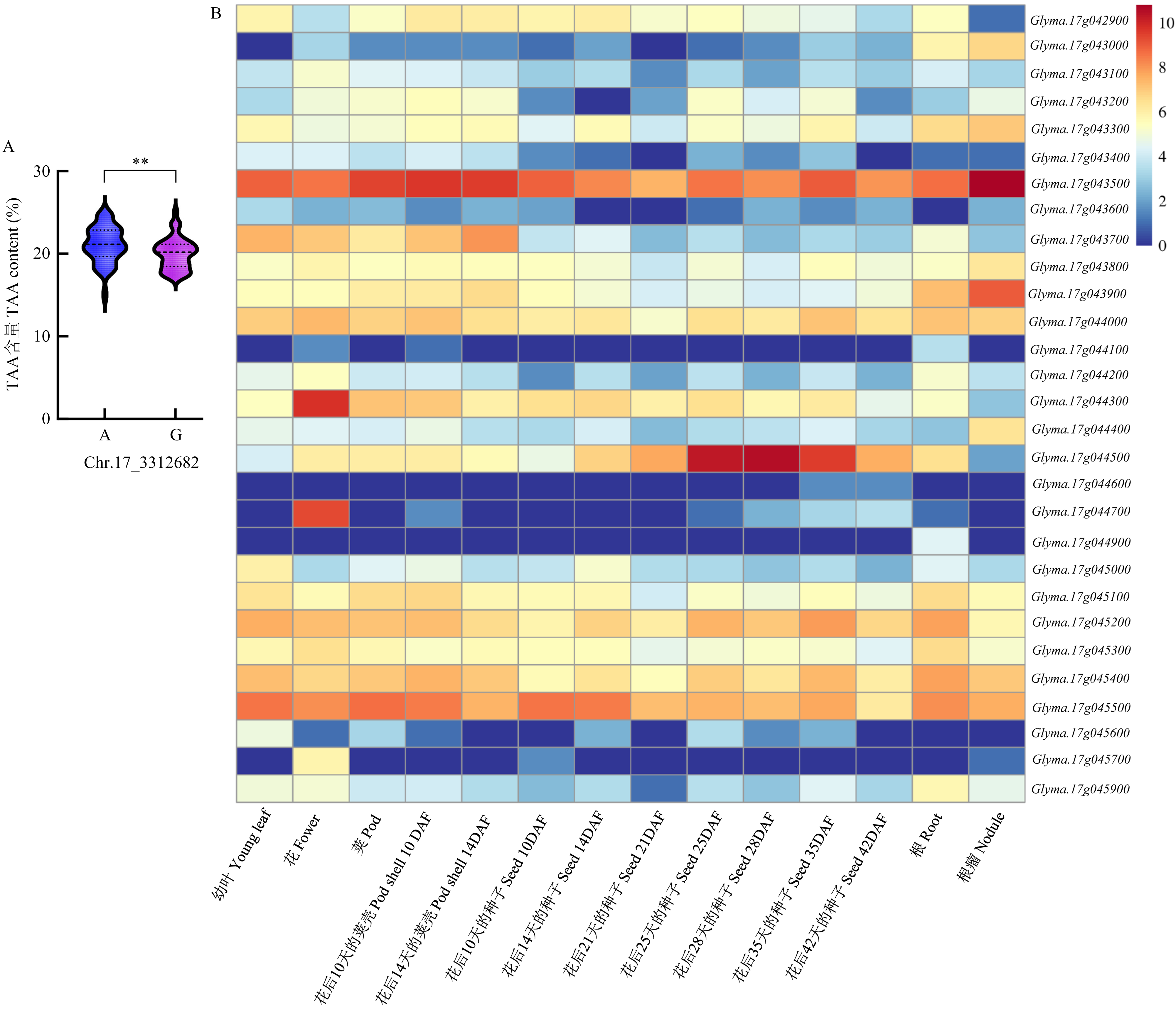
图4
氨基酸含量显著关联位点的单倍型分析和候选基因的组织表达量分析 A:携带Chr.17_3312682-A/G的大豆种质总氨基酸(TAA)含量箱线图;B:候选基因的组织表达热图"

图5
RTM-GWAS检测到的总氨基酸含量QTL等位变异矩阵"
表6
预测的前10个最佳杂交组合"
| 亲本1 P1 | 亲本2 P2 | TAA含量TAA content (%) |
|---|---|---|
| ZDD16743 | ZDD18558 | 29.36 |
| ZDD11575 | ZDD16743 | 29.00 |
| ZDD16743 | ZDD00326 | 28.78 |
| ZDD16743 | ZDD06494 | 28.65 |
| ZDD16743 | ZDD14228 | 28.40 |
| ZDD16743 | ZDD03013 | 28.35 |
| ZDD08228 | ZDD18558 | 28.33 |
| ZDD16771 | ZDD16743 | 28.21 |
| ZDD17574 | ZDD16743 | 28.06 |
| ZDD16743 | ZDD09279 | 27.89 |
| [1] |
|
| [2] |
doi: 10.1186/s12863-019-0737-9 pmid: 30922237 |
| [3] |
|
| [4] |
doi: 10.2527/jas1962.213558x |
| [5] |
doi: 10.1016/j.phytochem.2022.113216 |
| [6] |
doi: 10.1080/10942911003592761 |
| [7] |
王伟威, 王兴宇, 魏崃, 于志远, 赵贵兴, 任洪波, 李波, 刘丽君. 中俄大豆品种氨基酸组成特性分析[J]. 大豆科学, 2015(4): 635-638.
|
|
|
|
| [8] |
doi: 10.1016/j.indcrop.2013.08.064 |
| [9] |
doi: 10.1007/s00122-019-03304-5 pmid: 30806741 |
| [10] |
张红梅, 熊雅文, 许文静, 张威, 王琼, 刘晓庆, 刘慧, 崔晓艳, 陈新, 陈华涛. 大豆R6期籽粒氨基酸含量的全基因组关联分析[J]. 作物学报, 2023, 49(12): 3277-3288.
doi: 10.3724/SP.J.1006.2023.34031 |
|
doi: 10.3724/SP.J.1006.2023.34031 |
|
| [11] |
|
| [12] |
doi: 10.2135/cropsci1986.0011183X002600030042x |
| [13] |
doi: 10.2134/agronj1977.00021962006900030037x |
| [14] |
doi: 10.1016/j.foodchem.2010.07.091 |
| [15] |
张秋英, 李彦生, 刘长锴, 田博文, 涂冰洁, 毛健伟. 菜用大豆食用品质关键组分及其积累动态研究[J]. 作物学报, 2015, 41(11): 1692-1700.
doi: 10.3724/SP.J.1006.2015.01692 |
|
doi: 10.3724/SP.J.1006.2015.01692 |
|
| [16] |
doi: 10.1007/s00122-017-2962-9 pmid: 28828506 |
| [17] |
潘丽媛, 贺建波, 赵晋铭, 王吴彬, 邢光南, 喻德跃, 张小燕, 李春燕, 陈受宜, 盖钧镒. RTM-GWAS方法应用于大豆RIL群体百粒重QTL检测的功效[J]. 中国农业科学, 2020, 53(9): 1730-1742. DOI: 10.3864/j.issn.0578-1752.2020.09.004.
|
|
|
|
| [18] |
doi: 10.3389/fpls.2018.01793 pmid: 30568668 |
| [19] |
李曙光, 曹永策, 贺建波, 王吴彬, 邢光南, 杨加银, 赵团结, 盖钧镒. 大豆巢式关联作图群体蛋白质含量的遗传解析[J]. 中国农业科学, 2020, 53(9): 1743-1755. DOI: 10.3864/j.issn.0578-1752.2020.09.005.
|
|
|
|
| [20] |
邱丽娟, 李英慧, 关荣霞, 刘章雄, 王丽侠, 常汝镇. 大豆核心种质和微核心种质的构建、验证与研究进展[J]. 作物学报, 2009, 35(4): 571-579.
|
|
doi: 10.3724/SP.J.1006.2009.00571 |
|
| [21] |
doi: 10.1016/j.ecolind.2016.03.043 |
| [22] |
谢志坚. 农业科学中的模糊数学方法[M]. 武汉: 华中理工大学出版社, 1983: 99-193.
|
|
|
|
| [23] |
刘鹏鹏, 李江博, 徐红军, 聂迎彬, 韩新年, 孔德真, 桑伟. 新疆冬小麦品种资源蛋白组分及品质的遗传多样性[J]. 中国农业科学, 2025, 58(15): 2948-2959. DOI: 10.3864/j.issn.0578-1752.2025.15.002.
|
|
|
|
| [24] |
贺建波, 刘方东, 王吴彬, 邢光南, 管荣展, 盖钧镒. 限制性两阶段多位点全基因组关联分析法在遗传育种中的应用[J]. 中国农业科学, 2020, 53(9): 1704-1716. DOI: 10.3864/j.issn.0578-1752.2020.09.002.
|
|
|
|
| [25] |
doi: S0168-9452(18)30461-8 pmid: 30107877 |
| [26] |
李福山, 常汝镇, 舒世珍, 常碧影, 陈志萍, 左江湾. 栽培、野生、半野生大豆蛋白质含量及氨基酸组成的初步分析[J]. 大豆科学, 1986, 5(1): 65-72.
|
|
|
|
| [27] |
吕景良, 邵荣春, 吴百灵, 张明, 胡传璞, 吴桂荣. 东北地区大豆品种资源氨基酸组成的分析研究[J]. 大豆科学, 1988, 7(3): 193-201.
|
|
|
|
| [28] |
孙铭, 符开欣, 范彦, 张新全, 张成林, 郭志慧, 汪霞, 马啸. 15份多花黑麦草优良引进种质的表型变异分析[J]. 植物遗传资源学报, 2016, 17(4): 655-662.
|
|
|
|
| [29] |
孟祥勋, 胡明祥. 大豆籽粒蛋白质氨基酸组成成分的相关分析[J]. 大豆科学, 1987, 6(3): 213-219.
|
|
|
|
| [30] |
doi: 10.1007/s00122-023-04280-7 |
| [31] |
doi: 10.3390/plants12081665 |
| [32] |
武晓玲, 梁海媛, 杨峰, 刘卫国, 佘跃辉, 杨文钰. 大豆苗期耐荫性综合评价及其鉴定指标的筛选[J]. 中国农业科学, 2015, 48(13): 2497-2507. DOI: 10.3864/j.issn.0578-1752.2015.13.002.
|
|
|
|
| [33] |
张笛, 袁明, 韩冬伟, 王淑荣, 王振, 孙浩月, 朱治佳, 王连霞, 韩业辉, 王伟. 158份中欧大豆种质资源农艺性状综合评价及分析[J/OL]. 分子植物育种, 2023: 1-9. https://link.cnki.net/urlid/46.1068.s.20230216.1615.027.
|
|
|
|
| [34] |
李欢, 鄢小青, 杨占烈, 谭金玉, 黎小冰, 陈能刚, 吴荣菊, 陈惠查, 阮仁超. 贵州香禾糯地方稻种资源表型遗传多样性分析与综合评价[J]. 中国农业科学, 2023, 56(11): 2035-2046. DOI: 10.3864/j.issn.0578-1752.2023.11.001.
|
|
|
|
| [35] |
沈倩, 张思平, 刘瑞华, 刘绍东, 陈静, 葛常伟, 马慧娟, 赵新华, 杨国正, 宋美珍, 庞朝友. 棉花出苗期耐冷综合评价体系的构建及耐冷指标筛选[J]. 中国农业科学, 2022, 55(22): 4342-4355. DOI: 10.3864/j.issn.0578-1752.2022.22.002.
|
|
|
|
| [36] |
杨涛, 黄雅婕, 李生梅, 任丹, 崔进鑫, 庞博, 于爽, 高文伟. 海岛棉种质资源表型性状的遗传多样性分析及综合评价[J]. 中国农业科学, 2021, 54(12): 2499-2509. DOI: 10.3864/j.issn.0578-1752.2021.12.002.
|
|
|
|
| [37] |
黎松松, 赖建军, 张红梅, 崔晓艳, 刘晓庆, 陈新, 朱月林, 陈华涛. 江苏鲜食春大豆种质资源表型鉴定及综合评价[J]. 大豆科学, 2022, 41(4): 385-396.
|
|
|
|
| [38] |
石彦国, 单彤彤, 曾剑华, 刘琳琳, 朱秀清. 基于主成分分析和偏最小二乘法的蒸煮大豆食味品质评价[J]. 中国食品学报, 2019, 19(10): 265-277.
|
|
|
|
| [39] |
杜世坤, 赵宝勰, 赵振宁, 高玉芳, 李雨阳, 陈彩霞, 强旭阳. 间作用大豆亲本的相关性、主成分及聚类分析[J]. 分子植物育种, 2022, 20(1): 266-275.
|
|
|
|
| [40] |
doi: 10.2135/cropsci2013.11.0735 |
| [41] |
doi: 10.3389/fpls.2022.899212 |
| [42] |
陈文杰, 梁江, 钟开珍, 韦清源, 汤复跃, 曾维英, 陈渊. 大豆抗花叶病毒材料初步筛选及评价[J]. 大豆科学, 2012, 31(4): 617-620.
|
|
|
|
| [43] |
doi: 10.3390/ijms20235915 |
| [44] |
段金涛. 大豆蛋白质含量及组分的全基因组关联分析[D]. 雅安: 四川农业大学, 2022.
|
|
|
| [1] | 王小玮, 杜佛力, 闫红财, 郎正东, 党志娟, 李葆春, 汪军成, 马小乐, 王化俊, 张宏, 姚立蓉. 396份春小麦灌浆期和成熟期抗旱性评价[J]. 中国农业科学, 2026, 59(8): 1608-1621. |
| [2] | 陈宣伊, 郭星星, 张向前, 路战远, 刘凌悦, 罗方, 李金龙, 张传玲, 张志青, 车曼青. 间作行比对玉米冠层光环境异质性和光合物质生产的影响[J]. 中国农业科学, 2026, 59(8): 1653-1671. |
| [3] | 崔节浩, 张萌, 王沁, 于佳妍, 林琨, 李尚泽, 兰恒, 耿艳秋, 张强, 郭丽颖, 邵玺文. 粳稻资源抗倒伏性评价与生理机制[J]. 中国农业科学, 2026, 59(7): 1420-1438. |
| [4] | 李永娟, 张悦彤, 王艺博, 赵长江, 宋洁, 陈雪丽, 姚钦. 生物炭施用对大豆轮连作系统土壤固氮微生物nifH基因丰度及群落组成的影响[J]. 中国农业科学, 2026, 59(6): 1272-1285. |
| [5] | 郝琨, 陈洪德, 张威, 钟韵, 党美荣, 朱士江, 黄志坤, 金英. 基于柑橘产量、品质及水氮利用的涌泉根灌水氮综合评价[J]. 中国农业科学, 2026, 59(4): 862-873. |
| [6] | 刘方东, 孙磊, 王吴彬, 赵晋铭, 盖钧镒. 我国大豆种植制度的变更和生态栽培区划调整的建议[J]. 中国农业科学, 2026, 59(3): 486-498. |
| [7] | 年雪妍, 张庆, 张建国, 屠焰. 基于生命周期评价法的中国大豆及豆粕生产碳足迹(2014—2023年)[J]. 中国农业科学, 2026, 59(20): 4617-4629. |
| [8] | 刘泽洋, 梁亚宁, 陈琪, 谈梦琪, 张慧贤, 袁子彧, 杨勇, 张飞, 徐强, 邓秀新, 陈嘉景, 徐娟. 药用柑橘应用研究现状与前景[J]. 中国农业科学, 2026, 59(20): 4547-4569. |
| [9] | 蔡廷阳, 朱玉鹏, 李瑞东, 吴宗声, 徐一帆, 宋雯雯, 徐彩龙, 吴存祥. 苗期叶损伤对黄淮海夏大豆光合特性、荚果分布及产量形成的影响[J]. 中国农业科学, 2026, 59(2): 292-304. |
| [10] | 苏万龙, 任海燕, 薛晓芳, 石美娟, 刘丽, 赵爱玲, 李毅, 王永康. 基于感官、质构、理化分析的枣果品质综合评价[J]. 中国农业科学, 2026, 59(18): 4135-4148. |
| [11] | 王柯, 宫浩然, 王玉斌, 张彦威, 王彩洁, 刘鑫, 徐冉. 大豆品种产量源流库指标相互关系分析[J]. 中国农业科学, 2026, 59(16): 3519-3540. |
| [12] | 楚洪恩, 刘源, 白雪, 杨梦丽, 刘涛, 李芬, 李兰兰, 马云. 基于ATAC-seq筛选调控肉牛肌肉发育的关键转录因子[J]. 中国农业科学, 2026, 59(16): 3687-3698. |
| [13] | 丁倩, 何丽莲, 钱禛锋, 吴期滨, 赵昌祖, 林佩霞, 农韦优, 王誉洁, 张媛媛, 阙友雄, 李富生. 不同甘蔗品种/系脱叶性综合评价及叶鞘离区细胞形态和生理差异分析[J]. 中国农业科学, 2026, 59(15): 3315-3327. |
| [14] | 宋可心, 张茜南, 章金益, 孔影, 刘建, 兰青阔, 王永, 吴疆, 赵新. 转基因大豆WYN341GmC数字PCR精准定量检测方法的建立[J]. 中国农业科学, 2026, 59(14): 3022-3037. |
| [15] | 张新博, 范震, 吴昱霖, 王嘉豪, 罗璇, 林延荣, 强斌斌, 任小龙, 陈小莉. 玉米-大豆垄沟间作对半干旱地区作物产量和水分利用的影响[J]. 中国农业科学, 2026, 59(14): 3056-3069. |
|
||
