






中国农业科学 ›› 2026, Vol. 59 ›› Issue (16): 3519-3540.doi: 10.3864/j.issn.0578-1752.2026.16.005
王柯1,2( ), 宫浩然2(), 王玉斌1, 张彦威1, 王彩洁1, 刘鑫2(), 徐冉1()
收稿日期:2026-01-06
接受日期:2026-06-03
出版日期:2026-08-16
发布日期:2026-08-18
通信作者:
联系方式:
王柯,E-mail:15934542457@163.com。宫浩然,E-mail:1664956537@qq.com。王柯和宫浩然为同等贡献作者。
基金资助:
WANG Ke1,2(), GONG HaoRan2(), WANG YuBin1, ZHANG YanWei1, WANG CaiJie1, LIU Xin2(), XU Ran1()
Received:2026-01-06
Accepted:2026-06-03
Published:2026-08-16
Online:2026-08-18
摘要:
【目的】 评估大豆品种产量源、流、库指标对产量的贡献程度,明确产量形成过程中源、流、库各指标之间的相互关系,揭示影响大豆产量形成的关键生理机制,为大豆育种提供理论依据。【方法】 以大豆结荚期和鼓粒期为关键时期,采用13C同位素标记技术,系统分析齐黄34、临豆9号、潍豆9号、菏豆12在多生育时期的光合特性、器官物质积累及干物重变化,从源、流、库三方面对品种间生理特征进行综合评价。通过雷达图对各类指标进行整合分析,旨在阐明不同大豆品种产量形成过程中源、流、库关系的差异及其协同特征。【结果】 (1)源、流、库各指标与产量的相关性不同,与大豆产量的相关性强弱依次为:叶面积指数>百粒重>净光合速率>栅栏组织厚度>实际光化学效率>谷氨酰胺合成酶活性>谷氨酸合成酶活性>筛管平均直径>气孔导度>主叶脉直径。(2)源、流、库各指标存在互作。源库互作表现为:净光合速率、气孔导度、蒸腾速率与百粒重呈正相关关系;源流互作表现为:栅栏组织厚度与净光合速率、叶片厚度与净光合速率呈正相关关系;库流互作表现为:百粒重与筛管平均直径呈正相关关系。(3)不同大豆品种间源、流、库的表现有差异,齐黄34的叶面积指数、栅栏组织厚度、叶片厚度、净光合速率、实际光化学效率、主茎荚的持续积累能力、产量、百粒重、谷氨酰胺合成酶活性、谷氨酸合成酶活性、3 d主茎荚的转运能力、主茎荚的持续转运能力均高于其他3个品种。菏豆12的主叶脉直径、潍豆9号的株粒数、临豆9号的分枝荚碳吸收能力则高于其他3个品种,表明大豆高产的形成不依赖于单一的指标,而是源、流、库3个系统性指标的协同作用。【结论】 在4个供试品种中,齐黄34产量显著高于其他品种,主要优势在于较高的叶面积指数、较强的物质转运能力及较大的百粒重。在大豆育种中,为选育源、流、库协调的大豆高产品种,应基于实际光化学效率、净光合速率和叶面积指数等指标筛选高光效种质资源,再结合叶片与维管束解剖结构评价同化物运输效率,最后综合氮代谢酶活性及库容性状判断产量潜力,实现高产大豆品种的高效选育。
王柯, 宫浩然, 王玉斌, 张彦威, 王彩洁, 刘鑫, 徐冉. 大豆品种产量源流库指标相互关系分析[J]. 中国农业科学, 2026, 59(16): 3519-3540.
WANG Ke, GONG HaoRan, WANG YuBin, ZHANG YanWei, WANG CaiJie, LIU Xin, XU Ran. Analysis of Interrelationships Among Yield Source, Flow, and Sink Traits in Soybean Cultivars[J]. Scientia Agricultura Sinica, 2026, 59(16): 3519-3540.

表1
供试大豆品种信息"
| 品种Variety | 审定区域Approval status | 有效分枝Effective branches | 特性Characteristic |
|---|---|---|---|
| 齐黄34 Qihuang 34 | 国家审定Approved by the state | 1.3 | 高产、优质High yield, high quality |
| 菏豆12 Hedou 12 | 国家审定Approved by the state | 1.0—3.0 | 高产、优质High yield, high quality |
| 临豆9号Lindou 9 | 国家审定Approved by the state | 3.7 | 高蛋白型High-protein |
| 潍豆9号Weidou 9 | 山东省审定Approved by Shandong province | 1.9 | 高油型High-oil |
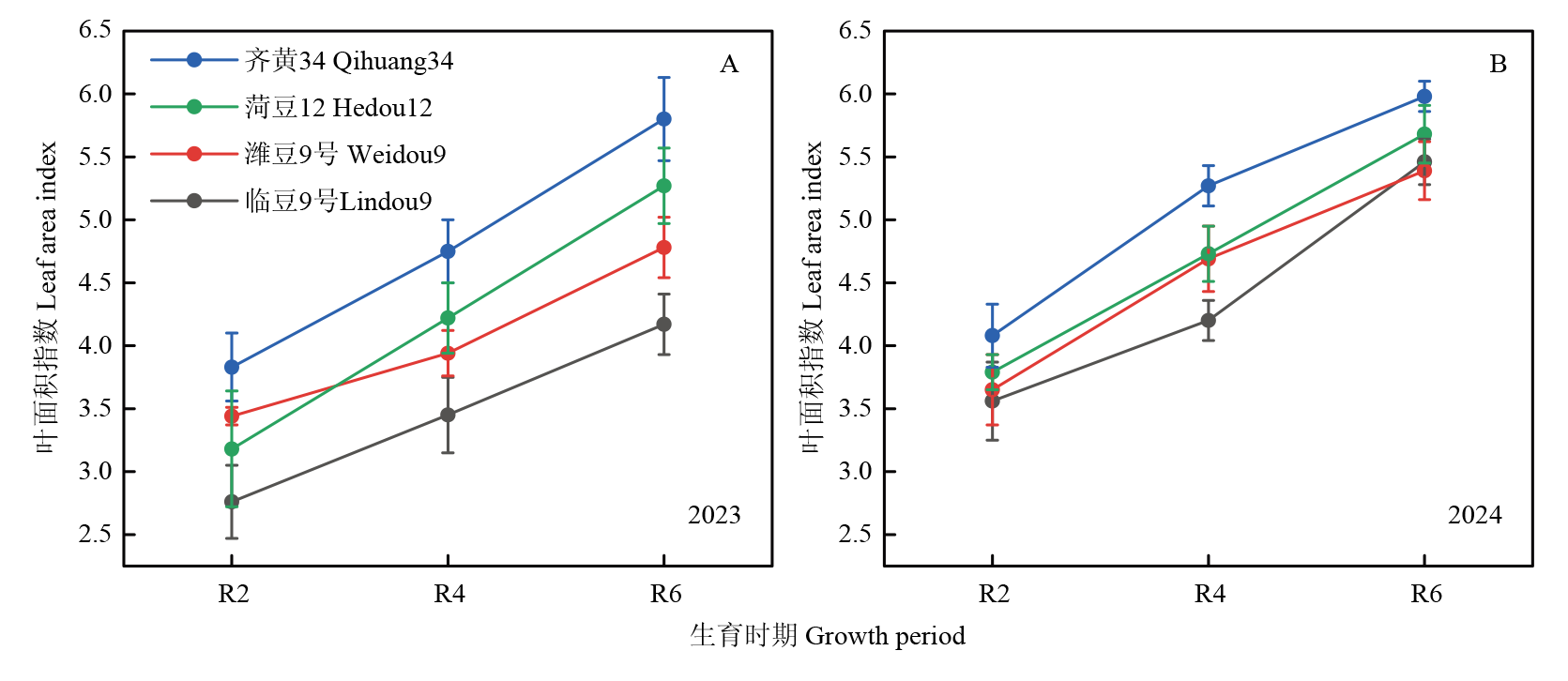
图1
不同大豆品种叶面积指数的变化趋势 R2:盛花期;R4:盛荚期;R6:鼓粒期。下同"
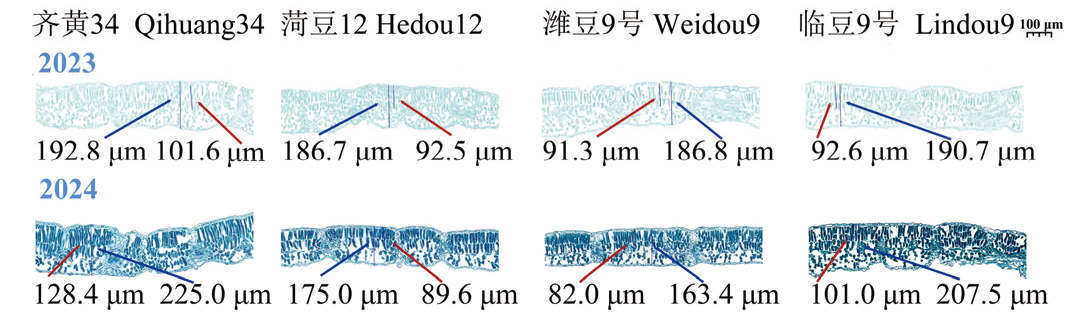
图2
鼓粒期不同大豆品种叶片剖面结构 红色线指向为栅栏组织厚度,蓝色线指向为叶片厚度"
表2
鼓粒期不同大豆品种叶片栅栏组织厚度、叶片厚度"
| 年份Year | 品种Cultivar | 栅栏组织厚度Palisade tissue thickness (μm) | 叶片厚度Leaf thickness (μm) |
|---|---|---|---|
| 2023 | 齐黄34 Qihuang 34 | 102.67±6.76a | 195.50±4.85a |
| 菏豆12 Hedou 12 | 93.57±1.93b | 184.27±2.18a | |
| 潍豆9号Weidou 9 | 91.53±1.56b | 187.13±0.85a | |
| 临豆9号Lindou 9 | 95.23±2.31b | 191.73±10.89a | |
| 2024 | 齐黄34 Qihuang 34 | 119.00±13.13b | 218.90±11.80a |
| 菏豆12 Hedou 12 | 79.30±9.72c | 172.20±3.34b | |
| 潍豆9号Weidou 9 | 80.50±1.37c | 165.10±2.44b | |
| 临豆9号Lindou 9 | 98.60±2.12a | 212.40±4.52a |
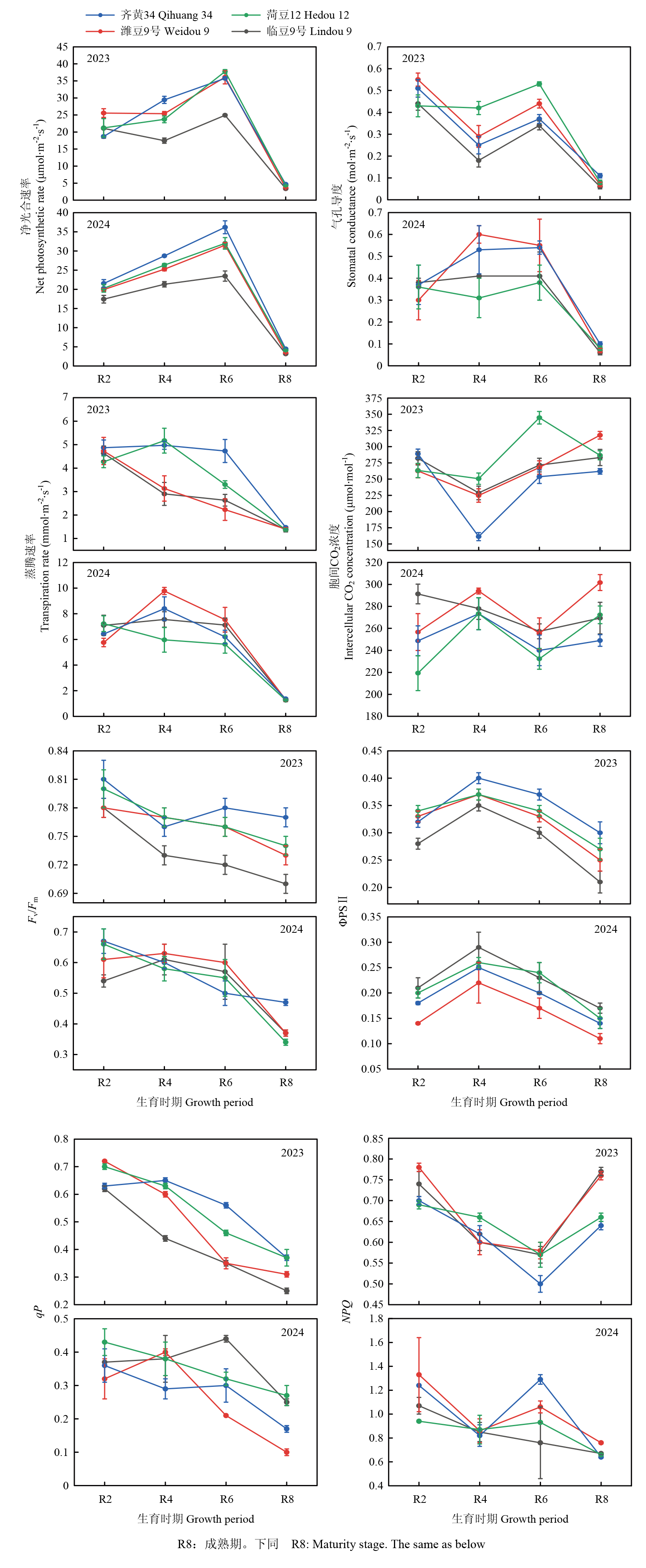
图3
不同大豆品种光合指标、叶绿素荧光参数指标的变化趋势 R8:成熟期。下同"
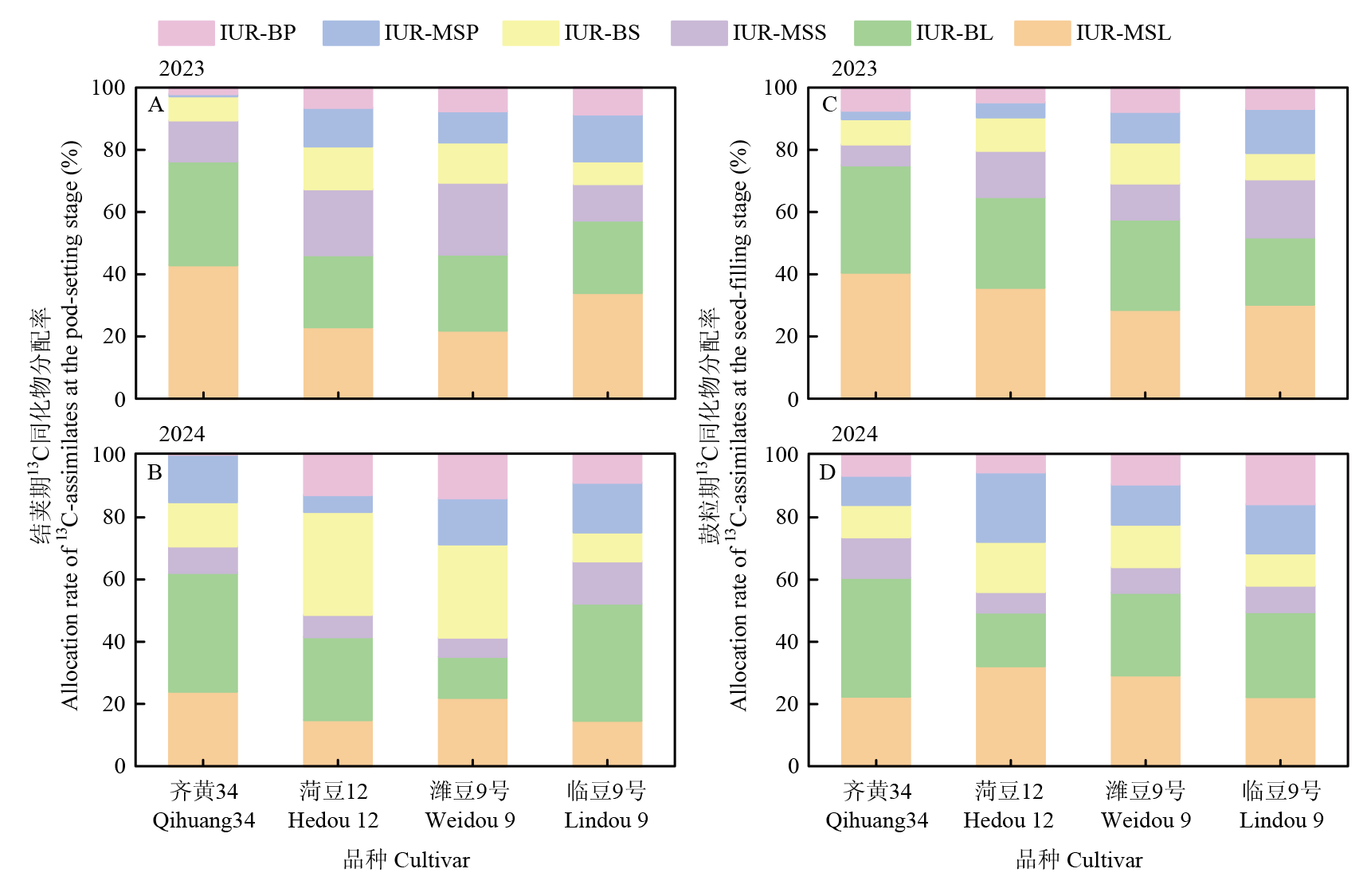
图4
不同品种在结荚期和鼓粒期13C标记后立即取样时不同器官13C分配率 IUR-BP:分枝荚13C瞬时吸收率;IUR-MSP:主茎荚13C瞬时吸收率;IUR-BS:分枝茎秆13C瞬时吸收率;IUR-MSS:主茎茎秆13C瞬时吸收率;IUR-BL:分枝叶片13C瞬时吸收率;IUR-MSL:主茎叶片13C瞬时吸收率。下同"
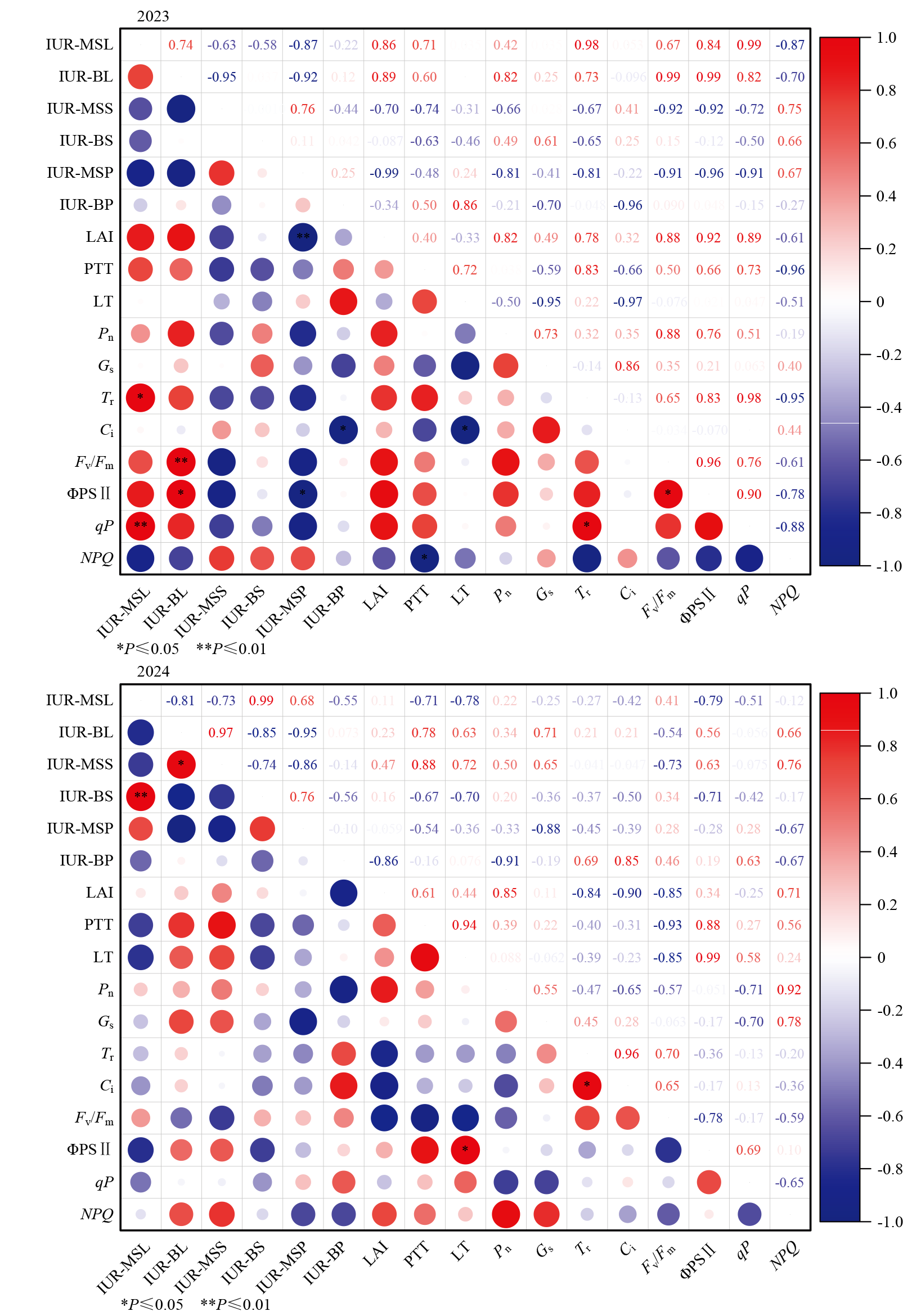
图5
鼓粒期各器官13C瞬时吸收率与源各项指标的相关性 *表示在P≤0.05水平上显著,**表示在P≤0.01水平上显著。LAI:叶面积指数;PTT:栅栏组织厚度;LT:叶片厚度;Pn:净光合速率;Gs:气孔导度;Tr:蒸腾速率;Ci:胞间二氧化碳浓度;Fv/Fm:PSⅡ最大光化学量子产量;ΦPSⅡ:实际光化学效率;qP:光化学荧光淬灭系数;NPQ:非光化学荧光淬灭系数。下同"
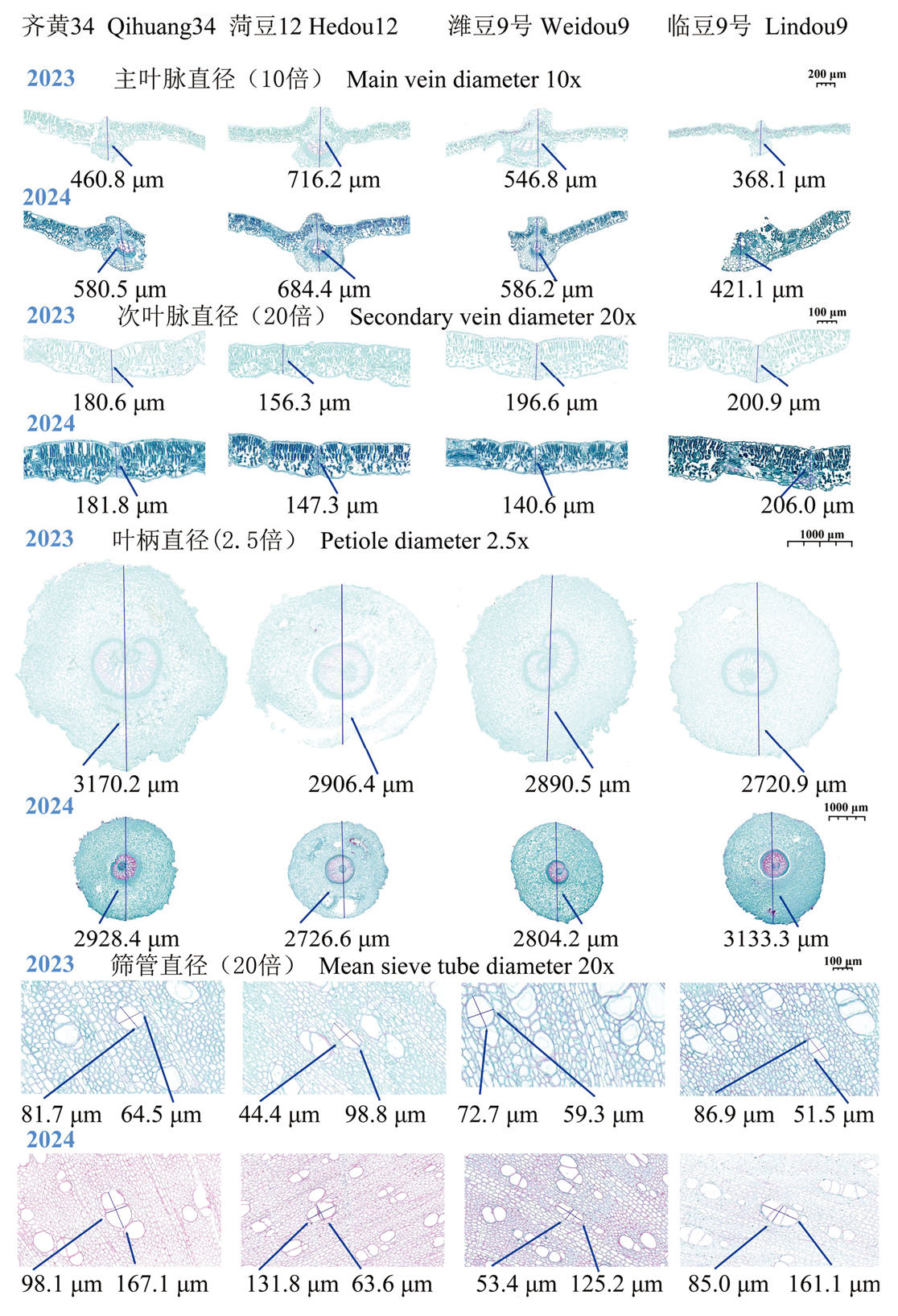
图6
不同大豆品种叶片、叶柄、茎秆剖面结构"
表3
鼓粒期不同大豆品种叶脉直径、叶柄直径、筛管平均直径"
| 年份 Year | 品种 Cultivar | 主叶脉直径 Midrib diameter (μm) | 次叶脉直径 Secondary vein diameter (μm) | 叶柄直径 Petiole diameter (μm) | 筛管平均直径 Mean sieve tube diameter (μm) |
|---|---|---|---|---|---|
| 2023 | 齐黄34 Qihuang 34 | 458.33±4.71c | 185.90±13.36b | 3180.83±15.09a | 72.75±2.79a |
| 菏豆12 Hedou 12 | 716.33±12.30a | 148.40±1.10c | 2913.60±16.80b | 67.78±3.90a | |
| 潍豆9号Weidou 9 | 547.73±5.86b | 195.00±4.52ab | 2883.33±8.46b | 67.67±1.81a | |
| 临豆9号Lindou 9 | 368.20±2.85d | 204.67±6.35a | 2717.50±25.67c | 70.05±0.74a | |
| 2024 | 齐黄34 Qihuang 34 | 584.63±5.12b | 179.70±9.92b | 2899.50±30.74b | 126.80±7.94b |
| 菏豆12 Hedou 12 | 686.67±2.87a | 143.97±6.93c | 2688.53±33.33d | 92.92±4.17c | |
| 潍豆9号Weidou 9 | 587.47±1.30b | 138.87±7.26c | 2783.20±31.32c | 83.80±5.85c | |
| 临豆9号Lindou 9 | 420.33±2.06c | 204.53±1.40a | 3131.17±17.80a | 121.97±4.57a |
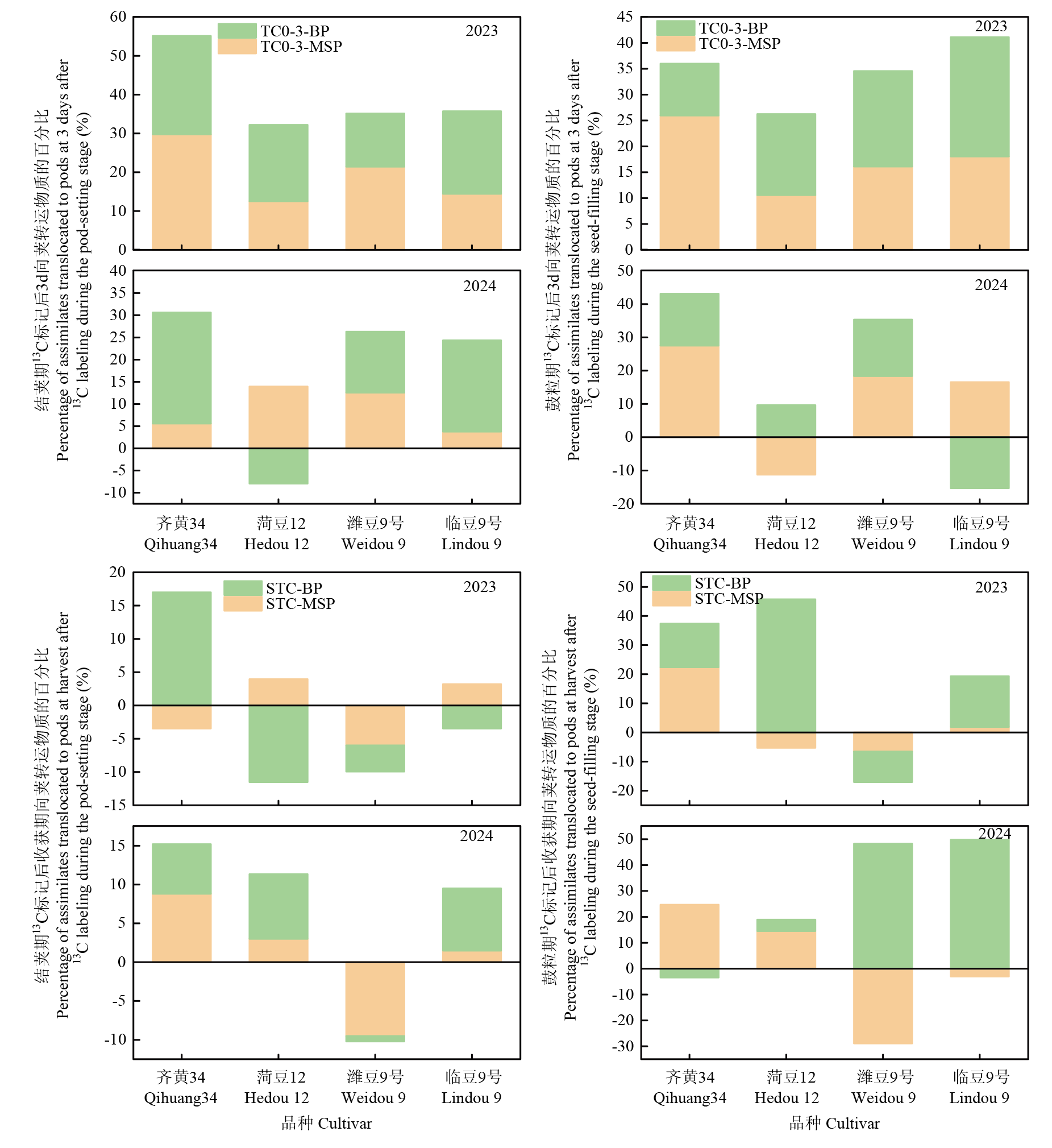
图7
不同品种结荚期和鼓粒期13C标记后品种的物质转运能力 TC0-3-BP:0—3 d向分枝荚转运能力;TC0-3-MSP:0—3 d向主茎荚转运能力;STC-BP:分枝荚的持续转运能力;STC-MSP:主茎荚的持续转运能力。下同"
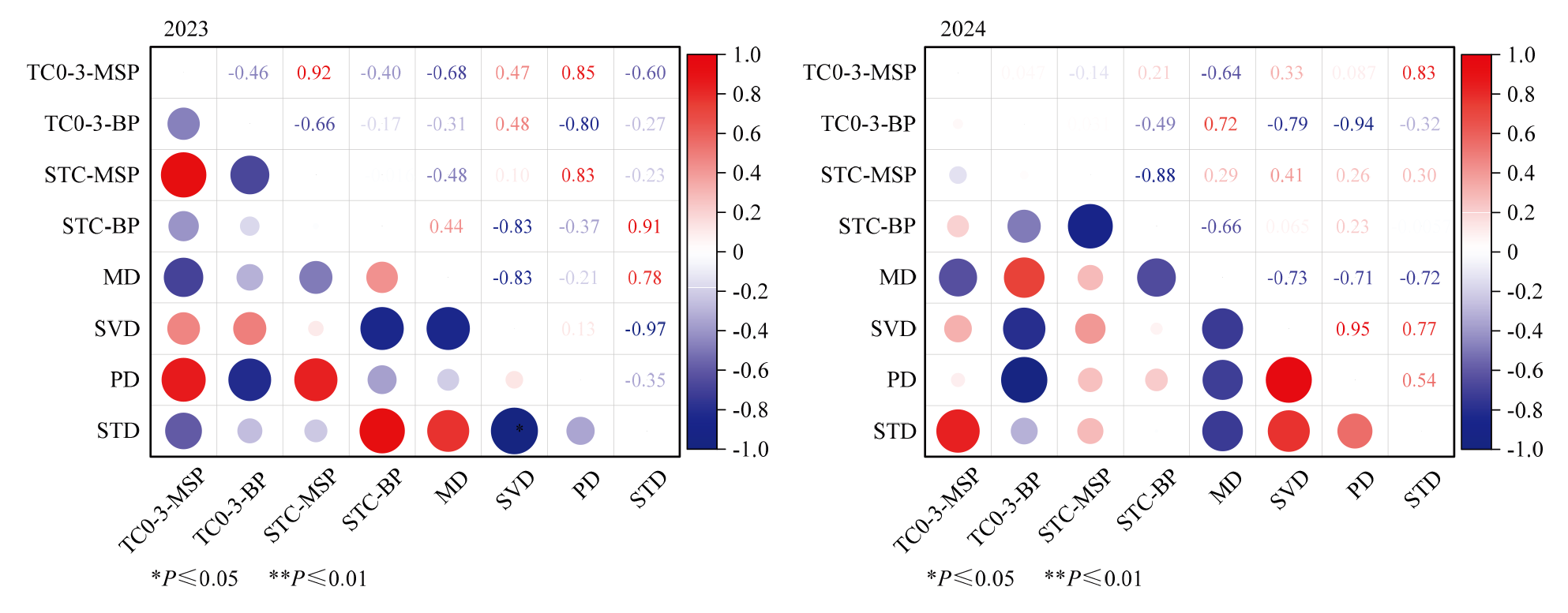
图8
鼓粒期同化物向荚的转运能力与流各项指标的相关性(2023—2024) MD:主叶脉直径;SVD:次叶脉直径;PD:叶柄直径;STD:筛管平均直径。下同"
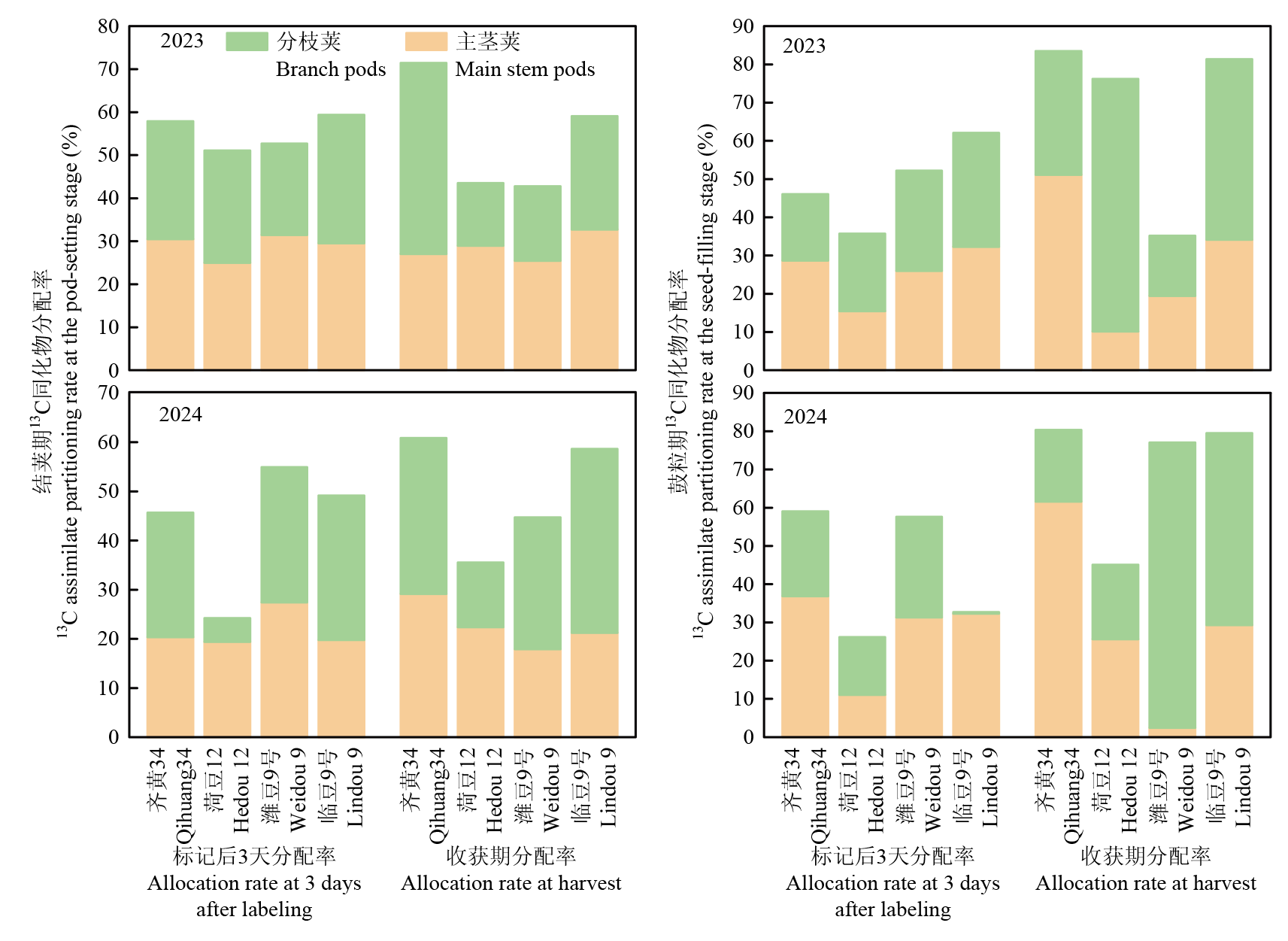
图9
不同品种结荚期和鼓粒期13C标记后荚的同化物分配率"
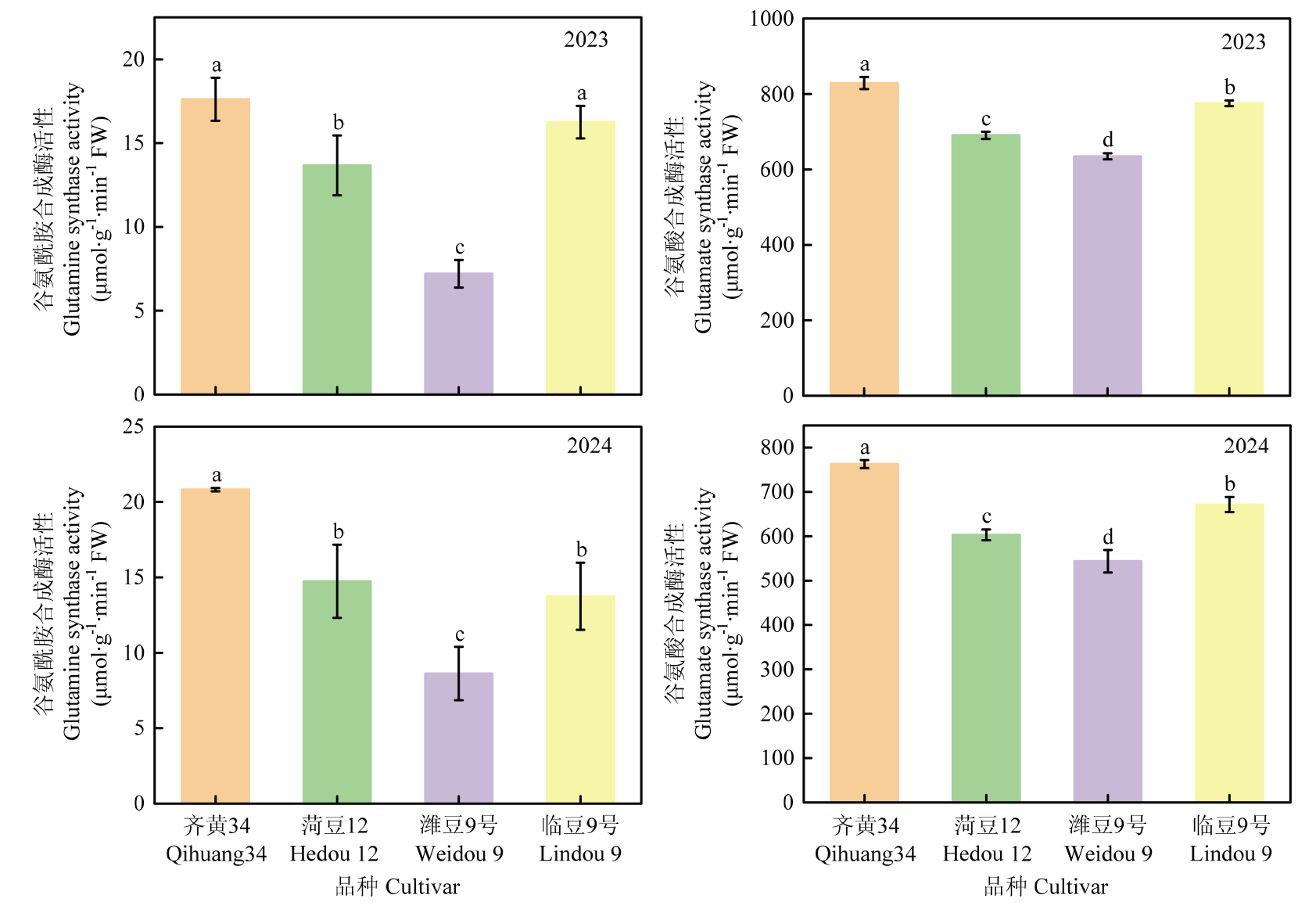
图10
不同大豆品种籽粒中谷氨酸合成酶活性、谷氨酰胺合成酶活性"
表4
不同大豆品种的产量、产量构成因素及经济系数"
| 年份 Year | 品种 Cultivar | 株粒数 Grains per plant | 百粒重 100-grain weight (g) | 株数 Plants per hectare (plants/hm2) | 产量 Yield (kg·hm-2) | 经济系数 Harvest index |
|---|---|---|---|---|---|---|
| 2023 | 齐黄34 Qihuang 34 | 113.28±9.26ab | 26.32±0.47a | 143850.16±617.61a | 3556.16±93.61a | 0.52±0.02ab |
| 菏豆12 Hedou 12 | 104.45±5.51bc | 24.81±0.53ab | 149307.18±1217.73a | 3446.93±94.9ab | 0.53±0.01a | |
| 潍豆9号Weidou 9 | 122.96±5.51a | 19.48±1.85c | 158772.30±5986.74a | 3285.60±120.07bc | 0.50±0.01b | |
| 临豆9号Lindou 9 | 93.24±8.57c | 23.10±0.83b | 154006.30±1805.22a | 3213.44±106.71b | 0.50±0.02ab | |
| 2024 | 齐黄34 Qihuang 34 | 127.90±10.00a | 26.49±1.23a | 160269.12±2038.59a | 3680.84±137.69a | 0.52±0.02a |
| 菏豆12 Hedou 12 | 117.30±11.53ab | 22.39±1.35b | 150406.47±1210.47a | 3360.94±75.51b | 0.51±0.03a | |
| 潍豆9号Weidou 9 | 113.97±6.69ab | 20.01±0.64b | 154585.85±959.76a | 3337.15±46.85b | 0.50±0.03a | |
| 临豆9号Lindou 9 | 100.50±9.49b | 20.30±1.10ab | 162570.85±1302.93a | 3254.55±75.12b | 0.50±0.04a |
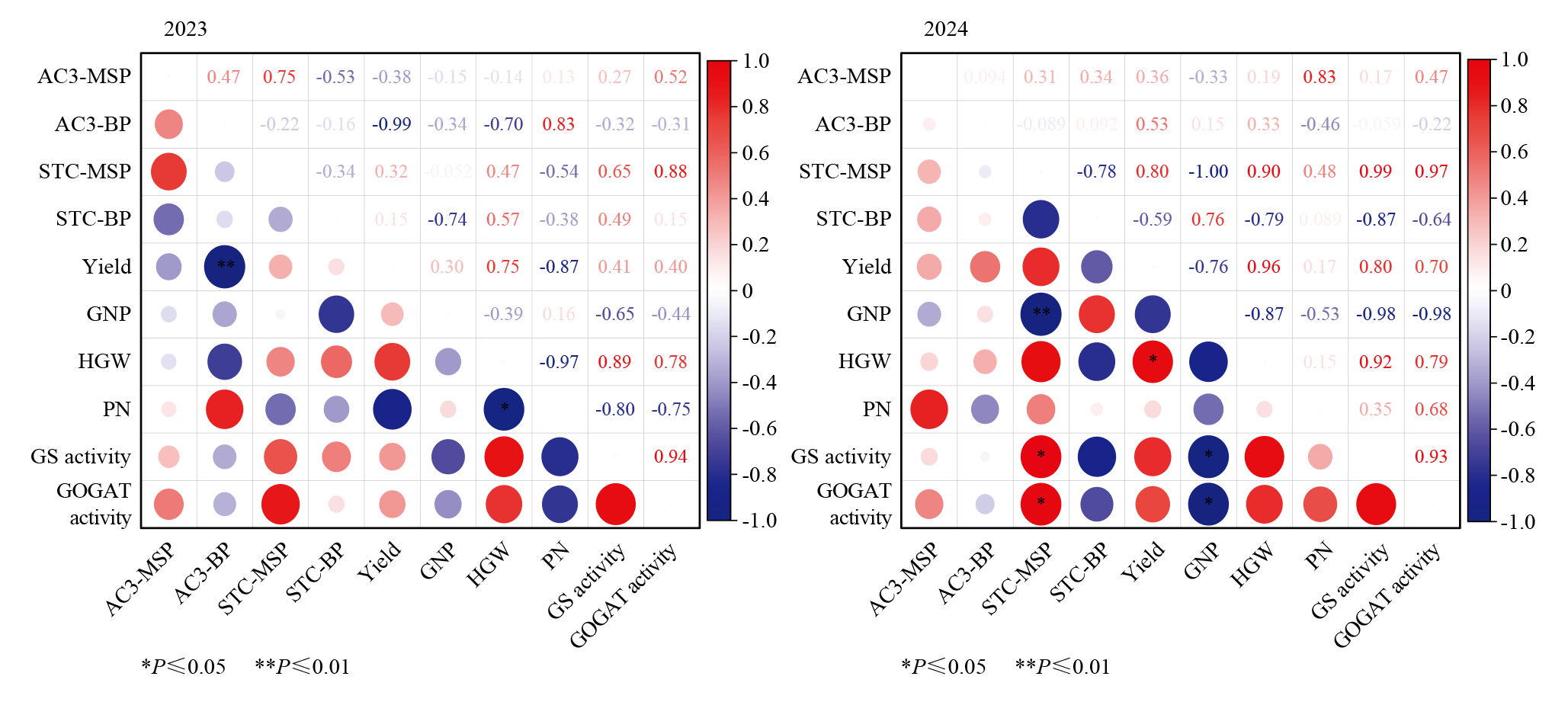
图11
鼓粒期主茎荚、分枝荚的积累能力与库各项指标的相关性(2023—2024) Yield:产量;GNP:株粒数;HGW:百粒重;PN:株数;GS activity:谷氨酰胺合成酶活性;GOGAT activity:谷氨酸合成酶活性。下同"
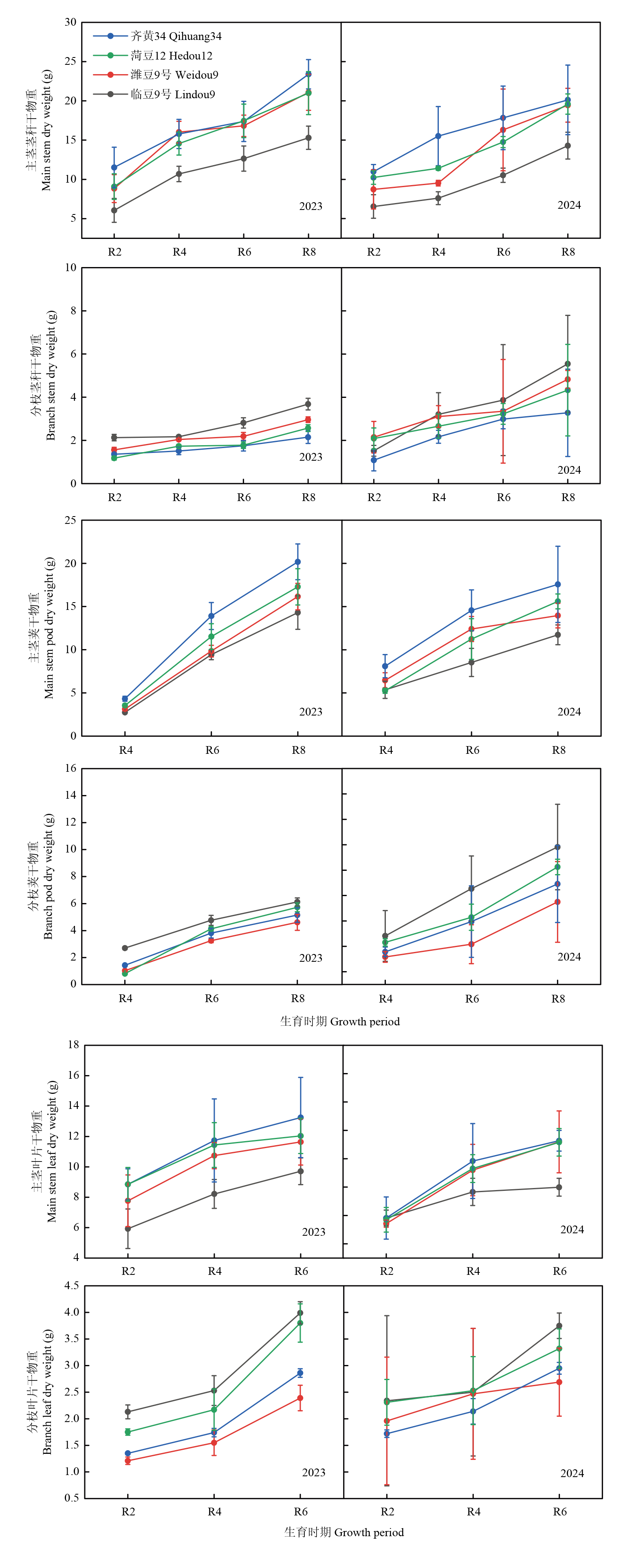
图12
不同大豆品种干物重的变化趋势(2023—2024)"
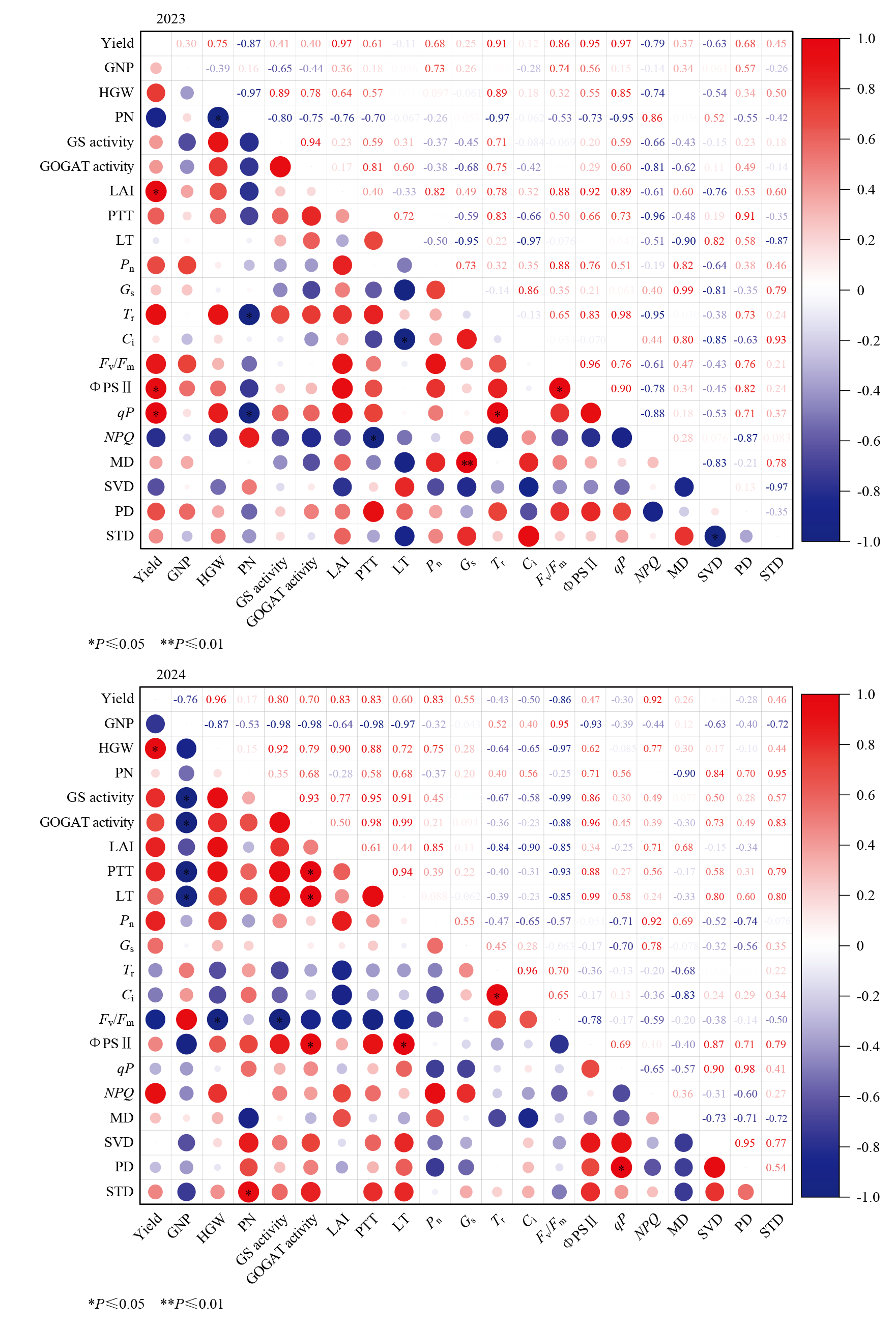
图13
不同大豆品种源、流、库指标及其与产量的相关性(2023—2024)"

图14
不同大豆品种源、流、库指标雷达图(2023—2024) 将齐黄34的数据标准化为1,其他品种数据均参照齐黄34标准化"
| [1] |
殷瑞锋. 未来我国大豆进口量仍将保持高位[J]. 中国农民合作社, 2023(10): 28-31.
|
|
|
|
| [2] |
郭勇, 姜思琦, 于莉莉, 徐江源, 洪慧龙, 邱丽娟. 基于国内外大豆品种比较的中国大豆品种改良路径探索[J]. 大豆科学, 2024, 43(4): 395-401.
|
|
|
|
| [3] |
丁艳明. 中美两国大豆生产成本对比及2024年生产展望[J]. 黑龙江粮食, 2024(6): 18-19, 23.
|
|
|
|
| [4] |
周宇, 孙童, 张艳红, 汝艳, 苏坦, 王帅, 朱金燕, 胡金龙, 熊强强, 张洪程, 周年兵. 施氮量对不同源库类型粳稻物质积累与氮素吸收的影响[J]. 中国农业科学, 2025, 58(11): 2096-2117. DOI: 10.3864/j.issn.0578-1752.2025.11.004.
|
|
|
|
| [5] |
doi: 10.1002/csc2.v65.2 |
| [6] |
于治广. 不同水分条件下燕麦产量形成的源库流关系研究[D]. 呼和浩特: 内蒙古农业大学, 2021.
|
|
|
|
| [7] |
|
| [8] |
doi: 10.1111/nph.20246 pmid: 39511951 |
| [9] |
doi: 10.1016/j.fecs.2022.100073 |
| [10] |
doi: 10.3389/fpls.2025.1622308 |
| [11] |
doi: 10.3390/biom12121772 |
| [12] |
doi: 10.3389/fpls.2022.787837 |
| [13] |
doi: 10.1111/nph.v239.5 |
| [14] |
doi: 10.3389/fpls.2024.1454615 |
| [15] |
doi: 10.3389/fpls.2022.885479 |
| [16] |
doi: 10.1002/tpg2.v17.2 |
| [17] |
doi: 10.1093/jxb/erz480 pmid: 31665486 |
| [18] |
doi: 10.1093/jxb/erac410 |
| [19] |
doi: 10.1093/jxb/erae310 pmid: 39021198 |
| [20] |
doi: 10.3389/fpls.2024.1337544 |
| [21] |
doi: 10.1111/pce.v49.7 |
| [22] |
doi: 10.1016/j.molp.2022.11.015 |
| [23] |
doi: 10.1038/s41598-021-04043-8 pmid: 35017557 |
| [24] |
李照君, 田汝美, 蒲艳艳, 宫永超, 刘艳, 刘玉芹, 李娜娜, 丁汉凤. 大豆光合指标日变化规律及其与产量关系研究[J]. 大豆科学, 2020, 39(4): 577-586.
|
|
|
|
| [25] |
刘薇, 王玉斌, 李伟, 张礼凤, 王彩洁, 徐冉, 戴海英, 张彦威. 大豆品种齐黄34广适性的遗传分析[J]. 山东农业科学, 2023, 55(5): 22-27.
|
|
|
|
| [26] |
doi: 10.1590/S0103-31312000000300003 |
| [27] |
doi: 10.1016/0003-9861(73)90435-9 pmid: 4150338 |
| [28] |
doi: 10.1104/pp.67.6.1198 pmid: 16661836 |
| [29] |
doi: 10.1038/s41598-022-14298-4 pmid: 35729247 |
| [30] |
doi: 10.1111/jac.v209.1 |
| [31] |
doi: 10.1038/s41598-024-81783-3 |
| [32] |
宋杰, 任昊, 赵斌, 张吉旺, 任佰朝, 李亮, 王少祥, 黄金苓, 刘鹏. 施钾量对夏玉米维管组织结构与物质运输性能的影响[J]. 作物学报, 2022, 48(11): 2908-2919.
doi: 10.3724/SP.J.1006.2022.23005 |
|
doi: 10.3724/SP.J.1006.2022.23005 |
|
| [33] |
doi: 10.1111/pce.v49.7 |
| [34] |
doi: 10.1093/plphys/kiab116 pmid: 33693938 |
| [35] |
doi: 10.3390/biom13121771 |
| [36] |
doi: 10.3389/fpls.2022.1058774 |
| [37] |
doi: 10.1111/nph.v242.3 |
| [38] |
doi: 10.3390/ijms24032255 |
| [1] | 白晶晶, 章宇辰, 倪子捷, 高佳勇, 刘伟洋, 盖东升, 王雨行, 何佳庆, 张强, 邵玺文, 吴莹, 耿艳秋, 郭丽颖. 不同灌溉量对东北地区水稻抗倒伏特性及产量的影响[J]. 中国农业科学, 2026, 59(9): 1848-1868. |
| [2] | 蔡巧红, 周甜, 苏明, 洪自强, 李翻过, 李彤, 汪华, 康建宏, 吴宏亮. 宁夏引黄灌区减氮增钾施肥模式对玉米光合荧光特性及光合产物积累的影响[J]. 中国农业科学, 2026, 59(9): 1869-1886. |
| [3] | 祝培, 赵耀, 白岩, 张金盔, 李莓, 龙金佳, 杨龙, 罗丽娅, 许本波, 徐劲松, 张学昆. 氟唑菌酰羟胺对油菜的生理调控作用及其与咪鲜胺的复配效应[J]. 中国农业科学, 2026, 59(9): 1903-1915. |
| [4] | 陈宣伊, 郭星星, 张向前, 路战远, 刘凌悦, 罗方, 李金龙, 张传玲, 张志青, 车曼青. 间作行比对玉米冠层光环境异质性和光合物质生产的影响[J]. 中国农业科学, 2026, 59(8): 1653-1671. |
| [5] | 侯慧芝, 尹嘉德, 马明生, 刘晓伟, 柳燕兰, 雷康宁. 耕作与增施有机肥对陇东马铃薯-玉米一年两熟制作物产量和水分利用的影响[J]. 中国农业科学, 2026, 59(8): 1672-1685. |
| [6] | 赵思捷, 任家欣, 南江磊, 王兴云, 成卫宁. 玉米叶片次生物质含量及相关基因表达与其对草地贪夜蛾抗性的关系[J]. 中国农业科学, 2026, 59(8): 1686-1696. |
| [7] | 彭廷燊, 陆久焱, 吴美林, 严雨欣, 刘宏周, 南文斌, 秦小健, 李明, 龚俊义, 梁永书. 多年生水稻黄糯2号和长白7号产量相关性状的QTL分析[J]. 中国农业科学, 2026, 59(7): 1361-1379. |
| [8] | 王玉萍, 符质, 孙佳莹, 穆晓萌, 刘慧淋, 郭进云, 宋文菁, 侯雷平, 赵海亮. 苗期施用褪黑素对番茄短期低温胁迫的缓解作用与应用效果评价[J]. 中国农业科学, 2026, 59(7): 1523-1535. |
| [9] | 王佳诺, 陈桂平, 李盼, 王丽萍, 南运有, 何蔚, 樊志龙, 胡发龙, 柴强, 殷文, 赵连豪. 免耕地膜两年覆盖提高绿洲灌区玉米产量的灌浆期光合生理机制[J]. 中国农业科学, 2026, 59(6): 1189-1202. |
| [10] | 周新杰, 任昊, 陈应龙, 张吉旺, 赵斌, 任佰朝, 刘鹏, 王洪章. 过氧化钙对渍涝农田夏玉米根系形态及产量形成的影响[J]. 中国农业科学, 2026, 59(6): 1203-1216. |
| [11] | 何继航, 张擎, 吕相月, 薛吉全, 徐淑兔, 刘建超. 不同保绿型玉米杂交种氮效率评价[J]. 中国农业科学, 2026, 59(6): 1217-1230. |
| [12] | 李永娟, 张悦彤, 王艺博, 赵长江, 宋洁, 陈雪丽, 姚钦. 生物炭施用对大豆轮连作系统土壤固氮微生物nifH基因丰度及群落组成的影响[J]. 中国农业科学, 2026, 59(6): 1272-1285. |
| [13] | 张利东, 郭一聪, 黄洪宇, 聂静, 王兵, 李梦雨, 李加旺, 眭晓蕾, 李愚鹤. 基于感官评价结合营养品质特征与风味物质特性关联分析黄瓜果实品质[J]. 中国农业科学, 2026, 59(5): 1087-1100. |
| [14] | 郭富城, 唐海江, 郝馨怡, 马国林, 杨九菊, 黄霖锋, 田蕾, 王彬, 罗成科. 不同灌溉方式对宁夏盐渍化土壤水盐运移、水稻产量及水分利用效率的影响[J]. 中国农业科学, 2026, 59(4): 750-764. |
| [15] | 郝琨, 陈洪德, 张威, 钟韵, 党美荣, 朱士江, 黄志坤, 金英. 基于柑橘产量、品质及水氮利用的涌泉根灌水氮综合评价[J]. 中国农业科学, 2026, 59(4): 862-873. |
|
||
