






中国农业科学 ›› 2026, Vol. 59 ›› Issue (12): 2623-2636.doi: 10.3864/j.issn.0578-1752.2026.12.007
苏一( ), 孙乐园, 吴承勖, 姬新颖, 聂瑞宁, 夏娟, 韩卓然, 周晔(), 张俊佩()
收稿日期:2026-01-31
接受日期:2026-04-05
出版日期:2026-06-16
发布日期:2026-06-16
通信作者:
联系方式:
苏一,E-mail:suyii2002@126.com。
基金资助:
SU Yi(), SUN LeYuan, WU ChengXu, JI XinYing, NIE RuiNing, XIA Juan, HAN ZhuoRan, ZHOU Ye(), ZHANG JunPei()
Received:2026-01-31
Accepted:2026-04-05
Published:2026-06-16
Online:2026-06-16
摘要:
【目的】明确胡桃醌对核桃黑斑病主要病原菌核桃黄单胞杆菌(Xanthomonas arboricola pv. juglandis,Xaj)与成团泛菌(Pantoea agglomerans,Pa)的抑菌活性,并探究其作用机制,为核桃黑斑病绿色防控提供理论依据。【方法】通过体外抑菌活性测定,明确胡桃醌对Xaj和Pa的最小抑菌浓度(MIC)和最小杀菌浓度(MBC)。借助生长曲线与刃天青染色法,明确胡桃醌处理后Xaj与Pa活性的动态变化;使用扫描电子显微镜(SEM)观察胡桃醌处理后的Xaj与Pa菌体表面和细胞形态变化;测定细胞膜相对电导率、细胞表面疏水性等指标,揭示胡桃醌对细胞膜完整性及其表面特性的影响机制;分析病原菌蛋白和核酸电泳变化,阐明胡桃醌对病原菌核酸及蛋白质合成等生物过程的干扰效应;采用紫外吸收光谱分析与分子对接技术,明确胡桃醌与病原菌DNA的互作方式;叶片接种试验评价胡桃醌对核桃黑斑病的叶片防治效果。【结果】胡桃醌对核桃黑斑病主要病原菌均具有明显抑菌活性,且Xaj较Pa更为敏感。胡桃醌对Xaj和Pa的MIC分别为 0.1和0.4 mg·mL-1,MBC分别为0.2和0.8 mg·mL-1。生长曲线表明,胡桃醌可浓度依赖性抑制两种病原菌生长;0.5×MIC处理30 min后,Xaj和Pa细胞活性分别降低35.25%和37.43%;SEM观察表明,胡桃醌处理后菌体出现皱缩、凹陷甚至破裂等形态异常;0.5×MIC处理后,两种病原菌细胞膜相对电导率和表面疏水性升高,并伴随胞内核酸和蛋白等物质泄漏增加,表明胡桃醌可破坏细胞膜完整性;紫外吸收光谱和分子对接结果显示,胡桃醌可能通过氢键等非共价相互作用与病原菌DNA发生沟槽结合;叶片试验表明,施用1×MIC胡桃醌能够显著降低核桃叶片侵染后的病斑面积,表现出较好的离体防治效果。【结论】胡桃醌对核桃黑斑病病原菌具有明显的抑菌活性,主要通过破坏细胞膜完整性、提高膜通透性,并进一步影响核酸和蛋白质相关生物过程,从而发挥其抑菌作用;同时在叶片上表现出一定的防治潜力。
苏一, 孙乐园, 吴承勖, 姬新颖, 聂瑞宁, 夏娟, 韩卓然, 周晔, 张俊佩. 胡桃醌对核桃黑斑病病原菌的抑制作用及其机制[J]. 中国农业科学, 2026, 59(12): 2623-2636.
SU Yi, SUN LeYuan, WU ChengXu, JI XinYing, NIE RuiNing, XIA Juan, HAN ZhuoRan, ZHOU Ye, ZHANG JunPei. Inhibitory Effects and Mechanisms of Juglone Against Walnut Blight Pathogens[J]. Scientia Agricultura Sinica, 2026, 59(12): 2623-2636.

图1
胡桃醌处理下核桃黑斑病病原菌的生长曲线 A:核桃黄单胞杆菌Xaj;B:成团泛菌Pa"
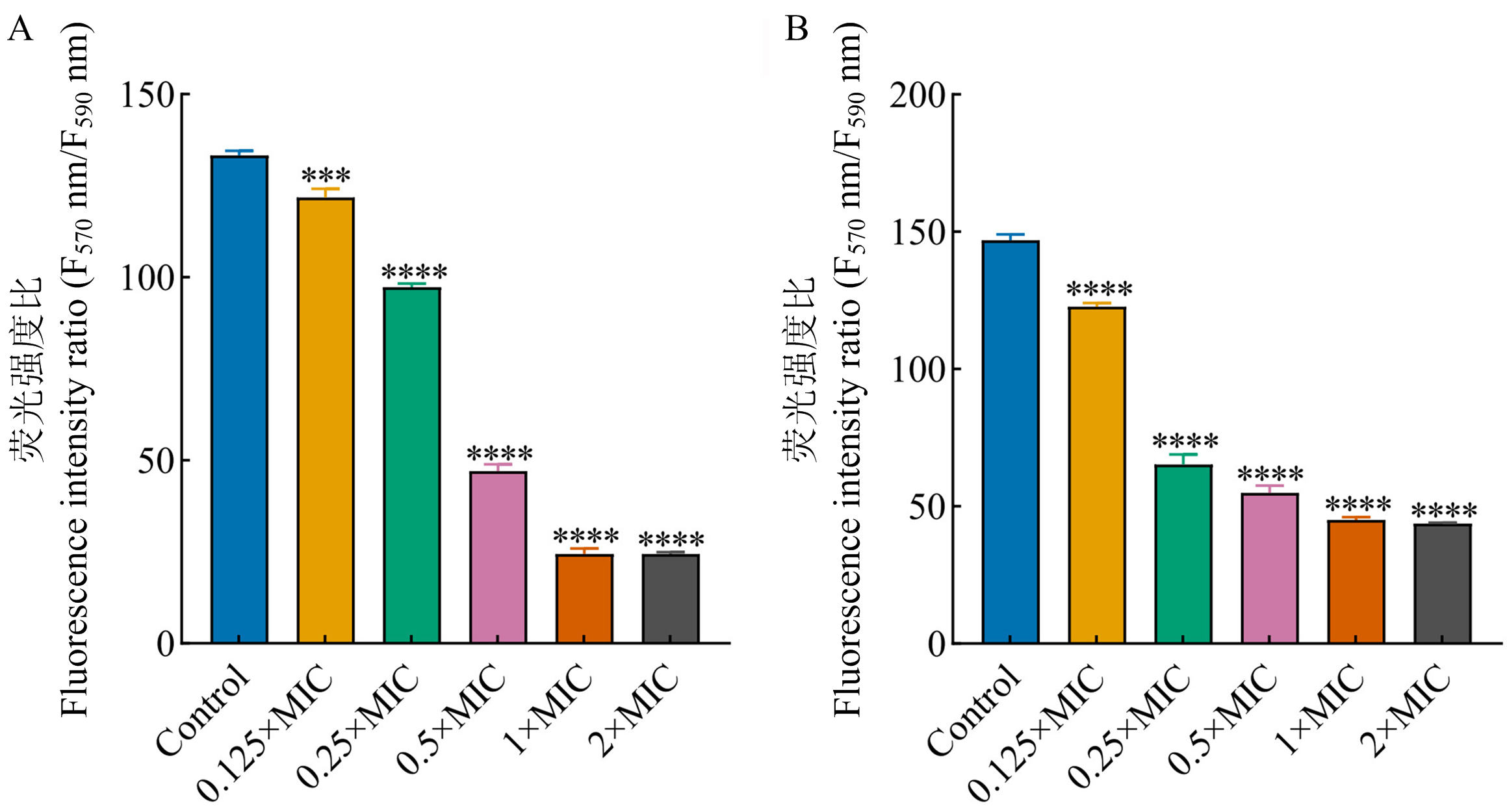
图2
胡桃醌处理对核桃黑斑病病原菌细胞活性的影响 A:核桃黄单胞杆菌Xaj;B:成团泛菌Pa **:P<0.01; ***:P<0.001;****:P<0.0001。下同The same as below"

图3
胡桃醌处理对核桃黑斑病病原菌形态的影响 A:核桃黄单胞杆菌Xaj;B:成团泛菌Pa"
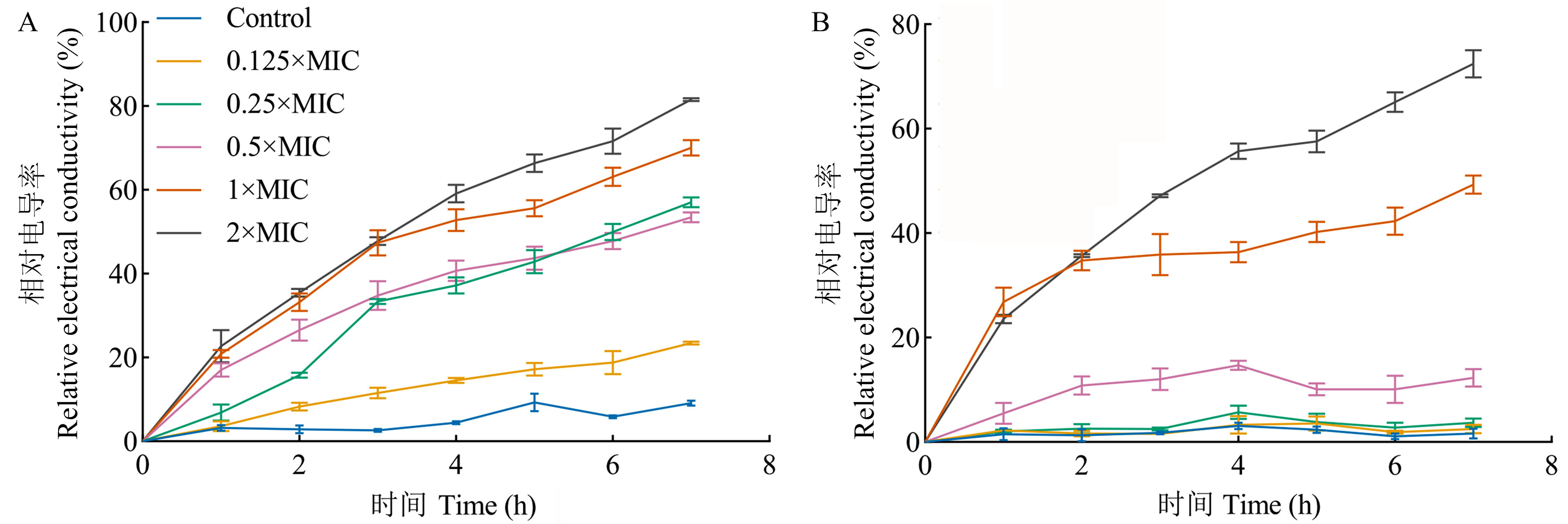
图4
胡桃醌处理对核桃黑斑病病原菌相对电导率的影响 A:核桃黄单胞杆菌Xaj;B:成团泛菌Pa"
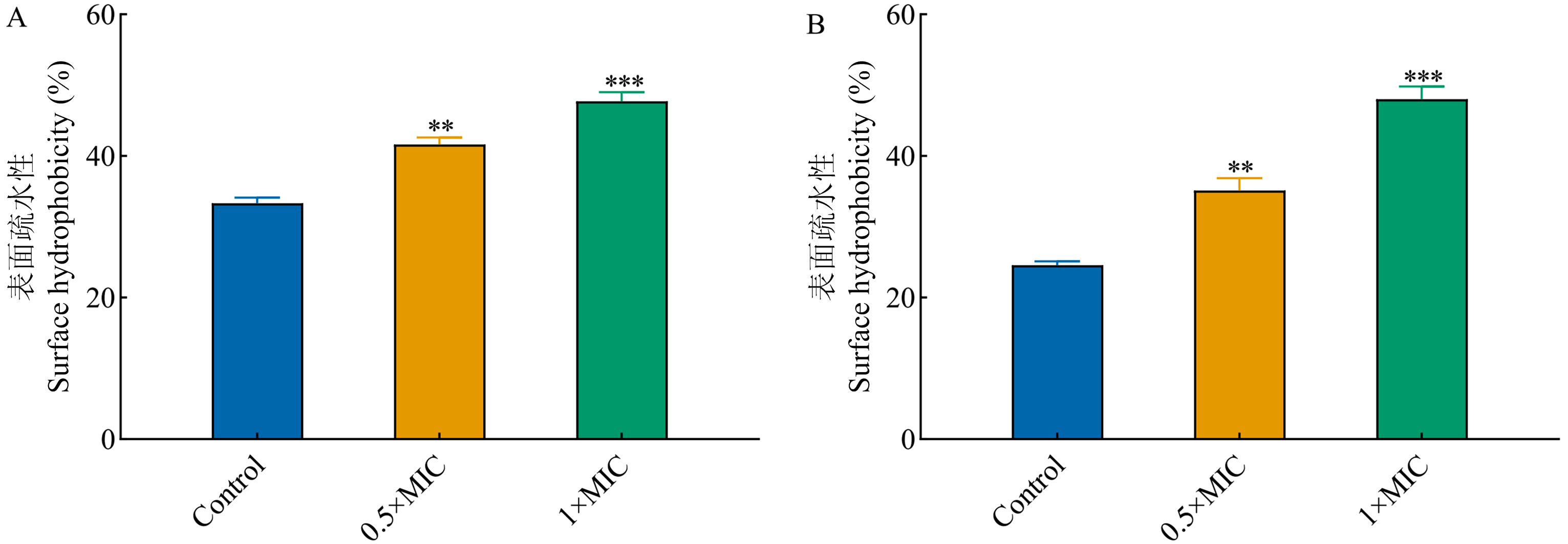
图5
胡桃醌处理对核桃黑斑病病原菌表面疏水性的影响 A:核桃黄单胞杆菌Xaj;B:成团泛菌Pa"
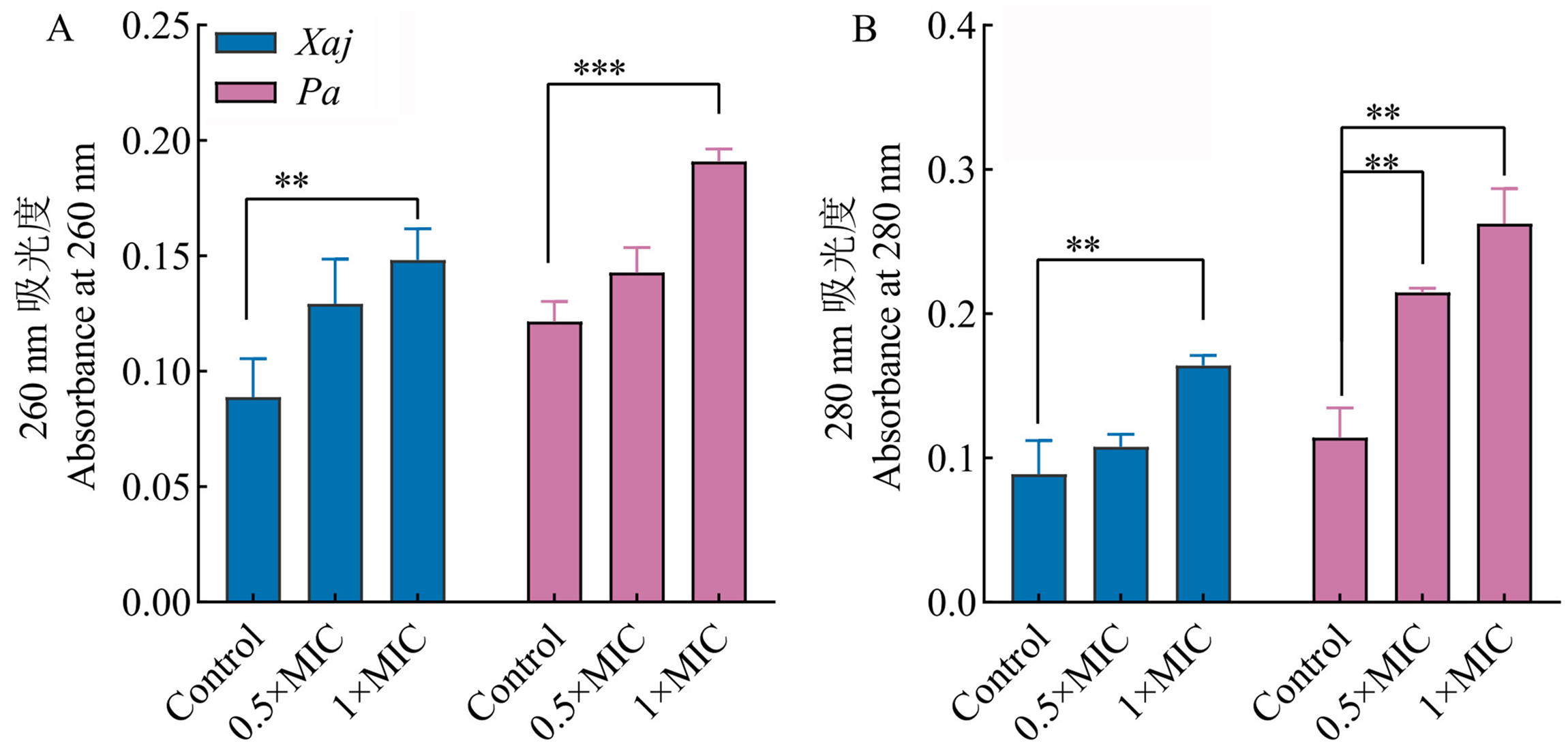
图6
胡桃醌处理对核桃黑斑病病原菌胞内物质泄漏的影响 A:病原菌核酸泄漏Nucleic acid leakage of pathogens;B:病原菌蛋白泄漏Protein leakage of pathogens"
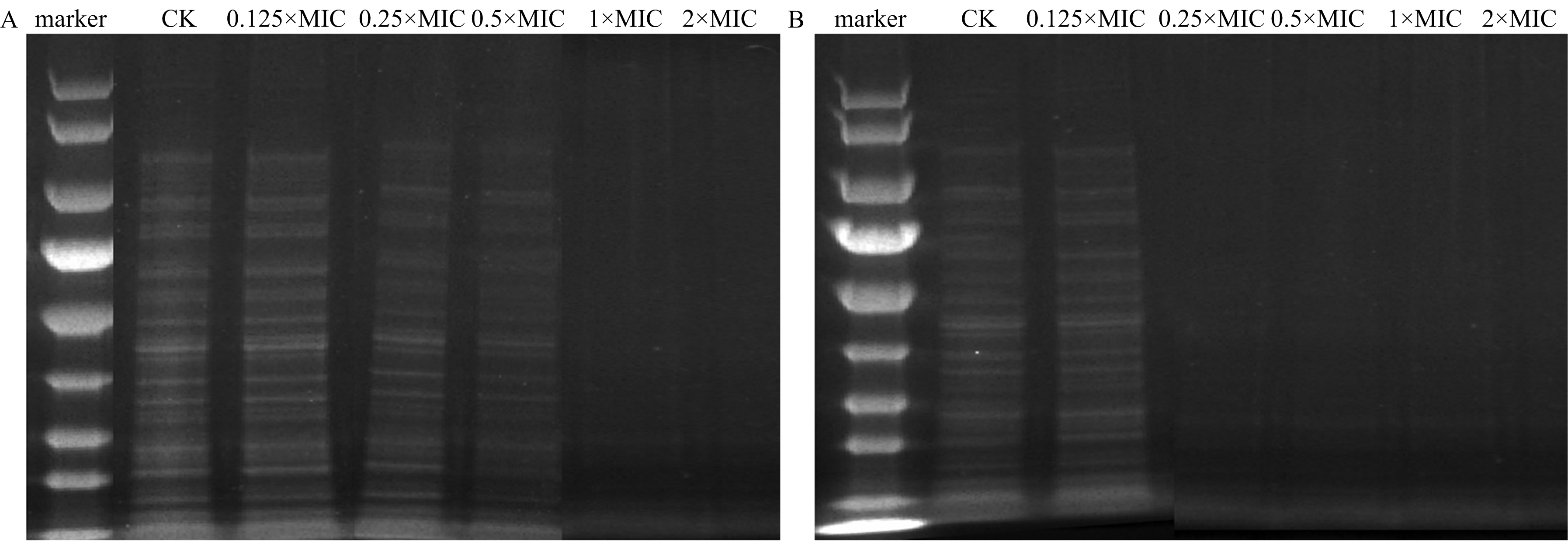
图7
胡桃醌处理下病原菌蛋白质的电泳分析 A:核桃黄单胞杆菌Xaj;B:成团泛菌Pa"

图8
胡桃醌处理下核桃黑斑病病原菌核酸电泳图谱 Aa:核桃黄单胞杆菌DNA Xaj DNA;Ab:成团泛菌DNA Pa DNA;Ba:核桃黄单胞杆菌RNA Xaj RNA;Bb:成团泛菌RNA Pa RNA"
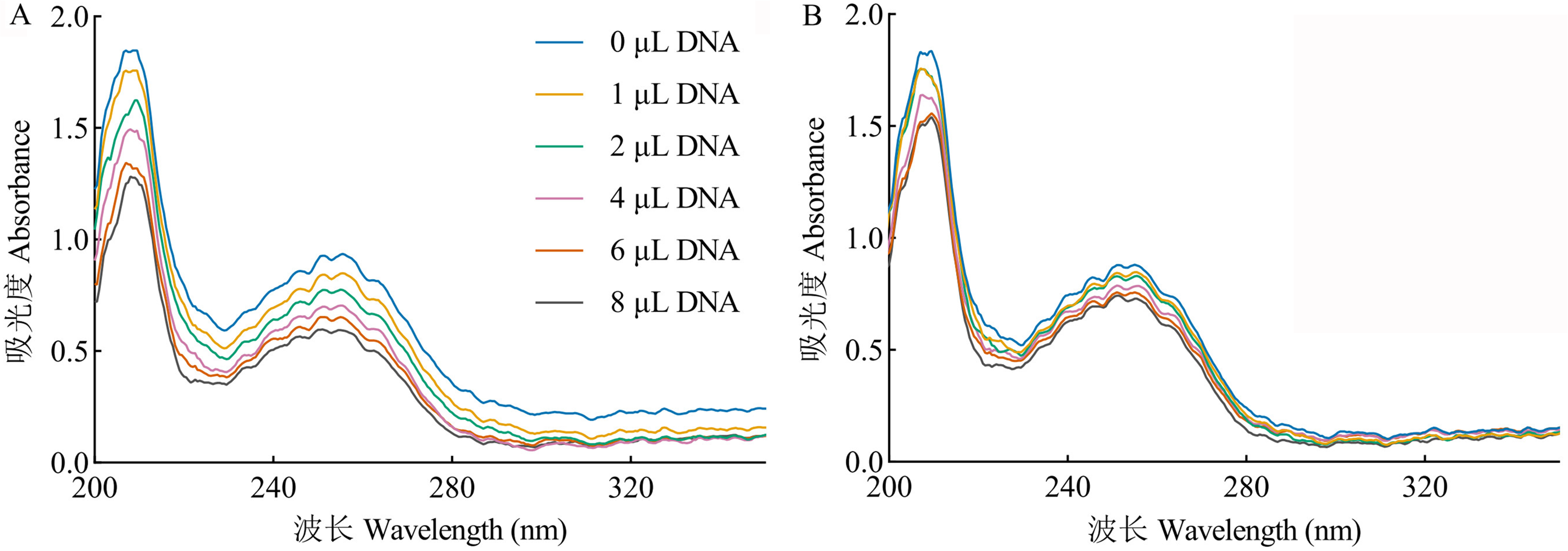
图9
胡桃醌与病原菌DNA作用的紫外吸收光谱 A:核桃黄单胞杆菌Xaj;B:成团泛菌Pa"

图10
胡桃醌-DNA复合体相互作用模型"
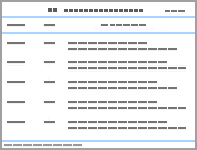
表1
分子对接结果"
| 对接体系 Docking system | 结合能Binding energy (kJ·mol-1) | 氢键作用(核苷酸-氢键长度) Hydrogen bonding (nucleotide-hydrogen bond length, Å) | 疏水作用(5 Å范围内核苷酸) Hydrophobic interaction (nucleotides<5 Å) |
|---|---|---|---|
| 1BNA ( | -27.21 | DG10 (A) (2.8, 3.0, 3.1); DG16 (B) (2.9, 3.1) | DC11 (A); DA17 (B); DA18 (B) |
| 1CGC ( | -26.80 | DG3 (A) (2.9, 3.2); DC18 (B) (2.8); DG19 (B) (3.0, 3.1) | DG4 (A); DG5 (A) |
| 1ZEW ( | -27.21 | DT3 (A) (3.2); DC4 (A) (2.8, 2.9); DG17 (B) (2.8) | DA18 (B); DG19 (B); DG20 (B) |
| 4C64 ( | -27.63 | DG10 (A) (2.8, 3.0); DC15 (B) (2.7); DG16 (B) (3.0) | DC11 (A); DG12(A); DA17 (B) |

图11
胡桃醌对核桃离体叶片黑斑病防治效果"
表2
叶片接种后的病斑面积"
| 病原菌Pathogen | 仅接病菌Pathogen inoculation only | 1×MIC胡桃醌处理Juglone treatment | 对照Control |
|---|---|---|---|
| 核桃黄单胞杆菌Xaj | 0.030±0.007a | 0.005±0.002b | 0.001±0.0001c |
| 成团泛菌Pa | 0.027±0.013a | 0.004±0.003b | 0.001±0.0002c |
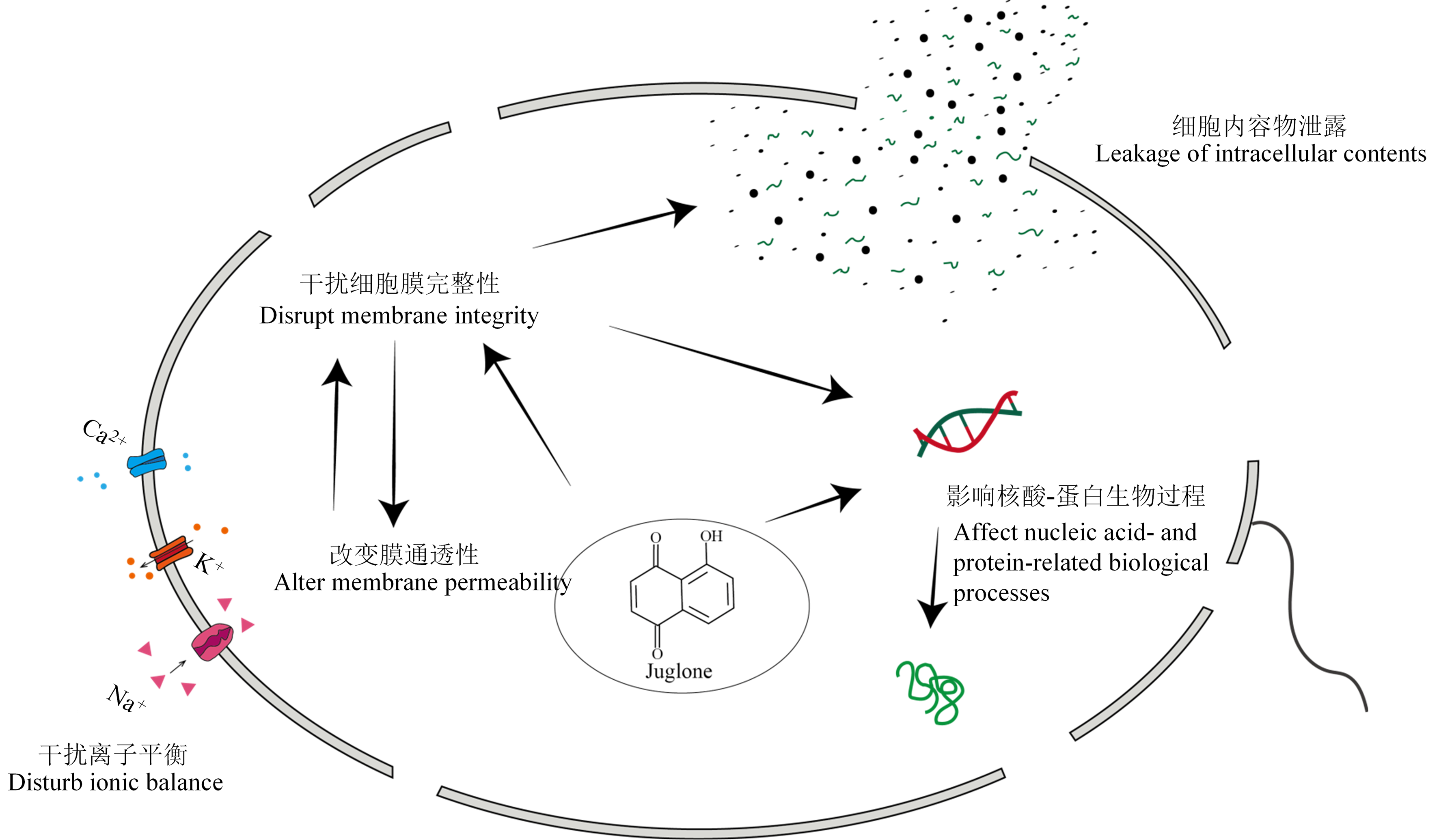
图12
胡桃醌对核桃黑斑病病原菌的抑菌作用机制示意图"
| [1] |
|
| [2] |
韩长志, 祝友朋, 王韵晴. 核桃细菌性黑斑病的研究进展. 林业科学研究, 2021, 34(4): 184-190.
|
|
|
|
| [3] |
doi: 10.1111/mpp.13073 |
| [4] |
|
| [5] |
李亚, 张珍荫, 肖波, 杨斌, 赵宁. 核桃细菌性黑斑病病原分子鉴定及室内药剂筛选. 西南林业大学学报(自然科学), 2022, 42(5): 104-110.
|
|
|
|
| [6] |
王瀚, 王让军, 田凤鸣, 赵淑玲, 何九军, 李志虎, 王一峰, 卓平清, 王明霞. 陇南核桃致病性成团泛菌的分离鉴定及其致病性研究. 福建农业学报, 2016, 31(10): 1086-1090.
|
|
|
|
| [7] |
曲文文, 杨克强, 刘会香, 王钧毅. 山东省核桃主要病害及其综合防治. 植物保护, 2011, 37(2): 136-140.
|
|
|
|
| [8] |
瞿佳, 门欣, 孙晓宇, 赵玲侠, 宁硕瀛, 陈锐. 陕西核桃黑斑病病原菌鉴定及药剂防治研究. 西北农业学报, 2021, 30(3): 452-461.
|
|
|
|
| [9] |
郭安柱, 张力元, 李岩, 朱姝颖, 唐光辉. 防治核桃黑斑病药剂筛选及田间药效试验. 西北林学院学报, 2020, 35(1): 177-182.
|
|
|
|
| [10] |
doi: 10.1038/s41438-018-0067-5 |
| [11] |
doi: 10.1021/jf60221a027 |
| [12] |
|
| [13] |
doi: 10.1016/j.plantsci.2005.09.012 |
| [14] |
|
| [15] |
韩齐齐. 胡桃醌的提取、纯化及对丁香假单胞杆菌和铜绿假单胞杆菌的抑菌机理研究[D]. 西安: 陕西师范大学, 2022.
|
|
|
|
| [16] |
曲中原, 邹翔, 胡国军, 崔兰, 季宇彬. 青龙衣中胡桃醌提取工艺研究. 中医药学报, 2008, 36(4): 30-32, 83.
|
|
|
|
| [17] |
李钧, 曲中原, 邹翔, 季宇彬. 青龙衣中胡桃醌的分离与鉴定. 哈尔滨商业大学学报(自然科学版), 2011, 27(5): 641-644.
|
|
|
|
| [18] |
刘婕, 侯瑞, 周泽华, 易图永. 聚六亚甲基胍对柑橘溃疡病菌的抑菌活性. 中国农业科学, 2025, 58(9): 1779-1790. doi: 10.3864/j.issn.0578-1752.2025.09.008.
|
|
|
|
| [19] |
doi: 10.1016/j.lwt.2021.111393 |
| [20] |
|
| [21] |
doi: 10.1021/acs.jafc.6b02507 |
| [22] |
doi: 10.1016/j.colsurfb.2008.04.003 |
| [23] |
doi: 10.1016/j.indcrop.2019.111561 |
| [24] |
|
| [25] |
doi: 10.1016/j.jff.2017.09.047 |
| [26] |
doi: 10.1016/j.foodcont.2018.09.030 |
| [27] |
doi: 10.1016/j.foodcont.2018.07.007 |
| [28] |
doi: 10.1016/j.jphotobiol.2017.11.015 |
| [29] |
doi: 10.1002/jcc.21256 pmid: 19399780 |
| [30] |
杨枫, 陈传武, 范七君, 石春梅, 谢宗周, 郭大勇, 刘继红. 温度和多胺对柑橘溃疡病发生的影响及作用机制. 中国农业科学, 2018, 51(10): 1899-1907. doi: 10.3864/j.issn.0578-1752.2018.10.009.
|
|
|
|
| [31] |
|
| [32] |
doi: 10.1016/j.ijbiomac.2023.127273 |
| [33] |
|
| [34] |
doi: 10.1146/annurev-micro-102215-095630 pmid: 28697671 |
| [35] |
doi: S0141-8130(17)32141-4 pmid: 28802847 |
| [36] |
doi: 10.1038/s41586-019-1665-6 |
| [37] |
doi: 10.3390/ijms24043931 |
| [38] |
doi: 10.3390/foods11172558 |
| [39] |
doi: 10.1016/j.foodcont.2025.111259 |
| [40] |
doi: 10.1016/j.foodchem.2017.01.112 |
| [41] |
doi: 10.1016/j.molstruc.2018.02.008 |
| [42] |
doi: 10.1038/nrc749 pmid: 11990855 |
| [43] |
doi: 10.1016/S0010-8545(01)00338-1 |
| [44] |
pmid: 16271620 |
| [45] |
doi: 10.1016/j.foodcont.2016.09.036 |
| [46] |
doi: 10.1016/j.saa.2021.119998 |
| [47] |
路振康, 吴庆智, 张建, 毛晓英. 核桃青皮中胡桃醌对大肠杆菌的抗菌作用及机制. 食品科学, 2023, 44(7): 65-73.
|
|
|
| [1] | 曹慧英,张力群,朱振东,王晓鸣,李洪杰,任争光 . 成团泛菌对玉米自交系PS056致病性基因yhfK的克隆 |
| [2] | 王海涛,王 倩,谢明杰 . 大豆异黄酮对金黄色葡萄球菌的抑菌机制研究[J]. 中国农业科学, 2009, 42(7): 2586-2591 . |
|
||
