






中国农业科学 ›› 2026, Vol. 59 ›› Issue (9): 1903-1915.doi: 10.3864/j.issn.0578-1752.2026.09.006
祝培1( ), 赵耀2, 白岩3, 张金盔4, 李莓5, 龙金佳1, 杨龙1, 罗丽娅1, 许本波1, 徐劲松1(), 张学昆1()
收稿日期:2026-01-16
接受日期:2026-03-07
出版日期:2026-05-01
发布日期:2026-05-06
通信作者:
联系方式:
祝培,Email:1833751248@qq.com。
基金资助:
ZHU Pei1(), ZHAO Yao2, BAI Yan3, ZHANG JinKui4, LI Mei5, LONG JinJia1, YANG Long1, LUO LiYa1, XU BenBo1, XU JinSong1(), ZHANG XueKun1()
Received:2026-01-16
Accepted:2026-03-07
Published:2026-05-01
Online:2026-05-06
摘要:
【目的】长江流域稻-油轮作区渍害与菌核病复合胁迫制约油菜生产。本研究旨在阐明新型琥珀酸脱氢酶抑制剂(succinate dehydrogenase inhibitor,SDHI)氟唑菌酰羟胺高效防控菌核病的同时,协同促进油菜生长、增强抗逆性并提升产量、品质的生理机制。【方法】2023—2025年,以甘蓝型油菜品种‘长双1号’为材料,在湖北荆州稻-油轮作区开展田间试验,结合室内发芽期胁迫模拟,测定幼苗期(正常、渍害、干旱胁迫下)生长与生理指标、盛花期叶片内源激素含量,以及成熟期菌核病抗性、产量和籽粒品质,系统评估氟唑菌酰羟胺、咪鲜胺、戊唑醇、啶酰菌胺及氟唑菌酰羟胺与咪鲜胺复配处理对油菜的生理生态效应。【结果】(1)苗期正常生长条件下,氟唑菌酰羟胺处理显著促进幼苗生长,其根长、侧根数、苗高和鲜重分别较对照增加65.8%、84.2%、39.0%和20.0%;叶绿素a、叶绿素b及类胡萝卜素含量分别较对照提高19.3%、28.1%和28.9%,增幅均高于其他杀菌剂处理。(2)在胁迫条件下,氟唑菌酰羟胺预处理显著提高幼苗抗逆性。渍害胁迫下其相对根长较对照显著增加48.3%,超氧化物歧化酶(SOD)与过氧化物酶(POD)活性较对照分别提高26.2%和26.3%;PEG模拟干旱胁迫下,其相对苗高、相对鲜重及活力指数较对照分别显著提高40.3%、36.0%和113.8%。(3)盛花期喷施氟唑菌酰羟胺能优化内源激素平衡,生长素(IAA)和赤霉素(GA3)含量分别较对照显著增加27.5%和45.5%,脱落酸(ABA)含量与对照无显著差异。(4)成熟期氟唑菌酰羟胺处理具有防病与增产的协同效应。两年度田间试验表明,该处理使菌核病病情指数较对照降低58.3%—59.9%,单株角果数、每角粒数及产量分别较对照显著提高13.9%—14.1%、7.0%—7.3%和34.4%—34.9%,籽粒含油量较对照平均提高5.1%,其综合效应优于供试的咪鲜胺、戊唑醇等传统杀菌剂。氟唑菌酰羟胺与咪鲜胺复配后表现出拮抗作用,产量较氟唑菌酰羟胺处理下降16.1%—16.9%。【结论】氟唑菌酰羟胺通过优化发芽期根系构型、激活抗氧化系统、调节盛花期的激素平衡,协同促进油菜生长、增强抗逆性、防控菌核病并提升籽粒品质,综合效应优于啶酰菌胺、咪鲜胺、戊唑醇等传统杀菌剂。
祝培, 赵耀, 白岩, 张金盔, 李莓, 龙金佳, 杨龙, 罗丽娅, 许本波, 徐劲松, 张学昆. 氟唑菌酰羟胺对油菜的生理调控作用及其与咪鲜胺的复配效应[J]. 中国农业科学, 2026, 59(9): 1903-1915.
ZHU Pei, ZHAO Yao, BAI Yan, ZHANG JinKui, LI Mei, LONG JinJia, YANG Long, LUO LiYa, XU BenBo, XU JinSong, ZHANG XueKun. Physiological Regulation of Pydiflumetofen on Rapeseed (Brassica napus) and Its Combined Effect with Prochloraz[J]. Scientia Agricultura Sinica, 2026, 59(9): 1903-1915.
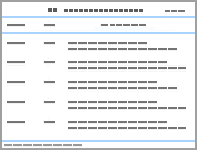
表1
油菜发芽期与田间试验的药剂处理"
| 处理Treatment | 药剂Fungicide | 处理浓度Treatment concentration (mg·L-1) |
|---|---|---|
| CK | 清水Water | 0 (蒸馏水Distilled water) |
| T1 | 45%咪鲜胺水乳剂Prochloraz 45% EW | 425 |
| T2 | 430 g·L-1戊唑醇悬浮剂Tebuconazole 430 g·L-1 SC | 215 |
| T3 | 50%啶酰菌胺水分散粒剂Boscalid 50% WDG | 333 |
| T4 | 200 g·L-1氟唑菌酰羟胺悬浮剂Pydiflumetofen 200 g·L-1 SC | 280 |
| T5 | 200 g·L-1氟唑菌酰羟胺+45%咪鲜胺Pydiflumetofen 200 g·L-1 SC+ Prochloraz 45% EW | 280+425 |

图1
不同杀菌剂处理下油菜幼苗的表型特征 CK:清水对照Control (distilled water);T1:咪鲜胺Prochloraz;T2:戊唑醇Tebuconazole;T3:啶酰菌胺Boscalid;T4:氟唑菌酰羟胺Pydiflumetofen;T5:咪鲜胺+氟唑菌酰羟胺Prochloraz+Pydiflumetofen"
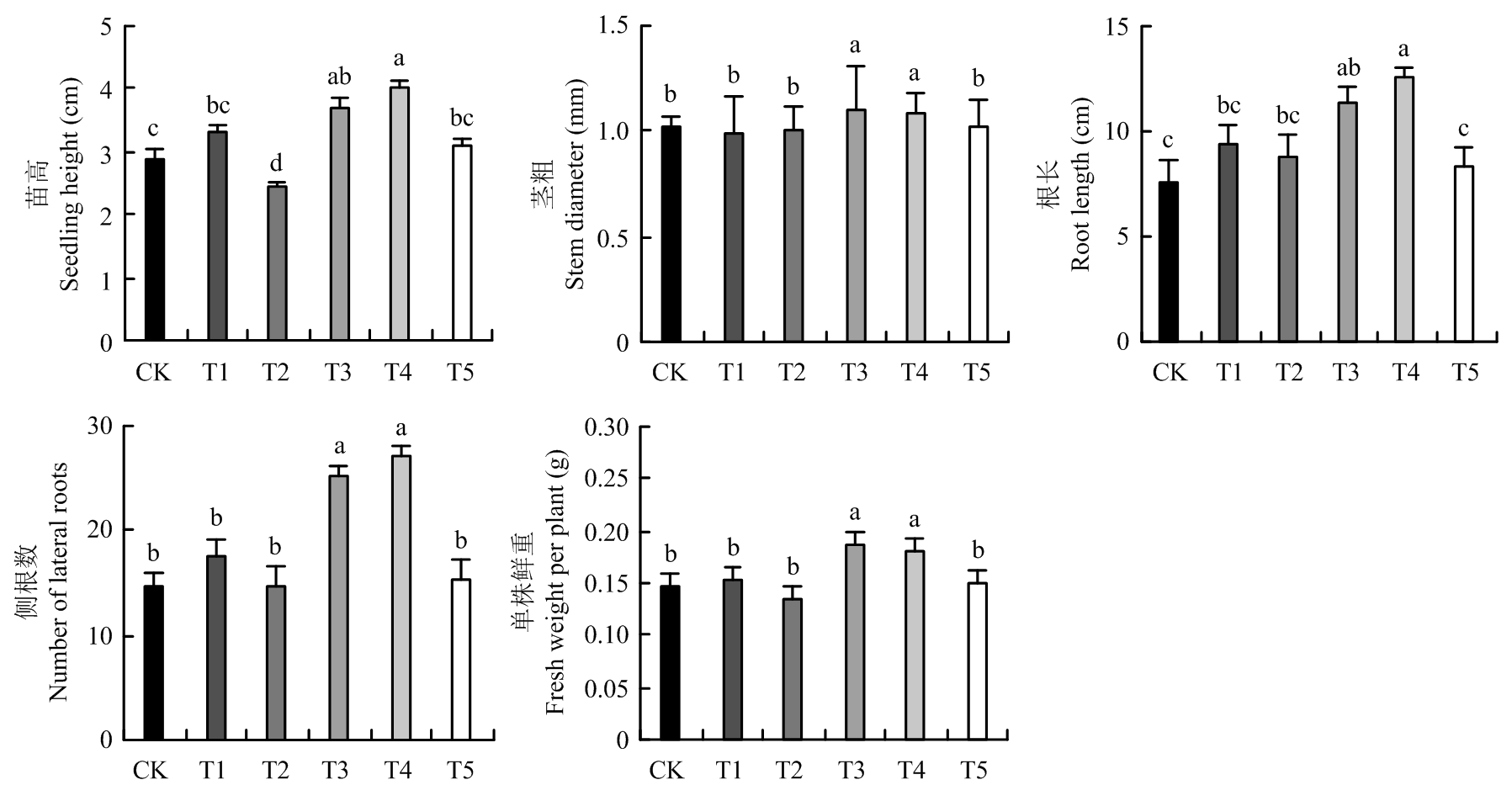
图2
不同杀菌剂喷施对油菜发芽期形态指标的影响 不同小写字母表示在P<0.05水平差异显著(Duncan检验);数据为平均值±标准差(n=3)。下同"
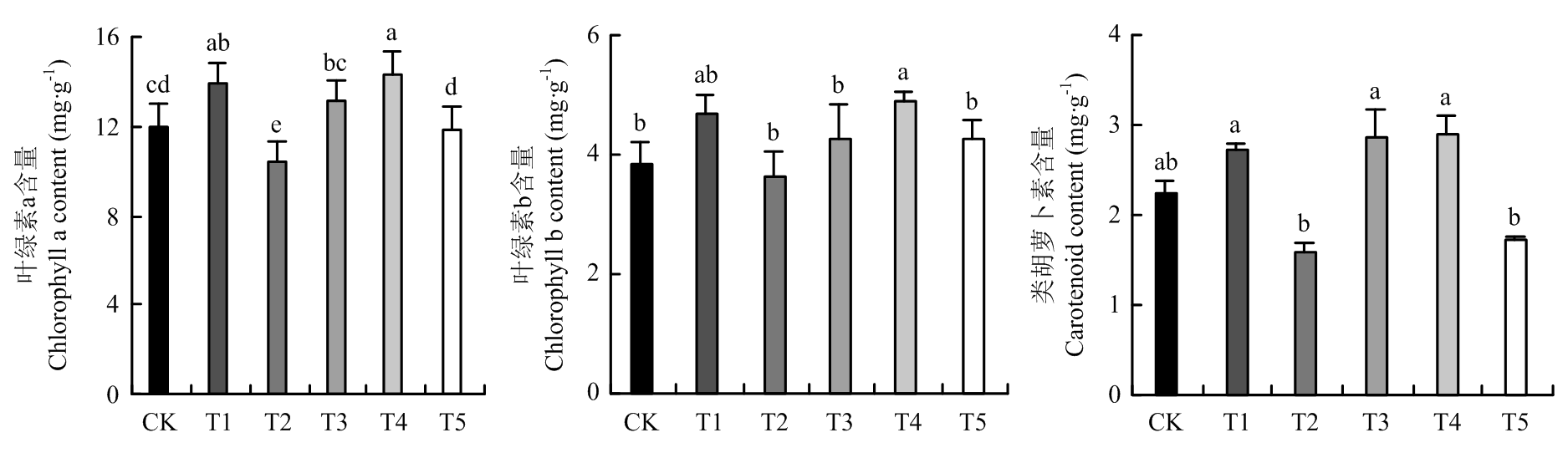
图3
不同杀菌剂喷施对油菜幼苗光合色素含量的影响"
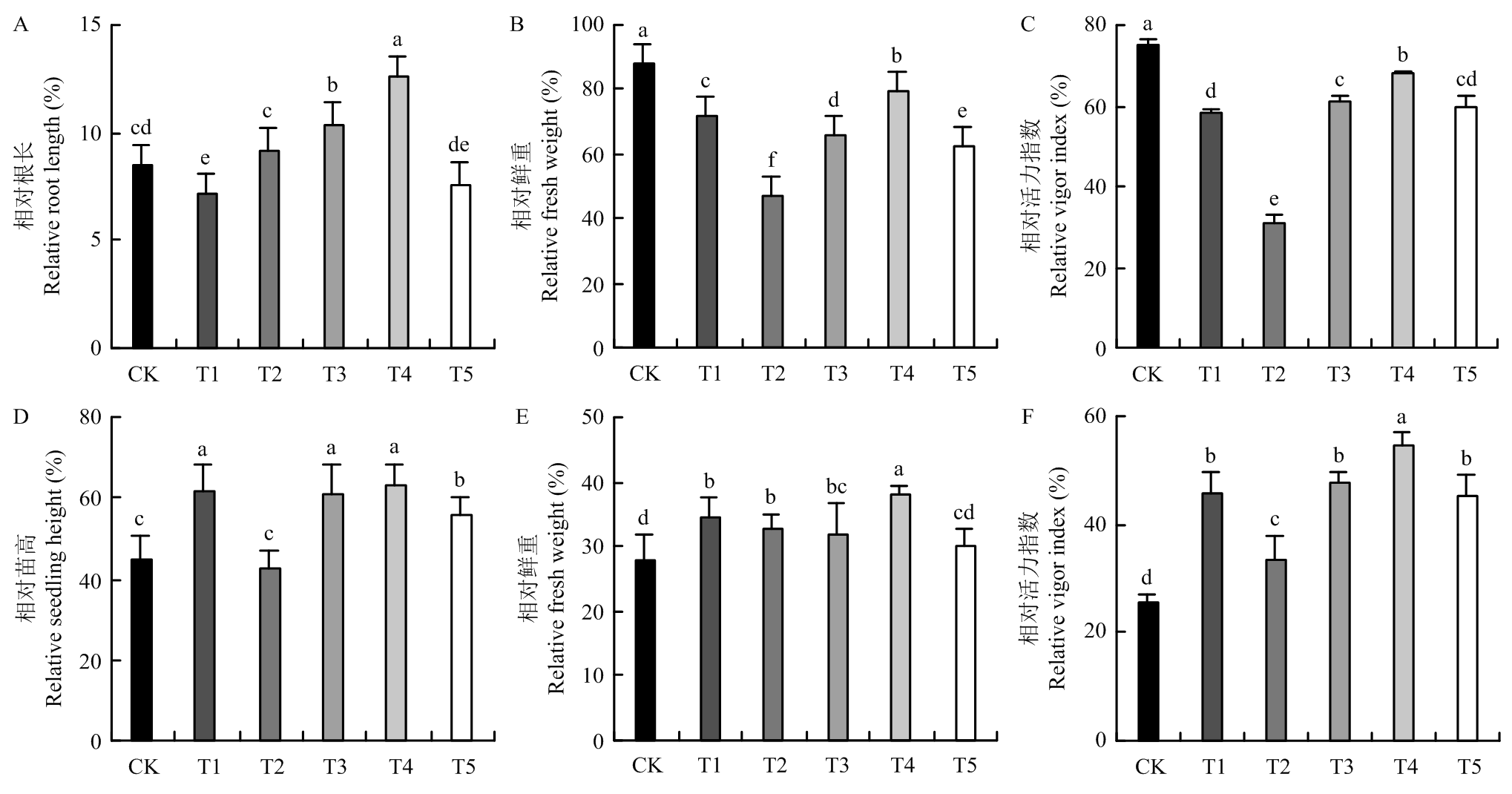
图4
不同杀菌剂预处理对油菜幼苗耐渍性(A—C)和耐旱性(D—F)的影响"
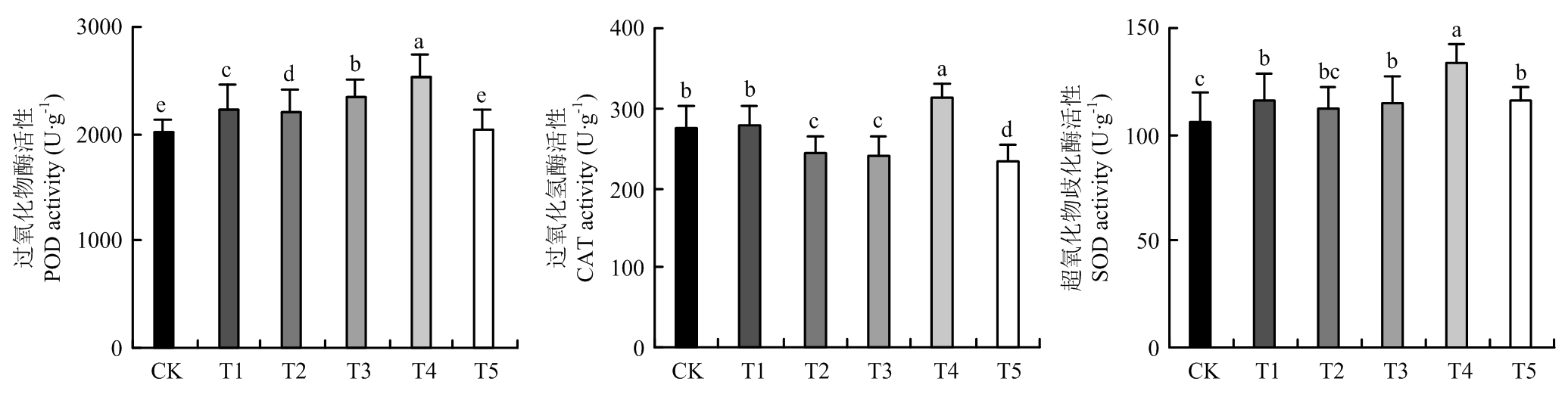
图5
不同杀菌剂预处理对油菜幼苗抗氧化酶活性的影响"
表2
不同杀菌剂对盛花期油菜叶片内源激素含量的影响"
| 处理Treatment | 生长素 IAA | 赤霉素3 GA3 | 赤霉素4 GA4 | 脱落酸 ABA | 异戊烯基腺嘌呤 IP | 异戊烯基腺苷 IPA | 反式玉米素核苷 tZR |
|---|---|---|---|---|---|---|---|
| CK | 9.46±0.385c | 0.66±0.023d | 0.38±0.051a | 49.96±0.704c | 0.05±0.003a | 0.26±0.017a | 0.55±0.195a |
| T1 | 11.26±0.421ab | 0.71±0.095d | 0.37±0.029a | 54.37±2.688b | 0.02±0.002d | 0.25±0.015a | 0.53±0.036a |
| T2 | 10.34±0.720bc | 0.86±0.034c | 0.32±0.038a | 59.05±0.903a | 0.02±0.001cd | 0.19±0.022bc | 0.44±0.046c |
| T3 | 9.31±0.484c | 1.11±0.029a | 0.33±0.029a | 54.11±3.633b | 0.03±0.003c | 0.22±0.051ab | 0.53±0.045a |
| T4 | 12.06±0.764a | 0.96±0.021b | 0.34±0.021a | 47.44±0.979c | 0.03±0.008bc | 0.12±0.021d | 0.51±0.004ab |
| T5 | 11.39±1.003ab | 0.67±0.054d | 0.26±0.019b | 33.75±1.093d | 0.04±0.002b | 0.17±0.019c | 0.46±0.028bc |
表3
2023—2024年不同杀菌剂叶面喷施对油菜产量性状及菌核病抗性的影响"
| 处理Treatment | 单株角果数 Number of siliques per plant | 每角粒数 Number of grains per silique | 千粒重 1000-seed weight (g) | 单株产量 Single plant yield (g) | 发病率 Disease incidence (%) | 病情指数 Disease index | 产量 Yield (kg·hm-2) |
|---|---|---|---|---|---|---|---|
| CK | 162.15±3.82c | 21.52±0.21b | 4.01±0.10a | 14.22±0.11c | 38.55±1.52a | 40.88±1.61a | 2312.45±41.23c |
| T1 | 165.88±1.29bc | 21.45±1.39b | 3.96±0.08a | 14.41±1.21c | 32.88±1.69a | 35.91±2.52ab | 2428.66±235.11c |
| T2 | 161.02±2.05c | 22.35±0.78ab | 3.88±0.19a | 14.18±0.79d | 36.92±0.98a | 37.12±4.45a | 2321.55±141.32c |
| T3 | 186.33±4.78a | 21.22±1.12b | 3.89±0.04a | 15.65±1.08b | 19.89±3.41b | 20.66±2.78c | 2835.78±219.33b |
| T4 | 185.11±3.05a | 23.02±0.17a | 3.94±0.20a | 17.01±1.02a | 16.98±1.47b | 17.05±1.86c | 3108.22±192.15a |
| T5 | 170.22±3.08b | 21.55±1.52b | 3.87±0.15a | 14.38±0.56c | 18.33±3.18b | 19.32±1.47c | 2601.55±116.78c |
表4
2024—2025年不同杀菌剂叶面喷施对油菜产量性状及菌核病抗性的影响"
| 处理Treatment | 单株角果数 Number of siliques per plant | 每角粒数 Number of grains per silique | 千粒重 1000-seed weight (g) | 单株产量 Single plant yield (g) | 发病率 Disease incidence (%) | 病情指数 Disease index | 产量 Yield (kg·hm-2) |
|---|---|---|---|---|---|---|---|
| CK | 166.27±4.15c | 22.08±0.26ab | 4.05±0.13a | 14.66±0.13b | 37.21±1.65a | 39.24±1.70a | 2381.37±44.89c |
| T1 | 170.58±1.42bc | 22.00±1.54ab | 4.00±0.10a | 14.85±1.35b | 31.20±1.82b | 34.55±2.65b | 2497.30±239.57c |
| T2 | 164.76±2.18c | 23.00±0.85ab | 3.92±0.23a | 14.64±0.87d | 35.46±1.05a | 35.78±4.58ab | 2390.47±145.58c |
| T3 | 191.23±5.08a | 21.70±1.25b | 3.93±0.06a | 16.19±1.16ab | 18.45±3.56c | 19.24±2.89c | 2930.28±223.71ab |
| T4 | 189.33±3.28a | 23.70±0.20a | 3.98±0.24a | 17.63±1.09a | 15.68±1.60c | 15.75±1.95c | 3216.86±196.81a |
| T5 | 174.60±3.22b | 22.11±1.69ab | 3.91±1.18a | 14.86±0.62b | 16.95±3.33c | 17.99±1.56c | 2692.45±121.14bc |
表5
清水对照与氟唑菌酰羟胺处理下油菜内源激素含量与产量性状的相关性分析"
| 激素 Hormone | 单株角果数 Number of siliques per plant | 每角粒数 Number of seeds per silique | 千粒重 1000-seed weight | 单株产量 Single plant yield | 产量 Yield |
|---|---|---|---|---|---|
| IAA | 0.942** | 0.935** | -0.113 | 0.887* | 0.922* |
| GA3 | 0.947** | 0.945** | -0.276 | 0.900* | 0.948** |
| GA4 | -0.578 | -0.635 | -0.390 | -0.552 | -0.552 |
| ABA | -0.960** | -0.945** | -0.235 | -0.969** | -0.961** |
| IP | -0.777 | -0.795 | 0.244 | -0.695 | -0.752 |
| IPA | -0.955** | -0.945** | 0.280 | -0.874* | -0.930* |
| tZR | -0.753 | -0.744 | 0.477 | -0.752 | -0.798 |
表6
不同杀菌剂叶面喷施对油菜籽品质指标的影响"
| 处理 Treatment | 含油量 Oil content (%) | 蛋白质 Protein (%) | 硫苷 Glucosinolate (μmol·L-1) | 油酸 Oleic acid (%) | 亚麻酸 Linolenic acid (%) |
|---|---|---|---|---|---|
| CK | 47.12±1.23b | 25.75±1.66ab | 19.38±1.57a | 60.33±0.99a | 8.31±0.29a |
| T1 | 44.73±0.67c | 24.78±1.77b | 18.73±2.52ab | 60.09±2.31a | 7.24±1.36a |
| T2 | 49.39±0.97a | 24.21±1.41b | 17.23±1.65b | 61.01±3.52a | 8.04±0.78a |
| T3 | 46.82±0.66b | 25.73±1.69ab | 18.95±0.72ab | 60.88±1.73a | 7.35±0.73a |
| T4 | 49.51±0.33a | 25.11±1.61b | 20.06±1.92a | 62.38±1.87a | 7.45±0.45a |
| T5 | 46.75±0.44b | 26.79±1.01a | 18.35±1.16ab | 61.63±1.88a | 7.48±0.77a |
| [1] |
殷艳, 尹亮, 张学昆, 郭静利, 王积军. 我国油菜产业高质量发展现状和对策. 中国农业科技导报, 2021, 23(8): 1-7.
|
|
doi: 10.13304/j.nykjdb.2020.1050 |
|
| [2] |
王汉中. 以新需求为导向的油菜产业发展战略. 中国油料作物学报, 2018, 40(5): 613-617.
doi: 10.7505/j.issn.1007-9084.2018.05.001 |
|
|
|
| [3] |
王瑞元. 2022年我国粮油产销和进出口情况. 中国油脂, 2023, 48(6): 1-7.
|
|
|
|
| [4] |
张佩, 吴洪颜, 江海东, 高苹, 徐敏. 长江中下游油菜春季湿渍害灾损风险评估研究. 气象与环境科学, 2019, 42(1): 11-17.
|
|
|
|
| [5] |
张卡, 李浩杰, 张锦芳, 崔成, 柴靓, 郑本川, 蒋俊, 戴成, 涂金星, 蒋梁材. 甘蓝型油菜菌核病抗病性研究进展. 中国油料作物学报, 2023, 45(6): 1095-1102.
doi: 10.19802/j.issn.1007-9084.2023212 |
|
doi: 10.19802/j.issn.1007-9084.2023212 |
|
| [6] |
孙祥良, 王华弟, 曹奎荣, 朱金良. 油菜菌核病对油菜千粒重及产量的影响. 浙江农业科学, 2014(11): 1732-1733.
|
|
|
|
| [7] |
杭德龙, 夏必文, 杨学文, 焦兆文, 翟宗清. 油菜菌核病产量损失调查及防治指标研究. 河北农业科学, 2008, 12(6): 27-28, 31.
|
|
|
|
| [8] |
杨清坡, 刘万才, 黄冲. 近10年油菜主要病虫害发生危害情况的统计和分析. 植物保护, 2018, 44(3): 24-30.
|
|
|
|
| [9] |
匡静, 王建新, 周明国. 江苏省油菜菌核病菌对多菌灵和菌核净的抗药性监测. 中国农学通报, 2011, 27(15): 285-291.
|
|
|
|
| [10] |
杨永青, 宋培玲, 燕孟娇, 郝丽芬, 连海飞, 李秀萍, 莎娜, 史志丹, 赵丽丽, 李子钦. 油菜核盘菌对戊唑醇的敏感性及室内抗药性诱导. 中国油料作物学报, 2021, 43(2): 300-306.
|
|
|
|
| [11] |
徐雪亮, 刘子荣, 黄衍章, 刘小娟, 陈庆隆, 熊焕华, 姚英娟, 王奋山. 不同杀菌剂对油菜菌核病菌的防治效果研究. 湖北农业科学, 2019, 58(18): 62-64, 69.
|
|
|
|
| [12] |
郝芳敏, 周锋, 朱福兴. 油菜菌核病菌对杀菌剂啶酰菌胺的抗性风险研究. 湖北农业科学, 2014, 53(11): 2555-2557.
|
|
|
|
| [13] |
段劲生, 郑修婷, 易晓童, 童舟, 董旭, 褚玥, 孙明娜, 孟丹丹, 徐立伟. 琥珀酸脱氢酶抑制剂类杀菌剂氟唑菌酰羟胺研究进展. 安徽农业大学学报, 2025, 52(4): 691-700.
|
|
|
|
| [14] |
doi: 10.1016/j.pestbp.2012.07.010 |
| [15] |
doi: 10.3389/fpls.2017.02072 pmid: 29270181 |
| [16] |
doi: S0048-3575(16)30110-9 pmid: 28364804 |
| [17] |
doi: 10.1002/ps.2013.69.issue-4 |
| [18] |
doi: 10.3389/fpls.2023.1130825 |
| [19] |
杨龙, 张学昆, 陈爱武, 李莓, 程泰, 马伍慧, 许本波, 徐劲松. 油菜品种、越冬调控和病虫害防控对直播油菜产量的影响. 中国农业科学, 2025, 58(21): 4333-4345. doi: 10.3864/j.issn.0578-1752.2025.21.003.
|
|
|
|
| [20] |
陈洁, 张学昆, 谌利, 晁国红, 李加纳. 甘蓝型油菜耐湿种质资源的快速筛选. 中国油料作物学报, 2006, 28(2): 138-143.
|
|
|
|
| [21] |
李震, 杨春杰, 张学昆, 邹崇顺, 程勇, 郑普英, 李桂英. PEG胁迫下甘蓝型油菜品种(系)种子发芽耐旱性鉴定. 中国油料作物学报, 2008, 30(4): 438-442.
|
|
|
|
| [22] |
李合生. 植物生理生化实验原理和技术. 北京: 高等教育出版社, 2000.
|
|
|
|
| [23] |
杨志敏. 生物化学实验. 北京: 高等教育出版社, 2015.
|
|
|
|
| [24] |
doi: 10.1021/acs.analchem.7b02589 pmid: 28783368 |
| [25] |
doi: 10.1016/j.talanta.2015.06.056 |
| [26] |
中国农业科学院油料作物研究所/全国农业技术推广服务中心. 油菜品种菌核病抗性鉴定技术规程: NY/T 3068—2016[S]. (2016-12-23) [2026-01-16].
|
|
Oil Crops Research Institute, Chinese Academy of Agricultural Sciences/National Agricultural Technology Extension Service Center. Code of practice for identification of resistance to Sclerotinia sclerotiorum in oilseed rape: NY/T 3068—2016[S]. (2016-12-23) [2026-01-16]. (in Chinese)
|
|
| [27] |
周香玉, 徐劲松, 谢伶俐, 许本波, 张学昆. 甘蓝型油菜苗期响应渍害胁迫的生理调控机制. 作物学报, 2024, 50(4): 1015-1029.
doi: 10.3724/SP.J.1006.2024.34116 |
|
doi: 10.3724/SP.J.1006.2024.34116 |
|
| [28] |
谢云韵, 余常兵, 侯加佳, 胡小加, 李银水, 沈宏, 廖星. 低氧胁迫对油菜幼苗不定根生长的影响. 中国油料作物学报, 2013, 35(3): 284-289.
doi: 10.7505/j.issn.1007-9084.2013.03.009 |
|
|
|
| [29] |
doi: 10.1016/j.plaphy.2010.08.016 pmid: 20870416 |
| [30] |
谢伶俐, 李永铃, 许本波, 张学昆. 油菜耐渍机理解析及遗传改良研究进展. 作物学报, 2025, 51(2): 287-300.
doi: 10.3724/SP.J.1006.2025.44121 |
|
doi: 10.3724/SP.J.1006.2025.44121 |
|
| [31] |
pmid: 15862093 |
| [32] |
doi: 10.1104/pp.107.111120 pmid: 18162592 |
| [33] |
doi: 10.3390/ijms232012157 |
| [34] |
doi: 10.1186/s43897-022-00023-2 pmid: 37789426 |
| [35] |
doi: 10.1007/s10725-023-01055-4 |
| [36] |
doi: 10.3389/fpls.2020.627331 |
| [37] |
谢伶俐, 韦丁一, 章子爽, 徐劲松, 张学昆, 许本波. 甘蓝型油菜发育进程中赤霉素动态变化及其与产量的关系. 中国农业科学, 2022, 55(24): 4793-4807. doi: 10.3864/j.issn.0578-1752.2022.24.002.
|
|
|
|
| [38] |
申鸽子. 不同生境下油菜高收获指数的激素平衡与调控[D]. 重庆: 西南大学, 2016.
|
|
|
|
| [39] |
崔力勃. 脱落酸(ABA)对十字花科油籽油分积累的影响与作用机制[D]. 杭州: 浙江大学, 2017.
|
|
|
|
| [40] |
doi: 10.1016/j.plipres.2010.01.001 pmid: 20102727 |
| [41] |
郭静, 周可金. 不同油菜品种内源激素水平的差异及其对催熟剂的响应. 浙江农业学报, 2016, 28(3): 383-388.
|
|
|
|
| [42] |
doi: 10.1111/emi.2014.16.issue-7 |
| [43] |
孔令鸿. 不同药剂对油菜菌核病防治效果分析. 中国农业文摘-农业工程, 2023, 44 (3): 44-47.
|
|
|
|
| [44] |
赵丽丽, 李子钦, 史志丹, 牟春雨, 皇甫海燕, 齐桂强, 宋培玲, 燕孟娇, 皇甫九茹, 杨永青. 油菜核盘菌(Sclerotinia sclerotiorum)对戊唑醇的抗药性风险评估. 中国油料作物学报, 2024, 46(1): 182-190.
doi: 10.19802/j.issn.1007-9084.2022225 |
|
|
|
| [45] |
邓梦可. 核盘菌对咪鲜胺的抗药性分析[D]. 合肥: 安徽农业大学, 2023.
|
|
|
|
| [46] |
doi: 10.1371/journal.pone.0053650 |
| [47] |
刘源, 赵冉, 卢振芳, 李瑞丽. 植物类胡萝卜素生物代谢途径及其功能研究进展. 生物技术通报, 2025, 41(5): 23-31.
doi: 10.13560/j.cnki.biotech.bull.1985.2024-1057 |
|
doi: 10.13560/j.cnki.biotech.bull.1985.2024-1057 |
|
| [48] |
doi: 10.1016/j.scib.2021.07.003 |
| [1] | 杨龙, 张学昆, 陈爱武, 李莓, 程泰, 马伍慧, 许本波, 徐劲松. 油菜品种、越冬调控和病虫害防控对直播油菜产量的影响[J]. 中国农业科学, 2025, 58(21): 4333-4345. |
| [2] | 关志林, 靳丰蔚, 刘婷婷, 王毅, 谭莹莹, 杨春慧, 李蕊彤, 王博, 刘克德, 董云. 甘蓝型油菜光叶性状的遗传分析及基因定位[J]. 中国农业科学, 2024, 57(4): 650-662. |
| [3] | 曾祥翠, 杨永念, 李如月, 蒋学乾, 蒋旭, 徐嫣然, 刘忠宽, 龙瑞才, 康俊梅, 杨青川, 李明娜. 紫花苜蓿MsCEP基因家族的鉴定及其调控根系生长发育功能的分析[J]. 中国农业科学, 2024, 57(24): 4839-4853. |
| [4] | 杨浩蓉, 贾凡, 胡徐, 穆蓉, 刘维娜, 刘昌云, 王善之, 孙现超, 马冠华, 陈国康. 油菜BnJAZ7通过调控抗氧化途径促进核盘菌侵染[J]. 中国农业科学, 2024, 57(19): 3799-3809. |
| [5] | 范军强, 武军艳, 刘丽君, 马骊, 杨刚, 蒲媛媛, 李学才, 孙万仓. 甘蓝型冬油菜气孔特性与抗寒性的关系[J]. 中国农业科学, 2023, 56(4): 599-618. |
| [6] | 李星星, 周国富, 骆官雨, 陈思蓉, 张金龙, 陈国华, 张晓明. 橘小实蝇对不同品种苹果的选择偏好及适应性[J]. 中国农业科学, 2023, 56(17): 3358-3371. |
| [7] | 胡盛,李阳阳,唐章林,李加纳,曲存民,刘列钊. 干旱胁迫下甘蓝型油菜籽粒含油量和蛋白质含量变化的全基因组关联分析[J]. 中国农业科学, 2023, 56(1): 17-30. |
| [8] | 巢成生,王玉乾,沈欣杰,代晶,顾炽明,李银水,谢立华,胡小加,秦璐,廖星. 甘蓝型油菜苗期氮高效吸收转运特征研究[J]. 中国农业科学, 2022, 55(6): 1172-1188. |
| [9] | 谢伶俐,韦丁一,章子爽,徐劲松,张学昆,许本波. 甘蓝型油菜发育进程中赤霉素动态变化及其与产量的关系[J]. 中国农业科学, 2022, 55(24): 4793-4807. |
| [10] | 张承启,廖露露,齐永霞,丁克坚,陈莉. 禾谷镰孢核孔蛋白基因FgNup42的功能分析[J]. 中国农业科学, 2021, 54(9): 1894-1903. |
| [11] | 陈茜,刘英杰,董勇浩,刘金燕,李炜,徐蓬军,臧云,任广伟. 黄瓜花叶病毒侵染烟草对烟蚜生长发育、取食和选择行为的影响[J]. 中国农业科学, 2021, 54(8): 1673-1683. |
| [12] | 侯彤瑜,郝婷丽,王海江,张泽,吕新. 棉花生长发育模型及其在我国的研究和应用进展[J]. 中国农业科学, 2021, 54(6): 1112-1126. |
| [13] | 王刘艳,王瑞莉,叶桑,郜欢欢,雷维,陈柳依,吴家怡,孟丽姣,袁芳,唐章林,李加纳,周清元,崔翠. 苯磺隆胁迫下甘蓝型油菜萌发期关联性状的QTL定位及候选基因筛选[J]. 中国农业科学, 2020, 53(8): 1510-1523. |
| [14] | 陈雪,王瑞,井付钰,张胜森,贾乐东,段谋正,吴宇. 基于二代测序的甘蓝型油菜白花基因候选区间定位及连锁标记验证[J]. 中国农业科学, 2020, 53(6): 1108-1117. |
| [15] | 柴亚茹,丁一娟,周思钰,杨文静,闫宝琴,远俊虎,钱伟. HIGS-SsCCS转基因拟南芥的菌核病抗性鉴定[J]. 中国农业科学, 2020, 53(4): 761-770. |
|
||
