






中国农业科学 ›› 2026, Vol. 59 ›› Issue (9): 1869-1886.doi: 10.3864/j.issn.0578-1752.2026.09.004
蔡巧红( ), 周甜, 苏明, 洪自强, 李翻过, 李彤, 汪华, 康建宏(), 吴宏亮()
收稿日期:2025-09-23
接受日期:2026-03-19
出版日期:2026-05-01
发布日期:2026-05-06
通信作者:
联系方式:
蔡巧红,E-mail:15693888327@163.com。
基金资助:
CAI QiaoHong(), ZHOU Tian, SU Ming, HONG ZiQiang, LI FanGuo, LI Tong, WANG Hua, KANG JianHong(), WU HongLiang()
Received:2025-09-23
Accepted:2026-03-19
Published:2026-05-01
Online:2026-05-06
摘要:
【目的】探讨减氮增钾施肥模式对玉米光合荧光特性及干物质积累的影响,旨在阐明其内在生理机制,为玉米氮钾精准施肥管理与绿色高产栽培提供理论支撑。【方法】以玉米品种先玉1321为试验材料,于2023—2024年在宁夏平吉堡农场开展田间试验。试验采用裂区设计,主区设置2个施氮量,分别为常规施氮(N0,450 kg·hm-2)、减氮30%(N1,315 kg·hm-2);副区为4个施钾量,分别为常规施钾(K0,45 kg·hm-2)、增钾50%(K1,68 kg·hm-2)、增钾100%(K2,90 kg·hm-2)、增钾150%(K3,113 kg·hm-2),测定玉米光合荧光参数、干物质积累与转运及产量构成因素,综合分析减氮增钾的协同效应。【结果】玉米光合荧光参数均随生育期推进呈先增后减的变化趋势,N1K2处理综合表现最优。两年试验抽雄期数据表明,N1K2处理净光合速率(Pn)较N1K0、N1K1和N1K3处理分别提高17.53%、6.74%和8.16%;蒸腾速率(Tr)较N1K0、N1K3显著分别提高11.57%、10.89%,与N1K1差异不显著,说明适宜施钾可有效提升叶片蒸腾效率;光系统II最大光化学效率(Fv/Fm)较N1K0、N1K1和N1K3处理提高4.93%—12.71%;荧光综合性能指数(PI)较N1K0、N1K1和N1K3提高2.53%—7.81%。干物质积累与转运分析表明,N1K2处理能显著促进花前干物质向籽粒的转运,其花前干物质积累量、转运率及对籽粒的贡献率较N0K0处理平均分别提高61.90%、21.14%和27.73%。产量分析显示,玉米产量随氮肥的减量和钾肥的增加呈先升后降的变化趋势,均在N1K2处理下获得最高产,2年分别达18 586.39和19 279.56 kg·hm-2。相关性与主成分分析进一步验证,减氮增钾模式下玉米光合荧光参数与产量呈显著正相关关系。【结论】减氮30%并增钾100%是宁夏引黄灌区玉米生产的最优施肥模式,该模式显著提升了叶片光合性能与光化学效率,促进了花后光合产物向籽粒的高效转运,提高了干物质积累量,实现了光合效率与养分利用效率的协同优化,可为当地玉米绿色生产提供可靠的施肥依据。
蔡巧红, 周甜, 苏明, 洪自强, 李翻过, 李彤, 汪华, 康建宏, 吴宏亮. 宁夏引黄灌区减氮增钾施肥模式对玉米光合荧光特性及光合产物积累的影响[J]. 中国农业科学, 2026, 59(9): 1869-1886.
CAI QiaoHong, ZHOU Tian, SU Ming, HONG ZiQiang, LI FanGuo, LI Tong, WANG Hua, KANG JianHong, WU HongLiang. Effects of Nitrogen Reduction and Potassium Enhancement Fertilization Mode on Photosynthetic Fluorescence Characteristics and Photosynthetic Product Accumulation of Maize in Ningxia Yellow Irrigation Area[J]. Scientia Agricultura Sinica, 2026, 59(9): 1869-1886.
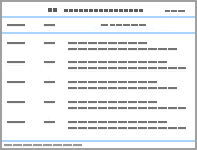
表1
2023—2024年试验地0—20 cm土壤基本理化性状"
| 年份 Year | pH | 全氮 Total N (g·kg -1) | 全磷 Total P (g·kg -1) | 速效钾 Available K (mg·kg -1) | 碱解氮 Available N (mg·kg -1) | 有机质 Organic matte (g·kg -1) |
|---|---|---|---|---|---|---|
| 2023 | 7.72 | 0.62 | 0.64 | 81.36 | 41.14 | 12.18 |
| 2024 | 7.81 | 0.54 | 0.55 | 80.09 | 45.06 | 11.83 |
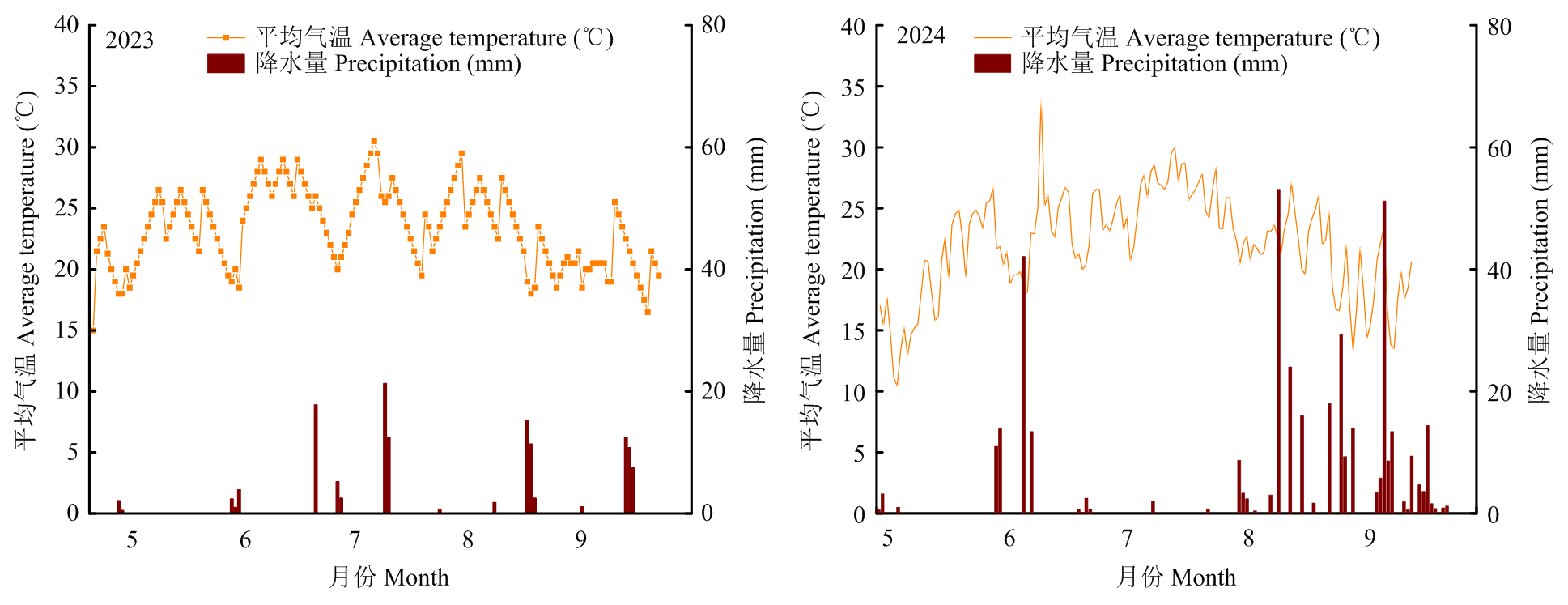
图1
试验地2023—2024年日平均气温和降水量分布"
表2
玉米各生育时期氮、磷、钾肥施用量"
| 生育时期 Growth period | 氮肥处理 Nitrogen fertilizer treatment (kg·hm-2) | 钾肥处理 Potassium fertilizer treatment (kg·hm-2) | 磷肥 P2O5 (kg·hm-2) | ||||
|---|---|---|---|---|---|---|---|
| 总施肥量 Total fertilizer application rate | 450 (N0) | 315 (N1) | 45 (K1) | 68 (K2) | 90 (K3) | 113 (K3) | 138 |
| 苗期 V3 | 45.0 | 31.5 | 13.6 | 18.0 | 9.0 | 22.6 | 27.6 |
| 拔节期 V6 | 135.0 | 94.5 | 18.0 | 27.2 | 36.0 | 45.2 | 55.2 |
| 大喇叭口期 V12 | 135.0 | 94.5 | 13.5 | 20.4 | 27.0 | 33.9 | 41.4 |
| 抽雄期 VT | 45.0 | 31.5 | 4.5 | 6.8 | 9.0 | 11.3 | 13.8 |
| 灌浆期 R3 | 90.0 | 63.0 | 0 | 0 | 0 | 0 | 0 |
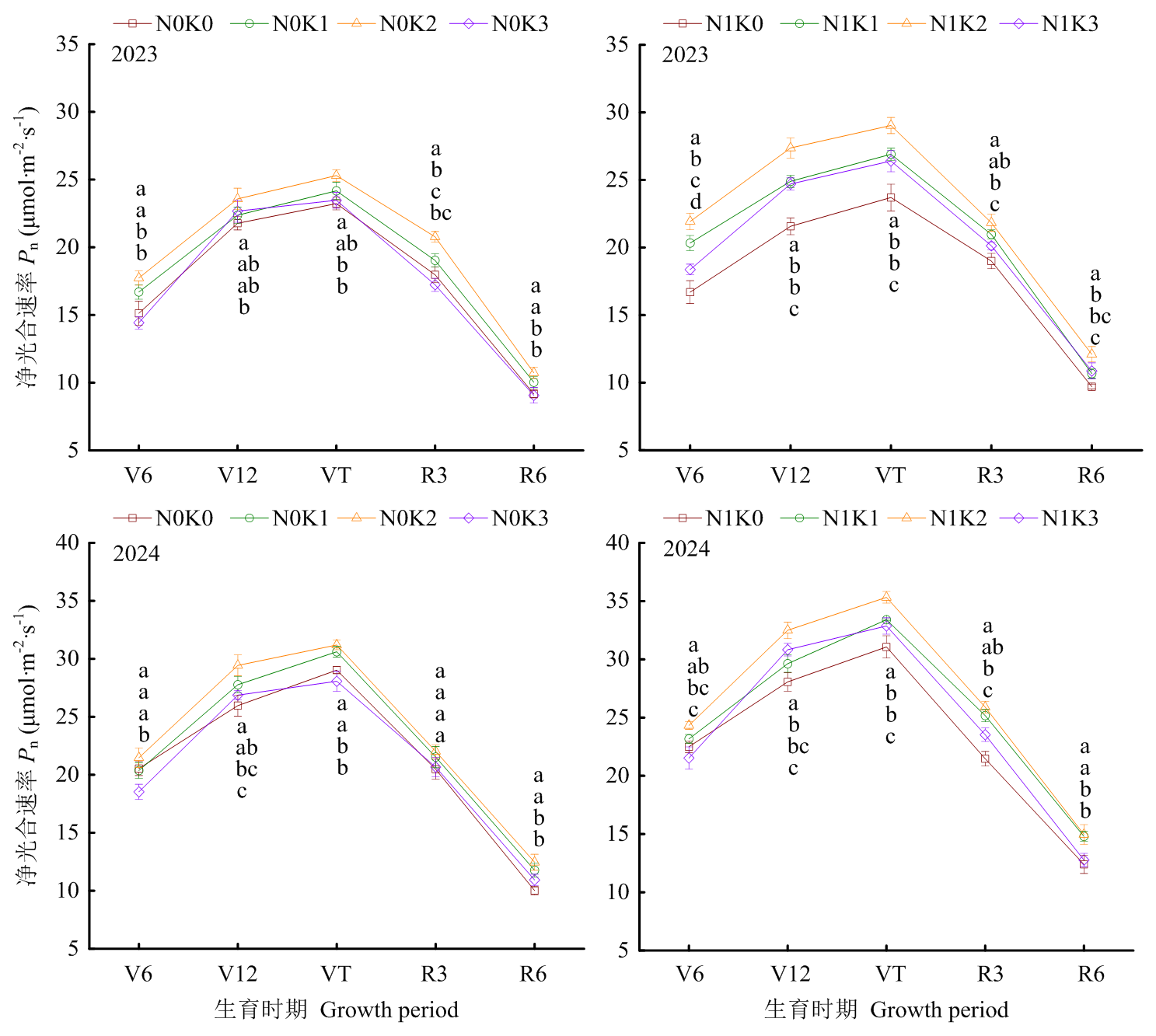
图2
不同处理下玉米净光合速率的动态变化 N0:常规施氮(450 kg·hm-2);N1:施氮量减施30%(315 kg·hm-2);K0:常规施钾(45 kg·hm-2);K1:施钾量增施50%(68 kg·hm-2);K2:施钾量增施100%(90 kg·hm-2)、K3:施钾量增施150%(113 kg·hm-2);V6:拔节期;V12:大喇叭口期;VT:抽雄期;R3:灌浆期;R6:成熟期。同一列数据中标注的小写字母表明在0.05显著性水平下存在显著差异。下同"
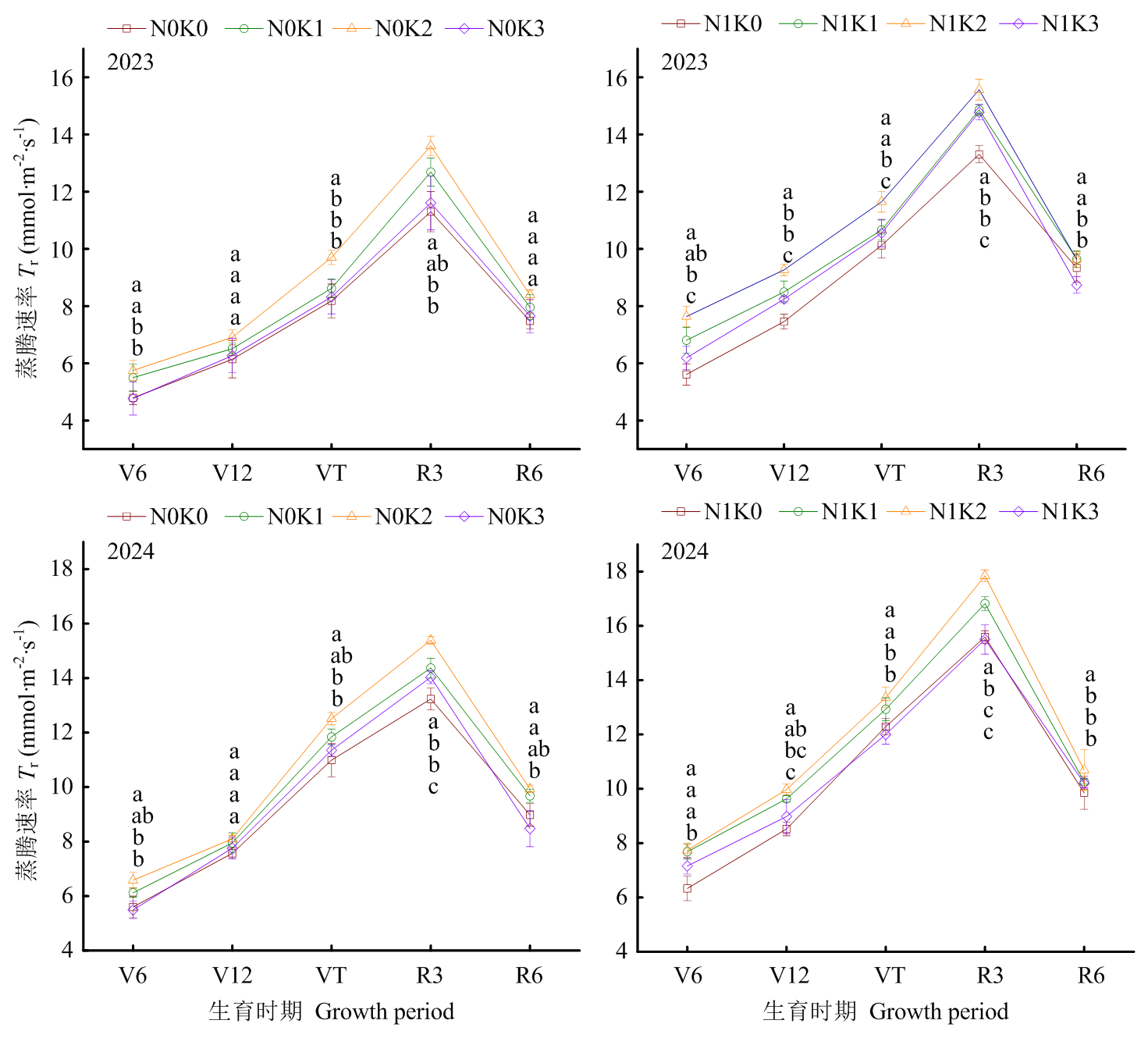
图3
不同处理下玉米蒸腾速率的动态变化"
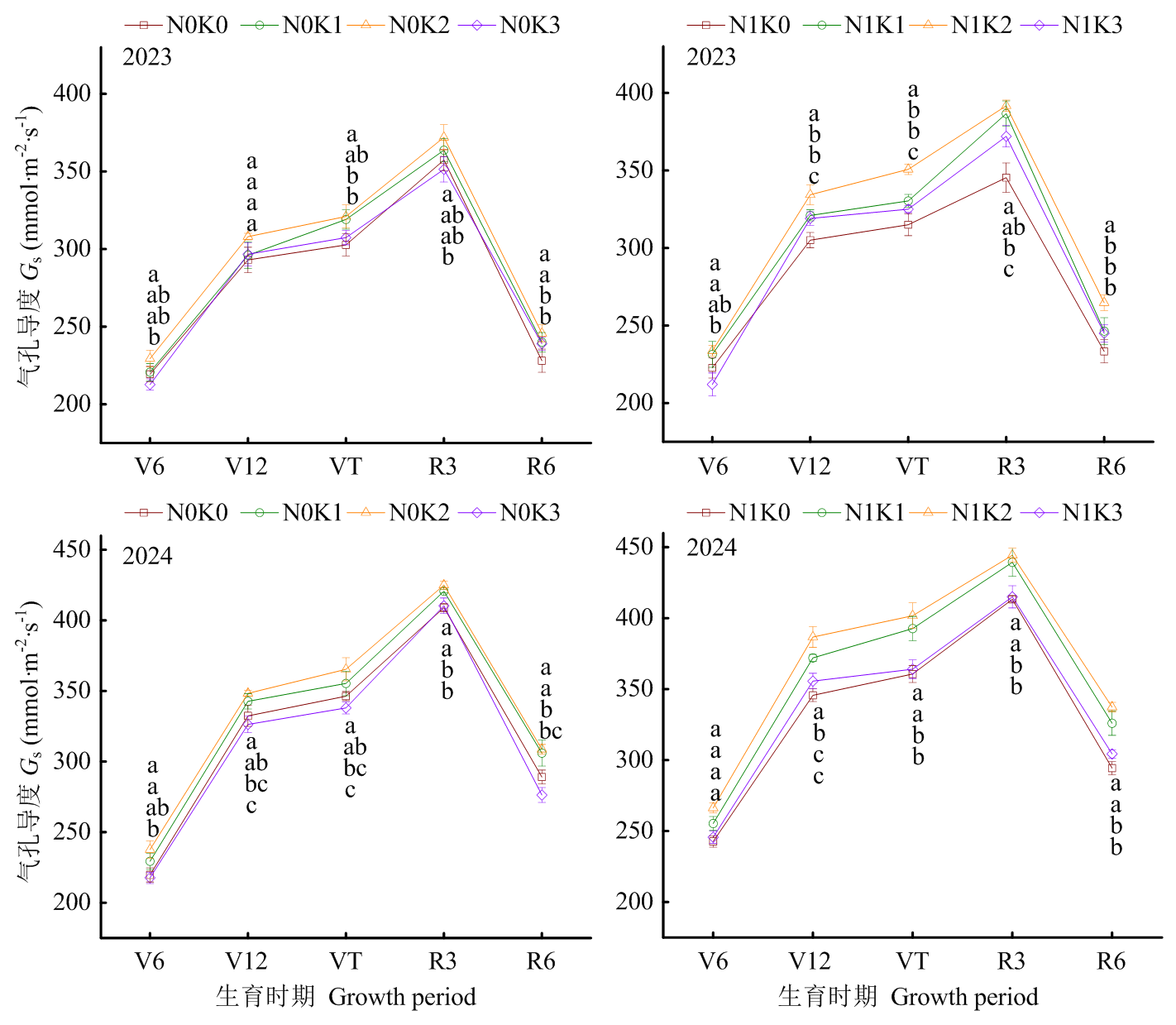
图4
不同处理下玉米叶片气孔导度的动态变化"
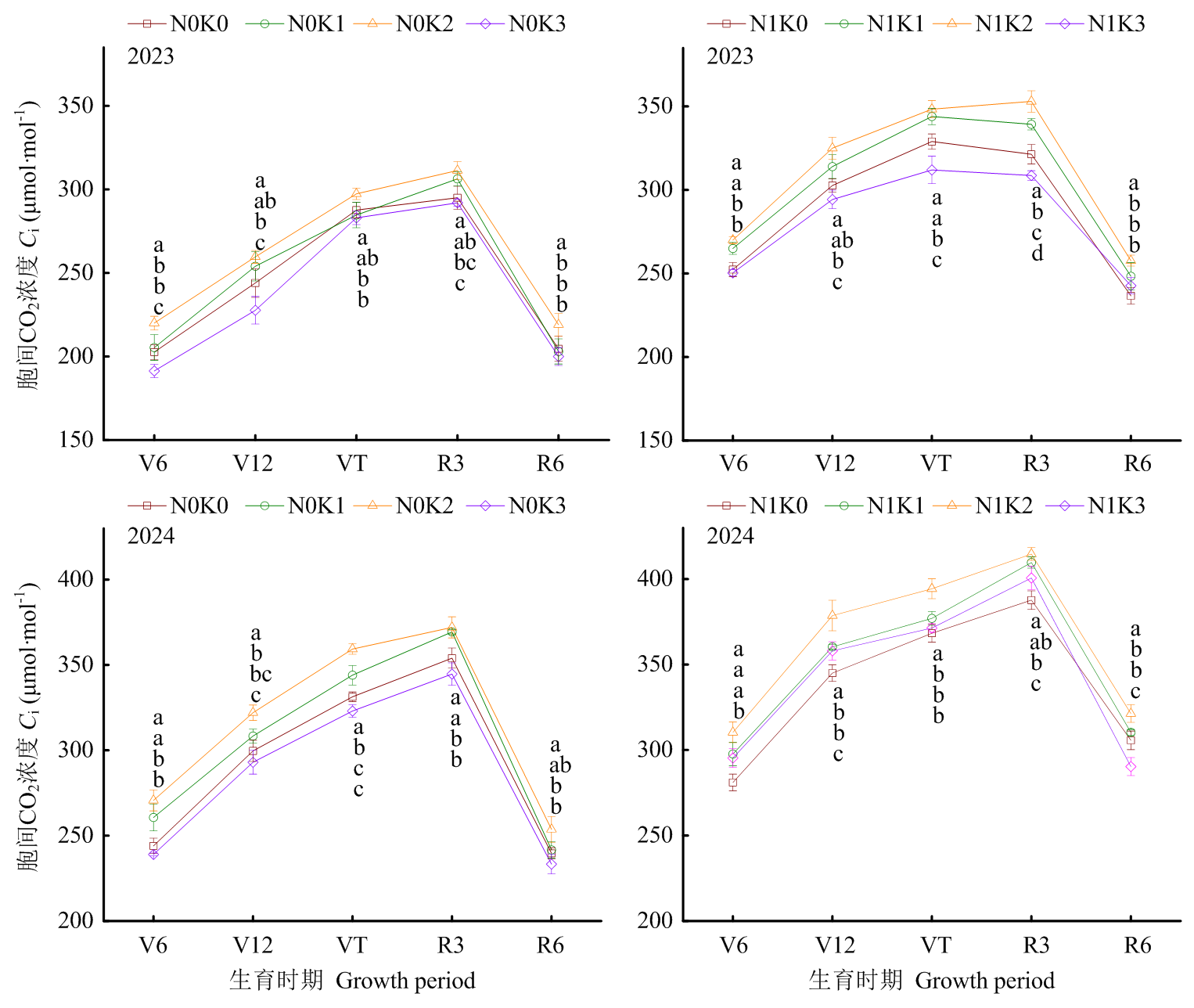
图5
不同处理下玉米叶片胞间二氧化碳浓度的动态变化"
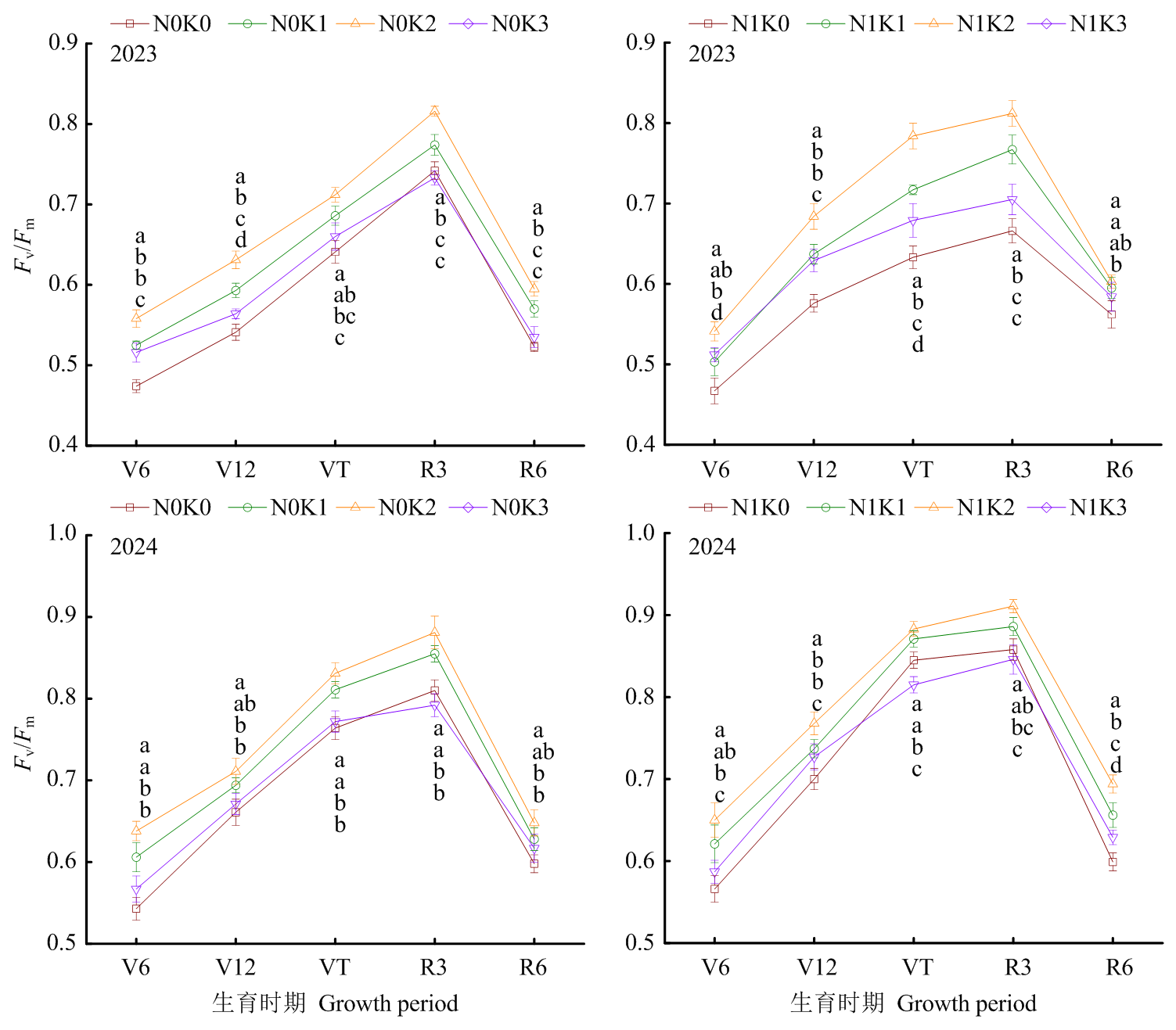
图6
不同处理下玉米光系统II最大光化学效率的动态变化"
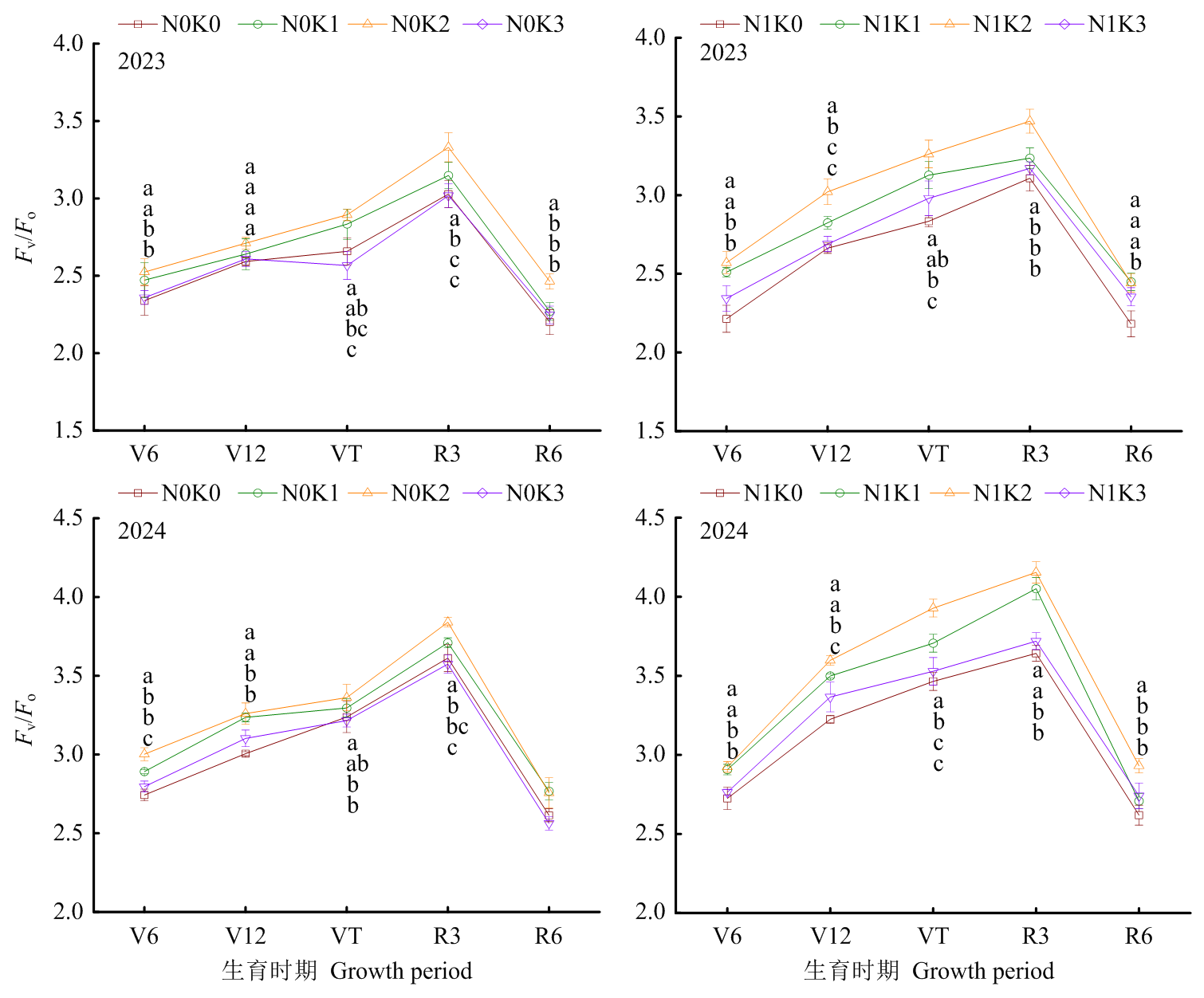
图7
不同处理下玉米光系统II潜在活性指标的动态变化"
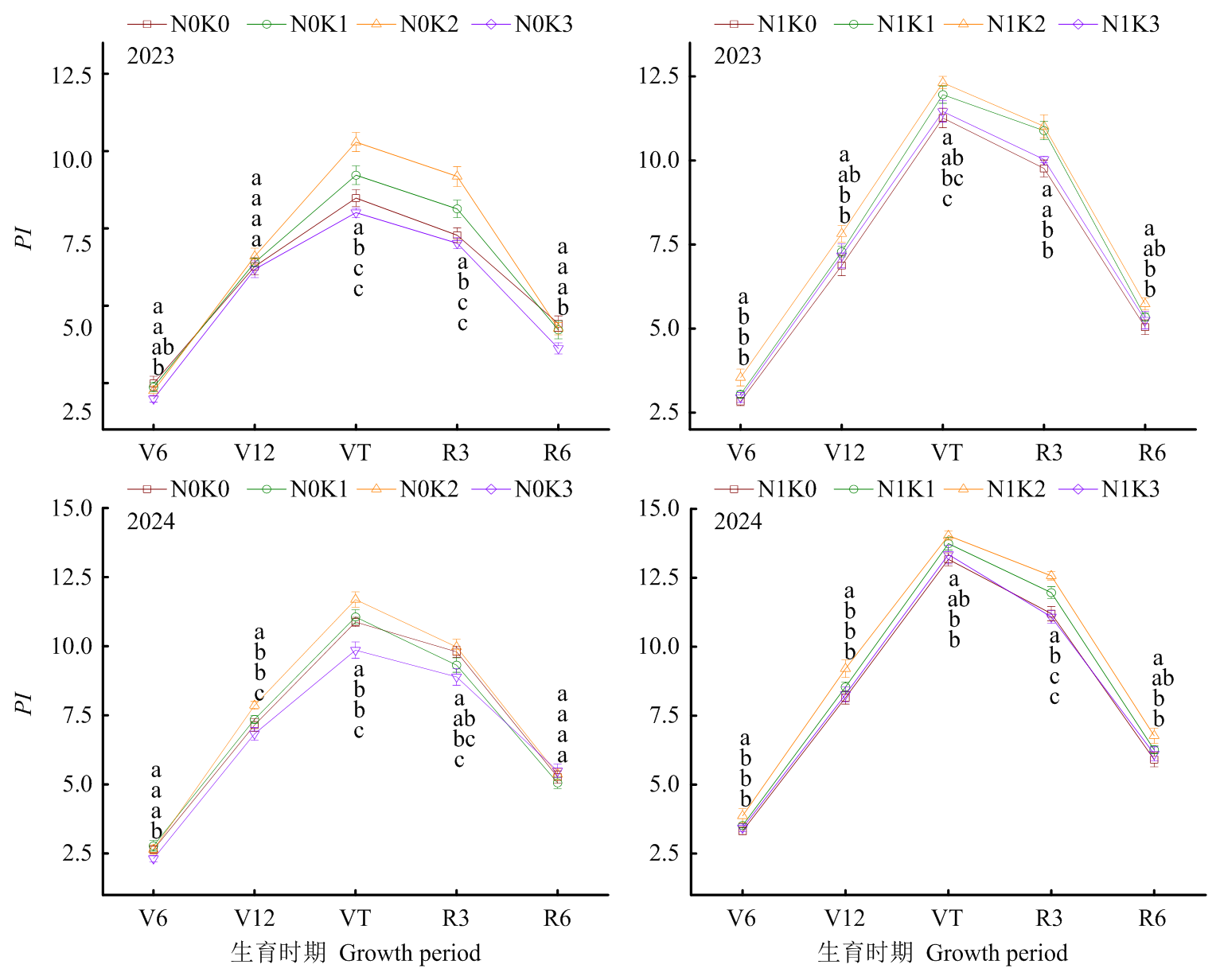
图8
不同处理下玉米荧光综合性能指数的动态变化"
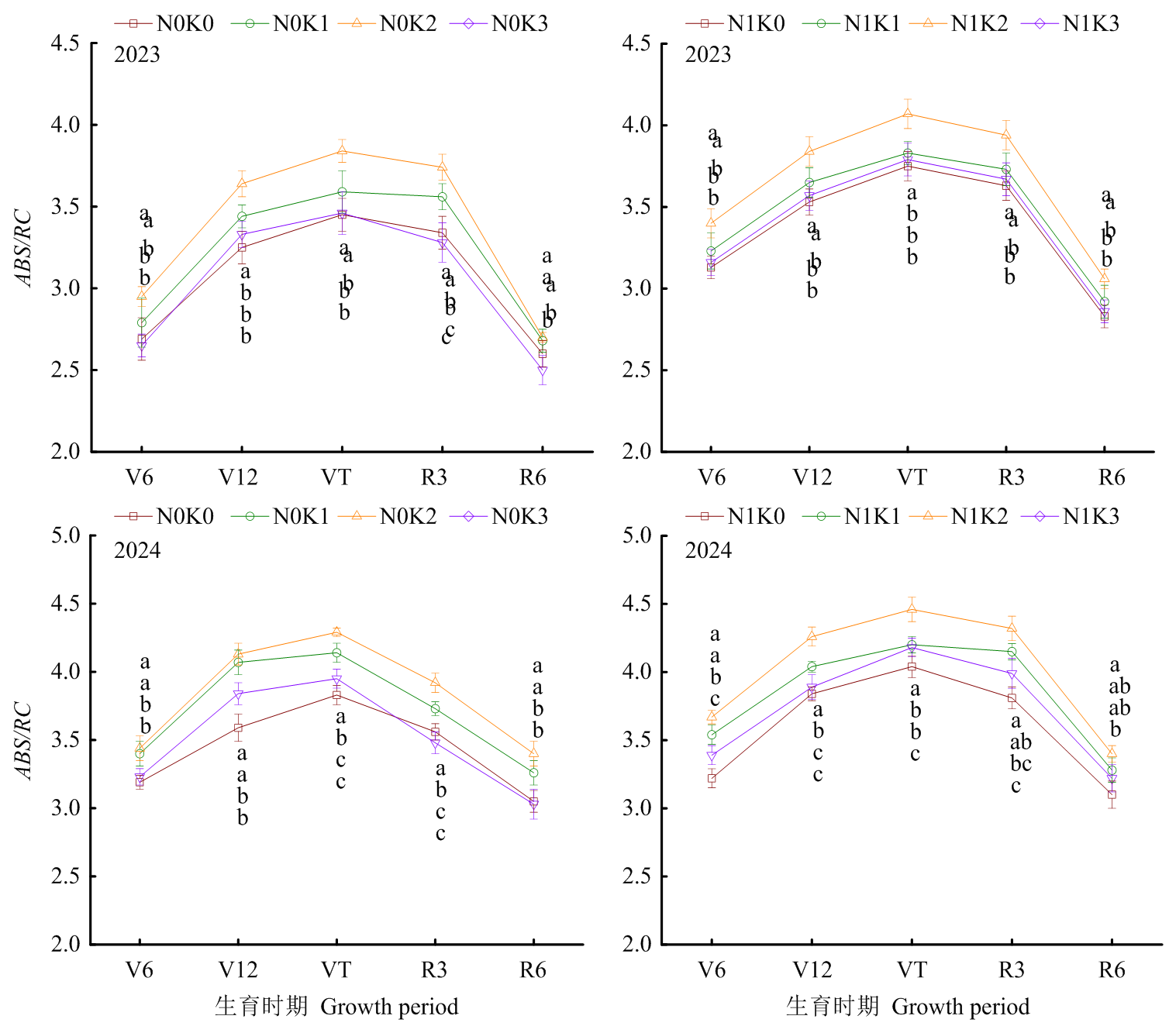
图9
不同处理下玉米单位反应中心吸收的光能的动态变化"
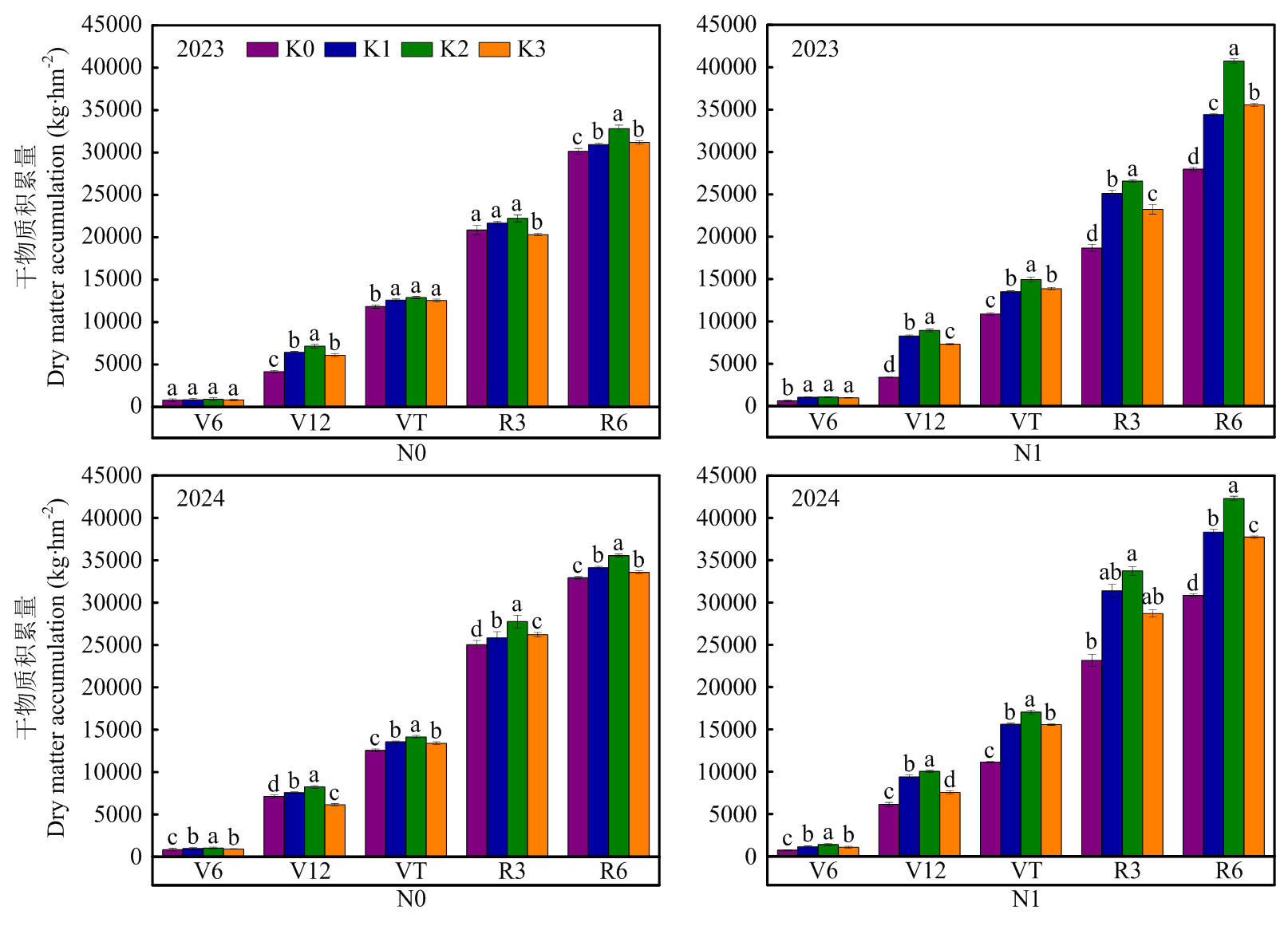
图10
减氮增钾协同调控下玉米干物质积累量的动态变化"
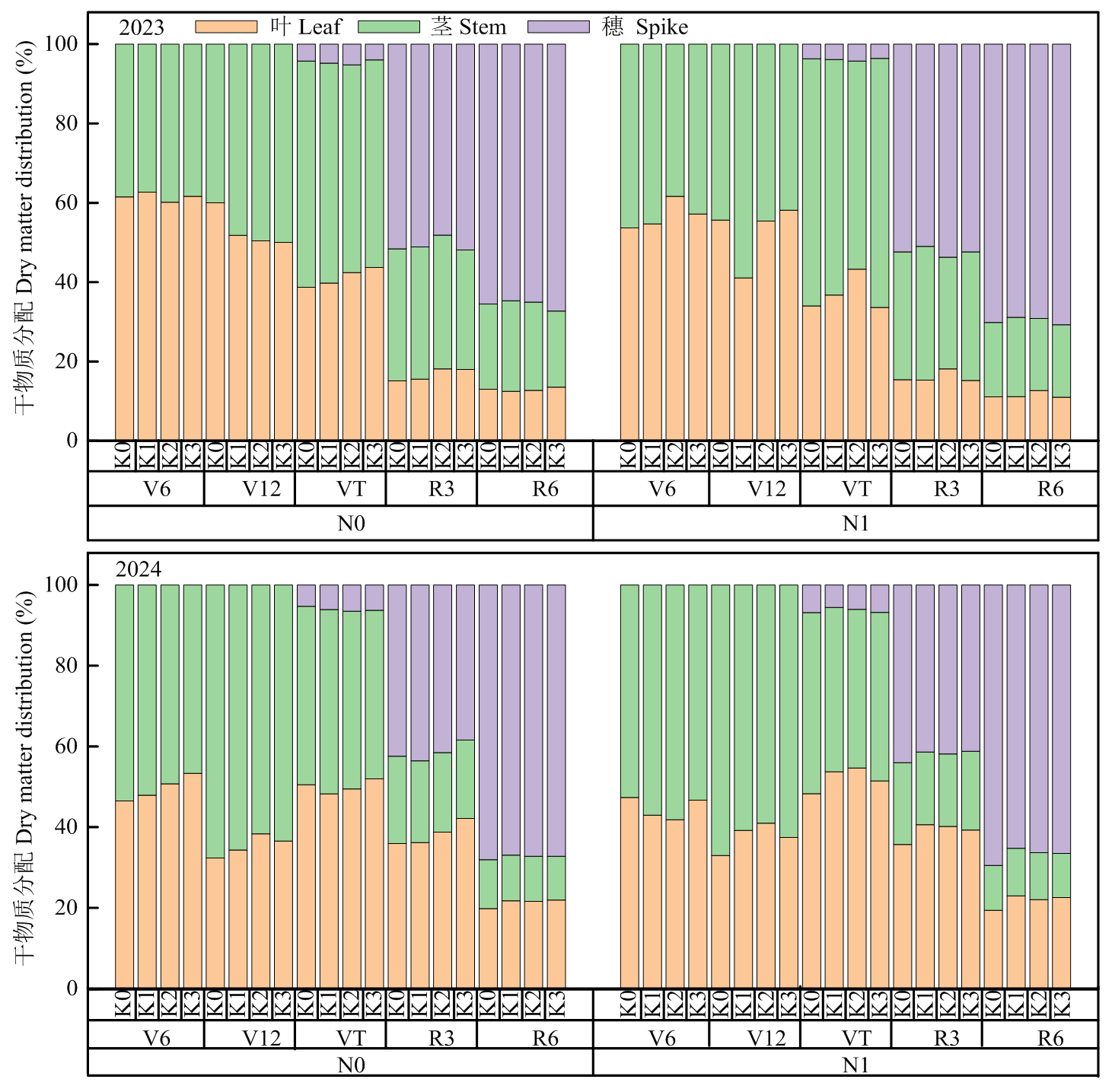
图11
减氮增钾对玉米干物质分配的动态变化规律"
表3
减氮增钾对玉米花前、花后干物质转运的变化规律"
| 年份 Year | 施氮处理 Nitrogen application treatment | 施钾处理 Potassium application treatment | 花前 Preanthesis | 花后 Postanthesis | |||
|---|---|---|---|---|---|---|---|
| 积累量 DMR (kg·hm-2) | 转运率 DMRE (%) | 贡献率 DMRCG (%) | 积累量 DMA (kg·hm-2) | 贡献率 DMAC (%) | |||
| 2023 | N0 | K0 | 2269.50a | 18.01a | 12.71ab | 15005.10c | 87.73ab |
| K1 | 2481.90a | 21.08a | 12.29ab | 16978.80b | 87.71ab | ||
| K2 | 2505.60a | 18.31a | 14.68a | 19082.10a | 89.42a | ||
| K3 | 2305.80a | 19.87a | 10.58a | 14093.70d | 85.53b | ||
| N1 | K0 | 2395.80b | 20.53ab | 10.99b | 18992.10c | 89.02a | |
| K1 | 2430.30b | 18.88b | 10.50b | 18669.60c | 85.56b | ||
| K2 | 3318.90a | 22.58a | 14.74a | 22617.60a | 90.67a | ||
| K3 | 2370.00b | 19.68ab | 9.33b | 20388.30b | 89.50a | ||
| 2024 | N0 | K0 | 3681.00b | 25.98b | 16.46b | 14214.00b | 74.72c |
| K1 | 3805.20b | 25.35b | 16.79b | 17490.45a | 78.83b | ||
| K2 | 5005.80a | 33.44a | 21.17a | 17876.10a | 83.54a | ||
| K3 | 3488.40b | 32.10b | 15.65b | 17832.45a | 84.35a | ||
| N1 | K0 | 3096.00c | 23.67c | 14.17c | 17790.00c | 85.83a | |
| K1 | 5877.60a | 30.44ab | 23.33a | 18175.35bc | 75.90c | ||
| K2 | 6314.85a | 30.71a | 22.52a | 20404.95a | 77.48c | ||
| K3 | 4757.70b | 27.73b | 19.36b | 18574.95b | 81.05b | ||
| ANOVA | 年份Year (Y) | ** | ** | ** | ** | ** | |
| 施氮量Nitrogen application (N) | ** | ** | ** | ** | NS | ||
| 施钾量Potassium application (K) | ** | ** | ** | ** | ** | ||
| N×K | ** | * | ** | ** | NS | ||
| Y×N | ** | NS | ** | ** | NS | ||
| Y×K | ** | ** | ** | ** | ** | ||
| Y×N×K | ** | NS | * | ** | * | ||
表4
2023—2024年减氮增钾处理对玉米产量的影响"
| 年份 Year | 施氮处理 Nitrogen application treatment | 施钾处理 Potassium application treatment | 穗数 Ear number (ear/hm2) | 穗粒数 Grain number per ear | 百粒重 100-kernel Weight (g) | 产量 Yield (kg·hm-2) |
|---|---|---|---|---|---|---|
| 2023 | N0 | K0 | 83031.12c | 484.88a | 35.73b | 15650.37b |
| K1 | 84562.48b | 501.68a | 36.82ab | 16210.02b | ||
| K2 | 87624.64a | 510.70a | 37.84a | 17597.08a | ||
| K3 | 82447.48c | 483.53a | 35.29b | 15888.59b | ||
| N1 | K0 | 86746.42b | 507.41c | 36.42c | 15261.12b | |
| K1 | 88133.91b | 536.22a | 38.76b | 18203.54a | ||
| K2 | 90941.46a | 540.98a | 40.27a | 18586.39a | ||
| K3 | 88018.23b | 519.26b | 38.53b | 18161.88a | ||
| 2024 | N0 | K0 | 85702.73c | 666.79a | 28.21b | 16352.58b |
| K1 | 87311.51b | 688.01a | 29.07a | 16488.74b | ||
| K2 | 90497.75a | 701.38a | 29.15a | 17305.46a | ||
| K3 | 87151.67b | 672.43a | 28.06a | 16785.16b | ||
| N1 | K0 | 83630.90d | 652.80c | 27.90c | 14895.10b | |
| K1 | 88008.11c | 715.66ab | 32.02a | 18392.79a | ||
| K2 | 92543.93a | 731.15a | 30.12b | 19279.56a | ||
| K3 | 90261.99b | 703.31b | 29.16b | 18384.68a | ||
| ANOVA | 年份Year (Y) | ** | ** | ** | ** | |
| 施氮量Nitrogen application (N) | ** | ** | ** | ** | ||
| 施钾量Potassium application (K) | ** | ** | ** | ** | ||
| N×K | ** | * | ** | ** | ||
| Y×N | ** | NS | * | NS | ||
| Y×K | ** | NS | * | NS | ||
| Y×N×K | * | NS | * | NS | ||
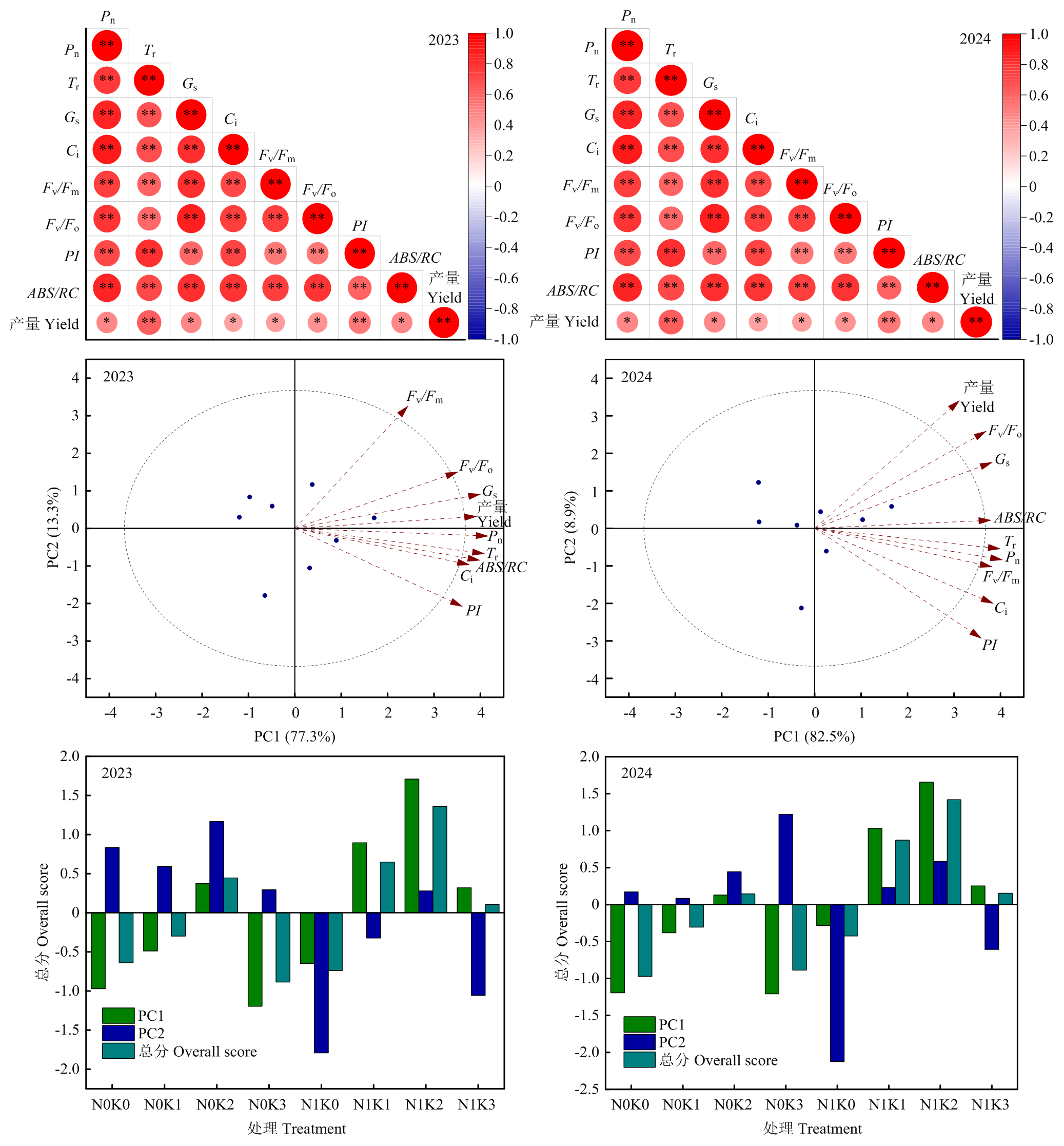
图12
减氮增钾对玉米光合荧光参数与产量的相关性分析和主成分分析"
| [1] |
徐珂, 樊志龙, 殷文, 赵财, 于爱忠, 胡发龙, 柴强. 氮肥后移及间作对玉米光合特性的耦合效应. 中国农业科学, 2022, 55(21): 4131-4143. doi: 10.3864/j.issn.0578-1752.2022.21.004.
|
|
|
|
| [2] |
doi: 10.3390/atmos16040373 |
| [3] |
doi: 10.1038/s41598-021-04508-w |
| [4] |
doi: 10.32615/ps.2022.032 pmid: 39650111 |
| [5] |
蔡泽江, 孙楠, 王伯仁, 徐明岗, 黄晶, 张会民. 长期施肥对红壤pH、作物产量及氮、磷、钾养分吸收的影响. 植物营养与肥料学报, 2011, 17(1): 71-78.
|
|
|
|
| [6] |
王英, 刘汝亮, 王芳, 洪瑜, 冒辛平, 马建森. 减氮对引黄灌区春玉米氮素吸收利用和淋失的影响. 农业资源与环境学报, 2024, 41(3): 576-584.
|
|
|
|
| [7] |
doi: 10.1186/s12870-020-02477-2 pmid: 32560674 |
| [8] |
doi: 10.1007/s13593-025-01027-0 |
| [9] |
张仲鹃, 郝曦煜, 王雪. 双城地区适宜青贮玉米品种生产性能及营养价值评价. 饲料研究, 2024, 47(21): 138-143.
|
|
|
|
| [10] |
汪帆, 胡大鹏, 郑玉涛, 钟宇帆, 姚宇阗. 减氮增钾对水稻产量品质和土壤肥力的影响. 江苏农业科学, 2023, 51(17): 86-90.
|
|
|
|
| [11] |
刘凯, 谢英荷, 李廷亮, 马红梅, 张奇茹, 姜丽伟, 曹静, 邵靖琳. 减氮覆膜对黄土旱塬小麦产量及养分吸收利用的影响. 中国农业科学, 2021, 54(12): 2595-2607. doi: 10.3864/j.issn.0578-1752.2021.12.010.
|
|
|
|
| [12] |
张丽丽, 齐华, 樊叶, 杨海龙, 付俊, 许淑娟, 景希强, 王璞. 氮肥后移对玉米冠层内物质分配及氮素利用的影响. 玉米科学, 2017, 25(1): 127-132.
|
|
|
|
| [13] |
阎世江, 房雅丽, 卢占龙, 张治家. 减量施用氮肥对玉米光合参数、产量与品质的影响. 江苏农业科学, 2022, 50(12): 64-69.
|
|
|
|
| [14] |
doi: 10.1017/S002185962000060X |
| [15] |
doi: 10.1016/j.agwat.2024.108948 |
| [16] |
张潇, 李岚涛, 耿赛男, 杨启睿, 苗玉红, 王宜伦. 施钾对夏玉米产量、钾素积累动态及光温生理特性的影响. 中国生态农业学报(中英文), 2024, 32(4): 640-649.
|
|
|
|
| [17] |
李元薇, 杨恒山, 葛选良, 张宏宇, 刘晶, 李维敏. 浅埋滴灌水肥一体化下氮肥减施对玉米花后光合特性和碳代谢的影响. 玉米科学, 2024, 32(8): 80-87, 95.
|
|
|
|
| [18] |
王佳, 慕瑞瑞, 杨乔乔, 刘伟, 张月荷, 康建宏. 滴灌水肥一体化下施钾量对宁夏春玉米叶绿素荧光特性与产量的影响. 浙江农业学报, 2021, 33(8): 1347-1357.
doi: 10.3969/j.issn.1004-1524.2021.08.01 |
|
doi: 10.3969/j.issn.1004-1524.2021.08.01 |
|
| [19] |
张美微, 屈俊峰, 张盼盼, 李川, 赵霞, 牛军, 黄璐, 陈京仑, 宇婷, 刘京宝, 乔江方. 减施氮肥对不同密度夏玉米产量和干物质积累特性的影响. 玉米科学, 2021, 29(5): 145-150.
|
|
|
|
| [20] |
doi: 10.1016/j.fcr.2022.108725 |
| [21] |
李强, 罗延宏, 余东海, 孔凡磊, 杨世民, 袁继超. 低氮胁迫对耐低氮玉米品种苗期光合及叶绿素荧光特性的影响. 植物营养与肥料学报, 2015, 21(5): 1132-1141.
|
|
|
|
| [22] |
刘欣宇, 谢畅, 王婧, 蒋春姬, 赵新华, 刘喜波, 钟超, 张鹤, 于海秋, 王晓光. 单垄小双行交错布种下氮肥减施对花生光合特性及产量的影响. 中国油料作物学报, 2025, 47(5): 1168-1178.
doi: 10.19802/j.issn.1007-9084.2024271 |
|
|
|
| [23] |
谭小兵, 杨焕文, 王戈, 张金峰, 白羽祥, 韦俊, 吕世保. 基肥减氮增钾对烤烟光合特性及产质量的影响. 湖北农业科学, 2017, 56(17): 3300-3304, 3333.
|
|
|
|
| [24] |
doi: 10.1016/S2095-3119(13)60346-9 |
| [25] |
doi: 10.1016/j.ecolind.2019.105686 |
| [26] |
王海琪, 王荣荣, 蒋桂英, 尹豪杰, 晏世杰, 车子强. 施氮量对滴灌春小麦叶片光合生理性状的影响. 作物学报, 2023, 49(1): 211-224.
doi: 10.3724/SP.J.1006.2023.11100 |
|
doi: 10.3724/SP.J.1006.2023.11100 |
|
| [27] |
杜祥备, 王家宝, 刘小平, 夏家平, 韩杨. 减氮运筹对甘薯光合作用和叶绿素荧光特性的影响. 应用生态学报, 2019, 30(4): 1253-1260.
doi: 10.13287/j.1001-9332.201904.012 |
|
|
|
| [28] |
汪顺义, 刘庆, 史衍玺, 李欢. 氮钾配施对甘薯光合产物积累及分配的影响. 中国农业科学, 2017, 50(14): 2706-2716. doi: 10.3864/j.issn.0578-1752.2017.14.007.
|
|
|
|
| [29] |
王旭敏, 雒文鹤, 刘朋召, 张琦, 王瑞, 李军. 节水减氮对夏玉米干物质和氮素积累转运及产量的调控效应. 中国农业科学, 2021, 54(15): 3183-3197. doi: 10.3864/j.issn.0578-1752.2021.15.004.
|
|
|
|
| [30] |
张绪成, 于显枫, 王红丽, 侯慧芝, 方彦杰, 马一凡. 半干旱区减氮增钾、有机肥替代对全膜覆盖垄沟种植马铃薯水肥利用和生物量积累的调控. 中国农业科学, 2016, 49(5): 852-864. doi: 10.3864/j.issn.0578-1752.2016.05.005.
|
|
|
|
| [31] |
陈路路, 孙哲, 田昌庚, 刘尚刚, 赵丰玲, 郑建利. 氮钾互作对甘薯生长发育、干物质积累分配及产量形成的影响. 江苏农业科学, 2023, 51(9): 68-75.
|
|
|
|
| [32] |
段显朝, 周艳宾, 马建彬, 彭胜强, 宋文峰, 朱宏强, 王腾龙, 王戈, 王娜, 白羽祥, 杜宇, 周鹏, 代惠娟. 基肥减氮增钾对烤烟生长及产质量的影响. 贵州农业科学, 2025, 53(7): 22-31.
|
|
|
|
| [33] |
唐江华, 孟令贻, 伍林, 徐文修, 陈楚豪, 王梓豪. 钾肥和氮肥配施对北疆棉花干物质积累分配及产量的影响. 新疆农业大学学报, 2024, 47(1): 19-26.
|
|
|
|
| [34] |
全必汉. 减氮增钾对水稻产量和品质的影响. 农业技术与装备, 2024(11): 144-146.
|
|
|
| [1] | 白晶晶, 章宇辰, 倪子捷, 高佳勇, 刘伟洋, 盖东升, 王雨行, 何佳庆, 张强, 邵玺文, 吴莹, 耿艳秋, 郭丽颖. 不同灌溉量对东北地区水稻抗倒伏特性及产量的影响[J]. 中国农业科学, 2026, 59(9): 1848-1868. |
| [2] | 祝培, 赵耀, 白岩, 张金盔, 李莓, 龙金佳, 杨龙, 罗丽娅, 许本波, 徐劲松, 张学昆. 氟唑菌酰羟胺对油菜的生理调控作用及其与咪鲜胺的复配效应[J]. 中国农业科学, 2026, 59(9): 1903-1915. |
| [3] | 王志高, 李刘滨, 许颖, 鞠澄辉, 何荣. 基于图像处理的玉米破损比例检测方法及其品质变化同步分析[J]. 中国农业科学, 2026, 59(9): 1987-2001. |
| [4] | 陈宣伊, 郭星星, 张向前, 路战远, 刘凌悦, 罗方, 李金龙, 张传玲, 张志青, 车曼青. 间作行比对玉米冠层光环境异质性和光合物质生产的影响[J]. 中国农业科学, 2026, 59(8): 1653-1671. |
| [5] | 侯慧芝, 尹嘉德, 马明生, 刘晓伟, 柳燕兰, 雷康宁. 耕作与增施有机肥对陇东马铃薯-玉米一年两熟制作物产量和水分利用的影响[J]. 中国农业科学, 2026, 59(8): 1672-1685. |
| [6] | 赵思捷, 任家欣, 南江磊, 王兴云, 成卫宁. 玉米叶片次生物质含量及相关基因表达与其对草地贪夜蛾抗性的关系[J]. 中国农业科学, 2026, 59(8): 1686-1696. |
| [7] | 彭廷燊, 陆久焱, 吴美林, 严雨欣, 刘宏周, 南文斌, 秦小健, 李明, 龚俊义, 梁永书. 多年生水稻黄糯2号和长白7号产量相关性状的QTL分析[J]. 中国农业科学, 2026, 59(7): 1361-1379. |
| [8] | 王亚菲, 闫鹏, 薛金涛, 董学瑞, 孟凡琦, 郭丽娜, 罗艺, 张娟, 董志强, 卢霖. 乙烯利-甜菜碱-水杨酸合剂对高温胁迫下玉米根系建构、生理功能和产量的影响[J]. 中国农业科学, 2026, 59(7): 1439-1455. |
| [9] | 王玉萍, 符质, 孙佳莹, 穆晓萌, 刘慧淋, 郭进云, 宋文菁, 侯雷平, 赵海亮. 苗期施用褪黑素对番茄短期低温胁迫的缓解作用与应用效果评价[J]. 中国农业科学, 2026, 59(7): 1523-1535. |
| [10] | 王佳诺, 陈桂平, 李盼, 王丽萍, 南运有, 何蔚, 樊志龙, 胡发龙, 柴强, 殷文, 赵连豪. 免耕地膜两年覆盖提高绿洲灌区玉米产量的灌浆期光合生理机制[J]. 中国农业科学, 2026, 59(6): 1189-1202. |
| [11] | 周新杰, 任昊, 陈应龙, 张吉旺, 赵斌, 任佰朝, 刘鹏, 王洪章. 过氧化钙对渍涝农田夏玉米根系形态及产量形成的影响[J]. 中国农业科学, 2026, 59(6): 1203-1216. |
| [12] | 何继航, 张擎, 吕相月, 薛吉全, 徐淑兔, 刘建超. 不同保绿型玉米杂交种氮效率评价[J]. 中国农业科学, 2026, 59(6): 1217-1230. |
| [13] | 李永娟, 张悦彤, 王艺博, 赵长江, 宋洁, 陈雪丽, 姚钦. 生物炭施用对大豆轮连作系统土壤固氮微生物nifH基因丰度及群落组成的影响[J]. 中国农业科学, 2026, 59(6): 1272-1285. |
| [14] | 李思源, 李鸿萍, 常洪庆, 张森焱, 栗思佳, 崔欣飞, 乔泼, 曾波, 刘桂珍, 刘天学, 汤继华, 李潮海. 增密对不同株高玉米品种产量和农艺性状动态变化的影响[J]. 中国农业科学, 2026, 59(5): 967-984. |
| [15] | 董金龙, 赵莹, 余海兵, 吕建晔, 秦佳琦, 梁晨, 明博, 李少昆. 多模型解析玉米籽粒容重的营养品质贡献度与区域异质性[J]. 中国农业科学, 2026, 59(5): 985-995. |
|
||
