






中国农业科学 ›› 2026, Vol. 59 ›› Issue (3): 575-588.doi: 10.3864/j.issn.0578-1752.2026.03.008
刘梦阳1( ), 刘洁1, 陈翔2, 王擎运1, 罗来超1, 齐永波1, 田达1, 李金才2, 柴如山1()
收稿日期:2025-03-24
接受日期:2025-06-04
出版日期:2026-02-01
发布日期:2026-01-31
通信作者:
联系方式:
刘梦阳,E-mail:18726694101@163.com。
基金资助:
LIU MengYang1(), LIU Jie1, CHEN Xiang2, WANG QingYun1, LUO LaiChao1, QI YongBo1, TIAN Da1, LI JinCai2, CHAI RuShan1()
Received:2025-03-24
Accepted:2025-06-04
Published:2026-02-01
Online:2026-01-31
摘要:
【目的】探究小麦玉米秸秆还田对砂姜黑土团聚体粒级分布及团聚体磷组分的调控作用,以期为土壤结构改良和磷素活化提供理论支撑。【方法】依托安徽省蒙城县始于2008年的小麦玉米秸秆还田长期定位试验,设置4个处理:常规施肥(F)、常规施肥+小麦秸秆单季还田(FWS)、常规施肥+玉米秸秆单季还田(FMS)、常规施肥+小麦玉米秸秆双季还田(FWMS),于2023年小麦成熟期采集0—20 cm耕层土样测定土壤团聚体组成及各粒级团聚体磷组分含量,解析小麦玉米秸秆还田对砂姜黑土团聚体磷素形态分布、磷活化度和有效磷贡献率的影响。【结果】与F处理相比,FWS、FMS、FWMS处理的>2 mm团聚体占比分别显著增加了35.9%、30.6%和39.1%,0.25—2 mm和0.053—0.25 mm团聚体的占比显著下降。小麦玉米秸秆还田可显著提升砂姜黑土的水稳性团聚体平均重量直径,显著降低土壤团聚体破坏率。秸秆还田条件下砂姜黑土的全磷和有效磷含量分别显著提高6.5%—26.0%和21.1%—37.6%。秸秆还田处理能够显著增加砂姜黑土中的活性磷组分NaHCO3-Pi和中活性磷组分NaOH-Po含量,增幅分别达到17.1%—51.3%和19.5%—46.2%。从土壤团聚体角度来看,与F处理相比,小麦玉米秸秆还田处理下0.25—2 mm团聚体的有效磷含量和磷活化度分别显著提升39.3%—63.9%和37.5%—51.7%。FWS、FMS和FWMS处理的>2 mm团聚体有效磷贡献率较F处理分别显著增加19.0%、17.3%和22.3%,秸秆还田使砂姜黑土微团聚体(0.053—0.25 mm)和粉黏粒组分(<0.053 mm)的有效磷贡献率显著下降。砂姜黑土0.25—2 mm团聚体的活性磷组分(H2O-P、NaHCO3-Po)和中活性磷组分(NaOH-Po)含量在小麦玉米秸秆还田条件下有所增加。【结论】小麦玉米秸秆还田是改善砂姜黑土团聚体粒级组成与稳定性、提升土壤供磷能力的有效措施。
刘梦阳, 刘洁, 陈翔, 王擎运, 罗来超, 齐永波, 田达, 李金才, 柴如山. 长期秸秆还田对砂姜黑土团聚体结构及磷组分分布的影响[J]. 中国农业科学, 2026, 59(3): 575-588.
LIU MengYang, LIU Jie, CHEN Xiang, WANG QingYun, LUO LaiChao, QI YongBo, TIAN Da, LI JinCai, CHAI RuShan. Effects of Long-Term Straw Return on Distribution of Aggregates and Phosphorus Fractions in Shajiang Black Soil[J]. Scientia Agricultura Sinica, 2026, 59(3): 575-588.
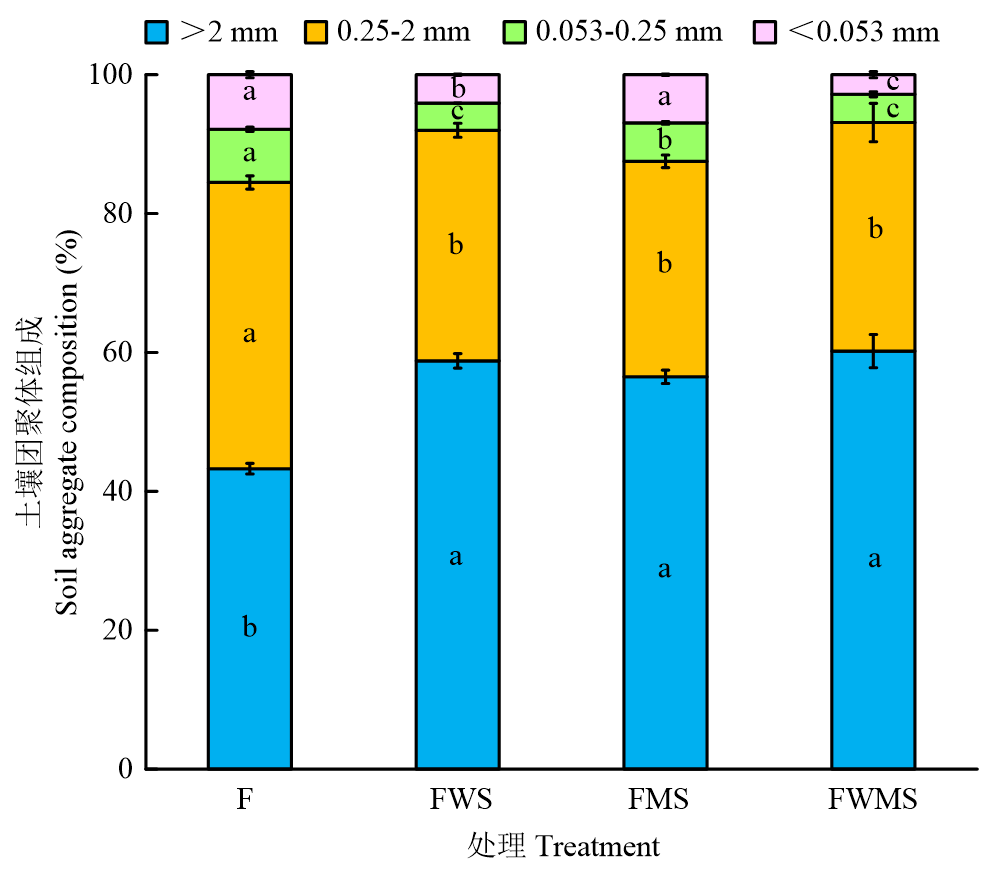
图1
不同处理土壤团聚体组成 F、FWS、FMS、FWMS分别表示常规施肥、常规施肥+小麦秸秆单季还田、常规施肥+玉米秸秆单季还田、常规施肥+小麦玉米秸秆双季还田。不同小写字母表示不同秸秆还田处理间差异显著(P<0.05)。误差线表示标准误。下同"
表1
不同处理土壤团聚体稳定性参数"
| 处理 Treatment | 干筛Dry sieving | 湿筛Wet sieving | 破坏率 PAD (%) | ||
|---|---|---|---|---|---|
| R0.25 (%) | MWD (mm) | R0.25 (%) | MWD (mm) | ||
| F | 96.7±0.5a | 4.35±0.03b | 84.5±0.7c | 2.78±0.06b | 12.7±0.4a |
| FWS | 96.9±0.4a | 4.77±0.01a | 92.0±0.1a | 3.70±0.07a | 5.1±0.4c |
| FMS | 96.9±0.5a | 4.64±0.11a | 87.5±0.3b | 3.63±0.08a | 9.7±0.7b |
| FWMS | 96.0±0.2a | 4.41±0.01b | 93.1±0.4a | 3.89±0.13a | 3.0±0.2d |
表2
不同处理土壤理化性质"
| 处理 Treatment | pH | 有机质 SOM (g·kg-1) | 全氮 TN (g·kg-1) | 全磷 TP (g·kg-1) | 有效磷 AP (mg·kg-1) | 磷活化系数 PAC (%) |
|---|---|---|---|---|---|---|
| F | 5.09±0.03a | 32.3±1.1c | 1.22±0.02b | 0.54±0.01d | 38.0±0.8c | 7.1±0.2c |
| FWS | 5.11±0.05a | 37.1±0.9b | 1.39±0.02a | 0.61±0.01b | 46.1±0.8b | 7.6±0.2bc |
| FMS | 5.06±0.04a | 34.6±1.0bc | 1.38±0.02a | 0.57±0.01c | 49.7±1.5ab | 8.6±0.2a |
| FWMS | 5.03±0.04a | 41.2±0.8a | 1.39±0.04a | 0.68±0.02a | 52.3±1.6a | 7.7±0.2bc |
表3
不同处理土壤磷组分含量"
| 处理 Treatment | H2O-P | NaHCO3-Pi | NaHCO3-Po | NaOH-Pi | NaOH-Po | D.HCl-Pi | Residual-P |
|---|---|---|---|---|---|---|---|
| F | 23.4±2.3b | 40.3±0.7c | 49.8±3.3b | 73.6±2.2c | 83.8±2.7c | 122.3±1.2b | 186.7±1.2a |
| FWS | 27.4±2.8b | 47.7±2.3b | 48.1±1.1b | 92.1±3.9b | 112.6±2.7ab | 124.7±3.9b | 191.8±6.6a |
| FMS | 22.1±2.7b | 47.2±1.2b | 51.1±5.3b | 78.5±2.7c | 100.2±7.2b | 126.5±1.5ab | 188.0±2.3a |
| FWMS | 43.2±0.8a | 60.9±3.4a | 85.4±3.2a | 108.1±1.2a | 122.6±2.9a | 134.8±4.3a | 192.9±4.4a |
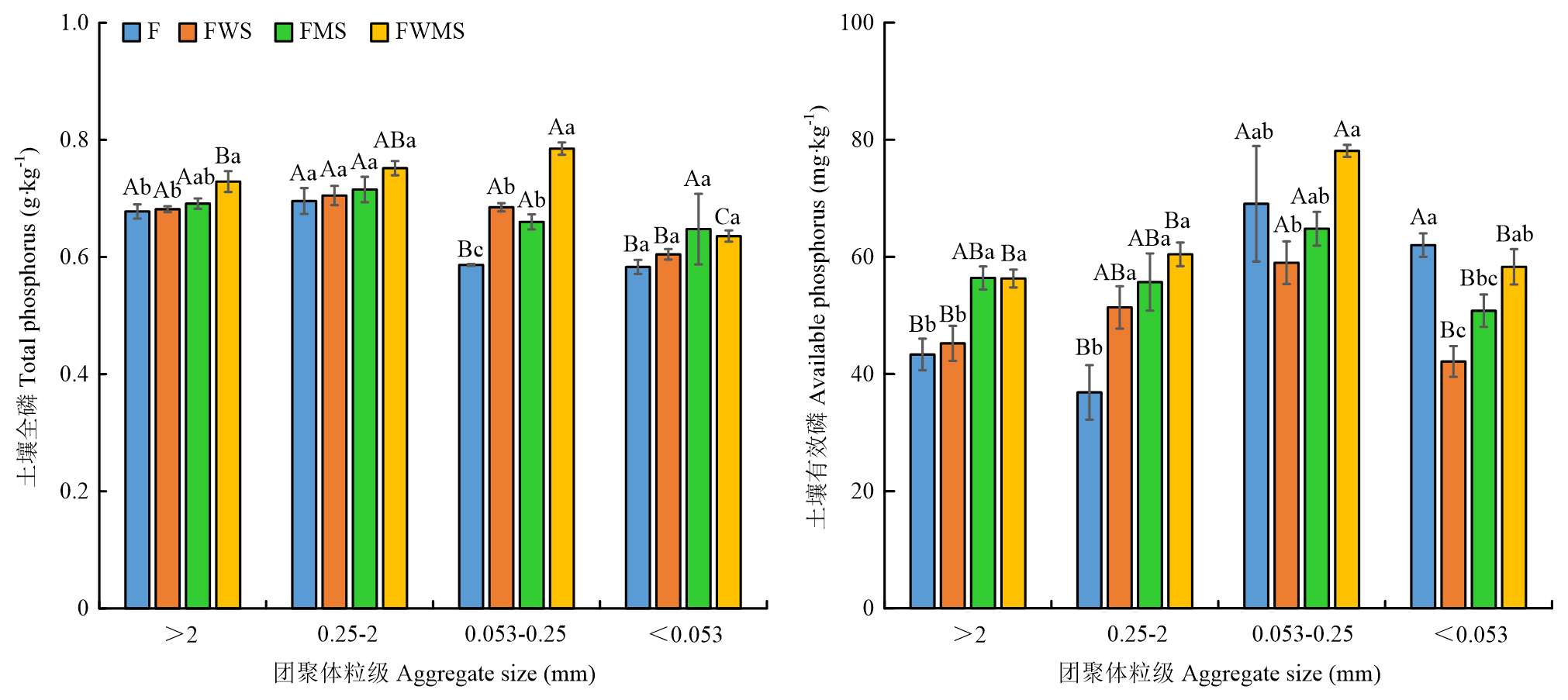
图2
不同处理土壤团聚体全磷和有效磷含量 不同大写字母表示不同粒级团聚体间差异显著(P<0.05)。下同"
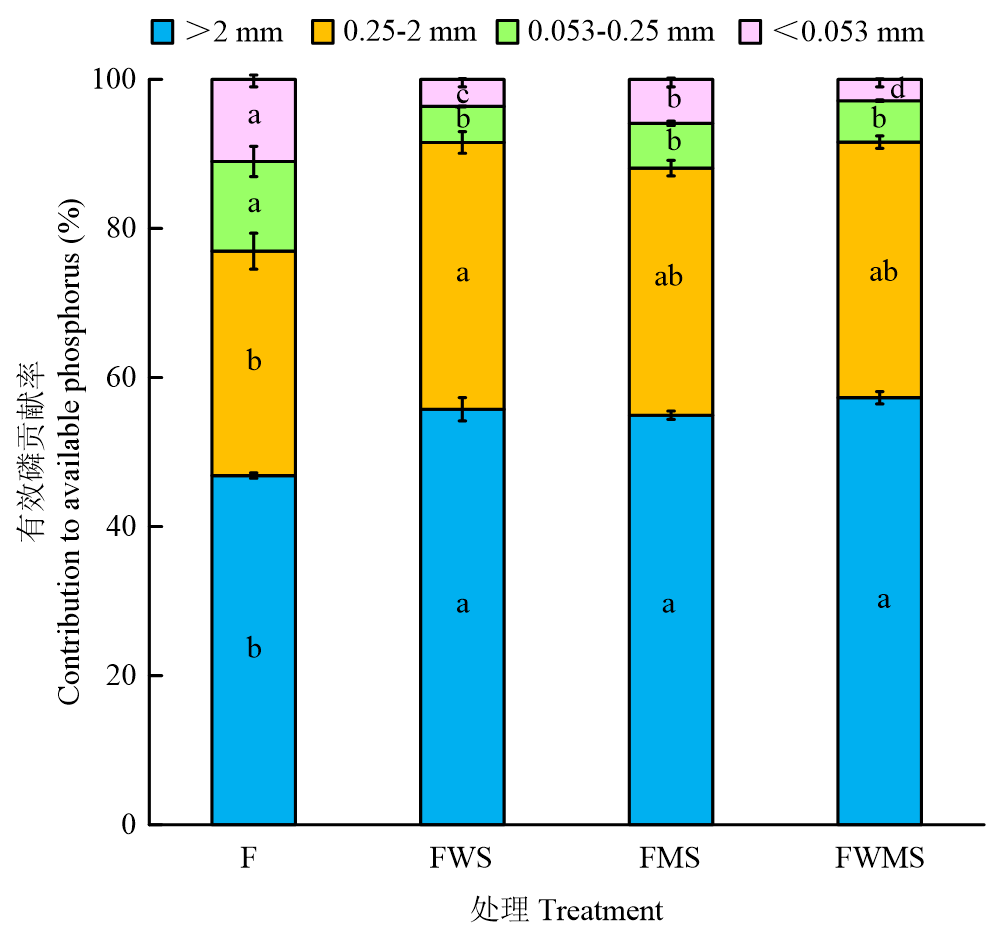
图3
不同处理土壤团聚体有效磷贡献率"
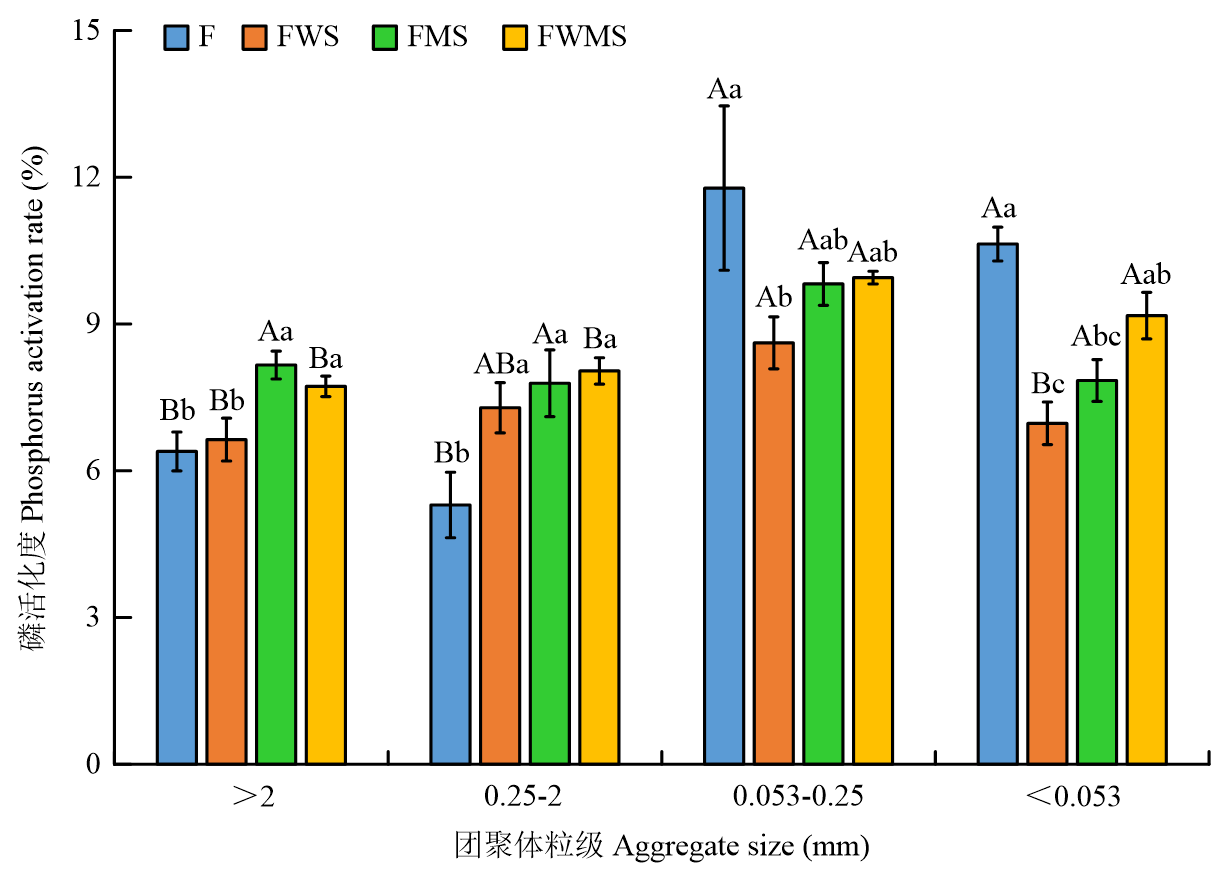
图4
不同处理土壤团聚体磷活化度"
表4
不同处理土壤团聚体磷组分含量"
| 团聚体粒级 Aggregate size | 处理 Treatment | H2O-P | NaHCO3-Pi | NaHCO3-Po | NaOH-Pi | NaOH-Po | D.HCl-Pi | Residual-P |
|---|---|---|---|---|---|---|---|---|
| >2 mm | F | 26.2±4.1b | 59.4±5.3a | 69.4±4.3b | 82.7±2.9b | 87.0±3.3b | 66.8±4.6a | 165.3±7.6a |
| FWS | 27.6±2.7ab | 70.2±3.5a | 88.3±4.3a | 100.3±4.8ab | 102.7±3.8b | 74.2±4.3a | 162.7±3.8a | |
| FMS | 23.2±3.0b | 63.2±3.4a | 80.3±3.7ab | 84.2±2.6b | 103.2±5.8b | 72.5±5.4a | 162.0±1.3a | |
| FWMS | 38.0±3.5a | 58.4±5.1a | 81.0±2.7ab | 109.4±9.9a | 127.0±8.5a | 63.9±4.1a | 155.8±3.4a | |
| 0.25-2 mm | F | 21.0±2.7b | 66.0±6.5a | 45.9±3.4c | 91.7±10.5a | 83.3±10.8b | 92.7±9.6b | 173.3±2.0a |
| FWS | 32.4±4.7a | 64.2±3.4a | 61.5±2.7bc | 99.7±8.5a | 130.5±9.5a | 117.2±2.4a | 149.2±3.2b | |
| FMS | 29.7±3.4ab | 66.4±5.4a | 77.1±5.2ab | 100.1±4.2a | 106.2±3.5ab | 87.0±3.6b | 158.8±2.5ab | |
| FWMS | 33.1±0.7a | 77.5±4.1a | 92.5±8.5a | 101.8±5.9a | 114.8±7.8a | 97.5±3.5b | 158.7±12.2ab | |
| 0.053-0.25 mm | F | 27.0±2.3a | 52.9±2.8b | 56.5±2.9b | 113.5±0.8a | 133.9±2.0ab | 82.3±4.1b | 140.8±1.7a |
| FWS | 16.6±1.9b | 54.5±1.6ab | 53.1±1.6b | 81.8±3.5b | 145.5±6.8a | 73.3±5.9b | 145.0±2.6a | |
| FMS | 24.2±2.6ab | 45.9±4.0b | 66.0±0.5a | 88.3±4.9b | 123.3±1.9b | 109.8±5.2a | 136.3±9.5a | |
| FWMS | 31.2±3.4a | 62.1±0.5a | 57.9±2.0b | 118.1±3.6a | 136.4±1.2a | 86.8±5.8b | 153.0±5.5a | |
| <0.053 mm | F | 6.2±1.7b | 37.1±3.2b | 71.5±2.7a | 118.9±1.9a | 98.0±4.6c | 126.3±5.5ab | 130.0±5.5a |
| FWS | 8.0±0.7ab | 40.4±2.1b | 55.5±1.6b | 57.9±4.3d | 137.3±1.2a | 114.9±5.7b | 123.8±8.7a | |
| FMS | 13.4±2.1a | 58.9±4.8a | 53.3±2.2b | 71.9±2.2c | 110.2±4.6bc | 134.2±4.8a | 137.3±6.3a | |
| FWMS | 12.7±1.5a | 67.5±4.1a | 52.7±4.8b | 93.0±3.5b | 116.3±4.7b | 130.7±4.4ab | 123.2±4.0a |
表5
不同磷组分与有效磷的相关关系"
| 磷组分 Phosphorus fraction | H2O-P | NaHCO3-Pi | NaHCO3-Po | NaOH-Pi | NaOH-Po | D.HCl-Pi | 有效磷 AP |
|---|---|---|---|---|---|---|---|
| H2O-P | 0.52** | ||||||
| NaHCO3-Pi | 0.60** | 0.64** | |||||
| NaHCO3-Po | 0.67** | 0.54** | 0.66** | ||||
| NaOH-Pi | 0.84** | 0.65** | 0.69** | 0.58** | |||
| NaOH-Po | 0.49* | 0.71** | 0.44* | 0.66** | 0.44* | ||
| D.HCl-Pi | 0.50* | 0.32 | 0.28 | 0.40 | 0.40 | 0.19 | |
| Residual-P | 0.08 | 0.38 | 0.28 | 0.23 | 0.39 | -0.21 | 0.24 |
表6
不同磷组分对有效磷的通径系数"
| 磷组分 Phosphorus fraction | 直接通径系数 Direct path coefficient | 间接通径系数Indirect path coefficient | ||||||
|---|---|---|---|---|---|---|---|---|
| H2O-P | NaHCO3-Pi | NaHCO3-Po | NaOH-Pi | NaOH-Po | D.HCl-Pi | Residual-P | ||
| H2O-P | 0.12 | 0.07 | 0.08 | 0.10 | 0.06 | 0.06 | 0.01 | |
| NaHCO3-Pi | 0.47 | 0.28 | 0.25 | 0.30 | 0.33 | 0.15 | 0.18 | |
| NaHCO3-Po | 0.44 | 0.30 | 0.24 | 0.30 | 0.19 | 0.12 | 0.12 | |
| NaOH-Pi | 0.18 | 0.15 | 0.12 | 0.12 | 0.12 | 0.07 | 0.04 | |
| NaOH-Po | -0.08 | -0.04 | -0.06 | -0.04 | -0.05 | -0.03 | -0.03 | |
| D.HCl-Pi | -0.08 | -0.04 | -0.03 | -0.02 | -0.03 | -0.03 | 0.02 | |
| Residual-P | -0.08 | -0.01 | -0.03 | -0.02 | -0.02 | -0.03 | 0.02 | |
| [1] |
doi: 10.1016/j.eja.2023.127072 |
| [2] |
doi: 10.1104/pp.111.175232 pmid: 21571668 |
| [3] |
doi: 10.1007/s10705-015-9736-z |
| [4] |
doi: 10.1111/sum.2018.34.issue-3 |
| [5] |
doi: 10.1016/j.jhydrol.2024.132419 |
| [6] |
doi: 10.1016/j.scitotenv.2017.08.095 |
| [7] |
doi: 10.1016/j.fcr.2022.108447 |
| [8] |
doi: 10.1016/j.resconrec.2023.107176 |
| [9] |
doi: 10.1007/s13593-023-00928-2 |
| [10] |
侯素素, 董心怡, 戴志刚, 巩细民, 徐志宇, 薛颖昊, 张洋洋, 李小坤, 丛日环, 鲁剑巍. 基于田间试验的秸秆还田化肥替减潜力综合分析. 农业工程学报, 2023, 39(5): 70-78.
|
|
|
|
| [11] |
doi: 10.1016/j.agee.2023.108683 |
| [12] |
安徽省统计局,国家统计局安徽调查总队. 安徽统计年鉴2024. 北京: 中国统计出版社, 2024.
|
|
Anhui Provincial Bureau of Statistics, Survey Office of the National Bureau of Statistics in Anhui. Anhui Statistical Yearbook 2024. Beijing: China Statistics Press, 2024. (in Chinese)
|
|
| [13] |
柴如山, 徐悦, 程启鹏, 王擎运, 马超, 叶新新, 章力干, 郜红建. 安徽省主要作物秸秆养分资源量及还田利用潜力. 中国农业科学, 2021, 54(1): 95-109. doi: 10.3864/j.issn.0578-1752.2021.01.008.
|
|
CHAI R S, XU Y, CHENG Q P, WANG Q Y, MA C, YE X X, ZHANG L G, GAO H J. Nutrient resource quantity of main crop straw and utilization potential under straw returning in Anhui Province. Scientia Agricultura Sinica, 2021, 54(1): 95-109. doi: 10.3864/j.issn.0578-1752.2021.01.008. (in Chinese)
|
|
| [14] |
王擎运, 陈景, 杨远照, 柴如山, 叶新新, 郜红建, 马东豪, 张佳宝, 周云鹏. 长期秸秆还田对典型砂姜黑土胀缩特性的影响机制. 农业工程学报, 2019, 35(14): 119-124.
|
|
|
|
| [15] |
韩上, 武际, 李敏, 陈峰, 王允青, 程文龙, 唐杉, 王慧, 郭熙盛, 卢昌艾. 深耕结合秸秆还田提高作物产量并改善耕层薄化土壤理化性质. 植物营养与肥料学报, 2020, 26(2): 276-284.
|
|
|
|
| [16] |
徐悦, 陈翔, 王擎运, 罗来超, 张朝春, 李金才, 叶新新, 郜红建, 柴如山. 小麦玉米秸秆长期还田对砂姜黑土磷库组成的影响. 农业环境科学学报, 2022, 41(8): 1768-1777.
|
|
|
|
| [17] |
王威, 唐蛟, 殷金忠, 潘飞飞, 樊姝言, 黄文文, 吴大付. 秸秆全量还田配施沼液对砂姜黑土水稳性团聚体及结合有机碳的影响. 土壤, 2023, 55(1): 53-61.
|
|
|
|
| [18] |
何家帅, 李新美, 魏跃鹏, 郭航兆, 杨康娜, 孙磊康, 李孝永, 贾绪存, 李玉霞, 李荣发, 王群. 长期深耕秸秆还田配施生物炭对砂姜黑土团聚体及小麦-玉米产量的影响. 农业工程学报, 2024, 40(7): 161-171.
|
|
|
|
| [19] |
李新悦, 李冰, 莫太相, 王昌全, 万艺媛, 陈写畅, 李和明. 长期秸秆还田对水稻土团聚体及氮磷钾分配的影响. 应用生态学报, 2021, 32(9): 3257-3266.
doi: 10.13287/j.1001-9332.202109.022 |
|
|
|
| [20] |
柳开楼, 都江雪, 邬磊, 张文菊, 韩天富, 李文军, 施林林, 余喜初. 长期施肥对不同深度稻田土壤团聚体磷素分配的影响. 农业资源与环境学报, 2022, 39(6): 1115-1123.
|
|
|
|
| [21] |
赵庆雷, 信彩云, 王瑜, 王佳, 刘奇华, 李景岭, 马加清. 稻麦轮作区连续秸秆还田和施肥条件下砂姜黑土无机磷分布特征. 草业学报, 2018, 27(12): 58-68.
doi: 10.11686/cyxb2018280 |
|
|
|
| [22] |
doi: 10.2136/sssaj1982.03615995004600050017x |
| [23] |
doi: 10.1016/j.jia.2022.07.018 |
| [24] |
doi: 10.1007/s11104-021-04915-y |
| [25] |
秦贞涵, 王琼, 张乃于, 金玉文, 张淑香. 黑土有效磷阈值区间的磷形态特征及对土壤化学性质的响应. 中国农业科学, 2022, 55(22): 4419-4432. doi: 10.3864/j.issn.0578-1752.2022.22.008.
|
|
QINZH,WANGQ,ZHANGNY,JIN Y W, ZHANG S X. Characteristics of phosphorus fractions and its response to soil chemical properties under the threshold region of Olsen P in black soil. Scientia Agricultura Sinica, 2022, 55(22): 4419-4432. doi: 10.3864/j.issn.0578-1752.2022.22.008. (in Chinese)
|
|
| [26] |
刘亚龙, 王萍, 汪景宽. 土壤团聚体的形成和稳定机制: 研究进展与展望. 土壤学报, 2023, 60(3): 627-643.
|
|
|
|
| [27] |
孔亚丽, 秦华, 朱春权, 田文昊, 朱晓芳, 虞轶俊, 张均华. 土壤微生物影响土壤健康的作用机制研究进展. 土壤学报, 2024, 61(2): 331-347.
|
|
|
|
| [28] |
翟龙波, 章熙锋, 陈靖, 况福虹, 唐家良. 施肥对坡地土壤团聚体与磷素赋存形态的影响. 西南大学学报(自然科学版), 2019, 41(7): 105-115.
|
|
|
|
| [29] |
谭文峰, 许运, 史志华, 蔡鹏, 黄巧云. 胶结物质驱动的土壤团聚体形成过程与稳定机制. 土壤学报, 2023, 60(5): 1297-1308.
|
|
|
|
| [30] |
窦森, 李凯, 关松. 土壤团聚体中有机质研究进展. 土壤学报, 2011, 48(2): 412-418.
|
|
|
|
| [31] |
doi: 10.1016/j.still.2004.03.008 |
| [32] |
doi: 10.1016/j.soilbio.2019.05.007 |
| [33] |
刘均阳, 周正朝, 苏雪萌. 植物根系对土壤团聚体形成作用机制研究回顾. 水土保持学报, 2020, 34(3): 267-273, 298.
|
|
|
|
| [34] |
doi: 10.1046/j.1365-2389.2000.00327.x |
| [35] |
苑亚茹, 韩晓增, 李禄军, 丁雪丽. 低分子量根系分泌物对土壤微生物活性及团聚体稳定性的影响. 水土保持学报, 2011, 25(6): 96-99.
|
|
|
|
| [36] |
吴宇, 蔡洪梅, 许波, 于敏, 王捧娜, 代雯慈, 张梦祥, 任驿, 武文明, 李金才, 陈翔. 不同季秸秆全量还田对小麦根系分泌物的影响. 中国生态农业学报(中英文), 2022, 30(12): 1938-1948.
|
|
|
|
| [37] |
陈翔, 许波, 吴宇, 许辉, 蔡洪梅, 孙东岳, 于敏, 刘绿洲, 郑宝强, 李金才. 不同季秸秆全量还田对夏玉米根系分泌物的影响. 中国生态农业学报(中英文), 2023, 31(9): 1403-1415.
|
|
|
|
| [38] |
柴如山, 程启鹏, 陈翔, 罗来超, 马超, 张亮亮, 章力干, 李金才, 郜红建. 安徽省县域麦稻玉米秸秆时空分异特征与还田养分输入量测算. 农业工程学报, 2021, 37(20): 234-247.
|
|
|
|
| [39] |
doi: 10.1016/j.soilbio.2014.03.003 |
| [40] |
doi: 10.1016/j.eja.2024.127144 |
| [41] |
贾瑞峰, 丛日环, 徐志宇, 孙元丰, 李晓阳, 戴志刚, 李小坤, 任涛, 鲁剑巍. 秸秆还田技术改善土壤理化性质提高作物产量的Meta分析. 农业工程学报, 2025, 41(4): 80-89.
|
|
|
|
| [42] |
向晓玲, 陈松鹤, 杨洪坤, 贺鹏, 樊高琼. 秸秆覆盖与施磷对四川丘陵旱地土壤磷形态及有效性的影响. 应用生态学报, 2022, 33(12): 3337-3344.
doi: 10.13287/j.1001-9332.202212.015 |
|
|
|
| [43] |
马莹, 程莹莹, 石孝均, 陈新平, 骆永明. 溶磷菌在磷素循环和生态农业中的作用与其生物肥料应用. 微生物学报, 2023, 63(12): 4502-4521.
|
|
|
|
| [44] |
马垒, 郭志彬, 王道中, 赵炳梓. 长期三水平磷肥施用梯度对砂姜黑土细菌群落结构和酶活性的影响. 土壤学报, 2019, 56(6): 1459-1470.
|
|
|
|
| [45] |
李千雪, 李春越, 张文婷, 窦祥祥, 薛英龙, 寇钊阳, 王益, 党廷辉. 秸秆覆盖还田保护性耕作对黄土旱塬土壤磷素组分的影响. 农业环境科学学报, 2024, 43(2): 368-377.
|
|
|
|
| [46] |
申文艳, 张乃于, 李天娇, 宋天昊, 张秀芝, 彭畅, 刘红芳, 张淑香, 段碧华. 长期施肥黑土phoD微生物群落特征及其对有机磷组分的影响. 中国农业科学, 2024, 57(20): 4082-4093. doi: 10.3864/j.issn.0578-1752.2024.20.013.
|
|
|
|
| [47] |
张向前, 陈欢, 赵竹, 李玮, 杜世州, 乔玉强, 曹承富. 不同秸秆覆盖水平对砂姜黑土生物学性状的影响. 生态环境学报, 2015, 24(4): 610-616.
doi: 10.16258/j.cnki.1674-5906.2015.04.010 |
|
|
|
| [48] |
魏丹, 杨华薇, 陈延华, 吕春玲, 毕睿忻, 张馨元, 马茂亭. 有机酸对土壤磷的活化利用研究进展. 农业环境科学学报, 2022, 41(7): 1391-1399.
|
|
|
|
| [49] |
黄少辉, 杨慧敏, 杨军芳, 杨文方, 聂浩亮, 张静, 邢素丽, 王敬霞, 杨云马, 贾良良. 磷肥长期施用对石灰性褐土团聚体中磷形态及磷酸酶活性的影响. 中国农业科学, 2025, 58(5): 943-956. doi: 10.3864/j.issn.0578-1752.2025.05.010.
|
|
|
|
| [50] |
郭斗斗, 黄绍敏, 张珂珂, 张水清, 宋晓, 王柏寒, 岳克. 有机无机外源磷素长期协同使用对潮土磷素有效性的影响. 植物营养与肥料学报, 2018, 24(6): 1651-1659.
|
|
|
|
| [51] |
张乃于, 闫双堆, 李娟, 王亚男, 刘越, 卜玉山. 低分子量有机酸对土壤磷组分影响的Meta分析. 植物营养与肥料学报, 2019, 25(12): 2076-2083.
|
|
|
|
| [52] |
段佳茹, 王淑颖, 李小红, 徐香茹, 梅秀文, 安婷婷, 汪景宽. 不同施肥条件下秸秆碳在表层和深层土壤团聚体中的分配与固存. 应用生态学报, 2022, 33(6): 1475-1481.
doi: 10.13287/j.1001-9332.202206.013 |
|
|
|
| [53] |
马悦, 田怡, 于杰, 王浩琳, 李永华, 李超, 党海燕, 牟文燕, 黄宁, 邱炜红, 石美, 王朝辉, 何刚. 北方麦区土壤有效磷阈值及小麦产量、籽粒氮磷钾含量对监控施肥的响应. 植物营养与肥料学报, 2021, 27(10): 1675-1691.
|
|
|
|
| [54] |
刘淑军, 李冬初, 黄晶, 曲潇林, 马常宝, 王慧颖, 于子坤, 张璐, 韩天富, 柳开楼, 申哲, 张会民. 近30年来我国小麦和玉米秸秆资源时空变化特征及还田减肥潜力. 中国农业科学, 2023, 56(16): 3140-3155. doi: 10.3864/j.issn.0578-1752.2023.16.008.
|
|
|
|
| [55] |
丁天宇, 郭自春, 钱泳其, 王玥凯, 黄先金, 张中彬, 彭新华. 秸秆还田方式对砂姜黑土有机碳组分和孔隙结构的影响. 农业工程学报, 2023, 39(16): 71-78.
|
|
|
| [1] | 袁浩亮, 聂军, 黎鹏, 鲁艳红, 廖育林, 徐昌旭, 李忠义, 曹卫东, 张江林. 紫云英与稻草联合利用对南方稻区土壤磷库组成及磷素活化的影响[J]. 中国农业科学, 2026, 59(7): 1480-1491. |
| [2] | 许杨浩峻, 陈丽明, 杨世奇, 唐奕凡, 谭雪明, 曾勇军, 潘晓华, 曾研华. 长期秸秆还田对双季稻田不同土层有机碳、养分和团聚体的影响[J]. 中国农业科学, 2026, 59(7): 1492-1506. |
| [3] | 李星宇, 黄容, 鲜一鸣, 田娇娇, 马晓瑾, 杨乔茜, 李冰, 王昌全. 稻田土壤不同粒级团聚体有机碳组分及CO2排放对长期施肥的响应[J]. 中国农业科学, 2026, 59(6): 1255-1271. |
| [4] | 张昊鑫, 于晟玥, 雷秋良, 杜新忠, 张继宗, 安妙颖, 樊秉乾, 罗加法, 刘宏斌. 基于RothC模型的东北旱地和稻田土壤有机碳动态变化模拟研究[J]. 中国农业科学, 2025, 58(8): 1564-1578. |
| [5] | 黄少辉, 杨慧敏, 杨军芳, 杨文方, 聂浩亮, 张静, 邢素丽, 王敬霞, 杨云马, 贾良良. 磷肥长期施用对石灰性褐土团聚体中磷形态及磷酸酶活性的影响[J]. 中国农业科学, 2025, 58(5): 943-955. |
| [6] | 靳晓莹, 肖柄政, 张天津, 刘忠宽, 冯伟, 杜章留. 冬绿肥提升滨海盐碱土团聚性及植物源与微生物源有机碳固存[J]. 中国农业科学, 2025, 58(20): 4203-4215. |
| [7] | 张斯佳, 杨杰, 赵帅, 李莉威, 王贵彦. 华北平原多样化作物与小麦-玉米轮作对土壤质量的影响[J]. 中国农业科学, 2025, 58(2): 238-251. |
| [8] | 李帅兵, 李晨欣, 任丽, 于晓娜, 耿赛男, 盛开, 张银杰, 王宜伦. 种植大豆促进后茬小麦磷吸收和土壤磷形态转化[J]. 中国农业科学, 2025, 58(19): 3932-3945. |
| [9] | 王安心, 方娅婷, 顿谦, 伍永清, 廖世鹏, 李小坤, 任涛, 陆志峰, 丛日环, 鲁剑巍. 秸秆直接还田与炭化还田对稻油轮作作物产量和氮素利用的影响[J]. 中国农业科学, 2025, 58(16): 3280-3292. |
| [10] | 熊志豪, 刘君权, 叶琳, 朱丹丹, 侯素素, 方娅婷, 丛日环, 任涛, 李小坤, 鲁剑巍. 稻油轮作系统秸秆直接还田与焚烧还田的作物产量和养分表观平衡特征[J]. 中国农业科学, 2025, 58(16): 3293-3303. |
| [11] | 霍润霞, 方娅婷, 张艳科, 吴海亚, 刘桂生, 李小坤, 任涛, 陆志峰, 丛日环, 鲁剑巍. 长期秸秆还田条件下化肥减量对稻稻油轮作系统作物产量和土壤肥力的影响[J]. 中国农业科学, 2025, 58(16): 3267-3279. |
| [12] | 宣泽鹏, 冯慧瑶, 陈美淇, 徐基胜, 刘梦璇, 赵炳梓, 张佳宝. 秸秆还田配施化肥对土壤生态系统多功能性的影响[J]. 中国农业科学, 2025, 58(14): 2821-2837. |
| [13] | 路鹏, 冯佳, 李莉, 杨莉, 杨雷, 吕德智, 薛彦飞. 长期施肥小麦根际与非根际土壤的磷组分及其有效性[J]. 中国农业科学, 2025, 58(12): 2382-2396. |
| [14] | 马玉洁, 李旭, 翟英芳, 李敬宇, 付鑫, 彭正萍. 秸秆还田方式和施氮量对土壤有机碳组分及酶活性的影响[J]. 中国农业科学, 2025, 58(12): 2397-2410. |
| [15] | 张旸, 高燕, 张延, 黄丹丹, 陈学文, 张士秀, 梁爱珍. 秸秆还田方式对东北黑土氮素矿化和氮循环功能基因的影响[J]. 中国农业科学, 2025, 58(10): 1958-1968. |
|
||
