






中国农业科学 ›› 2026, Vol. 59 ›› Issue (3): 528-542.doi: 10.3864/j.issn.0578-1752.2026.03.005
申丽琼1,2( ), 何林丽1(), 刘倪1, 陆俊杏1, 朱波1(), 张涛1()
收稿日期:2025-06-29
接受日期:2026-01-08
出版日期:2026-02-01
发布日期:2026-01-31
通信作者:
联系方式:
申丽琼,E-mail:717968821@qq.com。何林丽,E-mail:1103225897@qq.com。申丽琼和何林丽为同等贡献作者。
基金资助:
SHEN LiQiong1,2(), HE LinLi1(), LIU Ni1, LU JunXing1, ZHU Bo1(), ZHANG Tao1()
Received:2025-06-29
Accepted:2026-01-08
Published:2026-02-01
Online:2026-01-31
摘要:
【目的】探究钾对油菜抗湿害能力的影响,揭示钾参与油菜响应湿害胁迫的生理调节机制,为油菜生产上有效应对湿害胁迫提供理论支撑。【方法】采用砂培盆栽试验,设置正常浇水(CK)和湿害(WL)2个水分处理,及1.0 mmol K2SO4·L-1(HK)、0.1 mmol K2SO4·L-1(LK)2个钾水平,共有HK_CK、HK_WL、LK_CK和LK_WL 4个处理,分别为正常水分和钾肥、单一湿害、单一缺钾和湿害缺钾处理。在油菜苗期进行7 d湿害胁迫,比较不同钾肥水平下油菜生长、光合特征、抗氧化酶活性和内源激素等的差异。【结果】湿害和钾营养水平对油菜生长影响显著,生物量、根冠比和净光合速率均呈现HK_CK>HK_WL>LK_CK>LK_WL的趋势。湿害引起叶片超氧化物歧化酶(SOD)和过氧化氢酶(CAT)活性升高,LK处理(LK_CK和LK_WL)的SOD和CAT活性显著低于HK处理(HK_CK和HK_WL)。然而,LK处理的丙二醛(MDA)含量显著高于HK处理。湿害和缺钾对油菜内源激素影响显著,叶片脱落酸(ABA)含量呈现HK_CK<HK_WL<LK_CK<LK_WL的趋势。湿害胁迫7 d,叶片茉莉酸(JA)含量在缺钾和湿害条件下均显著增加,且在LK_WL处理下增幅最大。湿害和缺钾均会诱导水杨酸(SA)积累,且在LK_WL处理下根系和叶片中SA含量最高。与之相对的是,在恢复生长阶段,湿害和缺钾均导致组织中吲哚乙酸(IAA)含量显著降低,且在LK处理(LK_CK和LK_WL)下降幅最大。【结论】湿害导致油菜生长受阻、严重抑制根系生长,提高钾肥水平能显著促进根系生长和K+吸收、提高叶片光合作用能力和SOD、CAT活性,从而提高油菜抗湿害能力。湿害胁迫激发叶片ABA、JA和SA的积累,提高钾肥水平可显著缓解ABA和JA积累诱导的胁迫应激反应,并促进胁迫解除后根系和叶片IAA的积累,进而促进油菜恢复生长。
申丽琼, 何林丽, 刘倪, 陆俊杏, 朱波, 张涛. 钾营养水平对油菜苗期抗湿害能力及内源激素平衡的影响[J]. 中国农业科学, 2026, 59(3): 528-542.
SHEN LiQiong, HE LinLi, LIU Ni, LU JunXing, ZHU Bo, ZHANG Tao. Effects of Potassium Levels on Waterlogging Resistance and Endogenous Hormone Balance of Rapeseed During Seedling Stage[J]. Scientia Agricultura Sinica, 2026, 59(3): 528-542.
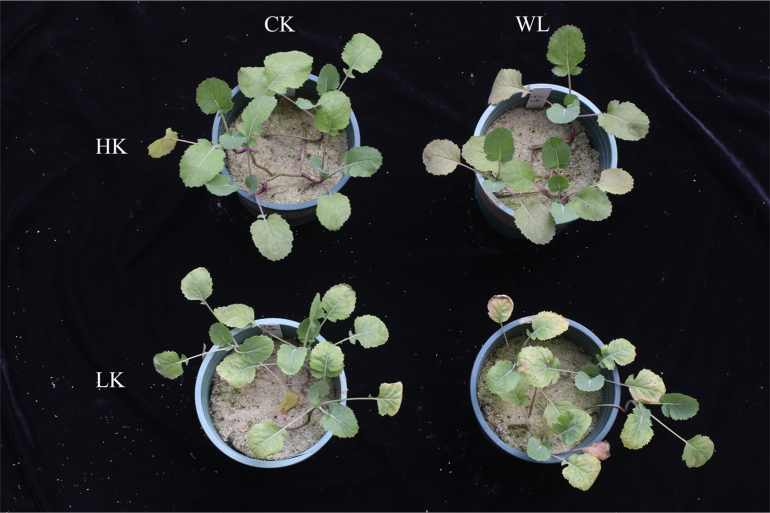
图1
不同钾肥水平条件下油菜湿害胁迫第21 d(胁迫消除后第14 d)的表型差异 HK:1 mmol K2SO4·L-1;LK:0.1 mmol K2SO4·L-1;CK:正常浇水 Normal water conditions;WL:湿害处理7 d 7 d waterlogging stress。下同 The same as below"
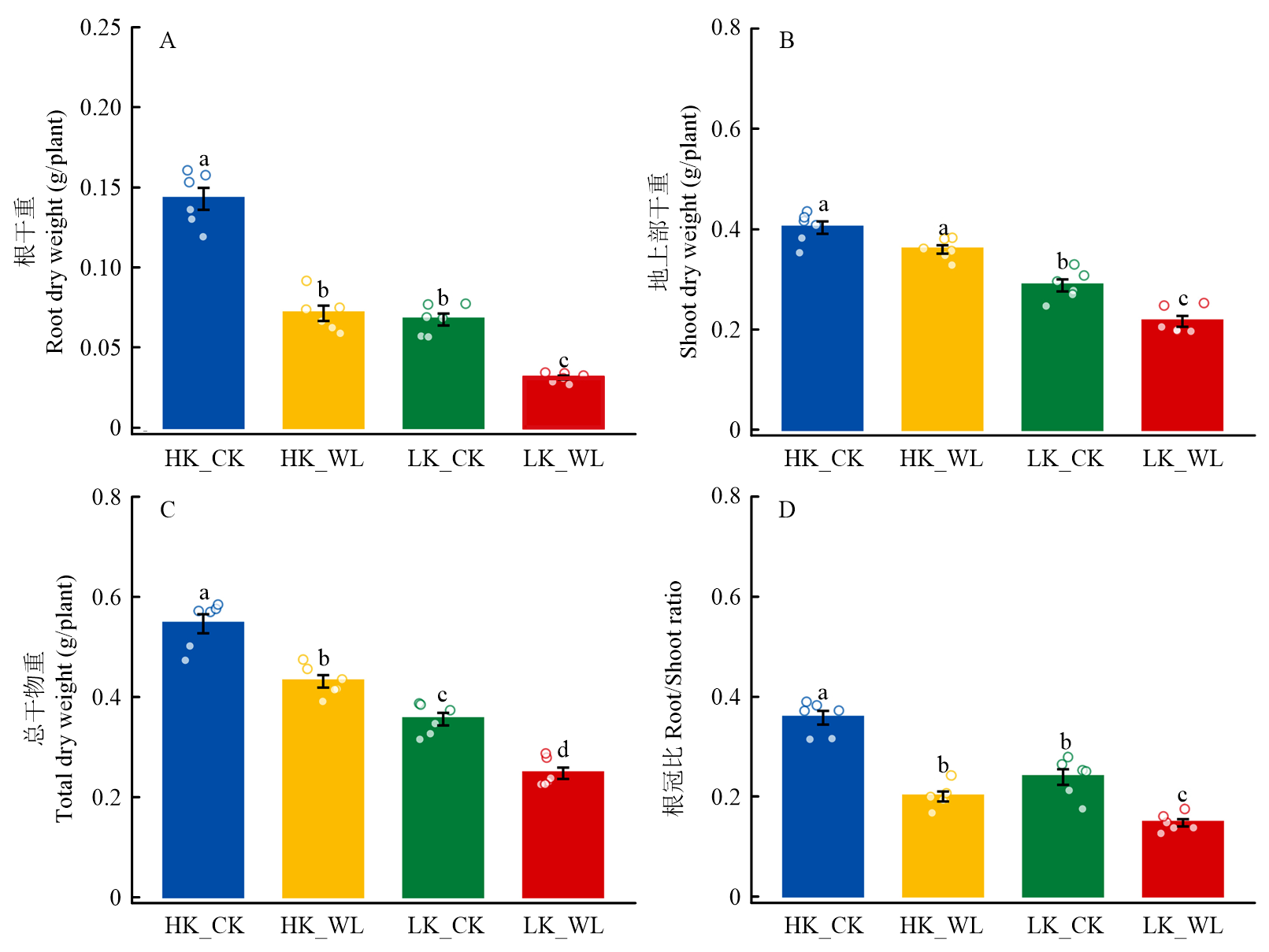
图2
不同钾营养水平和湿害胁迫下油菜生物量和根冠比 HK_CK、HK_WL、LK_CK和LK_WL分别代表正常水分和钾肥、单一湿害、单一缺钾和湿害缺钾处理。不同小写字母代表处理间显著差异(P<0.05),误差线代表标准误。下同"
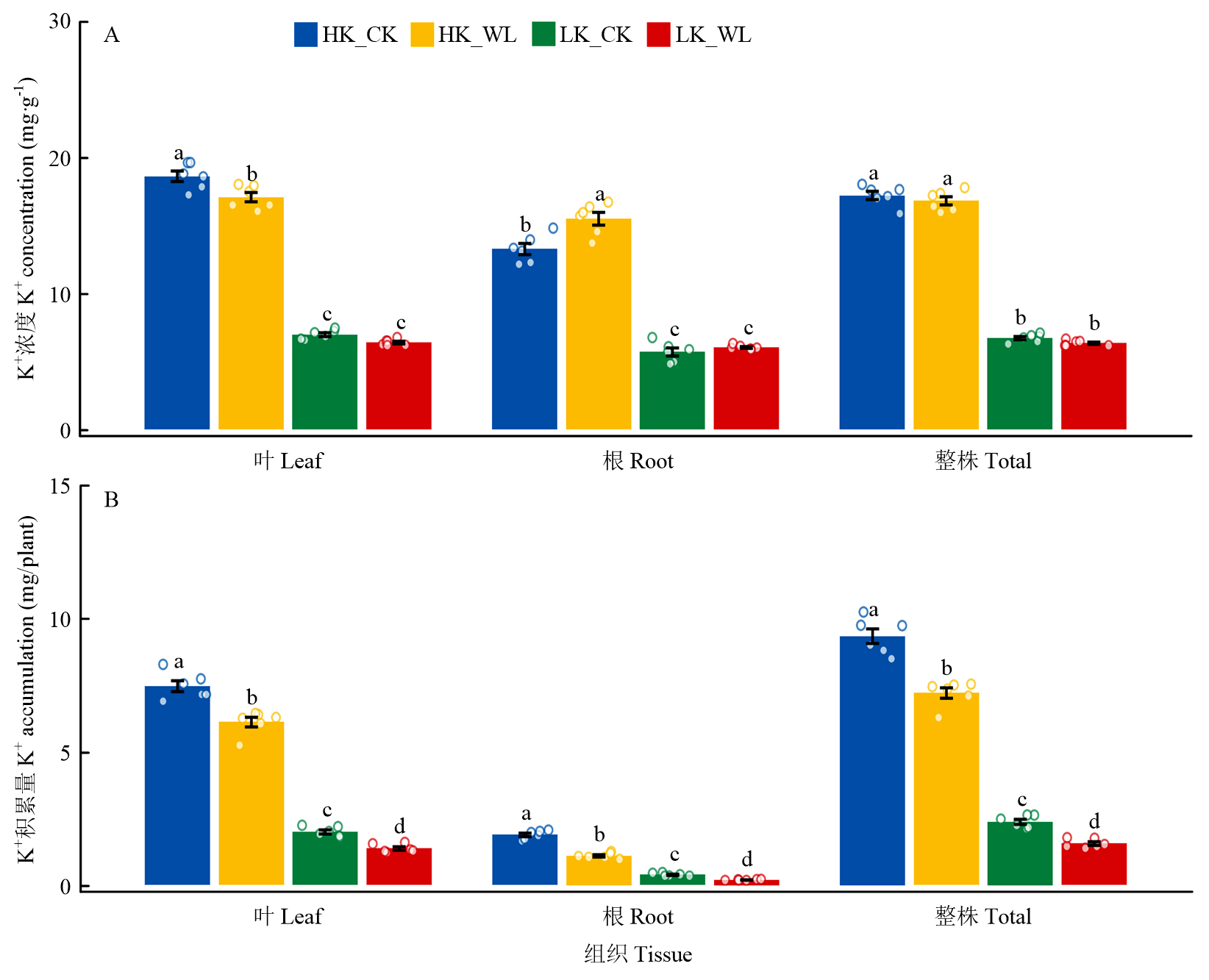
图3
不同钾肥水平对湿害胁迫下油菜K+浓度和K+积累量的影响"
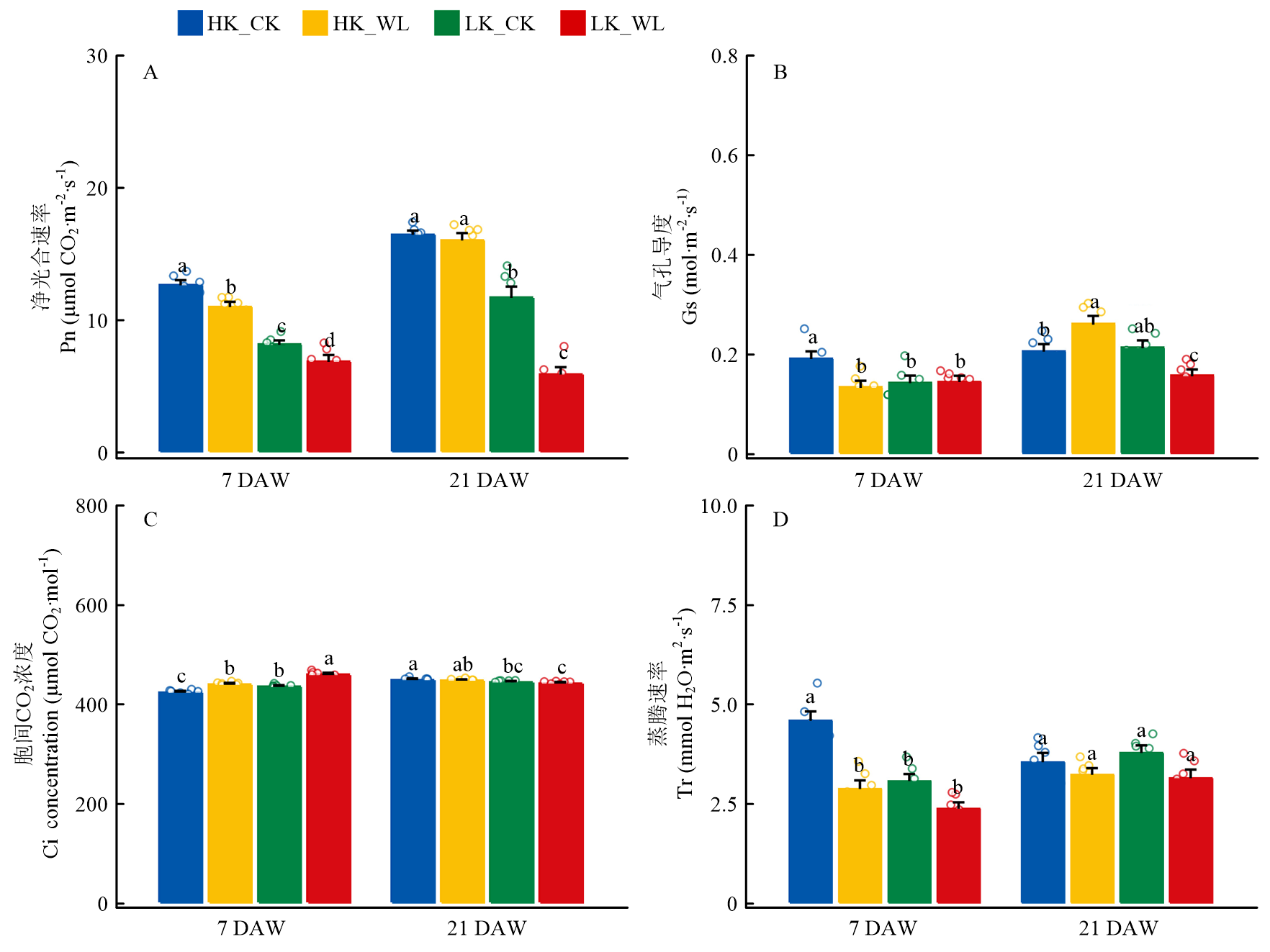
图4
不同钾肥水平对湿害胁迫下油菜光合作用的影响 7 DAW代表湿害胁迫7 d,21 DAW代表湿害胁迫消除后14 d。下同"
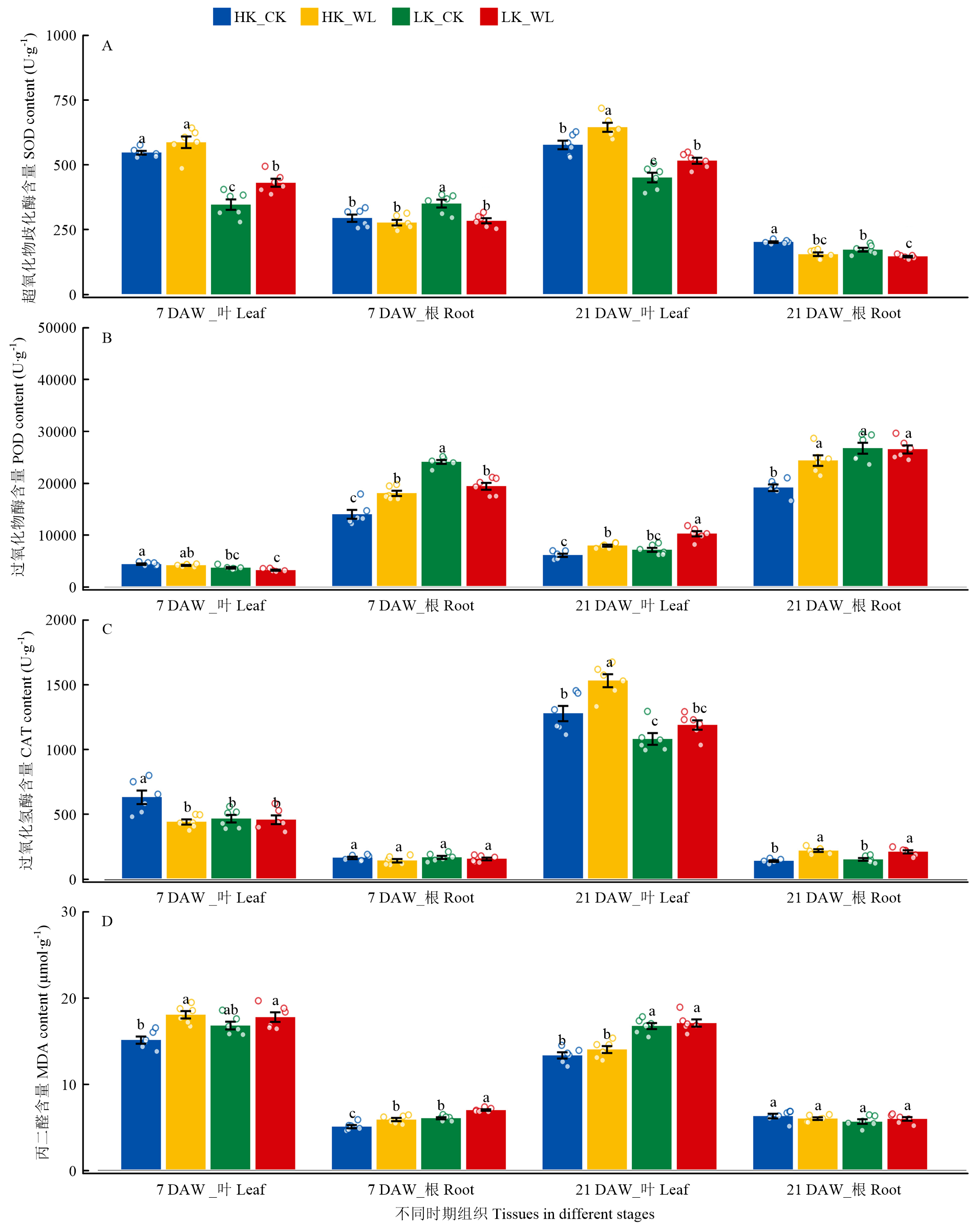
图5
不同钾肥水平对湿害胁迫下油菜抗氧化酶活性和MDA含量的影响"
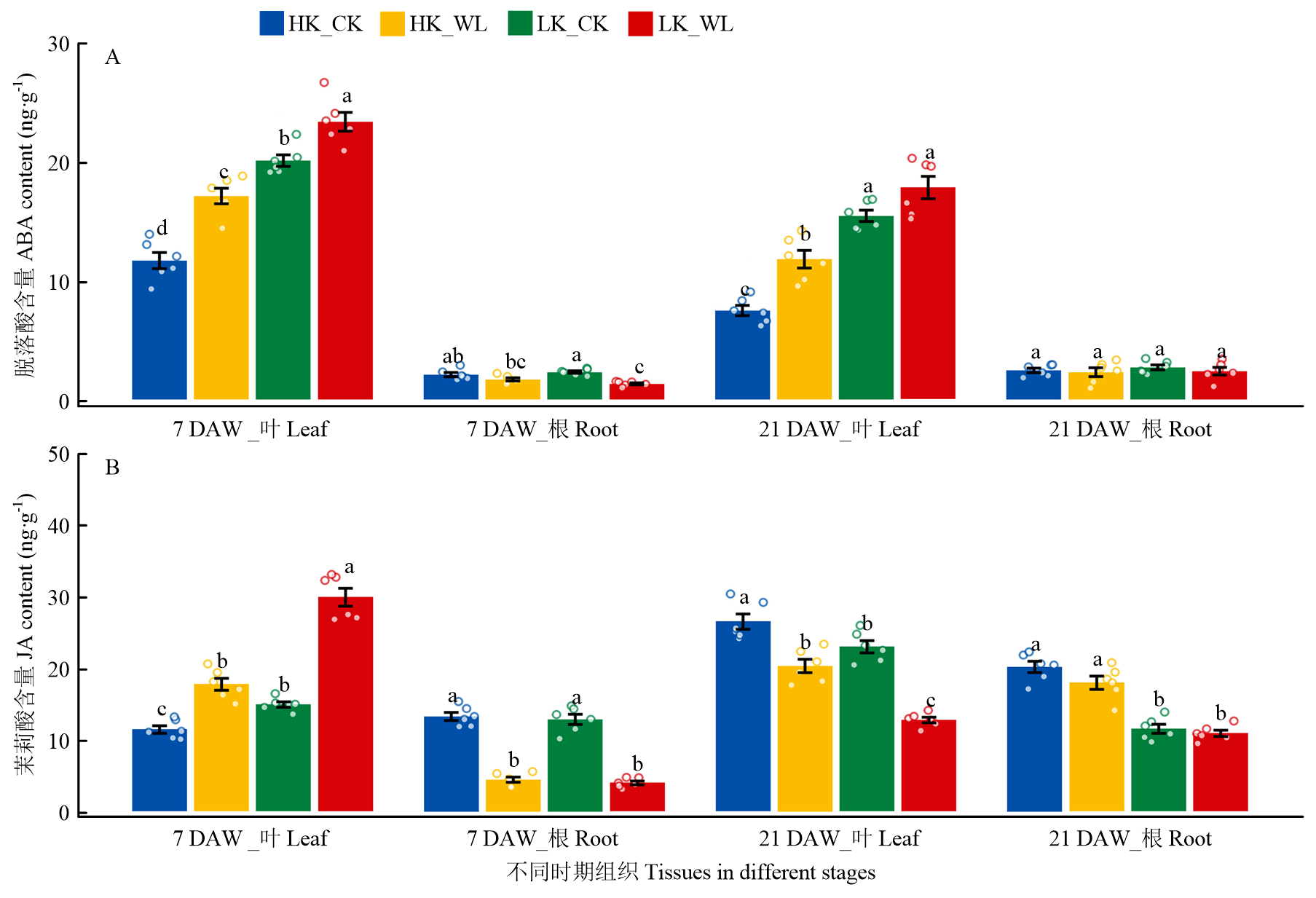
图6
不同钾肥水平对湿害胁迫下油菜ABA和JA含量的影响"
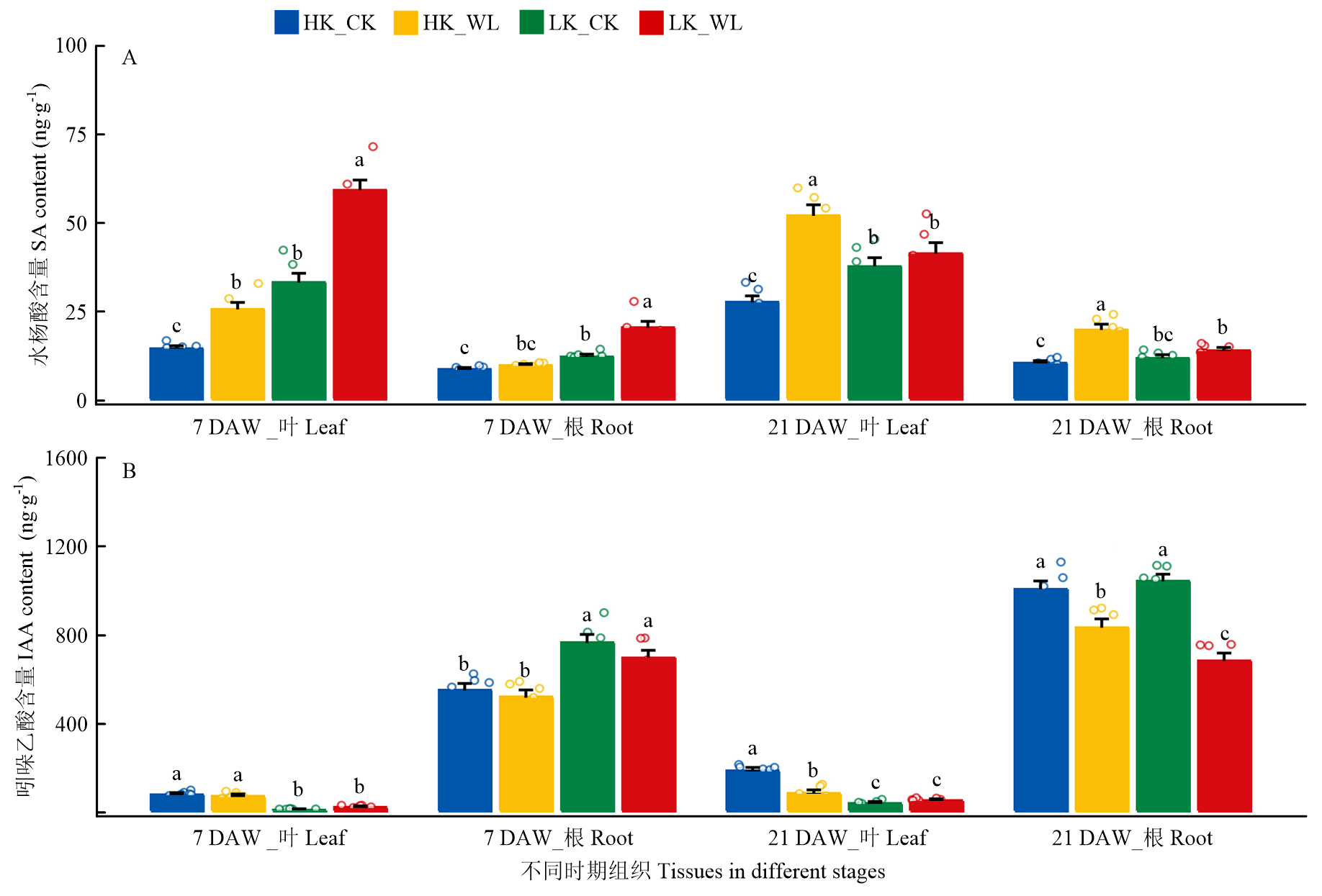
图7
不同钾肥水平对湿害胁迫下油菜SA和IAA含量的影响"
| [1] |
|
| [2] |
doi: 10.1093/jxb/erq271 |
| [3] |
doi: 10.1007/s11104-020-04669-z |
| [4] |
doi: 10.1111/j.1469-8137.2010.03575.x pmid: 21563365 |
| [5] |
鞠英芹, 杨霏云, 马德栗, 朱晓炜, 罗蒋梅, 李文科. 江淮地区油菜渍害的时空分析. 自然灾害学报, 2017, 26(6): 136-146.
|
|
|
|
| [6] |
doi: 10.3389/fpls.2018.01863 pmid: 30619425 |
| [7] |
doi: 10.1016/0378-4290(95)00075-5 |
| [8] |
doi: 10.1111/jac.v206.6 |
| [9] |
doi: 10.1016/j.fcr.2015.06.007 |
| [10] |
doi: 10.1016/0378-4290(96)00025-1 |
| [11] |
doi: 10.1111/nph.1984.97.issue-1 |
| [12] |
doi: 10.1093/jxb/erh002 pmid: 14739259 |
| [13] |
doi: 10.3390/agronomy8030031 |
| [14] |
doi: 10.1111/ppl.12165 |
| [15] |
doi: 10.1111/pce.2014.37.issue-10 |
| [16] |
|
| [17] |
doi: 10.1016/j.envexpbot.2012.09.006 |
| [18] |
doi: 10.1104/pp.108.133629 |
| [19] |
doi: 10.1111/nph.15751 pmid: 30767245 |
| [20] |
doi: 10.1111/pce.v42.2 |
| [21] |
|
| [22] |
doi: 10.3389/fpls.2020.607475 |
| [23] |
丛野, 李艳君, 周灿金, 邹崇顺, 张学昆, 廖星, 张春雷. 氮、磷、钾对湿害胁迫下甘蓝型油菜产量的影响. 植物营养与肥料学报, 2009, 15(5): 1122-1129.
|
|
|
|
| [24] |
|
| [25] |
doi: 10.1002/jpln.v176.3 |
| [26] |
中国农业科学院土壤肥料研究所. 中国化肥区划. 北京: 中国农业科学技术出版社, 1986: 13-14.
|
|
Institute of Soil and Fertilizer, Chinese Academy of Agricultural Sciences. Chemical Fertilizer Zoning in China. Beijing: China Agricultural Science and Technology Press, 1986: 13-14. (in Chinese)
|
|
| [27] |
韩上, 武际, 胡现荣, 吴新民, 胡鹏, 郭熙盛, 钱晓华, 夏伟光. 安徽省油菜钾肥施用效果及土壤速效钾丰缺指标研究. 土壤, 2016, 48(2): 265-269.
|
|
|
|
| [28] |
徐华丽, 鲁剑巍, 李小坤, 王寅, 苏伟. 湖北省油菜施肥现状调查. 中国油料作物学报, 2010, 32(3): 418-423.
|
|
|
|
| [29] |
doi: 10.3390/agriculture10060207 |
| [30] |
doi: 10.1007/s10725-019-00545-8 |
| [31] |
doi: 10.1039/C3AY41885E |
| [32] |
宋丰萍, 胡立勇, 周广生, 吴江生, 傅廷栋. 渍水时间对油菜生长及产量的影响. 作物学报, 2010, 36(1): 170-176.
doi: 10.3724/SP.J.1006.2010.00170 |
|
doi: 10.3724/SP.J.1006.2010.00170 |
|
| [33] |
周香玉, 徐劲松, 谢伶俐, 许本波, 张学昆. 甘蓝型油菜苗期响应渍害胁迫的生理调控机制. 作物学报, 2024, 50(4): 1015-1029.
doi: 10.3724/SP.J.1006.2024.34116 |
|
doi: 10.3724/SP.J.1006.2024.34116 |
|
| [34] |
doi: 10.1016/j.plaphy.2022.06.019 pmid: 35750001 |
| [35] |
doi: 10.3390/agronomy13041157 |
| [36] |
高冠龙, 冯起, 张小由, 司建华, 鱼腾飞. 植物叶片光合作用的气孔与非气孔限制研究综述. 干旱区研究, 2018, 35(4): 929-937.
doi: 10.13866/j.azr.2018.04.22 |
|
doi: 10.13866/j.azr.2018.04.22 |
|
| [37] |
朱波, 徐绮雯, 马淑敏, 刘帮艳, 段美春, 王龙昌. 干旱缺钾对油菜内源激素、光合作用和叶绿素荧光特性的影响. 中国油料作物学报, 2022, 44(3): 570-580.
doi: 10.19802/j.issn.1007-9084.2021133 |
|
doi: 10.19802/j.issn.1007-9084.2021133 |
|
| [38] |
doi: 10.3390/ijms24076015 |
| [39] |
doi: 10.1038/s41598-020-67260-7 |
| [40] |
doi: 10.1007/s00344-023-11034-8 |
| [41] |
doi: 10.3389/fpls.2017.00161 pmid: 28265276 |
| [42] |
doi: 10.3389/fpls.2022.1048227 |
| [43] |
doi: 10.3389/fpls.2022.896850 |
| [44] |
doi: 10.1007/s00344-008-9051-x |
| [45] |
doi: 10.3389/fpls.2020.627331 |
| [46] |
doi: 10.1016/j.envexpbot.2009.08.005 |
| [47] |
doi: 10.1016/j.envexpbot.2020.104040 |
| [48] |
王桂林, 范伟国, 彭福田. 桃树淹水及不同时间喷布水杨酸的生理响应. 果树学报, 2015, 32(5): 872-878.
|
|
|
|
| [49] |
|
| [50] |
doi: 10.1111/j.1365-313X.2010.04262.x pmid: 20497380 |
| [51] |
doi: 10.1007/s11104-015-2536-z |
| [52] |
|
| [53] |
doi: 10.1007/s10725-022-00925-7 |
| [1] | 朱琦, 贾振鹏, Tahir SHAH, 徐晨晟, 李芷琦, 吕会帅, 朱鹏超, 韦小敏, 黄冬琳, 孙艳妮, 曹卫东, 高亚军, 王朝辉, 张达斌. 绿肥配施增效产品降低旱地麦田温室气体排放及碳足迹[J]. 中国农业科学, 2026, 59(7): 1507-1522. |
| [2] | 苏一帆, 杨瞻旭, 王迪, 冒俊呈, 魏萌萌, 陈泽, 白欣冉, 楚天歌, 马昌宁, 乔明菲, 孙权, 胡大刚. 2, 4-表油菜素内酯对苹果果实采后贮藏性能的影响[J]. 中国农业科学, 2026, 59(7): 1536-1551. |
| [3] | 刘海卿, 金姣姣, 孙万仓, 柴鹏, 祁伟亮, 杨刚, 李婵, 骆雪梅, 苏芸芸, 秦雪雪. 甘蓝型冬油菜越冬期矮生长点形态建成及多激素调控机制[J]. 中国农业科学, 2026, 59(5): 951-966. |
| [4] | 杨锐, 陈敬东, 黄郢, 谢伶俐, 张学昆, 周登文, 刘清云, 徐劲松, 许本波. 长江上游油菜高产品系遗传改良与构型分析[J]. 中国农业科学, 2026, 59(2): 250-264. |
| [5] | 吕旭东, 孙世媛, 李亚楠, 刘玉龙, 王艳群, 付鑫, 张佳英, 宁鹏, 彭正萍. 智能机械化分层施肥对麦田根-土养分分布和小麦产量的影响[J]. 中国农业科学, 2026, 59(1): 129-146. |
| [6] | 赵宇萱, 苗纪元, 胡伟, 周治国. 苗期低温对棉花花芽分化和棉株产量的影响[J]. 中国农业科学, 2025, 58(7): 1311-1320. |
| [7] | 王彬, 吴朋浩, 鲁剑巍, 任涛, 丛日环, 陆志峰, 李小坤. 长江中游地区水稻-油菜轮作体系需水特征[J]. 中国农业科学, 2025, 58(7): 1355-1365. |
| [8] | 杜泰峰, 周媛媛, 秦桢, 李爱贤, 王庆美, 张立明, 侯夫云. 外源油菜素内酯减轻SPVD对甘薯块根萌芽的抑制作用[J]. 中国农业科学, 2025, 58(22): 4628-4637. |
| [9] | 杨龙, 张学昆, 陈爱武, 李莓, 程泰, 马伍慧, 许本波, 徐劲松. 油菜品种、越冬调控和病虫害防控对直播油菜产量的影响[J]. 中国农业科学, 2025, 58(21): 4333-4345. |
| [10] | 孟孜贞, 任涛, 刘陈, 王昆昆, 廖世鹏, 李小坤, 丛日环, 陆志峰, 方娅婷, 鲁剑巍. 稻油轮作系统氮磷钾肥平衡施用提高作物产量和养分利用效率[J]. 中国农业科学, 2025, 58(16): 3190-3200. |
| [11] | 郜紫依, 吴海亚, 刘君权, 崔鑫, 刘嫒桦, 方娅婷, 任涛, 李小坤, 鲁剑巍. 不同钾肥用量下稻油轮作系统钾素利用和作物产量形成特征[J]. 中国农业科学, 2025, 58(16): 3245-3255. |
| [12] | 赵勇, 张仲富, 王禹童, 艾静, 刘家勇, 吴建明, 邓军, 张跃彬. 施钾对根际土壤微生物群落和甘蔗生长的影响[J]. 中国农业科学, 2025, 58(13): 2630-2644. |
| [13] | 张天宇, 刘丽君, 杨刚, 武军艳, 蒲媛媛, 马骊, 王旺田, 路晓明, 马愿强, 孙万仓. 2006—2022年北方白菜型冬油菜农艺性状遗传增益分析[J]. 中国农业科学, 2025, 58(11): 2081-2095. |
| [14] | 何永强, 张金盔, 徐劲松, 丁晓雨, 程勇, 许本波, 张学昆. 14-羟基芸苔素甾醇生长调节剂对油菜生长和产量的影响[J]. 中国农业科学, 2024, 57(8): 1444-1454. |
| [15] | 杨启睿, 李岚涛, 张潇, 张倩, 张银杰, 张铎, 王宜伦. 施钾对夏花生产量、品质及光温生理特性的影响[J]. 中国农业科学, 2024, 57(7): 1335-1349. |
|
||
