






中国农业科学 ›› 2026, Vol. 59 ›› Issue (22): 5140-5155.doi: 10.3864/j.issn.0578-1752.2026.22.013
党海燕1( ), 张丰1(), 田怡1, 王文翔1, 郭戎博1, 马悦1, 李文虎1, 佘文婷1, 李小涵1, 邱炜红1, 王朝辉1,2
收稿日期:2026-01-06
接受日期:2026-05-15
出版日期:2026-11-16
发布日期:2026-11-19
通信作者:
联系方式:
党海燕, E-mail:haiyan-d@nwafu.edu.cn。张丰,E-mail:1609399383@qq.com。党海燕和张丰为同等贡献作者。
基金资助:
DANG HaiYan1(), ZHANG Feng1(), TIAN Yi1, WANG WenXiang1, GUO RongBo1, MA Yue1, LI WenHu1, SHE WenTing1, LI XiaoHan1, QIU WeiHong1, WANG ZhaoHui1,2
Received:2026-01-06
Accepted:2026-05-15
Published:2026-11-16
Online:2026-11-19
摘要:
【目的】通过多年多点试验,明确我国北方小麦产量和籽粒蛋白质含量与氮磷钾养分投入移出及土壤养分的关系,旨在为优化化肥用量及实现小麦高产优质绿色生产提供理论和技术支撑。【方法】于2018—2024年连续6个生长季在北方8个省区(甘肃、黑龙江、内蒙古、宁夏、青海、山西、陕西、新疆)开展监控施肥试验,研究小麦产量、籽粒蛋白质含量与养分盈余比(即养分投入量与养分移出量的比值)及土壤养分的关系。【结果】施氮(N)47.5—211.4 kg·hm-2、磷(P)8.4—33.6 kg·hm-2、钾(K)8.1—37.0 kg·hm-2时,研究区域理论上可实现小麦氮、磷、钾肥投入与移出平衡,超出此范围较难实现两者平衡。在相同施肥水平,氮盈余比从0.7提高到1.7,磷盈余比从0.7提升至2.0,钾盈余比从0.7提升到1.7,产量均逐渐降低,而小麦籽粒蛋白质含量未出现显著降低。氮、磷和钾盈余比分别介于0.9—1.1、1.1—1.3、0.9—1.1时,高产样点通过提高小麦生物量、穗数、籽粒养分吸收量和养分收获指数,平均产量分别可达9 591、9 485、8 971 kg·hm-2。【结论】在秸秆还田条件下,将氮、磷、钾肥用量维持在47.5—211.4、8.4—33.6、8.1—37.0 kg·hm-2,氮、磷和钾盈余比维持在0.9—1.1、1.1—1.3和0.9—1.1范围内有利于实现北方小麦高产、优质与土壤养分平衡的协同。
党海燕, 张丰, 田怡, 王文翔, 郭戎博, 马悦, 李文虎, 佘文婷, 李小涵, 邱炜红, 王朝辉. 秸秆还田条件下基于表观养分平衡优化小麦氮磷钾肥用量[J]. 中国农业科学, 2026, 59(22): 5140-5155.
DANG HaiYan, ZHANG Feng, TIAN Yi, WANG WenXiang, GUO RongBo, MA Yue, LI WenHu, SHE WenTing, LI XiaoHan, QIU WeiHong, WANG ZhaoHui. Optimize Nitrogen, Phosphorus, and Potassium Fertilizer Application Rate in Wheat Under Straw Return Based on Apparent Nutrient Balance[J]. Scientia Agricultura Sinica, 2026, 59(22): 5140-5155.
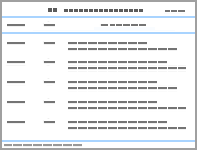
表1
各试验地点降水量、气温和0—20 cm土层土壤的基本理化性质"
| 试验地点 Experimental site | 小麦类型 Wheat type | 年降水 Apre (mm) | 年均温 AVT (℃) | 有机质 OM (g·kg-1) | pH | 全氮 TN (g·kg-1) | 矿质氮 MN (mg·kg-1) | 有效磷 AP (mg·kg-1) | 速效钾 AK (mg·kg-1) |
|---|---|---|---|---|---|---|---|---|---|
| 甘肃天水Tianshui Gansu | 冬小麦# Winter wheat | 702 | 9.1 | 11.7 | 8.4 | 0.7 | 9.62 | 28.2 | 139.5 |
| 甘肃通渭1 Tongwei-l Gansu | 春小麦# Spring wheat | 585 | 7.0 | 10.9 | 8.6 | 0.6 | 3.72 | 11.6 | 134.2 |
| 甘肃通渭2 Tongwei-2 Gansu | 冬小麦# Winter wheat | 585 | 7.0 | 10.0 | 8.6 | 0.7 | 5.64 | 7.3 | 134.9 |
| 甘肃通渭3 Tongwei-3 Gansu | 冬小麦# Winter wheat | 585 | 7.0 | 9.0 | 8.9 | 0.6 | 4.90 | 12.0 | 161.0 |
| 甘肃通渭4 Tongwei-4 Gansu | 冬小麦# Winter wheat | 585 | 7.0 | 10.5 | 8.6 | 0.6 | 9.26 | 8.0 | 121.0 |
| 甘肃武威Wuwei Gansu | 春小麦# Spring wheat | 220* | 7.8 | 13.9 | 8.6 | 0.8 | 23.23 | 27.0 | 145.6 |
| 甘肃张掖Zhangye Gansu | 春小麦# Spring wheat | 223* | 7.4 | 17.4 | 9.2 | 0.9 | 19.28 | 38.2 | 97.6 |
| 甘肃庄浪Zhuanglang Gansu | 冬小麦# Winter wheat | 624 | 7.6 | 14.5 | 8.4 | 0.9 | 31.62 | 26.4 | 135.7 |
| 黑龙江黑河1 Heihe-l Heilongjiang | 春小麦# Spring wheat | 567 | 0.2 | 38.2 | 5.5 | 2.1 | 18.54 | 33.9 | 166.5 |
| 黑龙江黑河2 Heihe-2 Heilongjiang | 春小麦# Spring wheat | 567 | 0.2 | 41.0 | 5.5 | 2.0 | 12.74 | 31.1 | 115.7 |
| 黑龙江克山1 Keshan-l Heilongjiang | 春小麦# Spring wheat | 523 | 2.6 | 31.2 | 6.6 | 1.6 | 14.08 | 68.6 | 296.9 |
| 黑龙江克山2 Keshan-2 Heilongjiang | 春小麦# Spring wheat | 523 | 2.6 | 34.5 | 6.9 | 1.6 | 13.51 | 33.8 | 305.4 |
| 内蒙古临河Linhe Inner Mongolia | 春小麦# Spring wheat | 151* | 8.8 | 15.1 | 8.6 | 0.8 | 23.98 | 70.3 | 206.9 |
| 内蒙古五原Wuyuan Inner Mongolia | 春小麦# Spring wheat | 178* | 8.3 | 7.4 | 8.4 | 0.4 | 57.64 | 4.4 | 59.8 |
| 内蒙古海拉尔Hailaer Inner Mongolia | 春小麦 Spring wheat | 402 | -0.6 | 31.9 | 8.3 | 1.6 | 18.54 | 47.1 | 208.1 |
| 宁夏贺兰Helan Ningxia | 春小麦# Spring wheat | 218* | 9.2 | 13.3 | 8.4 | 0.6 | 11.86 | 20.7 | 129.7 |
| 宁夏永宁1 Yongning-l Ningxia | 春小麦# Spring wheat | 219* | 10.1 | 12.4 | 8.6 | 0.7 | 23.36 | 18.0 | 144.6 |
| 宁夏永宁2 Yongning-2 Ningxia | 春小麦# Spring wheat | 219* | 10.1 | 14.6 | 8.6 | 0.8 | 16.94 | 29.0 | 135.9 |
| 宁夏永宁3 Yongning-3 Ningxia | 春小麦# Spring wheat | 219* | 10.1 | 12.8 | 8.4 | 0.7 | 17.31 | 21.2 | 95.4 |
| 宁夏永宁4 Yongning-4 Ningxia | 春小麦# Spring wheat | 219* | 10.1 | 18.2 | 8.7 | 0.9 | 15.51 | 38.9 | 124.1 |
| 青海湟中Huangzhong Qinghai | 春小麦# Spring wheat | 524 | 1.6 | 18.1 | 8.6 | 1.2 | 14.77 | 28.8 | 103.2 |
| 山西洪洞1 Hongtong-l Shanxi | 冬小麦# Winter wheat | 558 | 12.4 | 11.3 | 7.9 | 0.7 | 112.03 | 4.8 | 158.9 |
| 山西洪洞2 Hongtong-2 Shanxi | 冬小麦# Winter wheat | 558* | 12.4 | 18.7 | 8.4 | 1.0 | 16.58 | 8.8 | 129.0 |
| 山西洪洞3 Hongtong-3 Shanxi | 冬小麦# Winter wheat | 558* | 12.4 | 33.8 | 8.7 | 1.4 | 23.58 | 17.1 | 171.5 |
| 山西临汾Linfen Shanxi | 冬小麦# Winter wheat | 558* | 12.4 | 19.0 | 8.5 | 0.8 | 13.59 | 11.7 | 160.0 |
| 山西闻喜1 Wenxi-1 Shanxi | 冬小麦# Winter wheat | 607 | 13.6 | 14.0 | 8.2 | 0.7 | 12.59 | 5.6 | 121.3 |
| 山西闻喜2 Wenxi-2 Shanxi | 冬小麦# Winter wheat | 607* | 13.6 | 18.1 | 8.5 | 1.0 | 20.41 | 12.3 | 131.3 |
| 山西永济Yongji Shanxi | 冬小麦# Winter wheat | 629* | 14.0 | 14.8 | 8.5 | 0.8 | 14.23 | 10.1 | 145.5 |
| 陕西彬县Binxian Shaanxi | 冬小麦# Winter wheat | 697 | 11.2 | 12.3 | 8.3 | 0.3 | 33.92 | 16.1 | 181.2 |
| 陕西大荔Dali Shaanxi | 冬小麦# Winter wheat | 640 | 14.6 | 10.7 | 8.8 | 0.3 | 117.77 | 14.8 | 201.7 |
| 陕西合阳Heyang Shaanxi | 冬小麦# Winter wheat | 623 | 13.5 | 12.6 | 8.2 | 0.7 | 35.60 | 10.5 | 237.7 |
| 陕西蒲城Pucheng Shaanxi | 冬小麦# Winter wheat | 655 | 14.0 | 18.0 | 8.2 | 0.7 | 31.49 | 9.4 | 169.5 |
| 陕西岐山1 Qishan-1 Shaanxi | 冬小麦# Winter wheat | 765 | 13.1 | 12.1 | 7.8 | 0.6 | 71.77 | 12.2 | 122.2 |
| 陕西岐山2 Qishan-2 Shaanxi | 冬小麦# Winter wheat | 765* | 13.1 | 18.2 | 8.5 | 1.1 | 7.23 | 7.7 | 119.8 |
| 陕西乾县Qianxian Shaanxi | 冬小麦# Winter wheat | 726 | 13.5 | 10.9 | 8.4 | 0.4 | 74.68 | 14.2 | 98.5 |
| 试验地点 Experimental site | 小麦类型 Wheat type | 年降水 Apre (mm) | 年均温 AVT (℃) | 有机质 OM (g·kg-1) | pH | 全氮 TN (g·kg-1) | 矿质氮 MN (mg·kg-1) | 有效磷 AP (mg·kg-1) | 速效钾 AK (mg·kg-1) |
| 陕西武功1 Wugong-l Shaanxi | 冬小麦# Winter wheat | 725* | 14.1 | 19.2 | 8.3 | 1.2 | 19.66 | 23.0 | 257.6 |
| 陕西武功2 Wugong-2 Shaanxi | 冬小麦# Winter wheat | 725* | 14.1 | 17.2 | 8.3 | 1.1 | 18.23 | 19.4 | 128.2 |
| 陕西永寿1 Yongshou-l Shaanxi | 冬小麦# Winter wheat | 732 | 11.8 | 12.0 | 8.1 | 0.7 | 92.00 | 9.8 | 178.0 |
| 陕西永寿2 Yongshou-2 Shaanxi | 冬小麦# Winter wheat | 732 | 11.8 | 10.5 | 8.2 | 0.5 | 47.38 | 9.6 | 139.2 |
| 陕西永寿3 Yongshou-3 Shaanxi | 冬小麦# Winter wheat | 732 | 11.8 | 13.5 | 8.3 | 0.8 | 27.28 | 15.6 | 80.7 |
| 陕西永寿4 Yongshou-4 Shaanxi | 冬小麦# Winter wheat | 732 | 11.8 | 11.1 | 8.4 | 0.6 | 49.27 | 13.4 | 116.5 |
| 新疆泽普1 Zepu-1 Xinjiang | 冬小麦# Winter wheat | 38* | 13.9 | 14.4 | 8.6 | 0.7 | 12.92 | 29.2 | 126.4 |
| 新疆木垒 Mulei Xinjiang | 春小麦# Spring wheat | 92* | 6.5 | 9.6 | 8.3 | 0.7 | 17.50 | 7.0 | 198.1 |
| 新疆奇台 Qitai Xinjiang | 冬小麦# Winter wheat | 121* | 7.1 | 12.9 | 8.5 | 0.8 | 24.18 | 20.9 | 462.1 |
| 新彊塔城1 Tacheng-1 Xinjiang | 冬小麦# Winter wheat | 279* | 5.9 | 31.1 | 8.3 | 1.8 | 28.24 | 47.8 | 285.0 |
| 新疆塔城2 Tacheng-2 Xinjiang | 春小麦# Spring wheat | 279* | 5.9 | 20.1 | 8.8 | 1.2 | 9.09 | 15.0 | 212.5 |
| 新疆石河子Shihezi Xinjiang | 春小麦# Spring wheat | 141* | 8.8 | 15.5 | 8.3 | 0.9 | 32.33 | 36.2 | 391.2 |
| 新疆泽普2 Zepu-2 Xinjiang | 冬小麦 Winter wheat | 38* | 13.9 | 9.7 | 8.7 | 0.6 | 12.03 | 22.5 | 95.9 |
| 新疆泽普3 Zepu-3 Xinjiang | 冬小麦 Winter wheat | 38* | 13.9 | 15.7 | 8.9 | 0.5 | 21.49 | 34.3 | 68.4 |
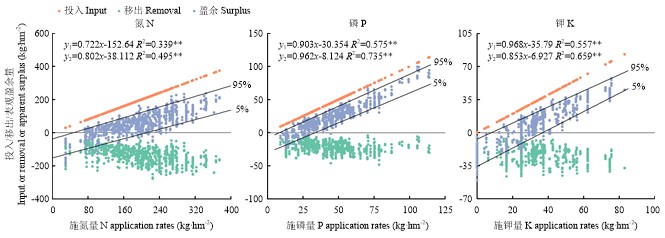
图1
我国北方麦田养分投入量、移出量及表观盈余量与施肥量的关系 图中数据为所有试验地点的农户施肥和监控施肥处理的试验结果(n=963)。5%和95%指在5%和95%分位数的样点的养分盈余量与施肥量之间的线性回归直线。方程y1和y2分别为5%和95%分位数线性回归方程。**,*分别表示回归方程达1%和5%的显著水平。y为盈余量,x为施肥量"
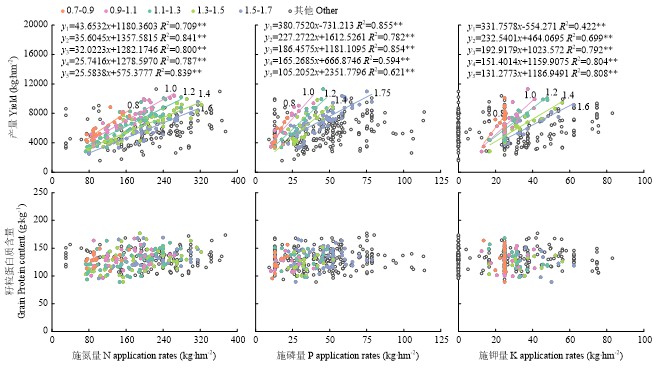
图2
我国北方养分盈余比与小麦产量和蛋白质含量的关系 图中深橙、红粉、深绿、黄绿和灰蓝色的实心点分别指养分盈余比为0.7—0.9、0.9—1.1、1.1—1.3、1.3—1.5和1.5—1.7(或1.5—2.0)时的样点产量和蛋白质含量,黑色圆圈指养分盈余比小于0.7和大于1.7(或大于2.0)时的样点产量和蛋白质含量。氮盈余比为0.7—0.9、0.9—1.1、1.1—1.3、1.3—1.5和1.5—1.7的样本量分别为19、32、58、53和42个;磷盈余比0.7—0.9、0.9—1.1、1.1—1.3、1.3—1.5和1.5—2.0的样本量分别为12、14、18、24和65个;钾盈余比0.7—0.9、0.9—1.1、1.1—1.3、1.3—1.5和1.5—1.7的样本量分别为21、26、33、25和17个。标注为0.8、1.0、1.2、1.4和1.6(1.75)的直线分别代表氮磷钾盈余比0.7—0.9、0.9—1.1、1.1—1.3、1.3—1.5和1.5—1.7(或1.5—2.0)样点的产量与施肥量线性回归拟合线。y1、y2、y3、y4和y5分别为0.7—0.9、0.9—1.1、1.1—1.3、1.3—1.5和1.5—1.7(或1.5—2.0)养分盈余比下样点的产量与施肥量的线性回归方程。**、*分别表示回归方程达1%、5%显著水平。y为产量,x为施肥量"
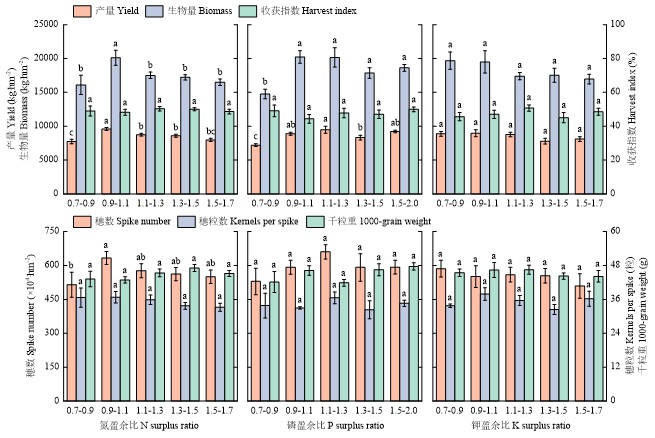
图3
我国北方不同养分盈余比高产样点的产量、地上部生物量、收获指数和产量三要素 0.7—0.9、0.9—1.1、1.1—1.3、1.3—1.5和1.5—1.7(或1.5—2.0)分别表示该养分盈余比中产量位于前25%的地点对应数据的平均值。不同小写字母表示不同养分盈余比之间差异显著(P<0.05)。氮盈余比0.7—0.9、0.9—1.1、1.1—1.3、1.3—1.5和1.5—1.7的样本量分别为5、8、15、13和11个;磷盈余比介于0.7—0.9、0.9—1.1、1.1—1.3、1.3—1.5和1.5—2.0的样本量分别为3、4、5、6和16个;钾盈余比介于0.7—0.9、0.9—1.1、1.1—1.3、1.3—1.5和1.5—1.7的样本量分别为5、7、8、6和4个。下同"
表2
我国北方不同养分盈余比高产样点的氮、磷、钾吸收及利用效率"
| 氮盈余比 N surplus ratio | 籽粒氮吸收量 Grain N uptake (kg·hm-2) | 地上部氮吸收量 Aboveground N uptake (kg·hm-2) | 氮收获指数 N harvest index (%) | 氮生理效率 N physiological efficiencies (kg·kg-1) | 氮肥偏生产力 N partial factor Productivity (kg·kg-1) |
|---|---|---|---|---|---|
| 0.7-0.9 | 173.3b | 217.4a | 79.9a | 36.0a | 54.1a |
| 0.9-1.1 | 212.3a | 262.2a | 81.1a | 36.8a | 43.6b |
| 1.1-1.3 | 179.8b | 217.2a | 83.2a | 41.8a | 41.8b |
| 1.3-1.5 | 185.0b | 224.8a | 82.7a | 39.4a | 33.6c |
| 1.5-1.7 | 179.1b | 223.7a | 80.4a | 36.2a | 28.3d |
| 磷盈余比 P surplus ratio | 籽粒磷吸收量 Grain P uptake (kg·hm-2) | 地上部磷吸收量 Aboveground P uptake (kg·hm-2) | 磷收获指数 P harvest index (%) | 磷生理效率 P physiological efficiencies (kg·kg-1) | 磷肥偏生产力 P partial factor productivity (kg·kg-1) |
| 0.7-0.9 | 27.5b | 33.3a | 82.7b | 217.7a | 343.8a |
| 0.9-1.1 | 30.8ab | 34.7a | 89.1a | 261.1a | 292.6b |
| 1.1-1.3 | 35.3a | 40.8a | 86.6ab | 233.1a | 217.8c |
| 1.3-1.5 | 29.0ab | 33.4a | 87.0ab | 259.1a | 212.5c |
| 1.5-2.0 | 33.4ab | 37.5a | 89.3a | 251.2a | 160.7d |
| 钾盈余比 K surplus ratio | 籽粒钾吸收量 Grain K uptake (kg·hm-2) | 地上部钾吸收量 Aboveground K uptake (kg·hm-2) | 钾收获指数 K harvest index (%) | 钾生理效率 K physiological efficiencies (kg·kg-1) | 钾肥偏生产力 K partial factor productivity (kg·kg-1) |
| 0.7-0.9 | 31.7a | 219.9a | 15.2b | 42.2a | 356.3a |
| 0.9-1.1 | 34.6a | 182.3ab | 19.6ab | 50.9a | 270.4b |
| 1.1-1.3 | 33.5a | 157.2b | 22.3a | 59.1a | 226.4c |
| 1.3-1.5 | 30.5a | 200.7ab | 16.5ab | 43.4a | 183.7d |
| 1.5-1.7 | 31.4a | 175.4ab | 18.8ab | 49.3a | 164.5d |
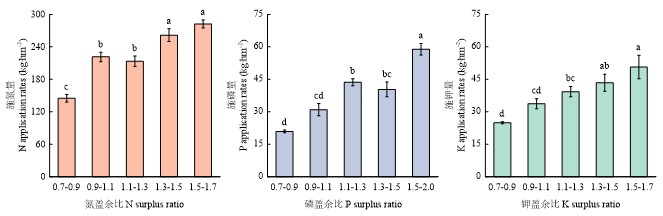
图4
我国北方不同养分盈余比高产样点的氮、磷、钾肥施用量"
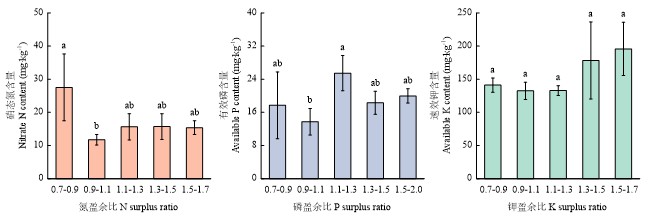
图5
我国北方不同养分盈余比高产样点0—20 cm土层的土壤硝态氮、有效磷和速效钾含量"
| [1] |
|
| [2] |
黄晓萌, 徐新朋, 何萍, 王秀斌, 杨兰芳, 仇少君, 赵士诚, 周卫. 长江流域冬小麦氮磷钾肥增产效应及其影响因素[J]. 植物营养与肥料学报, 2020, 26(6): 1059-1068.
|
|
|
|
| [3] |
黄倩楠, 党海燕, 黄婷苗, 侯赛宾, 王朝辉. 我国主要麦区农户施肥评价及减肥潜力分析[J]. 中国农业科学, 2020, 53(23): 4816-4834. DOI: 10.3864/j.issn.0578-1752.2020.23.009.
|
|
|
|
| [4] |
米东明, 周佐艳, 张晓妍, 范振杰, 孙培杰, 黄潇, 任爱霞, 孙敏, 任永康. 施氮量对黑小麦物质运转与蛋白质含量的影响[J]. 作物杂志, 2025(2): 155-161.
|
|
|
|
| [5] |
刘朋召, 周栋, 郭星宇, 于琦, 张元红, 李昊昱, 张琦, 王旭敏, 王小利, 王瑞, 李军. 不同降雨年型旱地冬小麦水分利用及产量对施氮量的响应[J]. 中国农业科学, 2021, 54(14): 3065-3076. DOI: 10.3864/j.issn.0578-1752.2021.14.012.
|
|
|
|
| [6] |
蒋小忠, 封超年, 郭文善. 施磷量与磷肥基追比对弱筋小麦产量和品质的影响[J]. 耕作与栽培, 2013, 33(5): 7-10.
|
|
|
|
| [7] |
杨胜利, 马玉霞, 冯荣成, 吕海英. 磷肥用量对强筋和弱筋小麦产量及品质的影响[J]. 河南农业科学, 2004, 33(7): 54-57.
|
|
|
|
| [8] |
张慎举, 郭振升, 侯乐新. 豫东砂壤土区强筋小麦施钾增产保优效应研究[J]. 中国农学通报, 2013(3): 47-52.
|
|
|
|
| [9] |
赵会杰, 薛延丰, 徐立新. 氮磷钾肥施用量及其配比对小麦品质的影响[J]. 河南农业大学学报, 2004, 38(4): 374-378, 399.
|
|
|
|
| [10] |
杨传文, 邢帆, 朱建春. 中国秸秆资源的时空分布、利用现状与碳减排潜力[J]. 环境科学, 2023, 44(2): 1149-1162.
|
|
|
|
| [11] |
农业农村部科学技术司. 秸秆去哪里,“五化”告诉你[EB/OL]. (2025/10/17) [2026/4/17]. https://kjs.moa.gov.cn/hbny/202510/t20251017_6478240.htm.
|
|
Department of Science and Technology, Ministry of Agriculture and Rural Affairs. Where does straw go? The "Five-Utilizations" tell you[EB/OL]. (2025/10/17) [2026/4/17]. https://kjs.moa.gov.cn/hbny/202510/t20251017_6478240.htm. (in Chinese)
|
|
| [12] |
黄倩楠, 王朝辉, 黄婷苗, 侯赛宾, 张翔, 马清霞, 张欣欣. 中国主要麦区农户小麦氮磷钾养分需求与产量的关系[J]. 中国农业科学, 2018, 51(14): 2722-2734. DOI: 10.3864/j.issn.0578-1752.2018.14.010.
|
|
|
|
| [13] |
章孜亮, 刘金山, 王朝辉, 赵护兵, 杨宁, 杨荣, 曹寒冰. 基于土壤氮素平衡的旱地冬小麦监控施氮[J]. 植物营养与肥料学报, 2012(6): 1387-1396.
|
|
|
|
| [14] |
黄宁, 王朝辉, 王丽, 马清霞, 张悦悦, 张欣欣, 王瑞. 我国主要麦区主栽高产品种产量差异及其与产量构成和氮磷钾吸收利用的关系[J]. 中国农业科学, 2020, 53(1): 81-93. DOI: 10.3864/j.issn.0578-1752.2020.01.008.
|
|
|
|
| [15] |
刁超朋, 王朝辉, 李莎莎, 刘璐, 王森, 黄宁. 旱地高产小麦品种籽粒氮含量差异与氮磷钾吸收利用的关系[J]. 植物营养与肥料学报, 2018, 24(2): 285-295.
|
|
|
|
| [16] |
惠晓丽, 马清霞, 王朝辉, 张翔, 罗来超. 基于旱地小麦高产优质的氮肥用量优化[J]. 植物营养与肥料学报, 2020, 26(2): 233-244.
|
|
|
|
| [17] |
巨晓棠, 谷保静. 氮素管理的指标[J]. 土壤学报, 2017, 54(2): 281-296.
|
|
|
|
| [18] |
|
| [19] |
|
| [20] |
|
| [21] |
|
| [22] |
|
| [23] |
|
| [24] |
|
| [25] |
|
| [26] |
|
| [27] |
|
| [28] |
蒋会利, 温晓霞, 廖允成. 施氮量对冬小麦产量的影响及土壤硝态氮运转特性[J]. 植物营养与肥料学报, 2010, 16(1): 237-241.
|
|
|
|
| [29] |
|
| [30] |
黄玉芳, 张辉, 张立花, 张红燕, 张雯雯, 赵亚南, 叶优良. 施磷量对高磷土壤小麦磷素吸收和土壤磷平衡的影响[J]. 麦类作物学报, 2022, 42(2): 211-219.
|
|
|
|
| [31] |
刘冲, 贾永红, 张金汕, 孙鹏, 罗四维, 王欢, 李鹏, 石书兵. 施磷量对不同播种方式下冬小麦干物质转运及养分吸收利用的影响[J]. 植物营养与肥料学报, 2020, 26(5): 975-986.
|
|
|
|
| [32] |
陈磊, 王盛锋, 刘荣乐, 汪洪. 不同磷供应水平下小麦根系形态及根际过程的变化特征[J]. 植物营养与肥料学报, 2012, 18(2): 324-331.
|
|
|
|
| [33] |
惠凯善, 冉庆赏, 石玉, 张振, 于振文, 张永丽. 补灌条件下施磷量对小麦不同茎蘖13C同化物分配及其成穗的影响[J]. 应用生态学报, 2024, 35(4): 942-950.
|
|
|
|
| [34] |
李巧丽, 刘朋召, 师祖姣, 刘苗, 陈跻, 李慧, 王小利, 王瑞, 李军. 关中平原冬小麦临界磷浓度稀释曲线的构建与磷营养诊断[J]. 植物营养与肥料学报, 2022, 28(11): 2011-2019.
|
|
|
|
| [35] |
吉庆凯, 王栋, 杨文宝, 韩彦茹, 马文奇, 魏静. 长期施磷对玉米-小麦轮作系统作物产量和磷素吸收及土壤磷积累的影响[J]. 应用生态学报, 2021, 32(7): 2469-2476.
|
|
|
|
| [36] |
冯媛媛, 申艳, 徐明岗, 田应兵, 任凤铃, 段英华. 施磷量与小麦产量的关系及其对土壤、气候因素的响应[J]. 植物营养与肥料学报, 2019, 25(4): 683-691.
|
|
|
|
| [37] |
|
| [38] |
娄梦玉, 薛华龙, 郭彬彬, 汪江涛, 昝志曼, 马超, 郭大勇, 焦念元, 付国占. 施磷水平与冬小麦产量和土壤有效磷含量的关系[J]. 植物营养与肥料学报, 2022, 28(9): 1582-1593.
|
|
|
|
| [39] |
柳开楼, 都江雪, 马常宝, 曲潇琳, 韩天富, 刘淑军, 黄晶, 李亚贞, 申哲, 张璐, 李冬初, 张会民. 中国主要旱作粮食耕地土壤钾素的时空演变特征[J]. 土壤学报, 2023, 60(3): 673-684.
|
|
|
|
| [40] |
谭德水, 金继运, 黄绍文, 刘兆辉, 江丽华. 长期施钾及小麦秸秆还田对北方典型土壤固钾能力的影响[J]. 中国农业科学, 2010, 43(10): 2072-2079. DOI: 10.3864/j.issn.0578-1752.2010.10.013.
|
|
|
|
| [41] |
|
| [42] |
|
| [43] |
|
| [44] |
|
| [45] |
武际, 郭熙盛, 王允青, 汪建来, 杨晓虎. 不同土壤供钾水平下施钾对弱筋小麦产量和品质的调控效应[J]. 麦类作物学报, 2007, 27(1): 102-106.
|
|
|
|
| [46] |
|
| [47] |
|
| [48] |
|
| [49] |
|
| [50] |
|
| [1] | 白晶晶, 章宇辰, 倪子捷, 高佳勇, 刘伟洋, 盖东升, 王雨行, 何佳庆, 张强, 邵玺文, 吴莹, 耿艳秋, 郭丽颖. 不同灌溉量对东北地区水稻抗倒伏特性及产量的影响[J]. 中国农业科学, 2026, 59(9): 1848-1868. |
| [2] | 蔡巧红, 周甜, 苏明, 洪自强, 李翻过, 李彤, 汪华, 康建宏, 吴宏亮. 宁夏引黄灌区减氮增钾施肥模式对玉米光合荧光特性及光合产物积累的影响[J]. 中国农业科学, 2026, 59(9): 1869-1886. |
| [3] | 祝培, 赵耀, 白岩, 张金盔, 李莓, 龙金佳, 杨龙, 罗丽娅, 许本波, 徐劲松, 张学昆. 氟唑菌酰羟胺对油菜的生理调控作用及其与咪鲜胺的复配效应[J]. 中国农业科学, 2026, 59(9): 1903-1915. |
| [4] | 王小玮, 杜佛力, 闫红财, 郎正东, 党志娟, 李葆春, 汪军成, 马小乐, 王化俊, 张宏, 姚立蓉. 396份春小麦灌浆期和成熟期抗旱性评价[J]. 中国农业科学, 2026, 59(8): 1608-1621. |
| [5] | 陈宣伊, 郭星星, 张向前, 路战远, 刘凌悦, 罗方, 李金龙, 张传玲, 张志青, 车曼青. 间作行比对玉米冠层光环境异质性和光合物质生产的影响[J]. 中国农业科学, 2026, 59(8): 1653-1671. |
| [6] | 侯慧芝, 尹嘉德, 马明生, 刘晓伟, 柳燕兰, 雷康宁. 耕作与增施有机肥对陇东马铃薯-玉米一年两熟制作物产量和水分利用的影响[J]. 中国农业科学, 2026, 59(8): 1672-1685. |
| [7] | 王彩玉, 刘小丽, 李文广, 杨文平, 杨珍平, 高志强. 有机肥不同替代比例对土壤多功能性的影响及微生物驱动机制[J]. 中国农业科学, 2026, 59(8): 1712-1726. |
| [8] | 彭廷燊, 陆久焱, 吴美林, 严雨欣, 刘宏周, 南文斌, 秦小健, 李明, 龚俊义, 梁永书. 多年生水稻黄糯2号和长白7号产量相关性状的QTL分析[J]. 中国农业科学, 2026, 59(7): 1361-1379. |
| [9] | 朱琦, 贾振鹏, Tahir SHAH, 徐晨晟, 李芷琦, 吕会帅, 朱鹏超, 韦小敏, 黄冬琳, 孙艳妮, 曹卫东, 高亚军, 王朝辉, 张达斌. 绿肥配施增效产品降低旱地麦田温室气体排放及碳足迹[J]. 中国农业科学, 2026, 59(7): 1507-1522. |
| [10] | 王玉萍, 符质, 孙佳莹, 穆晓萌, 刘慧淋, 郭进云, 宋文菁, 侯雷平, 赵海亮. 苗期施用褪黑素对番茄短期低温胁迫的缓解作用与应用效果评价[J]. 中国农业科学, 2026, 59(7): 1523-1535. |
| [11] | 叶美金, 吴雷, Lohani Md Nahibuzzaman, 尹丽, 胡欣荣, 刘亚西, 蒋云峰, 陈国跃, 蒲至恩, 李阳, 李婷, 邹亚亚, 吴佳怡, 马建. 基于GWAS的中国地方小麦成熟胚大小位点的鉴定及其遗传效应解析[J]. 中国农业科学, 2026, 59(6): 1157-1171. |
| [12] | 王佳诺, 陈桂平, 李盼, 王丽萍, 南运有, 何蔚, 樊志龙, 胡发龙, 柴强, 殷文, 赵连豪. 免耕地膜两年覆盖提高绿洲灌区玉米产量的灌浆期光合生理机制[J]. 中国农业科学, 2026, 59(6): 1189-1202. |
| [13] | 周新杰, 任昊, 陈应龙, 张吉旺, 赵斌, 任佰朝, 刘鹏, 王洪章. 过氧化钙对渍涝农田夏玉米根系形态及产量形成的影响[J]. 中国农业科学, 2026, 59(6): 1203-1216. |
| [14] | 何继航, 张擎, 吕相月, 薛吉全, 徐淑兔, 刘建超. 不同保绿型玉米杂交种氮效率评价[J]. 中国农业科学, 2026, 59(6): 1217-1230. |
| [15] | 李永娟, 张悦彤, 王艺博, 赵长江, 宋洁, 陈雪丽, 姚钦. 生物炭施用对大豆轮连作系统土壤固氮微生物nifH基因丰度及群落组成的影响[J]. 中国农业科学, 2026, 59(6): 1272-1285. |
|
||
