






中国农业科学 ›› 2026, Vol. 59 ›› Issue (21): 4815-4830.doi: 10.3864/j.issn.0578-1752.2026.21.008
覃英1,2( ), 阴伟晓1, 罗朝喜1,2()
收稿日期:2026-05-31
接受日期:2026-07-03
出版日期:2026-11-01
发布日期:2026-11-06
通信作者:
联系方式:
覃英,E-mail:1619914660@qq.com。
基金资助:
QIN Ying1,2(), YIN WeiXiao1, LUO ChaoXi1,2()
Received:2026-05-31
Accepted:2026-07-03
Published:2026-11-01
Online:2026-11-06
摘要:
【目的】桃褐腐病是由链核盘菌(Monilinia spp.)引起的一种真菌性病害,常年对桃产业造成严重经济损失。本研究旨在探究贝莱斯芽孢杆菌(Bacillus velezensis)C1-17菌株对桃褐腐病的防治潜力及其抑菌机制,为该病害的绿色防控提供新的菌株资源。【方法】前期获得一株贝莱斯芽孢杆菌C1-17,通过平板对峙培养法、菌液浸泡果实法及无菌培养滤液法,分别测定其对桃褐腐病优势致病菌实生链核盘菌(Monilinia fructicola)的离体抑菌活性和活体防病效果,评估其生防潜力。进一步利用光学显微镜、扫描电镜及透射电镜,逐级观察C1-17无菌培养滤液处理后病原菌菌丝的表面形态与细胞超微结构变化;并采用PI染色和DCFH-DA荧光探针,分别检测菌丝质膜完整性和胞内活性氧(ROS)水平的变化;通过特异性培养基检测C1-17产生蛋白酶、纤维素酶及嗜铁素等胞外抗菌活性物质的能力。同时,采用实时荧光定量PCR(RT-qPCR)分析单独喷施C1-17及在病原菌侵染背景下进行预处理后,桃果实中相关防御基因(PpPR1、PpNPR1、PpMYC2、PpJAZ5、PpPAL1、PpPOD)的相对表达量变化。桃果实分别用10% C1-17菌液和戊唑醇喷雾处理后,接种甾醇脱甲基酶抑制剂类(DMI)杀菌剂抗性菌株和敏感菌株孢子悬浮液,随后调查发病情况并计算防治效果,评估C1-17对不同菌株的防治效果。【结果】C1-17发酵菌液在2%(V/V)低浓度下对桃褐腐病的防效达93.25%。其无菌培养滤液在1%(V/V)添加量下可抑制95.93%实生链核盘菌菌丝生长,并使孢子萌发率降至3%。1%(V/V)C1-17无菌培养滤液处理下,病原菌菌丝出现膨大、空泡化、皱缩破损及质壁分离、线粒体等细胞器溶解现象;PI染色和DCFH-DA检测证实质膜完整性受损、胞内ROS大量积累,提示膜损伤与氧化爆发是其重要抑菌机制,同时C1-17能产生蛋白酶、纤维素酶及嗜铁素等活性物质并释放到胞外。单独喷施C1-17未显著诱导桃果实防御基因表达,但在实生链核盘菌侵染背景下,C1-17预处理于侵染后期(48 h)特异性上调水杨酸通路基因(PpPAL1、PpPR1)以及PpPOD的表达。10% C1-17菌液对DMI抗性和敏感桃褐腐病菌株均表现出良好的防治效果,防效不低于94.50%,其中对DMI抗性菌株的防效优于20 μg·mL-1戊唑醇,且与DMI类杀菌剂无交互抗性。【结论】贝莱斯芽孢杆菌C1-17对桃褐腐病展现出良好的生防应用潜力。C1-17通过分泌抗菌物质直接破坏实生链核盘菌菌丝形态与质膜完整性、诱导胞内ROS积累,同时在病原侵染后期选择性激活水杨酸信号通路及苯丙烷代谢途径,从而实现对桃褐腐病的高效防治。
覃英, 阴伟晓, 罗朝喜. 贝莱斯芽孢杆菌C1-17对桃褐腐病的生防潜力及防病机制[J]. 中国农业科学, 2026, 59(21): 4815-4830.
QIN Ying, YIN WeiXiao, LUO ChaoXi. Biocontrol Potential and Mechanism of Bacillus velezensis C1-17 Against Peach Brown Rot[J]. Scientia Agricultura Sinica, 2026, 59(21): 4815-4830.

图1
C1-17菌液对桃褐腐病的防治效果 A:发病情况Disease development;B:在桃果实上的防治效果Control efficacy on peach fruits。柱上不同字母表示处理间差异显著。下同"
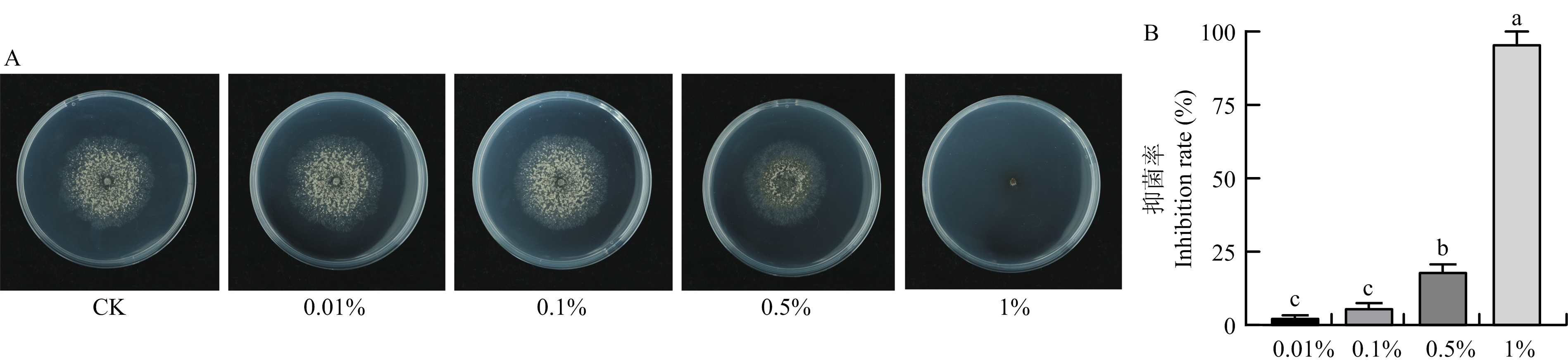
图2
C1-17无菌培养滤液对实生链核盘菌的抑制效果 A:无菌培养滤液处理后实生链核盘菌的生长情况Growth of M. fructicola on plates supplemented with different concentrations of cell-free incubation broth;B:无菌培养滤液对实生链核盘菌菌丝生长的抑制率Inhibition rate of cell-free incubation broth on the mycelial growth of M. fructicola"
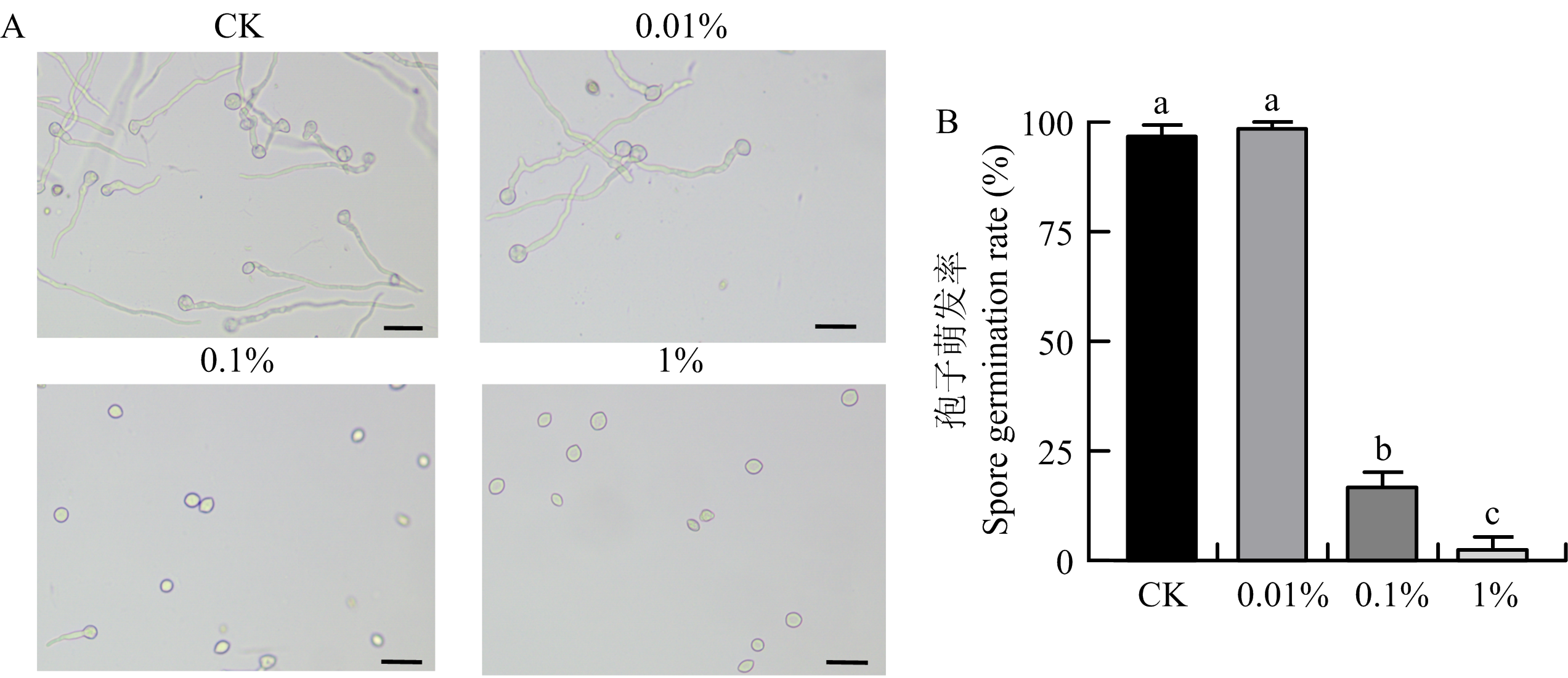
图3
C1-17无菌培养滤液对实生链核盘菌孢子萌发的抑制作用 A:无菌培养滤液处理后实生链核盘菌孢子萌发显微观察,比例尺=30 μm Microscopic observation of M. fructicola spore germination after treatment with cell-free incubation broth, scale bar=30 μm;B:无菌培养滤液对实生链核盘菌孢子萌发率的影响Effect of cell-free incubation broth on the spore germination rate of M. fructicola"
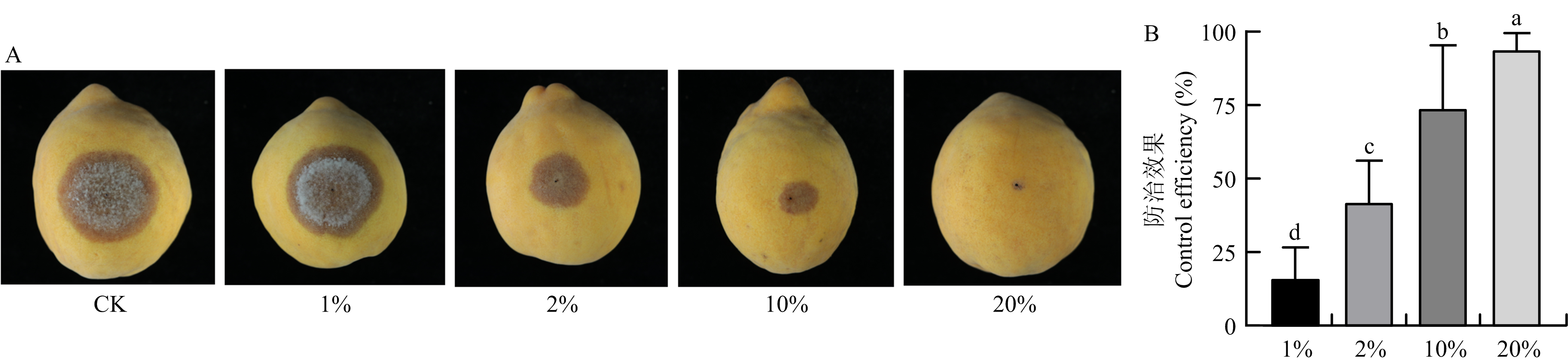
图4
C1-17无菌培养滤液对桃褐腐病的防治效果 A:发病症状Disease symptom;B:防治效果Control efficacy"

图5
光学显微镜下C1-17对实生链核盘菌菌丝形态影响的观察 A:1% LB液体培养处理的实生链核盘菌菌丝形态(对照)Mycelial morphology of M. fructicola treated with 1% LB liquid culture (control);B:1% C1-17无菌培养滤液处理的实生链核盘菌菌丝形态Mycelial morphology of M. fructicola treated with 1% C1-17 cell-free incubation broth。标尺Scale bar=50 μm"
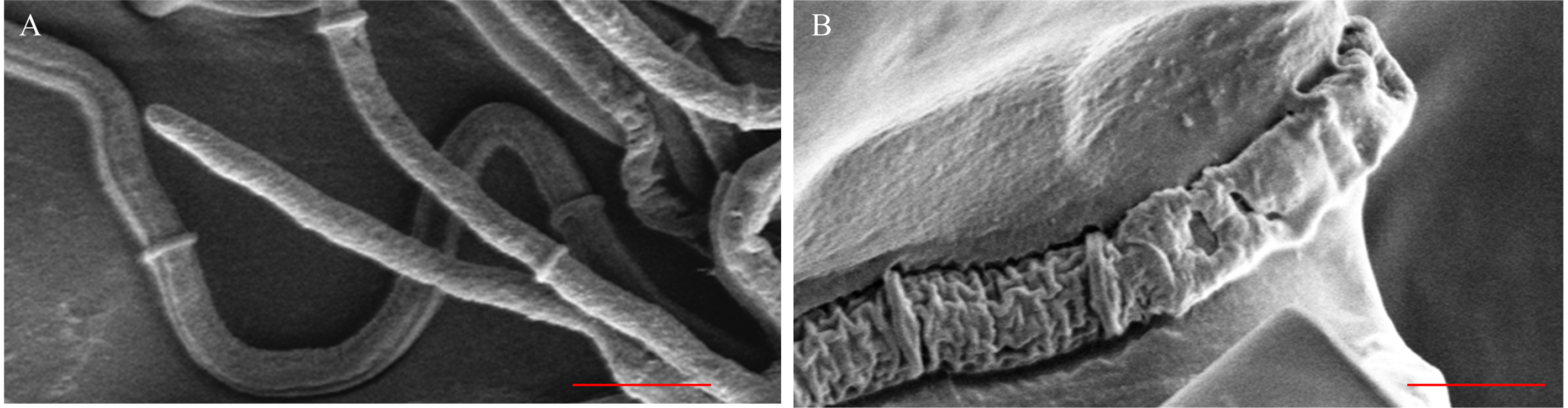
图6
扫描电镜观察C1-17对实生链核盘菌菌丝形态的影响 A:正常菌丝形态Normal mycelial morphology;B:C1-17处理后的菌丝形态Mycelial morphology after treatment with C1-17。标尺Scale bar=10 μm"

图7
C1-17处理实生链核盘菌的透射电镜观察 CW:细胞壁Cell wall;M:线粒体Mitochondrion;N:细胞核Nucleus;V:液泡Vacuole;P:色素粒Pigment granule。标尺Scale bar=1 μm"

图8
C1-17处理实生链核盘菌菌丝体后的PI染色观察 A:1% LB处理实生链核盘菌菌丝后的PI染色观察Microscopic observation of M. fructicola mycelia stained with PI after treatment with 1% LB;B:1% C1-17无菌培养滤液处理实生链核盘菌菌丝后的PI染色观察Microscopic observation of M. fructicola mycelia stained with PI after treatment with 1% C1-17 cell-free incubation broth。标尺Scale bar=50 μm"

图9
C1-17处理实生链核盘菌菌丝体后的DCFH-DA染色观察 A:1% LB处理实生链核盘菌菌丝后的DCFH-DA染色荧光图Fluorescence micrographs of M. fructicola mycelia stained with DCFH-DA after treatment with 1% LB;B:1% C1-17无菌培养滤液处理实生链核盘菌菌丝后的DCFH-DA染色荧光图Fluorescence micrographs of M. fructicola mycelia stained with DCFH-DA after treatment with 1% C1-17 cell-free incubation broth。标尺Scale bar=50 μm"

图10
C1-17抑菌活性物质的检测 A:C1-17在不同培养基上直接培养后透明圈观察Clear zones observed after culturing C1-17 directly on different media;B:C1-17无菌培养滤液滴加至不同培养基后透明圈观察Clear zones observed after spotting C1-17 cell-free incubation broth onto different media"
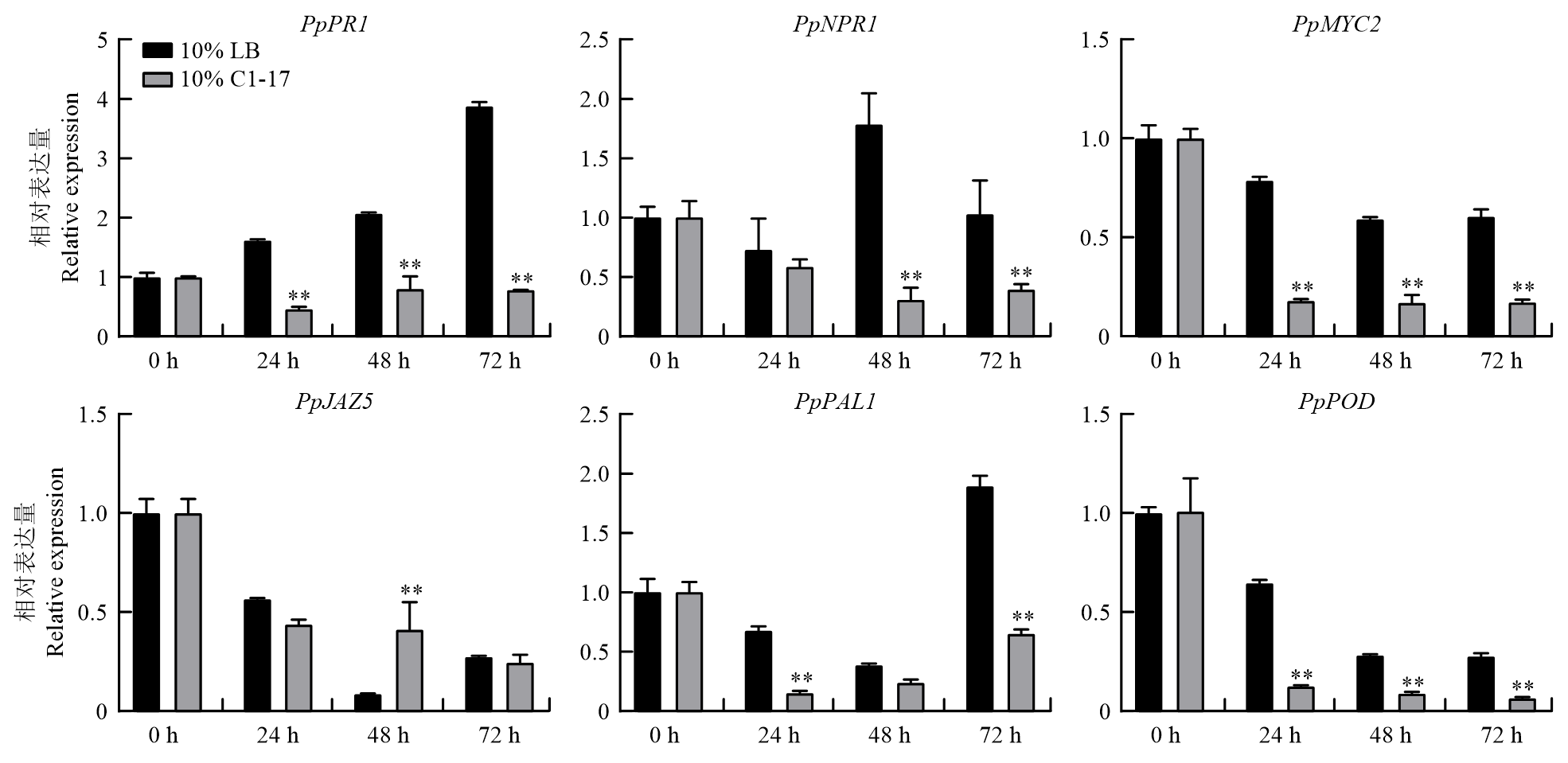
图11
单独喷施C1-17对桃果实防御基因的影响"
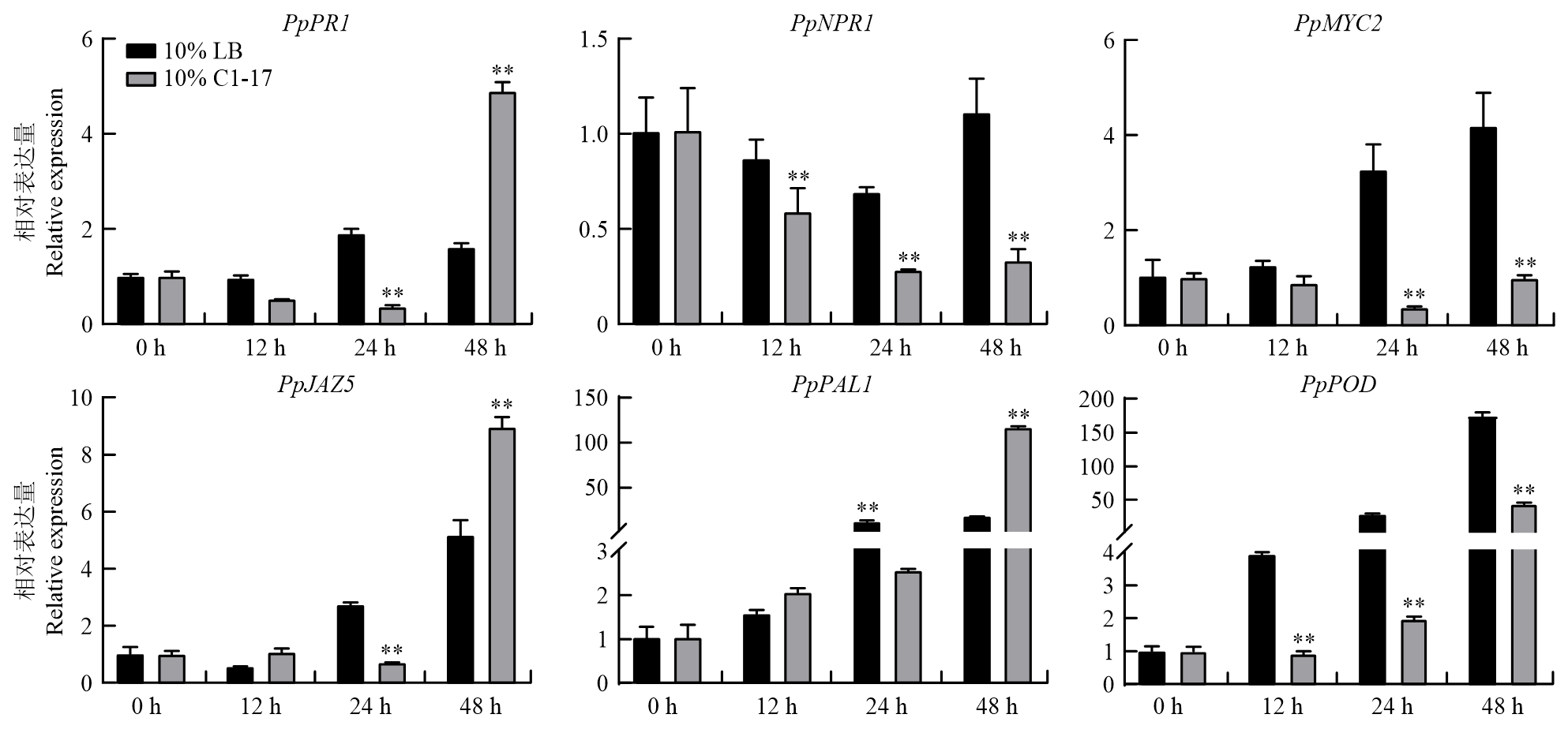
图12
接种实生链核盘菌后C1-17对桃果实防御基因的影响"
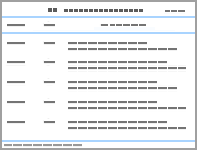
表1
C1-17菌液与戊唑醇对DMI抗性和敏感菌株的防治效果"
| 菌株 Strain | 戊唑醇Tebuconazole | C1-17菌液C1-17 bacterial suspension | ||||||
|---|---|---|---|---|---|---|---|---|
| 0.5 μg·mL-1 | 1 μg·mL-1 | 5 μg·mL-1 | 10 μg·mL-1 | 20 μg·mL-1 | 1% | 5% | 10% | |
| ZYTF5-1 | 19.36±4.28a | 65.07±3.23a | 100±0a | — | — | 12.06±2.37c | 35.24±11.42c | 100±0a |
| MD1-7 | 18.51±3.18a | 58.45±7.72b | 100±0a | — | — | 23.71±7.48b | 52.59±10.30b | 94.50±7.77b |
| Bmpc7 | — | — | 4.07±13.21b | 22.59±10.55 | 48.51±8.18 | 33.70±5.77a | 71.42±7.97a | 100±0a |

图13
不同浓度C1-17菌液与戊唑醇对DMI抗性和敏感菌株的防治作用(桃果实) A、B:对DMI抗性菌株的防治效果Control efficacy on DMI-resistant strain;C、D:对DMI敏感菌株的防治效果Control efficacy on DMI-sensitive strains"
| [1] |
doi: 10.1186/s42483-022-00134-0 |
| [2] |
|
| [3] |
doi: 10.1094/PDIS-94-4-0478A pmid: 30754483 |
| [4] |
doi: 10.1017/S0953756202005695 |
| [5] |
doi: 10.1007/s10327-004-0137-4 |
| [6] |
doi: 10.1094/PDIS-02-11-0079 |
| [7] |
罗朝喜. 果树褐腐病的研究现状及其展望[J]. 植物病理学报, 2017, 47(2): 145-153.
doi: 10.13926/j.cnki.apps.000015 |
|
|
|
| [8] |
曾哲政, 罗朝喜. 中国桃重要病害的化学防治现状及关键技术[J]. 现代农药, 2024, 23(2): 26-32.
|
|
|
|
| [9] |
doi: 10.3390/molecules28186735 |
| [10] |
doi: 10.1016/j.scitotenv.2025.180385 |
| [11] |
doi: 10.1094/PDIS-11-13-1145-RE pmid: 30699783 |
| [12] |
doi: 10.1128/AEM.69.12.7145-7152.2003 |
| [13] |
doi: 10.1094/PDIS-92-7-1099 |
| [14] |
doi: 10.30843/nzpp.1986.39 |
| [15] |
doi: 10.1094/PDIS-10-12-0924-RE pmid: 30722204 |
| [16] |
曲美慧. 桃褐腐病菌的多重抗药性评估及其初步机制研究[D]. 沈阳: 沈阳农业大学, 2024.
|
|
|
|
| [17] |
doi: 10.1016/j.cropro.2016.09.008 |
| [18] |
张慧, 许宁, 曹丽茹, 王蕊, 张凯. 我国微生物农药的研发与应用研究进展[J]. 农药学学报, 2023, 25(4): 769-778.
|
|
|
|
| [19] |
doi: 10.1016/j.postharvbio.2024.112971 |
| [20] |
doi: 10.1016/j.fbio.2025.107288 |
| [21] |
|
| [22] |
贾祥子, 叶建, 王诚, 熊正文, 孔祥伟, 张清霞, 纪兆林. 桃褐腐病生防细菌JY-d1种类鉴定及其对桃褐腐病菌生防机制研究[J]. 扬州大学学报(农业与生命科学版), 2021, 42(4): 128-134.
|
|
|
|
| [23] |
doi: 10.1016/j.fm.2024.104551 |
| [24] |
doi: 10.1094/PDIS-06-25-1318-SC |
| [25] |
doi: 10.1111/1751-7915.14348 pmid: 37837627 |
| [26] |
doi: 10.1038/s41467-024-48812-1 pmid: 38802389 |
| [27] |
|
| [28] |
doi: 10.3389/fmicb.2021.808938 |
| [29] |
doi: 10.1016/j.foodcont.2023.110068 |
| [30] |
doi: 10.1016/j.tibtech.2024.02.003 pmid: 38448350 |
| [31] |
doi: 10.1002/ps.v82.3 |
| [32] |
doi: 10.1016/j.biocontrol.2026.106086 |
| [33] |
pmid: 16171979 |
| [34] |
doi: 10.1016/S1360-1385(98)01297-7 |
| [35] |
周衍章, 陈艳, 易图永. 桃褐腐病的研究进展[J]. 生物灾害科学, 2025, 48(2): 286-293.
|
|
|
|
| [36] |
|
| [37] |
doi: 10.1007/s10658-021-02374-w |
| [38] |
|
| [39] |
doi: 10.1111/mmi.2009.71.issue-2 |
| [40] |
doi: 10.1128/EC.2.3.398-410.2003 |
| [41] |
doi: 10.1371/journal.ppat.1000200 |
| [42] |
doi: 10.1016/j.postharvbio.2025.113923 |
| [43] |
|
| [44] |
|
| [45] |
doi: 10.1104/pp.109.138636 pmid: 19448037 |
| [46] |
doi: 10.1094/MPMI.1997.10.6.761 |
| [47] |
doi: 10.1016/j.biocontrol.2019.03.017 |
| [48] |
刘晓光, 高克祥, 康振生, 何邦令. 生防菌诱导植物系统抗性及其生化和细胞学机制[J]. 应用生态学报, 2007, 18(8): 1861-1868.
|
|
|
|
| [49] |
doi: 10.1094/MPMI-06-11-0179 pmid: 21995763 |
| [50] |
doi: 10.1038/s41477-025-01918-w pmid: 39972185 |
| [51] |
doi: 10.1016/j.postharvbio.2025.113690 |
| [52] |
doi: 10.1016/j.postharvbio.2024.113254 |
| [53] |
doi: 10.1016/j.postharvbio.2026.114285 |
| [54] |
doi: 10.1038/s41586-025-09185-7 |
| [55] |
doi: 10.1038/s41586-025-09280-9 |
| [56] |
doi: 10.1038/s41586-025-09175-9 |
| [57] |
doi: 10.9787/PBB.2016.4.3.324 |
| [1] | 王晶, 李岗, 蔡晓雅, 庞璐瑶, 黄青滢, 林宝义, 孔海民, 郝跃, 任海英. 杨梅凋萎病生防芽孢杆菌的筛选及其防病机制[J]. 中国农业科学, 2026, 59(7): 1467-1479. |
| [2] | 鄢文英, 张元珍, 吴洪鑫, 庞锐, 陈泽鹏, 金丰良, 许小霞. 靶向小菜蛾PxGNBP3的RNAi增效绿僵菌构建及其免疫调控机制[J]. 中国农业科学, 2026, 59(3): 556-574. |
| [3] | 李姝, 马驰, 汪加佳, 肖达, 米莹莹, 岳艳丽, 王甦. 地统计学在害虫生物防治中的应用与决策支持[J]. 中国农业科学, 2026, 59(18): 4076-4091. |
| [4] | 刘羽凡, 陈峥, 陈德局, 刘欣, 肖荣凤, 王阶平, 王璕, 刘波, 何进, 陈梅春. 芽孢杆菌脂肽靶向减弱青枯雷尔氏菌致病力的生防作用[J]. 中国农业科学, 2026, 59(13): 2853-2866. |
| [5] | 郭富强, 彭治鑫, 李得瑞, 林木森, 许立峰, 张成省. 2-辛基-3-异噻唑啉酮抗烟草赤星病菌的生物活性及作用机制[J]. 中国农业科学, 2026, 59(13): 2841-2852. |
| [6] | 赵星宇, 高艳, 唐新科, 奉茵陈, 陈思颖, 顾天宇, 彭佳师. 铁在内生放线菌OsiPR-1诱导水稻稻瘟病抗性中的作用[J]. 中国农业科学, 2026, 59(13): 2828-2840. |
| [7] | 李睿, 梁跃, 白杨, 张桂悦, 王楠楠, 乔松林, 张改平. 自噬在猪繁殖与呼吸综合征病毒感染中的作用机制研究进展[J]. 中国农业科学, 2025, 58(4): 792-801. |
| [8] | 从琪琪, 张静怡, 孟祥龙, 戴蓬博, 李波, 胡同乐, 王树桐, 曹克强, 王亚南. 我国苹果轮纹病弱毒菌株中病毒的鉴定及其携带情况的检测[J]. 中国农业科学, 2025, 58(3): 478-492. |
| [9] | 蔡海林, 黄馨瑢, 曾维爱, 彭治鑫, 赵阿娟, 薄纯斌, 向世鹏, 高鹏程, 张成省, 赵栋霖. 菌核青霉HY5中3,5-二甲基苔色酸类混源萜的结构及其除草活性[J]. 中国农业科学, 2025, 58(22): 4673-4687. |
| [10] | 谢海鹏, 林俊旭, 刘勇, 麦贤俊, 罗丰, 王学武, 谢文, 李少卡, 孔祥义, 吴小燕. 施用不同有机肥对贝莱斯芽孢杆菌SD13防控豇豆枯萎病的影响[J]. 中国农业科学, 2025, 58(21): 4405-4420. |
| [11] | 胡佳燕, 沈之涵, 温丽慧, 郁嘉豪, 章雨君, 蒋冬花. 水稻细菌性条斑病菌拮抗放线菌的鉴定及其防病和促生功能[J]. 中国农业科学, 2025, 58(17): 3434-3450. |
| [12] | 赵琳琳, 贺羽茜, 彭杰丽, 王旭, 马佳, 张秀敏, 胡栋. 链霉菌TOR3209及其挥发性有机化合物提高烟草抗木贼镰孢的能力[J]. 中国农业科学, 2025, 58(11): 2162-2175. |
| [13] | 廖鑫琳, 郭鑫, 杨季学, 邵嘉朱, 袁歆瑜, 胡佳燕, 陈晓晓, 蒋冬花. 拮抗青枯雷尔氏菌的放线菌筛选及其防病作用[J]. 中国农业科学, 2024, 57(7): 1319-1334. |
| [14] | 石娜, 路杨, 隋丽, 王佳江, 赵宇, 李启云, 张正坤. 莱氏绿僵菌与异色瓢虫协同增效防治蚜虫研究[J]. 中国农业科学, 2024, 57(17): 3398-3407. |
| [15] | 罗万珍, 王丹, 齐宏玥, 王彤, 刘政, 田李, 戴小枫, 陈捷胤, 麦合木提江·米吉提. 拮抗细菌KRS022的鉴定及对大丽轮枝菌的抑制效果[J]. 中国农业科学, 2023, 56(4): 649-664. |
|
||
