






中国农业科学 ›› 2026, Vol. 59 ›› Issue (20): 4588-4599.doi: 10.3864/j.issn.0578-1752.2026.20.011
赵悦( ), 王永康, 姜越, 喻嘉仪, 程庆华, 王光宇(), 邱伟芬
收稿日期:2026-04-10
接受日期:2026-08-31
出版日期:2026-10-16
发布日期:2026-10-21
通信作者:
联系方式:
赵悦,E-mail:yuezhao911@163.com。
基金资助:
ZHAO Yue(), WANG YongKang, JIANG Yue, YU JiaYi, CHENG QingHua, WANG GuangYu(), QIU WeiFen
Received:2026-04-10
Accepted:2026-08-31
Published:2026-10-16
Online:2026-10-21
摘要:
【目的】探究聚乙烯微塑料(polyethylene microplastics,PE-MPs)对冷鲜肉优势腐败菌莓实假单胞菌(Pseudomonas fragi)生理行为、表面定殖能力及致腐能力的影响,揭示其在微生物与食品相关界面互作的潜在作用机制。【方法】以一株具有强致腐潜力的腐败菌P. fragi NMC25为研究对象,依据前期在肉类加工场景下的实际检测数据,设置肉类迁移浓度(35 μg·mL-1)和案板残留浓度(700 μg·mL-1)作为环境相关处理组。通过生长曲线测定、运动性实验、生物被膜定量与微观成像,以及腐败指标分析,系统评估微塑料对特定腐败菌从浮游到定殖再到致腐的全过程影响。【结果】结果显示,即使在案板残留浓度下,PE-MPs对P. fragi的基础生长能力也无显著影响,表明微塑料不直接干预其增殖能力,但显著增强了其swimming、swarming和twitching三种运动能力(P<0.05),并促进其在不锈钢表面的粘附与定殖;相比之下的肉类迁移浓度中,twitching运动显著增强(P<0.05),表明PE-MPs存在可诱导菌体局部迁移行为,且该效应呈现浓度依赖性。扫描电镜和激光共聚焦显微镜观察证实,菌粘附在微塑料颗粒周围,并分泌大量胞外聚合物包裹菌体,形成复杂的立体网状结构,案板残留浓度诱导形成的生物被膜结构胞外聚合物明显增多,结构更加致密,且呈聚集分布。在腐败功能方面,案板残留浓度的PE-MPs显著增强了P. fragi胞外蛋白酶活性,导致冷鲜肉中总挥发性盐基氮(total volatile basic nitrogen,TVBN)和pH的上升程度显著高于对照组,加速了感官腐败进程。【结论】案板残留浓度的PE-MPs并非通过影响细菌生物量,而是通过调控其运动行为、增强表面附着能力及蛋白酶活性,间接促进致密生物被膜的形成并加速蛋白质类基质的腐败。这一发现表明案板表面高负荷的微塑料残留可能成为加速腐败菌定殖与食品腐败的关键环境因子,为理解微塑料在实际食品加工环境中的微生物生态功能调控及其在食品安全风险评估中的作用提供了依据。
赵悦, 王永康, 姜越, 喻嘉仪, 程庆华, 王光宇, 邱伟芬. 聚乙烯微塑料对莓实假单胞菌生物学特性及致腐能力的影响[J]. 中国农业科学, 2026, 59(20): 4588-4599.
ZHAO Yue, WANG YongKang, JIANG Yue, YU JiaYi, CHENG QingHua, WANG GuangYu, QIU WeiFen. Effects of Polyethylene Microplastic on Biological Characteristic and Spoilage Potential of Pseudomonas fragi[J]. Scientia Agricultura Sinica, 2026, 59(20): 4588-4599.

图1
PE-MPs暴露对P. fragi NMC25生长和运动性的影响 各处理组间不同小写字母表示差异显著(P<0.05)。下同"
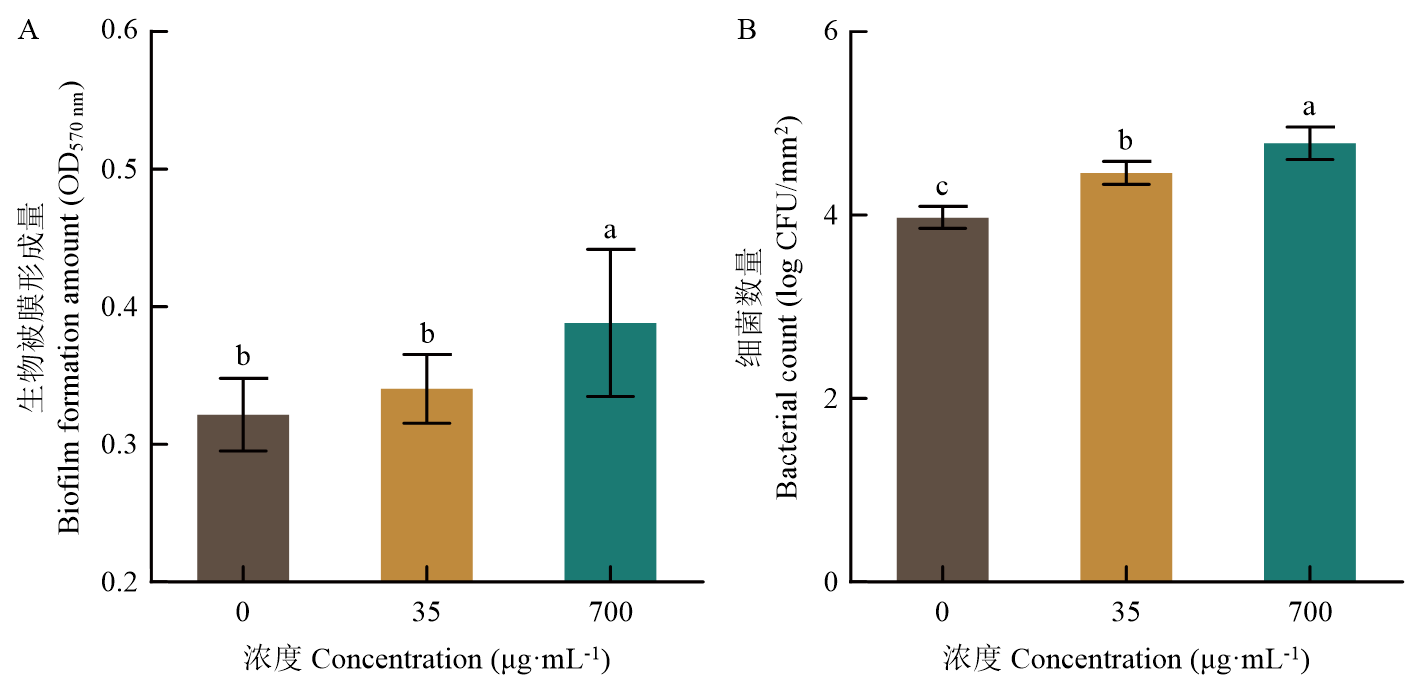
图2
PE-MPs对P. fragi NMC25生物被膜形成和表面附着的影响"

图3
不同浓度PE-MPs下P. fragi NMC25不锈钢表面生物被膜的CLSM和SEM图像 A-C:共聚焦激光扫描显微镜(CLSM)图像,展示生物被膜的微观结构和形态。D-F:扫描电子显微镜(SEM)图像,生物被膜经SYTO9/PI荧光染料染色(绿色:活菌;红色:死菌)"

图4
不同浓度PE-MPs下经P. fragi NMC25胞外蛋白酶处理的肌浆蛋白和肌原纤维蛋白SDS-PAGE分析 S:未经处理的肌浆蛋白(对照);S-0、S-35、S-700:分别在0、35和700 μg·mL-1 PE-MPs存在下与胞外蛋白酶共孵育的肌浆蛋白;M:未经处理的肌原纤维蛋白(对照);M-0、M-35、M-700:分别在0、35和700 μg·mL-1 PE-MPs存在下与胞外蛋白酶共孵育的肌原纤维蛋白"

图5
PE-MPs对样品贮藏期间品质变化的影响"
| [1] |
pmid: 15131299 |
| [2] |
doi: 10.1016/j.jhazmat.2025.137704 |
| [3] |
doi: 10.1021/es401288x |
| [4] |
doi: 10.1016/j.jhazmat.2025.138927 |
| [5] |
doi: 10.1016/j.scitotenv.2022.159024 |
| [6] |
doi: 10.1016/j.jhazmat.2025.138795 |
| [7] |
doi: 10.1016/j.jece.2025.118689 |
| [8] |
doi: 10.1016/j.ecoenv.2025.118119 |
| [9] |
doi: 10.1016/j.tox.2024.154043 |
| [10] |
doi: 10.1021/acsnano.5c00945 |
| [11] |
doi: 10.1021/acs.est.5c06662 |
| [12] |
张金瑞, 任思洋, 戴吉照, 丁凡, 肖谋良, 刘学军, 严昌荣, 葛体达, 汪景宽, 刘勤, 王锴, 张福锁. 地膜对农业生产的影响及其污染控制[J]. 中国农业科学, 2022, 55(20): 3983-3996. DOI: 10.3864/j.issn.0578-1752.2022.20.010.
|
|
|
|
| [13] |
李凯贺, 门聪, 程世昆, 李子富. 土壤中微塑料与抗生素吸附、迁移及复合毒性研究进展[J]. 环境科学, 2025, 46(8): 5271-5282.
|
|
doi: 10.1021/es301646m |
|
| [14] |
doi: 10.3390/polym14061246 |
| [15] |
doi: 10.1016/j.marpolbul.2025.117763 |
| [16] |
韦婧, 涂晨, 杨杰, 刘颖, 黄硕霈, 卜元卿, 骆永明. 微塑料对农田土壤理化性质、土壤微生物群落结构与功能的影响[J]. 生态与农村环境学报, 2023, 39(5): 644-652.
|
|
|
|
| [17] |
doi: 10.1016/j.jhazmat.2025.140425 |
| [18] |
杨杰, 涂晨, 袁宪正, 骆永明. 土壤-植物系统中微/纳塑料的环境过程和生态效应[J]. 化学进展, 2025, 37(1): 89-102.
doi: 10.7536/PC240801 |
|
doi: 10.7536/PC240801 |
|
| [19] |
doi: 10.1111/emi.v24.10 |
| [20] |
doi: 10.1016/j.jhazmat.2025.140036 |
| [21] |
doi: 10.1016/j.scitotenv.2023.165607 |
| [22] |
doi: 10.1021/acs.est.5c06285 |
| [23] |
doi: 10.1016/j.jhazmat.2024.136143 |
| [24] |
|
| [25] |
doi: 10.1016/j.jhazmat.2022.128636 |
| [26] |
doi: 10.1016/j.foodres.2026.118677 |
| [27] |
|
| [28] |
doi: 10.1016/j.fm.2024.104708 |
| [29] |
|
| [30] |
王光宇. 气调包装对冷鲜鸡肉中莓实假单胞菌致腐效应的抑制机制[D]. 南京: 南京农业大学, 2018.
|
|
|
|
| [31] |
doi: 10.1016/j.foodcont.2018.11.029 |
| [32] |
doi: 10.1016/j.foodcont.2011.02.021 |
| [33] |
doi: 10.1016/j.ijfoodmicro.2025.111064 |
| [34] |
doi: 10.1016/j.ijfoodmicro.2020.108643 |
| [35] |
doi: 10.1016/j.meatsci.2013.09.024 |
| [36] |
doi: 10.1016/j.lwt.2015.07.039 |
| [37] |
doi: 10.1128/aem.02282-24 |
| [38] |
doi: 10.1038/s41579-021-00626-4 |
| [39] |
doi: 10.1007/s00203-017-1344-7 |
| [40] |
|
| [41] |
doi: 10.1016/j.aquaculture.2023.739874 |
| [42] |
郭建慧, 何沿沿, 陈荣浩, 吴卫辉, 金守光, 靳永新. 铜绿假单胞菌mexS基因对其运动能力的影响[J]. 南开大学学报(自然科学版), 2015, 48(5): 44-50.
|
|
|
|
| [43] |
doi: 10.1016/j.watres.2023.119656 |
| [44] |
doi: 10.1002/imt2.121 pmid: 38867926 |
| [45] |
阎波, 张玥, 郭安. 微塑料上生物膜的形成及其环境行为[J/OL]. 天津科技大学学报. https://doi.org/10.13364/j.issn.1672-6510.20250085.
|
|
|
|
| [46] |
doi: 10.1016/j.jhazmat.2025.137740 |
| [47] |
|
| [48] |
doi: 10.1186/s12903-025-05463-y pmid: 39827354 |
| [49] |
doi: 10.1038/srep20190 |
| [50] |
doi: 10.1016/j.jhin.2025.10.034 |
| [51] |
doi: 10.1016/j.envpol.2020.114922 |
| [52] |
doi: 10.3390/app12105245 |
| [53] |
doi: 10.1016/j.marpolbul.2010.10.013 pmid: 21093883 |
| [54] |
doi: 10.1016/j.jhazmat.2023.132099 |
| [55] |
doi: 10.1007/978-3-031-08491-1_7 pmid: 36258073 |
| [56] |
doi: 10.1038/s41522-023-00436-x |
| [57] |
doi: 10.2175/106143016X14504669767292 |
| [58] |
doi: 10.1016/j.fm.2025.105010 |
| [59] |
doi: 10.1016/j.biortech.2024.130604 |
| [60] |
|
| [61] |
吴亚婕, 谭松, 陈愉平, 牛阿娟, 柳雨欣, 王光宇, 徐幸莲, 邱伟芬. 冷藏条件下肉源莓实假单胞菌nuoB对其生物被膜形成和细胞代谢的影响[J]. 中国农业科学, 2023, 56(11): 2172-2185. DOI: 10.3864/J.ISSN.0578-1752.2023.11.011.
|
|
|
|
| [62] |
doi: 10.1038/s41522-023-00427-y pmid: 37679355 |
| [63] |
doi: 10.1099/13500872-140-1-153 |
| [64] |
doi: 10.1016/j.fm.2018.07.007 |
| [1] | 冯英明, 农伟, 陈醒韵, 韩宏祥, 郑雨欣, 田晓, 唐娇, 郭依唯, 黄朝政, 李学文, 石磊, 喻敏. 纳米硅生物矿化沉积赋予水稻根边缘细胞及根尖耐铝性的生理机制[J]. 中国农业科学, 2024, 57(24): 4871-4883. |
| [2] | 吴亚婕, 谭松, 陈愉平, 牛阿娟, 柳雨欣, 王光宇, 徐幸莲, 邱伟芬. 冷藏条件下肉源莓实假单胞菌nuoB对其生物被膜形成和细胞代谢的影响[J]. 中国农业科学, 2023, 56(11): 2172-2185. |
| [3] | 张金瑞,任思洋,戴吉照,丁凡,肖谋良,刘学军,严昌荣,葛体达,汪景宽,刘勤,王锴,张福锁. 地膜对农业生产的影响及其污染控制[J]. 中国农业科学, 2022, 55(20): 3983-3996. |
| [4] | 王光宇,李晴,唐文倩,王虎虎,徐幸莲,邱伟芬. nuoB对莓实假单胞菌生理特性及在冷鲜鸡肉中致腐能力的影响[J]. 中国农业科学, 2021, 54(8): 1761-1771. |
| [5] | 张磊,贾琦,巫蔚,赵路评,薛冰,刘欢欢,尚静,雍太文,李庆,杨文钰. 大豆高隆象致病球孢白僵菌菌株BEdy1的鉴定及毒力测定[J]. 中国农业科学, 2020, 53(14): 2974-2982. |
| [6] | 马宁,王超璠,方东路,丁梦婷,姚嘉蕾,杨文建,胡秋辉. 聚乙烯膜包装金针菇冷藏期间的风味变化规律[J]. 中国农业科学, 2019, 52(8): 1435-1448. |
| [7] | 孙珂,祝昊丹,何孔旺,王丹丹,周俊明,俞正玉,吕立新,倪艳秀. 猪链球菌4型转录调控因子GalR的生物学特性[J]. 中国农业科学, 2019, 52(19): 3485-3494. |
| [8] | 齐麟,王昱翔,王宁,段一鸣,张盈,王娅,肖璐璐,李晓刚. 40%噻虫嗪·吡唑醚菌酯悬浮种衣剂成膜及生物学特性[J]. 中国农业科学, 2017, 50(9): 1624-1634. |
| [9] | 杨丙烨,付丹,胡方平,蔡学清. 西瓜细菌性果斑病菌鞭毛基因fliS的功能分析[J]. 中国农业科学, 2017, 50(15): 2946-2956. |
| [10] | 高苗,杨金广,刘旭,刘伟,孙航军,申莉莉1,钱玉梅,杨清林,余广宏,李锡宏,王凤龙. 一株裂解性青枯雷尔氏菌噬菌体的分离及生物学特性分析[J]. 中国农业科学, 2015, 48(7): 1330-1338. |
| [11] | 王文斌1, 2, 张荣胜2, 罗楚平2, 尹小乐2, 刘永锋2, 陆凡1, 2, 陈志谊1, 2. 中国主要稻区稻曲病菌的生物学特性及群体遗传多样性[J]. 中国农业科学, 2014, 47(14): 2762-2773. |
| [12] | 曹云, 常志州, 马艳, 杨豪, 付广青. 沼液施用对辣椒疫病的防治效果及对土壤生物学特性的影响[J]. 中国农业科学, 2013, 46(3): 507-516. |
| [13] | 郭龙军, 陆月华, 黄立平, 危艳武, 刘长明. 猪圆环病毒2型不同基因型毒株感染性克隆的构建及拯救毒株的体外生物学特性[J]. 中国农业科学, 2011, 44(23): 4918-4925. |
| [14] | 惠竹梅,岳泰新,张 瑾,程建梅,李 华 . 西北半干旱区葡萄园生草体系中土壤生物学特性与土壤养分的关系[J]. 中国农业科学, 2011, 44(11): 2310-2317 . |
| [15] | 顾春波,姜莉莉,王开运,史晓斌,段海明,林才华 . 抗戊唑醇草莓枯萎病菌ZY-W的诱导及其生物学特性[J]. 中国农业科学, 2010, 43(14): 2897-2904 . |
|
||
