






中国农业科学 ›› 2026, Vol. 59 ›› Issue (17): 3890-3906.doi: 10.3864/j.issn.0578-1752.2026.17.013
李文峰1,2,3( ), 黄诗涵1,3, 何立群1, 张莲娜1, 朱春霖1, 明建2()
收稿日期:2025-12-12
接受日期:2026-07-15
出版日期:2026-09-03
发布日期:2026-09-03
通信作者:
联系方式:
李文峰,E-mail:lwffood@163.com。
基金资助:
LI WenFeng1,2,3(), HUANG ShiHan1,3, HE LiQun1, ZHANG LianNa1, ZHU ChunLin1, MING Jian2()
Received:2025-12-12
Accepted:2026-07-15
Published:2026-09-03
Online:2026-09-03
摘要:
【目的】胭脂萝卜花色苷(anthocyanins of red radish,ARR)是一种加工稳定性强且具有多种生理活性的天然红色素。本研究旨在优化ARR纯化工艺,并系统评估ARR对胰脂肪酶的抑制机制,为开发抗高脂血症的功能性食品提供理论依据。【方法】评价6种不同极性大孔树脂对ARR的吸附与解吸性能,筛选出最优树脂并揭示其吸附ARR的动力学与热力学特征及不同浓度乙醇动态解吸规律;利用超高效液相色谱串联三重四级杆质谱鉴定ARR中花色苷分子构成,评估葡聚糖凝胶柱层析进一步提升ARR纯度的效果;通过体外酶活抑制试验评估ARR对胰脂肪酶的抑制活性及抑制类型,结合傅里叶变换红外光谱及分子动力学模拟技术揭示ARR与胰脂肪酶的分子互作机制。【结果】非极性X-5型大孔树脂吸附与解吸ARR的回收率达到81.17%,显著优于其他树脂。X-5吸附ARR遵循伪一阶动力学与Temkin模型,属于自发吸热反应;35 ℃时具有10.55 mg ARR/g·resin的最大平衡吸附量。40%乙醇为解吸X-5吸附ARR的最佳解吸剂。X-5单独纯化ARR效果优于其联用葡聚糖凝胶纯化。ARR中鉴定出22种花色苷分子,包括15种多酰化花色苷、4种单酰化花色苷和3种普通花色苷,合计占比58.14%的主要成分为天竺葵素-3-(阿魏酰)二葡萄糖苷-5-(丙二酰)葡萄糖苷、天竺葵素-3-(咖啡酰)二葡萄糖苷-5-(丙二酰)葡萄糖苷、天竺葵素-3-(阿魏酰)二葡萄糖苷-5-葡萄糖苷和天竺葵素-3-(咖啡酰)二葡萄糖苷-5-葡萄糖苷。ARR属于可逆的混合型胰脂肪酶抑制剂,IC50为3.01 mg·mL-1。ARR通过疏水、氢键和静电相互作用影响胰脂肪酶活性口袋的Phe77、His263和Ser152等氨基酸残基,诱导酶二级结构改变并抑制其活性。【结论】利用X-5大孔树脂高效率制备的高纯度ARR,能通过疏水和氢键相互作用对胰脂肪酶发挥混合型可逆抑制作用。
李文峰, 黄诗涵, 何立群, 张莲娜, 朱春霖, 明建. 胭脂萝卜酰化花色苷的吸附纯化行为及其体外抗脂肪酶活性[J]. 中国农业科学, 2026, 59(17): 3890-3906.
LI WenFeng, HUANG ShiHan, HE LiQun, ZHANG LianNa, ZHU ChunLin, MING Jian. Adsorptive Purification Behavior of Acylated Anthocyanins from Red Radish and Its Anti-Lipase Activity in vitro[J]. Scientia Agricultura Sinica, 2026, 59(17): 3890-3906.
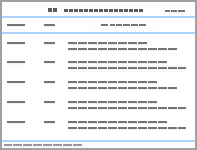
表1
本研究所用6种大孔树脂的物理性质"
| 大孔树脂 Macroporous resins | 极性 Polarity | 颗粒直径 Particle diameter (mm) | 水分含量 Water content (%) | 比表面积 Specific surface area (m2·g-1) | 平均孔径 Average pore diameter (A°) | 孔隙率 Porosity rate (%) |
|---|---|---|---|---|---|---|
| NKA-9 | 强极性 Strong polarity | 0.3—1.25 | 65—75 | 500—550 | 100—120 | 55 |
| DM301 | 半极性 Semi-polarity | 0.3—1.25 | 65—75 | 500—550 | 100—120 | 55 |
| DM130 | 弱极性 Weak polarity | 0.3—1.25 | 65—75 | 500—550 | 90—100 | 55 |
| AB-8 | 弱极性 Weak polarity | 0.3—1.25 | 65—75 | 480—520 | 130—140 | 46 |
| X-5 | 非极性 Non-polarity | 0.3—1.25 | 65—75 | 500—550 | 55—75 | 55 |
| D101 | 非极性 Non-polarity | 0.3—1.25 | 70.5 | 550—600 | 90—100 | 44 |
表2
单体花色苷的UHPLC-QQQ-MS/MS测定参数"
| 简写 Abbreviation | 花色苷全名 Full name of anthocyanins | 母离子 [M+H]+ | 碎片离子 MS/MS (m/z) |
|---|---|---|---|
| P3CCD5MG | 天竺葵素-3-(咖啡酰)(咖啡酰)二葡萄糖苷-5-(丙二酰)葡萄糖苷 Pelargonidin-3-(caffeoyl)(caffeoyl) diglucoside-5-(malonyl) glucoside | 1167 | 919; 519; 271 |
| P3CCD5G | 天竺葵素-3-(咖啡酰)(咖啡酰)二葡萄糖苷-5-葡萄糖苷 Pelargonidin-3-(caffeoyl)(caffeoyl) diglucoside-5-glucoside | 1081 | 919; 433; 271 |
| P3CFD5G | 天竺葵素-3-(咖啡酰)(阿魏酰)二葡萄糖苷-5-葡萄糖苷 Pelargonidin-3-(caffeoyl)(feruloyl) diglucoside-5-glucoside | 1095 | 933; 433; 271 |
| P3CD5MG | 天竺葵素-3-(咖啡酰)二葡萄糖苷-5-(丙二酰)葡萄糖苷 Pelargonidin-3-(caffeoyl) diglucoside-5-(malonyl) glucoside | 1005 | 757; 519; 271 |
| P3CD5G | 天竺葵素-3-(咖啡酰)二葡萄糖苷-5-葡萄糖苷 Pelargonidin-3-(caffeoyl) diglucoside-5-glucoside | 919 | 757; 595; 271 |
| P3FCD5MG | 天竺葵素-3-(阿魏酰)(阿魏酰)二葡萄糖苷-5-(丙二酰)葡萄糖苷 Pelargonidin-3-(feruloyl)(caffeoyl) diglucoside-5-(malonyl) glucoside | 1181 | 933; 771; 519; 271 |
| P3FFD5MG | 天竺葵素-3-(阿魏酰)(阿魏酰)二葡萄糖苷-5-(丙二酰)葡萄糖苷 Pelargonidin-3-(feruloyl)(feruloyl)diglucoside-5-(malonyl) glucoside | 1195 | 947; 519; 271 |
| P3FFD5G | 天竺葵素-3-(阿魏酰)(阿魏酰)二葡萄糖苷-5-葡萄糖苷 Pelargonidin-3-(feruloyl)(feruloyl) diglucoside-5-glucoside | 1109 | 947; 433; 271 |
| P3FD5MG | 天竺葵素-3-(阿魏酰)二葡萄糖苷-5-(丙二酰)葡萄糖苷 Pelargonidin-3-(feruloyl) diglucoside-5-(malonyl) glucoside | 1019 | 771; 519; 271 |
| P3FD5G | 天竺葵素-3-(咖啡酰)二葡萄糖苷-5-葡萄糖苷 Pelargonidin-3-(feruloyl)diglucoside-5-glucoside | 933 | 771; 433; 271 |
| P3PCD5MG | 天竺葵素-3-(对香豆酰)(咖啡酰)二葡萄糖苷-5-(丙二酰)葡萄糖苷 Pelargonidin-3-(p-coumaroyl)(caffeoyl) diglucoside-5-(malonyl) glucoside | 1151 | 903; 519; 271 |
| P3PCD5G | 天竺葵素-3-(对香豆酰)(咖啡酰)二葡萄糖苷-5-葡萄糖苷 Pelargonidin-3-(p-coumaroyl)(caffeoyl) diglucoside-5-glucoside | 1065 | 903; 433; 271 |
| P3PFD5MG | 天竺葵素-3-(对香豆酰)( 阿魏酰)二葡萄糖苷-5-(丙二酰)葡萄糖苷Pelargonidin-3-(p-coumaroyl)(feruloyl) diglucoside-5-(malonyl) glucoside | 1165 | 917; 519; 271 |
| P3PFD5G | 天竺葵素-3-(对香豆酰)(咖啡酰)二葡萄糖苷-5-葡萄糖苷 Pelargonidin-3-(p-coumaroyl)(feruloyl) diglucoside-5-glucoside | 1079 | 917; 433; 271 |
| P3PPD5MG | 天竺葵素-3-(对香豆酰)(对香豆酰)二葡萄糖苷-5-(丙二酰)葡萄糖苷 Pelargonidin-3-(p-coumaroyl)(p-coumaroyl) diglucoside-5-(malonyl) glucoside | 1135 | 887; 519; 271 |
| P3PPD5G | 天竺葵素-3-(对香豆酰)(对香豆酰)二葡萄糖苷-5-葡萄糖苷 Pelargonidin-3-(p-coumaroyl)(p-coumaroyl) diglucoside-5-glucoside | 1049 | 877; 433; 271 |
| P3PD5MG | 天竺葵素-3-(对香豆酰)二葡萄糖苷-5-(丙二酰)葡萄糖苷 Pelargonidin-3-(p-coumaroyl) diglucoside-5-(malonyl) glucoside | 989 | 741; 519; 271 |
| P3PD5G | 天竺葵素-3-(对香豆酰) 二葡萄糖苷-5-葡萄糖苷 Pelargonidin-3-(p-coumaroyl) diglucoside-5-glucoside | 903 | 741; 433; 271 |
| P3D5MG | 天竺葵素-3-二葡萄糖苷-5-(丙二酰)葡萄糖苷Pelargonidin-3-diglucoside-5-(malonyl) glucoside | 843 | 595; 519; 271 |
| P3D5G | 天竺葵素-3-二葡萄糖苷-5-葡萄糖苷 Pelargonidin-3-diglucoside-5-glucoside | 757 | 595; 433; 271 |
| P3G | 天竺葵素-3-葡萄糖苷 Pelargonidin-3-glucoside | 433 | 271 |
| P3G5G | 天竺葵素-3-葡萄糖苷-5-葡萄糖苷 Pelargonidin-3-glucoside-5-glucoside | 595 | 433; 271 |
表3
6种大孔树脂对胭脂萝卜花色苷的吸附和解吸容量及回收率"
| 大孔树脂 Macroporous resin | 吸附能力 Adsorption capacity (mg·g-1) | 吸附率 Adsorption ratio (%) | 解吸能力 Desorption capacity (mg·g-1) | 解吸率 Desorption ratio (%) | 回收率 Recovery ratio (%) |
|---|---|---|---|---|---|
| NKA-8 | 5.27±0.31b | 85.28±0.23d | 2.98±0.66b | 71.59±18.43a | 61.03±15.55b |
| DM301 | 5.73±0.37ab | 90.91±0.51b | 3.11±0.27b | 69.67±7.72b | 63.31±6.70b |
| DM130 | 5.53±0.32ab | 88.50±1.24c | 3.24±0.59ab | 73.94±10.36a | 65.40±8.72ab |
| AB-8 | 5.80±0.32ab | 91.79±1.19ab | 3.59±0.21ab | 78.93±5.29a | 72.49±5.60ab |
| X-5 | 5.88±0.35a | 92.79±0.19a | 4.05±0.19a | 87.49±7.18a | 81.17±6.51a |
| D101 | 5.90±0.29a | 93.00±0.82a | 3.83±0.79ab | 82.11±13.24a | 76.34±12.21ab |
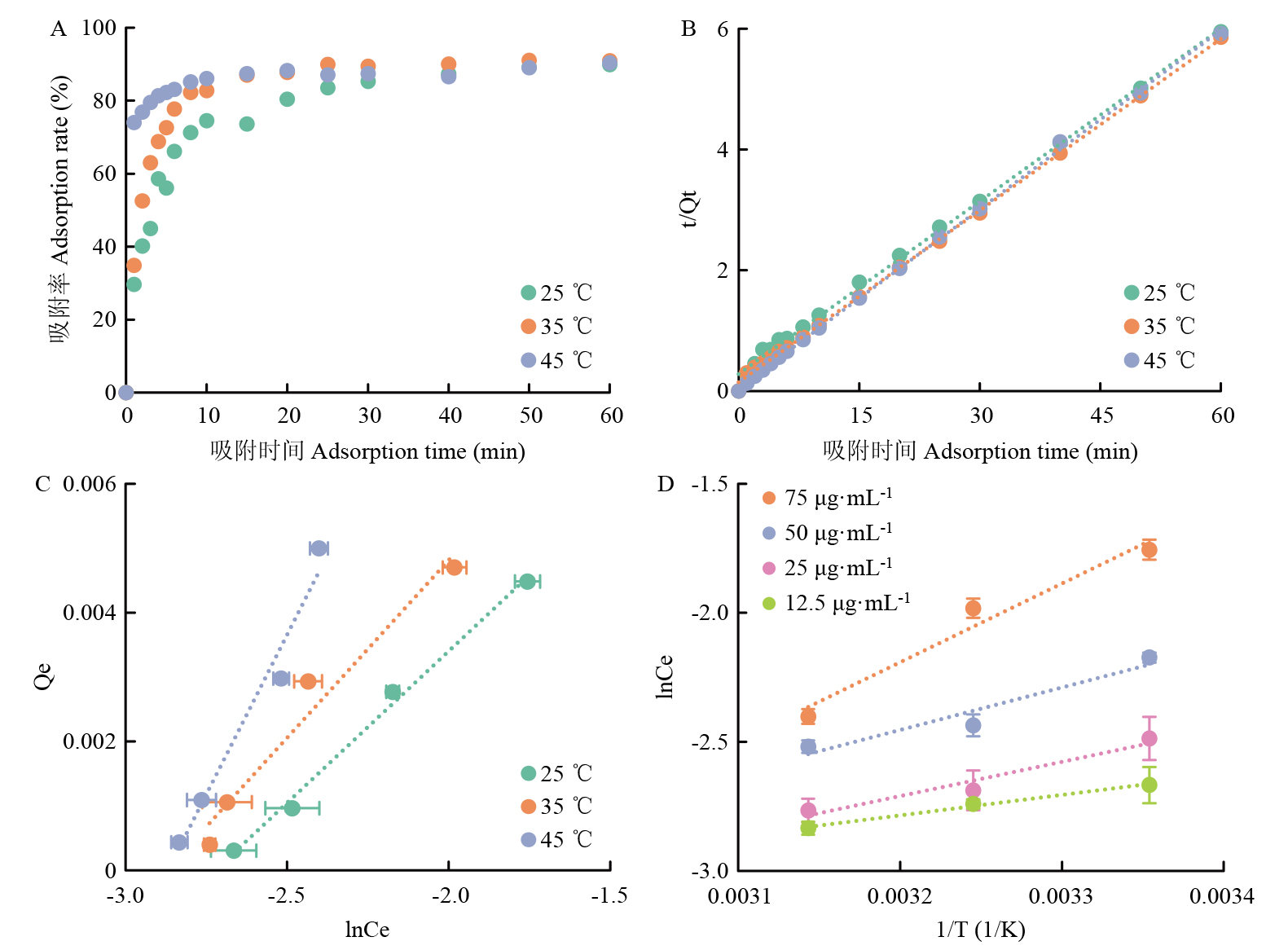
图1
X-5大孔树脂吸附胭脂萝卜花色苷的吸附动力学和吸附等温线模型 A:吸附动力学曲线;B:伪一级动力学拟合方程;C:描述X-5吸附胭脂萝卜花色苷的朗缪尔模型;D:X-5吸附胭脂萝卜花色苷的热力学曲线"
表4
模型拟合X-5大孔树脂吸附胭脂萝卜花色苷动力学参数"
| 温度 Temperature (℃) | 模型 Model | |||||
|---|---|---|---|---|---|---|
| In-particle diffusion (IPD) | Pseudo-second-order kinetic (PSOK) | Pseudo-first-order kinetic (PFOK) | ||||
| R2 | R2 | R2 | 方程 Equation | K1 (g·mg-1·min-1) | Qe (mg·g·resins-1) | |
| 25 | 0.8262 | 0.9737 | 0.9991 | y=0.0954x+0.2832 | 0.032 | 10.48 |
| 35 | 0.6750 | 0.9452 | 0.9997 | y=0.0948x+0.1467 | 0.061 | 10.55 |
| 45 | 0.3918 | 0.7546 | 0.9995 | y=0.0987x+0.0544 | 0.179 | 10.13 |
表5
X-5大孔树脂吸附胭脂萝卜花色苷的吸附等温线模型拟合"
| 温度 Temperature (℃) | 模型 Model | |||||
|---|---|---|---|---|---|---|
| Freundlich | Langmuir | Temkin | ||||
| R2 | R2 | R2 | 方程 Equation | KT (L·mg-1) | BT (J·mol-1) | |
| 25 | 0.8786 | 0.4421 | 0.9181 | Qe=0.0047lnCe+0.0128 | 15.23 | 0.0047 |
| 35 | 0.7865 | 0.3200 | 0.9742 | Qe=0.0055lnCe+0.0158 | 17.69 | 0.0055 |
| 45 | 0.7535 | 0.3427 | 0.9970 | Qe=0.0099lnCe+0.0285 | 17.79 | 0.0099 |
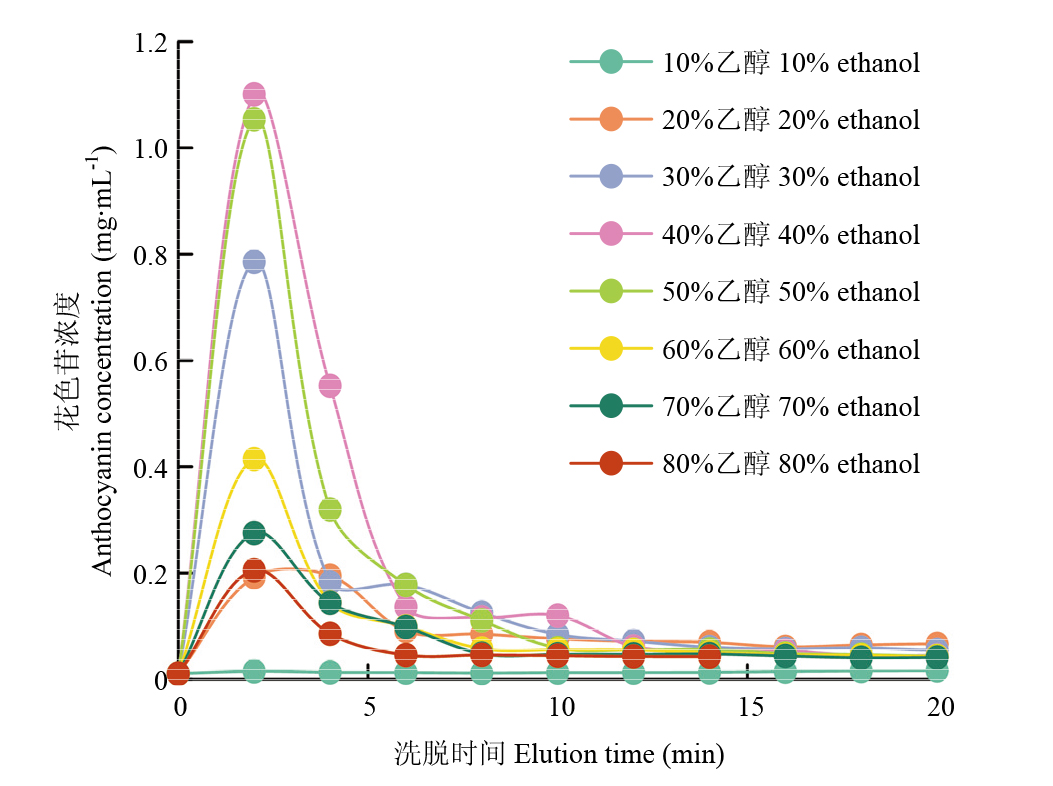
图2
不同浓度乙醇溶液从X-5大孔树脂解吸胭脂萝卜花色苷"
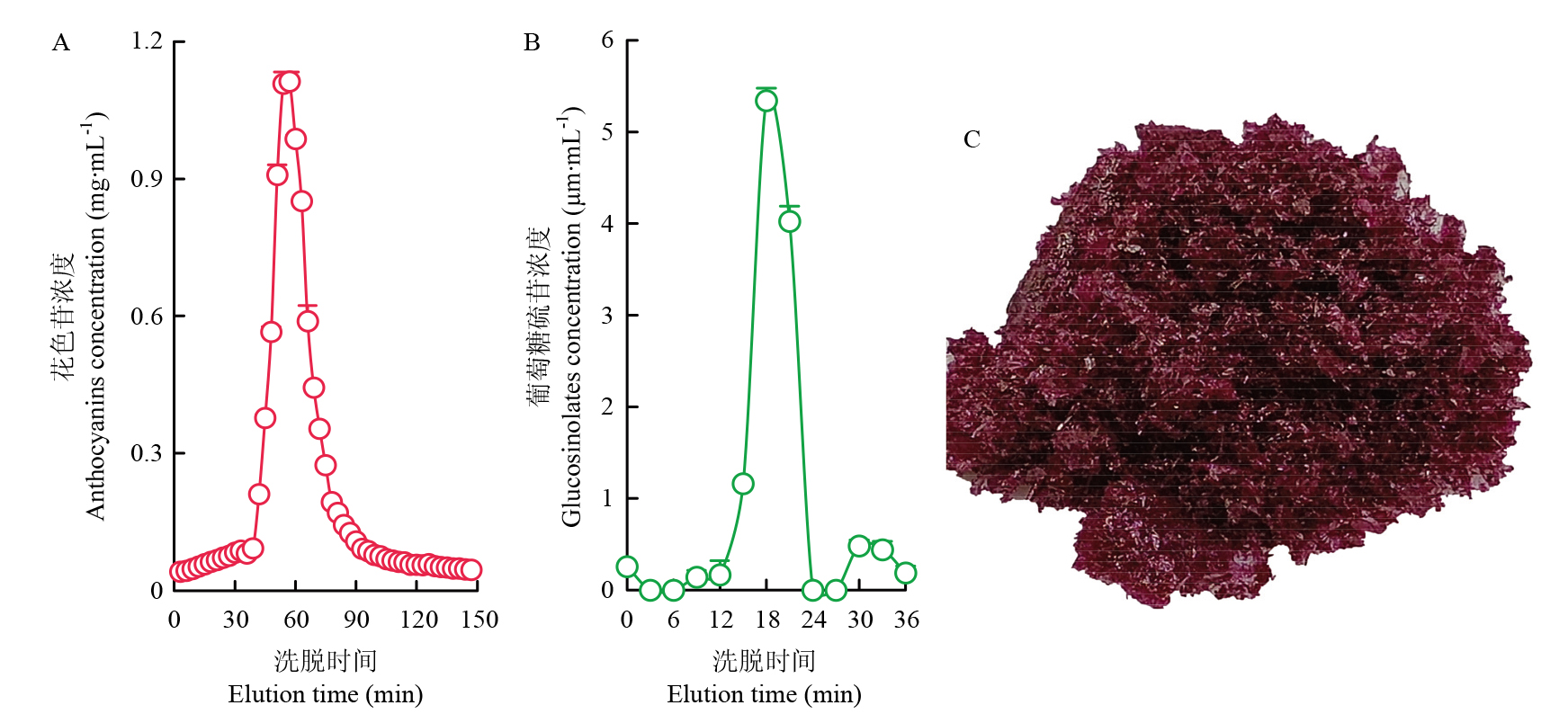
图3
葡聚糖凝胶纯化胭脂萝卜花色苷洗脱曲线与产物 A:从葡聚糖凝胶柱洗脱花色苷曲线;B:从葡聚糖凝胶柱洗脱葡萄糖硫苷曲线;C:X-5大孔树脂与葡聚糖凝胶纯化胭脂萝卜花色苷照片"
表6
提取物中单体花色苷含量"
| 花色苷名称 Name of anthocyanins | 粗提物 Crude extract | X-5纯化 Purified by X-5 | X-5和葡聚糖凝胶纯化 Purified by X-5 and dextran gel |
|---|---|---|---|
| P3FD5MG | 139.42±11.14 | 121.98±1.05 | 76.47±2.95**# |
| P3CD5MG | 71.98±0.73 | 58.71±1.72** | 21.28±1.29**# |
| P3FD5G | 59.13±5.76 | 65.52±4.75 | 19.64±1.25**# |
| P3CD5G | 45.81±2.68 | 56.32±1.67** | 6.21±0.31**# |
| P3FFD5MG | 37.62±0.71 | 30.50±1.31** | 11.54±0.38**# |
| P3PD5MG | 33.25±1.31 | 31.83±0.53 | 21.68±1.57**# |
| P3PD5G | 26.51±0.43 | 37.08±2.49** | 9.08±0.95**# |
| P3D5G | 26.9±4.34 | 30.54±3.35 | 13.53±1.30**# |
| P3D5MG | 12.6±0.55 | 12.15±0.10 | 3.92±0.23**# |
| P3CCD5MG | 9.52±0.48 | 7.35±0.12** | 3.08±0.17**# |
| P3PFD5MG | 9.88±0.44 | 9.94±0.27 | 4.66±0.21**# |
| P3FCD5MG | 9.49±0.10 | 9.50±0.83 | 4.51±0.31**# |
| P3CFD5G | 5.47±0.63 | 16.44±0.8** | 2.03±0.15**# |
| P3FFD5G | 4.25±0.03 | 7.35±0.67** | 1.81±0.14**# |
| P3PCD5MG | 3.90±0.25 | 3.37±0.03* | 2.18±0.06**# |
| P3CCD5G | 2.09±0.21 | 10.77±0.35** | 1.26±0.02**# |
| P3PFD5G | 1.73±0.08 | 4.00±0.13** | 0.95±0.03**# |
| P3PCD5G | 1.07±0.11 | 3.18±0.09** | 0.70±0.03**# |
| P3PPD5MG | 1.11±0.04 | 1.02±0.04* | 0.81±0.02**# |
| P3G5G | 0.73±0.12 | 1.20±0.15* | 0.44±0.04*# |
| P3G | 0.62±0.04 | 0.71±0.06 | 0.42±0.00**# |
| P3PPD5G | 0.58±0.03 | 0.90±0.09** | 0.46±0.03**# |
| 多酰化花色苷 Polyacylated anthocyanins | 331.34±11.70 | 316.82±1.28 | 153.42±1.41**# |
| 单酰化花色苷 Monoacylated anthocyanins | 144.06±5.87 | 171.08±8.25** | 38.85±2.08**# |
| 非酰化花色苷 Non-acetylated anthocyanins | 28.25±4.27 | 32.45±3.52 | 14.38±1.28**# |
| 花色苷总量 Total anthocyanin content | 503.65±10.58 | 520.35±6.73 | 206.65±2.22**# |
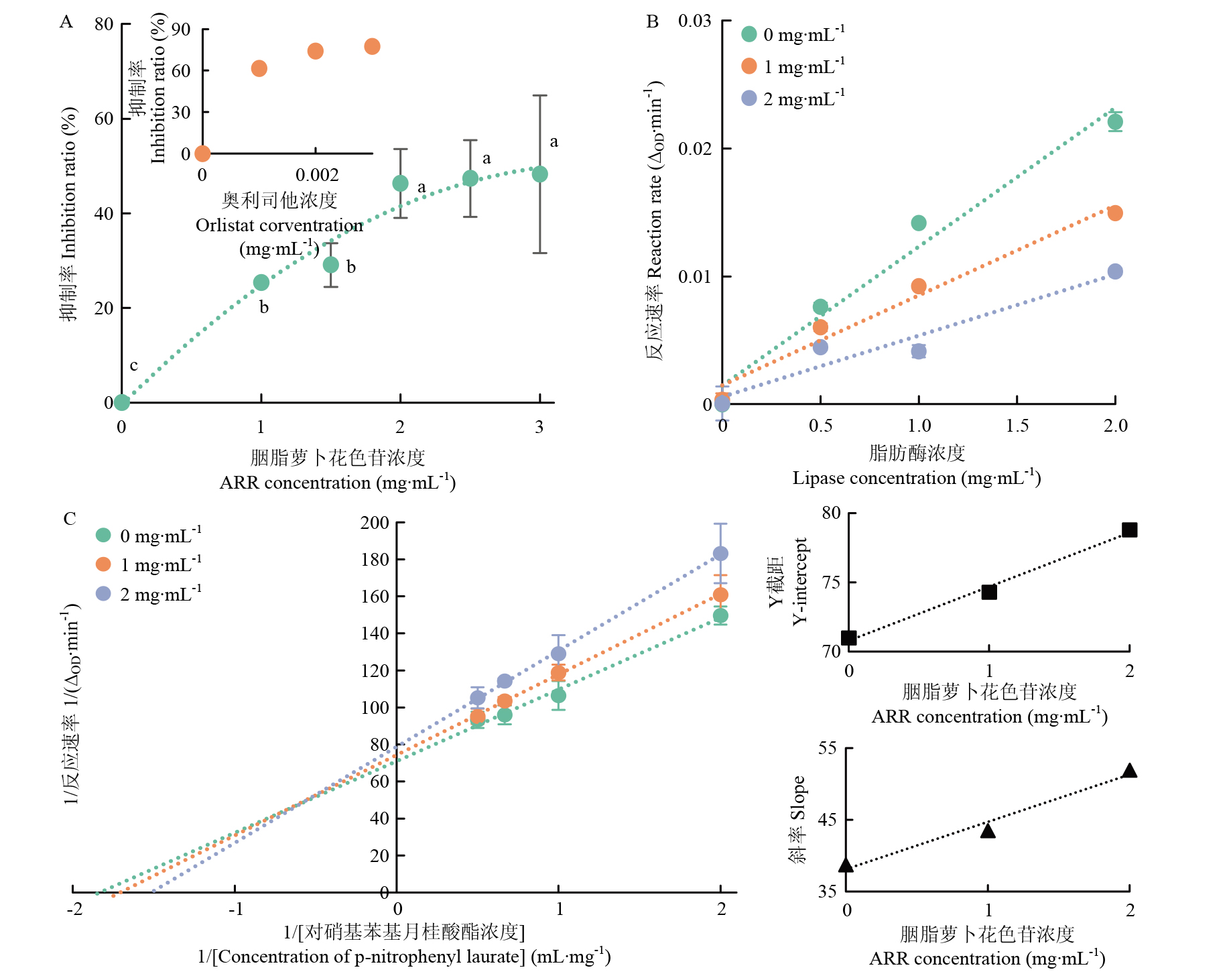
图4
胭脂萝卜酰化花色苷对脂肪酶的抑制活性 A:不同浓度胭脂萝卜花色苷和奥利司他对脂肪酶的抑制率;B:不同浓度胭脂萝卜花色苷对脂肪酶催化速率的影响;C:胭脂萝卜花色苷对脂肪酶抑制作用的Lineweaver-Burk图"
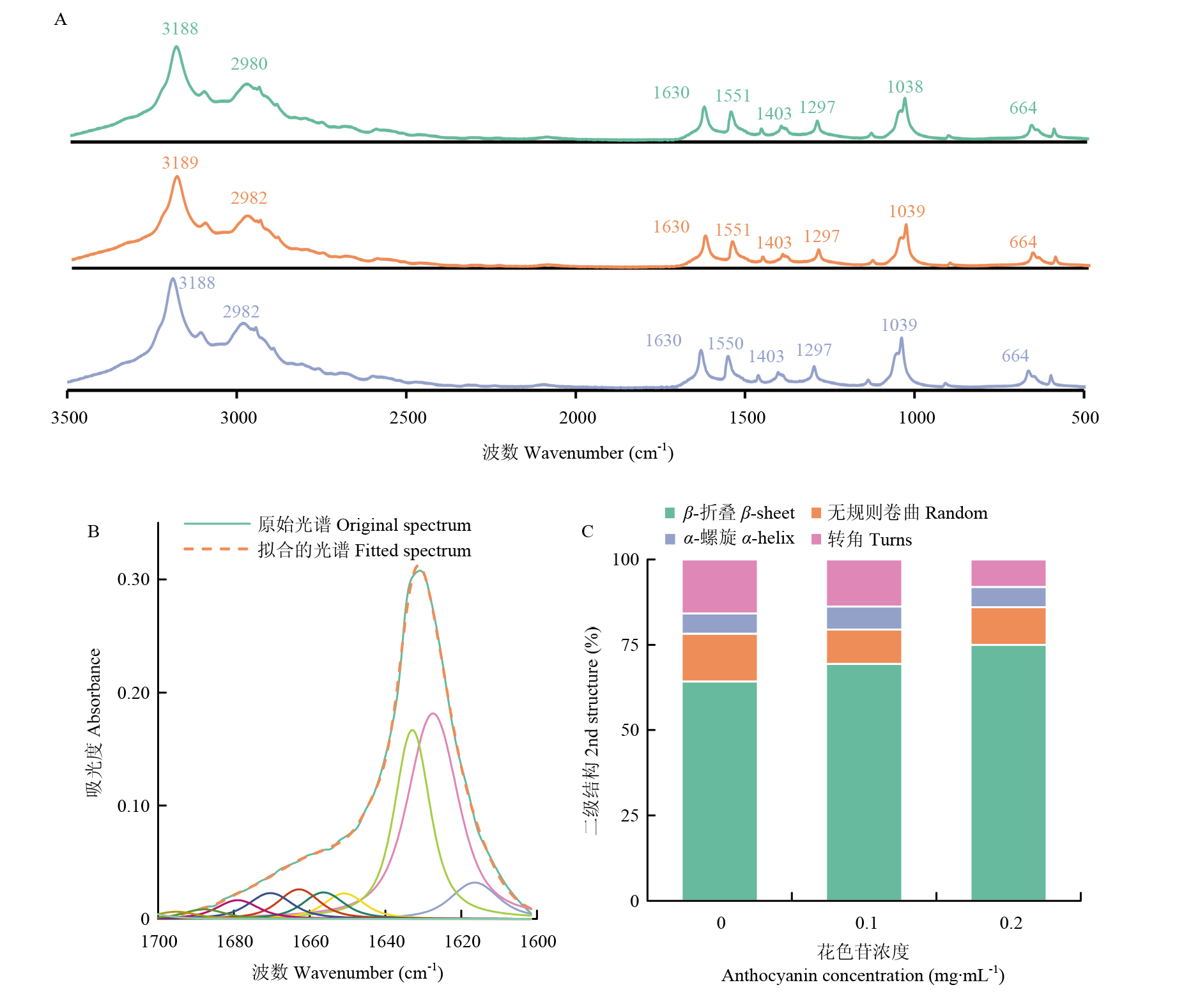
图5
胭脂萝卜花色苷改变脂肪酶近红外光谱与二级结构 A:胭脂萝卜花色苷对脂肪酶近红外光谱的影响;B:拟合波数1600—1700 cm-1的胭脂萝卜花色苷与脂肪酶近红外光谱;C:胭脂萝卜花色苷改变脂肪酶二级结构"
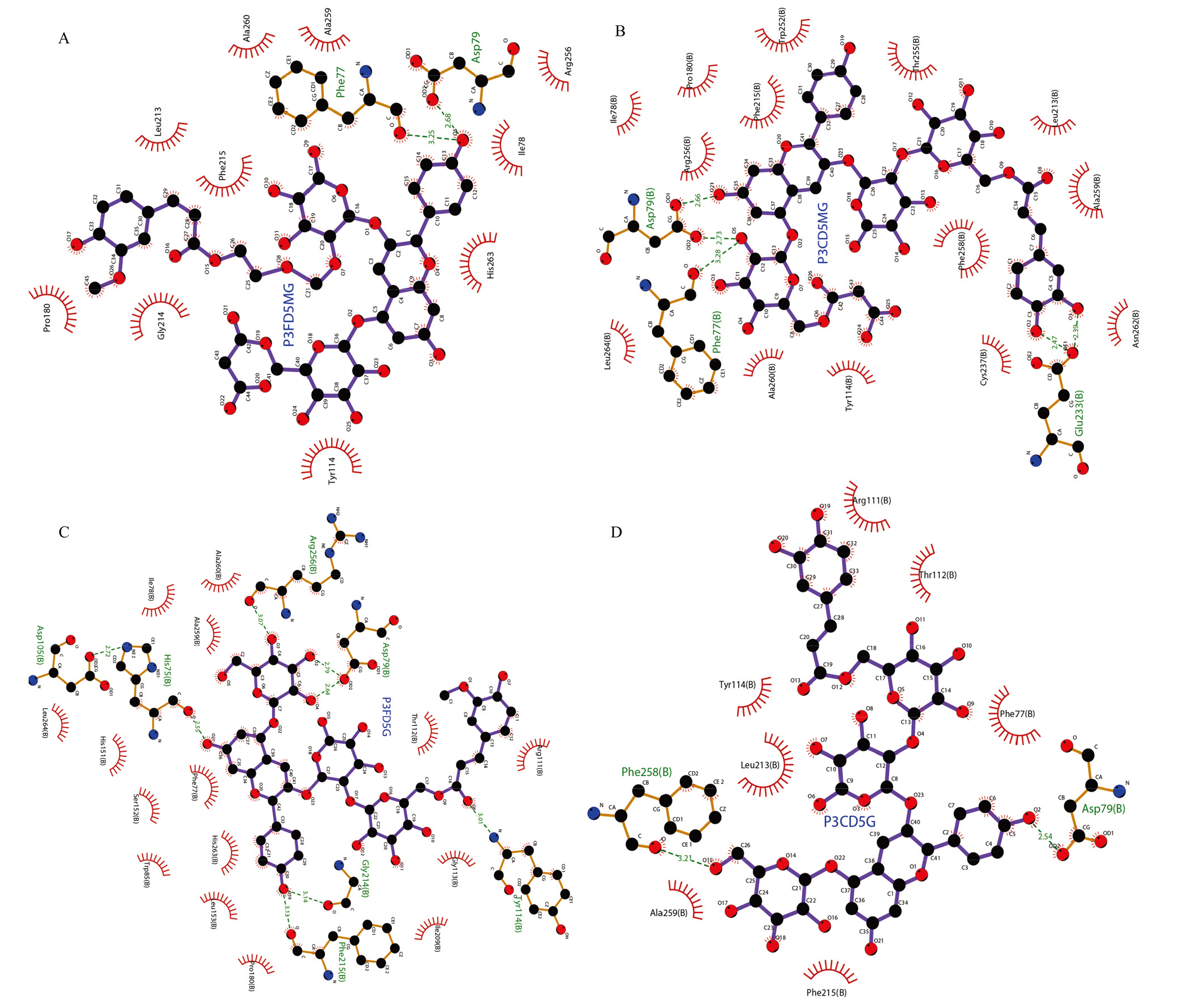
图6
4种胭脂萝卜主要花色苷对接到脂肪酶的计算机模拟 A:P3FD5MG对接脂肪酶;B:P3CD5MG对接脂肪酶;C:P3FD5G对接脂肪酶;D:P3CD5G对接脂肪酶"
表7
胭脂萝卜主要花色苷与脂肪酶分子动力学模拟能量"
| 能量 Energy (kJ·mol-1) | 花色苷Anthocyanin | |||
|---|---|---|---|---|
| P3FD5MG | P3FD5G | P3CD5MG | P3CD5G | |
| 范德华能 van der Waal energy | 4327.38±101.75 | -281.45±17.18 | -276.44±29.15 | -235.08±29.81 |
| 静电能 Electrostattic energy | -269.99±33.29 | -302.10±21.13 | -332.55±32.62 | -246.73±31.25 |
| 极性溶剂化能 Polar solvation energy | 268.80±38.32 | 268.30±21.33 | 336.19±44.01 | 209.25±37.31 |
| 溶剂可及表面积能 Solvent-accessible surface area energy | -32.57±1.98 | -29.33±1.80 | -32.22±2.39 | -27.02±3.28 |
| 结合能 Binding energy | 4293.61±99.79 | -344.58±21.30 | -305.03±29.25 | -299.58±26.78 |
| [1] |
|
| [2] |
郭子雨, 姚雨含, 刘涛, 赵军. 植物来源的胰脂肪酶抑制剂研究进展[J]. 食品研究与开发, 2021, 42(8): 212-217.
|
|
|
|
| [3] |
|
| [4] |
|
| [5] |
|
| [6] |
doi: 10.1002/jsfa.7708 pmid: 26970531 |
| [7] |
|
| [8] |
|
| [9] |
董楠, 宋会歌, 刘嘉, 赵国华. 咖啡酸对胭脂萝卜红色素辅色作用及稳定性的影响[J]. 食品科学, 2011, 32(7): 61-64.
doi: 10.7506/spkx1002-6630-201107014 |
|
|
|
| [10] |
|
| [11] |
|
| [12] |
|
| [13] |
邓仕彬, 林国荣, 林授锴, 潘梦柔. 去异味萝卜红色素提取工艺[J]. 食品工业, 2021, 42(3): 88-93.
|
|
|
|
| [14] |
|
| [15] |
|
| [16] |
|
| [17] |
|
| [18] |
|
| [19] |
|
| [20] |
|
| [21] |
|
| [22] |
|
| [23] |
|
| [24] |
doi: 10.1016/j.foodchem.2015.08.084 pmid: 26471611 |
| [25] |
|
| [26] |
doi: 10.1016/j.foodchem.2015.08.070 pmid: 26471633 |
| [27] |
|
| [28] |
|
| [29] |
|
| [30] |
杨同舟, 于殿宇. 食品工程原理[M]. 2版. 北京: 中国农业出版社, 2011: 321.
|
|
|
|
| [31] |
doi: 10.1016/j.foodchem.2014.07.109 pmid: 25172745 |
| [32] |
|
| [33] |
|
| [34] |
doi: 10.1021/jf200824c pmid: 21548630 |
| [35] |
|
| [36] |
|
| [37] |
doi: 10.1021/jf201452v pmid: 21797278 |
| [38] |
张萌萌, 王婧, 曹文红, 周龙建, 谭明堂, 朱国萍, 高加龙, 林海生, 郑惠娜, 陈忠琴. 牡蛎肽和花色苷协同抑制胰脂肪酶的作用研究[J]. 食品与发酵工业, 2025, 51(5): 140-149.
doi: 10.13995/j.cnki.11-1802/ts.041162 |
|
|
|
| [39] |
|
| [40] |
张静, 米佳, 禄璐, 罗青, 闫亚美, 冉林武, 金波, 曹有龙. 黑果枸杞花色苷提取物对胰脂肪酶活性的影响[J]. 食品科学, 2020, 41(5): 8-14.
doi: 10.7506/spkx1002-6630-20190620-234 |
|
|
|
| [41] |
pmid: 7893686 |
| [1] | 陈龙云, 胡俊强, 何灿, 史建荣, 徐剑宏, 王刚. 利用大孔吸附树脂与高速逆流色谱纯化脱氧雪腐镰刀菌烯醇-3-葡萄糖苷[J]. 中国农业科学, 2025, 58(8): 1627-1637. |
| [2] | 李帅兵, 李晨欣, 任丽, 于晓娜, 耿赛男, 盛开, 张银杰, 王宜伦. 种植大豆促进后茬小麦磷吸收和土壤磷形态转化[J]. 中国农业科学, 2025, 58(19): 3932-3945. |
| [3] | 郭斗斗, 张珂珂, 黄绍敏, 宋晓, 张水清, 岳克, 丁世杰, 郭腾飞. 长期不同施肥对潮土磷吸附解吸特性的影响[J]. 中国农业科学, 2025, 58(14): 2805-2820. |
| [4] | 路力榕, 姚晓琳, 李丹, 韦湘滢, 岳娟, 伊高阳. 不同形貌固体颗粒在Pickering乳液界面吸附特性的研究进展[J]. 中国农业科学, 2024, 57(17): 3469-3481. |
| [5] | 范鑫, 李宇鑫, 邝吉卫, 杨婷, 刘苗苗, 曹云刚, 黄峻榕. 超声辅助玉米醇溶蛋白基乙烯吸附膜的制备及其香蕉保鲜性能[J]. 中国农业科学, 2023, 56(8): 1574-1584. |
| [6] | 郭雨晨, 董铭, 曾宪明, 田惠鑫, 尹家琪, 侯钰柯, 白云, 唐长波, 韩敏义, 徐幸莲. 分子动力学模拟解析脉冲电场对类PSE鸡肉肌球蛋白凝胶特性作用规律[J]. 中国农业科学, 2023, 56(4): 741-753. |
| [7] | 邵小龙,徐文,王潇,杨晓静,沈飞,刘琴. 3种粳稻籽粒水分解吸过程中的裂纹变化[J]. 中国农业科学, 2022, 55(2): 390-402. |
| [8] | 魏天,王成宇,王凤杰,李忠鹏,张芳毓,张守峰,扈荣良,吕礼良,王永志. 非洲猪瘟病毒p30蛋白单克隆抗体制备及线性抗原表位定位[J]. 中国农业科学, 2022, 55(15): 3062-3070. |
| [9] | 李镇希,李文婷,黄家权,郑正,许美容,邓晓玲. 膜吸附法结合可视化环介导等温扩增技术检测柑橘黄龙病菌[J]. 中国农业科学, 2022, 55(1): 74-84. |
| [10] | 景建元,袁亮,张水勤,李燕婷,赵秉强. 腐殖酸磷肥中的腐殖酸对磷迁移的影响及机理[J]. 中国农业科学, 2021, 54(23): 5032-5042. |
| [11] | 黄丽波,王金全,高文博,陈红菊,侯衍猛,袁学军,王春阳. 玉米赤霉烯酮吸附剂对后备母猪子宫中LC3、PCNA分布和表达的影响[J]. 中国农业科学, 2021, 54(18): 4008-4017. |
| [12] | 王琼,展晓莹,张淑香,彭畅,高洪军,张秀芝,朱平,GILLES Colinet. 长期不同施肥处理黑土磷的吸附-解吸特征及 对土壤性质的响应[J]. 中国农业科学, 2019, 52(21): 3866-3877. |
| [13] | 尹彩霞, 于少雄, 宋琨, 李素, 杨玉莹, 仇华吉. E2蛋白介导猪瘟病毒的细胞吸附与内化[J]. 中国农业科学, 2018, 51(10): 1995-2003. |
| [14] | 李平,Magzum Nurolla,梁志杰,黄仲冬,齐学斌. 渠井用水比例对土壤脱盐与地下水化学特征的影响[J]. 中国农业科学, 2017, 50(3): 526-536. |
| [15] | 童 鑫,张瑞芬,邓媛元,肖 娟,刘 磊,张 雁,魏振承,张名位. 米糠酚类物质的大孔树脂分离纯化工艺[J]. 中国农业科学, 2016, 49(19): 3818-3830. |
|
||
