






中国农业科学 ›› 2026, Vol. 59 ›› Issue (16): 3687-3698.doi: 10.3864/j.issn.0578-1752.2026.16.015
• 畜牧·兽医 • 上一篇
楚洪恩1( ), 刘源1, 白雪1, 杨梦丽1, 刘涛1, 李芬2, 李兰兰1(), 马云1()
收稿日期:2025-10-27
接受日期:2026-06-04
出版日期:2026-08-16
发布日期:2026-08-17
通信作者:
联系方式:
楚洪恩,Tel:18749831533;E-mail:chuhongen0601@163.com。
基金资助:
CHU HongEn1(), LIU Yuan1, BAI Xue1, YANG MengLi1, LIU Tao1, LI Fen2, LI LanLan1(), MA Yun1()
Received:2025-10-27
Accepted:2026-06-04
Published:2026-08-16
Online:2026-08-17
摘要:
【目的】 牛作为反刍动物,肌肉生长发育周期长,但在牛背最长肌发育过程中,染色质可及性的调控机制尚未明确。通过探究安格斯牛和西门塔尔牛背最长肌中染色质可及性的差异,筛选影响牛肌肉生长的关键转录因子,进而构建TF-gene调控网络,为深入研究牛肌肉发育的表观遗传调控机制提供理论依据和新的分子靶点。【方法】 采集饲养管理方式相同的24月龄安格斯牛和西门塔尔牛各3头的背最长肌组织,依据国家标准《食品中氨基酸的测定》(GB 5009.124-2016)进行氨基酸含量检测,利用SPSS 9.4软件通过t检验进行组间背最长肌氨基酸含量差异显著性分析;并将采集的背最长肌组织进行ATAC-seq测序,通过识别染色质开放区(peak),进行组间差异peak分析、GO/KEGG功能富集分析、转录因子结合位点(motif)富集分析;并结合前期的RNA-seq测序得到的差异表达基因(DEGs),基于GTRD数据库与基迪奥云平台构建转录因子-基因(TF-gene)调控网络。【结果】 结果表明:(1)AGS组背最长肌中赖氨酸(Lys)、丝氨酸(Ser)、精氨酸(Arg)、组氨酸(His)、谷氨酸(Glu)含量显著高于XM组(P<0.05);而脯氨酸(Pro)含量则相反(P<0.05),说明氨基酸代谢表型在两组间显著差异;(2)染色质可及性在两组间整体保守,共检测到安格斯牛29 140个peak,西门塔尔牛28 781个peak,两组间染色质开放区域主要分布在转录起始位点(TSS)±2 kb,且在内含子区、远端基因间区和启动子区占比超过84.57%。(3)在两组间鉴定出6 185个差异peak,其中5 030个上调,1 155个下调,将差异peak注释到相关基因后,进行GO/KEGG富集分析发现,差异peak相关基因主要富集在解剖结构形态发生、肌肉结构发育、肌动蛋白丝介导过程、Hippo信号通路、MAPK信号通路、钙信号通路、肌动蛋白细胞骨架调控等经典肌肉发育相关通路。(4)Motif富集分析显示,在显著富集的前20个转录因子结合基序中,排名前4位均属于MEF2转录家族,分别是MEF2C、MEF2A、MEF2D与MEF2B;进一步聚焦AGS特异性peak和前期RNA-seq测序得到的差异表达基因交集分析,发现MEF2B与MEF2D结合位点富集程度最高,成功构建以MEF2B与MEF2D为核心转录因子的TF-gene调控网络,共筛选到ACTA1、CKM、CLCN1、SLN、MYOZ3等13个参与肌肉发育调控的靶基因;并利用IGV可视化证实上述靶基因启动子区存在MEF2B和MEF2D结合基序,并与ATAC-seq开放区域高度重合。【结论】 本研究通过ATAC-seq和RNA-seq数据联合分析,揭示了安格斯牛和西门塔尔牛在背最长肌发育过程中的染色质可及性差异,并筛选到MEF2B和MEF2D作为调控牛肌肉生长的关键转录因子(TFs),构建以MEF2B与MEF2D为核心转录因子的TF-gene调控网络,为深入解析肉牛肌肉发育表观遗传机制及CRISPR-Cas9功能验证提供了理论基础。
楚洪恩, 刘源, 白雪, 杨梦丽, 刘涛, 李芬, 李兰兰, 马云. 基于ATAC-seq筛选调控肉牛肌肉发育的关键转录因子[J]. 中国农业科学, 2026, 59(16): 3687-3698.
CHU HongEn, LIU Yuan, BAI Xue, YANG MengLi, LIU Tao, LI Fen, LI LanLan, MA Yun. The Key Transcription Factors Regulating Beef Cattle Muscle Development Screened by ATAC-seq[J]. Scientia Agricultura Sinica, 2026, 59(16): 3687-3698.

表1
各组背最长肌氨基酸含量统计"
| 必需氨基酸 EAA(μg·g-1 FW) | 安格斯牛 AGS | 西门塔尔牛 XM | 非必需氨基酸 NEAA(μg·g-1 FW) | 安格斯牛 AGS | 西门塔尔牛 XM | |
|---|---|---|---|---|---|---|
| 甲硫氨酸Met | 10.89±1.85 | 9.49±0.22 | 甘氨酸Gly | 77.44±2.88 | 70.17±7.14 | |
| 赖氨酸Lys | 68.80±13.04a | 28.12±6.85b | 丙氨酸Ala | 258.28±26.76 | 281.53±24.40 | |
| 苯丙氨酸Phe | 19.67±4.45 | 17.53±1.42 | 丝氨酸Ser | 127.76±3.62a | 95.19±8.68b | |
| 色氨酸Trp | 9.24±0.76 | 6.18±1.29 | 脯氨酸Pro | 38.03±1.44b | 46.59±1.83a | |
| 缬氨酸Val | 35.45±6.92 | 30.50±6.58 | 酪氨酸Tyr | 25.64±3.68 | 22.47±4.76 | |
| 苏氨酸Thr | 37.63±4.74 | 27.88±0.31 | 精氨酸Arg | 82.59±2.36a | 38.97±2.27b | |
| 亮氨酸Leu | 42.08±6.55 | 36.40±0.35 | 组氨酸His | 102.6±2.29a | 46.05±7.47b | |
| 异亮氨酸Ile | 28.54±4.29 | 24.24±2.72 | 天冬氨酸Asp | 7.24±1.1 | 5.85±0.91 | |
| 谷氨酸Glu | 94.63±3.33a | 34.67±3.46b |
表2
ATAC-seq测序数据统计"
| 样品 Sample | 下机数据碱基总数 Clean date (bp) | 过滤后有效碱基总数 HQ clean date (bp) | 唯一比对的reads数目 Unique mapped reads | 唯一比对的reads比例 Unique mapped rate (%) |
|---|---|---|---|---|
| AGS-1 | 14541584400 | 10980107923 | 65580095 | 67.92 |
| AGS-2 | 14919508800 | 11321472992 | 66649331 | 67.33 |
| AGS-3 | 16304789400 | 12394515837 | 74550934 | 68.88 |
| XM-1 | 17579211000 | 13510839920 | 80089254 | 68.68 |
| XM-2 | 14105058600 | 11076552540 | 63286080 | 67.66 |
| XM-3 | 15497562000 | 11696995991 | 68232416 | 66.33 |
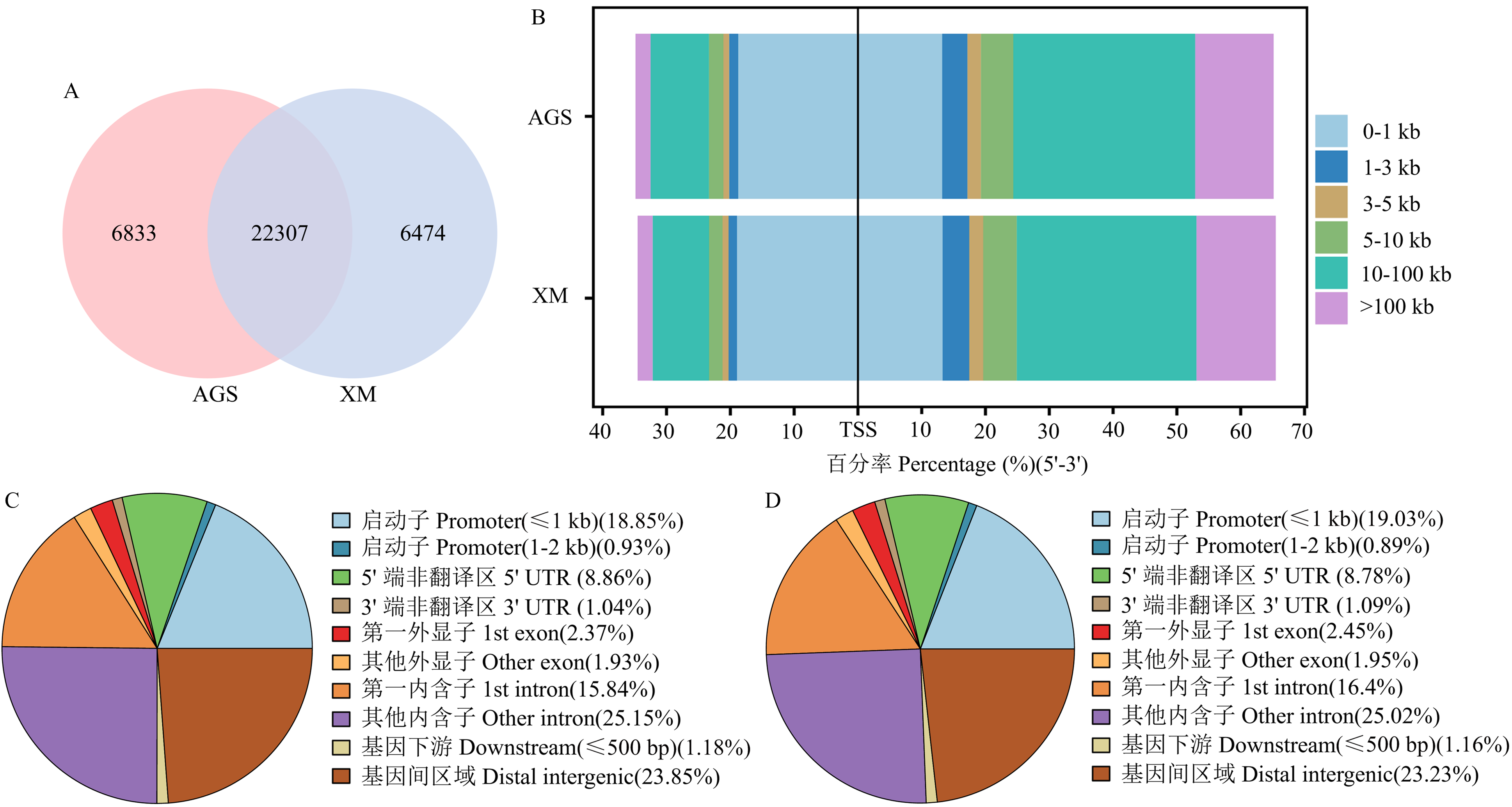
图1
染色质可及性检测 A:AGS VS XM背最长肌染色质开放区扫描;B:AGS VS XM相对TSS距离分布比例图;C:AGS组peak在基因功能元件上分布比例图;D:XM组 peak在基因功能元件上分布比例图"
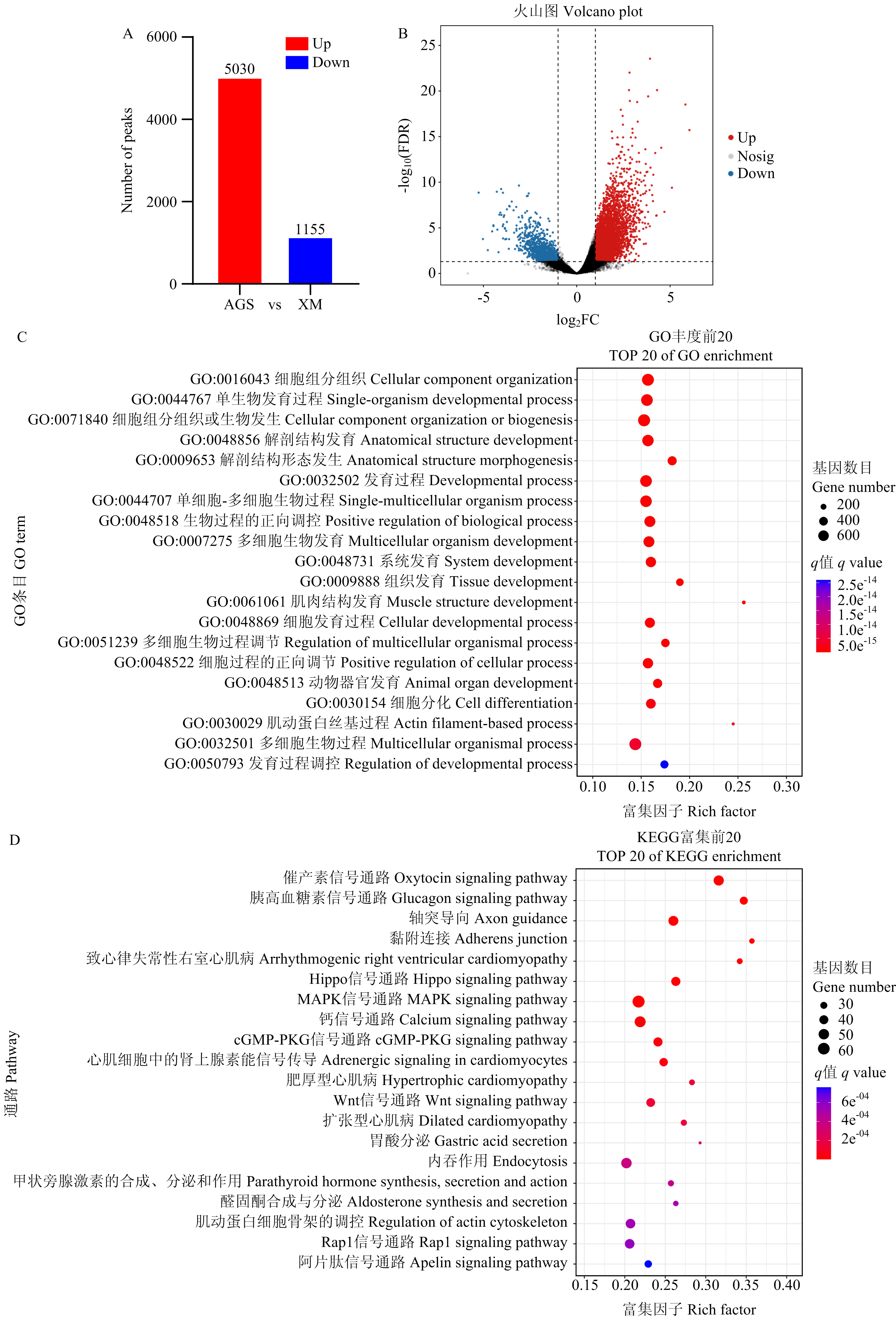
图2
差异peak相关基因富集分析 A:差异peak柱状图;B:差异peak火山图;C:GO功能富集分析;D:KEGG功能富集分析"
表3
组间显著性排序TOP20的motif统计"
| 序号 Rank | 结合基序 Binding motif | 转录因子 TF | E值 E-value | 序号 Rank | 结合基序 Binding motif | 转录因子 TF | E值 E-value | |
|---|---|---|---|---|---|---|---|---|
| 1 | | MEF2C | 3.10e-37 | 11 | | NR2F2 | 1.32e-4 | |
| 2 | | MEF2A | 7.04e-35 | 12 | | Nr1H2 | 1.34e-4 | |
| 3 | | MEF2D | 7.48e-19 | 13 | | SIX1 | 1.60e-4 | |
| 4 | | MEF2B | 2.19e-17 | 14 | | TBP | 1.73e-4 | |
| 5 | | NR4A1 | 3.80e-16 | 15 | | CDX1 | 1.86e-4 | |
| 6 | | NR4A2 | 9.85e-16 | 16 | | PBX2 | 2.28e-4 | |
| 7 | | SIX2 | 3.64e-11 | 17 | | HOXD12 | 2.74e-4 | |
| 8 | | MEIS2 | 3.70E-6 | 18 | | NFIX | 4.56e-4 | |
| 9 | | Hmga1 | 4.75e-6 | 19 | | Ppara | 2.41e-6 | |
| 10 | | Nr1h3 | 5.35e-6 | 20 | | FOXL1 | 7.47e-4 |
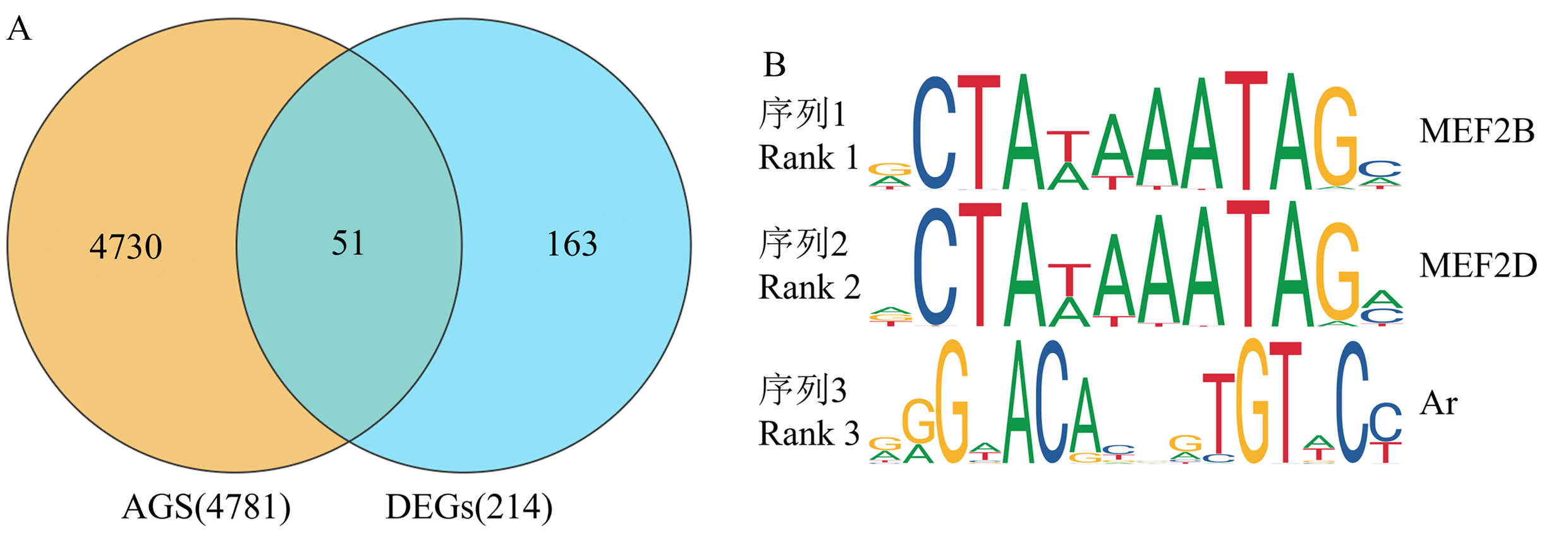
图3
AGS组特有peak与DEGs的联合分析 A:AGS组特有peak与DEGs的韦恩分析;B:AGS vs DEGs重叠基因的motif分析"

图4
牛背最长肌的TF-gene调控网络图及IGV可视化 A:牛背最长肌TF-gene 调控网络图;B:MYOZ3、CLCN1、SLN 和 CKM 基因启动子区MEF2B和MEF2D结合基序可视化"
| [1] |
doi: 10.3390/genes10070539 |
| [2] |
doi: 10.1016/j.psj.2023.102744 |
| [3] |
doi: 10.3390/foods13091316 |
| [4] |
doi: 10.3390/ijms25010158 |
| [5] |
张维, 崔清明, 任慧波, 陈晨, 李华丽, 胡雄贵, 朱吉, 杨仕柳, 李述初, 张四阳, 彭英林, 刘莹莹. 基于转录组学研究宁乡猪肌肉的生长发育[J]. 湖南农业大学学报(自然科学版), 2025, 51(2): 80-88.
|
|
|
|
| [6] |
doi: 10.1186/s40104-021-00577-z pmid: 33934724 |
| [7] |
doi: 10.3389/fnut.2021.742672 |
| [8] |
doi: 10.1186/s40104-024-01049-w pmid: 38961455 |
| [9] |
doi: 10.1038/s42003-023-05439-0 pmid: 37872364 |
| [10] |
doi: 10.3390/ijms25116029 |
| [11] |
doi: 10.1111/cpr.v55.5 |
| [12] |
中华人民共和国国家卫生和计划生育委员会, 国家食品药品监督管理总局. GB 5009.124—2016食品安全国家标准:食品中氨基酸的测定. 2016: 12.
|
|
National Health and Family Planning Commission of the People 's Republic of China, State Food and Drug Administration. GB 5009. 124-2016 National food safety standard: Determination of amino acids in food. 2016: 12. (in Chinese)
|
|
| [13] |
|
| [14] |
doi: 10.1038/nmeth.1923 pmid: 22388286 |
| [15] |
|
| [16] |
|
| [17] |
doi: 10.1016/j.aninu.2024.04.005 pmid: 39035983 |
| [18] |
刘顺德, 刘孟洲, 王玉涛, 韩玲, 孙晓萍, 陈国顺. 宁夏几个主要品种猪背最长肌组织学特性的研究[J]. 农业科学研究, 2006, 27(2): 33-37.
|
|
|
|
| [19] |
doi: 10.1186/s40104-022-00805-0 pmid: 36597116 |
| [20] |
来裕婷, 朱菲菲, 王轶敏, 郭宏, 张林林, 李新, 郭益文, 丁向彬. PSMB5蛋白对牛骨骼肌卫星细胞增殖与成肌分化的影响[J]. 中国农业科学, 2020, 53(20): 4287-4296. DOI: 10.3864/j.issn.0578-1752.2020.20.016.
|
|
|
|
| [21] |
doi: 10.1021/acs.jafc.2c01027 |
| [22] |
doi: 10.1101/gad.351666.124 |
| [23] |
|
| [24] |
doi: 10.1016/j.redox.2021.102016 |
| [25] |
doi: 10.1093/nutrit/nuab083 |
| [26] |
doi: 10.1016/j.meatsci.2020.108371 |
| [27] |
doi: 10.3390/cells11223654 |
| [28] |
doi: 10.1016/j.meatsci.2024.109582 |
| [29] |
doi: 10.1016/j.psj.2024.104173 |
| [30] |
|
| [31] |
鲍建军, 苏锐, 王庆增, 吕晓阳, 高雯, 于嘉瑞, 王利宏, 陈玲, 吴文忠, 盛水兴, 周洪, 孙伟, 戴国俊. Smads与Hippo通道中YAP1基因在湖羊肌肉组织中时空表达研究及关联分析[J]. 中国农业科学, 2016, 49(11): 2203-2213. DOI: 10.3864/j.issn.0578-1752.2016.11.016.
|
|
|
|
| [32] |
doi: 10.1007/s00018-025-05639-3 pmid: 40105989 |
| [33] |
doi: 10.3390/cells9041045 |
| [34] |
doi: 10.1002/jcsm.v15.5 |
| [35] |
doi: 10.1016/j.ijbiomac.2024.130855 |
| [36] |
doi: 10.1186/s13020-022-00705-5 |
| [37] |
doi: 10.3390/cells14020142 |
| [38] |
|
| [39] |
doi: 10.1080/15548627.2021.1904488 |
| [40] |
doi: 10.1080/15548627.2021.2016255 |
| [41] |
doi: 10.3389/fphar.2020.00714 pmid: 32499703 |
| [42] |
doi: 10.1371/journal.pone.0189476 |
| [43] |
doi: 10.1016/j.ijbiomac.2025.146518 |
| [1] | 俞云燕, 马高兴, 段亚宁, 陶琦, 李辛奕, 胡秋辉, 马宁. 基于氨基酸及其理化特性分析食用菌替代蛋白的潜力[J]. 中国农业科学, 2025, 58(15): 3097-3117. |
| [2] | 池润清, 韩海银, 王鹏, 李凯扬, 储明星, 刘玉芳. 雌激素介导circZNF423作为ceRNA调控oar-miR-541-3p/CALM3通路促进绵羊成肌细胞增殖[J]. 中国农业科学, 2024, 57(3): 597-612. |
| [3] | 邢羽桐, 滕永康, 吴天凡, 刘媛媛, 陈源, 陈媛, 陈德华, 张祥. 高温干旱下缩节胺通过调节碳和氨基酸代谢提高Bt棉杀虫蛋白含量的生理机制[J]. 中国农业科学, 2023, 56(8): 1471-1483. |
| [4] | 宋志忠, 王建萍, 史圣朋, 曹晶雯, 刘万好, 徐维华, 肖慧琳, 唐美玲. 葡萄铁蛋白基因Ferritin的鉴定、克隆及其在果实发育不同时期对氨基酸铁复合肥喷施的响应[J]. 中国农业科学, 2023, 56(18): 3629-3641. |
| [5] | 余琦隆,韩莹琰,郝敬虹,秦晓晓,刘超杰,范双喜. 外源亚精胺对高温胁迫下生菜氮代谢的影响[J]. 中国农业科学, 2022, 55(7): 1399-1410. |
| [6] | 杨时鳗, 许程志, 许榜丰, 吴运谱, 贾云慧, 乔传玲, 陈化兰. H1N1亚型猪流感病毒HA蛋白225位氨基酸对病毒致病性的影响[J]. 中国农业科学, 2022, 55(4): 816-824. |
| [7] | 颜统晶,张德权,李欣,刘欢,方菲,刘珊珊,王素,侯成立. 超快速冷却对冷鲜羊肉风味品质的影响[J]. 中国农业科学, 2022, 55(15): 3029-3041. |
| [8] | 朱荫,张悦,严寒,吕海鹏,林智. 不同茶叶中游离氨基酸的对映异构体[J]. 中国农业科学, 2021, 54(4): 804-819. |
| [9] | 侯成立,黄彩燕,郑晓春,刘维华,杨奇,张德权. 宰后不同时间滩羊肉抗氧化活性的变化及可能机制[J]. 中国农业科学, 2021, 54(23): 5110-5124. |
| [10] | 吴垚群,陈少康,盛熙晖,齐晓龙,王相国,倪和民,郭勇,王楚端,邢凯. 用高通量测序技术研究松辽黑猪与长白猪背最长肌 mRNA和lncRNA的差异表达[J]. 中国农业科学, 2020, 53(4): 836-847. |
| [11] | 潘争艳,刘博,蒋洪波,姚继攀,白元俊,徐正进. 水稻灌浆期穗颈瘟发生对产量及茎节代谢产物的影响[J]. 中国农业科学, 2020, 53(20): 4177-4188. |
| [12] | 王欣悦,石田培,赵志达,胡文萍,尚明玉,张莉. 基于绵羊胚胎骨骼肌蛋白质组学的PI3K-AKT信号通路分析[J]. 中国农业科学, 2020, 53(14): 2956-5963. |
| [13] | 朱子健,陈思雨,粟俊,陶永胜. 刺葡萄酒酒精发酵过程中氨基酸组成与果香酯类物质 生成的关联分析[J]. 中国农业科学, 2020, 53(11): 2272-2284. |
| [14] | 张文强,陈青君,张国庆,石世达,曹娜,阿布来提·托合提热结甫,果禹鑫,林文才. 蛋白添加剂对双孢蘑菇农艺性状及品质的影响[J]. 中国农业科学, 2020, 53(10): 2091-2100. |
| [15] | 张巍,戴晋军,杨雪海,魏金涛,陈明新,胡骏鹏,黄少文. 肉鸡酵母水解物代谢能及氨基酸可利用率评定[J]. 中国农业科学, 2019, 52(20): 3685-3694. |
|
||
