






中国农业科学 ›› 2026, Vol. 59 ›› Issue (16): 3673-3686.doi: 10.3864/j.issn.0578-1752.2026.16.014
任敏鹏1( ), 张夕霏2, 葛华梁1, 耿立英1, 李祥龙1, 禹保军1, 王坤杨1, 张传生1()
收稿日期:2025-12-09
接受日期:2026-03-23
出版日期:2026-08-16
发布日期:2026-08-17
通信作者:
联系方式:
任敏鹏,E-mail:2537374514@qq.com。
基金资助:
REN MinPeng1(), ZHANG XiFei2, GE HuaLiang1, GENG LiYing1, LI XiangLong1, YU BaoJun1, WANG KunYang1, ZHANG ChuanSheng1()
Received:2025-12-09
Accepted:2026-03-23
Published:2026-08-16
Online:2026-08-17
摘要:
【目的】 探究Babcock B380 黑白尾羽颜色形成机制,发掘与尾羽颜色相关关键候选基因及位点。为家禽育种和羽毛颜色相关性状的分子育种提供理论依据。【方法】 以80只B380黑尾和白尾母鸡组成的自然群体为材料,通过组织切片(光学显微镜)和透射电镜观察,分析毛囊黑素小体的形态与分布;利用转录组数据分析该材料的差异表达基因,并通过加权基因共表达网络分析(weighted gene co-expression network analysis,WGCNA)探究与尾羽颜色相关的共表达模块,识别模块核心基因,实时荧光定量 PCR(quantitative real-time PCR,qRT-PCR)方法对差异表达基因进行验证。结合自然群体基因型分析结果,利用全基因组关联分析(genome-wide association study,GWAS)方法,挖掘与Babcock B380黑/白尾羽颜色相关的遗传位点,并对其进行群体验证及整合分析,同时分析PMEL mRNA密码子偏好性。【结果】 显微镜观察发现,黑素小体主要沉积于鸡毛囊羽轴区域,黑尾鸡黑素小体面积显著高于白尾鸡。转录组分析筛选到373个差异表达基因(differentially expressed genes,DEGs),通路富集到黑色素合成过程,PMEL、TYR、TYRP1和SLC45A2在黑尾毛囊高表达。WGCNA富集得到25个模块,MEmagenta模块与黑素小体合成密切相关,网络连通性与蛋白互作网络分析挖掘到10个潜在调控核心基因,包括:PMEL、PIAS2、NDEL1、MSRA、HDLBP、GCNT4、FMR1NB、TBLX1、ST3GAL5、RAB11A。qRT-PCR结果显示4个DEGs表达趋势与RNA-seq结果一致。GWAS分析共筛选出968个显著SNP位点,分别位于鸡1、5和34号染色体上,注释到221个基因,7个PMEL SNP与表型显著关联;rs316665588位点与黑白尾羽性状显著关联,密码子偏好性指数(codon bias index,CBI)显示该位点突变导致稀有密码子UGU变为常见密码子UGC。【结论】 Babcock B380 黑尾鸡毛囊中黑素小体分布面积显著高于白尾鸡。转录组筛选出4个羽色关键DEGs,鉴定到10个潜在调控核心基因。PMEL为B380黑尾白尾性状候选基因,rs316665588 T/C 同义突变是Babcock B380黑/白尾形成的重要候选位点。
任敏鹏, 张夕霏, 葛华梁, 耿立英, 李祥龙, 禹保军, 王坤杨, 张传生. 基于多组学解析B380鸡黑尾与白尾羽色性状的相关候选基因[J]. 中国农业科学, 2026, 59(16): 3673-3686.
REN MinPeng, ZHANG XiFei, GE HuaLiang, GENG LiYing, LI XiangLong, YU BaoJun, WANG KunYang, ZHANG ChuanSheng. Identification of Candidate Genes Associated with Black-Tailed and White-Tailed Plumage Traits in B380 Chickens Based on Multi- Omics Analysis[J]. Scientia Agricultura Sinica, 2026, 59(16): 3673-3686.
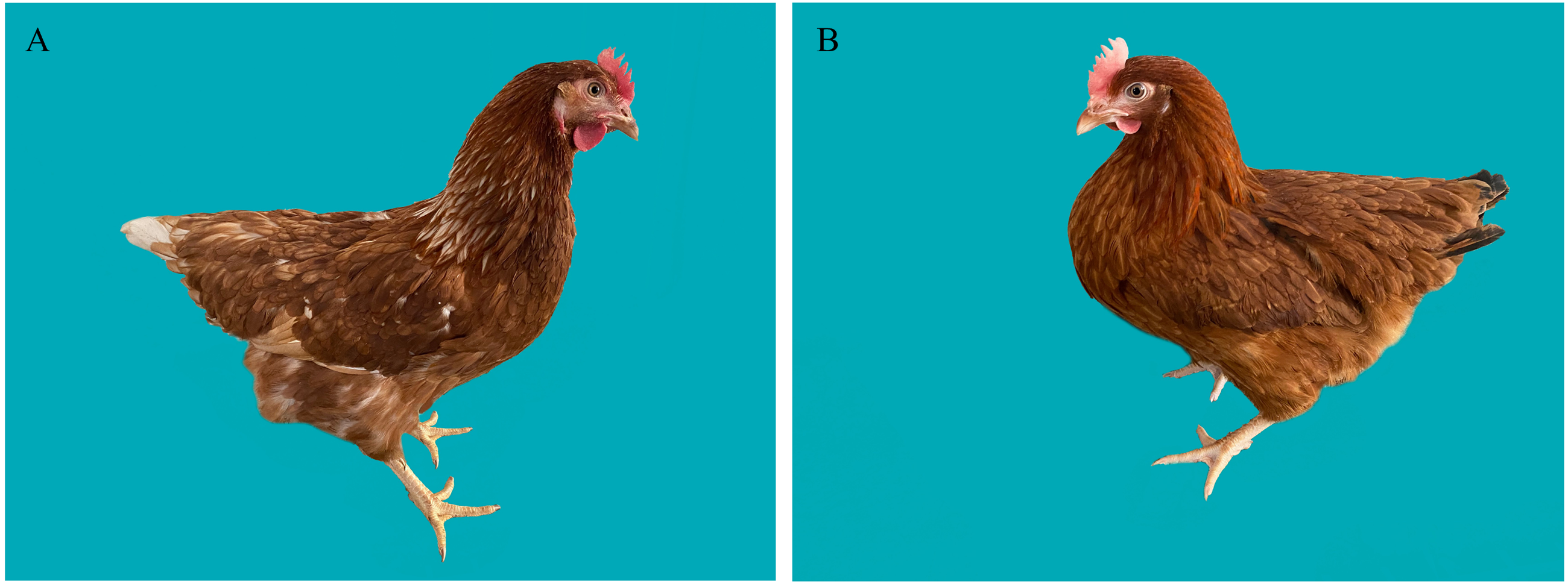
图1
Babcock B380黑尾和白尾母鸡 A:白尾母鸡;B:黑尾母鸡"
表1
NCBI数据库10种黑尾鸡品种"
| 品种 Breed | 缩略词 Abbreviation | 样本数量 Sample size | 登录号 Accession | 表型 Phenotype |
|---|---|---|---|---|
| 矮脚鸡 Aijiao chicken | AJ | 10 | PRJNA947391 | 黑尾Black-tailed |
| 怀乡鸡 Huaixiang chicken | HX | 10 | PRJNA482210 | 黑尾Black-tailed |
| 和田鸡 Hetian chicken | HT | 10 | PRJNA482210 | 黑尾Black-tailed |
| 广西黄鸡 Guangxi yellow chicken | GXH | 10 | PRJNA482210 | 黑尾Black-tailed |
| 江汉鸡 Jianghan chicken | JH | 10 | PRJNA482210 | 黑尾Black-tailed |
| 彭县黄鸡 Pengxian yellow chicken | PX | 10 | PRJNA656352 | 黑尾Black-tailed |
| 黔东南小香鸡 Qiandongnan xiaoxiang chicken | QDN | 10 | PRJNA947391 | 黑尾Black-tailed |
| 威宁鸡 Weining chicken | WN | 10 | PRJNA947391 | 黑尾Black-tailed |
| 文昌鸡 Wenchang chicken | WC | 10 | PRJNA800119 | 黑尾Black-tailed |
| 正阳黄鸡 Zhengyang yellow chicken | ZY | 10 | PRJNA482210 | 黑尾Black-tailed |
表2
qRT-PCR引物序列信息"
| 基因 Gene name | 描述 Description | F/R | 引物序列 Primer sequence (5'-3') | Tm (℃) | 产物大小 Production size (bp) |
|---|---|---|---|---|---|
| PMEL | 前黑素体蛋白 Premelanosome protein | F | TTGTCTACGTGTGGTGGACG | 60 | 173 |
| R | CTGGTCGGTGATGCTGAACT | 59 | |||
| TYR | 酪氨酸酶 Tyrosinase | F | CACTCTTAGGTGGCTCCAATGTG | 60 | 168 |
| R | CAGTCCCAGTAGGGGATGGTGAA | 60 | |||
| TYRP1 | 酪氨酸酶相关蛋白1 Tyrosinase related protein 1 | F | CAGAAGCTCAGTTCCCTCG | 59 | 198 |
| R | TGGTTGAAGAAGCGTATGG | 60 | |||
| NPY | 神经肽Y Neuropeptide Y | F | GAGGCACTACATCAACCTCATCAC | 59 | 142 |
| R | TGTTTTCTGTGCTTTCCCTCAA | 58 | |||
| β-actin | β-肌动蛋白 Beta-actin | F | TCACCAACTGGGATGATATGGA | 60 | 181 |
| R | TTGGCTTTGGGGTTCAGG | 59 |

图2
B380黑尾与白尾毛囊H.E染色组织切片图"

图3
B380黑尾和白尾毛囊黑素小体细胞电镜图 N:细胞核;BM:基底膜;M:线粒体;Ms:黑色素小体"
表3
黑素小体面积测量"
| 项目 Item | 白尾 White-tailed | 黑尾 Black-tailed |
|---|---|---|
| 黑素小体H.E染色面积 H.E-stained area of melanosomes (μm2) | 1686.52±111.02** | 7384.13±319.67** |
| 黑素小体电镜图像面积 Melanosome area in transmission electron microscopy images (μm2) | 0.20±0.012** | 1.03±0.032** |
| 褐黑素数量占比 Proportion of pheomelanin-containing melanosomes (%) | 57.14±0.67 | 59.25±1.17 |
| 真黑素数量占比 Proportion of eumelanin-containing melanosomes (%) | 42.85±0.67 | 40.75±1.17 |

图4
差异表达基因鉴定与qRT-PCR验证 A:DEGs火山图;B:qRT-PCR验证结果;C:差异表达基因蛋白相互作用网络 Welch’s t 检验,数据以均值±标准差(SD)表示。***表示P<0.001,****表示P<0.0001"

图5
WGCNA与蛋白互作网络分析图 A:层次聚类图;B:模块-性状相关图;C:MEmagenta KEGG富集图;D:MEmagenta模块基因显著性(GS)与模块成员度(MM)的相关性图;E:MEmagenta模块枢纽基因图;F:蛋白互作网络分析图"
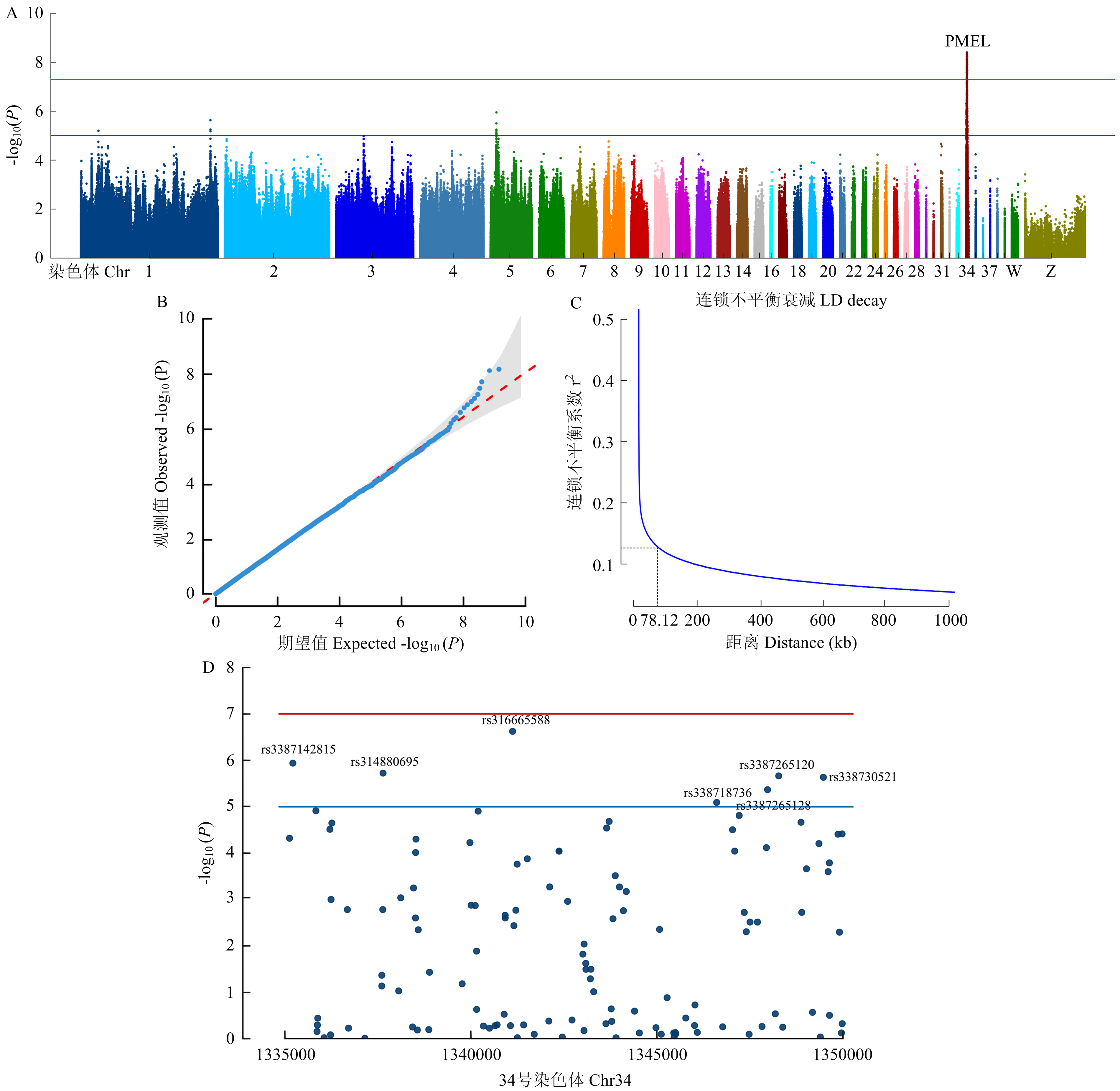
图6
黑尾和白尾表型全基因组关联分析 A:B380黑尾和白尾表型全基因组关联分析曼哈顿图;B:QQ图;C:连锁不平衡图;D:PMEL SNP曼哈顿图"
表4
PMEL rs316665588 位点基因型统计"
| CC | TC | 合计 Total | |
|---|---|---|---|
| 黑尾 Black-tailed | 79 | 1 | 80 |
| 白尾 White-tailed | 0 | 80 | 80 |
| 合计 Total | 79 | 81 | 160 |
| Fisher检验 Fisher’s exact test | 1.76E-45** | ||
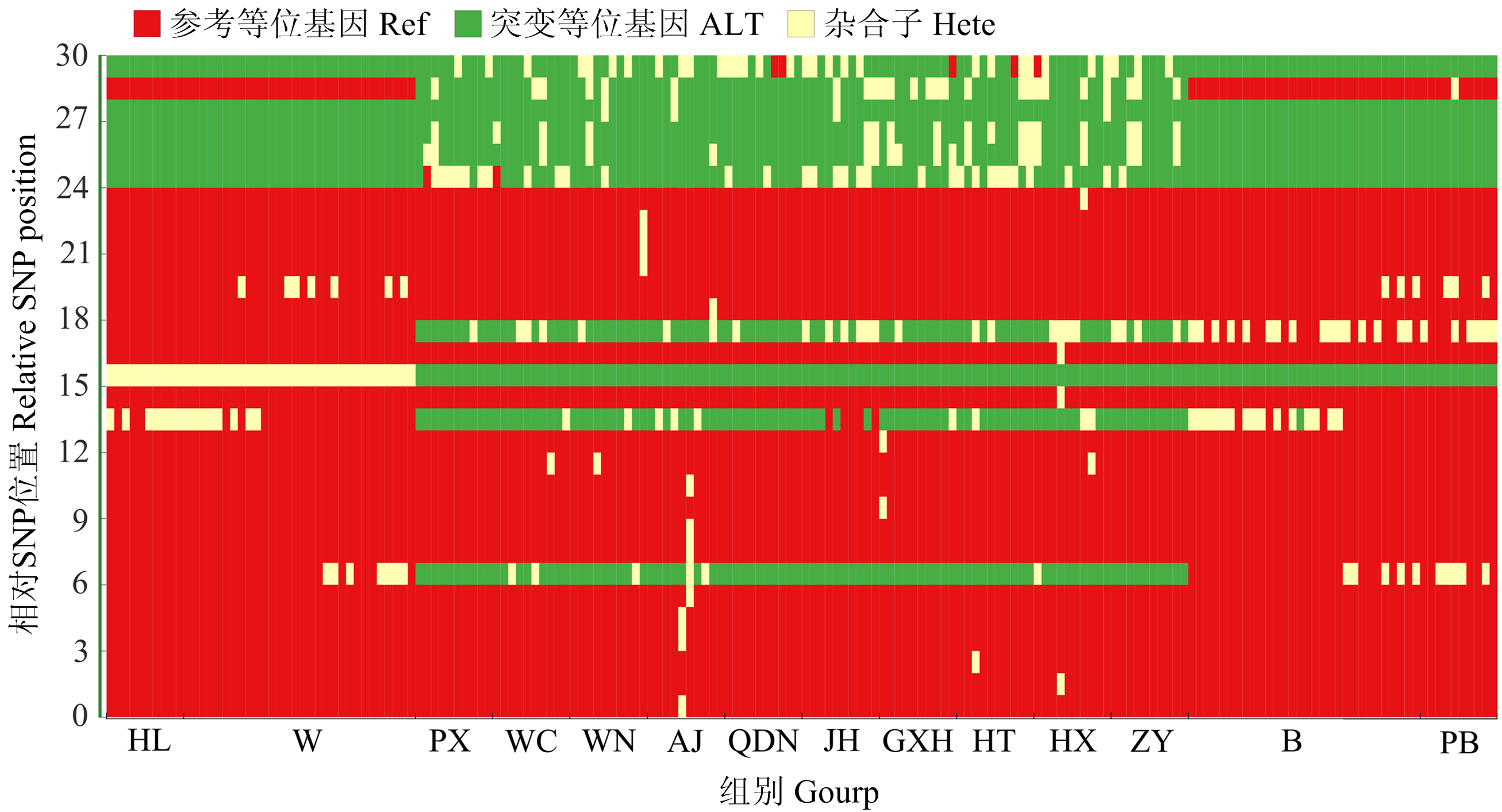
图7
PMEL基因型热图"
表5
PMEL mRNA序列密码子偏好性分析"
| 氨基酸 Amino acid | 密码子 Codon | 个数 Number | 同义密码子相对使用度 Relative synonymous codon usage, RSCU |
|---|---|---|---|
| Cys | UGU | 1 | 0.13 |
| Cys | UGC | 14 | 1.87 |
| [1] |
李东华, 付亚伟, 张晨曦, 曹艳芳, 李文婷, 李转见, 康相涛, 孙桂荣. 淅川乌骨鸡全基因组转座子的鉴定与分析[J]. 中国农业科学, 2020, 53(7): 1491-1500. DOI: 10.3864/j.issn.0578-1752.2020.07.017.
|
|
|
|
| [2] |
doi: 10.1093/icb/icu094 pmid: 24987010 |
| [3] |
pmid: 12950732 |
| [4] |
doi: 10.1021/jacs.0c12322 pmid: 33560127 |
| [5] |
赵兵令, 李亚楠, 陈天直, 刘颖, 常露程, 范瑞文, 薛霖莉, 王海东, 董常生. GPNMB通过调控MITF下游色素相关基因表达影响黑色素细胞色素的生成[J]. 中国农业科学, 2017, 50(7): 1334-1342. DOI: 10.3864/j.issn.0578-1752.2017.07.016.
|
|
|
|
| [6] |
doi: 10.3390/ani10030493 |
| [7] |
doi: 10.1371/journal.pone.0210850 |
| [8] |
doi: 10.1038/s41598-020-68931-1 pmid: 32694523 |
| [9] |
doi: 10.1016/j.psj.2025.105680 |
| [10] |
doi: 10.1016/j.psj.2025.105666 |
| [11] |
doi: 10.3389/fgene.2021.566047 |
| [12] |
doi: 10.1111/age.v55.2 |
| [13] |
doi: 10.1038/ng.2310 pmid: 22706312 |
| [14] |
doi: 10.1186/s13059-019-1758-4 pmid: 31477170 |
| [15] |
doi: 10.1016/j.molp.2023.09.010 |
| [16] |
doi: 10.1002/ar.v303.7 |
| [17] |
|
| [18] |
doi: 10.1093/jhered/esab014 pmid: 33885791 |
| [19] |
叶宇恒. 固原乌鸡黑色素分布沉积特征及酪氨酸对其组织黑色素含量与黑色素合成相关基因表达量的影响[D]. 银川: 宁夏大学, 2023.
|
|
|
|
| [20] |
doi: 10.1111/fec.2005.19.issue-5 |
| [21] |
doi: 10.1038/s41598-024-53072-6 pmid: 38291221 |
| [22] |
doi: 10.3389/fmolb.2024.1440187 |
| [23] |
|
| [24] |
|
| [25] |
doi: 10.1016/j.psj.2023.103266 |
| [26] |
doi: 10.1016/S0002-9440(10)63657-7 |
| [27] |
doi: 10.1007/s10495-023-01913-6 |
| [28] |
骆娜, 安炳星, 魏立民, 文杰, 赵桂苹. 全基因组关联分析筛选文昌鸡体尺性状相关分子标记[J]. 中国农业科学, 2024, 57(10): 2046-2060. DOI: 10.3864/j.issn.0578-1752.2024.10.015.
|
|
|
|
| [29] |
doi: 10.3390/ijms17091438 |
| [30] |
doi: S0365-05962013000100076 pmid: 23539007 |
| [31] |
doi: 10.18699/VJ19.499 |
| [32] |
doi: 10.1111/age.13094 pmid: 34224160 |
| [33] |
doi: 10.1534/genetics.104.027995 pmid: 15579702 |
| [34] |
doi: 10.1002/jex2.v3.1 |
| [35] |
doi: 10.1038/s41416-023-02468-8 pmid: 37898722 |
| [36] |
doi: 10.1146/annurev-biochem-071320-112701 pmid: 33441035 |
| [37] |
|
| [38] |
doi: 10.1016/j.cell.2025.06.007 pmid: 40602402 |
| [1] | 杨丽娟, 陈丝雨, 赵薇, 朱玲, 郭磊, 马丽娜, 马瑞敏, 张娟. 全基因组重测序揭示静原鸡羽色的遗传机制[J]. 中国农业科学, 2026, 59(6): 1348-1360. |
| [2] | 叶美金, 吴雷, Lohani Md Nahibuzzaman, 尹丽, 胡欣荣, 刘亚西, 蒋云峰, 陈国跃, 蒲至恩, 李阳, 李婷, 邹亚亚, 吴佳怡, 马建. 基于GWAS的中国地方小麦成熟胚大小位点的鉴定及其遗传效应解析[J]. 中国农业科学, 2026, 59(6): 1157-1171. |
| [3] | 王勇胜, 牛丽, 王长杰, 马立花, 廉潇潇, 孟亚雄, 马小乐, 姚立蓉, 张宏, 杨轲, 李葆春, 王化俊, 司二静, 汪军成. 冬小麦千粒重的全基因组关联分析及候选基因预测[J]. 中国农业科学, 2026, 59(3): 499-514. |
| [4] | 曹凡, 唐瑶, 王孟玮, 张栋渊, 卫亚博, 吴爽, 朱万超, 徐淑兔, 张兴华, 薛吉全. 陕A群、陕B群选育玉米自交系及其杂交种种子活力评价及遗传解析[J]. 中国农业科学, 2026, 59(16): 3476-3495. |
| [5] | 毛嘉琦, 武棒棒, 赵佳佳, 郝宇琼, 郑兴卫, 吴建辉, 曾庆东, 刘敏捷, 郑军. 山西小麦品种苗期锈病抗性鉴定及抗病基因检测[J]. 中国农业科学, 2026, 59(14): 3006-3021. |
| [6] | 陈圣琦, 刘金洋, 黄佳丽, 刘肖岑, 赵硕谦, 林云, 薛晨晨, 闫强, 陈景斌, 吴然然, 陈新, 程金平, 袁星星. 绿豆籽粒蛋白质与苏氨酸含量全基因组关联分析及KASP分子标记开发[J]. 中国农业科学, 2026, 59(13): 2789-2801. |
| [7] | 郭富强, 彭治鑫, 李得瑞, 林木森, 许立峰, 张成省. 2-辛基-3-异噻唑啉酮抗烟草赤星病菌的生物活性及作用机制[J]. 中国农业科学, 2026, 59(13): 2841-2852. |
| [8] | 叶美金, 王同著, 陈斌, LOHANI Md Nahibuzzaman, 陈家婷, 胡欣荣, 尹丽, 王超, 张昊芃, 杨夏, 王佳琳, 姚琦馥, 丁浦洋, 王凤, 李小雨, 马建. 基于全基因组关联分析解析小麦茎节间长度的遗传基础及其效应[J]. 中国农业科学, 2026, 59(12): 2551-2562. |
| [9] | 王慧玲, 王晓玥, 闫爱玲, 刘振华, 任建成, 卢浩成, 孙磊. 葡萄果实品质性状遗传特性与基因位点解析研究进展[J]. 中国农业科学, 2026, 59(11): 2447-2467. |
| [10] | 杨菁华, 孙娥, 刘小欢, 张盼, 戴莹葆, 王文辉, 董涵, 左存武. 类受体激酶基因PbeCRLK2正调控梨腐烂病抗性[J]. 中国农业科学, 2026, 59(10): 2165-2180. |
| [11] | 李云丽, 刁邓超, 刘雅睿, 孙玉晨, 孟祥宇, 邬陈芳, 汪妤, 吴建辉, 李春莲, 曾庆东, 韩德俊, 郑炜君. 小麦苗期耐热性全基因组关联分析[J]. 中国农业科学, 2025, 58(9): 1663-1683. |
| [12] | 周广飞, 马亮, 马璐, 张舒钰, 章慧敏, 宋旭东, 张振良, 陆虎华, 郝德荣, 冒宇翔, 薛林, 陈国清. 玉米苞叶性状全基因组关联分析[J]. 中国农业科学, 2025, 58(3): 431-442. |
| [13] | 武书羽, 衡燕芳, 于太飞, 王世佳, 于思佳, 李园, 胡正, 张辉, 孙现军, 黎亮, 姜奇彦. 玉米自然群体苗期耐盐性鉴定及耐盐相关基因分析[J]. 中国农业科学, 2025, 58(20): 4085-4099. |
| [14] | 向爱慧, 白荣基, 郝宇琼, 赵佳佳, 武棒棒, 李晓华, 郑兴卫, 关攀锋, 郑军. 山西小麦矮秆基因的鉴定及株高遗传位点挖掘[J]. 中国农业科学, 2025, 58(17): 3372-3388. |
| [15] | 郑敏华, 陈洛, 邢甲乐, 谢月兰, 姜先芽, 聂帅, 蔡甫格, 巫浩翔, 陆展华, 孙伟, 霍兴, 白嵩, 赵均良, 杨武. 华南籼稻稻瘟病抗性QTL鉴定与候选基因挖掘[J]. 中国农业科学, 2025, 58(14): 2707-2719. |
|
||
