






中国农业科学 ›› 2026, Vol. 59 ›› Issue (10): 2249-2264.doi: 10.3864/j.issn.0578-1752.2026.10.013
董雪( ), 刘佳乐, 邵晋, 陈梦秋, 吴学友, 唐培安()
收稿日期:2025-10-10
接受日期:2026-01-28
出版日期:2026-05-16
发布日期:2026-05-20
通信作者:
联系方式:
董雪,E-mail:xue_dong1990@126.com。
基金资助:
DONG Xue(), LIU JiaLe, SHAO Jin, CHEN MengQiu, WU XueYou, TANG PeiAn()
Received:2025-10-10
Accepted:2026-01-28
Published:2026-05-16
Online:2026-05-20
摘要:
【背景】稻谷作为全球半数以上人口的主食,其采后储藏期间的品质劣变与脂质降解密切相关。低温储藏是保持粮食品质、实现绿色储粮的重要策略。然而,关于长期低温储藏如何从代谢物动态与基因表达网络层面协同调控稻谷脂质代谢,以维持其稳定性的内在机制尚未得到全面阐释。【目的】整合多组学技术,系统解析低温长期储藏下粳稻脂质稳定的生化与分子机制。【方法】以新鲜的南粳46稻谷为材料,分别于25和15 ℃条件下储藏360 d,每30 d取样一次,采用生理生化指标测定、脂质代谢组学、转录组学联合分析,系统研究稻谷脂质在长期低温储藏中的稳定性。【结果】低温储藏通过多层次调控网络有效维持了稻谷脂质稳定。在膜脂代谢方面,低温通过下调PLDα1延缓磷脂(磷脂酰乙醇胺、磷脂酰肌醇和磷脂酰胆碱)的水解,有利于维持细胞膜的完整性。同时,OsCDase表达下降减少了鞘脂的降解,进一步增强了质膜的稳定性。在油脂水解方面,低温通过抑制脂肪酶(lipase)的活性,抑制了甘油三酯的水解。在氧化代谢途径,OsFAD2和ACX1的下调抑制了多不饱和脂肪酸的合成和β-氧化,使过氧化值与丙二醛含量显著降低,从而减轻了氧化应激;此外,脂氧合酶(lipoxygenase,LOX)在低温下的活性降低,进一步缓解了不饱和脂肪酸的氧化,减少了异味的生成。【结论】在稻谷储藏过程中,脂质水解是氧化反应的重要前提,二者共同决定稻谷储藏过程中品质的劣变。低温同步抑制脂质水解与氧化进程,从而在代谢物水平维持脂质组成稳定,在表型水平延缓品质下降。
董雪, 刘佳乐, 邵晋, 陈梦秋, 吴学友, 唐培安. 多组学揭示粳稻脂质在长期低温储藏中的稳定机制[J]. 中国农业科学, 2026, 59(10): 2249-2264.
DONG Xue, LIU JiaLe, SHAO Jin, CHEN MengQiu, WU XueYou, TANG PeiAn. Multi-Omics Reveals Mechanisms of Lipid Stabilization in Japonica Rice During Prolonged Low-Temperature Storage[J]. Scientia Agricultura Sinica, 2026, 59(10): 2249-2264.

表1
用于定量聚合酶链反应分析的引物序列"
| 基因ID Gene | 基因名称 Gene name | 引物序列 Primer sequences (5' to 3') | 产物大小 Amplicon size (bp) |
|---|---|---|---|
| Os02g0753300 | Os02g0753300 | F: CCCTCCTCTTCCTCCTC | 145 |
| R: ACGCACTCCATCTTGTC | |||
| Os10g0361900 | Os10g0361900 | F: CCAGCTACCTCATCCTC | 80 |
| R: GGTCTTGACGACGATCT | |||
| Os04g0447100 | OsLOX6 | F: AAGAACGAGATGCTGTC | 106 |
| R: CTCCTTGAAGAGGTTGTC | |||
| Os05g0355800 | Os05g0355800 | F: CCACGACGACATGACTG | 118 |
| R: CGGACTACACCAACACG | |||
| Os07g0162900 | OsCDAP3 | F: CGAAAGAACTCCTGGAAC | 99 |
| R: GTTGCGGTATGAGATGAG | |||
| Os06g0531900 | OsGELP85 | F: GCAACTACAACTTCAACCT | 141 |
| R: CATTCAGCCAGCCATTG | |||
| Os05g0408300 | Os05g0408300 | F: CTTAGCCTTACTTCCTTGT | 135 |
| R: ATAGACGATAACTCCAATCC | |||
| Os02g0796600 | OsSTA82 | F: GAGGCTGTTTATGACTGT | 85 |
| R: GTCCACTTCCAACTGATT | |||
| EF-la | F: AGACCACCAAGTACTACTGCAC | 540 | |
| R: CCACCAATCTTGTACACATCC | |||
| Actin | F: AGACTACATACAACTCCATCAT | 80 | |
| R: CACCACTGAGAACGATGT |
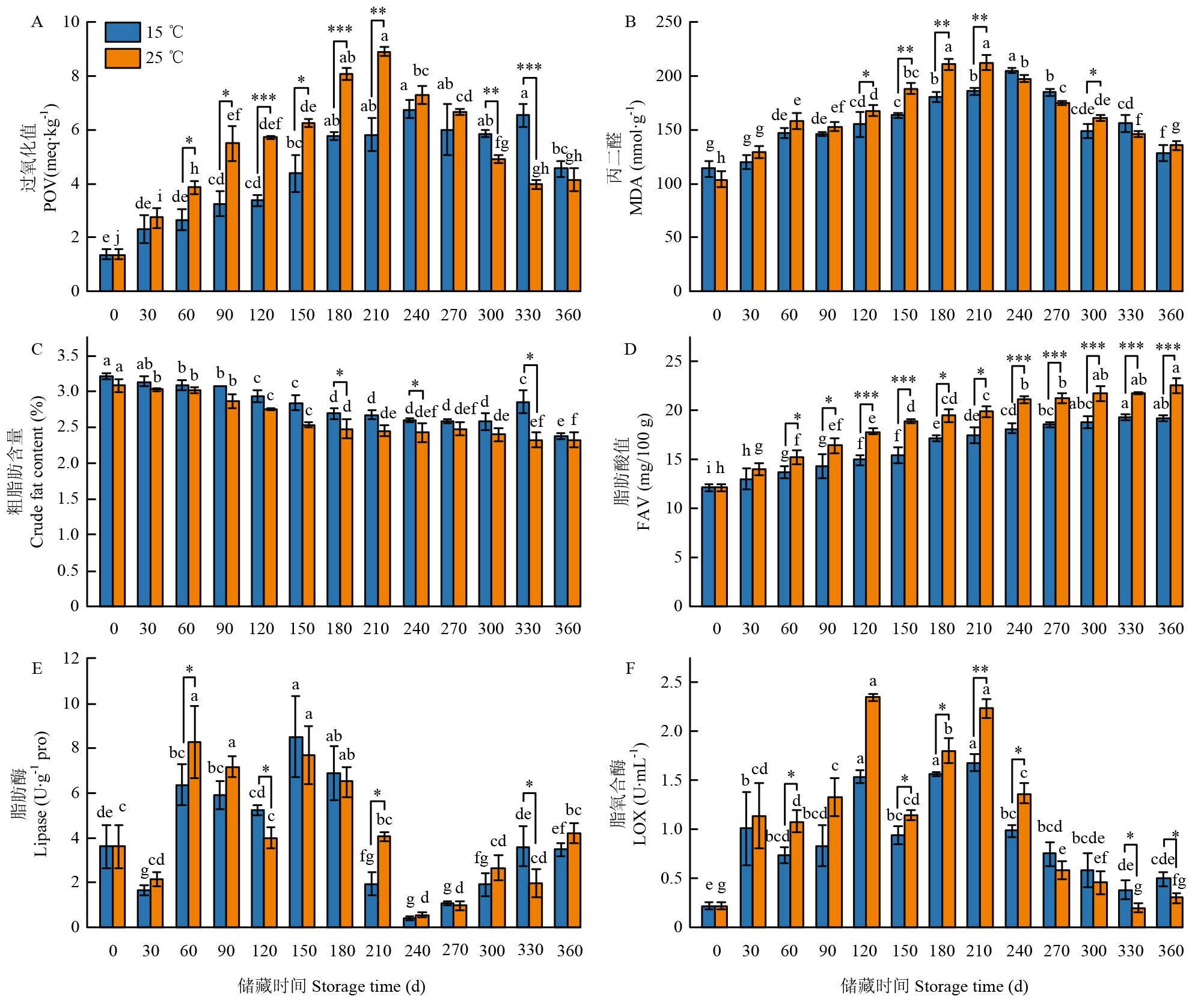
图1
脂质相关的质量参数变化 不同小写字母表示相同处理、不同时间之间的差异显著(P<0.05);相同时间、不同处理间的显著差异性用星号表示(*、**、***分别表示P<0.05、0.01和0.001)"
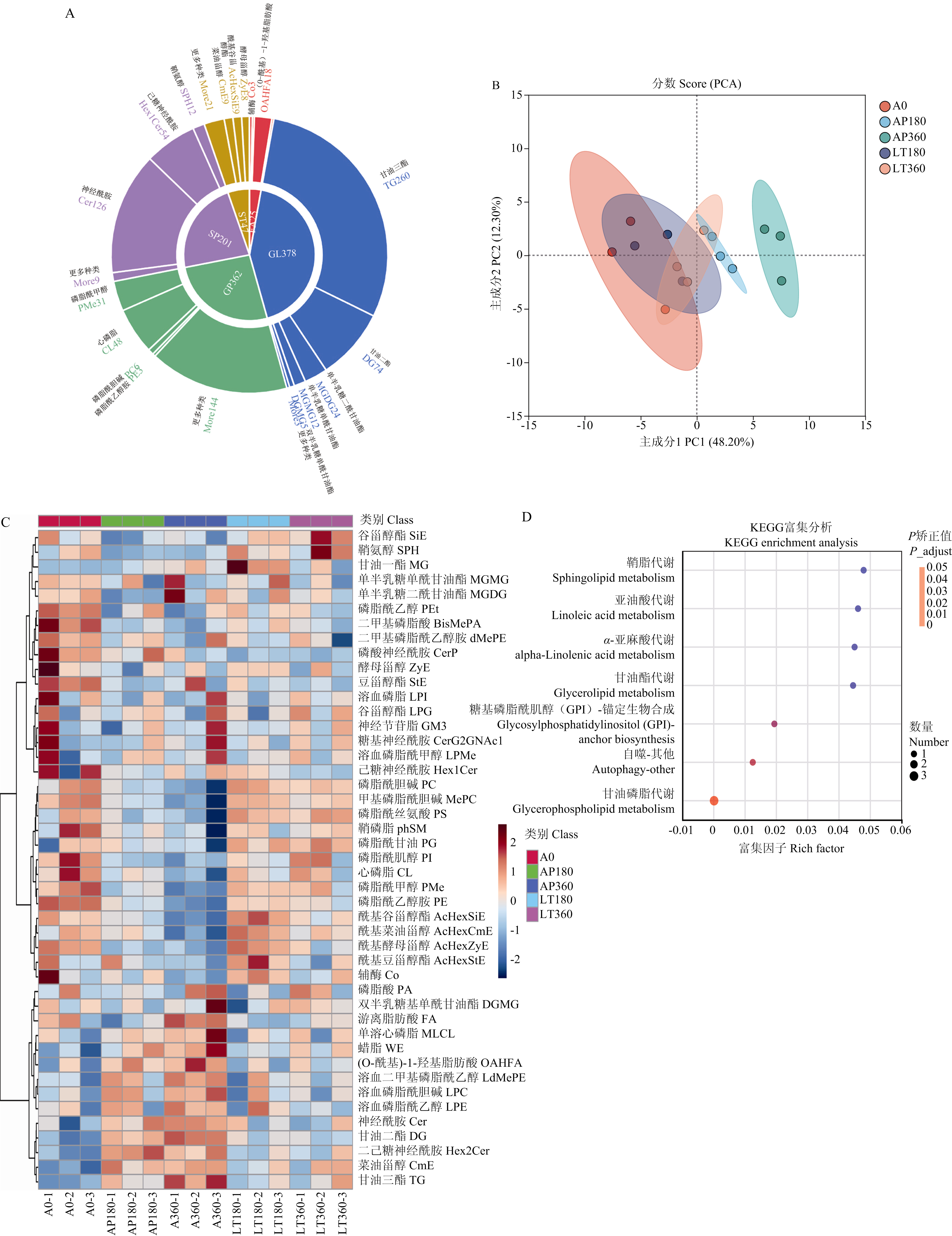
图2
不同条件下稻谷储藏期间脂质种类和代谢途径的变化 A:主要脂质类别的脂质分类及相对丰度;B:不同储藏条件下脂质的主成分分析(PCA);C:样本间差异脂质亚类(前20种)丰度的热图;D:低温储藏条件下显著改变脂质的KEGG通路富集分析。储藏条件包括新鲜的水稻籽粒(A0)、在25 ℃下储藏180 d(AP180)和360 d(AP360),以及在15 ℃下储藏180 d(LT180)和360 d(LT360)。下同"
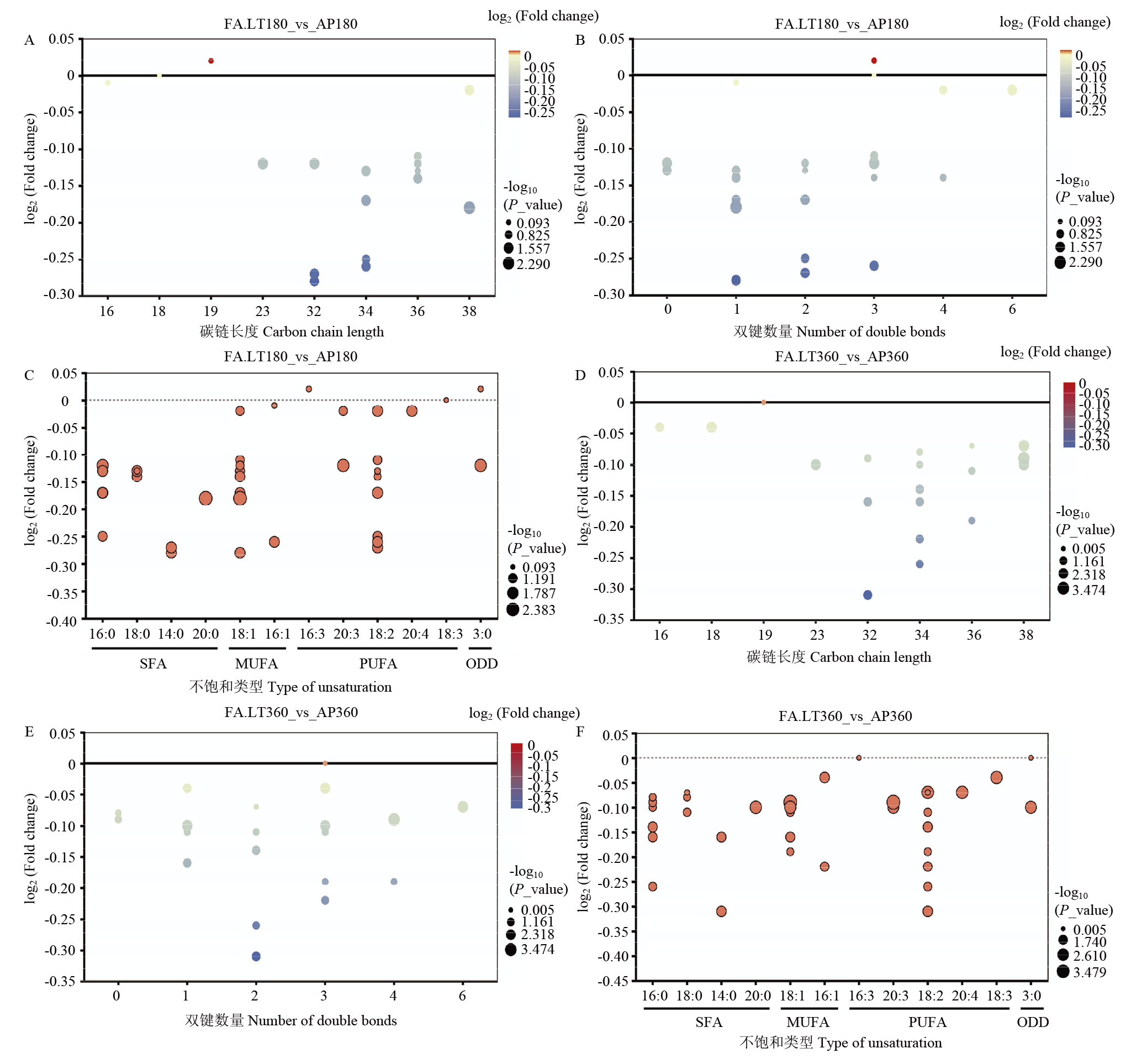
图3
脂肪酰基的结构特征及其对储藏温度的差异反应"
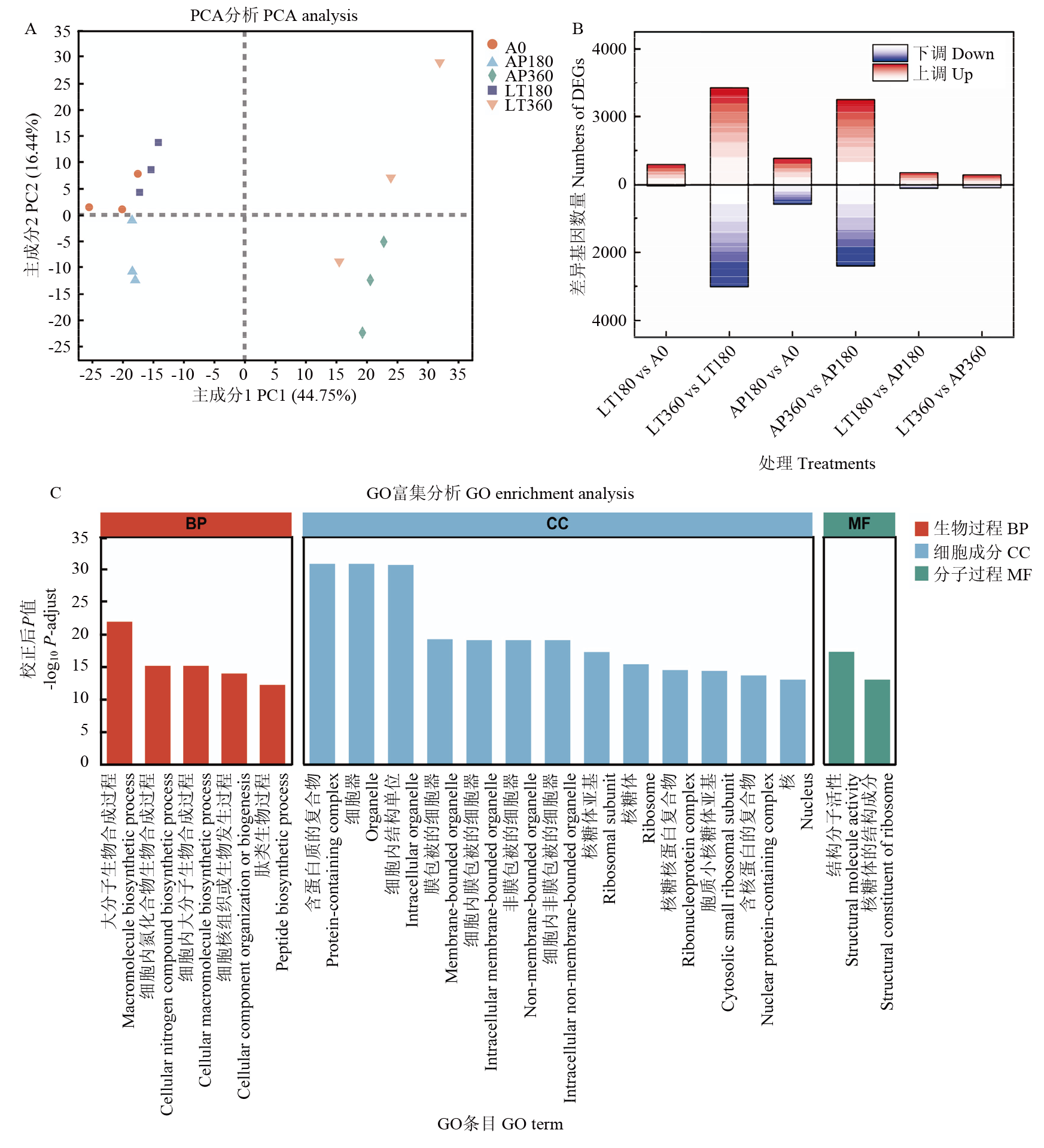
图4
不同条件下水稻籽粒储藏过程中基因表达及功能富集变化"
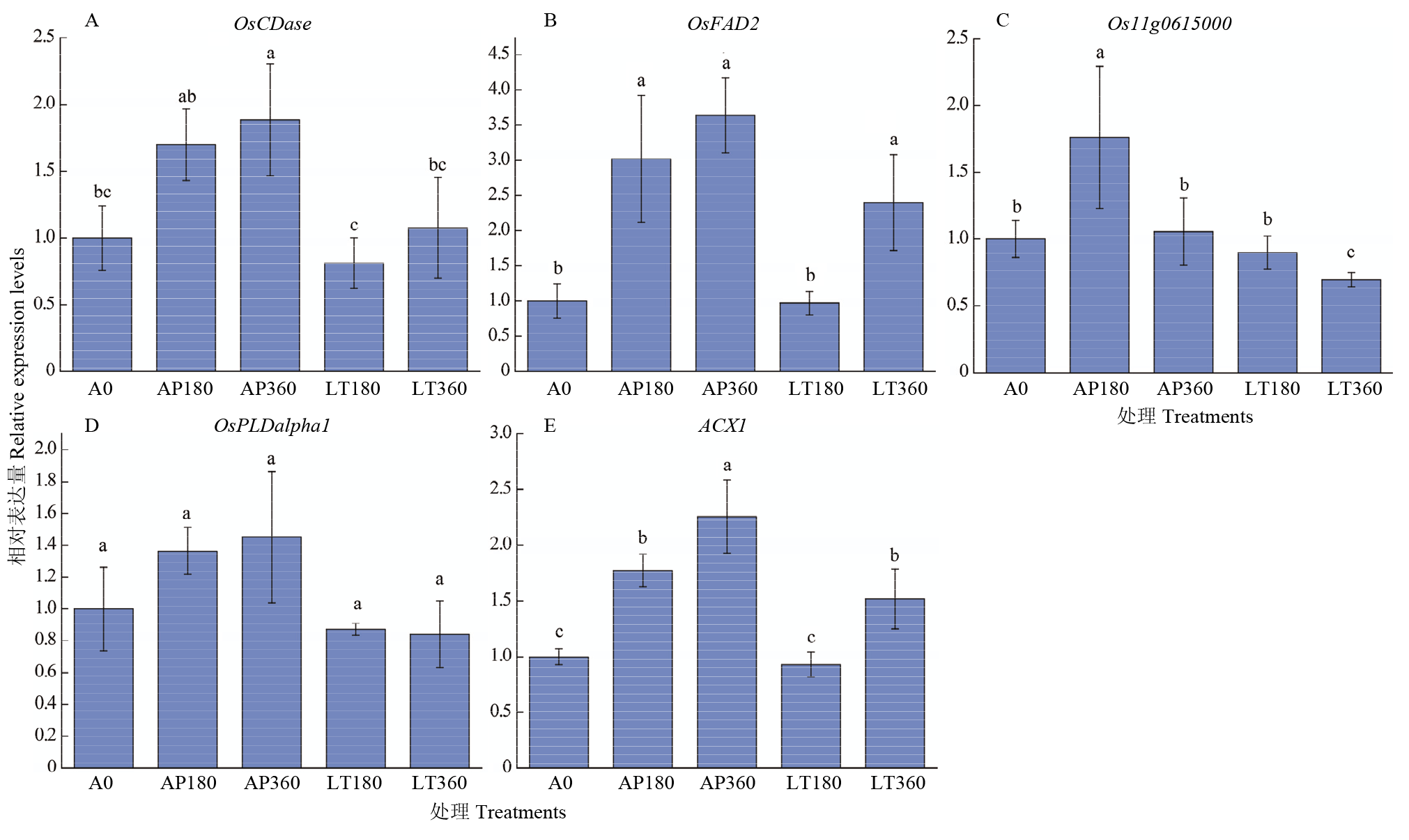
图5
基于KEGG通路分析不同条件下水稻籽粒储藏期间参与脂质代谢关键基因的相对表达水平 不同小写字母表示根据Tukey’s HSD检验具有显著差异(P<0.05)"
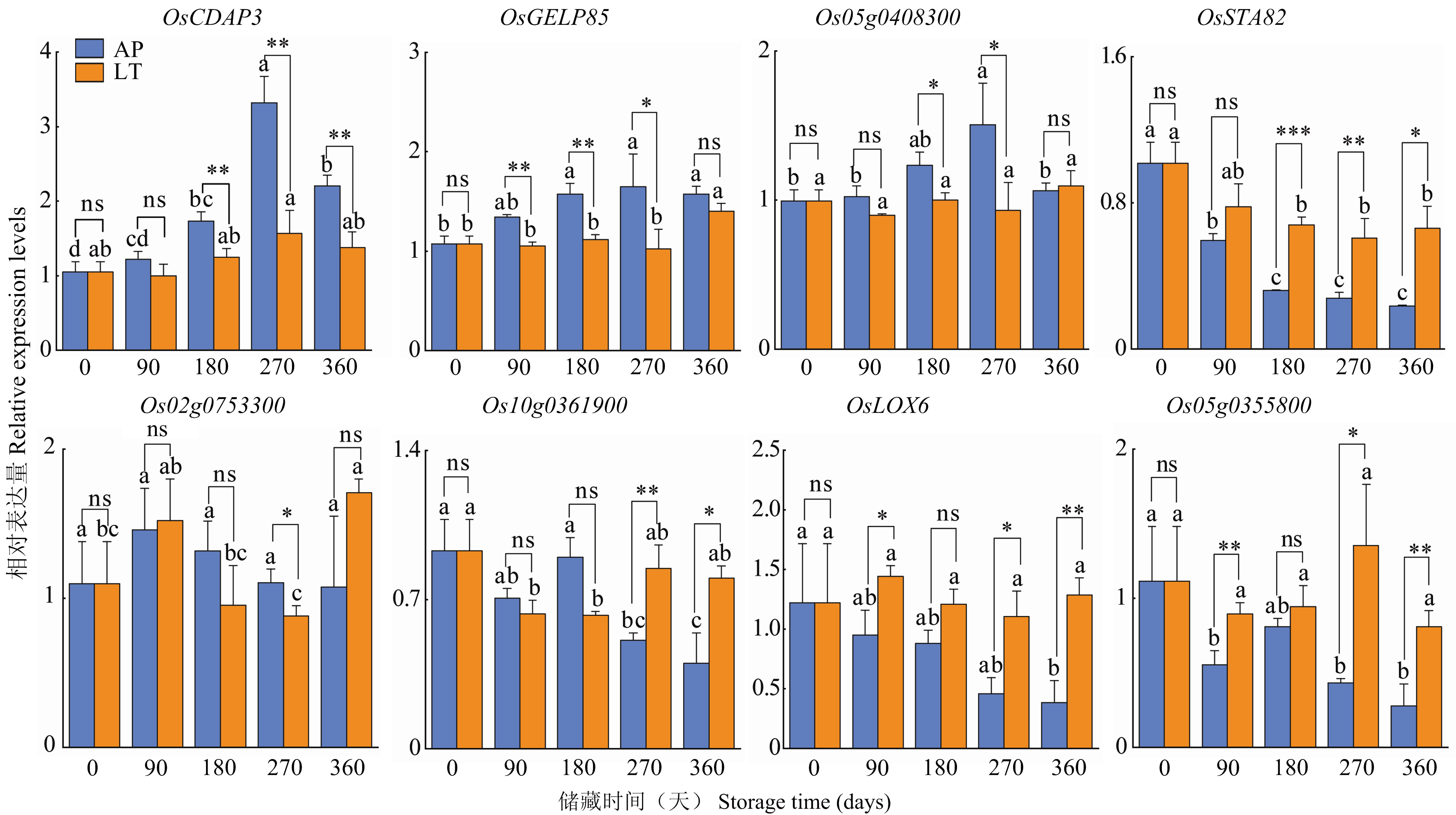
图6
不同条件下水稻籽粒储藏期间脂酶和LOX相关基因的表达水平 AP:25 ℃;LP:15 ℃。不同字母表示不同时间点之间存在统计学显著差异(P<0.05)。星号(*、**、***分别表示P<0.05、0.01和0.001)表示两种储藏条件之间存在统计学差异。ns表示无显著差异"
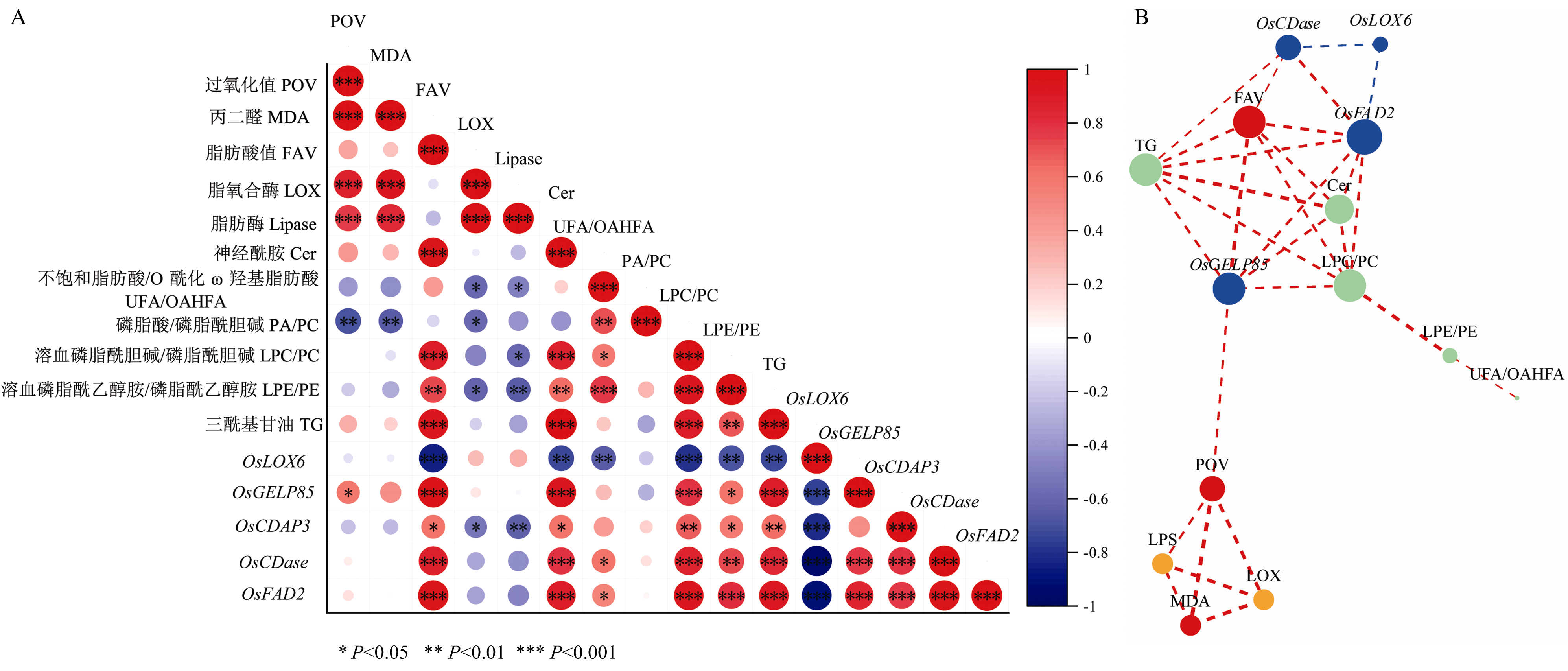
图7
稻谷储藏过程中多组学联合分析 图A中颜色表示相关系数r的方向(红色为正相关,蓝色为负相关),圆点大小与|r|成正比,显著性以星号表示(*:P<0.05,**:P<0.01,***:P<0.001)。图B节点颜色表示变量类别:红色为品质/氧化表型指标,橙色为酶活性指标,绿色为脂质特征,蓝色为候选基因;连线表示显著相关关系,红色表示正相关,蓝色表示负相关;线宽与相关强度(|r|)成正比"
| [1] |
doi: 10.3390/agriculture12060741 |
| [2] |
王英, 黄旭辉, 李冬梅, 秦磊, 张玉莹. 磷脂氧化降解机制及调控技术研究进展. 食品科学, 2024, 45(12): 349-357.
|
|
doi: 10.7506/spkx1002-6630-20230707-066 |
|
| [3] |
|
| [4] |
doi: 10.1016/j.jspr.2021.101770 |
| [5] |
doi: 10.1016/j.foodchem.2024.142107 |
| [6] |
doi: 10.1016/j.foodchem.2024.142140 |
| [7] |
doi: 10.3389/fpls.2021.563953 |
| [8] |
张义茹, 韩雪, 姚鑫杰, 冯军, 魏爱丽, 李文超, 张彬, 韩渊怀, 李红英. 基于多组学解析谷子后熟米色变化的分子机制. 中国农业科学, 2025, 58(9): 1702-1718. doi: 10.3864/j.issn.0578-1752.2025.09.003.
|
|
|
|
| [9] |
中华人民共和国国家卫生和计划生育委员会. 食品安全国家标准食品中过氧化值的测定:GB 5009.227-2016. 北京: 中国标准出版社, 2017.
|
|
National Health and Family Planning Commission of the People’s Republic of China. Determination of peroxide value in food safety national standards: GB 5009.227-2016. Beijing: Standards Press of China, 2017. (in Chinese)
|
|
| [10] |
国家质量监督检验检疫总局, 中国国家标准化管理委员会. 稻谷储存品质判定规则:GB/T 20569-2006. 北京: 中国标准出版社, 2006.
|
|
General Administration of Quality Supervision, Inspection and Quarantine of the People’s Republic of China, Standardization Administration of the People’s Republic of China. Guidelines for evaluation of grain storage character-Paddy: GB/T 20569-2006. Beijing: Standards Press of China, 2006. (in Chinese)
|
|
| [11] |
国家卫生和计划生育委员会, 国家食品药品监督管理总局. 食品安全国家标准食品中脂肪的测定:GB 5009.6-2016. 北京: 中国标准出版社, 2016.
|
|
National Health and Family Planning Commission of the People's Republic of China, China Food and Drug Administration. National Food Safety Standard -Determination of Fat in Foods: GB 5009.6- 2016. Beijing: Standards Press of China, 2016. (in Chinese)
|
|
| [12] |
|
| [13] |
doi: 10.1371/journal.pone.0143877 |
| [14] |
doi: 10.1016/j.foodchem.2023.136299 |
| [15] |
doi: 10.1016/j.jcs.2018.03.003 |
| [16] |
doi: S0309-1740(16)30097-3 pmid: 27091079 |
| [17] |
doi: 10.1007/s12161-017-1031-y |
| [18] |
doi: 10.3390/molecules27155014 |
| [19] |
doi: 10.1016/j.foodchem.2012.12.046 pmid: 23561219 |
| [20] |
doi: 10.1002/cche.v98.4 |
| [21] |
doi: 10.1016/j.foodchem.2025.143081 |
| [22] |
doi: 10.1093/pcp/pcx171 pmid: 29136239 |
| [23] |
doi: 10.1002/1873-3468.13987 pmid: 33151562 |
| [24] |
doi: 10.1016/j.bpj.2022.06.015 pmid: 35711144 |
| [25] |
|
| [26] |
doi: S0981-9428(18)30566-7 pmid: 30708258 |
| [27] |
doi: 10.1021/acs.jafc.7b03901 pmid: 28846395 |
| [28] |
doi: 10.1007/s11033-022-07568-x pmid: 35819557 |
| [29] |
doi: 10.1134/S1990519X21040076 |
| [30] |
doi: 10.1111/tpj.v106.1 |
| [31] |
doi: 10.3390/ijms241914857 |
| [32] |
董雪, 陈梦秋, 邵晋, 吴学友, 唐培安. 基于WGCNA的稻谷储藏期间差异基因挖掘与品质调控网络构建. 中国农业科学, 2025, 58(14): 2885-2903. doi: 10.3864/j.issn.0578-1752.2025.14.013.
|
|
|
|
| [33] |
doi: 10.1093/jxb/ert243 pmid: 23963678 |
| [34] |
doi: 10.1007/s11738-019-2944-4 |
| [35] |
doi: 10.1186/s13765-019-0439-z |
| [36] |
|
| [37] |
doi: 10.3390/plants11070979 |
| [38] |
doi: 10.1007/s00122-018-3091-9 |
| [39] |
doi: 10.1016/j.jplph.2017.04.007 |
| [40] |
doi: 10.1111/j.1745-4514.2008.00169.x |
| [1] | 岳楠栋, 蒋丙婷, 聂景贵, 方越, 唐军荣, 乐振声, 周莹, 李能波, 何霞红, 张雪春. 紫皮石斛茎、叶、花的成分和功能活性分析及代谢组学研究[J]. 中国农业科学, 2026, 59(8): 1775-1796. |
| [2] | 谭西北, 兰徐颖, 刘崇怀, 樊秀彩, 姜建福, 孙磊, 李鹏, 余书鑫, 张颖. 不同抗性葡萄响应白腐病侵染的次生代谢物变化[J]. 中国农业科学, 2025, 58(9): 1767-1778. |
| [3] | 张义茹, 韩雪, 姚鑫杰, 冯军, 魏爱丽, 李文超, 张彬, 韩渊怀, 李红英. 基于多组学解析谷子后熟米色变化的分子机制[J]. 中国农业科学, 2025, 58(9): 1702-1718. |
| [4] | 白文哲, 李继豪, 方钱海, 张帆, 胡睿祺, 陈洪波, 毕延震, 王锐. SCD5通过TRIM15调控脂滴数量的机制研究[J]. 中国农业科学, 2025, 58(8): 1638-1649. |
| [5] | 杨彩丽, 李永洲, 贺亮亮, 宋银花, 章鹏, 刘肇先, 李鹏慧, 刘三军. 葡萄TPS基因家族全基因组鉴定及VvTPS4在单萜形成中的功能验证[J]. 中国农业科学, 2025, 58(7): 1397-1417. |
| [6] | 吴郁, 曲翔汝, 杨丹, 伍芩, 陈国跃, 江千涛, 魏育明, 许强. 广泛非靶向代谢组学解析小麦抗条锈病反应中叶绿体代谢产物[J]. 中国农业科学, 2025, 58(7): 1333-1343. |
| [7] | 罗朝丹, 冯春梅, 李建强, 黎新荣, 韦勇, 杨李益, 刘筱瑾, 谭和, 任二芳, 罗小杰. 基于GC-MS非靶向代谢组学分析不同成熟度‘台农一号’芒果香气物质[J]. 中国农业科学, 2025, 58(3): 564-581. |
| [8] | 詹丽, 梁宗锁, 于靖, 卢俊, 梁倩. 油茶壳杀黏虫活性成分鉴定及其作用机制[J]. 中国农业科学, 2025, 58(13): 2591-2603. |
| [9] | 齐晓雨, 孔小平, 周红伟, 严湘萍. 基于广靶代谢组学分析胡萝卜萜类代谢产物差异[J]. 中国农业科学, 2024, 57(16): 3250-3263. |
| [10] | 蔚书涵, 秦小杰, 吴其超, 李玲, 臧德奎, 马燕. 芍药响应细极链格孢侵染的转录组分析[J]. 中国农业科学, 2024, 57(15): 3035-3052. |
| [11] | 郭荣琨, 董宁光, 农惠兰, 王菡, 滕维超, 孟佳欣. 基于靶向代谢组学的山楂黄色和红色果皮呈色物质差异分析[J]. 中国农业科学, 2024, 57(12): 2439-2453. |
| [12] | 生弘杰, 卢素文, 郑暄昂, 贾海锋, 房经贵. 基于广泛靶向代谢组学的葡萄种子代谢物鉴定与比较分析[J]. 中国农业科学, 2023, 56(7): 1359-1376. |
| [13] | 赵梓钧, 吴如会, 王硕, 张君, 游静, 段倩楠, 唐俊, 张新芳, 韦秘, 刘金艳, 李云峰, 何光华, 张婷. 水稻PDL2的突变导致小穗外稃退化[J]. 中国农业科学, 2023, 56(7): 1248-1259. |
| [14] | 唐玉林, 张博, 任曼, 张瑞雪, 秦俊杰, 朱浩, 郭延生. UPLC-MS/MS代谢组学评价归芪益母口服液对产后奶牛瘤胃的调节作用[J]. 中国农业科学, 2023, 56(2): 368-378. |
| [15] | 邹金鹏, 岳浩峰, 李海笑, 刘峥, 刘宁, 曹志艳, 董金皋. 基于非靶向代谢组学分析StLAC2和StLAC6差异影响玉米大斑病菌的机制[J]. 中国农业科学, 2023, 56(16): 3110-3223. |
|
||
