






中国农业科学 ›› 2025, Vol. 58 ›› Issue (24): 5128-5142.doi: 10.3864/j.issn.0578-1752.2025.24.003
张琦1( ), 薛芙珍1(), 杨秀洁1, 姜苏洋1, 黄雪娟1, 马佳怡1, 张哲文1, 徐杰飞2,*()
收稿日期:2025-07-02
接受日期:2025-09-03
出版日期:2025-12-16
发布日期:2025-12-22
通信作者:
联系方式:
张琦,E-mail:dqnuzhangqi@126.com。薛芙珍,E-mail:2031369445@qq.com。张琦和薛芙珍为同等贡献作者。
基金资助:
ZHANG Qi1(), XUE FuZhen1(), YANG XiuJie1, JIANG SuYang1, HUANG XueJuan1, MA JiaYi1, ZHANG ZheWen1, XU JieFei2,*()
Received:2025-07-02
Accepted:2025-09-03
Published:2025-12-16
Online:2025-12-22
摘要:
【目的】盐碱胁迫是制约大豆生产的重要非生物胁迫之一,烟酰胺酶基因GmNIC1是大豆体内合成NAD+的关键酶基因,具有参与非生物胁迫应答的功能,探究GmNIC1在盐碱胁迫下的功能,为大豆耐盐碱育种奠定基础。【方法】以大豆栽培品种合丰25为受体,创制GmNIC1-OE(基因过表达)和GmNIC1-KO(基因敲除)转基因T3代大豆植株,并测定其在盐碱胁迫下的生长情况和生理指标。通过对野生型(WT)、GmNIC1-OE和GmNIC1-KO植株进行转录组测序,并进行GO功能富集和KEGG通路富集分析。根据3种对比组合的差异表达基因构建蛋白质关系互作网络,并从中筛选出与GmNIC1互作的蛋白,利用实时荧光定量PCR方法对其进行验证。【结果】GmNIC1-OE植株在盐碱胁迫后,表现出新生叶片黄化但叶柄直立且株高增加;GmNIC1-KO植株叶片萎蔫干枯、茎秆严重黄化近乎死亡;WT植株茎秆基部黄褐、叶片黄化萎蔫程度轻于GmNIC1-KO植株。与WT和GmNIC1-KO植株相比,GmNIC1-OE植株的NAD+含量上升,NADP+含量下降,从而使葡萄糖积累,提高SOD酶和CAT酶活性,使O2-和H2O2的含量降低。转录组测序发现OE-1 vs KO-1对比组合共获得747个差异表达基因,包括622个上调表达差异基因和125个下调表达差异基因,这一组合的差异表达基因数远高于其他2组。3组对比组合的差异表达基因功能主要集中在催化活性、转录调控活性、氧化还原酶活性(作用于NADP(H))等;代谢通路主要集中在次生代谢物的生物合成、外源性物质代谢、硫代葡萄糖苷生物合成、半乳糖代谢、MAPK信号通路、谷胱甘肽代谢等。从中筛选出4个与GmNIC1相关的蛋白,推测Glyma.04G055000与GmNIC1正向互作,Glyma.12G086500与GmNIC1反向互作。【结论】GmNIC1通过提高植物体内NAD+含量和降低NADP+含量来积累葡萄糖,提高抗氧化酶活性来清除ROS,从而增强植物抵抗盐碱胁迫的能力。GmNIC1蛋白联合Glyma.04G055000和Glyma.12G086500共同调节盐碱胁迫下大豆幼苗的生长。
张琦, 薛芙珍, 杨秀洁, 姜苏洋, 黄雪娟, 马佳怡, 张哲文, 徐杰飞. 大豆烟酰胺酶GmNIC1在盐碱胁迫下的功能研究[J]. 中国农业科学, 2025, 58(24): 5128-5142.
ZHANG Qi, XUE FuZhen, YANG XiuJie, JIANG SuYang, HUANG XueJuan, MA JiaYi, ZHANG ZheWen, XU JieFei. Study on the Function of Soybean Nicotinamide Enzyme GmNIC1 Gene Under Saline Alkali Stress[J]. Scientia Agricultura Sinica, 2025, 58(24): 5128-5142.
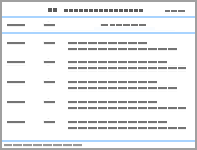
表1
PCR引物序列"
| 用途Purpose | 引物Primer | 序列Sequence (5′-3′) |
|---|---|---|
| 基因过表达 Gene overexpression | GmNIC1-OE-F | AATTTGGCGCCGAAAGAACC |
| GmNIC1-OE-R | GCCTGAGTGTTGCATTTGGG | |
| 基因敲除 Gene knockout | GmNIC1-KO-F | GCATAGTACTTGCTTTGCGTTGG |
| GmNIC1-KO-R | CTCGTGAACAACCTTTGGCTAGG | |
| 基因表达分析 Analysis of gene expression | Actin-F | GATCTACCATGTTCCCAAGT |
| Actin-R | ATAGAGCCACCAATCCAGAC | |
| qGmNIC1-F | GCGTGGTAAAGATGTTCAAGAGT | |
| qGmNIC1-R | CAATATTCGTACTGCCCAAACCA | |
| qGlyma.04G055000-F | ATCTGAGGAGATGCGGAGGA | |
| qGlyma.04G055000-R | CAGTGCTGGATTAACCCCCT | |
| qGlyma.12G086500-F | CGAGTAGAGGAGGAAACAAAACGA | |
| qGlyma.12G086500-R | ATTCTCTCTCCCTTCTCTGGCA | |
| qGlyma.13G242100-F | CGACAGGGGTCCATATCCAG | |
| qGlyma.13G242100-R | CGCTGCAATTCCCCAGTAGA | |
| qGlyma.14G114300-F | CGTAGGAACTGGGTTGGTGT | |
| qGlyma.14G114300-R | CCGACGAAGATGTAAGCGGA |

图1
盐碱胁迫下转基因大豆的生长情况 A:正常生长至V2期的T3代转基因大豆,bar=5 cm;B:盐碱胁迫下生长至V3期的T3代转基因大豆,bar=5 cm;C:基因过表达阳性苗的PCR结果,M:DL2000 DNA Marker;H2O:无模板对照;-:阴性对照;+:质粒阳性对照;D:基因敲除阳性苗的测序结果。WT:野生合丰25大豆幼苗;OE-1、OE-2:过表达GmNIC1的转基因合丰25大豆;KO-1、KO-2:敲除GmNIC1的转基因合丰25大豆"
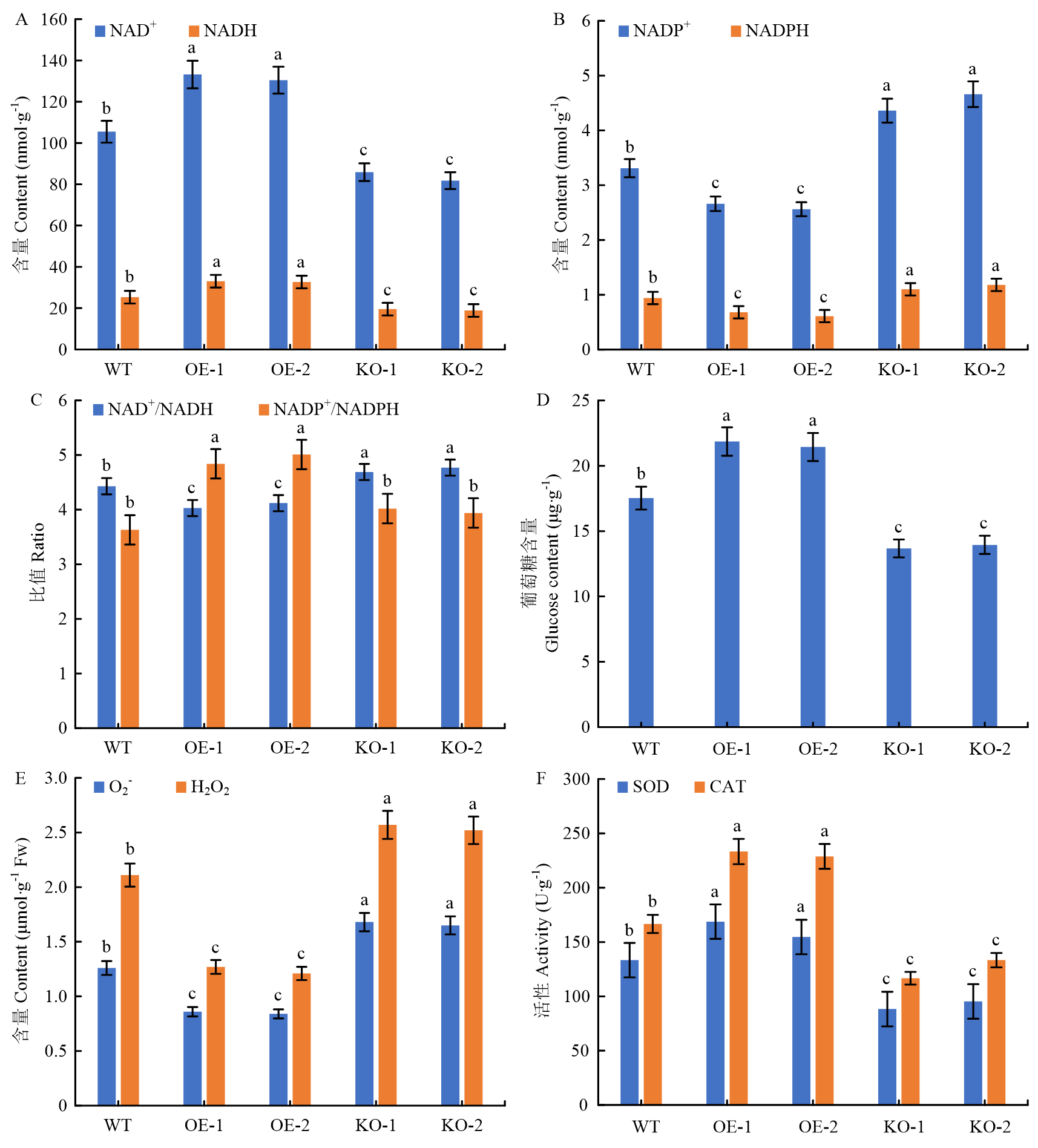
图2
盐碱胁迫下转基因大豆的生理指标 A:NAD+和NADH含量;B:NADP+和NADPH含量;C:NAD+/NADH和NADP+/NADPH;D:葡萄糖的含量;E:O2-和H2O2含量;F:SOD和CAT酶活性。不同小写字母代表差异显著(P<0.05)。下同"
表2
3个对比组合的差异表达基因数"
| 对比组合 Contrast and combination | 上调差异表达基因数 The number of up-regulated genes | 下调差异表达基因数 The number of down-regulated genes |
|---|---|---|
| WT vs OE-1 | 514 | 39 |
| WT vs KO-1 | 607 | 43 |
| OE-1 vs KO-1 | 622 | 125 |

图3
盐碱胁迫下转基因大豆中差异表达基因的GO功能富集"

图4
盐碱胁迫下转基因大豆中差异表达基因的KEGG富集"

图5
蛋白质互作关系网络图 NIT2:Omega-酰胺酶(NIT2);LTP:LTP蛋白家族;MYB63:转录因子MYB63;CGI_12:CGI_12相关蛋白;RAB6:磷酸盐转运系统蛋白;C6T5S0:含AP2/ERF结构域的蛋白质;CML14:CML14相关钙结合蛋白;SMC:SMC家族蛋白;DDX51:ATP依赖性RNA解旋酶DDX51;CLV1B:天冬酰胺合成酶蛋白(CLV1B)。每个元素之间线的粗细代表相关性的高低"
表3
蛋白互作分析筛选出与GmNIC1相关的蛋白信息"
| 序号 Number | 交点 Node | 分数 Score | 功能注释 Functional annotation |
|---|---|---|---|
| 1 | Glyma.04G055000 | 988 | Omega-酰胺酶 Omega-amidase |
| 2 | Glyma.12G086500 | 939 | 磷酸盐转运系统蛋白 Phosphate transport system protein |
| 5 | Glyma.13G242100 | 959 | 天冬酰胺合成酶 Asparagine synthetase |
| 6 | Glyma.14G114300 | 954 | ATP依赖性RNA解旋酶 ATP dependent RNA helicase |

图6
不同互作蛋白基因在转基因大豆中的表达量"
| [1] |
冯雯蜜, 周芳雪, 于哲, 牟可欣, 井妍, 李海燕. 大豆抗花叶病毒病基因GmRHF1的克隆及功能分析. 中国农业科学, 2024, 57(23): 4632-4645. doi: 10.3864/j.issn.0578-1752.2024.23.005.
|
|
|
|
| [2] |
doi: 10.3390/ijms232416048 |
| [3] |
doi: 10.3389/fpls.2021.667458 |
| [4] |
周道玮, 胡娟, 李强, 黄迎新. 松嫩平原盐碱地研究进展. 生态学杂志, 2025, 44(5): 1671-1677.
|
|
doi: 10.13292/j.1000-4890.202505.006 |
|
| [5] |
doi: 10.3389/fpls.2023.1217193 |
| [6] |
pmid: 27807106 |
| [7] |
doi: 10.1016/j.molp.2018.07.003 |
| [8] |
|
| [9] |
doi: 10.3389/fpls.2018.01472 |
| [10] |
doi: 10.3389/fpls.2020.00146 pmid: 32161612 |
| [11] |
doi: 10.1038/s41467-023-42629-0 pmid: 37891163 |
| [12] |
doi: 10.1111/tpj.2007.49.issue-6 |
| [13] |
陈平, 吴立文, 王忠伟, 张宇, 郭龙彪. 烟酰胺腺嘌呤二核苷酸(NAD)合成途径和水稻叶片早衰. 中国水稻科学, 2017, 31(5): 447-456.
doi: 10.16819/j.1001-7216.2017.7028 447 |
|
|
|
| [14] |
doi: 10.1093/mp/sss071 |
| [15] |
doi: 10.1271/bbb.70738 |
| [16] |
doi: 10.1016/j.molp.2022.03.003 |
| [17] |
doi: 10.3389/fbioe.2025.1585736 |
| [18] |
doi: 10.3389/fpls.2018.00379 |
| [19] |
杨萍. 外源维生素对盐胁迫下黄瓜种子萌发及植株生理特性的影响[D]. 重庆: 西南大学, 2010.
|
|
|
|
| [20] |
张婉莹, 王怡, 张洋, 窦可欣, 邱桂林, 赵晓菊, 张琦. 烟酰胺调控大豆幼苗耐盐碱性的生理机制研究. 安徽农学通报, 2024, 30(12): 38-44.
|
|
|
|
| [21] |
doi: 10.1094/PDIS-05-22-1126-RE |
| [22] |
|
| [23] |
张琦, 刘兴宇, 任馨原, 刘雅心, 隋京芮, 严红静, 赵晓菊, 徐杰飞. 大豆GmNIC1基因克隆及非生物胁迫应答分析. 西南农业学报, 2024, 37(12): 2573-2581.
|
|
|
|
| [24] |
doi: 10.1016/j.molp.2015.04.007 |
| [25] |
姚改芳, 张绍铃, 曹玉芬, 刘军, 吴俊, 袁江, 张虎平, 肖长城. 不同栽培种梨果实中可溶性糖组分及含量特征. 中国农业科学, 2010, 43(20): 4229-4237. doi: 10.3864/j.issn.0578-1752.2010.20.014.
|
|
|
|
| [26] |
黄友举, 于泳波, 逄翠晶, 孙轼絮, 路晨, 于延冲. 大豆GmWRKY44生物信息学分析及功能验证. 华北农学报, 2025, 40(1): 29-35.
doi: 10.7668/hbnxb.20195201 |
|
|
|
| [27] |
doi: 10.1016/j.plaphy.2025.110050 |
| [28] |
doi: 10.3390/ijms241512482 |
| [29] |
|
| [30] |
doi: 10.3389/fmicb.2023.1233351 |
| [31] |
马敏, 左震, 韩燕东, 邱野, 乔牡冬. 松嫩平原土壤盐碱化地表基质成因研究. 自然资源遥感, 2025, 37(2): 128-139.
|
|
|
|
| [32] |
|
| [33] |
|
| [34] |
doi: 10.1016/j.cmet.2015.05.023 |
| [35] |
doi: 10.1093/aob/mcp019 |
| [36] |
doi: 10.3390/ijms252413559 |
| [37] |
韩乐乐, 宋文迪, 边嘉珅, 李阳, 杨双胜, 陈紫怡, 李晓薇. 转录组与代谢组联合分析揭示大豆GmERD15c参与盐胁迫下类黄酮的生物合成. 生物技术通报, 2024, 40(10): 243-252.
doi: 10.13560/j.cnki.biotech.bull.1985.2024-0373 |
|
|
|
| [38] |
夏敏, 徐楠, 朱倩锋, 陈彦超, 杜丽桦, 汪启明, 夏新界, 饶力群. 基于转录组学挖掘湘巨1号耐盐相关候选基因. 西南农业学报, 2024, 37(8): 1645-1654.
|
|
|
|
| [39] |
doi: 10.1111/pbi.v23.6 |
| [40] |
doi: 10.1186/s12864-024-11095-3 pmid: 39838316 |
| [1] | 李永娟, 张悦彤, 王艺博, 赵长江, 宋洁, 陈雪丽, 姚钦. 生物炭施用对大豆轮连作系统土壤固氮微生物nifH基因丰度及群落组成的影响[J]. 中国农业科学, 2026, 59(6): 1272-1285. |
| [2] | 刘方东, 孙磊, 王吴彬, 赵晋铭, 盖钧镒. 我国大豆种植制度的变更和生态栽培区划调整的建议[J]. 中国农业科学, 2026, 59(3): 486-498. |
| [3] | 蔡廷阳, 朱玉鹏, 李瑞东, 吴宗声, 徐一帆, 宋雯雯, 徐彩龙, 吴存祥. 苗期叶损伤对黄淮海夏大豆光合特性、荚果分布及产量形成的影响[J]. 中国农业科学, 2026, 59(2): 292-304. |
| [4] | 吴琼, 谢香庭, 王磊, 牟勇, 李进伟. 转基因大豆DBN8205转化体特异性定量PCR方法的研发和验证[J]. 中国农业科学, 2026, 59(1): 29-40. |
| [5] | 严孙辉, 罗程, 陈银基, 庄昕波. 细菌纤维素协同pH偏移处理对大豆分离蛋白凝胶特性与微观结构的影响[J]. 中国农业科学, 2025, 58(6): 1210-1222. |
| [6] | 刘路平, 胡雪洁, 祁金, 陈强, 刘智, 赵田湉, 史晓蕾, 刘兵强, 孟庆民, 张孟臣, 韩天富, 杨春燕. 大豆生育期基因E1和E2的启动子克隆及其表达模式分析[J]. 中国农业科学, 2025, 58(5): 840-850. |
| [7] | 郑煜, 陈颐, 遆晋松, 史龙飞, 许校博, 李昱霖, 郭瑞. 烟草不同轮作模式碳足迹及经济效益评价[J]. 中国农业科学, 2025, 58(4): 733-747. |
| [8] | 马鹤逍, 葛国龙, 张向前, 路战远, 王满秀, 戎美仁, 师晶晶, 张德健, 孙雪萍. 不同作物轮作系统对土壤易氧化有机碳和碳库活度差异性的影响[J]. 中国农业科学, 2025, 58(24): 5201-5215. |
| [9] | 高春华, 赵海军, 赵逢涛, 孔玮琳, 巨飞燕, 李宗新, 石德杨, 刘苹. 生长调节剂对玉米大豆带状间作下夏玉米茎秆特性与产量的影响[J]. 中国农业科学, 2025, 58(23): 4920-4935. |
| [10] | 杨舒淇, 赵影星, 钱欣, 张学鹏, 孟维伟, 隋鹏, 李宗新, 陈源泉. 黄淮地区玉米大豆复合种植模式的综合效益评估[J]. 中国农业科学, 2025, 58(23): 4936-4951. |
| [11] | 房健, 秦召纪, 于园园, 于宁宁, 赵斌, 刘鹏, 任佰朝, 张吉旺. 大豆玉米带状间作下不同行比配置对作物个体和群体产量及效益的影响[J]. 中国农业科学, 2025, 58(23): 4841-4857. |
| [12] | 宋旭辉, 赵雪盈, 赵斌, 任佰朝, 张吉旺, 刘鹏, 任昊. 行比配置对玉米大豆带状复合种植系统冠层光合特性及产量形成的影响[J]. 中国农业科学, 2025, 58(23): 4858-4871. |
| [13] | 石德杨, 高春华, 李艳红, 赵海军, 夏德君. 行距配置对间作玉米冠层特性及产量的影响[J]. 中国农业科学, 2025, 58(23): 4872-4885. |
| [14] | 张梦雨, 何在菊, 王星星, 任昊, 任佰朝, 刘鹏, 张吉旺, 赵斌. 玉米大豆带状复合种植模式下不同株高玉米品种搭配对群体冠层光分布及玉米光合特性的影响[J]. 中国农业科学, 2025, 58(23): 4886-4904. |
| [15] | 孔玮琳, 高春华, 赵逢涛, 巨飞燕, 李宗新, 赵海军, 刘苹. 施氮量与播后滴灌量对玉米大豆带状复合种植系统产量、经济效益及水分利用特性的影响[J]. 中国农业科学, 2025, 58(23): 4905-4919. |
|
||
