






中国农业科学 ›› 2025, Vol. 58 ›› Issue (23): 4886-4904.doi: 10.3864/j.issn.0578-1752.2025.23.007
• 黄淮地区玉米大豆复合种植丰产增效技术研发 • 上一篇 下一篇
张梦雨( ), 何在菊, 王星星, 任昊, 任佰朝, 刘鹏, 张吉旺, 赵斌*()
收稿日期:2025-07-25
接受日期:2025-09-16
出版日期:2025-12-01
发布日期:2025-12-09
通信作者:
联系方式:
张梦雨,E-mail:15621496203@163.com。
基金资助:
ZHANG MengYu(), HE ZaiJu, WANG XingXing, REN Hao, REN BaiZhao, LIU Peng, ZHANG JiWang, ZHAO Bin*()
Received:2025-07-25
Accepted:2025-09-16
Published:2025-12-01
Online:2025-12-09
摘要:
【目的】 探究在玉米大豆带状复合种植模式下,不同株高玉米品种搭配对群体冠层光分布及光资源利用的调控效应。【方法】 于2023—2024年,以不同株高的4个玉米品种为试验材料,包括矮秆品种MY73、登海605(DH605)和高秆品种京科968(JK968)、先玉1466(XY1466)及大豆齐黄34。设置不同间作模式:4行均为同一玉米品种为对照(S-MY、S-DH、S-JK、S-XY),4行密度均为6.75万株/hm2和高矮秆品种搭配(中间行为高秆品种JK968,边行为矮秆品种MY73:MY-JK-1、MY-JK-2;中间行为高秆品种XY1466,边行为矮秆品种DH605:DH-XY-1、DH-XY-2),同时设置2种种植密度:4行密度均为6.75万株/hm2(MY-JK-1、DH-XY-1)和中间行为6.75万株/hm2,边行为8.25万株/hm2(MY-JK-2、DH-XY-2)。玉米大豆行配置均为4﹕4,各处理大豆株距均相同。重点分析不同间作模式对群体冠层结构、光分布、玉米光合特性及作物产量的影响。【结果】 不同株高玉米品种搭配种植优化了冠层结构,显著改善玉米穗位层透光率,提高了玉米叶面积指数和光合特性,最终促进系统产量的增加。在吐丝期,MY-JK-1、MY-JK-2的穗位层透光率较S-MY、S-JK增加18.55%—88.22%,DH-XY-1、DH-XY-2较S-DH、S-XY的穗位层透光率增加39.26%—55.77%。4个品种(除MY-JK-2下的MY73)在高矮秆搭配模式下的净光合速率(Pn)均有所提高,其中DH605在DH-XY-2模式下的Pn较S-DH提高6.88%,XY1466在DH-XY-2模式下的Pn较S-XY提高10.31%。同时,穗位叶最大光化学效率(Fv/Fm)和潜在活性(Fv/Fo)均有所提升。MY-JK-2模式下的玉米产量较S-MY、S-JK、MY-JK-1模式2年平均分别提高19.44%、9.58%、1.66%;DH-XY-2较S-DH、S-XY、DH-XY-1模式2年平均分别提高30.20%、14.94%、9.21%。2年均为DH-XY-2模式下的玉米产量(12 536.58 kg·hm-2)和系统产量(14 001.29 kg·hm-2)最高。【结论】 与单一玉米品种间作模式相比,不同株高玉米品种搭配种植能够优化群体冠层结构,改善群体冠层光分布,提高玉米穗位层透光率和大豆顶部光合有效辐射。同时,提高了玉米叶面积指数和光合特性,促进光合产物的积累,最终促进系统产量的增加。随着边行密度的增加,玉米产量得到进一步提升。本试验条件下,在黄淮海地区推荐使用矮秆DH605和高秆XY1466搭配种植,中间行密度为6.75万株/hm2且边行为8.25万株/hm2的模式。
张梦雨, 何在菊, 王星星, 任昊, 任佰朝, 刘鹏, 张吉旺, 赵斌. 玉米大豆带状复合种植模式下不同株高玉米品种搭配对群体冠层光分布及玉米光合特性的影响[J]. 中国农业科学, 2025, 58(23): 4886-4904.
ZHANG MengYu, HE ZaiJu, WANG XingXing, REN Hao, REN BaiZhao, LIU Peng, ZHANG JiWang, ZHAO Bin. The Influences of Different Plant Height Combinations of Maize Varieties on Light Distribution in the Canopy and the Photosynthetic Characteristics of Maize Under Maize-Soybean Strip Intercropping Pattern[J]. Scientia Agricultura Sinica, 2025, 58(23): 4886-4904.
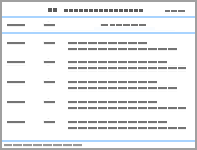
表1
田间配置设计"
| 品种Variety | 玉米带密度Density (plants/hm2) | 处理Treatment | 玉米播种带 Maize seeding strip | 大豆播种带 Soybean seeding strip | |||||||||
|---|---|---|---|---|---|---|---|---|---|---|---|---|---|
| 带宽 Strip width (m) | 带内行数 Rows in strip distance | 株距 Plant to plant distance (cm) | 带宽 Strip width (m) | 带内行数 Rows in strip distance | 株距 Plant to plant distance (cm) | ||||||||
| MY73 | 67500 | S-MY | 2.3 | 4 | 14.6 | 1.75 | 4 | 10 | |||||
| 67500 | MY-JK-1 | 2.3 | 2 | 14.6 | 1.75 | 4 | 10 | ||||||
| 82500 | MY-JK-2 | 2.3 | 2 | 12.0 | 1.75 | 4 | 10 | ||||||
| JK968 | 67500 | S-JK | 2.3 | 4 | 14.6 | 1.75 | 4 | 10 | |||||
| 67500 | MY-JK-1 | 2.3 | 2 | 14.6 | 1.75 | 4 | 10 | ||||||
| 67500 | MY-JK-2 | 2.3 | 2 | 14.6 | 1.75 | 4 | 10 | ||||||
| DH605 | 67500 | S-DH | 2.3 | 4 | 14.6 | 1.75 | 4 | 10 | |||||
| 67500 | DH-XY-1 | 2.3 | 2 | 14.6 | 1.75 | 4 | 10 | ||||||
| 82500 | DH-XY-2 | 2.3 | 2 | 12.0 | 1.75 | 4 | 10 | ||||||
| XY1466 | 67500 | S-XY | 2.3 | 4 | 14.6 | 1.75 | 4 | 10 | |||||
| 67500 | DH-XY-1 | 2.3 | 2 | 14.6 | 1.75 | 4 | 10 | ||||||
| 67500 | DH-XY-2 | 2.3 | 2 | 14.6 | 1.75 | 4 | 10 | ||||||
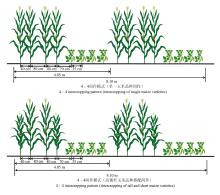
图1
田间种植模式图"
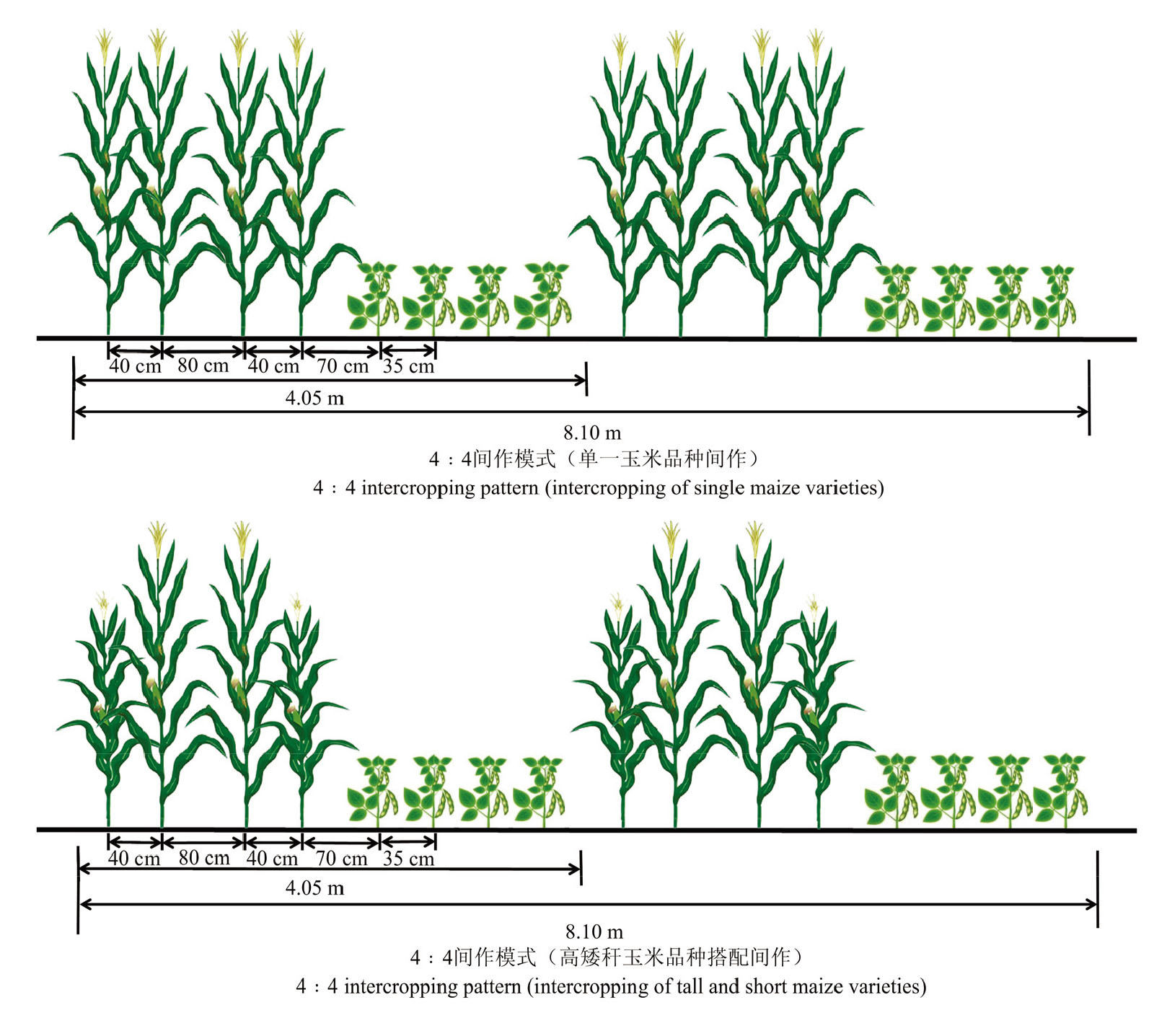
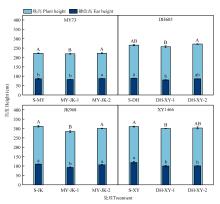
图2
不同间作模式对玉米株高、穗位高的影响 S-MY:MY73与大豆4﹕4间作MY73 intercropped with soybean at a ratio of 4:4;S-DH:DH605与大豆4﹕4间作 DH605 intercropped with soybean at a ratio of 4:4;S-JK:JK968与大豆4﹕4间作 JK968 intercropped with soybean at a ratio of 4:4;S-XY:XY1466与大豆4﹕4间作 XY1466 intercropped with soybean at a ratio of 4:4;MY-JK-1:玉米-大豆4﹕4间作,中间两行为JK968、边行为MY73,4行密度均为6.75万株/hm2 Maize-soybean 4:4 intercropping. The middle two rows are JK968 and the edge rows are MY73. The density of each of the four rows is 6.75×10⁴ plants/hm2;MY-JK-2:玉米-大豆4﹕4间作,中间两行为JK968、边行为MY73,中间行密度为6.75万株/hm2,边行密度为8.25万株/hm2 Maize-soybean 4:4 intercropping. The middle two rows are JK968 and the edge rows are MY73. The density of the middle rows is 6.75×10⁴ plants/hm2, and the density of the edge rows is 8.25×10⁴ plants/hm2;DH-XY-1:玉米-大豆4﹕4间作,中间两行为XY1466、边行为DH605,4行密度均为6.75万株/hm2 Maize-soybean 4:4 intercropping. The middle two rows are XY1466 and the edge rows are DH605. The density of each of the four rows is 6.75×10⁴ plants/hm2;DH-XY-2:玉米-大豆4﹕4间作,中间两行为XY1466、边行为DH605,中间行密度为6.75万株/hm2,边行密度为8.25万株/hm2 Maize-soybean 4:4 intercropping. The middle two rows are XY1466 and the edge rows are DH605. The density of the middle rows is 6.75×10⁴ plants/hm2, and the density of the edge rows is 8.25×10⁴ plants/hm2。 不同大写字母表示处理间株高在P<0.05水平差异显著,不同小写字母表示处理间穗位高在P<0.05水平差异显著 Different capital letters indicate significant differences in plant height between treatments(P<0.05), and different lowercase letters indicate significant differences in ear height between treatments (P<0.05)。标准误为3次生物学重复(n=3) Values shown are the mean ±SE。下同 The same as below"
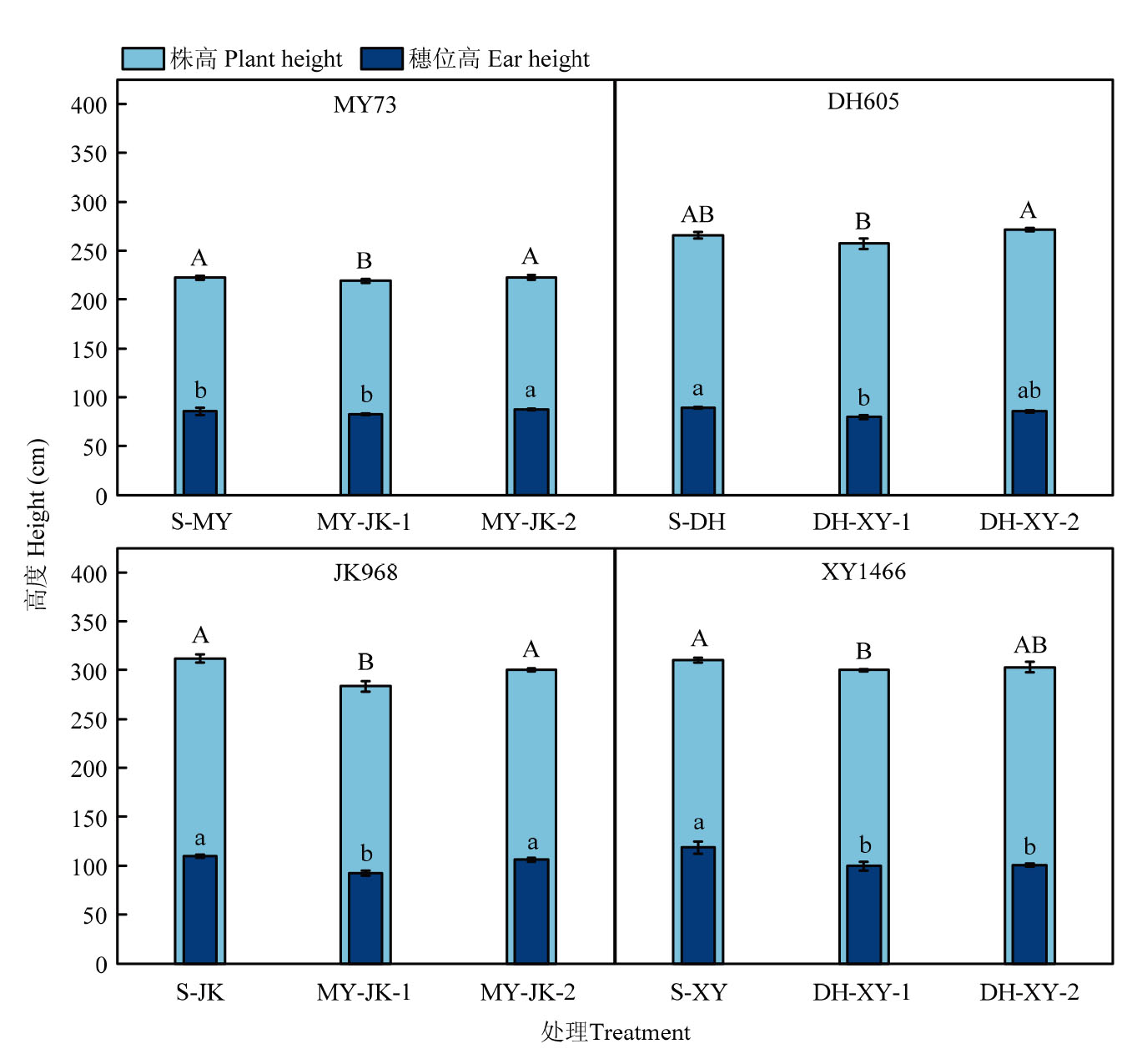
图3
不同间作模式对玉米叶面积指数的影响 R1-M:玉米吐丝期 Silking stage of maize;R3-M:玉米乳熟期 Milking stage of maize;R6-M:玉米成熟期 Maturity stage of maize。下同 The same as below"
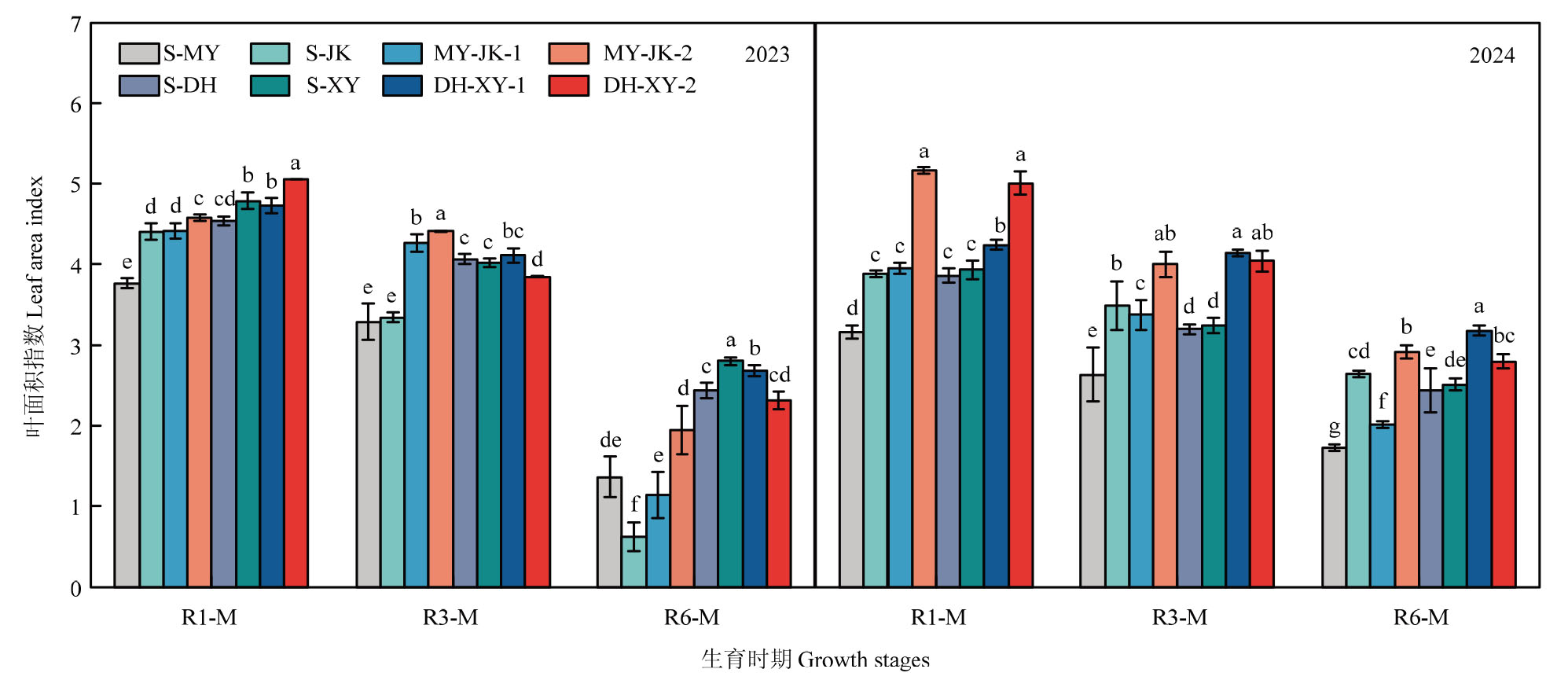
图4
不同间作模式对玉米干物质积累量的影响"
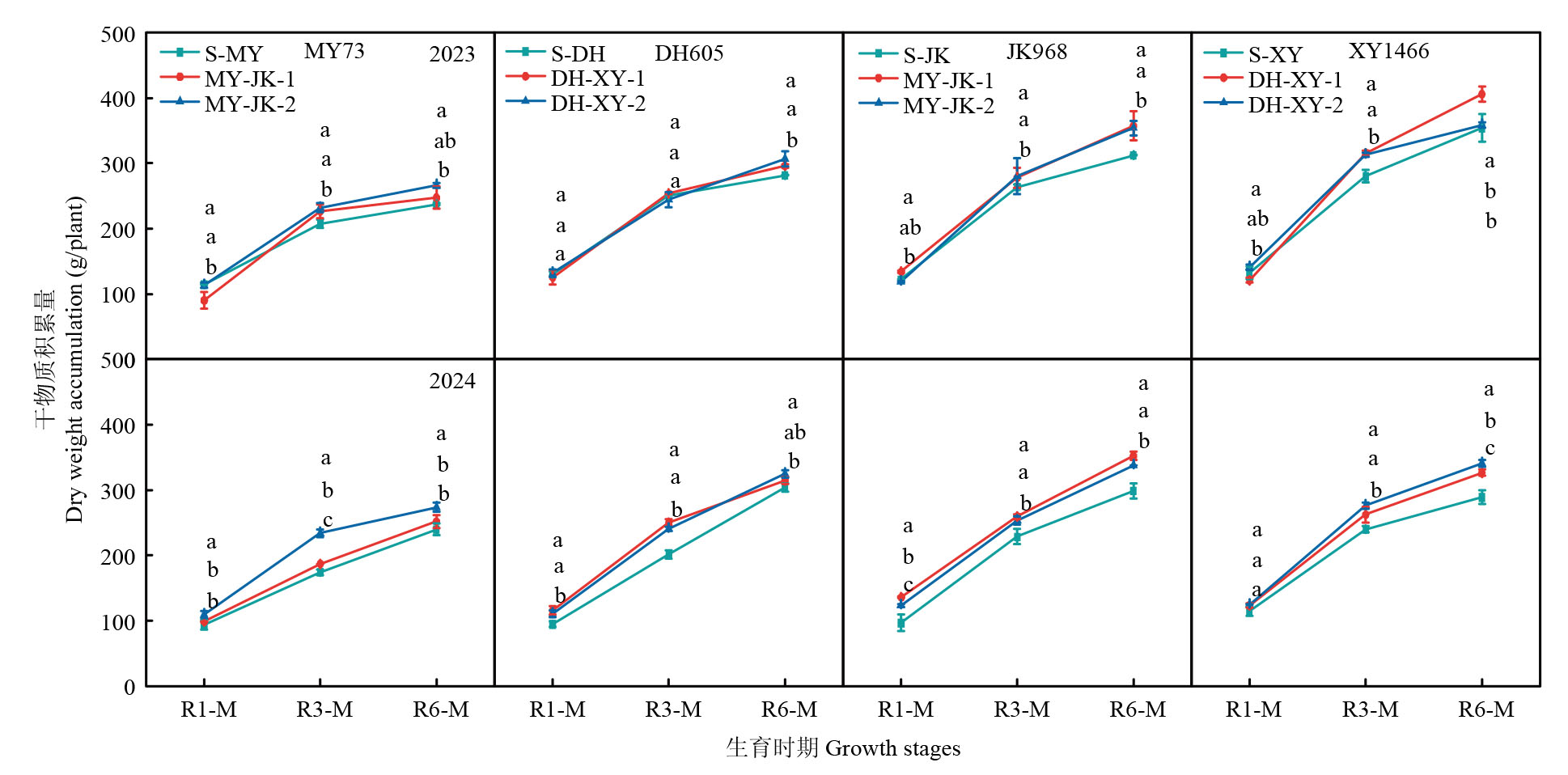
表2
不同间作模式对大豆干物质积累的影响"
| 处理 Treatment | 2023 | 2024 | |||||||
|---|---|---|---|---|---|---|---|---|---|
| R1-S | R3-S | R5-S | R7-S | R1-S | R3-S | R5-S | R7-S | ||
| S-MY | 19.38a | 30.41c | 38.55c | 60.50a | 17.86cd | 34.25bc | 50.76a | 56.28a | |
| S-JK | 20.55a | 37.88ab | 40.50bc | 48.87c | 21.08a | 37.49a | 46.31ab | 51.62b | |
| S-DH | 17.41a | 31.89bc | 43.80ab | 54.00b | 20.01abc | 36.73ab | 46.81ab | 57.98a | |
| S-XY | 18.49a | 31.95bc | 39.00c | 54.15b | 18.52bcd | 35.14ab | 37.22c | 51.42b | |
| MY-JK-1 | 20.28a | 44.24a | 47.65ab | 59.29a | 17.02d | 31.49c | 43.49b | 58.84a | |
| MY-JK-2 | 20.10a | 35.56bc | 53.15a | 57.48a | 19.81abc | 34.73ab | 40.15c | 55.93b | |
| DH-XY-1 | 20.02a | 35.83bc | 45.46ab | 57.96a | 20.39ab | 36.92ab | 41.35c | 52.03b | |
| DH-XY-2 | 18.37a | 36.63ab | 49.34ab | 52.37bc | 18.51bcd | 34.37bc | 43.12b | 48.62c | |
图5
不同间作模式对玉米穗位层透光率和大豆顶部PAR的影响"
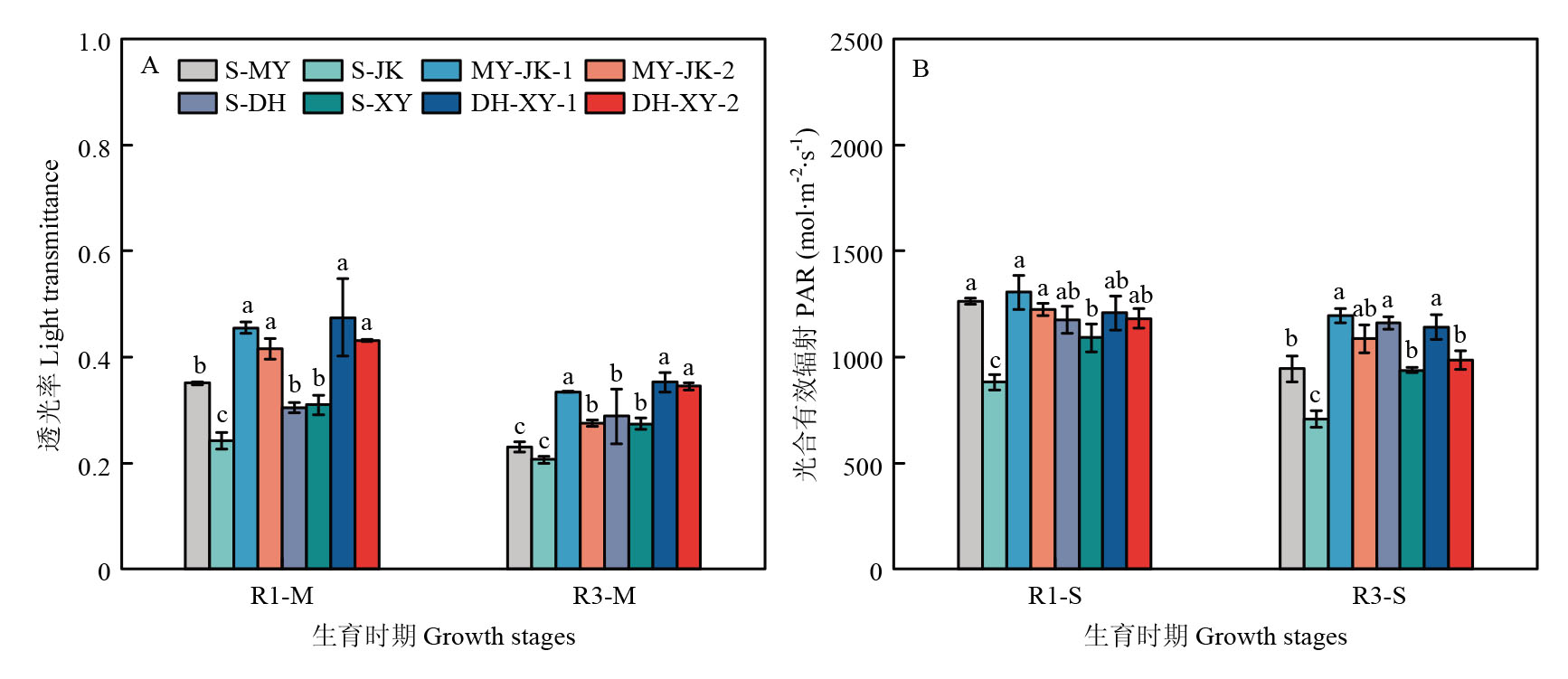
图6
不同间作模式对玉米SPAD值的影响"
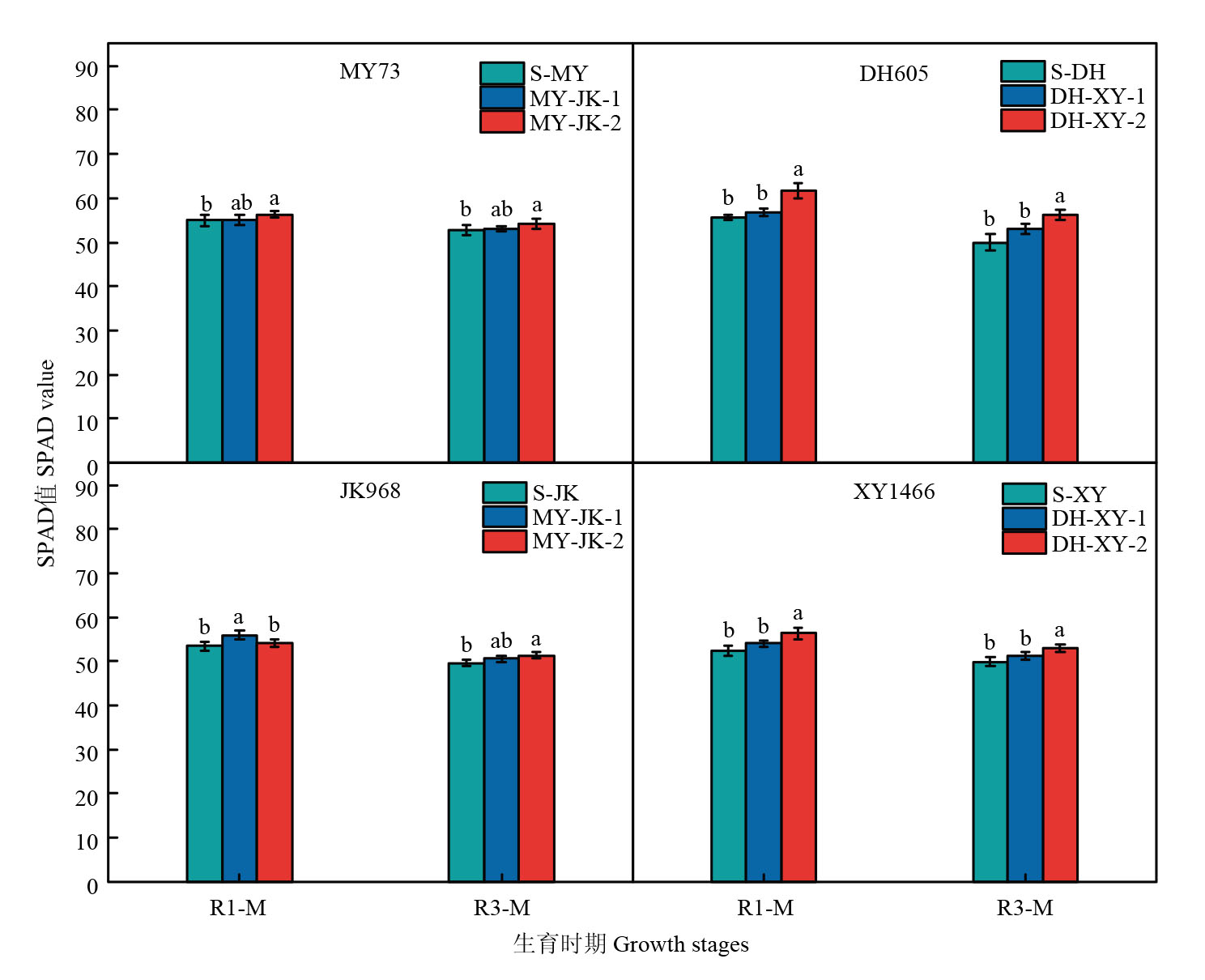
图7
不同间作模式对玉米穗位叶气体交换参数的影响"

表3
不同间作模式对玉米叶绿素荧光参数的影响"
| 处理 Treatment | 叶绿素荧光参数 Chlorophyll fluorescence parameters | |
|---|---|---|
| Fv/Fm | Fv/Fo | |
| S-MY | 0.801±0.006cdB | 3.987±0.077cdeB |
| MY-JK-1 | 0.815±0.003abA | 4.394±0.090abA |
| MY-JK-2 | 0.803±0.007cdB | 4.089±0.144cdB |
| S-DH | 0.809±0.002bcC | 4.228±0.059bcC |
| DH-XY-1 | 0.817±0.002abB | 4.456±0.083abB |
| DH-XY-2 | 0.820±0.002aA | 4.558±0.054aA |
| S-JK | 0.800±0.007cdB | 3.990±0.131cdB |
| MY-JK-1 | 0.815±0.001abA | 4.417±0.033abA |
| MY-JK-2 | 0.801±0.007cdB | 4.021±0.175cdeB |
| S-XY | 0.789±0.010eB | 3.750±0.154eB |
| DH-XY-1 | 0.800±0.009cdA | 3.997±0.058deA |
| DH-XY-2 | 0.799±0.005deA | 3.963±0.064deA |
表4
不同间作模式对各玉米品种产量的影响"
| 年份 Year | 处理 Treatment | 穗粒数 Spike grain number | 千粒重 1000-grain weight (g) | 产量 Yield (kg·hm-2) |
|---|---|---|---|---|
| 2023 | S-MY | 526.91dB | 259.04eB | 4465.56 |
| MY-JK-1 | 552.24bcA | 273.49eA | 4866.91 | |
| MY-JK-2 | 524.84dB | 261.06eB | 5345.49 | |
| S-JK | 527.01dC | 300.54dB | 4927.89 | |
| MY-JK-1 | 552.73bcA | 322.97cA | 5730.43 | |
| MY-JK-2 | 547.35bcB | 303.84dB | 5256.39 | |
| S-DH | 533.10cdB | 323.16cB | 5317.40 | |
| DH-XY-1 | 552.87bcA | 348.18aA | 6036.60 | |
| DH-XY-2 | 566.88abA | 326.22cB | 7306.07 | |
| S-XY | 562.35bC | 332.56bB | 6094.83 | |
| DH-XY-1 | 575.12aB | 344.43aA | 6456.57 | |
| DH-XY-2 | 585.24aA | 342.24aA | 6627.34 | |
| 2024 | S-MY | 482.86abB | 263.29dA | 4269.34 |
| MY-JK-1 | 502.65aA | 265.13dA | 4472.15 | |
| MY-JK-2 | 478.24bB | 257.51eB | 4983.55 | |
| S-JK | 452.63dC | 321.35cB | 4597.21 | |
| MY-JK-1 | 484.02abA | 335.11abA | 5471.30 | |
| MY-JK-2 | 478.52bB | 333.48bA | 5276.25 | |
| S-DH | 400.46eB | 334.91abA | 4305.18 | |
| DH-XY-1 | 444.98dA | 333.62abA | 5055.09 | |
| DH-XY-2 | 411.76eB | 327.35cB | 5587.53 | |
| S-XY | 461.92cB | 320.12cC | 4819.74 | |
| DH-XY-1 | 485.48abA | 336.82aA | 5366.39 | |
| DH-XY-2 | 483.18abA | 332.64bB | 5552.23 |
图8
不同间作模式对玉米产量的影响"
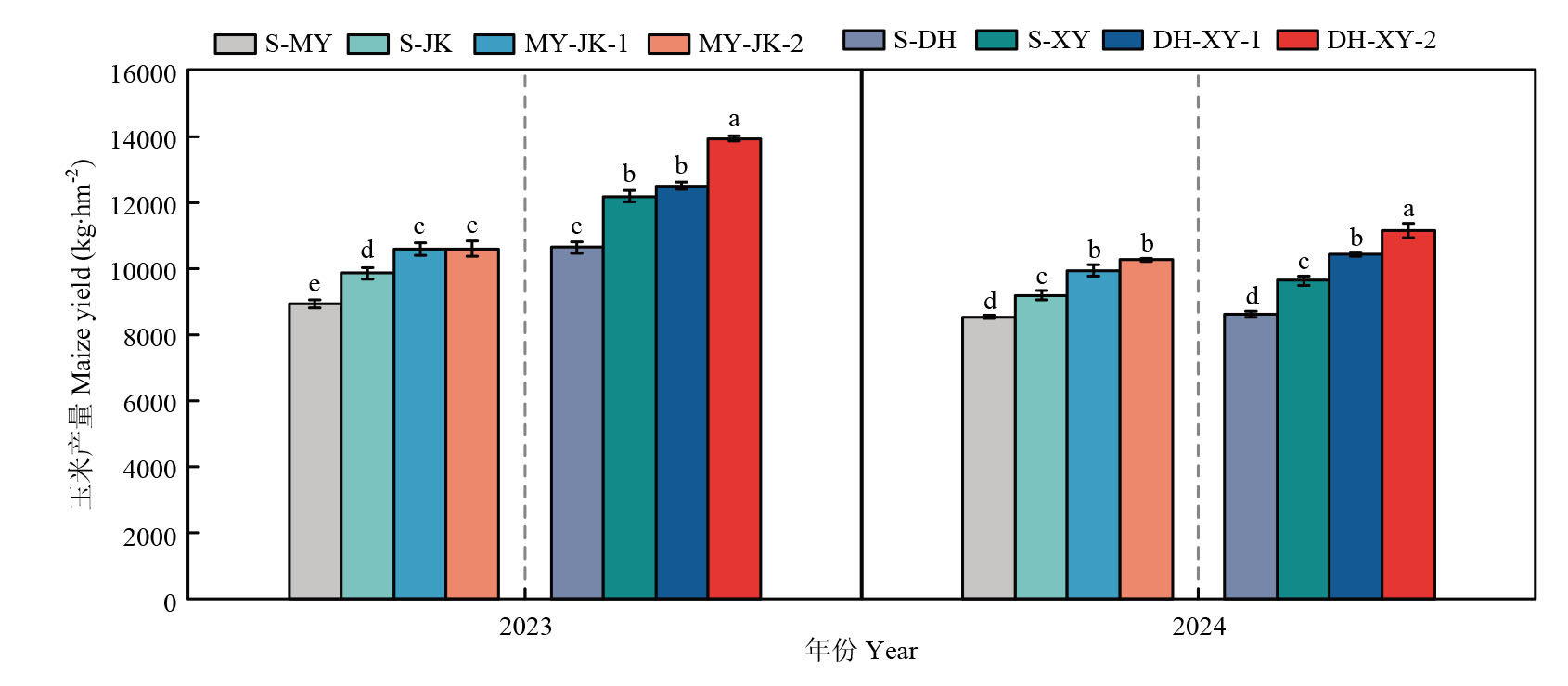
表5
不同间作模式对大豆产量的影响"
| 年份 Year | 处理 Treatment | 株粒数 Number of grains per plant | 公顷株数 Number of plants per hectare (104·hm-2) | 百粒重 100-grain weight (g) | 产量 Yield (kg·hm-2) |
|---|---|---|---|---|---|
| 2023 | S-MY | 95.00a | 7.50a | 27.92a | 1990.62a |
| S-JK | 81.37c | 7.34bc | 24.49c | 1462.85d | |
| S-DH | 89.78ab | 7.49b | 26.49b | 1780.61b | |
| S-XY | 77.32d | 7.45b | 26.81b | 1545.18c | |
| MY-JK-1 | 85.44b | 7.74a | 27.38a | 1809.60a | |
| MY-JK-2 | 87.00b | 7.14c | 26.92ab | 1672.80c | |
| DH-XY-1 | 85.56b | 7.68a | 27.22a | 1754.74b | |
| DH-XY-2 | 74.67d | 7.57a | 26.03b | 1470.77d | |
| 2024 | S-MY | 85.00a | 8.20b | 26.74bc | 1863.31a |
| S-JK | 69.75c | 8.16b | 26.25c | 1493.54c | |
| S-DH | 65.40d | 7.90c | 27.10b | 1400.40d | |
| S-XY | 65.50d | 8.17b | 27.49a | 1470.29c | |
| MY-JK-1 | 72.00b | 8.59a | 27.28b | 1687.68b | |
| MY-JK-2 | 63.70d | 8.00c | 27.54a | 1403.64d | |
| DH-XY-1 | 68.00c | 8.36a | 27.17b | 1544.56b | |
| DH-XY-2 | 66.33cd | 8.02c | 27.41a | 1458.64c |
表6
不同间作模式对经济效益的影响"
| 年份 Year | 处理 Treatment | 系统产量 Total system yield (kg·hm-2) | 玉米产值 Maize output value (yuan/hm2) | 大豆产值 Soybean output value (yuan/hm2) | 经济效益 Economic profit (yuan/hm2) |
|---|---|---|---|---|---|
| 2023 | S-MY | 10921.74d | 22381.39e | 9029.45a | 17439.71d |
| S-JK | 11318.63d | 24698.58d | 6635.49d | 16874.07d | |
| S-DH | 12415.41c | 26650.81c | 8076.85b | 20364.08c | |
| S-XY | 13734.84c | 30547.29b | 7008.94c | 23192.65b | |
| MY-JK-1 | 12396.94c | 26531.87c | 8208.35b | 20524.66c | |
| MY-JK-2 | 12274.68c | 26568.31c | 7587.82c | 19769.89c | |
| DH-XY-1 | 14247.91b | 31307.88b | 7959.50b | 24903.81b | |
| DH-XY-2 | 15404.18a | 34917.13a | 6671.41d | 27010.68a | |
| 2024 | S-MY | 10401.99c | 22542.12d | 9875.54a | 18446.53c |
| S-JK | 10687.95c | 24273.24c | 7915.76c | 17729.00c | |
| S-DH | 10010.76c | 22731.35d | 7422.12c | 15789.90d | |
| S-XY | 11109.77b | 25448.23c | 7792.54c | 18877.19c | |
| MY-JK-1 | 11631.13b | 26250.71b | 8944.70b | 20979.85b | |
| MY-JK-2 | 11663.44b | 27085.87b | 7439.29c | 20138.92b | |
| DH-XY-1 | 11966.04b | 27512.71b | 8186.17b | 21335.30a | |
| DH-XY-2 | 12598.39a | 29408.94a | 7730.79c | 22561.87a |
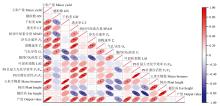
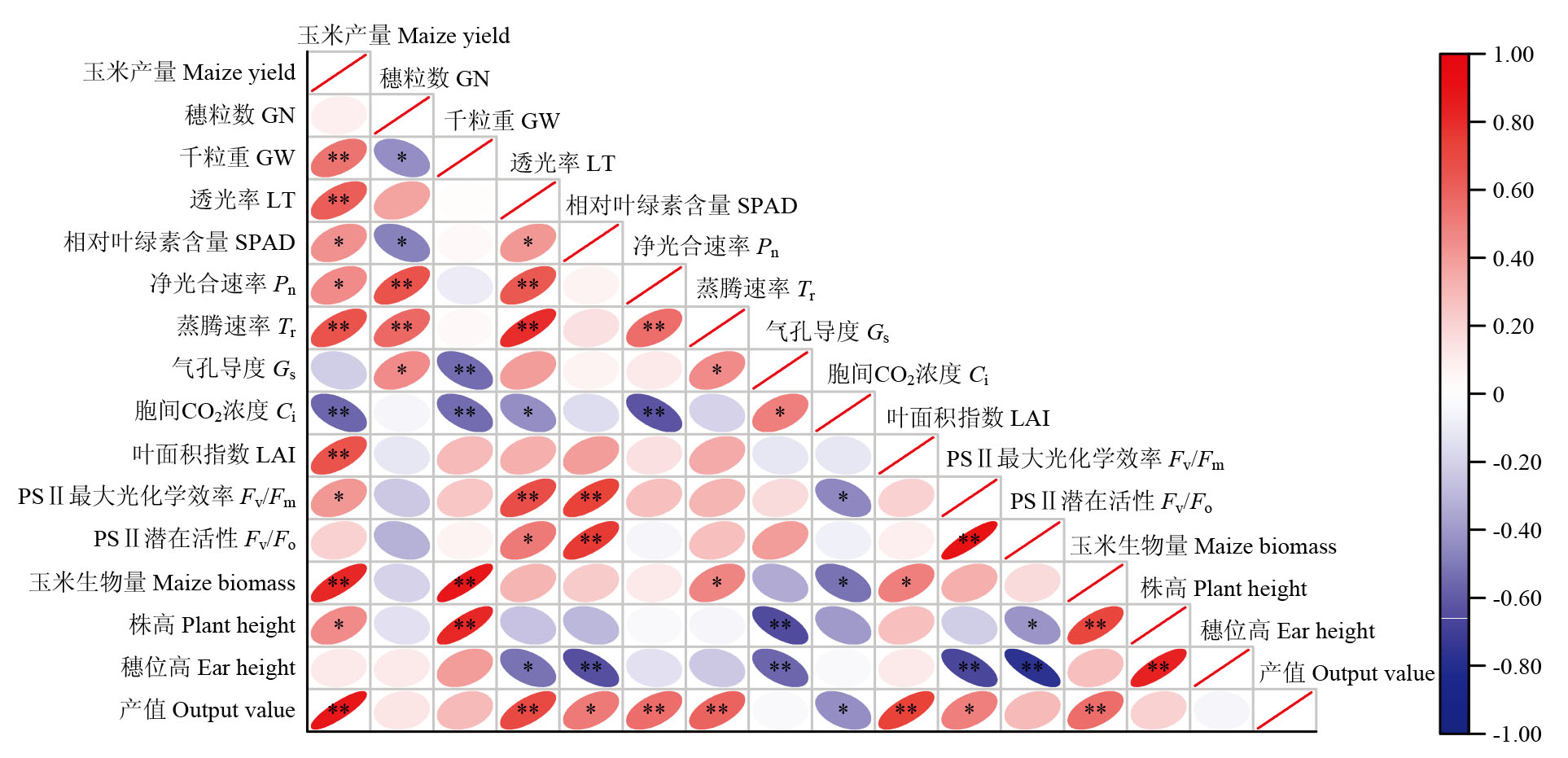
图9
不同间作模式下冠层透光率、光合特性与玉米产量的相关性分析 GN:玉米穗粒数 The number of maize kernels per ear;GW:玉米千粒重 The thousand-grain weight of maize。*、**分别表示在0.05、0.01水平上显著相关 *, ** respectively indicates that the correlation is significant at 0.05 and 0.01"
| [1] |
doi: 10.3390/agronomy9070375 |
| [2] |
董奎军, 张亦涛, 刘瀚文, 张继宗, 王伟军, 温延臣, 雷秋良, 文宏达. 玉米大豆间作减量施氮对当季作物农艺性状、经济效益和后茬小麦产量的影响. 中国农业科学, 2024, 57(22): 4495-4506. doi:10.3864/j.issn.0578-1752.2024.22.009.
|
|
|
|
| [3] |
杨文钰, 杨峰. 发展玉豆带状复合种植, 保障国家粮食安全. 中国农业科学, 2019, 52(21): 3748-3750. doi:10.3864/j.issn.0578-1752.2019.21.003.
|
|
|
|
| [4] |
李双伟, 朱俊奇,
|
|
|
|
| [5] |
代希茜, 詹和明, 崔兴洪, 赵银月, 单丹丹, 张亮, 王铁军. 玉米大豆间作种植密度耦合数学模型及其优化方案研究. 作物杂志, 2019(2): 128-135.
|
|
|
|
| [6] |
朱元刚, 高凤菊, 曹鹏鹏, 王乐政. 种植密度对玉米-大豆间作群体产量和经济产值的影响. 应用生态学报, 2015, 26(6): 1751-1758.
|
|
|
|
| [7] |
doi: 10.1093/jxb/eru406 pmid: 25324402 |
| [8] |
doi: 10.1016/j.fcr.2016.10.003 |
| [9] |
doi: 10.1007/s11099-012-0011-0 |
| [10] |
doi: 10.1016/j.fcr.2018.05.010 |
| [11] |
doi: 10.1016/j.fcr.2021.108122 |
| [12] |
汪直华. 西北地区玉米大豆带状间作田间配置对作物光能截获和产量的影响[D]. 雅安: 四川农业大学, 2023.
|
|
|
|
| [13] |
doi: 10.1016/j.agwat.2024.108817 |
| [14] |
赵德强, 李彤, 侯玉婷, 元晋川, 廖允成. 玉米大豆间作模式下干物质积累和产量的边际效应及其系统效益. 中国农业科学, 2020, 53(10): 1971-1985. doi:10.3864/j.issn.0578-1752.2020.10.005.
|
|
|
|
| [15] |
doi: 10.1016/j.cj.2024.12.005 |
| [16] |
武晶, 陈梦, 汪直华, 杨继芝, 李燕丽, 吴雨珊, 杨文钰. 带状间作不同带间距对玉米光能利用的影响. 中国农业科学, 2023, 56(23): 4648-4659. doi:10.3864/j.issn.0578-1752.2023.23.007.
|
|
|
|
| [17] |
陶静静, 王海标, 朱宗瑛, 谭金芳, 王宜伦. 不同基因型夏玉米间作对产量及氮素吸收利用的影响. 华北农学报, 2016, 31(6): 185-191.
doi: 10.7668/hbnxb.2016.06.029 |
|
doi: 10.7668/hbnxb.2016.06.029 |
|
| [18] |
焦贵华. 不同基因型夏玉米间作对产量及冠层光合特性的影响[D]. 保定: 河北农业大学, 2022.
|
|
|
|
| [19] |
卫得杰. 密植条件下高矮玉米品种间作对产量形成的影响[D]. 保定: 河北农业大学, 2023.
|
|
|
|
| [20] |
doi: 10.1016/j.fcr.2018.02.012 |
| [21] |
doi: 10.1016/j.eja.2022.126664 |
| [22] |
|
| [23] |
doi: 10.1016/j.agwat.2022.107595 |
| [24] |
丁相鹏, 白晶, 张春雨, 张吉旺, 刘鹏, 任佰朝, 赵斌. 扩行缩株对夏玉米群体冠层结构及产量的影响. 中国农业科学, 2020, 53(19): 3915-3927. doi:10.3864/j.issn.0578-1752.2020.19.006.
|
|
|
|
| [25] |
柏延文, 杨永红, 朱亚利, 李红杰, 薛吉全, 张仁和. 种植密度对不同株型玉米冠层光能截获和产量的影响. 作物学报, 2019, 45(12): 1868-1879.
doi: 10.3724/SP.J.1006.2019.93011 |
|
|
|
| [26] |
doi: 10.1016/j.eja.2015.10.001 |
| [27] |
doi: 10.1016/j.agwat.2016.03.014 |
| [28] |
徐宗贵, 孙磊, 王浩, 王淑兰, 王小利, 李军. 种植密度对旱地不同株型春玉米品种光合特性与产量的影响. 中国农业科学, 2017, 50(13): 2463-2475. doi:10.3864/j.issn.0578-1752.2017.13.006.
|
|
|
|
| [29] |
doi: 10.1038/s41598-021-95242-w pmid: 34344978 |
| [30] |
金容, 李钟, 杨云, 周芳, 杜伦静, 李小龙, 孔凡磊, 袁继超. 密度和株行距配置对川中丘区夏玉米群体光分布及雌雄穗分化的影响. 作物学报, 2020, 46(4): 614-630.
doi: 10.3724/SP.J.1006.2020.93034 |
|
doi: 10.3724/SP.J.1006.2020.93034 |
|
| [31] |
doi: 10.3389/fpls.2022.967203 |
| [32] |
doi: 10.1016/j.fcr.2016.12.018 |
| [33] |
doi: 10.1016/j.eja.2024.127119 |
| [34] |
doi: 10.1016/j.eja.2024.127160 |
| [35] |
doi: 10.1016/S2095-3119(18)62030-1 |
| [36] |
杨小琴, 王洋, 齐晓宁, 孙露莹, 张梦杰, 宋凤斌, 刘胜群, 李向楠, 朱先灿. 高光效种植模式下玉米间作平菇对玉米穗位叶光合特性的影响. 土壤与作物, 2020, 9(2): 166-177.
|
|
|
|
| [37] |
doi: 10.1016/j.cj.2019.09.009 |
| [38] |
杨宏伟. 玉米间作豌豆干物质累积对密植响应的光合生理与分子机制[D]. 兰州: 甘肃农业大学, 2021.
|
|
|
|
| [39] |
doi: 10.1016/j.agee.2024.109301 |
| [40] |
doi: 10.1016/j.fcr.2021.108077 |
| [41] |
doi: 10.1016/j.fcr.2023.109235 |
| [42] |
doi: 10.1016/j.jclepro.2021.127282 |
| [1] | 石德杨, 高春华, 李艳红, 赵海军, 夏德君. 行距配置对间作玉米冠层特性及产量的影响[J]. 中国农业科学, 2025, 58(23): 4872-4885. |
| [2] | 高春华, 赵海军, 赵逢涛, 孔玮琳, 巨飞燕, 李宗新, 石德杨, 刘苹. 生长调节剂对玉米大豆带状间作下夏玉米茎秆特性与产量的影响[J]. 中国农业科学, 2025, 58(23): 4920-4935. |
| [3] | 李易玲, 彭西红, 陈平, 杜青, 任俊波, 杨雪丽, 雷鹿, 雍太文, 杨文钰. 减量施氮对套作玉米大豆叶片持绿、光合特性和系统产量的影响[J]. 中国农业科学, 2022, 55(9): 1749-1762. |
| [4] | 丁相鹏,白晶,张春雨,张吉旺,刘鹏,任佰朝,赵斌. 扩行缩株对夏玉米群体冠层结构及产量的影响[J]. 中国农业科学, 2020, 53(19): 3915-3927. |
|
||
