






中国农业科学 ›› 2026, Vol. 59 ›› Issue (10): 2165-2180.doi: 10.3864/j.issn.0578-1752.2026.10.008
杨菁华( ), 孙娥, 刘小欢, 张盼, 戴莹葆, 王文辉, 董涵, 左存武()
收稿日期:2026-01-14
接受日期:2026-03-13
出版日期:2026-05-16
发布日期:2026-05-20
通信作者:
联系方式:
杨菁华,E-mail:1594560599@qq.com。
基金资助:
YANG JingHua(), SUN E, LIU XiaoHuan, ZHANG Pan, DAI YingBao, WANG WenHui, DONG Han, ZUO CunWu()
Received:2026-01-14
Accepted:2026-03-13
Published:2026-05-16
Online:2026-05-20
摘要:
【目的】钙/钙调蛋白调控受体样激酶(calcium/calmodulin-regulated receptor-like kinase,CRLK)在低温胁迫和淀粉合成中发挥重要作用,但该基因在植物免疫中的功能研究较少。研究PbeCRLK2在杜梨(Pyrus betulifolia)对梨腐烂病免疫应答过程中的具体功能,为梨树抗腐烂病育种提供理论依据与基因资源。【方法】通过生物信息学和亚细胞定位,明确PbeCRLK2的基本特征。结合果实瞬时表达和悬浮细胞稳定表达体系验证PbeCRLK2的抗病功能,进一步通过活性氧(ROS)检测及免疫相关通路基因表达分析,探究其调控的下游免疫通路。对经梨腐烂病菌(Valsa pyri)代谢物处理后不同时间段的PbeCRLK2过表达细胞进行转录组分析及qRT-PCR验证,进一步研究PbeCRLK2调控梨腐烂病抗性的作用机理。【结果】PbeCRLK2是定位于细胞膜、进化保守的胞质类受体激酶,其表达可被梨腐烂病菌代谢物显著诱导。瞬时和稳定表达PbeCRLK2能显著抑制梨腐烂病菌侵染,增强杜梨对腐烂病的抗性。其中瞬时表达72 h病斑直径减少11.59%,稳定表达后病斑直径平均减少44.06%。PbeCRLK2可通过激活WRKY22表达增强模式触发免疫(PTI)响应,诱导活性氧爆发并上调RBOHD、OXI1表达,同时上调水杨酸通路关键基因ChiV的表达,协同增强病原防御能力。对转录组中DC_vs_YC、DT1_vs_YT1、DT2_vs_YT2和DT3_vs_YT3 4个组别的差异基因进行GO和KEGG富集分析发现,差异基因主要在去磷酸化、几丁质分解、脂质代谢、次生代谢产物及萜类物质合成等通路富集。qRT-PCR结果显示,所选基因的表达变化趋势与转录组数据一致,证实转录组数据准确。【结论】PbeCRLK2可能参与几丁质信号传递,进而协同激活模式触发免疫响应、活性氧爆发及水杨酸信号通路增强杜梨对腐烂病抗性,且通过调控去磷酸化相关基因动态表达维持细胞免疫稳态。
杨菁华, 孙娥, 刘小欢, 张盼, 戴莹葆, 王文辉, 董涵, 左存武. 类受体激酶基因PbeCRLK2正调控梨腐烂病抗性[J]. 中国农业科学, 2026, 59(10): 2165-2180.
YANG JingHua, SUN E, LIU XiaoHuan, ZHANG Pan, DAI YingBao, WANG WenHui, DONG Han, ZUO CunWu. Receptor-Like Kinase Gene PbeCRLK2 Positively Regulates the Pyrus betulaefolia Resistance to Pear Valsa Canker[J]. Scientia Agricultura Sinica, 2026, 59(10): 2165-2180.
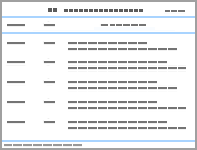
表1
基因克隆、载体构建和qRT-PCR所用引物"
| 基因名称Gene name | 正向引物Forward primer (5′-3′) | 反向引物Reverse primer (5′-3′) |
|---|---|---|
| PbeCRLK2-pFGC5941 | GAGGCGCGCCATGGTTCATCAAACTGATCTTGTTA | GAGGCGCGCCATGGTTCATCAAACTGATCTTGTTA |
| PbeCRLK2-GFP | GAGAACACGGGGGACGAGCTCATGGTTCATCAAA CTGATCTTGTTA | CTTGCTCACCATGGTGTCGACTTCAGTTACTCTTTC GTTCACGCTC |
| PbeCRLK2-qPCR | GTTATCATTGGCGTCTCTGTTGGT | TTGTGCGTATAGGTAGAGTGGTAAGA |
| Actin | TTCAGATACTGTTGTGGAGCCTTAC | AGTAACTCCAGACATTGTTGCAGAG |
| LOX1 | GCTTATGTGGCTGTAAATGACTCTG | GAGGATGCAGAAGTTTGTAAATTGG |
| ChiV | CTACAGCATAAACTACCCCTTCCAG | CGTTCCTATACCGGATCCATTAGC |
| RBOHD | TACGTGGAGATCACTCTCGACATC | CCGCTTCAGCTCCTGAGAGAC |
| OXI1 | CAACTTGGAAAACTCCGAGAAGTC | TTGTCAGTATCCGATAAAACGTCTC |
| WRKY22 | CATATCCAAGGGGATATTACAGATG | GTGACTATAAAAATATTCGGGTCGG |

图1
PbeCRLK2基本生物信息及进化分析 A:PbeCRLK2的基因结构与结构域分析Gene structure and domain analysis of PbeCRLK2,跨膜区 Transmembrane region (TM);丝氨酸/苏氨酸蛋白激酶催化结构域 Serine/threonine protein kinases catalytic domain (S-TKc);B:CRLK2的系统进化分析Phylogenetic analysis of CRLK2;C:CRLK2多序列比对分析Multiple sequence alignment analysis of CRLK2;D:PbeCRLK2亚细胞定位Subcellular localization of PbeCRLK2"
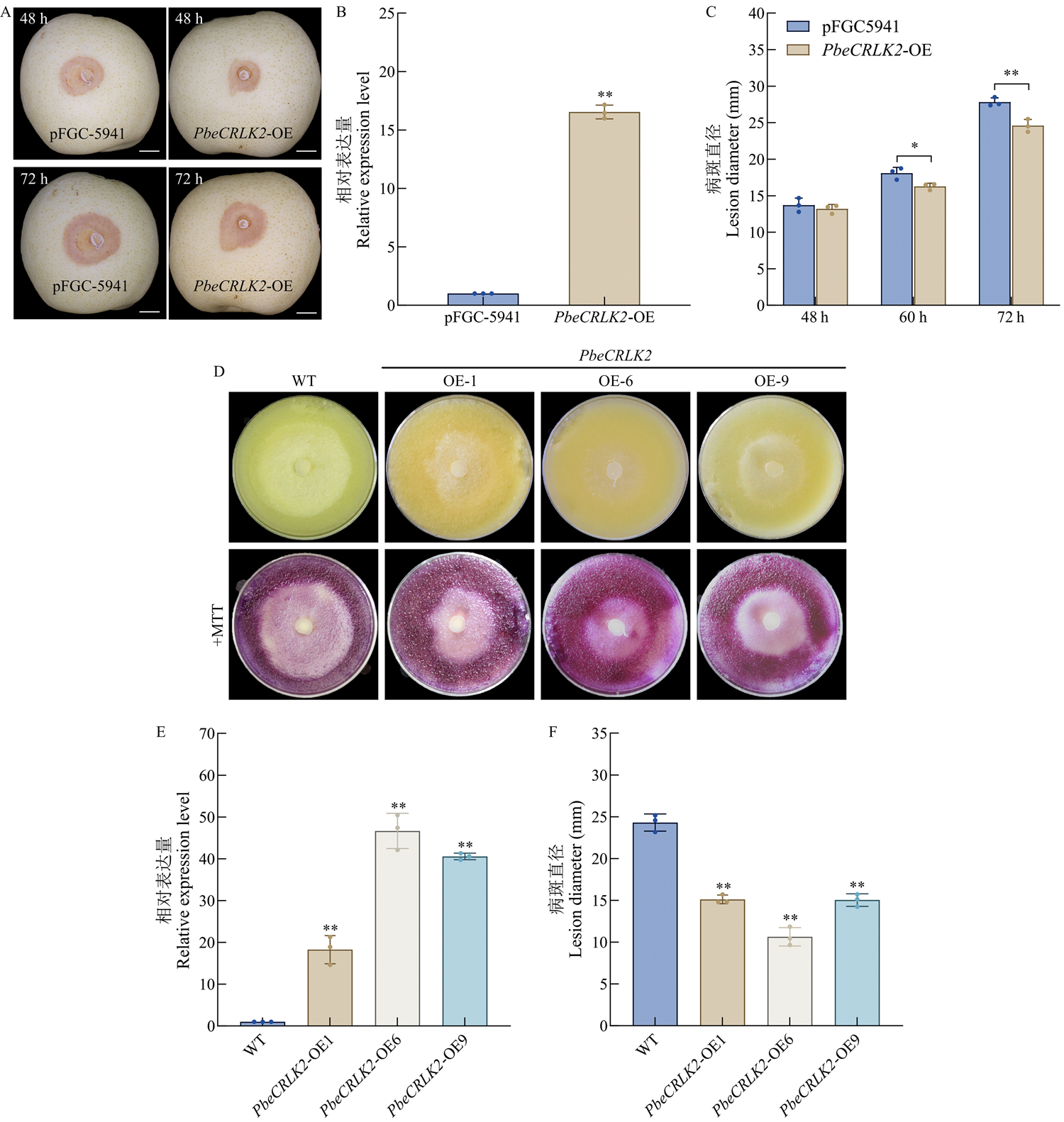
图2
PbeCRLK2过表达增强杜梨对梨腐烂病菌的抗性 A:‘黄冠梨’瞬时表达后接种梨腐烂病菌病斑表型。pFGC-5941为空载对照,PbeCRLK2-OE为过表达果实,标尺=1 cm Lesion phenotype of ‘Huangguan’ pear fruits after transient expression and inoculation with V. pyri. pFGC-5941 is empty vector control, PbeCRLK2-OE is overexpression fruit, bar=1 cm;B:PbeCRLK2在果实注射部位的表达量Expression level of PbeCRLK2 at the fruit injection site;C:果实接种后不同时间点病斑直径Lesion diameter on fruits at different times after inoculation;D:悬浮细胞病斑表型及MTT染色Lesion phenotype and MTT staining of suspension cells;E:过表达PbeCRLK2后的表达量Expression levels after PbeCRLK2 overexpression;F:悬浮细胞病斑直径统计Statistical analysis of lesion diameter in suspension cells *:P<0.05;**:P<0.01。下同The same as below"

图3
过表达PbeCRLK2增强杜梨悬浮细胞对VpM的抗性并诱导活性氧爆发 A、B:经10%、20% VpM处理后不同时间点细胞活性的比较Comparison of cell viability at different times after 10%, 20% VpM treatment, respectively;C、D:10%、20%VpM处理下不同时间点细胞内活性氧水平Intracellular ROS levels at different times after 10%, 20% VpM treatment, respectively"
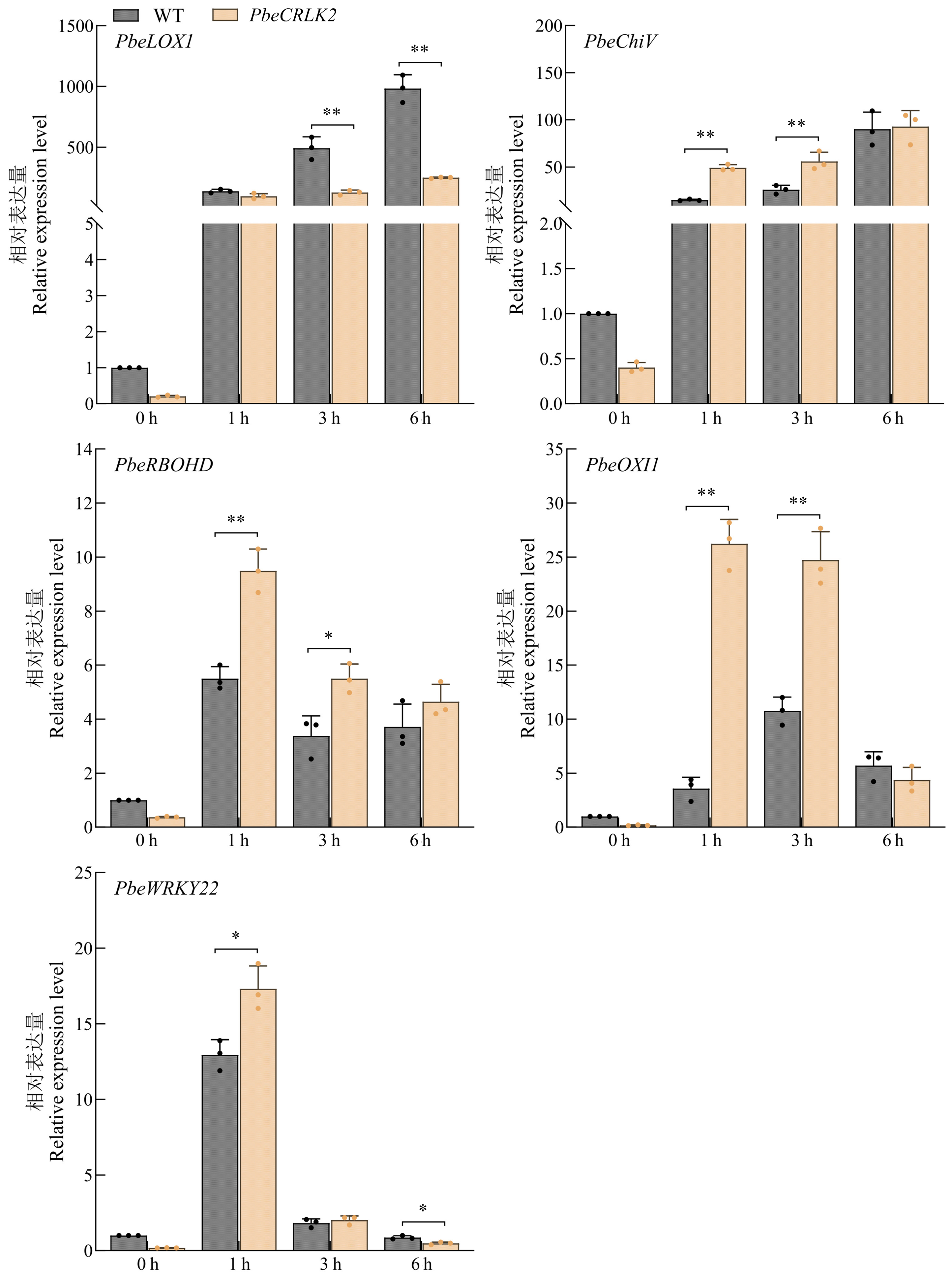
图4
PbeCRLK2激活免疫通路关键基因的表达"
表2
测序数据统计与质量检测"
| 样本 Sample | 原始数据 Raw data | 过滤后数据 Clean data | 过滤后数据比率 Clean data ratio (%) | Q20 (%) | Q30 (%) | GC (%) |
|---|---|---|---|---|---|---|
| YC-1 | 41866810 | 41866810 | 100 | 98.13 | 96.73 | 46.75 |
| YC-2 | 43720318 | 43720318 | 100 | 98.36 | 96.97 | 46.65 |
| YC-3 | 37260460 | 37260460 | 100 | 98.11 | 96.70 | 46.84 |
| YT1-1 | 40110802 | 40110802 | 100 | 98.06 | 96.63 | 46.57 |
| YT1-2 | 36265408 | 36265408 | 100 | 98.17 | 96.81 | 46.52 |
| YT1-3 | 36308808 | 36308808 | 100 | 98.07 | 96.61 | 46.62 |
| YT2-1 | 45657690 | 45657690 | 100 | 98.47 | 97.08 | 46.31 |
| YT2-2 | 39679760 | 39679760 | 100 | 98.25 | 96.92 | 46.35 |
| YT2-3 | 38180810 | 38180810 | 100 | 98.16 | 96.78 | 46.15 |
| YT3-1 | 41359618 | 41359618 | 100 | 98.30 | 97.01 | 46.03 |
| YT3-2 | 42150220 | 42150216 | 100 | 98.40 | 96.97 | 46.09 |
| YT3-3 | 41439948 | 41439948 | 100 | 98.37 | 97.12 | 46.11 |

图5
差异表达基因数目(A)及PbeCRLK2表达趋势(B)"
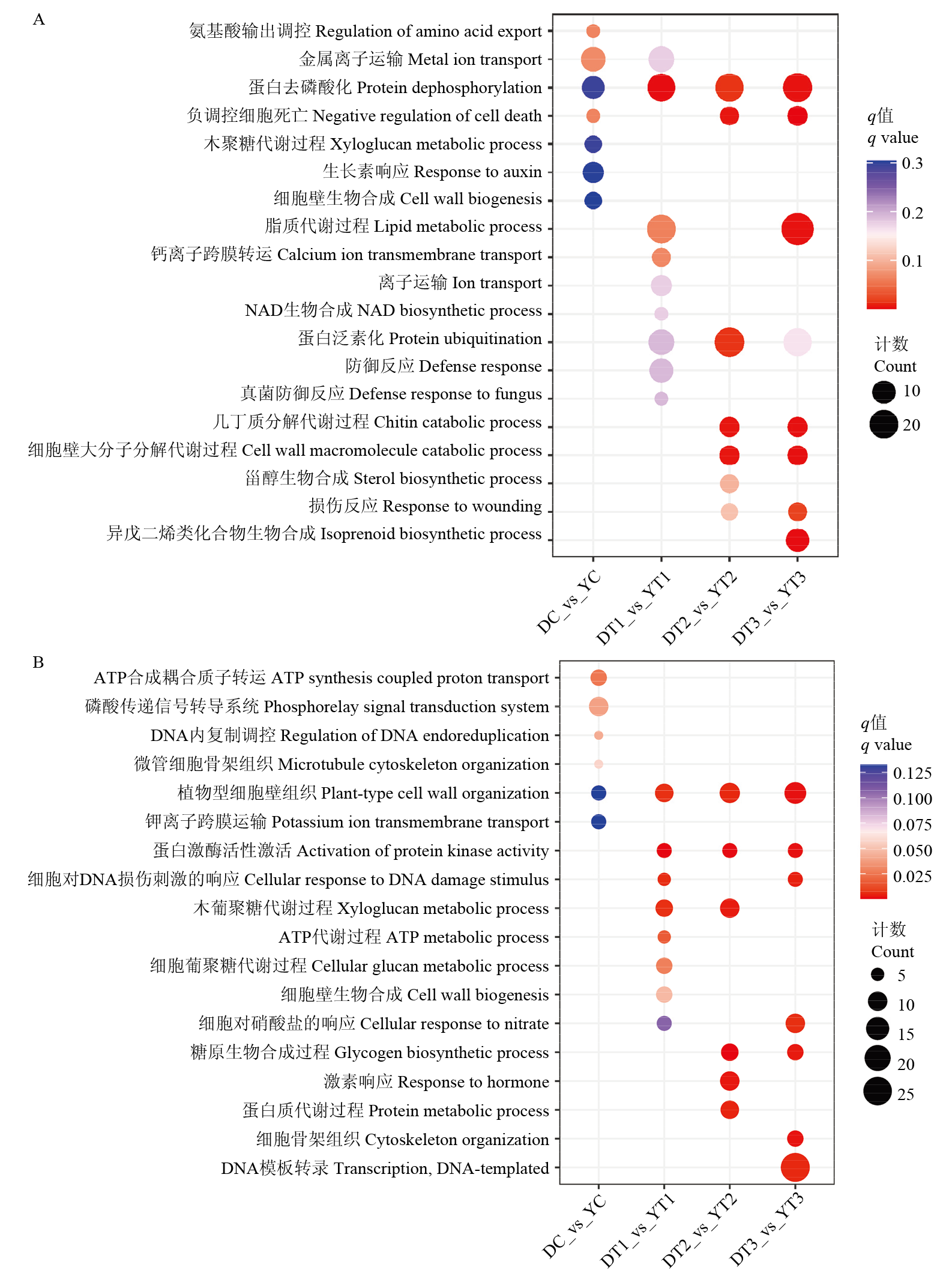
图6
差异表达基因GO富集分析 A:上调差异表达基因Up-regulated DEGs;B:下调差异表达基因Down-regulated DEGs"
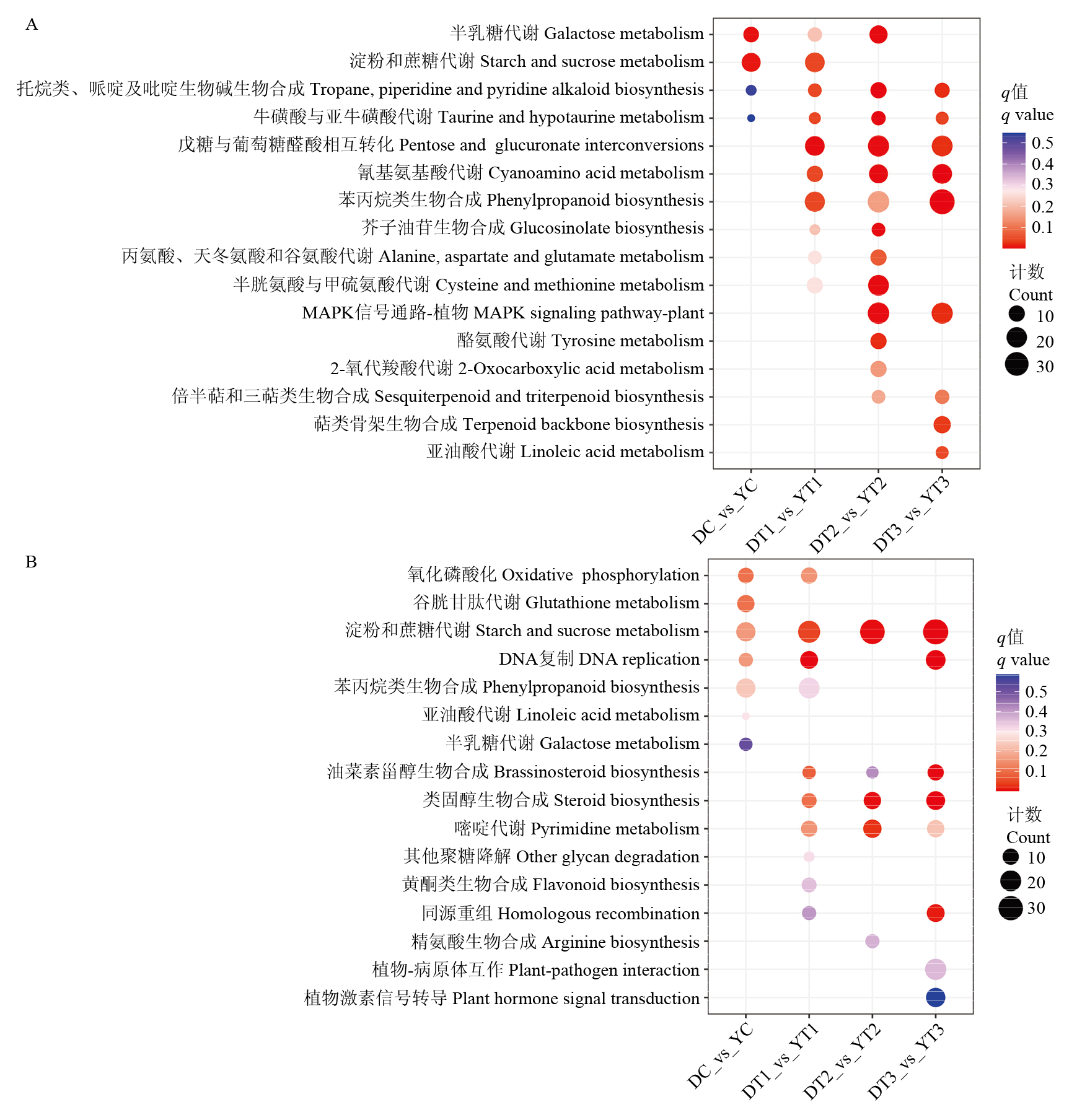
图7
差异表达基因KEGG富集分析 A:上调差异表达基因Up-regulated DEGs;B:下调差异表达基因Down-regulated DEGs"
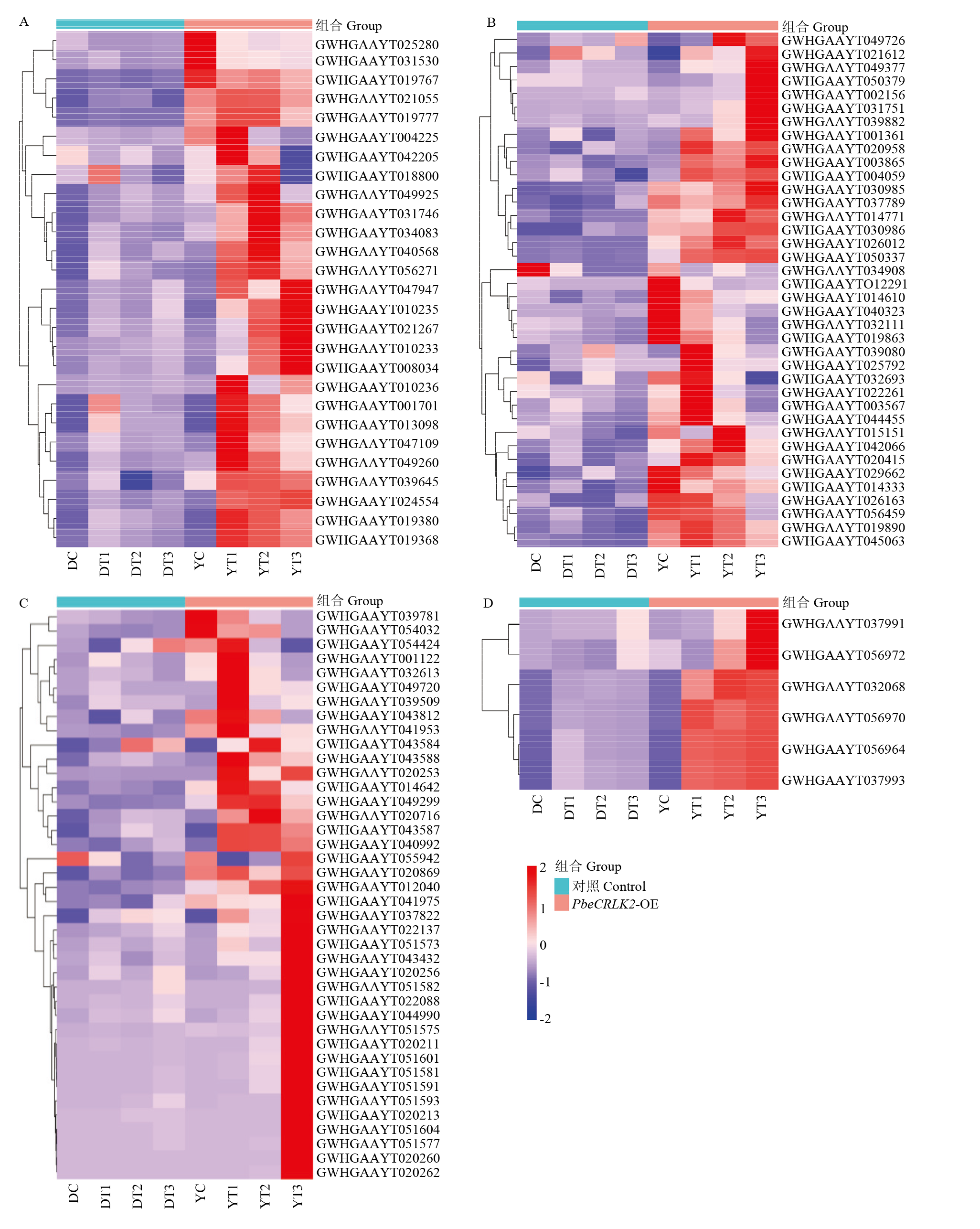
图8
差异表达基因在关键通路中的表达模式分析 A:泛素化通路Ubiquitination pathway;B:去磷酸化通路Dephosphorylation pathway;C:脂质代谢通路Lipid metabolism pathway;D:几丁质分解通路Chitin catabolic pathway"

图9
抗病相关差异基因qRT-PCR和RNA-Seq结果"
| [1] |
张绍铃, 谢智华. 我国梨产业发展现状、趋势、存在问题与对策建议. 果树学报, 2019, 36(8): 1067-1072.
|
|
|
|
| [2] |
联合国粮农组织. 联合国粮食及农业组织统计数据库. (2025-12-31)[2026-03-01]. https://www.fao.org/statistics/zh/.
|
|
Food and Agriculture Organization. Food and Agriculture Organization Statistical Database. (2025-12-31)[2026-03-01]. https://www.fao.org/statistics/zh/. (in Chinese)
|
|
| [3] |
吴芳, 刘红霞, 侯世星, 温俊宝. 梨树腐烂病在香梨树体上的空间分布特点. 中国农学通报, 2012, 28(10): 277-281.
|
|
|
|
| [4] |
王金友, 冯明祥. 新编梨树病虫害防治技术. 北京: 金盾出版社, 2005.
|
|
|
|
| [5] |
王静璞. 梨树主要病害及其防治方法. 现代园艺, 2020, 43(7): 194-195.
|
|
|
|
| [6] |
doi: 10.1105/tpc.16.00891 pmid: 28302675 |
| [7] |
pmid: 15012205 |
| [8] |
doi: 10.1038/s44318-024-00278-z |
| [9] |
doi: 10.1111/ppl.v177.1 |
| [10] |
doi: 10.1111/ppl.v176.3 |
| [11] |
doi: 10.1104/pp.17.00404 |
| [12] |
doi: 10.1146/pharmtox.2001.41.issue-1 |
| [13] |
doi: 10.1111/nph.v233.4 |
| [14] |
doi: 10.1104/pp.17.01024 |
| [15] |
|
| [16] |
|
| [17] |
doi: 10.4161/psb.5.8.12225 |
| [18] |
doi: 10.1186/s12284-024-00702-2 pmid: 38587574 |
| [19] |
doi: 10.1093/jxb/erac417 |
| [20] |
doi: 10.1093/jxb/erad126 |
| [21] |
doi: 10.1007/s13580-022-00444-4 |
| [22] |
杜成龙. 杜梨PbeLecRK-S.4-PbePIP1-4应答效应子NIS1/2调控腐烂病抗性的机制研究[D]. 兰州: 甘肃农业大学, 2025.
|
|
|
|
| [23] |
doi: 10.1074/jbc.M109.035659 |
| [24] |
doi: 10.1016/j.molp.2021.06.010 |
| [25] |
doi: 10.3389/fpls.2018.00867 |
| [26] |
doi: 10.1111/nph.v233.1 |
| [27] |
doi: 10.3390/ijms23105568 |
| [28] |
doi: 10.1146/annurev-arplant-081320-092855 pmid: 33756096 |
| [29] |
UM-E-AIMAN,
doi: 10.1016/j.ijbiomac.2021.02.164 |
| [30] |
doi: 10.1146/annurev-arplant-042817-040322 pmid: 29489394 |
| [31] |
doi: 10.1007/s11103-023-01358-0 |
| [32] |
doi: 10.1007/s11103-020-01069-w |
| [33] |
doi: 10.3390/ijms19051426 |
| [34] |
doi: 10.1093/plcell/koad187 |
| [35] |
|
| [36] |
doi: 10.1016/j.indcrop.2021.113555 |
| [37] |
doi: 10.1111/mpp.2012.13.issue-9 |
| [38] |
doi: 10.1016/j.plaphy.2025.109630 |
| [39] |
doi: 10.1093/jxb/erv001 |
| [40] |
|
| [41] |
doi: 10.1111/mpp.v25.4 |
| [42] |
蔡敏蕊. 苹果类受体激酶基因MdLYK7调控梨腐烂病的抗性功能研究[D]. 兰州: 甘肃农业大学, 2024.
|
|
|
|
| [43] |
doi: 10.3389/fpls.2022.1096268 |
| [44] |
THOLL D. Biosynthesis and biological functions of terpenoids in plants// Advances in Biochemical Engineering-Biotechnology, 2015, 148: 63-106.
doi: 10.1007/10_2014_295 pmid: 25583224 |
| [1] | 王凡, 刘陈玮, 陆红臣, 徐仁超, 卞晓春. 蚕豆响应交链格孢侵染的转录组分析及VfPR4的抗病功能验证[J]. 中国农业科学, 2025, 58(22): 4656-4672. |
| [2] | 张海青, 张恒涛, 高启明, 姚家龙, 王亚荣, 刘珍珍, 孟祥鹏, 周喆, 阎振立. 转录组分析筛选调控苹果分枝能力的关键基因[J]. 中国农业科学, 2024, 57(10): 1995-2009. |
| [3] | 栗晗, 江尚焘, 彭海英, 李培根, 顾长宜, 张金莲, 陈廷速, 徐阳春, 沈其荣, 董彩霞. 接种土著和外源AM真菌对杜梨抗旱性的影响及其适应机制[J]. 中国农业科学, 2024, 57(1): 159-172. |
| [4] | 李慧, 张雨峰, 李晓刚, 王中华, 蔺经, 常有宏. 全基因组DNA甲基化和转录组联合分析鉴定杜梨耐盐相关转录因子[J]. 中国农业科学, 2023, 56(7): 1377-1390. |
| [5] | 彭佳伟, 张叶, 寇单单, 杨丽, 刘晓飞, 张学英, 陈海江, 田义. ‘仓方早生’桃及其早熟芽变不同发育时期果实的转录组分析[J]. 中国农业科学, 2023, 56(5): 964-980. |
| [6] | 王建锋, 成嘉欣, 舒伟学, 张艳茹, 王晓杰, 康振生, 汤春蕾. 小麦条锈菌效应蛋白Hasp83在条锈菌致病性中的功能分析[J]. 中国农业科学, 2023, 56(5): 866-878. |
| [7] | 林兵,陈艺荃,钟淮钦,叶秀仙,樊荣辉. 荷兰鸢尾‘玉妃’花色变异关键结构基因分析[J]. 中国农业科学, 2021, 54(12): 2644-2652. |
| [8] | 周坤能,夏加发,云鹏,王元垒,马廷臣,张彩娟,李泽福. 水稻直立短穗突变体esp的转录组研究[J]. 中国农业科学, 2020, 53(6): 1081-1094. |
| [9] | 孙凯, 李冬秀, 杨靖, 董骥驰, 严贤诚, 罗立新, 刘永柱, 肖武名, 王慧, 陈志强, 郭涛. 水稻耐淹成苗率相关性状全基因组的关联分析[J]. 中国农业科学, 2019, 52(3): 385-398. |
| [10] | 刘希强,张涵,龚攀,宫文龙,王赞. 紫花苜蓿不同发育时期次生壁合成调控的转录组分析[J]. 中国农业科学, 2018, 51(11): 2049-2059. |
| [11] | 陶兴林,侯栋,朱惠霞,刘明霞,张金文,胡立敏. 花椰菜温敏雄性不育系GS-19花药败育的细胞学及转录组分析[J]. 中国农业科学, 2017, 50(13): 2538-2552. |
| [12] | 王俊娟,穆 敏,王 帅,陆许可,陈修贵,王德龙,樊伟丽,阴祖军,郭丽雪,叶武威,喻树迅. 棉花脱水素GhDHN1的克隆及其表达[J]. 中国农业科学, 2016, 49(15): 2867-2878. |
|
||
