






中国农业科学 ›› 2026, Vol. 59 ›› Issue (16): 3465-3475.doi: 10.3864/j.issn.0578-1752.2026.16.001
• 作物遗传育种·种质资源·分子遗传学 • 下一篇
姚方杰1( ), 杨漫宇1, 甘学琴1, 杨宁1, 曾令芸2, 李俊1, 杨武云1, 杨恩年1()
收稿日期:2025-12-30
接受日期:2026-02-16
出版日期:2026-08-16
发布日期:2026-08-17
通信作者:
联系方式:
姚方杰,E-mail:yaofangjie@scsaas.cn。
基金资助:
YAO FangJie1(), YANG ManYu1, GAN XueQin1, YANG Ning1, ZENG LingYun2, LI Jun1, YANG WuYun1, YANG EnNian1()
Received:2025-12-30
Accepted:2026-02-16
Published:2026-08-16
Online:2026-08-17
摘要:
【目的】 川麦82是利用国际玉米小麦改良中心(CIMMYT)持久抗病种质Singh6选育而成的多抗高产小麦新品种。通过构建川麦82基因型图谱,量化双亲对其基因组贡献率,解析其遗传构成,并明确抗病和产量等性状相关遗传位点的亲本来源,为小麦品种改良和亲本精准选配提供科学依据。【方法】 利用小麦100K SNP液相芯片技术对川麦82及其双亲进行全基因组扫描,系统分析其遗传构成;结合芯片搭载的与重要农艺性状及产量性状关联的功能标记,对川麦82的等位基因型进行分析,以追溯其抗病及产量相关性状的遗传来源。【结果】 全基因组分析结果表明,供体亲本Singh6和轮回亲本川农16对川麦82的遗传贡献率分别为16.36%和83.64%,与回交育种的理论预期相符。贡献率在A、B、D亚基因组间呈现A>B>D的差异。在染色体水平上,Singh6的遗传片段并非均匀分布,其在1B、2D、4B、5D和6A染色体上贡献了49.24%—86.91%的遗传组分,形成了显著的大片段供体区段;而川农16在其余多数染色体上的贡献率超过89%,构成了品种的遗传背景。基于功能标记的溯源分析进一步揭示,川麦82的条锈病、叶锈病和白粉病抗性基因主要源自Singh6,而抗穗发芽和产量相关基因则主要继承自川农16。【结论】 在基因组和染色体水平上精准量化了川麦82的遗传构成。尤为重要的是,发现供体亲本Singh6的遗传贡献集中分布于1B、2D、4B、5D和6A等染色体上,形成了大片段供体区段,保留了供体亲本的遗传多样性。结合功能标记分析,部分区段恰好富集了来自Singh6的锈病、白粉病抗性基因。因此,这些大片段供体区段与来自川农16的高产遗传背景的有机结合,很可能是川麦82实现持久抗病与高产协同提升的关键遗传基础。
姚方杰, 杨漫宇, 甘学琴, 杨宁, 曾令芸, 李俊, 杨武云, 杨恩年. 多抗高产小麦新品种川麦82的遗传构成解析[J]. 中国农业科学, 2026, 59(16): 3465-3475.
YAO FangJie, YANG ManYu, GAN XueQin, YANG Ning, ZENG LingYun, LI Jun, YANG WuYun, YANG EnNian. Genetic Composition Analysis of a New Multi-Resistant and High- Yield Wheat Variety, Chuanmai 82[J]. Scientia Agricultura Sinica, 2026, 59(16): 3465-3475.
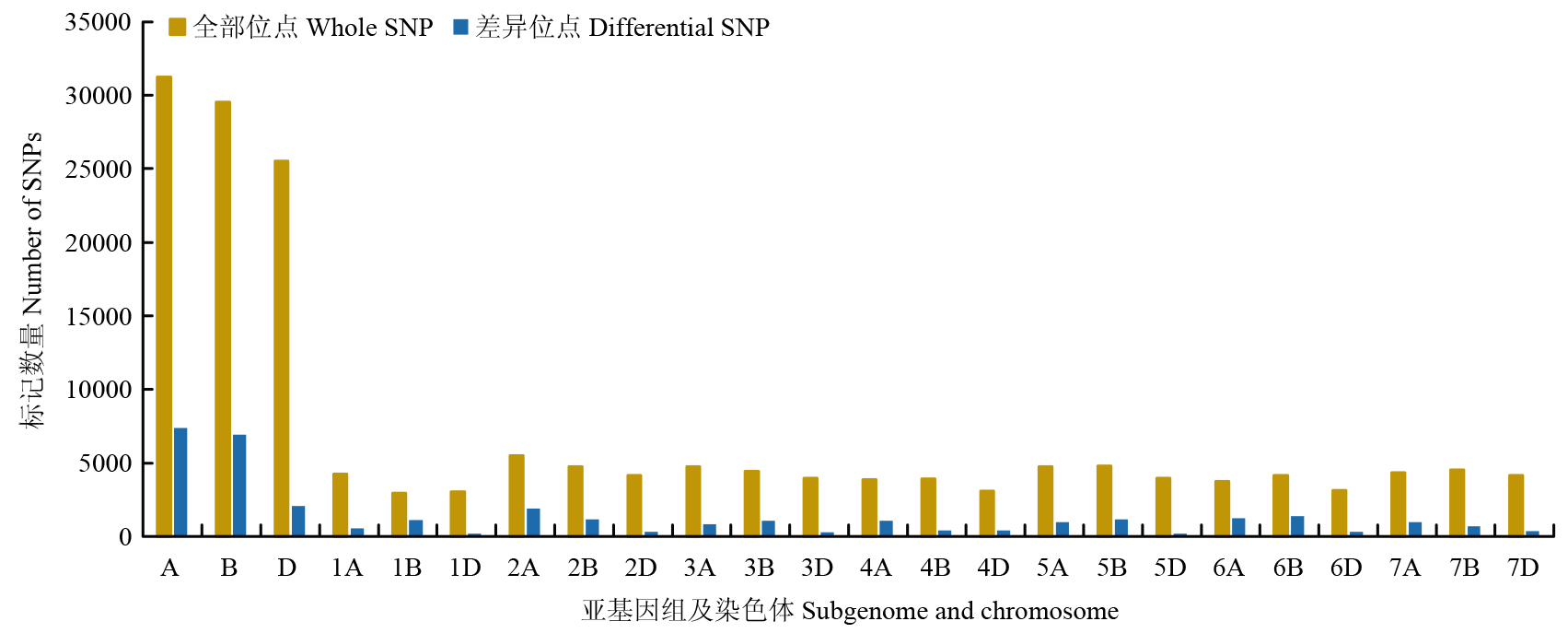
图1
差异位点在A、B、D亚基因组及21条染色体上的分布"
表1
川麦82来源于双亲川麦16和Singh6的遗传位点在21条染色体上的分布"
| 染色体 Chromosome | 总差异位点数 No. of total differential SNPs | 川农16 Chuannong 16 | Singh6 | |||
|---|---|---|---|---|---|---|
| 差异位点数 No. of differential SNPs | 贡献率 Contribution rate (%) | 差异位点数 No. of differential SNPs | 贡献率 Contribution rate (%) | |||
| 1A | 533 | 505 | 94.75 | 28 | 5.25 | |
| 1B | 1109 | 443 | 39.95 | 666 | 60.05 | |
| 1D | 174 | 156 | 89.66 | 18 | 10.34 | |
| 2A | 1869 | 1867 | 99.89 | 2 | 0.11 | |
| 2B | 1158 | 1151 | 99.40 | 7 | 0.60 | |
| 2D | 329 | 141 | 42.86 | 188 | 57.14 | |
| 3A | 792 | 719 | 90.78 | 73 | 9.22 | |
| 3B | 1031 | 1030 | 99.90 | 1 | 0.10 | |
| 3D | 265 | 264 | 99.62 | 1 | 0.38 | |
| 4A | 1042 | 1011 | 97.02 | 31 | 2.98 | |
| 4B | 408 | 137 | 33.58 | 271 | 66.42 | |
| 4D | 417 | 415 | 99.52 | 2 | 0.48 | |
| 5A | 954 | 951 | 99.69 | 3 | 0.31 | |
| 5B | 1133 | 1054 | 93.03 | 79 | 6.97 | |
| 5D | 197 | 100 | 50.76 | 97 | 49.24 | |
| 6A | 1230 | 161 | 13.09 | 1069 | 86.91 | |
| 6B | 1396 | 1392 | 99.71 | 4 | 0.29 | |
| 6D | 283 | 282 | 99.65 | 1 | 0.35 | |
| 7A | 961 | 857 | 89.18 | 104 | 10.82 | |
| 7B | 707 | 696 | 98.44 | 11 | 1.56 | |
| 7D | 373 | 352 | 94.37 | 21 | 5.63 | |
| A亚基因组Subgenome A | 7381 | 6071 | 82.25 | 1310 | 17.75 | |
| B亚基因组Subgenome B | 6942 | 5903 | 85.03 | 1039 | 14.97 | |
| D亚基因组Subgenome D | 2038 | 1710 | 83.91 | 328 | 16.09 | |
| 全基因组Whole Genome | 16361 | 13684 | 83.64 | 2677 | 16.36 | |
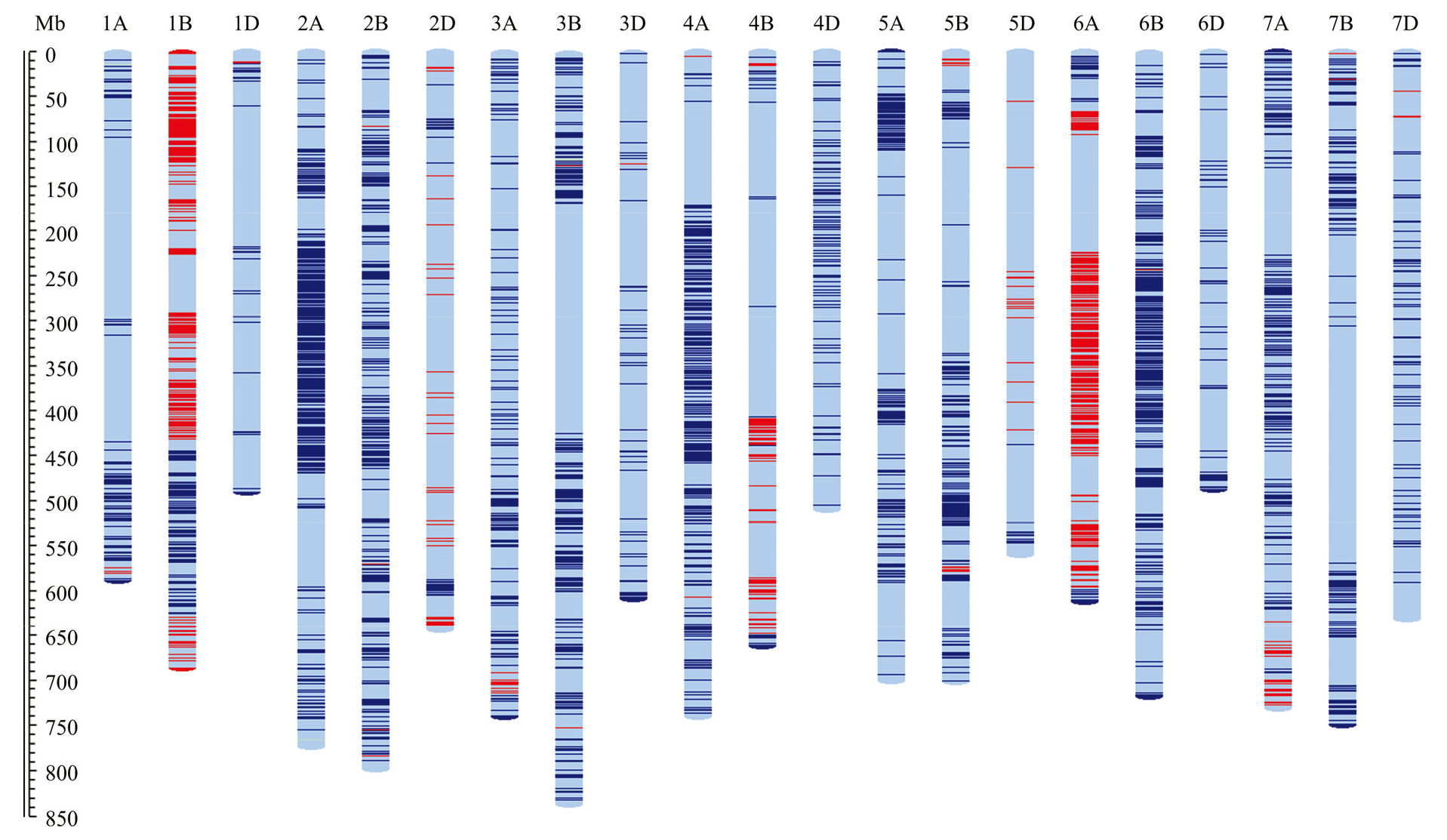
图2
川麦82的21条染色体基因型图谱 红色:供体亲本Singh6区段;深蓝色:轮回亲本川农16区段;浅蓝色:双亲Singh6和川农16共同区段;浅黄色:川麦82杂合区段"
表2
川麦82及双亲川麦16和Singh6的功能标记分析"
| 性状 Trait | 基因 Gene | 川农16 Chuannong 16 | Singh6 | 川麦82 Chuanmai 82 | 性状 Trait | 基因 Gene | 川农16 Chuannong 16 | Singh6 | 川麦82 Chuanmai 82 | |
|---|---|---|---|---|---|---|---|---|---|---|
| 条锈病 Stripe rust | Yr5 | - | - | - | 白粉病 Powdery mildew | Pm2a | - | - | - | |
| Yr18 | - | + | - | Pm21 | - | - | - | |||
| Yr26 | - | - | - | PmV | - | - | - | |||
| Yr29 | - | + | + | Pm12 | + | + | + | |||
| Yr30 | - | + | + | Pm5e | - | - | - | |||
| Yr75 | - | + | + | 黄花叶病毒病 Wheat yellow mosaic virus | IWA700 | - | - | - | ||
| Yr78 | - | + | - | 穗发芽 Pre-harvest sprouting | TaSdr-A1 | 易Prone | NA | 易Prone | ||
| Yr80 | - | NA | - | TaSdr-B1 | 易Prone | 易Prone | 易Prone | |||
| Yr82 | - | - | - | TaMFT-3A | 易Prone | 易Prone | 易Prone | |||
| YrZH58 | - | - | - | Phs1-3A | 抗Resistant | NA | 抗Resistant | |||
| YrSP | - | - | - | 多酚氧化酶活性 Polyphenol oxidase | Ppo2-B1 | 低Low | 高High | 低Low | ||
| QYrsn.nwafu-1BL | - | NA | NA | Ppo2-D1 | 高High | 高High | H | |||
| QYrxn.nwafu-1BL | + | - | - | 籽粒大小Seed size | QGl-4A | 小Small | 小Small | 小Small | ||
| QYrsn.nwafu-2AS | - | - | - | 籽粒大小/粒重 Seed size/weight | TaSus2-2A | 低Low | 低Low | 低Low | ||
| QYrqin.nwafu-2AL | + | + | + | TaSus2-2B | 高High | 低Low | 高High | |||
| QYrhm.nwafu-2BC | - | - | - | TaGS2-B1 | NA | / | / | |||
| QYrqin.nwafu-2BL | + | NA | + | 粒重 Seed weight | TaCwi-A1 | 高High | 低Low | 高High | ||
| QYr.nwafu-3BS | NA | + | NA | Tabas1 | H | H | 低Low | |||
| QYrsn.nwafu-3DL | - | + | - | TaGS5-A1 | 低Low | 低Low | 低Low | |||
| QYr.nwafu-4BL | - | - | - | TaGW2-6A | 低Low | H | 高High | |||
| QYrsn.nwafu-6BS | - | - | - | TaT6P | H | 低Low | 低Low | |||
| QYrqin.nwafu-6BS | - | - | - | 面粉色泽Flour color | Lyce-A1 | / | 高High | / | ||
| 叶锈病 Leaf rust | Lr21 | - | - | - | TaLCYE-B1 | 低Low | 低Low | 低Low | ||
| Lr37 | - | - | - | 籽粒硬度Grain hardness | Pinb-D1 | 软Soft | 软Soft | 软Soft | ||
| Lr46 | - | + | + | 种皮颜色Bran color | Tamyb10-B1 | H | / | / | ||
| Lr67 | + | + | + | 开花时间 Flower time | TaTOE-B1 | NA | H | / | ||
| Lr68 | - | - | - | ELF3-B1 | 晚Late | 晚Late | 晚Late | |||
| Lr80 | - | - | - | Vrn-A1 | 晚Late | 早Early | 晚Late | |||
| 赤霉病 Fusarium head blight | Qfhb.caas-3BL | - | H | - | 株高 Plant height | QPht-2D | 矮Short | 矮Short | 矮Short | |
| QFhb.hbaas-5AS | + | + | + | RHT-8 | 矮Short | 高High | 高High | |||
| QFhb.hbaas-5AL | - | + | - | Rht-D1 | 高High | NA | NA | |||
| QFhb.caas-5AL | - | - | - | Rht24_AP2 | 高High | H | 矮Short |
| [1] |
庄巧生. 中国小麦品种改良及系谱分析[M]. 北京: 中国农业出版社, 2003: 550-552.
|
|
|
|
| [2] |
doi: 10.1016/j.molp.2020.09.001 pmid: 32896642 |
| [3] |
doi: 10.1038/s41586-024-08277-0 |
| [4] |
肖永贵, 殷贵鸿, 李慧慧, 夏先春, 阎俊, 郑天存, 吉万全, 何中虎. 小麦骨干亲本“周8425B”及其衍生品种的遗传解析和抗条锈病基因定位[J]. 中国农业科学, 2011, 44(19): 3919-3929. DOI: 10.3864/j.issn.0578-1752.2011.19.001.
|
|
|
|
| [5] |
孔子明, 宋晓朋. 小麦品种周麦16的遗传构成分析[J]. 种子, 2020, 39(9): 117-119.
|
|
|
|
| [6] |
赵春华, 崔法, 李君, 丁安明, 李兴锋, 高居荣, 王洪刚. 冬小麦种质“矮孟牛”姊妹系遗传差异[J]. 作物学报, 2011, 37(8): 1333-1341.
|
|
|
|
| [7] |
邹少奎, 殷贵鸿, 唐建卫, 韩玉林, 李楠楠, 李顺成, 黄峰, 王丽娜, 张倩, 高艳. 小麦新品种周麦23号的遗传构成分析及其特异引物筛选[J]. 中国农业科学, 2015, 48(19): 3941-3951. DOI: 10.3864/j.issn.0578-1752.2015.19.016.
|
|
|
|
| [8] |
韩俊, 张连松, 李静婷, 石丽娟, 解超杰, 尤明山, 杨作民, 刘广田, 孙其信, 刘志勇. 小麦骨干亲本“胜利麦/燕大1817”杂交组合后代衍生品种遗传构成解析[J]. 作物学报, 2009, 35(8): 1395-1404.
|
|
doi: 10.3724/SP.J.1006.2009.01395 |
|
| [9] |
杨子博, 王安邦, 冷苏凤, 顾正中, 周羊梅. 小麦新品种淮麦33的遗传构成分析[J]. 中国农业科学, 2018, 51(17): 3237-3248. DOI: 10.3864/j.issn.0578-1752.2018.17.001.
|
|
|
|
| [10] |
于海霞, 肖静, 田纪春. 小麦骨干亲本矮孟牛及其衍生后代遗传解析[J]. 中国农业科学, 2012, 45(2): 199-207. DOI: 10.3864/j.issn.0578-1752.2012.02.001.
|
|
|
|
| [11] |
亓佳佳, 韩芳, 马守才, 张莉莉, 余欣欣, 陈蕴文, 毕晓静, 史秀秀, 牛娜, 张改生. 小麦骨干亲本小偃6号及其衍生品种(系)的遗传解析[J]. 西北农林科技大学学报(自然科学版), 2015, 43(11): 45-53.
|
|
|
|
| [12] |
李俊, 万洪深, 杨武云, 王琴, 朱欣果, 胡晓蓉, 魏会廷, 汤永禄, 李朝苏, 彭正松, 周永红. 小麦新品种川麦104的遗传构成分析[J]. 中国农业科学, 2014, 47(12): 2281-2291. DOI: 10.3864/j.issn.0578-1752.2014.12.001.
|
|
|
|
| [13] |
殷贵鸿, 韩玉林, 黄峰, 郑继周, 于海飞, 杜同连, 杨霞. 小麦新品种周麦16的选育及其特征特性[J]. 作物杂志, 2005(2): 54.
|
|
|
|
| [14] |
李小军, 胡铁柱, 李淦, 姜小苓, 冯素伟, 董娜, 张自阳, 茹振钢, 黄勇. 小麦品种百农AK58及其姊妹系的遗传构成分析[J]. 作物学报, 2012, 38(3): 436-446.
|
|
doi: 10.3724/SP.J.1006.2012.00436 |
|
| [15] |
袁园园, 王庆专, 崔法, 张景涛, 杜斌, 王洪刚. 小麦骨干亲本碧蚂4号的基因组特异位点及其在衍生后代中的传递[J]. 作物学报, 2010, 36(1): 9-16.
doi: 10.3724/SP.J.1006.2010.00009 |
|
doi: 10.3724/SP.J.1006.2010.00009 |
|
| [16] |
盖红梅, 李玉刚, 王瑞英, 李振清, 王圣健, 高峻岭, 张学勇. 鲁麦14对山东新选育小麦品种的遗传贡献[J]. 作物学报, 2012, 38(6): 954-961.
|
|
doi: 10.3724/SP.J.1006.2012.00954 |
|
| [17] |
李琼, 王长有, 刘新伦, 高冬丽, 吉万全. 小偃6号及其衍生品种(系)遗传多样性的SSR分析[J]. 麦类作物学报, 2008, 28(6): 950-955.
|
|
|
|
| [18] |
郑建敏, 罗江陶, 万洪深, 李式昭, 杨漫宇, 李俊, 刘于斌, 蒲宗君. 利用小麦660K SNP芯片分析川麦44在其衍生后代中的遗传贡献[J]. 麦类作物学报, 2019, 39(11): 1293-1300.
|
|
|
|
| [19] |
亓晓蕾, 王君, 吕广德, 牟秋焕, 米勇, 孙盈盈, 尹逊栋, 钱兆国, 王瑞霞, 吴科. 优质高产小麦新品种泰科麦33的遗传构成分析[J]. 中国农业科学, 2024, 57(22): 4391-4412. DOI: 10.3864/j.issn.0578-1752.2024.22.001.
|
|
|
|
| [20] |
刘易科, 朱展望, 陈泠, 邹娟, 佟汉文, 朱光, 何伟杰, 张宇庆, 高春保. 基于SNP标记揭示我国小麦品种(系)的遗传多样性[J]. 作物学报, 2020, 46(2): 307-314.
|
|
doi: 10.3724/SP.J.1006.2020.91039 |
|
| [21] |
杨漫宇, 姚方杰, 杨足君, 杨恩年. 六倍体小黑麦×六倍体小麦杂交后代中染色体遗传与结构变异鉴定[J]. 遗传, 2024, 46(1): 63-77.
|
|
|
|
| [22] |
程顺和, 高德荣, 张伯桥, 吴荣林, 陆成彬, 吴宏亚, 吕国锋, 张勇, 陈佩度, 刘大钧. 小麦抗白粉病的遗传改良及多系品系的配制[J]. 麦类作物学报, 2003, 23(2): 34-38.
|
|
|
|
| [23] |
张晓祥, 张伯桥, 吴宏亚, 高德荣, 吴荣林, 程顺和. 滚动回交与遗传标记辅助选择相结合聚合Pm21、Nib8和Wx基因[J]. 麦类作物学报, 2010, 30(2): 215-220.
|
|
|
|
| [24] |
刘登才, 郑有良, 兰秀锦. 小麦中国春遗传背景的育种改良[J]. 中国农业科学, 2003, 36(11): 1383-1389.
|
|
|
|
| [25] |
doi: 10.3390/genes14020283 |
| [26] |
邹裕春, 张镲, 杨武云, 杨恩年, 黄钢. 四川-CIMMYT小麦穿梭育种回顾与展望[J]. 西南农业学报, 2003, 16(3): 102-106.
|
|
|
|
| [27] |
邹裕春, 杨恩年. 冬春杂交小麦新品种川麦30[J]. 中国种业, 2001(4): 32-33.
|
|
|
|
| [28] |
邹裕春, 杨恩年. 四川审定的第一个强筋抗病小麦新品种川麦36[J]. 四川农业科技, 2003(6): 14.
|
|
|
|
| [29] |
邹裕春, 黄钢, 朱华忠. CIMMYT 1998—2000年中期工作计划给四川小麦超高产育种的启示[J]. 西南农业学报, 1998(增刊2): 268-270.
|
|
|
|
| [30] |
杨恩年, 邹裕春, 杨武云. 强筋小麦品种川麦36的抗条锈病性状遗传研究[J]. 西南农业学报, 2006, 19(5): 883-885.
|
|
|
|
| [31] |
黄钢, 邹裕春, 汤永禄, 杨恩年. 四川-CIMMYT小麦穿梭育种中的农艺学合作研究[J]. 西南农业学报, 2007, 20(2): 191-198.
|
|
|
|
| [32] |
邹裕春, 杨武云, 朱华忠, 杨恩年, 蒲宗君, 伍铃, 张颙, 汤永禄, 黄钢, 李跃建, 何中虎,
|
|
|
|
| [33] |
吴胜男, 李英壮, 王娜, 刘录祥, 谢彦周, 王成社. 小麦新品种陕农33的遗传构成分析[J]. 麦类作物学报, 2021, 41(2): 134-139.
|
|
|
|
| [34] |
doi: 10.1094/PHYTO.2003.93.2.153 pmid: 18943129 |
| [35] |
doi: 10.1007/s00122-008-0743-1 pmid: 18347772 |
| [36] |
doi: 10.1007/s00122-005-0153-6 pmid: 16331478 |
| [37] |
doi: 10.1094/PHYTO.1998.88.9.890 pmid: 18944865 |
| [38] |
doi: 10.1007/s00122-021-03818-x pmid: 33839800 |
| [39] |
蒲至恩. 小麦新品种川农16的遗传改良研究[D]. 雅安: 四川农业大学, 2005.
|
|
|
|
| [40] |
doi: 10.1002/(ISSN)1097-0010 |
| [41] |
周阳, 何中虎, 张改生, 夏兰琴, 陈新民, 高永超, 井赵斌, 于广军. 1BL/1RS易位系在我国小麦育种中的应用[J]. 作物学报, 2004, 30(6): 531-535.
|
|
|
|
| [42] |
doi: 10.2135/cropsci1996.0011183X003600040003x |
| [43] |
李俊, 魏会廷, 杨粟洁, 李朝苏, 汤永禄, 胡晓蓉, 杨武云. 川麦42的1BS染色体臂对小麦主要农艺性状的遗传效应[J]. 作物学报, 2009, 35(12): 2167-2173.
doi: 10.3724/SP.J.1006.2009.02167 |
|
doi: 10.3724/SP.J.1006.2009.02167 |
|
| [44] |
doi: 10.1016/j.xplc.2022.100472 |
| [45] |
doi: 10.3389/fpls.2020.00206 |
| [46] |
王琴, 刘泽厚, 万洪深, 魏会廷, 龙海, 李涛, 邓光兵, 李俊, 杨武云. 川麦42和川农16抗穗发芽QTL定位及聚合效应分析[J]. 中国农业科学, 2020, 53(17): 3421-3431. DOI: 10.3864/j.issn.0578-1752.2020.17.001.
|
|
|
| [1] | 叶美金, 吴雷, Lohani Md Nahibuzzaman, 尹丽, 胡欣荣, 刘亚西, 蒋云峰, 陈国跃, 蒲至恩, 李阳, 李婷, 邹亚亚, 吴佳怡, 马建. 基于GWAS的中国地方小麦成熟胚大小位点的鉴定及其遗传效应解析[J]. 中国农业科学, 2026, 59(6): 1157-1171. |
| [2] | 王勇胜, 牛丽, 王长杰, 马立花, 廉潇潇, 孟亚雄, 马小乐, 姚立蓉, 张宏, 杨轲, 李葆春, 王化俊, 司二静, 汪军成. 冬小麦千粒重的全基因组关联分析及候选基因预测[J]. 中国农业科学, 2026, 59(3): 499-514. |
| [3] | 叶美金, 王同著, 陈斌, LOHANI Md Nahibuzzaman, 陈家婷, 胡欣荣, 尹丽, 王超, 张昊芃, 杨夏, 王佳琳, 姚琦馥, 丁浦洋, 王凤, 李小雨, 马建. 基于全基因组关联分析解析小麦茎节间长度的遗传基础及其效应[J]. 中国农业科学, 2026, 59(12): 2551-2562. |
| [4] | 李明, 程宇坤, 白斌, 雷斌, 耿洪伟. 冬小麦穗部性状GWAS分析及优异单倍型筛选[J]. 中国农业科学, 2025, 58(18): 3583-3597. |
| [5] | 亓晓蕾, 王君, 吕广德, 牟秋焕, 米勇, 孙盈盈, 尹逊栋, 钱兆国, 王瑞霞, 吴科. 优质高产小麦新品种泰科麦33的遗传构成分析[J]. 中国农业科学, 2024, 57(22): 4391-4401. |
| [6] | 商航, 程宇坤, 任毅, 耿洪伟. 冬小麦淀粉糊化性状的全基因组关联分析[J]. 中国农业科学, 2024, 57(18): 3507-3521. |
| [7] | 马艳明, 娄鸿耀, 张胜军, 王威, 郭营, 倪中福, 刘杰. 新疆冬小麦品种资源主要产量性状全基因组关联分析[J]. 中国农业科学, 2023, 56(18): 3487-3499. |
| [8] | 董一帆, 任毅, 程宇坤, 王睿, 张志辉, 时晓磊, 耿洪伟. 冬小麦籽粒主要品质性状的全基因组关联分析[J]. 中国农业科学, 2023, 56(11): 2047-2063. |
| [9] | 胡朝月, 王凤涛, 郎晓威, 冯晶, 李俊凯, 蔺瑞明, 姚小波. 小麦抗条锈病基因对中国条锈菌主要流行小种的抗性分析[J]. 中国农业科学, 2022, 55(3): 491-502. |
| [10] | 张芳,任毅,曹俊梅,李法计,夏先春,耿洪伟. 基于SNP标记的小麦籽粒性状全基因组关联分析[J]. 中国农业科学, 2021, 54(10): 2053-2063. |
| [11] | 杨子博,王安邦,冷苏凤,顾正中,周羊梅. 小麦新品种淮麦33的遗传构成分析[J]. 中国农业科学, 2018, 51(17): 3237-3248. |
| [12] | 李志远,于海龙,方智远,杨丽梅,刘玉梅,庄木,吕红豪,张扬勇. 甘蓝SNP标记开发及主要品种的DNA指纹图谱构建[J]. 中国农业科学, 2018, 51(14): 2771-2787. |
| [13] | 孙正文,匡猛,马峙英,王省芬. 利用CottonSNP63K芯片构建棉花品种的指纹图谱[J]. 中国农业科学, 2017, 50(24): 4692-4704. |
| [14] | 张南南,鲁振华,崔国朝,潘磊,曾文芳,牛良,王志强. 基于SNP标记桃抗蚜性状的基因定位[J]. 中国农业科学, 2017, 50(23): 4613-4621. |
| [15] | 肖玉雄,王彩虹,田义轲,杨绍兰,李鼎立,张海月. 利用2b-RAD测序结合HRM分析技术开发与梨矮生性状相关的DNA分子标记[J]. 中国农业科学, 2017, 50(15): 3006-3012. |
|
||
