






中国农业科学 ›› 2026, Vol. 59 ›› Issue (16): 3476-3495.doi: 10.3864/j.issn.0578-1752.2026.16.002
曹凡( ), 唐瑶(), 王孟玮, 张栋渊, 卫亚博, 吴爽, 朱万超, 徐淑兔, 张兴华(), 薛吉全()
收稿日期:2025-12-31
接受日期:2026-02-26
出版日期:2026-08-16
发布日期:2026-08-17
通信作者:
联系方式:
曹凡,E-mail:cf1981624242@163.com。唐瑶,E-mail:ty95195@163.com。曹凡和唐瑶为同等贡献作者。
基金资助:
CAO Fan(), TANG Yao(), WANG MengWei, ZHANG DongYuan, WEI YaBo, WU Shuang, ZHU WanChao, XU ShuTu, ZHANG XingHua(), XUE JiQuan()
Received:2025-12-31
Accepted:2026-02-26
Published:2026-08-16
Online:2026-08-17
摘要:
【目的】 玉米种子活力是决定种子品质的关键因素之一,直接影响出苗率、幼苗生长及群体整齐度,进而影响产量形成。筛选高活力自交系与杂交种,挖掘调控种子萌发的关键基因,为培育高活力玉米品种提供理论依据。【方法】 选取陕A群、陕B群2个杂种优势群选育的22份玉米自交系并采用NC-Ⅱ遗传设计组配104份F1杂交组合。通过标准发芽试验和冷浸发芽试验测定发芽势、发芽率、发芽指数、苗长、根长、苗干重,以及活力指数Ⅰ、Ⅱ、Ⅲ共9个性状,开展种子活力的综合评价。结合基因型数据与表型数据,对主要性状开展全基因组关联分析,筛选与种子活力显著相关的数量性状核苷酸位点,并整合公共转录组数据对潜在候选基因进行挖掘与功能预测。【结果】 自交系与杂交种的种子活力相关性状均存在显著遗传变异。相较于标准发芽,冷浸处理显著降低了发芽势、发芽率和发芽指数,同时扩大了表型变异幅度,增强了基因型间的差异表达。多数性状在基因型、处理及其互作效应上达到显著或极显著水平,证实种子活力受遗传因素显著调控。发芽性状与苗期生长性状和活力指数呈显著正相关。并筛选出一批在不同发芽条件下表现稳定、对冷浸处理敏感性较低的优良材料,其中,在冷浸条件下,以陕A群的KA105、KA088、KA085、KA205和陕B群的KB088、KB060、KB168、KB076、KB021为亲本组配的杂交组合仍保持较高种子活力水平。自身活力中等的自交系在特定组合中可显著提升后代表现。全基因组关联分析共检测到43个与种子活力显著相关的QTN位点,其中7个为冷浸条件下的多性状共定位位点。利用公共转录组数据进一步筛选出11个候选基因,其中8个具有功能注释,主要涉及胁迫响应与转录调控等生物学过程。【结论】 玉米种子活力为遗传控制的数量性状,基因型变异是其表型差异的主要来源。种子活力受多位点协同调控,低温条件下存在关键遗传区域参与调节。有利等位基因的积累有助于提升杂交种活力,同时杂交种表现还受亲本间特异遗传互作影响。
曹凡, 唐瑶, 王孟玮, 张栋渊, 卫亚博, 吴爽, 朱万超, 徐淑兔, 张兴华, 薛吉全. 陕A群、陕B群选育玉米自交系及其杂交种种子活力评价及遗传解析[J]. 中国农业科学, 2026, 59(16): 3476-3495.
CAO Fan, TANG Yao, WANG MengWei, ZHANG DongYuan, WEI YaBo, WU Shuang, ZHU WanChao, XU ShuTu, ZHANG XingHua, XUE JiQuan. Evaluation and Genetic Analysis of Seed Vigor in Inbred Lines and Responding Hybrids in Shaan A and Shaan B Groups[J]. Scientia Agricultura Sinica, 2026, 59(16): 3476-3495.
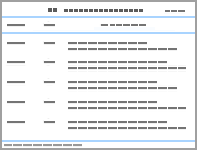
表1
自交系材料清单"
| 序号No. | 材料名称Name | 来源Source | 序号No. | 材料名称Name | 来源Source | |
|---|---|---|---|---|---|---|
| M1 | KA105 | 陕A群Shaan A Group | P4 | KB060 | 陕B群Shaan B Group | |
| M2 | KA023 | 陕A群Shaan A Group | P5 | KB076 | 陕B群Shaan B Group | |
| M3 | KA205 | 陕A群Shaan A Group | P6 | KB077-2 | 陕B群Shaan B Group | |
| M4 | KA215 | 陕A群Shaan A Group | P7 | KB088 | 陕B群Shaan B Group | |
| M5 | KA085 | 陕A群Shaan A Group | P8 | KB017 | 陕B群Shaan B Group | |
| M6 | KA088 | 陕A群Shaan A Group | P9 | KB113 | 陕B群Shaan B Group | |
| M7 | KB-9-1 | 陕B群Shaan B Group | P10 | KB168 | 陕B群Shaan B Group | |
| M8 | KB-9-2 | 陕B群Shaan B Group | P11 | KB177 | 陕B群Shaan B Group | |
| P1 | KB017 | 陕B群Shaan B Group | P12 | KB179 | 陕B群Shaan B Group | |
| P2 | KB021 | 陕B群Shaan B Group | P13 | KB209 | 陕B群Shaan B Group | |
| P3 | KB042-2 | 陕B群Shaan B Group | P14 | KB562 | 陕B群Shaan B Group |
表2
自交系与杂交种种子活力相关性状的描述性统计"
| 材料 Material | 性状 Trait | 处理 Treatment | 变异范围 Range | 平均值±标准偏差 Mean±SD | 偏度 Skewness | 峰度 Kurtosis | 变异系数 CV (%) |
|---|---|---|---|---|---|---|---|
| 自交系 Inbred lines | 发芽势GE (%) | SGT | 53.33-100.00 | 85.35±0.13 | -0.99 | 0.32 | 15.34 |
| CST | 4.44-95.56 | 58.64±0.24 | -0.37 | -0.48 | 41.50 | ||
| 发芽率GP (%) | SGT | 84.44-100.00 | 96.26±0.05 | -1.27 | 0.51 | 5.02 | |
| CST | 8.89-98.89 | 65.40±0.24 | -0.57 | -0.23 | 36.47 | ||
| 发芽指数GI | SGT | 6.14-9.81 | 7.74±0.92 | 0.48 | -0.19 | 11.91 | |
| CST | 0.60-9.11 | 5.56±2.22 | -0.37 | -0.45 | 39.93 | ||
| 苗长SL (cm) | SGT | 6.79-12.59 | 9.57±1.62 | -0.04 | -0.83 | 16.88 | |
| CST | 3.88-12.74 | 9.99±2.05 | -1.13 | 2.31 | 20.52 | ||
| 根长RL (cm) | SGT | 14.54-21.34 | 17.07±1.50 | 0.93 | 1.97 | 8.79 | |
| CST | 4.28-22.49 | 16.90±3.68 | -1.78 | 6.08 | 21.75 | ||
| 苗干重DW (g) | SGT | 0.14-0.74 | 0.51±0.13 | -0.94 | 1.99 | 25.59 | |
| CST | 0.46-0.88 | 0.68±0.12 | -0.10 | -0.74 | 17.18 | ||
| 活力指数I VIⅠ | SGT | 3.08-8.15 | 5.37±1.41 | 0.43 | -0.47 | 26.32 | |
| CST | 0.08-5.53 | 3.03±1.50 | 0.04 | -1.17 | 51.97 | ||
| 活力指数Ⅱ VIⅡ | SGT | 49.16-114.95 | 75.09±19.86 | 0.38 | -0.91 | 26.44 | |
| CST | 2.33-99.17 | 58.63±28.29 | -0.22 | -1.07 | 48.25 | ||
| 活力指数Ⅲ VI Ⅲ | SGT | 98.21-209.28 | 132.93±25.12 | 1.32 | 3.01 | 18.90 | |
| CST | 2.57-204.75 | 99.59±49.24 | 0.11 | -0.36 | 49.44 | ||
| 杂交种 Hybrids | 发芽势GE (%) | SGT | 55.56-100.00 | 90.55±0.10 | -1.67 | 2.26 | 11.49 |
| CST | 31.11-97.78 | 74.79±0.15 | -0.95 | 0.31 | 19.88 | ||
| 发芽率GP (%) | SGT | 85.56-100.00 | 98.17±0.03 | -2.47 | 6.69 | 2.85 | |
| CST | 36.67-100.00 | 80.79±0.13 | -1.04 | 0.85 | 16.70 | ||
| 发芽指数GI | SGT | 6.29-9.94 | 8.25±0.94 | -0.01 | -1.10 | 11.40 | |
| CST | 3.18-9.64 | 7.21±1.34 | -0.82 | 0.25 | 18.64 | ||
| 苗长SL (cm) | SGT | 8.47-16.69 | 12.61±1.84 | -0.14 | -0.68 | 14.62 | |
| CST | 4.95-15.97 | 11.89±1.87 | -0.80 | 1.18 | 15.72 | ||
| 根长RL (cm) | SGT | 15.45-25.68 | 19.71±1.88 | 0.46 | 0.27 | 9.53 | |
| CST | 11.53-22.40 | 18.18±1.82 | -0.62 | 1.13 | 10.01 | ||
| 苗干重DW (g) | SGT | 0.46-1.17 | 0.86±0.13 | -0.29 | 0.43 | 15.36 | |
| CST | 0.37-1.06 | 0.71±0.13 | 0.25 | 0.33 | 17.78 | ||
| 活力指数ⅠVIⅠ | SGT | 3.38-11.08 | 7.12±1.56 | 0.05 | -0.27 | 21.89 | |
| CST | 1.56-8.25 | 5.20±1.49 | -0.30 | -0.30 | 28.65 | ||
| 活力指数Ⅱ VIⅡ | SGT | 53.33-153.60 | 105.20±24.94 | 0.20 | -0.96 | 23.71 | |
| CST | 20.98-143.65 | 87.06±24.67 | -0.41 | -0.21 | 28.34 | ||
| 活力指数Ⅲ VI Ⅲ | SGT | 100.33-228.19 | 163.61±30.51 | 0.31 | -0.81 | 18.65 | |
| CST | 48.85-210.06 | 132.60±33.00 | -0.44 | 0.07 | 24.89 |
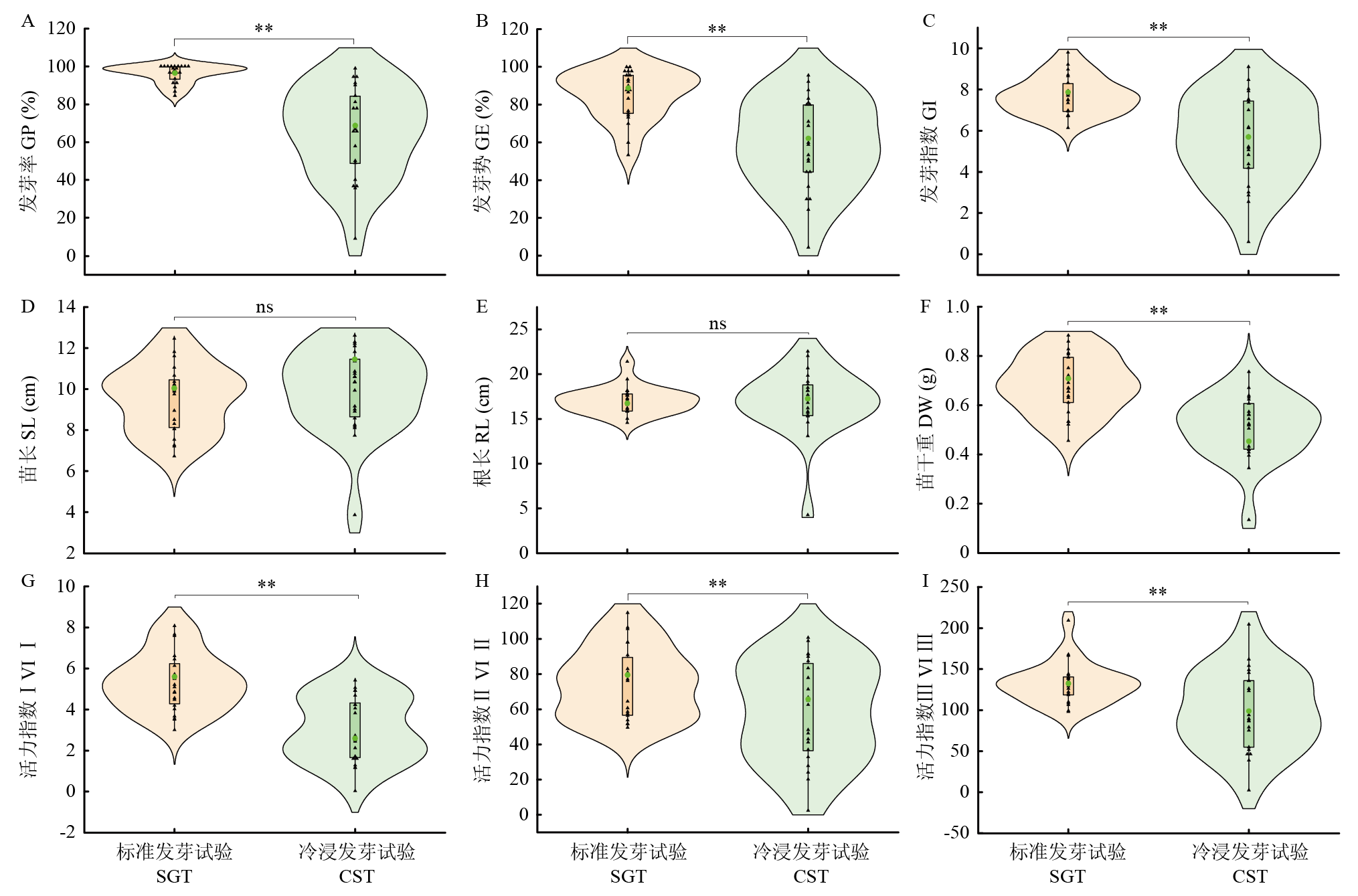
图1
自交系活力性状指标分析 ▲:自交系材料表型值;●:对照自交系KA105。*:P<0.05;**:P<0.01;***:P<0.001。ns:差异不显著。下同"
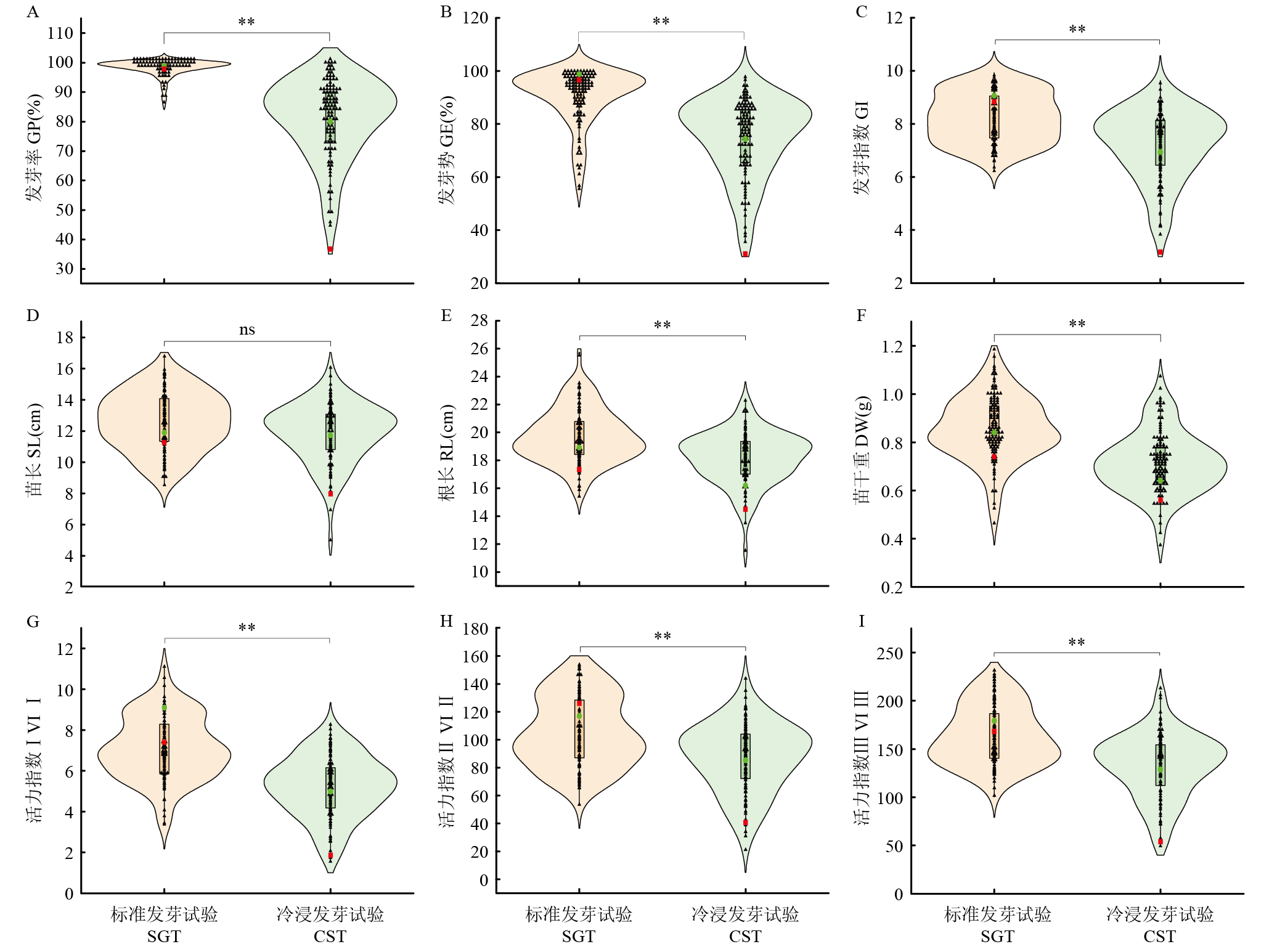
图2
杂交种活力性状指标分析 ▲:杂交种材料表型值;●:对照材料ZD958;■:对照材料SD650"
表3
自交系和杂交种种子活力性状联合方差分析"
| 材料 Material | 性状 Trait | 基因型 Genotype | 处理 Treatment | 处理×基因型 Genotype×Treatment | ||||||
|---|---|---|---|---|---|---|---|---|---|---|
| 自由度 DF | 均方 MS | F值 F-value | 自由度 DF | 均方 MS | F值 F-value | 自由度 DF | 均方 MS | F值 F-value | ||
| 自交系 Inbred lines | 发芽势GE | 21 | 0.14 | 36.83** | 1 | 2.36 | 605.78** | 21 | 0.09 | 22.08** |
| 发芽率GP | 21 | 0.11 | 39.73** | 1 | 3.14 | 1168.19** | 21 | 0.07 | 26.38** | |
| 发芽指数GI | 21 | 10.64 | 48.18** | 1 | 159.99 | 724.255** | 21 | 6.57 | 29.73** | |
| 苗长SL | 21 | 15.33 | 14.83** | 1 | 5.37 | 5.19 | 21 | 5.30 | 5.13 | |
| 根长RL | 21 | 33.27 | 32.05** | 1 | 0.65 | 0.63 | 21 | 11.67 | 11.24** | |
| 苗干重DW | 21 | 0.08 | 31.35** | 1 | 0.99 | 384.99** | 21 | 0.01 | 4.57 | |
| 活力指数Ⅰ VIⅠ | 21 | 11.01 | 27.52** | 1 | 75.22 | 188.09** | 21 | 4.39 | 10.97** | |
| 活力指数Ⅱ VIⅡ | 21 | 2409.15 | 28.49** | 1 | 9115.14 | 107.78** | 21 | 1124.84 | 13.30** | |
| 活力指数Ⅲ VI Ⅲ | 21 | 6158.26 | 43.45** | 1 | 37043.47 | 263.76** | 21 | 2900.96 | 20.66** | |
| 杂交种 Hybrids | 发芽势GE | 105 | 0.05 | 16.72** | 1 | 3.95 | 1326.67** | 105 | 0.05 | 16.49** |
| 发芽率GP | 105 | 0.03 | 19.51** | 1 | 4.80 | 2917.90** | 105 | 0.02 | 15.11** | |
| 发芽指数GI | 105 | 4.60 | 18.73** | 1 | 175.54 | 713.92** | 105 | 3.67 | 14.93** | |
| 苗长SL | 105 | 17.50 | 13.93** | 1 | 83.48 | 66.48 | 105 | 3.18 | 2.54** | |
| 根长RL | 105 | 13.36 | 7.08** | 1 | 374.04 | 198.29** | 105 | 7.17 | 3.80* | |
| 苗干重DW | 105 | 0.08 | 16.23** | 1 | 3.35 | 676.20** | 105 | 0.02 | 4.04** | |
| 活力指数ⅠVIⅠ | 105 | 8.72 | 15.24** | 1 | 252.55 | 441.49** | 105 | 4.35 | 7.61** | |
| 活力指数Ⅱ VIⅡ | 105 | 2687.82 | 18.32** | 1 | 53441.35 | 364.15** | 105 | 1038.37 | 7.08** | |
| 活力指数Ⅲ VI Ⅲ | 105 | 3894.52 | 15.62** | 1 | 154790.67 | 620.68** | 105 | 2248.23 | 9.02** | |

图3
自交系与杂交种各性状相关性分析 A:自交系材料相关性分析;B:杂交种材料相关性分析"

图4
自交系与杂交种基于2种发芽试验下各活力性状的聚类图 A:自交系材料;B:杂交种材料"
表4
自交系和杂交种各种子活力性状均值比较"
| 材料 Materials | 类别 Type | 材料数量 Number | 发芽势 GE (%) | 发芽率 GP (%) | 发芽指数 GI | 活力指数Ⅰ VIⅠ | 活力指数Ⅱ VIⅡ | 活力指数Ⅲ VIⅢ | ||||||
|---|---|---|---|---|---|---|---|---|---|---|---|---|---|---|
| SGT | CST | SGT | CST | SGT | CST | SGT | CST | SGT | CST | SGT | CST | |||
| 自交系 Inbred lines | 第Ⅰ类Category Ⅰ | 8 | 88.33 | 83.61 | 99.31 | 89.03 | 7.91 | 7.87 | 5.80 | 4.79 | 78.32 | 87.97 | 136.13 | 150.27 |
| 第Ⅱ类Category Ⅱ | 9 | 82.34 | 55.06 | 94.44 | 63.21 | 7.63 | 5.21 | 5.02 | 2.53 | 73.63 | 53.39 | 131.43 | 89.17 | |
| 第Ⅲ类Category Ⅲ | 5 | 86.00 | 25.10 | 94.67 | 31.95 | 7.69 | 2.46 | 5.27 | 1.10 | 72.53 | 21.14 | 130.51 | 37.26 | |
| 杂交种 Hybrids | 第Ⅰ类Category Ⅰ | 51 | 83.70 | 84.51 | 98.21 | 89.69 | 7.86 | 8.06 | 6.68 | 5.98 | 97.26 | 99.24 | 150.65 | 152.22 |
| 第Ⅱ类Category Ⅱ | 41 | 93.28 | 71.65 | 98.51 | 77.75 | 8.64 | 6.96 | 7.66 | 4.97 | 114.94 | 84.33 | 177.48 | 125.66 | |
| 第Ⅲ类Category Ⅲ | 14 | 94.37 | 48.58 | 96.99 | 57.23 | 8.53 | 4.86 | 7.12 | 3.02 | 105.65 | 50.65 | 170.22 | 81.41 | |
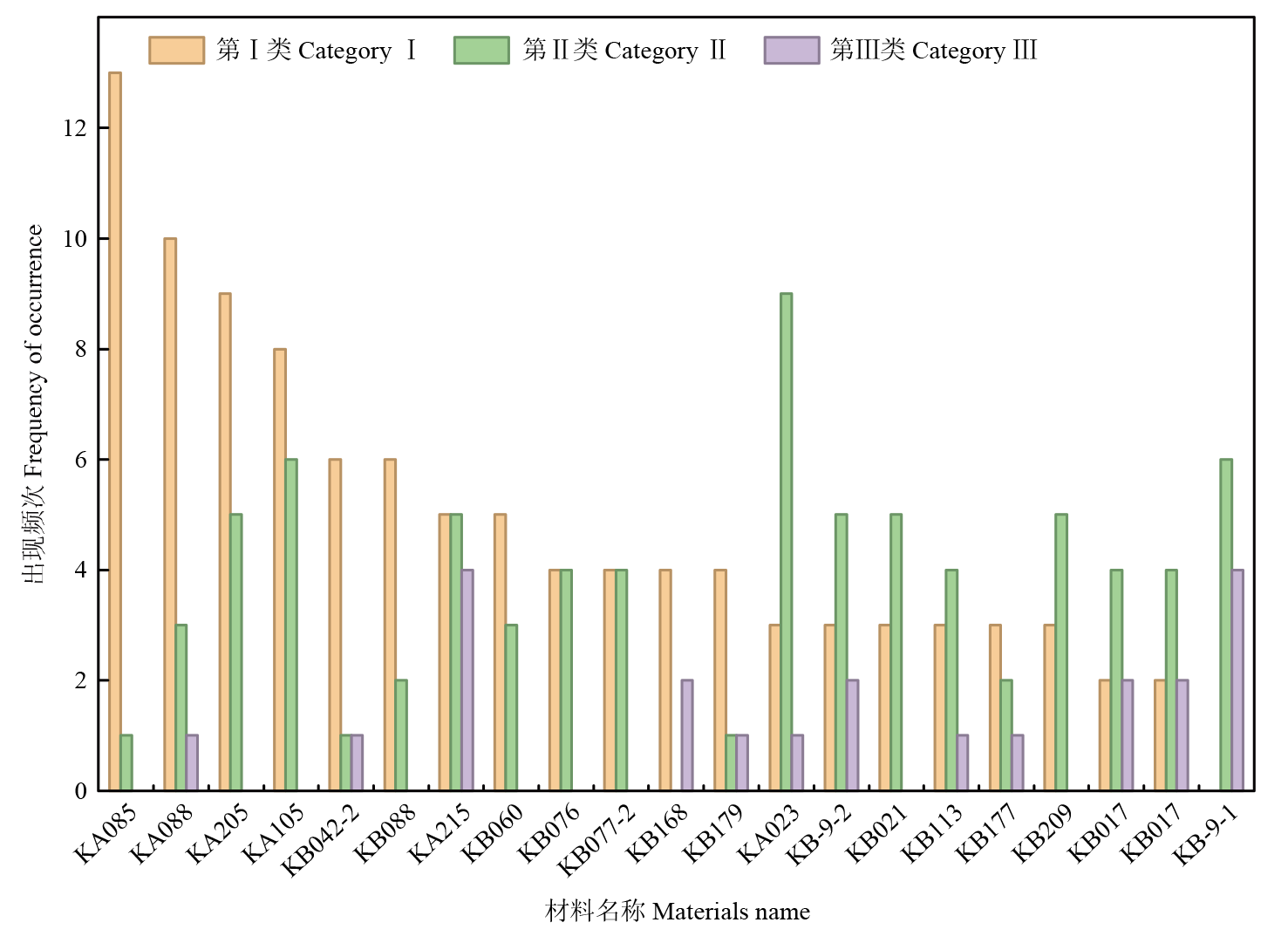
图5
自交系在杂交组合中出现频次分析"
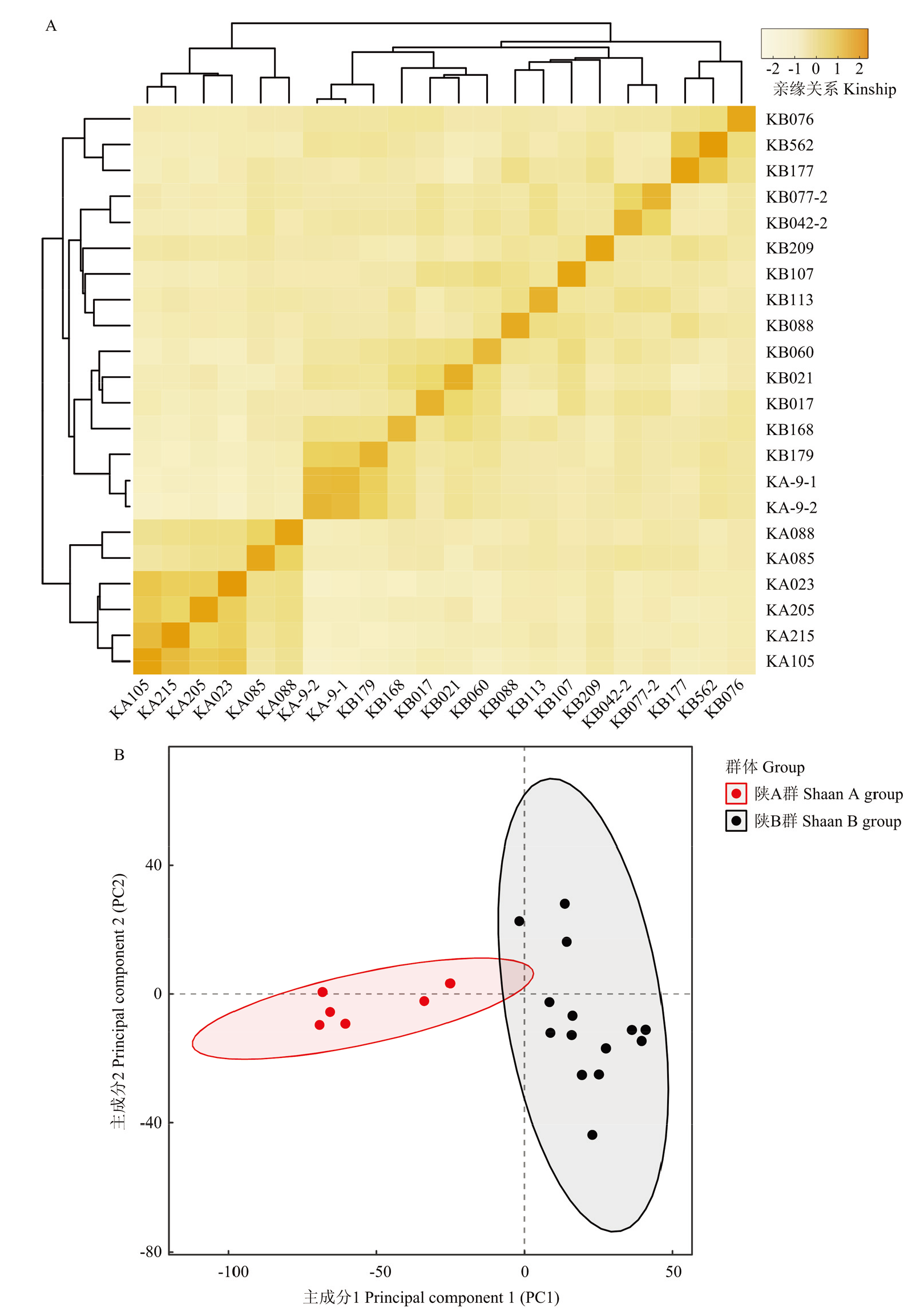
图6
亲本亲缘关系与群体结构分析 A:亲本亲缘关系分析;B:亲本群体结构分析"
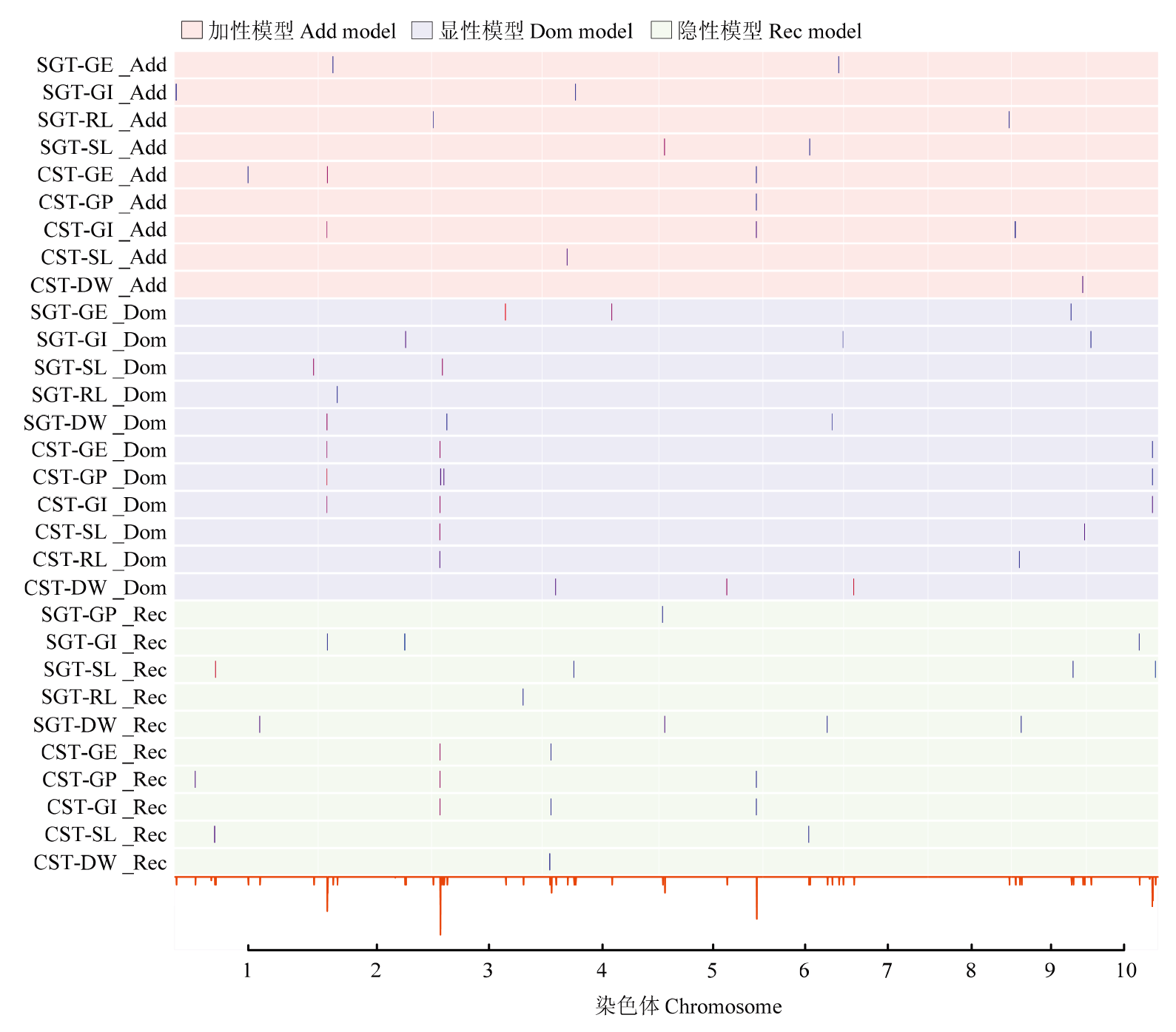
图7
不同模型下种子活力相关性状的全基因组关联分析结果 Add:加性模型;Dom:显性模型;Rec:隐性模型。下同"
表5
全基因组关联分析检测到的重要关联位点信息"
| 序号 No. | 标记 Marker | 染色体 Chromosome | 位置 Position (bp) | 基因型 Genotype | 模型 Model | 性状 Trait | P值 P value | 表型解释率 R2(%) |
|---|---|---|---|---|---|---|---|---|
| SNP1 | 1_3353289 | 1 | 3353289 | G/A | Add | SGT-GI | 9.00E-06 | 11.43 |
| SNP2 | 1_43499054 | 1 | 43499054 | T/C | Rec | CST-GP | 1.24E-10 | 18.26 |
| SNP3 | 1_84304371 | 1 | 84304371 | C/T | Rec | CST-SL | 2.86E-12 | 25.07 |
| SNP4 | 1_85839980 | 1 | 85839980 | A/C | Rec | SGT-SL | 2.05E-21 | 32.68 |
| SNP5 | 1_154295033 | 1 | 154295033 | A/G | Add | CST-GE | 7.82E-08 | 17.78 |
| SNP6 | 1_178647142 | 1 | 178647142 | A/G | Rec | SGT-DW | 1.55E-12 | 22.04 |
| SNP7 | 1_291856974 | 1 | 291856974 | T/C | Dom | SGT-SL | 5.13E-15 | 22.47 |
| SNP8 | 2_18197441* | 2 | 18197441 | A/G | Dom | CST-GE | 6.97E-15 | 18.78 |
| Dom | CST-GI | 2.80E-15 | 19.43 | |||||
| Dom | CST-GP | 1.10E-19 | 26.68 | |||||
| Add | CST-GI | 9.57E-15 | 18.69 | |||||
| SNP9 | 2_18739525 | 2 | 18739525 | T/C | Dom | SGT-DW | 2.63E-18 | 13.73 |
| SNP10 | 2_19244047 | 2 | 19244047 | T/C | Rec | SGT-GI | 3.47E-09 | 17.49 |
| SNP11 | 2_19372692 | 2 | 19372692 | C/T | Add | CST-GE | 8.77E-16 | 21.42 |
| SNP12 | 2_30802598 | 2 | 30802598 | G/C | Add | SGT-GE | 6.48E-08 | 19.44 |
| SNP13 | 2_39940294 | 2 | 39940294 | G/A | Dom | SGT-RL | 1.25E-06 | 11.55 |
| SNP14 | 2_183378697 | 2 | 183378697 | C/T | Dom | SGT-GI | 6.59E-10 | 13.51 |
| SNP15 | 3_17590250* | 3 | 17590250 | G/A | Dom | CST-RL | 6.46E-10 | 17.11 |
| Dom | CST-SL | 3.85E-15 | 24.91 | |||||
| SNP16 | 3_17805407* | 3 | 17805407 | C/T | Rec | CST-GE | 5.57E-18 | 35.60 |
| Rec | CST-GI | 8.49E-18 | 30.14 | |||||
| Rec | CST-GP | 7.32E-16 | 24.59 | |||||
| SNP17 | 3_17932972* | 3 | 17932972 | T/C | Dom | CST-GE | 4.91E-16 | 24.05 |
| Dom | CST-GI | 1.28E-14 | 20.89 | |||||
| SNP18 | 3_19091776 | 3 | 19091776 | G/A | Dom | CST-GP | 8.60E-11 | 11.02 |
| SNP19 | 3_22825936 | 3 | 22825936 | C/G | Dom | SGT-SL | 1.34E-14 | 23.70 |
| SNP20 | 3_32242592 | 3 | 32242592 | C/A | Dom | SGT-DW | 1.50E-07 | 12.62 |
| SNP21 | 3_155021348 | 3 | 155021348 | A/C | Dom | SGT-GE | 3.33E-27 | 19.80 |
| SNP22 | 3_192210299 | 3 | 192210299 | G/A | Rec | SGT-RL | 1.04E-06 | 19.69 |
| SNP23 | 4_15716701 | 4 | 15716701 | C/A | Rec | CST-DW | 3.26E-05 | 12.32 |
| SNP24 | 4_18511010* | 4 | 18511010 | G/C | Rec | CST-GE | 6.81E-07 | 13.60 |
| Rec | CST-GI | 1.31E-08 | 15.92 | |||||
| SNP25 | 4_28100027 | 4 | 28100027 | C/A | Dom | CST-DW | 3.08E-12 | 12.23 |
| SNP26 | 4_52506095 | 4 | 52506095 | C/T | Add | CST-SL | 3.61E-10 | 32.65 |
| SNP27 | 4_69862542 | 4 | 69862542 | C/T | Add | SGT-GI | 2.17E-06 | 16.18 |
| SNP28 | 4_145757636 | 4 | 145757636 | G/C | Dom | SGT-GE | 8.07E-16 | 18.45 |
| SNP29 | 5_7270274 | 5 | 7270274 | G/A | Rec | SGT-GP | 6.93E-06 | 15.31 |
| SNP30 | 5_11611314 | 5 | 11611314 | C/A | Add | SGT-SL | 3.07E-18 | 47.37 |
| SNP31 | 5_11960070 | 5 | 11960070 | T/C | Rec | SGT-DW | 2.63E-10 | 17.35 |
| SNP32 | 5_142175693 | 5 | 142175693 | A/G | Dom | CST-DW | 7.30E-18 | 14.83 |
| SNP33 | 5_204262820* | 5 | 204262820 | T/A | Rec | CST-GI | 3.49E-06 | 8.56 |
| Rec | CST-GP | 2.44E-09 | 14.74 | |||||
| Add | CST-GI | 5.57E-13 | 14.79 | |||||
| Add | CST-GP | 5.80E-08 | 14.18 | |||||
| Add | CST-GE | 1.63E-08 | 10.12 | |||||
| SNP34 | 6_96096697 | 6 | 96096697 | C/T | Rec | CST-SL | 3.58E-07 | 13.13 |
| SNP35 | 6_159316307 | 6 | 159316307 | C/T | Add | SGT-GE | 6.71E-07 | 11.82 |
| SNP36 | 6_168385013 | 6 | 168385013 | C/T | Dom | SGT-GI | 1.57E-08 | 10.40 |
| SNP37 | 7_21288129 | 7 | 21288129 | G/A | Dom | CST-DW | 2.01E-18 | 13.75 |
| SNP38 | 8_170405872 | 8 | 170405872 | C/A | Add | SGT-RL | 5.22E-08 | 22.64 |
| SNP39 | 9_149806469 | 9 | 149806469 | C/A | Add | CST-DW | 1.12E-09 | 15.24 |
| SNP40 | 9_153233111 | 9 | 153233111 | C/T | Dom | CST-SL | 3.84E-12 | 18.95 |
| SNP41 | 10_9606210 | 10 | 9606210 | T/C | Dom | SGT-GI | 1.93E-07 | 11.63 |
| SNP42 | 10_111383922 | 10 | 111383922 | A/C | Rec | SGT-GI | 5.59E-07 | 10.33 |
| SNP43 | 10_138859255* | 10 | 138859255 | C/T | Dom | CST-GE | 6.04E-08 | 7.74 |
| Dom | CST-GI | 7.85E-10 | 10.36 | |||||
| Dom | CST-GP | 1.35E-07 | 6.76 |
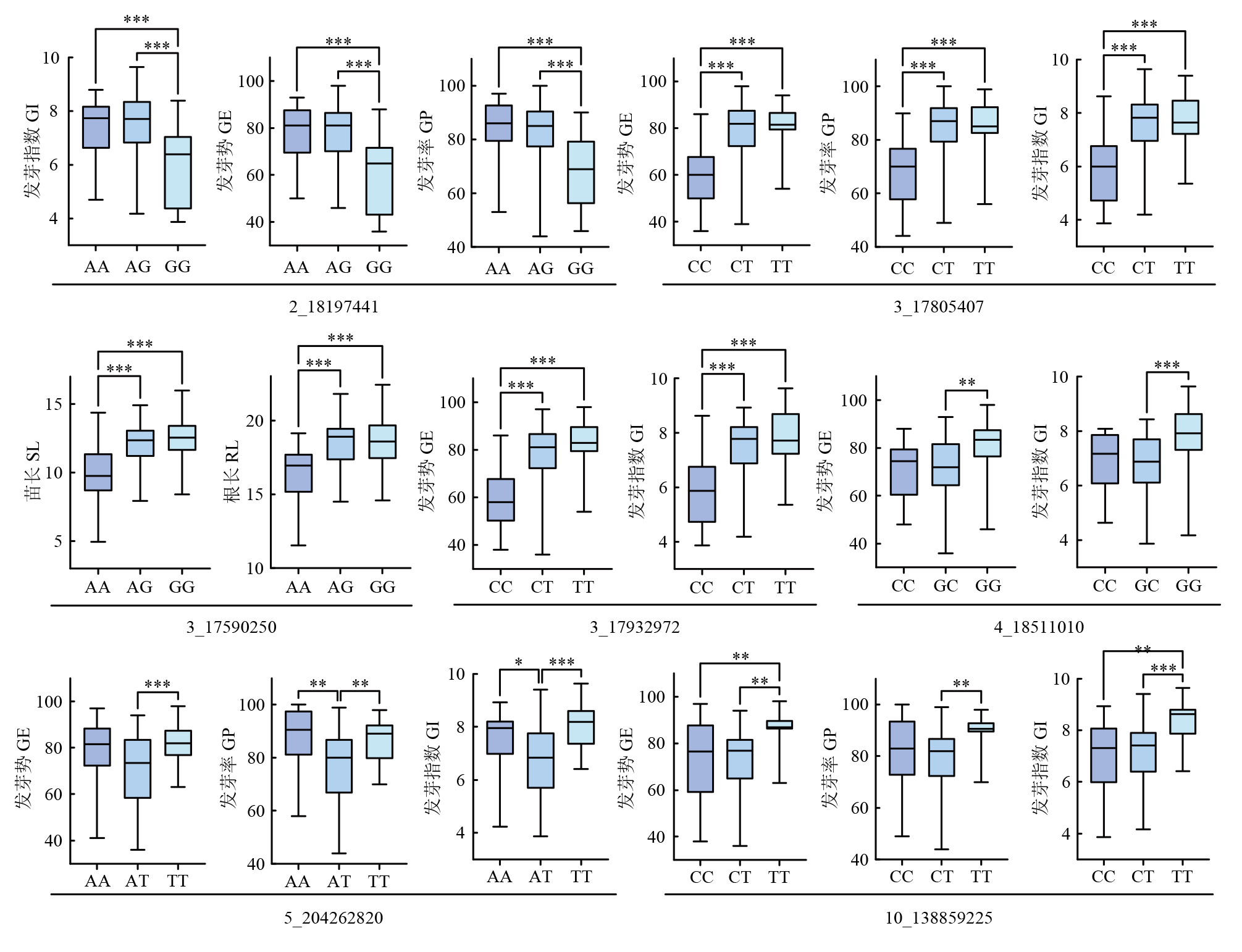
图8
共定位位点的表型效应分析"
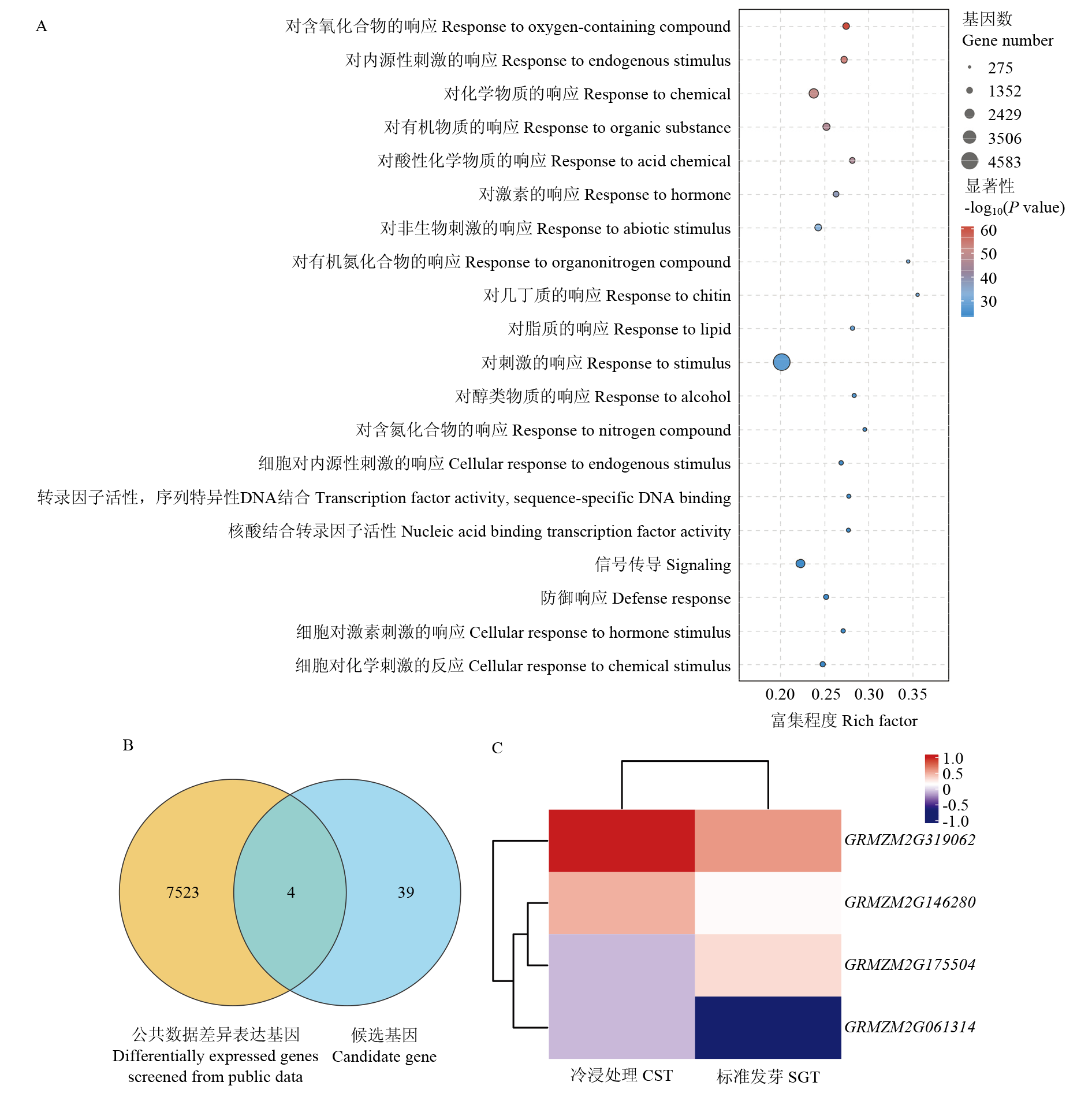
图9
转录组候选基因的差异表达分析 A:公共转录组数据GO富集分析;B:公共数据差异表达基因与候选基因韦恩图;C:2种处理下候选基因差异表达分析"
表6
候选基因预测及功能注释"
| QTN位点 QTN marker | 染色体位置 Position | 候选基因CandidateGenes | 功能注释 Annotation |
|---|---|---|---|
| 2_18197441 | Chr.2:18197441 | GRMZM2G567481 | — |
| 2_18739525 | Chr.2:18739525 | GRMZM2G175504 | 有丝分裂激活蛋白激酶激酶激酶YODA Mitogen-activated protein kinase kinase kinase YODA |
| 3_155021348 | Chr.3:155021348 | GRMZM2G146280 | 含WD重复序列的蛋白质结构域磷酸肌醇相互作用蛋白3 WD repeat-containing protein domain phosphoinositide-interacting protein 3 |
| 3_17590250 | Chr.3:17590250 | GRMZM2G166064 | 蛋白TRM32 Protein TRM32 |
| 3_17805407 | Chr.3:17805407 | GRMZM2G020941 | — |
| 3_17932972 | Chr.3:17932972 | GRMZM2G100898 | DNA甲基化因子1 Factor of DNA methylation 1 |
| 4_18511010 | Chr.4:18511010 | GRMZM5G846314 | — |
| 4_28100027 | Chr.4:28100027 | GRMZM2G319062 | 多酚氧化酶潜伏型,叶绿体 Polyphenol oxidase latent form, chloroplastic |
| 5_204262820 | Chr.5:204262820 | GRMZM2G000280 | 反转录转座子蛋白Ty1-copia亚类 Retrotransposon protein Ty1-copia subclass |
| 9_149806469 | Chr.9:149806469 | GRMZM2G061314 | 蛋白结合蛋白 protein binding protein |
| 10_138859255 | Chr.10:138859255 | GRMZM2G391272 | 皮层细胞描绘蛋白 Cortical cell-delineating protein |
| [1] |
doi: 10.1093/jxb/erv490 pmid: 26585226 |
| [2] |
doi: 10.1016/j.jcs.2020.102977 |
| [3] |
GB 4404.1—2024 粮食作物种子第1部分: 禾谷类[S].
|
|
GB 4404.1—2024 Seed of food crops: Part 1: Cereals[S]. (in Chinese)
|
|
| [4] |
吴丽丽. 甜玉米种子活力影响因素及检测方法概述[J]. 现代农村科技, 2021(3): 65-66.
|
|
|
|
| [5] |
doi: 10.2478/v10129-011-0072-4 |
| [6] |
doi: 10.3390/ijms232314865 |
| [7] |
doi: 10.3390/ijms23126493 |
| [8] |
doi: 10.1007/s13205-021-02799-4 pmid: 33968587 |
| [9] |
doi: 10.3389/fpls.2022.930438 |
| [10] |
doi: 10.1002/fes3.445 |
| [11] |
doi: 10.3390/cimb45120602 |
| [12] |
doi: 10.1007/s00122-022-04065-4 pmid: 35247071 |
| [13] |
doi: 10.3389/fgene.2020.00747 |
| [14] |
GB/T 3543.4—1995 农作物种子检验规程发芽试验[S].
|
|
GB/T 3543.4—1995 Rules for inspection of crop seeds Germination test[S]. (in Chinese)
|
|
| [15] |
doi: 10.2135/cropsci1985.0011183X002500010046x |
| [16] |
doi: 10.1086/519795 |
| [17] |
doi: 10.1093/bioinformatics/btm308 pmid: 17586829 |
| [18] |
doi: 10.1371/journal.pcbi.1011946 |
| [19] |
doi: 10.1093/molbev/msab120 pmid: 33892491 |
| [20] |
doi: 10.1038/ncomms7258 pmid: 25651972 |
| [21] |
doi: 10.1016/j.molp.2022.02.012 |
| [22] |
doi: 10.1111/tpj.13414 pmid: 28188666 |
| [23] |
doi: 10.1016/j.compag.2025.111036 |
| [24] |
doi: 10.3390/agronomy14030410 |
| [25] |
韩登旭, 杨杰, 王业建, 郗浩江, 梁晓玲, 李铭东, 阿布来提·阿布拉 国内外骨干玉米自交系耐低温萌发能力综合评价[J]. 新疆农业科学, 2021, 58(3): 401-411.
doi: 10.6048/j.issn.1001-4330.2021.03.002 |
|
doi: 10.6048/j.issn.1001-4330.2021.03.002 |
|
| [26] |
崔婷茹, 范志强, 郭晋杰. 低温胁迫对玉米种子萌发和幼苗活力的影响[J]. 山西农业科学, 2019, 47(10): 1695-1699.
|
|
|
|
| [27] |
侯立刚, 刘会芳, 田健, 关法春, 齐春艳, 翟相英, 崔彦如, 祝延立, 那伟. 不同菌剂浓度对低温处理下水稻种子萌发能力的影响[J]. 种子, 2021, 40(3): 87-90, 96.
|
|
|
|
| [28] |
doi: 10.1186/s12870-022-03690-x pmid: 35718761 |
| [29] |
韩赞平, 陈彦惠, 刘海英, 赵瑞芳, 郭书磊. 利用重组自交系群体定位不同温度条件下玉米种子发芽性状的QTL[J]. 河南农业科学, 2017, 46(7): 9-17, 85.
|
|
|
|
| [30] |
刘文童. 玉米自交系种子活力相关性状的综合评价和关联分析[D]. 保定: 河北农业大学, 2020.
|
|
|
|
| [31] |
doi: 10.3390/genes11010037 |
| [32] |
doi: 10.1007/s10722-021-01146-z |
| [33] |
doi: 10.1038/s41598-021-98907-8 |
| [34] |
doi: 10.3390/plants15010161 |
| [1] | 蔡巧红, 周甜, 苏明, 洪自强, 李翻过, 李彤, 汪华, 康建宏, 吴宏亮. 宁夏引黄灌区减氮增钾施肥模式对玉米光合荧光特性及光合产物积累的影响[J]. 中国农业科学, 2026, 59(9): 1869-1886. |
| [2] | 王志高, 李刘滨, 许颖, 鞠澄辉, 何荣. 基于图像处理的玉米破损比例检测方法及其品质变化同步分析[J]. 中国农业科学, 2026, 59(9): 1987-2001. |
| [3] | 陈宣伊, 郭星星, 张向前, 路战远, 刘凌悦, 罗方, 李金龙, 张传玲, 张志青, 车曼青. 间作行比对玉米冠层光环境异质性和光合物质生产的影响[J]. 中国农业科学, 2026, 59(8): 1653-1671. |
| [4] | 侯慧芝, 尹嘉德, 马明生, 刘晓伟, 柳燕兰, 雷康宁. 耕作与增施有机肥对陇东马铃薯-玉米一年两熟制作物产量和水分利用的影响[J]. 中国农业科学, 2026, 59(8): 1672-1685. |
| [5] | 赵思捷, 任家欣, 南江磊, 王兴云, 成卫宁. 玉米叶片次生物质含量及相关基因表达与其对草地贪夜蛾抗性的关系[J]. 中国农业科学, 2026, 59(8): 1686-1696. |
| [6] | 王亚菲, 闫鹏, 薛金涛, 董学瑞, 孟凡琦, 郭丽娜, 罗艺, 张娟, 董志强, 卢霖. 乙烯利-甜菜碱-水杨酸合剂对高温胁迫下玉米根系建构、生理功能和产量的影响[J]. 中国农业科学, 2026, 59(7): 1439-1455. |
| [7] | 叶美金, 吴雷, Lohani Md Nahibuzzaman, 尹丽, 胡欣荣, 刘亚西, 蒋云峰, 陈国跃, 蒲至恩, 李阳, 李婷, 邹亚亚, 吴佳怡, 马建. 基于GWAS的中国地方小麦成熟胚大小位点的鉴定及其遗传效应解析[J]. 中国农业科学, 2026, 59(6): 1157-1171. |
| [8] | 王佳诺, 陈桂平, 李盼, 王丽萍, 南运有, 何蔚, 樊志龙, 胡发龙, 柴强, 殷文, 赵连豪. 免耕地膜两年覆盖提高绿洲灌区玉米产量的灌浆期光合生理机制[J]. 中国农业科学, 2026, 59(6): 1189-1202. |
| [9] | 周新杰, 任昊, 陈应龙, 张吉旺, 赵斌, 任佰朝, 刘鹏, 王洪章. 过氧化钙对渍涝农田夏玉米根系形态及产量形成的影响[J]. 中国农业科学, 2026, 59(6): 1203-1216. |
| [10] | 何继航, 张擎, 吕相月, 薛吉全, 徐淑兔, 刘建超. 不同保绿型玉米杂交种氮效率评价[J]. 中国农业科学, 2026, 59(6): 1217-1230. |
| [11] | 李永娟, 张悦彤, 王艺博, 赵长江, 宋洁, 陈雪丽, 姚钦. 生物炭施用对大豆轮连作系统土壤固氮微生物nifH基因丰度及群落组成的影响[J]. 中国农业科学, 2026, 59(6): 1272-1285. |
| [12] | 杨丽娟, 陈丝雨, 赵薇, 朱玲, 郭磊, 马丽娜, 马瑞敏, 张娟. 全基因组重测序揭示静原鸡羽色的遗传机制[J]. 中国农业科学, 2026, 59(6): 1348-1360. |
| [13] | 李思源, 李鸿萍, 常洪庆, 张森焱, 栗思佳, 崔欣飞, 乔泼, 曾波, 刘桂珍, 刘天学, 汤继华, 李潮海. 增密对不同株高玉米品种产量和农艺性状动态变化的影响[J]. 中国农业科学, 2026, 59(5): 967-984. |
| [14] | 董金龙, 赵莹, 余海兵, 吕建晔, 秦佳琦, 梁晨, 明博, 李少昆. 多模型解析玉米籽粒容重的营养品质贡献度与区域异质性[J]. 中国农业科学, 2026, 59(5): 985-995. |
| [15] | 王勇胜, 牛丽, 王长杰, 马立花, 廉潇潇, 孟亚雄, 马小乐, 姚立蓉, 张宏, 杨轲, 李葆春, 王化俊, 司二静, 汪军成. 冬小麦千粒重的全基因组关联分析及候选基因预测[J]. 中国农业科学, 2026, 59(3): 499-514. |
|
||
