Scientia Agricultura Sinica ›› 2025, Vol. 58 ›› Issue (24): 5299-5314.doi: 10.3864/j.issn.0578-1752.2025.24.015

• AGRICULTURAL ECONOMY AND RURAL DEVELOPMENT • Previous Articles    

Evolutionary Trends and Influencing Factors of Global Agricultural and Rural Modernization

WANG Wei(), CHEN YangFen*()   

  1. Institute of Agricultural Economics and Development, Chinese Academy of Agricultural Sciences, Beijing 100081
  • Received:2025-03-25 Accepted:2025-07-11 Online:2025-12-22 Published:2025-12-22
  • Contact: CHEN YangFen

Abstract:

【Objective】Agricultural and rural modernization needs to be grounded in both general global patterns and unique Chinese characteristics. From a global perspective, investigating its evolutionary trends and influencing factors is of great significance for advancing China's comprehensive rural revitalization. 【Method】This study constructed an evaluation index system incorporating two dimensions: agricultural modernization and rural modernization. Based on the measurement of agricultural and rural development levels in 152 countries from 2000 to 2022, three-dimensional kernel density estimation and spatial Gini coefficient were employed to reveal the evolutionary trends of global agricultural and rural modernization. Furthermore, the optimal-parameter geographical detector was utilized to identify the intensity and interaction effects of socio-economic and agricultural factors. 【Result】Over the past two decades, global agricultural and rural modernization level has shown a steady upward trend. The gap between low-income and middle-income countries has been narrowing annually, yet a substantial gap with high-income countries persists. China has made remarkable progress in its agricultural and rural modernization, with its international ranking climbing from 78th to 57th. Regarding general patterns, economic development level remained a key driver. The roles of industrial structure and agricultural trade openness have become increasingly prominent. The contribution of agricultural technological progress remained important but exhibited a diminishing marginal trend, while the impact of agricultural land use structure was characterized by long-term complexity. In terms of differentiated patterns, informatization level was the primary driver for low- and lower-middle-income countries to achieve catch-up, whereas its influence diminished in upper-middle- and high-income countries. Population aging has become the dominant constraint hindering agricultural and rural modernization in middle-income countries, with a relatively minor impact on high-income countries. Environmental protection intensity showed significant differentiated effects across different income groups. The proportion of negative interaction effects between factors in low-income country groups has significantly decreased. Interaction effects among factors in lower-middle-income country groups have entirely transitioned to positive synergistic effects. Synergistic enhancement effects were prevalent among factors in upper-middle-income and high-income country groups. This indicated that the spatial-temporal differentiation of global agricultural and rural modernization was a result of the combined influence of socio-economic and agricultural factors. 【Conclusion】In advancing comprehensive rural revitalization, China should adhere to a "dual-driven" approach of concurrently promoting agricultural modernization and rural modernization. It was crucial to coordinate the relationships among economic development, social progress, and environmental protection to ultimately achieve integrated urban-rural development.

Key words: agricultural and rural modernization development, agricultural modernization, rural modernization, global patterns, Chinese characteristics

Table 1

Evaluation indicator system for agricultural and rural modernization"

维度层
Dimension layer
指标层
Indicator layer
指标释义
Indicator definition
属性
Attribute
权重
Weight
农业现代化
Agricultural modernization
(0.5)
农业劳动生产率
Agricultural labor productivity
农林牧渔业增加值/农业就业人员(万美元/人)
Added value of agriculture, forestry, animal husbandry, and fishery/Agricultural employment (104 USD/person)

Positive
0.3312
粮食单产
Grain yield per unit area
粮食产量/粮食播种面积(吨/公顷)
Grain output/Grain sown area (tons/hectare)

Positive
0.1723
农业资本投入强度
Agricultural capital input intensity
农林牧渔业资本存量/农业用地面积(万美元/公顷)
Capital stock of agriculture, forestry, animal husbandry, and fishery/Agricultural land area (104 USD/hm2)

Positive
0.0569
农产品国际市场占有率
International market share of agricultural products
农产品出口额/世界农产品出口额(%)
Agricultural export value/World agricultural export value (%)

Positive
0.2884
谷物自给率
Cereal self-sufficiency rate
谷物产量/(谷物产量+谷物进口量-谷物出口量)(%)
Cereal production/ (Cereal production+Cereal imports-Cereal exports) (%)

Positive
0.0718
食物供应量
Food supply
食物供应总量/总人口/当年天数(千卡/人/天)
Total food supply/Total population/Days in the year (kcal/person/day)

Positive
0.0643
农用化学品使用强度
Agrochemical use intensity
化肥农药使用量/耕地面积(千克/公顷)
Fertilizer and pesticide use/Cultivated land area (kg·hm2)

Negative
0.0087
农业碳排放强度
Agricultural carbon intensity
农业碳排放量/农林牧渔业增加值(吨/万美元)
Agricultural carbon emissions/Added value of agriculture, forestry, animal husbandry, and fishery (tons/104 USD)

Negative
0.0064
农村现代化
Rural modernization
(0.5)
乡村人口比重
Rural population proportion
农村人口/总人口(%)
Rural population/Total population (%)

Negative
0.1045
非农就业占比
Non-agricultural employment share
非农就业人员/就业人员(%)
Non-agricultural employment/Total employment (%)

Positive
0.0792
农业相对劳动生产率
Agricultural relative labor productivity
农林牧渔业增加值份额/农业就业人员份额(—)
Share of added value in agriculture, forestry, animal husbandry, and fishery/Share of agricultural employment (—)

Positive
0.0852
农村通电率
Rural electrification rate
获得电力供应的农村人口/农村总人口(%)
Rural population with access to electricity/Total rural population (%)

Positive
0.1956
农村供水率
Rural water supply rate
至少使用基本饮用水服务的农村人口/农村总人口(%)
Rural population using at least basic drinking water services/Total rural population (%)

Positive
0.0700
农村清洁能源使用率
Rural clean energy usage rate
获得清洁燃料和烹饪技术的农村人口/农村总人口(%)
Rural population with access to clean fuels and technologies for cooking/Total rural population (%)

Positive
0.3508
农村卫生设施普及率
Rural sanitation facility coverage rate
至少使用基本卫生服务的农村人口/农村总人口(%)
Rural population using at least basic sanitation services/Total rural population (%)

Positive
0.0913
营养不良发生率
Malnutrition incidence rate
营养不良人口/总人口(%)
Undernourished population/Total population (%)

Negative
0.0234

Fig. 1

Box plot of global agricultural and rural development level"

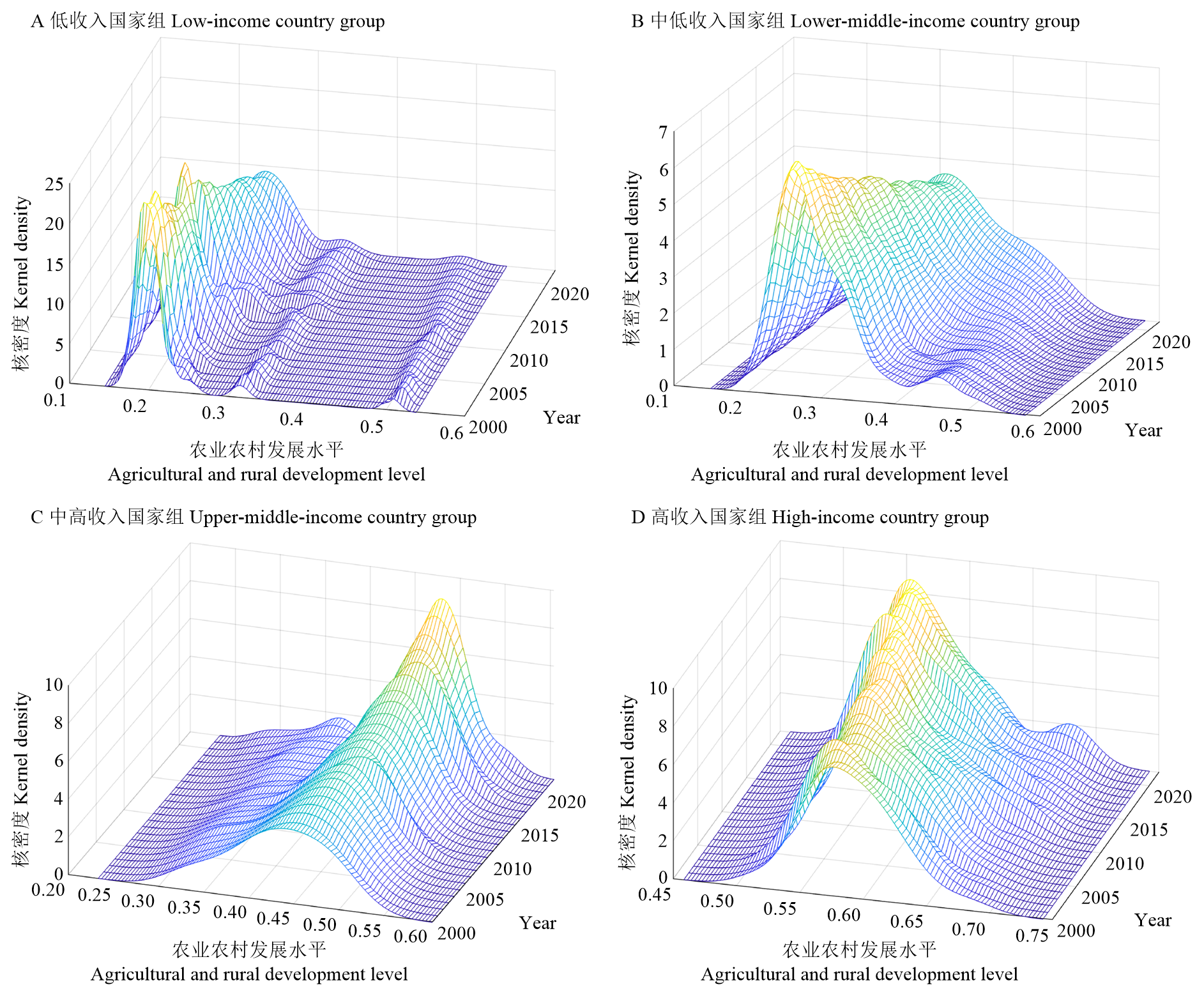
Fig. 2

Three-dimensional kernel density map of global agricultural and rural development level"

Table 2

Spatial differences in global agricultural and rural development level"

年份
Year
总体基尼系数
Overall Gini coefficient
各部分贡献度Contribution of each part (%)
组内差异
Within-group differences
组间差异
Between-group differences
超变密度
Super-variate density
2000 0.2444 11.25 85.01 3.74
2002 0.2414 11.20 85.15 3.64
2004 0.2380 11.38 84.86 3.75
2006 0.2315 11.47 84.57 3.96
2008 0.2275 11.62 84.59 3.79
2010 0.2223 11.82 84.39 3.79
2012 0.2182 11.97 84.35 3.68
2014 0.2141 12.06 84.41 3.53
2016 0.2085 12.05 84.50 3.45
2018 0.2024 12.01 84.76 3.24
2020 0.1994 12.00 84.80 3.20
2022 0.1967 12.17 84.71 3.12

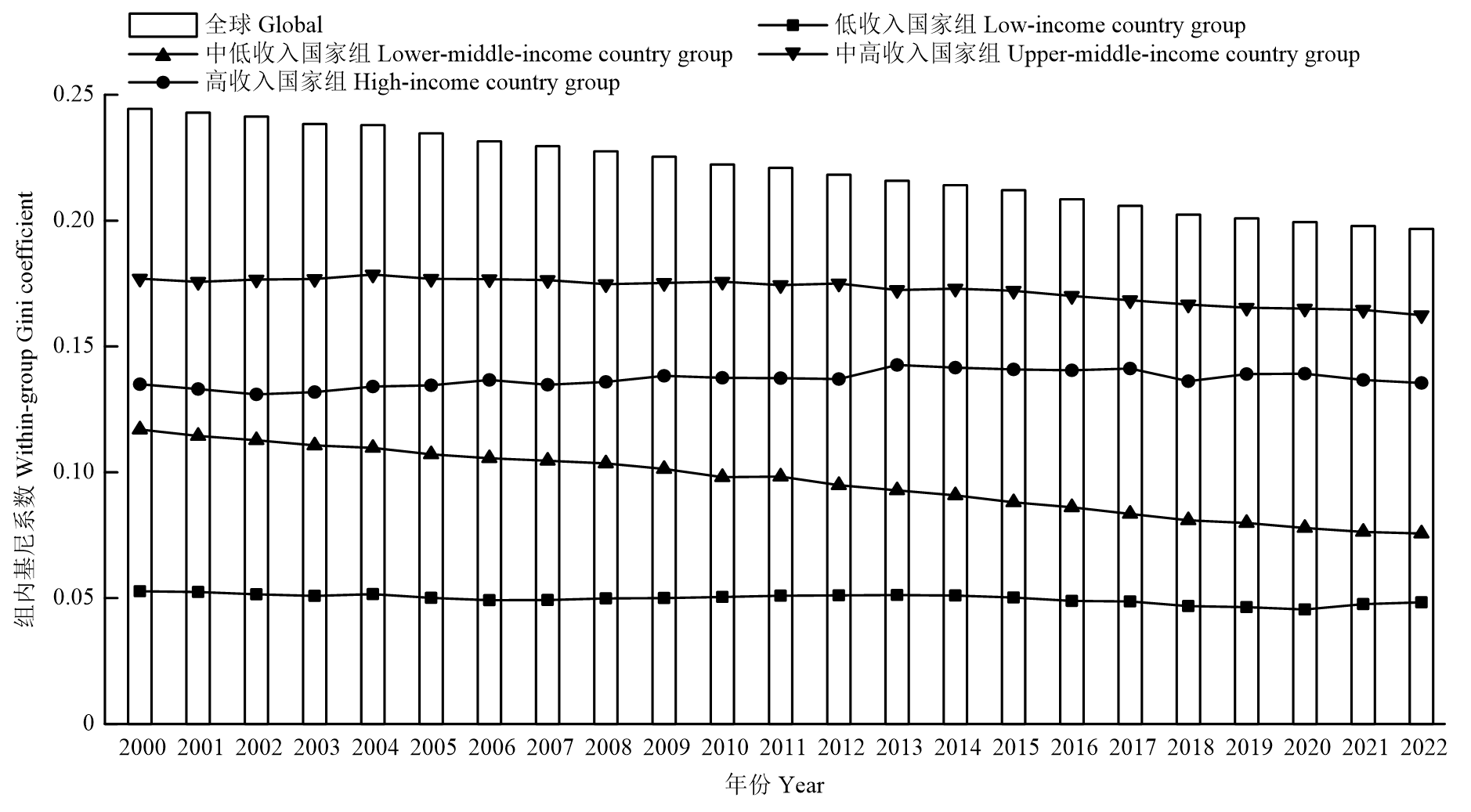
Fig. 3

Within-group differences in global agricultural and rural development level"

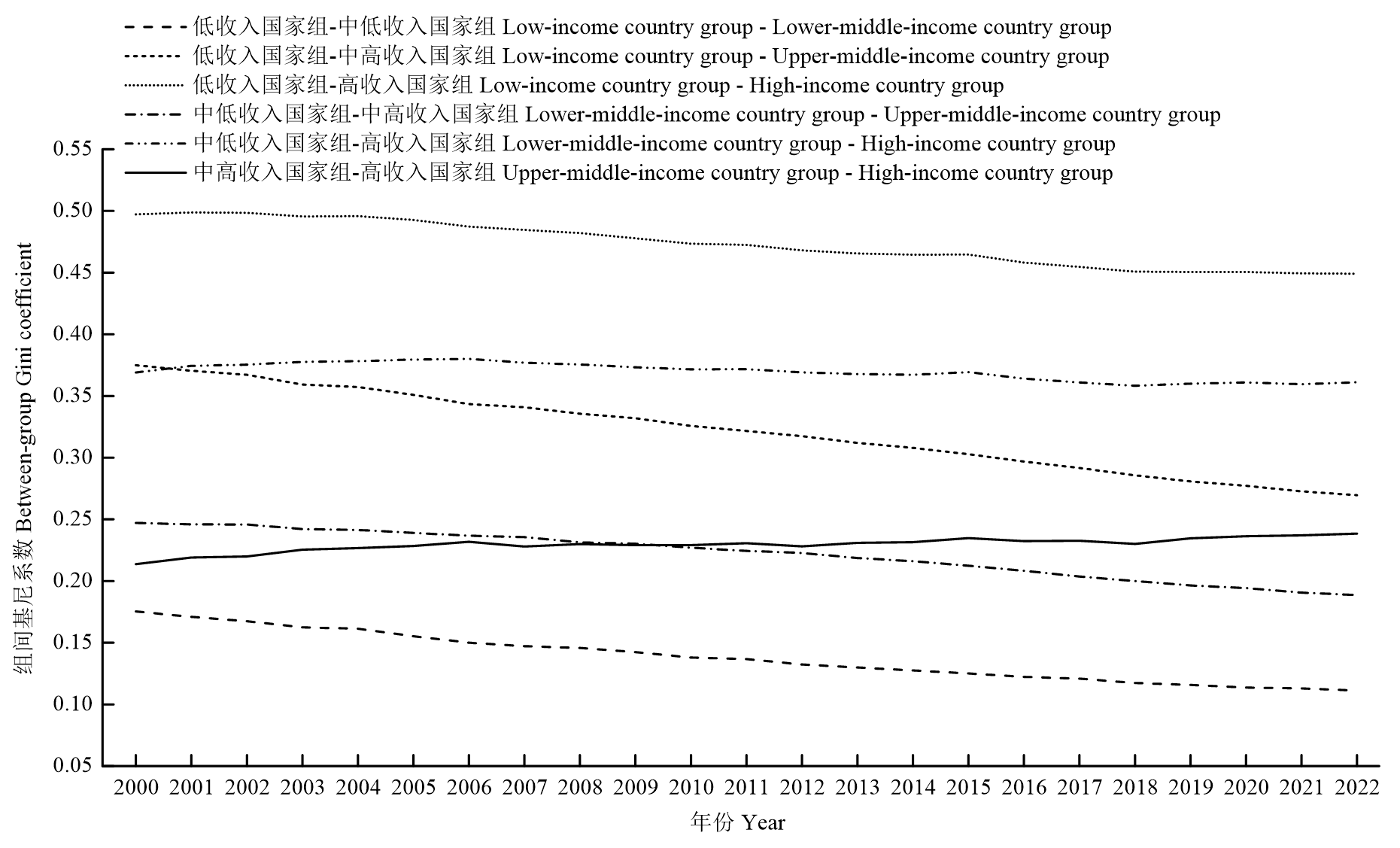
Fig. 4

Between-group differences in global agricultural and rural development level"

Table 3

Factor detection results of spatial differentiation of agricultural and rural development level in 2000"

影响因素
Influencing factor
低收入国家组
Low-income country group
中低收入国家组
Lower-middle-income country group
中高收入国家组
Upper-middle-income country group
高收入国家组
High-income country group
q
q-value
排序
Rank
q
q-value
排序
Rank
q
q-value
排序
Rank
q
q-value
排序
Rank
经济发展水平(X1
Economic development level (X1)
0.7683 1 0.5486 1 0.2150 4 0.6942 1
信息化水平(X2
Informatization level (X2)
0.1847 8 0.4026 3 0.2943 2 0.5191 2
产业结构(X3
Industrial structure (X3)
0.5163 2 0.1541 7 0.1557 6 0.1391 8
人口老龄化水平(X4
Population aging level (X4)
0.3024 4 0.2673 5 0.2896 3 0.1845 7
农产品贸易开放(X5
Agricultural trade openness (X5)
0.2306 7 0.1714 6 0.1766 5 0.1917 6
农业技术进步(X6
Agricultural technological progress (X6)
0.2732 5 0.3131 4 0.3347 1 0.3544 3
环境保护力度(X7
Environmental protection intensity (X7)
0.3682 3 0.4768 2 0.0878 7 0.2113 5
农地利用结构(X8
Agricultural land use structure (X8)
0.2564 6 0.1386 8 0.0623 8 0.2502 4

Table 4

Factor detection results of spatial differentiation of agricultural and rural development level in 2022"

影响因素
Influencing factor
低收入国家组
Low-income country group
中低收入国家组
Lower-middle-income country group
中高收入国家组
Upper-middle-income country group
高收入国家组
High-income country group
q
q-value
排序
Rank
q
q-value
排序
Rank
q
q-value
排序
Rank
q
q-value
排序
Rank
经济发展水平(X1
Economic development level (X1)
0.2253 7 0.5707 2 0.2599 2 0.6212 1
信息化水平(X2
Informatization level (X2)
0.4710 1 0.6074 1 0.2313 4 0.4186 2
产业结构(X3
Industrial structure (X3)
0.2551 6 0.3590 4 0.1657 6 0.2463 4
人口老龄化水平(X4
Population aging level (X4)
0.3025 5 0.4561 3 0.7159 1 0.1128 8
农产品贸易开放(X5
Agricultural trade openness (X5)
0.4378 3 0.1309 8 0.2516 3 0.2469 3
农业技术进步(X6
Agricultural technological progress (X6)
0.3285 4 0.2700 5 0.2154 5 0.1935 6
环境保护力度(X7
Environmental protection intensity (X7)
0.4601 2 0.1758 7 0.1085 8 0.2385 5
农地利用结构(X8
Agricultural land use structure (X8)
0.1907 8 0.2244 6 0.1445 7 0.1621 7

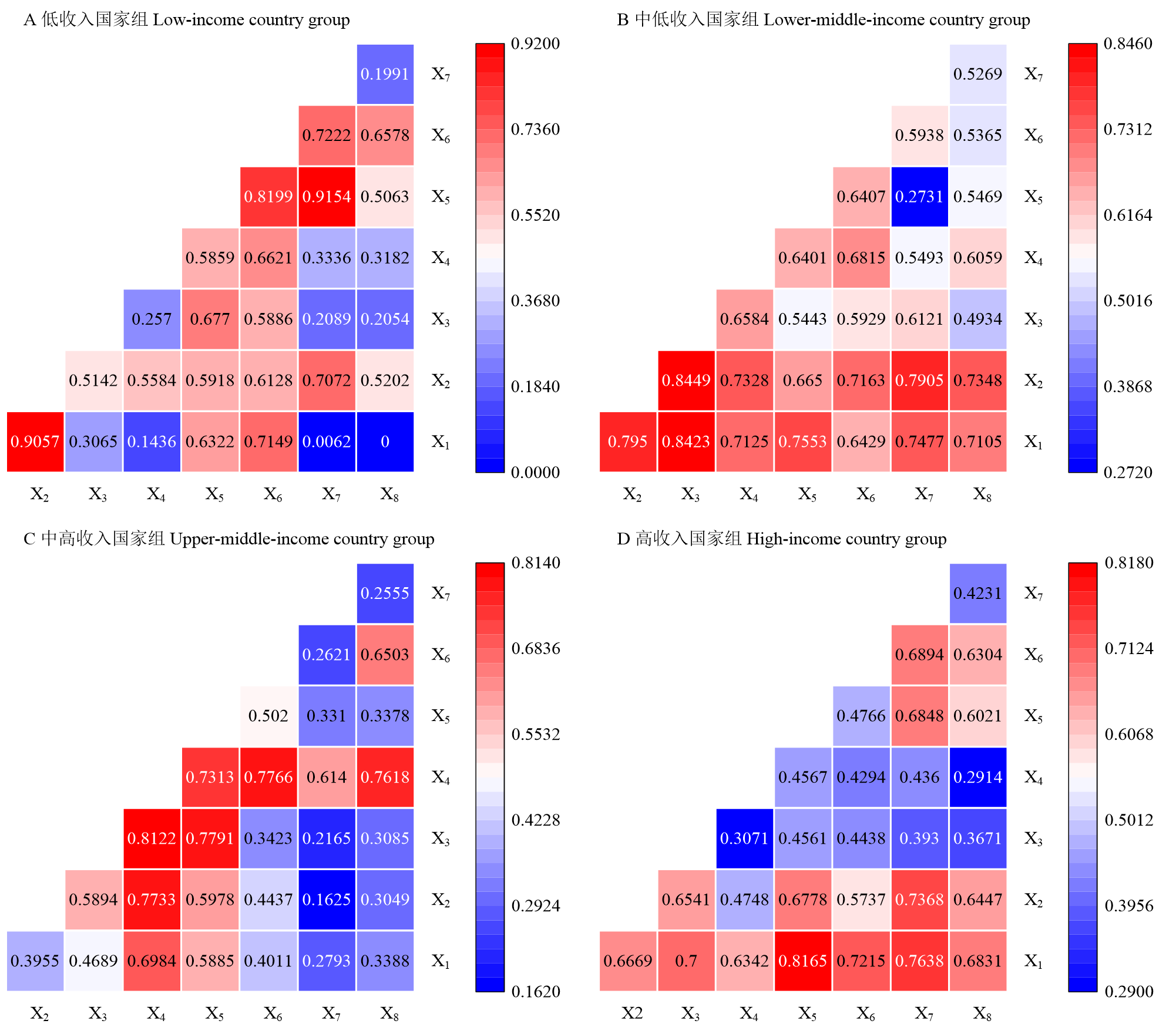
Fig. 5

Interaction detection results of influencing factors of agricultural and rural development level in 2000"

Fig. 6

Interaction detection results of influencing factors of agricultural and rural development level in 2022"

[1]
匡远配, 彭云, 李姗姗. 新时代中国农业农村现代化的多重逻辑、基本特征及实现路径. 中国农村经济, 2024(12): 2-22.
KUANG Y P, PENG Y, LI S S. The multiple logics, basic characteristics, and realization paths of China’s agricultural and rural modernization in the new era. Chinese Rural Economy, 2024(12): 2-22. (in Chinese)
[2]
李思梦, 杨忍, 龙花楼. 全球乡村发展理论演化及其对中国乡村现代化的启示. 地理学报, 2024, 79(4): 854-872.

doi: 10.11821/dlxb202404003
LI S M, YANG R, LONG H L. The theoretical evolution of global rural development and its enlightenment to rural modernization in China. Acta Geographica Sinica, 2024, 79(4): 854-872. (in Chinese)

doi: 10.11821/dlxb202404003
[3]
陈秧分, 卢昱嘉. 面向远景目标的农业强国建设: 国际比较与中国对策. 现代经济探讨, 2023(3): 1-11.
CHEN Y F, LU Y J. Construction of a powerful agricultural country oriented to the long-term goals: International comparison and China’s countermeasures. Modern Economic Research, 2023(3): 1-11. (in Chinese)
[4]
黄季焜, 胡瑞法, 易红梅, 盛誉, 王金霞, 宝明涛, 刘旭. 面向2050年我国农业发展愿景与对策研究. 中国工程科学, 2022, 24(1): 11-19.

doi: 10.15302/J-SSCAE-2022.01.002
HUANG J K, HU R F, YI H M, SHENG Y, WANG J X, BAO M T, LIU X. Development visions and policies of China’s agriculture by 2050. Strategic Study of CAE, 2022, 24(1): 11-19. (in Chinese)

doi: 10.15302/J-SSCAE-2022.01.002
[5]
蒋黎, 蒋和平, 郝汉. 中国式农业农村现代化: 科学内涵、条件分析及实现途径. 经济学家, 2024(11): 119-128.
JIANG L, JIANG H P, HAO H. Chinese-style agricultural and rural modernization: Scientific connotation, condition analysis, and realization approach. Economist, 2024(11): 119-128. (in Chinese)
[6]
魏后凯. “十四五”时期中国农村发展若干重大问题. 中国农村经济, 2020(1): 2-16.
WEI H K. Major issues of China’s rural development during the 14th Five-Year Plan period. Chinese Rural Economy, 2020(1): 2-16. (in Chinese)
[7]
吕新业, 万广华, 刘景琦, 汪晨. 中国式农业农村现代化: 内涵特征、现实挑战与策略选择. 改革, 2024(9): 125-137.
X Y, WAN G H, LIU J Q, WANG C. Chinese-style agricultural and rural modernization: Connotation, characteristics, challenges and strategy choices. Reform, 2024(9): 125-137. (in Chinese)
[8]
陈慧卿, 曾福生. 湖南省农业农村现代化发展水平测度及其区域差异. 经济地理, 2022, 42(11): 185-194.

doi: 10.15957/j.cnki.jjdl.2022.11.020
CHEN H Q, ZENG F S. Level measurement and regional difference of agricultural and rural modernization development in Hunan Province. Economic Geography, 2022, 42(11): 185-194. (in Chinese)

doi: 10.15957/j.cnki.jjdl.2022.11.020
[9]
覃朝晖, 范振楠, 余思明. 数字经济与农业农村现代化: 基于地级市层面的研究. 中南财经政法大学学报, 2024(4): 108-119.
QIN Z H, FAN Z N, YU S M. The digital economy and the agriculture and rural modernization: A study based on prefecture level cities. Journal of Zhongnan University of Economics and Law, 2024(4): 108-119. (in Chinese)
[10]
姬志恒. 中国农业农村高质量发展的空间差异及驱动机制. 数量经济技术经济研究, 2021, 38(12): 25-44.
JI Z H. Spatial differences and driving mechanism of high quality development in China’s agriculture and rural areas. The Journal of Quantitative & Technical Economics, 2021, 38(12): 25-44. (in Chinese)
[11]
张务伟, 王辰飞, 呼静茹. 山东省农业农村现代化动态演进及空间溢出效应研究. 农业现代化研究, 2024, 45(4): 577-590.
ZHANG W W, WANG C F, HU J R. Research on the dynamic evolution and spatial spillover effects of agricultural and rural modernization in Shandong Province. Research of Agricultural Modernization, 2024, 45(4): 577-590. (in Chinese)
[12]
谢会强, 王涵, 谭宇航. 中国农业农村现代化发展水平的时空演变特征及区域差异研究. 世界农业, 2023(3): 85-96.
XIE H Q, WANG H, TAN Y H. Spatial-temporal evolution characteristics and regional differences of agricultural and rural modernization development level in China. World Agriculture, 2023(3): 85-96. (in Chinese)
[13]
陈先兵. 数字经济、基本公共服务均等化与中国式农业农村现代化. 西南民族大学学报(人文社会科学版), 2023, 44(10): 95-109.
CHEN X B. Digital economy, equalization of basic public services, and modernization of Chinese agriculture and rural areas. Journal of Southwest Minzu University (Humanities and Social Sciences Edition), 2023, 44(10): 95-109. (in Chinese)
[14]
王力, 刘小凤, 李兴锋, 王一峰. 中国式农业农村现代化的时空特征及影响因素分析. 管理学刊, 2024, 37(6): 1-17.
WANG L, LIU X F, LI X F, WANG Y F. Analysis of spatio-temporal characteristics and influencing factors of Chinese-style agricultural and rural modernisation. Journal of Management, 2024, 37(6): 1-17. (in Chinese)
[15]
程美秀, 陈秧分. 国际比较视角下中国农业现代化成效评估与影响因素分析. 资源科学, 2022, 44(10): 1994-2005.

doi: 10.18402/resci.2022.10.04
CHENG M X, CHEN Y F. Evaluation of the effectiveness of China’s agricultural modernization based on international comparison and influencing factors. Resources Science, 2022, 44(10): 1994-2005. (in Chinese)

doi: 10.18402/resci.2022.10.04
[16]
张俊婕. 中国农业农村现代化发展水平的时空特征及障碍因子分析. 经济体制改革, 2022(2): 87-94.
ZHANG J J. Analysis on the spatial-temporal characteristics and obstacle factors of the development level of China’s agricultural and rural modernization. Reform of Economic System, 2022(2): 87-94. (in Chinese)
[17]
赵丹玉, 崔建军. 中国农业农村高质量发展的时空特征、区域差异及影响因素. 华中农业大学学报(社会科学版), 2024(3): 10-24.
ZHAO D Y, CUI J J. The spatial-temporal characteristics, regional disparities, and influencing factors of high-quality agricultural and rural development in China. Journal of Huazhong Agricultural University (Social Sciences Edition), 2024(3): 10-24. (in Chinese)
[18]
李媛, 阮连杰. 数字经济赋能中国式农业农村现代化: 理论逻辑与经验证据. 经济问题, 2023(8): 25-32.
LI Y, RUAN L J. Digital economy empowers Chinese agricultural and rural modernization theoretical logic and empirical evidence. On Economic Problems, 2023(8): 25-32. (in Chinese)
[19]
张梦飞, 吴琳玥. 数字普惠金融、双元创新与中国式农业农村现代化. 华东经济管理, 2024, 38(11): 41-52.
ZHANG M F, WU L Y. Digital inclusive finance, ambidextrous innovation, and Chinese-style modernization of agriculture and rural areas. East China Economic Management, 2024, 38(11): 41-52. (in Chinese)
[20]
孙贺, 傅孝天. 农业农村现代化一体推进的政治经济学逻辑. 求是学刊, 2021, 48(1): 81-89.
SUN H, FU X T. The political economy logic of the integrated promotion of agricultural and rural modernization. Seeking Truth, 2021, 48(1): 81-89. (in Chinese)
[21]
李周, 温铁军, 魏后凯, 杜志雄, 李成贵, 金文成. 加快推进农业农村现代化: “三农”专家深度解读中共中央一号文件精神. 中国农村经济, 2021(4): 2-20.
LI Z, WEN T J, WEI H K, DU Z X, LI C G, JIN W C. Speeding up the modernization of agriculture and rural areas: An in-depth interpretation by authoritative experts of the spirit of China’s No.1 central document. Chinese Rural Economy, 2021(4): 2-20. (in Chinese)
[22]
胡志全, 朱殿霄, 辛岭, 侯丽薇, 王东阳. 基于产业要素年代差距分析的农业现代化水平国际比较研究. 中国农业科学, 2018, 51(7): 1412-1420. doi: 10.3864/j.issn.0578-1752.2018.07.018.
HU Z Q, ZHU D X, XIN L, HOU L W, WANG D Y. Comparison study on the level of international agricultural modernization based on the method of generation gap of industry elements. Scientia Agricultura Sinica, 2018, 51(7): 1412-1420. doi: 10.3864/j.issn.0578-1752.2018.07.018. (in Chinese)
[23]
LI Y H, YOU X, SUN X Y, CHEN J. Dynamic assessment and pathway optimization of agricultural modernization in China under the sustainability framework: An empirical study based on dynamic QCA analysis. Journal of Cleaner Production, 2024, 479: 144072.

doi: 10.1016/j.jclepro.2024.144072
[24]
陈明. 农业农村现代化的世界进程与国际比较. 经济体制改革, 2022(4): 151-159.
CHEN M. The world process and international comparison of agricultural and rural modernization. Reform of Economic System, 2022(4): 151-159. (in Chinese)
[25]
张应禄, 陈志钢. 城乡二元经济结构: 测定、变动趋势及政策选择. 农业经济问题, 2011, 32(11): 84-93, 112.
ZHANG Y L, CHEN Z G. Urban-rural dual economic structure: Determination, trend of changes, and policy options. Issues in Agricultural Economy, 2011, 32(11): 84-93, 112. (in Chinese)
[26]
陈准, 刘云朋, 陈太政, 周志民, 王伟. 中国省际农业高质量发展空间关联网络结构演化及其驱动因素. 经济地理, 2024, 44(11): 151-160, 172.

doi: 10.15957/j.cnki.jjdl.2024.11.016
CHEN Z, LIU Y P, CHEN T Z, ZHOU Z M, WANG W. Spatiotemporal evolution and driving factors of spatial correlation network structure of China’s agricultural high-quality development. Economic Geography, 2024, 44(11): 151-160, 172. (in Chinese)

doi: 10.15957/j.cnki.jjdl.2024.11.016
[27]
HOSSAIN M, MENDIRATTA V, SAVASTANO S. Agricultural and rural development interventions and poverty reduction: Global evidence from 16 impact assessment studies. Global Food Security, 2024, 43: 100806.

doi: 10.1016/j.gfs.2024.100806
[28]
杨忍, 刘芮彤. 珠三角城市群地区都市农业功能演变及其协同-权衡关系. 地理研究, 2022, 41(7): 1995-2015.

doi: 10.11821/dlyj020210654
YANG R, LIU R T. Functional evolution and collaboration/trade-off relationship of urban agriculture in the Pearl River Delta urban agglomeration. Geographical Research, 2022, 41(7): 1995-2015. (in Chinese)
[29]
WANG K L, ZHANG F Q, XU R Y, MIAO Z, CHENG Y H, SUN H P. Spatiotemporal pattern evolution and influencing factors of green innovation efficiency: A China’s city level analysis. Ecological Indicators, 2023, 146: 109901.

doi: 10.1016/j.ecolind.2023.109901
[30]
郭强, 杨湘君. 中国省域发展软环境评价及其区域差异. 经济地理, 2023, 43(9): 10-19.

doi: 10.15957/j.cnki.jjdl.2023.09.002
GUO Q, YANG X J. Evaluation and regional disparity of the soft environment development at the provincial level. Economic Geography, 2023, 43(9): 10-19. (in Chinese)

doi: 10.15957/j.cnki.jjdl.2023.09.002
[31]
陈实, 黄银兰, 金云翔, 徐成林, 邹金秋. 中国北部冬小麦安全种植的农业气候因子及其阈值. 中国农业科学, 2024, 57(16): 3142-3153. doi: 10.3864/j.issn.0578-1752.2024.16.004.
CHEN S, HUANG Y L, JIN Y X, XU C L, ZOU J Q. Agricultural climatic factors and their thresholds for winter wheat cultivation in northern China. Scientia Agricultura Sinica, 2024, 57(16): 3142-3153. doi: 10.3864/j.issn.0578-1752.2024.16.004. (in Chinese)
[32]
刘同山, 陈斯懿. 农业强国的测度指标、国际比较与中国选择. 东岳论丛, 2023, 44(7): 5-14.
LIU T S, CHEN S Y. Measurement indicators, international comparison and China’s choice of agricultural power. Dongyue Tribune, 2023, 44(7): 5-14. (in Chinese)
[33]
孙运宏. 财政支农与农业现代化: 基于全球视野的分析. 世界经济与政治论坛, 2024(2): 146-165.
SUN Y H. Financial support for agriculture and agricultural modernization: Analysis based on a global perspective. Forum of World Economics & Politics, 2024(2): 146-165. (in Chinese)
[34]
FARAJZADEH Z, GHORBANIAN E, TARAZKAR M H. Sectoral impacts of climate change in Iran: A dynamic analysis with emphasis on agriculture. Sustainable Production and Consumption, 2024, 49: 571-588.

doi: 10.1016/j.spc.2024.07.020
[1] HU ZhiQuan, ZHU DianXiao, XIN Ling, HOU LiWei, WANG DongYang. Comparison Study on the Level of International Agricultural Modernization Based on the Method of Generation Gap of Industry Elements [J]. Scientia Agricultura Sinica, 2018, 51(7): 1412-1420.
[2] WU Yi-Ping, CHEN Su-Yun, SUN De-Zhong. Research on Path and Key Problem of Coordinated Development of Urbanization, Agricultural Modernization and Industrialization in Central Plains Economic Region [J]. Scientia Agricultura Sinica, 2012, 45(21): 4528-4533.
Viewed
Full text


Abstract

Cited

  Shared   
  Discussed   
No Suggested Reading articles found!