Scientia Agricultura Sinica ›› 2026, Vol. 59 ›› Issue (3): 655-667.doi: 10.3864/j.issn.0578-1752.2026.03.013

• ANIMAL SCIENCE·VETERINARY SCIENCE • Previous Articles     Next Articles

Establishment and Preliminary Application of Indirect ELISA Antibody Detection Method for Mycobacterium avium subsp. paratuberculosis in Sheep

GAO YunJie1,2(), GUO RuoNan1,3, CHEN ChunWen1,2, DUAN YiFan1, ZHANG ZhenJun1,3, NIE ChanChan1,2, LI MengYu1,2, WANG Hui1, FENG TingTing1, CUI YingYing1, DANG GuangHui1(), LIU SiGuo1()   

  1. 1 State Key Laboratory of Animal Control and Prevention/Harbin Veterinary Reserch Institute, Chinese Academy of Agricultural Sciences, Harbin 150069
    2 College of Animal Medical, Northeast Agricultural University, Harbin 150030
    3 College of Animal Medical, Xinjiang Agricultural University, Urumqi 830052
  • Received:2025-06-11 Accepted:2025-11-30 Online:2026-02-01 Published:2026-01-31
  • Contact: DANG GuangHui, LIU SiGuo

Abstract:

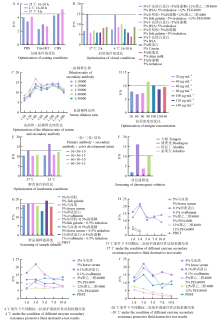
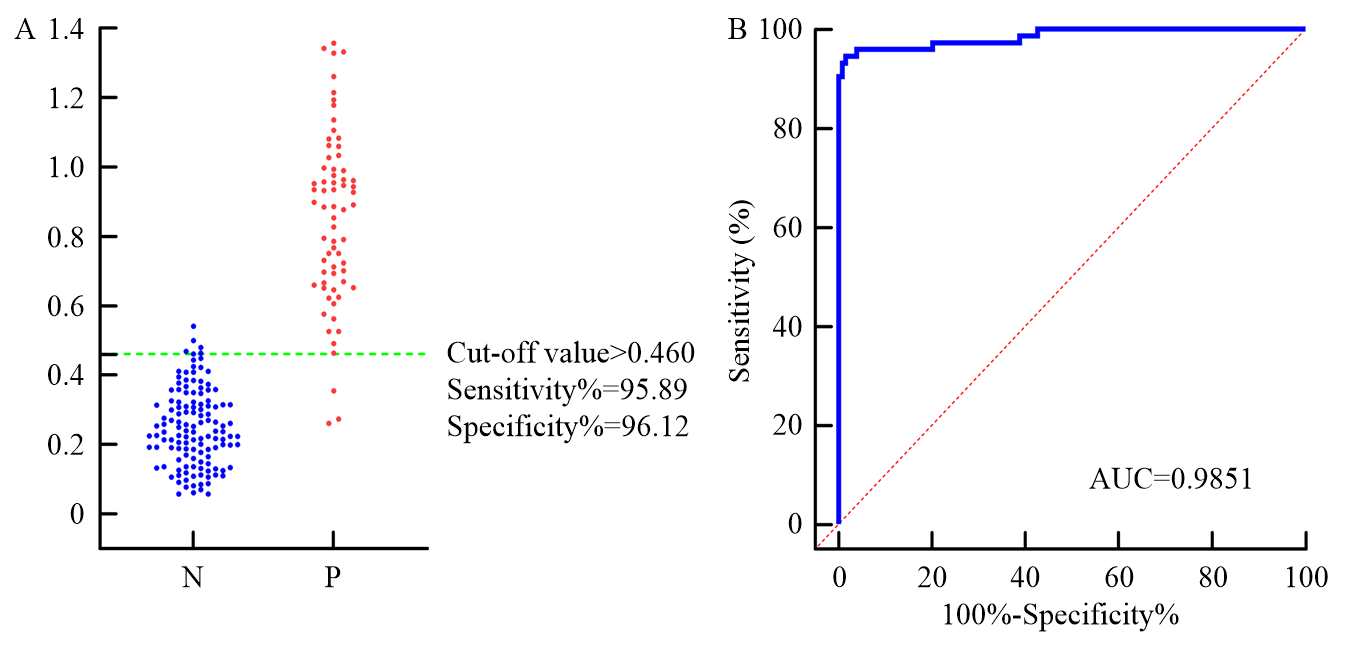
【Objective】This study aimed to develop an indirect ELISA detection method for antibodies against Mycobacterium avium subsp. paratuberculosis (MAP) in sheep, for providing an efficient and reliable technique for the epidemiological surveillance and serological testing of Johne's disease (JD) in sheep. 【Method】In this study, the culture supernatant of the strain (MAP-XJB13) was isolated in the laboratory during earlier stage, which was selected as the MAP-coated antigen. The optimal reaction conditions and critical values for indirect ELISA were determined through the systematic screening and optimization of various parameters, including the coating solution and conditions, blocking solution and conditions, antigen coating concentration, serum dilution ratio, antibody incubation and color development time, brand of color development solution, sample dilution solution and enzyme-labeled secondary antibody protective solution. The efficacy of the developed indirect ELISA antibody detection method for sheep MAP was assessed in terms of sensitivity, specificity, repeatability, preservation period, and coincidence rate. Finally, the initially assembled reagent kits were utilized for the clinical detection of samples from in Heilongjiang and Inner Mongolia. 【Result】The optimal conditions for the ELISA were determined as follows: the coating solution utilized as CBS buffer, with the coating condition process conducted at 37 ℃ for 4 hours. The blocking solution comprised 5% fish gelatin, 5% trehalose, and 12% PEG4000, with the blocking procedure also performed at 37 ℃ for 2 hours. The antigen coating concentration was set at 80 µg·mL-1, the serum dilution ratio was 1:40, and the dilution ratio for the enzyme-labeled secondary antibody was 1:30 000. The incubation parameters included primary antibody incubation at 25 ℃ for 30 minutes, followed by a 30-minute incubation of the enzyme-labeled secondary antibody, and a 15-minute color development phase. The color development solution employed was Biodragon, while the sample dilution solution consisted of 1% ovalbumin and 0.5% trehalose. Additionally, the protective solution for the enzyme-labeled secondary antibody contained 0.1% ovalbumin. The critical threshold for the developed indirect ELISA method for detecting antibodies against sheep MAP was determined to be 0.460, with a sensitivity of 95.89% and a specificity of 96.12%. The cross-reactivity analysis demonstrated that, based on the premise that the positive and negative results were valid, there was no cross-reactivity with the following: positive serum for Brucella in sheep, positive serum for Mycoplasma mycoides in sheep, positive serum for Corynebacterium pseudomycosis in goats, positive serum for tuberculosis in sheep, positive serum for peste des petits ruminants virus in goats, positive serum for peste des petits ruminants in sheep, and positive serum for poxvirus in sheep. The intra-batch and inter-batch coefficients of variation ranged from 0.754% to 7.812% and 1.252% to 7.277%, respectively, and the stability of the results was maintained for up to 8 months. The sheep MAP indirect ELISA antibody detection kit exhibited a positive concordance rate of 95.89% and a negative concordance rate of 95.55% when compared to the ID.vet MAP ELISA antibody detection kit, resulting in an overall concordance rate of 98.56%. The prevalence of MAP antibodies in sheep from Heilongjiang and Inner Mongolia was found to be 10.81%. 【Conclusion】This study successfully developed an indirect ELISA method for the detection of antibodies MAP in sheep. The method exhibited exceptional specificity, high sensitivity and a long shelf life, thereby offering robust technical support for the prevention and management of JD.

Key words: Mycobacterium avium subsp. paratuberculosis, sheep paratuberculosis, indirect ELISA, antibody detection, MAP- XJB13 stain

Table 1

MAP clinical serum source statistics"

阳性血清Positive serum 阴性血清 Negative serum
编号Number 来源Source 数量Quantity 编号Number 来源Source 数量Quantity
1-53 黑龙江Heilongjiang 53 1-77 黑龙江Heilongjiang 77
54-67 内蒙古Inner Mongolia 14 78-126 内蒙古Inner Mongolia 49
68-73 新疆Xinjiang 6 127-129 新疆Xinjiang 3
合计Total 73 合计Total 129

Fig. 1

Optimization of the indirect ELISA reaction conditions for Mycobacterium avium subsp. paratuberculosis in sheep"

Table 2

Test validity determination"

阳性血清 Positive serum 阴性血清 Negative serum
标准差 SD 0.010 0.100
平均值 x ¯ 0.072 1.662
x ¯-3SD 1.362 0.042
x ¯+3SD 1.962 0.102

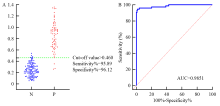
Fig. 2

Determination of cut-off value A: Scatter plot of 202 clinical serum tests; B: ROC curve"

Table 3

Sensitivity test results of 20240501 batch kits (OD450nm)"

血清
Serum
血清稀释度 Serum dilution
1:40 1:80 1:160 1:320 1:640 1:1 280 1:2 560 1:5,120
N1 2.659 2.514 2.21 1.95 1.278 0.86 0.472 0.273
N2 2.107 1.697 1.27 1.112 0.45 0.248 0.164 0.117
N3 0.982 0.802 0.426 0.28 0.127 0.085 0.071 0.074
N4 2.091 2.342 1.509 1.152 0.598 0.355 0.229 0.147
N5 2.474 2.392 2.15 1.921 1.438 0.958 0.627 0.396
N6 2.519 2.446 1.647 1.208 0.529 0.286 0.186 0.127
N7 2.542 2.383 1.706 1.225 0.627 0.337 0.215 0.142
N8 1.716 1.272 0.676 0.454 0.239 0.148 0.096 0.094
N9 0.173 0.153 0.119 0.106 0.071 0.066 0.062 0.07
N10 0.419 0.332 0.182 0.137 0.083 0.068 0.065 0.072
N11 0.301 0.204 0.136 0.114 0.07 0.065 0.063 0.066
N12 0.338 0.218 0.152 0.122 0.097 0.068 0.062 0.072
N13 0.711 0.459 0.279 0.198 0.128 0.085 0.073 0.073
阳性对照Positive control 1.550 1.749 1.535 1.447
阴性对照Negative control 0.094 0.101 0.064 0.087

Table 4

Sensitivity test results of 20240501 batch kits (S/P)"

血清
Serum
血清稀释度 Serum dilution
1:40 1:80 1:160 1:320 1:640 1:1280 1:2560 1:5120
N1 1.650 1.557 1.361 1.194 0.761 0.491 0.241 0.113
N2 1.295 1.031 0.755 0.654 0.227 0.097 0.043 0.013
N3 0.570 0.454 0.212 0.118 0.019 -0.008 -0.017 -0.015
N4 1.284 1.446 0.909 0.679 0.322 0.166 0.085 0.032
N5 1.531 1.478 1.322 1.175 0.864 0.554 0.341 0.192
N6 1.560 1.513 0.998 0.716 0.278 0.121 0.057 0.019
N7 1.575 1.473 1.036 0.726 0.341 0.154 0.076 0.029
N8 1.043 0.757 0.373 0.230 0.091 0.033 -0.001 -0.002
N9 0.049 0.036 0.014 0.005 -0.017 -0.020 -0.023 -0.018
N10 0.207 0.151 0.054 0.025 -0.009 -0.019 -0.021 -0.016
N11 0.131 0.069 0.025 0.011 -0.018 -0.021 -0.022 -0.020
N12 0.185 0.101 0.054 0.033 0.015 -0.005 -0.010 -0.002
N13 0.449 0.271 0.144 0.087 0.037 0.007 -0.002 -0.002

Table 5

Kit specific detection results of three batches (OD450nm)"

血清Serum 20240601 20240602 20240603
N1 0.305 0.12 0.111
N2 0.683 0.269 0.183
N3 0.120 0.117 0.096
N4 0.364 0.336 0.269
N5 0.390 0.261 0.186
N6 0.183 0.181 0.131
N7 0.47 0.495 0.324
阳性对照
Positive control
1.529 1.592 1.587
1.536 1.721 1.593
阴性对照
Negative control
0.097 0.075 0.085
0.099 0.074 0.081

Table 6

Kit specific detection results of three batches (S/P)"

血清Serum 20240601 20240602 20240603
N1 0.144 0.029 0.019
N2 0.408 0.123 0.066
N3 0.015 0.027 0.009
N4 0.185 0.165 0.123
N5 0.204 0.118 0.068
N6 0.059 0.067 0.032
N7 0.259 0.266 0.160

Table 7

Sensitivity test results of Batch 20240901 kit (OD450nm)"

血清稀释比例
Serum dilution ratio
1个月
1 month
2个月
2 months
4个月
4 months
6个月
6 months
8个月
8 months
1:40 1.311 1.097 1.186 1.190 1.037
1:80 0.968 0.918 0.871 0.888 0.764
1:160 0.606 0.633 0.533 0.633 0.521
1:320 0.291 0.279 0.231 0.293 0.209
阳性对照
Positive control
1.591 1.316 1.282 1.53 1.44
1.575 1.659 1.462 1.315 1.414
阳性对照
Positive control
0.063 0.076 0.069 0.077 0.096
0.06 0.077 0.081 0.08 0.088

Table 8

Sensitivity test results of Batch 20240901 kit (S/P)"

血清稀释比例
Serum dilution ratio
1个月
1 month
2个月
2 months
4个月
4 months
6个月
6 months
8个月
8 months
1:40 1.245 1.154 1.194 1.158 1.114
1:80 0.852 0.823 0.907 0.922 0.743
1:160 0.516 0.639 0.569 0.634 0.486
1:320 0.290 0.314 0.224 0.319 0.247

Table 9

Statistical results of coincidence rate between laboratory kit and ID.vet kit"

实验室自制试剂盒
Laboratory made kit
IDV.et试剂盒IDV.et kit
阳性Positive 阴性Negative 合计Total
阳性Positive 70 11 81
阴性Negative 3 231 234
合计Total 73 242 315
符合率
Rate of conformity
95.89% 95.55% 95.56%

Table 10

Statistical results of epidemiology"

实验室自制试剂盒
Laboratory made kit
省份Provinces
黑龙江
Heilongjiang
内蒙古
Inner Mongolia
合计
Total
阳Positive 82 60 142
阴Negative 597 569 1166
合计Total 679 629 1308
阳性率Positive rate 12.08% 9.54% 10.87%
[1]
ALONSO-HEARN M, BALLESTEROS A, NAVARRO A, BADIA-BRINGUÉ G, CASAIS R. Lateral-flow assays for bovine paratuberculosis diagnosis. Frontiers in Veterinary Science, 2023, 10: 1257488.

doi: 10.3389/fvets.2023.1257488
[2]
CUNHA M V, ROSALINO L M, LEÃO C, BANDEIRA V, FONSECA C, BOTELHO A, REIS A C. Ecological drivers of Mycobacterium avium subsp. paratuberculosis detection in mongoose (Herpestes ichneumon) using IS900 as proxy. Scientific Reports, 2020, 10(1): 860.

doi: 10.1038/s41598-020-57679-3
[3]
赵太革. 羊临床副结核的发病机制、诊断和控制措施. 中国动物保健, 2024, 26(1): 118-119.
ZHAO T G. The pathogenesis, diagnosis and control measures of clinical subclinical tuberculosis in sheep. China Animal Health, 2024, 26(1): 118-119. (in Chinese)
[4]
THARWAT M, ALI H, ALKHERAIF A A. Paratuberculosis in sheep and goats: Pathogenesis, diagnostic findings, and control strategies. Open Veterinary Journal, 2025, 15(1): 1-7.

doi: 10.5455/OVJ.2024.v15.i1.1 pmid: 40092194
[5]
WHITTINGTON R, DONAT K, WEBER M F, KELTON D, NIELSEN S S, EISENBERG S, ARRIGONI N, JUSTE R, SáEZ J L, DHAND N, et al. Control of paratuberculosis: who, why and how. A review of 48 countries. BMC Veterinary Research, 2019, 15(1): 198.

doi: 10.1186/s12917-019-1943-4 pmid: 31196162
[6]
MCALOON C G, ROCHE S, RITTER C, BARKEMA H W, WHYTE P, MORE S J, O’GRADY L, GREEN M J, DOHERTY M L. A review of paratuberculosis in dairy herds: Part 1: Epidemiology. The Veterinary Journal, 2019, 246: 59-65.

doi: 10.1016/j.tvjl.2019.01.010
[7]
DOW C T, ALVAREZ B L. Mycobacterium paratuberculosis zoonosis is a One Health emergency. EcoHealth, 2022, 19(2): 164-174.

doi: 10.1007/s10393-022-01602-x
[8]
MELES D K, MUSTOFA I, KHAIRULLAH A R, WURLINA W, MUSTOFA R I, SUWASANTI N, AKINTUNDE A O, PUTRA S W, KUSALA M K J, MOSES I B, et al. A comprehensive review of paratuberculosis in animals and its implications for public health. Open Veterinary Journal, 2024, 14(11): 2731-2744.

doi: 10.5455/OVJ.2024.v14.i11.2 pmid: 39737030
[9]
OKUNI J B, HANSEN S, ELTOM K H, ELTAYEB E, AMANZADA A, OMEGA J A, CZERNY C P, ABD EL WAHED A, OJOK L. Paratuberculosis: A potential zoonosis and a neglected disease in Africa. Microorganisms, 2020, 8(7): 1007.

doi: 10.3390/microorganisms8071007
[10]
COLLINS M T. Food safety concerns regarding paratuberculosis. The Veterinary Clinics of North America Food Animal Practice, 2011, 27(3): 631-636, vii-viii.

doi: 10.1016/j.cvfa.2011.07.009
[11]
BHARATH M N, GUPTA S, VASHISTHA G, AHMAD S, SINGH S V. Bioprospective Role of Ocimum sanctum and Solanum xanthocarpum against Emerging Pathogen: Mycobacterium avium Subspecies paratuberculosis: A review. Molecules, 2023, 28(8): 3490.

doi: 10.3390/molecules28083490
[12]
DE NORONHA XAVIER A, DE SÁ L M N, DE NAZARÉ SANTOS FERREIRA M, DE OLIVEIRA P R F, DE MORAES PEIXOTO R, MOTA R A, JUNIOR J W P. First serological diagnosis of Mycobacterium avium subsp. paratuberculosis infection in sheep in the state of Pernambuco, Brazil. Veterinary Research Communications, 2024, 48(2): 1293-1299.

doi: 10.1007/s11259-024-10300-8
[13]
DANE H, STEWART L D, GRANT I R. Culture of Mycobacterium avium subsp. paratuberculosis: challenges, limitations and future prospects. Journal of Applied Microbiology, 2023, 134(1): lxac017.
[14]
LUTTIKHOLT S, LIEVAART-PETERSON K, GONGGRIJP M, AALBERTS M, VAN SCHAIK G, VELLEMA P. Mycobacterium avium subsp. paratuberculosis elisa responses in milk samples from vaccinated and nonvaccinated dairy goat herds in the Netherlands. Veterinary Sciences, 2019, 6(2): 58.

doi: 10.3390/vetsci6020058
[15]
SHARMA K, SHARMA S, DHANDA S, BANGAR Y, KUMAR N, CHAUBEY K K. Meta-analysis of prevalence of paratuberculosis in cattle using published estimates under serum and milk ELISA. Research in Veterinary Science, 2024, 178: 105366.

doi: 10.1016/j.rvsc.2024.105366
[16]
MIKKELSEN H, AAGAARD C, NIELSEN S S, JUNGERSEN G. Review of Mycobacterium avium subsp. paratuberculosis antigen candidates with diagnostic potential. Veterinary Microbiology, 2011, 152(1/2): 1-20.

doi: 10.1016/j.vetmic.2011.03.006
[17]
MOYANO R D, ROMERO M A, COLOMBATTI OLIVIERI M A, ALVARADO PINEDO M F, TRAVERIA G E, ROMANO M I, ALONSO M N. Development and validation of a novel ELISA for the specific detection of antibodies against Mycobacterium avium subspecies paratuberculosis based on a chimeric polyprotein. Veterinary Medicine International, 2021, 2021(1): 7336848.
[18]
CHO D, COLLINS M T. Comparison of the proteosomes and antigenicities of secreted and cellular proteins produced by Mycobacterium paratuberculosis. Clinical and Vaccine Immunology, 2006, 13(10): 1155-1161.

doi: 10.1128/CVI.00058-06
[19]
刘虹秀, 程玉笛, 党光辉, 李田田, 李鹤, 崔子寅, 宋宁宁, 陈利苹, 刘思国. 牛副结核分枝杆菌的分离及鉴定. 中国预防兽医学报, 2018, 40(12): 1177-1180.
LIU H X, CHENG Y D, DANG G H, LI T T, LI H, CUI Z Y, SONG N N, CHEN L P, LIU S G. Isolation and identification of Mycobacterium avium subsp. paratuberculosis from cattle. Chinese Journal of Preventive Veterinary Medicine, 2018, 40(12): 1177-1180. (in Chinese)
[20]
JAIN M, KUMAR A, POLAVARAPU R, GUPTA S, ASERI G K, SHARMA D, SOHAL J S. Development of rELISA using novel markers for the diagnosis of paratuberculosis. Journal of Immunological Methods, 2021, 497: 113105.

doi: 10.1016/j.jim.2021.113105
[21]
张从钺, 周红, 蔺辉星, 范红结. 猪增生性肠病间接ELISA抗体检测试剂盒的研制与应用. 中国农业科学, 2024, 57(16): 3283-3293. doi: 10.3864/j.issn.0578-1752.2024.16.014.
ZHANG C Y, ZHOU H, LIN H X, FAN H J. Development and application of indirect ELISA kits for antibody detection of porcine proliferative enteropathy. Scientia Agricultura Sinica, 2024, 57(16): 3283-3293. doi: 10.3864/j.issn.0578-1752.2024.16.014. (in Chinese)
[22]
WINDSOR P A. Paratuberculosis in sheep and goats. Veterinary Microbiology, 2015, 181(1/2): 161-169.

doi: 10.1016/j.vetmic.2015.07.019
[23]
陈凡若, 张嘉俊, 鹿萍, 崔宁, 崔莹莹, 崔子寅, 党光辉, 刘思国. 副结核分枝杆菌免疫原蛋白的筛选及免疫保护效果评价. 中国农业科学, 2024, 57(6): 1204-1214. doi: 10.3864/j.issn.0578-1752.2024.06.014.
CHEN F R, ZHANG J J, LU P, CUI N, CUI Y Y, CUI Z Y, DANG G H, LIU S G. Screening of Mycobacterium avium subsp. paratuberculosis immunogenic proteins and its evaluation of immunological effect. Scientia Agricultura Sinica, 2024, 57(6): 1204-1214. doi: 10.3864/j.issn.0578-1752.2024.06.014. (in Chinese)
[24]
SCARPELLINI R, GIACOMETTI F, SAVINI F, ARRIGONI N, GARBARINO C A, CARNEVALE G, MONDO E, PIVA S. Bovine paratuberculosis: results of a control plan in 64 dairy farms in a 4-year period. Preventive Veterinary Medicine, 2023, 215: 105923.

doi: 10.1016/j.prevetmed.2023.105923
[25]
MUNJAL S K, BOEHMER J, BEYERBACH M, STRUTZBERG- MINDER K, HOMUTH M. Evaluation of a LAM ELISA for diagnosis of paratuberculosis in sheep and goats. Veterinary Microbiology, 2004, 103(1/2): 107-114.

doi: 10.1016/j.vetmic.2004.07.019
[26]
HEMATI Z, HAGHKHAH M, DERAKHSHANDEH A, CHAUBEY K K, SINGH S V. Novel recombinant Mce-truncated protein based ELISA for the diagnosis of Mycobacterium avium subsp. paratuberculosis infection in domestic livestock. PLoS ONE, 2020, 15(6): e0233695.

doi: 10.1371/journal.pone.0233695
[27]
GURUNG R B, BEGG D J, PURDIE A C, EAMENS G J, WHITTINGTON R J. Development of 316v antibody enzyme-linked immunosorbent assay for detection of paratuberculosis in sheep. Revue Scientifique et Technique (International Office of Epizootics), 2015, 34(3): 869-879.
[28]
WILLEMSEN P T J, WESTERVEEN J, DINKLA A, BAKKER D, VAN ZIJDERVELD F G, THOLE J E R. Secreted antigens of Mycobacterium avium subspecies paratuberculosis as prominent immune targets. Veterinary Microbiology, 2006, 114(3/4): 337-344.

doi: 10.1016/j.vetmic.2005.12.005
[29]
ROSSEELS V, MARCHÉ S, ROUPIE V, GOVAERTS M, GODFROID J, WALRAVENS K, HUYGEN K. Members of the 30- to 32-kilodalton mycolyl transferase family (Ag85) from culture filtrate of Mycobacterium avium subsp. paratuberculosis are immunodominant Th1-type antigens recognized early upon infection in mice and cattle. Infection and Immunity, 2006, 74(1): 202-212.

doi: 10.1128/IAI.74.1.202-212.2006
[30]
ELSOHABY I, ARANGO-SABOGAL J C, SELIM A, ATTIA K A, ALSUBKI R A, MOHAMED A M, MEGAHED A. Bayesian estimation of sensitivity and specificity of fecal culture, fecal PCR and serum ELISA for diagnosis of Mycobacterium avium subsp. paratuberculosis infections in sheep. Preventive Veterinary Medicine, 2022, 206: 105712.

doi: 10.1016/j.prevetmed.2022.105712
[31]
GUMBER S, EAMENS G, WHITTINGTON R J. Evaluation of a Pourquier ELISA kit in relation to agar gel immunodiffusion (AGID) test for assessment of the humoral immune response in sheep and goats with and without Mycobacterium paratuberculosis infection. Veterinary Microbiology, 2006, 115(1/2/3): 91-101.

doi: 10.1016/j.vetmic.2006.01.003
[32]
PICKRODT C, KÖHLER H, MOOG U, LIEBLER-TENORIO E M, MÖBIUS P. Molecular diversity of Mycobacterium avium subsp. paratuberculosis in four dairy goat herds from Thuringia (germany). Animals, 2023, 13(22): 3542.

doi: 10.3390/ani13223542
[33]
ROBBE-AUSTERMAN S. Control of paratuberculosis in small ruminants. The Veterinary Clinics of North America Food Animal Practice, 2011, 27(3): 609-620, vii.

doi: 10.1016/j.cvfa.2011.07.007
[1] ZHAO YiRan, SHAN YanKe, LI JiaHao, HE ZhaoQun, WANG XinYi, WEN Dun, WANG MiLa, CHU Rui, ZHAO DongMing, LIU Fei. Establishment of Rapid Field Co-Detection Method of ASFV Antibody and Nucleic Acid Based on Quantum Dot Microspheres and RPA Technology [J]. Scientia Agricultura Sinica, 2024, 57(24): 4990-5002.
[2] ZHANG PengYun, CHEN Min, LIU MingXing, ZHOU Hong, LIN HuiXing, FAN HongJie. Development and Application of Indirect ELISA Kits for Antibody Detection of Haemophilus parasuis [J]. Scientia Agricultura Sinica, 2023, 56(8): 1606-1614.
[3] GUO Kui, ZHANG ZeNan, WANG YaoXin, LI ShuaiJie, CHU XiaoYu, GUO Wei, HU Zhe, WANG XiaoJun. Development and Application of a Mab-Based iELISA for the Detection of Antibodies Against African Horse Fever Virus [J]. Scientia Agricultura Sinica, 2023, 56(16): 3237-3246.
[4] WANG Fang, FENG Yu, ZHANG Ge, JIANG Hui, ZHU Liang-quan, DING Jia-bo. Development of Indirect ELISA for Antibody of Brucella abortus [J]. Scientia Agricultura Sinica, 2016, 49(9): 1818-1825.
[5] CHEN Shan-Zhen, LI Chun-Ling, JIA Ai-Qing, WANG Gui-Ping. Expression of Outer Membrane Protein P5 Gene of Haemophilus Parasuis and Establishment of an Indirect ELISA Based on the OMP5 Protein [J]. Scientia Agricultura Sinica, 2011, 44(14): 3036-3044 .
[6] WANG Hong,YU Li-yun,HOU Xi-lin,PIAO Fan-ze,ZHAI Yan-qing
.

Development of an Indirect ELISA Diagnostic Method for Detecting Bovine Respiratory Syncytial Virus Using Recombinant Nucleocapsid Protein and Its Preliminary Application

[J]. Scientia Agricultura Sinica, 2010, 43(20): 4303-4309 .
Viewed
Full text


Abstract

Cited

  Shared   
  Discussed   
No Suggested Reading articles found!