






中国农业科学 ›› 2026, Vol. 59 ›› Issue (16): 3640-3654.doi: 10.3864/j.issn.0578-1752.2026.16.012
姚振豫1,2( ), 段文宜1,2,3(), 孟君仁2, 李昂2, 陈明2, 岳宗省2, 孙世航1,2,3, 潘磊1,2,3, 牛良1,3, 崔国朝1,3, 曾文芳1,2,3()
收稿日期:2026-02-21
接受日期:2026-07-01
出版日期:2026-08-16
发布日期:2026-08-17
通信作者:
联系方式:
姚振豫,E-mail:yaoyiqian1@gmail.com。段文宜,E-mail:duanwenyi@caas.cn。姚振豫和段文宜为同等贡献作者。
基金资助:
YAO ZhenYu1,2(), DUAN WenYi1,2,3(), MENG JunRen2, LI Ang2, CHEN Ming2, YUE ZongSheng2, SUN ShiHang1,2,3, PAN Lei1,2,3, NIU Liang1,3, CUI GuoChao1,3, ZENG WenFang1,2,3()
Received:2026-02-21
Accepted:2026-07-01
Published:2026-08-16
Online:2026-08-17
摘要:
【目的】 明确不同肉质类型桃果实发育过程中香气形成规律,挖掘造成品种间香气品质差异的关键调控基因,为硬质桃风味品质改良提供理论依据。【方法】 以溶质型品种‘春美’和硬质型品种‘中桃9号’为试材,在果实发育全周期设置7个关键采样点,采用顶空固相微萃取-气相色谱-质谱联用技术检测挥发性物质,结合转录组数据筛选差异表达基因(DEGs),通过Pearson相关性分析鉴定与关键香气物质显著关联的核心基因。【结果】 共检测到57种香气化合物,其组成与含量在不同品种及果实发育阶段均表现出显著差异。硬质型桃‘中桃9号’在整个发育过程中未检测到乙烯释放,C6醛类物质(如2-己烯醛)含量在成熟期仍维持较高水平,而内酯与酯类物质几乎未积累;溶质型桃‘春美’在S3到S4转折后出现乙烯跃变峰,内酯物质含量随之增加3.1—3.8倍,C6化合物含量显著下降。转录组分析共鉴定出2 806个DEGs,聚类分析显示两个品种在各发育时期呈现显著差异;KEGG富集分析表明DEGs主要富集在植物激素信号转导、α-亚麻酸代谢和类胡萝卜素生物合成等通路。关联分析筛选出16个与酯类/内酯类合成相关的候选基因,其中BSK2(Prupe.2G110200)、PpYUC11(Prupe.6G157400/6G157500)等基因表达水平分别与乙酸己酯、γ-癸内酯含量呈显著正相关关系。【结论】 乙烯是造成两种肉质类型桃果实香气品质差异的核心调控因子,‘中桃9号’乙烯信号通路受阻,导致脂肪酸代谢通路停滞于C6醛类物质积累阶段,无法启动下游酯化反应与内酯类香气物质合成进程。同时,筛选到BSK2、PpYUC11等候选基因,明确植物激素信号通路参与果实香气物质调控。
姚振豫, 段文宜, 孟君仁, 李昂, 陈明, 岳宗省, 孙世航, 潘磊, 牛良, 崔国朝, 曾文芳. 溶质型与硬质型桃果实香气代谢分化规律及关键调控基因挖掘[J]. 中国农业科学, 2026, 59(16): 3640-3654.
YAO ZhenYu, DUAN WenYi, MENG JunRen, LI Ang, CHEN Ming, YUE ZongSheng, SUN ShiHang, PAN Lei, NIU Liang, CUI GuoChao, ZENG WenFang. Differential Aroma Metabolism and Key Regulatory Genes Identification Between Melting and Stony Hard Peach Flesh Types[J]. Scientia Agricultura Sinica, 2026, 59(16): 3640-3654.
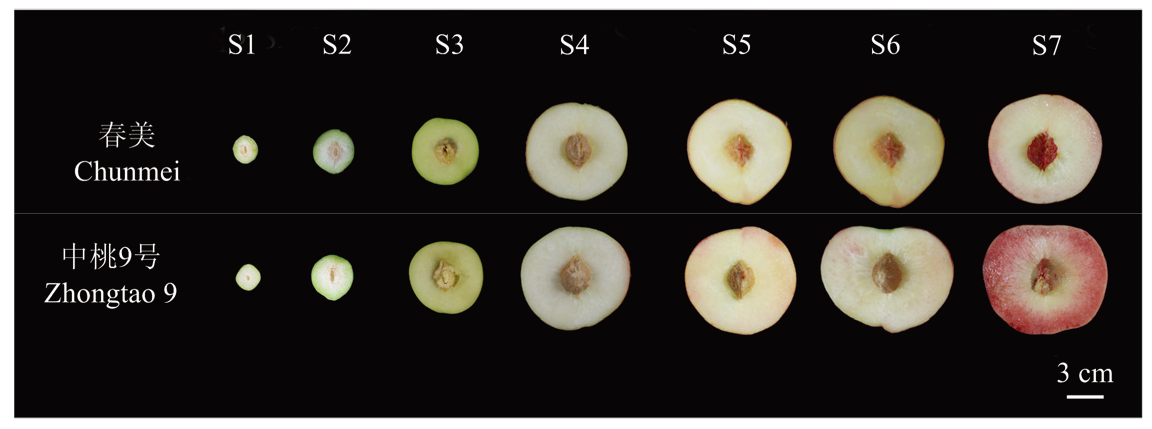
图1
‘春美’和‘中桃9号’不同发育阶段果实横截面表型 S1—S7分别代表花后45、60、75、84、90、96和102 d。下同"
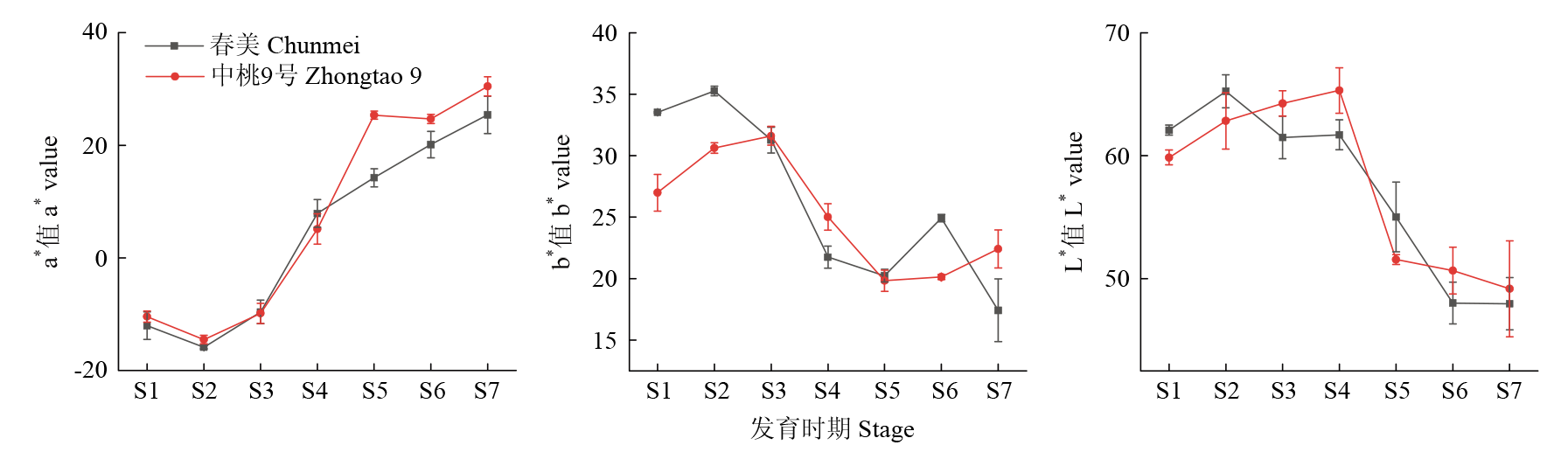
图2
‘春美’与‘中桃9号’不同发育阶段果实色泽参数的动态变化"
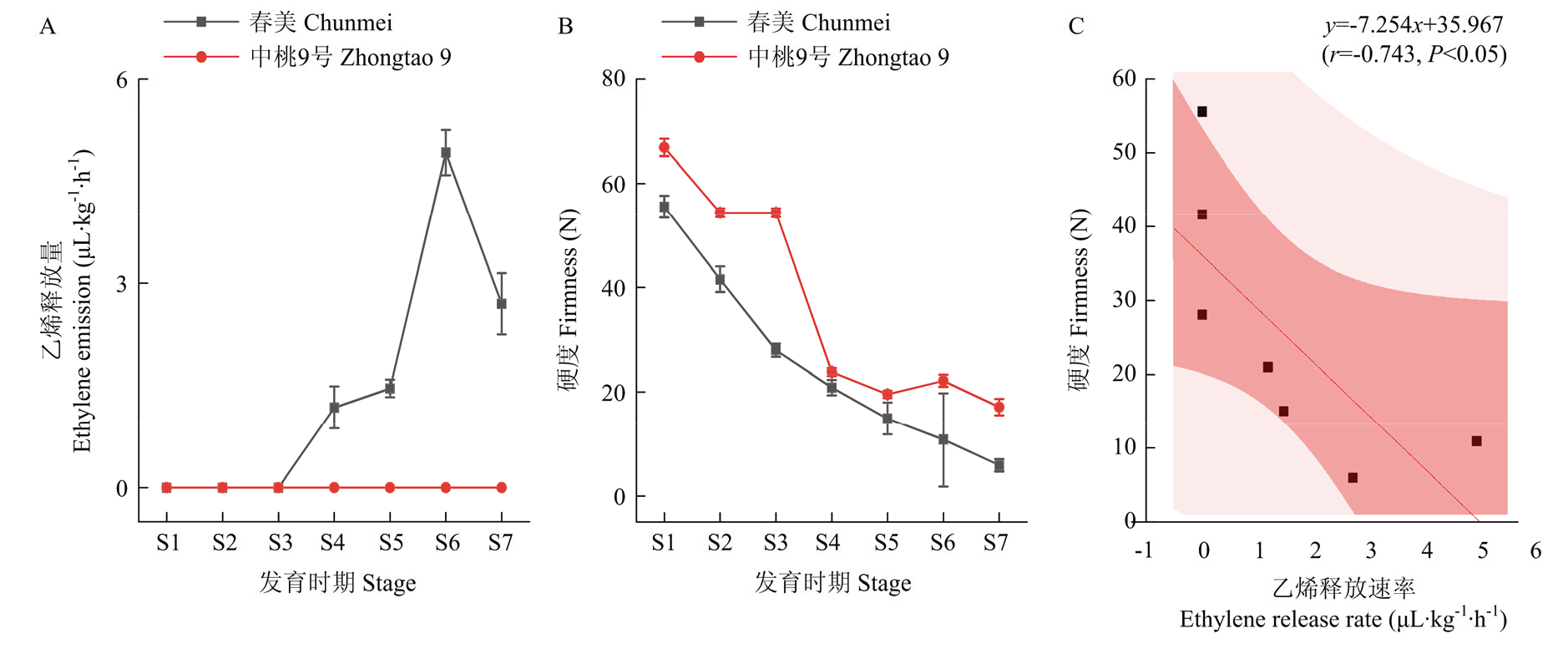
图3
‘春美’与‘中桃9号’果实硬度和乙烯释放速率动态变化及乙烯-硬度相关性分析"
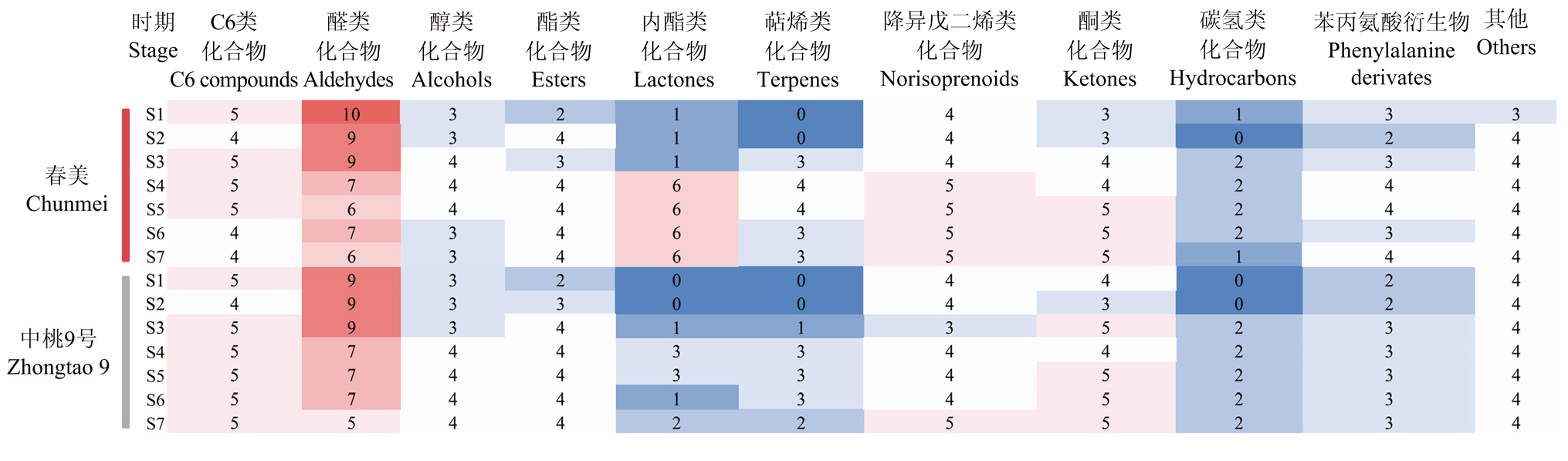
图4
‘春美’与‘中桃9号’不同发育阶段香气物质种类"

图5
‘春美’与‘中桃9号’香气物质组成分析"
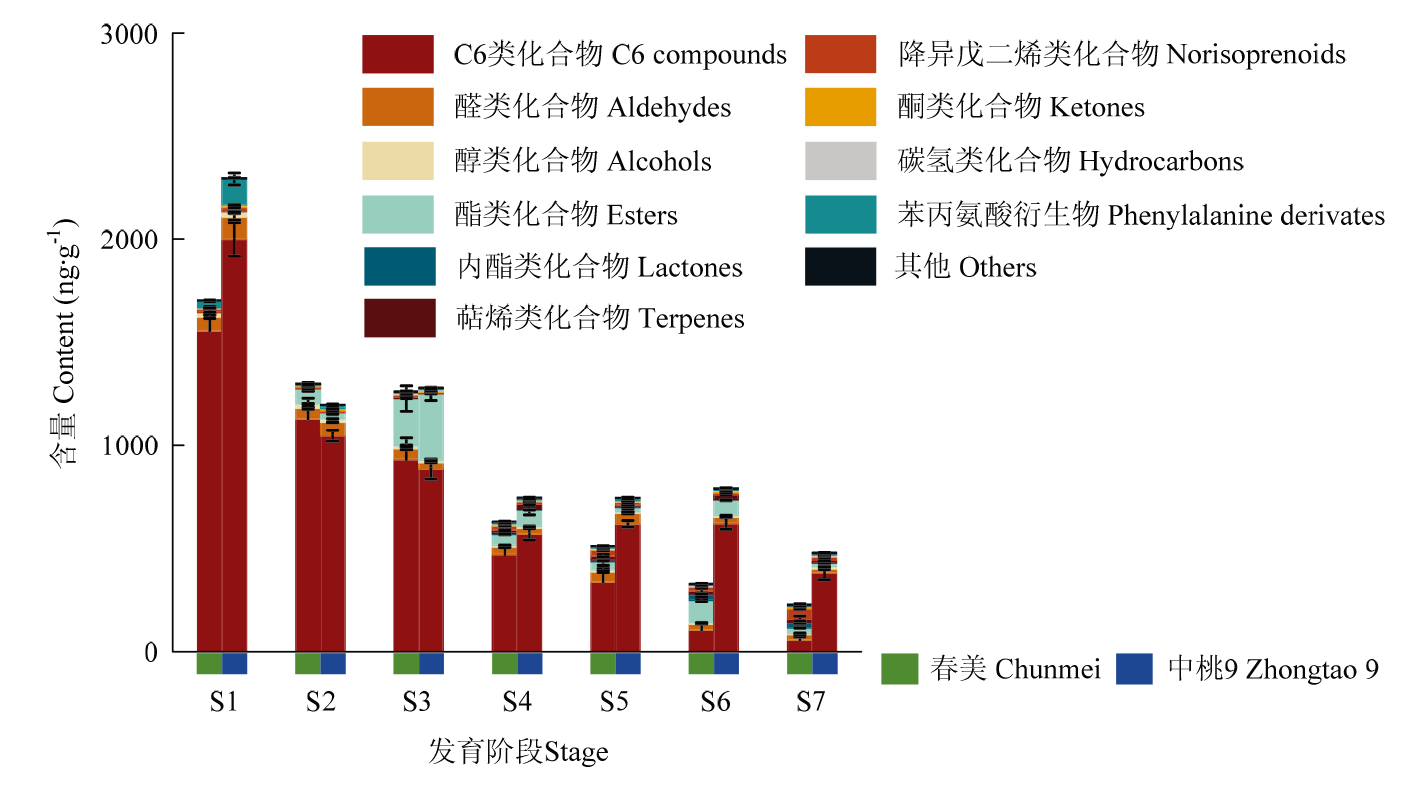
图6
‘春美’与‘中桃9号’不同发育阶段香气物质总量堆积图"
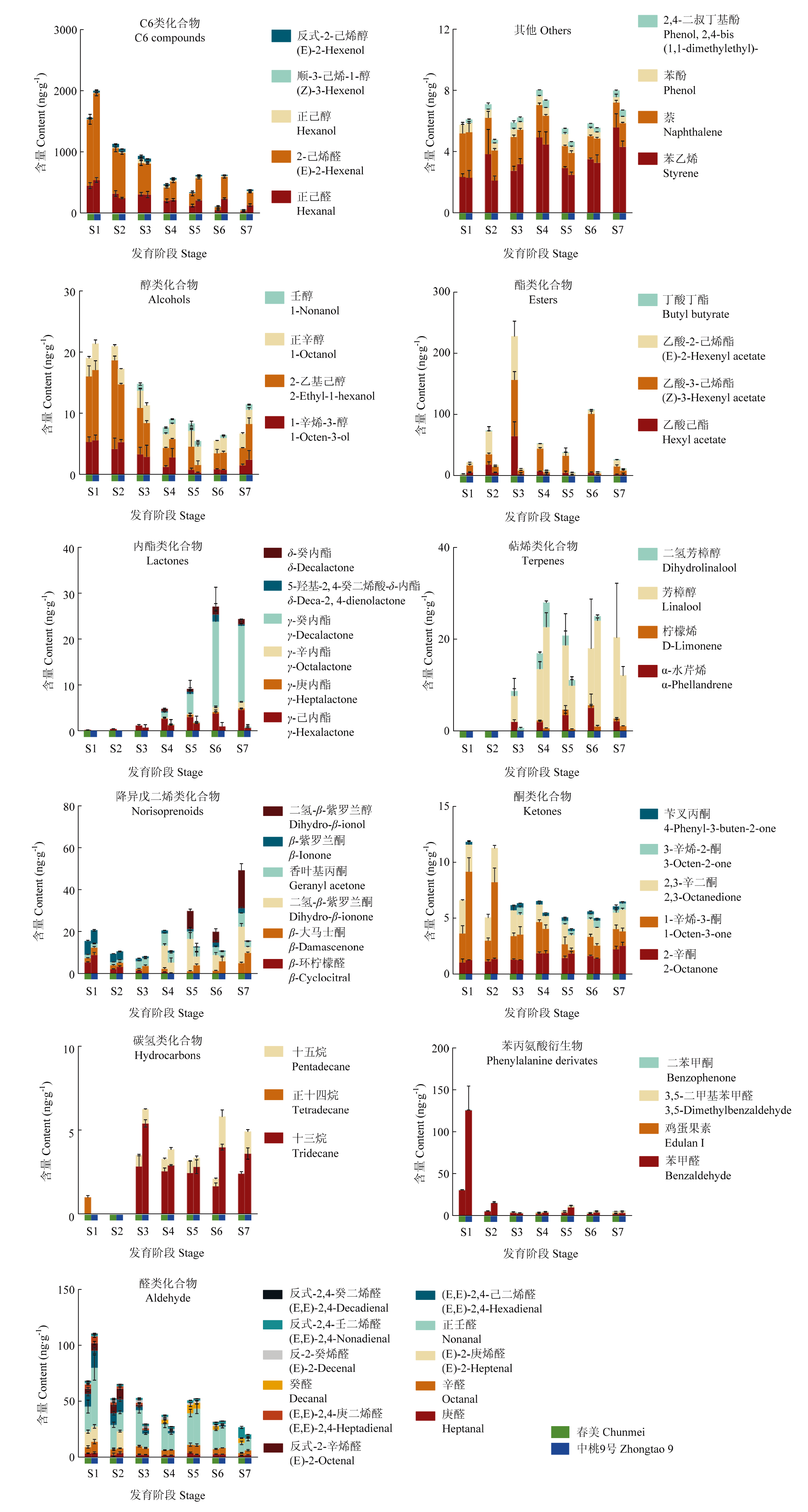
图7
‘春美’与‘中桃9号’不同类别香气物质含量动态变化"
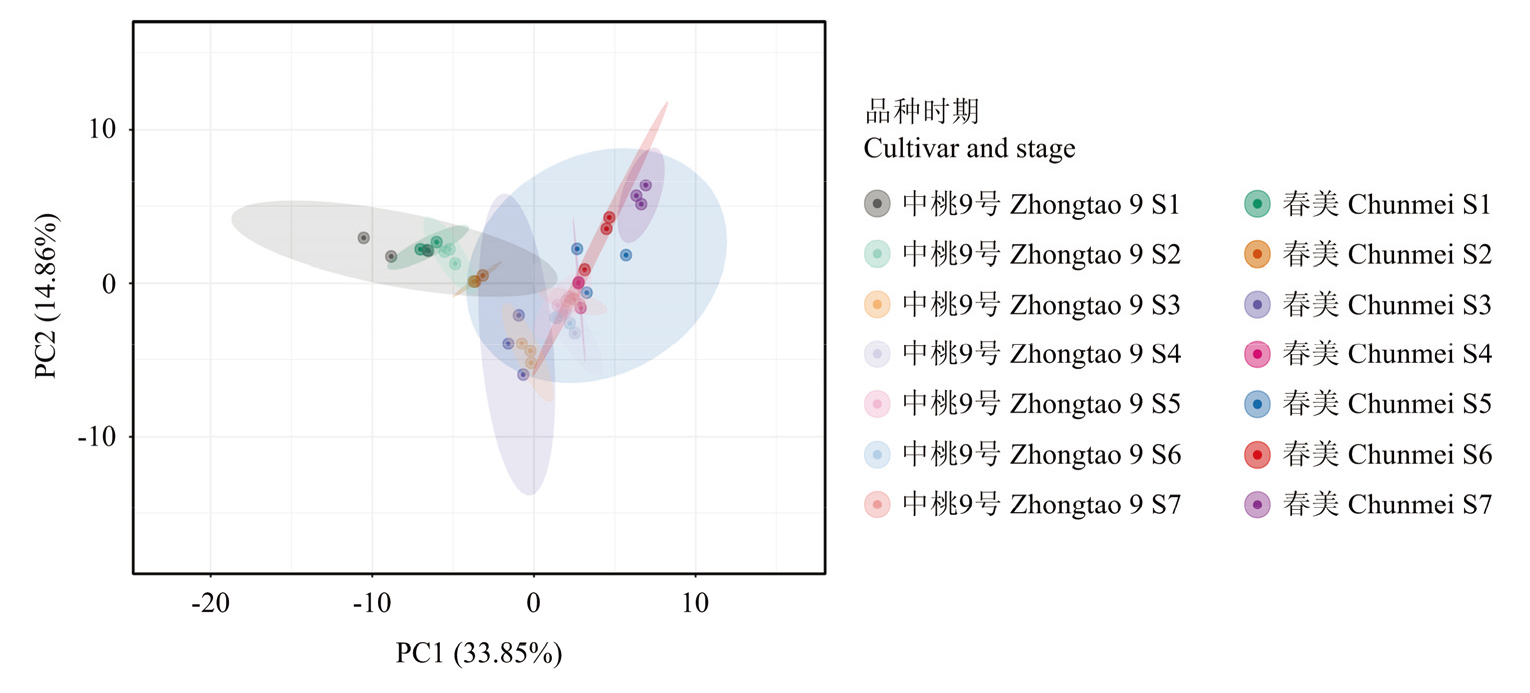
图8
‘春美’与‘中桃9号’不同发育阶段果实代谢组的PCA分析图"
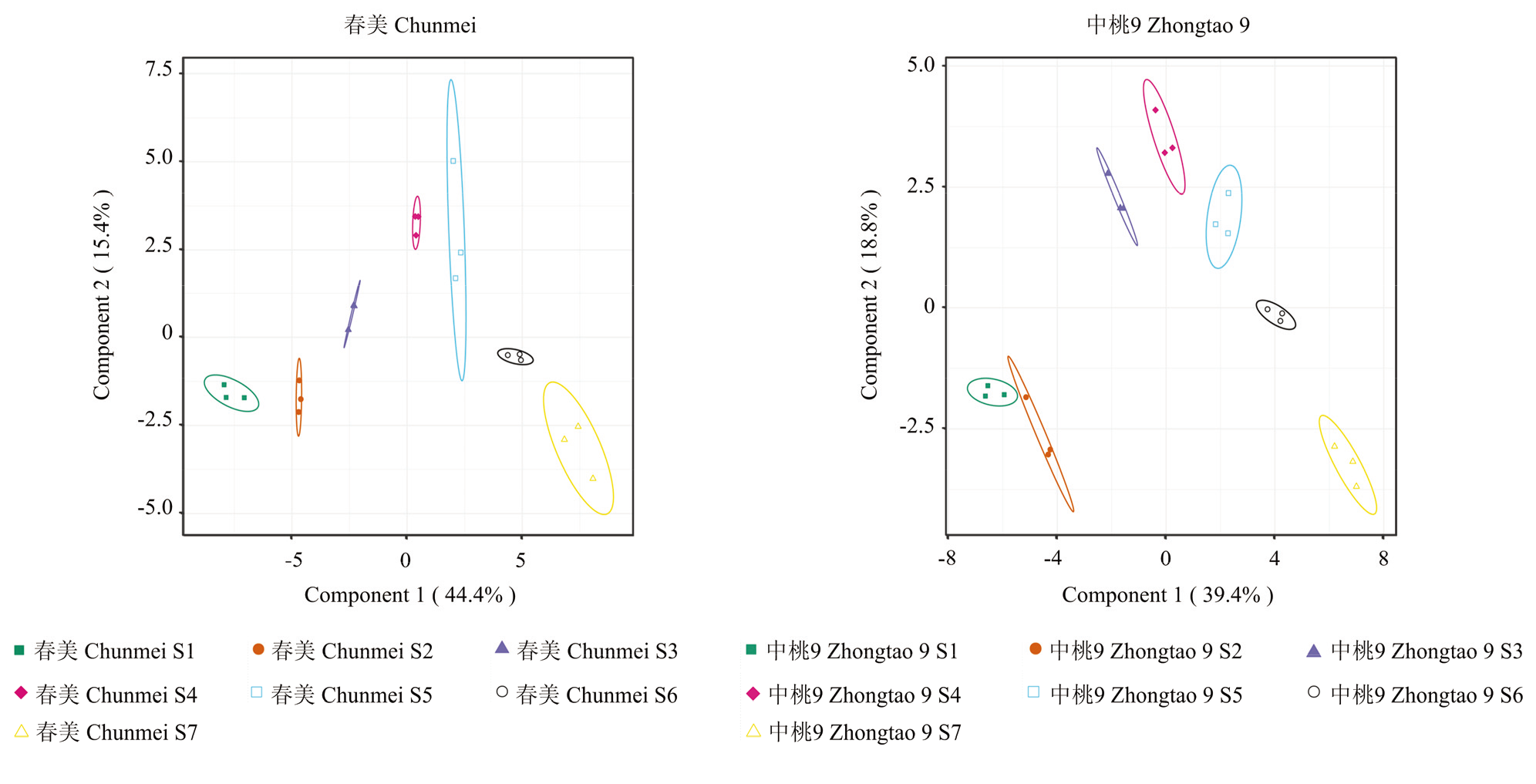
图9
‘春美’与‘中桃9号’不同发育阶段果实代谢组的OPLS-DA分析图"
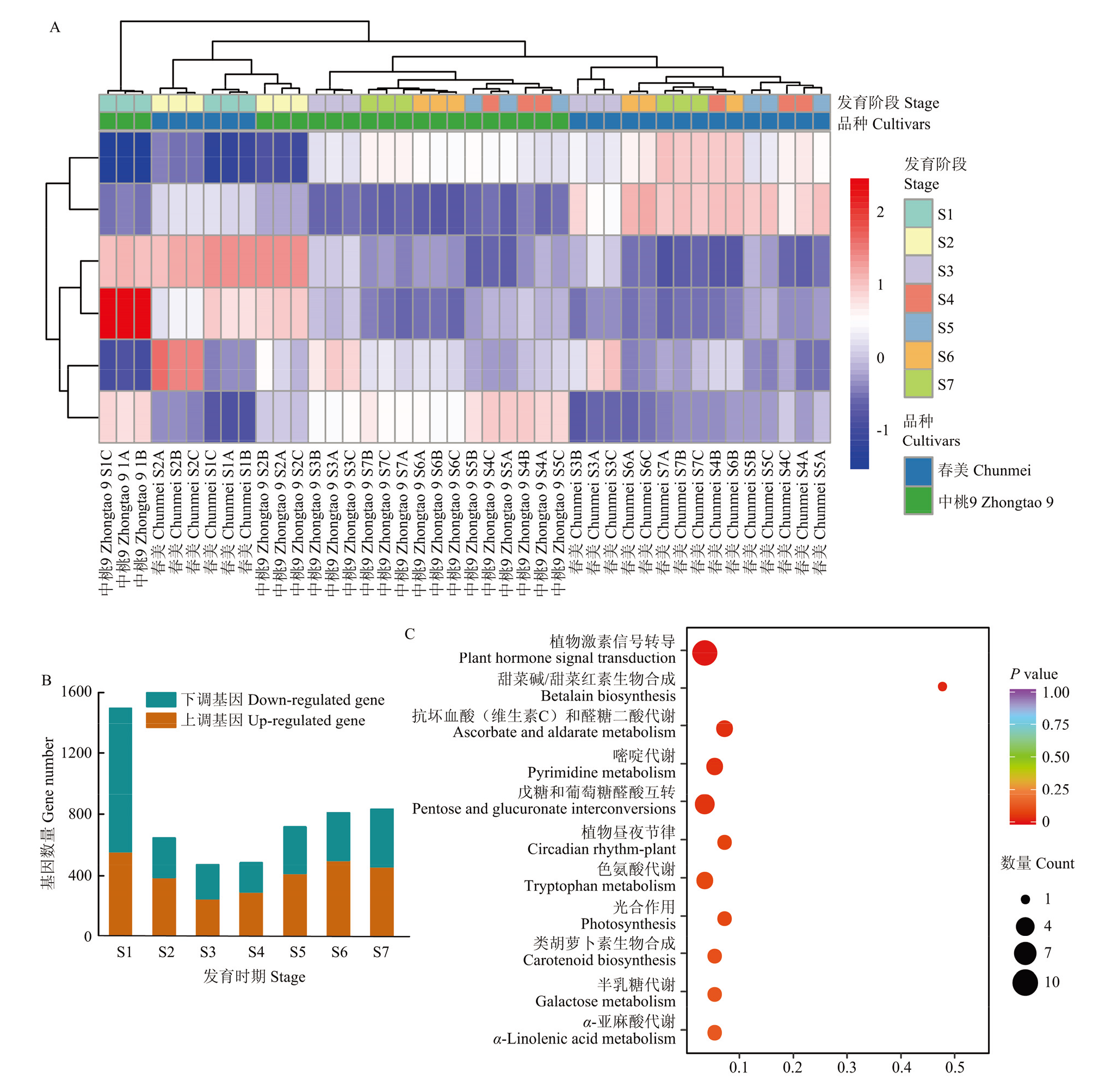
图10
‘春美’与‘中桃9号’差异基因表达模式及KEGG富集分析"

表1
21种OAV>1的关键香气物质及其气味阈值"
| 香气物质 Aroma substance | 气味阈值 Odor thresholds (μg·kg-1) | 风味类型 Aroma type |
|---|---|---|
| 辛醛 Octanal | 0.587 | 醛香 Aldehydic fragrance |
| 癸醛 Decanal | 3 | 醛香 Aldehydic fragrance |
| 1-辛烯-3-醇 1-Octen-3-ol | 1.5 | 泥土香 Scent of soil |
| 1-辛烯-3-酮 1-Octen-3-one | 0.003 | 泥土香 Scent of soil |
| 正壬醛 Nonanal | 1.1 | 油脂香 Oily fragrance |
| 反式-2-辛烯醛 (E)-2-Octenal | 3 | 油脂香 Oily fragrance |
| 反式-2, 4-癸二烯醛 (E, E)-2, 4-Decadienal | 0.027 | 油脂香 Oily fragrance |
| 反式-2, 4-壬二烯醛 (E, E)-2, 4-Nonadienal | 0.1 | 油脂香 Oily fragrance |
| 芳樟醇 Linalool | 0.22 | 花香味 Fragrance of flowers |
| β-大马士酮 β-Damascenone | 0.002 | 花香味 Fragrance of flowers |
| 二氢-β-紫罗兰酮 Dihydro-β-ionone | 1 | 花香味 Fragrance of flowers |
| β-紫罗兰酮 β-Ionone | 3.5 | 花香味 Fragrance of flowers |
| 乙酸己酯 Hexyl acetate | 2 | 果香味 Fruity |
| 乙酸-3-己烯酯 (Z)-3-Hexenyl acetate | 13 | 果香味 Fruity |
| 2, 3-辛二酮 2, 3-Octanedione | 2.52 | 果香味 Fruity |
| 正己醛 Hexanal | 5 | 草香味 Grassy fragrance |
| 2-己烯醛 (E)-2-Hexenal | 110 | 草香味 Grassy fragrance |
| 正己醇 Hexanol | 5.6 | 草香味 Grassy fragrance |
| 顺-3-己烯-1-醇 (Z)-3-Hexenol | 3.9 | 草香味 Grassy fragrance |
| 庚醛 Heptanal | 2.8 | 草香味 Grassy fragrance |
| γ-癸内酯 γ-Decalactone | 1.1 | 桃香 Peach fragrance |
表2
两个桃品种与酯类及内酯类物质显著差异基因关联物质"
| 基因序号 Gene id | 注释信息 Annotation | 挥发物质 Volatiles | 相关性 Correlation | P值 P value |
|---|---|---|---|---|
| Prupe.1G007300 | 谷胱甘肽S-转移酶家族蛋白 Glutathione S-transferase family protein | γ-癸内酯 γ-Decalactone | 0.78977232 | 5.06302E-10 |
| Prupe.8G081800 | SAUR样生长素响应蛋白家族(Small Auxin-Upregulated RNA) SAUR-like auxin-responsive protein family | γ-癸内酯 γ-Decalactone | 0.781266115 | 1.02782E-09 |
| Prupe.6G157500 | 黄素单加氧酶家族蛋白 Flavin-containing monooxygenase family protein | γ-癸内酯 γ-Decalactone | 0.77503427 | 1.69318E-09 |
| Prupe.4G262200 | 果胶裂解酶样超家族蛋白 Pectin lyase-like superfamily protein | γ-癸内酯 γ-Decalactone | 0.773254369 | 1.947E-09 |
| Prupe.7G192800 | 果胶裂解酶样超家族蛋白 Pectin lyase-like superfamily protein | γ-癸内酯 γ-Decalactone | 0.77149158 | 2.23311E-09 |
| Prupe.6G157400 | 黄素单加氧酶家族蛋白 Flavin-containing monooxygenase family protein | γ-癸内酯 γ-Decalactone | 0.765521038 | 3.5216E-09 |
| Prupe.7G247900 | 泛素样超家族蛋白 Ubiquitin-like superfamily protein | γ-癸内酯 γ-Decalactone | 0.765034818 | 3.65255E-09 |
| Prupe.7G216300 | 肌醇加氧酶4 myo-inositol oxygenase 4 | γ-癸内酯 γ-Decalactone | 0.750757713 | 1.02794E-08 |
| Prupe.2G110200 | 油菜素甾醇信号激酶2 BR-signaling kinase 2 | 乙酸己酯 Hexyl acetate | 0.840380176 | 3.38379E-12 |
| Prupe.6G361600 | 核糖核酸酶E抑制剂RraA/二甲基甲萘醌甲基转移酶 Ribonuclease E inhibitor RraA/Dimethylmenaquinone methyltransferase | 乙酸己酯 Hexyl acetate | 0.823552189 | 2.13017E-11 |
| Prupe.8G178000 | 植物U-盒蛋白15(PUB15) Plant U-Box 15 | 乙酸己酯 Hexyl acetate | 0.820125425 | 3.02577E-11 |
| Prupe.1G317500 | 脂质磷酸磷酸酶2 lipid phosphate phosphatase 2 | 乙酸己酯 Hexyl acetate | 0.816580973 | 4.31669E-11 |
| Prupe.3G162800 | 钙依赖脂质结合蛋白(CaLB结构域)家族蛋白 Calcium-dependent lipid-binding (CaLB domain) family protein | 乙酸己酯 Hexyl acetate | 0.769708345 | 2.56219E-09 |
| Prupe.4G188000 | 蛋白激酶家族蛋白 protein kinase family protein | 乙酸己酯 Hexyl acetate | 0.761710103 | 4.67746E-09 |
| Prupe.2G107600 | 七次跨膜MLO家族蛋白(Mildew Locus O) Seven transmembrane MLO family protein | 乙酸-3-己烯酯(Z)-3-Hexenyl acetate | 0.791412693 | 4.40037E-10 |
| Prupe.3G250400 | 类COBRA蛋白1前体 COBRA-like protein 1 precursor | 乙酸-3-己烯酯 (Z)-3-Hexenyl acetate | 0.754508468 | 7.88601E-09 |
| [1] |
doi: 10.1186/s13059-019-1648-9 pmid: 30791928 |
| [2] |
doi: 10.1016/j.hpj.2024.12.005 |
| [3] |
|
| [4] |
doi: 10.3390/s18030765 |
| [5] |
席万鹏, 郁松林, 周志钦. 桃果实香气物质生物合成研究进展[J]. 园艺学报, 2013, 40(9): 1679-1690.
|
|
|
|
| [6] |
曹香梅. 桃果实酯类芳香物质的代谢与调控研究[D]. 杭州: 浙江大学, 2019.
|
|
|
|
| [7] |
doi: 10.1104/pp.19.00964 pmid: 32001520 |
| [8] |
doi: 10.1186/1471-2229-11-24 |
| [9] |
doi: 10.1186/s12870-025-06991-z |
| [10] |
doi: 10.3389/fpls.2021.787049 |
| [11] |
|
| [12] |
doi: 10.1007/s44281-024-00029-4 |
| [13] |
杨康慧, 李丹, 白丽霞, 杨璐, 程平. 不同品种桃果实香气及氨基酸成分分析[J]. 南方农业学报, 2025, 56(11): 3522-3532.
|
|
|
|
| [14] |
doi: 10.1016/j.foodchem.2021.130604 |
| [15] |
doi: 10.1016/j.foodchem.2019.124954 |
| [16] |
严娟, 蔡志翔, 张明昊, 徐子媛, 沈志军, 马瑞娟, 俞明亮. 利用电子鼻评价桃果实香气[J]. 植物遗传资源学报, 2021, 22(1): 274-282.
doi: 10.13430/j.cnki.jpgr.20200616002 |
|
|
|
| [17] |
牛良, 曾文芳, 潘磊, 孟君仁, 鲁振华, 崔国朝, 王志强. 硬质桃研究现状及展望[J]. 果树学报, 2020, 37(8): 1227-1235.
|
|
|
|
| [18] |
doi: 10.1111/pbi.v23.10 |
| [19] |
寇单单, 李东东, 曹洪波, 王朋飞, 张学英, 陈海江. 不同肉质类型桃果实贮藏期间品质指标与淀粉酶活性的变化[J]. 山东农业科学, 2025, 57(2): 90-96.
|
|
|
|
| [20] |
doi: 10.1038/s41438-018-0094-2 |
| [21] |
doi: 10.1016/j.plaphy.2022.06.024 pmid: 35777129 |
| [22] |
doi: 10.1038/s41438-021-00644-6 |
| [23] |
doi: 10.1016/j.postharvbio.2023.112584 |
| [24] |
doi: 10.1007/s11103-024-01429-w pmid: 38630415 |
| [25] |
doi: 10.1016/j.plantsci.2004.12.018 |
| [26] |
doi: 10.3390/ijms222111308 |
| [27] |
|
| [28] |
苗玉乐. 乙烯调控桃果实内酯类香气形成原因初探[D]. 北京: 中国农业科学院, 2023.
|
|
|
|
| [29] |
doi: 10.1104/pp.15.01668 |
| [30] |
doi: 10.1186/s12870-018-1293-6 |
| [31] |
doi: 10.1093/jxb/erw021 pmid: 26850878 |
| [32] |
doi: 10.1186/s43897-025-00157-z pmid: 40611342 |
| [1] | 鲁雪莉, Syeda Wajeeha Gillani, 孟晨, 李晓彬, 宋奕汝, 柏雨, 王菊英, 冯晓菲, 刘晨晨, 李义强, 徐宗昌. 不同类型盐胁迫对狼尾草种子萌发的影响及钠调控转录组研究[J]. 中国农业科学, 2026, 59(7): 1400-1419. |
| [2] | 吴斌, 葛秉坤, 秦田雨, 肖桂青, 秦华. 乙烯与赤霉素协同调控水稻胚芽鞘伸长生长[J]. 中国农业科学, 2026, 59(16): 3509-3518. |
| [3] | 冯亚青, 孙亚涵, 周巧慧, 林芃, 李佳翌, 王惠申, 刘涛, 刘占德, 王南南. 猕猴桃种质资源对缺铁渍水复合胁迫的耐性筛选评价及生理差异分析[J]. 中国农业科学, 2026, 59(15): 3387-3399. |
| [4] | 赵宁, 张计育, 王锐, 原双进, 陈金辉, 李莎莎, 陈智坤. 基于优化MaxEnt模型及土地利用类型的中国薄壳山核桃适生区预测评价[J]. 中国农业科学, 2026, 59(14): 3147-3161. |
| [5] | 苏一, 孙乐园, 吴承勖, 姬新颖, 聂瑞宁, 夏娟, 韩卓然, 周晔, 张俊佩. 胡桃醌对核桃黑斑病病原菌的抑制作用及其机制[J]. 中国农业科学, 2026, 59(12): 2623-2636. |
| [6] | 张帆, 王晨冰, 任家玄, 李宇. 吲哚丁酸诱导桃砧木插穗不定根形成的分子机理[J]. 中国农业科学, 2026, 59(12): 2697-2711. |
| [7] | 张悦青, 张玉亭, 薛晨飞, 韩秦宇, 贺一容, 徐紫娟, 范秀梅, 王军娥, 罗丹, 冯雪, 孙胜. 364份樱桃番茄种质资源表型性状的遗传多样性分析及综合评价[J]. 中国农业科学, 2026, 59(11): 2468-2483. |
| [8] | 王思琪, 邹利人, 白瑞雯, 闫可, 王思洋, 齐晓光, 申海林, 温景辉. 赤霉素调控‘蜜汁’葡萄穗轴硬化关键基因的挖掘[J]. 中国农业科学, 2026, 59(1): 179-189. |
| [9] | 孙萍, 朱文灿, 林贤锐, 吴嘉颀, 曹译文, 陈辰斐, 王轶, 朱建锡, 贾惠娟, 钱敏杰, 沈建生. 基于代谢组和转录组解析多雨寡照对桃果皮着色和类黄酮积累的影响[J]. 中国农业科学, 2025, 58(6): 1173-1194. |
| [10] | 郭天发, 吴金龙, 仇倩倩, 马新超, 王力荣, 吴翠云. 新疆土桃果皮纯色形成与PpMYB10.1启动子变异的关系[J]. 中国农业科学, 2025, 58(2): 326-338. |
| [11] | 邹霈怡, 刘美艳, 王颖, 李然红. 狗枣猕猴桃AkNAC2的克隆及功能研究[J]. 中国农业科学, 2025, 58(19): 3985-3999. |
| [12] | 郭磊, 张斌斌, 沈志军, 严娟, 许建兰, 蔡志翔, 俞明亮, 王发林, 宋宏峰. 桃园绿肥连续还田后中微量元素释放特征及对土壤有效养分的影响[J]. 中国农业科学, 2025, 58(12): 2411-2426. |
| [13] | 廖锴, 李欣, 石延霞, 谢学文, 李磊, 范腾飞, 王绍辉, 李宝聚, 柴阿丽. 塑料拱棚不同通风方式对黄瓜细菌性角斑病传播的影响[J]. 中国农业科学, 2025, 58(10): 1934-1946. |
| [14] | 郭磊, 黄晨艳, 宋宏峰, 沈志军, 张斌斌, 马瑞娟, 孙朦, 何鑫, 俞明亮. 桃苗圃适用除草剂的筛选、混配与安全性评价[J]. 中国农业科学, 2024, 57(9): 1734-1747. |
| [15] | 戚仁洁, 宁宇, 刘静, 刘之洋, 徐海, 罗志丹, 陈龙正. 基于转录组测序的苦瓜皂苷合成相关基因的鉴定和分析[J]. 中国农业科学, 2024, 57(9): 1779-1793. |
|
||
