






中国农业科学 ›› 2026, Vol. 59 ›› Issue (11): 2447-2467.doi: 10.3864/j.issn.0578-1752.2026.11.011
王慧玲1( ), 王晓玥2, 闫爱玲3, 刘振华4, 任建成1, 卢浩成1, 孙磊1()
收稿日期:2026-01-06
接受日期:2026-03-07
出版日期:2026-06-01
发布日期:2026-06-03
通信作者:
联系方式:
王慧玲,E-mail:wanghui198216@126.com。
基金资助:
WANG HuiLing1(), WANG XiaoYue2, YAN AiLing3, LIU ZhenHua4, REN JianCheng1, LU HaoCheng1, SUN Lei1()
Received:2026-01-06
Accepted:2026-03-07
Published:2026-06-01
Online:2026-06-03
摘要:
果实品质是葡萄育种的核心目标,其相关性状多为多基因控制的数量性状,易受遗传背景和环境因素共同影响,解析其遗传基础对葡萄分子设计育种具有重要意义。本研究系统综述葡萄果实品质性状(大小、质地、糖酸、颜色、无核和香气等)的遗传特性,梳理近30年来基于双亲分离群体连锁分析和自然群体关联分析鉴定品质性状QTL/候选基因的研究进展。葡萄果实大小、形状、质地等为典型多基因数量性状,具有较高广义遗传力;颜色、无核性、玫瑰香味等兼具质量与数量双重遗传特性,由主效基因联合微效基因调控,且多数品质性状的表型表达受栽培措施、光照、温度等环境因子显著影响。连锁分析方面,利用约60个以F1代为主的杂交群体,共定位果实品质相关QTL约386个,其中,糖酸含量相关QTL数量最多,且在第18连锁群鉴定到无核、果实大小、质地等性状的主效QTL,第5连锁群存在玫瑰香味主效QTL;同时挖掘出VviAGL11、DXS、MYBA1/2等关键候选基因,明确其在无核性、玫瑰香味、果实颜色调控中的核心作用。关联分析方面,候选基因关联分析证实VvMybA基因簇、DXS等基因的序列多态性与果实颜色、玫瑰香味等性状显著关联,且部分基因存在多效性;全基因组关联分析已鉴定出大量与果实品质相关的SNP位点和结构变异,其中,结构变异在部分性状遗传调控中的贡献高于SNP。目前,分子标记在葡萄品质育种中的应用仍局限于主效基因控制的颜色、无核性、玫瑰香味等性状,果实大小、质地等复杂数量性状尚未实现分子标记辅助选择的实际应用。当前葡萄品质性状基因定位仍面临定位精度不足、多组学数据整合困难、多基因互作网络解析复杂、分子标记稳定性差等问题。未来需依托超级泛基因组、高通量表型鉴定平台,结合深度学习、基因编辑等技术,加强基因-环境互作研究,提高QTL定位精度和基因功能解析效率,构建高效的分子育种技术体系,为葡萄优质品种培育提供理论支撑和技术保障。本文旨在为后续优质葡萄品种的分子设计育种提供全面的文献参考与理论支撑。
王慧玲, 王晓玥, 闫爱玲, 刘振华, 任建成, 卢浩成, 孙磊. 葡萄果实品质性状遗传特性与基因位点解析研究进展[J]. 中国农业科学, 2026, 59(11): 2447-2467.
WANG HuiLing, WANG XiaoYue, YAN AiLing, LIU ZhenHua, REN JianCheng, LU HaoCheng, SUN Lei. Research Progress in Genetic Characteristics and Loci Mapping for Grape Berry Quality Traits[J]. Scientia Agricultura Sinica, 2026, 59(11): 2447-2467.
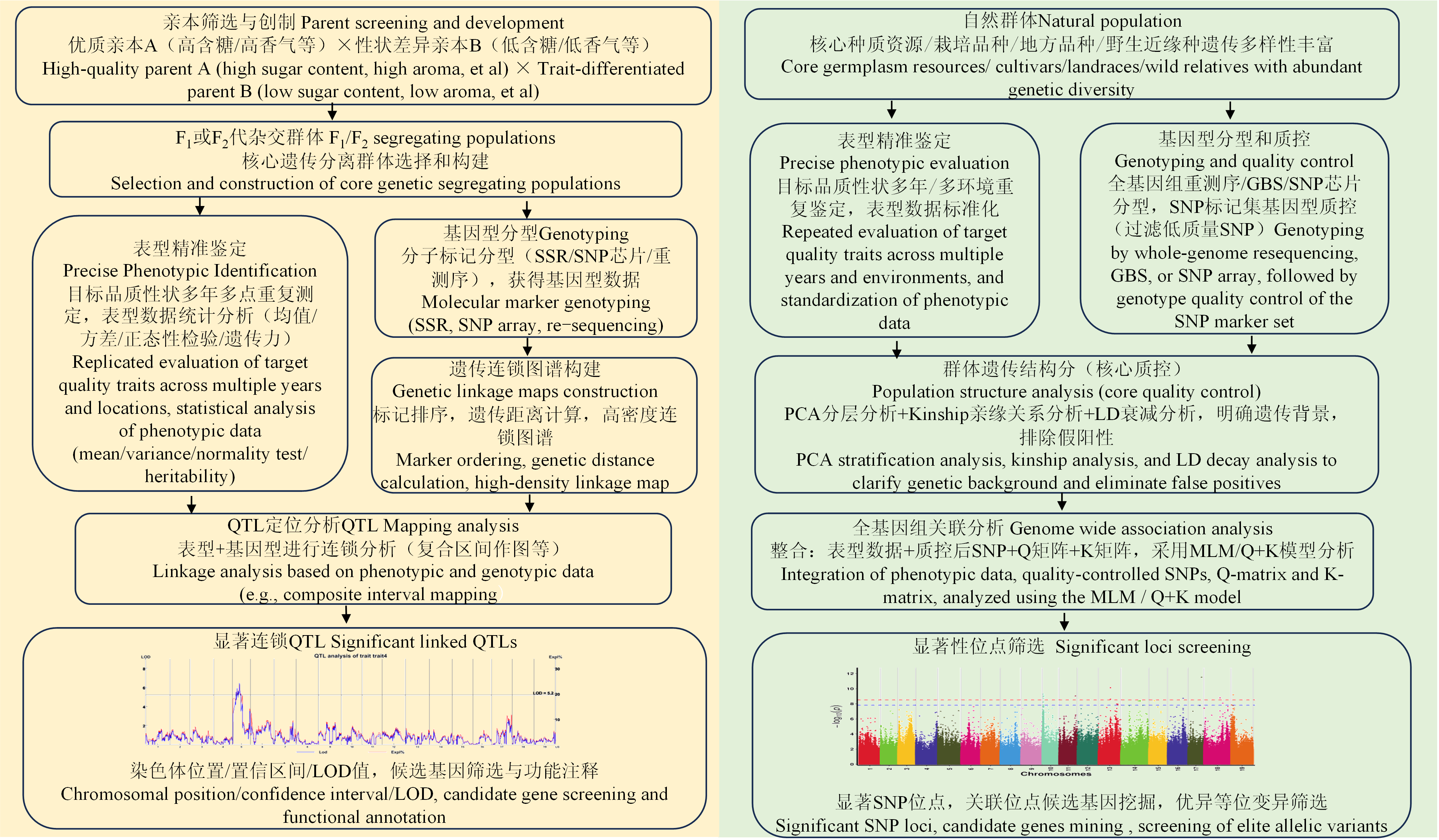
图1
葡萄连锁分析和关联分析流程示意图"
表1
葡萄果实品质性状QTL定位总结"
| 性状分类 Trait category | 细分性状及定位连锁群 Sub traits and linked group (LG) | 参考文献 Reference |
|---|---|---|
| 果实大小 Berry size | 果实单重:LG1—LG2、LG4—LG19;果实纵径:LG5—LG6、LG8、LG15、LG17和LG18;果实横径:LG2、LG6、LG9、LG17—LG18;果实体积:LG2、LG12、LG17—LG18;果实面积:LG6和LG17 Berry weight: LG1-LG2, LG4-LG19; Berry length: LG5-LG6, LG8, LG15, LG17-LG18; Berry diameter: LG2, LG6, LG9, LG17-LG18; Berry volume: LG2, LG12, LG17-LG18; Berry area: LG6, LG17 | [ |
| 果实形状 Berry shape | 果形指数:LG4—LG5、LG8—LG9、LG17—LG18 Shape index:LG4-LG5, LG8-LG9, LG17-LG18 | [ |
| 果实质地 Berry texture | 果实硬度:LG1、LG3—LG6、LG8、LG10—LG11、LG13—LG14、LG17—LG18;果实黏性:LG12、LG17—LG18;果实咀嚼性:LG18;果实凝聚性:LG13、LG15、LG17—LG18;果实弹性:LG17—LG18;果肉硬度:LG1、LG4、LG6、LG8、LG10;果皮穿刺硬度:LG6、LG10—LG11、LG14、LG16—LG17;果皮脆性:LG3、LG6、LG9、LG14、LG16;多汁性:LG19 Berry firmness: LG1, LG3- LG6, LG8, LG10-LG11, LG13-LG14, LG17-LG18; Berry gumminess: LG12, LG17-LG18; Berry chewiness: LG18; Berry cohesiveness: LG13, LG15, LG17-LG18; Berry resilience: LG17-LG18; Mesocarp firmness: LG1, LG4, LG6, LG8, LG10; Pericarp puncture hardness: LG6, LG10-LG11, LG14, LG16-LG17; Pericarp brittleness: LG3, LG6, LG9, LG14, LG16; Juiciness: LG19 | [ |
| 糖酸含量 Sugar and acid content | 可溶性固形物含量:LG1—LG3、LG6、LG13;酸碱度:LG1、LG4、LG6、LG8、LG10—LG11、LG13—LG14、LG16—LG18;可滴定酸含量:LG1—LG2、LG5—LG7、LG9、LG13、LG17、LG19;可溶性固形物含量/可滴定酸含量:LG1—LG2、LG4;酸含量:LG2、LG4—LG9、LG12—LG14、LG17、LG19;糖含量:LG2、LG7—LG8、LG16—LG17、LG19;果糖:LG4、LG11、LG14、LG17;葡萄糖:LG14;果糖/葡萄糖:LG2—LG3、LG5、LG7、LG9、LG17;苹果酸:LG1、LG4—LG10、LG14—LG15、LG17—LG18;酒石酸:LG2、LG6、LG8、LG13、LG18—LG19;酒石酸/苹果酸:LG1、LG5—LG6、LG8、LG10—LG11、LG18;酒石酸+苹果酸:LG5;钾离子:LG2;钾离子/酒石酸:LG13 Total soluble solid content: LG1-LG3, LG6, LG13; pH value: LG1, LG4, LG6, LG8, LG10-LG11, LG13-LG14, LG16-LG18; Titratable acidity: LG1-LG2, LG5-LG7, LG9, LG13, LG17, LG19; Total soluble solid content/Titratable acidity: LG1-LG2, LG4; Acids: LG2, LG4-LG9, LG12-LG14, LG17, LG19; Sugars: LG2, LG7-LG8, LG16-LG17, LG19; Fructose: LG4, LG11, LG14, LG17; Glucose: LG14; Fructose/Glucose: LG2-LG3, LG5, LG7, LG9, LG17; Malic acid: LG1, LG4-LG10, LG14-LG15, LG17-LG18; Tartaric acid: LG2, LG6, LG8, LG13, LG18-LG19; Tartaric acid: LG2, LG6, LG8, LG13, LG18-LG19; Tartaric acid/Malic acid: LG1, LG5-LG6, LG8, LG10-LG11, LG18; Tartaric acid+Malic acid: LG5; K+: LG2; K+/Tartaric acid: LG13 | [ |
| 果实颜色 Berry color | 花色苷:LG1—LG4、LG6—LG10、LG12—LG14、LG16—LG19;花色苷甲基化水平:LG1—LG2;花色苷糖基转移酶:LG2、LG16;果实颜色:LG2、LG4;色差:LG2、LG4;颜色等级:LG2;三羟基化花青素:LG2、LG4;甲基化花青素:LG2、LG4、LG6;酰基化花青素:LG2、LG4、LG6、LG11、LG17;红色:LG1-LG2;绿色:LG1—LG2;蓝色:LG6、LG15;亮度:LG2;红绿色值:LG2、LG10;蓝黄色值:LG2;色调:LG1—LG2、LG7、LG10;饱和度:LG1—LG2;强度:LG2 Anthocyanins: LG1-LG4, LG6-LG10, LG12-LG14, LG16-LG19; Methylation level of anthocyanins: LG1-LG2; UDP-glucose flavonoid 7-O-glucosyltransferase: LG2, LG16; Berry color: LG2, LG4; Chromatic aberration: LG2, LG4; Color grade: LG2; Trihydroxylated anthocyanins: LG2, LG4; Methylated anthocyanins: LG2, LG4, LG6; Acylated anthocyanins: LG2, LG4, LG6, LG11, LG17; Red: LG1-LG2; Green: LG1-LG2; Blue: LG6, LG15; Lightness: LG2; Red-green: LG2, LG10; Blue-yellow: LG2; Hue: LG1-LG2, LG7, LG10; Saturation: LG1-LG2; Intensity: LG2 | [ |
| 无核性状 Seedless | 种子重量:LG1—LG2、LG4—LG6、LG8—LG16、LG18—LG19;种子数量:LG1—LG2、LG4—LG5、LG7—LG8、LG11—LG14、LG16、LG18;每个果实中种子重量:LG4、LG9、LG13—LG14、LG18;种子大小:LG6—LG8、LG11、LG13、LG17 Seed weight: LG1-LG2, LG4-LG6, LG8-LG16, LG18-LG19; Seed number: LG1-LG2, LG4-LG5, LG7-LG8, LG11-LG14, LG16, LG18; Seed fresh weight per berry: LG4, LG9, LG13-LG14, LG18; Seed size: LG6-LG8, LG11, LG13, LG17 | [ |
| 玫瑰香味 Muscat flavor | 单萜:LG1—LG3、LG5、LG7—LG8、LG10—LG19;玫瑰香味:LG5;关键途径基因表达:LG6、LG12、LG16;降异戊二烯:LG2 Monoterpenes: LG1-LG3, LG5, LG7-LG8, LG10-LG19; Muscat flavor: LG5; Key gene expression: LG6, LG12, LG16; Norisoprenoids: LG2 | [ |
| 涩味 Astringency | 单宁:LG2;果皮原花色素含量:LG1—LG2、LG8、LG13、LG17;种子原花色素含量:LG1—LG4、LG8、LG10、LG12—LG14、LG16—LG18;不同原花色素组分:LG1—LG6、LG8、LG10、LG13、LG17—LG19;聚合度:LG4、LG14、LG17 Tannins: LG2; Skin proanthocyanidins content: LG1-LG2, LG8, LG13, LG17; Seed proanthocyanidins content: LG1-LG4, LG8, LG10, LG12-LG14, LG16-LG18; Skin Different proanthocyanidins component: LG1-LG6, LG8, LG10, LG13, LG17-LG19; Degree of polymerisation: LG4, LG14, LG17 | [ |
表2
葡萄中候选基因关联分析总结"
| 品质性状 Quality traits | 群体大小Population size | 分子标记(数目)Molecular markers (number) | 候选基因 Candidate genes | 参考文献 Reference |
|---|---|---|---|---|
| 果实颜色Berry colour | 168 | SNP (46) | VvMybA1 | [ |
| 花色苷 Anthocyanins | 141 | SNP (78) | MYB基因簇(VvMybA1、VvMybA2、VvMybA3、VvMybA4) MYB gene cluster (VvMybA1, VvMybA2, VvMybA3, VvMybA4) | [ |
| 甲基化花色苷 Methylated anthocyanins | 50 | SNP (37) | 花色苷甲基转移酶基因1和2(VviAOMT1和VviAOMT2) Anthocyanin O-methyltransferase 1 and 2 (VviAOMT1, VviAOMT2) | [ |
| 颜色、花色苷 Berry color, anthocyanins | 149 | SNP (124) | 花色苷合成相关15个基因 15 genes related to anthocyanins biosynthesis | [ |
| 原花色素 Proanthocyanidins | 141 | SNP (110) | 原花色素合成相关9个基因 9 genes related to proanthocyanidins biosynthesis | [ |
| 原花色素 Proanthocyanidins | 141 | SNP (81) | Cob家族基因(VviCob-like)),丝氨酸羧肽酶样基因(VviGat-like),MYB转录因子(VviMybC2-L1) Cob family gene (VviCob-like), serine carboxy peptidase-like (SCPL) gene (VviGat-like), MYB-type transcription factor family (VviMybC2-L1) | [ |
| 玫瑰香味 Muscat flavor | 148 | SNP (102) | 1-脱氧-D-木酮糖-5-磷酸合酶(VvDXS) 1-deoxy-D-xylulose-5-phosphate synthase (VvDXS) | [ |
| 玫瑰香味 Muscat flavor | 92 | SNP (22) | 1-脱氧-D-木酮糖-5-磷酸合酶(VvDXS) 1-deoxy-D-xylulose-5-phosphate synthase (VvDXS) | [ |
| 萜品醇α-Terpineol | 61 | SNP (20) | α-萜品醇合酶基因(α-TPS) α-Terpineol synthase gene (α-TPS) | [ |
| 单粒重Berry weight | 38 | SNP (447) | 果肉缺失突变(Flb)Fleshless berry mutation (Flb) | [ |
| 果实质地Berry texture | 96 | SNP (32) | 果胶裂解酶(VvPel)Pectate lyase (VvPel) | [ |
| 果实质地Berry texture、果实横径、出汁率Berry width, juiciness | 127 | SNP (15) | 赤霉素不敏感蛋白(VvGAI1) 1DELLA subfamily (VvGAI1) | [ |
| 果实大小、穗长、穗宽、穗重 Berry size, cluster length, cluster width, cluster weight | 140 | SNP (60) | 终端开花基因(VvTFL1A) TERMINAL FLOWER 1A (VvTFL1A) | [ |
| 果实纵径、横径、单粒重、体积 Berry length, berry width, berry weight, berry volume | 114 | SNP (69) | NAC结构域转录因子26(VvNAC26) NAC domain-containing transcription factor 26 (VvNAC26) | [ |
| 果穗紧密度Cluster compactness | 114 | SNP (7032) | 183个候选基因183 related candidate genes | [ |
| 果穗紧密度Cluster compactness | 114 | SNP (80) | VvUCC1植物特异性细胞壁蛋白Uclacyanin plant-specific cell-wall protein | [ |
| 无核Seedlessness | 124 | SNP (537) | AGAMOUS类似基因11 AGAMOUS-LIKE11 (VvAGL11) | [ |
| 种子Seed | 114 | SNP (15309) | 289个基因289 related candidate genes | [ |
表3
葡萄中全基因组关联分析总结"
| 年份Year | 群体大小Population size | 分子标记类型(数目)Molecular markers (number) | 性状及显著关联染色体位点 Quality traits (significant associated chromosomes) | 参考文献 Reference |
|---|---|---|---|---|
| 2011 | 289 | SNP (5110) | 果皮颜色(Chr.2) Berry color (Chr.2) | [ |
| 2017 | 96 | SSR (187) | 里那醇(Chr.1、Chr.5、Chr.7、Chr.19);萜品醇(Chr.1、Chr.5、Chr.7、Chr.16、Chr.17、Chr.18);橙花醇(Chr.1、Chr.2、Chr.3、Chr.4、Chr.5、Chr.6、Chr.8、Chr.13、Chr.14、Chr.16、Chr.19);香叶醇(Chr.1、Chr.2、Chr.3、Chr.4、Chr.5、Chr.7、Chr.9) Linalool (Chr.1, Chr.5, Chr.7, Chr.19); Terpineol (Chr.1, Chr.5, Chr.7, Chr.16, Chr.17, Chr.18); Nerol (Chr.1, Chr.2, Chr.3, Chr.4, Chr.5, Chr.6, Chr.8, Chr.13, Chr.14, Chr.16, Chr.19); Geraniol (Chr.1, Chr.2, Chr.3, Chr.4, Chr.5, Chr.7, Chr.9) | [ |
| 2017 | 199 | SNP (414233) | 无核(Chr.5、Chr.6、Chr.10、Chr.17、Chr.18) Seedlessness (Chr.5, Chr.6, Chr.10, Chr.17, Chr.18) | [ |
| 2017 | 1817 | SNP (9114) | 果皮颜色(Chr.2);玫瑰香气(Chr.5、Chr.8);果实大小(Chr.11) Berry color (Chr.2); Muscat flavor (Chr.5, Chr.8); Berry size (Chr.11) | [ |
| 2017 | 304 | SNP (481192) | 果形(Chr.2) Berry shape (Chr.2) | [ |
| 2018 | 86 | SNP (26893) | 果粒单重(Chr.6);可溶性固形物(Chr.14) Berry weight (Chr.6); Total soluble solid content (Chr.14) | [ |
| 2018 | 783 | SNP (10207) | 穗重(Chr.13);酸度(Chr.2);玫瑰香味(Chr.5);无核(Chr.6、Chr.9、Chr.19);果实颜色(Chr.2) Cluster weight (Chr.13); Acid (Chr.2); Muscat flavor (Chr.5); Seedlessness (Chr.6, Chr.9, Chr.19); Berry color (Chr.2) | [ |
| 2019 | 179 | SNP (32311) | 果实颜色(Chr.2);单粒重(Chr.18、Chr.17、Chr.19);果实质地(Chr.16);玫瑰香味(Chr.5) Berry color (Chr.2); Berry weight (Chr.18, Chr.17, Chr.19); Berry texture (Chr.16); Muscat flavor (Chr.5) | [ |
| 2019 | 472 | SNP (873000) | 果形指数(Chr.1、Chr.3、Chr.7、Chr.8、Chr.10、Chr.15) Berry shape index (Chr.1, Chr.3, Chr.7, Chr.8, Chr.10, Chr.15) | [ |
| 2020 | 33 | SNP (5373452) | 无核(Chr.1、Chr.8、Chr.18)Seedlessness (Chr.1, Chr.8, Chr.18) | [ |
| 2021 | 88 | SNP (68600) | 种子果实比重(Chr.17)Seed/berry ratio (Chr.17) | [ |
| 2022 | 279 | SNP (63000) | 果实单粒重(Chr.1、Chr.2、Chr.8、Chr.11、Chr.15、Chr.17);苹果酸(Chr.9、Chr.12、Chr.18);柠檬酸(Chr.3);葡萄糖/果糖(Chr.2);单宁聚合度(Chr.2、Chr.17);花色苷总量(Chr.2);花色苷组分(Chr2、Chr.13) Berry weight (Chr.1, Chr.2, Chr.8, Chr.11, Chr.15, Chr.17); Malic acid (Chr.9, Chr.12, Chr.18); Citric acid (Chr.3); Glusose/fructose ratio (Chr.2); Tannin polymerization degree (Chr.2, Chr.17); Anthocyanin content (Chr.2); Anthocyanin components (Chr.2, Chr.13) | [ |
| 2022 | 356 | rhAmpSeq (1599) | 果实颜色(Chr.2、Chr.4、Chr.13、Chr.16、Chr.17);果实纵径(Chr.2、Chr.5、Chr.10、Chr.15、Chr.18、Chr.19);果实横径(Chr.1、Chr.2、Chr.5、Chr.10、Chr.15、Chr.18);果实单粒重(Chr.2、Chr.3、Chr.6、Chr.7、Chr.9、Chr.13);果实硬度(Chr.2、Chr.3、Chr.8);种子数(Chr.7、Chr.17);单穗粒数(Chr.5、Chr.7、Chr.14);单穗重(Chr.17) Berry color (Chr.2, Chr.4, Chr.13, Chr.16, Chr.17); Berry length (Chr.2, Chr.5, Chr.10, Chr.15, Chr.18, Chr.19); Berry width (Chr.1, Chr.2, Chr.5, Chr.10, Chr.15, Chr.18); Berry weight (Chr.2, Chr.3, Chr.6, Chr.7, Chr.9, Chr.13); Berry firmness (Chr.2, Chr.3, Chr.8); Seed number (Chr.7, Chr.17); Berry number per cluster (Chr.5, Chr.7, Chr.14); Cluster weight (Chr.17) | [ |
| 2022 | 348 | rhAmpSeq (1599) | 果实颜色(Chr.4) Berry color (Chr.4) | [ |
| 2022 | 287 | SNP (601261) | 果实裂果指数(Chr.1、Chr.2、Chr.3、Chr.18);裂果类型(Chr.18) Berry cracking index (Chr.1, Chr.2, Chr.3, Chr.18); Cracking type (Chr.18) | [ |
| 2022 | 279 | SNP (566129) | 弯曲果形指数(Chr.3、Chr.7、Chr.9、Chr.13、Chr.16);果形指数外部(Chr.3、Chr.9、Chr.13、Chr.16);内部果形指数(Chr.2、Chr.3、Chr.4、Chr.6、Chr.7、Chr.8、Chr.9、Chr.10、Chr.12、Chr.13、Chr.16、Chr.19) Curved fruit shape index (Chr.3, Chr.7, Chr.9, Chr.13, Chr.16); Fruit shape index external (Chr.3, Chr.9, Chr.13, Chr.16); Fruit shape index internal (Chr.2, Chr.3, Chr.4, Chr.6, Chr.7, Chr.8, Chr.9, Chr.10, Chr.12, Chr.13, Chr.16, Chr.19) | [ |
| 2023 | 117 | SNP (12734) | 玫瑰香味(Chr.5、Chr.18);果实颜色(Chr.2) Muscat flavor (Chr.5, Chr.18); Berry color (Chr.2) | [ |
| 2023 | 149(F1) | SNP (568953) | 降异戊二烯(Chr.5、Chr.10、Chr.8) Isoprenoids (Chr.5, Chr.10, Chr.8) | [ |
| 2023 | 150 | SNP (3401402) | 果实单粒重(Chr.1、Chr.5、Chr.11、Chr.16);种子数目和质量(Chr.18) Berry weight (Chr.1, Chr.5, Chr.11, Chr.16); Seed number and weight (Chr.18) | [ |
| 2024 | 437 | SNP (2124668) | 果实质地(Chr.3、Chr.4、Chr.6、Chr.7、Chr.8、Chr.9、Chr.10、Chr.11、Chr.12、Chr.13、Chr.14、Chr.15、Chr.16、Chr.18、Chr.19) Berry texture (Chr.3, Chr.4, Chr.6, Chr.7, Chr.8, Chr.9, Chr.10, Chr.11, Chr.12, Chr.13, Chr.14, Chr.15, Chr.16, Chr.18, Chr.19) | [ |
| 2024 | 122 | SNP (108777) | 穗长(Chr.9、Chr.15);果粒重(Chr.3、Chr.5);果粒纵径(Chr.4、Chr.5、Chr.9、Chr.19);果粒横径(Chr.4、Chr.5、Chr.13、Chr.15、Chr.17) Cluster length (Chr.9, Chr.15); Berry weight (Chr.3, Chr.5); Berry length (Chr.4, Chr.5, Chr.9, Chr.19); Berry weight (Chr.4, Chr.5, Chr.13, Chr.15, Chr.17) | [ |
| 2024 | 588 | SNP (49210) | 种子鲜重(Chr.1、Chr.2、Chr.9、Chr.11、Chr.13、Chr.14、Chr.15、Chr.19);种子干重(Chr.1、Chr.4、Chr.18、Chr.19);果实纵径(Chr.3, Chr.5, Chr.8, Chr.11, Chr.14);果实横径(Chr.2, Chr.5, Chr.6, Chr.7, Chr.8, Chr.11, Chr.17, Chr.18);果形(Chr.1, Chr.4, Chr.5, Chr.8, Chr.9, Chr.10, Chr.14, Chr.16, Chr.18);果实单粒重(Chr.15) Seed fresh weight (Chr.1, Chr.2, Chr.9, Chr.11, Chr.13, Chr.14, Chr.15, Chr.19); Seed dry weight (Chr.1, Chr.4, Chr.18, Chr.19); Berry length (Chr.3, Chr.5, Chr.8, Chr.11, Chr.14); Berry width (Chr.2, Chr.5, Chr.6, Chr.7, Chr.8, Chr.11, Chr.17, Chr.18); Berry shape (Chr.1, Chr.4, Chr.5, Chr.8, Chr.9, Chr.10, Chr.14, Chr.16, Chr.18); Berry weight (Chr.15) | [ |
| 2024 | 444 | SNPs (4462797), InDels (443812 ), SVs (487204) | 无核性状(Chr.1、Chr.4、Chr.5、Chr.7、Chr.8、Chr.9、Chr.10、Chr.11、Chr.12、Chr.13、Chr.14、Chr.15、Chr.18、Chr.19) Seedlessness (Chr.1, Chr.4, Chr.5, Chr.7, Chr.8, Chr.9, Chr.10, Chr.11, Chr.12, Chr.13, Chr.14, Chr.15, Chr.18, Chr.19) | [ |
| 2024 | 324 | SNPs和Indel (9105787), SVs (236449) | 颜色(Chr.2);果实单重(Chr.1、Chr.6、Chr.8、Chr.9、Chr.13);果实体积(Chr.6、Chr.8、Chr.9、Chr.10、Chr.11、Chr.15、Chr.18);果实纵径(Chr.7、Chr.10);果实横径(Chr.6、Chr.8、Chr.9、Chr.11、Chr.15、Chr.17);种子长度(Chr.1、Chr.5、Chr.6、Chr.8、Chr.9、Chr.10、Chr.18、Chr.19);种子数量(Chr.1、Chr.5、Chr.6、Chr.8、Chr.17、Chr.18);果实形状(Chr.3、Chr.7、Chr.12);果肉硬度(Chr.2、Chr.6、Chr.12、Chr.16);出汁率(Chr.1、Chr.7);果皮收敛性(Chr.3、Chr.4);果皮厚度(Chr.12、Chr.17);穗重(Chr.1、Chr.11、Chr.14、Chr.15);柠檬酸含量(Chr.1、Chr.3、Chr.7、Chr.12);苹果酸(Chr.1、Chr.6、Chr.7);酒石酸(Chr.1、Chr.7、Chr.17);可滴定酸(Chr.4、Chr.10、Chr.12)、可溶性固形物(Chr.5、Chr.7、Chr.9、Chr.11)、蔗糖含量(Chr.4、Chr.6、Chr.11)、果糖(Chr.9、Chr.12)、葡萄糖(Chr.18) Berry color (Chr.2); Berry weight (Chr.1, Chr.6, Chr.8, Chr.9, Chr.13); Berry volume (Chr.6, Chr.8, Chr.9, Chr.10, Chr.11, Chr.15, Chr.18); Berry length (Chr.7, Chr.10); Berry width (Chr.6, Chr.8, Chr.9, Chr.11, Chr.15, Chr.17); Seed length (Chr.1, Chr.5, Chr.6, Chr.8, Chr.9, Chr.10, Chr.18, Chr.19); Seed number (Chr.1, Chr.5, Chr.6, Chr.8, Chr.17, Chr.18); Berry shape (Chr.3, Chr.7, Chr.12); Berry firmness (Chr.2, Chr.6, Chr.12, Chr.16); Juice yield (Chr.1, Chr.7); Pericarp astringency (Chr.3, Chr.4); Berry skin thickness (Chr.12, Chr.17); Cluster weight (Chr.1, Chr.11, Chr.14, Chr.15); Citric acid content (Chr.1, Chr.3, Chr.7, Chr.12); Malic acid (Chr.1, Chr.6, Chr.7); Tartaric acid (Chr.1, Chr.7, Chr.17); Titratable acidity (Chr.4, Chr.10, Chr.12); Soluble solid content (Chr.5, Chr.7, Chr.9, Chr.11); Surcose content (Chr.4, Chr.6, Chr.11); Frucose (Chr.9, Chr.12); Glusose (Chr.18) | [ |
| 2025 | 279 | SNP (566129) | 种子相关性状(Chr.4、Chr.18)Seed related traits (Chr.4, Chr.18) | [ |
| 2025 | 1081(F1) | SNP (42678-67394) | 单果重(Chr.1、Chr.2、Chr.3、Chr.4、Chr.5、Chr.7、Chr.9、Chr.11、Chr.12、Chr.13、Chr.14、Chr.15、Chr.16、Chr.17、Chr.18、Chr.19);可滴定酸(Chr.2、Chr.4、Chr.7、Chr.8、Chr.11、Chr.12、Chr.13、Chr.14、Chr.16、Chr.17、Chr.18、Chr.19);果实pH(Chr.1、Chr.2、Chr.3、Chr.4、Chr.5、Chr.7、Chr.9、Chr.11、Chr.13、Chr.14、Chr.15、Chr.16、Chr.17、Chr.18、Chr.19);果实糖含量(Chr.1、Chr.2、Chr.3、Chr.5、Chr.6、Chr.7、Chr.8、Chr.9、Chr.10、Chr.11、Chr.12、Chr.14、Chr.15、Chr.16、Chr.18、Chr.19);穗重(Chr.2、Chr.4、Chr.6、Chr.7、Chr.8、Chr.9、Chr.10、Chr.12、Chr.13、Chr.14、Chr.16、Chr.17、Chr.18);果穗紧密度(Chr.1、Chr.2、Chr.8、Chr.9、Chr.10、Chr.11、Chr.12、Chr.13、Chr.14、Chr.16、Chr.18) | [ |
| Berry weight (Chr.1, Chr.2, Chr.3, Chr.4, Chr.5, Chr.7, Chr.9, Chr.11, Chr.12, Chr.13, Chr.14, Chr.15, Chr.16, Chr.17, Chr.18, Chr.19); Titratable acidity (Chr.2, Chr.4, Chr.7, Chr.8, Chr.11, Chr.12, Chr.13, Chr.14, Chr.16, Chr.17, Chr.18, Chr.19); Berry pH (Chr.1, Chr.2, Chr.3, Chr.4, Chr.5, Chr.7, Chr.9, Chr.11, Chr.13, Chr.14, Chr.15, Chr.16, Chr.17, Chr.18, Chr.19); Sugar content (Chr.1, Chr.2, Chr.3, Chr.5, Chr.6, Chr.7, Chr.8, Chr.9, Chr.10, Chr.11, Chr.12, Chr.14, Chr.15, Chr.16, Chr.18, Chr.19); Cluster weight (Chr.2, Chr.4, Chr.6, Chr.7, Chr.8, Chr.9, Chr.10, Chr.12, Chr.13, Chr.14, Chr.16, Chr.17, Chr.18); Cluster compactness (Chr.1, Chr.2, Chr.8, Chr.9, Chr.10, Chr.11, Chr.12, Chr.13, Chr.14, Chr.16, Chr.18) | ||||
| 2025 | 288 | SNP (11115) | 果实纵径(Chr.1、Chr.6、Chr.8、Chr.11、Chr.14、Chr.19);果实横径(Chr.1、Chr.2、Chr.3、Chr.5、Chr.6、Chr.11、Chr.14);果实单重(Chr.4、Chr.5、Chr.6、Chr.11、Chr.19);穗长(Chr.3、Chr.7、Chr.8、Chr.14);穗宽(Chr.3、Chr.4、Chr.6、Chr.7、Chr.15、Chr.18);穗重(Chr.1、Chr.9、Chr.10) Berry length (Chr.1, Chr.6, Chr.8, Chr.11, Chr.14, Chr.19); Berry width (Chr.1, Chr.2, Chr.3, Chr.5, Chr.6, Chr.11, Chr.14); Berry weight (Chr.4, Chr.5, Chr.6, Chr.11, Chr.19); Cluster length (Chr.3, Chr.7, Chr.8, Chr.14); Cluster width (Chr.3, Chr.4, Chr.6, Chr.7, Chr.15, Chr.18); Cluster weight (Chr.1, Chr.9, Chr.10) | [ |
| 2025 | 116 | SNP (70335) | 果穗紧密度(Chr.2、Chr.4、Chr.5、Chr.6、Chr.14、Chr.17、Chr.18) Cluster compactness (Chr.2, Chr.4, Chr.5, Chr.6, Chr.14, Chr.17, Chr.18) | [ |
| 2025 | 120 | SNP (5848986) | 果皮硬度(Chr.4、Chr.6、Chr.14);果肉硬度(Chr.2、Chr.15);果皮纤维素含量(除了Chr.7外,其他染色体均有分布);果肉纤维素含量(Chr.1、Chr.2、Chr.3、Chr.5、Chr.6、Chr.10、Chr.12、Chr.14、Chr.16、Chr.18) Pericarp hardness (Chr.4, Chr.6,Chr.14); Mericarp hardness (Chr.2, Chr.15); Pericarp cellulose content (distributed on all the Chrs except Chr.7); Mericarp cellulose content (Chr.1, Chr.2, Chr.3, Chr.5, Chr.6, Chr.10, Chr.12, Chr.14, Chr.16, Chr.18) | [ |
| 2025 | 149(F1) | SNP (568953) | 单萜(Chr.1、Chr.4、Chr.5、Chr.19、Chr.0(未知染色体)) Monoterpenes (Chr.1, Chr.4, Chr.5, Chr.19, Chr.0 (unkown)) | [ |
| [1] |
doi: 10.1016/j.scienta.2013.05.046 |
| [2] |
张演义, 宋长年, 房经贵, 刘洪, 王西成, 李晓颖. 鲜食葡萄品种资源果实性状分析及育种目标的制定. 浙江农业学报, 2012, 24(4): 567-573.
|
|
|
|
| [3] |
张培安, 樊秀彩, 刘众杰, 吴伟民, 刘崇怀, 房经贵. 葡萄种质资源果形性状的分析. 园艺学报, 2018, 45(8): 1456-1466.
doi: 10.16420/j.issn.0513-353x.2017-0709 |
|
doi: 10.16420/j.issn.0513-353x.2017-0709 |
|
| [4] |
doi: 10.1007/s00122-002-0951-z |
| [5] |
doi: 10.1186/1471-2229-13-217 |
| [6] |
doi: 10.1016/j.scienta.2022.111403 |
| [7] |
doi: 10.21273/JASHS05334-23 |
| [8] |
doi: 10.1186/s12870-020-02630-x pmid: 32883214 |
| [9] |
doi: 10.1111/ajgw.2015.21.issue-3 |
| [10] |
doi: 10.1007/s10681-016-1737-8 |
| [11] |
刘崇怀, 沈育杰, 陈俊, 郭景南, 潘兴, 樊秀彩, 赵淑兰, 马小河, 杨义明, 李晓红, 等. 葡萄种质资源描述规范和数据标准. 北京: 中国农业出版社, 2006.
|
|
|
|
| [12] |
王勇, 苏来曼·艾则孜, 李玉玲, 孙锋, 伍国红, 骆强伟, 肯吉古丽·苏力旦. ‘火州黑玉’葡萄杂交后代果实性状遗传倾向分析. 西北植物学报, 2015, 35(2): 275-281.
|
|
|
|
| [13] |
李晓梅, 谭伟, 董志刚, 唐晓萍. 鲜食葡萄杂交后代果肉质地表型遗传分析. 中国农学通报, 2015, 31(16): 73-77.
doi: 10.11924/j.issn.1000-6850.casb14120019 |
|
doi: 10.11924/j.issn.1000-6850.casb14120019 |
|
| [14] |
刘诗佳. 葡萄果实糖酸含量及硬度遗传趋势分析[D]. 沈阳: 沈阳农业大学, 2018.
|
|
|
|
| [15] |
|
| [16] |
|
| [17] |
doi: 10.3390/ijms21030797 |
| [18] |
doi: 10.1002/jsfa.v86:10 |
| [19] |
doi: 10.1186/s12870-015-0428-2 |
| [20] |
doi: 10.4238/2015.August.19.21 pmid: 26345921 |
| [21] |
doi: 10.1111/ajgw.v27.3 |
| [22] |
doi: 10.1007/s10681-006-9246-9 |
| [23] |
doi: 10.1186/s12870-015-0588-0 |
| [24] |
doi: 10.1007/s11105-019-01145-6 |
| [25] |
doi: 10.1007/s00122-019-03524-9 pmid: 31932953 |
| [26] |
|
| [27] |
|
| [28] |
doi: 10.1007/s00122-006-0472-2 |
| [29] |
doi: 10.1534/genetics.109.103929 |
| [30] |
doi: 10.1016/j.foodchem.2008.04.069 |
| [31] |
|
| [32] |
doi: 10.1007/s10681-014-1087-3 |
| [33] |
|
| [34] |
doi: 10.1093/jxb/erv159 pmid: 26071528 |
| [35] |
doi: 10.1186/s12870-020-02517-x pmid: 32605636 |
| [36] |
doi: 10.1093/oxfordjournals.jhered.a111419 |
| [37] |
|
| [38] |
doi: 10.1007/s001220050976 |
| [39] |
王慧玲, 闫爱玲, 王晓玥, 刘振华, 任建成, 徐海英, 孙磊. 葡萄果粒质量相关性状全基因组关联分析. 中国农业科学, 2023, 56(8): 1561-1573. doi: 10.3864/j.issn.0578-1752.2023.08.011.
|
|
|
|
| [40] |
doi: 10.1139/g06-122 pmid: 17426772 |
| [41] |
doi: 10.5344/ajev.2007.58.4.499 |
| [42] |
doi: 10.1186/1471-2229-8-38 |
| [43] |
doi: 10.1038/s41438-019-0163-1 pmid: 31645942 |
| [44] |
doi: 10.1007/s11032-006-9016-3 |
| [45] |
doi: 10.1016/j.foodchem.2014.01.005 |
| [46] |
doi: 10.1007/s00122-008-0927-8 |
| [47] |
doi: 10.1007/s00122-008-0919-8 |
| [48] |
王晓玥, 张国军, 孙磊, 赵印, 闫爱玲, 王慧玲, 任建成, 徐海英. 2种架式对3个鲜食葡萄品种栽培性状及果实品质的影响. 中国农业科学, 2019, 52(7): 1150-1163. doi: 10.3864/j.issn.0578-1752.2019.07.003.
|
|
|
|
| [49] |
王慧玲, 王晓玥, 闫爱玲, 孙磊, 张国军, 任建成, 徐海英. 不同架式‘爱神玫瑰’葡萄果实成熟期间单萜积累及相关基因的表达. 中国农业科学, 2019, 52(7): 1136-1149. doi: 10.3864/j.issn.0578-1752.2019.07.002.
|
|
|
|
| [50] |
|
| [51] |
doi: 10.1080/01904167.2022.2160761 |
| [52] |
doi: 10.1016/j.foodres.2019.108667 |
| [53] |
doi: 10.1007/s00344-022-10585-6 |
| [54] |
doi: 10.3390/horticulturae8060511 |
| [55] |
doi: 10.20870/oeno-one.2017.51.2.1868 |
| [56] |
doi: 10.3389/fpls.2017.00851 |
| [57] |
doi: 10.1016/j.agwat.2010.01.025 |
| [58] |
|
| [59] |
doi: 10.20870/oeno-one.2021.55.1.3994 |
| [60] |
doi: 10.1007/s00122-003-1445-3 |
| [61] |
doi: 10.1007/s00122-005-2016-6 pmid: 15995866 |
| [62] |
doi: 10.1007/s00122-018-3269-1 pmid: 30569367 |
| [63] |
doi: 10.1038/s41598-025-31531-y |
| [64] |
doi: 10.1186/s12870-015-0622-2 |
| [65] |
doi: 10.1186/s12870-020-02564-4 |
| [66] |
doi: 10.1016/j.hpj.2022.11.005 |
| [67] |
doi: 10.1002/advs.v12.29 |
| [68] |
doi: 10.5344/ajev.2015.15049 |
| [69] |
doi: 10.5344/ajev.2025.24060 |
| [70] |
doi: 10.1371/journal.pone.0149560 |
| [71] |
doi: 10.1126/science.1095011 pmid: 15143274 |
| [72] |
doi: 10.1111/tpj.2007.49.issue-5 |
| [73] |
doi: 10.1016/j.plantsci.2013.02.011 |
| [74] |
doi: 10.34133/2020/8086309 |
| [75] |
doi: 10.1186/1471-2229-11-179 |
| [76] |
|
| [77] |
doi: 10.1007/s00122-019-03302-7 pmid: 30756127 |
| [78] |
doi: 10.1186/1471-2229-11-57 |
| [79] |
doi: 10.1104/pp.18.00259 |
| [80] |
doi: 10.3390/genes11020151 |
| [81] |
doi: 10.1016/j.jia.2022.07.047 |
| [82] |
|
| [83] |
|
| [84] |
doi: 10.1186/1471-2229-10-241 |
| [85] |
doi: 10.1093/jxb/err231 pmid: 21868399 |
| [86] |
doi: 10.1007/s11032-013-9929-6 |
| [87] |
|
| [88] |
|
| [89] |
doi: 10.1186/s12870-022-03842-z |
| [90] |
doi: 10.3389/fpls.2023.1112214 |
| [91] |
王慧玲, 闫爱玲, 孙磊, 张国军, 王晓玥, 任建成, 徐海英. 鲜食葡萄果实单萜合成关键基因的eQTL分析. 中国农业科学, 2022, 55(5): 977-990. doi: 10.3864/j.issn.0578-1752.2022.05.011.
|
|
|
|
| [92] |
doi: 10.5344/ajev.2023.22046 |
| [93] |
doi: 10.1186/1471-2229-12-30 |
| [94] |
doi: 10.1371/journal.pone.0046021 |
| [95] |
doi: 10.1016/j.plaphy.2013.04.014 pmid: 23684499 |
| [96] |
|
| [97] |
|
| [98] |
doi: 10.1186/1471-2229-10-284 |
| [99] |
doi: 10.3390/genes11060598 |
| [100] |
doi: 10.1111/ajgw.12029 |
| [101] |
doi: 10.1007/s10681-013-0866-6 |
| [102] |
doi: 10.1186/s12870-014-0209-3 |
| [103] |
doi: 10.1007/s00122-015-2623-9 pmid: 26536891 |
| [104] |
doi: 10.1016/j.plantsci.2021.110875 |
| [105] |
|
| [106] |
doi: 10.1038/hortres.2017.35 pmid: 28791127 |
| [107] |
doi: 10.1038/s41438-018-0041-2 |
| [108] |
doi: 10.1371/journal.pone.0192540 |
| [109] |
doi: 10.1038/s41438-018-0089-z |
| [110] |
doi: 10.1038/s41467-019-09135-8 |
| [111] |
|
| [112] |
doi: 10.1016/j.scienta.2024.112882 |
| [113] |
|
| [114] |
doi: 10.1371/journal.pone.0343491 |
| [115] |
doi: 10.3390/plants14091308 |
| [116] |
|
| [117] |
doi: 10.1126/science.add8655 pmid: 36862793 |
| [118] |
doi: 10.1038/s41588-024-01967-5 pmid: 39496880 |
| [119] |
张恒, 刘众杰, 樊秀彩, 张川, 崔力文, 刘崇怀, 房经贵. 葡萄果粒形状简化基因组关联分析. 园艺学报, 2017, 44(10): 1959-1968.
doi: 10.16420/j.issn.0513-353x.2016-0845 |
|
doi: 10.16420/j.issn.0513-353x.2016-0845 |
|
| [120] |
doi: 10.1186/s12870-022-03434-x pmid: 35057757 |
| [121] |
doi: 10.1007/s10681-017-1919-z |
| [122] |
doi: 10.1038/s41467-021-27487-y |
| [123] |
doi: 10.1534/g3.120.401521 |
| [124] |
doi: 10.1016/j.cub.2024.07.022 |
| [125] |
doi: 10.1016/j.hpj.2024.02.015 |
| [126] |
doi: 10.3390/ijms252313065 |
| [127] |
doi: 10.1021/acs.jafc.5c00085 |
| [128] |
doi: 10.1016/S2095-3119(21)63881-9 |
| [129] |
doi: 10.21273/JASHS04086-17 |
| [130] |
doi: 10.3389/fpls.2023.1142139 |
| [131] |
|
| [132] |
|
| [133] |
doi: 10.1038/s42003-022-04001-8 pmid: 36153380 |
| [134] |
doi: 10.1007/s00606-014-1181-y |
| [135] |
doi: 10.1016/j.scienta.2024.113522 |
| [136] |
|
| [137] |
|
| [138] |
doi: 10.1007/s12033-013-9654-8 |
| [139] |
|
| [140] |
doi: 10.3390/genes12050747 |
| [1] | 马宗桓, 南昕彤, 陈丽珍, 杜云博, 唐星, 李文芳, 毛娟, 陈佰鸿. VvMYB14调控葡萄花青素合成及互作蛋白筛选[J]. 中国农业科学, 2026, 59(9): 1975-1986. |
| [2] | 岳楠栋, 蒋丙婷, 聂景贵, 方越, 唐军荣, 乐振声, 周莹, 李能波, 何霞红, 张雪春. 紫皮石斛茎、叶、花的成分和功能活性分析及代谢组学研究[J]. 中国农业科学, 2026, 59(8): 1775-1796. |
| [3] | 李元晶, 袁瑞祥, 李永泰, 孙天歌, 刘峰, 李艳军, 张新宇. 棉花黄萎病菌β-葡萄糖苷酶基因的鉴定及其在致病中的功能[J]. 中国农业科学, 2026, 59(7): 1380-1399. |
| [4] | 张东梅, 周鑫鑫, 肖桂林, 曾祥国, 王春燕, 王泽先, 韩永超. 草莓花器应答灰霉病菌侵染的表现特征及抗病性评价方法[J]. 中国农业科学, 2026, 59(7): 1456-1466. |
| [5] | 叶美金, 吴雷, Lohani Md Nahibuzzaman, 尹丽, 胡欣荣, 刘亚西, 蒋云峰, 陈国跃, 蒲至恩, 李阳, 李婷, 邹亚亚, 吴佳怡, 马建. 基于GWAS的中国地方小麦成熟胚大小位点的鉴定及其遗传效应解析[J]. 中国农业科学, 2026, 59(6): 1157-1171. |
| [6] | 杨丽娟, 陈丝雨, 赵薇, 朱玲, 郭磊, 马丽娜, 马瑞敏, 张娟. 全基因组重测序揭示静原鸡羽色的遗传机制[J]. 中国农业科学, 2026, 59(6): 1348-1360. |
| [7] | 朱嘉伟, 关璇, 饶博涵, 刘秀海, 范国元, 武运, 陶永胜. 短乳杆菌LB-21介导的酒精-苹乳三菌共发酵对干红葡萄酒色泽的影响[J]. 中国农业科学, 2026, 59(5): 1101-1110. |
| [8] | 马桂兰, 张旭阳, 李武. 鸟苷酸结合蛋白2在金黄色葡萄球菌诱导巨噬细胞凋亡中的调控作用[J]. 中国农业科学, 2026, 59(4): 912-926. |
| [9] | 王勇胜, 牛丽, 王长杰, 马立花, 廉潇潇, 孟亚雄, 马小乐, 姚立蓉, 张宏, 杨轲, 李葆春, 王化俊, 司二静, 汪军成. 冬小麦千粒重的全基因组关联分析及候选基因预测[J]. 中国农业科学, 2026, 59(3): 499-514. |
| [10] | 张梦博, 谭鸿冰, 沈甜, 徐美隆, 周新明, 房玉林, 鞠延仑. 不同灌溉量与抗蒸腾剂处理对葡萄酒品质的影响[J]. 中国农业科学, 2026, 59(2): 413-426. |
| [11] | 刘芝妤, 陈伊洁, 于欢, 申茂廷, 邱丽娟, 王俊. 大豆持绿QTL定位及全基因组选择[J]. 中国农业科学, 2026, 59(10): 2075-2087. |
| [12] | 冯伟晴, 倪媛蒨, 费腾, 李有梅, 谢兆森. 不同果形葡萄果实维管束形态结构、分布特征及其水分运输功能差异[J]. 中国农业科学, 2026, 59(1): 161-178. |
| [13] | 王思琪, 邹利人, 白瑞雯, 闫可, 王思洋, 齐晓光, 申海林, 温景辉. 赤霉素调控‘蜜汁’葡萄穗轴硬化关键基因的挖掘[J]. 中国农业科学, 2026, 59(1): 179-189. |
| [14] | 李云丽, 刁邓超, 刘雅睿, 孙玉晨, 孟祥宇, 邬陈芳, 汪妤, 吴建辉, 李春莲, 曾庆东, 韩德俊, 郑炜君. 小麦苗期耐热性全基因组关联分析[J]. 中国农业科学, 2025, 58(9): 1663-1683. |
| [15] | 谭西北, 兰徐颖, 刘崇怀, 樊秀彩, 姜建福, 孙磊, 李鹏, 余书鑫, 张颖. 不同抗性葡萄响应白腐病侵染的次生代谢物变化[J]. 中国农业科学, 2025, 58(9): 1767-1778. |
|
||
