






中国农业科学 ›› 2026, Vol. 59 ›› Issue (13): 2878-2893.doi: 10.3864/j.issn.0578-1752.2026.13.010
贾会丽1,2,3( ), 朱熠辰1,2,3(), 陈思学1,2,3, 刘妙1,2,3, 董宽虎1,2,3, 赵祥1,2,3, 石永红1,2
收稿日期:2025-08-18
接受日期:2025-12-10
出版日期:2026-07-01
发布日期:2026-07-01
联系方式:
贾会丽,E-mail:jiahuilisxau@126.com。朱熠辰,E-mail:zhuyichen233@163.com。朱熠辰和贾会丽为同等贡献作者
基金资助:
JIA HuiLi1,2,3(), ZHU YiChen1,2,3(), CHEN SiXue1,2,3, LIU Miao1,2,3, DONG KuanHu1,2,3, ZHAO Xiang1,2,3, SHI YongHong1,2
Received:2025-08-18
Accepted:2025-12-10
Published:2026-07-01
Online:2026-07-01
摘要:
【目的】探究不同水平氮添加对晋北赖草草地土壤微生物群落结构、多样性和参与氮循环功能基因的影响,明晰氮沉降背景下草地生态系统氮循环过程,深入揭示其内在变化规律,为草地养分平衡调控与生态管护提供理论支撑。【方法】依托右玉黄土高原草地生态系统国家定位观测研究站2017年建立的不同水平氮添加试验平台,设置N0、N1、N2、N4、N8、N16、N24和N32共8个处理,对应施氮量分别为0、1、2、4、8、16、24和32 g N·m-2·a-1,利用宏基因组技术,对不同水平氮添加下土壤微生物进行了研究。【结果】(1)氮添加显著影响土壤细菌和真菌的群落结构,增加了细菌群落中酸杆菌门和热脱硫杆菌门的相对丰度,降低了硝化螺旋菌门的相对丰度;增加了真菌群落中子囊菌门的相对丰度,降低了毛霉门和担子菌门的相对丰度。(2)氮添加显著影响细菌群落的丰富度,对多样性无显著影响;对真菌群落的丰富度和多样性无显著影响。(3)不同水平氮添加富集的微生物差异类群不同。(4)氮添加显著增加了硝化基因amoABC和hao的相对丰度;N4处理显著增加了反硝化基因nirK和nirS相对丰度,N1、N24处理显著增加了norBC相对丰度;N16—N32处理显著增加异化硝酸盐还原基因nirBD和nrfAH的相对丰度,而N1、N2、N4、N16和N24处理则显著降低napAB和narGHI相对丰度;N32处理显著增加固氮基因nifDKH和vnfDKGH相对丰度。(5)随着氮添加水平的增加,土壤含水量(SWC)、pH显著下降,全碳(TC)、全氮(TN)呈现出先升高后降低的趋势,微生物量碳(MBC)、微生物量氮(MBN)也是先升高后降低。这些土壤因子的改变显著影响了细菌群落结构组成,其中SWC是最显著的影响因素。(6)异化硝酸盐还原为铵过程基因与SWC和pH呈显著负相关,同化硝酸盐还原为铵过程基因与MBC和MBN呈极显著正相关,固氮过程基因与SWC呈显著正相关,硝化过程基因与SWC呈显著负相关,与NO3--N呈显著正相关。【结论】氮添加显著影响土壤微生物群落结构,通过影响SWC和pH显著影响硝化过程、异化硝酸盐还原为铵过程、固氮过程和反硝化过程的基因相对丰度,从而改变了土壤氮循环过程。土壤微生物在养分循环中起着关键作用。
贾会丽, 朱熠辰, 陈思学, 刘妙, 董宽虎, 赵祥, 石永红. 氮添加对晋北赖草草地土壤微生物的影响[J]. 中国农业科学, 2026, 59(13): 2878-2893.
JIA HuiLi, ZHU YiChen, CHEN SiXue, LIU Miao, DONG KuanHu, ZHAO Xiang, SHI YongHong. Effect of Nitrogen Addition on Soil Microorganisms in Leymus secalinus Grassland in Northern Shanxi[J]. Scientia Agricultura Sinica, 2026, 59(13): 2878-2893.
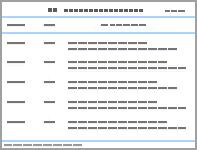
表1
不同氮添加水平下土壤理化性质(平均值±标准差)"
| 处理Treatment | pH | SWC (%) | TN | TC | C/N |
|---|---|---|---|---|---|
| N0 | 9.71±0.05a | 18.75±0.60a | 0.1±0.02c | 1.54±0.04d | 15.28±2.79ab |
| N1 | 9.54±0.02ab | 16.78±0.69c | 0.12±0.01c | 2.11±0.06bc | 17.54±1.13a |
| N2 | 9.41±0.03ab | 17.69±0.81b | 0.20±0.02a | 2.47±0.08ab | 12.29±0.83bc |
| N4 | 9.10±0.04b | 17.44±0.44b | 0.18±0.04a | 2.62±0.05a | 14.60±2.85b |
| N8 | 9.11±0.01b | 18.87±0.87a | 0.17±0.03ab | 1.97±0.04c | 11.55±1.68c |
| N16 | 8.75±0.04bc | 13.22±0.22e | 0.18±0.01a | 2.26±0.04b | 12.41±0.46bc |
| N24 | 8.42±0.02bc | 14.26±0.26d | 0.13±0.03bc | 1.74±0.05cd | 13.47±2.74bc |
| N32 | 8.39±0.01c | 13.04±0.51e | 0.10±0.01c | 1.49±0.05d | 14.57±0.94b |
| TP (g·kg-1) | NH4+-N (mg·kg-1) | NO3--N (mg·kg-1) | MBC (mg·kg-1) | MBN (mg·kg-1) | |
| N0 | 0.55±0.03a | 90.44±4.23b | 7.15±4.03e | 115.04±4.92cd | 16.21±1.02e |
| N1 | 0.49±0.01a | 87.07±2.31cd | 21.72±1.72d | 119.92±2.81d | 30.81±2.17d |
| N2 | 0.48±0.01a | 80.73±3.22c | 50.87±2.12b | 230.36±5.35b | 37.53±0.82c |
| N4 | 0.53±0.02a | 102.17±5.17bc | 44.01±1.27c | 174.77±3.22c | 45.42±2.40b |
| N8 | 0.55±0.02a | 133.75±5.24a | 21.63±1.53d | 412.08±9.94a | 69.98±2.98a |
| N16 | 0.50±0.03a | 131.62±1.42a | 29.15±0.85cd | 98.37±2.36de | 19.04±1.33e |
| N24 | 0.55±0.02a | 99.64±3.63bc | 55.41±1.19b | 86.35±1.34e | 6.87±0.86f |
| N32 | 0.54±0.04a | 112.57±4.43b | 127.98±4.91a | 153.27±3.27cd | 18.46±1.43e |
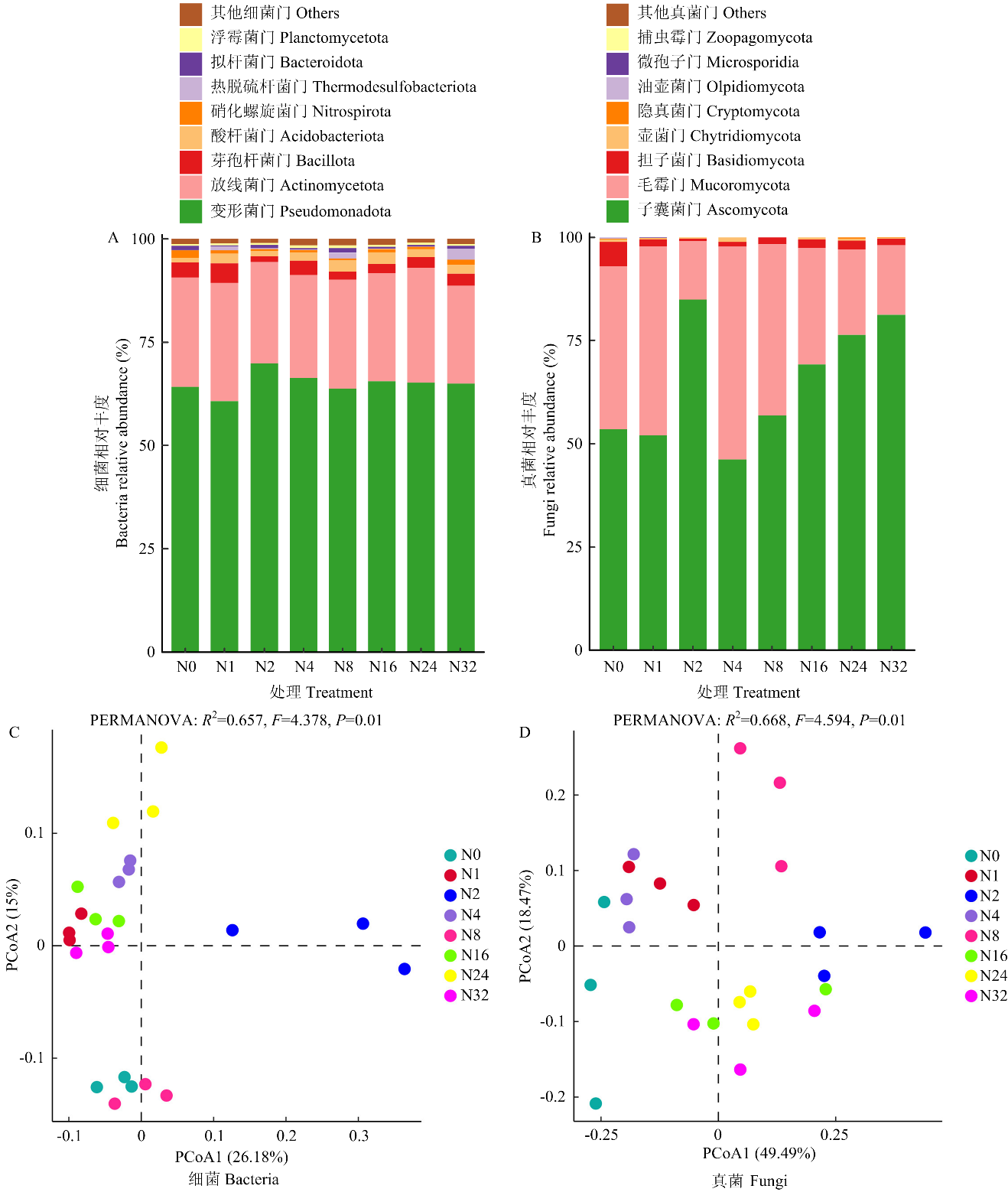
图1
不同氮添加水平下土壤细菌与真菌的群落结构分析"
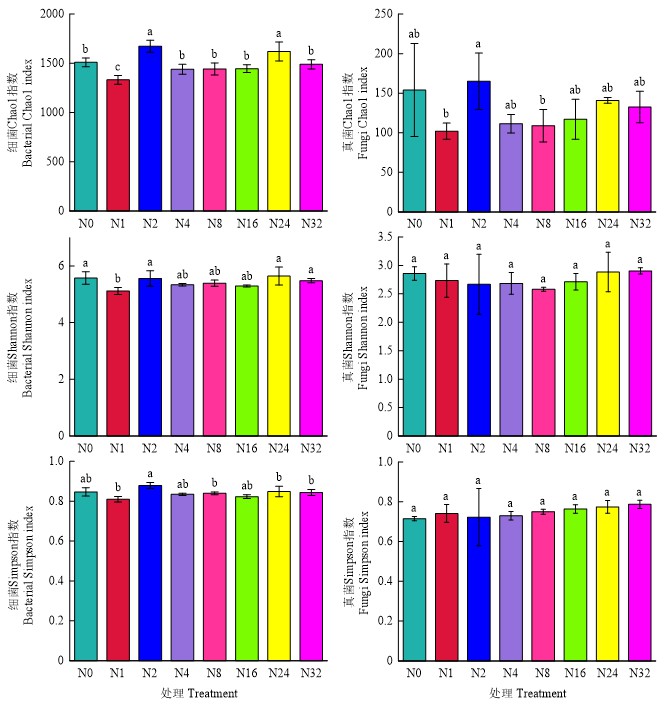
图2
不同氮添加水平下土壤细菌和真菌的Chao1、Shannon和Simpson指数 图柱上不同小写字母代表处理间在0.05水平上差异显著"
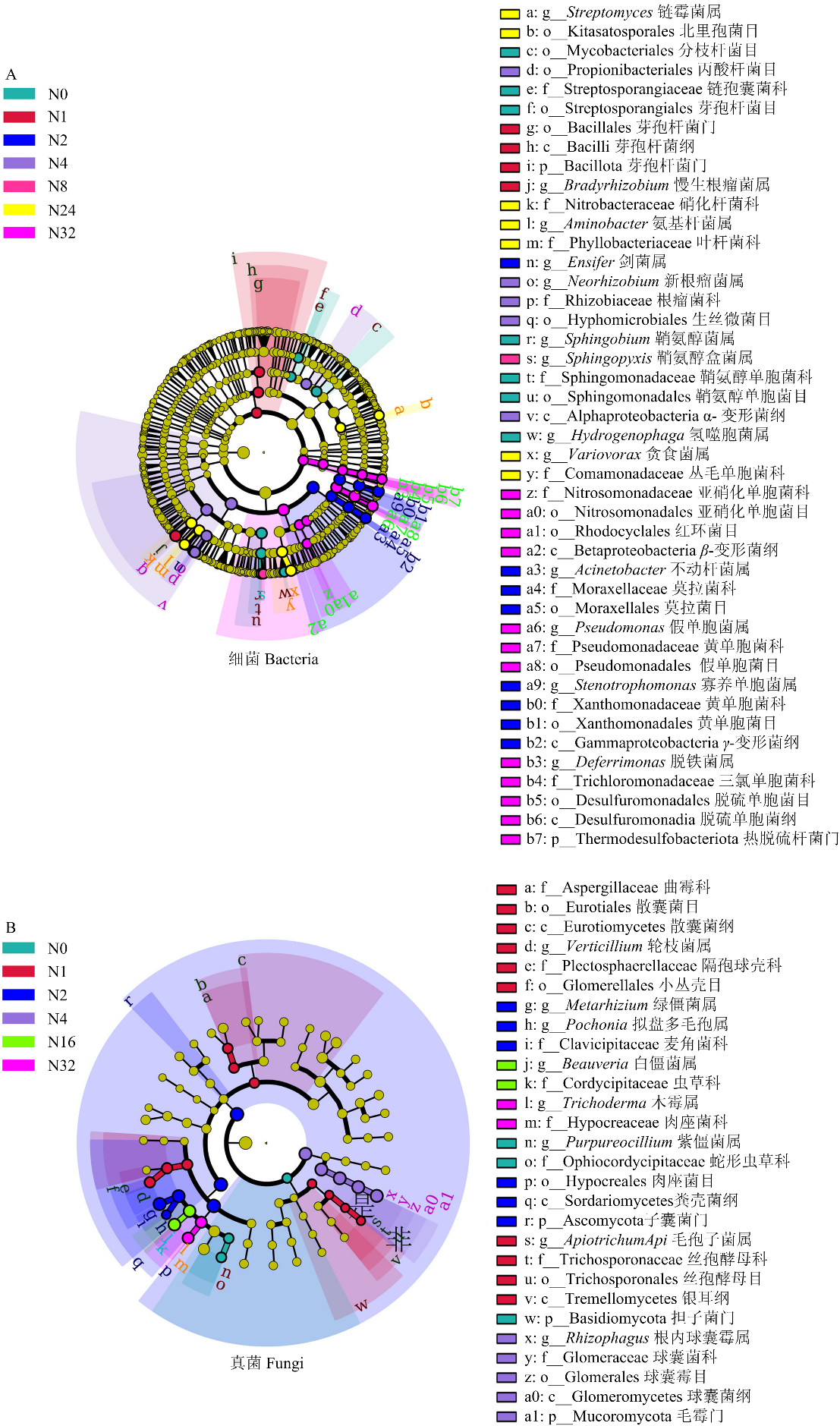
图3
不同氮添加水平下土壤细菌和真菌的多级物种LefSe差异分析(LDA>4)(P<0.05)"
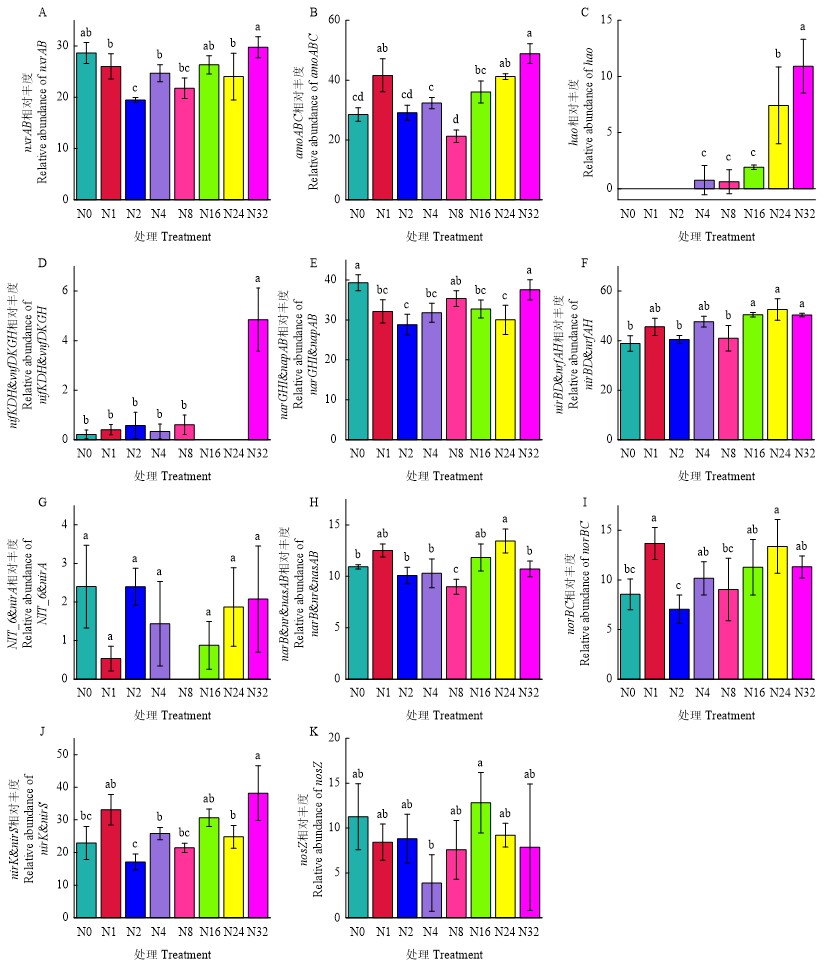
图4
不同氮添加水平下参与氮循环过程基因的相对丰度"
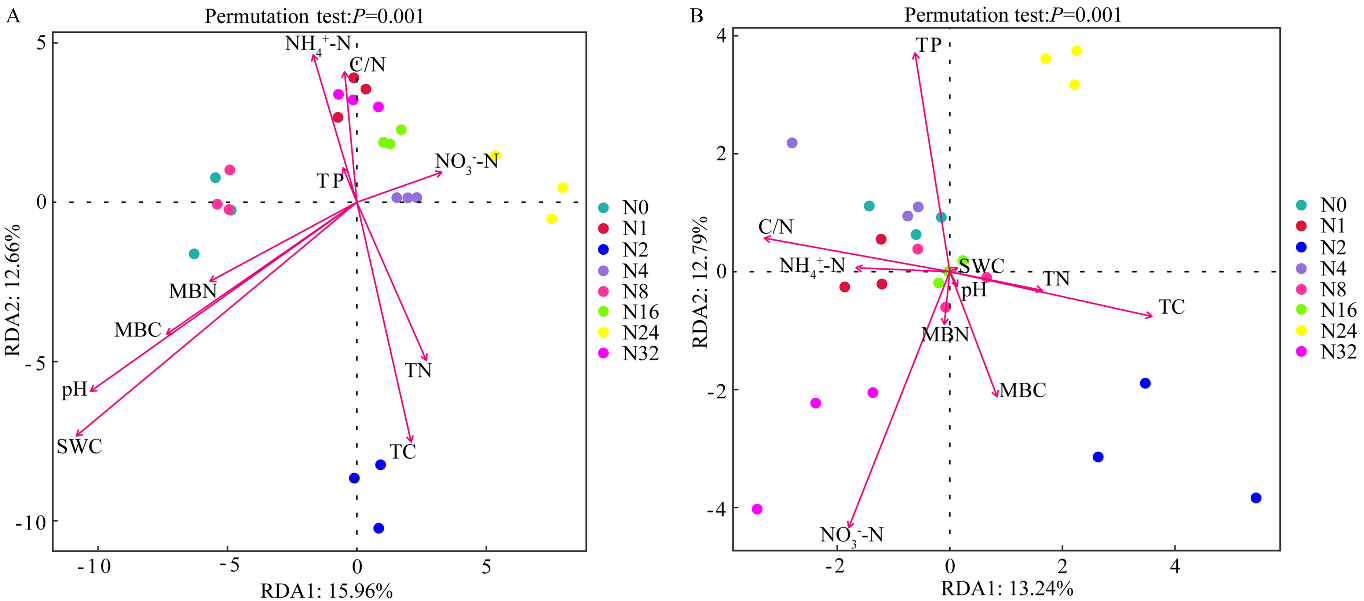
图5
不同氮添加水平下细菌(a)和真菌(b)冗余分析"
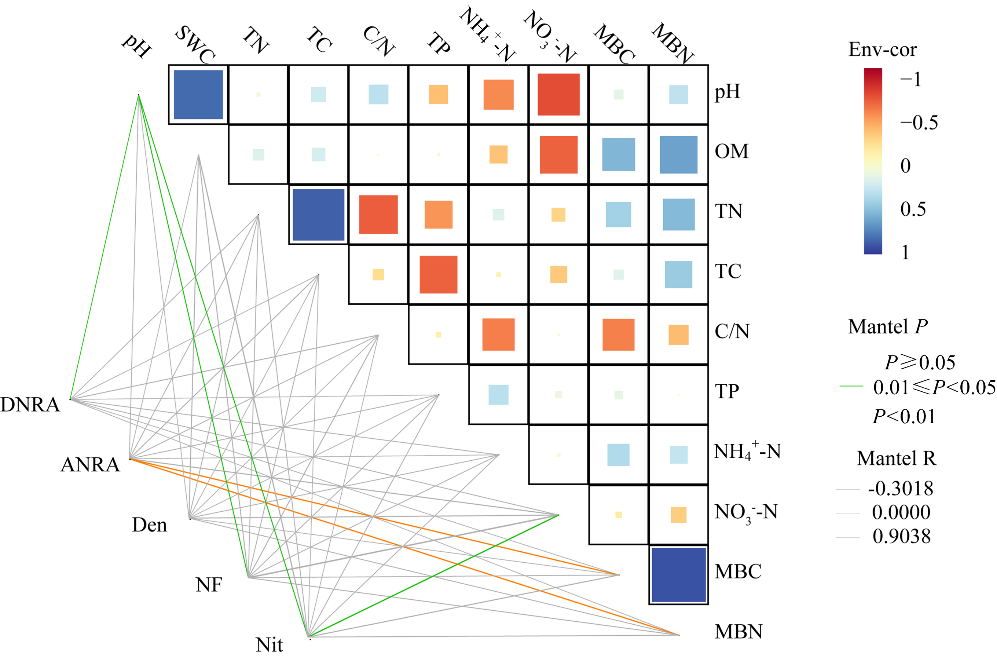
图6
不同氮添加水平下氮循环功能基因与土壤理化性质的关系(P<0.05) DNRA:异化硝酸盐还原为铵,ANRA:同化硝酸盐还原为铵,Den:反硝化,NF:固氮,Nit:硝化"
| [1] |
|
| [2] |
邓旭, 王丽娜, 周莹, 张泽凌, 路浩, 唐亚坤. 模拟大气沉降氮在陆地生态系统中的留存及其影响因素[J]. 生态学报, 2025, 45(3): 1077-1089.
|
|
|
|
| [3] |
刘佳婷, 廖迎春, 谢越, 施星星. 氮沉降对土壤养分影响研究综述[J]. 中国水土保持, 2019(9): 63-65.
|
|
|
|
| [4] |
|
| [5] |
|
| [6] |
郝海平, 白红彤, 夏菲, 郝渊鹏, 李慧, 崔洪霞, 谢晓明, 石雷. 茶-山苍子间作对茶园土壤微生物群落结构的影响[J]. 中国农业科学, 2021, 54(18): 3959-3969. DOI: 10.3864/j.issn.0578-1752.2021.18.014.
|
|
|
|
| [7] |
石素梅, 杨敬杰, 单晓静. 草原土壤微生物群落结构及其生态功能[J]. 农村科学实验, 2025(6): 24-26.
|
|
|
|
| [8] |
|
| [9] |
陆姣云. 氮沉降影响草地生态系统土壤氮循环过程的研究进展[J]. 草业学报, 2022, 31(6): : 221-234.
|
|
|
|
| [10] |
王清清. 土壤氮循环的过程、意义及影响因素[J]. 环境科学导刊, 2025, 44(1): 10-15.
|
|
|
|
| [11] |
|
| [12] |
李婷婷. 内蒙古草原土壤微生物群落对氮沉降的响应研究[D]. 北京: 中国农业科学院, 2023.
|
|
|
|
| [13] |
|
| [14] |
李岱岩. 氮添加对森林草原交错带土壤氮转化特征及微生物群落结构的影响[D]. 沈阳: 沈阳农业大学, 2024.
|
|
|
|
| [15] |
王钊, 张冰, 董思奇, 胡雨翕, 齐书宇, 冯国忠, 高强, 周雪. 长期施用氮肥对黑土和风沙土根际微生物群落结构及功能的影响[J]. 中国农业科学, 2025, 58(3): 520-537. DOI: 10.3864/j.issn.0578-1752.2025.03.009.
|
|
|
|
| [16] |
|
| [17] |
马红钰, 周小国, 王宝, 宋渝川, 艾克热木·阿不拉提江, 蒋邵丽, 闵九洲, 赵红梅, 程军回. 准噶尔荒漠梭梭和柽柳根际土壤微生物功能基因丰度变化特征[J]. 草业学报, 2025, 34(8): 109-122.
|
|
|
|
| [18] |
袁月. 长期氮源添加对矿区土壤理化性质及固氮微生物群落特征的影响[D]. 桂林: 广西师范大学, 2025.
|
|
|
|
| [19] |
|
| [20] |
高树琴, 段瑞, 王竑晟, 李昂, 石岳, 景海春, 方精云. 北方农牧交错带在保障国家大粮食安全中发挥重要作用[J]. 中国科学院院刊, 2021, 36(6): 643-651.
|
|
|
|
| [21] |
许雯丽, 卞嘉琛, 林茂, 韩菲, 杨倩雯, 李东旭, 宁亚楠, 伊李凯, 庞高亮, 王润东, 朱熠辰, 董宽虎, 王常慧, 刁华杰. 晋北赖草草地土壤呼吸对养分添加和改变降水的响应[J]. 草地学报, 2025, 33(1): 170-180.
|
|
|
|
| [22] |
刘平, 刘学军, 骆晓声, 吴庆华, 刘恩科, 韩彦龙, 李丽君, 白光洁, 武文丽, 张强. 山西北部农村区域大气活性氮沉降特征[J]. 生态学报, 2016, 36(17): 5353-5359.
|
|
|
|
| [23] |
卞嘉琛, 王睿, 高阳阳, 梁雯君, 晋红, 张文轩, 张晓荣, 郝杰, 王常慧, 董宽虎, 刁华杰. 不同水平氮添加对晋北赖草草地地上和地下净初级生产力的影响[J]. 植物生态学报, 2025, 49(12): 2043-2053.
|
|
|
|
| [24] |
|
| [25] |
陈鸿飞, 赵芳草, 王一昊, 董宽虎, 王常慧, 陈晓鹏. 氮添加对盐渍化草地根际土壤理化性质的影响[J]. 应用生态学报, 2023, 34(1): 67-74.
|
|
|
|
| [26] |
王庆峰, 褚长彬, 赵峥, 吴淑杭, 周德平. 草莓连作对土壤微生物及碳氮磷功能基因丰度的影响[J]. 中国农业科学, 2025, 58(17): 3488-3502. DOI: 10.3864/j.issn.0578-1752.2025.17.010.
|
|
|
|
| [27] |
杨金鹏, 牟兰, 仇嘉悦, 吴宗烨, 张鑫亮, 张美艳, 蔡明, 黄必志. 生草对滇中苹果园土壤酶活性和微生物群落多样性的影响[J]. 草地学报, 2025, 33(2): 419-428.
|
|
Yang J P, (Mou/mu) L,
|
|
| [28] |
王璐, 徐仁飞, 邓磊, 李小刚, 陈哲, 王世雄, 王文颖, 关晋宏. 高寒沙区不同恢复年限青杨人工林土壤碳氮磷化学计量特征[J]. 生态学报, 2025, 45(18): 9192-9202.
|
|
|
|
| [29] |
|
| [30] |
李明, 毕江涛, 王静. 宁夏不同地区盐碱化土壤细菌群落多样性分布特征及其影响因子[J]. 生态学报, 2020, 40(4): 1316-1330.
|
|
|
|
| [31] |
汉鑫, 牧仁, 陈鑫, 全梓豪, 高浩诚, 焦婷. 施氮对高寒生态条件下垂穗披碱草(Elymus nutans)草地土壤微生物特征的影响[J]. 中国草地学报, 2025, 47(4): 33-45.
|
|
|
|
| [32] |
|
| [33] |
赵文, 尹亚丽, 李世雄, 刘燕, 刘晶晶, 董怡玲, 苏世锋, 吉凌鹤. 祁连山不同类型草地土壤细菌群落特征研究[J]. 草业学报, 2021, 30(12): 161-171.
|
|
|
|
| [34] |
杨杰, 陈闻, 侯海军, 陈春兰, 秦红灵, 吕殿青. 南方红壤丘陵区土壤细菌对土壤水分和温度的响应差异[J]. 热带作物学报, 2019, 40(3): 609-615.
|
|
|
|
| [35] |
|
| [36] |
潘禹. 模拟N沉降对滇中亚高山典型森林凋落物分解及土壤微生物的影响[J]. 林业科学研究, 2021, 34(3): 88-97.
|
|
|
|
| [37] |
刘超, 李仕蓉, 许巧玲, 乔志伟. 外源碳氮对农田土壤真菌群落结构及功能的影响[J]. 南方农业学报, 2025, 56(3): 795-806.
|
|
|
|
| [38] |
孙雪琦, 戴辉, 曾泉鑫, 周嘉聪, 彭园珍, 陈文伟, 张秋芳, 陈岳民. 氮添加土壤微生物群落结构影响微生物碳利用效率[J]. 生态学报, 2024, 44(4): 1737-1746.
|
|
|
|
| [39] |
杨建强, 刁华杰, 胡姝娅, 王常慧. 不同水平氮添加对盐渍化草地土壤微生物特征的影响[J]. 植物生态学报, 2021, 45(7): 780-789.
|
|
|
|
| [40] |
|
| [41] |
|
| [42] |
|
| [43] |
|
| [44] |
冯蒙蒙, 林永新, 樊剑波, 贺纪正. 温度和氮添加对旱地红壤反硝化功能基因丰度的影响[J]. 土壤, 2023, 55(3): 562-568.
|
|
|
|
| [45] |
|
| [46] |
王静. 土壤肥力和施氮量对双季稻氮素利用效率和氮循环相关土壤微生物的影响[D]. 南昌: 江西农业大学, 2022.
|
|
|
|
| [47] |
闻鸣, 刘禹, 冯朝阳, 计伟, 李卓卿. 不同土地利用方式下土壤氮循环关键过程的差异及其驱动因素[J]. 应用生态学报, 2025, 36(5): 1387-1397.
|
|
|
|
| [48] |
丛兢兢, 马君玲, 李顺和, 高威, 鲍雪莲, 朱雪峰, 解宏图, 王连峰. 不同水分含量下黑土硝化反硝化微生物群落结构的变化[J]. 植物营养与肥料学报, 2023, 29(8): 1400-1410.
|
|
|
|
| [49] |
陈韬, 李剑沣, 邹子介, 张本. 氧化还原电位和pH对生物滞留系统硝酸盐异化还原为氨作用的影响[J]. 科学技术与工程, 2018, 18(4): 368-373.
|
|
|
|
| [50] |
|
| [51] |
|
| [1] | 王彩玉, 刘小丽, 李文广, 杨文平, 杨珍平, 高志强. 有机肥不同替代比例对土壤多功能性的影响及微生物驱动机制[J]. 中国农业科学, 2026, 59(8): 1712-1726. |
| [2] | 吴文琪, 焦阳, 惠家祯, 王绪锋, 郭博森, 沈玉芳. 不同有机物料配施化肥对土壤肥力和玉米产量的影响[J]. 中国农业科学, 2025, 58(23): 4966-4978. |
| [3] | 袁慧琳, 李雅莹, 顾文杰, 徐培智, 卢钰升, 孙丽丽, 周昌敏, 黎婉玲, 仇荣亮. 长期施用新鲜与腐熟畜禽粪肥土壤溶解性有机质与微生物群落的特征及其关联性[J]. 中国农业科学, 2025, 58(2): 307-325. |
| [4] | 袁波, 徐丽君, 磋么机, 聂莹莹, 张洪志, 柳新伟, 杨敏, 郭明英. 氮添加对不同种植模式下人工草地产量稳定性的影响[J]. 中国农业科学, 2025, 58(15): 3007-3019. |
| [5] | 张旸, 高燕, 张延, 黄丹丹, 陈学文, 张士秀, 梁爱珍. 秸秆还田方式对东北黑土氮素矿化和氮循环功能基因的影响[J]. 中国农业科学, 2025, 58(10): 1958-1968. |
| [6] | 王清慧, 李乃荟, 张一平, 狄成乾, 吴凤芝. 小麦和豌豆填闲对白菜幼苗生长和土壤微生物群落结构的影响[J]. 中国农业科学, 2024, 57(3): 555-569. |
| [7] | 舒小伟, 王树深, 伏桐, 王子涵, 丁周宇, 杨英, 赵士茹, 周娟, 黄建晔, 姚友礼, 王余龙, 董桂春. 小麦秸秆还田后不同水稻品种对简化穗肥施用的响应及其成因[J]. 中国农业科学, 2024, 57(10): 1961-1978. |
| [8] | 马南, 安婷婷, 张久明, 汪景宽. 添加玉米秸秆和根茬对不同肥力黑土微生物残体碳氮的影响[J]. 中国农业科学, 2023, 56(4): 686-696. |
| [9] | 陈义勇, 黎健龙, 周波, 吴小敏, 崔莹莹, 冯少茂, 胡海涛, 唐劲驰. 鼠茅草间作对茶园土壤及茶叶品质成分的影响[J]. 中国农业科学, 2023, 56(24): 4916-4929. |
| [10] | 侯将将,王金洲,孙平,朱文琰,徐靖,卢昌艾. 中国草地地上生产力氮素敏感性的时空变化[J]. 中国农业科学, 2022, 55(9): 1811-1821. |
| [11] | 朱长伟,孟威威,石柯,牛润芝,姜桂英,申凤敏,刘芳,刘世亮. 不同轮耕模式下小麦各生育时期土壤养分及酶活性变化特征[J]. 中国农业科学, 2022, 55(21): 4237-4251. |
| [12] | 夏芊蔚,陈浩,姚宇阗,笪达,陈健,石志琦. “优标”水稻体系对稻田土壤环境的影响[J]. 中国农业科学, 2022, 55(17): 3343-3354. |
| [13] | 龚小雅,石记博,方凌,方亚鹏,吴凤芝. 淹水对辣椒连作土壤化学性质与微生物群落结构的影响[J]. 中国农业科学, 2022, 55(12): 2472-2484. |
| [14] | 邵美琪,赵卫松,苏振贺,董丽红,郭庆港,马平. 盐胁迫下枯草芽孢杆菌NCD-2对番茄促生作用及对土壤微生物群落结构的影响[J]. 中国农业科学, 2021, 54(21): 4573-4584. |
| [15] | 郝海平,白红彤,夏菲,郝渊鹏,李慧,崔洪霞,谢晓明,石雷. 茶-山苍子间作对茶园土壤微生物群落结构的影响[J]. 中国农业科学, 2021, 54(18): 3959-3969. |
|
||
