






中国农业科学 ›› 2026, Vol. 59 ›› Issue (11): 2374-2386.doi: 10.3864/j.issn.0578-1752.2026.11.006
范晓涵1( ), 张维军2, 袁锦锋2, 赵栋霖1, 张成省1, 张之矾2(), 徐康文1()
收稿日期:2026-02-10
接受日期:2026-04-03
出版日期:2026-06-01
发布日期:2026-06-03
通信作者:
联系方式:
范晓涵,E-mail:821012450504@caas.cn。
基金资助:
FAN XiaoHan1(), ZHANG WeiJun2, YUAN JinFeng2, ZHAO DongLin1, ZHANG ChengSheng1, ZHANG ZhiFan2(), XU KangWen1()
Received:2026-02-10
Accepted:2026-04-03
Published:2026-06-01
Online:2026-06-03
摘要:
【背景】青枯病是由青枯劳尔氏菌(Ralstonia solanacearum)引发的毁灭性土传植物病害,c-di-GMP作为细菌保守第二信使调控病原菌致病表型,但其在青枯菌中的核心代谢基因功能仍需深入解析。【目的】探究青枯菌GMI 1000中c-di-GMP代谢相关基因的功能及调控机制,明确关键基因对菌株生理表型和致病力的影响,完善青枯菌c-di-GMP信号调控网络,为青枯病新型防控靶点挖掘与绿色防控策略研发提供理论依据。【方法】以青枯菌GMI 1000为研究对象,采用RT-qPCR检测常规培养与模拟侵染条件下24个潜在c-di-GMP代谢基因的转录表达差异;针对极显著下调的Rsp1208,通过同源重组与电转化技术构建缺失、回补、酶活位点突变及过表达工程菌株;系统测定各菌株的生长动态、运动能力、生物膜形成量、胞外多糖产量等关键生理表型,结合RT-qPCR分析运动与胞外多糖合成相关基因的转录水平;采用LC-MS/MS与噻唑橙荧光反应法检测胞内c-di-GMP含量及体外合成酶活性;采用伤根接种法测定菌株对番茄的致病力。【结果】模拟侵染环境下,24个c-di-GMP代谢相关基因均呈不同程度转录下调,其中Rsp1208下调水平极显著,其编码蛋白同时含有GGDEF与EAL双结构域。Rsp1208缺失后,菌株运动能力与胞外多糖产量分别显著提升26.57%、85.92%,生物膜形成量降低75%,胞内c-di-GMP水平显著下降,对番茄致病力极显著增强;回补菌株表型恢复至野生型水平,过表达菌株则表现为运动能力减弱、生物膜形成微量提升、致病力显著降低。Rsp1208缺失株中运动相关基因(flhC、fliA、fliM、fliC)与胞外多糖合成基因(xpsR、epsB)转录水平均极显著上调。GGDEF酶活位点突变可使Rsp1208基本丧失c-di-GMP合成能力,EAL位点突变无显著影响。【结论】Rsp1208通过GGDEF结构域发挥c-di-GMP合成酶功能,调控青枯菌胞内c-di-GMP稳态,进而介导运动性、生物膜、胞外多糖等表型重塑,最终调控病原菌致病力,研究结果可为深入解析青枯菌的致病机制、研发绿色防控技术提供理论支撑。
范晓涵, 张维军, 袁锦锋, 赵栋霖, 张成省, 张之矾, 徐康文. 青枯菌GMI 1000菌株c-di-GMP合成酶Rsp1208的功能[J]. 中国农业科学, 2026, 59(11): 2374-2386.
FAN XiaoHan, ZHANG WeiJun, YUAN JinFeng, ZHAO DongLin, ZHANG ChengSheng, ZHANG ZhiFan, XU KangWen. Function of c-di-GMP Synthase Rsp1208 of Ralstonia solanacearum Strain GMI 1000[J]. Scientia Agricultura Sinica, 2026, 59(11): 2374-2386.

表1
Rsp1208基因敲除、回补及过表达载体构建所用引物"
| 引物名称 Primer name | 引物序列 Primer sequence | 靶标基因 Target gene | 退火温度 Annealing temperature (℃) | 产物大小 Product size (bp) | 用途 Purpose |
|---|---|---|---|---|---|
| Rsp1208-F1 | gagctcggtacccggggatccAACACGTCGTCGTTGGTGATC | 上游 Upstream | 56 | 550 | 基因克隆 Gene clone |
| Rsp1208-R1 | tatcgtcgatccagCAGCAGCTGGACGAATCGTT | ||||
| Rsp1208-F2 | ctgctgCTGGATCGACGATACGCAGG | 下游 Downstream | 56 | 740 | 基因克隆 Gene clone |
| Rsp1208-R2 | acgacggccagtgccaagcttGAAACCGCCTCCAGCATGG | ||||
| Rsp1208OE-F | agggaacaaaagctgggtaccGTTGCCTGACCGCGAACG | 过表达片段 Overexpression fragment | 58 | 1350 | 基因克隆 Gene clone |
| Rsp1208OE-R | caggaattcgatatcaagcttTTACGGCATCAGATCGCGC | ||||
| M13F | TGTAAAACGACGGCCAGT | — | 55 | — | 过表达验证 Overexpression verification |
| M13R | AACAGCTATGACCATGA | ||||
| Rsp1208-pET30-F | taagaaggagatatacatatgTTGCCTGACCGCGAACGATTCGTC | 蛋白表达片段 Protein expression fragment | 55 | 1371 | 基因克隆 Gene clone |
| Rsp1208-pET30-R | ctcgagtgcggccgcaagcttCGGCATCAGATCGCGCGCGCGTTCG |
表2
RT-qPCR引物"
| 基因Gene | 引物序列Primer sequence | |
|---|---|---|
| gyrB | F: CAAGGGCAAGATCCTGAACG | R: GATGATGATGCGGTGGTAGC |
| flhC | F: AAGAGGTGCTGTCGATCACT | R: TCACGGTGTGCAACATCTTC |
| fliA | F: CATCGCCAACCAGATGATGG | R: GCGGCATAGAACTCGAACTG |
| fliM | F: CATGCCGTACACCATGATCG | R: TGTTGAGGATGTCGGACACA |
| fliC | F: ACTACAACGGCAACAAGCTG | R: TGGCCATATTGGAAGGTCGT |
| xpsR | CCCGCCAGTTCATTCTTCAG | GGACTGATGATCCAGGTGGT |
| epsB | GTGAGCTTGCTCAACGACAT | GTCAGCTTCTTGGGCTTCAC |
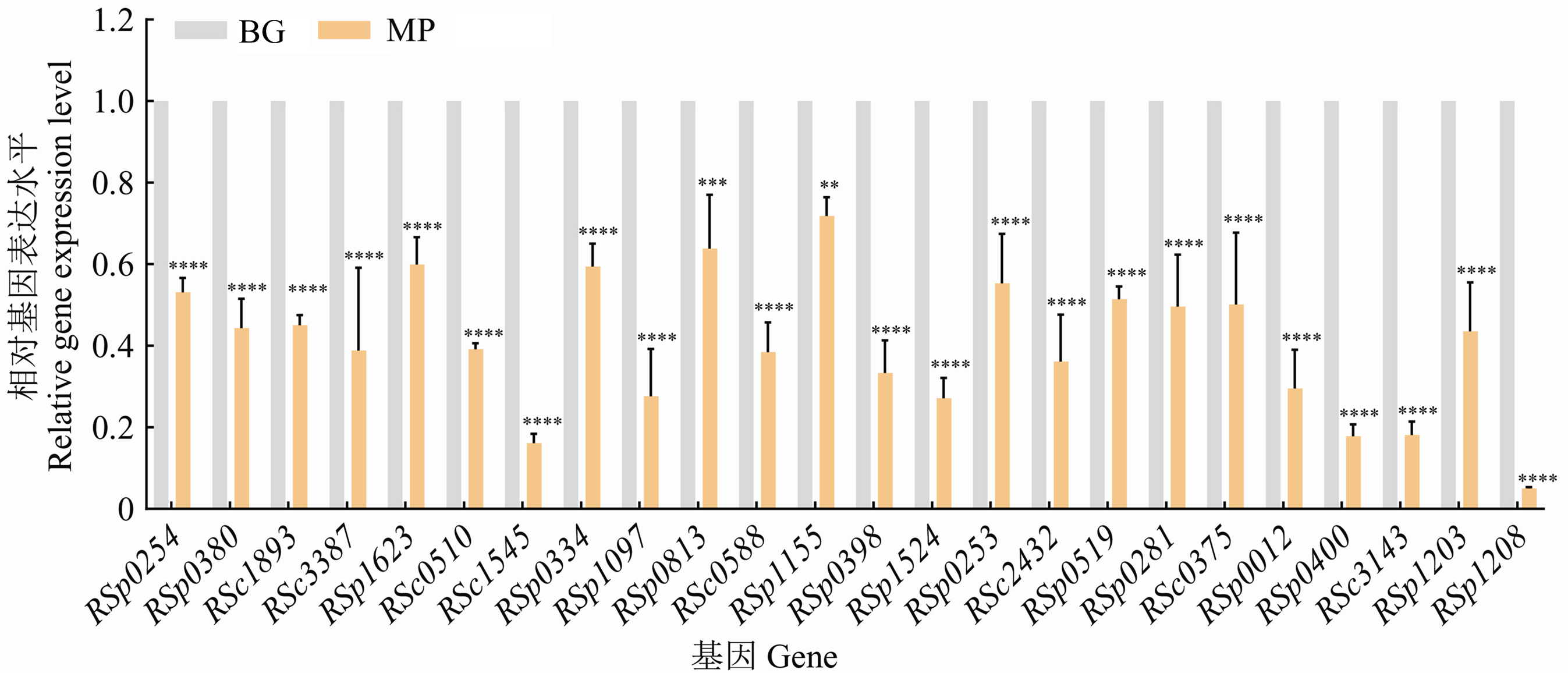
图1
青枯菌中与c-di-GMP代谢相关基因的筛选 ns:P>0.05;*:P<0.05;**:P<0.01;***:P<0.001;****:P<0.0001。下同The same as below"
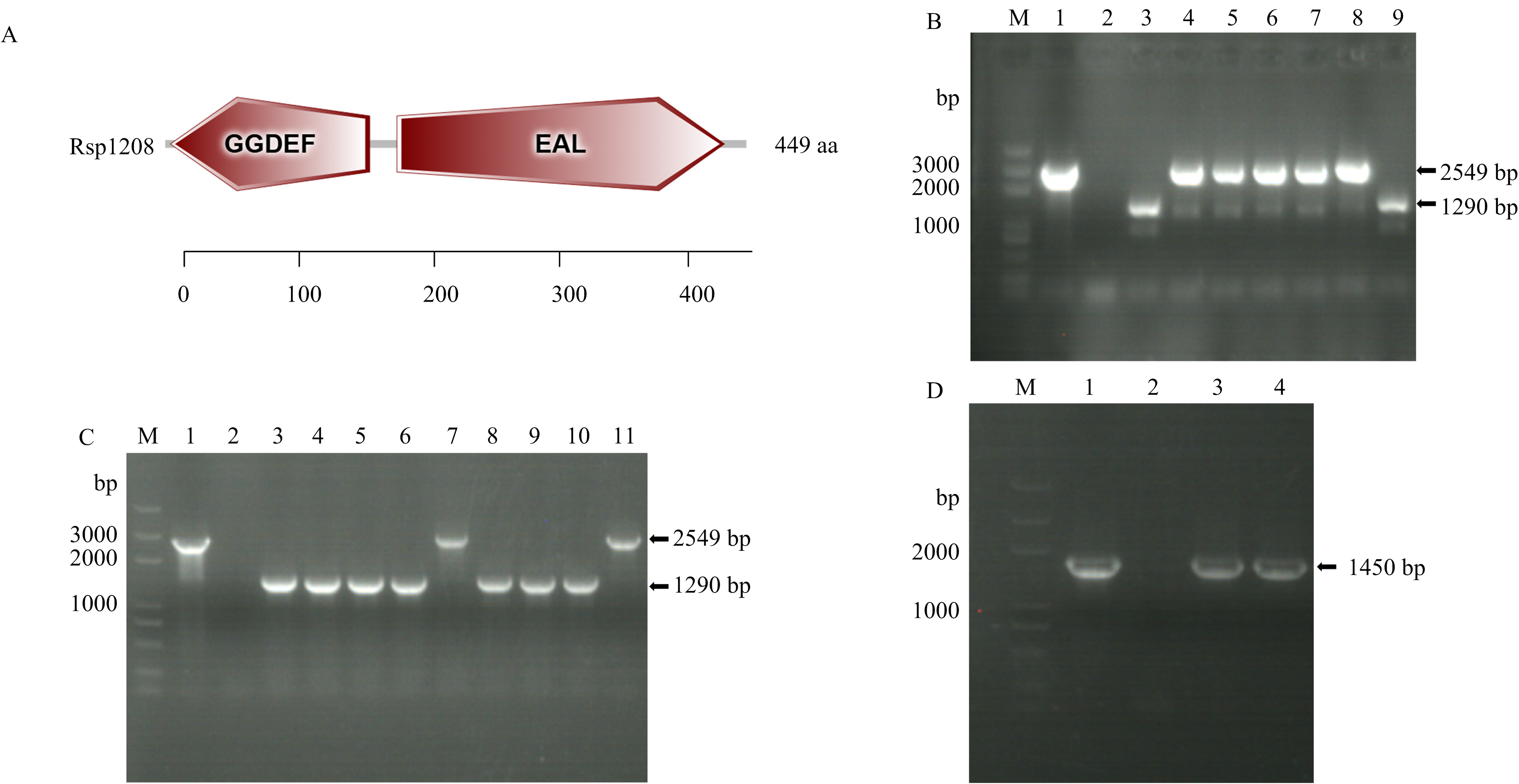
图2
Rsp1208蛋白结构域分析及缺失、回补、点突变与过表达菌株的PCR鉴定 A:Rsp1208结构域分析Domain analysis of the protein Rsp1208。B:Rsp1208缺失突变株PCR验证PCR validation of the Rsp1208 deletion mutant strains,1:以GMI 1000 DNA为模板扩增的长度为2549 bp产物The 2549 bp product amplified using GMI 1000 DNA as the template;3、9:以Rsp1208缺失突变株DNA为模板扩增的长度为1259 bp产物The 1259 bp product amplified using DNA from the Rsp1208 deletion mutant strain as the template;4—8:以Rsp1208未成功敲除的野生型菌株DNA为模板扩增的长度为2549 bp产物The 2549 bp product amplified from the DNA of the wild-type strain using Rsp1208 was not successfully knocked out as the template。C:Rsp1208回补菌株PCR验证PCR validation of Rsp1208 complementary strains,1:以GMI 1000 DNA为模板扩增的长度为2549 bp产物The 2549 bp product amplified using GMI 1000 DNA as the template;7、11:分别为以Rsp1208回补、关键酶活位点突变菌株DNA为模板扩增的长度为2549 bp产物The 2549 bp product amplified using DNA from the Rsp1208 complementation and key enzymatic activity site mutant strains as the template;3—6、8—10:以未成功构建的回补及点突变菌株DNA为模板扩增的长度为1450 bp产物The 1450 bp product amplified using the DNA of the unsuccessfully constructed complementation and point mutation strains as the template。D:Rsp1208过表达菌株PCR验证PCR analysis of Rsp1208 overexpression strains,1、3、4:以过表达菌株GMI 1000(Rsp1208)DNA为模板扩增的长度约为1450 bp产物The products of approximately 1450 bp amplified using DNA from the overexpressing strain GMI 1000 (Rsp1208) as the template。M:200 bp DNA ladder;2:阴性对照Negative control"
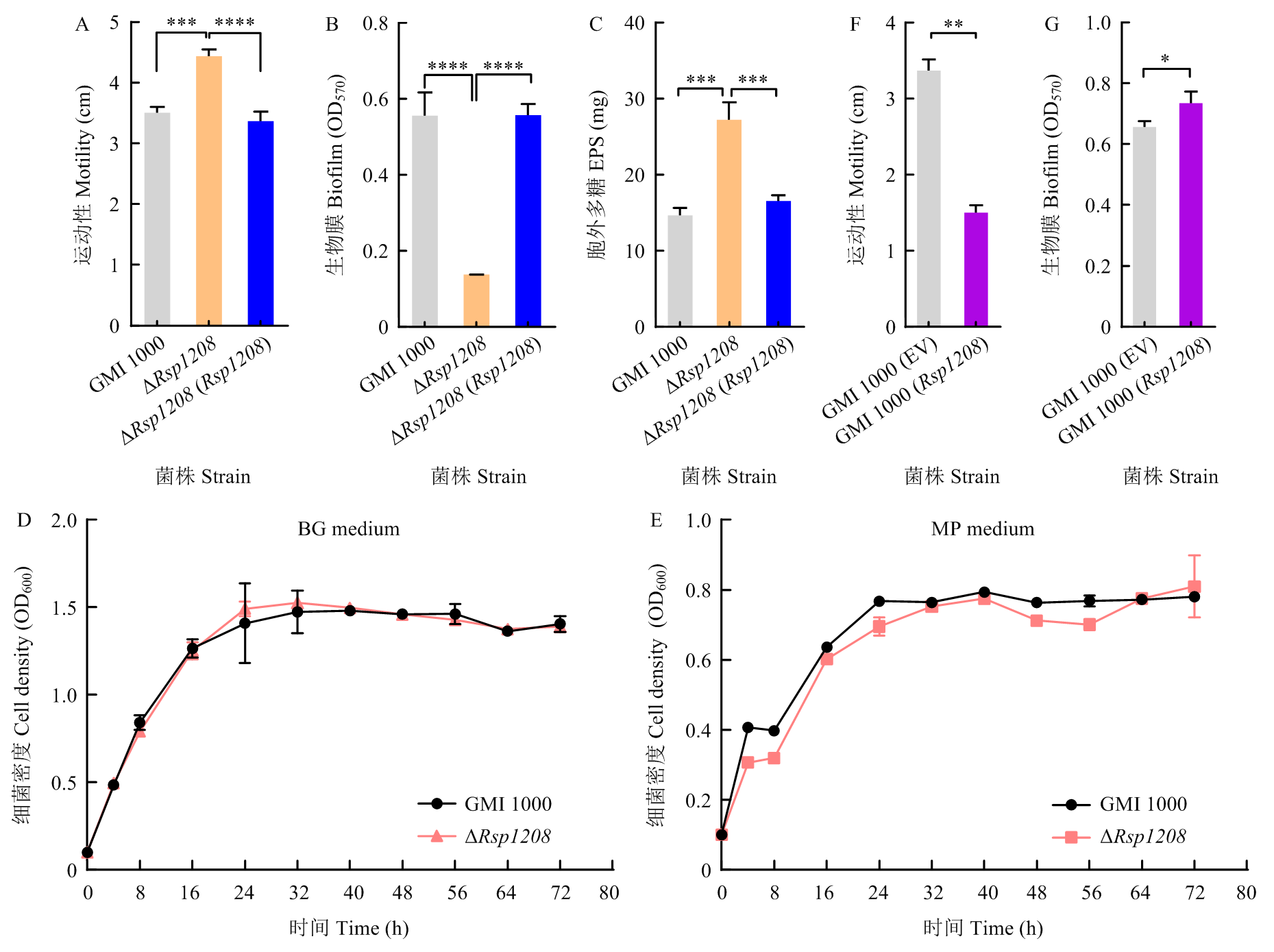
图3
Rsp1208缺失与过表达对青枯菌GMI 1000生长及运动性、生物膜、胞外多糖表型的影响"
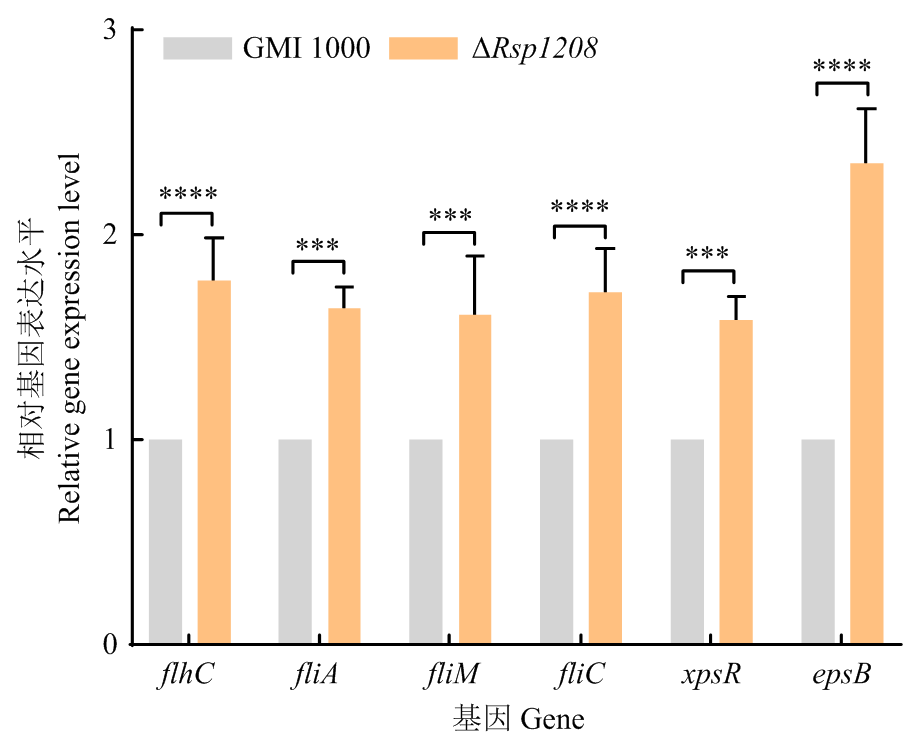
图4
Rsp1208缺失菌株中相关基因的转录水平"
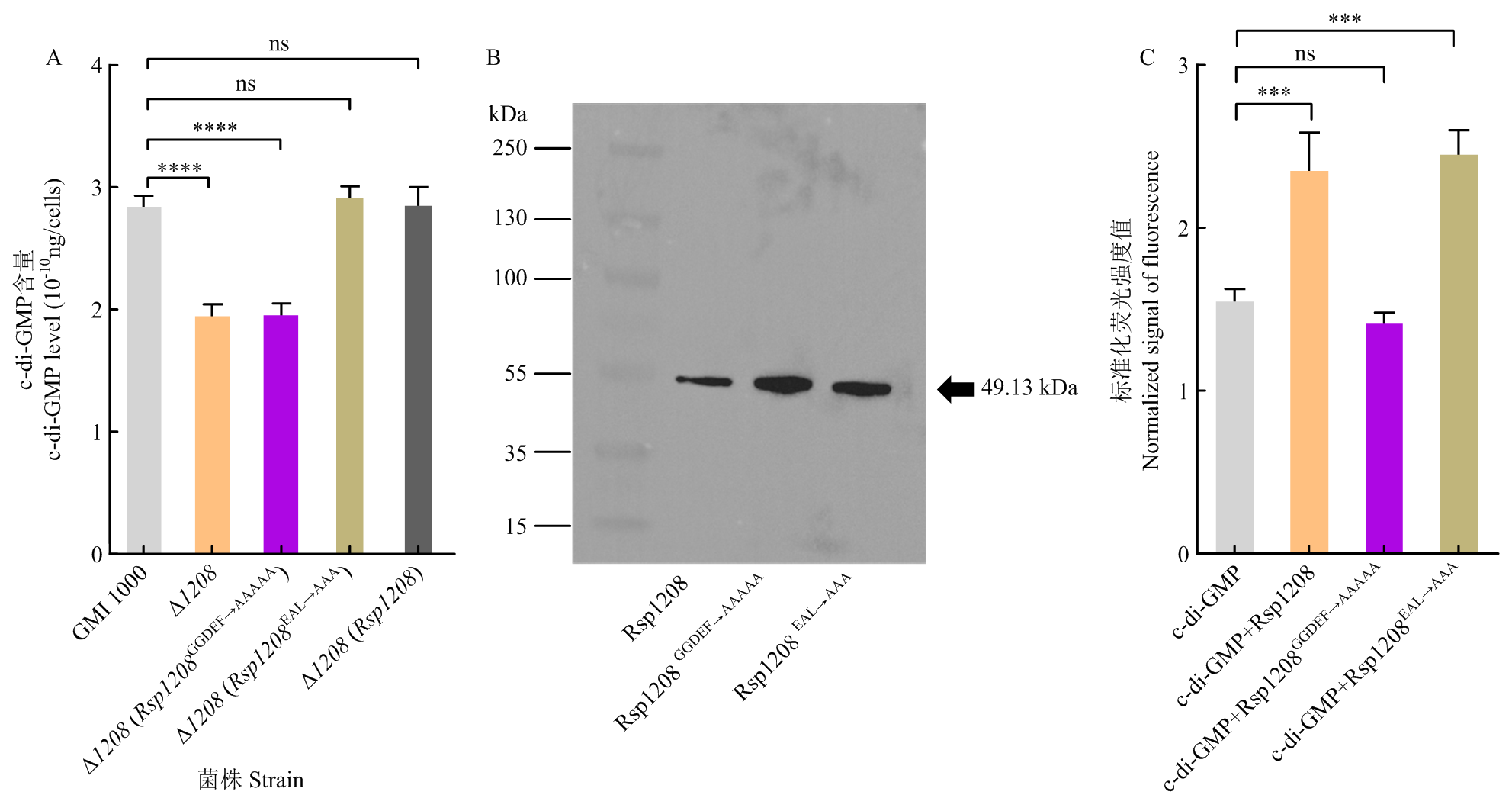
图5
Rsp1208对青枯菌胞内c-di-GMP含量的调控及体外c-di-GMP合成酶活性验证 A:GMI1000及Rsp1208突变菌株的胞内c-di-GMP水平Intracellular c-di-GMP levels in the GMI1000 and Rsp1208 deletion mutants;B:Rsp1208及定点突变蛋白的表达与纯化检测Expression and purification detection of Rsp1208 and site-directed mutant proteins;C:Rsp1208及其定点突变体的体外c-di-GMP合成酶活性In vitro c-di-GMP synthase activity of Rsp1208 and its site-directed mutants"

图6
Rsp1208缺失与过表达对番茄致病力的影响 A:不同菌悬液接种后的植株发病情况Disease occurrence of plants inoculated with bacterial suspension;B、C:病情指数Disease index"
| [1] |
李亚培, 曹景林, 程君奇, 吴成林, 张俊杰. 烟草抗青枯病育种启示. 中南农业科技, 2023, 44(2): 233-237.
|
|
|
|
| [2] |
doi: 10.1146/phyto.2004.42.issue-1 |
| [3] | |
|
|
|
| [4] |
屈皓. 青枯菌双组分调控系统PhoB-PhoR的功能研究[D]. 南宁: 广西大学, 2024.
|
|
|
|
| [5] |
谢秀明, 沈虹, 孙锦. 番茄青枯病综合防治研究进展. 中国果菜, 2018, 38(11): 63-67.
|
|
|
|
| [6] |
刘蕾, 徐进, 许景升, 陈匡宇, 张丽勍, 张昊, 冯洁. 青枯菌Po82菌株III型分泌系统调控基因hrpB的功能研究. 植物保护, 2012, 38(5): 9-15.
|
|
|
|
| [7] |
doi: 10.5423/PPJ.OA.06.2023.0090 |
| [8] |
张晨宁, 杜甜甜, 诸卫平, 梁小敏, 舒迎花, 王建武, 冯远娇. 作物青枯病发生与生态防控研究进展. 生态科学, 2025, 44(2): 280-288.
|
|
|
|
| [9] |
doi: 10.1038/nrmicro2109 pmid: 19287449 |
| [10] |
doi: 10.1038/s41467-024-46149-3 |
| [11] |
doi: 10.1007/s00284-025-04260-8 |
| [12] |
doi: 10.1128/mbio.01982-25 |
| [13] |
doi: 10.1038/nrmicro.2016.190 pmid: 28163311 |
| [14] |
|
| [15] |
doi: 10.1128/MMBR.00043-12 pmid: 23471616 |
| [16] |
doi: 10.1038/s41467-022-34607-9 pmid: 36335118 |
| [17] |
doi: 10.1038/s41467-023-43442-5 |
| [18] |
韩森. 产酶溶杆菌OH11中第二信使c-di-GMP受体蛋白CdgL调控抗菌物质HSAF合成与蹭行运动的机制研究[D]. 南京: 南京农业大学, 2020.
|
|
|
|
| [19] |
|
| [20] |
doi: 10.1016/S0021-9258(19)84115-7 |
| [21] |
|
| [22] |
doi: 10.1074/jbc.R115.711507 |
| [23] |
doi: 10.1038/sj.emboj.7601918 |
| [24] |
doi: 10.1111/mmi.2011.82.issue-2 |
| [25] |
doi: 10.1111/mpp.v23.8 |
| [26] |
doi: 10.1074/jbc.RA119.008252 |
| [27] |
doi: 10.1093/nar/gky146 |
| [28] |
牛世霖. 青枯菌GMI1000中5个环二鸟苷酸代谢相关基因功能的鉴定[D]. 福州: 福建农林大学, 2025.
|
|
|
|
| [29] |
杨晓欣, 许景升, 徐进, 韩文超, 李志明, 冯洁. 青枯菌GMI 1000菌株c-di-GMP代谢酶调控基因vsrD功能研究. 植物保护, 2025, 51(3): 102-112.
|
|
|
|
| [30] |
王卓, 魏嘉倓, 杨艳艳, 郭欣, 王传旭, 杨静, 牛亚洁, 李新. 信号分子自诱导物-2(AI-2)通过Tar1调节伸长盐单胞菌的趋化运动和生物膜形成. 微生物学报, 2026, 66(2): 770-782.
|
|
|
|
| [31] |
doi: 10.1016/j.mimet.2016.11.001 |
| [32] |
doi: 10.1038/ismej.2007.76 |
| [33] |
doi: 10.1038/s41396-020-0682-7 |
| [34] |
石俊龙. 枯草芽孢杆菌MEB-44胞外多糖产量优化、结构解析及活性分析[D]. 南宁: 广西大学, 2025.
|
|
|
|
| [35] |
doi: 10.1021/ja1091062 pmid: 21384923 |
| [36] |
高志宇, 薛敏钊, 刘燕刚, 黄德音. 噻唑橙类菁染料与生物大分子结合的光谱特性的研究. 感光科学与光化学, 2002, 20(4): 269-275.
|
|
|
|
| [37] |
|
| [38] |
doi: 10.3389/fmicb.2017.01234 |
| [39] |
doi: 10.1038/s41467-023-43461-2 |
| [40] |
doi: 10.1038/415497a |
| [41] |
doi: 10.3390/microorganisms8121956 |
| [42] |
doi: 10.1371/journal.pone.0059428 |
| [43] |
doi: 10.1038/srep10052 |
| [44] |
doi: 10.1146/annurev-micro-020518-115555 pmid: 31500536 |
| [45] |
孙雨, 解志红, 刘卫, 郭洪恩. 茎瘤固氮根瘤菌ORS571 GGDEF和EAL结构域蛋白的预测及功能研究. 微生物学报, 2019, 59(10): 2000-2012.
|
|
|
|
| [46] |
doi: 10.1128/aem.02270-21 |
| [47] |
doi: 10.3390/biology11091364 |
| [1] | 董钰, 吴千, 冯萱, 郑银英, 崔百明. 解淀粉欧文氏菌新质粒pEA60通过调节毒力因子的合成增强菌株的致病力[J]. 中国农业科学, 2026, 59(5): 996-1007. |
| [2] | 童朝阳, 刘文华, 张国欣, 董春燕, 张燕霞, 徐晓伟, 何东, 刘何春, 李杨, 王凤涛, 冯晶, 姚小波, 刘梅金, 蔺瑞明. 青稞穗腐病发生与穗螨群体迁移的关系[J]. 中国农业科学, 2025, 58(3): 493-506. |
| [3] | 从琪琪, 张静怡, 孟祥龙, 戴蓬博, 李波, 胡同乐, 王树桐, 曹克强, 王亚南. 我国苹果轮纹病弱毒菌株中病毒的鉴定及其携带情况的检测[J]. 中国农业科学, 2025, 58(3): 478-492. |
| [4] | 杨文娟, 高嘉诚, 王艳婷, 李妍, 郭铭, 汪军成, 孟亚雄, 王化俊, 司二静. 条纹病菌效应蛋白Pg00778调控对大麦致病力的作用[J]. 中国农业科学, 2025, 58(15): 3020-3035. |
| [5] | 董在芳, 丁腾腾, 单艺轩, 李洪连, 陈琳琳, 邢小萍. 自噬相关基因FpAtg3参与假禾谷镰孢的生长和致病[J]. 中国农业科学, 2024, 57(6): 1080-1090. |
| [6] | 王南威, 李莉莉, 陈凯风, 周洲平, 潘鹏, 关晋, 徐成刚, 廖明, 张建民. STM2503调控鼠伤寒沙门菌的生物被膜形成和压力适应性[J]. 中国农业科学, 2024, 57(16): 3294-3304. |
| [7] | 张健, 赵彬森, 冯浩, 黄丽丽. Vm-milRN7调控苹果树腐烂病菌致病的功能及机理[J]. 中国农业科学, 2024, 57(10): 1930-1942. |
| [8] | 宫安东, 雷银玉, 吴楠楠, 刘景榕, 宋梦鸽, 张艺美, 杨光, 杨鹏. 氧酰基载体蛋白还原酶基因FgOAR1对禾谷镰孢生长、发育和致病的影响[J]. 中国农业科学, 2023, 56(24): 4854-4865. |
| [9] | 黄家权,李莉,吴丰年,郑正,邓晓玲. 携带不同原噬菌体的黄龙病菌在柑橘木虱体内的增殖及致病力[J]. 中国农业科学, 2022, 55(4): 719-728. |
| [10] | 张晋龙,赵志博,刘巍,黄丽丽. 猕猴桃细菌性溃疡病菌T3SS关键效应蛋白基因致病功能[J]. 中国农业科学, 2022, 55(3): 503-513. |
| [11] | 张承启,廖露露,齐永霞,丁克坚,陈莉. 禾谷镰孢核孔蛋白基因FgNup42的功能分析[J]. 中国农业科学, 2021, 54(9): 1894-1903. |
| [12] | 曹钰晗,李紫腾,张静怡,张静娜,胡同乐,王树桐,王亚南,曹克强. 我国苹果斑点落叶病菌携带dsRNA分析及一种dsRNA病毒的鉴定[J]. 中国农业科学, 2021, 54(22): 4787-4799. |
| [13] | 赵静雅,夏荟清,彭梦雅,凡卓,殷悦,徐赛博,张楠,陈文波,陈琳琳. 假禾谷镰孢转录因子FpAPSES的鉴定与功能分析[J]. 中国农业科学, 2021, 54(16): 3428-3439. |
| [14] | 王宝宝,郭成,孙素丽,夏玉生,朱振东,段灿星. 玉米穗腐病致病禾谷镰孢复合种的遗传多样性、致病力与毒素化学型分析[J]. 中国农业科学, 2020, 53(23): 4777-4790. |
| [15] | 孙琦,何芳,邵胜楠,刘政,黄家风. 棉花黄萎病菌VdHP1的克隆及功能分析[J]. 中国农业科学, 2020, 53(14): 2872-2884. |
|
||
