






中国农业科学 ›› 2026, Vol. 59 ›› Issue (9): 1955-1974.doi: 10.3864/j.issn.0578-1752.2026.09.009
刘冬丽( ), 吕魏(), 张祥, 戴雄泽, 邹学校, 徐昊()
收稿日期:2025-11-25
接受日期:2026-03-24
出版日期:2026-05-01
发布日期:2026-05-06
通信作者:
联系方式:
刘冬丽,E-mail:483882667@qq.com。吕魏,E-mail:Lvwei201706@stu.hunau.edu.cn。刘冬丽和吕魏为同等贡献作者。
基金资助:
LIU DongLi(), LÜ Wei(), ZHANG Xiang, DAI XiongZe, ZOU XueXiao, XU Hao()
Received:2025-11-25
Accepted:2026-03-24
Published:2026-05-01
Online:2026-05-06
摘要:
【目的】探究低磷胁迫对辣椒(Capsicum annuum L.)地上株型、根系构型及磷利用效率的影响,并揭示其生理与分子适应机制,阐明辣椒耐低磷调控机理,为辣椒种质改良和减磷栽培提供理论支撑。【方法】以辣椒栽培品种‘樟树港’(S8)、‘遵辣1号’(Zunla-1)、8214为试材,设置5个磷浓度梯度:缺磷(P0,0 μmol·L-1)、低磷(P20,20 μmol·L-1)、中磷(P60,60 μmol·L-1;P120,120 μmol·L-1)、正常磷(P200,200 μmol·L-1),比较辣椒的地上株型、根系构型、光合色素含量、光合特性、氮磷钾养分分配及酸性磷酸酶活性,并采用qRT-PCR技术分析株型建成及磷响应相关基因的表达。【结果】低磷胁迫显著影响了辣椒的地上株型建成,导致茎秆变细、茎节间缩短、侧芽减少和分枝伸长受阻。同时,辣椒地上部生长受抑,伴随叶片脱落,导致光合色素含量与光合性能均显著下降。在根系构型方面,低磷胁迫诱导了根系构型重塑,虽然主根长度被抑制、侧根生成减少,导致根长、根尖数、根表面积、根体积、根平均直径等指标均显著下降,但植株可能通过优化资源分配,优先将光合产物和营养物质分配至根系,使得根冠比和根冠磷分配比显著增加。品种间比较显示,Zunla-1在低磷胁迫下,其总根长、根尖数、叶绿素含量、净光合速率、叶磷含量的耐低磷系数均显著高于S8和8214,表现出较强的耐低磷能力,其耐受策略表现为通过增加侧根数量和促进根系伸长来优化根系构型,并保持较高的光合色素含量、光合效率及叶磷含量。生理与分子分析显示,辣椒的适应性响应涉及生理与分子的协同调控。一方面,低磷胁迫显著上调了磷信号与转运相关基因(CaSPX1、CaSPX3、CaPHT1;7)、酸性磷酸酶基因(CaPAP15、CaPAP17)的表达,以增强酸性磷酸酶活性和磷利用效率;另一方面,低磷胁迫还显著上调了与根茎株型建成相关的脱落酸降解基因(CaCYP707A1)和独脚金内酯合成基因(CaCCD7、CaCCD8)的表达。【结论】低磷胁迫可能通过上调独脚金内酯合成和脱落酸降解基因CaCCD7、CaCCD8和CaCYP707A1的表达,从而抑制辣椒地上部分枝,优化根系构型,提高根冠比,并将光合产物优先分配至根系;同时激活磷响应途径以提高酸性磷酸酶活性和磷利用效率,进而系统性地提升辣椒对低磷胁迫的适应能力。
刘冬丽, 吕魏, 张祥, 戴雄泽, 邹学校, 徐昊. 低磷胁迫对辣椒株型、根系构型及磷利用效率的影响[J]. 中国农业科学, 2026, 59(9): 1955-1974.
LIU DongLi, LÜ Wei, ZHANG Xiang, DAI XiongZe, ZOU XueXiao, XU Hao. Effects of Low Phosphorus Stress on Shoot Architecture, Root System Architecture, and Phosphorus Use Efficiency in Pepper (Capsicum annuum L.)[J]. Scientia Agricultura Sinica, 2026, 59(9): 1955-1974.
表1
不同处理Hoagland营养液配方"
| 磷水平 P level | 各元素浓度 Element concentrations (mg·L-1) | ||||
|---|---|---|---|---|---|
| KNO3 | NH4NO3 | MgSO4 | Ca(NO3)2·4H2O | KH2PO4 | |
| P0 | 607.2 | 40 | 241 | 945 | 0 |
| P20 | 607.2 | 40 | 241 | 945 | 2.72 |
| P60 | 607.2 | 40 | 241 | 945 | 8.17 |
| P120 | 607.2 | 40 | 241 | 945 | 16.33 |
| P200 | 607.2 | 40 | 241 | 945 | 27.22 |
表2
定量引物"
| 基因 Gene | 正向引物 Forward primer(5′‒3′) | 反向引物 Reverse primer(5′‒3′) |
|---|---|---|
| Ubi | CCACCTCTTCACTCTCTGCTCT | ACTAGGAAAAAACGCCCTTGGT |
| PAP15 | GGACCTGGCTAATGTTGATAGG | CGATAGTGTGCCGTGTAAGTAG |
| PAP17 | AGTACTTCGTGGAAACGGAACATA | CACACTTCTAATGGCATGATGACC |
| SPX1 | AGAGCACCATATCCGCTTTAC | CCAGGTATCTTCGAGTCCACTA |
| SPX3 | AAGAGTGTGAAAGCACCATAGA | CTTCACCTGCAGCTCCTATTT |
| PHT1;7 | TTCCTCAAGCAGATTATGTGTGGA | CTCTGTCCCAATTTCAACTTGCAT |
| CCD7 | TGGATGTTGCTGCTCAAATCT | CCGAGGGAGCAACATATCCT |
| CCD8 | AAGGCGAGTTACCCTTGTGG | AGGTGGCGTAACCGTCAAAA |
| CYP707A1 | GTACCAGGGAATCTGGGAATAC | GCCGGAGTCTAACAAAGTCATA |

图1
不同磷浓度对辣椒株高、茎粗、一级分支长、节间数和侧枝数的影响 P0:缺磷,0 µmol·L-1;P20:低磷,20 µmol·L-1;P60:低磷,60 µmol·L-1;P120:中磷,120 µmol·L-1;P200:正常磷,200 µmol·L-1。A:S8表型图;B:Zunla-1表型图;C:8214表型图。不同大写字母表示品种在P<0.05水平处理间差异显著。下同"
表3
不同磷浓度对辣椒节间长的影响"
| 处理 Treatment | 第N节 The Nth node (mm) | ||||||||
|---|---|---|---|---|---|---|---|---|---|
| 第1节 The 1st node | 第2节 The 2nd node | 第3节 The 3rd node | 第4节 The 4th node | 第5节 The 5th node | 第6节 The 6th node | 第7节 The 7th node | 第8节 The 8th node | 第9节 The 9th node | |
| S8-P20 | 25.63±3.09a | 14.58±2.61b | 16.52±2.87b | 11.37±3.36b | 7.62±0.34b | 5.61±1.62b | - | - | - |
| S8-P60 | 25.69±0.65a | 18.92±2.42b | 16.61±1.72b | 11.69±2.44b | 15.34±1.54a | 10.78±2.75a | - | - | - |
| S8-P120 | 25.52±3.19a | 27.30±3.54a | 26.95±2.13a | 18.33±3.42a | 16.80±2.60a | 10.54±1.66a | - | - | - |
| S8-P200 | 25.06±3.52a | 28.14±1.25a | 25.82±1.87a | 24.60±1.84a | 16.04±1.62a | 13.18±0.11a | - | - | - |
| Zunla-1-P20 | 23.30±5.16a | 15.51±1.78ab | 8.97±2.70b | 8.18±2.44b | 8.34±0.56b | 7.34±2.02b | 7.18±0.66b | 6.40±1.89b | - |
| Zunla-1-P60 | 24.45±3.59a | 11.14±1.95b | 11.50±5.63ab | 10.06±1.39ab | 14.37±1.35a | 7.37±1.67b | 9.48±1.85ab | 6.69±2.11b | 7.69±2.21a |
| Zunla-1-P120 | 24.90±1.55a | 17.46±4.06a | 15.55±4.56a | 15.97±2.68a | 13.78±0.89a | 12.84±3.42ab | 12.41±2.59ab | 12.86±1.56ab | 7.32±2.51a |
| Zunla-1-P200 | 24.71±0.64a | 16.71±2.11ab | 16.33±1.21a | 15.80±3.75a | 16.83±4.87a | 15.74±3.23a | 14.44±4.22a | 13.78±3.69a | 9.26±4.11a |
| 8214-P20 | 25.18±3.00b | 12.15±1.33b | 11.51±2.93b | 15.90±1.80a | 7.91±2.81b | 5.24±0.42b | - | - | - |
| 8214-P60 | 26.59±1.91ab | 14.99±3.23b | 16.59±3.34b | 15.11±1.93a | 8.07±3.25ab | 8.75±1.49a | - | - | - |
| 8214-P120 | 35.52±3.08a | 16.43±3.52b | 16.11±2.53b | 15.93±3.04a | 13.49±3.21a | 9.77±1.15a | - | - | - |
| 8214-P200 | 32.85±1.85ab | 26.55±3.25a | 21.22±1.21a | 14.63±3.93a | 15.10±3.20a | 10.32±2.14a | - | - | - |
表4
不同磷浓度对辣椒侧枝长的影响"
| 处理 Treatment | 第N分枝The Nth lateral branch (mm) | ||||
|---|---|---|---|---|---|
| 第1分枝 1st lat. branch | 第2分枝 2nd lat. branch | 第3分枝 3rd lat. branch | 第4分枝 4th lat. branch | ||
| S8-P20 | 20.73±1.40c | 9.43±2.66c | 8.51±1.20c | 13.98±1.92b | |
| S8-P60 | 63.87±2.38b | 33.17±3.80b | 27.29±1.68b | 13.32±0.61b | |
| S8-P120 | 113.26±7.05a | 112.04±8.41a | 76.01±3.59a | 63.33±2.60a | |
| S8-P200 | 122.95±8.58a | 107.75±0.71a | 83.85±5.31a | 64.22±4.45a | |
| Zunla-1-P20 | 8.10±2.67b | - | - | - | |
| Zunla-1-P60 | 7.76±1.37b | - | - | - | |
| Zunla-1-P120 | 26.80±9.73ab | 13.92±4.01b | 20.92±8.29b | - | |
| Zunla-1-P200 | 33.39±3.55a | 19.21±1.49a | 38.29±3.06a | 24.11±5.01* | |
| 8214-P20 | 9.77±0.93b | 10.13±1.29c | - | - | |
| 8214-P60 | 12.68±0.93b | 19.36±0.73b | - | - | |
| 8214-P120 | 46.92±10.16a | 86.48±4.51a | - | - | |
| 8214-P200 | 45.68±3.29a | 89.67±2.65a | 11.49±0.85* | - | |

图2
不同磷浓度对辣椒根系形态指标和根冠比的影响"

图3
不同磷浓度对辣椒光合色素含量的影响"
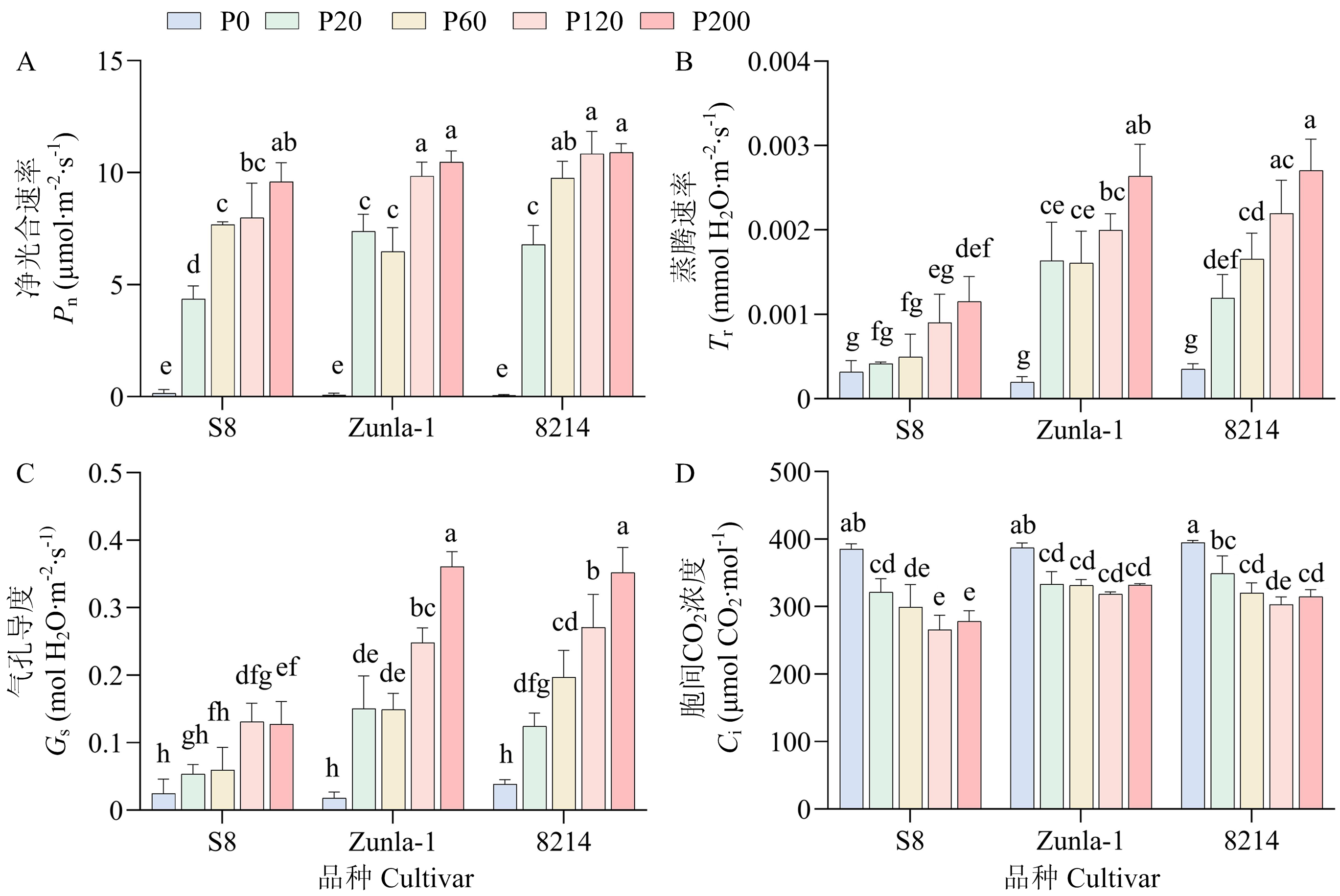
图4
不同磷浓度对辣椒光合指标的影响"
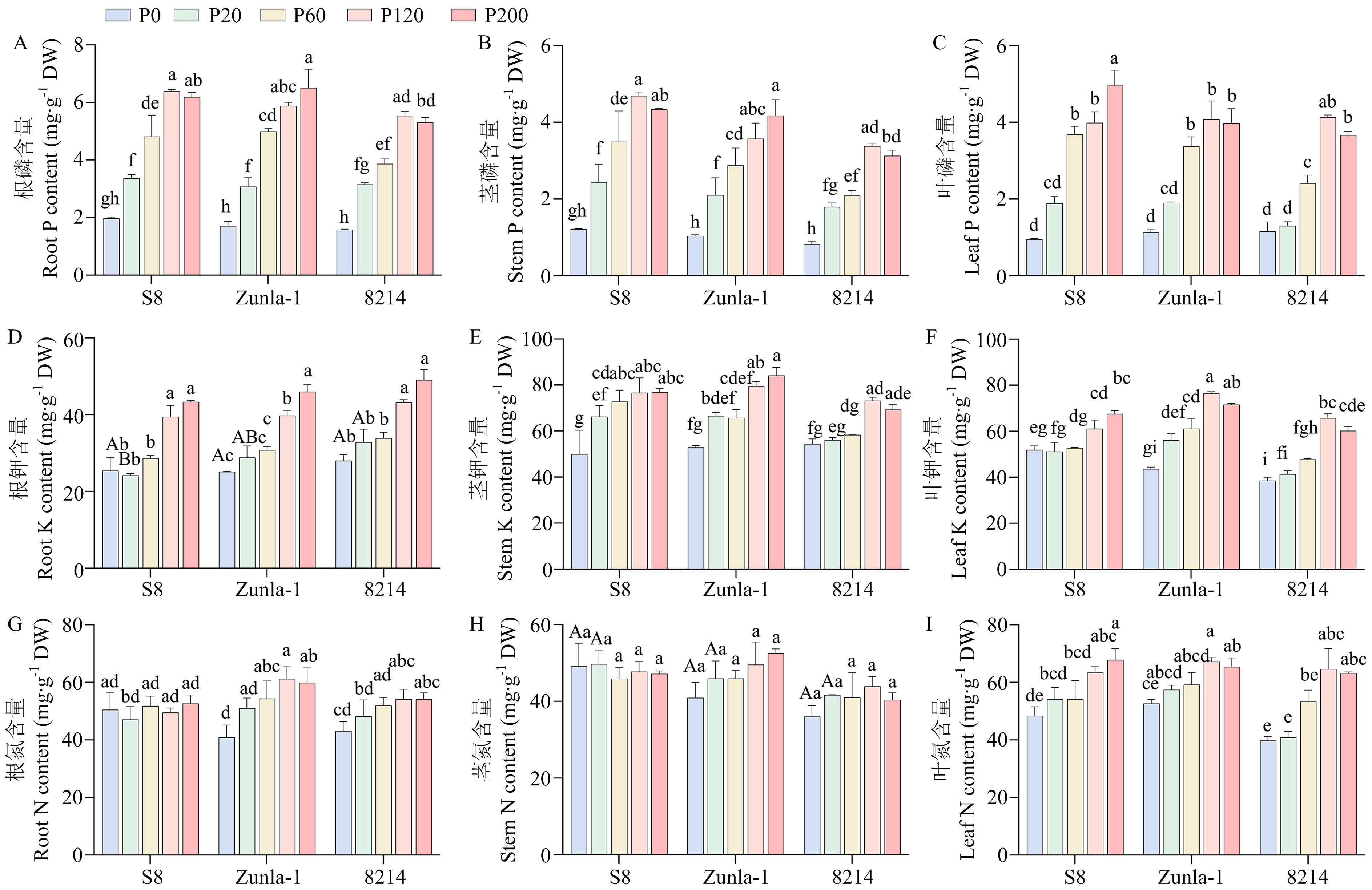
图5
不同磷浓度对辣椒氮、磷、钾含量的影响"

图6
不同磷浓度对辣椒氮、磷、钾分配的影响"
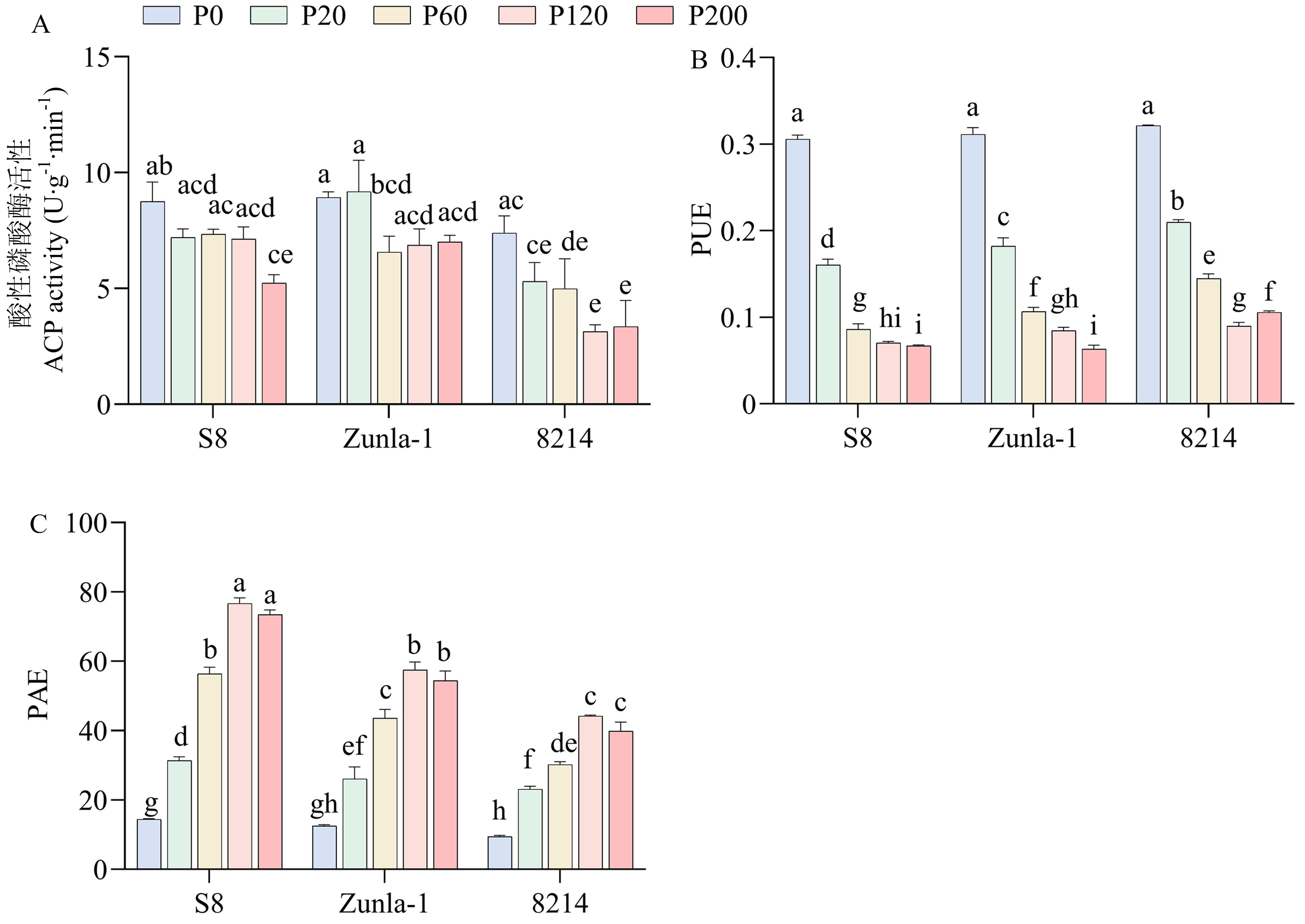
图7
不同磷浓度对辣椒酸性磷酸酶和磷吸收利用效率的影响"
表5
不同辣椒品种的单项指标的耐低磷系数"
| 指标 Index | S8耐低磷系数 S8 low-P tolerance coefficient | Zunla-1耐低磷系数 Zunla-1 low-P tolerance coefficient | 8214耐低磷系数 8214 low-P tolerance coefficient |
|---|---|---|---|
| 株高 Plant height (mm) | 0.56±0.02b | 0.65±0.03a | 0.63±0.01a |
| 茎粗 Stem diameter(mm) | 0.60±0.04a | 0.64±0.05a | 0.55±0.01b |
| 根长 Root length(mm) | 0.54±0.04b | 0.83±0.09a | 0.50±0.13b |
| 根尖数 Apical number | 0.57±0.06b | 0.91±0.08a | 0.48±0.08b |
| 叶绿素含量 Chlorophyll content (mg·g-1) | 0.74±0.04b | 1.19±0.06a | 0.86±0.10b |
| 净光合速率Pn (μmol·m-2·s-1) | 0.46±0.05b | 0.84±0.07a | 0.64±0.08c |
| 叶片磷含量 Leaf P content (mg·g-1DW) | 0.40±0.05b | 0.49±0.06a | 0.35±0.02b |
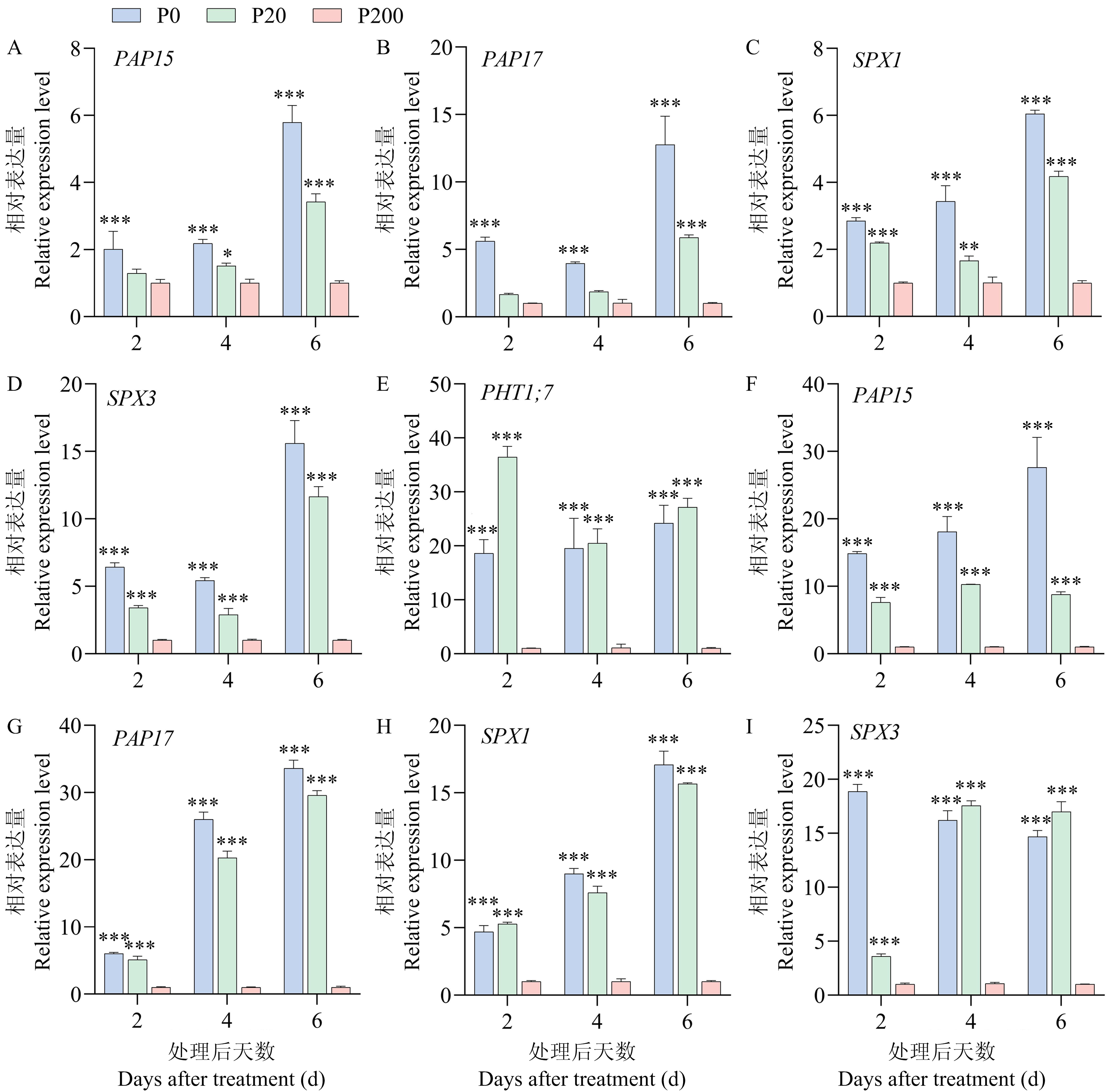
图8
不同磷浓度下不同处理时间后PAP15、PAP17、SPX1、SPX3、PHT1;7基因的相对表达量 A—D:根系相对表达量;F—J:叶片相对表达量。*:在P<0.05水平上差异显著,**:在P<0.01水平上差异显著,***:在P<0.001水平上差异显著。下同"
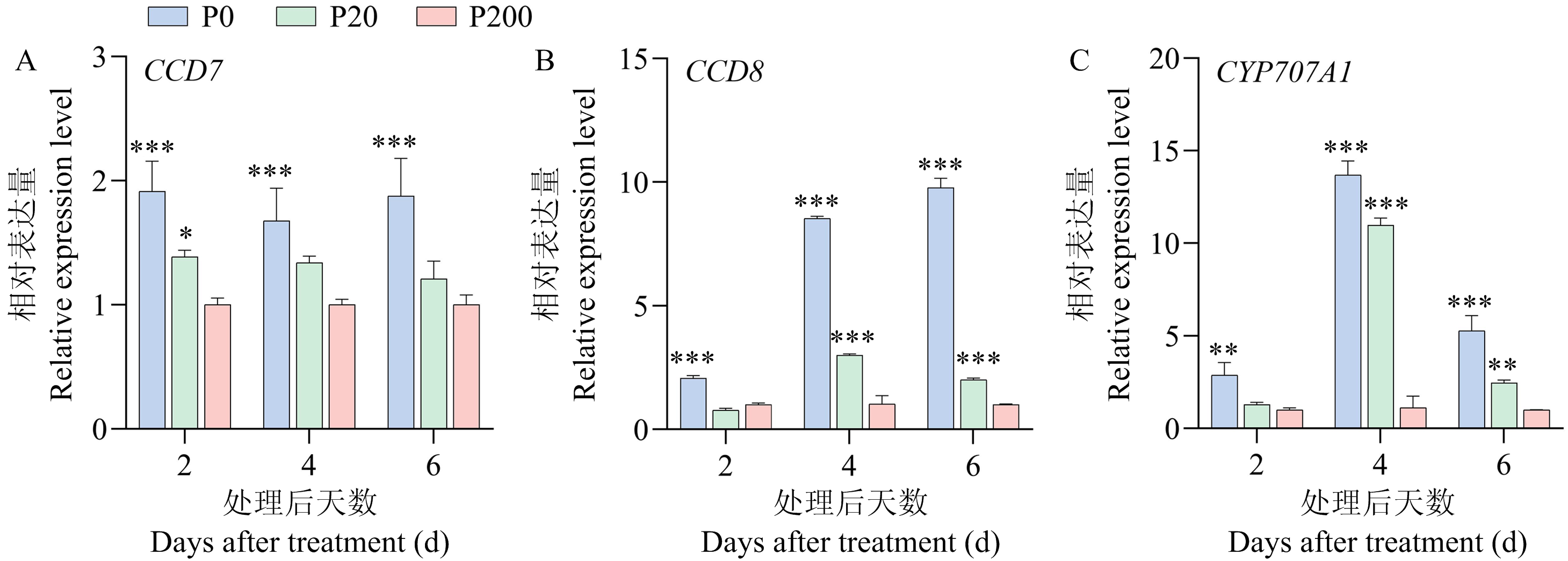
图9
不同磷浓度下不同处理时间后CCD7、CCD8、CYP707A1基因的相对表达量"
| [1] |
|
| [2] |
doi: 10.1016/S0005-2736(00)00141-3 |
| [3] |
冶赓康, 俄胜哲, 陈政宇, 袁金华, 路港滨, 张鹏, 刘雅娜, 赵天鑫, 王钰轩. 土壤中磷的存在形态及分级方法研究进展. 中国农学通报, 2023, 39(1): 96-102.
doi: 10.11924/j.issn.1000-6850.casb2022-0041 |
|
doi: 10.11924/j.issn.1000-6850.casb2022-0041 |
|
| [4] |
|
| [5] |
doi: 10.1007/s10265-024-01533-4 pmid: 38517656 |
| [6] |
doi: 10.1016/j.geoderma.2018.02.035 |
| [7] |
doi: 10.1093/aob/mcq015 pmid: 20181569 |
| [8] |
邹学校, 朱凡. 辣椒的起源、进化与栽培历史. 园艺学报, 2022, 49(6): 1371-1381.
doi: 10.16420/j.issn.0513-353x.2021-0853 |
|
|
|
| [9] |
邹学校, 马艳青, 戴雄泽, 李雪峰, 杨莎. 辣椒在中国的传播与产业发展. 园艺学报, 2020, 47(9): 1715-1726.
|
|
doi: 10.16420/j.issn.0513-353x.2020-0103 |
|
| [10] |
邹学校, 杨莎, 戴雄泽, 胡博文, 徐昊, 朱凡, 裴宋雨, 远方. 中国辣椒产业快速发展40年回顾与展望. 园艺学报, 2025, 52(1): 247-258.
doi: 10.16420/j.issn.0513-353x.2024-0805 |
|
doi: 10.16420/j.issn.0513-353x.2024-0805 |
|
| [11] |
唐荣莉, 王春萍, 王红娟, 吴红, 韩垚, 林清, 雷开荣. 低磷胁迫对辣椒苗期生长和生理特性的影响. 西南农业学报, 2020, 33(9): 1933-1942.
|
|
|
|
| [12] |
徐明睿, 王晓娟, 杨亚莉, 马越飞, 刘万茂, 孙颖. 基于转录组学分析辣椒对磷营养逆境的响应. 中国农业科学, 2024, 57(14): 2827-2846. doi: 10.3864/j.issn.0578-1752.2024.14.011.
|
|
|
|
| [13] |
杜淼鑫. 磷肥水平对设施栽培辣椒生长生理及养分吸收利用的影响[D]. 兰州: 甘肃农业大学, 2019.
|
|
|
|
| [14] |
doi: 10.1038/s41586-020-2382-x |
| [15] |
陈磊, 王盛锋, 刘自飞, 刘荣乐, 汪洪. 低磷条件下植物根系形态反应及其调控机制. 中国土壤与肥料, 2011(6): 1-12.
|
|
|
|
| [16] |
蒲子天, 张弛, 张佳崎, 张瑞芳, 王红, 王鑫鑫. 供磷水平对苗期小麦地上和地下部性状关联性的影响. 植物营养与肥料学报, 2022, 28(9): 1594-1602.
|
|
|
|
| [17] |
逯路文, 杨飞, 王倩倩, 王秀荣. 不同类型土壤上玉米生长对低磷和施磷肥的响应. 华南农业大学学报, 2024, 45(4): 516-524.
|
|
|
|
| [18] |
高利娟, 张猛, 魏建林, 刘冬梅, 丁效东. 磷肥减施对设施番茄根系形态、磷吸收及土壤微生物量磷含量的影响. 天津农业科学, 2019, 25(8): 16-22.
|
|
|
|
| [19] |
doi: 10.1146/arplant.2011.62.issue-1 |
| [20] |
doi: 10.1111/tpj.v111.1 |
| [21] |
doi: 10.1016/j.molp.2019.08.002 |
| [22] |
doi: 10.1016/j.envpol.2021.116778 |
| [23] |
doi: 10.1016/j.molp.2023.05.009 |
| [24] |
doi: 10.1111/tpj.12488 pmid: 24612082 |
| [25] |
doi: 10.1007/s00425-016-2479-5 |
| [26] |
doi: 10.1016/S0005-2728(89)80347-0 |
| [27] |
doi: 10.1104/pp.24.1.1 pmid: 16654194 |
| [28] |
鲍士旦. 土壤农化分析. 3版. 北京: 中国农业出版社, 2000.
|
|
|
|
| [29] |
doi: 10.2134/agronj1985.00021962007700030011x |
| [30] |
doi: 10.1080/01904168109362919 |
| [31] |
韩张雄, 董亚妮, 王曦婕, 李慧慧, 雷腾. 设施蔬菜地施用磷肥对土壤及环境中磷素积累的影响研究现状. 中国农业信息, 2016, 28(20): 70-72.
|
|
|
|
| [32] |
王雅琴. 浅谈氮磷钾三元素对农作物生长的作用. 现代农村科技, 2009(16): 38.
|
|
|
|
| [33] |
doi: 10.1016/j.molp.2023.09.022 |
| [34] |
刘灵, 廖红, 王秀荣, 严小龙. 不同根构型大豆对低磷的适应性变化及其与磷效率的关系. 中国农业科学, 2008, 41(4): 1089-1099. doi: 10.3864/j.issn.0578-1752.2008.04.019.
|
|
|
|
| [35] |
任士伟, 马存金, 王亮亮, 胡兆平. 亚磷酸二氢钾对辣椒光合特性及根系生长的影响. 磷肥与复肥, 2018, 33(4): 41-43.
|
|
|
|
| [36] |
朱向明, 韩秉进. 不同供磷水平下苗期大豆根系形态特征及吸水特性. 土壤与作物, 2014, 3(3): 112-116.
|
|
|
|
| [37] |
王晶, 韩晓日, 宫亮, 阴红彬, 于成广. 低磷胁迫下不同番茄品种苗期根系生理适应性研究. 沈阳农业大学学报, 2005, 36(5): 615-618.
|
|
|
|
| [38] |
胡华群. 磷对辣椒根系生长发育及生理代谢的影响[D]. 贵阳: 贵州大学, 2009.
|
|
|
|
| [39] |
doi: 10.1016/S0167-4781(02)00502-X |
| [40] |
doi: 10.1007/s12298-023-01319-3 pmid: 37363416 |
| [41] |
doi: 10.1023/A:1004310217694 |
| [42] |
范曾丽, 王三根. 不同基因型玉米自交系在低磷胁迫下的生理生化特性比较初探. 西华师范大学学报(自然科学版), 2005, 26(3): 257-261.
|
|
|
|
| [43] |
pmid: 14966012 |
| [44] |
陈芬, 余高, 陈容, 毕昕媛, 卢心, 侯建伟. 减磷配施有机肥对辣椒生长及光合荧光特性的影响. 西北农林科技大学学报(自然科学版), 2021, 49(7): 114-125.
|
|
|
|
| [45] |
doi: 10.3390/ijms24119286 |
| [46] |
田江, 梁翠月, 陆星, 陈倩倩. 根系分泌物调控植物适应低磷胁迫的机制. 华南农业大学学报, 2019, 40(5): 175-185.
|
|
|
|
| [47] |
|
| [48] |
卢坤, 张凯, 柴友荣, 陆俊杏, 唐章林, 李加纳. 甘蓝和白菜紫色酸性磷酸酶17基因家族的克隆和比较分析. 作物学报, 2010, 36(3): 517-525.
doi: 10.3724/SP.J.1006.2010.00517 |
|
doi: 10.3724/SP.J.1006.2010.00517 |
|
| [49] |
doi: 10.1371/journal.pgen.1001102 |
| [50] |
doi: 10.1104/pp.114.252338 |
| [51] |
doi: 10.1371/journal.pone.0220374 |
| [52] |
doi: 10.1111/nph.2015.205.issue-4 |
| [53] |
|
| [54] |
丁广大, 陈水森, 石磊, 蔡红梅, 叶祥盛. 植物耐低磷胁迫的遗传调控机理研究进展. 植物营养与肥料学报, 2013, 19(3): 733-744.
|
|
|
|
| [55] |
doi: 10.1111/j.1365-313X.2008.03692.x pmid: 18808455 |
| [56] |
doi: 10.1093/plphys/kiac030 |
| [57] |
doi: 10.3390/ijms241210246 |
| [58] |
doi: 10.1111/pbi.v18.12 |
| [59] |
doi: 10.1111/tpj.2008.54.issue-6 |
| [60] |
doi: 10.1080/00380768.1991.10415018 |
| [61] |
doi: 10.1111/jipb.v56.3 |
| [62] |
doi: 10.1016/j.eja.2009.07.001 |
| [63] |
王峻, 宋科, 潘剑君, 薛永, 孙丽娟, 蔡银美. 氮磷养分胁迫下小麦幼苗期生物学响应研究. 中国土壤与肥料, 2019(2): 152-158, 164.
|
|
|
|
| [64] |
吴照辉, 贺立源, 严昶, 左雪冬. 低磷胁迫对水稻地上部氮、钾吸收和积累的影响. 植物营养与肥料学报, 2009, 15(2): 311-316.
|
|
|
| [1] | 白晶晶, 章宇辰, 倪子捷, 高佳勇, 刘伟洋, 盖东升, 王雨行, 何佳庆, 张强, 邵玺文, 吴莹, 耿艳秋, 郭丽颖. 不同灌溉量对东北地区水稻抗倒伏特性及产量的影响[J]. 中国农业科学, 2026, 59(9): 1848-1868. |
| [2] | 宁若云, 银煜祺, 沈建国, 章淑玲, 龚梅芳, 高芳銮. 辣椒轻斑驳病毒的谱系地理历史[J]. 中国农业科学, 2026, 59(3): 543-555. |
| [3] | 裴红霞, 汪露瑶, 蒋雅苹, 李生梅, 高晶霞. 基于BSA-Seq和蛋白组学筛选辣椒核雄性不育基因[J]. 中国农业科学, 2026, 59(3): 637-654. |
| [4] | 侯普兴, 王勇, 冯俊涛, 马志卿, 吴华. 75种植物乙醇提取物对两种土传病原菌的抑制活性[J]. 中国农业科学, 2026, 59(2): 322-335. |
| [5] | 王梦园, 魏倩睿, 李海艳, 杨巧敏, 宇军, 黄炜, 逯明辉. 辣椒MADS-box转录因子基因CaAGL61的耐热功能分析[J]. 中国农业科学, 2025, 58(8): 1604-1616. |
| [6] | 赵耀, 程前, 徐田军, 刘正, 王荣焕, 赵久然, 陆大雷, 李从锋. 高密度条件下株型改良对春玉米根-冠特征及籽粒产量的影响[J]. 中国农业科学, 2025, 58(7): 1296-1310. |
| [7] | 郑煜, 陈颐, 遆晋松, 史龙飞, 许校博, 李昱霖, 郭瑞. 烟草不同轮作模式碳足迹及经济效益评价[J]. 中国农业科学, 2025, 58(4): 733-747. |
| [8] | 吴立东, 林淑婷, 邱胤晖, 刘亚婷, 张锐, 李永清, 尚伟, 钟柳青. 不同干燥方式辣椒品质的差异性分析[J]. 中国农业科学, 2025, 58(3): 582-599. |
| [9] | 李倪菲, 杨巧敏, 杨可成, 邢誉腾, 王梦园, 臧天宝, 逯明辉. 辣椒自噬相关蛋白CaATG8c互作蛋白CaIAA8的耐热功能分析[J]. 中国农业科学, 2025, 58(22): 4732-4745. |
| [10] | 刘静, 汪泓, 张磊, 肖玖军, 吴建高, 龚明冲. 基于高光谱的辣椒叶片氮素含量反演[J]. 中国农业科学, 2025, 58(2): 252-265. |
| [11] | 张杰, 胡晨曦, 祁建波, 张永泰, 陈以博, 张永吉. 外源玉米素对低温弱光胁迫下辣椒光合参数、抗氧化系统及玉米素合成相关基因表达的影响[J]. 中国农业科学, 2025, 58(19): 3959-3969. |
| [12] | 吴慧琴, 王静, 阳宜, 刘雪晴, 张凯旋, 王麓尧, 路佳伟, 翟源, 成妍. 96份辣椒种质资源的果实质地品质分析及评价[J]. 中国农业科学, 2025, 58(14): 2854-2868. |
| [13] | 徐佳鑫, 华楠, 王永强, 徐浩, 刘震, 赵小锐, 李悦, 陈启蔚, 叶林. 响应曲面法优化水肥药耦合对辣椒生长、光合特性及根腐病的影响[J]. 中国农业科学, 2025, 58(14): 2869-2884. |
| [14] | 熊楚雯, 郭智滨, 周强华, 程艳波, 马启彬, 蔡占东, 年海. 大豆转录因子NAC1耐低磷胁迫的功能研究[J]. 中国农业科学, 2024, 57(3): 442-453. |
| [15] | 廖宏娟, 谭佳思, 张志斌, 余璟蓉, 张馨月, 江玉梅, 朱笃. 球毛壳菌小麦秸秆发酵产物抑制辣椒疫霉的稳定性及机制[J]. 中国农业科学, 2024, 57(3): 500-513. |
|
||
