






中国农业科学 ›› 2026, Vol. 59 ›› Issue (3): 637-654.doi: 10.3864/j.issn.0578-1752.2026.03.012
裴红霞1( ), 汪露瑶2(), 蒋雅苹2, 李生梅3(), 高晶霞1()
收稿日期:2025-07-11
接受日期:2025-09-05
出版日期:2026-02-01
发布日期:2026-01-31
通信作者:
联系方式:
裴红霞,E-mail:810444147@qq.com。汪露瑶,E-mail:2171100066@zju.edu.cn。裴红霞和汪露瑶为同等贡献作者。
基金资助:
PEI HongXia1(), WANG LuYao2(), JIANG YaPing2, LI ShengMei3(), GAO JingXia1()
Received:2025-07-11
Accepted:2025-09-05
Published:2026-02-01
Online:2026-01-31
摘要:
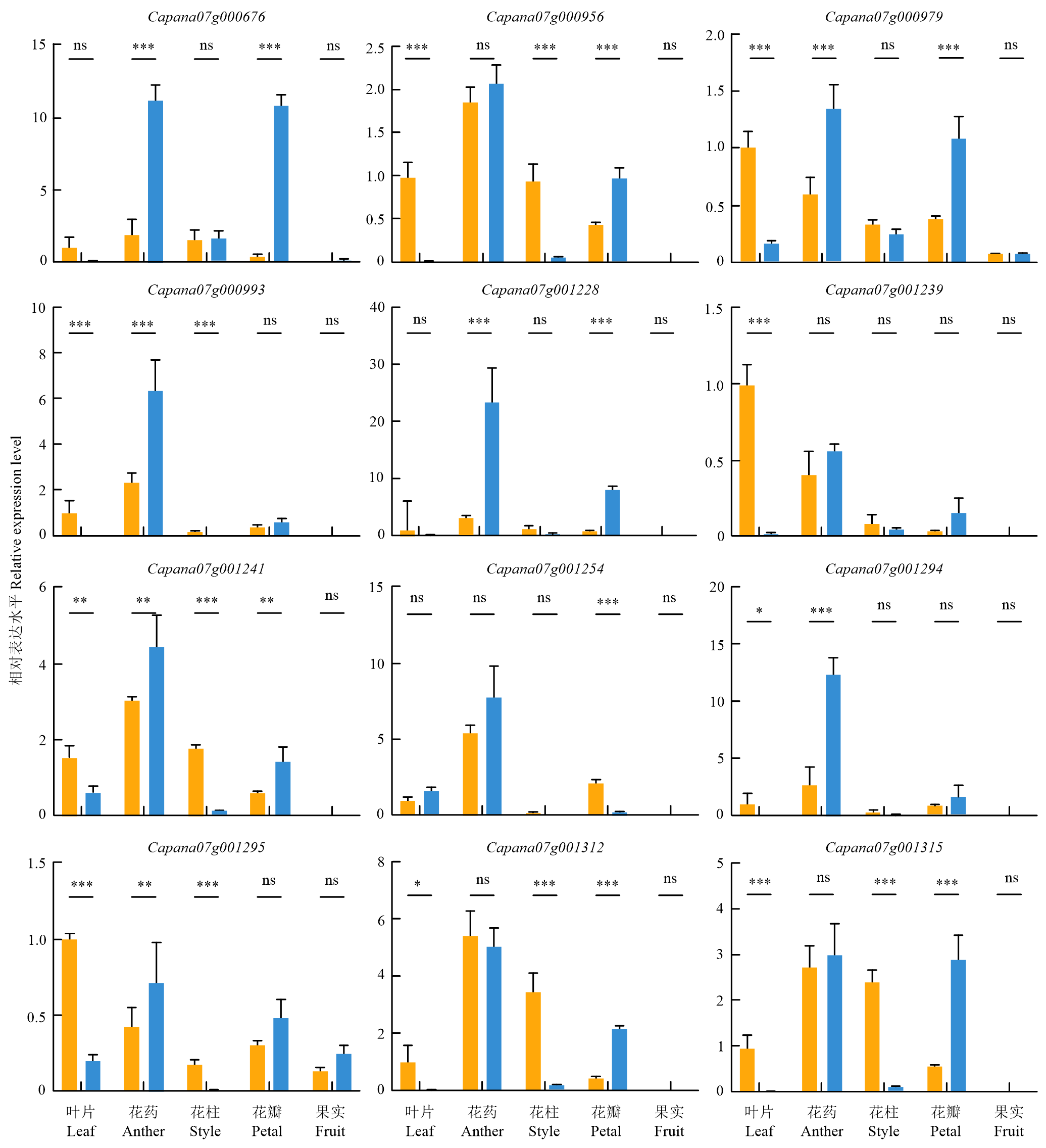
【目的】辣椒雄性不育系是实现辣椒杂种优势和开展辣椒遗传育种的主要方式之一,研究辣椒核雄性不育基因的精确定位,为后续基因克隆、功能验证、分子机制解析和新种质创制提供相关基因资源,为创制辣椒雄性不育系奠定基础。【方法】以田间发现的自然雄性不育突变体pby-1与野生型PBY-1为亲本进行杂交,获得F1后代,并自交至F2代,选取F₂群体中表现不育与正常个体各30株,构建2个极端池。通过混池测序(bulked segregant analysis sequencing,BSA-Seq)分析,鉴定雄性不育候选区间,挖掘区间内候选基因,并进行GO(Gene Ontology)和KEGG(Kyoto Encyclopedia of Genes and Genomes)富集分析。进一步将候选基因与亲本pby-1和PBY-1不同发育时期的差异表达蛋白进行联合分析,缩小辣椒核雄性不育相关候选基因的范围。运用实时荧光定量PCR技术检测候选基因在辣椒花器官中的表达水平,验证候选基因调控辣椒雄性不育的潜力。【结果】通过BSA-Seq测序分析,在Chr.07染色体上鉴定到12个与雄性不育相关联的区域,总长度约70.02 Mb,包含343个候选基因,与已知msc-1、msc-2、msc-3不育基因区间无重叠。GO富集和KEGG富集分析结果表明,碳水化合物代谢、脂质运输代谢和植物激素信号传导等途径与辣椒雄性不育性密切相关。结合蛋白组学数据综合分析,筛选到12个候选基因(Capana07g000676、Capana07g000956、Capana07g000979、Capana07g000993、Capana07g001228、Capana07g001239、Capana07g001241、Capana07g001254、Capana07g001294、Capana07g001295、Capana07g001312和Capana07g001315),经qRT-PCR检测,Capana07g000676、Capana07g000979、Capana07g000993、Capana07g001228、Capana07g001241和Capana07g001294为雄性不育关键候选基因。【结论】结合BSA-Seq与蛋白质组学,在辣椒第7染色体上定位到核雄性不育功能区段,并筛选出6个核心候选基因。
裴红霞, 汪露瑶, 蒋雅苹, 李生梅, 高晶霞. 基于BSA-Seq和蛋白组学筛选辣椒核雄性不育基因[J]. 中国农业科学, 2026, 59(3): 637-654.
PEI HongXia, WANG LuYao, JIANG YaPing, LI ShengMei, GAO JingXia. Identification of Nuclear Male Sterility Genes in Pepper Based on BSA-Seq and Proteomics[J]. Scientia Agricultura Sinica, 2026, 59(3): 637-654.
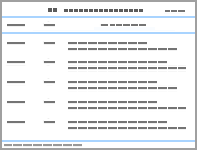
表1
候选基因的qRT-PCR引物"
| 引物ID Primer ID | 引物序列 Primer sequence (5′-3′) |
|---|---|
| Capana07g000676-qPCR-F | GAGCACAAAATGGTAGTTGCGA |
| Capana07g000676-qPCR-R | AAGTAGACGATTTGCTGGCG |
| Capana07g000956-qPCR-F | CATCGACTGTGGTGGTCCTC |
| Capana07g000956-qPCR-R | TGTTGAAGACGACGCTGGAA |
| Capana07g000979-qPCR-F | AAGATACGCATCCGCTGG |
| Capana07g000979-qPCR-R | TAAAACACACCGCCGTCAA |
| Capana07g000993-qPCR-F | TGGCGAGGGGAATGTGAATC |
| Capana07g000993-qPCR-R | CGATTCAGGCTGTCTGGGTT |
| Capana07g001228-qPCR-F | GCAGGAGCAGTGGTAATGGT |
| Capana07g001228-qPCR-R | CTCAGCAACACTATCCGGCA |
| Capana07g001239-qPCR-F | TCCGACAGAAGCCAAGAAGG |
| Capana07g001239-qPCR-R | TCAGAAATGGGAAAGACGACAGT |
| Capana07g001241-qPCR-F | TACTTGGTACCTGGTGCTGG |
| Capana07g001241-qPCR-R | GCCAAATAACGAAGGCACCC |
| Capana07g001254-qPCR-F | TCGGAGATCGCGTTGTTGAA |
| Capana07g001254-qPCR-R | CGCCTTGATGGAAACGTGAC |
| Capana07g001294-qPCR-F | CTTGAACCAGGTTGTGCTGC |
| Capana07g001294-qPCR-R | AGGCAAGTGACTCGATGCAA |
| Capana07g001295-qPCR-F | GCTGAGGAAGCTGAAGAGCA |
| Capana07g001295-qPCR-R | TCCATTGCGACCTCCAAACA |
| Capana07g001312-qPCR-F | TAGTCTTGCTGTTGGCTGGG |
| Capana07g001312-qPCR-R | GCTTTAACTGTCGTGCTGCC |
| Capana07g001315-qPCR-F | AGGGGTGCACTGATTTGCAT |
| Capana07g001315-qPCR-R | CTGCTCCTCCGTACCAACAT |
| CaREV05-qPCR-F | GGACCAGCAAAGGTTGATTT |
| CaREV05-qPCR-R | CAGATGGAGGGTTGATTCCT |
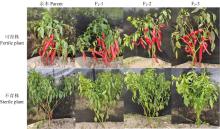
图1
亲本和F2群体育性表型差异植株"
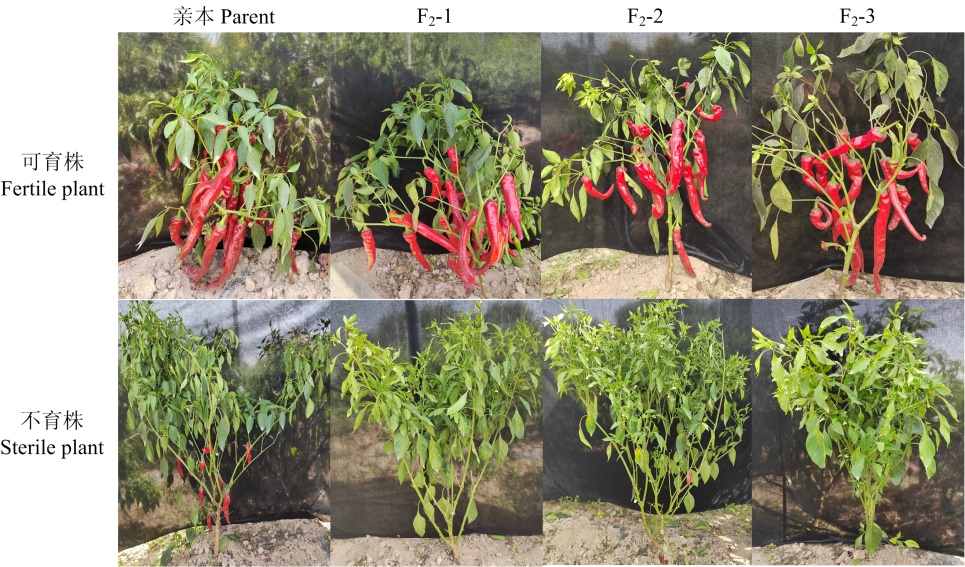
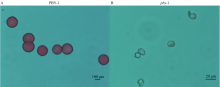
图2
辣椒可育株和不育株花粉粒的活力检测 A:可育型;B:不育型"
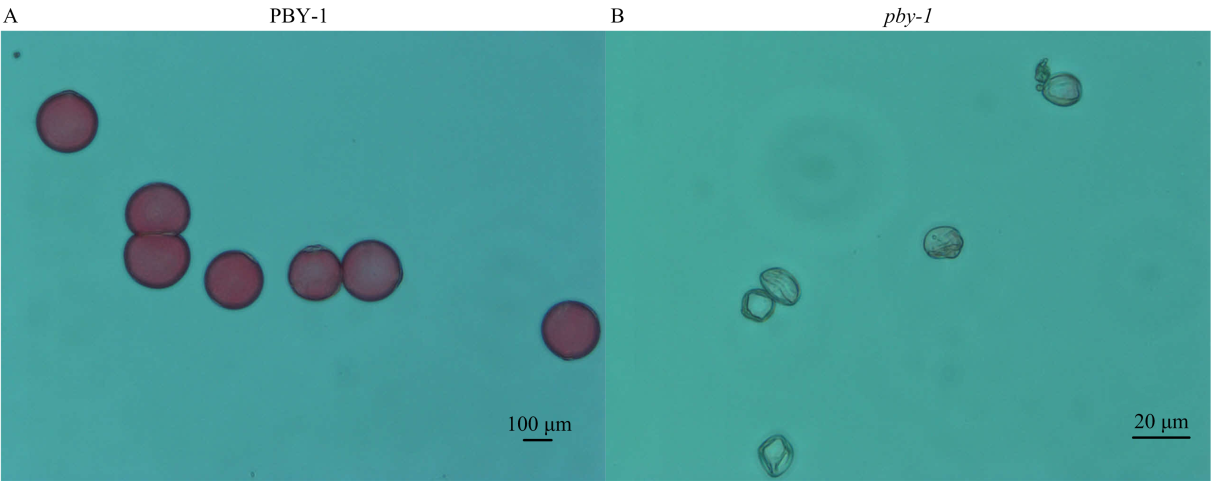
表2
pby-1雄性不育遗传规律分析"
| 组合 Combination | 世代 Generations | 可育株 Fertile strain | 不育株 Sterile strain | 总数 Total | 期望比例 Expectation ratio | 实际比例 Actual proportion | χ2 |
|---|---|---|---|---|---|---|---|
| pby-1×PBY-1 | F1 | 255 | 0 | 255 | 全可育 Fully fertile | 全可育 Fully fertile | / |
| F2 | 770 | 264 | 1034 | 3F﹕1S | 2.917﹕1 | 0.156(P=0.69) | |
| BC1 | 799 | 808 | 1607 | 1F﹕1S | 1﹕1.011 | 0.0504(P=0.82) |
表3
BSA-Seq数据统计"
| 编号 ID | 原始读段 Raw reads | 接头比例 Adapter percent (%) | 有效读段 Clean_reads | 有效碱基数 Clean_base | Q30比例 Q30 (%) | GC含量 GC (%) | 比对率 Properly- mapped (%) | 覆盖深度 Ave_depth | 覆盖比例 Cov_ratio (%) |
|---|---|---|---|---|---|---|---|---|---|
| R01 | 121331436 | 0.02 | 121312127 | 36345286212 | 92.60 | 35.52 | 95.49 | 11× | 88.36 |
| R02 | 118143280 | 0.04 | 118091227 | 35365642094 | 93.55 | 39.12 | 93.72 | 10× | 85.47 |
| R03 | 240816363 | 0.01 | 240773371 | 72130680194 | 92.92 | 34.80 | 95.85 | 22× | 89.37 |
| R04 | 230255180 | 0.03 | 230183074 | 68955090602 | 92.42 | 34.74 | 95.69 | 21× | 89.68 |
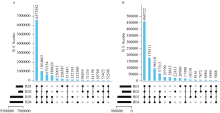
图3
亲本、可育池和不育池检测到的SNP和InDel的集合图 A:SNP集合图;B:InDel集合图"
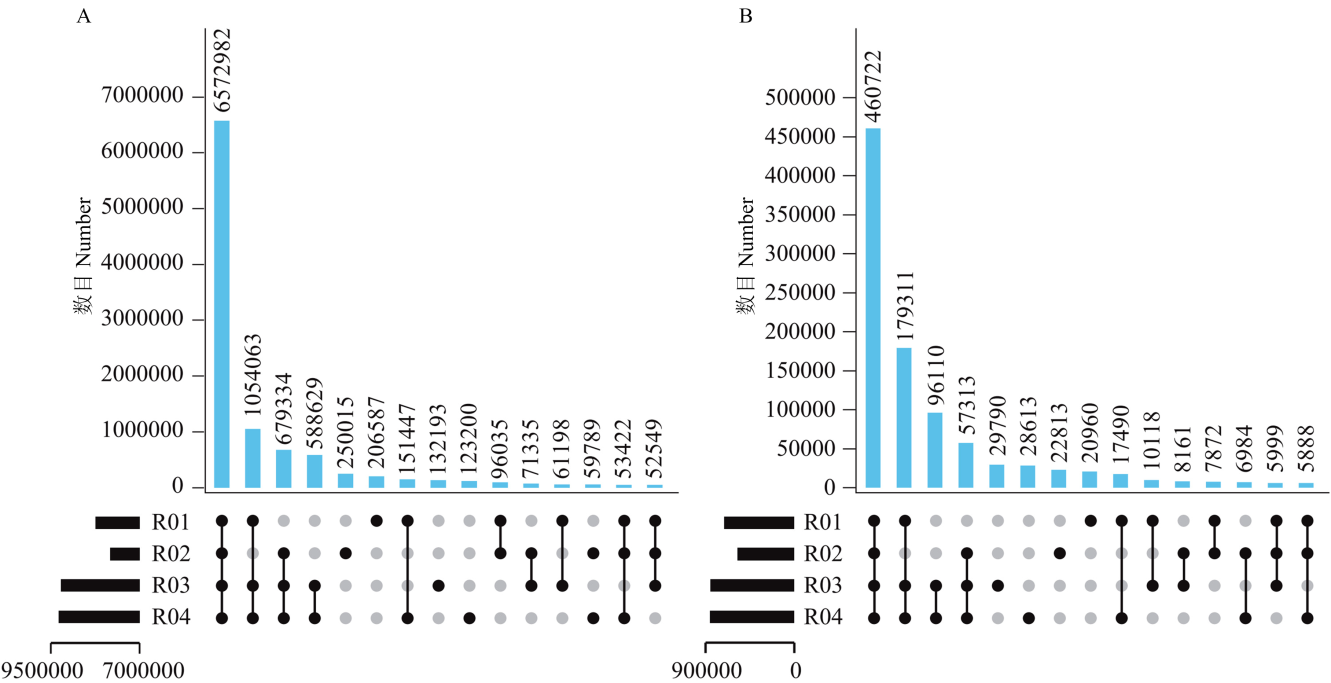
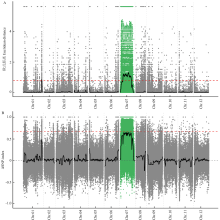
图4
基于SNP的ED和ΔSNP-index关联值在染色体上的分布 A:基于SNP的ED关联值在染色体上的分布;B:基于SNP的ΔSNP-index关联值在染色体上的分布"
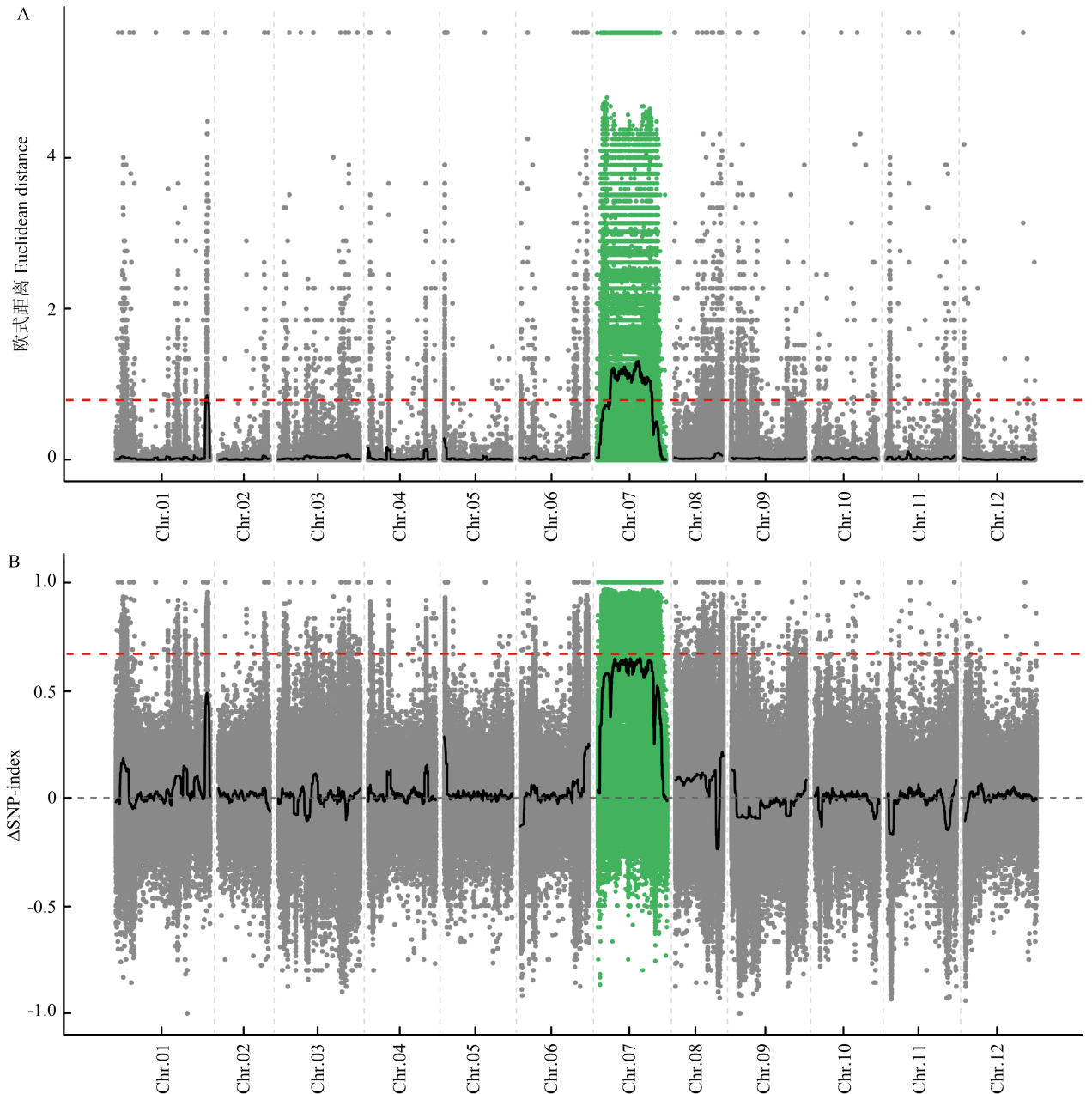
表4
候选SNP关联区域的分析"
| 染色体 Chromosome | 开始 Start (bp) | 结束 End (bp) | 区间大小 Size (Mb) | 基因数 Gene number |
|---|---|---|---|---|
| Chr.07 | 100650000 | 101180000 | 0.53 | 1 |
| Chr.07 | 102340000 | 110650000 | 8.31 | 33 |
| Chr.07 | 117910000 | 137750000 | 19.84 | 52 |
| Chr.07 | 160200000 | 172740000 | 12.54 | 137 |
| Chr.07 | 51230000 | 61780000 | 10.55 | 49 |
| Chr.07 | 62420000 | 65490000 | 3.07 | 21 |
| Chr.07 | 69800000 | 91530000 | 21.73 | 60 |
| Chr.07 | 98710000 | 100300000 | 1.59 | 6 |
| 总计Total | - | - | 78.16 | 359 |
图5
基于InDel的ED和ΔInDel-index关联值在染色体上的分布 A:基于InDel的ED关联值在染色体上的分布;B:基于InDel的ΔInDel-index关联值在染色体上的分布"

表5
候选InDel区域的关联分析"
| 染色体 Chromosome | 开始 Start (bp) | 结束 End (bp) | 区间大小 Size (Mb) | 基因数 Gene number |
|---|---|---|---|---|
| Chr.07 | 102730000 | 110510000 | 7.78 | 32 |
| Chr.07 | 118520000 | 137650000 | 19.13 | 52 |
| Chr.07 | 149840000 | 150650000 | 0.81 | 6 |
| Chr.07 | 152260000 | 152980000 | 0.72 | 1 |
| Chr.07 | 160550000 | 176010000 | 15.46 | 171 |
| Chr.07 | 176540000 | 176600000 | 0.06 | 1 |
| Chr.07 | 49410000 | 50610000 | 1.20 | 1 |
| Chr.07 | 51160000 | 65660000 | 14.50 | 71 |
| Chr.07 | 69440000 | 74810000 | 5.37 | 24 |
| Chr.07 | 75590000 | 78070000 | 2.48 | 5 |
| Chr.07 | 78150000 | 79000000 | 0.85 | 5 |
| Chr.07 | 81480000 | 82020000 | 0.54 | 3 |
| Chr.07 | 84940000 | 91280000 | 6.34 | 13 |
| Chr.07 | 98750000 | 101240000 | 2.49 | 7 |
| 总计Total | - | - | 77.73 | 392 |
表6
候选SNP和InDel区域交叉分析"
| 染色体 Chromosome | 开始 Start (bp) | 结束 End (bp) | 区间大小 Size (Mb) | 基因数 Gene number |
|---|---|---|---|---|
| Chr.07 | 100650000 | 101180000 | 0.53 | 1 |
| Chr.07 | 102730000 | 110510000 | 7.78 | 32 |
| Chr.07 | 118520000 | 137650000 | 19.13 | 52 |
| Chr.07 | 160550000 | 172740000 | 12.19 | 136 |
| Chr.07 | 51230000 | 61780000 | 10.55 | 49 |
| Chr.07 | 62420000 | 65490000 | 3.07 | 21 |
| Chr.07 | 69800000 | 74810000 | 5.01 | 20 |
| Chr.07 | 75590000 | 78070000 | 2.48 | 5 |
| Chr.07 | 78150000 | 79000000 | 0.85 | 5 |
| Chr.07 | 81480000 | 82020000 | 0.54 | 3 |
| Chr.07 | 84940000 | 91280000 | 6.34 | 13 |
| Chr.07 | 98750000 | 100300000 | 1.55 | 6 |
| 总计Total | - | - | 70.02 | 343 |
图6
雄性不育相关候选区域内基因GO和KEGG注释 A:候选区域内基因GO富集分析;B:候选区域内基因KEGG富集分析"
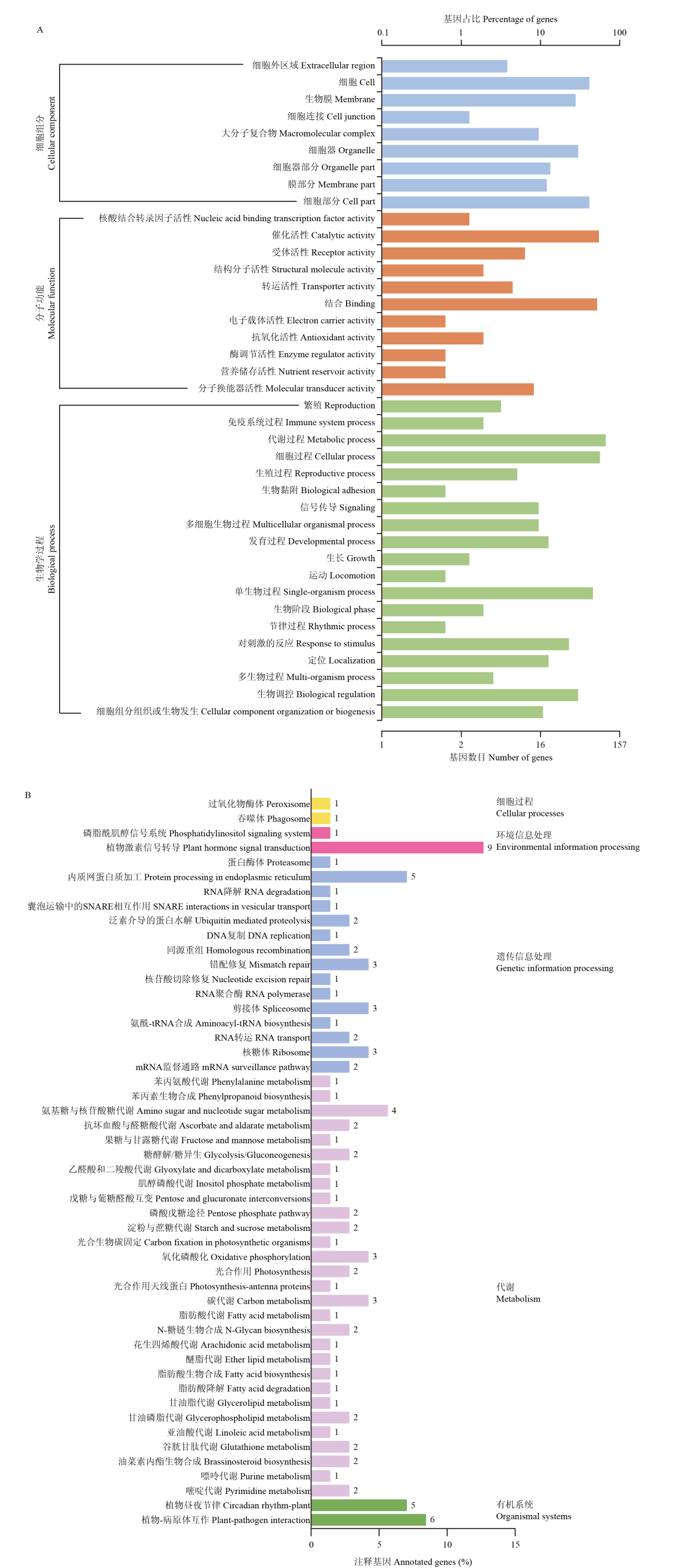
表7
雄性不育候选基因注释及蛋白表达"
| 基因 Gene_IDs | Pfam号 Pfam_IDs | Pfam注释 Pfam_description | 染色体位置 Chromosome location | 蛋白编号 Protein accession | 蛋白功能注释 Protein description | 比率 Ratio | 调控类型 Regulated type | 分子质量 MW (kDa) |
|---|---|---|---|---|---|---|---|---|
| Capana07g000676 | PF12697 | α/β水解酶家族 Alpha/beta hydrolase family | Chr.07:63427965:63430386:- | A0A2G2ZK80 | 含AB水解酶-1结构域蛋白 AB hydrolase-1 domain-containing protein | 1.515 | 上调 Up | 36.1 |
| PF00561 | α/β水解酶折叠 Alpha/beta hydrolase fold | A0A1U8FW28 | 含AB水解酶-1结构域蛋白 AB hydrolase-1 domain-containing protein | 0.751 | 下调 Down | 36.8 | ||
| A0A2G2ZK45 | 含AB水解酶-1结构域蛋白 AB hydrolase-1 domain-containing protein | 1.624 | 上调 Up | 36.5 | ||||
| Capana07g000956 | PF00571 | 胱硫醚β-合成酶结构域CBS domain | Chr.07:124819375:124819884:+ | A0A2G3A5F5 | 含CBS结构域蛋白 CBS domain-containing protein | 1.304 | 上调 Up | 26.0 |
| Capana07g000979 | PF00128 | α-淀粉酶 Alpha amylase | Chr.07:132522155:132527031:+ | |||||
| 催化结构域 Catalytic domain | ||||||||
| Capana07g000993 | PF00082 | 枯草杆菌蛋白酶家族Subtilase family | Chr.07:135830482:135833179:- | A0A2G3AE94 | 枯草杆菌蛋白酶样蛋白酶 Subtilisin-like protease | 0.702 | 下调 Down | 79.0 |
| PF05922 | 肽酶抑制剂I9家族Peptidase inhibitor I9 | A0A2G3AF34 | 含抑制剂I9结构域蛋白 Inhibitor I9 domain-containing protein | 0.683 | 下调 Down | 24.1 | ||
| Capana07g001228 | PF00646 | F-box结构域 F-box domain | Chr.07:165750151:165751491:+ | A0A1U8H680 | 含F-box结构域蛋白 F-box domain-containing protein | 1.319 | 上调 Up | 43.0 |
| Capana07g001239 | PF02518 | 组氨酸激酶-, DNA旋转酶B-, 热休克蛋白90样ATP酶结构域 Histidine kinase-, DNA gyrase B-, and HSP90- like ATPase | Chr.07:166068142:166074467:- | A0A2G2Z950 | 热休克蛋白82 Heat shock protein 82 | 1.349 | 上调 Up | 80.3 |
| A0A1U8GAJ4 | 内质网样蛋白 Endoplasmin-like protein | 0.74 | 下调 Down | 92.9 | ||||
| Capana07g001241 | PF00106 | 短链脱氢酶 Short chain dehydrogenase | Chr.07:166153425:166159029:- | |||||
| PF13561 | 烯酰-(酰基载体蛋白)还原酶 Enoyl-(Acyl carrier protein) reductase | A0A2G2YR93 | 托品酮还原酶2 Tropinone reductase 2 | 0.763 | 下调 Down | 29.5 | ||
| Capana07g001254 | PF00069 | 蛋白激酶结构域 Protein kinase domain | Chr.07:167320450:167335317:- | A0A1U8GXD8 | 酪蛋白激酶1δ Casein kinase I isoform delta | 1.483 | 上调 Up | 53.1 |
| PF07714 | 蛋白酪氨酸激酶 Protein tyrosine kinase | A0A2G2YZW4 | 含蛋白激酶结构域蛋白 Protein kinase domain-containing protein | 3.431 | 上调 Up | 48.5 | ||
| A0A2G2YBJ3 | 假定丝氨酸/苏氨酸蛋白激酶 Putative serine/threonine-protein kinase | 1.32 | 上调 Up | 54.2 | ||||
| Capana07g001294 | PF00651 | BTB/POZ结构域BTB/POZ domain | Chr.07:170187515:170190321:- | |||||
| Capana07g001295 | PF00564 | PB1结构域 PB1 domain | Chr.07:170302463:170304671:+ | |||||
| Capana07g001312 | PF07714 | 蛋白酪氨酸激酶 Protein tyrosine kinase | Chr.07:171800459:171817027:+ | A0A2G3APD0 | 丝氨酸/苏氨酸蛋白激酶CTR1 Serine/threonine-protein kinase CTR1 | 1.429 | 上调 Up | 80.9 |
| PF00069 | 蛋白激酶结构域 Protein kinase domain | |||||||
| PF01476 | LysM结构域 LysM domain | |||||||
| Capana07g001315 | PF02902 | Ulp1蛋白酶家族 Ulp1 protease family | Chr.07:171946489:171949534:+ | |||||
| C-末端催化结构域 C-terminal catalytic domain |
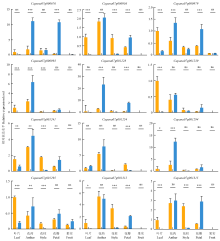
图7
候选基因的qRT-PCR检测 ns:无显著性;*:P<0.01;**:P<0.001;***:P<0.0001"
| [1] |
doi: 10.1007/BF03030398 |
| [2] |
doi: 10.1007/s11033-011-0793-3 |
| [3] |
doi: 10.1371/journal.pone.0065209 |
| [4] |
doi: S1674-2052(17)30076-X pmid: 28343897 |
| [5] |
doi: 10.1016/j.scienta.2017.05.023 |
| [6] |
邹学校, 马艳青, 戴雄泽, 李雪峰, 杨莎. 辣椒在中国的传播与产业发展. 园艺学报, 2020, 47(9): 1715-1726.
|
|
doi: 10.16420/j.issn.0513-353x.2020-0103 |
|
| [7] |
王立浩, 张宝玺, 张正海, 曹亚从, 于海龙, 冯锡刚. “十三五” 我国辣椒育种研究进展、产业现状及展望. 中国蔬菜, 2021(2): 21-29.
|
|
|
|
| [8] |
张强, 张涛, 常晓轲, 韩娅楠, 程志芳, 刘卫, 王彬, 姚秋菊. 一个辣椒胞质雄性不育SCAR标记的KASP转化及其应用. 华北农学报, 2019, 34(5): 93-98.
doi: 10.7668/hbnxb.20190131 |
|
doi: 10.7668/hbnxb.20190131 |
|
| [9] |
孟雅宁, 严立斌, 田玉, 范妍芹. 利用重测序InDel位点开发甜椒隐性核不育分子标记. 分子植物育种, 2019, 17(18): 6041-6046.
|
|
|
|
| [10] |
杨婷玉, 邵贵芳, 张水, 王姣, 张靖柔, 赵凯, 邓明华. 辣椒胞质雄性不育系CaNAD9线粒体基因的克隆及表达分析. 热带作物学报, 2020, 41(5): 978-984.
doi: 10.3969/j.issn.1000-2561.2020.05.018 |
|
|
|
| [11] |
梁赛, 贾利, 王艳, 张强强, 陈友根, 江海坤, 方凌, 张其安, 董言香. 辣椒细胞核雄性不育系主要农艺性状的对比及生理特性分析. 中国蔬菜, 2020(10): 55-61.
|
|
|
|
| [12] |
doi: 10.1016/j.hpj.2020.01.004 |
| [13] |
邵贵芳, 张凡, 王姣, 赵凯, 莫云容, 邓明华. 辣椒雄性不育的研究进展. 生物技术通报, 2017, 33(8): 7-13.
doi: 10.13560/j.cnki.biotech.bull.1985.2017-0207 |
|
|
|
| [14] |
doi: 10.1111/pbr.v139.1 |
| [15] |
doi: 10.1007/s00122-018-3119-1 |
| [16] |
doi: 10.1007/s00122-019-03510-1 |
| [17] |
doi: 10.1111/tpj.v113.3 |
| [18] |
doi: 10.3390/ijms23169099 |
| [19] |
doi: 10.1007/s11103-006-9106-y |
| [20] |
doi: 10.3390/ijms14011050 |
| [21] |
doi: 10.1007/s00122-020-03565-5 pmid: 32088729 |
| [22] |
张曦, 王秀雪, 邹春蕾. 辣椒抗疫病基因初步定位. 东北农业大学学报, 2021, 52(3): 20-25.
|
|
|
|
| [23] |
doi: 10.11924/j.issn.1000-6850.casb2023-0860 |
| [24] |
doi: 10.1111/pce.14503 |
| [25] |
李合生. 植物生理生化实验原理和技术. 北京: 高等教育出版社, 2000.
|
|
|
|
| [26] |
罗阿东, 陆邹红, 蔡秋, 王艳, 曹云恒, 陈霄. 不同提取方法提取辣椒及其制品中DNA效果研究. 现代农业科技, 2019(1): 212-213, 215.
|
|
|
|
| [27] |
|
| [28] |
doi: 10.1093/bioinformatics/btp324 pmid: 19451168 |
| [29] |
doi: 10.1101/gr.107524.110 pmid: 20644199 |
| [30] |
doi: 10.1038/nbt.2053 |
| [31] |
|
| [32] |
doi: 10.1101/gr.146936.112 pmid: 23299975 |
| [33] |
doi: 10.1371/journal.pone.0068529 |
| [34] |
doi: 10.1038/75556 |
| [35] |
|
| [36] |
doi: S1674-2052(20)30187-8 pmid: 32585190 |
| [37] |
doi: 10.3389/fpls.2017.01128 pmid: 28706523 |
| [38] |
刘丽滨, 孔子豪, 李聪, 杨博皓, 高树仁, 孙丽芳, 仲义. 玉米核雄性不育系7024不育性遗传分析及不育基因初步定位. 玉米科学, 2024, 32(6): 11-18.
|
|
|
|
| [39] |
汪胜, 贾利, 唐菁, 李浩宇, 宋婷婷, 袁娟伟, 严从生, 方凌, 张其安, 孙玉军, 等. 辣椒细胞核雄性不育材料GMS702AB的鉴定. 植物遗传资源学报, 2024, 25(4): 612-621.
doi: 10.13430/j.cnki.jpgr.20230923001 |
|
doi: 10.13430/j.cnki.jpgr.20230923001 |
|
| [40] |
doi: 10.1111/pbi.12559 pmid: 26990124 |
| [41] |
尹明智, 胡燕. 基于BSA-seq法的油菜野芥胞质雄性不育恢复基因的分析. 西北植物学报, 2020, 40(7): 1148-1156.
|
|
|
|
| [42] |
甘丹阳, 李龙盘, 王倩, 徐国成, 居超明. 温敏核不育水稻HD9802-9S育性相关基因的BSA测序初步分析. 湖北大学学报(自然科学版), 2020, 42(2): 165-171.
|
|
|
|
| [43] |
高斌. 棉花细胞质雄性不育恢复基因的定位、克隆与验证[D]. 武汉: 华中农业大学, 2021.
|
|
|
|
| [44] |
唐雨. 甜瓜ms4雄性不育株的生物学特性及不育基因的初步定位[D]. 哈尔滨: 东北农业大学, 2021.
|
|
|
|
| [45] |
张颖. 大豆核不育基因ms6的定位、克隆及功能性分子标记开发[D]. 长春: 吉林农业大学, 2021.
|
|
|
|
| [46] |
卫笑. 小麦BNS雄性不育遗传机制研究和不育基因QTLs初步定位[D]. 新乡: 河南科技学院, 2018.
|
|
|
|
| [47] |
doi: 10.3390/ijms141122982 |
| [48] |
白志元, 杨玉花, 张瑞军. 不同恢复型大豆细胞质雄性不育杂种F1的转录组分析. 植物遗传资源学报, 2022, 23(6): 1847-1855.
doi: 10.13430/j.cnki.jpgr.20220510001 |
|
|
|
| [49] |
doi: 10.1093/plphys/kiac307 pmid: 35748750 |
| [50] |
任源, 林彦萍. 玉米细胞核雄性不育基因的研究进展及其在玉米育种中的应用. 分子植物育种, 2022, 20(12): 3959-3973.
|
|
|
|
| [51] |
doi: 10.1007/s00122-020-03706-w |
| [52] |
doi: 10.3390/plants12223804 |
| [53] |
韩玉翠. YS型小麦温敏雄性不育基因定位及表达调控研究[D]. 杨凌: 西北农林科技大学, 2020.
|
|
|
|
| [54] |
郑湘如, 王丽. 植物学. 北京: 中国农业大学出版社, 2001.
|
|
|
|
| [55] |
doi: 10.1093/protein/5.3.197 pmid: 1409539 |
| [56] |
doi: 10.1046/j.1432-1033.2002.03130.x pmid: 12230552 |
| [57] |
张月婷, 秦政, 王建, 汪信东. 短链脱氢酶超家族介导植物次级代谢研究进展. 南方林业科学, 2020, 48(5): 62-67.
|
|
|
|
| [58] |
doi: 10.1002/cbic.v19.9 |
| [1] | 宁若云, 银煜祺, 沈建国, 章淑玲, 龚梅芳, 高芳銮. 辣椒轻斑驳病毒的谱系地理历史[J]. 中国农业科学, 2026, 59(3): 543-555. |
| [2] | 侯普兴, 王勇, 冯俊涛, 马志卿, 吴华. 75种植物乙醇提取物对两种土传病原菌的抑制活性[J]. 中国农业科学, 2026, 59(2): 322-335. |
| [3] | 王梦园, 魏倩睿, 李海艳, 杨巧敏, 宇军, 黄炜, 逯明辉. 辣椒MADS-box转录因子基因CaAGL61的耐热功能分析[J]. 中国农业科学, 2025, 58(8): 1604-1616. |
| [4] | 郑煜, 陈颐, 遆晋松, 史龙飞, 许校博, 李昱霖, 郭瑞. 烟草不同轮作模式碳足迹及经济效益评价[J]. 中国农业科学, 2025, 58(4): 733-747. |
| [5] | 吴立东, 林淑婷, 邱胤晖, 刘亚婷, 张锐, 李永清, 尚伟, 钟柳青. 不同干燥方式辣椒品质的差异性分析[J]. 中国农业科学, 2025, 58(3): 582-599. |
| [6] | 李倪菲, 杨巧敏, 杨可成, 邢誉腾, 王梦园, 臧天宝, 逯明辉. 辣椒自噬相关蛋白CaATG8c互作蛋白CaIAA8的耐热功能分析[J]. 中国农业科学, 2025, 58(22): 4732-4745. |
| [7] | 刘静, 汪泓, 张磊, 肖玖军, 吴建高, 龚明冲. 基于高光谱的辣椒叶片氮素含量反演[J]. 中国农业科学, 2025, 58(2): 252-265. |
| [8] | 张杰, 胡晨曦, 祁建波, 张永泰, 陈以博, 张永吉. 外源玉米素对低温弱光胁迫下辣椒光合参数、抗氧化系统及玉米素合成相关基因表达的影响[J]. 中国农业科学, 2025, 58(19): 3959-3969. |
| [9] | 吴慧琴, 王静, 阳宜, 刘雪晴, 张凯旋, 王麓尧, 路佳伟, 翟源, 成妍. 96份辣椒种质资源的果实质地品质分析及评价[J]. 中国农业科学, 2025, 58(14): 2854-2868. |
| [10] | 徐佳鑫, 华楠, 王永强, 徐浩, 刘震, 赵小锐, 李悦, 陈启蔚, 叶林. 响应曲面法优化水肥药耦合对辣椒生长、光合特性及根腐病的影响[J]. 中国农业科学, 2025, 58(14): 2869-2884. |
| [11] | 廖宏娟, 谭佳思, 张志斌, 余璟蓉, 张馨月, 江玉梅, 朱笃. 球毛壳菌小麦秸秆发酵产物抑制辣椒疫霉的稳定性及机制[J]. 中国农业科学, 2024, 57(3): 500-513. |
| [12] | 路露, 李一诺, 张修国, 高丹美, 吴凤芝. 小麦和蚕豆填闲及其腐解液对连作辣椒幼苗生长及疫病的影响[J]. 中国农业科学, 2024, 57(22): 4541-4552. |
| [13] | 何勇, 范晓珠, 陈新月, 段书静, 胡婷婷, 谢如雪, 王宇晴, 陈静. 利用酵母双杂交系统筛选与辣椒轻斑驳病毒126 kDa蛋白互作的辣椒寄主因子[J]. 中国农业科学, 2024, 57(15): 2986-2996. |
| [14] | 徐明睿, 王晓娟, 杨亚莉, 马越飞, 刘万茂, 孙颖. 基于转录组学分析辣椒对磷营养逆境的响应[J]. 中国农业科学, 2024, 57(14): 2827-2846. |
| [15] | 鄢柳慧, 钟琦, 马增凤, 韦敏益, 刘驰, 秦媛媛, 周小龙, 黄大辉, 卢颖萍, 秦钢, 张月雄. 普通野生稻早抽穗基因OsEHD8的鉴定与进化分析[J]. 中国农业科学, 2024, 57(14): 2703-2716. |
|
||
