






中国农业科学 ›› 2026, Vol. 59 ›› Issue (6): 1302-1316.doi: 10.3864/j.issn.0578-1752.2026.06.012
陈敏氡( ), 裘波音, 黄昊, 李永平, 温庆放()
收稿日期:2025-10-13
接受日期:2026-01-10
出版日期:2026-03-16
发布日期:2026-03-24
通信作者:
联系方式:
陈敏氡,E-mail:1053870789@qq.com。
基金资助:
CHEN MinDong(), QIU BoYin, HUANG Hao, LI YongPing, WEN QingFang()
Received:2025-10-13
Accepted:2026-01-10
Published:2026-03-16
Online:2026-03-24
摘要:
【目的】通过对松花菜种质资源花球质地性状数据的分析,建立统一、客观的松花菜花球质地评价方法,并研究影响花球质地的潜在因素,以期为松花菜食用品质评价和品质育种提供参考。【方法】应用质地多面剖析法(TPA)和感官评价法对166份松花菜种质资源进行评价,获得5种TPA指标(硬度、内聚性、弹性、咀嚼性和回复性)和3种感官评价指标(感官脆度、感官硬度和感官咀嚼性)数据,开展相关性分析和线性回归分析,构建感官评价指标与质地参数间的关系模型,并通过主成分分析、隶属函数分析和聚类分析,建立松花菜花球质地评价数学模型,划分松花菜种质资源的质地类群。进一步分析不同类群松花菜花球的细胞微观结构、细胞壁组分含量的差异,探究影响松花菜花球质地的潜在因素。【结果】8个花球质地指标在不同松花菜种质间差异显著,其中,咀嚼性指标的离散程度最大。感官评价指标与TPA指标之间存在不同程度的正相关性,通过构建二者的线性回归方程,发现硬度在感官质地评价中具有重要预测价值。采用主成分分析提取2个影响松花菜花球质地的主成分,累计贡献率达90.22%,其中,第一主成分主要包括硬度、咀嚼性和弹性,是决定松花菜的适口性的重要参数。建立松花菜花球质地评价数学模型:质地综合得分值C=-2.045+0.017×咀嚼性+3.108×回复性+0.555×弹性+0.010×硬度+1.950×内聚性。依据C值将166份松花菜种质资源分为3种质地类型,第Ⅰ类群花球C值最低(0.01≤C≤0.35),呈现低硬度、咀嚼性差的特征,属绵软型;第Ⅱ类群花球C值居中(0.37≤C≤0.62),质地均衡且适口性良好,属脆嫩型;第Ⅲ类群花球C值最高(0.65≤C≤1.00),表现为较高的硬度、弹性与咀嚼性,属脆弹型。不同质地的松花菜花球在细胞结构和细胞壁成分上存在显著差异,脆弹型松花菜花球细胞圆度较高、结构紧密,纤维素与半纤维素含量较高;脆嫩型松花菜花球细胞形态饱满、结构均匀,其纤维素、半纤维素和可溶性果胶含量比例适中;绵软型松花菜花球则具有明显的细胞孔隙和疏松结构,可溶性果胶含量偏高。【结论】建立松花菜花球质地评价数学模型:C=-2.045+0.017×咀嚼性+3.108×回复性+0.555×弹性+0.010×硬度+1.950×内聚性,划分出不同松花菜花球质地类型的C值范围可用于松花菜种质资源的鉴定,细胞结构和细胞壁组成物质对松花菜花球的质地品质具有重要影响。
陈敏氡, 裘波音, 黄昊, 李永平, 温庆放. 松花菜种质花球质地品质的评价[J]. 中国农业科学, 2026, 59(6): 1302-1316.
CHEN MinDong, QIU BoYin, HUANG Hao, LI YongPing, WEN QingFang. Evaluation of Curd Texture Quality in Loose-Curd Cauliflower Germplasm[J]. Scientia Agricultura Sinica, 2026, 59(6): 1302-1316.
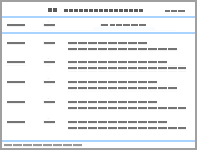
表1
松花菜感官评价标准"
| 指标 Index | 指标描述 Index description | 评价标准Evaluation standard | ||
|---|---|---|---|---|
| 0—4分0-4 points | 5—7分5-7 points | 8—10分8-10 points | ||
| 感官脆度 Sensory crispness | 样品出现折断时的力 The force at which the sample breaks | 不脆 Not crisp | 较脆 Relatively crisp | 很脆 Very crisp |
| 感官硬度 Sensory hardness | 牙齿挤压样品的力量 The force of teeth squeezing the sample | 不硬 Not hard | 较硬 Relatively hard | 很硬 Very hard |
| 感官咀嚼性 Sensory chewiness | 咀嚼固体样品时需要的能量 The energy required for chewing solid sample | 咀嚼性差 Poor chewiness | 咀嚼性适中 Moderate chewiness | 耐咀嚼 Chewy |
表2
5个TPA指标的定义"
| 指标Index | 指标描述Index description |
|---|---|
| 硬度 Hardness | 第一次挤压循环的最大力量峰值,单位N The maximum peak force of the first squeezing cycle, Unit N |
| 内聚性 Cohesiveness | 第二次挤压循环的正峰面积同第一次挤压循环的正峰面积的比值,计算方式为A2/A1 The ratio of the positive peak area of the second extrusion cycle to the positive peak area of the first extrusion cycle. The calculation method is A2/A1 |
| 弹性 Springiness | 第一挤压结束后第二次挤压开始前样品恢复的高度,计算方式为T2/T1 The height at which the sample recovers after the first compression is completed and before the second compression begins. The calculation method is T2/T1 |
| 咀嚼性 Chewiness | 咀嚼样品所需的能量,计算方式为内聚性×硬度×弹性,单位mJ The energy required to chew the sample. The calculation method is cohesiveness×hardness ×springiness, Unit mJ |
| 回复性 Responsiveness | 样品在第1次压缩过程中回弹的能力,计算方式为A4/A3 The ability of the sample to rebound during the first compression process. The calculation method is A4/A3 |
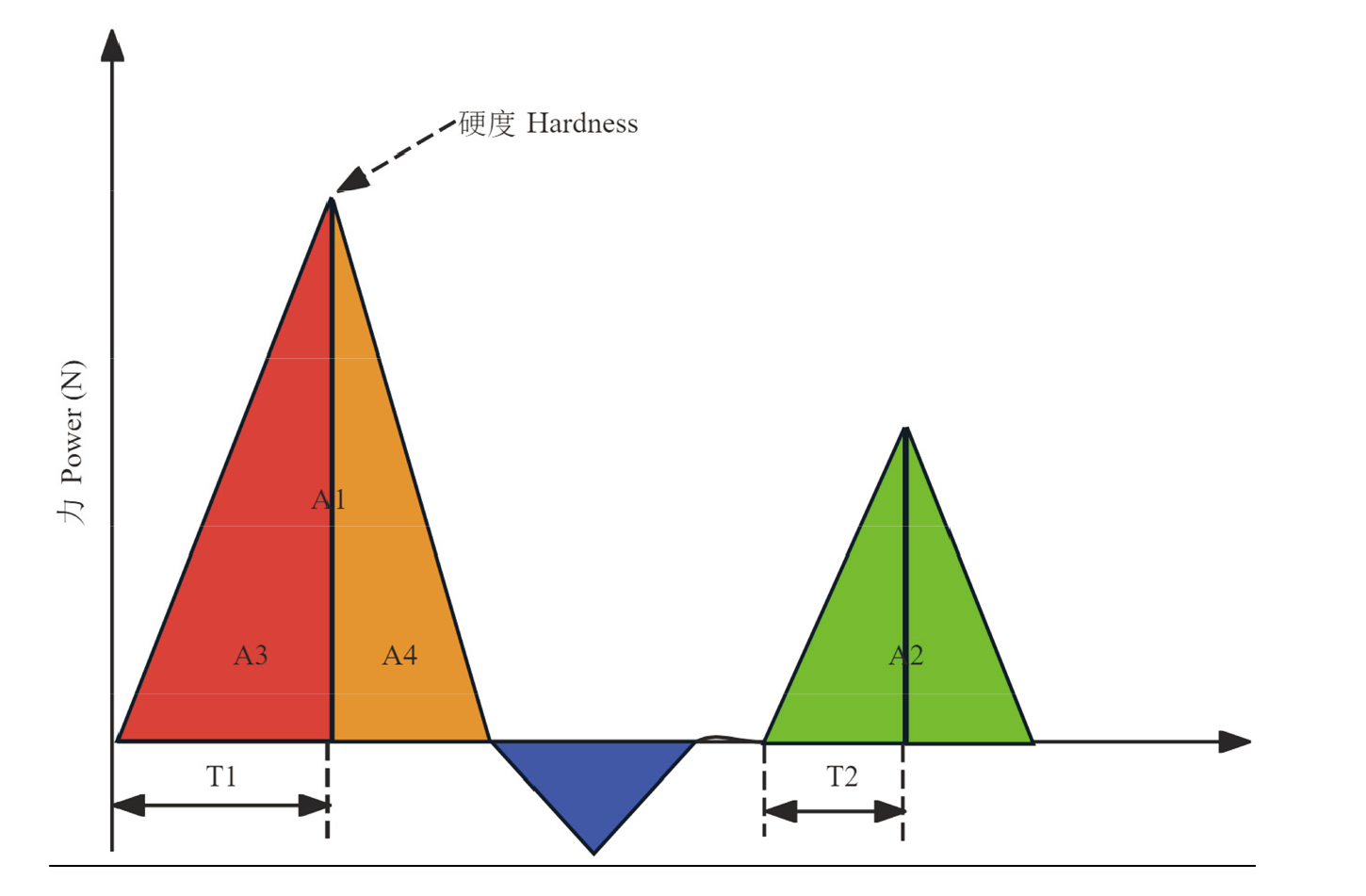
图1
TPA特征曲线 图上文字含义同表2"
表3
松花菜花球感官评价指标和TPA指标的变异与方差分析"
| 指标Index | 最大值Max | 最小值Min | 平均值Average | 标准差SD | 变异系数CV (%) | F值F-value | |
|---|---|---|---|---|---|---|---|
| 感官指标 Sensory index | 感官脆度 Sensory crispness | 7.66 | 3.29 | 6.04 | 0.92 | 15.22 | 6.246** |
| 感官硬度 Sensory hardness | 7.30 | 3.70 | 6.12 | 0.89 | 14.60 | 8.357** | |
| 感官咀嚼性 Sensory chewiness | 7.80 | 3.00 | 6.24 | 0.97 | 15.60 | 7.011** | |
| TPA指标 TPA index | 硬度 Hardness | 50.82 | 22.50 | 35.62 | 6.20 | 17.40 | 46.033** |
| 内聚性 Cohesiveness | 0.41 | 0.27 | 0.33 | 0.03 | 8.60 | 4.330** | |
| 弹性 Springiness | 1.46 | 0.98 | 1.21 | 0.12 | 10.20 | 24.530** | |
| 咀嚼性 Chewiness | 26.95 | 6.47 | 14.69 | 4.67 | 31.80 | 30.032** | |
| 回复性 Responsiveness | 0.24 | 0.16 | 0.20 | 0.02 | 10.08 | 10.506** | |
表4
感官评价指标与TPA指标的相关性分析"
| 指标Index | 感官脆度Sensory crispness | 感官硬度Sensory hardness | 感官咀嚼性Sensory chewiness |
|---|---|---|---|
| 硬度Hardness | 0.438** | 0.471** | 0.755** |
| 内聚性Cohesiveness | 0.135** | 0.051** | 0.188** |
| 弹性Springiness | 0.280** | 0.203** | 0.366** |
| 咀嚼性Chewiness | 0.393** | 0.363** | 0.637** |
| 回复性Responsiveness | 0.227** | 0.295** | 0.520** |
表5
感官评价指标与TPA指标的多元线性回归分析"
| 感官指标Sensoryindex | 预测模型Predictionmodel | R2 | P值P value |
|---|---|---|---|
| 感官脆度Sensory crispness | Y=2.825+0.091X1 | 0.279 | <0.001 |
| 感官硬度Sensory hardness | Y=3.112+0.085X1 | 0.258 | <0.001 |
| 感官咀嚼性Sensory chewiness | Y=-0.146+0.172X1-0.092X4+8.051X5 | 0.548 | <0.001 |
表6
5个TPA指标的相关性分析"
| 指标Index | 硬度Hardness | 内聚性Cohesiveness | 弹性Springiness | 咀嚼性Chewiness | 回复性Responsiveness |
|---|---|---|---|---|---|
| 硬度Hardness | 1.000 | ||||
| 内聚性Cohesiveness | 0.225** | 1.000 | |||
| 弹性Springiness | 0.536** | 0.564** | 1.000 | ||
| 咀嚼性Chewiness | 0.868** | 0.536** | 0.807** | 1.000 | |
| 回复性Responsiveness | 0.685** | 0.500** | 0.673** | 0.803** | 1.000 |
表7
各主成分旋转后的载荷矩阵、特征值、贡献率和累积贡献率"
| 指标 Index | 第一主成分 First principal component | 第二主成分 Second principal component |
|---|---|---|
| 硬度Hardness | 0.907 | -0.544 |
| 内聚性Cohesiveness | 0.646 | 0.713 |
| 弹性Springiness | 0.862 | 0.419 |
| 咀嚼性Chewiness | 0.901 | -0.230 |
| 回复性Responsiveness | 0.813 | -0.150 |
| 特征值Eigenvalues | 3.456 | 1.055 |
| 贡献率Contribution rate (%) | 69.12 | 21.10 |
| 累计贡献率Cumulative contribution rate (%) | 69.12 | 90.22 |
表8
166份松花菜种质花球质地的综合得分值"
| 编号No. | C值C value | 编号No. | C值C value | 编号No. | C值C value | 编号No. | C值C value | |||
|---|---|---|---|---|---|---|---|---|---|---|
| 1 | 0.02 | 43 | 0.96 | 85 | 0.27 | 127 | 0.74 | |||
| 2 | 0.05 | 44 | 0.33 | 86 | 0.41 | 128 | 0.69 | |||
| 3 | 0.47 | 45 | 0.26 | 87 | 0.77 | 129 | 0.82 | |||
| 4 | 0.12 | 46 | 0.71 | 88 | 0.80 | 130 | 0.89 | |||
| 5 | 0.40 | 47 | 0.43 | 89 | 0.24 | 131 | 0.55 | |||
| 6 | 0.20 | 48 | 0.92 | 90 | 0.27 | 132 | 0.76 | |||
| 7 | 0.06 | 49 | 0.22 | 91 | 0.33 | 133 | 0.81 | |||
| 8 | 0.42 | 50 | 0.52 | 92 | 0.37 | 134 | 0.40 | |||
| 9 | 0.55 | 51 | 0.55 | 93 | 0.46 | 135 | 0.97 | |||
| 10 | 0.39 | 52 | 0.33 | 94 | 0.61 | 136 | 0.98 | |||
| 11 | 0.77 | 53 | 0.60 | 95 | 0.38 | 137 | 0.85 | |||
| 12 | 0.46 | 54 | 0.46 | 96 | 0.27 | 138 | 0.43 | |||
| 13 | 0.45 | 55 | 0.73 | 97 | 0.26 | 139 | 0.62 | |||
| 14 | 0.39 | 56 | 0.39 | 98 | 0.55 | 140 | 0.73 | |||
| 15 | 0.44 | 57 | 0.62 | 99 | 0.75 | 141 | 0.76 | |||
| 16 | 0.32 | 58 | 0.28 | 100 | 0.48 | 142 | 0.69 | |||
| 17 | 0.30 | 59 | 0.87 | 101 | 0.31 | 143 | 0.73 | |||
| 18 | 0.12 | 60 | 0.66 | 102 | 0.33 | 144 | 0.87 | |||
| 19 | 0.20 | 61 | 0.53 | 103 | 0.62 | 145 | 0.78 | |||
| 20 | 0.27 | 62 | 0.79 | 104 | 0.57 | 146 | 0.69 | |||
| 21 | 0.09 | 63 | 0.53 | 105 | 0.49 | 147 | 0.80 | |||
| 22 | 0.47 | 64 | 0.23 | 106 | 0.59 | 148 | 0.42 | |||
| 23 | 0.26 | 65 | 0.45 | 107 | 0.87 | 149 | 0.38 | |||
| 24 | 0.09 | 66 | 0.65 | 108 | 0.65 | 150 | 0.61 | |||
| 25 | 0.09 | 67 | 0.30 | 109 | 0.50 | 151 | 0.52 | |||
| 26 | 0.19 | 68 | 0.68 | 110 | 0.45 | 152 | 0.91 | |||
| 27 | 0.16 | 69 | 0.54 | 111 | 0.31 | 153 | 0.98 | |||
| 28 | 0.01 | 70 | 0.28 | 112 | 0.51 | 154 | 0.79 | |||
| 29 | 0.28 | 71 | 0.33 | 113 | 0.58 | 155 | 0.71 | |||
| 30 | 0.28 | 72 | 0.28 | 114 | 0.88 | 156 | 0.60 | |||
| 31 | 0.14 | 73 | 0.34 | 115 | 0.67 | 157 | 0.53 | |||
| 32 | 0.09 | 74 | 0.56 | 116 | 0.53 | 158 | 0.82 | |||
| 33 | 0.28 | 75 | 0.37 | 117 | 0.45 | 159 | 0.97 | |||
| 34 | 0.24 | 76 | 0.27 | 118 | 0.76 | 160 | 0.54 | |||
| 35 | 0.28 | 77 | 0.41 | 119 | 0.81 | 161 | 0.48 | |||
| 36 | 0.29 | 78 | 0.37 | 120 | 0.29 | 162 | 0.61 | |||
| 37 | 0.28 | 79 | 0.40 | 121 | 0.50 | 163 | 0.71 | |||
| 38 | 0.28 | 80 | 0.35 | 122 | 0.29 | 164 | 0.77 | |||
| 39 | 0.52 | 81 | 0.28 | 123 | 0.73 | 165 | 0.75 | |||
| 40 | 0.62 | 82 | 0.28 | 124 | 0.61 | 166 | 0.74 | |||
| 41 | 0.55 | 83 | 0.45 | 125 | 0.74 | |||||
| 42 | 0.97 | 84 | 0.19 | 126 | 1.00 |

图2
166份松花菜种质花球质地聚类分析"
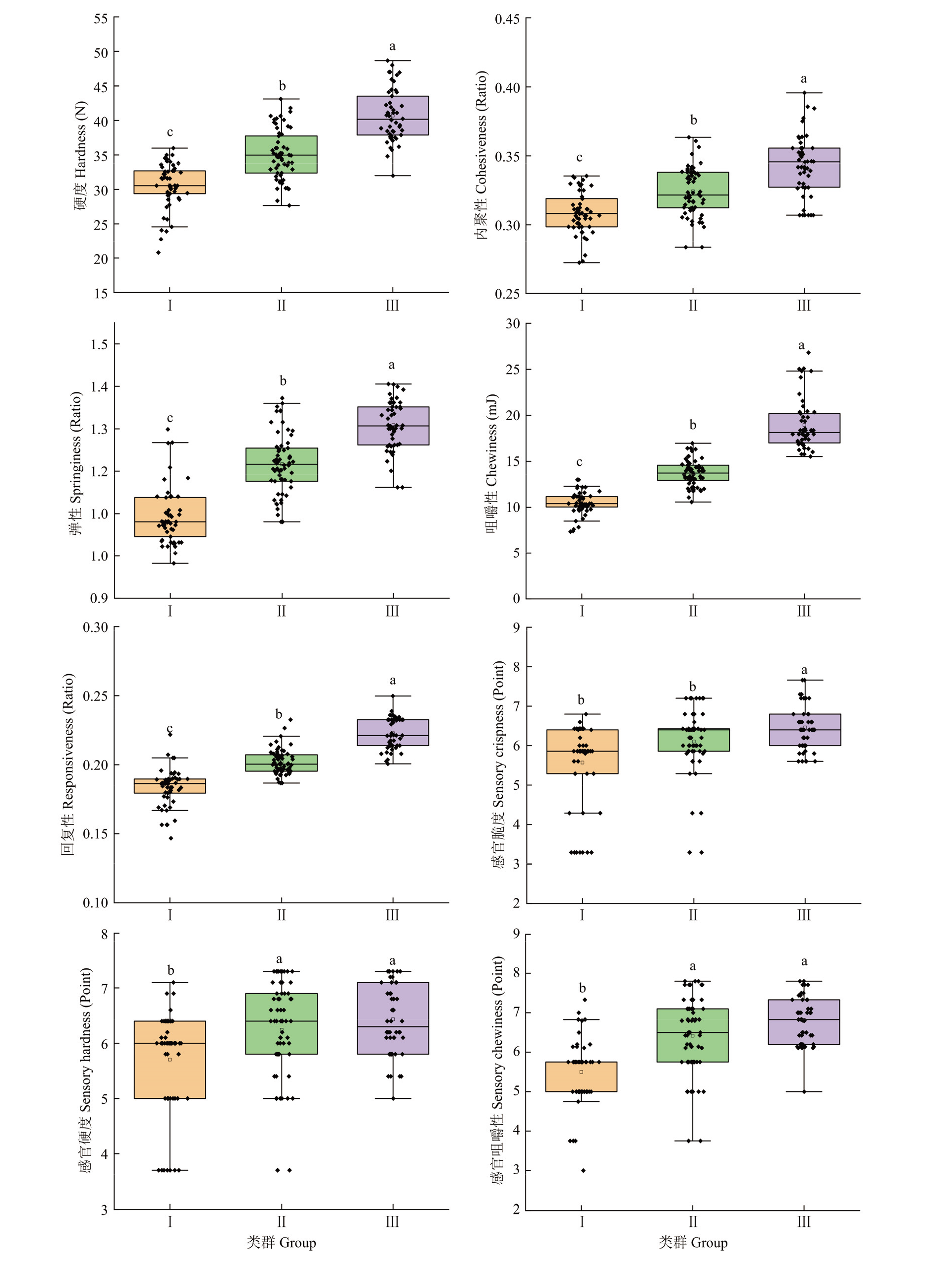
图3
不同类群松花菜种质质地性状的箱线图 不同字母表示差异显著(P<0.05)"
表9
不同类群松花菜种质的细胞形态"
| 类群 Group | 编号 No. | 长度 Length (μm) | 宽度 Width (μm) | 面积 Area (μm2) | 周长 Circumference (μm) | 横纵比 Aspectratio | 圆度 Roundness |
|---|---|---|---|---|---|---|---|
| Ⅰ | 25 | 103.10 | 56.66 | 6269.00 | 327.74 | 1.82 | 0.73 |
| Ⅱ | 103 | 95.23 | 61.13 | 5261.29 | 290.90 | 1.56 | 0.77 |
| Ⅲ | 128 | 96.01 | 65.08 | 5403.58 | 297.26 | 1.48 | 0.78 |

图4
不同类群松花菜种质花枝细胞的微观结构 A:第Ⅰ类(种质25);b:第Ⅱ类(种质103);c:第Ⅲ类(种质128)。标尺:50 μm,放大200倍"
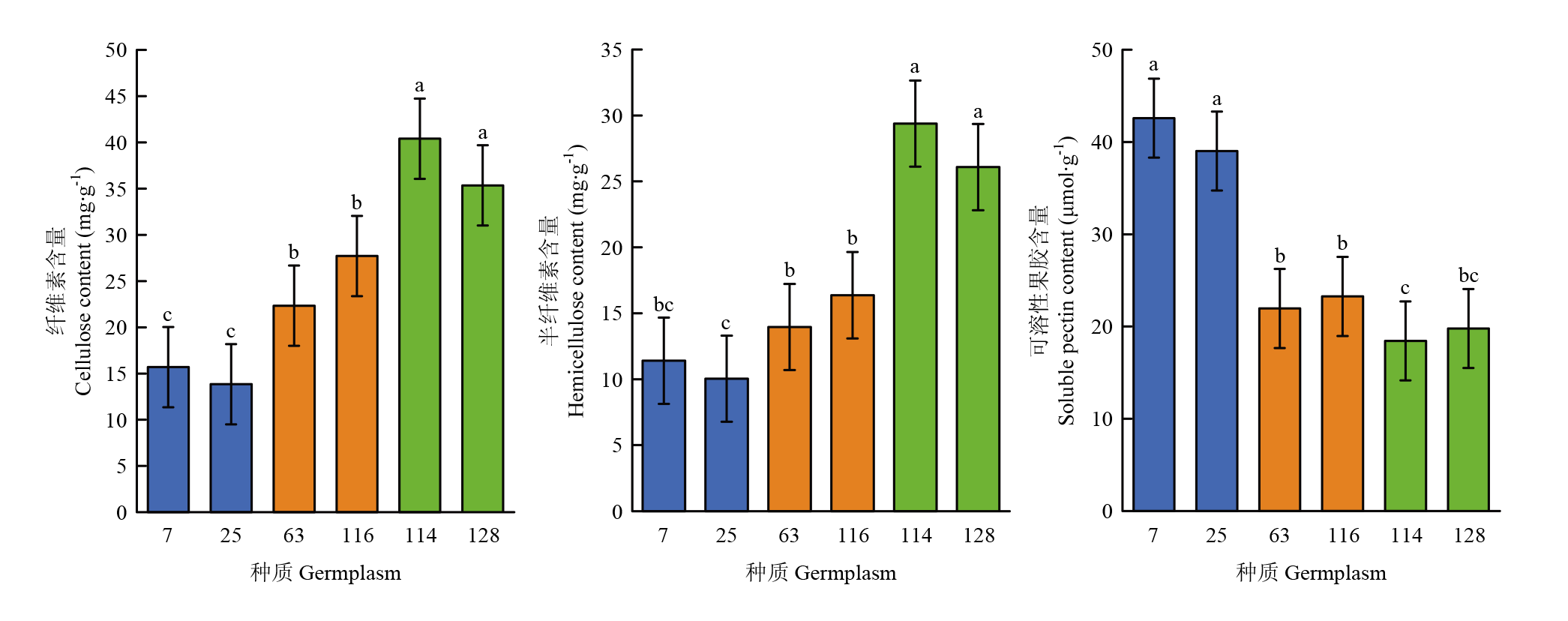
图5
不同类群松花菜种质细胞壁组分的含量"
| [1] |
|
| [2] |
宋晓玉, 韩硕, 甘德芳, 宋顺华, 刘凡, 郭宁, 孟淑春. 基于SSR标记的花椰菜育种种质遗传多样性分析. 农业生物技术学报, 2024, 32(9): 1982-1995.
|
|
|
|
| [3] |
单晓政, 张小丽, 眭丽英, 辛燕, 李戍彤, 文正华, 牛国保, 江汉民, 张伟, 田立鹏. 松散型花椰菜种质创制及新品种选育. 中国科技成果, 2023, 24(23): 10-11.
|
|
|
|
| [4] |
陈淳, 李惠华. 厦门地区夏季播种的松花型花椰菜营养品质评价. 亚热带植物科学, 2019, 48(4): 349-353.
|
|
|
|
| [5] |
doi: 10.3390/foods14010087 |
| [6] |
doi: 10.3382/ps/pex428 pmid: 29438548 |
| [7] |
刘亚平, 李红波. 物性分析仪及TPA在果蔬质构测试中的应用综述. 山西农业大学学报(自然科学版), 2010, 30(2): 188-192.
|
|
|
|
| [8] |
张红肖, 严立斌, 孟雅宁, 范妍芹. TPA试验测定鲜食甜椒果实质地的研究. 河北农业科学, 2021, 25(4): 39-43.
|
|
|
|
| [9] |
赵彦婷, 岳智臣, 陶鹏, 雷娟利, 胡齐赞, 李必元. 质构仪在大白菜口感品质评价中的应用. 分子植物育种, 2023, 21(16): 5429-5436.
|
|
|
|
| [10] |
潘少香, 刘雪梅, 郑晓冬, 谭梦男, 曹宁, 宋烨, 闫新焕. 基于质构分析的鲜食草莓质地感官品质综合评价. 食品科技, 2023, 48(8): 37-43.
|
|
|
|
| [11] |
王燕, 杨丽, 刘新琦, 马依楠, 张华启, 罗效糠. 基于TPA法与感官评价法研究果蔬冻干前后质地变化. 中国果菜, 2025, 45(6): 12-19.
|
|
|
|
| [12] |
衡周, 谢炳春, 李涛, 孙保娟, 游倩, 李植良. 不同茄子品种感官评价及品质指标研究. 中国蔬菜, 2023(7): 39-44.
|
|
|
|
| [13] |
陈月清, 牛坡. 热风干燥下不同品种猕猴桃果干感官评价与质构特性的相关性分析. 食品工业科技, 2024, 45(17): 273-281.
|
|
|
|
| [14] |
doi: 10.1002/jsfa.6071 pmid: 23520063 |
| [15] |
赵邯, 刘春菊, 李越, 李大婧, 李斌, 牛丽影, 肖亚冬, 于蕊. 果蔬成分与细胞结构对其质地特性的影响. 核农学报, 2024, 38(5): 931-942.
doi: 10.11869/j.issn.1000-8551.2024.05.0931 |
|
doi: 10.11869/j.issn.1000-8551.2024.05.0931 |
|
| [16] |
王红娟, 陈复生, 杨宏顺, 陈亚敏. 采后果蔬质地调控中细胞壁多糖骨架的演化机理研究. 农业机械, 2012(21): 107-110.
|
|
|
|
| [17] |
刘春香, 何启伟, 于占东. 黄瓜质地与组织结构、纤维素及果胶含量的关系. 中国蔬菜, 2003(5): 3-7.
|
|
|
|
| [18] |
赵思颖, 李璐, 刘小茜, 赵钢军, 吴海滨, 罗剑宁, 龚浩, 郑晓明, 李俊星. 基于感官品质、质构特征及理化成分分析的中国南瓜果实感官综合评价预测模型. 食品科学, 2022, 43(23): 63-71.
|
|
doi: 10.7506/spkx1002-6630-20211011-105 |
|
| [19] |
周田田. 花椰菜营养物质和感官品质分析与评价[D]. 武汉: 华中农业大学, 2024.
|
|
|
|
| [20] |
doi: 10.1080/07373937.2019.1709199 |
| [21] |
doi: 10.3233/JBR-140085 |
| [22] |
叶志彪. 园艺产品品质分析. 北京: 中国农业出版社, 2011.
|
|
|
|
| [23] |
杨植, 王振磊. 基于TPA法评价枣果实质地及聚类分析. 新疆农业科学, 2019, 56(10): 1860-1868.
doi: 10.6048/j.issn.1001-4330.2019.10.011 |
|
doi: 10.6048/j.issn.1001-4330.2019.10.011 |
|
| [24] |
范霞, 崔心平. 基于HS-SPME-GC-MS和电子鼻技术研究不同肉质桃子采后贮藏期的香气成分. 食品科学, 2021, 42(20): 222-229.
|
|
doi: 10.7506/spkx1002-6630-20201026-261 |
|
| [25] |
王洋, 张明生, 李祥栋, 任明见, 高翔. 不同高粱种质资源形态多样性及其形态标记聚类分析. 贵州农业科学, 2014, 42(6): 1-5.
|
|
|
|
| [26] |
李晓玲, 李金泉, 卢永根. 水稻核心种质的构建策略研究. 沈阳农业大学学报, 2007, 38(5): 681-687.
|
|
|
|
| [27] |
杨亚恒, 贾培龙, 乜兰春, 赵文圣, 赵佳腾, 王金祥, 刘杰. 厚皮甜瓜种质材料果实质地品质评价. 中国农业科学, 2024, 57(8): 1560-1574. doi: 10.3864/j.issn.0578-1752.2024.08.011.
|
|
|
|
| [28] |
张杨, 梁怡蕾, 潘琦雯, 张文. 猕猴桃感官评定与质地剖面分析的相关性. 食品工业科技, 2018, 39(16): 243-247, 252.
|
|
|
|
| [29] |
李丽娜, 赵武奇, 曾祥源, 薛珊, 霍瑶瑶, 方媛, 郭玉蓉. 苹果的质构与感官评定相关性研究. 食品与机械, 2017, 33(6): 37-41, 45.
|
|
|
|
| [30] |
刘丙花, 王开芳, 王小芳, 梁静, 白瑞亮, 解小锋, 孙蕾. 基于主成分分析的蓝莓果实质地品质评价. 核农学报, 2019, 33(5): 927-935.
doi: 10.11869/j.issn.100-8551.2019.05.0927 |
|
doi: 10.11869/j.issn.100-8551.2019.05.0927 |
|
| [31] |
吴慧琴, 王静, 阳宜, 刘雪晴, 张凯旋, 王麓尧, 路佳伟, 翟源, 成妍. 96份辣椒种质资源的果实质地品质分析及评价. 中国农业科学, 2025, 58(14): 2854-2868. doi: 10.3864/j.issn.0578-1752.2025.14.011.
|
|
|
|
| [32] |
付山, 梁邺, 徐玖亮, 阮云泽, 罗剑, 李婷玉. 基于多种方法的菠萝果实质地及食味品质综合评价. 中国农业科学, 2023, 56(15): 3006-3019. doi: 10.3864/j.issn.0578-1752.2023.15.014.
|
|
|
|
| [33] |
黄聪丽, 朱凤林, 刘景春, 邱煜辉, 张春叶. 我国花椰菜品种资源的分布与类型. 中国蔬菜, 1999(3): 35-38.
|
|
|
|
| [34] |
肖瑜, 牛国保, 单晓政, 刘莉莉, 张小丽, 文正华, 江汉民, 李戍彤, 马云生, 兰璞, 等. 花椰菜农艺性状相关性、主成分及聚类分析. 分子植物育种, 2024, 22(9): 3016-3027.
|
|
|
|
| [35] |
武新慧, 郭玉明, 冯慧敏. 高压脉冲电场预处理对果蔬动态黏弹特性的影响. 农业工程学报, 2016, 32(18): 247-254.
|
|
|
|
| [36] |
吴一璇, 高冉, 周小萱, 郝建雄, 赵丹丹. 果蔬细胞壁果胶在贮藏和干燥过程中的理化及结构特性变化规律. 食品与发酵工业, 2025, 51(15): 384-391.
doi: 10.13995/j.cnki.11-1802/ts.041235 |
|
doi: 10.13995/j.cnki.11-1802/ts.041235 |
|
| [37] |
田青兰, 张英俊, 刘洁云, 吴艳艳, 韦毅刚, 温放, 黄伟华, 辛子兵, 韦弟, 牟海飞. 西番莲果皮质构特性和显微结构特征分析. 果树学报, 2022, 39(12): 2365-2375.
|
|
|
|
| [38] |
李三培, 华德平, 高星, 徐伟欣, 杨旭辉, 刘莉. 不同类型甜瓜成熟过程中果肉质地及其细胞显微结构的变化. 西北植物学报, 2017, 37(6): 1118-1125.
|
|
|
|
| [39] |
李红光, 刘俊灵, 党美乐, 杨惠娟, 范献光, 杨亚州, 赵政阳. 苹果新品种‘瑞阳’及其亲本果实组织结构的比较分析. 果树学报, 2018, 35(10): 1182-1189.
|
|
|
| [1] | 陈敏, 焦紫岚, 乔承彬, 许昊, 张碧, 马东花, 孔维儒, 王敬文, 宋佳伟, 罗成科, 李培富, 田蕾. 不同亚种水稻种质资源对盐胁迫的形态生理响应及适应策略[J]. 中国农业科学, 2026, 59(4): 705-722. |
| [2] | 何治霖, 孙翠霞, 岳红丽, 谈月霞, 张耀海, 王福生, 刘思涛, 江东. 基于重测序枸橼、柠檬类种质资源的遗传多样性分析和别罗勒烯的全基因组关联分析[J]. 中国农业科学, 2026, 59(2): 386-401. |
| [3] | 吕涛, 孙国清, 郭栋材, 陈全家, 蔡永生, 樊标星, 曲延英, 郑凯. 海岛棉纤维强度QTL紧密连锁InDel分子标记开发及效应评价[J]. 中国农业科学, 2025, 58(9): 1684-1701. |
| [4] | 陈彩锦, 马琳, 蒋庆雪, 刘金晖, 苗童, 张志鹏, 孟翔, 马晓冉, 周昕越, 张建, 刘文辉, 王学敏. 244份饲用燕麦种质资源表型性状遗传多样性分析[J]. 中国农业科学, 2025, 58(23): 4825-4836. |
| [5] | 陈天晓, 曹榕, 宋倩楠, 胡亮亮, 王素华, 王丽侠, 程须珍, 陈红霖. 小豆种质资源苗期耐盐性综合评价及耐盐种质筛选[J]. 中国农业科学, 2025, 58(21): 4317-4332. |
| [6] | 张帆, 杨青川. 紫花苜蓿育种历史、现状与展望[J]. 中国农业科学, 2025, 58(21): 4471-4481. |
| [7] | 陈永先, 陈瑞江, 都艺芝, 术钧捷, 陈晚霞, 赵梓含, 王季春, 杜康, 张凯. 耐旱甘薯种质资源的筛选与鉴定[J]. 中国农业科学, 2025, 58(2): 214-237. |
| [8] | 包明芳, 秦燕, 陈彩锦, 张尚沛, 张国辉, 沙晓弟. 111份紫花苜蓿种质资源苗期表型抗旱性鉴定评价[J]. 中国农业科学, 2025, 58(19): 3825-3836. |
| [9] | 孟姿诺, 付长青, 张玲玉, 高顺娟, 常金华, 崔江慧. 高粱芽苗期耐盐性评价及耐盐种质筛选[J]. 中国农业科学, 2025, 58(16): 3317-3326. |
| [10] | 郑敏华, 陈洛, 邢甲乐, 谢月兰, 姜先芽, 聂帅, 蔡甫格, 巫浩翔, 陆展华, 孙伟, 霍兴, 白嵩, 赵均良, 杨武. 华南籼稻稻瘟病抗性QTL鉴定与候选基因挖掘[J]. 中国农业科学, 2025, 58(14): 2707-2719. |
| [11] | 吴慧琴, 王静, 阳宜, 刘雪晴, 张凯旋, 王麓尧, 路佳伟, 翟源, 成妍. 96份辣椒种质资源的果实质地品质分析及评价[J]. 中国农业科学, 2025, 58(14): 2854-2868. |
| [12] | 李翔宇, 刘健茁, 胡丹丹, 刘耕瑜, 陈良宇, 李冰, 杜万里, 宋波. 玉米种质资源对瘤黑粉病的抗性评价及生理差异分析[J]. 中国农业科学, 2025, 58(13): 2504-2521. |
| [13] | 崔梦杰, 孙子淇, 齐飞艳, 刘华, 徐静, 杜培, 黄冰艳, 董文召, 韩锁义, 张新友. 322份花生种质资源黄曲霉侵染抗性的评价[J]. 中国农业科学, 2025, 58(12): 2303-2315. |
| [14] | 陈彩锦, 马琳, 包明芳, 张国辉, 蒋庆雪, 杨天辉, 王川, 王晓春, 高婷, 王学敏, 刘文辉. 111份紫花苜蓿种质资源萌发期抗旱性鉴定评价[J]. 中国农业科学, 2025, 58(10): 1896-1907. |
| [15] | 赵海娟, 张玉萍, 张玉君, 刘宁, 徐铭, 刘家成, 王碧君, 刘威生, 刘硕. 基于电子鼻评价中国李种质资源果实气味[J]. 中国农业科学, 2024, 57(21): 4328-4341. |
|
||
