






中国农业科学 ›› 2026, Vol. 59 ›› Issue (5): 1020-1033.doi: 10.3864/j.issn.0578-1752.2026.05.008
魏圆慧1,2( ), 余益辉1,2, 李子钧1,2, 丁文杰1,2, 涂文龙1,2, 毛艳玲1,2,3()
收稿日期:2025-04-19
接受日期:2025-06-16
出版日期:2026-03-01
发布日期:2026-03-06
通信作者:
联系方式:
魏圆慧,E-mail:13239931900@163.com。
基金资助:
WEI YuanHui1,2(), YU YiHui1,2, LI ZiJun1,2, DING WenJie1,2, TU WenLong1,2, MAO YanLing1,2,3()
Received:2025-04-19
Accepted:2025-06-16
Published:2026-03-01
Online:2026-03-06
摘要:
【目的】 土壤有机碳(SOC)稳定性受官能团组成和固碳微生物的影响,通过比较长期不同施肥对黄泥田土壤有机碳结构和固碳细菌cbbL基因群落结构影响的差异,全面认识黄泥田土壤固碳潜力及其机制。【方法】 基于农业农村部福建耕地保育科学观测实验站长期定位稻田,设不施肥(CK)、化肥(NPK)、化肥+稻草还田(NPKS)和化肥+牛粪(NPKM)处理,利用13C核磁共振和傅里叶技术测定土壤有机碳结构,及利用高通量测序技术测定固碳细菌群落结构。【结果】 化肥配施有机肥(NPKS和NPKM处理)显著提高了黄泥田土壤有机碳含量,土壤有机碳含量随土层加深而降低。矿质结合态有机碳的含量、颗粒态有机碳的含量及颗粒态有机碳占土壤有机碳的比例均随土层加深而降低,而矿质结合态有机碳占土壤有机碳比例则随土层加深而增加。NPKS和NPKM处理增加了SOC中烷烃及芳香碳化合物含量,提高了土壤有机碳的稳定性及复杂程度,亚表层土壤有机碳稳定性高于表层。土壤固碳细菌α多样性指数分析结果显示,施肥显著提高了黄泥田土壤固碳细菌多样性指数,其中NPKM处理表现最好。土壤优势菌纲为β-变形菌纲,施肥不同程度地提高β-变形菌纲的相对丰度。Sulfuricaulis和Sulfuritortus为优势菌属。亚表层土壤相较于表层土壤降低了光自养微生物相对丰度,而提高了化能自养微生相对丰度。【结论】 稻草、牛粪与化肥配施不仅促进了黄泥田土壤有机碳的稳定性,而且显著增加了土壤固碳细菌的多样性和丰度,改变了土壤固碳细菌群落的结构。其中,牛粪配施化肥更有利于黄泥田土壤有机碳结构稳定和固碳细菌群落的多样性。
魏圆慧, 余益辉, 李子钧, 丁文杰, 涂文龙, 毛艳玲. 长期施肥对黄泥田土壤有机碳化学结构与固碳细菌群落结构的影响[J]. 中国农业科学, 2026, 59(5): 1020-1033.
WEI YuanHui, YU YiHui, LI ZiJun, DING WenJie, TU WenLong, MAO YanLing. Effects of Long-Term Fertilization on Soil Organic Carbon Structure and Carbon-Fixing Bacterial Community Structure in Yellow-Mud Paddy Soil[J]. Scientia Agricultura Sinica, 2026, 59(5): 1020-1033.

图1
试验期间研究区逐月降雨量和平均气温"

图2
长期施肥对黄泥田土壤有机碳含量的影响"

图3
长期施肥下黄泥田土壤有机碳红外光谱特征"

表1
长期施肥下黄泥田土壤有机碳吸光度"
| 土层 Soil layer (cm) | 处理 Treatment | 醇、酚类 Alcohols and phenols (3697-3000 cm-1) | 烷烃类 Alkanes (2928 cm-1) | 芳香类 Aromatics (1630+694 cm-1)1) | 碳水化合物 Carbohydrate (1032 cm-1) | 有机态硅 Organo silicone (792 cm-1) |
|---|---|---|---|---|---|---|
| 0-20 | CK | 0.19±0.04c | 0.01±0.01b | 0.07±0.01d | 0.35±0.02c | 0.06±0.01d |
| NPK | 0.56±0.01b | 0.01±0.01b | 0.17±0.02c | 1.00±0.01b | 0.16±0.01c | |
| NPKS | 0.58±0.01b | 0.02±0.01ab | 0.20±0.02b | 1.01±0.01b | 0.20±0.02b | |
| NPKM | 0.96±0.01a | 0.03±0.02a | 0.28±0.01a | 1.71±0.02a | 0.31±0.02a | |
| 20-40 | CK | 0.65±0.02b | 0.02±0.01c | 0.26±0.01c | 1.26±0.01c | 0.28±0.02c |
| NPK | 0.74±0.02c | 0.03±0.01bc | 0.20±0.01d | 1.21±0.01b | 0.26±0.01c | |
| NPKS | 1.43±0.03b | 0.05±0.02b | 0.35±0.01b | 2.34±0.02b | 0.45±0.01b | |
| NPKM | 1.96±0.01a | 0.17±0.01a | 0.61±0.02a | 2.66±0.02a | 0.52±0.02a |

图4
长期施肥下黄泥田土壤有机碳NMR谱图"
表2
长期施肥下黄泥田土壤有机碳各官能团组分相对含量及质量特征指数"
| 土层 Soil layer (cm) | 处理 Treatment | 化学位移 Chemical shift | 质量特征指数 Quality characteristic index | |||||
|---|---|---|---|---|---|---|---|---|
| 烷基碳 Alkyl C (0-45 cm-1) | 烷氧碳 O-alkyl C (45-110 cm-1) | 芳香碳 Aromatic C (110-160 cm-1) | 羰基碳 Carbonyl C (160-200 cm-1) | 腐殖化系数 Humification index | 芳香性 Aromaticity | 疏水性 Hydrophobicity | ||
| 0-20 | CK | 32.54±0.21b | 44.03±0.14a | 11.40±0.05b | 12.02±0.01b | 0.74±0.01b | 0.13±0.02b | 0.78±0.02c |
| NPK | 30.60±0.57c | 42.71±0.17b | 13.55±0.08a | 13.14±0.05a | 0.72±0.01b | 0.16±0.01a | 0.79±0.01bc | |
| NPKS | 31.01±0.15c | 42.19±0.05c | 13.65±0.11a | 13.15±0.03a | 0.74±0.02b | 0.16±0.01a | 0.81±0.01b | |
| NPKM | 34.86±0.05a | 42.01±0.11c | 11.42±0.03b | 11.70±0.06c | 0.83±0.01a | 0.13±0.02b | 0.86±0.02a | |
| 20-40 | CK | 27.70±0.02d | 38.83±0.01b | 18.74±0.03d | 14.73±0.03a | 0.71±0.02c | 0.22±0.03b | 0.87±0.02d |
| NPK | 30.06±0.03b | 39.69±0.02a | 19.04±0.01c | 11.21±0.02c | 0.76±0.01b | 0.21±0.03b | 0.96±0.01c | |
| NPKS | 29.69±0.02c | 37.87±0.02c | 20.37±0.03b | 12.08±0.02b | 0.78±0.02b | 0.23±0.01a | 1.00±0.01b | |
| NPKM | 30.55±0.01a | 37.25±0.02d | 21.49±0.03a | 10.71±0.02d | 0.82±0.01a | 0.24±0.01a | 1.09±0.01a | |
表3
长期施肥下黄泥田土壤固碳细菌多样性"
| 土层 Soil layer (cm) | 处理 Treatment | Chao1 | Observed species | PD whole tree | Shannon |
|---|---|---|---|---|---|
| 0-20 | CK | 572.77±84.01b | 406.62±46.55c | 15.49±1.96c | 4.45±0.40c |
| NPK | 647.03±67.43ab | 463.24±25.64bc | 17.85±0.64b | 4.98±0.28b | |
| NPKS | 678.27±56.31a | 520.95±31.65ab | 18.96±0.34ab | 5.27±0.29ab | |
| NPKM | 691.06±52.36a | 557.54±42.14a | 20.38±0.96a | 5.50±0.26a | |
| 20-40 | CK | 547.38±51.87b | 379.95±19.30c | 14.82±1.28c | 4.26±0.41b |
| NPK | 607.02±15.70ab | 438.26±9.25b | 15.86±0.47bc | 4.83±0.16ab | |
| NPKS | 627.38±24.31ab | 448.60±21.12ab | 17.67±1.29ab | 5.12±0.23a | |
| NPKM | 671.84±82.81a | 472.67±22.83a | 18.81±2.87a | 5.37±0.25a |
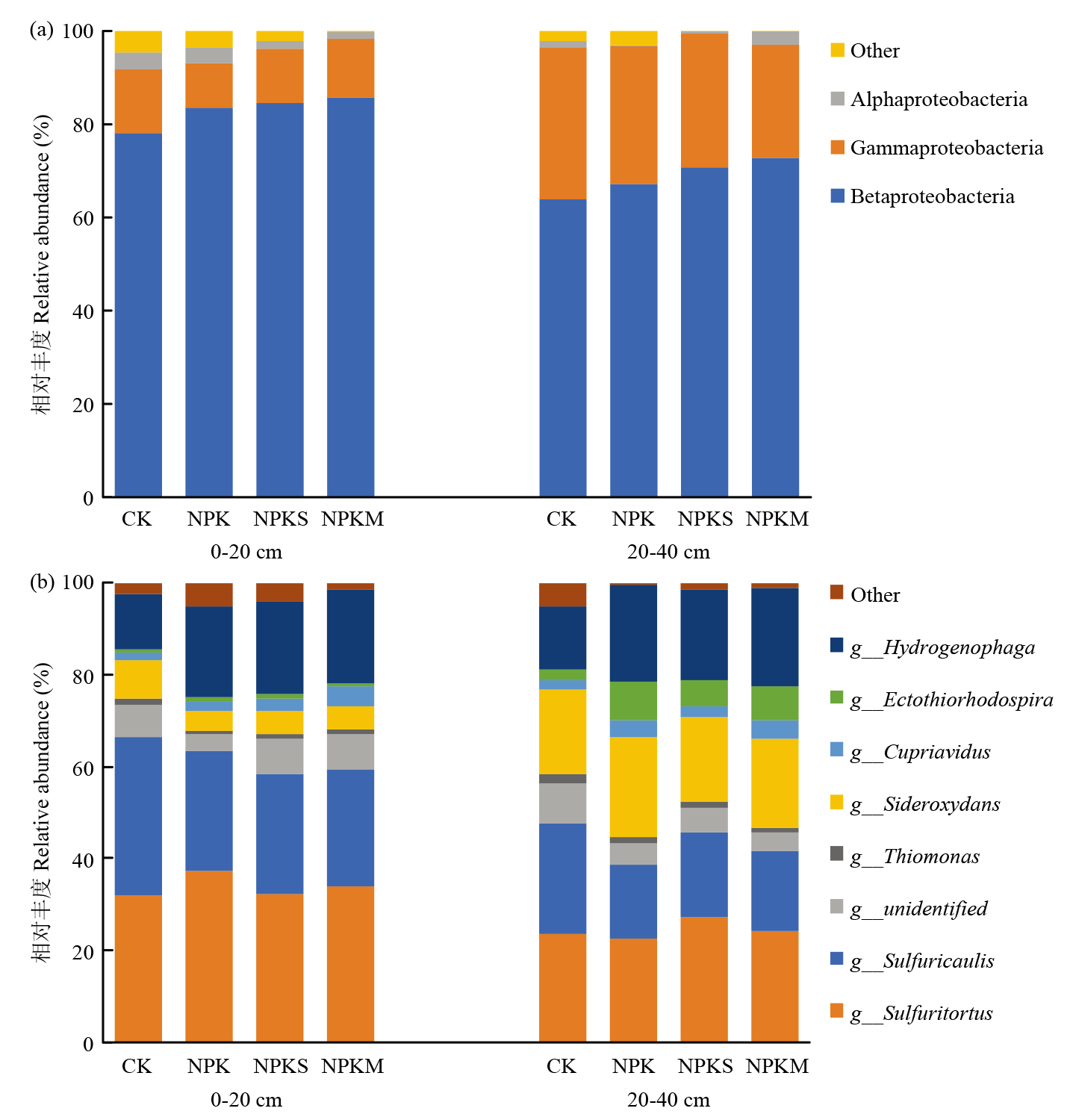
图5
长期施肥下黄泥田土壤固碳细菌在纲(a)、属(b)水平上群落结构组成分布"

图6
长期施肥下黄泥田土壤有机碳组分和结构与固碳细菌多样性的相关性"
| [1] |
doi: 10.1016/j.still.2013.01.013 |
| [2] |
吴金水, 李勇, 童成立, 肖和艾, 刘守龙, 葛体达, 周萍, 沈健林, 祝贞科, 黄习知. 亚热带水稻土碳循环的生物地球化学特点与长期固碳效应. 农业现代化研究, 2018, 39(6): 895-906.
|
|
|
|
| [3] |
doi: 10.1038/s41561-019-0484-6 |
| [4] |
薛志婧, 李霄云, 焦磊, 杨阳, 窦艳星, 王宝荣, 黄倩, 刘春晖, 屈婷婷, 周正朝, 安韶山. 土壤矿质结合态有机碳形成及稳定机制的研究进展. 水土保持学报, 2023, 37(5): 12-23.
|
|
|
|
| [5] |
doi: 10.1007/s10584-004-1822-1 |
| [6] |
刘中良, 宇万太. 土壤团聚体中有机碳研究进展. 中国生态农业学报, 2011, 19(2): 447-455.
|
|
doi: 10.3724/SP.J.1011.2011.00447 |
|
| [7] |
姜桂英, 张玉军, 魏喜, 张东旭, 刘世亮, 柳开楼, 黄绍敏, 申凤敏. 不同碳饱和水平下典型农田土壤有机质的红外光谱特征. 中国农业科学, 2018, 51(16): 3117-3129. doi: 10.3864/j.issn.0578-1752.2018.16.008.
|
|
|
|
| [8] |
蓝贤瑾, 吕真真, 刘秀梅, 侯红乾, 冀建华, 刘益仁. 长期施肥对红壤性水稻土颗粒有机质和矿物结合态有机质含量与化学组成的影响. 土壤, 2021, 53(1): 140-147.
|
|
|
|
| [9] |
周子榆, 王孟佳, 冯向前, 覃金华, 王爱冬, 马横宇, 褚光, 刘元辉, 徐春梅, 章秀福, 王丹英, 郑希, 陈松. 轮作模式和氮肥处理对稻田土壤有机碳储量及其结构的影响. 中国水稻科学, 2024, 38(5): 577-590.
doi: 10.16819/j.1001-7216.2024.230912 |
|
doi: 10.16819/j.1001-7216.2024.230912 |
|
| [10] |
doi: 10.1016/j.gca.2013.03.020 |
| [11] |
doi: 10.1111/gcb.v29.1 |
| [12] |
doi: 10.1023/A:1006211417981 |
| [13] |
doi: 10.1007/s00374-012-0750-x |
| [14] |
doi: 10.1007/s00253-013-5179-0 |
| [15] |
刘琼, 魏晓梦, 吴小红, 袁红朝, 王久荣, 李裕元, 葛体达, 吴金水. 稻田土壤固碳功能微生物群落结构和数量特征. 环境科学, 2017, 38(2): 760-768.
|
|
|
|
| [16] |
袁红朝, 秦红灵, 刘守龙, 童成立, 葛体达, 魏文学, 吴金水. 长期施肥对稻田土壤固碳功能菌群落结构和数量的影响. 生态学报, 2012, 32(1): 183-189.
|
|
doi: 10.5846/stxb |
|
| [17] |
doi: 10.1111/ejs.2007.58.issue-3 |
| [18] |
doi: 10.2136/sssaj2005.0116 |
| [19] |
doi: 10.5194/bg-17-5223-2020 |
| [20] |
周萍,
|
|
|
|
| [21] |
罗璐, 周萍, 童成立, 石辉, 吴金水, 黄铁平. 长期施肥措施下稻田土壤有机质稳定性研究. 环境科学, 2013, 34(2): 692-697.
|
|
|
|
| [22] |
缪玉琳, 梁丰, 谢军, 张嵚, 刘益仁, 赵小敏. 长期有机肥替代化肥对水稻土有机碳稳定性的影响. 土壤学报, 2023, 60(2): 512-522.
|
|
|
|
| [23] |
张维理,
|
|
|
|
| [24] |
邱璇, 赵建宁, 李文亚, 张乃芹, 朱岩, 杨殿林. 不同利用方式对小针茅荒漠草原土壤有机碳储量及其结构的影响. 农业环境科学学报, 2016, 35(11): 2137-2145.
|
|
|
|
| [25] |
孙慧敏, 姜姜, 崔莉娜, 张水锋, 张金池. 互花米草入侵对漳江口红树林湿地土壤有机碳官能团特征的影响. 植物生态学报, 2018, 42(7): 774-784.
doi: 10.17521/cjpe.2018.0104 |
|
doi: 10.17521/cjpe.2018.0104 |
|
| [26] |
|
| [27] |
刘鑫, 窦森, 李长龙, 王培宇. 开垦年限对稻田土壤腐殖质组成和胡敏酸结构特征的影响. 土壤学报, 2016, 53(1): 137-145.
|
|
|
|
| [28] |
申云鑫, 邹雪峰, 包玲凤, 周旭东, 付斌, 杨明英, 施竹凤, 裴卫华, 倪明, 陈齐斌, 胡万里, 杨佩文. 不同施肥对洱海流域农田水稻根际厌氧微生物群落多样性特征的影响. 西南农业学报, 2022, 35(12): 2819-2826.
|
|
|
|
| [29] |
王祎, 杨文浩, 毛艳玲, 周碧青, 聂三安, 邢世和. 水稻生育期对不同施肥条件下黄泥田土壤无机氮及细菌群落的影响. 应用与环境生物学报, 2019, 25(6): 1352-1358.
|
|
|
|
| [30] |
|
| [31] |
刘赵文, 周葆华, 寇乐勇, 刘海军, 赵宽. 武昌湖典型退化湿地菰草根际微生物群落结构. 地球与环境, 2018, 46(4): 339-347.
|
|
|
|
| [32] |
石岩. Pandoraea sp.B-6和Cupriavidus basilensis B-8降解碱木质素及其模型苯化合物的机制研究[D]. 长沙: 中南大学, 2013.
|
|
|
| [1] | 李星宇, 黄容, 鲜一鸣, 田娇娇, 马晓瑾, 杨乔茜, 李冰, 王昌全. 稻田土壤不同粒级团聚体有机碳组分及CO2排放对长期施肥的响应[J]. 中国农业科学, 2026, 59(6): 1255-1271. |
| [2] | 延廷霖, 杜娅丹, 胡笑涛, 王贺, 李晓雁, 王玉明, 牛文全, 谷晓博. 加气滴灌下氮肥有机替代对亏缺灌溉棉花产量和水分利用效率的影响[J]. 中国农业科学, 2026, 59(3): 602-618. |
| [3] | 王仁卓, 李玥颖, 黄绍敏, 姜桂英, 张琦, 刘超麟, 杨锦, 王梦茹, 王贝贝, 刘芳, 郭斗斗, 介晓磊, 宋练, 刘世亮. 长期有机无机肥配施对潮土细菌群落结构、生态网络及关键物种的影响[J]. 中国农业科学, 2026, 59(2): 354-367. |
| [4] | 韦文华, 李盼, 邵冠贵, 樊志龙, 胡发龙, 范虹, 何蔚, 柴强, 殷文, 赵连豪. 西北灌区青贮玉米产量及品质对减量灌水与有机无机肥配施的响应[J]. 中国农业科学, 2025, 58(8): 1521-1534. |
| [5] | 白雨欣, 刘灵芝, 安婷婷, 李双异, 汪景宽. 长期不同施肥对棕壤细菌群落结构和碳代谢功能的影响[J]. 中国农业科学, 2025, 58(8): 1579-1590. |
| [6] | 陈桂平, 李盼, 邵冠贵, 吴霞玉, 殷文, 赵连豪, 樊志龙, 胡发龙. 减量灌水与有机无机肥配施对青贮玉米吐丝期后叶片持绿特性的调控作用[J]. 中国农业科学, 2025, 58(7): 1381-1396. |
| [7] | 史帆, 李文广, 易树生, 杨娜, 陈玉萌, 郑伟, 张雪辰, 李紫燕, 翟丙年. 有机无机肥配施下旱地麦田土壤有机碳组分含量的变化特征[J]. 中国农业科学, 2025, 58(4): 719-732. |
| [8] | 房康睿, 丁世杰, 陈雨珊, 杨秉庚, 郭腾飞, 徐新朋, 赵士诚, 王秀斌, 黄绍敏, 仇少君, 何萍, 周卫. 有机无机肥配施下典型潮土小麦季有机肥氮磷的当季释放率[J]. 中国农业科学, 2025, 58(24): 5234-5246. |
| [9] | 袁慧琳, 李雅莹, 顾文杰, 徐培智, 卢钰升, 孙丽丽, 周昌敏, 黎婉玲, 仇荣亮. 长期施用新鲜与腐熟畜禽粪肥土壤溶解性有机质与微生物群落的特征及其关联性[J]. 中国农业科学, 2025, 58(2): 307-325. |
| [10] | 郭斗斗, 张珂珂, 黄绍敏, 宋晓, 张水清, 岳克, 丁世杰, 郭腾飞. 长期不同施肥对潮土磷吸附解吸特性的影响[J]. 中国农业科学, 2025, 58(14): 2805-2820. |
| [11] | 路鹏, 冯佳, 李莉, 杨莉, 杨雷, 吕德智, 薛彦飞. 长期施肥小麦根际与非根际土壤的磷组分及其有效性[J]. 中国农业科学, 2025, 58(12): 2382-2396. |
| [12] | 胡丹丹, 宋惠洁, 段英华, 吴艳, 胡志华, 徐小林, 张文菊, 何小林, 柳开楼, 苏鹏, 黄群招. 长期施肥对红壤双季稻系统氮素盈亏和土壤碱解氮的影响[J]. 中国农业科学, 2024, 57(24): 4907-4918. |
| [13] | 申文艳, 张乃于, 李天娇, 宋天昊, 张秀芝, 彭畅, 刘红芳, 张淑香, 段碧华. 长期施肥黑土phoD微生物群落特征及其对有机磷组分的影响[J]. 中国农业科学, 2024, 57(20): 4082-4093. |
| [14] | 李天娇, 张乃于, 申文艳, 宋天昊, 刘红芳, 刘晓燕, 张秀芝, 彭畅, 杨劲峰, 张淑香. 长期施肥对黑土和棕壤团聚体稳定性的影响及驱动因素[J]. 中国农业科学, 2024, 57(19): 3835-3847. |
| [15] | 杨文辉, 罗灏程, 董二伟, 王劲松, 王媛, 刘秋霞, 黄晓磊, 焦晓燕. 长期不同施肥和深翻对玉米高粱轮作体系作物钾利用及土壤钾形态的影响[J]. 中国农业科学, 2024, 57(12): 2390-2403. |
|
||
