






中国农业科学 ›› 2026, Vol. 59 ›› Issue (2): 250-264.doi: 10.3864/j.issn.0578-1752.2026.02.003
杨锐1, 陈敬东1, 黄郢1, 谢伶俐1, 张学昆1,2, 周登文3, 刘清云4, 徐劲松1, 许本波1
收稿日期:2025-08-20
接受日期:2025-10-07
出版日期:2026-01-16
发布日期:2026-01-22
通信作者:
联系方式:
杨锐,E-mail:ruiyang.stu@yangtzeu.edu.cn。
基金资助:YANG Rui1, CHEN JingDong1, HUANG Ying1, XIE LingLi1, ZHANG XueKun1,2, ZHOU DengWen3, LIU QingYun4, XU JinSong1, XU BenBo1
Received:2025-08-20
Accepted:2025-10-07
Published:2026-01-16
Online:2026-01-22
摘要:
【目的】 长江上游为我国重要油菜主产区之一,在保障我国食用植物油供给安全和提高我国油料自给率中发挥关键作用。然而,该地区气候条件复杂多变,传统的遗传改良评价方法受环境干扰较大,难以精准识别品种遗传潜力变化趋势。建立一种以年度高产品系为代表的遗传改良追踪方法,系统揭示2004—2023年长江上游地区油菜品系的遗传进步轨迹与农艺性状演化特征,明确高产品系关键农艺性状的协同调控机制,为油菜高产稳产育种提供理论支撑。 【方法】 以长江上游地区2004—2023年国家冬油菜新品种比较试验中年度平均产量最高的品系作为研究对象,运用混合线性模型、最佳线性无偏预测(BLUP)模型分离环境影响,结合线性回归、皮尔森相关性分析、通径分析和主成分分析,全面评估2004—2023年高产品系的产量遗传进步趋势与农艺性状变异特征,构建多性状协同调控网络。 【结果】 2004—2023年长江上游地区油菜品系实际产量和产量BLUP值均呈显著上升趋势,高产品系性状改良表现出显著的阶段性变化特征:2004—2013年育种策略以紧凑株型为主,表现为分枝数、单株角果数和全生育期显著下降;2014—2023年则向粒数型转变,单株角果数和千粒重稳定提升。相关性分析与通径分析揭示单株产量为提升群体产量的核心直接驱动因子,单株角果数与分枝数主要通过提升单株产量来促进群体产量增加。主成分分析结果表明,前五个主成分特征值均大于1,累计解释76%的总变异,其中,以单株角果数、分枝数和株高等结构性状为主导的PC1贡献率为29%,成为导致品种间差异最主要的特征维度,揭示了高产品系从“单一性状突破”向“多因子协同”转型的育种趋势。 【结论】 明确了油菜育种方向由早期的株型结构优化逐步转向后期粒数强化的阶段性演变趋势;系统揭示了单株产量为核心直接驱动因子,“分枝数-角果数-粒型”为支撑的多性状协同高产模式。长江上游地区2004—2013年缺乏高产品系的推广,表明未来该区域的育种方向应综合考虑产油量和抗倒伏性,在不同生态和管理条件下实现长江上游油菜产量的持续突破。
杨锐, 陈敬东, 黄郢, 谢伶俐, 张学昆, 周登文, 刘清云, 徐劲松, 许本波. 长江上游油菜高产品系遗传改良与构型分析[J]. 中国农业科学, 2026, 59(2): 250-264.
YANG Rui, CHEN JingDong, HUANG Ying, XIE LingLi, ZHANG XueKun, ZHOU DengWen, LIU QingYun, XU JinSong, XU BenBo. Genetic Improvement and Configuration Analysis of High-Yield Rapeseed Lines in the Upper Reaches of the Yangtze River[J]. Scientia Agricultura Sinica, 2026, 59(2): 250-264.
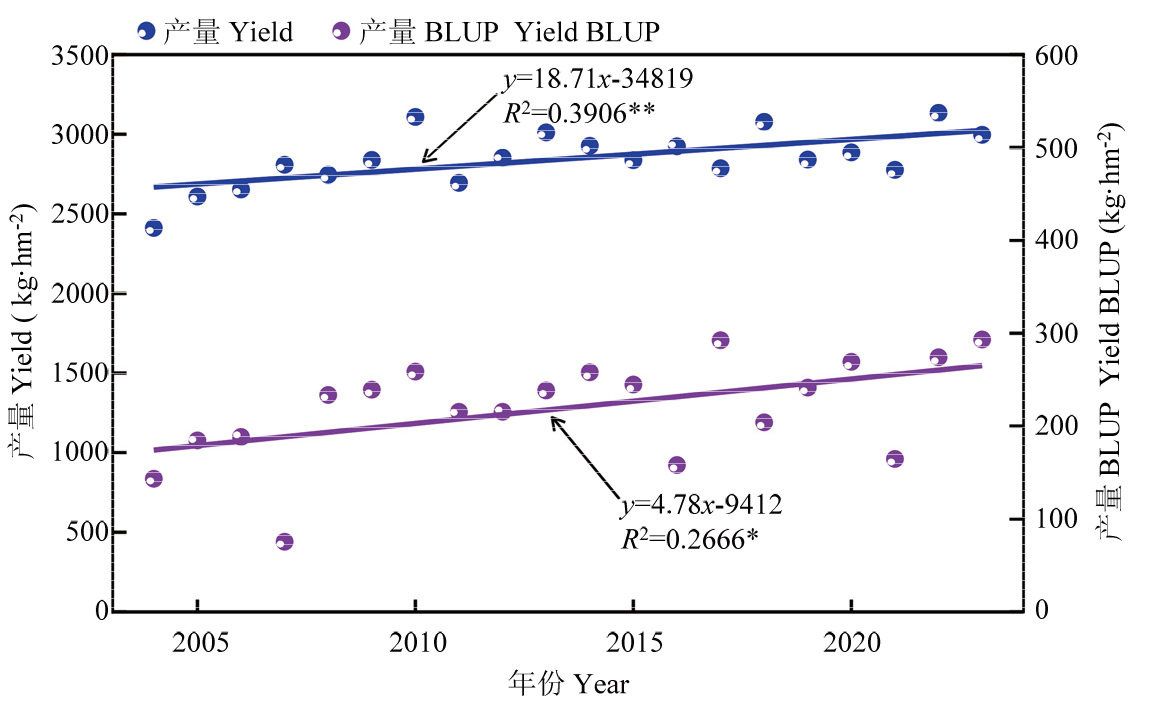
图1
2004—2023年长江上游油菜高产品系的实际产量与BLUP遗传产量趋势图 *:P<0.05,**:P<0.01,***:P<0.001,未标注为不显著(P≥0.05)。下同"
表1
长江上游油菜年度高产品系主要农艺性状的统计与变异系数(2004—2023年)"
| 年份 Year | 菌核病 病指 Sclerotium index | 株高 Plant height (cm) | 分枝数 Branching number | 单株角果数 Silique number per plant | 每角粒数 Seed number per silique | 千粒重 Thousand seeds weight (g) | 单株产量 Yield per plant (g) | 全生育期 Whole growth period (d) | 硫甙含量 Glucosinolate content (µmol·g-1) | 含油量 Oil content (%) | 产量 Yield (kg·hm-2) |
|---|---|---|---|---|---|---|---|---|---|---|---|
| 2004 | 2.03 | 210.02 | 9.10 | 486.10 | 15.75 | 3.34 | 24.31 | 229.67 | 24.64 | 36.88 | 2411.50±152.39 |
| 2005 | 3.35 | 205.02 | 9.92 | 429.22 | 18.37 | 3.56 | 24.66 | 227.00 | 109.98 | 44.14 | 2608.83±168.98 |
| 2006 | 1.31 | 212.72 | 9.15 | 430.52 | 20.16 | 3.24 | 28.42 | 222.50 | 20.02 | 39.44 | 2653.33±132.24 |
| 2007 | 3.34 | 194.60 | 8.72 | 509.38 | 18.07 | 3.72 | 30.85 | 226.83 | 27.70 | 40.83 | 2808.33±135.13 |
| 2008 | 4.36 | 197.43 | 9.62 | 445.82 | 18.83 | 3.57 | 29.42 | 223.83 | 35.69 | 40.51 | 2745.83±121.48 |
| 2009 | 3.59 | 207.20 | 8.60 | 483.90 | 16.97 | 4.05 | 30.77 | 224.00 | 29.57 | 39.78 | 2838.83±131.54 |
| 2010 | 5.14 | 195.32 | 8.67 | 450.27 | 16.84 | 4.23 | 28.01 | 230.50 | 29.72 | 40.39 | 3108.67±167.14 |
| 2011 | 1.01 | 203.75 | 7.73 | 366.24 | 19.91 | 3.77 | 23.61 | 224.17 | 20.73 | 40.74 | 2694.83±199.79 |
| 2012 | 1.27 | 186.26 | 7.24 | 308.22 | 20.62 | 4.04 | 23.38 | 220.00 | 21.08 | 43.12 | 2852.80±215.20 |
| 2013 | 1.84 | 192.35 | 6.70 | 265.55 | 18.83 | 4.13 | 20.58 | 221.00 | 22.55 | 37.28 | 3011.50±251.33 |
| 2014 | 2.20 | 187.03 | 7.22 | 319.93 | 21.42 | 3.16 | 21.73 | 206.50 | 21.17 | 40.75 | 2927.40±180.34 |
| 2015 | 7.88 | 202.35 | 6.72 | 320.18 | 17.77 | 3.40 | 18.52 | 216.83 | 19.57 | 42.06 | 2837.17±233.09 |
| 2016 | 5.01 | 191.78 | 8.93 | 347.47 | 16.52 | 3.69 | 19.27 | 215.17 | 28.08 | 41.85 | 2924.17±283.79 |
| 2017 | 3.57 | 202.52 | 7.78 | 318.16 | 25.38 | 3.13 | 19.86 | 214.80 | 20.76 | 42.46 | 2786.40±150.37 |
| 2018 | 2.51 | 208.68 | 5.82 | 255.10 | 17.72 | 4.15 | 17.10 | 214.00 | 39.35 | 44.12 | 3078.33±196.57 |
| 2019 | 0.89 | 196.17 | 7.45 | 216.48 | 20.63 | 4.19 | 12.88 | 209.33 | 34.58 | 46.14 | 2841.17±177.64 |
| 2020 | 4.67 | 196.40 | 7.62 | 268.64 | 20.98 | 3.49 | 17.90 | 216.00 | 20.81 | 42.95 | 2886.00±132.45 |
| 2021 | 5.48 | 185.52 | 6.20 | 300.34 | 18.96 | 4.21 | 17.66 | 209.40 | 39.26 | 45.35 | 2776.60±117.67 |
| 2022 | 17.85 | 205.08 | 9.42 | 398.32 | 20.10 | 3.24 | 20.16 | 219.40 | 49.68 | 39.00 | 3134.80±422.14 |
| 2023 | 15.99 | 193.23 | 9.28 | 425.15 | 21.28 | 3.40 | 22.48 | 213.83 | 34.29 | 41.86 | 2996.50±238.17 |
| 平均值 Average | 4.66 | 198.67 | 8.09 | 367.25 | 19.26 | 3.69 | 22.58 | 219.24 | 32.46 | 41.48 | 2846.15 |
| 最大值 Maximum | 17.85 | 212.72 | 9.92 | 509.38 | 25.38 | 4.23 | 30.85 | 230.50 | 109.98 | 46.14 | 3134.80 |
| 最小值 Minimum | 0.89 | 185.52 | 5.82 | 216.48 | 15.75 | 3.13 | 12.88 | 206.50 | 19.57 | 36.88 | 2411.50 |
| 标准差 STDEV | 4.56 | 8.13 | 1.21 | 86.98 | 2.21 | 0.39 | 4.98 | 6.89 | 20.03 | 2.44 | 177.08 |
| 变异系数 CV (%) | 97.81 | 4.09 | 14.89 | 23.68 | 11.49 | 10.48 | 22.04 | 3.14 | 61.70 | 5.87 | 6.22 |
表2
长江上游油菜年度高产品系主要农艺性状的BLUP值与年度变化"
| 性状 Trait | 斜率Slope | ||
|---|---|---|---|
| 2004-2023 | 2004-2013 | 2014-2023 | |
| 菌核病病指Sclerotium index | 0.0090 | -0.0746 | 0.0675 |
| 株高Plant height | 0.0071 | -0.4473 | -0.2764 |
| 分枝数Branching number | 0.0089 | -0.0742* | 0.0379 |
| 单株角果数Silique number per plant | 0.9342* | -3.7045** | 1.7955** |
| 每角粒数Seed number per silique | -0.0215 | 0.0838 | -0.2311 |
| 千粒重Thousand seeds weight | -0.0129 | 0.0401* | 0.0256 |
| 单株产量Yield per plant | -0.0204 | -0.0096 | -0.0363 |
| 全生育期Whole growth period | 0.0322 | -0.2791* | 0.2387** |
| 硫甙含量Glucosinolate content | -0.6253 | -3.8843 | 1.9544 |
| 含油量Oil content | 0.1496* | 0.2122 | 0.2011 |
| 产量Yield | 4.7836* | 11.7442 | 5.6638 |
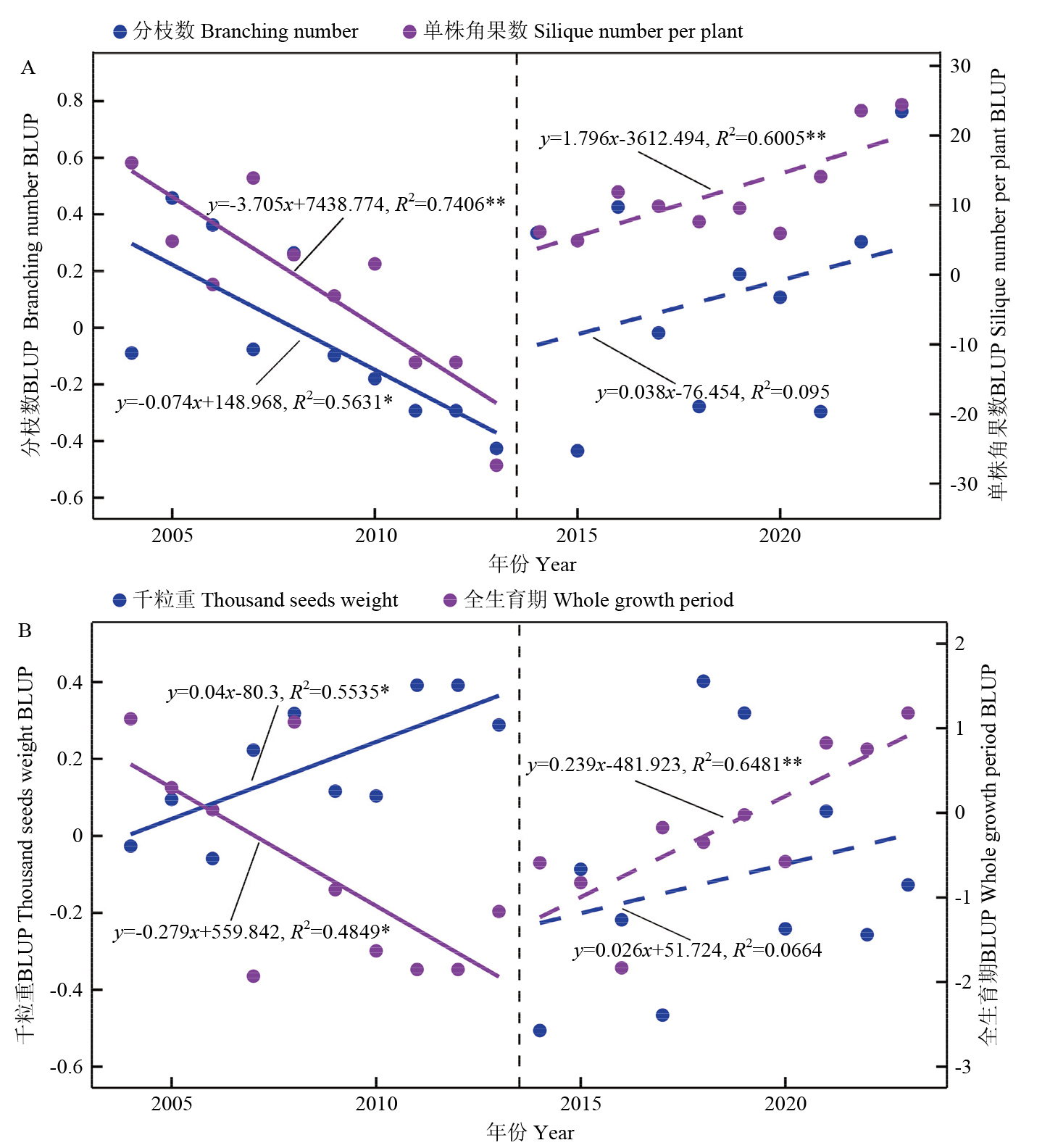
图2
长江上游油菜年度高产品系重要农艺性状BLUP的分期趋势图(2004—2013与2014—2023) A:分枝数与单株角果数BLUP的分期趋势;B:千粒重与全生育期BLUP的分期趋势。虚线表示2013/2014年度分界"
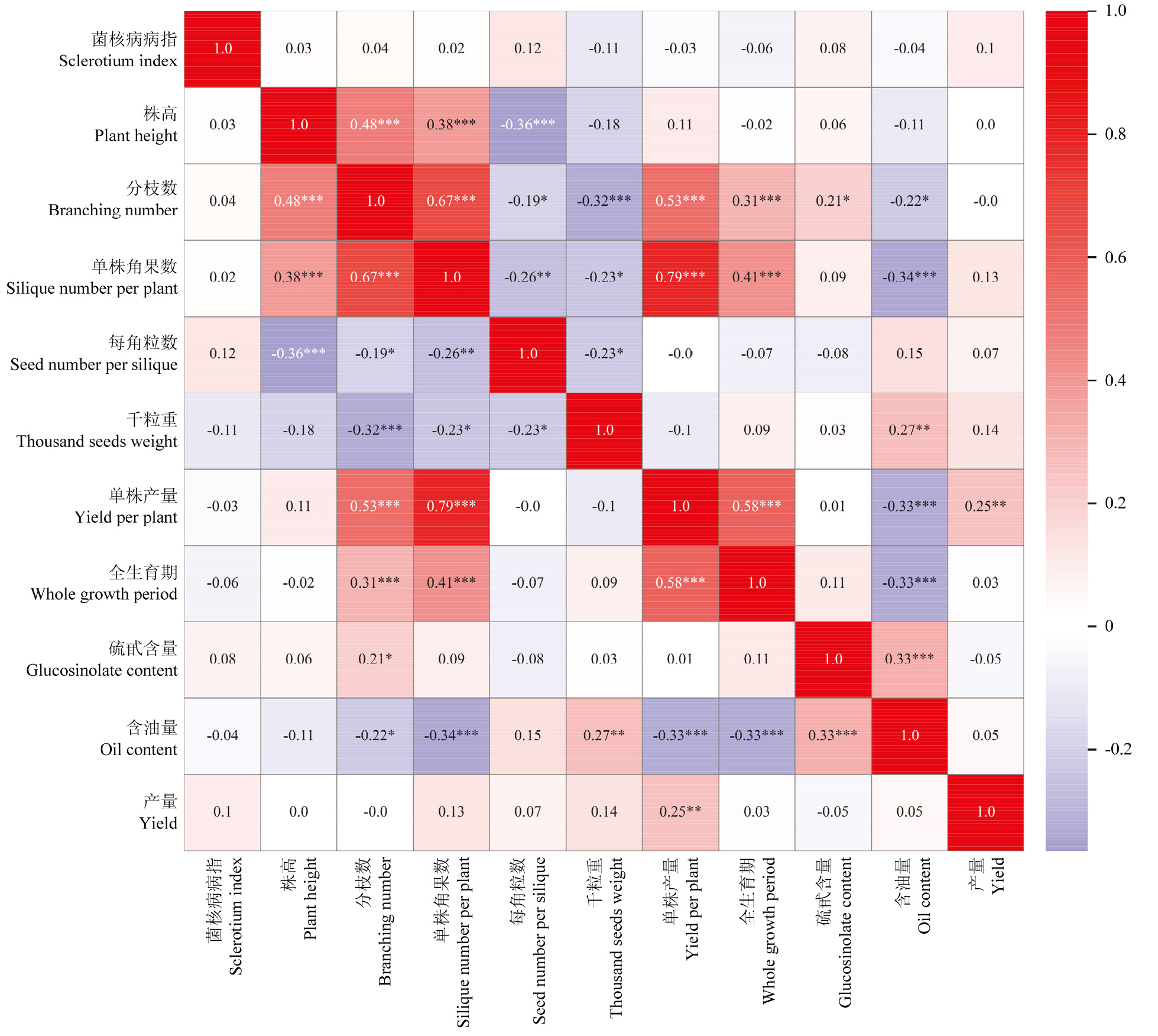
图3
2004—2023年长江上游油菜年度高产品系主要农艺性状和产量的相关性分析"
表3
2004—2023年长江上游油菜年度高产品系主要农艺性状与产量的通径分析"
| |
表4
2004—2023年长江上游油菜年度高产品系主要农艺性状的主成分分析"
| 主成分 Principal component | 特征值 Eigenvalue | 贡献率 Contribution (%) | 累计贡献率 Accumulative contribution rate (%) |
|---|---|---|---|
| PC1 | 3.21 | 29 | 29 |
| PC2 | 1.47 | 13 | 42 |
| PC3 | 1.41 | 13 | 55 |
| PC4 | 1.30 | 12 | 67 |
| PC5 | 1.09 | 10 | 76 |
| PC6 | 0.86 | 8 | 84 |
| PC7 | 0.54 | 5 | 89 |
| PC8 | 0.46 | 4 | 93 |
| PC9 | 0.32 | 3 | 96 |
| PC10 | 0.30 | 3 | 99 |
| PC11 | 0.12 | 1 | 100 |

图4
长江上游油菜年度高产品系11个农艺性状的主成分特征向量"
| [1] |
王汉中. 以新需求为导向的油菜产业发展战略. 中国油料作物学报, 2018, 40(5): 613-617.
doi: 10.7505/j.issn.1007-9084.2018.05.001 |
|
|
|
| [2] |
谢伶俐, 李永铃, 许本波, 张学昆. 油菜耐渍机理解析及遗传改良研究进展. 作物学报, 2025, 51(2): 287-300.
doi: 10.3724/SP.J.1006.2025.44121 |
|
doi: 10.3724/SP.J.1006.2025.44121 |
|
| [3] |
宁宁, 莫娇, 胡冰, 李大双, 娄洪祥, 王春云, 白晨阳, 蒯婕, 汪波, 王晶, 等. 长江流域不同生态区油菜籽关键品质比较研究. 作物学报, 2023, 49(12): 3315-3327.
doi: 10.3724/SP.J.1006.2023.34017 |
|
doi: 10.3724/SP.J.1006.2023.34017 |
|
| [4] |
doi: 10.3390/su14106051 |
| [5] |
李谷成, 牛秋纯, 冷博峰, 丁逸飞, 童婷, 范丽霞. 新时代十年: 我国油菜产业发展与路径选择. 中国油料作物学报, 2024, 46(2): 228-235.
doi: 10.19802/j.issn.1007-9084.2023248 |
|
|
|
| [6] |
doi: 10.1016/j.jafr.2025.101794 |
| [7] |
殷艳, 廖星, 余波, 王汉中. 我国油菜生产区域布局演变和成因分析. 中国油料作物学报, 2010, 32(1): 147-151.
|
|
|
|
| [8] |
谢雄泽, 谢捷, 褚乾梅, 尹羽丰, 余小红, 王盾, 冯鹏. 长江流域冬油菜需水量及水分盈亏特征分析. 作物学报, 2024, 50(7): 1829-1840.
doi: 10.3724/SP.J.1006.2024.34190 |
|
doi: 10.3724/SP.J.1006.2024.34190 |
|
| [9] |
doi: 10.1016/j.ocsci.2020.07.001 |
| [10] |
doi: 10.1007/s10681-007-9449-8 |
| [11] |
doi: 10.1038/s41477-025-01986-y pmid: 40247143 |
| [12] |
|
| [13] |
doi: 10.1186/s12284-023-00677-6 pmid: 38099942 |
| [14] |
doi: 10.1002/csc2.v64.2 |
| [15] |
doi: 10.1007/s00122-024-04763-1 pmid: 39503804 |
| [16] |
doi: 10.1007/s12355-021-01011-4 |
| [17] |
doi: 10.3390/agronomy12040922 |
| [18] |
常世豪, 耿臻, 杨青春, 舒文涛, 李金花, 李琼, 张保亮, 张东辉. 基于BLUP值的夏大豆产量与农艺性状的相关分析. 作物杂志, 2023(5): 10-15.
|
|
|
|
| [19] |
doi: 10.3389/fpls.2022.950992 |
| [20] |
doi: 10.52547/jcb.13.37.132 |
| [21] |
|
| [22] |
doi: 10.2134/agronj2019.03.0220 |
| [23] |
doi: 10.1007/s10681-020-02760-1 |
| [24] |
doi: 10.1016/j.eja.2023.126787 |
| [25] |
|
| [26] |
doi: 10.1016/j.xplc.2024.100854 |
| [27] |
doi: 10.1016/j.cj.2022.05.003 |
| [28] |
doi: 10.3390/agronomy13030795 |
| [29] |
|
| [30] |
|
| [31] |
doi: 10.1038/s41477-023-01432-x |
| [32] |
doi: 10.1093/plcell/koae132 pmid: 38701340 |
| [33] |
张天宇, 刘丽君, 杨刚, 武军艳, 蒲媛媛, 马骊, 王旺田, 路晓明, 马愿强, 孙万仓. 2006—2022年北方白菜型冬油菜农艺性状遗传增益分析. 中国农业科学, 2025, 58(11): 2081-2095. doi: 10.3864/j.issn.0578-1752.2025.11.003.
|
|
|
|
| [34] |
|
| [35] |
doi: 10.61186/jcb.15.45.60 |
| [36] |
doi: 10.1007/s12298-021-01060-9 |
| [37] |
|
| [38] |
王贺亚, 孟玲, 李怀胜, 艾海峰, 贾东海. 塔额垦区甘蓝型油菜主要性状与产量的相关性及通径分析. 种子, 2023, 42(4): 127-132.
|
|
|
|
| [39] |
尚丽平, 赵卫国, 郭凯红, 张立坚, 罗斌, 赵亚军, 王灏. 甘蓝型油菜主要农艺性状的主成分分析. 中国农学通报, 2021, 37(28): 9-13.
doi: 10.11924/j.issn.1000-6850.casb2020-0808 |
|
|
|
| [40] |
郑本川, 张锦芳, 蒋俊, 崔成, 柴靓, 黄友涛, 周正鉴, 李浩杰, 蒋梁材. 不同熟期“川油”系列甘蓝型油菜品种主要性状与产量的相关分析. 中国农学通报, 2022, 38(7): 7-17.
doi: 10.11924/j.issn.1000-6850.casb2021-0430 |
|
|
|
| [41] |
doi: S0168-9452(15)00137-5 pmid: 26566834 |
| [42] |
doi: 10.1186/s12870-018-1606-9 |
| [43] |
doi: 10.1007/s00122-025-04857-4 |
| [44] |
|
| [45] |
|
| [46] |
|
| [47] |
doi: 10.3390/plants13141986 |
| [48] |
|
| [49] |
吴亚军, 李莓, 汤松, 陈于婷, 张莹莹, 徐劲松, 许本波, 张哲, 张学昆. 影响我国油菜主栽品种推广面积的因素分析. 中国油料作物学报, 2025: 1-8. https://link.cnki.net/doi/10.19802/j.issn.1007-9084.2025008.
|
|
|
| [1] | 朱琦, 贾振鹏, Tahir SHAH, 徐晨晟, 李芷琦, 吕会帅, 朱鹏超, 韦小敏, 黄冬琳, 孙艳妮, 曹卫东, 高亚军, 王朝辉, 张达斌. 绿肥配施增效产品降低旱地麦田温室气体排放及碳足迹[J]. 中国农业科学, 2026, 59(7): 1507-1522. |
| [2] | 苏一帆, 杨瞻旭, 王迪, 冒俊呈, 魏萌萌, 陈泽, 白欣冉, 楚天歌, 马昌宁, 乔明菲, 孙权, 胡大刚. 2, 4-表油菜素内酯对苹果果实采后贮藏性能的影响[J]. 中国农业科学, 2026, 59(7): 1536-1551. |
| [3] | 赵子杰, 宋豪, 董小鸥, 万建民. 转座元件系统介导的大片段DNA定向插入技术研究进展[J]. 中国农业科学, 2026, 59(6): 1141-1156. |
| [4] | 刘海卿, 金姣姣, 孙万仓, 柴鹏, 祁伟亮, 杨刚, 李婵, 骆雪梅, 苏芸芸, 秦雪雪. 甘蓝型冬油菜越冬期矮生长点形态建成及多激素调控机制[J]. 中国农业科学, 2026, 59(5): 951-966. |
| [5] | 申丽琼, 何林丽, 刘倪, 陆俊杏, 朱波, 张涛. 钾营养水平对油菜苗期抗湿害能力及内源激素平衡的影响[J]. 中国农业科学, 2026, 59(3): 528-542. |
| [6] | 王彬, 吴朋浩, 鲁剑巍, 任涛, 丛日环, 陆志峰, 李小坤. 长江中游地区水稻-油菜轮作体系需水特征[J]. 中国农业科学, 2025, 58(7): 1355-1365. |
| [7] | 杜泰峰, 周媛媛, 秦桢, 李爱贤, 王庆美, 张立明, 侯夫云. 外源油菜素内酯减轻SPVD对甘薯块根萌芽的抑制作用[J]. 中国农业科学, 2025, 58(22): 4628-4637. |
| [8] | 杨龙, 张学昆, 陈爱武, 李莓, 程泰, 马伍慧, 许本波, 徐劲松. 油菜品种、越冬调控和病虫害防控对直播油菜产量的影响[J]. 中国农业科学, 2025, 58(21): 4333-4345. |
| [9] | 郑敏华, 陈洛, 邢甲乐, 谢月兰, 姜先芽, 聂帅, 蔡甫格, 巫浩翔, 陆展华, 孙伟, 霍兴, 白嵩, 赵均良, 杨武. 华南籼稻稻瘟病抗性QTL鉴定与候选基因挖掘[J]. 中国农业科学, 2025, 58(14): 2707-2719. |
| [10] | 张天宇, 刘丽君, 杨刚, 武军艳, 蒲媛媛, 马骊, 王旺田, 路晓明, 马愿强, 孙万仓. 2006—2022年北方白菜型冬油菜农艺性状遗传增益分析[J]. 中国农业科学, 2025, 58(11): 2081-2095. |
| [11] | 何永强, 张金盔, 徐劲松, 丁晓雨, 程勇, 许本波, 张学昆. 14-羟基芸苔素甾醇生长调节剂对油菜生长和产量的影响[J]. 中国农业科学, 2024, 57(8): 1444-1454. |
| [12] | 李荣德, 何平, 罗莉霞, 史梦雅, 侯乾, 马振国, 郭瑞星, 成洪涛. “稻-稻-油”生产模式下短生育期冬油菜品种选育与推广现状分析[J]. 中国农业科学, 2024, 57(5): 846-854. |
| [13] | 关志林, 靳丰蔚, 刘婷婷, 王毅, 谭莹莹, 杨春慧, 李蕊彤, 王博, 刘克德, 董云. 甘蓝型油菜光叶性状的遗传分析及基因定位[J]. 中国农业科学, 2024, 57(4): 650-662. |
| [14] | 李飞, 熊财, 谷佳佳, 曹欣, 王珊珊, 胡伟, 周治国, 陈兵林. 迟播对油菜产量、品质、光合源演替及载荷特征的影响[J]. 中国农业科学, 2024, 57(23): 4673-4685. |
| [15] | 李亦扬, 王龙, 钱晨, 李静, 林国冰, 瞿雯婷, 王炎, 林耀威, 黄怡航, 郑经东, 尤晶晶, 左青松. 密度对油菜角果性状的影响及高产油菜增产路径分析[J]. 中国农业科学, 2024, 57(22): 4459-4472. |
|
||
