






中国农业科学 ›› 2026, Vol. 59 ›› Issue (8): 1809-1824.doi: 10.3864/j.issn.0578-1752.2026.08.015
• 畜牧·兽医 • 上一篇
龙熙1,2( ), 柴捷1,2, 张亮1,2, 潘雨1,2, 涂志1,2, 张利娟1,2, 张力丹2, 唐乙仝1, 郭宗义1,2(), 潘红梅1,2()
收稿日期:2025-07-22
接受日期:2026-03-30
出版日期:2026-04-21
发布日期:2026-04-21
通信作者:
联系方式:
龙熙,E-mail:13618288075@163.com。
基金资助:
LONG Xi1,2(), CHAI Jie1,2, ZHANG Liang1,2, PAN Yu1,2, TU Zhi1,2, ZHANG LiJuan1,2, ZHANG LiDan2, TANG YiTong1, GUO ZongYi1,2(), PAN HongMei1,2()
Received:2025-07-22
Accepted:2026-03-30
Published:2026-04-21
Online:2026-04-21
摘要:
【背景】种质资源是种业振兴和农业可持续发展的基础,其保护和合理利用对于保障国家种业安全、提高畜牧业竞争力以及维持生物多样性至关重要。湖川山地猪作为我国西南地区典型的地方猪类群,具有独特的遗传背景及优良的地方性状,是当地农民经济收入的重要来源和区域农业发展的重要支撑。然而,近年来非洲猪瘟的频发以及市场竞争加剧,其遗传多样性受到了严重威胁。一些群体如罗盘山猪、合川黑猪、渠溪猪已处于濒危状态,亟需加强保护。因此,系统解析湖川山地猪的遗传结构、群体分化及潜在适应性变异,对于其科学保护、遗传改良具有重要理论和实践价值。【目的】通过全面解析湖川山地猪地方类群的群体结构和遗传分化特征,识别不同保种模式下的选择信号,并探讨潜在适应性基因,为地方猪遗传资源保护和遗传改良提供理论依据和实践参考。【方法】以湖川山地猪6个类群为研究对象,对其进行全基因组重测序。基于高质量的SNP数据,利用主成分分析(principal component analysis, PCA)和 Admixture 分析评估群体间的遗传差异与混合程度,揭示各群体的遗传结构特征;通过构建系统发育树分析各群体的亲缘关系及遗传渗透情况,进一步明确群体间的遗传联系;结合 Fst(群体遗传分化指数)与 π(核苷酸多态性)比值进行选择信号检测,识别不同保种模式群体适应性进化中受选择的位点及候选基因;对候选基因进行 GO 和 KEGG 功能富集分析,揭示其潜在功能及与适应性相关的生物学特征,从而系统解析湖川山地猪群体的遗传结构及适应性表型的遗传机理。【结果】PCA 和 Admixture 分析显示,湖川山地猪整体存在明显的遗传分化,不同群体之间的遗传结构差异显著。丫杈猪和恩施黑猪遗传背景相对独立,而渠溪猪与盆周山地猪存在较强的基因交叉。部分合川黑猪个体与恩施黑猪聚类接近,罗盘山猪在多个群体中出现遗传渗透现象。系统发育树分析与上述结果一致,进一步验证了群体间复杂的遗传关系。基于 Fst 与 π比值的选择信号分析显示,保护区保种模式的群体识别出 998 个高分化位点,对应 7 088 个候选基因;保种场保种模式的群体识别出 616 个高分化位点,对应 3 360 个候选基因。GO与KEGG 富集分析显示,保护区保种模式群体的候选基因主要涉及免疫应答、能量代谢及环境适应相关通路,反映了自然选择和环境压力的作用;保种场保种模式群体的候选基因主要富集于繁殖调控、激素信号及代谢通路,反映了人工选择对生产性能和繁殖能力的强化作用。【结论】湖川山地猪地方类群具有复杂的遗传结构和明显的群体分化特征,保护区保种模式有助于维持群体的遗传多样性和环境适应能力,而保种场保种模式则强化了生产性能和繁殖特性。
龙熙, 柴捷, 张亮, 潘雨, 涂志, 张利娟, 张力丹, 唐乙仝, 郭宗义, 潘红梅. 基于全基因组SNPs的湖川山地猪群体结构与选择信号分析[J]. 中国农业科学, 2026, 59(8): 1809-1824.
LONG Xi, CHAI Jie, ZHANG Liang, PAN Yu, TU Zhi, ZHANG LiJuan, ZHANG LiDan, TANG YiTong, GUO ZongYi, PAN HongMei. Analysis of Population Structure and Selection Signals of Huchuan Mountain Pigs Based on Whole-Genome SNPs[J]. Scientia Agricultura Sinica, 2026, 59(8): 1809-1824.
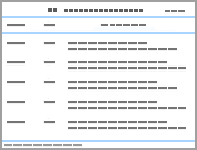
表 1
6个品种 179 个个体的样本信息"
| 品种 Breed | 简称 Abbreviation | 样本数量 Number of samples | 采样地点 Location of samples | 保种模式 Breed conservation model | 采样时间 Sampling time | |
|---|---|---|---|---|---|---|
| 罗盘山猪 Luopanshan pig | LP | 公 Male | 3 | 重庆市潼南区新胜镇罗盘山猪保护区 Luopanshan pig conservation area in Xinsheng town, Tongnan district, Chongqing | 保护区 Conservation area | 2022年12月 December 2022 |
| 母 Female | 27 | |||||
| 合川黑猪 Hechuan Black pig | HC | 公 Male | 14 | 重庆市合川区龙市镇合川黑猪保护区 Hechuan black pig conservation area in Longshi town, Hechuan district, Chongqing | 保护区 Conservation area | 2022年12月 December 2022 |
| 母 Female | 16 | |||||
| 盆周山地猪 Penzhou Mountain pig | PZ | 公 Male | 15 | 重庆市盆周山地猪涪陵保种场 Fuling conservation farm of Penzhou mountain pig in Chongqing | 保种场 Conservation farm | 2022年12月 December 2022 |
| 母 Female | 15 | |||||
| 恩施黑猪 Enshi Black pig | ES | 公 Male | 11 | 湖北省恩施州地大农牧有限责任公司 Hubei Enshi prefecture dida agriculture and animal husbandry Co., Ltd. | 保种场 Conservation farm | 2022年12月 December 2022 |
| 母 Female | 19 | |||||
| 丫杈猪 Yacha pig | YC | 公 Male | 7 | 四川省泸州市古蔺县兰洋生态农业专业合作社 Lanyang ecological agriculture specialized cooperative in Gulin county, Luzhou city, Sichuan | 保种场 Conservation farm | 2022年12月 December 2022 |
| 母 Female | 23 | |||||
| 渠溪猪 Quxi pig | QX | 公 Male | 5 | 重庆市渠溪猪丰都保种场 Chongqing Fengdu conservation farm of Quxi Pig | 保种场 Conservation farm | 2022年12月 December 2022 |
| 母 Female | 24 | |||||
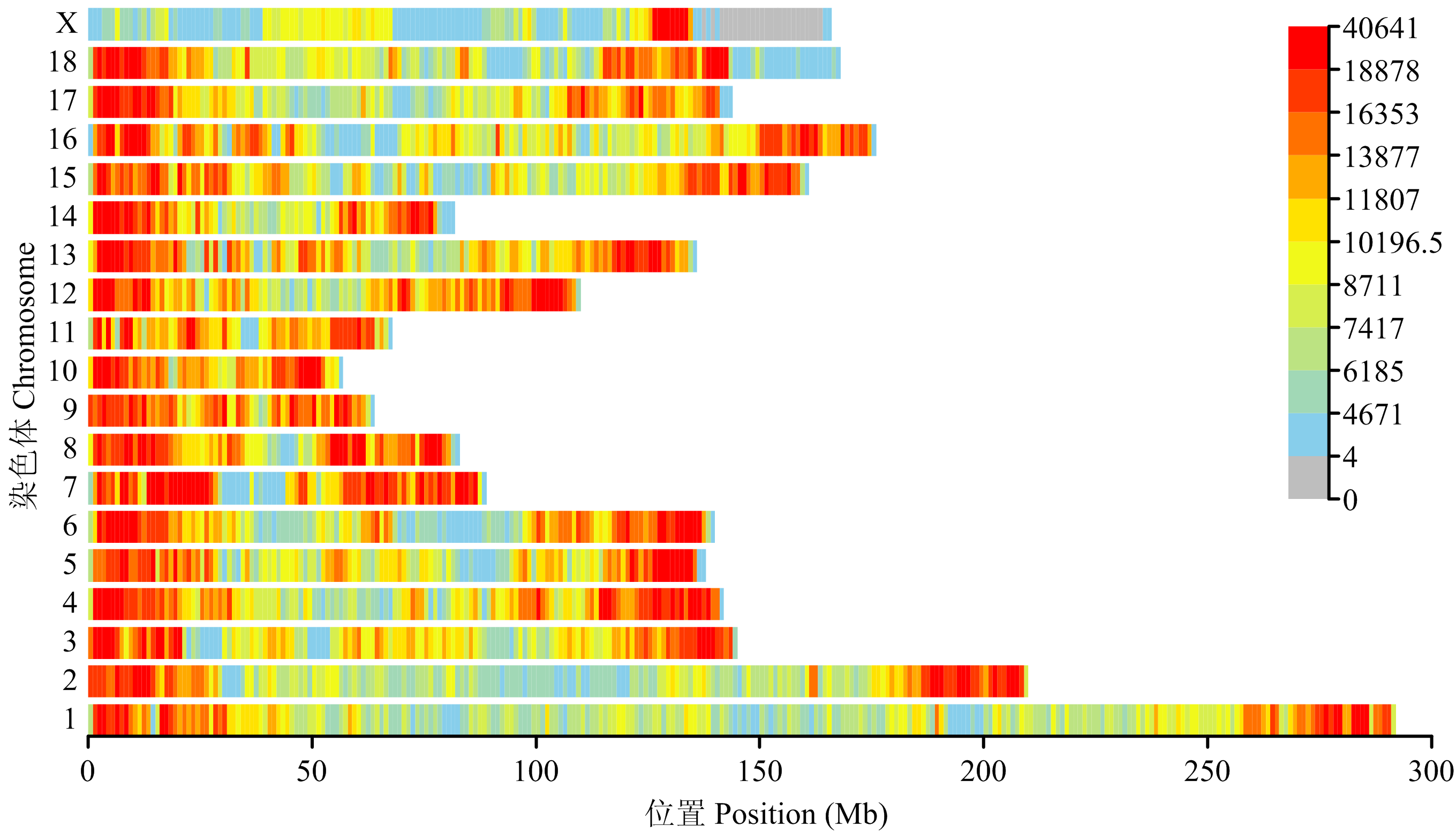
图1
SNP在染色体上的分布图"
表2
湖川山地猪群体遗传多样性参数分析"
| 有效等位基因数 Effective allele number | 期望杂合度 Expected heterozygosity | 观测杂合度 Observed heterozygosity | 纯合度 Homozygosity | 多态信息含量 Polymorphism information content | |
|---|---|---|---|---|---|
| 罗盘山猪Luopanshan pig | 1.405 | 0.2 440 | 0.2 295 | 0.770 | 0.198 |
| 合川黑猪Hechuan Black pig | 1.398 | 0.2 407 | 0.2 127 | 0.787 | 0.196 |
| 盆周山地猪Penzhou Mountain pig | 1.446 | 0.2 703 | 0.2 625 | 0.737 | 0.220 |
| 恩施黑猪Enshi Black pig | 1.467 | 0.2 834 | 0.2 830 | 0.717 | 0.231 |
| 丫杈猪Yacha pig | 1.479 | 0.2 859 | 0.2 989 | 0.701 | 0.231 |
| 渠溪猪Quxi pig | 1.486 | 0.2 948 | 0.3 061 | 0.694 | 0.240 |
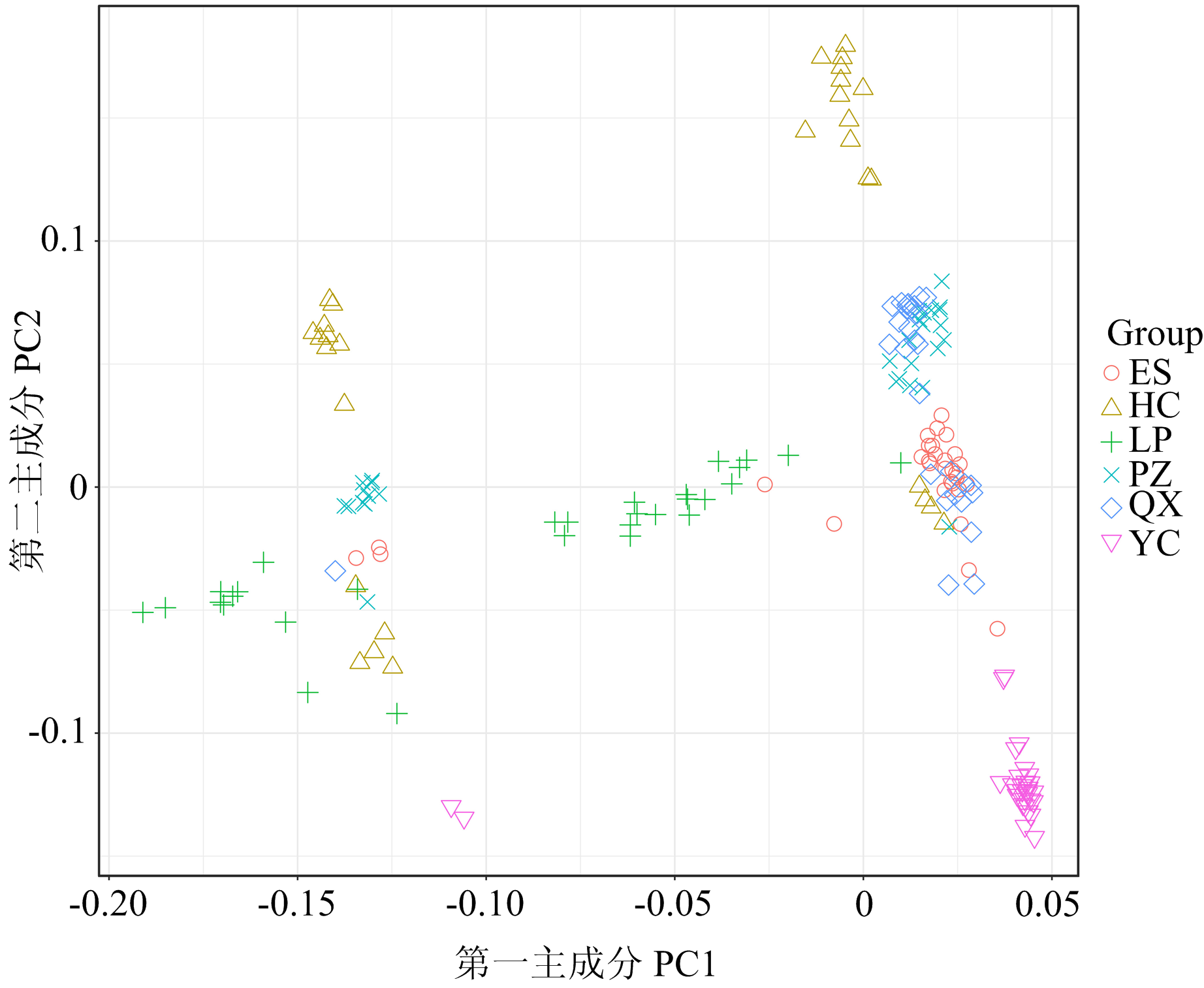
图2
湖川山地猪的主成分分析"
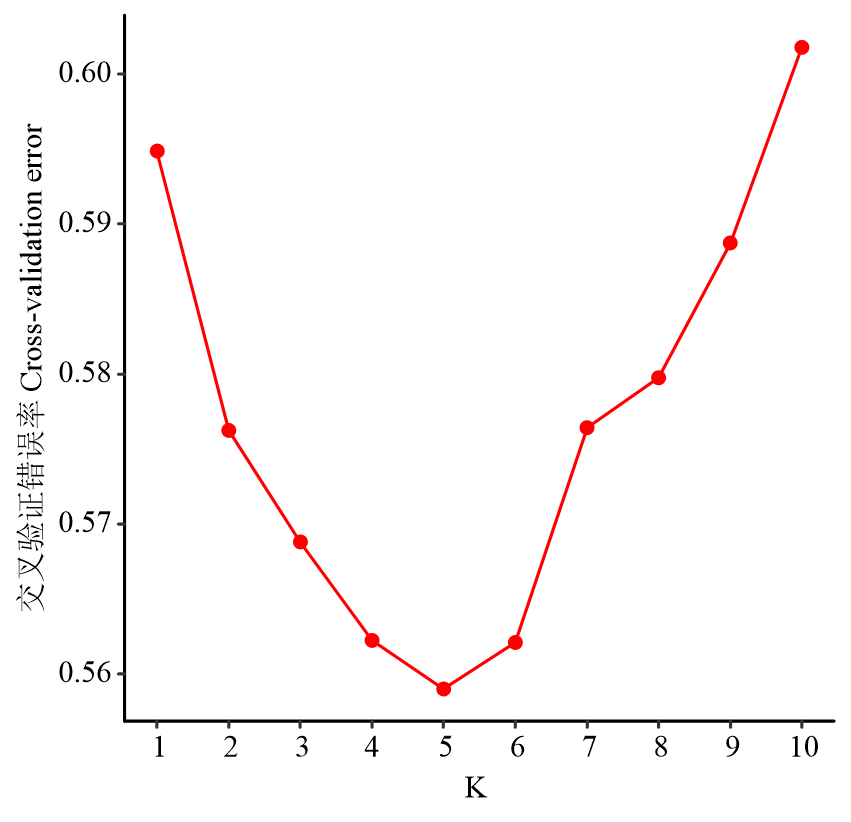
图3
不同K值水平下的交叉验证误差值"
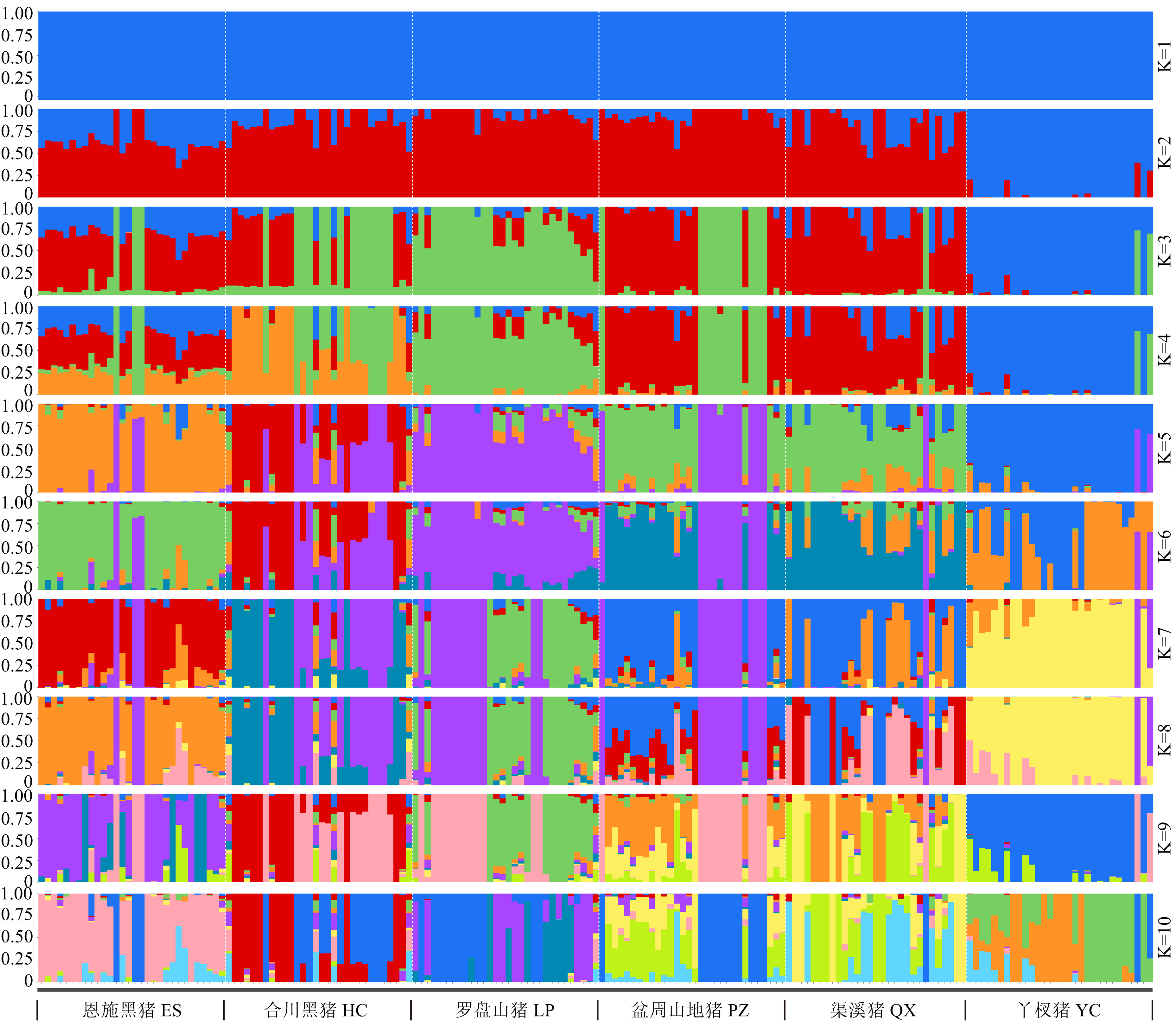
图4
湖川山地猪的祖先血缘成分分析"
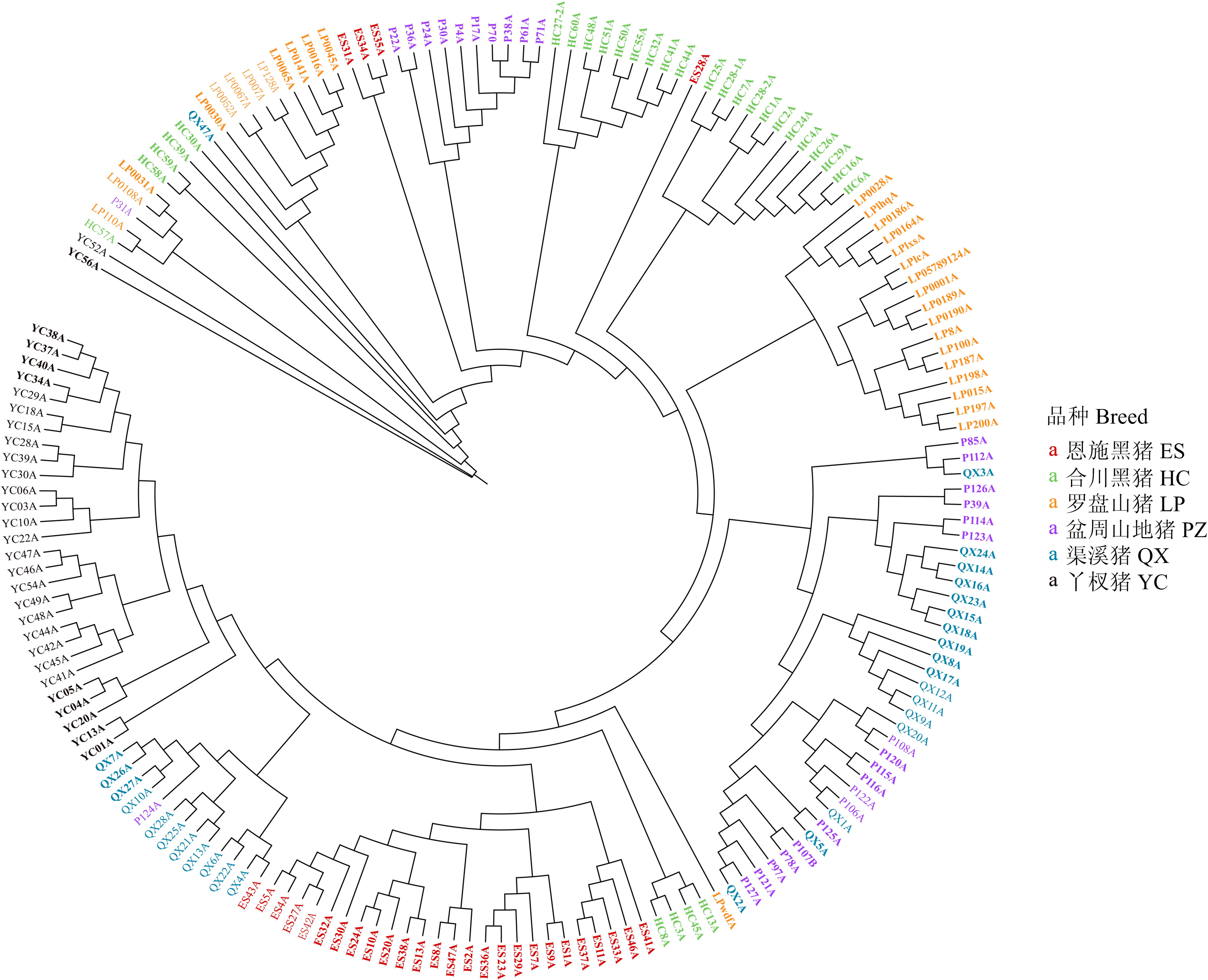
图5
湖川山地猪群体系统进化树"
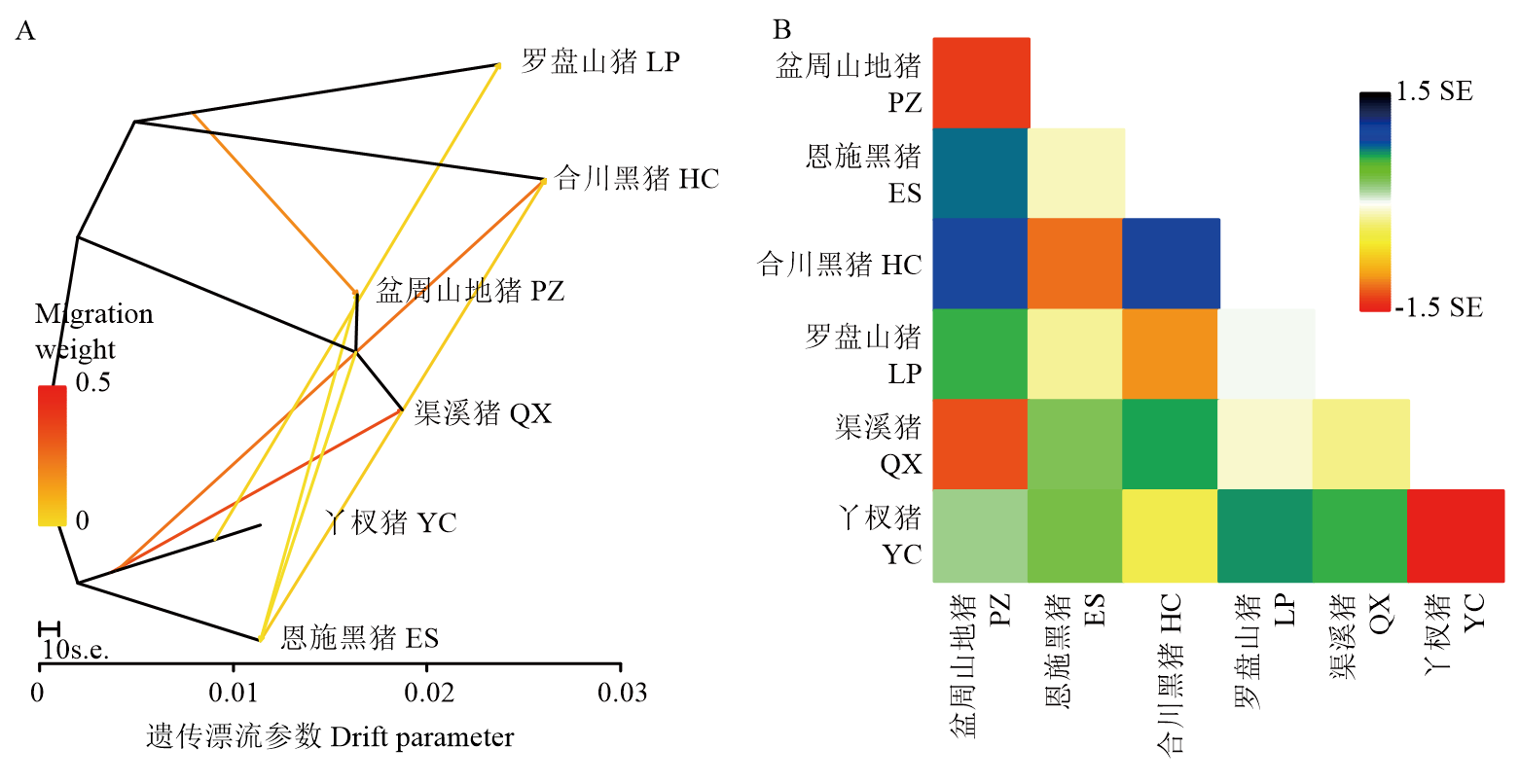
图6
湖川山地猪6个类群的基因流分析 A:类群间遗传漂流与基因渐渗网络图;横轴代表遗传漂流参数(Drift parameter),线条颜色与粗细对应迁移权重(Migration weight),表征群体间基因交流强度;B:6个猪类群间遗传分化矩阵热图;颜色梯度对应标准化遗传分化Z-score(-1.5 SE—1.5 SE)"
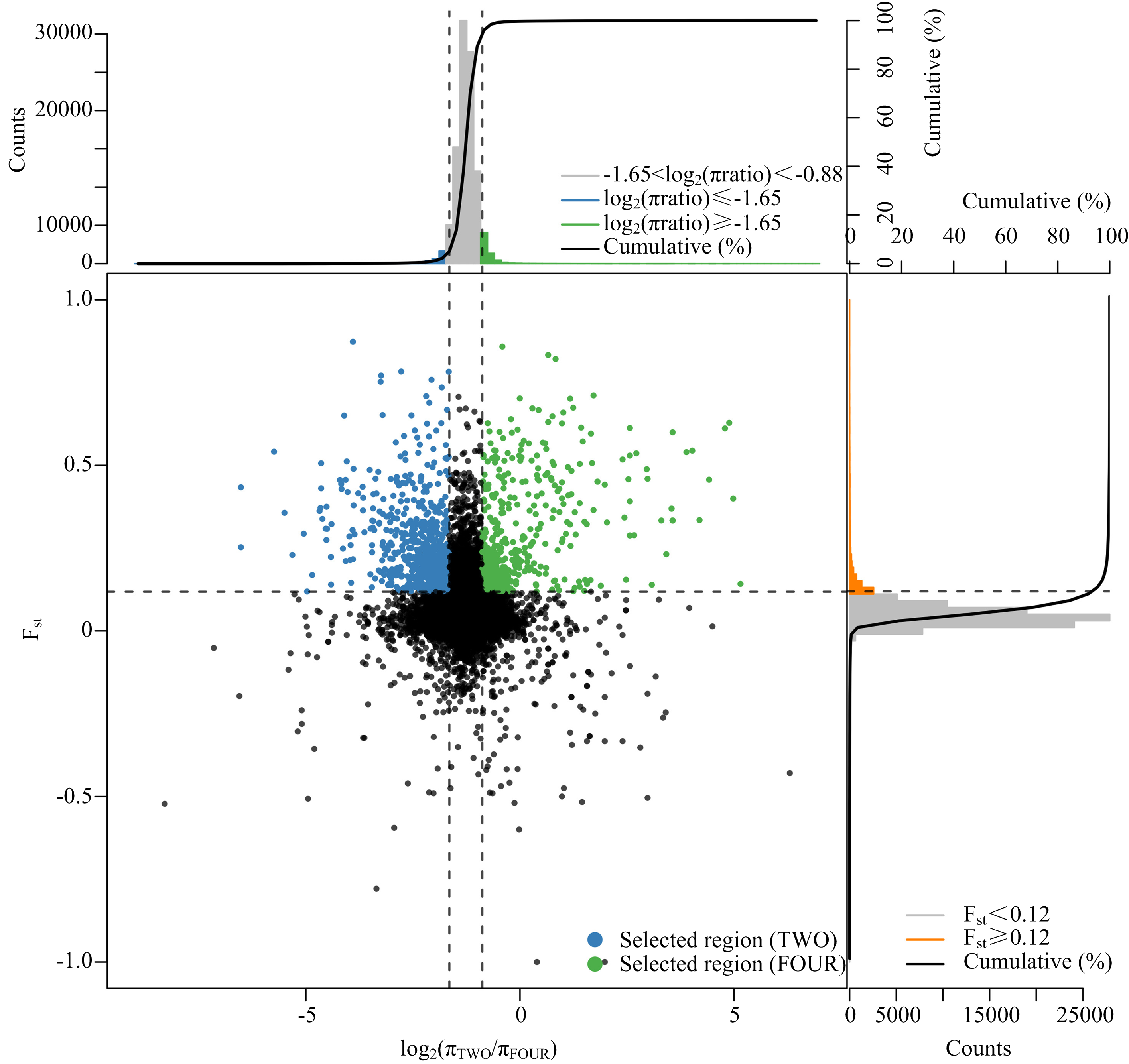
图7
基于Fst与θπ比值联合分析识别湖川山地猪不同保种模式的受选择区域 横坐标为采用保护区保种模式的群体与采用保种场保种模式的群体之间的log2(θπ比值),纵坐标为Fst值。TWO为采用保护区保种模式的群体,FOUR为采用保种场保种模式的群体。蓝色点表示采用保护区保护模式的群体中受选择的基因区域,绿色点表示采用保种场保种模式的群体中受选择的基因区域。上方与右侧的边缘图展示了log2(θπ比值)和Fst值的分布密度及累计百分比。筛选阈值分别为log2(θπ比值)≤-1.65 或≥1.65,Fst≥0.12"
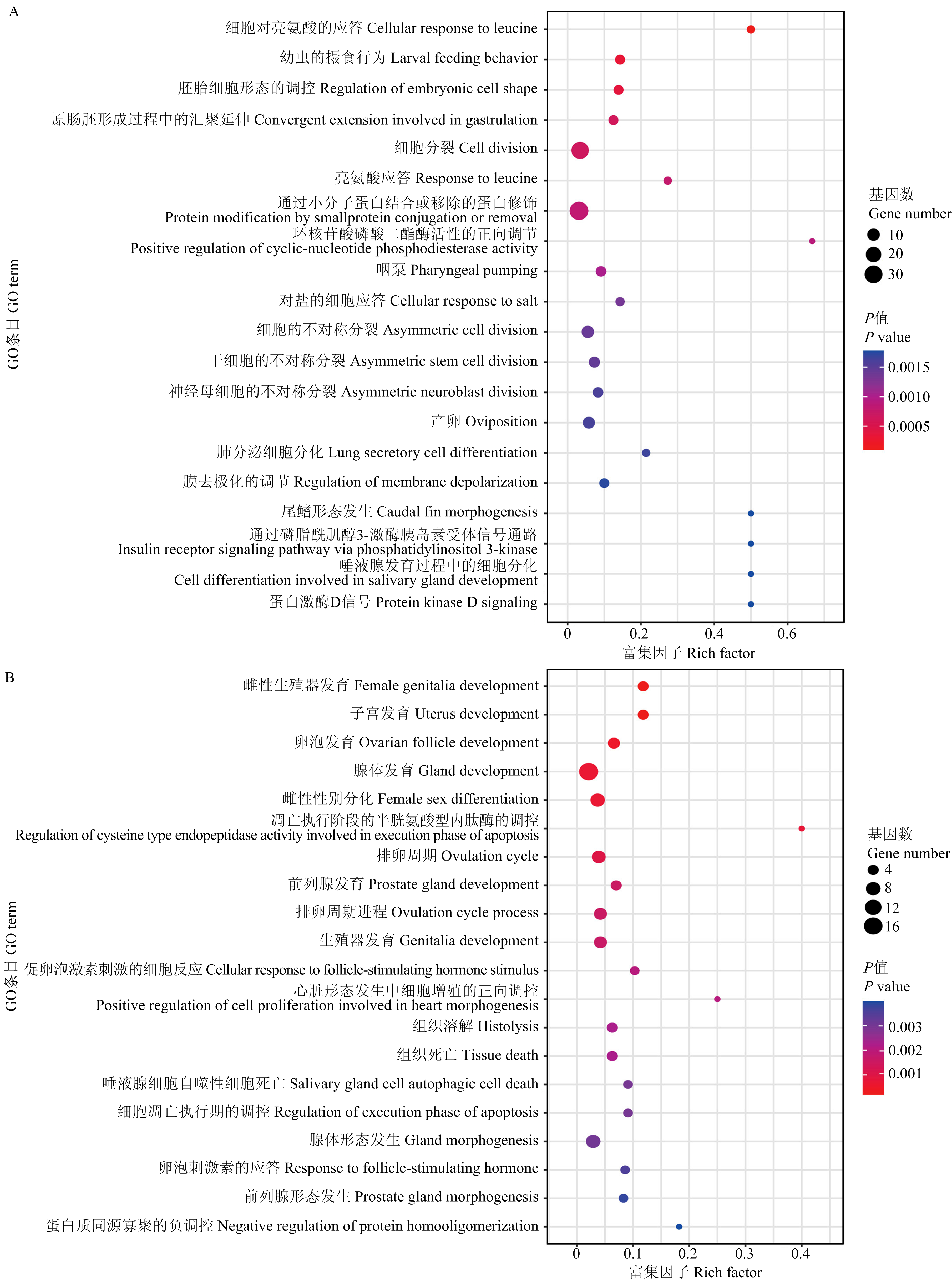
图8
GO富集分析结果 A:保护区保种模式的群体受选择基因的GO富集;B:保种场保种模式的群体受选择基因的GO富集"
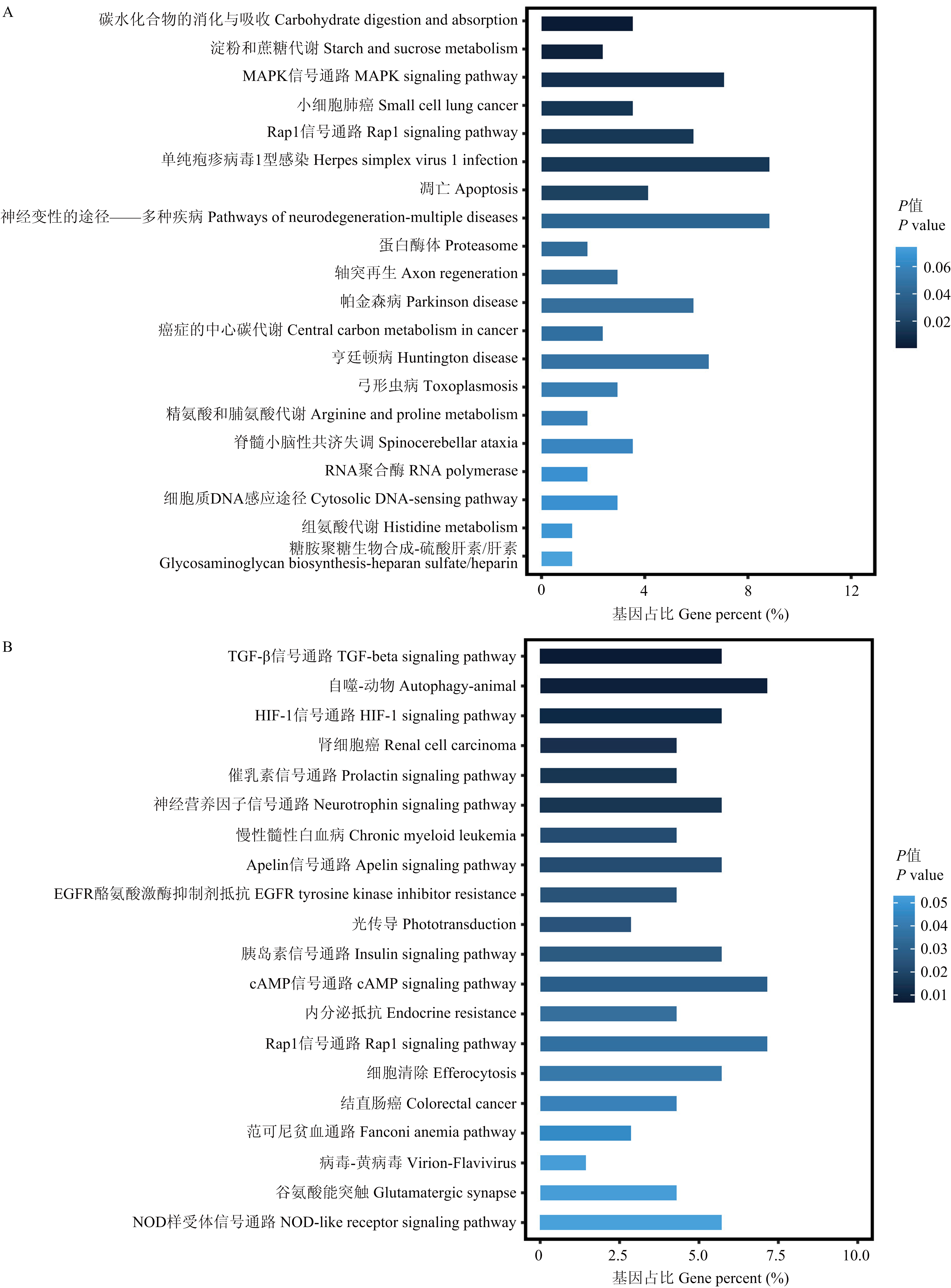
图9
KEGG富集分析 A:采用保护区保种模式的群体受选择基因的KEGG富集结果;B:采用保种场保种模式的群体受选择基因的KEGG富集结果"
| [1] |
李林峰, 吴卓穗, 王盼, 曾检华, 胡旭进, 李剑豪, 孟繁明, 胡斌. 中国主要地方猪资源杂交利用屠宰性能对比分析. 广东畜牧兽医科技, 2024, 49(4): 24-34.
doi: 10.19978/j.cnki.xmsy.2024.04.04 |
|
|
|
| [2] |
赵思思, 贾青, 胡慧艳, 李晓敏. 西南型地方猪品种资源的变化. 贵州农业科学, 2016, 44(10): 91-94.
|
|
|
|
| [3] |
王旭, 尹亚斌. 四川农业大学: 保护开发利用猪品种确保生猪稳产保供. 中国畜牧业, 2021(1): 25.
|
|
|
|
| [4] |
葛桂华, 李强, 王小强, 杨舒慧, 陈映, 杨东丽. 四川省地方猪遗传资源的保护利用. 四川畜牧兽医, 2022, 49(7): 8-9.
|
|
|
|
| [5] |
国家畜禽遗传资源委员会. 中国畜禽遗传资源志-猪志. 北京: 中国农业出版社, 2011.
|
|
National Commission on Genetic Resources for Livestock and Poultry. Animal genetic resources in China. Beijing: China Agriculture Press, 2011. (in Chinese)
|
|
| [6] |
邓纯干, 张向东, 邓茂林. 恩施黑猪的生产性能与杂交效果测定. 中国畜牧杂志, 1983, 19(5): 33-36.
|
|
|
|
| [7] |
付玉华. 多组学分析揭示恩施黑猪经济性状相关的遗传信号和分子通路[D]. 武汉: 华中农业大学, 2017.
|
|
|
|
| [8] |
吴林慧, 孙琦, 王荔茹, 张凯丽, 谢胜松, 李新云, 赵书红, 马云龙. 恩施黑猪基因组群体遗传学参数的估计与选择信号研究. 畜牧兽医学报, 2019, 50(3): 485-494.
|
|
doi: 10.11843/j.issn.0366-6964.2019.03.003 |
|
| [9] |
龙熙, 柴捷, 陈力, 潘红梅, 张亮, 陈四清, 郭宗义, 张廷焕. 基于SNP芯片的盆周山地猪保种群体保种效果评估. 华北农学报, 2022, 37(S1): 358-365.
doi: 10.7668/hbnxb.20192586 |
|
doi: 10.7668/hbnxb.20192586 |
|
| [10] |
潘晓, 王德蓉, 周丽萍. 湖川山地猪(合川黑猪)遗传资源保护与开发利用. 中国猪业, 2013, 8(S1): 146-148.
|
|
|
|
| [11] |
龙熙, 陈力, 吴平先, 张廷焕, 潘红梅, 张亮, 王金勇, 郭宗义, 柴捷. 合川黑猪保种群遗传结构及选择信号分析. 畜牧兽医学报, 2023, 54(5): 1854-1867.
doi: 10.11843/j.issn.0366-6964.2023.05.009 |
|
doi: 10.11843/j.issn.0366-6964.2023.05.009 |
|
| [12] |
邓娟. 湖川山地猪(罗盘山猪)的保护和开发利用. 中国猪业, 2013, 8(S1): 132-133.
|
|
|
|
| [13] |
陈勇. 渠溪猪保护与利用. 今日养猪业, 2008(3): 49-50.
|
|
|
|
| [14] |
杨雪梅, 吕学斌, 何志平, 梁艳, 龚建军, 向德. 丫杈猪种质特性研究. 养猪, 2009(5): 36-38.
|
|
|
|
| [15] |
陶璇, 杨雪梅, 梁艳, 刘一辉, 汪勇, 孔繁晶, 雷云峰, 杨跃奎, 王言, 安瑞, 等. 基于SNP芯片的丫杈猪保种群体遗传结构研究. 畜牧兽医学报, 2023, 54(6): 2308-2319.
doi: 10.11843/j.issn.0366-6964.2023.06.011 |
|
doi: 10.11843/j.issn.0366-6964.2023.06.011 |
|
| [16] |
童雄, 罗威, 闵力, 张志飞, 马新燕, 罗成龙, 陈卫东, 徐斌, 李大刚. 基于全基因组SNPs分析陆丰黄牛和雷琼牛的群体结构与遗传多样性特征. 中国农业科学, 2023, 56(14): 2798-2811. doi: 10.3864/j.issn.0578-1752.2023.14.014.
|
|
|
|
| [17] |
李沛, 何治霖, 谈月霞, 赵婉彤, 冯锦英, 陈贵虎, 严池, 王子豪, 黄平, 江东. 基于重测序数据与表型性状的宽皮柑橘遗传多样性分析与优异种质筛选. 中国农业科学, 2024, 57(23): 4761-4773. doi: 10.3864/j.issn.0578-1752.2024.23.014.
|
|
|
|
| [18] |
|
| [19] |
|
| [20] |
doi: 10.1093/bioinformatics/btp352 pmid: 19505943 |
| [21] |
doi: 10.1101/gr.107524.110 pmid: 20644199 |
| [22] |
doi: 10.1086/519795 |
| [23] |
|
| [24] |
doi: 10.1093/molbev/msy096 pmid: 29722887 |
| [25] |
doi: 10.1111/mee3.2017.8.issue-1 |
| [26] |
doi: 10.1101/gr.094052.109 pmid: 19648217 |
| [27] |
doi: 10.1093/bioinformatics/btr330 pmid: 21653522 |
| [28] |
doi: 10.1093/bioinformatics/btq033 pmid: 20110278 |
| [29] |
|
| [30] |
农业农村部. 种质资源保护利用取得新突破. 植物遗传资源学报, 2025, 26(2): 404.
|
|
Ministry of Agriculture and Rural Affairs. New breakthroughs have been made in the protection and utilization of germplasm resources. Journal of Plant Genetic Resources, 2025, 26(2): 404. (in Chinese)
|
|
| [31] |
皮忠宽. 浅谈地方畜禽品种遗传资源保护及利用策略. 中文科技期刊数据库(全文版)农业科学, 2024, 5: 129-132.
|
|
|
|
| [32] |
编辑部. 加强地方畜禽遗传资源保护. 中国畜牧业, 2024, 24:8.
|
|
|
|
| [33] |
李广斌. 地方优良猪品种的保护和利用探讨. 中文科技期刊数据库(全文版)农业科学, 2025, 4: 96-99.
|
|
|
|
| [34] |
张雯韬, 马思奇, 向鸿坤, 贺建华, 伍树松. 地方猪品种改良及营养调控研究进展. 中国猪业, 2024, 19(2): 3-14.
|
|
|
|
| [35] |
朱蓓蓓, 李美发, 李杨, 曾璐瑶. 恩施黑猪饲养管理措施. 猪业科学, 2024, 41(1): 124-125.
|
|
|
|
| [36] |
牛丽莉, 赵叶, 林涛, 李林祥, 曾德彬, 张裕贤, 朱砺. 青峪猪的保护与利用. 四川畜牧兽医, 2021, 48(12): 40-40, 43.
|
|
|
|
| [37] |
李良华, 武华玉, 徐小娟, 宋忠旭, 彭先文, 梅书棋, 刘贵生, 董斌科, 孙华, 李明波, 胡建国. 湖川山地猪(恩施黑猪)资源之开发利用. 中国猪业, 2013, 8(S1): 101-103.
|
|
|
|
| [38] |
任宏伟. 猪基因组育种研究进展与应用趋势. 养猪, 2025(1): 17-19.
|
|
|
|
| [39] |
刘国信. 加强地方猪种保护利用推动产业高质量发展. 兽药市场指南, 2024(4): 1-6.
|
|
|
|
| [40] |
doi: 10.1002/wics.v2:4 |
| [41] |
doi: 10.1186/1471-2105-12-246 |
| [42] |
doi: 10.1016/0025-5564(81)90043-2 |
| [43] |
doi: 10.1534/genetics.118.301319 pmid: 30626638 |
| [44] |
doi: 10.1101/gr.4252305 pmid: 16251466 |
| [1] | 何治霖, 孙翠霞, 岳红丽, 谈月霞, 张耀海, 王福生, 刘思涛, 江东. 基于重测序枸橼、柠檬类种质资源的遗传多样性分析和别罗勒烯的全基因组关联分析[J]. 中国农业科学, 2026, 59(2): 386-401. |
| [2] | 罗嘉锐, 吴三玲, 郭芾, 刘振, 宋婧含, 谭瑗瑗, 舒庆尧. 籼稻品种基因组中逆转座子Tos17的鉴定与研究[J]. 中国农业科学, 2025, 58(15): 2933-2947. |
| [3] | 李沛, 何治霖, 谈月霞, 赵婉彤, 冯锦英, 陈贵虎, 严池, 王子豪, 黄平, 江东. 基于重测序数据与表型性状的宽皮柑橘遗传多样性分析与优异种质筛选[J]. 中国农业科学, 2024, 57(23): 4761-4773. |
| [4] | 徐金青, 边海燕, 陈同睿, 王蕾, 王寒冬, 尤恩, 邓超, 唐有林, 沈裕虎. 青海省青稞主栽品种昆仑14与昆仑15的基因组序列多态性比较[J]. 中国农业科学, 2024, 57(21): 4192-4204. |
| [5] | 郑文燕, 常源升, 何平, 何晓文, 王森, 高文胜, 李林光, 王海波. ‘鲁丽’ב红1#’苹果杂交群体全基因组KASP标记开发及验证[J]. 中国农业科学, 2023, 56(5): 935-950. |
| [6] | 童雄, 罗威, 闵力, 张志飞, 马新燕, 罗成龙, 陈卫东, 徐斌, 李大刚. 基于全基因组SNPs分析陆丰黄牛和雷琼牛的群体结构与遗传多样性特征[J]. 中国农业科学, 2023, 56(14): 2798-2811. |
| [7] | 李恒,字向东,王会,熊燕,吕明杰,刘宇,蒋旭东. 基于全基因组重测序的山羊产羔数性状关键调控基因的筛选[J]. 中国农业科学, 2022, 55(23): 4753-4768. |
| [8] | 李东华,付亚伟,张晨曦,曹艳芳,李文婷,李转见,康相涛,孙桂荣. 淅川乌骨鸡全基因组转座子的鉴定与分析[J]. 中国农业科学, 2020, 53(7): 1491-1500. |
| [9] | 寇淑君, 霍阿红, 付国庆, 纪军建, 王瑶, 左振兴, 刘敏轩, 陆平. 利用荧光SSR分析中国糜子的遗传多样性和群体遗传结构[J]. 中国农业科学, 2019, 52(9): 1475-1477. |
| [10] | 魏潇,章秋平,刘宁,张玉萍,徐铭,刘硕,张玉君,马小雪,刘威生. 不同来源中国李(Prunus salicina L.)的多样性与近缘种关系[J]. 中国农业科学, 2019, 52(3): 568-578. |
| [11] | 王嘉, 曾召琼, 梁建秋, 于晓波, 吴海英, 张明荣. 基于全基因组重测序的大豆分子标记开发及籽粒蛋白质含量QTL定位[J]. 中国农业科学, 2019, 52(16): 2743-2757. |
| [12] | 齐传翔,徐奎,牟玉莲,杨述林,李奎,吴添文. 猪CBR1基因不同拷贝形式克隆及其多态性分析[J]. 中国农业科学, 2018, 51(8): 1607-1616. |
| [13] | 赵久然,李春辉,宋伟,王元东,张如养,王继东,王凤格,田红丽,王蕊. 基于SNP芯片揭示中国玉米育种种质的遗传多样性与群体遗传结构[J]. 中国农业科学, 2018, 51(4): 626-634. |
| [14] | 董合忠,张艳军,张冬梅,代建龙,张旺锋. 基于集中收获的新型棉花群体结构[J]. 中国农业科学, 2018, 51(24): 4615-4624. |
| [15] | 薛延桃,陆平,乔治军,刘敏轩,王瑞云. 基于SSR标记的黍稷种质资源遗传多样性及亲缘关系研究 [J]. 中国农业科学, 2018, 51(15): 2846-2859. |
|
||
