






中国农业科学 ›› 2026, Vol. 59 ›› Issue (8): 1797-1808.doi: 10.3864/j.issn.0578-1752.2026.08.014
刘雨晴1( ), 张璐1, 李建杰1, 杨海通1, 宋连杰2, 李伯森3, 高玉红1(), 张会文3, 孙新胜4()
收稿日期:2025-05-21
接受日期:2026-03-30
出版日期:2026-04-21
发布日期:2026-04-21
通信作者:
联系方式:
刘雨晴,Tel:15832391785;E-mail:747934131@qq.com。
基金资助:
LIU YuQing1(), ZHANG Lu1, LI JianJie1, YANG HaiTong1, SONG LianJie2, LI BoSen3, GAO YuHong1(), ZHANG HuiWen3, SUN XinSheng4()
Received:2025-05-21
Accepted:2026-03-30
Published:2026-04-21
Online:2026-04-21
摘要:
【背景】三甲胺(trimethylamine,TMA)作为典型的含氮胺类有机污染物,是养殖业臭气污染的主要贡献气体之一。该物质为具有鱼腥臭味的有害气体,其恶臭强烈,不仅造成养殖区域的点源污染,长期低浓度暴露还会对人类造成潜在的健康风险,近几年已受到人们关注。【目的】通过对采集的畜粪中TMA脱除菌的分离和筛选,得到降解能力强的高效TMA脱除菌,为畜牧养殖中TMA的污染防治研究提供优良菌种。【方法】以猪粪和牛粪作为TMA脱除菌株的分离来源,通过富集培养、分离和纯化及除臭能力测定分离出TMA脱除率高的菌株,并采用形态学观察和16S rRNA基因分析对菌株进行鉴定以确定其菌属特性;在此基础上,进一步探究该菌株在不同pH(5.0、6.0、7.0、8.0 和 9.0)、碳源(木糖、蔗糖、果糖、麦芽糖和葡萄糖)、盐度(0、0.5%、1.0%、1.5% 和 2.0%)和接种量(1%、5%、10%、15% 和 20%)条件下菌株生物量的变化,确定菌株适宜的生长条件;最后对高效菌株的实际除臭效果进行验证,通过检测粪便发酵初期TMA的释放量和脱除率,确定菌株对TMA的脱除能力。【结果】(1)从畜粪中共分离出10株TMA脱除菌株(命名T1—T10),其中菌株T2(枯草芽孢杆菌(Bacillus subtilis))和菌株T3(不动杆菌(Acinetobacter sp.))的TMA脱除率最高,培养48 h的脱除率分别达26.91%和29.59%,显著高于其他8株菌(P<0.05)。(2)不同pH、碳源、盐度和接种量对菌株T2和T3的生长均产生不同影响。菌株T2的适宜生长条件为pH=6.0、碳源=葡萄糖、盐度=0.5%和接种量=1.0% ;T3的适宜生长条件为pH=8.0、碳源=蔗糖、盐度=0.5%和接种量=1.0%。在此条件下菌株生长最快,生物量最大。(3)除臭效果验证试验表明,粪便中添加菌株T2和T3的TMA平均释放量均显著低于对照组(P<0.01),最高除臭率分别达42.65%和39.63%。【结论】分离的枯草芽孢杆菌(T2)和不动杆菌(T3)具有高效脱除TMA能力,在畜禽粪污处理及畜牧养殖污染防治领域具有潜在的利用价值。
刘雨晴, 张璐, 李建杰, 杨海通, 宋连杰, 李伯森, 高玉红, 张会文, 孙新胜. 高效三甲胺脱除菌株的筛选及生长条件优化[J]. 中国农业科学, 2026, 59(8): 1797-1808.
LIU YuQing, ZHANG Lu, LI JianJie, YANG HaiTong, SONG LianJie, LI BoSen, GAO YuHong, ZHANG HuiWen, SUN XinSheng. Isolation of Efficient Trimethylamine-Removing Strains and Optimization of Growth Conditions[J]. Scientia Agricultura Sinica, 2026, 59(8): 1797-1808.

图1
TMA选择培养基中存活菌株(T1—T10)"
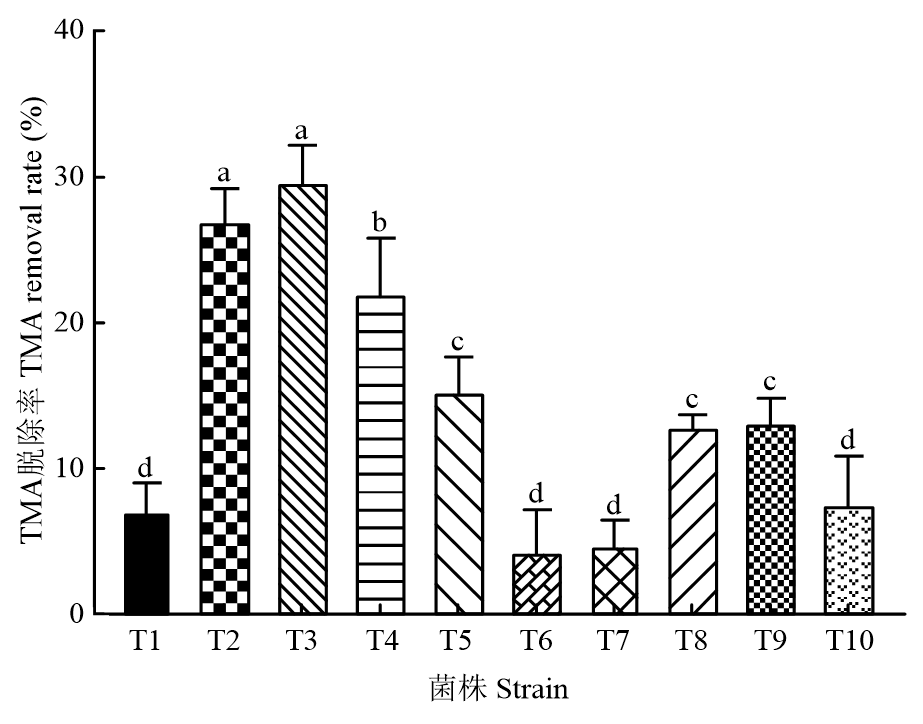
图2
所筛10株TMA脱除菌培养48 h的脱除率 柱上方不同字母表示差异显著(P<0.05),相同字母表示差异不显著(P>0.05)"
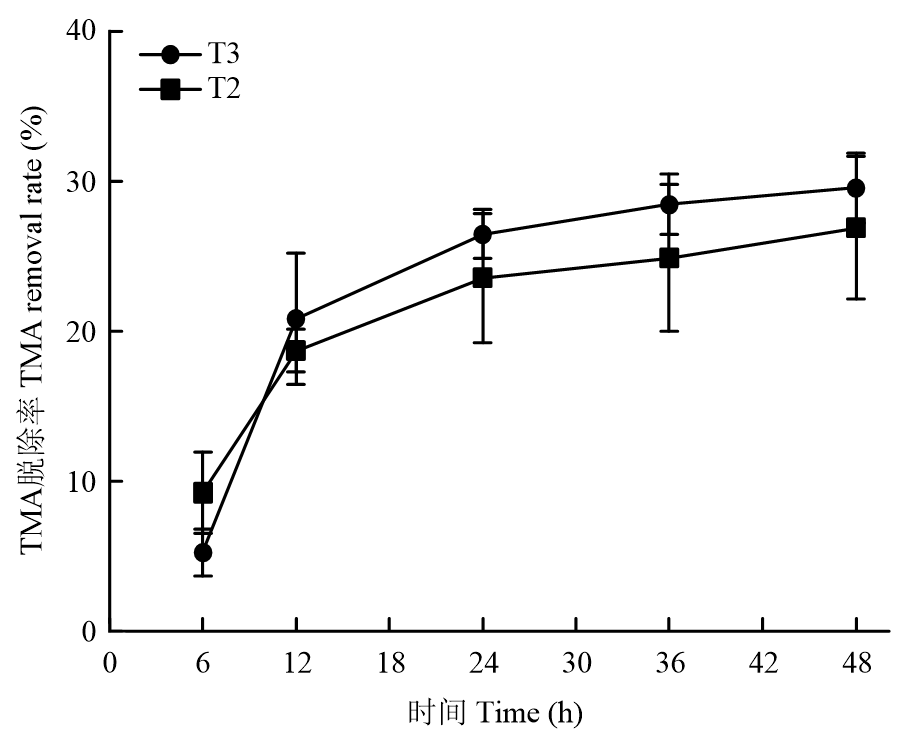
图3
菌株T3和T2对TMA的脱除效果"

图4
T2和T3的菌落形态及革兰氏染色 A、C为T2、T3菌落形态;B、D为T2、T3革兰氏染色结果"
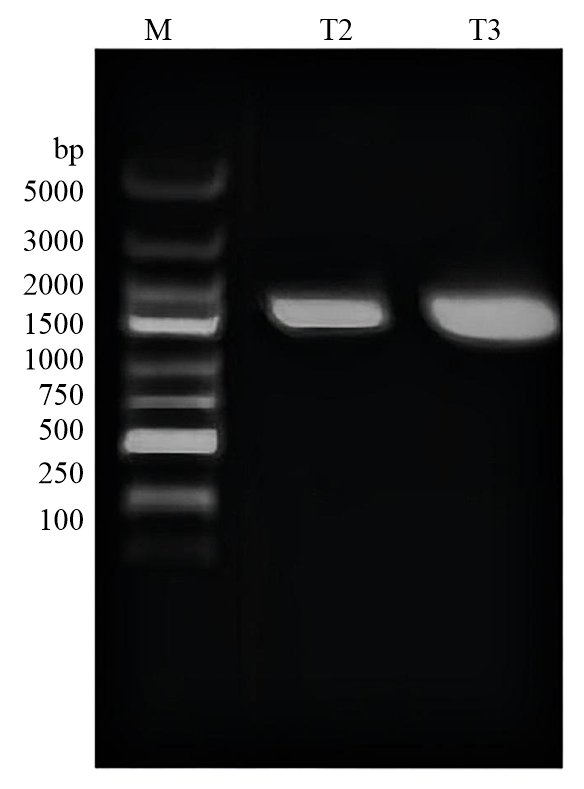
图5
T2和T3菌株的PCR扩增产物 M:DL2000DNA标记物"
表1
T2和T3菌株的16S rRNA序列相似性比对"
| 菌株编号Strain number | 菌名Bacterial name | 覆盖率Coverage | 同源性Homology | 序列号Serial number |
|---|---|---|---|---|
| T2 | 枯草芽孢杆菌Bacillus subtilis | 100% | 100% | MT372156.1 |
| T3 | 不动杆菌Acinetobacter sp. | 100% | 99.58% | MT757941.1 |
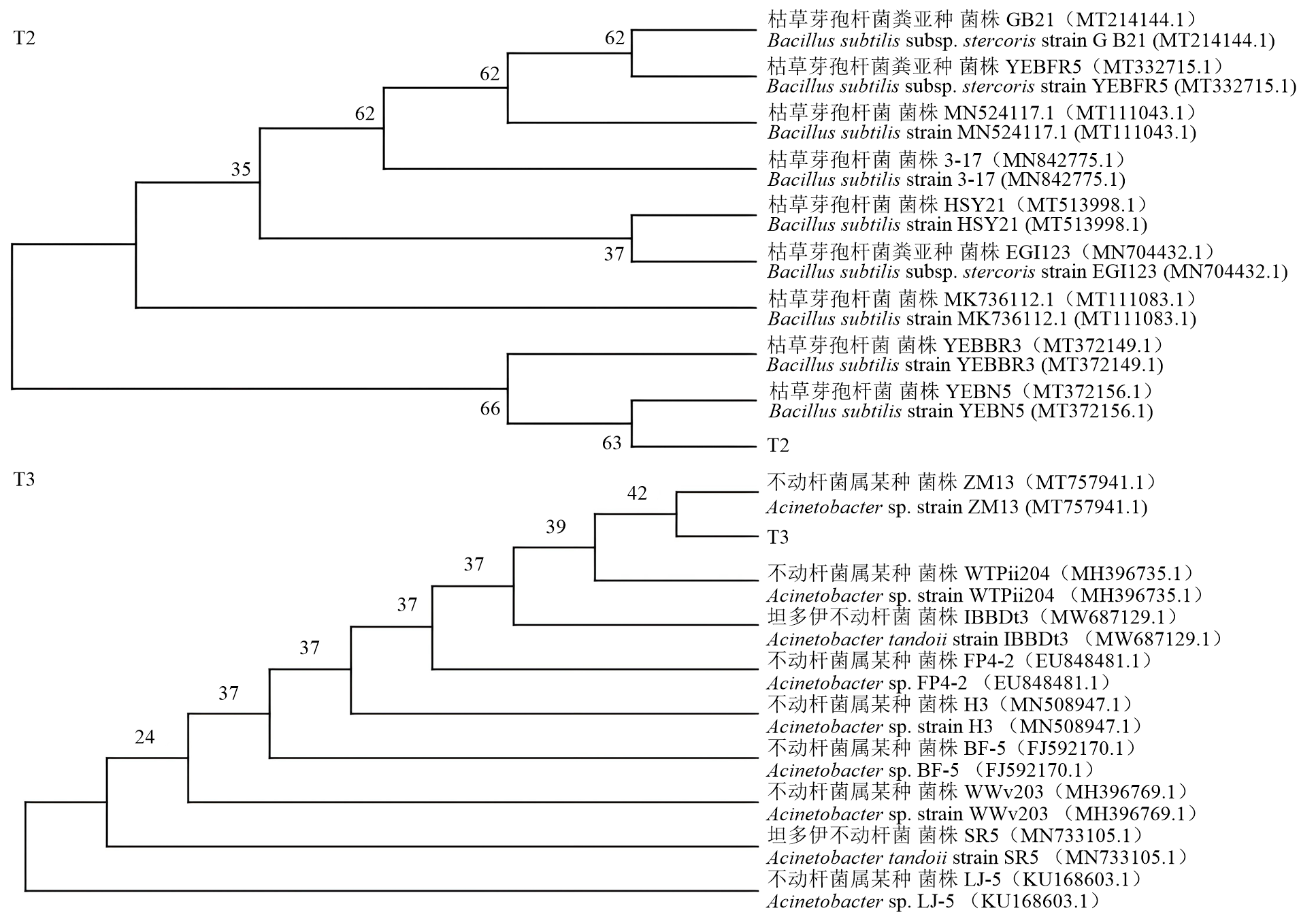
图6
T2和T3依据16S rRNA序列构建菌株和相关菌株系统发育树 A为T2菌株系统发育树;B为T3菌株系统发育树"
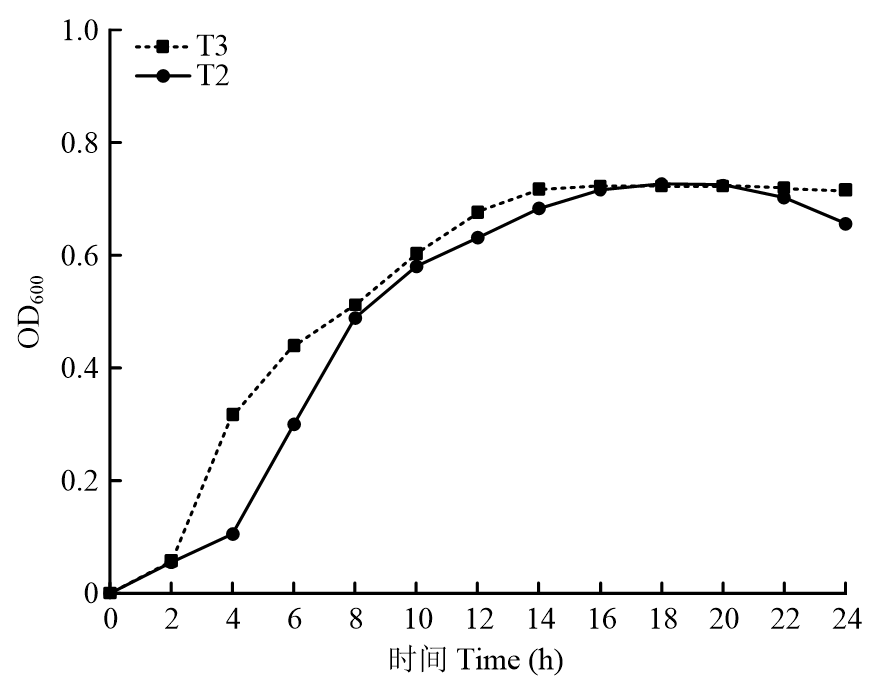
图7
T2和T3菌株的生长曲线"

图8
菌株T2在不同pH、碳源、盐度和接种量的生长条件优化 A:pH;B:碳源;C:盐度;D:接种量。图9同"
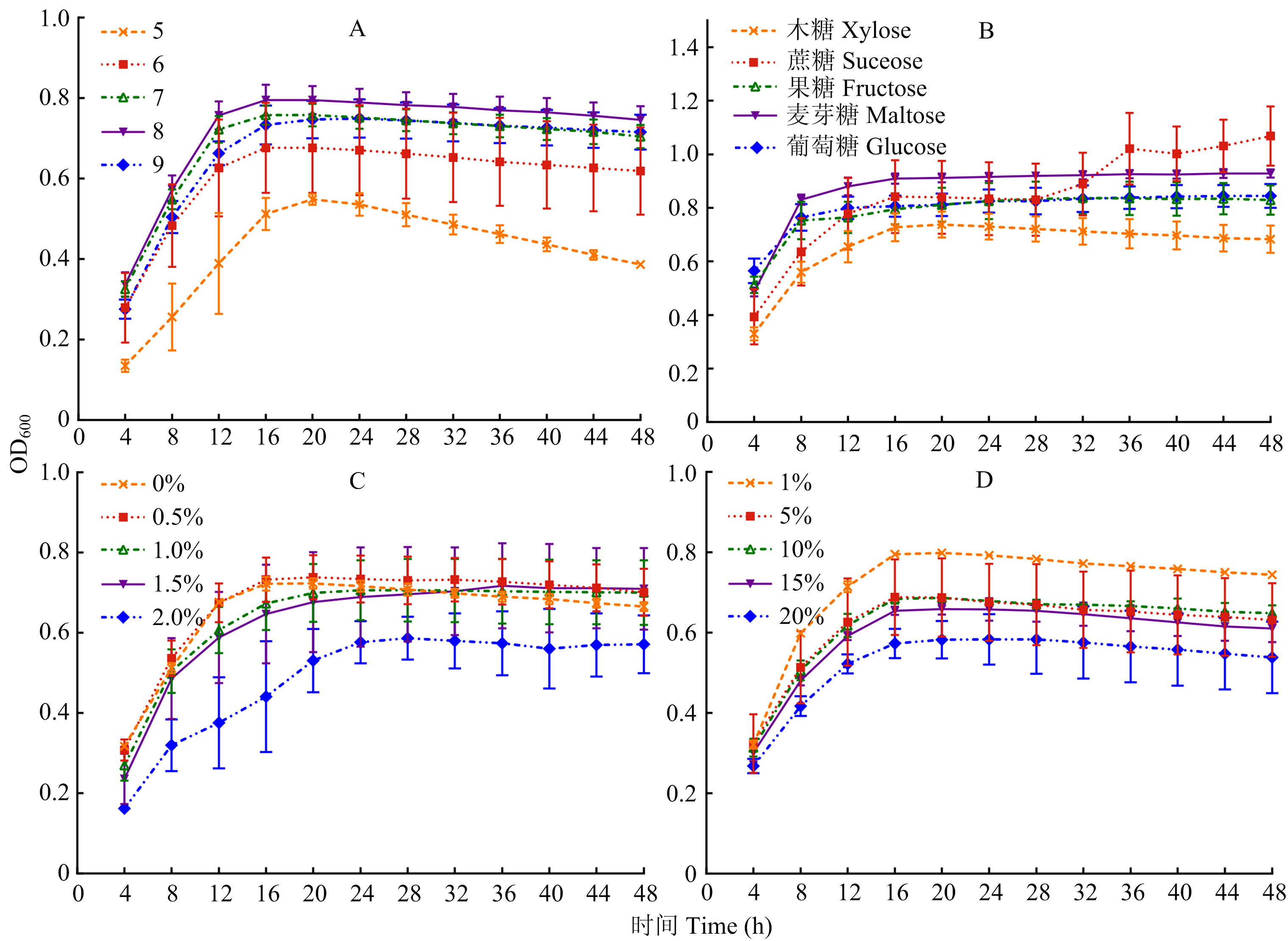
图9
菌株T3在不同pH、碳源、盐度和接种量的生长条件优化"
表2
2株TMA脱除菌对粪便中TMA释放量的影响"
| 时间 Time (d) | CK组 CK group (mg·m-3) | T2组 T2 group (mg·m-3) | T3组 T3 group (mg·m-3) |
|---|---|---|---|
| 1 | 4.55±0.028aA | 4.16±0.963aB | 4.11±0.427aB |
| 2 | 5.13±0.503aA | 3.94±0.530abB | 3.09±0.483bB |
| 3 | 5.92±1.976aA | 3.67±0.612abA | 3.92±0.651abA |
| 4 | 5.55±0.595aA | 3.15±0.355bB | 3.34±0.465abB |
| 5 | 5.56±0.488aA | 3.79±0.233abB | 3.61±0.563abB |
| 全期Overall | 5.34±0.956A | 3.74±0.494B | 3.61±0.578B |
| 处理Treatment | <0.01 | ||
| 时间Time | 0.53 | ||
| 处理×时间 Treatment×Time | 0.19 | ||
表3
菌株T2和T3对粪便中TMA脱除率的影响"
| 时间Time (d) | T2组 T2 group (%) | T3组 T3 group (%) |
|---|---|---|
| 1 | 8.59±3.012bA | 9.66±6.032aA |
| 2 | 23.06±6.983abA | 39.49±8.477aA |
| 3 | 31.66±8.377abA | 27.07±6.572aA |
| 4 | 42.65±7.252aA | 39.63±8.736aA |
| 5 | 31.54±3.371abA | 34.42±4.922aA |
| 全期Overall | 27.50±12.650A | 30.05±12.490A |
| 处理Treatment | 0.64 | |
| 时间Time | 0.02 | |
| 处理×时间 Treatment×Time | 0.76 | |
| [1] |
杨保留. 当前畜牧养殖环境污染的现状及治理对策. 中兽医学杂志, 2021(9): 93-94.
|
|
|
|
| [2] |
陈贺亮. 畜牧养殖环境污染的不同类型及其治理对策研究. 畜牧兽医科技信息, 2024(8): 65-68.
|
|
|
|
| [3] |
车大璐, 赵俐辰, 程素彩, 刘爱瑜, 李晓宇, 赵寿培, 王健诚, 王媛, 高玉红, 孙新胜. 垫料床对育肥羔羊生长性能和臭气排放的影响. 中国农业科学, 2022, 55(24): 4943-4956. doi: 10.3864/j.issn.0578-1752.2022.24.012.
|
|
|
|
| [4] |
高旭, 李建立, 路占云, 王孟雄, 郑忠, 刘从, 田树军. 羊床模式与环境气象因素对肉羊养殖异味气体水平的影响. 黑龙江畜牧兽医, 2025(2): 50-54.
|
|
|
|
| [5] |
吴玉洪, 张世昌, 田茜, 马桂珍, 郭荣君, 李世东, 钟增明. 堆肥臭味物质: 粪臭素高效降解菌Rp3的分离和鉴定. 农业资源与环境学报, 2021, 38(4): 576-584.
|
|
|
|
| [6] |
徐彦鹏, 吕道飞, 郭雅欣, 许锋, 颜健, 袁文兵, 陈忻. 三甲胺移除技术的研究进展. 广州化工, 2023, 51(11): 8-10.
|
|
|
|
| [7] |
韩鹏, 任爱玲, 郭斌, 律国黎. 过氧化氢改性活性炭对三甲胺废气的吸附. 河北科技大学学报, 2013, 34(2): 159-165.
|
|
|
|
| [8] |
杜国伟, 夏文水. 鲢鱼糜脱腥前后及贮藏过程中挥发性成分的变化. 食品工业科技, 2007, 28(9): 76-80.
|
|
|
|
| [9] |
doi: 10.1016/j.scitotenv.2021.146915 |
| [10] |
国家环境保护局, 国家技术监督局.. 恶臭污染物排放标准:GB14554—1993[S]. 北京: 中国标准出版社, 1994.
|
|
State Bureau of Environmental Protection of the People’s Republic of China, State Bureau of Quality and Technical Supervision of the People’s Republic of China. EmissionSTANDARDsforodorpollutants:GB14554—1993[S]. Beijing: Standards Press of China, 1994. (in Chinese)
|
|
| [11] |
魏启航, 冯瑶, 王晓醒, 朱宏岗, 方昭, 李兆君. 除臭菌的筛选及其在堆肥中的应用效果. 中国农业科学, 2024, 57(13): 2623-2634. doi: 10.3864/j.issn.0578-1752.2024.13.010.
|
|
|
|
| [12] |
doi: 10.1007/s00203-024-03931-7 |
| [13] |
|
| [14] |
doi: 10.1007/s002030100319 |
| [15] |
|
| [16] |
陈薇, 刘标, 高帅帅, 唐冰璇, 李咏梅, 吴民熙, 尹红梅. 巨大芽孢杆菌Y2对猪粪堆肥腐熟度和氮素转化的影响. 家畜生态学报, 2024, 45(9): 79-84.
|
|
|
|
| [17] |
关健. 一株三甲胺降解菌的分离鉴定、生长和降解特性三甲胺对水域微生物影响的研究[D]. 杭州: 浙江大学, 2006.
|
|
|
|
| [18] |
张生伟. 猪粪高效除臭菌株筛选及其除臭机理研究[D]. 兰州: 甘肃农业大学, 2016.
|
|
|
|
| [19] |
王艾伦, 金敬岗, 汪开英. 畜禽场微生物除臭技术的研究进展. 中国畜牧杂志, 2019, 55(1): 18-21, 28.
|
|
|
|
| [20] |
王晓阁. 枯草芽孢杆菌研究进展与展望. 中山大学研究生学刊(自然科学医学版), 2012(3): 14-23.
|
|
|
|
| [21] |
唐玉兰, 马悦, 何亚婷, 王晓华. 改性生物炭固定枯草芽孢杆菌对黑臭水体中污染物的处理效果研究. 安全与环境学报, 2023, 23(4): 1250-1260.
|
|
|
|
| [22] |
doi: 10.1186/s12917-020-02321-7 |
| [23] |
朱瑾, 朱红军. 枯草芽孢杆菌的作用机制及其在动物生产中的应用. 粮食与饲料工业, 2019(8): 47-51.
|
|
|
|
| [24] |
夏远舰, 杨小丽, 李海华, 赵博. 异养硝化-好氧反硝化菌Acinetobacter johnsonii sp. N26的脱氮性能及代谢途径. 微生物学通报, 2023, 50(4): 1374-1395.
|
|
|
|
| [25] |
王睿, 朱子恒, 舒文明, 余维初, 孙文秀. 一株不动杆菌JBX-006对聚丙烯酰胺的降解特性研究. 环境污染与防治, 2023, 45(10): 1369-1373, 1408.
|
|
|
|
| [26] |
陈晓娟. 三甲胺高效降解菌Arthrobacter sp. TMA-1的分离鉴定及其降解特性研究[D]. 南京: 南京农业大学, 2011.
|
|
|
|
| [27] |
doi: 10.1016/j.jenvman.2016.01.007 |
| [28] |
殷峻, 陈英旭, 刘和. 三甲胺降解细菌的分离、降解特性及其系统发育分析. 环境科学学报, 2004, 24(5): 883-889.
|
|
|
|
| [29] |
刘铜, 毕思宁, 史洁, 侯巨梅, 崔素萍, 王彦杰, 左豫虎, 于裴芝. 假单胞杆菌BS1培养条件的研究. 黑龙江八一农垦大学学报, 2013, 25(1): 7-11.
|
|
|
|
| [30] |
陈明霞, 施俊豪, 邢元军, 葛慧华. “环境因素对微生物生长的影响”的实验教学设计: 以粘质沙雷氏菌为例. 南阳师范学院学报, 2025, 24(1): 102-108.
|
|
|
|
| [31] |
谢丹莹, 贾超祥, 杨晨, 张赛宇, 刘一, 李和平, 郭爽, 王月影. 1株蜡样芽孢杆菌噬菌体的分离与生物学特性分析. 黑龙江畜牧兽医, 2024(24): 71-75, 140.
|
|
|
|
| [32] |
张璋, 赵腾飞, 李红霞, 宋露露. 产淀粉酶芽孢杆菌的筛选、耐酸性驯化及淀粉酶酶学性质分析. 中国酿造, 2024, 43(8): 74-79.
doi: 10.11882/j.issn.0254-5071.2024.08.011 |
|
doi: 10.11882/j.issn.0254-5071.2024.08.011 |
|
| [33] |
doi: 10.13005/bbra/ |
| [34] |
高琳, 潘志华, 杨书运, 王立为, 徐慧, 董智强, 张婧婷, 黄蕾, 赵慧, 张君, 等. 碳源和巨大芽孢杆菌添加对土壤微生物环境及N2O、CH4排放的影响. 中国农业气象, 2016, 37(6): 645-653.
|
|
|
|
| [35] |
许敏. 异源表达果聚糖蔗糖酶及其体外合成左聚糖的研究[D]. 天津: 天津大学, 2021.
|
|
|
|
| [36] |
陈显玲, 宋连萍, 周燕妮, 王海芳, 谭夏云, 苏龙. 蔗糖磷酸化酶产生菌的筛选及其催化合成α-熊果苷条件优化. 中国酿造, 2022, 41(3): 117-124.
doi: 10.11882/j.issn.0254-5071.2022.03.020 |
|
|
|
| [37] |
王劲松, 关峰, 王学文, 许丽, 刘佐民, 张雷, 董玲. 蜡样芽孢杆菌和嗜酸乳杆菌发酵条件的优化. 饲料工业, 2022, 43(3): 16-20.
|
|
|
|
| [38] |
doi: 10.1007/s12602-019-09581-2 |
| [39] |
陈欣怡, 栗波, 赵杜娟, 汪博伦, 郭华楠, 付丽, 刘爱军, 杨辉, 王泽建. 不同碳源对E.adhaerens产维生素B12发酵代谢动力学分析. 华东理工大学学报(自然科学版), 2024, 50(1): 80-87.
|
|
|
|
| [40] |
doi: 10.3390/microorganisms12061159 |
| [41] |
doi: 10.1016/j.algal.2024.103592 |
| [42] |
doi: 10.1016/j.chemosphere.2023.139949 |
| [43] |
|
| [44] |
陈红初. 高效柴油降解菌的筛选鉴定及其降解烷烃组分机理的研究[D]. 长春: 吉林大学, 2024.
|
|
|
|
| [45] |
周杏荣, 周佳豪, 雷文平, 叶望娟, 周辉, 刘成国. 干酪乳杆菌LZ183E高密度培养条件优化. 中国酿造, 2020, 39(12): 64-68.
doi: 10.11882/j.issn.0254-5071.2020.12.013 |
|
|
|
| [46] |
王彩衣, 夏靖雯, 庞冰瑜, 覃丽媛, 程忠, 张婷. 高产纤维素酶菌株的筛选、固态发酵条件优化及其酶学性质研究. 中国酿造, 2024, 43(9): 105-111.
doi: 10.11882/j.issn.0254-5071.2024.09.016 |
|
doi: 10.11882/j.issn.0254-5071.2024.09.016 |
|
| [47] |
丁佳乐, 韩先杰, 李树文. 酵母菌及其与芽孢杆菌复配去除水泡粪污水氨氮效果的研究. 畜牧与饲料科学, 2024, 45(6): 113-121.
|
|
|
|
| [48] |
郭南南, 杨传伦, 张心青, 蔡倩倩, 周倩, 张萧萧, 傅英旬, 田杰伟, 马春峰. 苯胺降解菌的筛选、降解特性及其发酵优化. 微生物学通报, 2023, 50(3): 983-996.
|
|
|
| [1] | 董晴, 宋连杰, 张洪伟, 苏东遥, 张澳, 张璐, 张会文, 李伯森, 高玉红, 孙新胜. 高效除氨菌的筛选及条件优化研究[J]. 中国农业科学, 2024, 57(21): 4367-4375. |
| [2] | 彭治鑫, 张希芬, 韩小斌, 司国栋, 徐康文, 张成省. 脂肪酸类天然产物2E,4E-癸二烯酸对烟草根际微生物群落的影响[J]. 中国农业科学, 2024, 57(18): 3601-3611. |
| [3] | 车大璐,赵俐辰,程素彩,刘爱瑜,李晓宇,赵寿培,王健诚,王媛,高玉红,孙新胜. 垫料床对育肥羔羊生长性能和臭气排放的影响[J]. 中国农业科学, 2022, 55(24): 4943-4956. |
| [4] | 赵卫松,郭庆港,董丽红,王培培,苏振贺,张晓云,鹿秀云,李社增,马平. 枯草芽孢杆菌NCD-2对棉花根系分泌物L-脯氨酸响应的转录-蛋白质组学联合分析[J]. 中国农业科学, 2021, 54(21): 4585-4600. |
| [5] | 邵美琪,赵卫松,苏振贺,董丽红,郭庆港,马平. 盐胁迫下枯草芽孢杆菌NCD-2对番茄促生作用及对土壤微生物群落结构的影响[J]. 中国农业科学, 2021, 54(21): 4573-4584. |
| [6] | 郝怡宁,王志高,何荣,鞠兴荣,袁建. 混菌静态发酵改善双低菜籽粕品质[J]. 中国农业科学, 2020, 53(10): 2066-2077. |
| [7] | 周华飞,杨红福,姚克兵,庄义庆,束兆林,陈志谊. FliZ调控枯草芽孢杆菌Bs916生物膜形成 及其对水稻纹枯病的防治效果[J]. 中国农业科学, 2020, 53(1): 55-64. |
| [8] | 李晓颍,王海静,徐宁伟,曹翠玲,刘建珍,武春成,张立彬. 顶空固相微萃取-气相色谱-质谱联用法分析 欧李果实挥发性成分[J]. 中国农业科学, 2019, 52(19): 3448-3459. |
| [9] | 罗楚平1, 2, 王晓宇1, 周华飞1, 2, 刘邮洲1, 陈志谊1, 2. 生防菌Bs916合成脂肽抗生素泛革素的 操纵子结构功能及生物活性[J]. 中国农业科学, 2013, 46(24): 5142-5149. |
| [10] | 王晓宇, 罗楚平, 陈志谊, 刘永锋, 刘邮洲, 聂亚锋, 于俊杰, 尹小乐. 枯草芽胞杆菌Bs-916的全基因组分析[J]. 中国农业科学, 2011, 44(23): 4807-4814. |
| [11] | 周小虹, 陆兆新, 吕凤霞, 别小妹. Bacillus subtilis fmbj与2-脱氧葡萄糖协同作用Rhizopus stolonifer的生物防治效果[J]. 中国农业科学, 2011, 44(21): 4447-4453. |
| [12] | 邓 凯, 苏丽芳, 张日. 细菌素Subticin 112对金黄色葡萄球菌 CVCC 1885的体内外抑菌活性[J]. 中国农业科学, 2011, 44(13): 2830-2837 . |
| [13] | 黄现青,王玉芬,赵改名,谢华,高晓平,孙灵霞,李苗云,张秋会,赵光辉 . 一株玉米肠致腐菌的16S rDNA鉴定及其防腐剂复配优化 [J]. 中国农业科学, 2010, 43(24): 5112-5120 . |
| [14] | 罗楚平,王晓宇,陈志谊,刘永锋,张杰,刘邮洲,聂亚锋,余俊杰,尹小乐 . 枯草芽孢杆菌Bs916中脂肽抗生素Bacillomycin L的操纵子结构及生物活性 [J]. 中国农业科学, 2010, 43(22): 4624-4634 . |
| [15] | 赵雅峰,陶晶,武占省,刘燕,李春 . 组合生防菌与解盐促生菌复配对棉花的促生效应[J]. 中国农业科学, 2010, 43(22): 4754-4760 . |
|
||
