






中国农业科学 ›› 2026, Vol. 59 ›› Issue (7): 1439-1455.doi: 10.3864/j.issn.0578-1752.2026.07.005
王亚菲1( ), 闫鹏1, 薛金涛2, 董学瑞1, 孟凡琦1, 郭丽娜1, 罗艺1, 张娟1, 董志强1(), 卢霖1()
收稿日期:2025-09-02
接受日期:2026-03-16
出版日期:2026-04-08
发布日期:2026-04-08
通信作者:
联系方式:
王亚菲,E-mail:1020483482@qq.com。
基金资助:
WANG YaFei1(), YAN Peng1, XUE JinTao2, DONG XueRui1, MENG FanQi1, GUO LiNa1, LUO Yi1, ZHANG Juan1, DONG ZhiQiang1(), LU Lin1()
Received:2025-09-02
Accepted:2026-03-16
Published:2026-04-08
Online:2026-04-08
摘要:
【目的】黄淮海夏玉米区生产中高温热害频发,严重抑制玉米根系的生长发育,影响根系对水分和养分的吸收利用。明确乙烯利-甜菜碱-水杨酸合剂(简称EGS合剂)对高温胁迫下玉米根系形态建构和产量形成的影响,可为建立黄淮海夏玉米区耐热增产化控栽培技术提供技术支撑和理论依据。【方法】于2022和2023年在中国农业科学院新乡试验站开展田间试验,以豫单9953(YD9953)和郑单958(ZD958)为试验材料,设置化学调控和高温胁迫处理,化控处理于6展叶期叶面喷施EGS合剂,对照喷施等量清水;高温胁迫于9展叶期(V9)和抽雄期(VT)分别进行4 d的田间增温处理(H),设置常温对照(CK),研究EGS对不同时期高温胁迫下玉米根系建构、生理功能和产量的影响。【结果】在V9和VT期分别进行高温胁迫处理(H)后,相较于CK,在根系形态建构方面,两品种玉米根干重、根冠比、根条数、根长、根表面积和根体积均显著减少;在根系生理功能方面,根系活力和根系抗氧化酶(SOD、POD和CAT)活性均显著降低,丙二醛含量显著增加;在产量形成方面,两品种玉米的穗粒数、百粒重和产量均显著降低;EGS处理后的高温胁迫下(EGS-H),相较于H,改善根系形态建成,缓解高温胁迫对两品种玉米根条数(尤其是气生根条数)的抑制作用,显著增加高温胁迫下根干重、根长、根表面积和根体积,其中根体积与产量呈极显著正相关关系;增强根系生理功能,根系活力和根系抗氧化酶活性显著提高,膜脂过氧化程度显著降低;显著增加高温胁迫下两品种玉米的穗粒数和产量。在V9和VT期分别进行高温胁迫处理后,2022年YD9953的产量在EGS-H处理下较H处理分别提高19.42%和19.56%,ZD958分别提高9.81%和13.02%;2023年YD9953产量分别提高14.40%和17.95%,ZD958分别提高7.68%和7.78%。【结论】EGS合剂可以调控高温胁迫下夏玉米根系建构,促进根系发育,提高高温逆境下玉米的单产。
王亚菲, 闫鹏, 薛金涛, 董学瑞, 孟凡琦, 郭丽娜, 罗艺, 张娟, 董志强, 卢霖. 乙烯利-甜菜碱-水杨酸合剂对高温胁迫下玉米根系建构、生理功能和产量的影响[J]. 中国农业科学, 2026, 59(7): 1439-1455.
WANG YaFei, YAN Peng, XUE JinTao, DONG XueRui, MENG FanQi, GUO LiNa, LUO Yi, ZHANG Juan, DONG ZhiQiang, LU Lin. Effects of Ethephon-Glycine Betaine-Salicylic Acid Mixture on Root System Architecture, Physiological Function and Yield of Maize Under Heat Stress[J]. Scientia Agricultura Sinica, 2026, 59(7): 1439-1455.
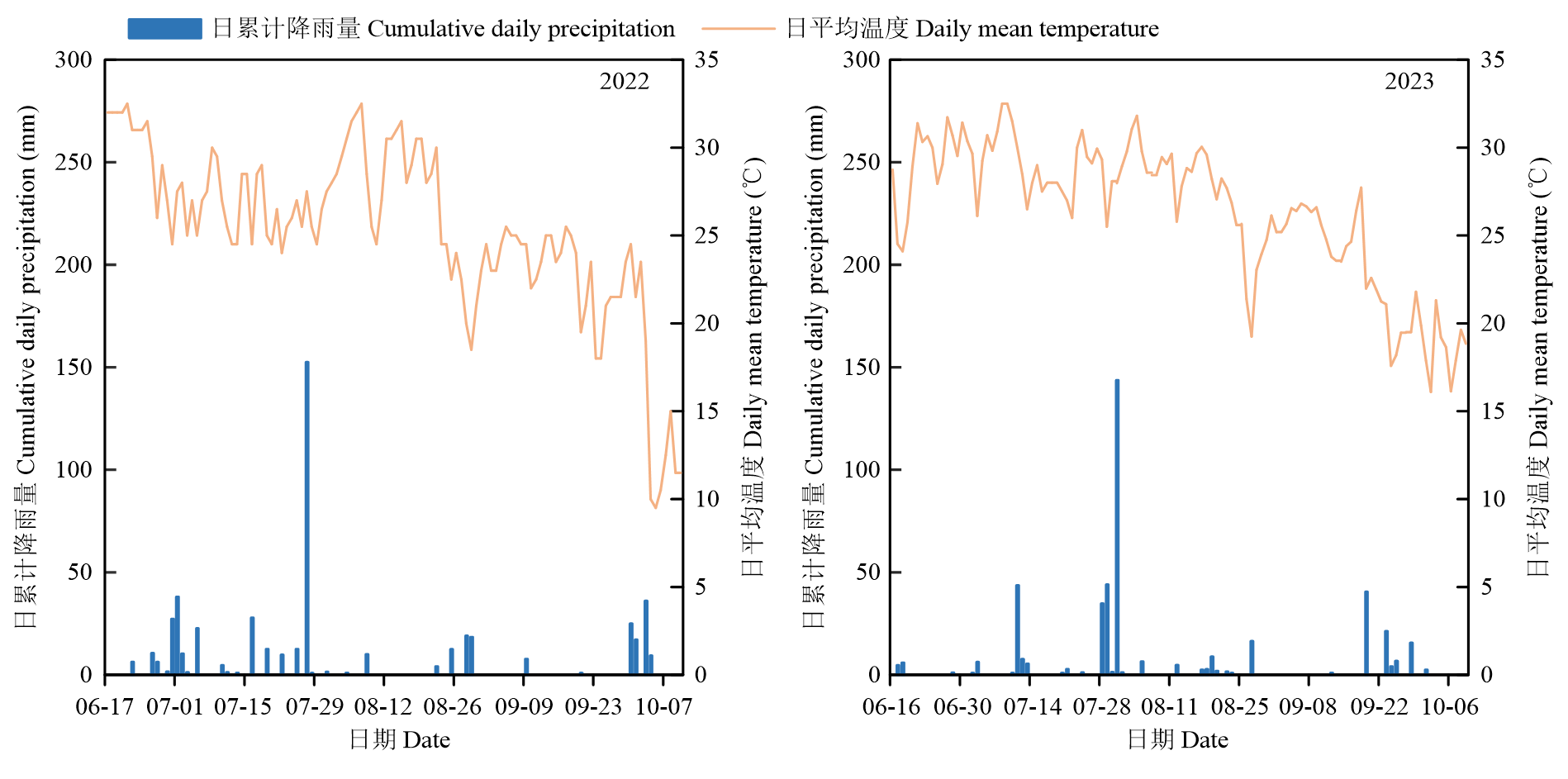
图1
夏玉米试验期内日累计降雨量和日均温度"
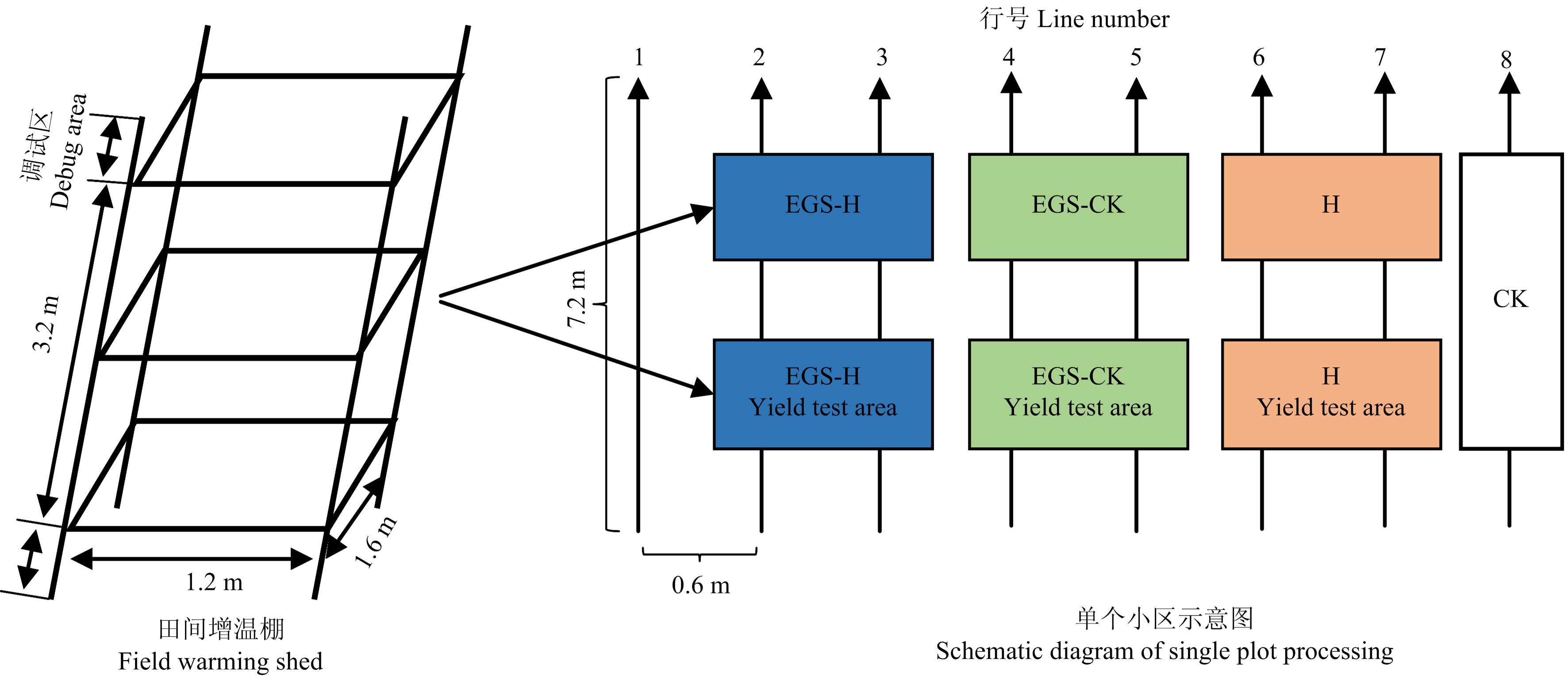
图2
田间增温棚及单个小区布置示意图 CK:常温对照;EGS-CK:化控处理下常温处理;H:高温胁迫处理;EGS-H:化控处理下高温胁迫处理;Yield test area:保留区。下同"
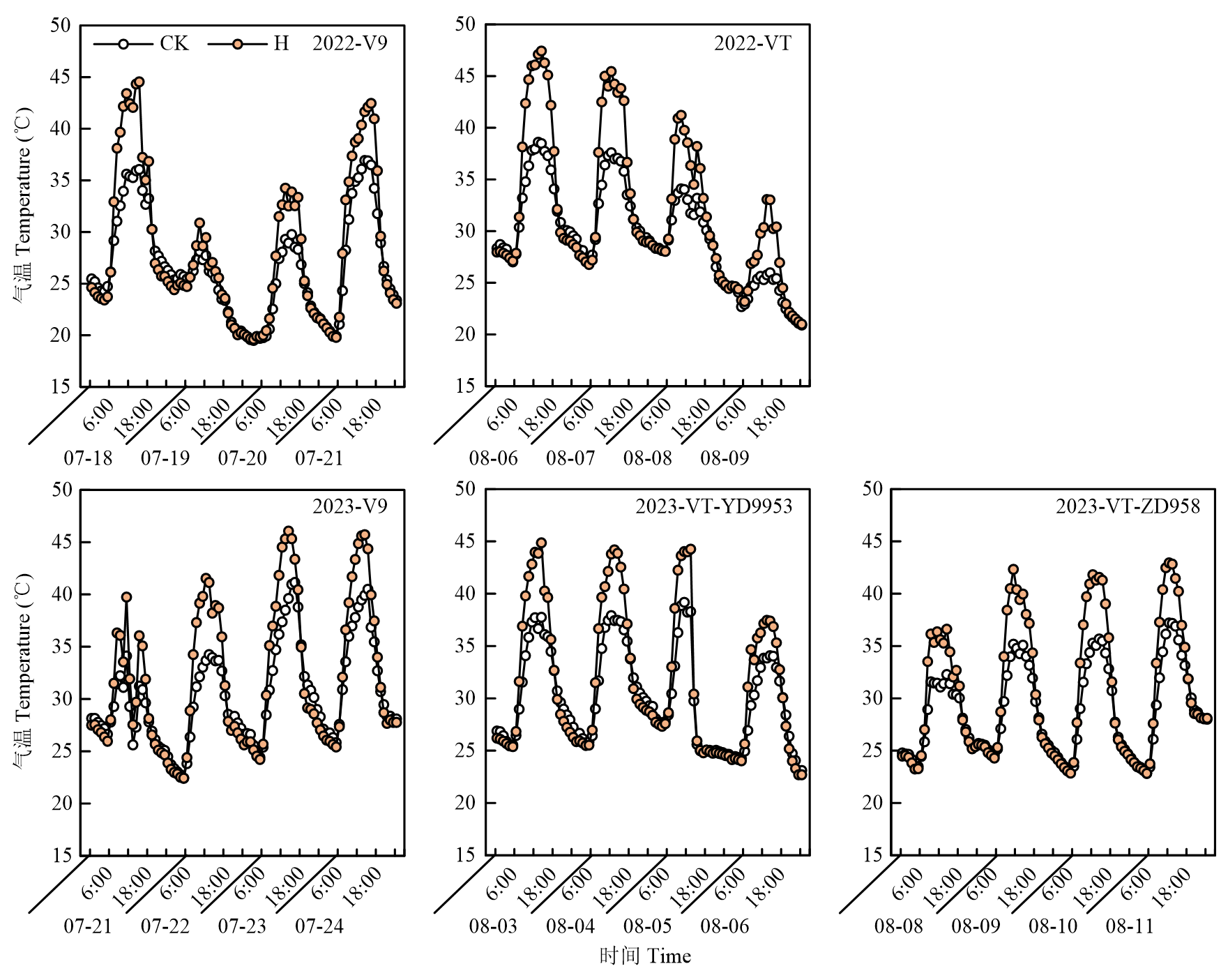
图3
夏玉米常温和高温试验期间日间分时温度变化 V9:9展叶期;VT:抽雄期"
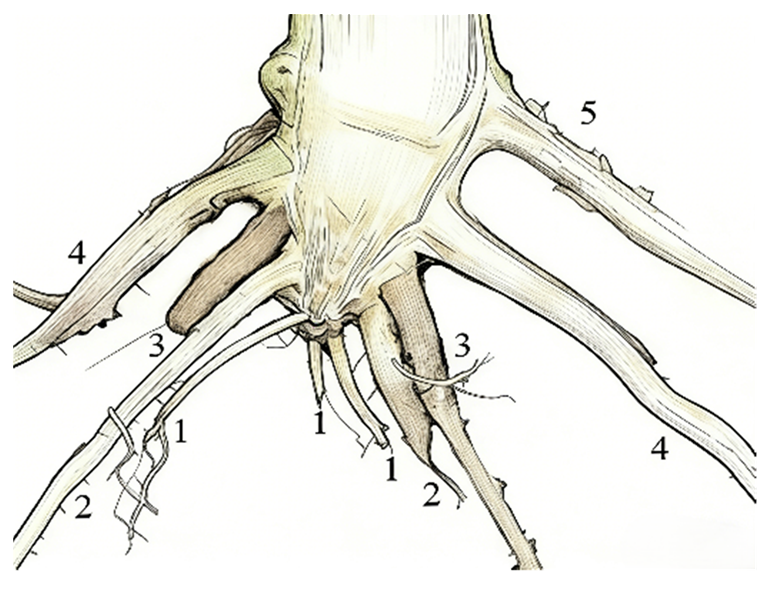
图4
玉米根系分层示意图 1—5:玉米第1—5层根的数量"
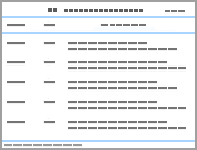
表1
EGS处理对高温胁迫下夏玉米地上部干重、根干重和根冠比的影响"
| 年份 Year | 品种 Variety | 生育时期 Growth stage | 处理 Treatment | 地上部干重 Seedling dry weight (g/plant) | 根干重 Root dry weight (g/plant) | 根冠比 Root-shoot ratio (×10-2) |
|---|---|---|---|---|---|---|
| 2022 | YD9953 | V9 | CK | 24.13b | 3.05b | 12.67a |
| EGS-CK | 25.37a | 3.39a | 13.35a | |||
| H | 21.82c | 2.44c | 11.22b | |||
| EGS-H | 24.34b | 3.10b | 12.74a | |||
| VT | CK | 98.21a | 9.32b | 9.49b | ||
| EGS-CK | 100.37a | 10.33a | 10.30a | |||
| H | 85.87c | 7.08c | 8.26c | |||
| EGS-H | 94.52b | 9.16b | 9.69b | |||
| ZD958 | V9 | CK | 25.30b | 3.62b | 14.31a | |
| EGS-CK | 26.76a | 3.93a | 14.70a | |||
| H | 23.80c | 3.15c | 13.26b | |||
| EGS-H | 24.89b | 3.50b | 14.06a | |||
| VT | CK | 108.82b | 9.80b | 9.02a | ||
| EGS-CK | 114.79a | 10.62a | 9.27a | |||
| H | 100.33c | 8.24c | 8.22b | |||
| EGS-H | 106.97b | 9.46b | 8.85a | |||
| 2023 | YD9953 | V9 | CK | 45.19a | 5.81b | 12.92b |
| EGS-CK | 43.61a | 6.51a | 14.94a | |||
| H | 37.95c | 4.78d | 12.61b | |||
| EGS-H | 40.81b | 5.32c | 13.08b | |||
| VT | CK | 104.15a | 11.51b | 11.06b | ||
| EGS-CK | 100.37a | 12.95a | 12.92a | |||
| H | 85.57c | 8.87d | 10.38c | |||
| EGS-H | 93.87b | 10.48c | 11.19b | |||
| ZD958 | V9 | CK | 46.32a | 6.64b | 14.38b | |
| EGS-CK | 45.41a | 7.42a | 16.37a | |||
| H | 39.90c | 5.54d | 13.94b | |||
| EGS-H | 42.85b | 5.93c | 13.88b | |||
| VT | CK | 123.90a | 12.73b | 10.29b | ||
| EGS-CK | 121.70a | 13.95a | 11.48a | |||
| H | 105.95c | 10.20d | 9.65c | |||
| EGS-H | 114.00b | 10.95c | 9.62c | |||
| ANOVA | Year | *** | *** | *** | ||
| Growth stage | *** | *** | *** | |||
| Variety | *** | *** | ** | |||
| EGS | *** | *** | *** |
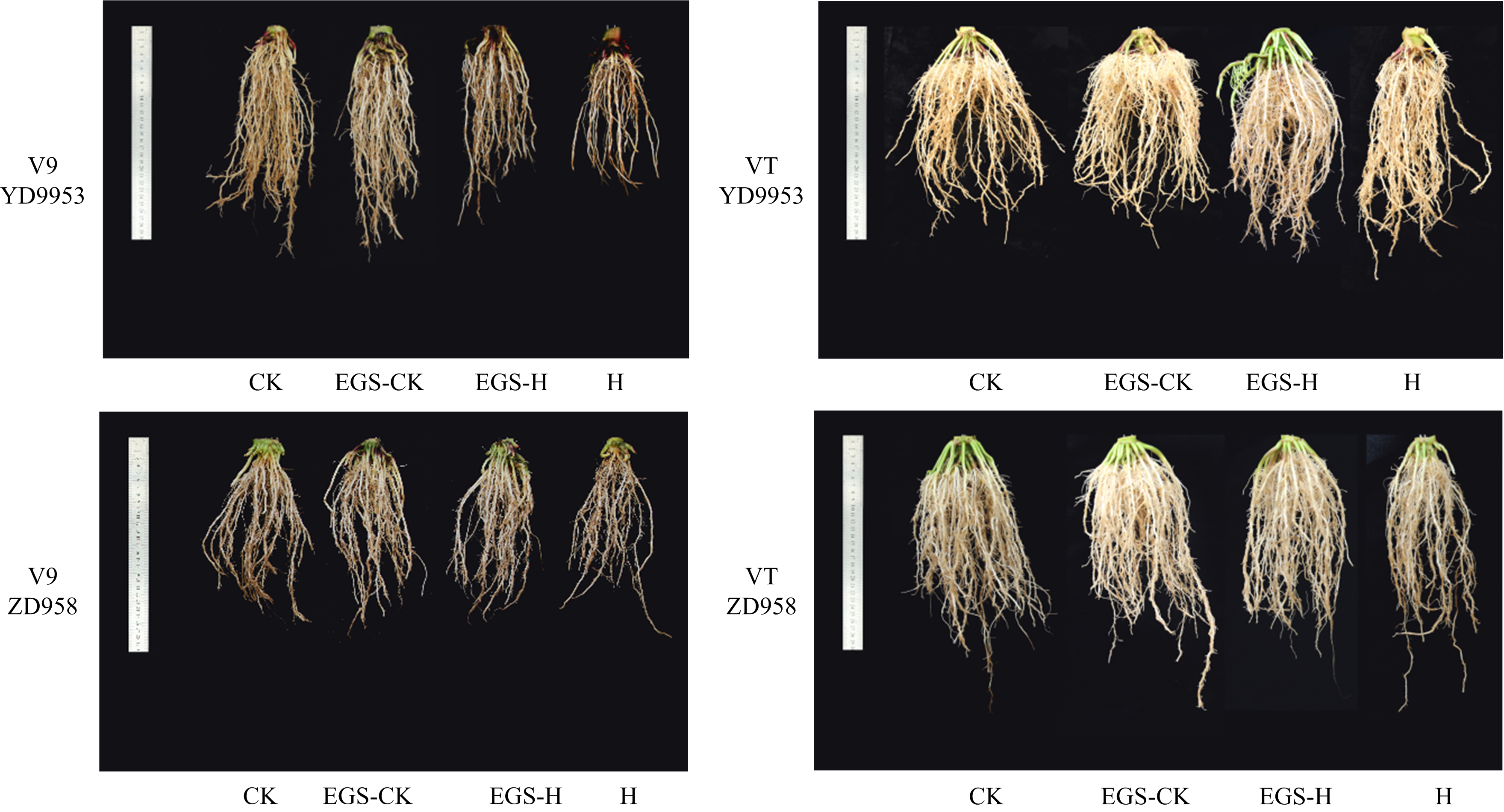
图5
夏玉米V9期和VT期根系形态图"
表2
EGS对高温胁迫下夏玉米根条数的影响"
| 年份 Year | 品种 Variety | 生育时期 Growth stage | 处理 Treatment | 第1—2层根条数 Number of roots in the first to second layers | 第3层根条数 Number of roots of the third layer | 第4层根条数 Number of roots of the fourth layer | 第5层根条数 Number of roots of the fifth layer | 气生根条数 Number of aerial roots |
|---|---|---|---|---|---|---|---|---|
| 2022 | YD9953 | V9 | CK | 8.56b | 5.00ab | 5.22ab | 7.33b | 13.22b |
| EGS-CK | 9.67a | 5.56a | 5.44a | 8.89a | 15.44a | |||
| H | 7.67c | 4.33b | 4.89b | 6.78b | 11.44c | |||
| EGS-H | 8.78b | 5.00ab | 5.22ab | 7.56b | 13.44b | |||
| VT | CK | 10.78b | 5.67ab | 6.56b | 9.56a | 32.67b | ||
| EGS-CK | 11.22a | 5.89a | 8.11a | 10.00a | 38.22a | |||
| H | 9.78c | 5.00b | 5.67b | 7.11b | 29.44c | |||
| EGS-H | 10.67b | 5.44ab | 8.00a | 9.11a | 32.56b | |||
| ZD958 | V9 | CK | 7.67b | 4.78a | 5.00a | 6.78a | 6.88b | |
| EGS-CK | 8.22a | 5.00a | 5.11a | 6.67a | 8.44a | |||
| H | 7.11c | 4.44a | 4.78a | 6.78a | 5.50c | |||
| EGS-H | 7.67b | 4.89a | 5.11a | 6.56a | 7.56b | |||
| VT | CK | 9.11b | 3.78a | 5.44a | 8.22a | 22.33b | ||
| EGS-CK | 10.00a | 3.78a | 5.67a | 8.33a | 25.78a | |||
| H | 8.44c | 3.33a | 5.22a | 8.44a | 19.00c | |||
| EGS-H | 9.00b | 3.33a | 5.56a | 8.11a | 22.78b | |||
| 2023 | YD9953 | V9 | CK | 9.56b | 5.33a | 5.67a | 7.67c | 23.78b |
| EGS-CK | 10.67a | 5.89a | 6.00a | 9.00a | 26.44a | |||
| H | 8.67c | 4.78a | 5.11a | 7.22c | 20.56c | |||
| EGS-H | 9.56b | 5.22a | 5.89a | 8.44b | 23.11b | |||
| VT | CK | 10.56b | 6.78a | 6.22b | 10.00a | 37.00b | ||
| EGS-CK | 11.22a | 6.89a | 8.11a | 10.00a | 42.22a | |||
| H | 9.78c | 6.11a | 5.78b | 7.56a | 31.22d | |||
| EGS-H | 10.33b | 6.33a | 8.00a | 9.67a | 35.22c | |||
| ZD958 | V9 | CK | 9.44a | 4.00a | 5.44a | 6.56a | 9.11b | |
| EGS-CK | 9.67a | 4.00a | 5.11a | 6.67a | 12.44a | |||
| H | 9.00b | 3.67a | 5.56a | 6.56a | 7.33c | |||
| EGS-H | 9.67a | 4.00a | 5.22a | 6.67a | 9.44b | |||
| VT | CK | 10.33b | 3.89a | 5.56a | 6.78a | 28.44b | ||
| EGS-CK | 11.00a | 3.78a | 5.67a | 6.89a | 31.78a | |||
| H | 9.56c | 3.67a | 5.22a | 6.22a | 25.33c | |||
| EGS-H | 10.22b | 3.78a | 5.33a | 6.56a | 29.11b | |||
| ANOVA | Year | *** | ns | *** | *** | *** | ||
| Growth stage | *** | *** | *** | *** | *** | |||
| Variety | *** | *** | *** | *** | *** | |||
| EGS | *** | *** | *** | *** | *** |
表3
EGS对高温胁迫下夏玉米根系构型的影响"
| 年份 Year | 品种 Variety | 生育时期 Growth stage | 处理 Treatment | 根长 Root length (cm/plant) | 根表面积 Root surface area (cm2/plant) | 根体积 Root volume (cm3/plant) | 根径 Root diameter (mm) | ||||||||||
|---|---|---|---|---|---|---|---|---|---|---|---|---|---|---|---|---|---|
| 0<D≤0.5 | 0.5<D≤1.0 | 1.0<D≤2.0 | D>2.0 | ||||||||||||||
| 根长 Root length (cm) | |||||||||||||||||
| 2022 | YD9953 | V9 | CK | 2881.80b | 535.59b | 12.72c | 1796.25b | 251.83c | 559.51b | 274.22b | |||||||
| EGS-CK | 3286.37a | 617.50a | 16.16a | 1978.71a | 332.58a | 651.80a | 323.28a | ||||||||||
| H | 2407.34c | 444.17c | 10.28d | 1591.93c | 186.00d | 475.91c | 153.50c | ||||||||||
| EGS-H | 2944.33b | 540.19b | 13.36b | 1819.57b | 274.52b | 568.01b | 282.23b | ||||||||||
| VT | CK | 4580.03c | 1112.38b | 21.10b | 2831.73b | 547.18c | 774.62c | 426.49b | |||||||||
| EGS-CK | 5152.98a | 1261.47a | 25.85a | 3155.76a | 631.32a | 891.61a | 474.29a | ||||||||||
| H | 3691.29d | 873.90c | 15.67c | 2411.29c | 392.54d | 648.25d | 240.39c | ||||||||||
| EGS-H | 4786.91b | 1112.70b | 21.54b | 2947.56b | 573.28b | 837.68b | 428.39b | ||||||||||
| ZD958 | V9 | CK | 2380.25b | 556.90b | 13.13b | 1543.15b | 261.31b | 291.83b | 282.45b | ||||||||
| EGS-CK | 2667.19a | 624.86a | 16.20a | 1747.33a | 294.35a | 312.89a | 312.61a | ||||||||||
| H | 2132.99c | 489.02c | 11.47c | 1475.74c | 201.73c | 245.80d | 212.67d | ||||||||||
| EGS-H | 2368.48b | 556.50b | 13.06b | 1573.76b | 251.83b | 276.74c | 266.14c | ||||||||||
| VT | CK | 4653.00b | 1184.81b | 23.09b | 2943.22b | 587.18b | 563.08b | 559.52b | |||||||||
| EGS-CK | 5233.19a | 1326.08a | 27.94a | 3332.34a | 614.41a | 660.17a | 626.27a | ||||||||||
| H | 3918.67c | 1000.52c | 19.10c | 2562.61c | 455.25d | 465.58c | 435.24c | ||||||||||
| EGS-H | 4637.00b | 1170.96b | 22.44b | 2991.69b | 541.61c | 561.01b | 542.70b | ||||||||||
| 2023 | YD9953 | V9 | CK | 2314.75b | 722.72b | 20.48b | 1217.57b | 232.43b | 466.88b | 397.87b | |||||||
| EGS-CK | 2585.70a | 823.33a | 25.65a | 1355.28a | 261.87a | 513.23a | 455.32a | ||||||||||
| H | 1952.64c | 588.66c | 18.20c | 1058.17c | 186.89c | 403.91c | 303.68c | ||||||||||
| EGS-H | 2359.15b | 707.39b | 21.03b | 1241.00b | 236.96b | 475.78b | 405.41b | ||||||||||
| VT | CK | 6387.59c | 1675.97b | 30.67b | 4019.09b | 740.71c | 1059.08c | 568.72c | |||||||||
| EGS-CK | 7061.35a | 1882.80a | 36.93a | 4322.96a | 901.88a | 1128.62a | 707.90a | ||||||||||
| H | 5137.93d | 1287.31c | 25.44c | 3335.83c | 577.03d | 874.81d | 350.26d | ||||||||||
| EGS-H | 6535.01b | 1640.87b | 30.83b | 4019.75b | 807.67b | 1093.04b | 614.56b | ||||||||||
| ZD958 | V9 | CK | 2403.76b | 733.88b | 22.24b | 1400.32b | 390.92b | 255.03b | 357.48b | ||||||||
| EGS-CK | 2676.71a | 822.18a | 27.00a | 1574.18a | 426.60a | 303.78a | 372.16a | ||||||||||
| H | 2086.50c | 622.35c | 19.84c | 1235.02c | 344.98c | 207.12c | 299.38c | ||||||||||
| EGS-H | 2434.83b | 742.76b | 22.63b | 1411.92b | 400.50b | 263.49b | 358.92b | ||||||||||
| VT | CK | 7578.98b | 1734.40b | 32.89b | 5036.41b | 866.66b | 911.06c | 764.86b | |||||||||
| EGS-CK | 8388.44a | 1950.12a | 39.35a | 5462.85a | 990.98a | 1064.80a | 869.82a | ||||||||||
| H | 6465.31c | 1419.00c | 27.77c | 4362.68c | 726.92c | 734.64d | 641.08c | ||||||||||
| EGS-H | 7752.56b | 1766.91b | 33.00b | 5123.29b | 896.90b | 951.70b | 780.68b | ||||||||||
| ANOVA | Year | *** | *** | *** | *** | *** | *** | *** | |||||||||
| Growth stage | *** | *** | *** | *** | *** | *** | *** | ||||||||||
| Variety | *** | *** | *** | *** | *** | *** | *** | ||||||||||
| EGS | *** | *** | *** | *** | *** | *** | *** | ||||||||||
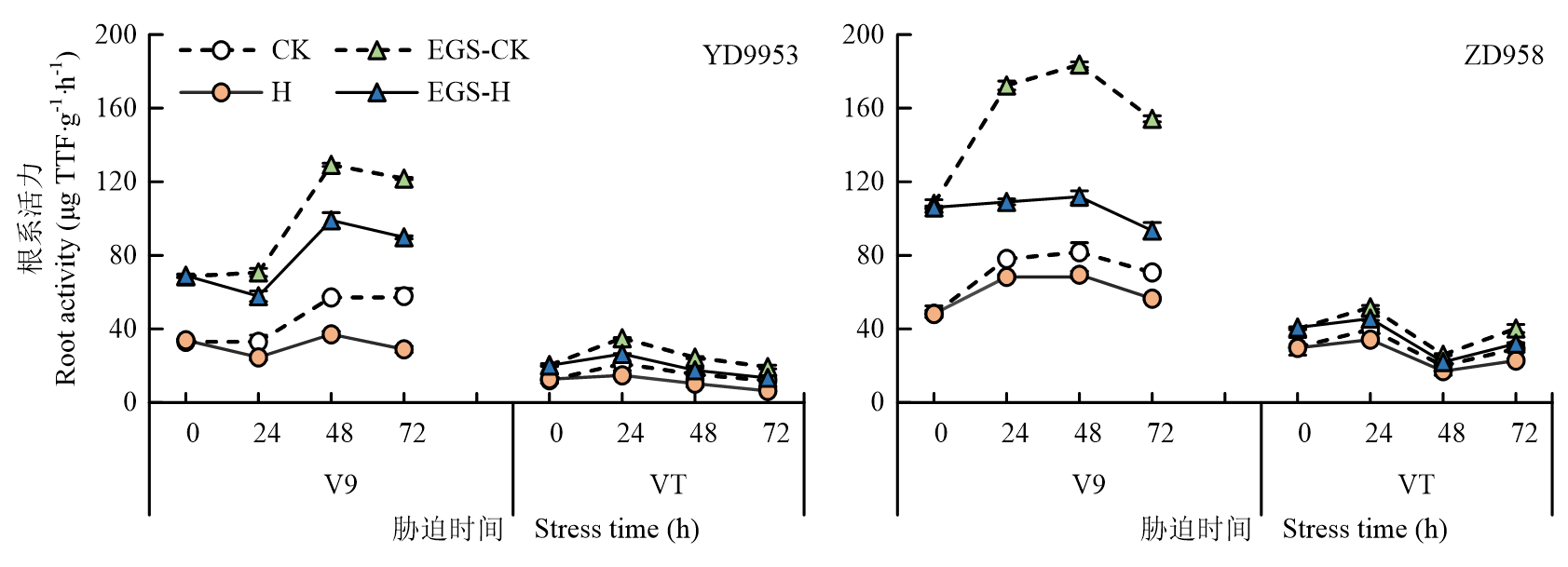
图6
EGS处理对V9和VT期高温胁迫后夏玉米根系活力的影响"
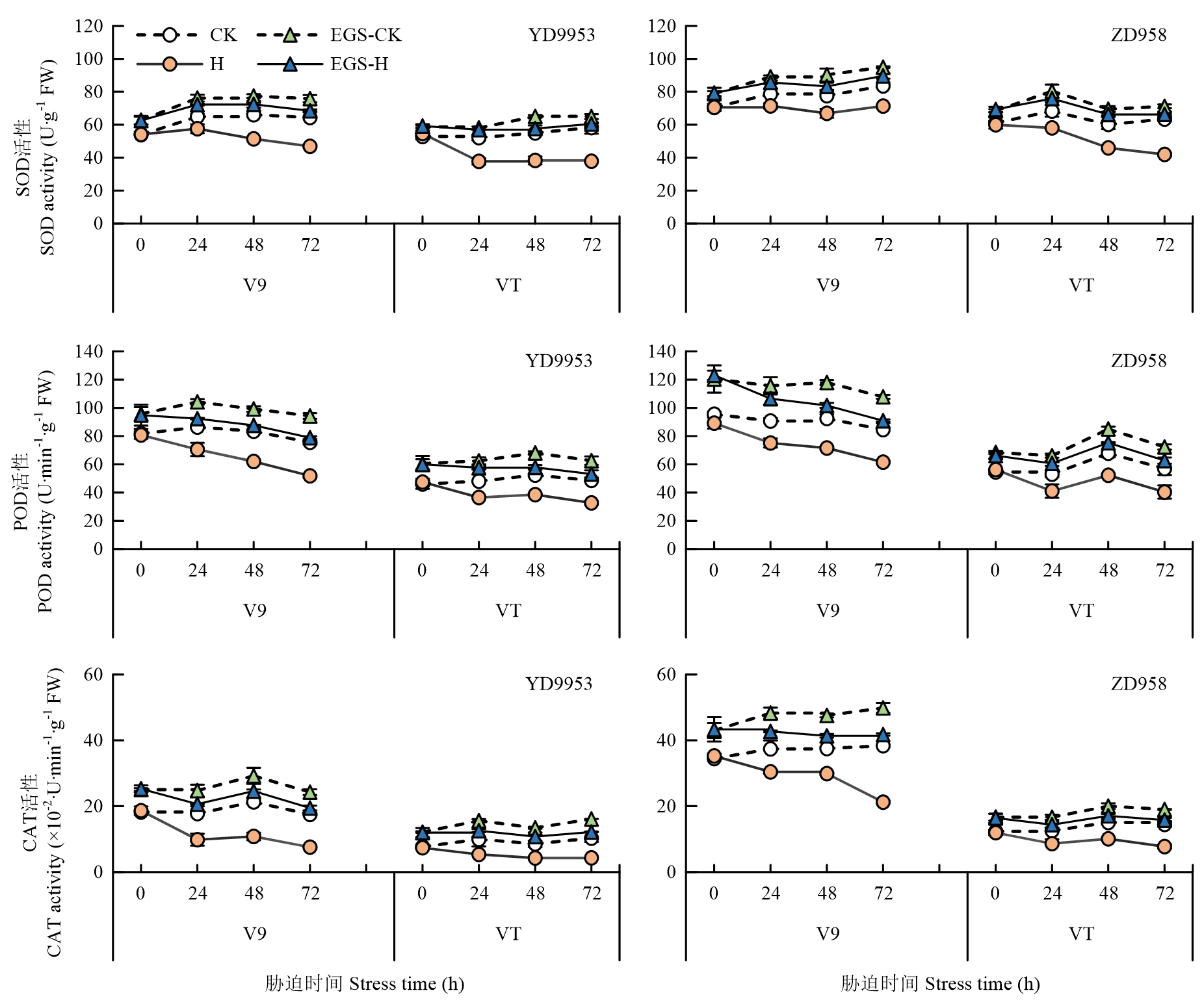
图7
EGS处理对V9和VT期高温胁迫后夏玉米根系SOD、POD和CAT活性的影响"
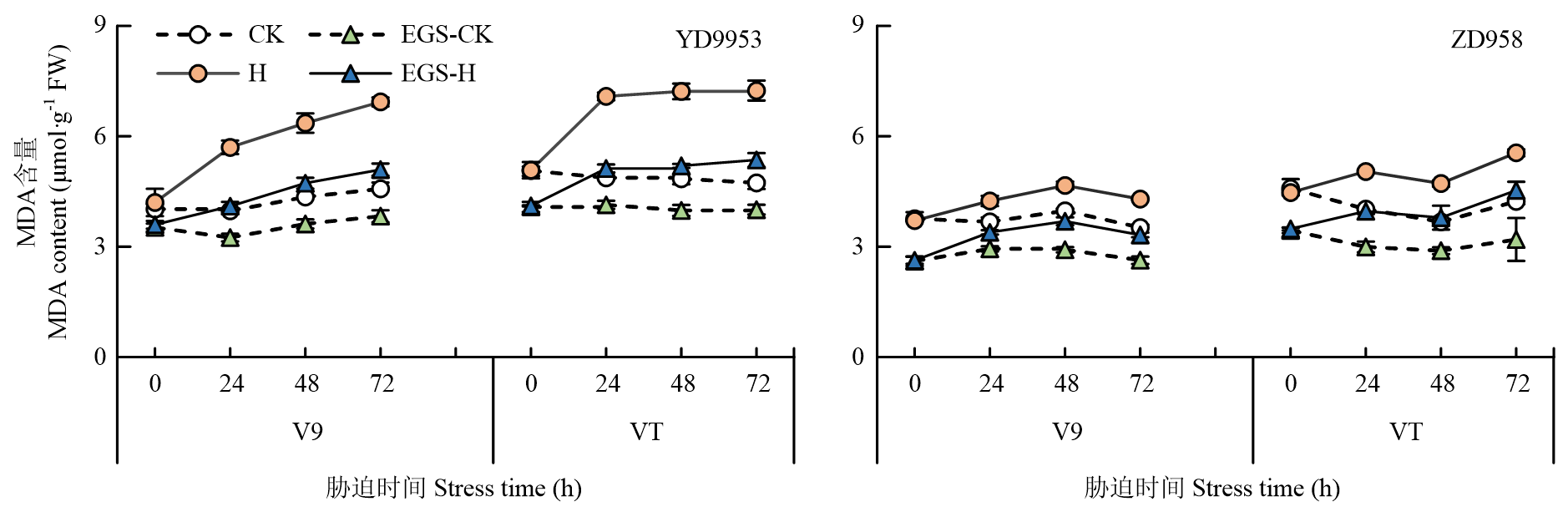
图8
EGS处理对V9和VT期高温胁迫后夏玉米根系MDA含量的影响"
表4
EGS对高温胁迫下夏玉米产量及其构成因素的影响"
| 年份 Year | 品种 Variety | 生育时期 Growth stage | 处理 Treatment | 穗粒数 Kernel number per ear | 百粒重 100-kernel weight (g) | 产量 Yield (kg·hm-2) | |
|---|---|---|---|---|---|---|---|
| 2022 | YD9953 | V9 | CK | 396.19a | 30.31a | 6326.97a | |
| EGS-CK | 409.81a | 30.93a | 6732.17a | ||||
| H | 353.76b | 29.01b | 5387.48b | ||||
| EGS-H | 394.71a | 30.46a | 6433.60a | ||||
| VT | CK | 409.29a | 29.22a | 6740.41a | |||
| EGS-CK | 409.87a | 30.35a | 7012.71a | ||||
| H | 362.35b | 27.09b | 5561.3b | ||||
| EGS-H | 399.32a | 29.57a | 6648.82a | ||||
| ZD958 | V9 | CK | 382.44a | 45.81a | 9527.93a | ||
| EGS-CK | 393.86a | 46.15a | 9953.71a | ||||
| H | 354.79b | 43.69b | 8436.36b | ||||
| EGS-H | 385.35a | 44.08b | 9263.82a | ||||
| VT | CK | 376.27a | 46.25a | 9558.58a | |||
| EGS-CK | 385.83a | 46.68a | 9974.25a | ||||
| H | 347.65b | 42.77b | 8211.40b | ||||
| EGS-H | 375.22a | 43.69b | 9280.32a | ||||
| 2023 | YD9953 | V9 | CK | 563.52a | 31.96a | 10419.95a | |
| EGS-CK | 536.76b | 32.99a | 10168.52a | ||||
| H | 470.40d | 30.55b | 8452.64c | ||||
| EGS-H | 496.92c | 33.29a | 9670.17b | ||||
| VT | CK | 545.51a | 32.39a | 10082.99a | |||
| EGS-CK | 525.05a | 33.18a | 10074.03a | ||||
| H | 450.33b | 29.80b | 7855.43c | ||||
| EGS-H | 520.79a | 30.48b | 9265.43b | ||||
| ZD958 | V9 | CK | 533.97a | 43.86a | 13670.45a | ||
| EGS-CK | 525.14ab | 44.89a | 13608.81a | ||||
| H | 492.54c | 41.56b | 11914.85c | ||||
| EGS-H | 521.46b | 42.12b | 12829.62b | ||||
| VT | CK | 513.59a | 43.74a | 13298.30a | |||
| EGS-CK | 513.73a | 44.01a | 13246.31a | ||||
| H | 466.52c | 39.90b | 10789.49c | ||||
| EGS-H | 486.12b | 41.19b | 11629.36b | ||||
| ANOVA | 年份 Year | *** | ns | *** | |||
| 生育时期 Growth stage | ** | ** | ** | ||||
| 品种 Variety | *** | *** | *** | ||||
| EGS | *** | *** | *** | ||||
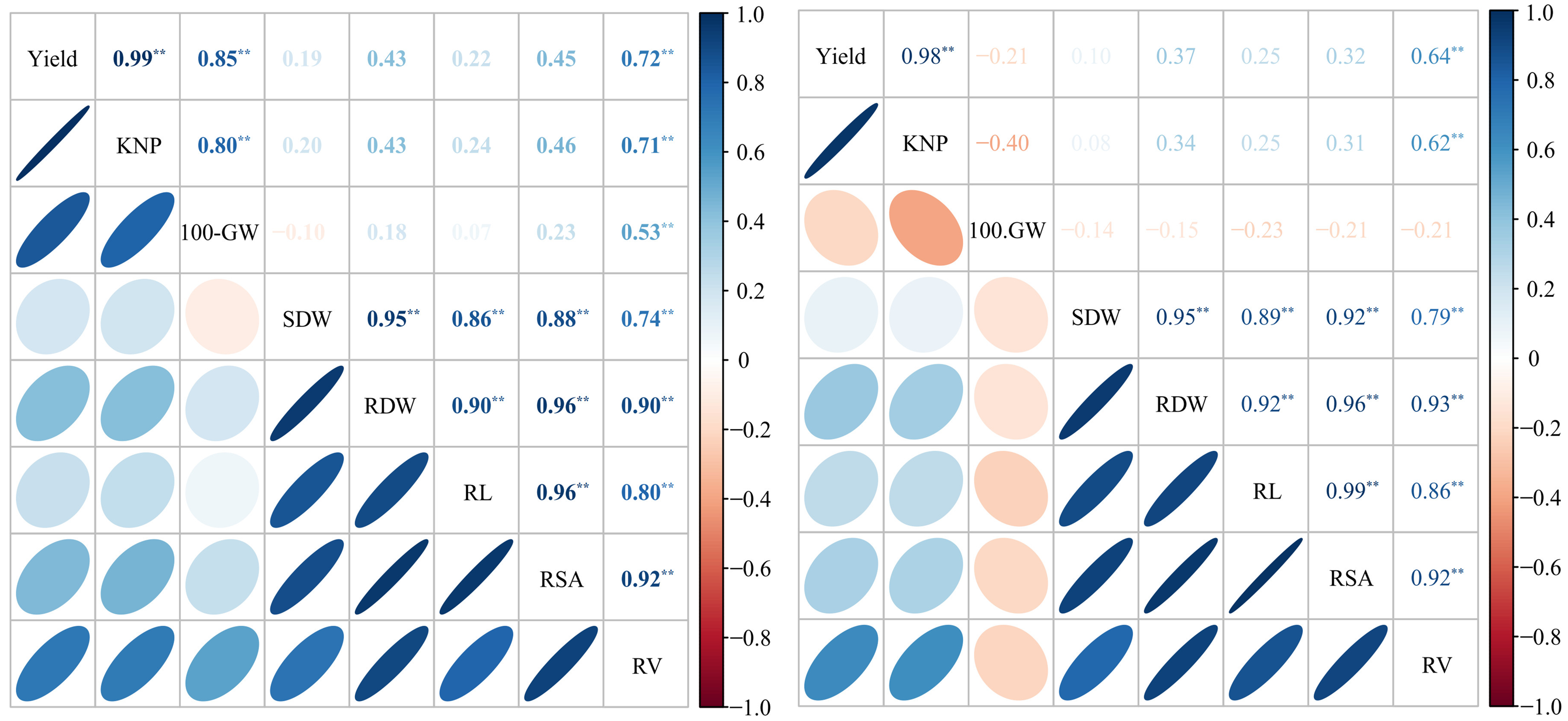
图9
夏玉米根系形态建构与产量的相关性分析 Yield:产量;KNP:穗粒数;100-GW:百粒重;SDW:地上部干重;RDW:根干重;RL:根长;RSA:根表面积;RV:根体积。*表示在0.05水平差异显著"
| [1] |
李静, 王洪章, 许佳诣, 刘鹏, 张吉旺, 赵斌, 任佰朝. 不同栽培模式对夏玉米冠层结构及光合性能的影响. 中国农业科学, 2020, 53(22): 4550-4560. doi:10.3864/j.issn.0578-1752.2020.22.003.
|
|
|
|
| [2] |
任寒, 刘鹏, 董树亭, 张吉旺, 赵斌. 高温胁迫影响玉米生长发育的生理机制研究进展. 玉米科学, 2019, 27(5): 109-115.
|
|
|
|
| [3] |
杨琴, 陈艺博, 赵文龙, 苗正言, 王晶晶, 贾绪存, 宋睿, 王群. 增温对玉米冠根形态、生长发育和产量的影响. 玉米科学, 2022, 30(6): 67-77.
|
|
|
|
| [4] |
doi: 10.1016/j.envexpbot.2022.105010 |
| [5] |
doi: 10.3390/agriculture11060477 |
| [6] |
吕梦薇. 夏玉米生长生理状况对高温干旱胁迫的响应及水分状况的光谱诊断[D]. 杨凌: 西北农林科技大学, 2022.
|
|
|
|
| [7] |
刘剑锋, 程云清, 陈智文. 乙烯促进与抑制剂对旱后复水玉米生长、保护酶活性及膜脂过氧化的影响. 中国农学通报, 2008, 24(8): 225-229.
|
|
doi: 10.11924/j.issn.1000-6850.20086066 |
|
| [8] |
许晅, 李小艳, 张占芳, 周燮, 夏凯, 甘立军. 乙烯利-甜菜碱复配剂对玉米生长发育的影响. 玉米科学, 2014, 22(5): 71-75.
|
|
|
|
| [9] |
doi: 10.3390/plants12193475 |
| [10] |
doi: 10.1038/s41598-021-82264-7 |
| [11] |
doi: 10.3390/life12060886 |
| [12] |
孟凡琦, 房孟颖, 罗艺, 卢霖, 董学瑞, 王亚菲, 郭丽娜, 闫鹏, 董志强, 张凤路. 乙烯利-甜菜碱-水杨酸合剂对夏玉米耐热性和产量的调控效应. 作物学报, 2025, 51(5): 1299-1311.
doi: 10.3724/SP.J.1006.2025.33074 |
|
doi: 10.3724/SP.J.1006.2025.33074 |
|
| [13] |
李汶哲, 王候文, 张润泽, 杨瑞思, 王飞, 罗平, 郝转芳, 张林. 玉米耐热性遗传改良研究进展. 玉米科学, 2025, 33(8): 26-34.
|
|
|
|
| [14] |
兰宏亮. 东北春玉米密度对根系质量的影响与化学调控机理研究[D]. 北京: 中国农业科学院, 2011.
|
|
|
|
| [15] |
楚光红, 章建新, 高阳, 傅积海, 唐长青, 王娜. 施氮量对滴灌超高产春玉米根系时空分布及产量的影响. 干旱地区农业研究, 2018, 36(3): 156-160.
|
|
|
|
| [16] |
张薇, 王琦, 闫鹏, 许艳丽, 严洪冬, 李桂英, 陈迪苏, 焦晓燕, 卢霖, 董志强. 聚糠萘合剂对东北地区高粱不同密度群体叶片衰老及产量的影响. 作物杂志, 2024(5): 96-104.
|
|
|
|
| [17] |
王姝媚, 李腾, 张赛, 徐洁, 隋鹏. 不同土壤温度对玉米苗期根系构型的影响. 中国农业大学学报, 2024, 29(4): 94-102.
|
|
|
|
| [18] |
穆心愿, 吕姗姗, 卢良涛, 刘天学, 李树岩, 薛昌颖, 王宏伟, 赵霞, 夏来坤, 唐保军. 授粉期高温胁迫下雄穗大小对玉米干物质积累及产量的影响. 中国农业科学, 2023, 56(15): 2880-2894. doi:10.3864/j.issn.0578-1752.2023.15.004.
|
|
|
|
| [19] |
鄂玉江, 戴俊英, 顾慰连. 玉米根系的生长规律及其与产量关系的研究Ⅰ.玉米根系生长和吸收能力与地上部分的关系. 作物学报, 1988, 14(2): 149-154.
|
|
|
|
| [20] |
doi: 10.1186/s12870-022-03805-4 |
| [21] |
梁茵龙, 陈丽伊, 吴晗艳, 杨玉萱, 王晓玉, 程钰佳, 张玉. 玉米根系及其构型的研究进展. 北方农业学报, 2022, 50(1): 59-65.
doi: 10.12190/j.issn.2096-1197.2022.01.08 |
|
|
|
| [22] |
|
| [23] |
房孟颖, 闫鹏, 卢霖, 王庆燕, 董志强. 乙矮合剂对不同氮水平夏玉米氮代谢及产量的调控效应. 作物杂志, 2022(2): 96-103.
|
|
|
|
| [24] |
刘文露, 钱婧雅, 徐志明, 潘素君, 王悦. 温度和甜菜碱对水稻种子萌发的影响. 分子植物育种, 2025, 23(20): 6790-6796.
|
|
|
|
| [25] |
|
| [26] |
彭超颖, 霍川, 杨梅, 冯云超, 向振凡, 羊炼, 黄美瑕, 晏庆九, 霍仕平. 玉米耐低氮胁迫响应研究进展. 中国农学通报, 2024, 40(32): 1-9.
doi: 10.11924/j.issn.1000-6850.casb2023-0831 |
|
doi: 10.11924/j.issn.1000-6850.casb2023-0831 |
|
| [27] |
doi: 10.1016/j.plaphy.2023.107719 |
| [28] |
余梦奇, 路梦莉, 张雅婷, 陈志英, 李文阳. 灌浆期高温对玉米叶片光合特性及抗氧化酶活性的影响. 中国农业气象, 2023, 44(7): 599-610.
|
|
|
|
| [29] |
doi: 10.3389/fpls.2016.00179 pmid: 26925085 |
| [30] |
魏晓凯, 罗小兵, 赵杰, 姚忠虎. 外源甜菜碱对烤烟幼苗干旱胁迫的缓解效应. 山西农业科学, 2024, 52(1): 79-85.
|
|
|
|
| [31] |
doi: 10.1007/s00344-019-09969-y |
| [32] |
张川, 刘栋, 王洪章, 任昊, 赵斌, 张吉旺, 任佰朝, 刘存辉, 刘鹏. 不同时期高温胁迫对夏玉米物质生产性能及籽粒产量的影响. 中国农业科学, 2022, 55(19): 3710-3722. doi:10.3864/j.issn.0578-1752.2022.19.003.
|
|
|
|
| [33] |
卢霖. 乙矮合剂对不同密度夏玉米抗倒防衰的调控效应[D]. 北京: 中国农业科学院, 2015.
|
|
|
|
| [34] |
陈静, 任佰朝, 赵斌, 刘鹏, 张吉旺. 叶面喷施甜菜碱对不同播期夏玉米产量形成及抗氧化能力的调控. 作物学报, 2022, 48(6): 1502-1515.
doi: 10.3724/SP.J.1006.2022.13021 |
|
doi: 10.3724/SP.J.1006.2022.13021 |
|
| [35] |
宋旭东, 章慧敏, 张振良, 周广飞, 冒宇翔, 陆虎华, 陈国清, 石明亮, 黄小兰, 薛林, 等. 外源水杨酸和氯化钙对糯玉米花期高温胁迫下光合特性及产量的调控效应. 江苏农业科学, 2022, 50(7): 87-94.
|
|
|
|
| [36] |
doi: 10.1111/jac.2017.203.issue-6 |
| [1] | 李云丽, 刁邓超, 刘雅睿, 孙玉晨, 孟祥宇, 邬陈芳, 汪妤, 吴建辉, 李春莲, 曾庆东, 韩德俊, 郑炜君. 小麦苗期耐热性全基因组关联分析[J]. 中国农业科学, 2025, 58(9): 1663-1683. |
| [2] | 薛钰琦, 赵继玉, 孙旺胜, 任佰朝, 赵斌, 刘鹏, 张吉旺. 不同氮素形态对夏玉米产量和品质的影响[J]. 中国农业科学, 2025, 58(8): 1535-1549. |
| [3] | 孟慧, 罗丙玉, 卢正宇, 王鹏, 康冬茹, 郑成淑, 王文莉. 菊花CmASMT的克隆及其在高温抗性中的作用[J]. 中国农业科学, 2025, 58(8): 1617-1626. |
| [4] | 唐宇, 雷毕欣, 王传伟, 严轩韬, 王浩, 郑杰, 张文静, 马尚宇, 黄正来, 樊永惠. 彩色小麦花青素积累对花后高温胁迫的响应机理[J]. 中国农业科学, 2025, 58(6): 1083-1101. |
| [5] | 苏明, 李翻过, 洪自强, 周甜, 柳强娟, 班文慧, 吴宏亮, 康建宏. 施氮缓解旱地马铃薯花后高温早衰的抗氧化特性研究[J]. 中国农业科学, 2025, 58(4): 660-675. |
| [6] | 王同超, 于宁宁, 崔栋, 任佰朝, 赵斌, 刘鹏, 任昊, 熊伟, 张吉旺. 滴灌水肥一体化条件下种植密度对夏玉米受精结实特性的调控[J]. 中国农业科学, 2025, 58(24): 5156-5174. |
| [7] | 高春华, 赵海军, 赵逢涛, 孔玮琳, 巨飞燕, 李宗新, 石德杨, 刘苹. 生长调节剂对玉米大豆带状间作下夏玉米茎秆特性与产量的影响[J]. 中国农业科学, 2025, 58(23): 4920-4935. |
| [8] | 丁宁, 齐恩芳, 贾小霞, 黄伟, 马丽荣, 李建武, 燕汝楠. 马铃薯幼苗应答高温胁迫的miRNA筛选与鉴定[J]. 中国农业科学, 2025, 58(22): 4589-4602. |
| [9] | 雷毕欣, 余勇波, 张明通, 崔国际, 洪嘉雯, 胡涛, 犹艾欣, 张文静, 马尚宇, 黄正来, 樊永惠. 花后高温胁迫对小麦氮素同化利用及产量形成的影响[J]. 中国农业科学, 2025, 58(19): 3837-3856. |
| [10] | 杜思琪, 温育纶, 宁力兴, 尹晓雨, 王淑芬, 宋海燕, 王兆海, 李炜星, 廖江林. 开花期高温对不同基因型籼稻开花授粉的影响[J]. 中国农业科学, 2025, 58(10): 1867-1877. |
| [11] | 曹雄军, 王博, 韩佳宇, 廖永峰, 谢蜀豫, 白扬, 黄小云, 陆丽, 黄秋秘, 江春分, 盘丰平, 白先进. 热区葡萄高光效育种研究与实践[J]. 中国农业科学, 2025, 58(10): 1994-2007. |
| [12] | 李永飞, 李战魁, 张战胜, 陈永伟, 康建宏, 吴宏亮. 氮肥后移对高温胁迫下春小麦旗叶生理特性和产量的影响[J]. 中国农业科学, 2024, 57(8): 1455-1468. |
| [13] | 罗丽丹, 陈嘉明, 安琪, 刘磊, 孙勤哲, 刘欢, 王森山, 宋丽雯. 极端高温对截形叶螨体内海藻糖含量及海藻糖转运蛋白基因的影响[J]. 中国农业科学, 2024, 57(6): 1091-1101. |
| [14] | 高尚洁, 刘杏认, 李迎春, 柳晓婉. 施用生物炭和秸秆还田对农田温室气体排放及增温潜势的影响[J]. 中国农业科学, 2024, 57(5): 935-949. |
| [15] | 苏小雨, 谭政委, 李春明, 李磊, 鲁丹丹, 余永亮, 董薇, 安素妨, 杨青, 孙瑶, 许兰杰, 杨红旗, 梁慧珍. 高温胁迫下芝麻全基因组甲基化差异及关联基因表达分析[J]. 中国农业科学, 2024, 57(24): 4825-4838. |
|
||
