






中国农业科学 ›› 2026, Vol. 59 ›› Issue (5): 937-950.doi: 10.3864/j.issn.0578-1752.2026.05.002
焦文娟1( ), 何万龙1, 耿洪伟1, 白斌2, 李剑峰3, 程宇坤()
收稿日期:2025-08-12
接受日期:2025-10-02
出版日期:2026-03-01
发布日期:2026-03-06
通信作者:
联系方式:
焦文娟,E-mail:jiaowenjuan0612@163.com。
基金资助:
JIAO WenJuan1(), HE WanLong1, GENG HongWei1, BAI Bin2, LI JianFeng3, CHENG YuKun()
Received:2025-08-12
Accepted:2025-10-02
Published:2026-03-01
Online:2026-03-06
摘要:
【目的】 了解新疆地区春小麦种质的条锈病抗性水平和抗条锈病基因利用情况,筛选携带多个抗病基因的抗病品种(系),为小麦抗病基因资源有效利用和抗病育种提供参考。【方法】 利用当前流行条锈病菌生理小种CYR32和CYR34对155份春小麦种质进行单小种苗期抗性鉴定,并于2023年和2024年,在甘肃清水和新疆陆港,利用CYR32、CYR33、CYR34、Su11-4、Su11-5和G22-14组成的混合菌种进行成株期抗性鉴定,同时,利用与抗条锈病基因Yr9、Yr15、Yr17、Yr18、Yr28、Yr29、Yr30、Yr80、Yr81、Yr82、Yr86、YrZH22和YrZH84紧密连锁的侧翼标记或功能标记进行分子检测。【结果】 苗期鉴定结果表明,20份品种(系)对CYR32表现抗病,26份品种(系)对CYR34表现抗病,14份品种(系)同时对CYR32和CYR34表现抗病,Pirsabak-13和Millat-11对CYR32和CYR34均表现免疫(IT=0)。在成株期,101份品种(系)在新疆和甘肃2个环境表现稳定抗病,其中,包括80份中国新疆育成品种(系)和21份国外引进品种(系)。国外品种(系)10136和10123,以及中国新疆育成品种(系)9628、核春137、粮春1832、粮春1773、品9616、品9638共8份品种(系)表现环境稳定高度抗病(IT=0—3、DS≤20%)。分子标记检测显示,155份春小麦中携带Yr9、Yr17、Yr18、Yr28、Yr29、Yr30、Yr81、Yr82、Yr86和YrZH84的分别有14、66、6、8、17、62、17、2、1和11份,未检测到含Yr15、Yr80和YrZH22的品种(系)。Pirsabak-13(Yr9、Yr17、Yr29、Yr81)、Borluag-16(Yr17、Yr30、Yr86)、Ufaq-2000(Yr9、Yr18、Yr30)、巴丰5(Yr9、Yr17、Yr28、Yr30)、9628(Yr30、Yr81、Yr82)、新春5(Yr17、Yr29、Yr30)、新春50(Yr9、Yr17、Yr30)、宁33(Yr17、Yr29、Yr81)、宁28(Yr17、Yr28、Yr29)等品种(系)聚合了3—4个抗条锈病基因,且对供试毒性小种表现全生育期或成株期稳定抗病性,在新疆小麦抗条锈病育种中具有重要价值。【结论】 新疆春小麦苗期对CYR32和CYR34抗性水平较低,成株期抗病性水平整体较高,101份品种(系)对混合菌表现环境稳定抗病性;Yr17和Yr30在供试春小麦中分布最多,部分种质还携带未检测的其他已知基因或蕴含新基因/QTL,需进一步加强对抗病基因的挖掘。
焦文娟, 何万龙, 耿洪伟, 白斌, 李剑峰, 程宇坤. 155份春小麦品种(系)条锈病抗性评价与抗病基因分子检测[J]. 中国农业科学, 2026, 59(5): 937-950.
JIAO WenJuan, HE WanLong, GENG HongWei, BAI Bin, LI JianFeng, CHENG YuKun. Stripe Rust Resistance Evaluation and Molecular Characterization of Yr Genes for 155 Spring Wheat Varieties (Lines)[J]. Scientia Agricultura Sinica, 2026, 59(5): 937-950.
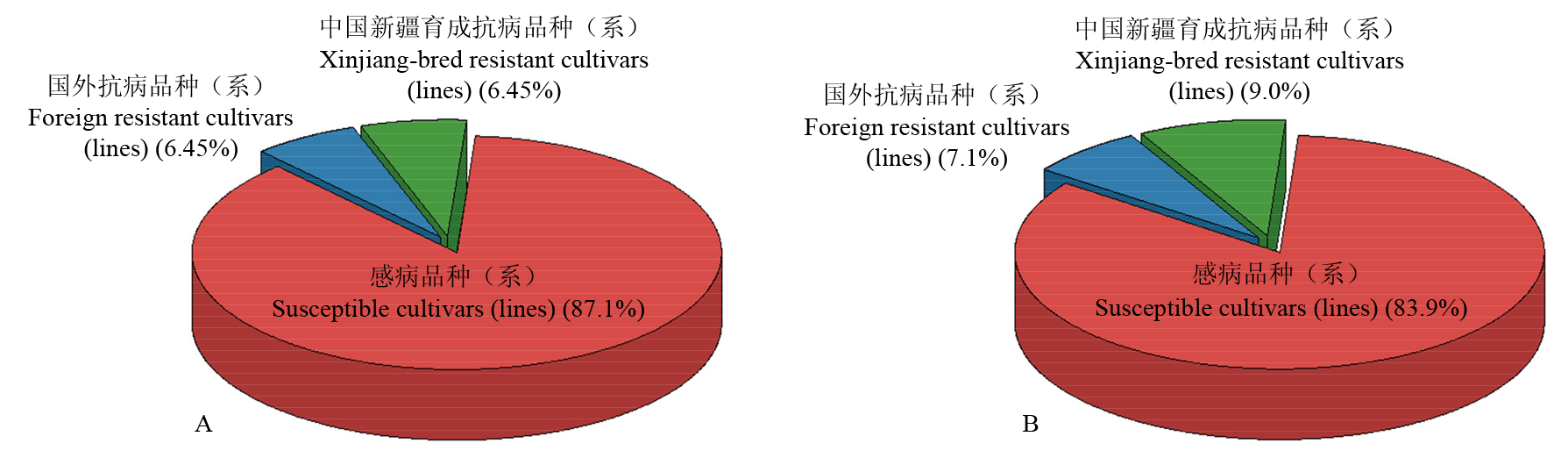
图1
中国新疆育成品种(系)和国外品种(系)苗期对条锈菌CYR32(A)和CYR34(B)的抗病性"

图2
155份春小麦品种(系)成株期抗病性及分布 GS-HR:品种(系)在甘肃表现高度抗病;XJ-HR:品种(系)在新疆表现高度抗病;GS-MR:品种(系)在甘肃表现中度抗病;XJ-MR:品种(系)在新疆表现中度抗病;GS-HS:品种(系)在甘肃表现高度感病;XJ-HS:品种(系)在新疆表现高度感病;GS-MS:品种(系)在甘肃表现中度感病;XJ-MS:品种(系)在新疆表现中度感病"
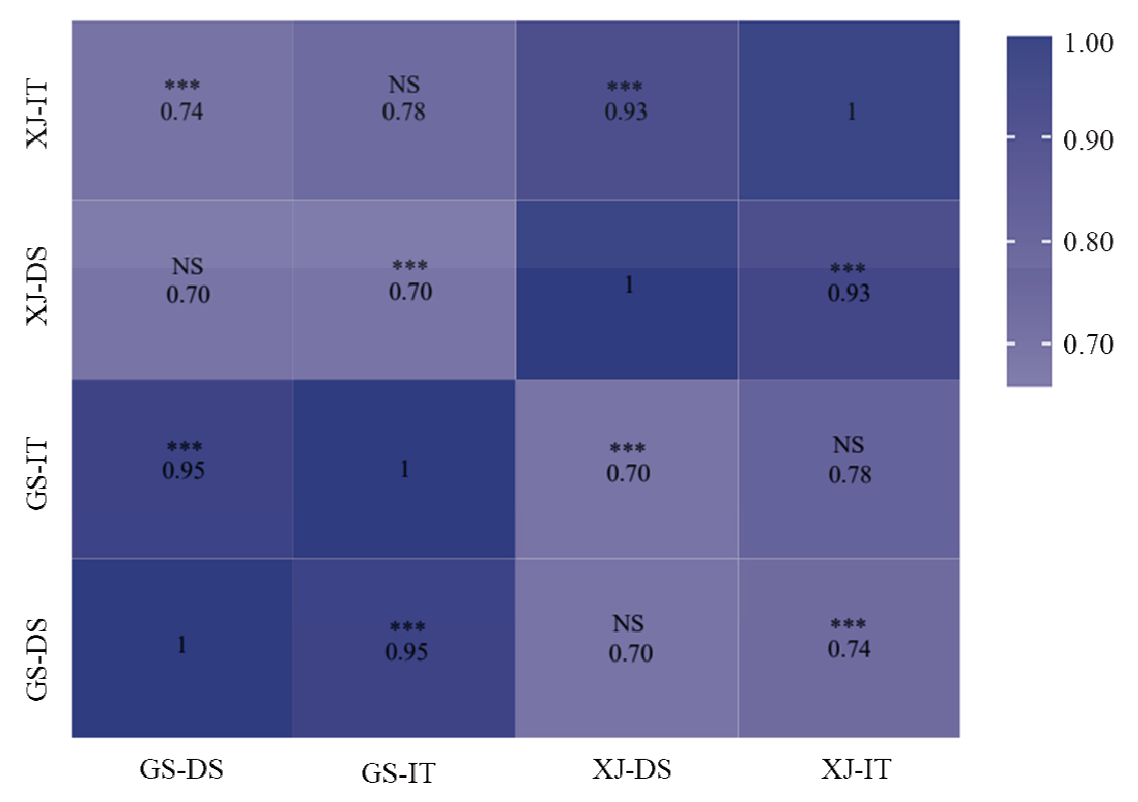
图3
155份春小麦品种(系)在不同环境下抗病性表型DS和IT值的相关系数热图 GS-DS:品种(系)在甘肃进行成株期抗病性鉴定的严重度;XJ-DS:品种(系)在新疆进行成株期抗病性鉴定的严重度;GS-IT:品种(系)在甘肃进行成株期抗病性鉴定的反应型;XJ-IT:品种(系)在新疆进行成株期抗病性鉴定的反应型。*:P≤0.05;**:P≤0.01;***:P≤0.001;NS:P>0.05。下同"
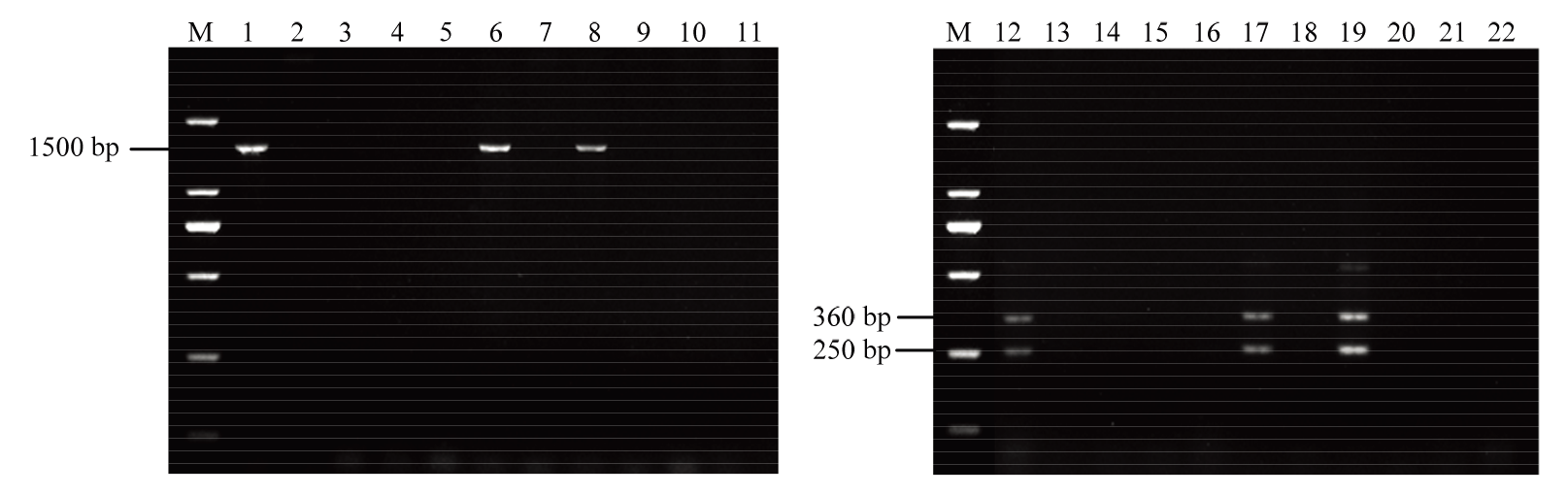
图4
部分小麦品种(系)Yr9分子检测结果 M:Marker(DL2000);1、12:AvSYr9 NIL;2、13:新春4;3、14:九圣禾C1809;4、15:粮春1522;5、16:宁麦13;6、17:巴丰5;7、18:农麦2;8、19:永1285;9、20:巴麦12;10、21:广麦13;11、22:宁麦28。1—11:Yr9标记AF1/AF4;12—22:Yr9标记P6M12P"
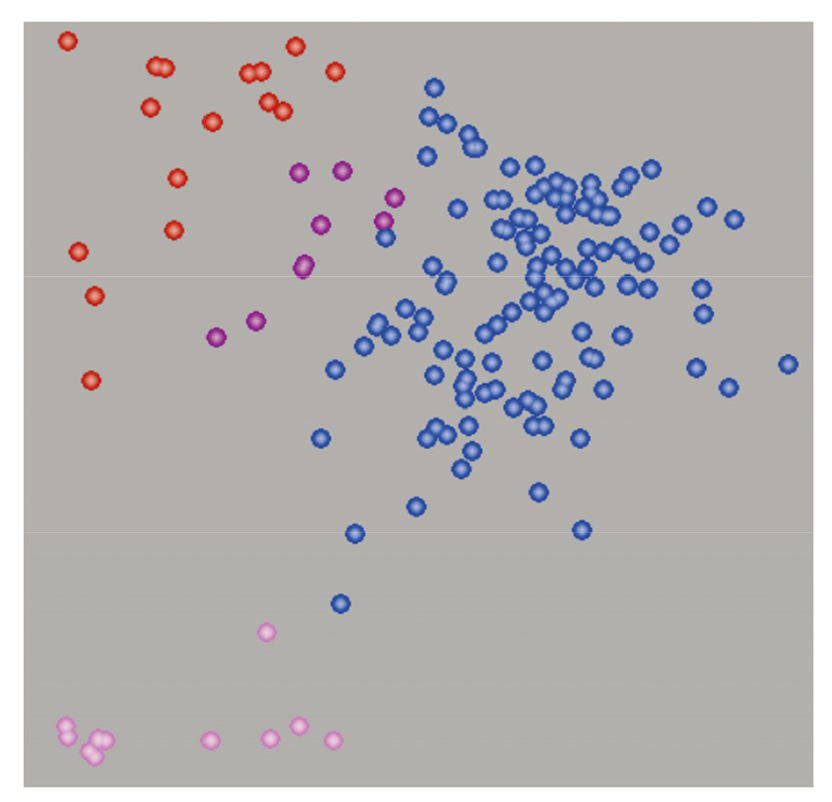
图5
Yr81基因分型的KASP聚类图谱 红色:携带Yr81;蓝色:不携带Yr81;粉色、紫色:无信号"
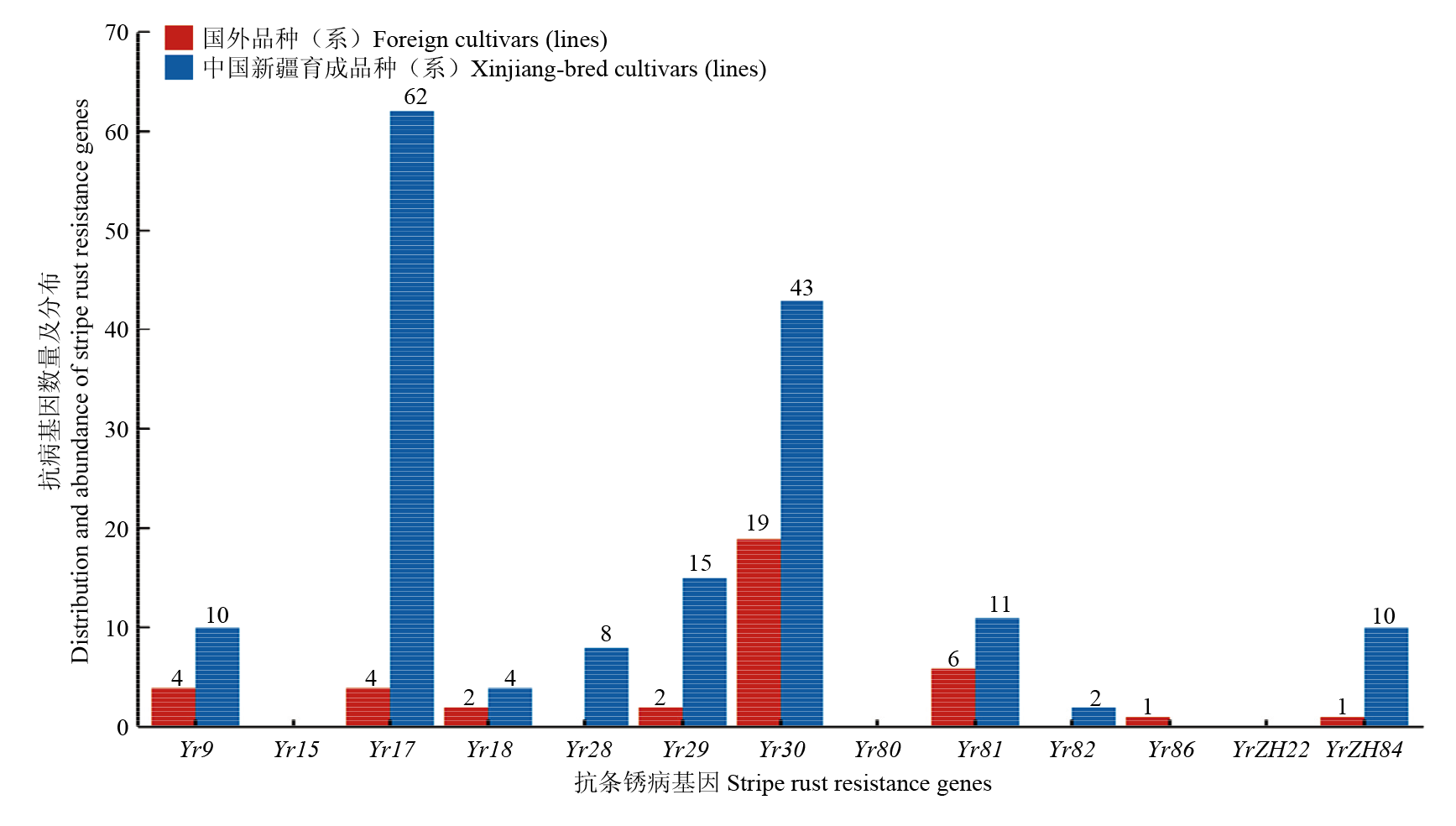
图6
抗条锈病基因在国外品种(系)和中国新疆育成品种(系)中的分布"

图7
155份春小麦品种(系)聚合不同数量条锈病抗性基因的成株期严重度"
| [1] |
陈万权. 中国小麦条锈病生态调控技术研究与应用. 植物医学, 2025, 4(2): 1-11.
|
|
|
|
| [2] |
doi: 10.1094/PDIS-93-11-1093 |
| [3] |
刘万才, 王保通, 赵中华, 李跃, 康振生. 我国小麦条锈病历次大流行的历史回顾与对策建议. 中国植保导刊, 2022, 42(6): 21-27, 41.
|
|
|
|
| [4] |
李晶, 曾娟, 姜玉英, 李虎. 新疆小麦条锈病发生特点及流行规律初探. 中国植保导刊, 2010, 30(6): 16-19.
|
|
|
|
| [5] |
朱嘉宁. 新疆小麦条锈菌群体遗传及其小麦品种(系)抗条锈性研究[D]. 阿拉尔: 塔里木大学, 2024.
|
|
|
|
| [6] |
陈万权, 刘太国. 我国小麦秋苗条锈病发生规律及其区间菌源传播关系. 植物保护, 2023, 49(5): 50-70.
|
|
|
|
| [7] |
张欣欣, 曹昌玉, 李韩忆, 董静雅, 任建东, 马斌, 王晓醒, 相吉山. 小麦条锈病发病特点和防治策略及抗病性遗传改良. 伊犁师范大学学报(自然科学版), 2025, 19(2): 61-68.
|
|
|
|
| [8] |
刘琦, 陈利, 曾明昊, 艾尼赛·赛米, 马泽宇, 马占鸿. 新疆伊犁州小麦条锈菌生理小种鉴定及毒性分析. 植物保护, 2022, 48(5): 314-319, 340.
|
|
|
|
| [9] |
doi: 10.1038/s41467-024-54068-6 |
| [10] |
doi: 10.1094/PDIS-11-19-2402-RE |
| [11] |
刘志勇, 张怀志, 白斌, 李俊, 黄林, 徐智斌, 陈永兴, 刘旭, 曹廷杰, 李淼淼, 等. 中国小麦抗条锈病基因育种利用现状与策略. 中国农业科学, 2024, 57(1): 34-51. doi: 10.3864/j.issn.0578-1752.2024.01.004.
|
|
|
|
| [12] |
韩德俊, 张培禹, 王琪琳, 曾庆东, 吴建辉, 周新力, 王晓杰, 黄丽丽, 康振生. 1980份小麦地方品种和国外种质抗条锈性鉴定与评价. 中国农业科学, 2012, 45(24): 5013-5023. doi: 10.3864/j.issn.0578-1752.2012.24.006.
|
|
|
|
| [13] |
杨芳萍, 曹世勤, 郭莹, 杜久元, 鲁清林, 吕迎春, 白斌, 周刚, 张文涛, 马瑞, 何瑞. 小麦条锈病抗性基因定位及分子标记技术研究进展. 寒旱农业科学, 2024(1): 1-10.
|
|
|
|
| [14] |
周警卫, 叶博伟, 张朋飞, 张宇庆, 郝敏, 尹毓若, 袁婵, 李志康, 李顺达, 夏先春, 等. 国内外153份小麦种质条锈病抗性鉴定与评价. 中国农业科学, 2024, 57(1): 18-33. doi: 10.3864/j.issn.0578-1752.2024.01.003.
|
|
|
|
| [15] |
张学慧, 来汉林, 杨红, 杨蕙, 沈煜洋, 登斯拉木·吐尔逊拜, 孙娜, 高海峰. 90份小麦品种(系)抗条锈病鉴定及抗病基因分子检测. 麦类作物学报, 2025, 45(7): 881-890.
|
|
|
|
| [16] |
贾永红, 魏海鹏, 曾潮武, 刘俊, 陈艳妮, 李建疆, 梁晓东. 基于KASP技术鉴定新疆春小麦材料抗病基因分析. 作物杂志, 2025: 1-6. (2025-04-09). https://www.cnki.com.cn/Article/CJFDTotal-ZWZZ20250408006.htm.
|
|
|
|
| [17] |
王荣, 程宇坤, 白斌, 孙娜, 曹俊梅, 张飞飞, 耿洪伟. 新疆小麦品种(系)条锈病抗性与抗病基因分析. 麦类作物学报, 2024, 44(11): 1423-1430.
|
|
|
|
| [18] |
|
| [19] |
张海鹏, 叶雪玲, 管方念, 黄林玉, 李伟, 邓梅, 魏育明, 蒋云峰, 陈国跃. 220份四川小麦条锈病抗性鉴定与评价. 四川农业大学学报, 2023, 41(6): 1020-1031.
|
|
|
|
| [20] |
doi: 10.1007/BF00222127 pmid: 24174021 |
| [21] |
doi: 10.1007/s10681-007-9484-5 |
| [22] |
doi: 10.1038/s41467-018-06138-9 |
| [23] |
doi: 10.2135/cropsci2003.1839 |
| [24] |
doi: 10.1007/s00122-009-1097-z |
| [25] |
doi: 10.1007/s00122-006-0406-z |
| [26] |
doi: 10.1007/s10658-019-01912-x |
| [27] |
doi: 10.1094/PHYTO.2003.93.2.153 |
| [28] |
doi: 10.1007/s00122-004-1787-5 |
| [29] |
doi: 10.1007/s00122-018-3090-x pmid: 29560515 |
| [30] |
doi: 10.1094/PDIS-06-18-1055-RE |
| [31] |
doi: 10.1007/s00122-019-03416-y |
| [32] |
|
| [33] |
doi: 10.1007/s00122-017-2950-0 |
| [34] |
doi: 10.1007/s00122-006-0211-8 |
| [35] |
doi: 10.3389/fpls.2024.1394213 |
| [36] |
陈利, 周婷婷, 沈煜洋, 路子峰, 崔燕华, 赵海燕, 刘琦, 高海峰. 9种杀菌剂对荒漠绿洲麦区小麦条锈病的防治效果. 中国农学通报, 2021, 37(35): 78-81.
doi: 10.11924/j.issn.1000-6850.casb2021-0025 |
|
doi: 10.11924/j.issn.1000-6850.casb2021-0025 |
|
| [37] |
|
| [38] |
白斌, 张怀志, 杜久元, 张晓洋, 何瑞, 伍玲, 张哲, 张耀辉, 曹世勤, 刘志勇. 西北条锈菌源区冬小麦育种抗条锈病基因的利用现状与策略. 中国农业科学, 2024, 57(1): 4-17. doi: 10.3864/j.issn.0578-1752.2024.01.002.
|
|
|
|
| [39] |
黄洁, 杨金叶,
doi: 10.13926/j.cnki.apps.000924 |
|
doi: 10.13926/j.cnki.apps.000924 |
|
| [40] |
郑良梅, 杨慧, 徐晓伟, 童朝阳, 蔺瑞明, 冯晶, 姚强, 王凤涛. 107个山东小麦品种抗条锈性评价及分子标记检测. 麦类作物学报, 2023, 43(8): 968-976.
|
|
|
|
| [41] |
doi: 10.1038/s41598-024-82772-2 |
| [42] |
姚强, 王洁荣, 孟岩, 詹刚明, 黄丽丽, 康振生. 中国小麦条锈病菌CYR32和CYR33的毒性及基因型多样性. 植物保护学报, 2018, 45(1): 46-52.
|
|
|
|
| [43] |
张兴宗, 黄亮, 夏先全, 张华, 陈万权, 夏崇靖, 刘太国. 88份四川省小麦后备品系抗条锈性评价及抗性基因的分子检测. 植物保护学报, 2024, 51(4): 764-773.
|
|
|
|
| [44] |
张小娟, 侯万伟. 青海省小麦种质资源抗条锈鉴定和抗病基因筛选. 西南农业学报, 2021, 34(6): 1156-1166.
|
|
|
|
| [45] |
习玲, 王昱琦, 朱微, 王益, 陈国跃, 蒲宗君, 周永红, 康厚扬. 78份四川小麦育成品种(系)条锈病抗性鉴定与抗条锈病基因分子检测. 作物学报, 2021, 47(7): 1309-1323.
doi: 10.3724/SP.J.1006.2021.01061 |
|
doi: 10.3724/SP.J.1006.2021.01061 |
|
| [46] |
戴妙飞, 穆京妹, 王晓婷, 王琪琳, 余世洲, 黄硕, 曾庆东, 吴建辉, 刘胜杰, 聂小军, 等. ICARDA小麦种质抗条锈资源筛选和抗病基因分析. 麦类作物学报, 2019, 39(8): 934-940.
|
|
|
|
| [47] |
徐默然, 蔺瑞明, 王凤涛, 冯晶, 徐世昌. 103份小麦品种(系)抗条锈性和遗传多样性评价及基因检测. 中国农业科学, 2020, 53(4): 748-760. doi: 10.3864/j.issn.0578-1752.2020.04.007.
|
|
|
|
| [48] |
管方念, 龙黎, 姚方杰, 王昱琦, 江千涛, 康厚扬, 蒋云峰, 李伟, 邓梅, 李豪, 等. 152份黄淮海麦区小麦农家品种抗条锈性评价及重要条锈病抗性基因的分子检测. 中国农业科学, 2020, 53(18): 3629-3637. doi: 10.3864/j.issn.0578-1752.2020.18.001.
|
|
|
|
| [49] |
习玲, 王昱琦, 杨修, 朱微, 陈国跃, 王益, 覃鹏, 周永红, 康厚扬. 243份云南普通小麦地方品种抗条锈病鉴定及分子标记检测. 中国农业科学, 2021, 54(4): 684-695. doi: 10.3864/j.issn.0578-1752.2021.04.002.
|
|
|
|
| [50] |
杨迪, 李岩佳, 蔡奇昌, 黄洁, 李莹, 王保通, 龙书生, 李强. 194份小麦品种(系)抗条锈性和白粉性评价及抗病基因检测. 植物病理学报, 2025, 55(2): 261-269.
doi: 10.13926/j.cnki.apps.000937 |
|
doi: 10.13926/j.cnki.apps.000937 |
|
| [51] |
李俣佳, 许豪, 于士男, 唐建卫, 李巧云, 高艳, 郑继周, 董纯豪, 袁雨豪, 郑天存, 等. 小麦骨干亲本周8425B抗条锈病优异基因在其衍生品种中的遗传解析. 作物学报, 2024, 50(1): 16-31.
doi: 10.3724/SP.J.1006.2024.31013 |
|
doi: 10.3724/SP.J.1006.2024.31013 |
|
| [52] |
doi: 10.3389/fpls.2020.00824 |
| [1] | 吴郁, 曲翔汝, 杨丹, 伍芩, 陈国跃, 江千涛, 魏育明, 许强. 广泛非靶向代谢组学解析小麦抗条锈病反应中叶绿体代谢产物[J]. 中国农业科学, 2025, 58(7): 1333-1343. |
| [2] | 罗刚, 程依依, 杨雯, 肖怡梦, 杨铖熹. CRISPR-Cas12a基因编辑技术及其在农业生产中的应用[J]. 中国农业科学, 2025, 58(7): 1434-1450. |
| [3] | 陈细红, 蔡伟, 虞赟, 李敏, 王念武, 杜振国, 沈建国, 高芳銮. 福建省茶树病毒种类鉴定及多重PCR检测技术的建立[J]. 中国农业科学, 2024, 57(4): 698-710. |
| [4] | 梅广源, 李荣, 梅新, 陈日强, 樊意广, 程金鹏, 冯子恒, 陶婷, 赵倩, 赵培钦, 杨小冬. 基于VSURF-CA的小麦条锈病高光谱病情指数估测模型[J]. 中国农业科学, 2024, 57(3): 484-499. |
| [5] | 周警卫, 叶博伟, 张朋飞, 张宇庆, 郝敏, 尹毓若, 袁婵, 李志康, 李顺达, 夏先春, 何中虎, 张宏军, 兰彩霞. 国内外153份小麦种质条锈病抗性鉴定与评价[J]. 中国农业科学, 2024, 57(1): 18-33. |
| [6] | 张旭, 韩金妤, 李晨晨, 张丹丹, 吴启蒙, 刘胜杰, 焦韩轩, 黄硕, 李春莲, 王长发, 曾庆东, 康振生, 韩德俊, 吴建辉. 结合基因关联和转录组分析鉴定小麦成株期抗条锈病位点YrZ501-2BL的候选基因[J]. 中国农业科学, 2023, 56(8): 1429-1443. |
| [7] | 王建锋, 成嘉欣, 舒伟学, 张艳茹, 王晓杰, 康振生, 汤春蕾. 小麦条锈菌效应蛋白Hasp83在条锈菌致病性中的功能分析[J]. 中国农业科学, 2023, 56(5): 866-878. |
| [8] | 胡朝月, 王凤涛, 郎晓威, 冯晶, 李俊凯, 蔺瑞明, 姚小波. 小麦抗条锈病基因对中国条锈菌主要流行小种的抗性分析[J]. 中国农业科学, 2022, 55(3): 491-502. |
| [9] | 方桃红,张敏,马春花,郑晓晨,谭文静,田冉,燕琼,周新力,李鑫,杨随庄,黄可兵,王建锋,韩德俊,王晓杰,康振生. 小麦抗条锈基因Yr52在品种改良中的应用[J]. 中国农业科学, 2022, 55(11): 2077-2091. |
| [10] | 习玲, 王昱琦, 杨修, 朱微, 陈国跃, 王益, 覃鹏, 周永红, 康厚扬. 243份云南普通小麦地方品种抗条锈病鉴定及分子标记检测[J]. 中国农业科学, 2021, 54(4): 684-695. |
| [11] | 周天宇,李姜玲,杨澜,阮仁武,杨宇衡,李中安. 基于亲本对条锈病敏感性预测小麦杂交种的抗性[J]. 中国农业科学, 2020, 53(9): 1806-1819. |
| [12] | 徐默然,蔺瑞明,王凤涛,冯晶,徐世昌. 103份小麦品种(系)抗条锈性和遗传多样性评价及基因检测[J]. 中国农业科学, 2020, 53(4): 748-760. |
| [13] | 相吉山,刘鹏鹏,桑伟,崔凤娟,韩新年,聂迎彬,孔德真,邹波,徐红军,穆培源. 新疆春小麦品种Pins基因等位变异及其对新疆拉面加工品质的影响[J]. 中国农业科学, 2020, 53(19): 3857-3866. |
| [14] | 黄苗苗,陈万权,曹世勤,孙振宇,贾秋珍,高利,刘博,刘太国. 甘肃、青海地区小麦条锈菌监测及群体遗传多样性分析[J]. 中国农业科学, 2020, 53(18): 3693-3706. |
| [15] | 管方念,龙黎,姚方杰,王昱琦,江千涛,康厚扬,蒋云峰,李伟,邓梅,李豪,陈国跃. 152份黄淮海麦区小麦农家品种抗条锈性评价及重要条锈病抗性基因的分子检测[J]. 中国农业科学, 2020, 53(18): 3629-3637. |
|
||
