






中国农业科学 ›› 2026, Vol. 59 ›› Issue (4): 900-911.doi: 10.3864/j.issn.0578-1752.2026.04.015
张文瑄1( ), 谢硕奇1, 吴鑫1, 王月强2, 李阳光3, 张震4, 任小丽4, 高腾云1, 梁栋1, 黄河天1()
收稿日期:2025-07-28
出版日期:2026-02-10
发布日期:2026-02-10
通信作者:
联系方式:
张文瑄,E-mail:wenxuan031104@163.com。
基金资助:
ZHANG WenXuan1(), XIE ShuoQi1, WU Xin1, WANG YueQiang2, LI YangGuang3, ZHANG Zhen4, REN XiaoLi4, GAO TengYun1, LIANG Dong1, HUANG HeTian1()
Received:2025-07-28
Published:2026-02-10
Online:2026-02-10
摘要:
【背景】中国荷斯坦牛是我国主要的乳用牛品种,其生产性能直接关系到产业的经济效益。初生重和断奶重是评估犊牛健康和未来产奶潜力的关键早期性状,系统掌握其遗传规律是实现高效遗传改良的基础。然而,基于我国大规模荷斯坦牛群体,系统评估其初生重与断奶重遗传参数、育种值及遗传趋势的研究仍相对有限。【目的】探究影响中国荷斯坦牛初生重和断奶重的非遗传因素,同时估计其遗传参数及育种值,为我国荷斯坦牛的高效选育提供理论依据。【方法】收集河北省某规模化荷斯坦牛牧场2017—2023年的完整生产记录。经过严格的数据清洗,并追溯其完整的三代系谱,最终获得来自5 798头母牛,100头公牛的15 672头荷斯坦犊牛的有效初生重和断奶重数据。采用SPSS 26.0软件的GLM模型分析出生年份、出生季节、胎次、性别及产犊类型等固定效应对荷斯坦牛初生重和断奶重的影响。使用DMU软件的AI-REML结合EM算法,通过拟合双性状动物模型估计荷斯坦牛初生重和断奶重的各方差组分,计算初生重和断奶重的遗传力及两性状间遗传相关。利用动物模型BLUP法估计所有个体的育种值,并通过对种公牛育种值排名、后代性能比较以及遗传趋势分析,评估育种实践的效果。【结果】对荷斯坦牛初生重和断奶重数据描述性统计显示:荷斯坦牛初生重均值为(40.05±4.53) kg,断奶重均值为(100.31±8.60) kg。固定效应显著性检验结果表明:出生年份、出生季节、胎次、性别及产犊类型对荷斯坦牛初生重和断奶重均具有极显著影响(P<0.01)。初生重直接遗传力为0.57(0.04),断奶重直接遗传力为0.39(0.02),均属于高遗传力性状。初生重与断奶重之间存在中高强度的正向遗传相关,估计值为0.46±0.04。育种值估计准确性高,排名前十的种公牛,其后代的平均初生重(40.26 kg)和断奶重(104.41 kg)均显著高于排名后十的种公牛后代(39.08 kg、97.90 kg)。对荷斯坦犊牛初生重和断奶重绘制遗传趋势图可知,随出生年份的增长,初生重和断奶重的平均育种值变化较大,整体呈现波动下降趋势。【结论】荷斯坦牛初生重和断奶重受年份、性别等影响,证实初生重和断奶重的高遗传力以及两性状间中高遗传相关,支持对其进行协同选育。筛选出早期生长性状优异的种公牛,建议在实际育种中优先选用断奶重育种值高而初生重适中的种公牛。研究揭示了中国荷斯坦牛早期体重性状的遗传规律,为中国荷斯坦牛初生重和断奶重性状的遗传选育和平衡育种策略的制定提供了理论基础和数据支持。
张文瑄, 谢硕奇, 吴鑫, 王月强, 李阳光, 张震, 任小丽, 高腾云, 梁栋, 黄河天. 中国荷斯坦牛初生重和断奶重遗传参数及育种值估计[J]. 中国农业科学, 2026, 59(4): 900-911.
ZHANG WenXuan, XIE ShuoQi, WU Xin, WANG YueQiang, LI YangGuang, ZHANG Zhen, REN XiaoLi, GAO TengYun, LIANG Dong, HUANG HeTian. Estimation of Genetic Parameters and Breeding Values for Birth Weight and Weaning Weight in Chinese Holstein Cattle[J]. Scientia Agricultura Sinica, 2026, 59(4): 900-911.
表1
初生重和断奶重描述性统计"
| 性状 Trait | 样本量 N | 均值 Mean | 标准差 SD | 变异系数 CV (%) | 最大值 Max | 最小值 Min | 中位数 Median |
|---|---|---|---|---|---|---|---|
| 初生重Birth weight(kg) | 15672 | 40.05 | 4.53 | 11.31 | 54.00 | 27.00 | 40.00 |
| 断奶重Weaning weight(kg) | 15672 | 100.31 | 8.60 | 8.57 | 127.38 | 72.71 | 100.62 |
表2
各影响因素显著性检验及各水平观察值个数和数据均值"
| 效应 Effect | 水平 Level | 数据量 N | 初生重 Birth weight(kg) | 断奶重 Weaning weight(kg) |
|---|---|---|---|---|
| 胎次 Parity | ** | ** | ||
| 1 | 5670 | 38.31±0.05c | 98.51±0.12e | |
| 2 | 3672 | 41.09±0.07a | 101.22±0.14bc | |
| 3 | 2802 | 41.11±0.09a | 101.93±0.15ab | |
| 4 | 1852 | 40.97±0.11a | 100.63±0.19cd | |
| 5 | 985 | 40.86±0.15a | 102.40±0.25a | |
| 6 | 541 | 41.05±0.21a | 100.34±0.37d | |
| 7+ | 150 | 40.41±0.36b | 98.43±0.70e | |
| 出生年份 Birth year | ** | ** | ||
| 2017 | 463 | 38.59±0.16e | 83.26±0.39f | |
| 2018 | 663 | 39.97±0.17c | 95.91±0.35e | |
| 2019 | 2651 | 38.66±0.08e | 97.94±0.13d | |
| 2020 | 3062 | 39.51±0.08d | 101.77±0.14b | |
| 2021 | 3054 | 40.36±0.08b | 104.51±0.14a | |
| 2022 | 4403 | 40.89±0.07a | 100.37±0.12c | |
| 2023 | 1376 | 41.13±0.13a | 99.96±0.19c | |
| 出生季节 Birth season | ** | ** | ||
| 春季Spring | 3452 | 40.35±0.07a | 102.47±0.13a | |
| 夏季Summer | 3708 | 39.35±0.07c | 97.80±0.16d | |
| 秋季Autumn | 4222 | 39.99±0.07b | 99.77±0.12c | |
| 冬季Winter | 4290 | 40.47±0.07a | 101.28±0.13b | |
| 性别 Sex | ** | ** | ||
| 雌性Female | 14354 | 39.71±0.04b | 100.53±0.07a | |
| 雄性Male | 1318 | 43.77±0.13a | 97.64±0.29b | |
| 产犊类型 Calving type | ** | ** | ||
| 单胎Singleton pregnancy | 14802 | 40.32±0.04a | 100.51±0.07a | |
| 多胎Multiple pregnancy | 870 | 35.43±0.12b | 96.54±0.27b |
表3
初生重和断奶重方差组分及遗传力估计结果"
| 参数 Parameter | 初生重 Birth weight | 断奶重 Weaning weight |
|---|---|---|
| 加性遗传方差σ2a | 9.68 | 16.87 |
| 母体遗传方差σ2m | 1.81 | 0.35 |
| 母体永久环境方差σ2pm | 0.59 | 0.11 |
| 残差方差σ2e | 5.04 | 26.35 |
| 表型方差σ2p | 17.11 | 43.68 |
| 直接遗传力及标准误h2d±SE | 0.57±0.04 | 0.39±0.02 |
| 母体遗传力及标准误h2m±SE | 0.11±0.03 | 0.01±0.004 |
| 遗传相关及标准误rA±SE | 0.46±0.04 | |
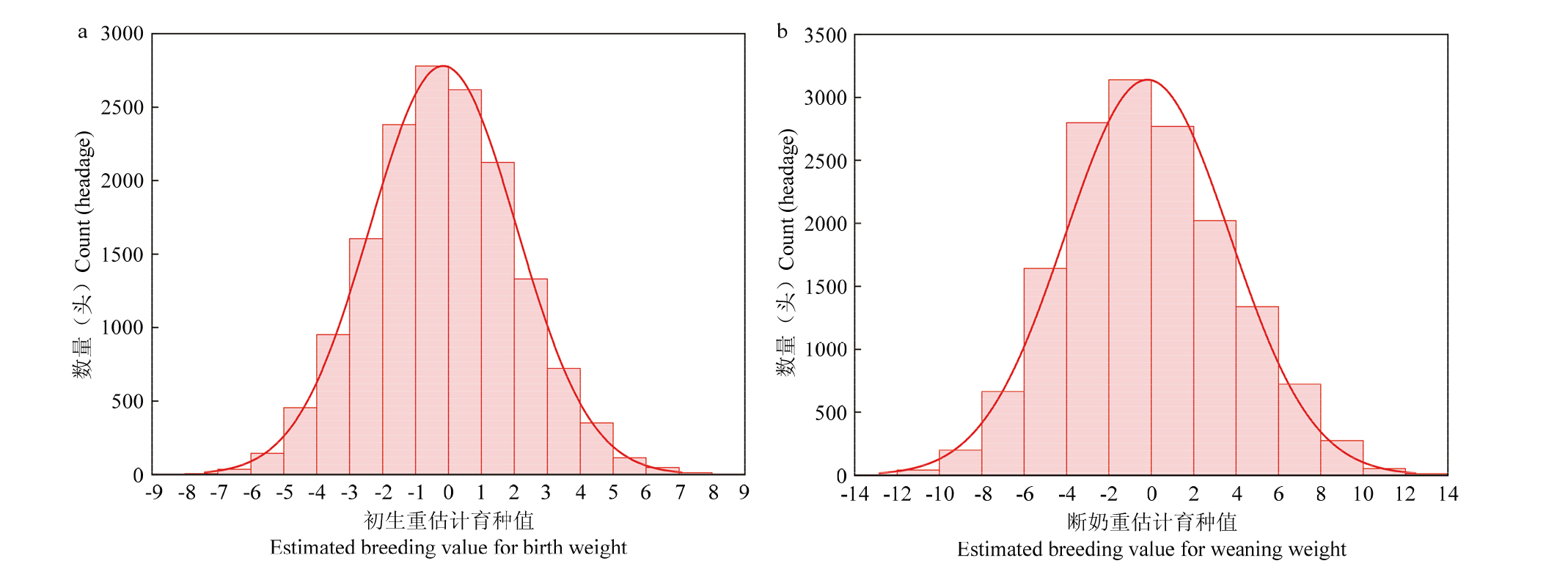
图1
初生重(a)与断奶重(b)育种值分布"
表4
荷斯坦种公牛初生重和断奶重育种值排名前十与后十"
| 排名 Rank | 初生重Birth weight | 断奶重Weaning weight | |||||||||
|---|---|---|---|---|---|---|---|---|---|---|---|
| ID | 育种值 EBV | 可靠性 Rel(%) | 后代数 N | 均值 Mean (kg) | ID | 育种值 EBV | 可靠性 Rel(%) | 后代数 N | 均值 Mean (kg) | ||
| 前十Top10 | 40.26 | 104.41 | |||||||||
| 1 | S54 | 5.40 | 96 | 201 | 38.98 | S66 | 13.34 | 93 | 147 | 107.44 | |
| 2 | S35 | 4.24 | 95 | 175 | 38.70 | S96 | 12.89 | 91 | 122 | 99.15 | |
| 3 | S19 | 3.85 | 91 | 64 | 40.67 | S16 | 12.38 | 96 | 444 | 106.53 | |
| 4 | S5 | 3.59 | 97 | 296 | 43.22 | S17 | 10.92 | 96 | 359 | 104.01 | |
| 5 | S62 | 3.38 | 97 | 308 | 40.15 | S36 | 10.88 | 92 | 115 | 104.71 | |
| 6 | S80 | 3.03 | 93 | 92 | 39.45 | S67 | 10.74 | 89 | 79 | 105.83 | |
| 7 | S40 | 2.97 | 90 | 58 | 39.97 | S18 | 10.64 | 96 | 308 | 102.13 | |
| 8 | S60 | 2.86 | 96 | 338 | 41.38 | S37 | 10.03 | 85 | 53 | 103.79 | |
| 9 | S37 | 2.62 | 90 | 53 | 41.06 | S19 | 8.89 | 87 | 64 | 105.34 | |
| 10 | S96 | 2.38 | 94 | 122 | 39.01 | S15 | 8.49 | 96 | 342 | 103.94 | |
| 后十Bottom 10 | 39.08 | 97.90 | |||||||||
| 1 | S4 | -4.93 | 96 | 239 | 38.63 | S81 | -16.23 | 92 | 125 | 97.88 | |
| 2 | S23 | -3.81 | 98 | 487 | 38.65 | S6 | -13.77 | 94 | 294 | 95.63 | |
| 3 | S1 | -3.80 | 97 | 660 | 40.46 | S30 | -10.11 | 97 | 673 | 99.27 | |
| 4 | S78 | -3.39 | 94 | 119 | 37.56 | S4 | -9.57 | 94 | 239 | 98.16 | |
| 5 | S81 | -3.12 | 95 | 125 | 37.83 | S7 | -9.47 | 96 | 618 | 97.98 | |
| 6 | S30 | -3.08 | 98 | 673 | 37.83 | S57 | -9.45 | 91 | 115 | 101.34 | |
| 7 | S3 | -3.04 | 95 | 225 | 41.21 | S33 | -9.06 | 89 | 108 | 98.75 | |
| 8 | S8 | -3.03 | 97 | 358 | 38.84 | S29 | -8.24 | 93 | 189 | 99.16 | |
| 9 | S10 | -2.95 | 91 | 73 | 40.60 | S97 | -8.02 | 89 | 102 | 88.40 | |
| 10 | S15 | -2.56 | 97 | 342 | 39.16 | S26 | -7.10 | 97 | 892 | 102.44 | |
表5
特殊种公牛相关信息"
| ID | 真实牛号 True cattle number | 出生年份 Birth year | 体重综合指数 Body weight composite index | 难产率 Dystocia rate(%) | 死产率 Stillbirth rate(%) | 乳房综合指数 Udder composite index |
|---|---|---|---|---|---|---|
| S19 | ***HO11981 | 2016 | 0.45 | 1.5 | 2.9 | -0.10 |
| S37 | ***HO11531 | 2013 | 0.98 | 1.6 | 3.6 | -0.71 |
| S96 | ***HO14258 | 2007 | 1.06 | 1.4 | 3.7 | -1.36 |
| S15 | ***HO12240 | 2017 | -0.28 | 1.1 | 3.4 | 0.73 |
| S4 | ***HO03869 | 2018 | -2.10 | 1.2 | 3.9 | 0.00 |
| S81 | ***HO15055 | 2018 | -0.33 | 1.1 | 2.8 | 0.50 |
| S30 | ***HO12346 | 2017 | -0.55 | 1.3 | 3.0 | -0.23 |
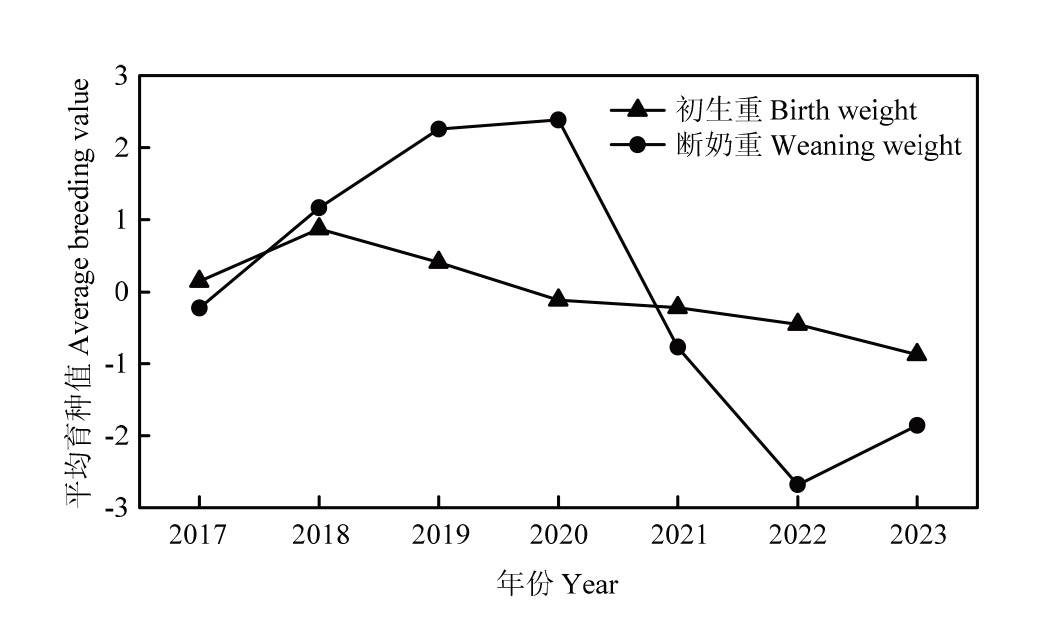
图2
初生重和断奶重遗传趋势"
| [1] |
张胜利, 孙东晓. 奶牛种业的昨天、今天和明天. 中国畜牧业, 2021(15): 22-26.
|
|
|
|
| [2] |
|
| [3] |
doi: 10.1007/s11250-022-03343-z pmid: 36261674 |
| [4] |
doi: 10.3168/jds.2020-18560 pmid: 33189278 |
| [5] |
doi: 10.3390/ani13243821 |
| [6] |
pmid: 14672206 |
| [7] |
王月强, 张敏, 金磊, 华金玲. 荷斯坦奶牛初生重和哺乳期日增重对未来产奶量的影响. 动物营养学报, 2024, 36(4): 2425-2433.
doi: 10.12418/CJAN2024.209 |
|
doi: 10.12418/CJAN2024.209 |
|
| [8] |
|
| [9] |
doi: 10.21451/1984-3143-AR2019-0005 pmid: 32368262 |
| [10] |
doi: 10.3168/jds.2023-24164 |
| [11] |
doi: S0022-0302(18)30514-9 pmid: 29803425 |
| [12] |
doi: 10.3168/jds.2009-2992 pmid: 21183056 |
| [13] |
doi: 10.3168/jds.2016-12229 |
| [14] |
doi: S0022-0302(16)30457-X pmid: 27448860 |
| [15] |
常瑶, 苏国生, 李艳华, 李想, 麻柱, 王雅春. 基于系谱和基因组信息估计荷斯坦青年母牛体重性状遗传参数. 畜牧兽医学报, 2022, 53(11): 3759-3768.
doi: 10.11843/j.issn.0366-6964.2022.11.005 |
|
doi: 10.11843/j.issn.0366-6964.2022.11.005 |
|
| [16] |
任小丽, 张旭, 王雅春, 吴宏军, 刘爱荣, 张毅, 王东升, 崔久辉, 窦同喜, 袁鹏, 等. 三河牛初生体尺和初生重遗传参数的估计. 中国农业科学, 2013, 46(23): 5020-5025. doi: 10.3864/j.issn.0578-1752.2013.23.019.
|
|
|
|
| [17] |
doi: 10.3168/jds.2021-21450 pmid: 35840408 |
| [18] |
董明明, 赵番番, 葛建军, 赵俊亮, 王丹, 胥磊, 张梦华, 种丽伟, 黄锡霞, 王雅春. 新疆地区荷斯坦牛长寿性与产奶量的遗传力估计及相关性分析. 中国农业科学, 2022, 55(21): 4294-4303.
doi: 10.3864/j.issn.0578-1752.2022.21.015 |
|
doi: 10.3864/j.issn.0578-1752.2022.21.015 |
|
| [19] |
doi: 10.1016/j.animal.2024.101177 |
| [20] |
国家市场监督管理总局, 国家标准化管理委员会. 中国荷斯坦牛:GB/T3157—2023[S]. 北京: 中国标准出版社, 2023.
|
|
State Administration for Market Regulation, Standardization Administration of the People's Republic of China. ChineseHolstein:GB/T3157—2023[S]. Beijing: Standards Press of China, 2023. (in Chinese)
|
|
| [21] |
常瑶. 荷斯坦牛生长性状遗传评估及全基因组关联分析[D]. 北京: 中国农业大学, 2021.
|
|
|
|
| [22] |
夏淑雯, 陈坤琳, 沈阳阳, 安振江, 赵芳, 丁强, 仲跻峰, 林志平, 王慧利. 江苏地区荷斯坦成母牛长寿性状遗传参数估计. 畜牧兽医学报, 2024, 55(3): 1030-1039.
doi: 10.11843/j.issn.0366-6964.2024.03.016 |
|
doi: 10.11843/j.issn.0366-6964.2024.03.016 |
|
| [23] |
呙明鹏, 孟源, 王宏浩, 王元, 车雷杰, 申莉, 王曦. 晋南牛不同生长阶段体重和体尺性状遗传参数估计. 畜牧兽医学报, 2023, 54(4): 1452-1464.
doi: 10.11843/j.issn.0366-6964.2023.04.010 |
|
doi: 10.11843/j.issn.0366-6964.2023.04.010 |
|
| [24] |
王梦琦, 朱小瑞, 邢世宇, 张成龙, 刘洵, 杨章平, 毛永江. 影响荷斯坦牛犊牛初生重的因素分析. 家畜生态学报, 2016, 37(10): 22-25.
|
|
|
|
| [25] |
doi: 10.3389/fvets.2023.1198697 |
| [26] |
doi: 10.1007/s00484-021-02237-3 |
| [27] |
doi: 10.3390/ani15152248 |
| [28] |
|
| [29] |
doi: 10.3168/jds.2024-26044 pmid: 40451584 |
| [30] |
doi: 10.3390/dairy2030030 |
| [31] |
doi: 10.3390/ani11020552 |
| [32] |
doi: 10.3168/jds.2018-14400 |
| [33] |
doi: 10.1002/vms3.v8.1 |
| [34] |
doi: 10.1007/s11250-023-03621-4 pmid: 37191884 |
| [35] |
pmid: 12836956 |
| [36] |
pmid: 17183113 |
| [37] |
pmid: 16357296 |
| [38] |
doi: S0022-0302(17)31194-3 pmid: 29274962 |
| [39] |
doi: 10.1016/0301-6226(94)00062-C |
| [40] |
doi: 10.3168/jds.2023-23462 |
| [41] |
再娜古丽·君居列克, 黄锡霞, 马晓燕, 热西提·阿不都热依木, 叶东东, 张文龙, 荷斯坦牛初生重与头胎305d产奶量的遗传参数估计. 中国畜牧杂志, 2014, 50(11): 13-16.
|
|
|
|
| [42] |
doi: 10.5194/aab-48-261-2005 |
| [43] |
doi: 10.1186/s12711-018-0444-4 pmid: 30727969 |
| [44] |
孙东晓, 张胜利, 张勤, 李姣, 张桂香, 刘丑生, 郑伟杰. 我国奶牛基因组选择技术应用进展. 畜牧兽医学报, 2023, 54(10): 4028-4039.
doi: 10.11843/j.issn.0366-6964.2023.10.003 |
|
doi: 10.11843/j.issn.0366-6964.2023.10.003 |
|
| [45] |
doi: 10.5187/jast.2020.62.4.429 pmid: 32803175 |
| [46] |
doi: 10.1186/1297-9686-43-43 |
| [47] |
虎雪姣, 脱征军, 张建勇. 育种技术进展对中国荷斯坦牛育种工作的启示. 中国奶牛, 2025(1): 17-22.
|
|
|
|
| [48] |
doi: 10.14269/2318-1265/jabb.v4n2p43-49 |
| [49] |
赵晓铎, 张华林, 许诗凡, 刘光磊. 奶牛繁殖性状占育种值评估体系权重分析. 中国奶牛, 2019(1): 8-11.
|
|
|
| [1] | 郭军, 邵丹, 窦套存, 马猛, 卢建, 胡玉萍, 王星果, 王强, 李永峰, 郭伟, 童海兵, 曲亮. 鸡产蛋期剩余采食量的随机回归分析及遗传标记筛选[J]. 中国农业科学, 2024, 57(22): 4568-4577. |
| [2] | 郭军, 曲亮, 邵丹, 马猛, 窦套存, 卢建, 胡玉萍, 王星果, 王强, 李永峰, 郭伟, 童海兵. 基于一步法全基因组关联分析解析蛋黄比率遗传结构[J]. 中国农业科学, 2024, 57(21): 4356-4366. |
| [3] | 陈球, 黄晶晶, 王哲鹏. 略阳乌鸡褐壳蛋壳颜色量化体系的建立和遗传基础分析[J]. 中国农业科学, 2023, 56(17): 3452-3460. |
| [4] | 董明明,赵番番,葛建军,赵俊亮,王丹,胥磊,张梦华,种丽伟,黄锡霞,王雅春. 新疆地区荷斯坦牛长寿性与产奶量的遗传力估计及相关性分析[J]. 中国农业科学, 2022, 55(21): 4294-4303. |
| [5] | 郭军,王克华,韩威,窦套存,王星果,胡玉萍,马猛,曲亮. 42日龄如皋黄鸡体重间接遗传效应分析[J]. 中国农业科学, 2022, 55(19): 3854-3861. |
| [6] | 刘有春,刘威生,王兴东,杨艳敏,魏鑫,孙斌,张舵,杨玉春,刘成,李天忠. 基于越橘南高丛与北高丛正反交群体的果实贮藏相关性状筛选及其遗传倾向[J]. 中国农业科学, 2020, 53(19): 4045-4056. |
| [7] | 党李苹,周雯馨,刘瑞芳,白云,王哲鹏. 略阳乌鸡体重和产蛋数性状遗传参数估计[J]. 中国农业科学, 2020, 53(17): 3620-3628. |
| [8] | 郭军,曲亮,窦套存,王星果,沈曼曼,胡玉萍,王克华. 应用随机回归模型估计蛋鸡体重遗传参数[J]. 中国农业科学, 2020, 53(11): 2297-2304. |
| [9] | 赵勇,赵培方,胡鑫,赵俊,昝逢刚,姚丽,赵丽萍,杨昆,覃伟,夏红明,刘家勇. 基于农艺性状分级对317份甘蔗种质资源的评价[J]. 中国农业科学, 2019, 52(4): 602-615. |
| [10] | 张剑搏,袁超,岳耀敬,郭健,牛春娥,王喜军,王丽娟,吕会芹,杨博辉. 不同动物模型对高山美利奴羊早期生长性状遗传参数估计的比较[J]. 中国农业科学, 2018, 51(6): 1202-1212. |
| [11] | 王晓,张勤,俞英. 基于体细胞评分的中国荷斯坦牛乳房炎抗性全基因组关联分析[J]. 中国农业科学, 2017, 50(4): 755-763. |
| [12] | 王梦琦,倪炜,张慧敏,杨章平,王西朴,蒋彦森,毛永江. 中国荷斯坦牛CXCR1基因编码区SNP多态与临床乳房炎和生产寿命的关联分析[J]. 中国农业科学, 2017, 50(12): 2359-2370. |
| [13] | 徐晨希,王梦琦,朱小瑞,张玉锋,夏海磊,刘贤慧,王小龙,张慧敏,杨章平,毛永江. 中国荷斯坦牛FADS2基因3′端SNP突变对乳中脂肪酸组成的影响[J]. 中国农业科学, 2016, 49(11): 2194-2202. |
| [14] | 王小龙, 常玲玲, 陈莹, 陈仁金, 李云龙, 毛永江, 冀德君, 杨章平. 中国荷斯坦牛SCD1外显子5基因多态性及其对乳中脂肪酸组成的影响[J]. 中国农业科学, 2014, 47(9): 1858-1864. |
| [15] | 潘晨1, 胡燕2, 包满珠1, 艾叶1, 何燕红1. 孔雀草杂交组合遗传效应分析[J]. 中国农业科学, 2014, 47(12): 2395-2404. |
|
||
