






中国农业科学 ›› 2026, Vol. 59 ›› Issue (2): 386-401.doi: 10.3864/j.issn.0578-1752.2026.02.012
何治霖( ), 孙翠霞, 岳红丽, 谈月霞, 张耀海, 王福生, 刘思涛, 江东()
收稿日期:2025-05-29
接受日期:2025-07-28
出版日期:2026-01-16
发布日期:2026-01-22
通信作者:
联系方式:
何治霖,E-mail:741699105@qq.com。
基金资助:
HE ZhiLin(), SUN CuiXia, YUE HongLi, TAN YueXia, ZHANG YaoHai, WANG FuSheng, LIU SiTao, JIANG Dong()
Received:2025-05-29
Accepted:2025-07-28
Published:2026-01-16
Online:2026-01-22
摘要:
【目的】 基于重测序数据和表型数据的遗传多样性分析和综合评价,阐明枸橼、柠檬类种质资源的群体遗传结构,为实现柠檬种质创新提供基础材料。 【方法】 2023年11月测定158份枸橼、柠檬类种质资源成熟期果实的13个果实表型性状和43个果皮挥发性功能成分,2023年6月测定幼果期果实的4种类黄酮含量,利用Shannon-Wiener指数和变异系数对158份枸橼、柠檬类种质资源进行遗传多样性分析,结合相关性分析、聚类分析、主成分分析等方法进行综合评价。利用SNP数据构建系统进化树和群体遗传结构分析图,并基于表型数据筛选特异种质。利用表型数据和基因型数据开展全基因组关联分析,筛选出与别罗勒烯相关联的显著变异位点,结合以往报道和基因功能注释,在显著变异位点10 kb附近挖掘出相关的候选基因。 【结果】 参试的158份枸橼、柠檬类种质资源的果实品质性状具有丰富的遗传多样性和广泛的变异,13个果实表型性状(单果重FW、单果皮重PW、果实横径FD、果实纵径FL、果形指数FSI、果皮厚度PT、囊瓣数SNPF、单果种子数SNF、单粒种子重SW、可溶性固形物含量TSS、抗坏血酸含量AA、可滴定酸含量TA、固酸比TSS/TA)的变异系数为14.81%—143.47%,遗传多样性指数为1.21—2.01。芦丁、柚皮苷、橙皮苷和新橙皮苷4种类黄酮成分含量的遗传多样性指数为0.75—1.89,43个果皮挥发性功能成分含量的遗传多样性指数为0.25—1.93。将参试枸橼、柠檬类种质资源的60个数量性状进行主成分分析,选出的前5个主成分累计贡献率达66.55%。结合主成分分析结果进行综合评价,得出枸橼、柠檬类种质资源综合得分范围为-0.09—2.14,筛选出沃尔卡默、方达斯蒂柯巴柑檬、卡斯塔奈罗巴柑檬、琥珀、维尔纳柠檬等特异种质。表型聚类分析和基于基因型的系统进化树分析将参试枸橼、柠檬类种质资源分为7个亚群,除在梾檬、㰀檬的分群上有较大差异外,其他种质的分群结果都比较相似,综合评价中得分较高的优异种质资源大多集中于系统进化树的第Ⅲ亚群。群体遗传结构分析结果显示,除将甜柠檬等杂交品种重新划分为一个亚群外,其他品种与系统进化树分析得出的分群结果基本一致。基于别罗勒烯含量的全基因组关联分析筛选出候选基因C71D7_SOLCH和C71DB_LOTJA,均属于细胞色素P450家族。 【结论】 参试枸橼、柠檬类种质资源的果实品质性状存在广泛的变异和丰富的遗传多样性。枸橼与宽皮柑橘、柚等不同资源类型的杂交是推动亚群遗传分化的重要因子。综合评价中得分较高的枸橼、柠檬类种质资源在系统进化树中比较集中,表明这些优异和特异种质具有相似的遗传背景。C71D7_SOLCH和C71DB_LOTJA可能参与果皮挥发性物质别罗勒烯的代谢。
何治霖, 孙翠霞, 岳红丽, 谈月霞, 张耀海, 王福生, 刘思涛, 江东. 基于重测序枸橼、柠檬类种质资源的遗传多样性分析和别罗勒烯的全基因组关联分析[J]. 中国农业科学, 2026, 59(2): 386-401.
HE ZhiLin, SUN CuiXia, YUE HongLi, TAN YueXia, ZHANG YaoHai, WANG FuSheng, LIU SiTao, JIANG Dong. Genetic Diversity Analysis and GWAS of Alloocimene Based on Resequencing of Citron, Lemon Germplasm Resources[J]. Scientia Agricultura Sinica, 2026, 59(2): 386-401.
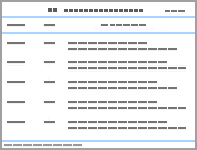
表1
枸橼、柠檬类种质资源果实表型性状的遗传多样性分析"
| 性状 Traits | 最小值 Min | 最大值 Max | 均值±标准差 Mean±SD | 中位数 Med | 变异系数 CV (%) | 多样性指数 H |
|---|---|---|---|---|---|---|
| 单果重FW (g) | 22.90 | 1762 | 246.70±266.99 | 163.30 | 108.22 | 1.37 |
| 果实横径FD (cm) | 3.07 | 14.30 | 7.12±1.89 | 6.72 | 26.51 | 1.81 |
| 果实纵径FL (cm) | 2.89 | 17.30 | 7.65±2.44 | 7.33 | 31.85 | 1.85 |
| 果形指数FSI | 0.72 | 2.29 | 1.08±0.24 | 1.05 | 21.82 | 1.84 |
| 果皮厚度PT (cm) | 0.09 | 2.90 | 0.39±0.34 | 0.30 | 88.36 | 1.40 |
| 单果皮重PW (g) | 6.25 | 861.20 | 88.00±126.25 | 52.79 | 143.47 | 1.24 |
| 囊瓣数SNPF | 7.00 | 17.00 | 10.27±1.75 | 10.00 | 17.05 | 1.89 |
| 单果种子数SNF | 0.00 | 141 | 26.45±25.05 | 18.00 | 94.69 | 1.76 |
| 单粒种子重SW (g) | 0.00 | 0.59 | 0.19±0.10 | 0.16 | 55.26 | 1.86 |
| 可溶性固形物TSS (%) | 5.80 | 13.70 | 8.34±1.23 | 8.10 | 14.81 | 1.85 |
| 可滴定酸TA (g/100 mL) | 0.28 | 9.73 | 3.67±1.45 | 3.79 | 39.59 | 2.01 |
| 固酸比TSS/TA | 1.21 | 27.50 | 3.16±3.28 | 2.05 | 103.90 | 1.21 |
| 抗坏血酸AA (mg/100 mL) | 11.40 | 83.85 | 32.86±10.74 | 32.17 | 32.67 | 1.92 |
| 平均值Mean | — | — | — | — | 59.34 | 1.65 |
表2
枸橼、柠檬类种质资源果实类黄酮含量的统计值"
| 种类 Types | 最小值 Min | 最大值 Max | 均值±标准差 Mean±SD | 中位数 Med | 变异系数 CV (%) | 多样性指数 H |
|---|---|---|---|---|---|---|
| 芦丁Rutin (μg·mL-1) | 0.00 | 27.45 | 3.94±5.29 | 2.17 | 134.18 | 1.55 |
| 柚皮苷Naringin (μg·mL-1) | 0.00 | 1384.79 | 154.79±355.34 | 0.00 | 229.57 | 0.75 |
| 橙皮苷Hesperidin (μg·mL-1) | 0.00 | 326.70 | 64.26±55.96 | 62.72 | 87.08 | 1.89 |
| 新橙皮苷Neohesperidin (μg·mL-1) | 0.00 | 1202.73 | 99.07±226.69 | 0.00 | 228.83 | 0.76 |
| 平均值Mean | — | — | — | — | 169.92 | 1.24 |
表3
枸橼、柠檬类种质资源果皮挥发性功能成分含量的统计值"
| 种类 Types | 最小值 Min | 最大值 Max | 均值±标准差 Mean±SD | 中位数 Med | 变异系数 CV (%) | 多样性指数 H |
|---|---|---|---|---|---|---|
| 反式-2-己烯醛 Trans-2-hexenal (μg·g-1) | 0.00 | 115.72 | 14.17±18.86 | 6.85 | 133.08 | 1.53 |
| α-蒎烯α-pinene (μg·g-1) | 46.91 | 3243.90 | 451.83±437.87 | 366.42 | 96.91 | 1.53 |
| β-蒎烯β-pinene (μg·g-1) | 0.00 | 4111.50 | 789.63±814.04 | 530.69 | 103.09 | 1.63 |
| 桧烯Sabenene (μg·g-1) | 0.00 | 2936.65 | 256.7±595.63 | 0.00 | 232.03 | 0.85 |
| 月桂烯Myrcene (μg·g-1) | 0.00 | 3700.35 | 628.33±491.66 | 544.54 | 78.25 | 1.75 |
| α-水芹烯α-phellandrene (μg·g-1) | 0.00 | 3298.94 | 70.56±310.22 | 31.17 | 439.63 | 0.49 |
| delta-3-carene (μg·g-1) | 0.00 | 291.89 | 36.87±54.32 | 0 | 147.32 | 1.45 |
| α-松油烯α-terpinene (μg·g-1) | 0.00 | 372.64 | 47.69±69.76 | 21.15 | 146.28 | 1.51 |
| 柠檬烯Limonene (μg·g-1) | 0.00 | 30464.39 | 6898.57±3386.06 | 6450.99 | 49.08 | 1.85 |
| 顺式-罗勒烯cis-ocimene (μg·g-1) | 0.00 | 913.36 | 105.40±174.29 | 38.25 | 165.37 | 1.49 |
| γ-松油烯γ-Terpinene (μg·g-1) | 0.00 | 5496.34 | 272.54±619.11 | 57.28 | 227.16 | 0.92 |
| 正辛醇1-octanol (μg·g-1) | 0.00 | 201.46 | 28.66±31.29 | 23.12 | 109.16 | 1.66 |
| 异松油烯Terpinolene (μg·g-1) | 0.00 | 1029.97 | 151.13±181.93 | 84.12 | 120.38 | 1.53 |
| 芳樟醇Linalool (μg·g-1) | 34.30 | 4871.18 | 456.50±829.34 | 160.16 | 181.67 | 0.85 |
| 别罗勒烯Alloocimene (μg·g-1) | 0.00 | 383.26 | 33.5±61.76 | 11.63 | 184.37 | 1.35 |
| 正壬醛Nonanal (μg·g-1) | 0.00 | 87.67 | 17.21±24.43 | 0.00 | 141.90 | 1.47 |
| 香茅醛Citronellal (μg·g-1) | 0.00 | 1220.20 | 70.19±192.28 | 11.26 | 273.95 | 0.75 |
| 4-松油烯醇4-terpineol (μg·g-1) | 0.00 | 356.95 | 112.70±81.01 | 106 | 71.88 | 1.93 |
| α-松油醇α-terpineol (μg·g-1) | 0.00 | 2403.68 | 283.85±356.64 | 190.04 | 125.65 | 1.42 |
| 正癸醛Decanal (μg·g-1) | 0.00 | 359.77 | 48.70±54.91 | 35.91 | 112.75 | 1.56 |
| 香茅醇Citronellol (μg·g-1) | 0.00 | 780.35 | 68.08±130.72 | 0.00 | 192.01 | 1.36 |
| 香叶醇Geraniol (μg·g-1) | 0.00 | 954.00 | 112.81±160.10 | 34.56 | 141.92 | 1.53 |
| 反式柠檬醛Trans- geranial (μg·g-1) | 0.00 | 1968.27 | 263.11±377.31 | 91.03 | 143.40 | 1.51 |
| 二甲基辛二烯3,7-dimethyl-1,6-octadiene (μg·g-1) | 0.00 | 65.15 | 11.97±13.62 | 9.25 | 113.81 | 1.62 |
| 百里香酚Thymol (μg·g-1) | 0.00 | 1595.56 | 20.30±150.09 | 0.00 | 739.28 | 0.25 |
| 正十一醛Undecanal (μg·g-1) | 0.00 | 198.59 | 14.06±21.17 | 9.21 | 150.58 | 1.54 |
| α-荜澄茄油烯α-cubebene (μg·g-1) | 0.00 | 113.42 | 12.22±19.85 | 1.98 | 162.45 | 1.43 |
| 乙酸橙花酯Nerylacetate (μg·g-1) | 0.00 | 866.85 | 147.59±180.98 | 66.49 | 122.62 | 1.56 |
| 古巴烯Copaene (μg·g-1) | 0.00 | 160.17 | 17.68±32.46 | 2.62 | 183.65 | 1.43 |
| 乙酸香叶酯Geranyl acetate (μg·g-1) | 0.00 | 754.77 | 103.86±159.23 | 49.62 | 153.30 | 1.41 |
| 榄香烯Elemene (μg·g-1) | 0.00 | 610.32 | 29.37±66.27 | 9.62 | 225.64 | 0.85 |
| 月桂醛Lauryl aldehyde (μg·g-1) | 0.00 | 115.80 | 11.19±17.39 | 5.29 | 155.35 | 1.51 |
| β-石竹烯β-caryophyllene (μg·g-1) | 0.00 | 666.93 | 157.12±146.37 | 117.51 | 93.16 | 1.78 |
| 毕澄茄烯Cubebene (μg·g-1) | 0.00 | 65.00 | 11.01±14.22 | 3.79 | 129.18 | 1.54 |
| 金合欢烯Farnesene (μg·g-1) | 0.00 | 1271.53 | 86.11±209.31 | 34.14 | 243.07 | 0.57 |
| 茂伦烯Muurolene (μg·g-1) | 0.00 | 109.53 | 17.41±22.72 | 7.07 | 130.48 | 1.57 |
| 大牛儿烯D Germacrone D (μg·g-1) | 0.00 | 360.37 | 52.5±75.62 | 12.82 | 144.02 | 1.52 |
| α-香柠檬烯α-bergamotene (μg·g-1) | 0.00 | 1268.51 | 272.92±261.71 | 212.11 | 95.89 | 1.89 |
| 巴伦西亚橘烯Valencene (μg·g-1) | 0.00 | 363.39 | 25.10±52.52 | 2.98 | 209.23 | 0.92 |
| 红没药烯Bisabolene (μg·g-1) | 0.00 | 1791.62 | 283.99±316.13 | 217.82 | 111.32 | 1.58 |
| 杜松烯Cadinene (μg·g-1) | 0.00 | 335.95 | 44.83±62.03 | 13.58 | 138.36 | 1.49 |
| 橙花醇Nerol (μg·g-1) | 0.00 | 778.09 | 89.18±142.53 | 0.00 | 159.82 | 1.39 |
| 顺式-柠檬醛cis-neral (μg·g-1) | 0.00 | 1687.75 | 161.8±262.28 | 39.54 | 162.10 | 1.49 |
| 平均值Mean | - | - | - | - | 168.38 | 1.39 |
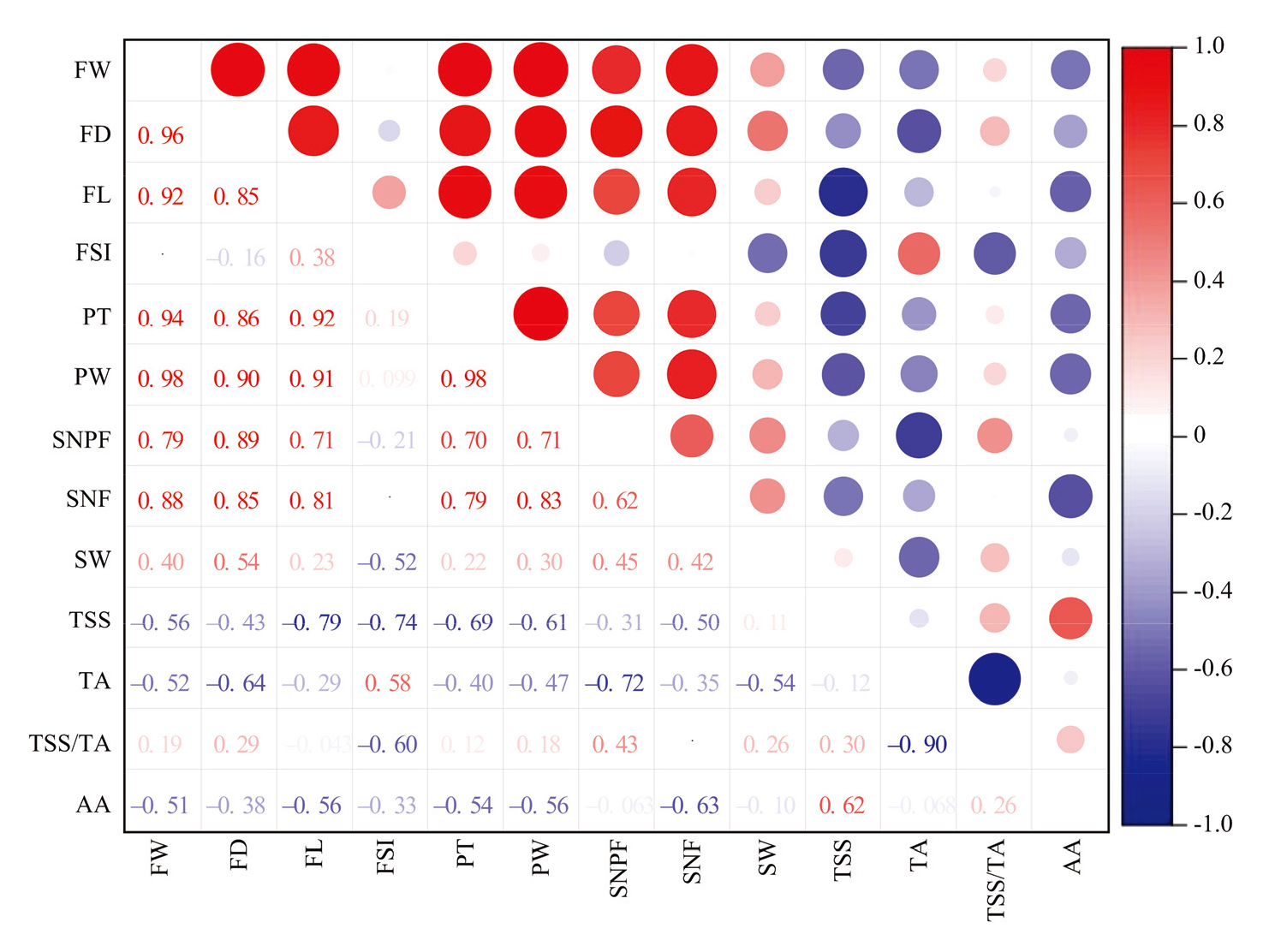
图1
枸橼、柠檬类种质资源果实表型性状的相关性分析"
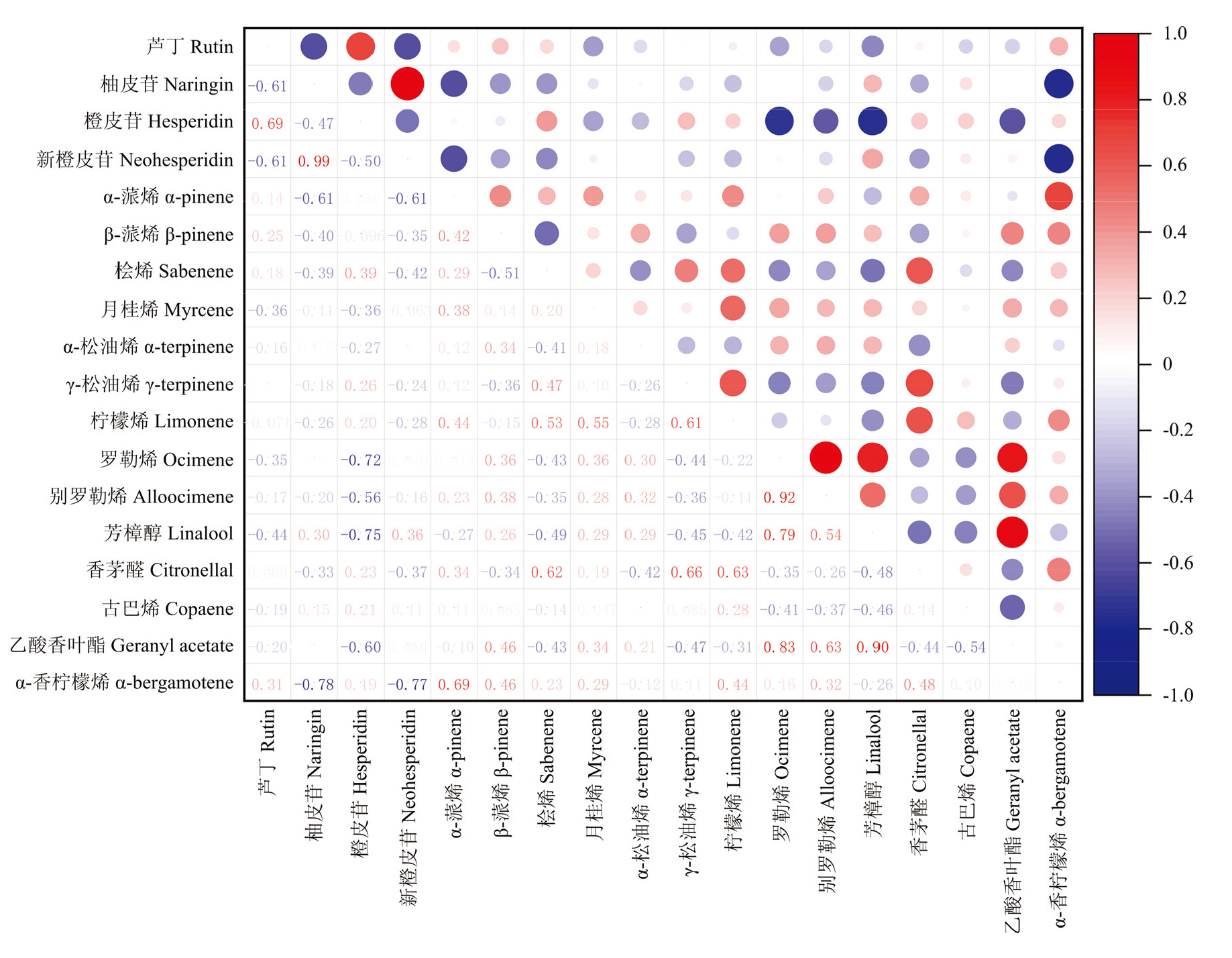
图2
枸橼、柠檬类种质资源果实典型次生代谢物含量的相关性分析"

图3
基于枸橼、柠檬类种质资源数量性状的聚类分析"
表4
枸橼、柠檬类种质资源数量性状的主成分分析"
| 性状 Traits | 主成分1 PC1 | 主成分2 PC2 | 主成分3 PC3 | 主成分4 PC4 | 主成分5 PC5 |
|---|---|---|---|---|---|
| 单果重FW (g) | -0.074 | 0.277 | -0.124 | -0.604 | 0.546 |
| 果形指数FSI | 0.447 | -0.447 | -0.423 | -0.076 | 0.312 |
| 可溶性固形物TSS (%) | -0.489 | 0.221 | 0.362 | 0.531 | 0.125 |
| 可滴定酸TA (g/100 mL) | 0.314 | -0.507 | -0.087 | 0.539 | 0.001 |
| 抗坏血酸AA (mg/100 mL) | -0.323 | 0.093 | 0.044 | 0.495 | 0.600 |
| 柚皮苷Naringin (μg·mL-1) | -0.441 | 0.520 | 0.154 | 0.094 | 0.009 |
| 蒎烯Pinene (μg·g-1) | 0.604 | -0.055 | 0.019 | 0.430 | 0.249 |
| 桧烯Sabenene (μg·g-1) | 0.050 | -0.333 | 0.514 | -0.092 | -0.097 |
| 月桂烯Myrcene (μg·g-1) | 0.459 | 0.304 | 0.570 | -0.190 | 0.353 |
| 松油烯Terpinene (μg·g-1) | 0.050 | -0.226 | 0.591 | 0.038 | -0.204 |
| 柠檬烯Limonene (μg·g-1) | 0.314 | -0.042 | 0.791 | -0.177 | 0.059 |
| 罗勒烯Ocimene (μg·g-1) | 0.644 | 0.471 | -0.137 | -0.018 | -0.176 |
| 芳樟醇Linalool (μg·g-1) | 0.377 | 0.751 | -0.056 | 0.220 | -0.173 |
| 乙酸香叶酯Geranyl acetate (μg·g-1) | 0.581 | 0.630 | -0.102 | 0.149 | -0.050 |
| α-香柠檬烯α-bergamotene (μg·g-1) | 0.752 | -0.360 | 0.077 | 0.011 | 0.069 |
| 特征值Eigenvalue | 2.978 | 2.433 | 1.961 | 1.531 | 1.080 |
| 方差贡献率Variance contribution rate (%) | 19.855 | 16.223 | 13.074 | 10.204 | 7.199 |
| 累计贡献率Accumulated contribution rate (%) | 19.855 | 36.078 | 49.152 | 59.356 | 66.555 |
表5
特异枸橼、柠檬类种质资源的部分性状信息"
| 编号 Code | 单果重 FW | 柚皮苷 Naringin | 蒎烯 Pinene | 月桂烯 Myrcene | 柠檬烯 Limonene | 罗勒烯 Ocimene | 芳樟醇 Linalool | α-香柠檬烯 α-bergamotene |
|---|---|---|---|---|---|---|---|---|
| H4 | 119.85 | 0.00 | 1591.21 | 2328.93 | 30464.39 | 20.67 | 209.8 | 779.80 |
| H119 | 350.12 | 301.78 | 2847.78 | 1646.42 | 9849.52 | 707.42 | 4871.18 | 345.45 |
| H120 | 296.52 | 207.81 | 3007.67 | 2038.05 | 7767.49 | 1006.22 | 2861.46 | 370.65 |
| H97 | 342.00 | 125.60 | 2281.77 | 797.39 | 7073.66 | 736.81 | 3849.56 | 204.99 |
| H86 | 145.80 | 0.00 | 1089.39 | 1235.88 | 16867.77 | 45.28 | 233.77 | 1055.60 |
| H21 | 297.35 | 264.52 | 2576.17 | 1873.15 | 8038.02 | 367.72 | 1742.97 | 342.25 |
| H11 | 169.63 | 0.00 | 5523.10 | 1288.77 | 11033.55 | 137.71 | 125.81 | 757.55 |
| MEAN | 245.90 | 128.53 | 2702.42 | 1592.71 | 13013.43 | 431.64 | 1985.12 | 550.86 |
| AVTG | 246.70 | 154.79 | 789.63 | 628.33 | 6898.57 | 105.40 | 456.50 | 272.92 |

图4
158份枸橼、柠檬类种质资源系统进化树分析"

图5
158份枸橼、柠檬类种质资源群体的遗传结构图"

图6
枸橼、柠檬类种质资源别罗勒烯含量全基因组关联分析图 A:曼哈顿图;B:Q-Q图 A: Manhattan plot; B: QQ plot"
| [1] |
doi: 10.1016/j.scienta.2015.09.004 |
| [2] |
|
| [3] |
doi: 10.1093/aob/mcw005 pmid: 26944784 |
| [4] |
徐淼. 枸橼种质资源果实糖酸与类胡萝卜素分析[D]. 武汉: 华中农业大学, 2022.
|
|
|
|
| [5] |
尤桂春, 林文忠, 武竞超, 姚文. 柠檬种质资源表型性状遗传多样性分析. 中国南方果树, 2020, 49(6): 34-39.
|
|
|
|
| [6] |
祝进. 尤力克柠檬(Citrus limon (L.)Burm.F.)小种子植株遗传多样性研究[D]. 雅安: 四川农业大学, 2007.
|
|
|
|
| [7] |
李沛, 何治霖, 谈月霞, 赵婉彤, 冯锦英, 陈贵虎, 严池, 王子豪, 黄平, 江东. 基于重测序数据与表型性状的宽皮柑橘遗传多样性分析与优异种质筛选. 中国农业科学, 2024, 57(23): 4761-4795. doi: 10.3864/j.issn.0578-1752.2024.23.014.
|
|
|
|
| [8] |
范刚, 乔宇, 姚晓琳, 徐晓云, 王可兴, 潘思轶, 段雅庆. 柑橘加工制品中香气物质的研究进展. 中国农业科学, 2009, 42(12): 4324-4332. doi: 10.3864/j.issn.0578-1752.2009.12.026.
|
|
|
|
| [9] |
李春秀, 李勋兰, 梁国鲁, 向素琼, 韩国辉. 不同成熟阶段柠檬果皮挥发物和酚类成分分析. 食品科学, 2022, 43(4): 215-224.
|
|
doi: 10.7506/spkx1002-6630-20210325-316 |
|
| [10] |
doi: 10.3390/plants10091941 |
| [11] |
胡忠勤, 郭廷翘, 王玉峰, 刘香环, 刘德臣. 别罗勒烯水合的研究. 东北林业大学学报, 1995, 23(2): 62-67.
|
|
|
|
| [12] |
江东, 龚桂芝. 柑橘种质资源描述规范和数据标准. 北京: 中国农业出版社, 2006.
|
|
|
|
| [13] |
盛雪飞. 柑橘黄酮抗氧化及协同作用研究[D]. 杭州: 浙江大学, 2010.
|
|
|
|
| [14] |
涂勋良, 阳姝婷, 吴忠旺, 吴传雪, 张利, 吕秀兰. HPLC法同时测定柠檬果实中11种类黄酮含量. 湖南农业大学学报(自然科学版), 2016, 42(5): 543-548.
|
|
|
|
| [15] |
张耀海, 张念, 龚蕾, 王成秋, 赵其阳. 不同成熟阶段五种柚果实的主要理化品质和挥发性成分变化规律. 食品与发酵工业, 2023, 50(20): 136-144.
|
|
|
|
| [16] |
南京农学院. 田间试验和统计方法. 北京: 农业出版社, 1979.
|
|
Nanjing Agricultural College.
|
|
| [17] |
李小孟. 柑橘及其近缘属植物的分子进化与栽培柑橘的起源研究[D]. 重庆: 西南大学, 2010.
|
|
|
|
| [18] |
doi: 10.1016/j.jss.2012.10.050 |
| [19] |
邓秀新. 中国柑橘品种. 北京: 中国农业出版社, 2008.
|
|
|
|
| [20] |
doi: 10.1016/j.scienta.2009.02.018 |
| [21] |
doi: 10.1016/j.scienta.2024.113690 |
| [22] |
陈伟. 主成份分析法用于评价需注意的若干问题. 人类工效学, 2002, 8(1): 30-33.
|
|
|
|
| [23] |
王秀秀, 邢爱双, 杨茹, 何守朴, 贾银华, 潘兆娥, 王立如, 杜雄明, 宋宪亮. 陆地棉种质资源表型性状综合评价. 中国农业科学, 2022, 55(6): 1082-1094. doi: 10.3864/j.issn.0578-1752.2022.06.003.
|
|
|
|
| [24] |
吴春文, 冯致, 张邦伟, 王涛, 吴秀忠, 蒋龙, 黄娟, 申林静, 李萌, 王义强. 银杏种质资源表型性状遗传多样性分析和优异种质筛选. 分子植物育种, 2022: 1-14. (2022-03-02).https://kns.cnki.net/kcms/detail/46.1068.S.20220301.0938.006.html.
|
|
|
|
| [25] |
|
| [26] |
doi: 10.1038/ng.3839 |
| [27] |
李海媚, 范燕萍. 花朵萜类花香主要成分、代谢通路和关键功能基因. 分子植物育种, 2023: 1-17. (2023-07-19).https://kns.cnki.net/kcms/detail/detail.aspxdbcode=CJFD&dbname=CJFD&filename=FZZW20230718004.
|
|
|
|
| [28] |
doi: 10.1134/S0006297908090022 |
| [29] |
doi: 10.1105/tpc.113.117382 |
| [30] |
doi: 10.1093/pcp/pcx123 |
| [1] | 陈敏氡, 裘波音, 黄昊, 李永平, 温庆放. 松花菜种质花球质地品质的评价[J]. 中国农业科学, 2026, 59(6): 1302-1316. |
| [2] | 陈敏, 焦紫岚, 乔承彬, 许昊, 张碧, 马东花, 孔维儒, 王敬文, 宋佳伟, 罗成科, 李培富, 田蕾. 不同亚种水稻种质资源对盐胁迫的形态生理响应及适应策略[J]. 中国农业科学, 2026, 59(4): 705-722. |
| [3] | 吕涛, 孙国清, 郭栋材, 陈全家, 蔡永生, 樊标星, 曲延英, 郑凯. 海岛棉纤维强度QTL紧密连锁InDel分子标记开发及效应评价[J]. 中国农业科学, 2025, 58(9): 1684-1701. |
| [4] | 许玉娟, 张捷, 王天译, 陈浩洋, 赵佳佳, 武棒棒, 郝宇琼, 李晓华, 郑兴卫, 左静静, 郑军. 山西小麦低分子量麦谷蛋白Glu-A3和Glu-B3位点多样性鉴定及其对品质的影响[J]. 中国农业科学, 2025, 58(24): 5110-5127. |
| [5] | 陈彩锦, 马琳, 蒋庆雪, 刘金晖, 苗童, 张志鹏, 孟翔, 马晓冉, 周昕越, 张建, 刘文辉, 王学敏. 244份饲用燕麦种质资源表型性状遗传多样性分析[J]. 中国农业科学, 2025, 58(23): 4825-4836. |
| [6] | 魏益民, 周美亮, 唐宇. 荞麦的起源、进化与传播[J]. 中国农业科学, 2025, 58(21): 4305-4316. |
| [7] | 陈天晓, 曹榕, 宋倩楠, 胡亮亮, 王素华, 王丽侠, 程须珍, 陈红霖. 小豆种质资源苗期耐盐性综合评价及耐盐种质筛选[J]. 中国农业科学, 2025, 58(21): 4317-4332. |
| [8] | 刘晓旭, 钟泽鑫, 邱佳仁, 杨春晓, 张永军, 谢文, 张友军, 潘慧鹏. 豆大蓟马不同地理种群线粒体CO1的遗传多样性[J]. 中国农业科学, 2025, 58(21): 4361-4371. |
| [9] | 张帆, 杨青川. 紫花苜蓿育种历史、现状与展望[J]. 中国农业科学, 2025, 58(21): 4471-4481. |
| [10] | 陈永先, 陈瑞江, 都艺芝, 术钧捷, 陈晚霞, 赵梓含, 王季春, 杜康, 张凯. 耐旱甘薯种质资源的筛选与鉴定[J]. 中国农业科学, 2025, 58(2): 214-237. |
| [11] | 唐桂梅, 李卫东, 周宇霞, 孔佑涵, 肖晓玲, 彭颖姝, 张力, 符红艳, 刘洋, 黄国林. 基于表型性状分析蕙兰种质资源遗传多样性[J]. 中国农业科学, 2025, 58(2): 339-354. |
| [12] | 包明芳, 秦燕, 陈彩锦, 张尚沛, 张国辉, 沙晓弟. 111份紫花苜蓿种质资源苗期表型抗旱性鉴定评价[J]. 中国农业科学, 2025, 58(19): 3825-3836. |
| [13] | 郭孟泽, 张磊, 孙平平, 江彪, 闫晋强, 李正男. ToLCNDV广东冬瓜分离物的分子特征及其遗传演化规律[J]. 中国农业科学, 2025, 58(19): 3890-3904. |
| [14] | 孟姿诺, 付长青, 张玲玉, 高顺娟, 常金华, 崔江慧. 高粱芽苗期耐盐性评价及耐盐种质筛选[J]. 中国农业科学, 2025, 58(16): 3317-3326. |
| [15] | 罗嘉锐, 吴三玲, 郭芾, 刘振, 宋婧含, 谭瑗瑗, 舒庆尧. 籼稻品种基因组中逆转座子Tos17的鉴定与研究[J]. 中国农业科学, 2025, 58(15): 2933-2947. |
|
||
