






中国农业科学 ›› 2026, Vol. 59 ›› Issue (16): 3605-3620.doi: 10.3864/j.issn.0578-1752.2026.16.010
吴佳佳1( ), 刘蕊1, 李鑫艳1, 张久东2, 常单娜3(), 曹卫东3()
收稿日期:2025-10-26
接受日期:2025-11-22
出版日期:2026-08-16
发布日期:2026-08-17
通信作者:
联系方式:
吴佳佳,E-mail:2978594601@qq.com。
基金资助:
WU JiaJia1(), LIU Rui1, LI XinYan1, ZHANG JiuDong2, CHANG DanNa3(), CAO WeiDong3()
Received:2025-10-26
Accepted:2025-11-22
Published:2026-08-16
Online:2026-08-17
摘要:
【目的】 玉米间作豆科绿肥能够实现节肥增效,施用生物炭是减少农田气态氮损失的有效措施。然而,关于间作绿肥下减氮并配施生物炭对氮素气态损失及系统氮足迹的影响尚不明确。为此,本研究通过田间试验,明确该模式对氮素气态损失与系统氮足迹的综合影响,为西北绿洲灌区玉米生产的绿色发展提供技术途径。【方法】 于2021年在甘肃武威绿洲农业试验站开始设置田间试验,双因素设计,主因素为施氮制度,包括常规施氮(N100),减氮30%(N70),减氮30%配施田菁生物炭(N70S)。副因素为种植模式,分别为玉米单作(MM)和玉米间作箭筈豌豆(IMC)。共形成6个处理:N100-MM、N100-IMC、N70-MM、N70-IMC、N70S-MM、N70S-IMC。测定2024—2025年玉米产量、氮素吸收及土壤理化性状,同步监测氧化亚氮(N2O)排放与氨(NH3)挥发,并采用生命周期评价法量化系统氮足迹。【结果】 相比常规施氮,减氮30%玉米籽粒产量、地上部生物量和氮素累积量分别降低7.9%、6.1%和4.7%;而配施田菁生物炭籽粒产量和地上部生物量分别增加8.6%和2.7%。玉米间作绿肥较单作增产3.8%。N70S-IMC较N100-MM处理产量、生物量和氮素累积量分别增加了12.6%、4.3%和4.0%。减氮30%处理的N2O和NH3累积排放量分别降低16.0%—25.2%和9.9%—24.7%,配施田菁生物炭处理分别降低24.8%—27.7%和17.6%—43.9%。相比N100-MM,N70-IMC处理的N2O和NH3累积排放量分别降低了12.1%—20.1%和11.2%—20.1%,N70S-IMC处理分别降低15.3%—24.3%和20.1%—35.8%。N70-IMC较N100-MM处理土壤铵态氮(NH4+-N)、硝态氮(NO3--N)和微生物量氮(MBN)分别降低17.6%、15.6%和9.6%,N70S-IMC处理土壤NH4+-N和可溶性有机氮(DON)分别降低15.6%和7.3%,全氮(TN)和MBN分别增加3.9%和25.0%。随机森林分析表明,土壤NO3--N、NH4+-N、MBN和DON是驱动N2O排放的关键因子,而NH3挥发主要受NO3--N、NH4+-N和全氮驱动。生命周期评价表明,相比N100-MM处理,N70-IMC和N70S-IMC处理的氮足迹分别降低28.9%和39.7%,N70S-IMC较N70-IMC处理氮足迹降低了10.4%。【结论】 玉米间作绿肥减氮30%配施田菁生物炭能够增加玉米产量和氮素吸收,改善土壤理化性状,降低N2O排放、NH3挥发及系统氮足迹,是西北绿洲灌区玉米绿色可持续生产的有效路径。
吴佳佳, 刘蕊, 李鑫艳, 张久东, 常单娜, 曹卫东. 间作绿肥下减氮并配施生物炭降低玉米生产氮足迹[J]. 中国农业科学, 2026, 59(16): 3605-3620.
WU JiaJia, LIU Rui, LI XinYan, ZHANG JiuDong, CHANG DanNa, CAO WeiDong. Reducing Nitrogen Footprint of Maize Production with Intercropping Green Manure, Nitrogen Reduction, and Sesbania Biochar[J]. Scientia Agricultura Sinica, 2026, 59(16): 3605-3620.
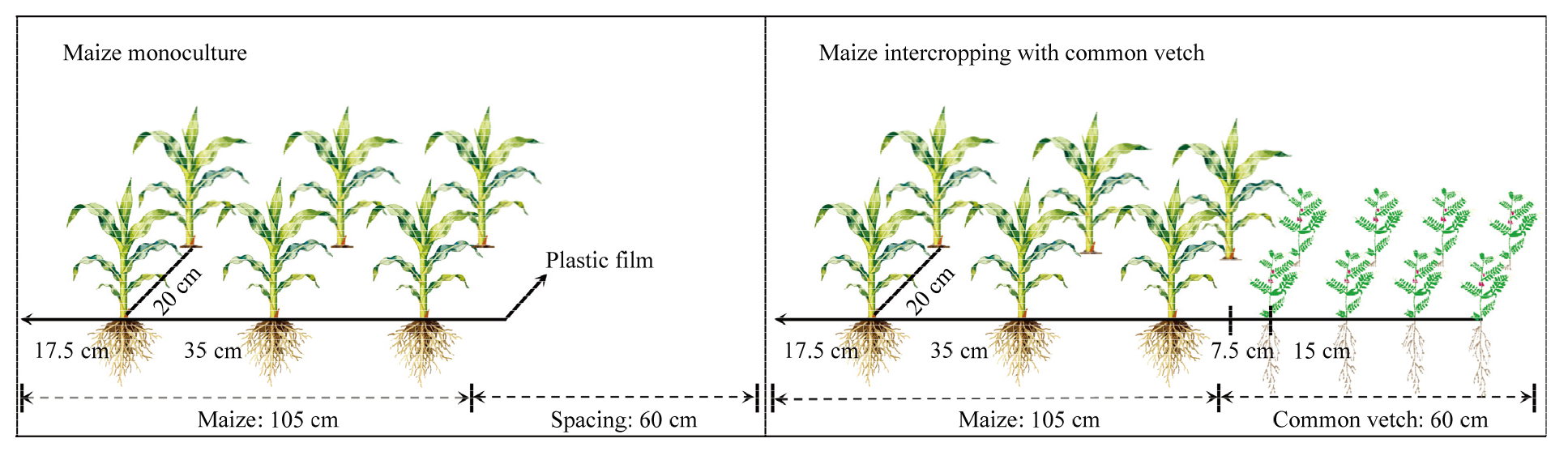
图1
玉米单作和玉米间作绿肥模式田间布置参数"
表1
农业投入数据的活性氮损失系数"
| 投入 Input | 单位 Unit | 活性氮损失系数 Cumulative reactive N losses (kg N-eq·kg-1) | 来源 Source |
|---|---|---|---|
| 氮肥N fertilizer | kg N | 7.15×10⁻³ | [ |
| 磷肥P fertilizer | kg P2O5 | 1.83×10⁻⁴ | |
| 除草剂Herbicide | kg | 4.69×10⁻³ | |
| 杀虫剂Insecticide | kg | 4.69×10⁻³ | |
| 农膜Agricultural film | kg N-eq·kg-1 | 1.2×10⁻⁴ | |
| 柴油Diesel | L | 2.86×10⁻² | |
| 灌溉用电Irrigation electricity | kWh | 1.97×10⁻³ | |
| 生物炭Biochar | kg N-eq·t-1 | -1.26 | [ |
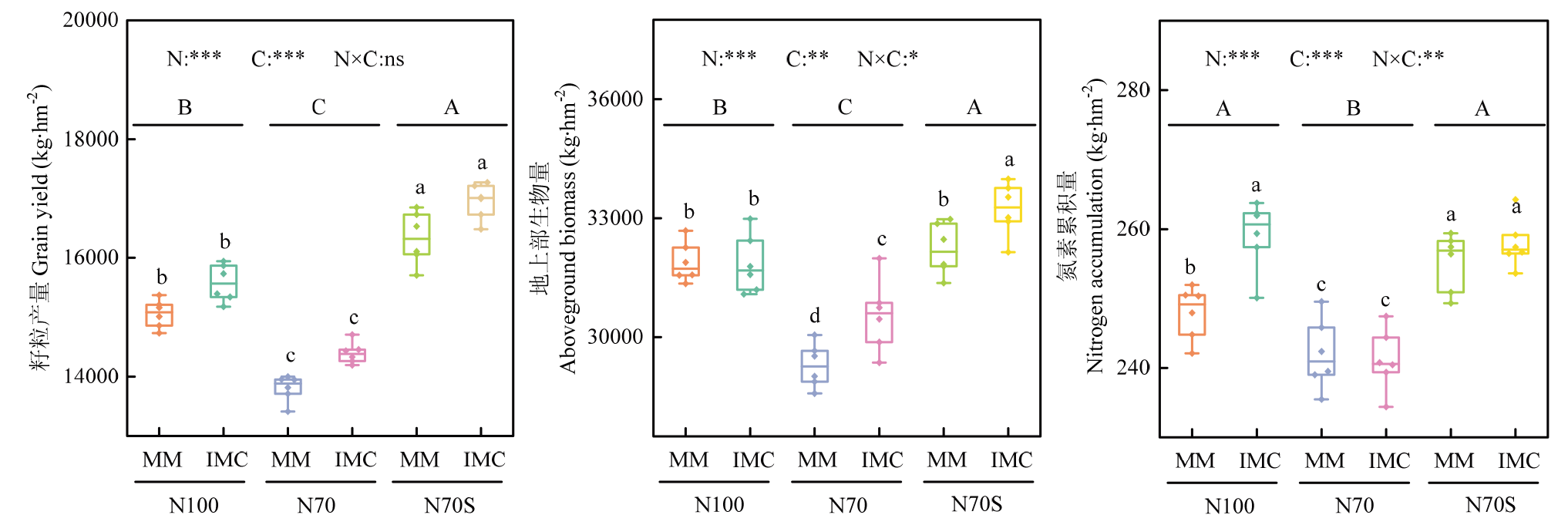
图2
玉米籽粒产量、生物量和氮素累积量(2024—2025年) MM:玉米单作;IMC:玉米间作绿肥;N100:常规施氮;N70:减氮30%;N70S:减氮30%配施田菁生物炭;N:施氮制度;C:种植模式;N×C:施氮制度与种植模式间的交互作用。图中不同小写字母表示处理间差异显著(n=6,P<0.05),不同大写字母代表施氮制度间差异显著(n=3,P<0.05)。*:P<0.05;**:P<0.01;***:P<0.001。下同"
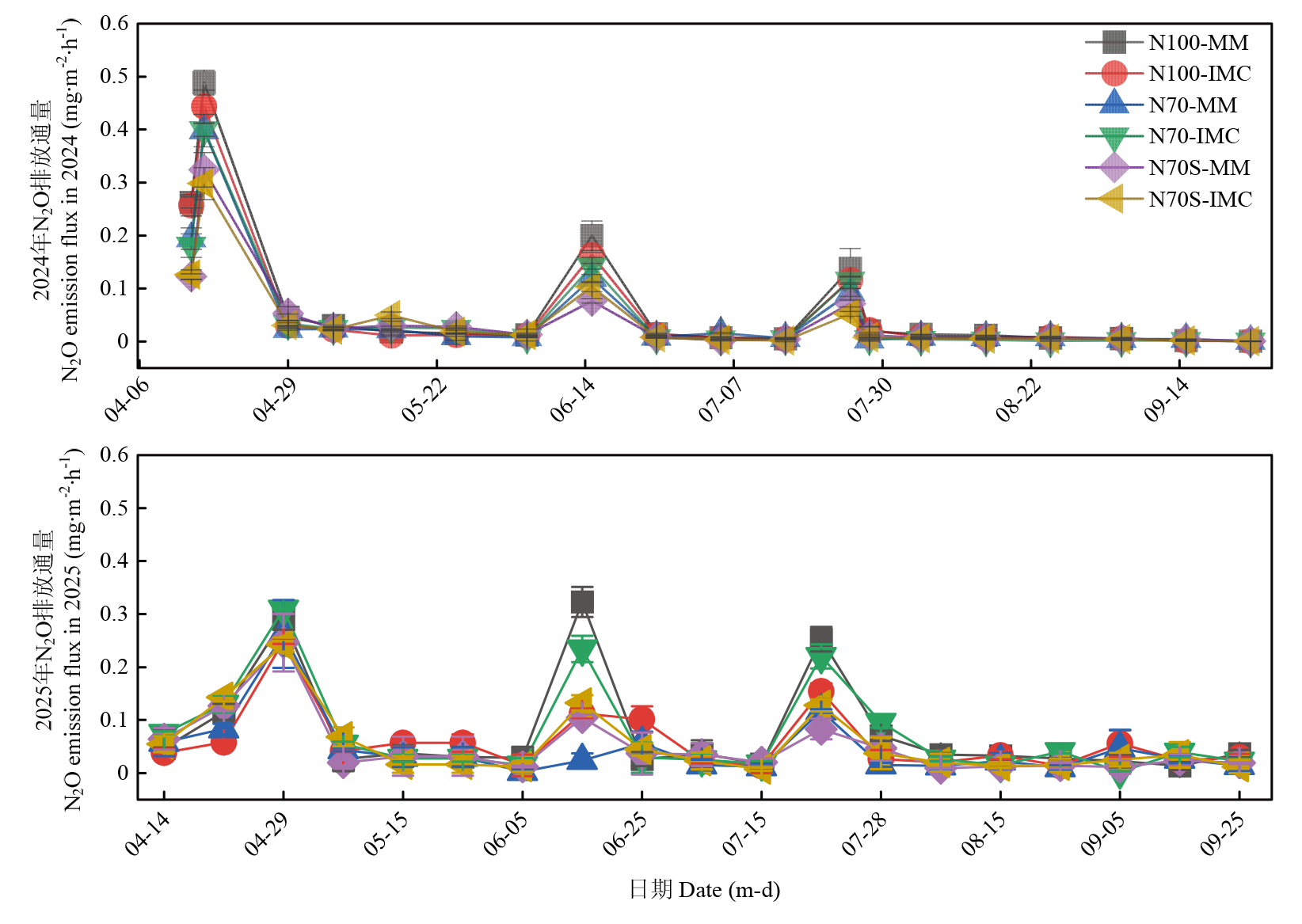
图3
不同处理下N2O排放通量"
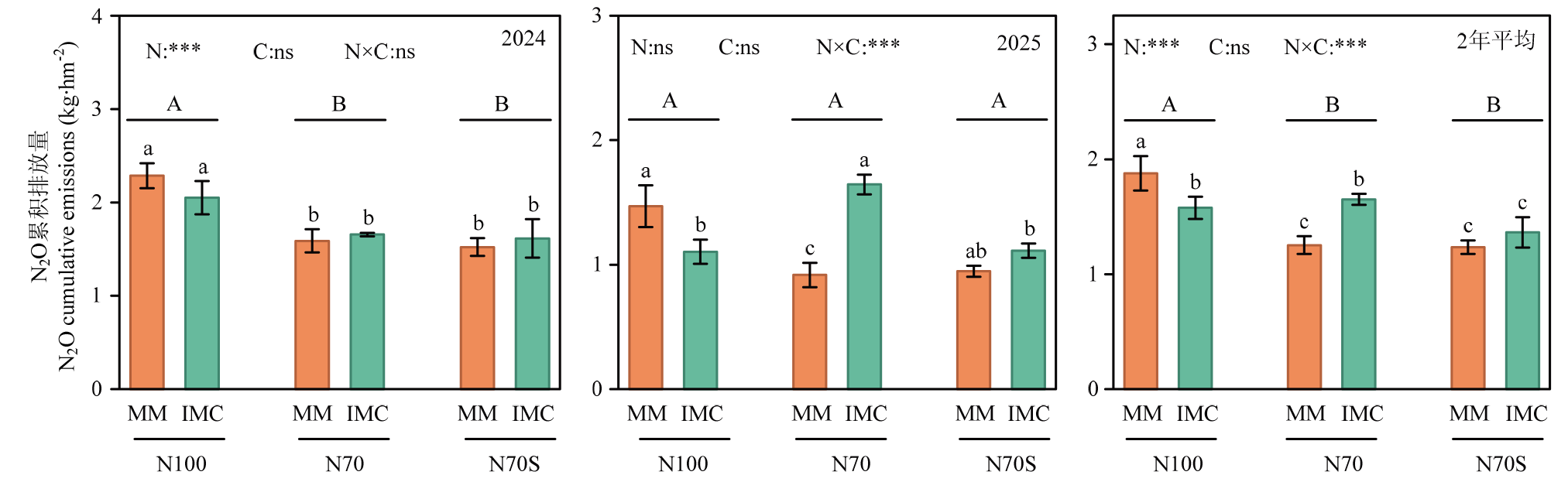
图4
不同处理N2O累积排放量"
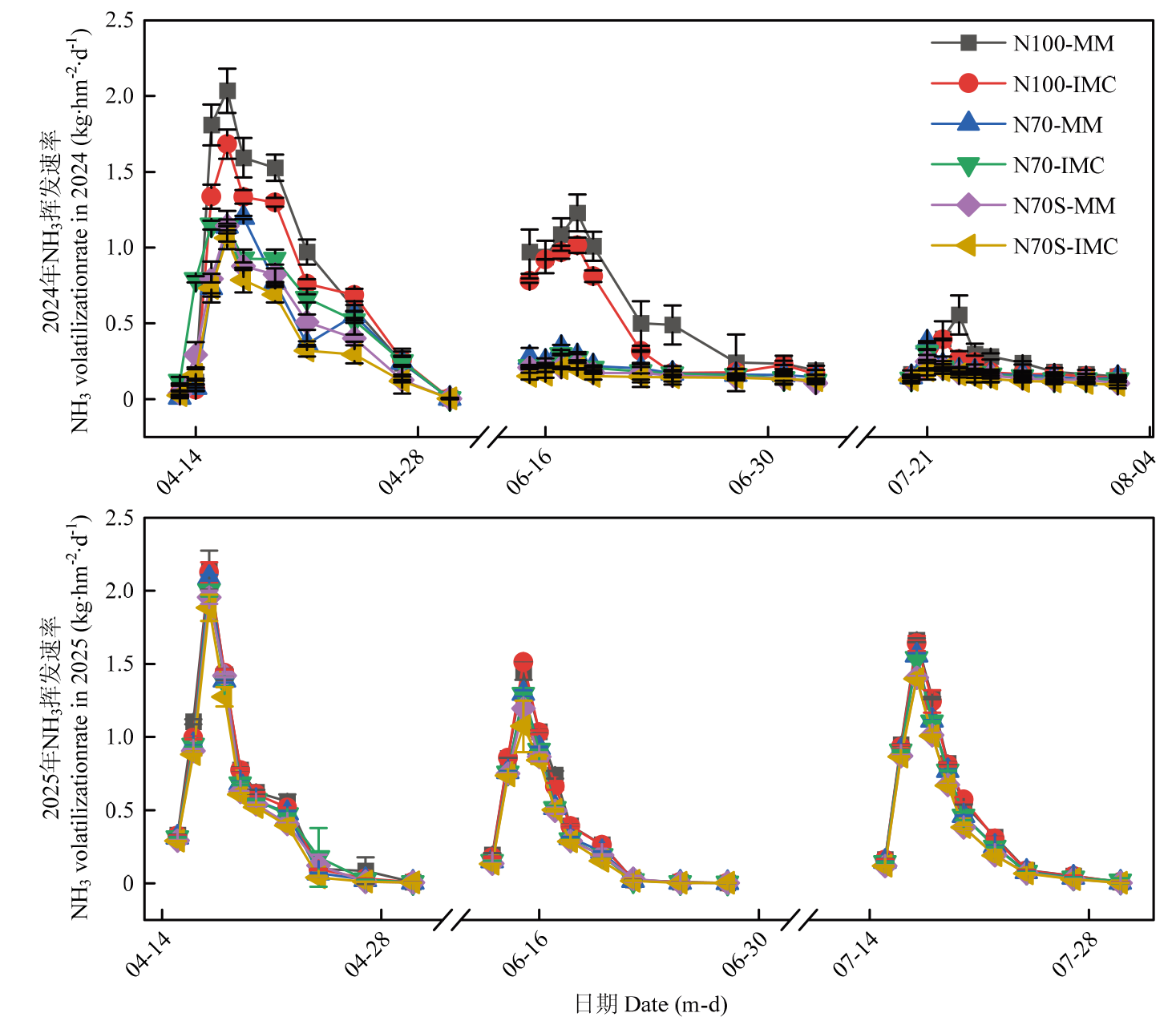
图5
不同处理NH3 挥发速率"
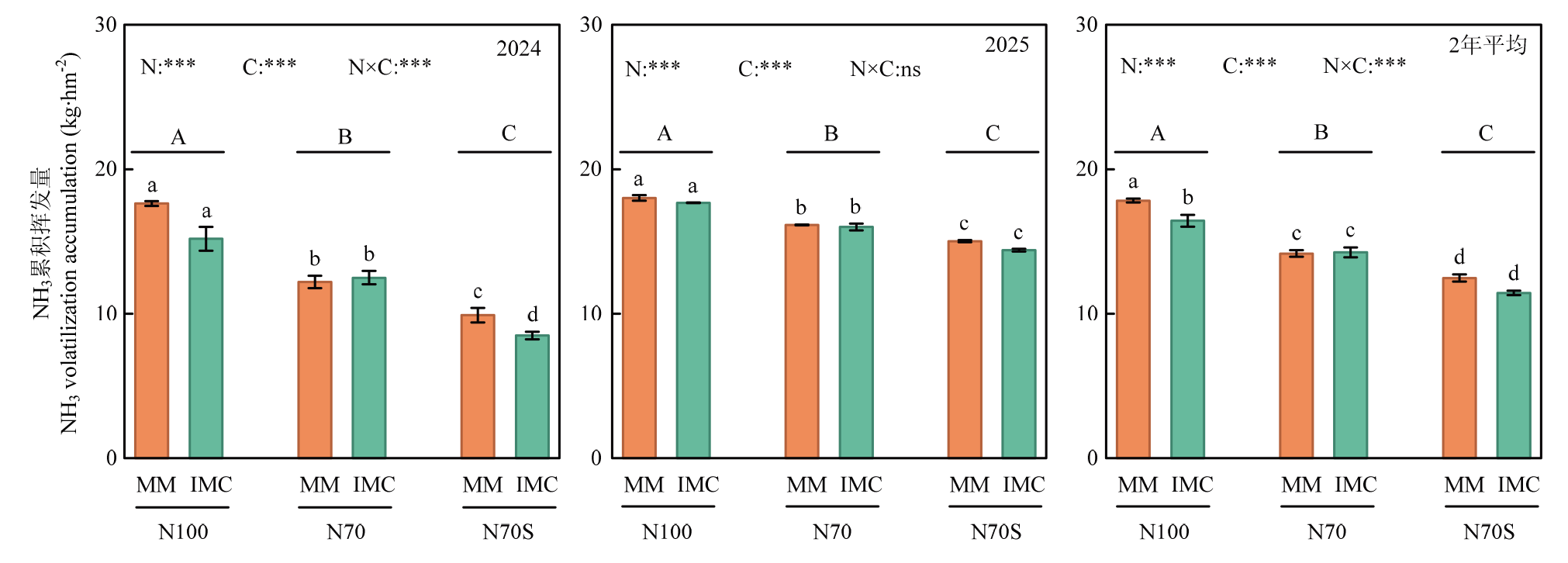
图6
不同处理NH3累积挥发量"
表2
不同处理中土壤理化性状(2024-2025年)"
| 年份 Year | 施氮制度 Fertilization system | 种植模式 Cropping pattern | pH | 有机质 SOM (g·kg-1) | 全氮 TN (g·kg-1) | 有效磷 AP (mg·kg-1) | 速效钾 AK (mg·kg-1) | 铵态氮 NH4+-N (mg·kg-1) | 硝态氮 NO3--N (mg·kg-1) | 可溶性有机碳 DOC (mg·kg-1) | 可溶性有机氮 DON (mg·kg-1) | 微生物量碳 MBC (mg·kg-1) | 微生物量氮 MBN (mg·kg-1) | |||||||||||
|---|---|---|---|---|---|---|---|---|---|---|---|---|---|---|---|---|---|---|---|---|---|---|---|---|
| 2024 | N100 | MM | 8.33±0.01b | C | 24.9±0.7ab | A | 1.3±0.2c | B | 23.9±1.6a | A | 78.8±3.3a | A | 1.3±0.7b | A | 15.3±0.9b | A | 112.7±0.5b | A | 43.5±0.6b | A | 102.1±2.8c | B | 32.9±1.0b | A |
| IMC | 8.27±0.02c | 25.7±0.4a | 1.3±0.1b | 24.8±0.7a | 77.3±2.8a | 1.4±0.1a | 17.9±0.8a | 118.1±3.3a | 45.7±0.7a | 111.9±7.0b | 37.1±1.6a | |||||||||||||
| N70 | MM | 8.31±0.04bc | B | 24.2±0.2b | B | 1.3±0.1d | C | 20.0±0.4b | B | 74.7±4.6a | A | 0.9±0.1d | B | 10.5±0.4d | B | 97.1±1.3c | B | 38.7±0.7e | B | 90.2±0.4d | C | 26.1±0.7d | B | |
| IMC | 8.47±0.03a | 24.6±0.6ab | 1.3±0.1c | 21.3±1.6ab | 78.5±3.0a | 1.1±0.1c | 13.0±0.8c | 108.5±1.2b | 41.9±1.4c | 94.7±1.8d | 29.8±1.0c | |||||||||||||
| N70S | MM | 8.48±0.01a | A | 25.3±0.3ab | A | 1.4±0.1b | A | 22.5±3.2ab | A | 79.2±2.3a | A | 1.0±0.1d | B | 11.8±0.9cd | B | 101.4±1.6c | B | 39.6±0.8de | B | 109.2±3.4b | A | 28.1±0.7c | B | |
| IMC | 8.47±0.01a | 25.3±1.0ab | 1.4±0.1a | 23.8±2.1a | 75.7±1.0a | 1.1±0.1c | 14.8±0.5b | 108.1±5.2b | 40.6±0.4cd | 127.6±4.8a | 32.6±0.6b | |||||||||||||
| 双因素方差分析 Two-way analysis of variance | ||||||||||||||||||||||||
| N | 78.478*** | 4.425* | 72.058*** | 6.51* | 0.365 | 33.977*** | 68.65*** | 38.142*** | 77.560*** | 40.365*** | 159.084*** | |||||||||||||
| C | 6.648* | 1.645 | 27.333*** | 1.807 | 0.073 | 19.374*** | 61.437*** | 38.519*** | 26.094*** | 38.371*** | 81.562*** | |||||||||||||
| N×C | 35.836*** | 0.606 | 1.21 | 0.024 | 2.323 | 0.036 | 0.241 | 2.146 | 0.932 | 1.358 | 0.144 | |||||||||||||
| 2025 | N100 | MM | 8.45±0.01a | A | 23.8±0.7ab | A | 1.2±0.3a | A | 25.0±0.6a | A | 76.5±2.3a | A | 1.5±0.1ab | A | 16.6±0.9b | A | 95.7±0.5b | A | 38.8±0.5b | A | 106.9±2.8cd | B | 39.9±1.2b | A |
| IMC | 8.39±0.02a | 24.5±0.4a | 1.2±0.5a | 25.9±2.7a | 75.0±1.1a | 1.6±0.2a | 19.6±0.9a | 100.4±2.9a | 41.0±0.7a | 116.7±7.0b | 45.1±2.0a | |||||||||||||
| N70 | MM | 8.42±0.04a | A | 23.1±0.2b | B | 1.2±1.0a | A | 19.7±2.6b | B | 72.4±4.7a | A | 1.2±0.2bc | B | 11.5±0.5d | B | 82.1±1.1c | B | 34.1±0.7d | B | 105.0±0.4d | B | 31.5±0.8d | B | |
| IMC | 8.41±0.15a | 23.4±0.6ab | 1.2±0.3a | 22.3±1.6ab | 76.2±2.1a | 1.2±0.2c | 14.1±0.9c | 92.1±1.0b | 37.2±1.4b | 105.5±4.1d | 36.1±1.2c | |||||||||||||
| N70S | MM | 8.49±0.09a | A | 24.2±0.3ab | A | 1.2±0.3a | A | 23.5±1.1ab | A | 76.8±1.3a | A | 1.1±0.1c | B | 12.9±0.9cd | B | 85.8±1.4c | B | 35.0±0.8c | B | 113.9±3.4b | A | 34.0±0.8c | B | |
| IMC | 8.44±0.03a | 24.2±1.0ab | 1.3±0.1a | 24.8±1.0a | 73.3±0.8a | 1.3±0.1bc | 16.2±0.6b | 91.7±4.5b | 36.0±0.4c | 132.4±4.8a | 39.5±0.7b | |||||||||||||
| 双因素方差分析 Two-way analysis of variance | ||||||||||||||||||||||||
| N | 0.001 | 6.6455* | 0.618 | 13.165** | 0.659 | 16.019*** | 128.874*** | 65.884*** | 79.260*** | 7.125* | 138.274*** | |||||||||||||
| C | 2.053 | 1.548 | 1.082 | 1.816 | 0.67 | 3.561 | 56.548*** | 29.397*** | 22.436*** | 30.166*** | 78.611*** | |||||||||||||
| N×C | 0.251 | 0.339 | 0.07 | 0.515 | 2.205 | 0.715 | 0.115 | 3.908 | 0.283 | 3.623 | 0.384 | |||||||||||||
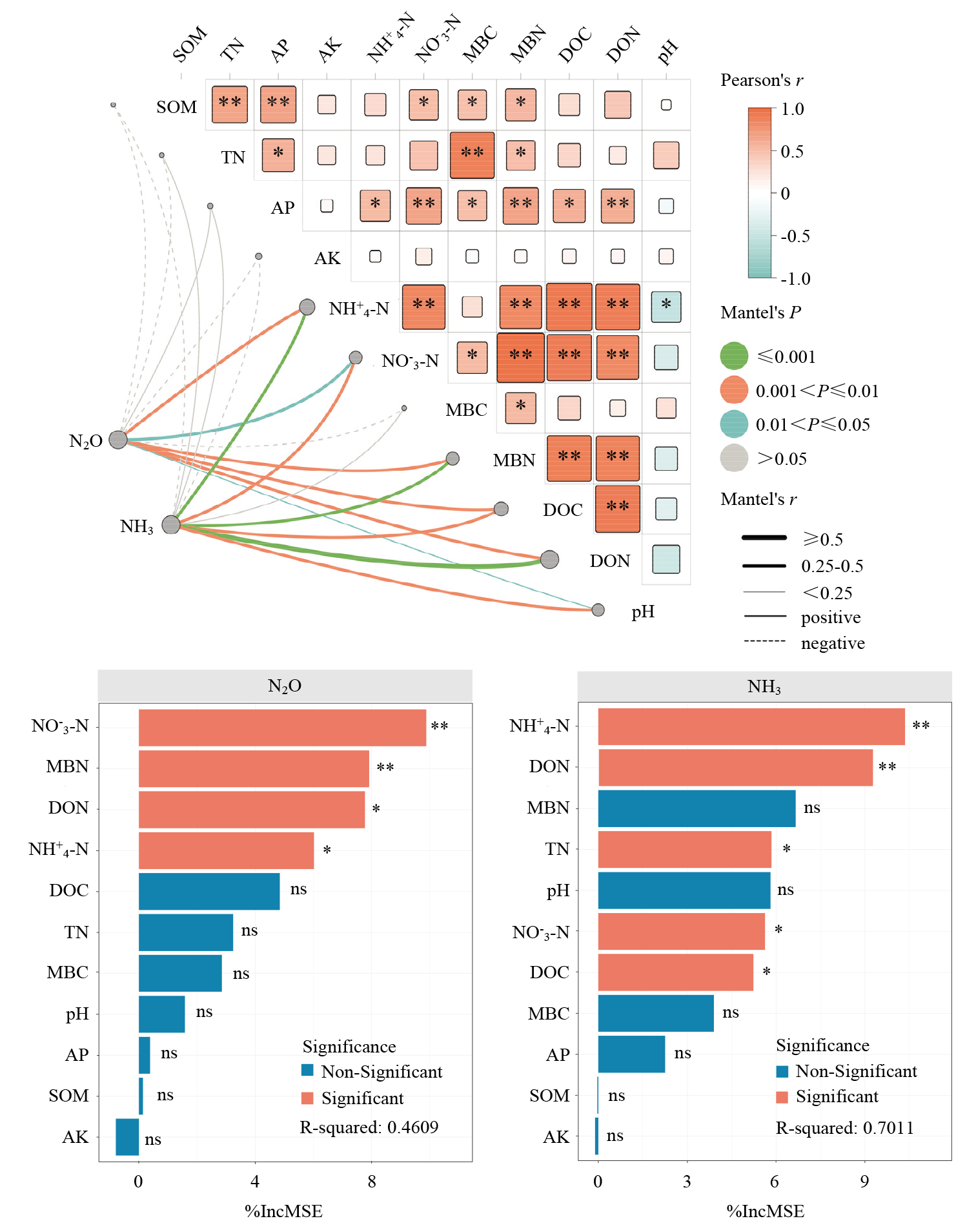
图7
N2O排放量、NH3挥发量与土壤环境因子之间的Mantel分析和随机森林模型 土壤养分为两年平均值,N2O和NH3是两年平均累积排放量。SOM:有机质;TN:全氮;AP:有效磷;AK:有效钾;MBC:微生物量碳;MBN:微生物量氮;DOC:可溶性有机碳;DON:可溶性有机氮"
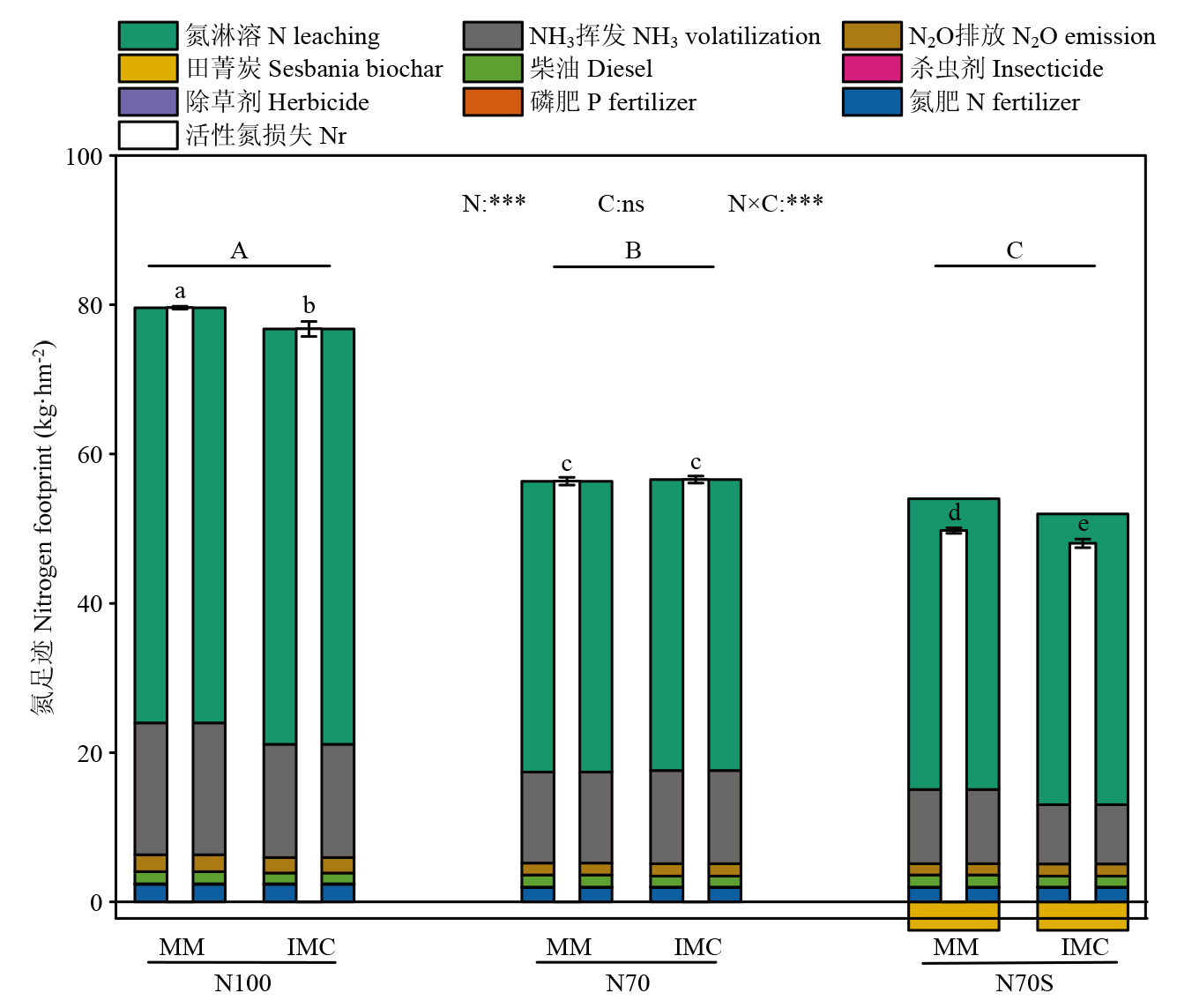
图8
不同处理中氮足迹(2024—2025年平均值)"
| [1] |
doi: 10.1038/s41561-024-01542-x |
| [2] |
习斌, 翟丽梅, 刘申, 刘宏斌, 杨波, 任天志. 有机无机肥配施对玉米产量及土壤氮磷淋溶的影响[J]. 植物营养与肥料学报, 2015, 21(2): 326-335.
|
|
|
|
| [3] |
李欠欠, 李雨繁, 高强, 李世清, 陈新平, 张福锁, 刘学军. 传统和优化施氮对春玉米产量、氨挥发及氮平衡的影响[J]. 植物营养与肥料学报, 2015, 21(3): 571-579.
|
|
|
|
| [4] |
doi: 10.1016/j.fcr.2025.109821 |
| [5] |
doi: 10.1016/j.jclepro.2024.142672 |
| [6] |
doi: 10.1016/j.jenvman.2023.119033 |
| [7] |
|
| [8] |
李含婷. 间作绿肥及减氮对玉米氮素高效利用的微生物机制[D]. 兰州: 甘肃农业大学, 2023.
|
|
|
|
| [9] |
doi: 10.1016/j.agee.2023.108444 |
| [10] |
doi: 10.1016/j.resconrec.2023.107025 |
| [11] |
doi: 10.1016/j.cj.2024.07.004 |
| [12] |
李越, 樊志龙, 张刁亮, 董勇杰, 彭建辰, 胡发龙, 殷文, 柴强. 生物炭和间作鲜食豌豆对氮肥减量下玉米产量的促进效应[J]. 干旱地区农业研究, 2024, 42(4): 178-188.
|
|
|
|
| [13] |
doi: 10.1016/j.agee.2023.108366 |
| [14] |
doi: 10.1007/s13593-025-01033-2 |
| [15] |
doi: 10.1016/j.agee.2024.108989 |
| [16] |
doi: 10.1016/j.eja.2024.127237 |
| [17] |
doi: 10.1016/j.scitotenv.2023.166279 |
| [18] |
赵秋, 赵鑫, 张新建, 宁晓光, 曹卫东, 常单娜, 吴迪. 控释氮肥结合减氮对冬绿肥夏玉米轮作体系土壤氧化亚氮排放的影响[J]. 植物营养与肥料学报, 2025, 31(8): 1542-1551.
|
|
|
|
| [19] |
doi: 10.1016/S2095-3119(21)63674-2 |
| [20] |
乔远, 杨欢, 雒金麟, 汪思娴, 梁蓝月, 陈新平, 张务帅. 西北地区玉米生产投入及生态环境风险评价[J]. 中国农业科学, 2022, 55(5): 962-976. DOI: 10.3864/j.issn.0578-1752.2022.05.010.
|
|
|
|
| [21] |
刘洋, 栗岩峰, 李久生, 严海军. 东北半湿润区膜下滴灌对农田水热和玉米产量的影响[J]. 农业机械学报, 2015, 46(10): 93-104, 135.
|
|
|
|
| [22] |
高洪军, 朱平, 彭畅, 张秀芝, 李强, 张卫建. 等氮条件下长期有机无机配施对春玉米的氮素吸收利用和土壤无机氮的影响[J]. 植物营养与肥料学报, 2015, 21(2): 318-325.
|
|
|
|
| [23] |
陈津赛, 王广帅, 张莹莹, 高阳, 刘坤. 玉米大豆间作对农田土壤N2O排放的影响[J]. 灌溉排水学报, 2020, 39(9): 32-40.
|
|
|
|
| [24] |
doi: 10.1016/j.scitotenv.2025.179502 |
| [25] |
谢勇, 荣湘民, 张玉平, 何欣, 石敦杰, 刘强. 控释氮肥减量施用对春玉米土壤N2O排放和氨挥发的影响[J]. 农业环境科学学报, 2016, 35(3): 596-603.
|
|
|
|
| [26] |
doi: 10.1016/j.jenvman.2023.117676 |
| [27] |
鲍士旦. 土壤农化分析[M]. 3版. 北京: 中国农业出版社, 2000.
|
|
|
|
| [28] |
刘夏璐, 王洪涛, 陈建, 何琴, 张浩, 姜睿, 陈雪雪, 侯萍. 中国生命周期参考数据库的建立方法与基础模型[J]. 环境科学学报, 2010, 30(10): 2136-2144.
|
|
|
|
| [29] |
doi: 10.1016/0038-0717(87)90052-6 |
| [30] |
doi: 10.1016/j.scitotenv.2023.163578 |
| [31] |
廖启元, 李粤丰, 詹慧秀, 童成立, 方贤滔, 王聪, 吴金水, 沈健林. 生物炭配施硝化/脲酶抑制剂及秸秆覆盖对红壤茶园氮磷淋失影响[J]. 水土保持学报, 2025, 39(5): 116-127.
|
|
|
|
| [32] |
陈中督, 徐春春, 纪龙, 方福平. 长江中游地区稻麦生产系统碳足迹及氮足迹综合评价[J]. 植物营养与肥料学报, 2019, 25(7): 1125-1133.
|
|
|
|
| [33] |
秦树平, 胡春胜, 张玉铭, 王玉英, 董文旭, 李晓欣. 氮足迹研究进展[J]. 中国生态农业学报, 2011, 19(2): 462-467.
|
|
doi: 10.3724/SP.J.1011.2011.00462 |
|
| [34] |
doi: 10.1016/j.agee.2023.108880 |
| [35] |
doi: 10.1038/s41893-021-00767-7 |
| [36] |
doi: 10.1016/j.fcr.2023.108854 |
| [37] |
doi: 10.1016/j.agwat.2024.108786 |
| [38] |
doi: 10.1007/s42773-024-00336-z |
| [39] |
白芳芳, 乔冬梅, 李平, 杜臻杰, 陆红飞, 郭魏, 齐学斌. 减氮对麦玉轮作农田土壤反硝化细菌群落结构和多样性的影响[J]. 农业环境科学学报, 2024, 43(6): 1338-1349.
|
|
|
|
| [40] |
doi: 10.1016/j.fcr.2024.109715 |
| [41] |
董成, 陈智勇, 谢迎新, 张阳阳, 缑培欣, 杨家蘅, 马冬云, 王晨阳, 郭天财. 生物炭连续施用对农田土壤氮转化微生物及N2O排放的影响[J]. 中国农业科学, 2020, 53(19): 4024-4034. DOI: 10.3864/j.issn.0578-1752.2020.19.015.
|
|
|
|
| [42] |
范靖尉, 白晋华, 任寰宇, 韩雪, 刁田田, 郭李萍. 减氮和施生物炭对华北夏玉米-冬小麦田土壤CO2和N2O排放的影响[J]. 中国农业气象, 2016, 37(2): 121-130.
|
|
|
|
| [43] |
王翰琨, 吴永波, 刘俊萍, 薛建辉. 生物炭对土壤氮循环及其功能微生物的影响研究进展[J]. 生态与农村环境学报, 2022, 38(6): 689-701.
|
|
|
|
| [44] |
郭儆瑜, 金文, 刘志涛, 程照瑞, 赵文青, 孟亚利. 秸秆与生物炭对棉田碱性土壤NH3挥发与N2O排放的影响[J]. 农业环境科学学报, 2024, 43(2): 442-451.
|
|
|
|
| [45] |
刘玉学, 刘微, 吴伟祥, 钟哲科, 陈英旭. 土壤生物质炭环境行为与环境效应[J]. 应用生态学报, 2009, 20(4): 977-982.
|
|
|
|
| [46] |
樊志龙, 柴强, 曹卫东, 于爱忠, 赵财, 谢军红, 殷文, 胡发龙. 绿肥在我国旱地农业生态系统中的服务功能及其应用[J]. 应用生态学报, 2020, 31(4): 1389-1402.
doi: 10.13287/j.1001-9332.202004.023 |
|
|
|
| [47] |
秦文利, 张静, 肖广敏, 崔素倩, 叶建勋, 智健飞, 张立锋, 谢楠, 冯伟, 刘振宇, 潘璇, 代云霞, 刘忠宽. 绿肥部分替代化肥氮对土壤物理性状的影响[J]. 草业学报, 2025, 34(6): 27-45.
doi: 10.11686/cyxb2024399 |
|
|
|
| [48] |
刘蕊, 常单娜, 周国朋, 高嵩涓, 柴强, 曹卫东. 农田氧化亚氮减排技术及其与绿肥协同应用分析[J]. 草业学报, 2025, 34(2): 196-210.
doi: 10.11686/cyxb2024111 |
|
|
|
| [49] |
胡立煌, 史文竹, 项剑, 王艮梅, 张焕朝. 生物炭、秸秆和粪肥对滨海盐碱土氮矿化和硝化作用的影响[J]. 生态与农村环境学报, 2020, 36(8): 1089-1096.
|
|
|
| [1] | 蔡巧红, 周甜, 苏明, 洪自强, 李翻过, 李彤, 汪华, 康建宏, 吴宏亮. 宁夏引黄灌区减氮增钾施肥模式对玉米光合荧光特性及光合产物积累的影响[J]. 中国农业科学, 2026, 59(9): 1869-1886. |
| [2] | 王志高, 李刘滨, 许颖, 鞠澄辉, 何荣. 基于图像处理的玉米破损比例检测方法及其品质变化同步分析[J]. 中国农业科学, 2026, 59(9): 1987-2001. |
| [3] | 陈宣伊, 郭星星, 张向前, 路战远, 刘凌悦, 罗方, 李金龙, 张传玲, 张志青, 车曼青. 间作行比对玉米冠层光环境异质性和光合物质生产的影响[J]. 中国农业科学, 2026, 59(8): 1653-1671. |
| [4] | 侯慧芝, 尹嘉德, 马明生, 刘晓伟, 柳燕兰, 雷康宁. 耕作与增施有机肥对陇东马铃薯-玉米一年两熟制作物产量和水分利用的影响[J]. 中国农业科学, 2026, 59(8): 1672-1685. |
| [5] | 赵思捷, 任家欣, 南江磊, 王兴云, 成卫宁. 玉米叶片次生物质含量及相关基因表达与其对草地贪夜蛾抗性的关系[J]. 中国农业科学, 2026, 59(8): 1686-1696. |
| [6] | 王亚菲, 闫鹏, 薛金涛, 董学瑞, 孟凡琦, 郭丽娜, 罗艺, 张娟, 董志强, 卢霖. 乙烯利-甜菜碱-水杨酸合剂对高温胁迫下玉米根系建构、生理功能和产量的影响[J]. 中国农业科学, 2026, 59(7): 1439-1455. |
| [7] | 王佳诺, 陈桂平, 李盼, 王丽萍, 南运有, 何蔚, 樊志龙, 胡发龙, 柴强, 殷文, 赵连豪. 免耕地膜两年覆盖提高绿洲灌区玉米产量的灌浆期光合生理机制[J]. 中国农业科学, 2026, 59(6): 1189-1202. |
| [8] | 周新杰, 任昊, 陈应龙, 张吉旺, 赵斌, 任佰朝, 刘鹏, 王洪章. 过氧化钙对渍涝农田夏玉米根系形态及产量形成的影响[J]. 中国农业科学, 2026, 59(6): 1203-1216. |
| [9] | 何继航, 张擎, 吕相月, 薛吉全, 徐淑兔, 刘建超. 不同保绿型玉米杂交种氮效率评价[J]. 中国农业科学, 2026, 59(6): 1217-1230. |
| [10] | 李永娟, 张悦彤, 王艺博, 赵长江, 宋洁, 陈雪丽, 姚钦. 生物炭施用对大豆轮连作系统土壤固氮微生物nifH基因丰度及群落组成的影响[J]. 中国农业科学, 2026, 59(6): 1272-1285. |
| [11] | 李思源, 李鸿萍, 常洪庆, 张森焱, 栗思佳, 崔欣飞, 乔泼, 曾波, 刘桂珍, 刘天学, 汤继华, 李潮海. 增密对不同株高玉米品种产量和农艺性状动态变化的影响[J]. 中国农业科学, 2026, 59(5): 967-984. |
| [12] | 董金龙, 赵莹, 余海兵, 吕建晔, 秦佳琦, 梁晨, 明博, 李少昆. 多模型解析玉米籽粒容重的营养品质贡献度与区域异质性[J]. 中国农业科学, 2026, 59(5): 985-995. |
| [13] | 陈桂平, 韦金贵, 郭瑶, 李盼, 王菲儿, 仇海龙, 冯福学, 殷文. 宽窄行与增密对绿洲灌区玉米光合特性及资源利用的协同效应[J]. 中国农业科学, 2026, 59(2): 278-291. |
| [14] | 张志勇, 谭世超, 熊淑萍, 马新明, 韦一昊, 王小纯. 水氮周年优化对豫北灌区小麦玉米轮作系统产量和氮迁移的影响[J]. 中国农业科学, 2026, 59(2): 336-353. |
| [15] | 曹凡, 唐瑶, 王孟玮, 张栋渊, 卫亚博, 吴爽, 朱万超, 徐淑兔, 张兴华, 薛吉全. 陕A群、陕B群选育玉米自交系及其杂交种种子活力评价及遗传解析[J]. 中国农业科学, 2026, 59(16): 3476-3495. |
|
||
